History of Jersey 83-93 Banner sm photo History of Jersey 83-93 Banner sm.jpg

Friday, December 27, 2013

1979-80 Los Angeles Kings Charlie Simmer Jersey

On this date in 1974, playing in the first game of his career, rookie Charlie Simmer of the California Golden Seals scored his first goal against the Boston Bruins. He later added an assist to cap off a 5-2 Seals win.

In total, Simmer would play 35 games that season with the Golden Seals, scoring 8 goals and 21 points. The next year Simmer again split time between the Seals (21 games, scoring just once) and their top minor league affiliate, the Salt Lake Golden Eagles (42 games, 23 goals and 39 points).

Simmer Seals photo SimmerSeals.jpg
Simmer while with the Golden Seals

For the 1976-77 season, Simmer again had a productive season for Salt Lake with 32 goals and 62 points in 51 games for the Eagles. He also saw action in 24 games with the parent club, only the Golden Seals had relocated to Ohio where they were now known as the Cleveland Barons.

His career took a new path of sorts when he was traded to the Los Angeles Kings in time for the 1977-78 season, but his return to California was a brief one, as he only played a mere 3 games with the Kings and spent the season with the Springfield Indians of the AHL, where he finished in the top ten in scoring and second in goals with 42.

Simmer played 37 games with the Kings in 1978-79, hitting the 20 goal mark for the first time with 21 after playing the first half of the season with Springfield. He also appeared in a pair of playoff games with the Kings, adding another goal to his total.

For the 1979-80 season, Simmer was now finally established as an NHL regular and on November 24th, he scored his 18th goal of the season with an assist from linemate Dave Taylor. The power play goal at 9:15 of the first period would be the start of one of the longest goal scoring streaks in NHL history.

He then reeled off goals against the Winnipeg Jets on the 27th, opened the scoring on December 1st versus the Chicago Blackhawks with his 20th goal of the season, a power play goal at 10:46 of the first period from Triple Crown Line teammates Taylor and Marcel Dionne before adding a second goal at 1:21 of the second.

Triple Crown Line photo TripleCrownLineKings.jpg
The Triple Crown Line of Taylor, Dionne and Simmer

The Atlanta Flames surrendered goal number 22 on December 4th before the streak reached five games on the 6th against the Philadelphia Flyers with another goal assisted by Taylor and Dionne.

The streak was barely prolonged when Simmer scored with less than a minute remaining in the game against the Quebec Nordiques on the 9th, his 25th goal of the season. Simmer had a four point night against the Hartford Whalers on December 12th, including a goal 8:22 into the second period.

The Vancouver Canucks were victimized by Simmer on December 15th before he stung the Toronto Maple Leafs for a pair on the 19th, both being power play goals with assists from Butch Goring and Doug Halward to push the streak into double digits at 10.

Goal #30 came on the 20th from the familiar Taylor and Dionne combo.

At home on December 22nd the Kings roared out to a 4-0 first period lead with Simmer assisting on goals by Taylor and later Dionne. The rout continued, along with Simmer's streak, when the deadly Triple Crown Line struck with goals by Simmer at 4:26 and again at 8:43 of the second period. The goal put Simmer into a tie with Cy Denneny of the Ottawa Senators, who had a 12 game goal scoring streak during the 1917-18 season.

Simmer Kings photo SimmerKings2.jpg

Finally, on this date in 1979, Simmer's goal scoring streak reached 13 consecutive games with an even strength goal at 18:43 of the second period, which was followed by his 34th goal of the season, and 17th of his streak with an even strength goal at 12:19 of the third from…Dionne and Taylor of course. By reaching 13 games, Simmer was now tied with Newsy Lalonde of the Montreal Canadiens, who performed the feat in the 1920-21 season.

Simmer was then held scoreless by the Minnesota North Stars, and Simmer's former Seals and Barons teammate, goaltender Gilles Meloche on December 29th, leaving Simmer in third place all-time, just one game back of Joe Malone (14 games in 1917-18) and Punch Broadbent (16 games in 1921-22).

Since the time of Simmer's streak, two other players have taken strong runs at his mark of 13, the Edmonton Oilers Dave Lumley in 1981-82, and the Pittsburgh Penguins Mario Lemieux (1992-93) but both came up short at 12, leaving Simmer with the longest streak in the NHL since 1921, a span of over 90 years.

Simmer would remain prolific for the remainder of the season and finish with 56 goals, tied for the league lead with two others. The following season of 1980-81, Simmer would again tally 56 goals, which would remain his career high.

 photo SimmerKings1.jpg

He would play four more seasons with Los Angeles before being dealt to Boston for three seasons. His career would conclude with one season with the Penguins, a year in Germany playing for the Frankfurt Lions in 1988-89 and 43 games with the San Diego Gulls of the IHL in 1990-91 and a single game with the Gulls in 1991-92 closing the book on his playing days.

Simmer would finish with 712 NHL games, 342 goals and 711 points. Additionally, he would win the Masterton Trophy in 1986.

Today's featured jersey is a 1979-80 Los Angeles Kings Charlie Simmer jersey as worn during his impressive goal scoring streak that season.

This was the second season the Kings wore names on the backs of this style road jersey, which was introduced back in 1967 with one color gold numbers. One season later they introduced a bolder font for the numbers, now outlined in white which remained in use for the remainder of the life of this style jersey through 1978-79, the year the names were first added.

 photo LosAngelesKings1979-80Fjersey.jpg
Los Angeles Kings 1979-80 jersey photo LosAngelesKings1979-80Bjersey.jpg

Today's video section begins with Simmer becoming a part of the Triple Crown Line and then scoring a goal during the Miracle on Manchester playoff game.


Next, Simmer recalls his career on the occasion of being honored on Legends Night at the Staples Center in early 2012.


Finally, just what were they thinking when they made this?


Thursday, December 26, 2013

2004 Team USA Zach Parise Jersey

Today kicks off the IIHF 2014 World Junior Hockey Championships in Malmö, Sweden where the 2010 champions from the United States will be looking to defend their title.

 photo 2014WJClogo-1.png

The World Juniors have become a much anticipated annual event, particularly in Canada, and anybody who's anybody has played in the tournament on their road to the NHL, dating back to Wayne Gretzky, Jari Kurri, Mario Lemeiux, Steve Yzerman, Alexander Mogilny, Sergei Fedorov, Jeremy Roenick, Mike Modano, Pavel Bure, Jaromir Jagr and Peter Forsberg through current NHL stars Jarome Iginla, Daniel and Henrik Sedin, Zach Parise, Ryan Getzlaf, Alexander Oveckin, Evgeni Malkin, Sidney Crosby, Johnathan Toews and Patrick Kane, making it a must-see event each year.

Crosby Ovechkin 2005 WJC photo CrosbyOvechkin2005WJC.jpg
Future NHL stars Sidney Crosby and Alexander Ovechkin
meeting in the 2005 World Juniors

The ten teams in this year's edition are divided into two groups of five and each team will play the other four teams in it's group once each in the Preliminary Round, with the top four advancing to the Playoff Round. With so few games determining each team's fate, no one can afford to take a night off as each and every game is critical to each team's chances.

For the unfortunate two clubs who finish in the bottom two of their groups, they will be paired in the best-of-three Relegation Round with the loser demoted to the Division I Group A level for 2015 and will need to earn their way back up to the Top Division, which can only be achieved by winning a championship in Division I Group A. This relegation format ensures that nearly every game matters in the World Juniors and the games that determine which clubs stay up can be very exciting affairs when two countries are battling with survival on the line. We strongly encourage those in attendance take in the Relegation Round, as spirited games in the much more homey secondary arena can provide some terrific competition in a small town or collegiate atmosphere that differs greatly from the environment more polished main rink and is a recommended part of the World Junior Tournament experience.

Once in the Playoff Round, the four advancing teams will be paired in the quarterfinal games which will take place on January 2nd, with the winners advancing to the semifinals on January 4th. The semifinal losers will meet for the bronze medal on January 5th with the winners meeting for the gold medal later that evening.

For 2014, Group A consists of the United States, Canada, the Czech Republic, Germany and Slovakia.

Group B sees Russia, Sweden, Finland, Switzerland and underdogs Norway.

In Group A, the Americans and Canadians are favored to advance along with the Czech Republic while Germany and Slovakia will be battling it out for the final playoff spot, with all teams looking to avoid giving away points, or worse, being upset by either Slovakia or Germany.

For the Slovaks and Germans to avoid the Relegation Round the key will clearly be to defeat the other during their key meeting on December 27th and then steal a point whenever they can by getting to overtime against the other three teams, if not pulling off an outright upset along the way.

Group B is more clear cut, as Russia, Sweden, Finland and Switzerland are expected to advance with as many points as possible for the most favorable semifinal matchup.

Poor Norway will be in for a rough go and will most certainly be hoping one of the four teams ranked above them will be having a down year and that they can manage to take enough points in the Preliminary Round to avoid the relegation fight entirely, or their tournament will come down to the best-of-three battle with the Group A relegation representative.

Canada put together a dominant run of five consecutive titles from 2005 to 2009, but their program is a victim of it's own success in breeding top quality players, as tournament eligible players often cannot take part due to having found gainful employment in the NHL.

Still, 19 of the 22 Canadian players are already have been draft picks in the NHL. with Scott Laughton, Matt Pelech and Matt Dumba already having NHL experience. Despite the distance to Sweden, the Canadians will feel right at home playing in front of many red-clad supporters who annually make the trip to the World Juniors and waving the Maple Leaf each time they take to the ice.

The host United States has three players returning from the team that won gold last year. Captain Riley Barber, goaltender Jon Gilles and winger Ryan Hartman all are back in an attempt to capture a second consecutive gold, while 21 of the 23 members of the roster are NHL draft picks.

The tournament begins with four games today, with Germany taking on Canada and Norway facing Russia in the early games followed by the United States beginning their schedule against the Czech Republic while Switzerland faces off against the host Swedes in the evening games.

Fans in attendance in Malmö will have the luxury of being able to attend any game they choose since the two arenas are located a mere 2 miles apart, unlike some other years when the two host arenas have been several hours drive between them. The Malmö Arena is the main venue, with a capacity of 15,500 with the Malmö Isstadion as the secondary rink, with a capacity of 5,140.

Malm photo Malmo-Arena.jpg
Malmö Arena

With the large number of games compressed into such a small schedule, the second arena can often find itself hosting some terrific matchups. This year, with Group B being held entirely in the larger Malmö Arena due to the presence of host Sweden, the Isstadion will host such matchups as the United States vs. the Czech Republic today, Canada vs. the Czechs on the 28th, and the highlight game of the group, the United States facing rival Canada in the group's final game on New Year's Eve. We highly recommend taking in one game at the secondary arena during the Preliminary Round each year when possible.

In the United States, the NHL Network will be airing all of the Preliminary Round games for Group A, which therefore includes all games for both the United States and Canada, as well as the three remaining Group A games which do not involve the North American rivals.

Once the Playoff Round begins, all eight playoff games on January 2nd, 4th and 5th will be aired through the gold medal final.

For viewers in Canada, TSN will be airing all of the Group A games as well as eight out of the ten Group B games prior to their coverage of the eight Playoff Round contests through the gold medal game on January 5th.

In a nice bit of traditional scheduling, the tournament always takes off New Year's Day between the Preliminary Round and the commencement of the playoffs, avoiding any conflict with the now annual NHL Winter Classic.

Today's featured jersey is a 2004 United States National Team Zach Parise jersey from the first American team to ever capture a gold medal at the World Junior Tournament, which took place in Helsinki, Finland. The United States won their group by defeating Austria, Slovakia, Sweden and Russia before defeating Finland and then Canada in the final to claim the championship.

Parise led the US with five goals and 11 points on his way to being named the Most Valuable Player of the tournament.

This style of jersey was first used by the United States at the 2002 Olympics in Salt Lake City and remained in use through the 2005 World Junior Tournament.

2004 USA F jersey
2004 USA B jersey

Here are extended highlights from the 2004 World Juniors when the United States captured the gold medal thanks to an errant clearing attempt by Canadian goaltender Marc-Andre Fleury.


This next highlights are the gold medal final from 2013 when the United States defeated Sweden 3-1.

Wednesday, December 25, 2013

Merry Hockey Christmas! Joyeux Hockey Noël!

Merry Hockey Christmas! Joyeux Hockey Noël!

We hope Santa was good to you this year and brought you the jersey you've been wanting.

We also hope you enjoy our special video collection today.

Don't forget - as our countdown clock in the right hand column shows - tomorrow the World Junior tournament begins, the annual festival hockey featuring "Tomorrow's Stars Today"!

And now...

On to the videos!


Again, Merry Christmas and Happy Holidays, and for those of you who do not celebrate Christmas, Happy Festivus!

Tuesday, December 24, 2013

1927-28 Ottawa Senators Harry "Punch" Broadbent Jersey

Born on July 13, 1892, Harry "Punch" Broadbent, after playing four seasons for various teams in the Ottawa city league, began his professional career with his hometown Ottawa Senators for the 1912-13 season when the Senators were members of the National Hockey Association, the forerunner to the NHL. Broadbent averaged more than a goal per game with 20 as well as being credited with a pair of assists for a total of 22 points from 18 games, good for seventh in the league as a rookie.

 photo BroadbentSenators1911.jpg
Young rookie Harry Broadbent in the short-lived Senators vertically striped sweater

The following season he was limited by injuries to 17 games of Ottawa's 20 games, scoring 6 goals and 13 points, but rebounded in 1914-15 with 24 goals and 27 points while playing in all of the Senators' 20 games, which placed him fourth overall in NHA scoring. The Senators would go on to win the league playoffs and advance to the Stanley Cup Finals against the Pacific Coast Hockey Association's Vancouver Millionaires, where Broadbent would score 3 of the Senators 8 goals in their 3 game series.

 photo BroadbentSenators1914-15.jpg
Broadbent in the Senators 1914-15 flag crested jerseys

It would prove to be his last hockey for some time, as he would miss three seasons while serving in the Canadian military during World War I, for which he was awarded the Military Medal. By the time he returned to the Senators, they were now members of the fledgling National Hockey League for it's second ever season, which at the time consisted of a mere three clubs, Ottawa, the Montreal Canadiens and the Toronto Arenas!

Broadbent eased back into hockey with only 4 goals in just 8 games and added 2 more in 5 playoff games. He returned to form in 1919-20 with 19 goals and 23 points in 20 games to finish in the top ten in NHL scoring. The Senators advanced to the Stanley Cup Finals by winning both halves of the split NHL season and captured the first Stanley Cup championship of Broadbent's career.

Broadbent Senators photo BroadbentSenators.jpg

The 1920-21 season was all but lost, as Broadbent's rights were dealt to the Hamilton Tigers, but he refused to report. After six days his rights were then sold to the Canadiens, but again he would not budge. Finally, seven weeks later, Broadbent's rights were transferred back to the Senators by the NHL. Eventually, he would play in just 9 regular season games and 6 playoff games as the Senators would defeat the Millionaires for their second consecutive Stanley Cup.

On this date in 1921, just three games into the 1921-22 season, Broadbent scored his second goal of the season in a 10-0 win over the Canadiens, as well as racking up three assists, all of which came in a span of 3:15 of the third period.

He scored the game winning goal on Dec. 28th in overtime to defeat the Canadiens again, only this time in Montreal. His fourth goal of the season helped Ottawa defeat Hamilton on New Year's Eve. He tallied another goal to open the scoring in a 3-2 loss to the Toronto St. Patricks on January 4th. Three days later he found the back of the net twice to defeat the Canadiens yet again, nudging his goal total to 7 and kicking his scoring pace into a higher gear.

Two goals and two assists followed on January 11th in a 7-2 defeat over Toronto before Broadbent added another pair of goals to close out the scoring in a 5-2 win in the return match against the St. Patricks in Toronto three days later. Montreal was on the receiving end of another beating, this one 10-6, as Broadbent registered a hat trick by the time the game was 23 minutes old. The spotlight was not all his though, as teammate Cy Denneny also had a hat trick while Sprague Cleghorn and Odie Cleghorn combined for 6 goals, with Odie netting 4 to take top honors in a losing effort.

A second hat trick followed on January 21, which included extended his scoring streak just 2:45 into the game, which was won by Hamilton 7-6 in overtime, who were led by Joe Malone's hat trick.

Broadbent's goal scoring streak reached ten games in Ottawa on January 25th when he scored twice in the first 2:30 of the third period in a 4-2 win over the Tigers. Goal #20 arrived on January 28th at the 12:00 mark of the second period, followed exactly two minutes later by goal #21 as the Senators held on to defeat Toronto 2-1, meaning Broadbent was a perfect eight for eight in scoring in Senators games in January.

The streak continued into February with another pair of goals against Montreal, a 4-2 win for Ottawa. While the Senators pounded Hamilton 10-6 on February 4th, Broadbent continued his goal scoring streak, extending his streak to 13 games and Ottawa's lead to 6-0 at the time, but his run of multiple goal games ended at eight and included 18 goals during that span dating back to January 7th.

While the Tigers exacted their revenge on the Senators with a 9-1 thrashing of the Senators, Broadbent's streak continued as he registered his 25th goal of the season just after the game's midway point.

The streak then reached 15 games at the 11:45 mark of the second period in a 4-4 tie at home against the St. Patricks. Broadbent's streak was pushed to 16 games with a pair of goals in another tie, this one 6-6 versus the Canadiens in Montreal.

Finally on February 18th, 1922, goaltender Howard Lockhart and the Tigers ended the longest goal scoring streak in league history, a record which still stands today, over 90 years later. During the 16 game goal scoring streak, Broadbent tallied 27 goals, an average of nearly 1.7 per game, a streak which included two hat tricks and nine multiple goal games.

Broadbent would follow being held off the scoresheet with three goals in his next two games to pass the 30 goal mark and finish the season with a staggering 32 goals and 46 points in 24 games to win the NHL scoring title by 7 points over teammate Denneny.

Broadbent would spend two more seasons in Ottawa, including winning another Stanley Cup in 1923, his third in four seasons, before being sold to the Montreal Maroons, along with goaltender Clint Benedict, just prior to the 1924-25 season. He would play for the Maroons for three seasons, which included winning his fourth Stanley Cup in 1926.

Broadbent Maroons 1924-25 photo BroadbentMaroons1924-25.jpg
Broadbent during his first season with the Maroons

For the 1927-28 season, Broadbent was dealt back to the Senators, but his return lasted only a single season that resulted in just 3 goals and 5 points in 43 games. Ottawa then sold Broadbent, now 36 years old, to the New York Americans for his final NHL season of 1928-29.

 photo BroadbentSensChampsJersey.jpg
Broadbent during his return season with the Senators

He would finish his career with 122 goals and 167 points in 302 games, four Stanley Cups. one NHL scoring title and one goal scoring record which has now stood for over 90 years and counting.

Broadbent was elected to the Hockey Hall of Fame in 1962.

Broadbent autograph photo Broadbentautograph.png

Today's featured jersey is a 1927-28 Ottawa Senators Harry "Punch" Broadbent jersey from his final season in Ottawa. This sweater has the Stanley Cup Champions patch worn on the upper left chest to commemorate the Senators final Stanley Cup title in franchise history, a frequent practice of the Senators in the 1920's, as they also wore championship patches in 1921-22 and 1923-24. This patch was the inspiration for the sleeve patches on the current Senators alternate jerseys.

Ottawa Senators Jersey photo OttawaSenators27-28jersey.png

Bonus jersey: Today's bonus jersey is a 1928-29 New York Americans Punch Broadbent jersey. This sweater is from Broadbent's final season in the NHL. The Americans wore their star spangled sweaters from their inaugural season of 1925-26 (pre-dating the New York Rangers by one season) through the 1937-38 season. The franchise would last through the 1941-42 season before folding, leaving the NHL with just six teams for the next 25 years.

New York Americans 1928-29 jersey photo NewYorkAmericans1928-29Fjersey.jpg
New York Americans 1928-29 jersey photo NewYorkAmericans1928-29Bjersey.jpg

Monday, December 23, 2013

1979-80 Boston Bruins Terry O'Reilly Jersey

On this date in 1979, the Boston Bruins had just completed a 4-3 victory over the New York Rangers at Madison Square Garden in New York and were in the process of heading off to the locker room to celebrate and begin a brief Christmas break in the schedule on a winning note. Some of the players had actually made their way off the ice while a scrum formed in the left corner of the rink between some of the Bruins and Rangers players after the Ranges goaltender John Davidson skated the length of the ice to confront the Bruins' Al Secord and John Wensink. Davidson was in a foul mood, having given up three third period goals and was unhappy with Secord for the sucker punch he hit Swede Ulf Nilsson with after the game ended among other things.

The rest of the Rangers players entered the area seeing Davidson confronting Secord and the Rangers Frank "Never" Beaton eventually began to confront Secord which moved the scrum over towards the stands. Once by the glass, the Bruins Stan Jonathan got hit in the face - not by a Ranger player, but by a Ranger fan who had reached over the then much lower glass used back then and clouted Jonathan with a rolled up program, drawing blood from under Jonathan's eye.

Jonathan was later quoted as saying he raised his stick to protect himself, only to have the fan rip the stick put of Jonathan's hands!

"He just reached over the glass and whacked me with it," Jonathan said. "I put my stick up to protect myself, and he just took it, and I can't be hitting no fan with a stick, really, eh, so I just let him take it."

Perhaps the "gentlemanly" Jonathan wasn't actually trying to whack the belligerent fan with his stick as some reported, but either way, it was now in possession of the fan which caused the Bruins Terry O'Reilly to become possessed.

With the fuse now lit, O'Reilly set off the explosion when he immediately scaled the boards and launched himself into the stands and began to wrestle with the attacking fan.

O'Reilly into stands
O'Reilly hurtles over the glass, setting off chaos in the stands

"I went into the stands because somebody, who had no right to, punched Stanley," said O'Reilly. "It's none of the fans' business. We don't interfere with them if they leave us alone. When I got in there it was pretty bad. I regret it, but I don't think I had a choice. There was no way he was going to strike one of my teammates and steal his stick, wield it like a weapon and then disappear into the crowd and go to a local bar with a souvenir and a great story. A soon as I got him into a bearhug, I felt like I was being pummeled by multiple people. All I could do was cover up."

Seeing O'Reilly enter the stands, where he was going to obviously be heavily outnumbered, several other Bruins didn't hesitate when the brother of the fan O'Reilly had gone after started hitting O'Reilly and the Bruins poured over the glass into the seats.

Bruins into stands

Brad McCrimmon, Bob Miller, Wensink and Secord all scaled the glass while Peter McNab, who was not known as a thug in any way, having totaled just four penalty minutes the previous season, went after the brother of the fan who had clearly been hitting O'Reilly and threw him down onto the seats.

"Peter was usually the guy who'd pick up our gloves for us after a fight," Jonathan said.

While Craig McTavish held back another fan from joining in McNab's confrontation, most of the Bruins actually showed a level of restraint by not throwing punches. The ugliest part of the incident, separate from O'Reilly entering the stands in the first place, was when Mike Milbury ripped a shoe off of the fan McNab had pinned, who Milbury claimed had kicked him while flailing under McNab, and hit him with it before it was pulled out of his hand before he could get in a second shot.

Mike Milbury in stands
Milbury in the eye of the storm

Milbury was already off the ice when the fight in the stands broke out. "I went from happy and content, and ready to go home for Christmas, to full combat mode in about 20 seconds," he recalled.

The entire confrontation lasted roughly 40 seconds from the time O'Reilly started to scale the glass and Milbury was calmed down. He later added to the fan's indignity by throwing his shoe onto the ice.

"Things could have been a lot worse. I give the security people a lot of credit," said Milbury. "Everyone was very fortunate that there weren't any serious injuries."

During the entire affair the Rangers' players stood on the ice and watched the episode unfolding in the seats. Four fans were charged with disorderly conduct with the charges eventually being dropped. O'Reilly was suspended for eight games, while McNab and Milbury each had to sit out six games. All 18 of the Bruins who entered the stands were fined the princely sum of $500 each.

Here is an interview with Milbury 29 years after he entered the stands in Madison Square Garden to join the melee from WEEI radio.


Today's featured jersey is a 1979-80 Boston Bruins Terry O'Reilly jersey as worn during the infamous brawl when O'Reilly entered the stands at Madison Square Garden in New York to confront a fan who hit Bruins teammate Stan Jonathan.

O'Reilly would spend his entire 14 year NHL career with the Boston and was the Bruins captain for the final two seasons of his career. Although widely regarded as a tough guy who had over 200 penalty minutes in five consecutive seasons, unlike today's fighting specialists, O'Reilly was a more complete player who scored over 20 goals four times with a high of 29 in 1977-78 when he totaled 90 points to go with his 211 penalty minutes that season. His number 24 was retired by the Bruins in 2002.

Boston Bruins O'Reilly 79-80 F
Boston Bruins O'Reilly 79-80 B

Bonus Jersey: Today's bonus jersey is a 1979-80 Boston Bruins Mike Milbury jersey, as worn while he was caught on video beating a Rangers fan with his own shoe during his part in the Bruins invasion of the stands in New York.

Milbury was a 12 year member of the Bruins defensive corps and racked up 149 minutes or more in penalty minutes seven times, including over 200 twice. He followed his playing career by becoming head coach for the Bruins for two years and later the New York Islanders as well as their general manager. He is now known of his outspoken and opinionated television and radio commentary work.

Boston Bruins Milbury 79-80 F
Boston Bruins Milbury 79-80 B

Here is the live broadcast of the end of the game, followed by Davidson confronting the Bruins and the subsequent escalation as O'Reilly enters the stands.


This interview is with the Rangers' Phil Esposito in the aftermath, discussing his desire for higher glass to prevent any repeats of the incident.


In this interview, Milbury recounts his involvement in the fracas. It's very similar to the one linked to above, but we felt worth posting.


Sunday, December 22, 2013

Greatest Use of the Goal Cam Ever

Followers of our Twitter feed or our Facebook page will recall that we recently discovered that Third String Goalie was the 4,511,544th most visited website in the world and we speculated that perhaps more nudity was the answer to increasing our page views.
We here at Third String Goalie strive to maintain a certain level of professionalism by avoiding profanity as well as poor grammar and spelling errors (as much as possible).

Additionally, we also have no plans to stoop to the level of outright nudity in search of hits, but in a blatant effort to increase our web traffic and draw some attention to our corner of the web, we simply must share The Greatest Use of the Goal Cam Ever.


Saturday, December 21, 2013

Hockey Solstice

While today might be the shortest day of the year, it ushers in some of the longest days of hockey viewing over the next two months.

winter_solstice photo winter_solstice.jpg

The hockey kicks off on December 26th in Sweden with the start of the 2014 World Junior Championships in Malmö, Sweden, where ten countries face off in the annual holiday season tournament which runs through January 5th's Gold Medal Final.

2014 WJC logo photo 2014WJClogo.png

The teams are divided into two groups, with Group A stacked with the defending gold medal champions the United States, Canada, the Czech Republic, Slovakia and Germany, with the key matchup looking to be the US vs. Canada on New Year's Eve.

 photo 2013WJCUSAGold.jpg
The United States will be looking to win it's second consecutive gold medal

Group B looks no easier with the hosts Sweden having to face Russia, Switzerland, Finland and Norway. Key games in the group are Sweden vs. rival Finland on Dec. 28th and and Sweden vs. Russia also on Dec. 31st.

Viewers in the United States can watch 18 games on the NHL Network, including all the Group A games, covering all the United States and Canada preliminary round games, as well as all 8 playoff round contests.

When the World Juniors takes a break on New Year's Day prior to the start of the Quarterfinals, the NHL steps into the void with the sixth Winter Classic, this year featuring the delayed game between the Detroit Red Wings (making their second Winter Classic appearance) taking on Original 6 rivals the Toronto Maple Leafs, the first Canadian team to play in the Winter Classic.

2014 Winter Classic logo photo 2014_Winter_Classic.png

The game will be held at Michigan Stadium and is expected to set a new world record for attendance at a hockey game, as "The Big House" is the current world record holder at a certified 104.173 when the University of Michigan Wolverines faced off against rivals the Michigan State Spartans in December of 2010. Attendance at that game was actually announced at 113,411 and the stadium has held as many as 115,109 for football, so you can be certain the NHL will meticulously document each person through the turnstiles.

Big Chill Big House photo BigChillBigHouse.jpg

The festivities for the Winter Classic actually began back on December 15th with many youth games taking place from the 18th to the 26th on the rink at Comerica Park (home of the Detroit Tigers), but the big spectator events will start on Friday, December 27th with the Great Lake Invitational (GLI) college hockey tournament when Michigan State (Big Ten) faces off against the Michigan Tech Huskies (WCHA) followed by the Western Michigan Broncos (NCHC) taking on Michigan (Big Ten) with the losers meeting the following afternoon before the championship game on Saturday evening.

Sunday sees the Windsor Spitfires (from just across the river in Canada) playing the Saginaw Spirit followed by the London Knights and the Plymouth Whalers finishing off the Ontario Hockey League doubleheader. The American Hockey League takes center stage on Monday when the Toronto Marlies square off against the Grand Rapids Griffins.

The NHL takes over on Tuesday, December 31st with the highly anticipated pair of alumni games between veteran Red Wings and Maple Leafs, which should be a virtual Hockey Hall of Fame on ice.

After the NCAA, OHL, AHL and NHL Alumni finish up at Comerica Park on the 31st, the action switches to The Big House on New Years Day for the Winter Classic itself in Ann Arbor.

Once the Winter Classic concludes, things return to normal for three weeks until the NHL Stadium series begins with the highly anticipated January 25th game between the Anaheim Ducks and the Los Angeles Kings at Dodger Stadium in sunny California. That game will be followed immediately by the New York Rangers and New Jersey Devils playing the first of two games at Yankee Stadium on January 26th, followed by the Rangers facing off against the New York Islanders on January 29th.

2014 NHL Stadium Series logo photo 2014_Stadium_Series.png

A week later, the 2014 Winter Olympics get under way in Sochi, Russia on February 8th when the women's tournament begins, followed by the start of the men's competition on the 12th with the first two of 30 games, concluding on Sunday, February 23rd with the Gold Medal Game with the women having concluded on the 20th.

Sochi Olympic logo photo sochi-2014-logo-1.jpg

The men's competition is divided into three groups, with Group A being Russia, Slovenia, Slovakia and the United States, Group B consisting of Austria, Canada, Finland and Norway while Group C has the Czech Republic, Latvia, Switzerland and Sweden battling it out.

Canada 2010 gold photo Canada2010gold.jpg
Canada celebrates their gold on home ice in 2010

Six days later it this incredible run of 67 days of hockey concludes with the final game of the NHL Stadium Series when the Chicago Black Hawks host the Pittsburgh Penguins at Soldier Field in Chicago followed the very next day with the 2014 Heritage Classic when the Ottawa Senators travel to take on the Vancouver Canucks in what may very well be the best dressed game of the entire stretch of games, as the Senators will wear a white version of their amazing heritage alternate jersey while the Canucks will reprise their Vancouver Millionaires throwbacks from last season, although the red vs. blue Winter Classic between Detroit and Toronto is also going to look great, if not slightly unusual without a white home jersey in action.

Speaking of jerseys, decisions must be made by collectors, as each of the six NHL outdoor games will feature special one-off jerseys (as many as 11 in all since the Rangers will play twice and depending on what the New Jersey Devils decide to wear) and the Olympics see an entirely new lineup of jerseys from Nike, many of which are some of the most bold and controversial seen in a long time - another two dozen to pick from, although Nike has a history of only releasing the colored road jersey for many of the lower ranked teams at the retail level, and those they do sell are often in short supply. Those who remember 2010 will recall that after the games started, several countries jerseys were already a challenge to acquire, so shop early to avoid disappointment.

Friday, December 20, 2013

1982-83 Winnipeg Jets Doug Smail Jersey

On this date in 1981, the Winnipeg Jets faced off against the St. Louis Blues. Just after the opening face-off and before the fans could even settle into their seats, Winnipeg's Doug Smail scored just five seconds into the game to set a new NHL record for the fastest goal at the start of a game to break the eight year old record of six seconds set in 1973 by Henry Boucha of the Detroit Red Wings against the Montreal Canadiens.

Doug Smail, Doug Smail

Boucha's record was equalled by the Pittsburgh Penguins Jean Pronovost in 1976, also against the Blues.

Paul McLean added to the Jets lead two minutes later, but the Blues came back with three consecutive goals by the half way point of the game to overcome the early Jets lead. As the third period began, the Jets reasserted themselves with three goals of their own within the first 11 minutes of the third period on scores by Bengt Lundholm, Smail again and Willy Lindstrom.

When Perry Turnbull added a meaningless goal with 9 seconds remaining in the game, Smail also then received credit for the game winning goal to go along with his new record.

Bryan Trottier of the New York Islanders later equalled Smail's record on March 22, 1984 in a 3-3 draw against the Boston Bruins.

Trottier Islanders, Trottier Islanders
Bryan Trottier

Buffalo's Alexander Mogilny joined the group on ten years and a day after Smail's goal when he intercepted a cross ice passing attempt by Michel Petit, skated in and fired a shot past goalie Jeff Reese to begin a 4-1 Sabres victory over the Toronto Maple Leafs.

Mogilny Sabres, Mogilny Sabres
Alexander Mogilny

Smail played at the University of North Dakota, which included winning an NCAA championship in 1980 and earning tournament MVP honors. The ultra quick winger played 13 NHL seasons, ten of those with the Winnipeg Jets before a trade to the Minnesota North Stars for one season. He would also play single seasons with the Quebec Nordiques and Ottawa Senators before finishing out his career with three year stint in Great Britain.

Smail Jets, Smail Jets
Doug Smail

His NHL high of 66 points came in 1984-85 with his only 30 goal season, with 31 goals, and a career high 35 assists. He was primarily a penalty killer and defensive forward in the high flying 1980's. He did have three additional 20 goal seasons for the Jets, but never reached even 50 points in the NHL again. Of note however, was his first season with the Fife Flyers in Great Britain, where in 53 games, and free of his NHL defensive responsibilities, Smail cut loose with 74 goals and 139 points! Oddly, he also racked up 114 penalty minutes, nearly three times his NHL average of 46, which came in a considerably longer 80 game season.

Today's featured jersey is a 1982-83 Winnipeg Jets Doug Smail jersey. To celebrate their move to the NHL from the WHA, the Jets took the opportunity to revamp their jerseys, introducing an entirely new (to them) style which featured full length sleeve striping, a pattern formerly used by the New York Rangers while under the control of general manager John Ferguson, who now held the reins in Winnipeg. One unique feature of the jersey was the extremely thin font used for the names on the back. This style would serve the Jets well through 11 seasons until 1989-90.

Winnipeg Jets 82-83 jersey, Winnipeg Jets 82-83 jersey

Sadly, we were unable to locate video of Smail's goal but were able to find a clip of Trottier's rapid goal.


Recently Alexander Radulov of Salavat Yulaev Ufa took a run at Smail's record when he set the Russian and Kontinental Hockey League record at six seconds, besting Andrei Pchelykaov's Russian Super League goal at seven seconds.


Thursday, December 19, 2013

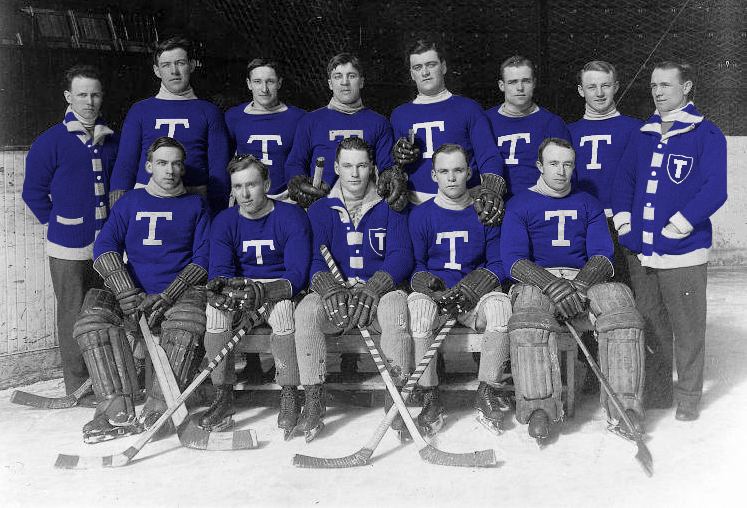
1917-18 Toronto Blueshirts Hap Holmes Jersey

It was on this date in 1917 that the first games of the National Hockey League were played. The league was formed for one basic reason - for the owners to rid themselves of fellow team owner Eddie Livingstone!

Livingstone was the owner of the Toronto Shamrocks of the National Hockey Association (NHA) and had a contentious relationship with his fellow owners, primarily Sam Lichtenhein of the Montreal Wanderers, with whom he often butted heads with. At one point, Lichtenhein even offered Livingstone $3,000 to abandon his team and walk away, but the cheeky Livingstone countered with a $5,000 offer for Lichtenhein to do the same!

Prior to the 1915-16 season, Livingstone purchased the Toronto Blueshirts, giving him both Toronto NHA franchises - and an unwelcome two votes in league matters. When Frank Patrick and Lester Patrick, owners of the Pacific Coast Hockey League (PCHA) Seattle Metropolitans raided the Blueshirts roster, Livingstone transferred Shamrocks players to the Blueshirts. The league seized the Shamrocks franchise from Livingstone, as had been demanded by the league only a week earlier, not wanting one owner with whom they did not get along with having two votes, when there was now nothing left for Livingstone to sell since the club had no players. It also angered the other owners that they were now a five team league, forcing one club to be idle each week and that road trips to Toronto would be for one game instead of the more economical two, as in the past.

In 1916-17, the 228th Battalion of the Canadian Army formed a team in the six team NHA, taking the place of the Shamrocks. Unfortunately, the 228th received their orders to head overseas to join the fighting in World War I and had to withdraw from the league during the season. This gave the other four owners of the Montreal Canadiens, Montreal Wanderers, Quebec Bulldogs and Ottawa Senators the opening they needed, and they held a meeting without Livingstone and voted to suspend his remaining Blueshirts franchise with the excuse of wanting to keep the league with an even number of teams.

228th Battallion Hockey Team photo 228thBattallionHockeyTeam.jpg
The 228th Battalion

Livingstone field suit against the league as a result. The Blueshirts home rink, the Arena Gardens, were then given three weeks to separate itself from Livingstone by the NHA or the other owners would operate without a club in Toronto and thus the arena would lose it's tennant. The feisty Livingstone of course refused to sell his club, and therefore, at their annual meeting in November, the NHA announced it was suspending league operations due to the difficulty of running a five team league, also blaming player shortages due to World War I.

 photo Mutual_Street_Arena_interior.jpg
The Blueshirts home rink, the Arena Gardens

A week later, all of the owners, minus Livingstone naturally, announced they had formed a brand new league, the National Hockey League (NHL), which consisted of the Montreal Canadiens, the Montreal Wanderers, the Ottawa Senators and the Quebec Bulldogs. The new league also claimed to have retained the contracts of the suspended Toronto Blueshirts players!

With the Quebec Bulldogs suspending operations due to financial difficulties before the new NHL could even begin the 1917-18 season, the Arena Gardens were awarded a temporary NHL franchise, managed by Charlie Querrie, to make the fledgling NHL a four team league once again and assigned the Blueshirts players on a lease basis to the temporary Toronto franchise. To further complicate matters, many of the players signed contracts with both Livingstone and the Arena.

The season, and the league, would kick off on this date in 1917 when the Ottawa Senators lost to the Montreal Canadiens 7-4 and Toronto lost to the Montreal Wanderers by a score of 10-9. The Canadiens would win the first half of the season to earn a spot in the postseason championship playoff, while the Wanderers would cease operations following the fire that burned down their home, the Montreal Arena.

The Toronto club had no official nickname, but the "Blueshirts" were successful on the ice, winning the second half of the season schedule and earned the right to play Montreal for the championship. Toronto was led by Reg Noble, who scored 30 goals and 10 assists in 20 games for 40 points, third overall in the league behind the prolific Joe Malone of the Canadiens who scored a spectacular 44 goals in just 20 games as part of his league leading point total. Corbett Denneny and Harry Cameron also were standouts for Toronto, with 29 and 27 points respectively, for fifth and sixth in league scoring. Toronto's Harry "Hap" Holmes came in second to Georges Vezina of Montreal in the goaltending department with a goals against average of 4.80 in 16 games.

Toronto defeated the Canadiens for the league championship in a two games, total goals series 10-7, capturing the O'Brien Cup. Toronto then faced off against the Vancouver Millionaires of the PCHA and won the Stanley Cup by 3 games to 2, causing Livingstone to again head to court to file suit for the revenue earned by "his" championship squad of players.


As a result of this lawsuit, the Arena Gardens formed a new company, the Toronto Arena Hockey Club Company, to own and run a hockey team, separate from the Arena Gardens business to protect the Arena business from Livingstone's lawsuits. The NHL then awarded a "new" franchise to the Hockey Club Company. This club was officially named the Toronto Arenas and, not surprisingly, was stocked with the same players from the 1918 championship club. When his players were once again not returned to him for the 1918-19 season, Livingstone sued the Arena Gardens.

Once again, the players were uncertain who would prevail in the courts, and covered their bases by signing contracts with both the Toronto Arena Hockey Club Company and Livingstone.

Livingstone did prevail in the courts sometimes, but not always. Two rulings in his favor of $20,000 and later $100,000 sent the Arena Gardens into bankruptcy. Despite the company's legal wranglings at the time, the arena would continue to operate for 77 years until closing in 1989.

When the Toronto Arenas did take to the ice in the 1918-19 season as Stanley Cup Champions, they did not play like it. Forced to sell most of their star players due to mounting legal bills, the Arenas record for the season was 5 wins and 13 losses, attendance was low and several players left the team. Finally, the team wrote to the league requesting that the season be ended when each of the three clubs had reached 18 games played and then officially withdrew from the league. This left only the Canadiens and Senators to play for the championship of the NHL and the right to meet the Pacific Coast Hockey Association champions for the Stanley Cup, which Montreal won 4 games to 1.

Meanwhile, Livingstone was busy was attempting to overthrow the NHA management, purchased the dormant Quebec Bulldogs franchise, and began an unsuccessful attempt to start a rival league, the Canadian Hockey Association and threatened to file an injunction to stop the NHL from operating. He also made unsuccessful attempts to start new leagues in 1920, 1924 and 1926, none of which ever played a single game.

Finally, the Toronto Arenas franchise was sold to the St. Patricks Hockey Club of Toronto, who ran the successful senior amateur St. Patricks team in the Ontario Hockey League, which included Arenas team manager Querrie in the four-man ownership group, in December of 1919.

The new owners renamed the club the Toronto St. Patricks and the $5,000 sale price was supposed to go to Livingstone to settle the purchase of his NHA club, for which he had once demanded $20,000 for after they had won the 1918 Stanley Cup. However, Livingstone never received the money, which many believe was kept by NHL president Frank Calder.

The Toronto St. Patricks were members of the NHL through the 1926-27 season, when Querrie, having been sued by none other than Livingstone, was forced to sell the St. Patricks. He reached an agreement to sell the club to Conn Smythe, who renamed the club the Toronto Maple Leafs and constructed Maple Leaf Gardens in 1931.

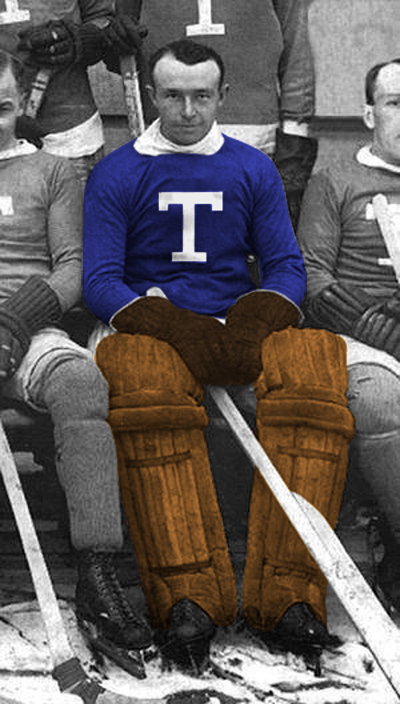
Today's featured jersey is a 1917-18 Toronto Blueshirts Hap Holmes jersey as worn during the inaugural season of the National Hockey League.

Holmes would win the Stanley Cup four different times, and with four different teams. He first joined Eddie Livingstone's Toronto Blueshirts of the NHA in 1912, winning the cup with them in 1914. He joined the Seattle Metropolitans of the PCHA in 1915 and won the cup with Seattle in 1917.

In his only season with the Toronto Blueshirts, he would win his third Stanley Cup before returning to Seattle the following season. After the Metropolitans folded four seasons later, Holmes would join the WCHL's Victoria Cougars in 1924 and go on to win his fourth Stanley Cup, the last cup won by a non-NHL team. After one more season in Victoria, the entire WCHL folded and the Victoria Cougars players were sold to the new Detroit NHL franchise, which took the name the Cougars as a tribute to the Victoria club before eventually becoming the Red Wings. Holmes would play his final two seasons in Detroit and conclude his career with 408 games played, 198 wins, 40 of which were shutouts, 192 losses and 14 ties.

Holmes was inducted into the Hockey Hall of Fame in 1972 and the American Hockey League award for the top goaltender each season is named the Hap Holmes Memorial Award.


hit counter for blogger