History of Jersey 83-93 Banner sm photo History of Jersey 83-93 Banner sm.jpg
Showing posts with label Colorado Avalanche. Show all posts

Tuesday, April 18, 2017

Valeri Kamensky - The First Russian Triple Gold Club Member

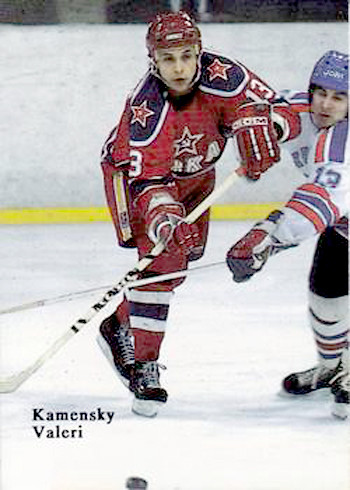
After beginning his career with three seasons with Khmik Voskresensk in the Soviet Championship League beginning with the 1982-83 season, Valeri Kamensky, like so many other top Soviet players, found himself drafted by the military and assigned duty as a hockey player for the dominant Central Sports Club of the Army, CSKA Moscow beginning with the 1985-86 season.

Kamensky Red Army 2
A young Kamensky with CSKA Moscow

During his first season with Red Army, Kamensky would immediately see his point total double from his best and final season with Khimik, as he scored 15 goals and 24 points in 40 games. Two seasons later he set a Soviet career highs with 26 goals and 46 points. Three seasons later he matched his 46 points from 20 goals and 26 assists. Kamensky's time with CSKA was the twilight of their incredible dynasty, and the club won the final four championships of their period of complete domination in 1986, 1987, 1988 and 1989. He was named the Soviet MVP following the 1990-91 season.
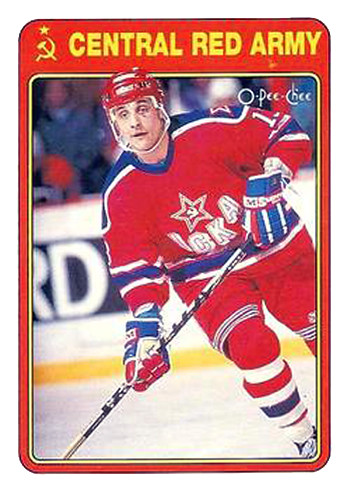
Kamensky Red Army
Kamensky was the Soviet MVP in 1991

Kamensky's final two seasons with Red Army saw the club begin to be depleted, as their players were now being allowed to leave the Soviet Union to play in the NHL. Having been drafted by the Quebec Nordiques back in 1988, he now made the jump to North America for the 1991-92 season.

His first two seasons with Quebec were limited to just 23 and 32 games, but his potential was on display as he averaged over a point per game in those 55 contests. Finally playing a full season in 1993-94, Kamensky scored 28 goals and 65 points in 76 games.
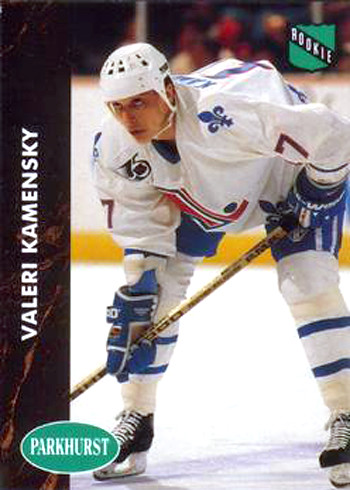
Kamensky rookie Nordiques
Kamensky wore #17 as an NHL rookie in 1991-92

With the start of the 1994-95 NHL season delayed due to labor issues, Kamensky played in a dozen games with HC Ambri-Piotta in the Swiss National League A, scoring 13 goals and 19 points. When the NHL season finally began, Kamensky returned to the Nordiques, where he scored 10 goals and was credited with 20 assists for 30 points in 40 games.
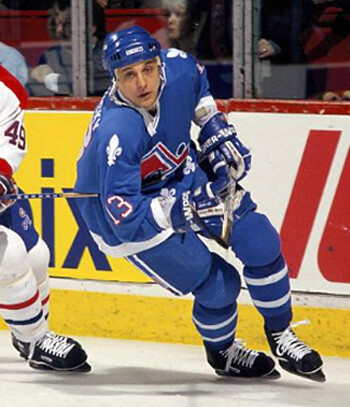
Kamensky Nordiques 3
After two seasons as #31, Kamensky finally got to wear his preferred #13 in 1994-95

The financial situation for the Nordiques was a dire one, having to do business in weaker Canadian dollars yet pay their players in American dollars while also having difficulties getting free agents to sign in French speaking Quebec City, which was also the smallest market in the NHL. All of this, plus their aging arena, Le Colisee, proved too much to overcome and the team was sold to new owners, who moved the team to Denver, where they were renamed the Colorado Avalanche.

Kamensky moved with the club to Denver and the change of scenery suited him well, as he had a career year with 38 goals and 47 assists for 85 points. Before the move, the Nordiques were a team on the rise, thanks to their many high draft picks due to how dismal the team and been for so long. With stars like Joe Sakic and Peter Forsberg and a solid supporting cast, things were looking bright for the Avalanche. That outlook grew even brighter two months into the season when, after a falling out with the Montreal Canadiens, Colorado was able to obtain the final key piece of the puzzle in goaltender Patrick Roy.

The team won the Pacific Division with the second most points in the regular season. In the playoffs, they defeated the Vancouver Canucks in six, eliminated the Chicago Blackhawks in six and advance to the Finals by beating the Detroit Red Wings in six. They then swept the overmatched Florida Panthers in four to win the 1996 Stanley Cup. Kamensky, after finishing third during the regular season behind only Sakic and Forsberg, was second in Avalanche playoff scoring with 10 goals and 12 assists for 22 points in 22 games played.
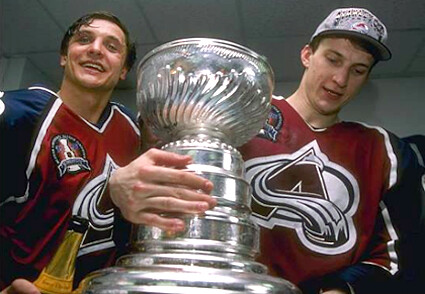
Kamensky Avalanche 5
Kamensky and Sandis Ozolinsh celebrate with the Stanley Cup

Kamensky equaled his second highest goal total in 1996-97 when he scored 28 for the second time on his was to 66 points, also the second highest of his career while playing in only 68 games. He had a fine playoff season that year with another 22 points, this time in 17 games. He matched his point total from the previous season with 66 again in 1997-98 from 26 goals and 40 assists. He would play one more season in Colorado in 1998-99 with 44 points in 65 games.
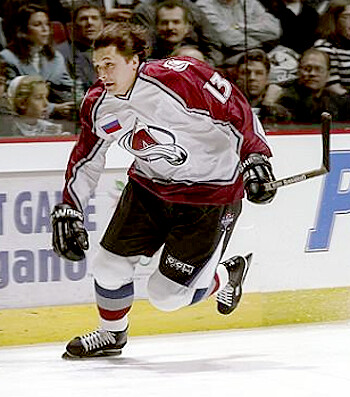
Kamensky Avalanche 4
Kamensky at the 1998 NHL All-Star SuperSkills Competition
Note the Russian flag patch on his right chest, worn only during the event

Despite the success he enjoyed with Colorado, Kamensky signed as a free agent with the New York Rangers for the 1999-00 season. Once again, his season was affected by injuries and he only played in 58 games for New York that season, which limited him to 13 goals and 32 points. His second season with the Rangers was a similar story, as Kamensky played in only 65 games with a similar scoreline of 14 goals and 34 points.
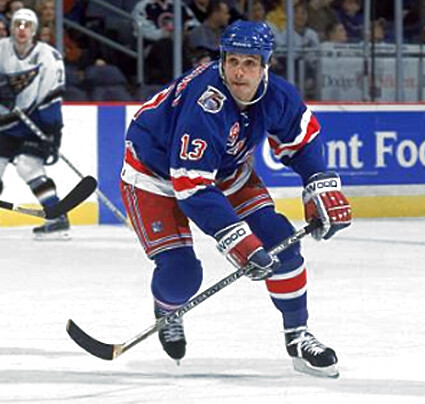
Kamensky Rangers 2
Kamensky played two seasons with the Rangers

For the 2001-02 season, Kamensky signed as a free agent with the Dallas Stars, but after just 24 games and only 9 points, he was traded to the New Jersey Devils in January where he played the final 30 games of his NHL career with 4 goals and 12 points.
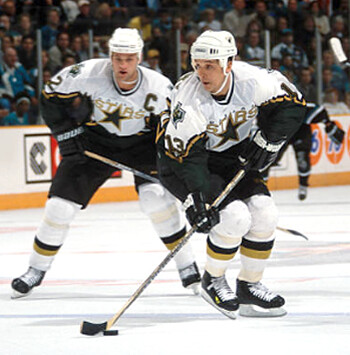
Kamensky Stars 1

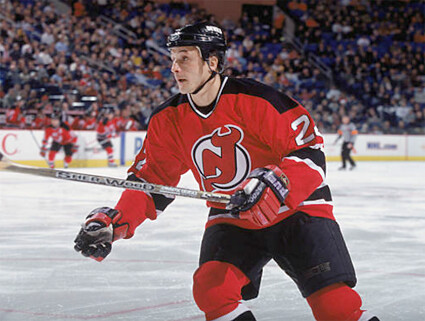
Kamensky Devils 1
Kamensky played for both Dallas and New Jersey in 2001-02

After not playing during the 2002-03 season, Kamensky took to the ice once again for Khimik Voskresensk in the Russian Superleague. He played in 23 games that first season, with 5 goals and 14 points. He was back with Khimik for the 2003-04 season, where he closed out his career with a fine season, scoring 17 goals and 36 points in 57 games before announcing his retirement.

His final NHL totals were 637 games played with exactly 200 goals and 301 assists for 501 points. Thanks to his two great playoff seasons with the Avalanche, he also had 25 goals and 60 points in his playoff career.

Internationally, Kamensky made annual appearances for the Soviet Union during his time with CSKA Moscow. He first played in the World Junior Championships in 1985, earning a bronze medal. He had a memorable 1986 winning gold at the World Juniors, scoring 7 goals and 13 points in 7 games, and gold again at his first World Championships at the senior level four months later as he turned 20 during the tournament.
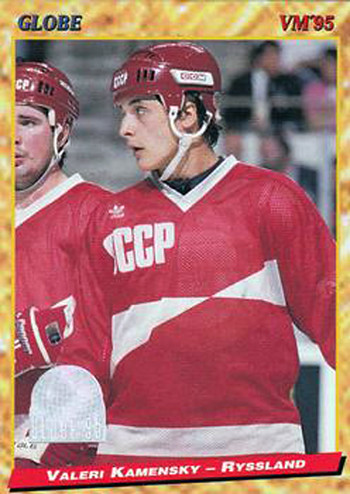
Kamensky Soviet Union 1
Kamensky wore the "double triangle" style early in his international career

Kamensky won silver at the 1987 Worlds and came in second at the 1987 Canada Cup later that fall. He won a gold medal at his first Olympics in 1988 in Calgary with 4 goals and 6 points in 8 games. His career for the Soviet Union concluded with gold medals at the 1989 and 1990 World Championships and a bronze in 1991.
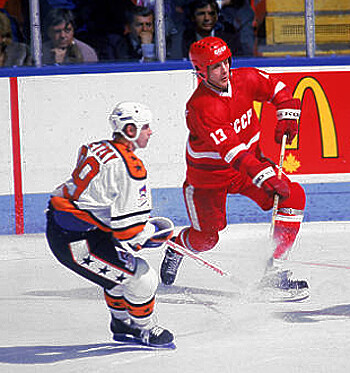
Kamensky Soviet Union 2
Kamensky was a member of the Soviet team at Rendez-vous '87,
the two game series held in place of the NHL All-Star Game

After the break up of the Soviet Union, he would not return to the international stage until the 1994 World Championships, where he suited up for Russia for the first time. He participated in his second Olympics in 1998 in Nagano, Japan, winning a silver medal. His international career concluded with the 2000 World Championships.
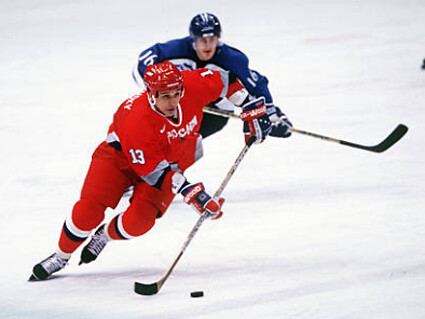
Kamensky Russia 1
Kamensky now playing for Russia at the 1998 Olympics

In all, Kamensky won five gold medals (1 World Junior, 3 World Championship and 1 Olympic), two silver, (1 at the Worlds and 1 Olympic) and two bronze (1 World Junior and 1 at the Worlds). His Stanley Cup championship in 1996 made him just the fourth member of the exclusive Triple Gold Club to go with his World Championship and Olympic gold medals. To date, only 27 men are members of the Triple Gold Club and just six from Russia. In recognition of his outstanding international hockey career, Kamensky was inducted into the IIHF Hall of Fame in 2016.

Today's first featured jersey is a 1990 Soviet Union Valeri Kamensky jersey as worn during the 1990 World Championships. Kamensky won his first World Championship gold medal in his first try in 1986 as a 20 year old, his first step on his way to becoming the first Russian to become a member of the Triple Gold Club. He would win additional gold medals with the Soviet Union in 1989 and 1990.

The Soviets wore this style from 1988 through the end of the Soviet Union in 1991 and beyond. This style was worn one last time at the 1992 Olympics when many of the former Soviet states competed as the Unified Team, only with the CCCP cresting removed from the jerseys.
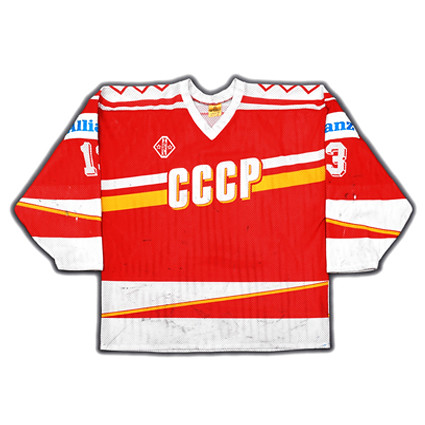
Soviet Union 1990 F jersey
Soviet Union 1990 B jersey

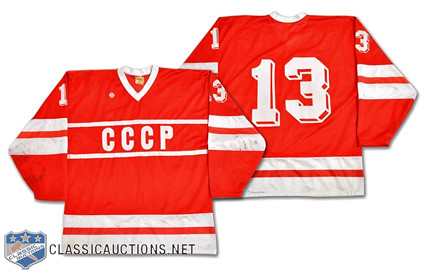
Today's second featured jersey is a 1988 Soviet Union Valeri Kamensky jersey as worn during the 1988 Olympics when Kamensky won a gold medal, his second step on the way to the Triple Gold Club. He would later win an Olympic silver medal with Russia in 1998.

This style of Tackla jersey was worn only during the 1988 Olympics, as evidenced by the tiny Tackla logo on the chest and the lack of colored shoulders. A similar style was worn during World and European Junior tournaments with contrasting colored shoulders adorned with the Tackla diamond logo from 1987 to 1989.

Soviet Union 1988 jersey
photo courtesy of Classic Auctions

Today's third featured jersey is a 1995-96 Colorado Avalanche Valeri Kamensky jersey as worn during the club's first season in Denver when they completed their Cinderella season by winning the Stanley Cup in their first year in their new home, a championship which made Kamensky the first Russian, along with teammate Alexei Gusarov, to become a member of the Triple Gold Club, which requires a World Championship gold medal, an Olympic gold medal and a Stanley Cup.
After their amazing first season in their new jerseys, they remain unchanged until the 2007-08 season when the new Reebok Edge jerseys signal the end of the Avalanche cup winning jerseys.
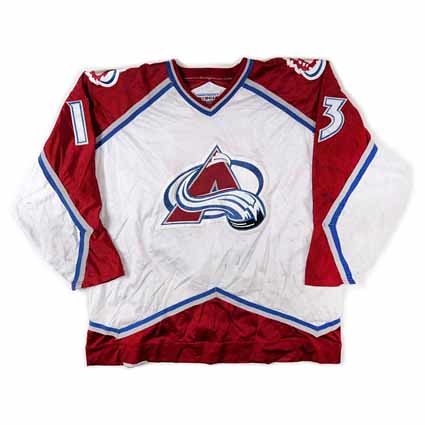
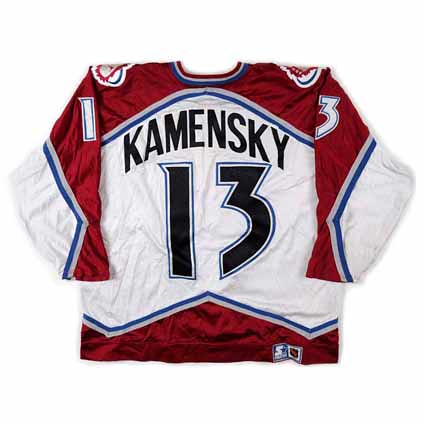
Colorado Avalanche 1995-96 F jersey
Colorado Avalanche 1995-96 B jersey

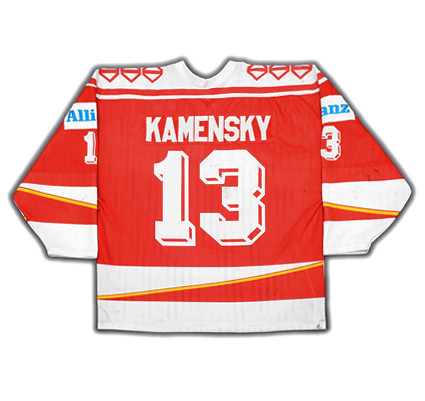
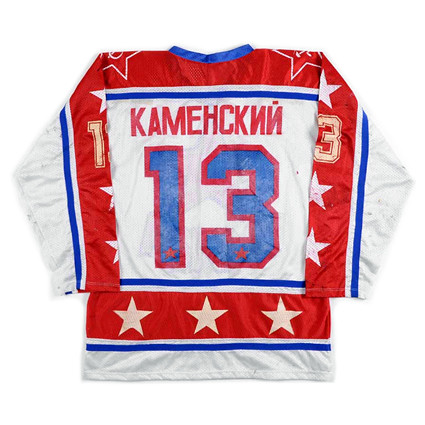
Bonus jersey: Today's bonus jersey is a 1988-89 Soviet Central Red Army Valeri Kamensky jersey as worn during the final season of CSKA's run of dominance over the Soviet Championship League when they won 13 consecutive Soviet championships from 1977 to 1989 and 13 European Champions Cups from 1978 to 1990 and the 1991 Spengler Cup.
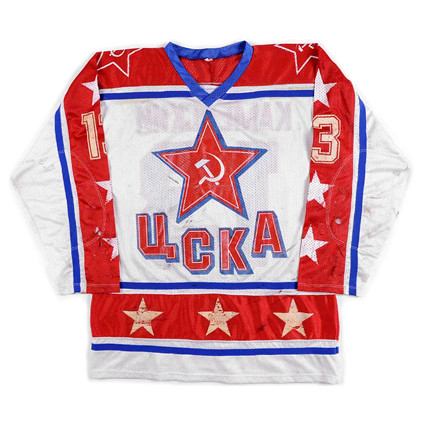
CSKA 1988-89 F jersey
CSKA 1988-89 B jersey

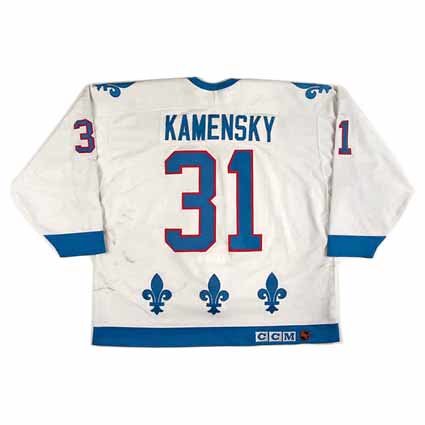
Extra bonus jersey: Today's extra bonus jersey is a 1992-93 Quebec Nordiques Valeri Kamensky jersey as worn during Kamensky's second season with the Nordiques when he wore #31.

During his first season with the club, Kamensky wore #17 as Mats Sundin was already wearing his preferred #13. In 1992-93, he changed to the reverse of #13, #31 as goaltender Stephane Fiset had changed from #31 worn the previous season to now #35. For 1994-95, Sundin had been traded to the Toronto Maple Leafs, finally freeing up #13 for Kamensky in his fourth season with the Nordiques.

Quebec wore this style dating back to 1975-76 when they were still members of the WHA. For the 1980-81 season they changed from a white version of their crest on the blue jerseys to the same red one worn on the home white jerseys. The final change came in 1991-92, Kamensky's first season in the NHL, when the one color numbers became two color, as they were now trimmed in red. They also became the last team to sew the names and numbers on their jerseys in tackle twill fabric, as up to that point they had been heat sealed numbers, which have shown to crack and peel with age, putting a premium on any game worn jersey worn before 1991-92 that has the names and numbers in good physical condition.

This jersey also features the Stanley Cup Centennial patch worn on all players jerseys for the 1992-93 season, with those worn by the Nordiques and Canadiens being a French variation, that read "Coupe Stanley" instead of the standard "Stanley Cup" worn by every other club.
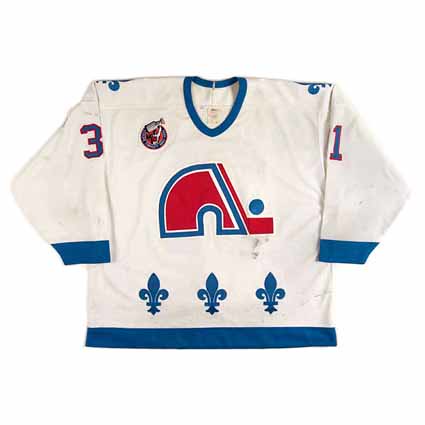
Quebec Nordiques 1992-93 F jersey
Quebec Nordiques 1992-93 B jersey

Today's video section is a terrific collection of highlights of Kamensky from both the Soviet Union and the NHL.


Next, Kamensky scores the first goal in Colorado Avalanche history.


Here's a little bit of insanity for you. The Soviet Union versus the United States at the 1990 World Championships with the commentary in Japanese. We kid you not.


In this next highlight, Kamensky scores a goal which must be seen to be believed.


Here, Kamensky shows that despite being a European, you don't want to mess with him in this very brief but worthwhile highlight.


If you don't watch any of the above videos, you have to see this one. We've seen still photos of this, but we were thrilled to find video of it. Kamensky gets into a fight with New Jersey's Scott Niedermayer and manages to wrap Niedermayer's head up in the sleeve of his Rangers jersey! Niedermayer's reaction to the absurd fight is also something you've never seen before in this awesome highlight.

Thursday, April 6, 2017

1983-84 Montreal Canadiens Claude Lemieux Jersey

Hate him or love him, Claude Lemieux is one of the most polarizing, yet accomplished players in NHL history.

His junior hockey resume begins with the Trois-Rivieres Draveurs of the Quebec Major Junior Hockey League for the 1982-83 season when Lemieux scored 28 goals and 66 points in 62 games while announcing his presence with 213 penalty minutes. Lemieux was then drafted 26th overall by the Montreal Canadiens during the 1983 NHL Entry Draft.

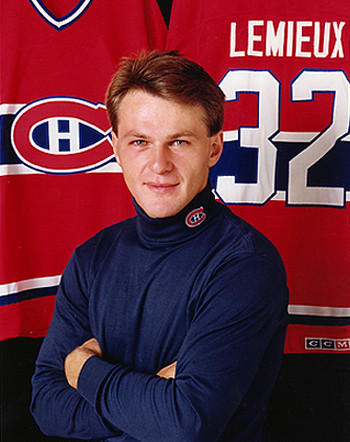
Lemieux Canadiens 1
Lemieux was drafted in 1983 by the Montreal Canadiens

He returned to junior hockey for the 1983-84 season, now with the Verdun Juniors. His rugged style of play was still in full effect, as he amassed 227 penalty minutes in 51 games played while raising his offensive game to a new level with 41 goals and 45 assists for 86 points, more than a point and a half per game. He also made his NHL debut with the Canadiens that season, seeing action in 8 games with a goal and an assist. He also appeared in two playoff games for the Nova Scotia Voyageurs of the American Hockey League after scoring 20 points in 9 playoff games for Verdun.

He returned to Verdun once more for the 1984-85 season, now as the team captain. He lit up the scoreboard with 58 goals and 66 assists for 124 points in 52 games and continued his torrid pace in the postseason with 23 goals and 40 points in just 14 playoff games, which earned him the Guy Lafleur Trophy as the QMJHL Playoff MVP.

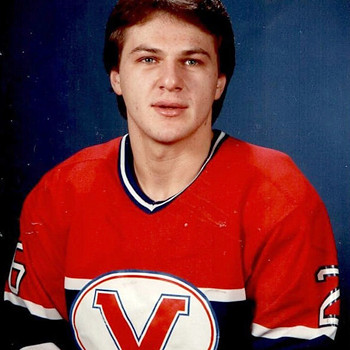
Lemieux Verdun
Lemieux was the playoff MVP for Verdun in 1985

That season Lemieux also made his international debut for Canada at the 1985 World Juniors, scoring 3 goals and 5 points in 6 games as Canada captured the gold medal.

Lemieux continued to develop during the 1985-86 season with 58 games with the Sherbrooke Canadiens of the AHL, scoring 21 goals and 53 points in 58 games. He also played ten games with Montreal in the NHL with a goal and an assist before becoming a vital member of the club during the playoffs where he scored an eye opening 10 goals in 20 games, with four of those goals being game winners as Montreal would win the first Stanley Cup of his career.

Lemieux Stanley Cup Montreal 1986
Lemieux won the Stanley Cup with Montreal in 1986

That performance led to Lemieux playing full time for the Canadiens in the 1986-87 season, playing in 76 games with 27 goals and 53 points. Montreal went on another extended playoff run, with Lemieux scoring 13 points in 17 games. He was also named to the squad of NHL All-Stars who took on the Soviet Union in the two game Rendez-vous '87 that took the place of the traditional NHL All-Star Game that season.

Before the start of the next NHL season, Lemieux once again suited up for Canada, this time at the 1987 Canada Cup, where he contributed a goal and an assist in 6 games as Canada would defeat the Soviet Union in a three game final to win the tournament.

Lemieux would play three more seasons for Montreal, which included reaching the 30 goal mark for the first time with 31 in 1987-88. Montreal again reached the Stanley Cup Finals in 1989 before falling in seven games to the Calgary Flames. His final season with Montreal was ruined by an abdominal strain just as the season was getting underway which limited him to 39 games.

Before the start of the 1990-91 season, Lemieux was traded to the New Jersey Devils for Sylvain Turgeon and erased any doubts he was back to full health by playing in 78 games while scoring 30 goals for the second time. He has his first 40 goal season in 1991-92 with 41 in 74 games.

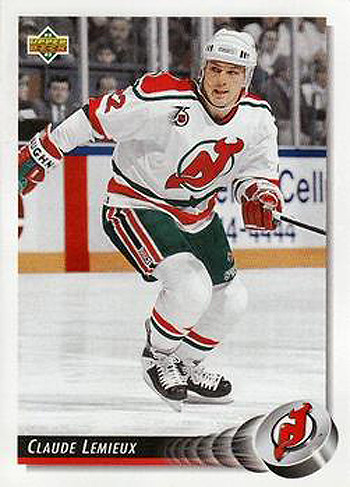
Lemieux Devils 2
Lemieux scored 40 goals during the Devils final season in red and green jerseys

In 1992-93, Lemieux again reached the 30 goal mark while he set career highs with 51 assists and 81 points to lead the Devils in scoring for the second consecutive season.

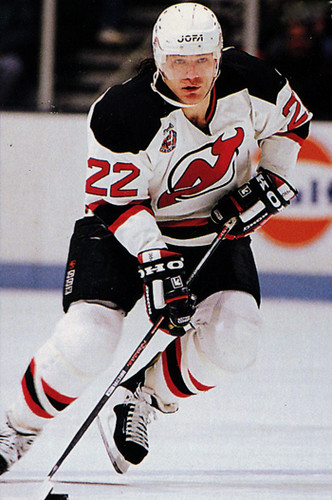
Lemieux Devils 3
Lemieux set a career high in points in 1992-93 in the Devils new red and black jerseys

While he was limited to 18 goals and 44 points in 1993-94, the Devils made it to the Conference Finals before losing in overtime of Game 7 in an epic series against the eventual champion New York Rangers.

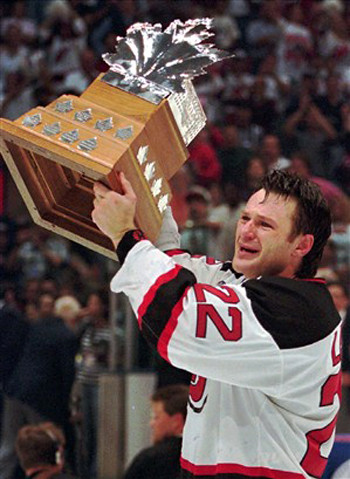
The 1994-95 season was delayed by labor problems, but once the postseason got underway, Lemieux's game came to life and he scored 13 goals and 16 points in 20 playoff games as the Devils won the Stanley Cup, with Lemieux being named the winner of the Conn Smythe Trophy as the playoff MVP.

Lemieux Conn Smythe
Lemieux won the Conn Smythe Trophy as the 1995 Playoff MVP

Winning the cup would prove to be Lemieux's final game with New Jersey, as he was involved in a three way trade that saw him wind up being traded to the Colorado Avalanche for their first season of play after the Quebec Nordiques were relocated to Denver.

The Nordiques were a talented team on the rise before moving to Colorado, but the arrival during the season of goaltender Patrick Roy elevated the club to another level. Additionally, playing with the likes of Joe Sakic and Peter Forsberg revitalized Lemieux's offensive game, as he immediately scored 39 goals and 71 points, both the second highest of his career.

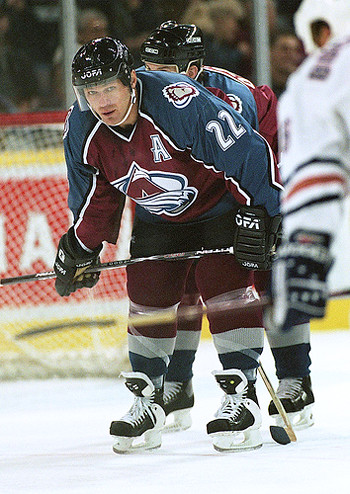
Lemieux Avalanche 1
After winning a Stanley Cup and Conn Smythe,
the Devils traded Lemieux to the Avalanche

In the playoffs, Colorado eliminated the Vancouver Canucks, Chicago Blackhawks and began an intense rivalry with the Detroit Red Wings before sweeping the upstart Florida Panthers in four games to win Lemieux's second consecutive Stanley Cup, making him just the fifth player to ever win back-to-back cups with two different teams.

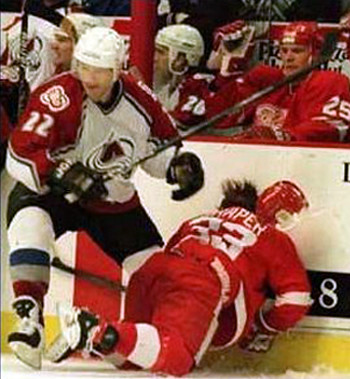
The flash point of the Avalanche rivalry with the Red Wings can be traced back to a check from behind by Lemieux on Detroit's Kris Draper, who smashed face first into the top edge of the boards, breaking his jaw, nose and cheekbone which resulted in a concussion and facial reconstructive surgery. Lemieux was suspended for two games by the NHL, while many felt the severity of the incident deserved a harsher penalty. The animosity was genuine between the two clubs, as voiced by Detroit's Dino Ciccarelli, who lamented after the series, "I can't believe I shoot that guy's firggin' hand after the game. That pisses me right off."

Lemieux Draper hit
Draper falling to the ice after being nailed by Lemieux

In the fall of 1996, Lemieux was once again called upon by Canada, this time for the 1996 World Cup of Hockey.

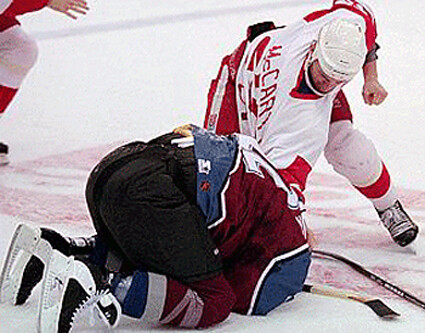
Lemieux was limited by injuries in 1996-97, but once again rose to the moment in the playoffs. After scoring 11 goals in 45 regular season games, he scored 13 goals in 17 playoff games. The Red Wings were also gunning for Lemieux during the regular season. During their fourth meeting on March 26, 1997, the Red Wings Darren McCarty suckerpunched Lemieux with a right hook, ripped his helmet off and rained blows on Lemieux, who covered up after the sneak attack. McCarty then drilled Lemieux repeatedly with violent punches before dragging him over to the boards and kneeing him in the head before the officials restrained him.

McCarty Lemieux
McCarty's attack on Lemieux in retribution for his hit on Draper

This fight also led to numerous other brawls, most notably when goaltenders Roy and Mike Vernon staged a slugfest at center ice which left Roy bloodied. Appallingly, McCarty would only receive a double minor for roughing for his attack which would have landed anyone else in jail had it happened in public.

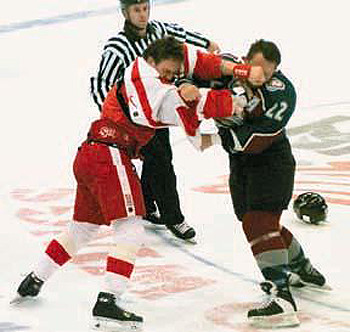
Lemieux would fight McCarty again right off the opening faceoff on a game on November 11, 1997, as McCarty would change move from right wing to left wing to line up opposite McCarty for a chance to restore his reputation after being accused of "turtling" when he covered up after being flattened by McCarty's sneak attack the previous March.

Lemieux McCarty 2
Lemieux and McCarty fought again for a second time
in one of hockey's all-time best rivalries

Lemieux would go on to score 26 goals and 53 points that season while the Avalanche and Red Wings would engage in another bout of mayhem when late in the season the two teams would stage another brawl that featured goaltenders Roy and Chris Osgood.

After playing a full season of 82 games with 27 goals and 51 points, Lemieux and the Avalanche would make it to the Conference Finals, but fall to the eventual champion Dallas Stars.

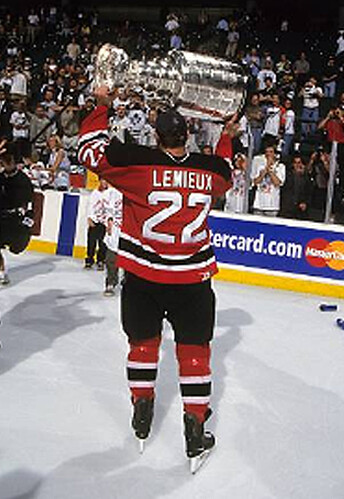
After 13 games of the 1999-00 season, Lemieux was traded back to New Jersey, where he scored 17 goals and 38 points in 70 games, which included Lemieux playing in his 1,000th NHL game on this date in 2000 against the Buffalo Sabres. The Devils qualified for the playoffs, Lemieux's 15th consecutive postseason dating back to 1986. New Jersey swept Florida, defeated the Toronto Maple Leafs in 6, outlasted the Philadelphia Flyers in 7 and won the third Stanley Cup of Lemieux's career by defeating Dallas in 6 games.

Lemieux Devils 2000
Lemieux won his fourth Stanley Cup in 2000

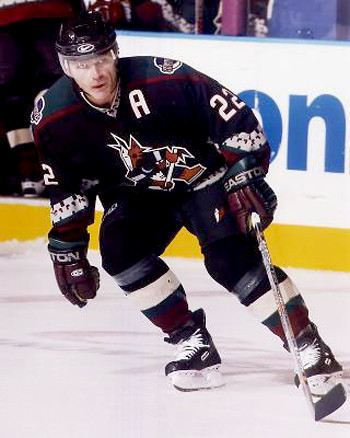
Once again, lifting the cup brought a close to his time in New Jersey, as Lemieux signed as a free agent with the Phoenix Coyotes for the 2000-01 season. He would play in just 46 games for the Coyotes that season before returning to play a full schedule of 82 games in 2001-02, scoring 41 points.

Lemieux Coyotes 1
Lemieux signed as a free agent with Phoenix

He would return to Phoenix for a third season, but after 36 games, he was traded to the Stars where he would play the final 32 games of his NHL career.

Lemieux did play in 7 games with EV Zug in Switzerland in 2003-04 as well as 5 playoff games to close out his career.

Or so we thought...

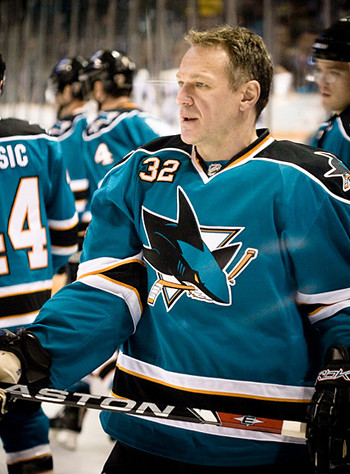
After four full seasons away from the ice, Lemieux unexpectedly made a comeback at the age of 43! Oddly, Lemieux played pair of games with the China Sharks of the Asian Hockey League and then 23 games with the Worcester Sharks of the AHL before being recalled by the San Jose Sharks, returning to the NHL for the first time  in nearly six years. He would play 18 games with San Jose with one assist and 21 penalty minutes before retiring for a second time that summer.

Lemieux Sharks 1
Seemingly out of nowhere, Lemieux was back in the NHL with the Sharks

Lemieux would play in the NHL playoffs 18 of his 19 seasons, playing in 234 postseason games with 80 goals, 78 assists and 158 points as well as 529 penalty minutes. His 234 games played are fourth all-time and his 19 game winning goals in the playoffs are second only to Wayne Gretzky's 24. His 80 playoff goals rank ninth all-time.

Lemieux would finish with 1,215 games played with 379 goals and 407 assists for 786 points with 1,777 penalty minutes. He would win a Conn Smythe Trophy in 1995 and four Stanley Cups with Montreal in 1986, New Jersey in 1996, Colorado in 1996 and the Devils again in 2000.

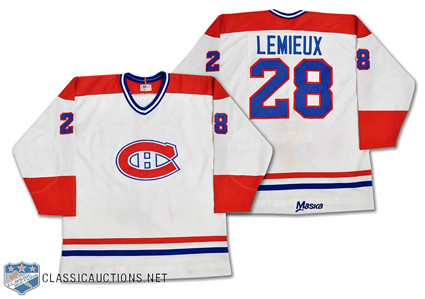
Today's first featured jersey is a 1983-84 Montreal Canadiens Claude Lemieux jersey from his rookie season.

Montreal Canadiens 1983-84 jersey

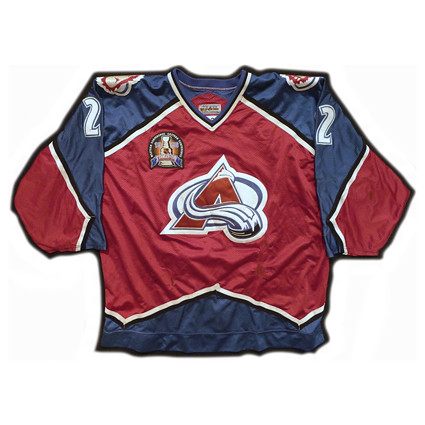
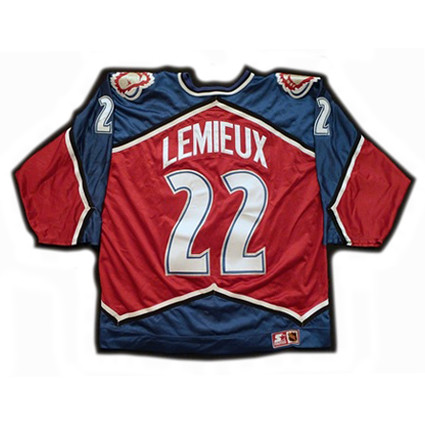
Today's second featured jersey is a 1995-96 Colorado Avalanche Claude Lemieux jersey worn during the 1996 Stanley Cup Finals.

The Avalanche would burst onto the scene with unique jerseys with zig-zag arm and waist stripes that mimicked a mountain range and a unique burgundy and blue color scheme, unlike anything that has ever been worn in the NHL. They would win a pair of Stanley Cups in this style which would be used all the way through the 2006-07 season.

Colorado Avalanche 1995-96 F jersey
Colorado Avalanche 1995-96 B jersey

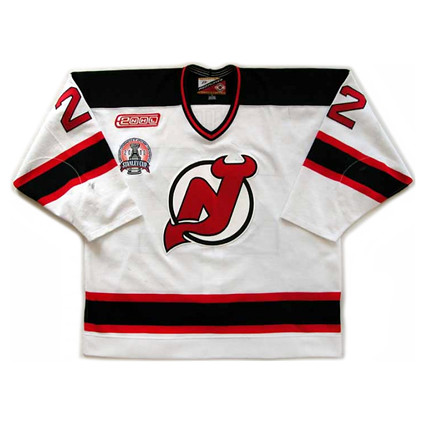
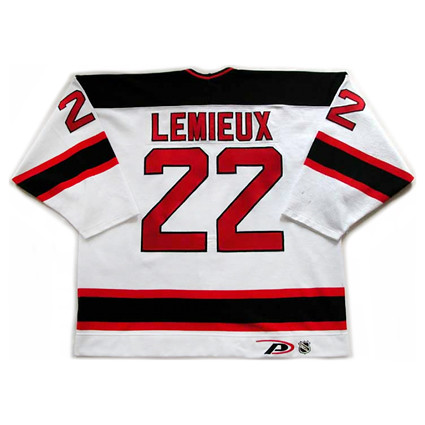
Today's third featured jersey is a 1999-00 New Jersey Devils Claude Lemieux jersey worn during the 2000 Stanley Cup Finals.

The Devils would still be wearing their original red and green jerseys during Lemieux's first two seasons until changing to their new red and black colors for the 1992-93 season. They would win three Stanley Cups to date in this style jersey, which remains in use unchanged through today, surviving the change to the Reebok Edge jerseys in 2007-08, which killed off many styles, including those worn above by the Avalanche.

New Jersey Devils 1999-00 F jersey
New Jersey Devils 1999-00 B jersey

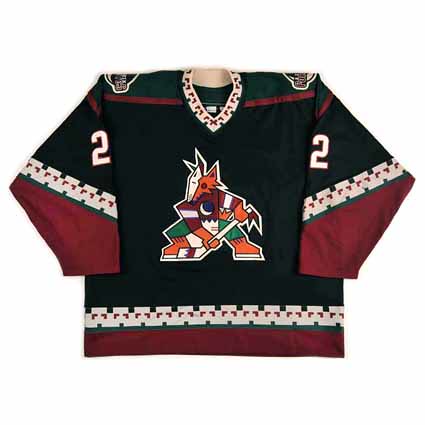
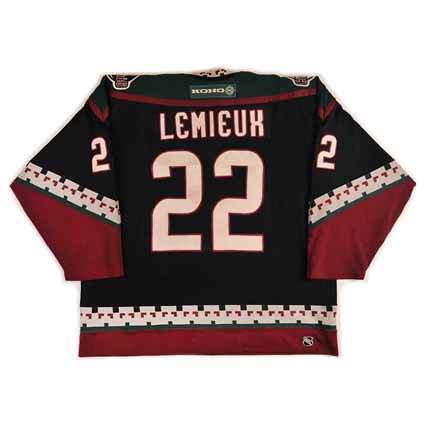
Bonus jersey: Today's bonus featured jersey is a 2000-01 Phoenix Coyotes Claude Lemieux jersey. When the Winnipeg Jets relocated to Phoenix for the 1996-97 season, they turned the hockey world on its ear with these unusual jerseys with Southwest inspired colors and Native American striping patterns in addition to their somewhat busy and rather bizarre logo, not to mention their unique choice of font for the names and especially numbers.

This style was worn for 12 seasons until a complete, and we mean complete overhaul of their identity package when they moved into their new arena, which changed the team colors, logo and, of course, their jerseys, bringing an end to the era of their highly unique and unusual original jerseys.

With this being the 20th Anniversary of the Coyotes, the team revived their original black jerseys for two games as celebratory throwbacks.

Phoenix Coyotes 2000-01 F jersey
Phoenix Coyotes 2000-01 B jersey

In today's video section, we hope you have some time on your hands today, as McCarty and Lemieux meet up for the first time ever to discuss the incident and what led up to it, thirteen years after the incident. It's a fascinating insight into "The Code" among hockey players and the mindset of both McCarty and Lemieux both then and now and the respect they have for each other. It's quite possibly the most interesting interview we've ever posted on Third String Goalie.


Saturday, October 1, 2016

1995-96 Colorado Avalanche Joe Sakic Jersey

On this date in 2009, the Colorado Avalanche retired the #19 of long time captain Joe Sakic.

A little known fact is that Sakic's parents were Croatian immigrants and he grew up speaking Croatian before attending elementary school. He would be named Rookie of the Year in the Western Hockey League of Canadian Juniors in 1987 after scoring 133 points. He also survived a horrific bus crash involving his club, the Swift Current Broncos, in which four of his teammates were killed. Sakic was then drafted by the Quebec Nordiques 15th overall in the 1987 NHL Entry Draft.

The following year Sakic was named WHL Most Valuable Player and Canadian Major Junior Player of the Year after scoring 160 points.

Sakic Swift Current Broncos, Sakic Swift Current Broncos
Sakic during his days with Swift Current

He scored an assist on his NHL debut on October 6, 1988 versus the Hartford Whalers and originally wore sweater #88 because Alain Cote was wearing his preferred #19. He finished with 62 points in 70 games as a rookie.

Sakic Rookie, Sakic Rookie
Sakic wearing #88 as a rookie

With Cote now retired, Sakic claimed his #19 for 1989-90 and scored 102 points. 1990-91 saw Sakic score 109 points, sixth overall in the league, and be named co-captain of the Nordiques (for home games).

Sakic would miss 11 games in 1991-92, which would hurt him in his chances to repeat another 100 point season, and he would conclude the year with 94 points. During this time period. the Nordiques regularly finished in last place, which allowed them to load up on high draft choices and put them in position to acquire a number of talented players, highlighted by their trade of holdout Eric Lindros.

Now named full time team captain of the newly reconfigured Nordiques, Sakic would respond in 1992-93 with 105 points and lead the Nordiques out of the wilderness and into the playoffs for the first time in his career on the heels of a staggering 52 point improvement, double their total of the year prior. Without any previous playoff experience, the Nordiques would be eliminated in the first round by arch-rivals the Montreal Canadiens.

Sakic Nordiques Captain, Sakic Nordiques Captain
Sakic as captain of the Nordiques

1993-94 was a slight step back for Sakic, as he would fall short of the 100 point barrier with 92, but the Nordiques would take a large step back, dropping 28 points in the standings and miss the playoffs yet again.

The Nordiques final season of in Quebec saw Sakic finish fourth in scoring during the lockout shortened 1994-95 season and the Nordiques would capture the division title, only to be eliminated in six games by the New York Rangers, ending their time in Canada.

Relocated to Denver, the Colorado Avalanche took to the ice in the 1995-96 season hoping to continue the improvement shown during Sakic's seven seasons in Quebec. Little did anyone anticipate the events that would unfold that season.

After having a major falling out with the Montreal Canadiens, superstar goaltender Patrick Roy was traded to the Canadiens former arch-rivals, now located in Colorado, a trade which would have never, ever happened had the club remained in Quebec, and the Avalanche were now on their way to glory.

Sakic topped 50 goals for the first time with 51, adding 69 assists for a career high 120 points for third in the league. The Avalanche would storm the playoffs, defeating first the Vancouver Canucks, followed by the Chicago Blackhawks by identical 4 games to 2 margins. Next up was a hard fought series with the Detroit Red Wings, upsetting the team that finished 27 points ahead of them in the standings 4-2 for the right to face the upstart Florida Panthers, whom they easily dismissed in four straight games for the the franchises first Stanley Cup Championship in their first season out of Quebec. Sakic would lead the playoffs in scoring that season and be named the winner of the Conn Smythe Trophy.

It had been a long journey for Sakic, who, along with Curtis Leschyshyn, were the only two Nordiques players from the 1988-89 season to suffer through the years of last place finishes to eventually raise the Stanley Cup.

Sakic 1996 Stanley Cup, Sakic 1996 Stanley Cup
Sakic raises the 1996 Stanley Cup after many years of toil with the franchise

Sakic would eventually play 13 seasons in Colorado, scoring 100 points twice more in his career, eventually surpassing the 600 goal, 1,000 assist and 1,600 point marks. The Avalanche were regular fixtures in the playoffs, and contenders for the Stanley Cup for seven straight seasons, reaching the conference finals in six of those seven seasons, including winning the Stanley Cup again in 2001, the same season he won the Hart Trophy as league MVP, the Pearson Award and the Lady Byng Trophy.

Sakic 2001 Stanley Cup, Sakic 2001 Stanley Cup
Sakic again raised the Stanley Cup in 2001

Today's featured jersey is a 1995-96 Colorado Avalanche Joe Sakic jersey and features the 1996 Stanley Cup Finals patch. This jersey stands apart with it's "mountain range" striping on the waist and arms, unlike any other jersey of it's day. Combined with it's unique color palette, custom number font, memorable secondary shoulder logos and the club's success on the ice, this style Colorado Avalanche jersey is a true icon of it's era and only the change to the templated Reebok Edge jerseys killed off what would have likely been one of those jerseys that lived on unchanged for years.

The white names and numbers on this jersey have a textured herringbone pattern pattern to them, which is called "Glacier Twill". In addition to that detail, the silver outline around all the numbers is a metallic silver material, which is often done as a flat grey material on Avalanche jerseys. The lettering for the name is also tall and narrow, as shown by the shape of the "C", which is also often found as a nearly perfect circle shape with rounded, instead of flat sides like shown here.

Colorado Avalanche 95-96 jersey photo Colorado Avalanche 95-96 F.jpg
Colorado Avalanche 95-96 jersey photo Colorado Avalanche 95-96 B.jpg

Bonus jersey: Today's bonus jersey is a 1989-90 Quebec Nordiques Joe Sakic jersey. This jersey was worn on the road when Sakic was still an assistant captain of the club, as he would not become a co-captain until the following season, and then only for home games, raising questions about just when and why Sakic was wearing the "C" on the road in 1989-90, perhaps due to an injury to their then Captain Peter Stastny. Close inspection will reveal clear remnants of an "A", replaced by a somewhat crudely fashioned "C" over the top of the "A".

Quebec Nordiques 89-90 jersey, Quebec Nordiques 89-90 jersey

Our first video today are the Top 10 Joe Sakic Moments from his throughout his career.


Our second video is a tribute video dedicated to his entire career on the occasion of his retirement.

Thursday, October 1, 2015

1995-96 Colorado Avalanche Joe Sakic Jersey

On this date in 2009, the Colorado Avalanche retired the #19 of long time captain Joe Sakic.

A little known fact is that Sakic's parents were Croatian immigrants and he grew up speaking Croatian before attending elementary school. He would be named Rookie of the Year in the Western Hockey League of Canadian Juniors in 1987 after scoring 133 points. He also survived a horrific bus crash involving his club, the Swift Current Broncos, in which four of his teammates were killed. Sakic was then drafted by the Quebec Nordiques 15th overall in the 1987 NHL Entry Draft.

The following year Sakic was named WHL Most Valuable Player and Canadian Major Junior Player of the Year after scoring 160 points.

Sakic Swift Current Broncos, Sakic Swift Current Broncos
Sakic during his days with Swift Current

He scored an assist on his NHL debut on October 6, 1988 versus the Hartford Whalers and originally wore sweater #88 because Alain Cote was wearing his preferred #19. He finished with 62 points in 70 games as a rookie.

Sakic Rookie, Sakic Rookie
Sakic wearing #88 as a rookie

With Cote now retired, Sakic claimed his #19 for 1989-90 and scored 102 points. 1990-91 saw Sakic score 109 points, sixth overall in the league, and be named co-captain of the Nordiques (for home games).

Sakic would miss 11 games in 1991-92, which would hurt him in his chances to repeat another 100 point season, and he would conclude the year with 94 points. During this time period. the Nordiques regularly finished in last place, which allowed them to load up on high draft choices and put them in position to acquire a number of talented players, highlighted by their trade of holdout Eric Lindros.

Now named full time team captain of the newly reconfigured Nordiques, Sakic would respond in 1992-93 with 105 points and lead the Nordiques out of the wilderness and into the playoffs for the first time in his career on the heels of a staggering 52 point improvement, double their total of the year prior. Without any previous playoff experience, the Nordiques would be eliminated in the first round by arch-rivals the Montreal Canadiens.

Sakic Nordiques Captain, Sakic Nordiques Captain
Sakic as captain of the Nordiques

1993-94 was a slight step back for Sakic, as he would fall short of the 100 point barrier with 92, but the Nordiques would take a large step back, dropping 28 points in the standings and miss the playoffs yet again.

The Nordiques final season of in Quebec saw Sakic finish fourth in scoring during the lockout shortened 1994-95 season and the Nordiques would capture the division title, only to be eliminated in six games by the New York Rangers, ending their time in Canada.

Relocated to Denver, the Colorado Avalanche took to the ice in the 1995-96 season hoping to continue the improvement shown during Sakic's seven seasons in Quebec. Little did anyone anticipate the events that would unfold that season.

After having a major falling out with the Montreal Canadiens, superstar goaltender Patrick Roy was traded to the Canadiens former arch-rivals, now located in Colorado, a trade which would have never, ever happened had the club remained in Quebec, and the Avalanche were now on their way to glory.

Sakic topped 50 goals for the first time with 51, adding 69 assists for a career high 120 points for third in the league. The Avalanche would storm the playoffs, defeating first the Vancouver Canucks, followed by the Chicago Blackhawks by identical 4 games to 2 margins. Next up was a hard fought series with the Detroit Red Wings, upsetting the team that finished 27 points ahead of them in the standings 4-2 for the right to face the upstart Florida Panthers, whom they easily dismissed in four straight games for the the franchises first Stanley Cup Championship in their first season out of Quebec. Sakic would lead the playoffs in scoring that season and be named the winner of the Conn Smythe Trophy.

It had been a long journey for Sakic, who, along with Curtis Leschyshyn, were the only two Nordiques players from the 1988-89 season to suffer through the years of last place finishes to eventually raise the Stanley Cup.

Sakic 1996 Stanley Cup, Sakic 1996 Stanley Cup
Sakic raises the 1996 Stanley Cup after many years of toil with the franchise

Sakic would eventually play 13 seasons in Colorado, scoring 100 points twice more in his career, eventually surpassing the 600 goal, 1,000 assist and 1,600 point marks. The Avalanche were regular fixtures in the playoffs, and contenders for the Stanley Cup for seven straight seasons, reaching the conference finals in six of those seven seasons, including winning the Stanley Cup again in 2001, the same season he won the Hart Trophy as league MVP, the Pearson Award and the Lady Byng Trophy.

Sakic 2001 Stanley Cup, Sakic 2001 Stanley Cup
Sakic again raised the Stanley Cup in 2001

Today's featured jersey is a 1995-96 Colorado Avalanche Joe Sakic jersey and features the 1996 Stanley Cup Finals patch. This jersey stands apart with it's "mountain range" striping on the waist and arms, unlike any other jersey of it's day. Combined with it's unique color palette, custom number font, memorable secondary shoulder logos and the club's success on the ice, this style Colorado Avalanche jersey is a true icon of it's era and only the change to the templated Reebok Edge jerseys killed off what would have likely been one of those jerseys that lived on unchanged for years.

The white names and numbers on this jersey have a textured herringbone pattern pattern to them, which is called "Glacier Twill". In addition to that detail, the silver outline around all the numbers is a metallic silver material, which is often done as a flat grey material on Avalanche jerseys. The lettering for the name is also tall and narrow, as shown by the shape of the "C", which is also often found as a nearly perfect circle shape with rounded, instead of flat sides like shown here.

Colorado Avalanche 95-96 jersey photo Colorado Avalanche 95-96 F.jpg
Colorado Avalanche 95-96 jersey photo Colorado Avalanche 95-96 B.jpg

Bonus jersey: Today's bonus jersey is a 1989-90 Quebec Nordiques Joe Sakic jersey. This jersey was worn on the road when Sakic was still an assistant captain of the club, as he would not become a co-captain until the following season, and then only for home games, raising questions about just when and why Sakic was wearing the "C" on the road in 1989-90, perhaps due to an injury to their then Captain Peter Stastny. Close inspection will reveal clear remnants of an "A", replaced by a somewhat crudely fashioned "C" over the top of the "A".

Quebec Nordiques 89-90 jersey, Quebec Nordiques 89-90 jersey

Our first video today are the Top 10 Joe Sakic Moments from his throughout his career.


Our second video is a tribute video dedicated to his entire career on the occasion of his retirement.


hit counter for blogger