History of Jersey 83-93 Banner sm photo History of Jersey 83-93 Banner sm.jpg
Showing posts with label Lach Elmer. Show all posts

Tuesday, March 7, 2017

1974-75 Montreal Canadiens Guy Lafleur Jersey

The Montreal Canadiens were founded in 1909 as members of the brand new National Hockey Association in order to provide the French fans of Montreal a team to rival the Anglophone Montreal Wanderers.

The first player to ever score a goal for the Canadiens was future Hall of Famer Newsy Lalonde, who would lead the club with 16 goals despite only appearing in 6 games before being traded to the Renfrew Creamery Kings (also known as the Millionaires). Lalonde would add another 22 goals for Renfrew in just five games to lead the NHA in scoring with 38 goals, as assists were not awarded back then. Lalonde would return to Montreal for the 1910-11 season and again led the club with 19 goals in 16 games.

Newsy Lalonde photo Newsy Lalonde 1909-10.png
The first goal scorer in Canadiens history, Newsy Lalonde,
picture here in the first ever Canadiens sweater

With Lalonde lured out west by the Vancouver Millionaires for the 1911-12 season, Didier Pitre became the first Canadiens player to reach the 20 point mark when he finished as the runner up in the NHA scoring race with 27 goals in an 18 game schedule.

In 1914-15, Pitre became the first Canadiens player to reach the 30 point mark when he totaled 34 points from 30 goals and 4 assists, which were now credited as of 1913-14. Pitre barely missed out being the first 40 point scorer in 1915-16 when his 24 goals and 15 assists, but his 39 points made him the first Canadien to lead the league in scoring.

Didier Pitre photo Didier Pitre.jpg
Pitre was the first Canadiens player with both 20 and 30 points

For the 1917-18 season, the NHA was disbanded and a new league rose to take it's place, the National Hockey League, of which the Canadiens were charter members. The brand new NHL was led in scoring by Joe Malone, who was on loan from the dormant Quebec Bulldogs. Malone was teamed with Lalonde and Pitre and the trio put on a scoring display unlike any ever seen before, as Malone became the first Canadiens player to top 40 points when he blitzed the league for 44 goals and 4 assists for 48 points in just 20 games. Malone's 44 goals in 1917-18 would stand as the league record for 46 years until 1943-44!

Joe Malone photo Joe Malone Montreal.jpg
Joe Malone's 44 goals stood as the NHL record for 46 years

Such was the dominance of Malone's season, it would take until the 1927-28 season for Howie Morenz to become the first for Montreal to reach the 50 point barrier when his 33 goals and 16 assists game him 51 points to not only lead the club, but the entire NHL.

Howie Morenz photo Howie Morenz Canadiens.jpg
Howie Morenz was the first to 50 points

While Toe Blake came oh-so-close to hitting 60 points in 1942-43 with 59, the honors went to teammate Elmer Lach the following season when he vaulted past the 60 point barrier on his way to 72! While it took 16 years for Lach to hit both 60 points and 70 for the first time in team history, it took him just 12 months to become the first member of the Canadiens with 80 when he scored 26 goals and 54 points for exactly 80 in 1944-45, leading a 1-2-3 Canadiens sweep of the NHL scoring race, as Lach's 80 led Maurice Richard's 73 and Blake with 67.

Elmer Lach photo Elmer Lach.jpg
Lach rewrote the Montreal record book in the 1940's,
as he was the first to 60, 70 and 80 points in two seasons

While Jean Beliveau came close with 88 points in 1955-59, it would be left winger Dickie Moore to first reach the 90 point plateau with 41 goals and 55 assists for 96 points, with Beliveau close behind at 91 to finish 1-2 in the league.

Dickie Moore photo Dickie Moore Canadiens.jpg
Dickie Moore pushed the mark to 90 points

While both Frank Mahovlich (96 in 1972) and Jacques Lemaire (95 in 1973) would take runs to become the first to reach the century mark, it would be Guy Lafleur who would take the honors as the first Canadien in the then 58 year history of the club to ever reach 100 points in a single season when he scored twice and added two assists on this date in 1975 in an 8-4 Montreal win over the Washington Capitals in Montreal.

Lafleur would go on to surpass 110 points later that season as he finished with 53 goals and 66 assists for a total of 119 points.

Just one season later, Lafleur eclipsed the 120 point mark with 125 from 56 goals and 69 points to win the NHL scoring race, a feat he repeated the very next season of 1976-77 as he amassed 136 points from 56 goals and 80 assists to set a team record which still stands to this day.

Guy Lafleur photo Guy Lafleur Canadiens.jpg
Guy Lafleur was the first to 100, as well as 110, 120 and
130 points in the span of just three seasons during the 1970's

To put Lafleur's 136 point season into perspective, Max Pacioretty led Montreal in scoring in the 2013-14 season with 60 points, less than half of Lafleur's record setting total.

Today's featured jersey is a 1974-75 Montreal Canadiens Guy Lafleur jersey as worn during the season Lafleur became the first player in franchise history to score 100 points in a single season.

While the first red Canadiens sweater with a blue band across the chest can be traced back to the 1912-13 season, it underwent a period of evolution, which included a "CA" crest before adopting to the "CH" logo in 1916, until arriving at the today's featured jersey for the 1966-67 season when the sleeve numbers were relocated inside the arm stripes. The 1974-75 season would be the final one for this variation with the lace up collar, which arrived back in 1941, as it would be replaced by a modern v-neck for 1975-76.

Montreal Canadiens 1974-75 jersey photo Montreal Canadiens 1974-75 jersey copy.jpg
photo courtesy of Classic Auctions

Today's video section is a career retrospective of Lafleur in his native French.

Saturday, March 7, 2015

1974-75 Montreal Canadiens Guy Lafleur Jersey

The Montreal Canadiens were founded in 1909 as members of the brand new National Hockey Association in order to provide the French fans of Montreal a team to rival the Anglophone Montreal Wanderers.

The first player to ever score a goal for the Canadiens was future Hall of Famer Newsy Lalonde, who would lead the club with 16 goals despite only appearing in 6 games before being traded to the Renfrew Creamery Kings (also known as the Millionaires). Lalonde would add another 22 goals for Renfrew in just five games to lead the NHA in scoring with 38 goals, as assists were not awarded back then. Lalonde would return to Montreal for the 1910-11 season and again led the club with 19 goals in 16 games.

Newsy Lalonde photo Newsy Lalonde 1909-10.png
The first goal scorer in Canadiens history, Newsy Lalonde,
picture here in the first ever Canadiens sweater

With Lalonde lured out west by the Vancouver Millionaires for the 1911-12 season, Didier Pitre became the first Canadiens player to reach the 20 point mark when he finished as the runner up in the NHA scoring race with 27 goals in an 18 game schedule.

In 1914-15, Pitre became the first Canadiens player to reach the 30 point mark when he totaled 34 points from 30 goals and 4 assists, which were now credited as of 1913-14. Pitre barely missed out being the first 40 point scorer in 1915-16 when his 24 goals and 15 assists, but his 39 points made him the first Canadien to lead the league in scoring.

Didier Pitre photo Didier Pitre.jpg
Pitre was the first Canadiens player with both 20 and 30 points

For the 1917-18 season, the NHA was disbanded and a new league rose to take it's place, the National Hockey League, of which the Canadiens were charter members. The brand new NHL was led in scoring by Joe Malone, who was on loan from the dormant Quebec Bulldogs. Malone was teamed with Lalonde and Pitre and the trio put on a scoring display unlike any ever seen before, as Malone became the first Canadiens player to top 40 points when he blitzed the league for 44 goals and 4 assists for 48 points in just 20 games. Malone's 44 goals in 1917-18 would stand as the league record for 46 years until 1943-44!

Joe Malone photo Joe Malone Montreal.jpg
Joe Malone's 44 goals stood as the NHL record for 46 years

Such was the dominance of Malone's season, it would take until the 1927-28 season for Howie Morenz to become the first for Montreal to reach the 50 point barrier when his 33 goals and 16 assists game him 51 points to not only lead the club, but the entire NHL.

Howie Morenz photo Howie Morenz Canadiens.jpg
Howie Morenz was the first to 50 points

While Toe Blake came oh-so-close to hitting 60 points in 1942-43 with 59, the honors went to teammate Elmer Lach the following season when he vaulted past the 60 point barrier on his way to 72! While it took 16 years for Lach to hit both 60 points and 70 for the first time in team history, it took him just 12 months to become the first member of the Canadiens with 80 when he scored 26 goals and 54 points for exactly 80 in 1944-45, leading a 1-2-3 Canadiens sweep of the NHL scoring race, as Lach's 80 led Maurice Richard's 73 and Blake with 67.

Elmer Lach photo Elmer Lach.jpg
Lach rewrote the Montreal record book in the 1940's,
as he was the first to 60, 70 and 80 points in two seasons

While Jean Beliveau came close with 88 points in 1955-59, it would be left winger Dickie Moore to first reach the 90 point plateau with 41 goals and 55 assists for 96 points, with Beliveau close behind at 91 to finish 1-2 in the league.

Dickie Moore photo Dickie Moore Canadiens.jpg
Dickie Moore pushed the mark to 90 points

While both Frank Mahovlich (96 in 1972) and Jacques Lemaire (95 in 1973) would take runs to become the first to reach the century mark, it would be Guy Lafleur who would take the honors as the first Canadien in the then 58 year history of the club to ever reach 100 points in a single season when he scored twice and added two assists on this date in 1975 in an 8-4 Montreal win over the Washington Capitals in Montreal.

Lafleur would go on to surpass 110 points later that season as he finished with 53 goals and 66 assists for a total of 119 points.

Just one season later, Lafleur eclipsed the 120 point mark with 125 from 56 goals and 69 points to win the NHL scoring race, a feat he repeated the very next season of 1976-77 as he amassed 136 points from 56 goals and 80 assists to set a team record which still stands to this day.

Guy Lafleur photo Guy Lafleur Canadiens.jpg
Guy Lafleur was the first to 100, as well as 110, 120 and
130 points in the span of just three seasons during the 1970's

To put Lafleur's 136 point season into perspective, Max Pacioretty led Montreal in scoring in the 2013-14 season with 60 points, less than half of Lafleur's record setting total.

Today's featured jersey is a 1974-75 Montreal Canadiens Guy Lafleur jersey as worn during the season Lafleur became the first player in franchise history to score 100 points in a single season.

While the first red Canadiens sweater with a blue band across the chest can be traced back to the 1912-13 season, it underwent a period of evolution, which included a "CA" crest before adopting to the "CH" logo in 1916, until arriving at the today's featured jersey for the 1966-67 season when the sleeve numbers were relocated inside the arm stripes. The 1974-75 season would be the final one for this variation with the lace up collar, which arrived back in 1941, as it would be replaced by a modern v-neck for 1975-76.

Montreal Canadiens 1974-75 jersey photo Montreal Canadiens 1974-75 jersey copy.jpg
photo courtesy of Classic Auctions

Today's video section is a career retrospective of Lafleur in his native French.

Tuesday, November 2, 2010

1934-35 Montreal Canadiens Howie Morenz Jersey

On this date in 1937, the Montreal Canadiens retired the first sweater in club history, the #7 of the late Howie Morenz, who had died at age 34 following a heart attack while hospitalized for a broken leg suffered in a game five weeks earlier. Morenz had played for Montreal for 12 seasons, winning three Stanley Cups, two Art Ross Trophies and three Hart Trophies.

Morenz locker
Howie Morenz's #7 jersey hangs in his locker in the Canadiens dressing room following his death in 1937

The Canadiens would not retire another number for 23 years when the iconic #9 of Maurice Richard was raised to the rafters of the Montreal Forum following Richard's great career, which included him becoming the first player to score 50 goals in 50 games, as well as winning eight Stanley Cups and one Hart Trophy.

Maurice Richard jersey
Richard's game worn #9 jersey

Eleven years on, the Canadiens would honor the great Jean Beliveau by ensuring no one else would wear his #4. Beliveau would play 20 seasons with Montreal, score over 500 goals, retire as the club's all-time leading scorer and the NHL's leading playoff scorer, play in 14 All-Star Games, win an Art Ross Trophy, a Conn Smythe Trophy and a pair of Hart Trophies on his way to winning ten Stanley Cups and serve as team captain longer than any other player.

Jean Beliveau
Beliveau wearing his #4 captain's jersey

Henri Richard's #16 was next to be set aside on December 10, 1975 after his career which included his record 11 Stanley Cups, which still stands today, and more than 1,000 career points. He also holds the record for Most Games Played in club history and was also a team captain for the Canadiens.

Henri Richard #16
Henri Richard poses with his home and away #16 sweaters

Both Guy Lafleur and defenseman Doug Harvey had their numbers retired in 1985. Lafleur's #10 received the honor on February 16, 1985 after his career, which included five Stanley Cups, 1,246 points which makes him the all-time leader in Canadiens history, over 500 goals, the club records for most goals in a season with 60 and most points in a season with 136. He was also the first player to have 50 goals and 100 points in six consecutive seasons and the fastest player to reach 1,000 career points. He won three Art Ross Trophies, two Hart Trophies, three Pearson Awards and a Conn Smythe trophy while a member of the Canadiens.

Lafleur #10
Lafleur pictured in front of his #10

#2 Doug Harvey was honored with his sweater retirement early the following season on October 26, 1985. The seven-time winner of the Norris Trophy played 14 seasons with Montreal, winning six Stanley Cups in the process.

Doug Harvey #2
Doug Harvey's #2 is retired in 1985

It would be another ten years before Jacques Plante's #1 was raised to the rafters. Plante played for Montreal for ten seasons, winning six Stanley Cups, including five in a row. Plante was a winner of the Hart Trophy once and six Vezina Trophies while a member of the Canadiens. He is also credited for wearing the first modern goalie mask.

Banners #1,#5,#4
Plante's banner hangs in the rafters with the other retired banners

Following Plante's jersey retirement, it would be an additional ten years before the Canadiens would honor another player in the same manner.

As part of their Centennial celebrations, the Canadiens announced a series of sweater retirements to take place over the course of the next five seasons. Having retired just one number in 20 years, the Canadiens began to make up for lost time by retiring the #12 for two men, Dickie Moore and Yvan Cournoyer on November 12, 2005. Moore was a two-time Art Ross Trophy winner who once held the single season scoring record with 96 points. In 12 years with the Canadiens, Moore won six Stanley Cups.

Cournoyer skated for the Canadiens for 16 years, including being named team captain. He won a Conn Smythe Trophy and won ten Stanley Cups while with the Canadiens. At the time of his retirement in 1978, he was fourth on the all-time Montreal scoring list.

cournoyer #12
Cournoyer holds up a signed #12 Canadiens jersey

Bernie "Boom Boom" Geoffrion's #5 came next on March 11, 2006. Geoffrion's colorful nickname is a result of his invention of the slapshot. He played 14 seasons in Montreal, won the Calder Trophy, two Art Ross Trophies, the Hart Trophy and six Stanley Cups. Sadly, he passed away on the day his number was retired.

Geoffrion Ceremony
The ceremony to retire Geoffrion's #5 just hours after his passing

The 2006-07 season saw the retirements of #18 for Serge Savard and #29 for goaltender Ken Dryden. Savard became the first defenseman to win the Conn Smythe Trophy in 1969. He also was named the winner of the Bill Masterton Trophy in 1979 and won eight Stanley Cups in 15 seasons with Montreal.

Serge Savard #18
Serge Savard's #18 rests in the rafters in Montreal

Dryden's career was shorter at eight seasons, but during those years he won the Calder Trophy, the Conn Smythe Trophy (before winning the Calder!), five Vezina Trophies and six Stanley Cups.

Dryden #29
Ken Dryden and his family watch is banner being raised in 2007

Larry Robinson and Bob Gainey were honored in 2007-08. Robinson's #19 rose to the rafters in honor of his 17 seasons with Montreal which included two Norris Trophies, a Conn Smythe and six Stanley Cups. In 1976-77 he finished the year with a +120 rating, the second highest in history, and one of only two seasons ever over +100.

Robinson ceremony
Robinson's #19 is retired

Bob Gainey's #23 was retired following his 16 seasons with Montreal which saw him capture four Selke Trophies. While his list of awards is not as lengthy and his point totals not as high as his fellow honored Canadiens, his role as a defensive forward was a key component to the five Stanley Cups Montreal won during Gainey's time with the Canadiens.

Gainey ceremony
Gainey's #23 is raised to the rafters

Patrick Roy was welcomed back into the Canadiens family on November 22, 2008. Roy is the youngest winner of the Conn Smythe Trophy at age 20. In 12 seasons in Montreal, Roy won three Vezina Trophies, four Jennings Trophies, two Conn Smythe Trophies and two Stanley Cups.

Roy banner
Patrick Roy poses with his banner

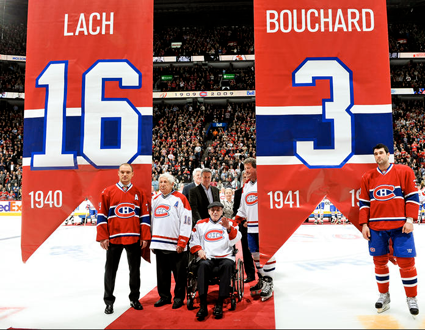
Finally on the date of the Canadiens centennial, December 4, 2009, the jerseys of both #3 Emile Bouchard and #16 Elmer Lach were surprisingly retired as part of the festivities that evening. Lach played 14 seasons for the Canadiens as part of the famed "Punch Line" with Maurice Richard and Toe Blake. He won two Art Ross Trophies and the Hart Trophy as well as three Stanley Cups. At the time of his retirement in 1954, he was the league's all-time leading scorer.

Bouchard, a defenseman, was captain of the Canadiens for eight seasons during his 15 years with Montreal, which included four Stanley Cup titles. He was the first Quebec-born player to wear the "C" for Montreal. The QMJHL's Defenseman of the Year trophy is named in his honor. At the time of Bouchard's sweater retirement, Canadiens player Ryan O'Byrne was wearing #3, but surrendered it as part of the ceremony, permanently changing to #20.

Lach Bouchard jersey retirement
Lach and Bouchard have their numbers retired in 2009

With the recent run of sweater retirements, the Canadiens have now taken 15 numbers out of circulation in honor of 17 players. Only numbers 6 and 8 remain in the single digits, resulting in an unprecedented number of Canadiens wearing non-traditional jersey numbers higher than #30.

In keeping with the current trend of wearing a patch on the occasion of a jersey retirement, the Canadiens have worn special patches on the players jerseys during the game following their recent jersey retirements.

Kovalev Gainey patch
Alexi Kovalev wearing a patch on the occasion of the retirement of Bob Gainey's #23

Today's featured jersey is a 1934-35 Montreal Canadiens Howie Morenz jersey. This jersey is on display at the Hockey Hall of Fame in Toronto. His was the first of 15 numbers retired by the Montreal Canadiens.

The Canadiens first wore their "CH" logo back in 1916 and it appeared on the sleeves for the first time in 1924 when the club wore a globe on the front of their jerseys to symbolize their status as world champions. The following season the logo returned to the chest, but the smaller version of the logo remained on the left sleeve through 1935.

Howie Morenz jersey

In a wonderful ceremony on the occasion of the clubs 100th Anniversary, many of the men who have had their jerseys retired by the Canadiens took part in a special pre-game warmup and then participated in the remainder of the celebrations that evening, which included the unexpected retirement of Bouchard's #3 and Lach's #16.


Saturday, December 5, 2009

Montreal Canadiens Centennial Celebration Jersey Retirements

The Montreal Canadiens surprised those in attendance last night when they retired the numbers of #16 Elmer Lach and #3 Émile "Butch" Bouchard after previously stating they had no plans to retire any further sweater numbers from the past.


"Not only were they star players in their day, but emile Bouchard and Elmer Lach are widely considered to be two proud Montrealers who dedicated their lives to their team and to their community. They are most deserving of this honour," said Montreal Canadiens President, Pierre Boivin.

Bouchard, a defenseman, was nicknamed the "Rock of Gibraltar", was a four time All-Star and in 1948 became the captain of the Canadiens, the first Quebec-born player to do so. During his career he would win the Stanley Cup four times, twice while as team captain, and would go out on top, retiring after winning the Stanley Cup in 1956.

The QMJHL's Defenceman of the Year Trophy is named in his honor and he was inducted into the Hockey Hall of Fame in 1966.

Here is team captain Bouchard being presented the 1953 Stanley Cup

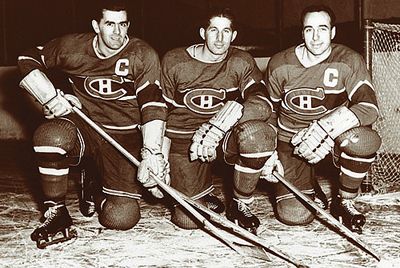
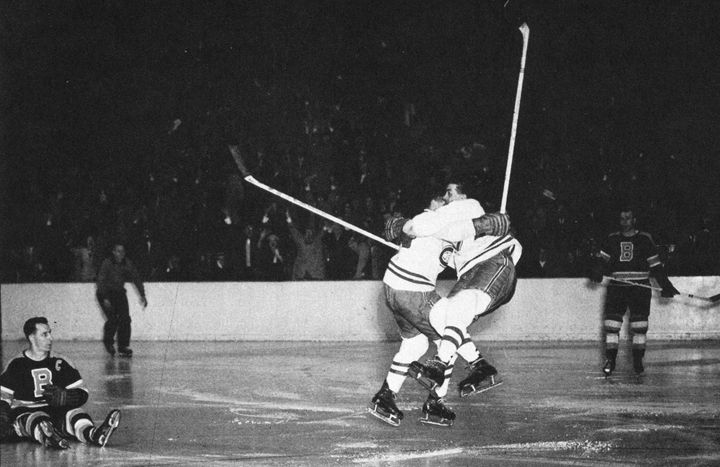
Elmer Lach was part of "The Punch Line", along with Maurice Richard and Toe Blake, and led the NHL in scoring twice and was awarded the Hart Trophy as league MVP in 1945. He would win three Stanley Cups in his 14 year career and score the Cup-winning goal in overtime in 1953 and have his nose broken by Richard's stick when he leapt into his arms in celebration!

He retired in 1954 as the league's all-time leading scorer up to that point and was inducted into the Hockey Hall of Fame, also in 1966 along with Bouchard.

The "Punch Line" - Richard, Lach & Blake

Updating yesterday's post, while the Canadiens had already retired Lach's #16 in honor of Henri Richard, the retirement of Bouchard's #3 now means the Canadiens have taken seven of nine single digit sweater numbers out of circulation and 12 numbers under #20. Only #6 and #8 remain in the single digits and the 15 retired numbers in honor of 17 players is by far the most of any NHL team, with Boston's 10 being the next highest.

During the raising of Bouchard's #3 banner, current Canadien Ryan O'Byrne reprised Ray Bourque's surrendering of his #7 jersey to Phil Esposito by removing his current #3 jersey and presenting it to Bouchard, revealing his new #20 sweater.

The first video, following Jean Beliveau, is the introduction of Lach and Bouchard and the announcement that their jersey numbers will be retired, followed by the second video which shows the raising of the banners, along with O'Byrne surrendering his #3 sweater.


hit counter for blogger