History of Jersey 83-93 Banner sm photo History of Jersey 83-93 Banner sm.jpg
Showing posts with label McDonald Lanny. Show all posts

Saturday, May 27, 2017

The Rocky History of the Colorado Rockies - 1980-81 Colorado Rockies Lanny McDonald Jersey

The NHL had planned to expand in 1976-77 and had awarded "conditional" franchises to both Denver and Seattle. However, several franchises were having financial difficulties at the time, the California Golden Seals, Kansas City Scouts and Pittsburgh Penguins in particular.

Due to the number of existing clubs having enough troubles of their own, the proposed expansion was called off and the Seals relocated to Cleveland to become the Barons while the Scouts moved to Denver after selling only 2,000 season tickets for the upcoming season while finding themselves nearly $1 million in debt after playing just two seasons in Kansas City.

While in Denver, the Colorado Rockies continued the Scouts tradition of struggling to make the playoffs. Their first season record in Denver of 20-46-14 was a 13 point improvement over anything achieved in Kansas City, but they still failed to qualify for the playoffs. The club was led in scoring by Wilf Paiement, who set a franchise record that would never be topped with 41 goals on his way to 81 total points.
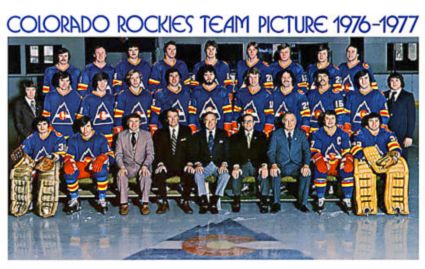
1976-77 Colorado Rockies team photo 1976-77 Colorado Rockies team.jpg
The inaugural 1976-77 Colorado Rockies

Doug Favell arrived from the Toronto Maple Leafs to split time in goal with Scouts holdover Michel Plasse, who led the team in games played with 54 and had 12 of their 20 wins.

In 1977-78, thanks to an increase in their number of ties from 14 to 21, over 25% of the team's games and finishing with more ties than wins, they set a Rockies record with 59 points after going 19-40-21 and actually finished second in the horrid Smythe Division, which also had league doormats Vancouver (57 points), St. Louis (53) and Minnesota (45). Luckily for the Rockies, they resided in the Campbell Conference, as the Penguins failed to make the top six in the Wales Conference despite having 68 points in the standings! Paiement again led the team in scoring with 87 points, establishing the club record. Favell took over as the number one goaltender, playing in 47 games with 13 wins, while Plasse had 3 wins in 25 games and Bill McKenzie added 3 more in 12 games.
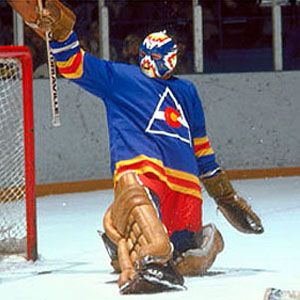
Favell Rockies photo FavellRockies.jpg
Doug Favell in his bold Rockies mask

The one and only Rockies playoff experience was desperately brief, as the format of the opening round of the playoffs was a best-of-three format and Colorado lost 3-2 at Philadelphia in Game 1 and followed that with a 3-1 loss in the only home playoff game in Rockies history as the Flyers swept them out of the playoffs two games to none.

The Rockies actually requested to relocate the team to New Jersey in 1978, but were turned down as their proposed home, the Byrne Arena had yet to be completed and no suitable temporary rink was available at the time. The Rockies point total dropped to 42 after a 15 win season in 1978-79 under two head coaches, Pat Kelly and Bep Guidolin. Paiement once more led the team in scoring, although his total shrank to just 60 points.
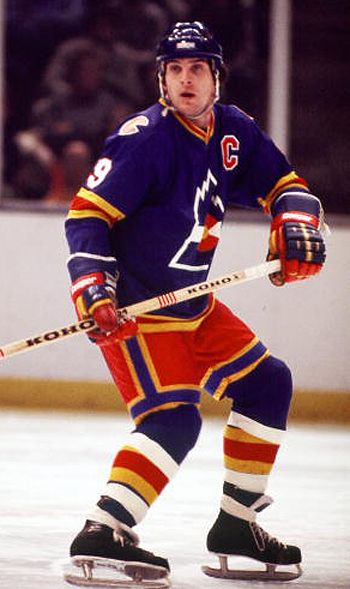
Wilf Paiement Rockies photo Wilf Paiement Rockies.jpg
Wilf Paiement led the Rockies in scoring their first three seasons

Several new arrivals in 1979-80 attempted to infuse some hope in the fans, as Rene Robert came from the Buffalo Sabres to lead the team in scoring with 63 points and be named team captain. Additionally, the club traded for veteran Lanny McDonald and Don Cherry took over behind the bench as head coach. At one point the outspoken Cherry even nicknamed his own goalie Hardy Astrom "The Swedish Sieve"!

McDonald Rockies photo McDonaldRockies.jpg
Lanny McDonald

Despite their attempts at improvement, the league did the Rockies no favors by expanding in 1979-80 by allowing four WHA teams to join the NHL, with the Edmonton Oilers and Winnipeg Jets being added to the Smythe Division, putting two more obstacles between the Rockies and the playoffs despite the increase in playoff teams from 12 to 16. Even with having their rosters purged by the terms of the expansion, Edmonton would qualify for the playoffs with 18 more points than Colorado and Winnipeg was able to tie the Rockies in points with 51.

McDonald took over the scoring lead with 81 points in 1980-81 and defenseman Rob Ramage made his presence known with 62 points while goaltender Chico Resch also arrived from the New York Islanders. The team scored a franchise high of 258 goals and improved to 57 points, but well short of the 74 needed to make the playoffs.

Resch Rockies
Chico Resch

Their final season of 1981-82 in Denver was more of the same, with an 18-49-13 record for 49 points and the Rockies gave up 121 more goals than they scored, an average deficit of 1.5 per game. Brent Ashton edged Steve Tambellini 60 to 59 for the club scoring lead and Resch anchored the goaltending, seeing action in 61 games and setting the franchise high with 16 wins.

The Rockies were not helped by having major stability issues during their time in Colorado. In six seasons they had three owners, seven head coaches and seven different team captains.

Finally on this date in 1982, the Colorado Rockies franchise was sold to Dr. John McMullen, who relocated the franchise to New Jersey and renamed the club the New Jersey Devils, ending the Rockies six year run in Denver.

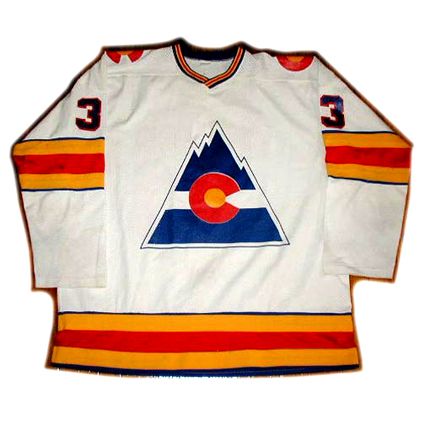
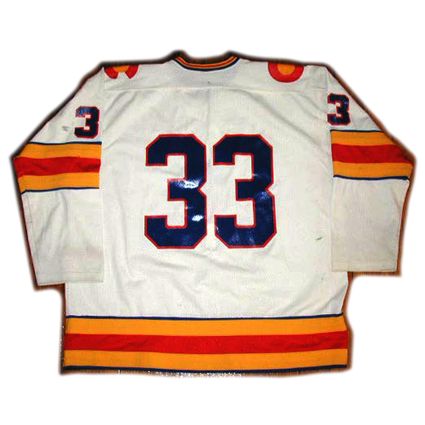
Today's featured jersey is a 1980-81 Colorado Rockies Lanny McDonald jerseyWhen the team moved to Colorado from Kansas City, they retained the team's blue, red and gold colors, which conveniently matched those of the Colorado state flag. A striking new logo, which borrowed heavily from the Colorado state flag, was created, incorporating the imagery of the Rocky Mountains. The Rockies blue road jerseys were particularly attractive when compared to the home whites.

Aside from the addition of the player's names on the back in 1977, the Rockies jerseys remained unchanged during their time in Denver.

Colorado Rockies Jersey
photo courtesy of Classic Auctions

Bonus jersey: Today's bonus jersey is a 1976-77 Colorado Rockies Nelson Pyatt jersey. This lightweight mesh jersey was from the Rockies first set of jerseys, worn early in their first season until their main jersey set arrived.

This jersey stands out due to it's smaller crest made of a white mountain, while the club's main jerseys had a much larger crest which consisted of a blue mountain outlined with a bold white outline as shown in today's extra bonus jersey below.

 photo Colorado Rockies 1976-77 road jersey.jpg
photo courtesy of Classic Auctions

Extra bonus jersey: Today's extra bonus jersey is a 1981-82 Colorado Rockies Joe Micheletti jersey as worn during Micheletti's final NHL season. The Rockies main set of jerseys featured a much more professional logo, with a blue mountain outlined in white with a bolder C. Additonally, the numbers were now two colors instead of the single color of their early first season placeholder jerseys.

When the player names arrived on the back, they were single color letters on both the home and road jerseys.
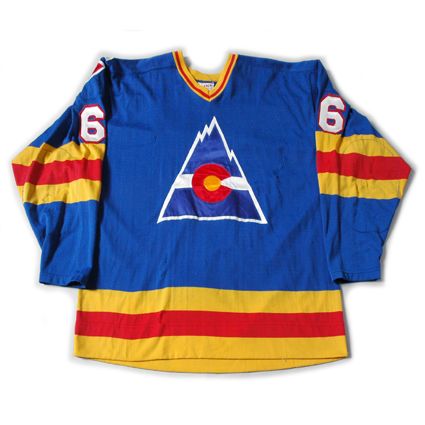
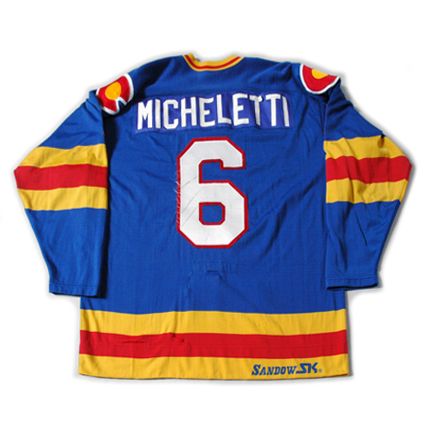
 photo ColoradoRockies1981-82F.jpg
Colorado Rockies 1981-82 jersey photo ColoradoRockies1981-82B-1.jpg

Extra extra bonus jersey: Today's extra extra bonus jersey is a 1977-78 Colorado Rockies Doug Favell jersey as worn during Favell's second season in Colorado when he played in 47 games as the club's main goaltender. Following the season the name was removed from the back of the jersey to prepare the jersey for possible reuse of the jersey.

Notice the shine on the back numbers from the plasticized, heat sealed material used for the numbers rather than the modern sewn on twill material.

Colorado Rockies 77-78 jersey, Colorado Rockies 77-78 jersey

Today's video segment begins the Legends of Hockey profile on Lanny McDonald and discusses his departure from Toronto to Colorado and what he meant to the Maple Leafs before moving to to focus on his time in Calgary.


You knew it had to happen sooner or later, the video for "Rock and Roll, Part 2", first used as an arena anthem by the Colorado Rockies and then adopted by nearly every other professional sports team for over twenty years.


Just in case you were ever curious, here's the nearly forgotten "Rock and Roll, Part 1".

Sunday, April 5, 2015

1986-87 Calgary Flames Lanny McDonald Jersey

After turning professional in 1973-74 with the Toronto Maple Leafs, Lanny McDonald began his NHL career somewhat slowly with 14 goals as a rookie, followed by scoring 17 in 1974-75. He began to pick up steam the following season with 37 before reeling off three straight seasons in the 40's, with 46, 47 and 43 goals.

McDonald Maple Leafs, McDonald Maple Leafs
McDonald established himself as an NHL player in Toronto

The next season of 1979-80 was a tumultuous one for the Maple Leafs, as Punch Imlach was named the club's new General Manager and immediately had issues with the team's captain, Darryl Sittler. Imlach wanted to trade Sittler, but when Sittler refused to waive his no trade clause, Imlach responded by trading teammates who were close to him. McDonald, who was also himself in conflict with Imlach due to his role as the club's player representative for their union, was one of those traded, banished to the hinterlands of the American west when he was dealt to the moribund Colorado Rockies.

The trade was a shock to high scoring and popular McDonald, the Maple Leafs fans, the team's coach Floyd Smith and Sittler, who resigned as team captain in protest.

The veteran McDonald was named the Rockies captain and did his best to lead a struggling club, but his stay in Colorado was relatively brief. He arrived half way through the 1979-80 season, scored 81 points to lead the team in scoring the following season, yet 16 games into the 1981-82 campaign, he was gone, having been traded to the Calgary Flames.

McDonald Rockies, McDonald Rockies
McDonald, trying to make the best of it in Colorado

McDonald, an Alberta native, was immediately embraced by the fans in Calgary and responded with 34 goals over the remainder of the season. The next season saw him produce by far his best offensive season, as he equalled his career high of 47 goals by the all-star break, leading Wayne Gretzky for the league lead by two. McDonald eventually finished with 66 goals, still the Flames franchise record and the fourth highest total in NHL history at the time. His 98 points were were also a career high for McDonald, who was named the recipient of that season's Masterton Trophy to cap off his memorable year.

McDonald was named a team captain for the 1983-84 season, but injuries limited him over the next two seasons. He rebounded with a healthy 1985-86, playing in 80 games that season, which included his first appearance in the Stanley Cup Final during a postseason run which saw him score 18 points in 22 games.

McDonald would play in his 1,000th career game in the 1986-87 season, a 3-1 loss to the Winnipeg Jets on this date in 1987, the 59th player in NHL history to ever reach 1,000 games.

The 1989-90 season saw McDonald reach the 1,000 point mark, followed by scoring the 500th goal of his career two weeks later on a wraparound goal against the New York Islanders in a remarkable game which also saw teammates Joey Mullen and Joe Nieuwendyk each score their 50th goals of the season.

Mullen McDonald Joe N, Mullen McDonald Joe N
Following a remarkable game, McDonald poses with his 500th goal puck, along with Mullen and Niewendyk, who each scored their 50th goals during the same game

The Flames finshed the season with the best record in the league that season, but had to battle the Vancouver Canucks through a full seven games in the opening round before prevailing 4-3 in overtime to advance. The Flames hit their stride and required just nine games to defeat both the Los Angeles Kings and Chicago Blackhawks to earn a place in the finals to set up a rematch of 1986 against the Canadiens.

With age taking its toll, McDonald, now 36, was scratched from the lineup periodically during the playoffs, including sitting out games 3, 4 and 5 of the finals. However, Flames head coach Terry Crisp felt that if they were to win the cup, currently leading 3 games to 1, McDonald, who had never won a cup, deserved to be on the ice.

The decision paid off handsomely, when McDonald, who had just left the penalty box, joined what was now a 3-on-1 break into the Canadiens zone. McDonald took a pass from Nieuwendyk and fired a shot past the Canadiens goaltender Patrick Roy to give the Flames a lead they would never relinquish on their way to a 4-2 win and the first Stanley Cup in franchise history in what would prove to be the final game of McDonald's career.

McDonald Flames Stanley Cup, McDonald Flames Stanley Cup
McDonald roaring in celebration as he raises the Stanley Cup
following the final game of his career

In all, McDonald would play 1,111 games over the course of 16 seasons while scoring exactly 500 goals and 506 assists for 1,006 points.

Internationally, McDonald represented a victorious Canada during the 1976 Canada Cup, played for the NHL All-Stars during the 1979 Challenge Cup against the Soviet Union and again skated for Canada at the 1981 World Championships, scoring 3 goals in 8 games.

McDonald Canada, McDonald Canada
McDonald during the inaugural 1976 Canada Cup tournament

On March 17, 1990, McDonald became the first player in Flames history have his number retired, followed by becoming the first Flames player inducted into the Hockey Hall of Fame n 1992.

McDonald Banner, McDonald Banner

Today's featured jersey is a 1986-87 Calgary Flames Lanny McDonald jersey as worn during the season during which McDonald would play in his 1,000th NHL game.

The Flames kept the same jerseys they wore during the early days of the franchise history in Atlanta, save for changing their flaming A crest to a flaming C. This style would last from 1980-81 though the 1993-94 season until being replaced by a modernized jersey, which featured the trendy black as an additional color.

Calgary Flames 1986-87 jersey photo Calgary Flames 1986-87 jersey.jpg
photo courtesy of Classic Auctions

Bonus jersey: Today's bonus jersey is a 1979 NHL All-Star Lanny McDonald jersey as worn during the 1979 Challenge Cup as a team of NHL All-Stars took on the Soviet Union National Team in a three game series at Madison Square Garden in place of the traditional East vs West NHL All-Star Game.

 photo NHL 1979 Challenge Cup jersey.jpg
photo courtesy of Classic Auctions

Extra bonus jersey: Today's extra bonus jersey is a 1981 Canadian National Team Lanny McDonald jersey as worn by McDonald as he captained the Canadians in the 1981 World Championships, the only time he suited up for Canada, due in part to the Canadians withdrawing from international competition from 1970 through 1976 in a dispute over the use of professional players.

This was a brand new style in 1981 and differed from the one used for the Canada Cup tournament that same year. It had a short run, only being used for the 1981 and 1982 World Championships, with different styles being used for the World Juniors.

Canada 1981 World Championships jersey photo Canada 1981 World Championships F jersey.jpg
Canada 1981 World Championships jersey photo Canada 1981 World Championships B jersey.jpg
photos courtesy of Classic Auctions

In today's video section, highlights of Game 6 of the 1989 Stanley Cup Finals, including McDonald scoring the Flames second goal of the game.


Next, the Legends of Hockey profile of McDonald, which chronicles his career back to his days with the Maple Leafs.

Monday, May 27, 2013

1980-81 Colorado Rockies Lanny McDonald Jersey

The NHL had planned to expand in 1976-77 and had awarded "conditional" franchises to both Denver and Seattle. However, several franchises were having financial difficulties at the time, the California Golden Seals, Kansas City Scouts and Pittsburgh Penguins in particular. Due to the number of existing clubs having enough troubles of their own, the proposed expansion was called off and the Seals relocated to Cleveland to become the Barons while the Scouts moved to Denver after selling only 2,000 season tickets while finding themselves nearly $1 million in debt after playing just two seasons in Kansas City.

While in Denver, the Colorado Rockies continued the Scouts tradition of struggling to make the playoffs. Their first season record in Denver of 20-46-14 was a 13 point improvement over anything achieved in Kansas City, but they still failed to qualify for the playoffs. The club was led in scoring by Wilf Paiement, who set a franchise record that would never be topped with 41 goals with 41 and totaled 81 points.

Paiement Rockies
Wilf Paiement

Thanks to an increase of ties from 14 to 21, over 25% of the team's games and more ties than wins, they set a Rockies record with 59 points after going 19-40-21 and actually finished second in the horrid Smythe Division, which also had league doormats Vancouver (57 points), St. Louis (53) and Minnesota (45). Luckily for the Rockies, they resided in the Campbell Conference, as the Penguins failed to make the top six in the Wales Conference despite having 68 points in the standings! Paiement again led the team in scoring with 87 points, establishing the club record.

The one and only Rockies playoff experience was desperately brief, as the format of the opening round of the playoffs were then a best-of-three format and Colorado lost 3-2 at Philadelphia in Game 1 and followed that with a 3-1 loss in the only home playoff game in Rockies history as the Flyers swept them out of the playoffs two games to none.

The Rockies actually requested to relocate the team to New Jersey in 1978, but were turned down as their proposed home, the Byrne Arena had yet to be completed and no suitable temporary rink was available at the time. The Rockies point total dropped to 42 after a 15 win season in 1978-79 under two head coaches, Pat Kelly and Bep Guidolin. Paiement once more led the team in scoring, although his totals shrank to just 60 points.

Several new arrivals in 1979-80 attempted to infuse some hope in the fans, as Rene Robert came from the Buffalo Sabres to lead the team in scoring with 63 points and be named team captain. Additionally, the club traded for veteran Lanny McDonald and Don Cherry took over behind the bench as head coach. At one point the outspoken Cherry nicknamed his own goalie Hardy Astrom "The Swedish Sieve"!

Still, the league did the Rockies no favors by expanding in 1979-80 by allowing four WHA teams to join the NHL, with the Edmonton Oilers and Winnipeg Jets being added to the Smythe Division, putting two more obstacles between the Rockies and the playoffs despite the increase in playoff teams from 12 to 16. Even with having their rosters purged by the terms of the expansion, Edmonton would qualify for the playoffs with 18 more points than Colorado and Winnipeg was able to tie the Rockies in points with 51.

McDonald took over the scoring lead with 81 points in 1980-81 and Rob Ramage on defense made his presence known with 62 points. Goaltender Chico Resch also arrived from the New York Islanders. The team scored a franchise high of 258 goals and improved to 57 points, but well short of the 74 needed to make the playoffs.

Resch Rockies
Chico Resch

Their final season of 1981-82 in Denver was more of the same, with an 18-49-13 record for 49 points and the Rockies gave up 121 more goals than they scored, an average deficit of 1.5 per game. Brent Ashton edged Steve Tambellini 60 to 59 for the club scoring lead and Resch anchored the goaltending seeing action in 61 games and setting the franchise high with 16 wins.

The Rockies were not helped by having major stability issues during their time in Colorado. In six seasons they had three owners, seven head coaches and seven different team captains.

Finally on this date in 1982, the Colorado Rockies franchise was sold to Dr. John McMullen, who relocated the franchise to New Jersey and renaming the club the Devils, ending the Rockies six year run in Denver.

Today's featured jersey is a 1980-81 Colorado Rockies Lanny McDonald jersey. McDonald played seven seasons with the Toronto Maple Leafs before being traded to the Rockies along with Joel Quenneville for Pat Hickey and Paiement. He was later traded to the Calgary Flames where he would play for eight seasons and retire after winning the Stanley Cup. His final regular season goal was his 500th.

When the team moved to Colorado from Kansas City, they retained the team's blue, red and gold jerseys, which conveniently matched those of the Colorado state flag, and developed a striking logo which borrowed heavily from the state flag while incorporating the imagery of the Rocky Mountains. The Rockies blue road jerseys were particularly attractive when compared to the home whites.

Aside from the addition of the player's names on the back in 1977, the Rockies jerseys remained unchanged during their time in Denver.

Colorado Rockies Jersey

Today's video segment begins the Legends of Hockey profile on Lanny McDonald and discusses his departure from Toronto to Colorado and what he meant to the Maple Leafs before moving to to focus on his time in Calgary.


You knew it had to happen sooner or later, the video for "Rock and Roll, Part 2", first used as an arena anthem by the Colorado Rockies and then adopted by nearly every other professional sports team for over twenty years.


Just in case you were ever curious, here's the nearly forgotten "Rock and Roll, Part 1".


Wednesday, March 21, 2012

1989-90 Calgary Flames Lanny McDonald Jersey

After turning professional in 1973-74 with the Toronto Maple Leafs, Lanny McDonald began his NHL career somewhat slowly with 14 goals as a rookie, followed by scoring 17 in 1974-75. He began to pick up steam the following season with 37 before reeling off three straight seasons in the 40's, with 46, 47 and 43 goals.

McDonald Maple Leafs, McDonald Maple Leafs

The following season was a tumultuous one for the Maple Leafs, as Punch Imlach was named the club's new General Manager and immediately had issues with the team's captain, Darryl Sittler. Imlach wanted to trade Sittler, but when he refused to waive his no trade clause, Imlach responded by trading teammates who were close to Sittler. McDonald, who was also himself in conflict with Imlach due to his role as the club's player representative for their union, was one of those dealt, banished to the hinterlands of the American west to the moribund Colorado Rockies.

The trade was a shock to high scoring and popular McDonald, the Maple Leafs fans, the team's coach Floyd Smith and Sittler, who resigned as team captain in protest.

The veteran McDonald was named the Rockies captain and did his best to lead a struggling club, but his stay in Colorado was relatively brief. He arrived half way through the 1979-80 season, scored 81 points to lead the team in scoring the following season, yet 16 games into the 1981-82 campaign, he was gone, having been traded to the Calgary Flames.

McDonald Rockies, McDonald Rockies

McDonald, an Alberta native, was immediately embraced by the fans in Calgary and responded with 34 goals over the remainder of the season. The next season saw him produce by far his best offensive season, as he equalled his career high of 47 goals by the all-star break, leading Wayne Gretzky for the league lead by two. McDonald eventually finished with 66 goals, still the Flames franchise record and the fourth highest total in NHL history at the time. His 98 points were were also a career high for McDonald, who was named the recipient of that season's Masterton Trophy.

He was named a team captain for the 1983-84 season, but injuries limited him over the next two seasons. He rebounded with a healthy 1985-86, playing in 80 games that season, which included his first appearance in the Stanley Cup Finals during a postseason run which saw him score 18 points in 22 games.

His age began to take it's toll on McDonald, but he would play in his 1,000th career game in the 1986-87 season.

The 1989-90 season saw McDonald reach the 1,000 point mark, followed by scoring the 500th goal of his career two weeks later on this date in 1989 on a wraparound goal against the New York Islanders in a remarkable game which also saw teammates Joey Mullen and Joe Nieuwendyk each score their 50th goals of the season.

Mullen McDonald Joe N, Mullen McDonald Joe N
Following a remarkable game, McDonald poses with his 500th goal puck, along with Mullen and Niewendyk, who each scored their 50th goals during the same game

The Flames finshed the season with the best record in the league that season, but had to battle the Vancouver Canucks through a full seven games in the opening round before prevailing 4-3 in overtime to advance. The Flames hit their stride and required just nine games to defeat both the Los Angeles Kings and Chicago Blackhawks to earn a place in the finals to set up a rematch of 1986 against the Canadiens.

McDonald, now 36, was scratched from the lineup periodically during the playoffs, including sitting out games 3, 4 and 5 of the finals. However, Flames head coach Terry Crisp felt that if they were to win the cup, currently leading 3 games to 1, McDonald, who had never won a cup, deserved to be on the ice. The decision paid off handsomely, when McDonald, who had just left the penalty box, joined what was now a 3-on-1 break into the Canadiens zone. McDonald took a pass from Nieuwendyk and fired a shot past the Canadiens goaltender Patrick Roy to give the Flames a lead they would never relinquish on their way to a 4-2 win and the first Stanley Cup in franchise history in what would prove to be the final game of McDonald's career.

McDonald Flames Stanley Cup, McDonald Flames Stanley Cup

In all, McDonald would play 1,111 games over the course of 16 seasons while scoring exactly 500 goals and 506 assist for 1,006 points.

Internationally, McDonald represented a victorious Canada during the 1976 Canada Cup, played for the NHL All-Stars during the 1979 Challenge Cup against the Soviet Union and again skated for Canada at the 1981 World Championships, scoring 3 goals in 8 games.

McDonald Canada, McDonald Canada
McDonald during the inaugural 1976 Canada Cup tournament

On March 17, 1990, McDonald became the first player in Flames history have his number retired, followed by becoming the first Flames player inducted into the Hockey Hall of Fame n 1992.

McDonald Banner, McDonald Banner

Today's featured jersey is a 1989-90 Calgary Flames Lanny McDonald jersey as worn during McDonald's final season during which he scored his 1,000th point and 500th goal, as well as going out in style by hoisting the Stanley Cup as the Flames captain in his final game.

Calgary Flames 1988-89 jersey, Calgary Flames 1988-89 jersey

In today's video section, highlights of Game 6 of the 1989 Stanley Cup Finals, including McDonald scoring the Flames second goal of the game.


Next, the Legends of Hockey profile of McDonald, which chronicles his career back to his days with the Maple Leafs.


Thursday, May 27, 2010

1980-81 Colorado Rockies Lanny McDonald Jersey

The NHL had planned to expand in 1976-77 and had awarded "conditional" franchises to both Denver and Seattle. However, several franchises were having financial difficulties at the time, the California Golden Seals, Kansas City Scouts and Pittsburgh Penguins in particular. Due to the number of existing clubs having enough troubles of their own, the proposed expansion was called off and the Seals relocated to Cleveland to become the Barons while the Scouts moved to Denver after selling only 2,000 season tickets while finding themselves nearly $1 million in debt after playing just two seasons in Kansas City.

While in Denver, the Colorado Rockies continued the Scouts tradition of struggling to make the playoffs. Their first season record in Denver of 20-46-14 was a 13 point improvement over anything achieved in Kansas City, but they still failed to qualify for the playoffs. The club was led in scoring by Wilf Paiement, who set a franchise record that would never be topped with 41 goals with 41 and totaled 81 points.

Paiement Rockies
Wilf Paiement

Thanks to an increase of ties from 14 to 21, over 25% of the team's games and more ties than wins, they set a Rockies record with 59 points after going 19-40-21 and actually finished second in the horrid Smythe Division, which also had league doormats Vancouver (57 points), St. Louis (53) and Minnesota (45). Luckily for the Rockies, they resided in the Campbell Conference, as the Penguins failed to make the top six in the Wales Conference despite having 68 points in the standings! Paiement again led the team in scoring with 87 points, establishing the club record.

The one and only Rockies playoff experience was desperately brief, as the format of the opening round of the playoffs were then a best-of-three format and Colorado lost 3-2 at Philadelphia in Game 1 and followed that with a 3-1 loss in the only home playoff game in Rockies history as the Flyers swept them out of the playoffs two games to none.

The Rockies actually requested to relocate the team to New Jersey in 1978, but were turned down as their proposed home, the Byrne Arena had yet to be completed and no suitable temporary rink was available at the time. The Rockies point total dropped to 42 after a 15 win season in 1978-79 under two head coaches, Pat Kelly and Bep Guidolin. Paiement once more led the team in scoring, although his totals shrank to just 60 points.

Several new arrivals in 1979-80 attempted to infuse some hope in the fans, as Rene Robert came from the Buffalo Sabres to lead the team in scoring with 63 points and be named team captain. Additionally, the club traded for veteran Lanny McDonald and Don Cherry took over behind the bench as head coach. At one point the outspoken Cherry nicknamed his own goalie Hardy Astrom "The Swedish Sieve"!

Still, the league did the Rockies no favors by expanding in 1979-80 by allowing four WHA teams to join the NHL, with the Edmonton Oilers and Winnipeg Jets being added to the Smythe Division, putting two more obstacles between the Rockies and the playoffs despite the increase in playoff teams from 12 to 16. Even with having their rosters purged by the terms of the expansion, Edmonton would qualify for the playoffs with 18 more points than Colorado and Winnipeg was able to tie the Rockies in points with 51.

McDonald took over the scoring lead with 81 points in 1980-81 and Rob Ramage on defense made his presence known with 62 points. Goaltender Chico Resch also arrived from the New York Islanders. The team scored a franchise high of 258 goals and improved to 57 points, but well short of the 74 needed to make the playoffs.

Resch Rockies
Chico Resch

Their final season of 1981-82 in Denver was more of the same, with an 18-49-13 record for 49 points and the Rockies gave up 121 more goals than they scored, an average deficit of 1.5 per game. Brent Ashton edged Steve Tambellini 60 to 59 for the club scoring lead and Resch anchored the goaltending seeing action in 61 games and setting the franchise high with 16 wins.

The Rockies were not helped by having major stability issues during their time in Colorado. In six seasons they had three owners, seven head coaches and seven different team captains.

Finally on this date in 1982, the Colorado Rockies franchise was sold to Dr. John McMullen, who relocated the franchise to New Jersey and renaming the club the Devils, ending the Rockies six year run in Denver.

Today's featured jersey is a 1980-81 Colorado Rockies Lanny McDonald jersey. McDonald played seven seasons with the Toronto Maple Leafs before being traded to the Rockies along with Joel Quenneville for Pat Hickey and Paiement. He was later traded to the Calgary Flames where he would play for eight seasons and retire after winning the Stanley Cup. His final regular season goal was his 500th.

When the team moved to Colorado from Kansas City, they retained the team's blue, red and gold jerseys, which conveniently matched those of the Colorado state flag, and developed a striking logo which borrowed heavily from the state flag while incorporating the imagery of the Rocky Mountains. The Rockies blue road jerseys were particularly attractive when compared to the home whites.

Aside from the addition of the player's names on the back in 1977, the Rockies jerseys remained unchanged during their time in Denver.

Colorado Rockies Jersey

Today's video segment begins with an interview with Rockies captain Lanny McDonald on the occasion of his first time back in Toronto after being traded away by the Maple Leafs.


You knew it had to happen sooner or later, the video for "Rock and Roll, Part 2", first used as an arena anthem by the Colorado Rockies and then adopted by nearly every other professional sports team for over twenty years.


Just in case you were ever curious, here's the nearly forgotten "Rock and Roll, Part 1".


hit counter for blogger