History of Jersey 83-93 Banner sm photo History of Jersey 83-93 Banner sm.jpg
Showing posts with label Austria. Show all posts

Sunday, April 30, 2017

2017 IIHF Lower Divisions Tournament Update

The IIHF  World Championship season is upon us. To date, titles have been decided at the Division I, II and III levels in action that took place between April 3rd and concluded yesterday in advance of the Top Division 2017 IIHF World Championships that begin on May 5th in Cologne, Germany and Paris, France.

The Division III tournament took place from April 10-16 in Sofia, Bulgaria and saw an eclectic mix of eight countries scheduled to participate that consisted of Bosnia & Herzegovina, hosts Bulgaria, Chinese Taipei (Taiwan), Georgia, Hong Kong, Luxembourg, South Africa and the United Arab Emirates.

 photo D3 Bulgaria.png

However, before the competition could begin, Bosnia & Herzegovina withdrew and all their scheduled games became 5-0 forfeits. Why 5-0 and not 3 or 6 for 1 or 2 goals per period, we don't understand...

The teams were divided into two groups, with Group A consisting of Bulgaria, Taiwan, Hong Kong and Bosnia & Herzegovina, with Bulgaria winning the group with a 3-0 record and a 18-3 goals for and against margin. Hong Kong took the other spot in the playoff round after beating Taiwan 5-2.

In Group B, Luxembourg took the top honors with a 3-0 mark and an even greater goal differential of +21. Georgia was next after defeating both South Africa 6-5 and the overmatched United Arab Emirates 19-0 for the other playoff position.

While the United Arab Emirates were thrashed 17-0 by Luxembourg, 8-0 by South Africa and 19-0 by Georgia to finish the competition without even a single goal while giving up 44 for an average of nearly 15 per game, it will be Bosnia & Herzegovina who are demoted for their failure to participate.

In the playoff games, Luxembourg defeated Hong Kong 8-1 while Bulgaria had a similarly easy time over Georgia 9-3. The final saw Luxembourg dominate with a 10-4 victory for their first ever IIHF gold medals. Goaltender Philippe Lepage was the star with no less than 57 saves in the victory, while three players, Benny Welter, Miroslav Mosr and Thierry Beran each had two goals and an assist in the victory that propels them into Division II Group B for 2018.

 photo Luxembourgh 2017.jpg
Luxembourg was thrilled to win their first ever tournament

The next step up the IIHF ladder system is Division II Group B, which was held in Auckland, New Zealand from April 4-10 with another eclectic grouping of six teams consisting of China, North Korea, Israel, Mexico, New Zealand and Turkey.

 photo D2B NZ.jpg

With just six teams in this tournament, all teams were placed in a single group with a round robin schedule and the final results determined by the standings rather than a knockout playoff format as Division III used this year.

The round robin schedule is always set to have the two top seeded teams meeting in the final game of the competition in anticipation that all the favorites will win and the final game will provide the drama over who will win promotion, but things do not always go to plan, and the key game of the tournament actually took place on the second day when China defeated New Zealand 5-2.

China would go on to complete their schedule undefeated with all wins coming in regulation and finishing with a +17 goal differential. Hosts New Zealand finished second at 4-1 thanks to their unfortunate third period against China, as the teams were tied at 2-2 after two periods before giving up 3 goals in the final 20 minutes.

After Israel in third place at 3-2, things become a lot more complicated, as North Korea, Mexico and Turkey all finished even at 1-4! The North Koreans win came from a 11-3 thrashing of Turkey, while Mexico's win came at the expense of North Korea 5-1. Turkey, on the other hand, beat Mexico 1-0 throwing the deciding factor of relegation down to Division III for next year to the goal differential for games among the three tied teams, which sank the Turkish hopes after their 8 goal loss to the North Koreans.

China will now compete at the Division II Group A level next year where they last played in 2016.

 photo China 2017.jpg
China celebrates their championship

Division II Group A was held in Galati, Romania among Australia, Belgium, Iceland, Romania, Serbia and Spain.

 photo D2A RM.jpg

This was a close-fought affair with the host Romanians winning the promotion to Division I Group B for 2018 after winning 4 regulation games against 1 loss, that coming against Iceland after winning their first two games. Romania finished with 12 points in the standings to the 11 for Australia, thanks to the opening game of the tournament seeing the Aussies defeat Serbia 4-3 in overtime after the Serbs tied the game with 4:34 to play in regulation. The overtime win was worth 2 standings points to the Australians, rather than 3 had they won in regulation, which was the difference between them and the Romanians 12 points and their 11. Of course, the other factor was the 5-1 Romanian victory over the Australians in their head to head meeting.

Serbia earned points in 4 of their 5 games with 2 wins, 2 overtime losses and a defeat for 8 points. Belgium and Israel also won 2 games each, but did not take anyone to overtime for any additional points in the standings. All of this left Spain in last place, as they managed one overtime win over Serbia, but their 2 points left them far back of the other teams who all won at least 2 games in regulation. Spain's relegation will see them play in Division II Group B next year.

 photo Romania 2017.jpg
Romania will move up to Division I for 2018

Moving up to Division I Group B, the six participants were Croatia, Estonia, Great Britain, Japan, Lithuania and the Netherlands with the competition taking place in Belfast, Northern Ireland, which is a part of Great Britain.

 photo DIB GB.png

The final game of the tournament yesterday was a winner take all affair between the undefeated British and the Japanese. Playing in front of a raucous home crowd, Great Britain scored one in the first and three in the second to take a 4-0 win to earn the promotion up to Division I Group A for the first time since 2013.


After the Japanese in second, Baltic states Lithuania and Estonia were third and fourth, while Croatia's 6-2 win over the Netherlands assured their safety as winless Netherlands was relegated to Division II Group A for 2018.

 photo Great Britain 2017.jpg
Joyful Great Britain was able to win at home in dominant fashion

In Division I Group A, two promotion spots were on the line for the six participants, as two teams are relegated from the Top Division each year. Vying for those spots were Austria, Hungary, Kazakhstan, South Korea, Poland and hosts Ukraine.

 photo DIA UKR.png

South Korea began with a 4-2 win over Poland and Austria dropped a 2-3 decision to Kazakhstan. The next day South Korea then defeated the Kazakhs. Day 3 saw Austria keep pace with a 3-1 victory over Hungary. Everyone was back in action on Day 4 and it was the South Koreans turn to defeat Hungary by the same 3-1 score while Austria made a second period goal hold up in a 1-0 win over Ukraine. Meanwhile, Kazakhstan stayed in the hunt with a 1-0 of their own over Poland.

Wednesday's only game saw the Kazakhs defeat Ukraine 4-2 to keep the host team winless.

This set up a meeting between the undefeated South Koreans and Austria, who were in need of a win to equalize the standings due to their opening game loss. The Austrians answered the call with a dominant 5-0 win.

The battle then came down to the final day. Kazakhstan had 8 points (2 wins, 1 OT Win and a loss), while South Korea were both at 9 points, each with 3 wins and a loss.

Kazakhstan was up first and did what they needed to do with a 3-1 regulation win over Hungary to take over the top spot at 11 points. Austria then secured a promotion to the Top Division with an 11-0 pasting of the Poles to leap into first place with now 12 points. Finally, South Korea took to the ice against Ukraine, who already knew they were relegated.

 photo Austria 2017.jpg
Austria roared to the gold with 16 goals in their final two games

After a scoreless first period, South Korea scored first five minutes into the second period but at 13:24 of the second, the Ukrainians tied the game at 1-1. Neither team could find the net in the third period, but the point earned by South Korea for getting to overtime bumped them up to 10 points, needing the win to claim a second point on the day to claim the other promotion place, as they held the head-to-head tiebreaker over Kazakhstan thanks to their earlier 5-2 win on Day 2.

Neither team was able to win in overtime and the game progressed to a shootout. South Korea led 1-0 after one round and again after two rounds. Then Sanghoon Shin scored to win the shootout 2-0 and the game 2-1 for the Koreans to take the additional point for the win to climb to 11 points and earn their first promotion to the Top Division in their history.


With the five lower division tournaments now complete, all eyes will turn toward the Top Division of the World Championship ladder, as the 2017 IIHF World Championships will begin this coming Friday, May 5th, which will be co-hosted by Cologne, Germany and Paris, France.
 photo 2017 IIHF WC logo.jpg

The competition will be divided into two groups, with Group A consisting of Russia, the United States, Sweden, Slovakia, Germany, Latvia, Denmark and Italy and will take place in Cologne. 


Group B, being held in Paris, will see Canada, Finland, the Czech Republic, Switzerland, Belarus, Norway, France and Slovenia all taking part.

After each team plays the other teams once each in a round robin format concluding on May 16th, the last place team in each group will be relegated to Division I Group A and be replaced by Austria and South Korea for 2018. The top four teams in each group will advance to the playoff round, which starts on May 18th with the bronze and gold medals decided on the final day of May 21st in Cologne.

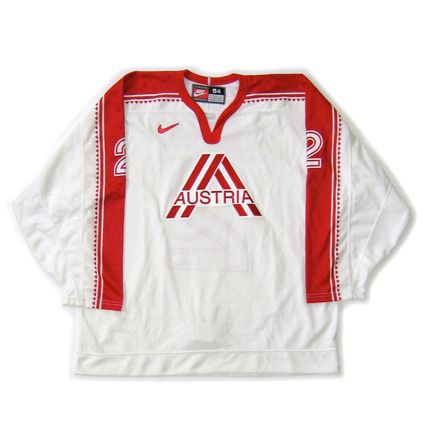
Our featured jersey today is a 2005 Austria National Team Gerhard Unterluggauer jersey as worn during the 2005 World Championships, which were hosted by Austria. This was an unfortunately short lived style, as all national teams received attractive new jerseys for 2005 only to see them replaced with the new Nike Swift styles for the 2006 Olympics.
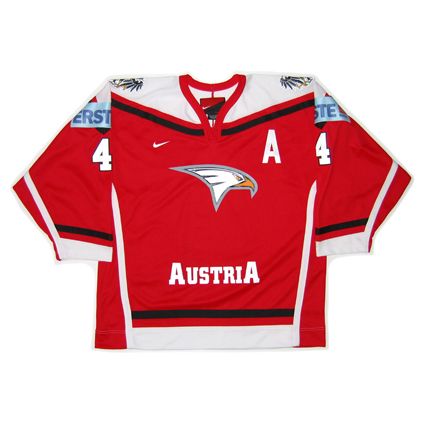
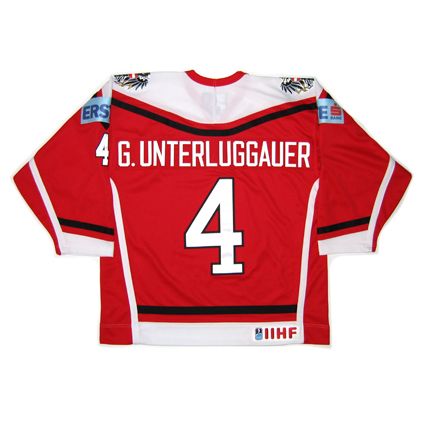
Unterluggauer, a defenseman, began his pro career back in the 1992-93 season, playing his entire career in Austria save for a three year stint in the German DEL in the early 2000's. He has won the Austrian championship twice, in 1993 and 1999.

He has been playing for the Austria National Team since 1993 and his resume includes three Olympic Games (1998, 2002 and 2014) and 18 World Championships.

Austria 2005 jersey photo Austria2005F.jpg
Austria 2005 jersey photo Austria2005B.jpg

Bonus jersey: Today's bonus jersey is a 2008 Great Britain National Team Jason Hewitt jersey as worn during Olympic Pre-Qualifying Group D held in Poland in November of 2008. This is a truly striking jersey with it's large, dynamic lion crest logo with Union Jack mane. The curved, vertical striping only add to the excitement of this vibrantly colored jerseys.

Great Britain 2008 jersey, Great Britain 2008 jersey

Monday, October 26, 2015

Austrian National Day

On this date in 1955 Austria's Parliament issued The Declaration of Neutrality, declaring the country permanently neutral as a part of the Constitution of Austria. The declaration was as a result of Austria being occupied by the Allied Forces (the Soviet Union, the United States, the United Kingdom and France) following World War II from 1945 to 1955. The occupation was ended with the Austria State Treaty of May 15, 1955, which re-established Austria as an independent and democratic sovereign state.

Austria flag photo Austrian-flag.jpg

The Soviets would not have agreed to the treaty if Austria had not committed to declare it's neutrality following the withdrawal of the Allies. As a result of the treaty, the Allies left on October 25, 1955 and the Declaration of Neutrality was enacted the next day, October 26, 1955, the first day of their return to independence, and a date now celebrated as a national holiday known as Austrian National Day.
Austria parliament photo The Austrian Parliament Building in Vienna.jpg
The Austrian Parliament

On Austrian National Day, memorial ceremonies take place, the main one being the Federal President and Federal Minister of Defense attending a ceremony at the Heldenplatz, a large public space in front of Hofburg Palace in Vienna known as Heroes' Square, during which the President lays a wreath at the tomb of the Unknown Soldier. He later  gives a state of the union speech on TV later that day.

Austria Day photo Austrian-national-day-celebrations-in-vienna.jpg
Ceremonies taking place on Austrian National Day

Additionally, flags fly everywhere, concerts and held, new recruits are sworn into the Austrian military, federal museums offer free admission to further the public understanding of Austrian history, and, somewhat uniquely, "fitness marches" are held, which are organized hikes throughout the country to promote fitness and raise awareness of a healthy life style, which attract 100,000 participants annually.

The Austria National Hockey Team is currently ranked 16th in the IIHF World Rankings.

 photo Austrianhockeyfederation.jpg

The Austrians have participated in the Olympics in ice hockey 13 times since 1928, with their best result being an 7th place in 1936 and a 8th place in 1948 and again in 1976. 2014 was the first time Austria had qualified for the Olympic tournament since 2002 and they finished classified 10th, their best showing since 9th in 1988. In order to participate at the 2014 Games in Sochi, Russia, the then ranked 15th Austrians had to survive a Qualification Tournament hosted by the 10th ranked Germans.

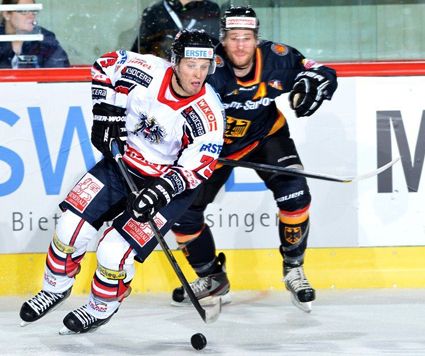
Austria vs Germany 2013 photo AustriavsGermany2013.jpg
Austria battles Germany for the right to participate in the 2014 Olympics

Austria entered the 2014 Olympics with three NHLers on it's roster, Michael Grabner and Thomas Vanek of the New York Islanders and Michael Raffl of the Philadelphia Flyers.

 photo VanekAustria.jpg
Vanek celebrates a goal

Austria has participated in the World Championships dating as far back as 1930, with regular participation since 1959. Austria has won bronze medals at the World Championships in both 1931 and 1947.


Since 1951, Austria was either in Pool B or Pool C nearly exclusively from 1951 to 1992, before a run of 12 out of 13 years in the Top Division before beginning the roller coaster of promotions (2006, 2008, 2010, 2012 and 2014) and relegations (2005, 2007, 2009, 2011, 2013 and 2015), including a bitter relegation in 2009 only because 15th place Germany were saved from their rightful demotion by being scheduled as hosts for the 2010 tournament, which granted the Germans an exemption from relegation for 2009, which sent the 14th place Austrians down to Division I for 2010 instead.


 photo UnterluggauerAustria.jpg
Frequent Austrian National Team captain Gerhard Unterluggauer

Vanek, now a member of he Minnesota Wild, leads all Austrian-born players by far in career NHL scoring with 614 career points, trailed by Grabner at 157. Raffl is third with 51 and all three are still active in the NHL.


Vanek at the 2004 World Championships

The other Austrians to have played in the NHL are Andreas Nodl (36 points with Philadelphia and Carolina), defenseman Thomas Pock (17 with the Rangers and Islanders), Christophe Brandner, the first Austrian to play and score a goal in the NHL in 2003, (9 points with Minnesota) and goaltender Reinhard Divis, who won six games for St. Louis in four seasons.

 photo Divis Austria.jpg
Reinhard Divis

Today's featured jersey is a 1997 Austrian National Team Christoph Brandner jersey as worn in the 1997 World Championships "B" pool. The "waving flag" style of international jerseys were introduced in 1996 and are best known for being used in the 1996 World Cup of Hockey. They were also used in the various World Championships in 1997 before a new style was debuted for the 1998 Winter Olympic Games in Japan.

Brandner scored a goal and two assists in seven game for Austria at the 1997 World Championships. In 2003 Brandner became the first Austrian to play in the NHL and then became the first Austrian to score an NHL goal on October 12, 2009.

Austria 1997 jersey photo Austria 1997 F.jpg
Austria 1997 jersey photo Austria 1997 B.jpg

Bonus jersey: Today's bonus jersey is a 2004 Austria National Team Thomas Vanek jersey as worn in the World Junior Championships in Finland. Austria first wore this jersey style in 1998 and continued to wear it through 2004.

Two distinctive features of this jersey are the fine details of the trim running down the arms and the unique font for the numbers on the back, which are much more at home on a soccer jersey.

Austria 2004 jersey photo Austria 2004 WJC F.jpg
Austria 2004 jersey photo Austria 2004 WJC B.jpg

Extra bonus jersey: Today's extra bonus jersey is a 2005 Austria National Team Gerhard Unterluggauer jersey as worn during the 2005 World Championships, which were held in Austria. This was an unfortunately short lived style, as all national teams received attractive new jerseys for 2005 only to see them replaced with the new Nike Swift styles for the 2006 Olympics.

The now 39 year old Unterluggauer, a defenseman, began his pro career back in the 1992-93 season, playing his entire career in Austria save for a three year stint in the German DEL in the early 2000's. He has won the Austrian championship twice, in 1993 and 1999.

He has been playing for the Austria National Team since 1993 and his resume includes three Olympic Games (1998, 2002 and 2014) and 19 World Championships.

Austria 2005 jersey photo Austria2005F.jpg
Austria 2005 jersey photo Austria2005B.jpg

Today's video section are highlights of the final day of Olympic qualifying, highlighted by Austria's vital game against Germany, which sent the Austrians to Sochi.


Next, showing Austria is not to be taken lightly, they dominate Latvia 6-3 at the 2014 World Championships.

Sunday, December 14, 2014

Third String Goalie Book Review - This is Russia: Life in the KHL

A perfect gift for the hockey fan in your life, especially fans of international hockey and those like us interested in the world of hockey beyond just the NHL, is Austrian goaltender Bernd Brückler's book "This is Russia: Life in the KHL - Doctors, Bazas and Millions of Air Miles".

Life in Russia photo LifeinRussiacover.jpg

Published a year ago, the book details Brückler's career path around the globe, from Graz in his homeland of Austria, to the junior leagues of the United States and on to the University of Wisconsin. From there he played in the minor leagues of North America for a brief period prior to becoming a full time professional with the Espoo Blues in Finlan's SM-liiga for eight seasons until contract offers from the KHL saw him give the life in Russia a go for three seasons, which is the main focus of his entertaining book.

Bruckler photo BrucklerBadgers.jpg
Bruckler in goal for the Wisconsin Badgers

His first stop was with Torpedo Nizhny Novgorod, where he was introduced to the unexplainable daily occurrences of ordinary life there, which the locals simply shrug off and say in resignation "This is Russia."

It's fascinating look at things we take for granted, such as an ordinary hotel room. In Russia, you may have a very nice room. Then again, you may not have working lights. Or a phone. Or a TV. In one memorable occasion, in Nizhnekamsk the hotel was also partly used as a rehabilitation center and there were patients walking around in robes going to and from their treatments. The players didn't mind though, because the rooms were good and had internet access!

Another difference that comes with the territory are the road trips to the far East, as a trip to Khabarovsk is no less than 4,800 miles, a flight so long that the plane needs to refuel on the way! This leads to another sobering part of life in Russia - the state of aviation, as the Lokomotiv Air Disaster happened while Brückler was not only playing in Russia at the time, but his team flew on an identical Yak-42 model that had crashed in Yaroslavl.

Even on the shorter trips where the team took the bus, the onboard toilets naturally didn't work and Brückler describes a scene of 30 men standing on the side of the road all relieving themselves.

A real highlight of the book is Yuri, the driver Brückler hired and the friendship they developed. Yuri knew all the tricks, which of course included occasionally driving on the sidewalk if traffic got to be too much for his liking. He was more than just a driver though, he was a friend and even bodyguard, helping the players assemble their Ikea furniture if needed or pulling gun if the situation called for it!

Bruckler photo BrucklerTorpedo.jpg
There's a lot going on behind the scenes before Brückler
ever takes to the ice for Torpedo

One glaring difference between how the Russian teams are organized and those in North America is the Soviet-era holdover of the baza, the team's combination dormitory/training facility/penal colony. The Baza is also a prime example of the way the Russians do many things "because that's the way it's always been done" regardless of wether it still makes any sense.

To begin with, Torpedo's baza was an hour and fifteen minutes drive from their arena in the middle of a forest. There were two players per room, and two rooms per bathroom, so four men shared one bathroom. At the time of Brückler's arrival in 2009, there was no internet at the baza and the players had only just been allowed to watch TV while there! The players were required to spend the night there the evening before home games, and sometimes the night after a loss. Some team employees and even some players, Russians to be certain, even lived there rent free, despite the lack of heat or air conditioning!

Brückler also covers the world of financial topics, the rise of the KHL fueled by cash, dealing with agents and banking in Russia, including once making a worrisome trip to a bank with a garbage bag full of cash because the team once received their paychecks in stacks of smaller denomination rubles! And you will definitely want to read about the time Brückler hit a pedestrian with his car…

Then of course, there is the hockey. Brückler spends a great deal of the second part of the book discussing the games, coaching philosophy and style of play. He also goes into some detail about some of his teammates, including current NHL star-in-the-making Vladimir Tarasekno of the St. Louis Blues. In addition to the hockey, he also discusses the strange world of the team trainers and doctors, who wanted Brückler on a regimen of 16 pills a day! This was something that bothers him, as Alexi Cherepanov had just passed away with a banned substance in his system a year before Brückler arrived in the KHL.

We really, really enjoy books about how outside players react to living and playing in the Soviet Union and Russia, and this one is no exception. It's a fascinating ride through the many culture clashes and offbeat ways life can be complicated by the smallest things when they are done in ways you never imagined possible, especially when logic seems to have taken a holiday. Any hockey fan on your Christmas list will really enjoy Brückler's book Life in Russia, which is available from Amazon.com


Of course, no story on Third String Goalie would be complete without a featured jersey, and today's is no exception, as today's featured jersey is a 2004 Austria National Team Bernd Brückler jersey. To date, Brückler has made five appearances for Austria at the World Championships, including a promotion from Division I back to the Top Division in 2008.

This style jersey was first used in 1998 and had a long run through 2004 and is notable for it's unusual number font.

After being let go by Sibir, Brückler signed with EC Red Bull Salzburg in his native Austria and is currently in his third season with the club.

Austria 2004 photo Austria2002Fjersey.jpg
 photo Austria2002Bjersey.jpg

Saturday, February 1, 2014

2014 Olympic Hockey Preview - Austria

The Austria National Hockey Team is currently ranked 15th in the IIHF World Rankings. Based on their status outside the top nine ranked countries, Austria was obligated to participate in the Olympic Qualification process, a series of tournaments that date back to September of 2012. Austria entered the qualification process in the third and final round of qualification, being placed in Group D along with the Netherlands (ranked 24th), Italy (18th) and hosts Germany, who were the highest ranked team in the entire qualification process at 10th, one place out of an automatic spot in the Olympics thanks to their poor showing at the 2012 World Championships, where they finished 12th, dropping from 7th to 10th in the 2012 IIHF World Ranking and forcing them into the qualification process.

 photo Austrianhockeyfederation.jpg

In Group D, Austria defeated Italy 3-2 in their opening game and took the top spot in the group with a 6-1 romp over the Netherlands while Germany lost to Italy 2-1 in overtime. In the deciding final game of the group, Austria clinched their place in Sochi by scoring a tying goal in regulation with 7:38 remaining to make the score 3-3. By reaching overtime, Austria now had 7 points in the standings, clear of Germany's 5. While Germany did win the game in overtime, the additional point was not enough to equal the underdog Austrians, who knocked the rival Germans out of the Olympics for the first time in 65 years.

Austria vs Germany 2013 photo AustriavsGermany2013.jpg

The Austrians have participated in the Olympics in ice hockey 12 times since 1928, with their best result being an 7th place in 1936 and a 8th place in 1948 and again in 1976. 2014 will be the first time Austria has qualified for the Olympic tournament since 2002.

Austria has participated in the World Championships dating as far back as 1930, with regular participation since 1959. Austria has won bronze medals at the World Championships in both 1931 and 1947. Since 1951, Austria was either in Pool B or Pool C nearly exclusively from 1951 to 1992, before a run of 12 out of 13 years in the Top Division before beginning the roller coaster of promotions (2006, 2008, 2010 and 2012) and relegations (2005, 2007, 2009, 2011 and 2013), including a bitter relegation in 2009 only because 15th place Germany were saved from their rightful demotion by being scheduled as hosts for the 2010 tournament, which granted them an exemption from relegation for 2009, which sent the 14th place Austrians down to Division I for 2010 instead.

Austria enters the 2014 Olympics with three NHLers on it's roster, Michael Grabner and Thomas Vanek of the New York Islanders and Michael Raffl of the Philadelphia Flyers. 

 photo VanekAustria.jpg
Thomas Vanek

Of the remaining members of the Austrian roster, two play in Swedish Elite League, three in Switzerland and 17 in the Austrian Erste Bank Eishockey Liga, including 37 year old defenseman Gerhard Unterluggauer, who has been playing for the Austria National Team since 1993. Unterluggauer's resume includes two previous Olympic Games (1998 and 2002) and 18 World Championships.

 photo UnterluggauerAustria.jpg
Gerhard Unterluggauer

With the format for this year's Olympics calling for the top four teams after the Preliminary Round to receive byes into the quarterfinals, the key for Austria will be trying to keep their games as close as possible in Group B and hopefully reaching overtime against either Austria or Canada to earn a point or two in the standings before their showdown on February 16th against Norway, where a win over Norway would surely raise them up the rankings to avoid a Qualification Playoff matchup with top six nation.

Unfortunately, the format of the tournament goes against the smaller countries like Austria, as the top teams will be looking to pour it on in the preliminary round since the short schedule puts a great emphasis on goal differential to determine who gets the coveted bye into the quarterfinals, or at least the most favorable matchup in the secondary round on February 18th for a berth in the quarterfinals.

Today's featured jersey is a 2005 Austria National Team Gerhard Unterluggauer jersey as worn during the 2005 World Championships, which were held in Austria. This was a short lived style, as all the teams received attractive new jerseys for 2005, only to see them all replaced with the new Nike Swift styles for the 2006 Olympics.

Unterluggauer began his pro career back in the 1992-93 season, playing his entire career in Austria save for a three year stint in the German DEL in the early 2000's. He has won the Austrian championship twice, in 1993 and 1999 and is frequently the captain of the national team.

Austria 2005 jersey photo Austria2005F.jpg
Austria 2005 jersey photo Austria2005B.jpg

Here is a look at the jerseys that Austria will be wearing in the 2014 Olympics in Sochi. These jerseys are one of the more classic and attractive of the 2014 sets, as Nike has taken a rather unconventional approach with many of the other nations, with decidedly mixed results. 

Austria 2014 jersey photo Austria2014jerseys.png

Today's video section are highlights of the final day of Olympic qualifying, highlighted by Austria's vital game against Germany, which sent the Austrians to Sochi.


Next, showing Austria is not to be taken lightly, they dominate Latvia 6-3 at the most recent World Championships.

Thursday, January 30, 2014

2014 Olympic Preview - Qualification Tournaments Review

With the top nine teams in the 2012  IIHF World Rankings (Russia, Finland, the Czech Republic, Sweden, Canada, Slovakia, the United States, Norway and Switzerland) earning automatic spots in the 2014 Winter Olympic hockey tournament, the final places in the competition were determined by a series of Olympic Qualification Tournaments, which began all the way back in September of 2012.

 photo sochi-2014-logo.jpg

The first phase was the Olympic Preliminary Qualification, which took place in Zagreb, Croatia, where the host Croatians won all three of their games to advance over Mexico, Serbia and Israel.

Croatia moved on to the Olympic Pre-Qualification round, held in November of 2012, and was placed in Group G with Lithuania, Hungary and the Netherlands, who pulled off an upset by defeating the host Hungarians in Budapest in a tournament deciding shootout following a thrilling 6-6 game.

In Kiev, Ukraine delighted the home fans by advancing with a stellar effort, scoring 22 and giving up a mere one goal to defeat Poland, Spain and Estonia in Group H.

Group J took place in Japan and was en eclectic mix of nations, which eventually saw Great Britain win the group with 2 wins and an overtime loss to outlast South Korea, Japan and Romania.

For the Final Olympic Qualification tournaments, the Netherlands was placed in Group D with Italy, Austria and Germany, which came down to rivals Germany and Austria with Germany needing a regulation win and Austria needing only to reach overtime to move on to Sochi.

Germany took until 18:41 to claim the lead, but Austria was the next to score, tying the game with a goal by Andre Lakos at 11:46 of the second period. Michael Wolf gave the home fans hope with a power play goal at 6:54 of the third period, only to have Markus Peintner respond at 12:22 with the key goal for Austria.

 photo AustriaGermany.jpg
Clearly the Olympic ban on commercialism does NOT apply to the qualification stages!

10th ranked Germany pressed for the game winner, out shooting Austria 11-5 for the period, but goaltender Bernhard Starkbaum denied the Germans at every turn to secure the 15th ranked Austrians an upset place in Sochi, ending a streak of Olympic participation for Germany that dates back to 1928!

Of little consolation was the fact that Germany would actually go on to win the game in overtime when Patrick Reimer scored a power play goal at 2:34 of overtime, leaving the Germans to regret not just their overtime loss to Italy, but their dismal performance at the 2012 World Championships, where their 2-5 record (which included losses to Latvia and Norway) left them with a 12th place finish that dropped them from 8th in the World Rankings to 10th, costing them an automatic berth in Sochi for those in the top 9.

Austria (15) will find Finland (2), Canada (5) and Norway (9) awaiting them in Group B in Sochi.

Group E in Riga saw France needing a regulation win over Latvia to send the group into tiebreakers, as a 60 minute win by France would have left Kazakhstan, 6-0 winners over Great Britain, Latvia and France all tied at 6 points each, with France needing to win by 2 goals to claim the invitation to Sochi.

France took a giant step toward that goal by taking a surprising 2-0 lead after one period, only to see goaltender Edgars Masalskis knuckle down as his teammates began to generate some much needed offense. Lauris Darzins got the home team on the board with a goal that took until 14:59 of the second period to arrive to cut the French lead to 2-1 after two periods.

Martins Karsums delighted the home supporters with the equalizer a mere 12 seconds into the third period to give Latvia the appearance of being on their way to Sochi. However, despite the shot of energy by the early goal, a third one was not in the cards for Latvia.

Unable to take the lead and breathe easy, it then became a matter of survival for Latvia as time wore down, as merely getting to overtime and earning a point in the standings was all Latvia required to win the group, but two French goals could steal it all away.

Things got interesting late when each team took a penalty at 17:10 for roughing and then France pulled goaltender Christobal Huet for a late man advantage at 18:06, only to have Kevin Hecquefeuille get called for cross-checking at 19:17.

In the end, Latvia was able to hold on through the end of regulation to claim the point needed to win the group and secure their place in Sochi, which should delight those responsible for ticket sales in Russia as well as their bar owners near the arena as the Latvians fans are known to travel in droves and support their team like no others. The game was not over, however, and Pierre Edouard Bellemare won the game with a goal at 4:20 of overtime, but it came too late for France.

Latvia photo Latvia-3.jpg
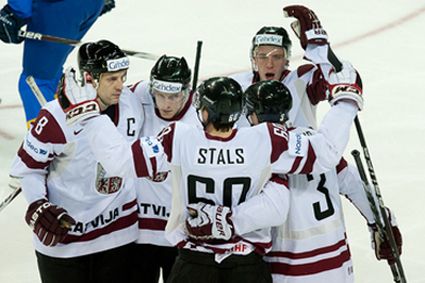
Latvia had much reason to celebrate, winning the war despite losing the battle

Latvia (11) will now join the Czech Republic (4), Sweden (1) and Switzerland (7) in Group C in Sochi, which appears to be the most difficult of the groups.

Finally, in Group F, where Slovenia clinched an upset berth in Sochi by going 3-0 with wins over Belarus, host Denmark and Ukraine to claim their first Olympic berth as the only team in the round to go undefeated.

Slovenia photo Slovenia.jpg
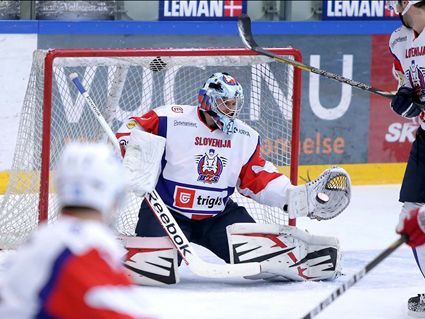
Slovenia completed their memorable weekend in fine form

Group A will consist of Russia (3) , Slovakia (8), the United States (6) and Slovenia (17).

With teams ranked 10th (Germany), 11th (Latvia) and 12th (Denmark) having home ice advantage as the host nation for their group, it certainly was a surprising round of tournaments, as the teams to advance were Latvia in 11th, Austria in 15th and 18th ranked Slovenia as only one host advanced to Sochi.

Be sure to come back over the next 12 days as we preview each of the teams competing in Sochi for the gold medal in the 2014 Winter Olympic men's hockey tournament and feature some terrific jerseys along the way.

Today's featured jersey is a 2008 Croatia Ivan Brencun jersey worn in the 2008 U18 Division II Group A world championships held in France. Both Croatia and Slovenia declared their independence from Yugoslavia on June 25, 1991, which led to a war that lasted until November of 1995 as Serbian forces attempted to keep Croatia as a part of Yugoslavia, or at least reduce the size of Croatia by more than 25% in an effort to keep some Croatian territories as a part of Serbian controlled Yugoslavia.

As a result of the conflicts, the Croatia National Hockey Team did not make its first international appearance until November of 1993 when it debuted in the Group C2 Qualifying Round, where they utterly demolished Turkey by scores of 34-1 and 24-0!

Their win over Turkey advanced them to the main C2 tournament held in Spain. They concluded that tournament ranked 31st in the world, but have since been raked as high as 24th and currently play in Division I Group B, an impressive feat for a country with less than 100 senior level men's players and only two indoor rinks.

Croatia 2008 jersey photo Croatia2008F.jpg
Croatia 2008 jersey photo Croatia2008B.jpg

Sunday, February 10, 2013

2014 Final Olympic Qualification Report

The final games of the 2014 Final Olympic Qualification have just been completed, and with some very unusual and surprising results!

First, in Group F, where Slovenia had already clinched their upset berth in Sochi, they backed up their earlier performance with a  dominant victory lap over Ukraine by a score of 6-1.

Slovenia photo Slovenia.jpg
Slovenia completed their memorable weekend in fine form

A reminder, as determined Friday, Group A will consist of Russia (ranked #1 in the IIHF World Rankings) , Slovakia (6), the United States (7) and Slovenia (18).

Group E in Riga saw France needing a regulation win over Latvia to send the group into tiebreakers, as a 60 minute win by France would have left Kazakhstan, 6-0 winners earlier today over Great Britain, Latvia and France all tied at 6 points each, with France needing to win by 2 goals to claim the invitation to Sochi.

France took a giant step toward that goal by taking a surprising 2-0 lead after one period, only to see goaltender Edgars Masalskis knuckle down as his teammates began to generate some much needed offense. Lauris Darzins got the home team on the board with a goal that took until 14:59 of the second period to arrive to cut the French lead to 2-1 after two periods.

Martins Karsums delighted the home supporters with the equalizer a mere 12 seconds into the third period to give Latvia the appearance of being on their way to Sochi. However, despite the shot of energy by the early goal, a third one was not in the cards for Latvia.

Unable to take the lead and breathe easy, it then became a matter of survival for Latvia as time wore down, as merely getting to overtime and earning a point in the standings was all Latvia required to win the group, but two French goals could steal it all away.

Things got interesting late when each team took a penalty at 17:10 for roughing and then France pulled goaltender Christobal Huet for a late man advantage at 18:06, only to have Kevin Hecquefeuille get called for cross-checking at 19:17.

In the end, Latvia was able to hold on through the end of regulation to claim the point needed to win the group and secure their place in Sochi, which should delight those responsible for ticket sales in Russia as well as their bar owners near the arena! The game was not over, however, and Pierre Edouard Bellemare won the game with a goal at 4:20 of overtime, but it came too late for France.

Latvia photo Latvia-3.jpg
Latvia had much reason to celebrate, winning the war despite losing the battle

Latvia (11) will now join the Czech Republic (3), Sweden (4) and Switzerland (9) in Group C in Sochi, which appears to be the most even of the groups.

Meanwhile, Group D came down to rivals Germany and Austria with a similar scenario, Germany needing a regulation win and Austria needing only to reach overtime.

Germany took until 18:41 to claim the lead, but Austria was the next to score, tying the game with a goal by Andre Lakos at 11:46 of the second period. Michael Wolf gave the home fans hope with a power play goal at 6:54 of the third period, only to have Markus Peintner respond at 12:22 with the key goal for Austria.

 photo AustriaGermany.jpg
Clearly the Olympic ban on commercialism does NOT apply to the qualification stages!

10th ranked Germany pressed for the game winner, out shooting Austria 11-5 for the period, but goaltender Bernhard Starkbaum denied the Germans at every turn to secure the 15th ranked Austrians an upset place in Sochi, ending a streak of Olympic participation for Germany that dates back to 1928!

Of little consolation was the fact that, like France, Germany would actually go on to win the game in overtime when Patrick Reimer scored a power play goal at 2:34 of overtime, leaving the Germans to regret not just their overtime loss to Italy, but their dismal performance at the 2012 World Championships, where their 2-5 record (which included losses to Latvia and Norway) left them with a 12th place finish that dropped them from 8th in the World Rankings to 10th, costing them an automatic berth in Sochi for those in the top 9.

Austria (15) will find Finland (2), Canada (5) and Norway (8) awaiting them in Group B as the full field for Sochi is now set, and fans from Slovenia, Austria and especially Latvia can now begin making travel plans for February of 2014.

With teams ranked 10th (Germany), 11th (Latvia) and 12th (Denmark) having home ice advantage as the host nation for their group, it certainly was a surprising weekend, as the teams to advance were Latvia in 11th, Austria in 15th and 18th ranked Slovenia.

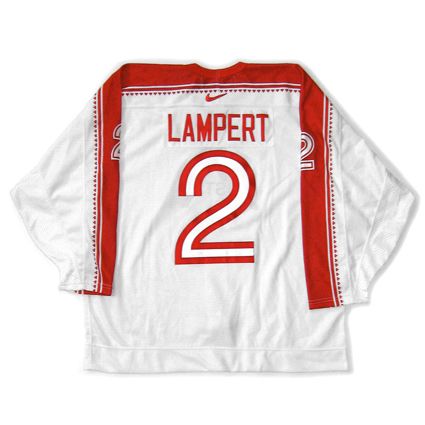
Today's featured jersey is a 2002 Austria National Team Michael Lampert jersey from the last time Austria competed in the Olympics back in 2002 in Salt Lake City. There, Austria lost to Latvia 4-2 and Germany 3-2 before defeating an undermanned Slovakia 3-2, as the NHL had yet to take a break to allow a number of their best players to compete in the Preliminary Round. Their 1-2 record left Austria in their place and only the winner of the group advancing to the First Round. Austria then lost to Switzerland 4-1, which left them classified in 12th place of the 14 teams.

This style of Austrian jersey was first adopted in 1998 and served them for a long time, seven seasons through 2004, with the trim detail on the arm stripe and their unique "soccer jersey" numbers being their most memorable design elements.

Austria 2002 jersey photo Austria2002F.jpg
 photo Austria2002B.jpg
 

hit counter for blogger