History of Jersey 83-93 Banner sm photo History of Jersey 83-93 Banner sm.jpg
Showing posts with label Ottawa Nationals. Show all posts

Friday, April 14, 2017

A Brief History of the Brief Ottawa Nationals - 1972-73 Ottawa Nationals Tom Martin Jersey

When plans began to take place for the inaugural season of the World Hockey Association in 1972-73, the league naturally wanted to have a club located in Canada's largest city Toronto, but they ran into a road block of the most stubborn kind in the form of Harold Ballard, the cantankerous owner of the Toronto Maple Leafs of the rival NHL and, more importantly, their arena, Maple Leaf Gardens.

When no deal was able to be reached with Ballard, the franchise earmarked for Toronto was instead placed in the capital of Ottawa after an attempt to locate the club in Hamilton. The Nationals failed to lure any top-flight NHL talent to Ottawa, such as Brad Park, Dave Keon or Eddie Shack, all of whom were on their draft list, due to their late start in finding a home.

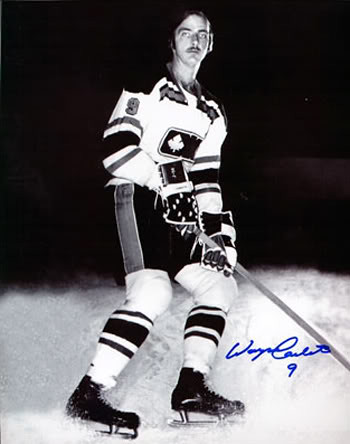
Wayne Carlton was signed away from the California Golden Seals, one of several players the Seals lost to the upstart WHA, and Carlton went on to lead the club with 42 goals, 29 assists and 91 points.
CarletonNationals
The Nationals leading scorer Wayne Carlton

The goaltending duties were handled by rookie Gilles Gratton, who was backed up by former Pittsburgh Penguin veteran Les Binkley. Gavin Kirk and Bob Charlebois each scored more than 60 points while Brian Gibbons led all defensemen in scoring with 42 points while Rick Cunningham led the team with 121 penalty minutes.
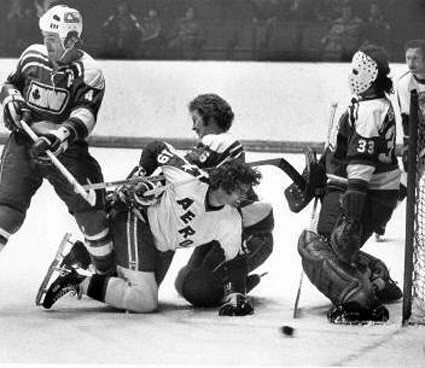
GrattonNationals
Gilles Gratton guards the Nationals goal

After losing their first three games, the Nationals won their next four. They spent their first three months hovering around the .500 mark, closing out December with a 16-18-3 record, which included a pair of four game winning streaks.
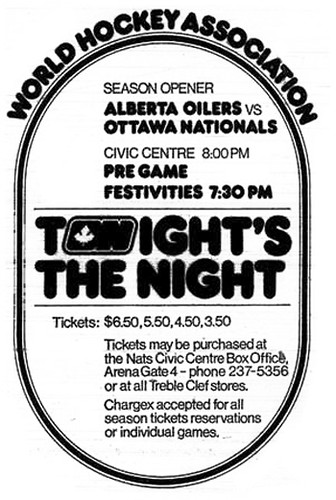
Nationals opening night
An advertisement for the Nationals first game on October 11, 1972

January was unkind to the Nationals, who dropped 11 out of 14 to fall to 19-29-3. After going 6-7-1 in February, the Nationals caught fire and roared through March with a spectacular run, winning 11 of 12 to force themselves back into the playoffs, with their 74 points edging out the Quebec Nordiques at 71.
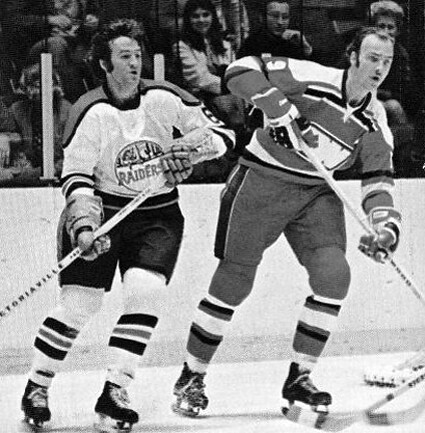
raidersnationals
Ottawa's Wayne Carleton battles Ron Ward of the New York Raiders

Despite Ottawa not having had top level professional hockey since the once-dominant Ottawa Senators left the capital way back in 1934, attendance proved to be an issue, as the team drew an average of just 3,226 fans per game in the 9,000 seat Ottawa Civic Centre.

A big part of the problem with the public in Ottawa was the knowledge that Ottawa was not the intended home for the team. Or even ownership's second choice. After plans to play in both Toronto and then Hamilton fell through, only then did they turn to Ottawa. They only sold 400 season tickets and reduced ticket prices twice in an effort to win over the fans while competing with the established and quite popular Ottawa 67's junior club of the Ontario Hockey Association, which had no problem selling out the Civic Centre.

The Nationals were paired with the first place New England Whalers in the opening round of the postseason, however...

...the City of Ottawa demanded a payment of $100,000 to secure dates for the following season prior to the playoffs, which prompted the club's ownership to consider their options. The option they chose resulted in the Nationals moving all their "home" playoff games to their original intended home Toronto!

Nationals head coach Billy Harris dismissed the relocation for the playoffs when asked if it would affect the team, "Everyone seems to think this will bother our players, that they're thinking of moving instead of concentrating on hockey. Heck, earlier in the year they went through five weeks when they didn't know if they should buy groceries or not. We were supposed to be on our way to Milwaukee, so a little thing like this isn't going to affect us."

Now known as the Ontario Nationals during the playoffs, they lost their first two games 6-3 and 4-3 in Boston. The Nationals returned "home" to face the New England Whalers and won Game 3 by a score of 4-2, but lost Game 4 by a decisive 7-3 score while averaging 5,000 fans a game. The Whalers closed out the series with a 5-4 win back in Boston on this date in 1973 to end the Nationals season, and, as it turned out, the Nationals themselves, as the team was sold following the season to John Bassett, who made Toronto their permanent home and renamed the team the Toronto Toros in June of 1973.

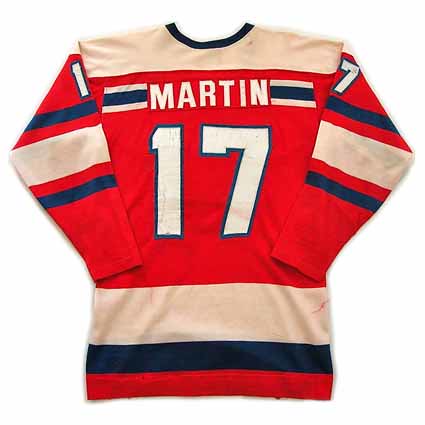
Today's first featured jersey is a 1972-73 Ottawa Nationals Tom Martin jersey as worn for road games during the Nationals only season in Ottawa. This is a very attractive jersey for it's day and the addition of the extra blue stripe trimmed in white just under the shoulder yoke makes it very unique. We especially like the white name on the red nameplate placed directly on top of that stripe.

The team logo is also very bold and well executed, although we always felt it looked more like a corporate logo, for a railroad in particular, rather than a pro hockey team.

Still, a very nice jersey and one that lived an all too short life.
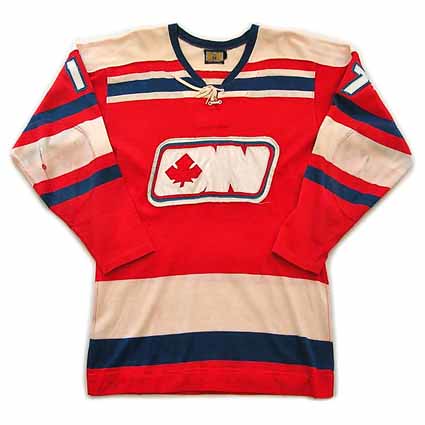
Ottawa Nationals 1972-73 R F jersey
Ottawa Nationals 1972-73 R B jersey

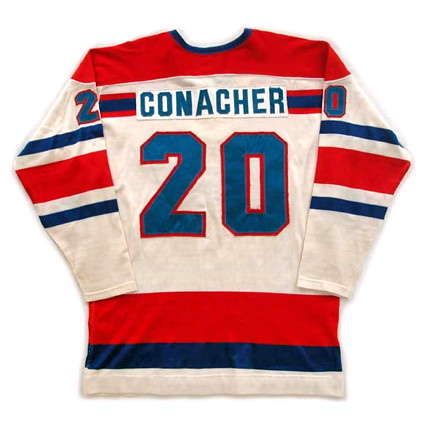
Today's second featured jersey is a 1972-73 Ottawa Nationals Brian Conacher jersey as worn at home during the Nationals only season in Ottawa. 

Ottawa Nationals 1972-73 H F jersey
Ottawa Nationals 1972-73 H B jersey

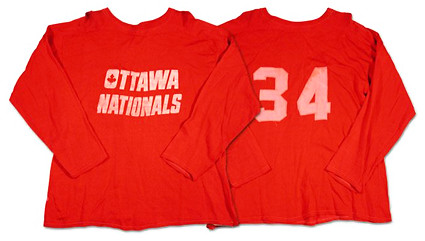
Bonus jersey: Today's bonus featured jersey is a 1972-73 Ottawa Nationals practice jersey as worn during the Nationals only season in Ottawa. 

Ottawa Nationals 1972-73 P jersey

Here is a look at Dennis Murphy and the formation of the WHA and some of the first players to join the upstart league.


Sunday, July 6, 2014

1972-73 Ottawa Nationals Brian GIbbons Jersey

July by the Numbers once again crosses the continent for jersey #6.

When plans began to take place for the inaugural season of the World Hockey Association in 1972-73, the league naturally wanted to have a club located in Toronto, but they ran into a road block of the most stubborn kind in the form of Harold Ballard, the cantankerous owner of the Toronto Maple Leafs and, more importantly, their arena, Maple Leaf Gardens.

When no deal was able to be reached with Ballard, the franchise earmarked for Toronto was instead placed in the capital of Ottawa after an attempt to locate the club in Hamilton. The Nationals failed to lure any top-flight NHL talent to Ottawa, such as Brad Park, Dave Keon or Eddie Shack, all of whom were on their draft list, due to their late start in finding a home, but Wayne Carlton was signed away from the California Golden Seals, one of several players the Seals lost to the upstart WHA, and led the club with 42 goals and 91 points.

Carleton Nationals, Carleton Nationals
The Nationals leading scorer Wayne Carlton

The goaltending duties where handled by rookie Gilles Gratton, who was backed up by former Pittsburgh Penguin veteran Les Binkley. Gavin Kirk and Bob Charlebois each scored more than 60 points while Brian Gibbons led all defensemen in scoring with 42 points while Rick Cunningham led the team with 121 penalty minutes.

Gratton Nationals, Gratton Nationals
Gilles Gratton guards the Nationals goal

After losing their first three games, the Nationals won their next four. They spent their first three months hovering around the .500 mark, closing out December with a 16-18-3 record, which included a pair of four game winning streaks.

January was unkind to the Nationals, who dropped 11 out of 14 to fall to 19-29-3. After going 6-7-1 in February, the Nationals caught fire and roared through March with a spectacular run, winning 11 of 12 to force themselves back into the playoffs, with their 74 points edging the Quebec Nordiques at 71.

Despite Ottawa not having had top level professional hockey since the once-dominant Ottawa Senators left the capital in 1934, attendance proved to be an issue, as the team drew an average of just 3,226 fans per game in the 9,000 seat Ottawa Civic Centre while competing with the established and quite popular Ottawa 67's junior club of the Ontario Hockey Association.

The Nationals were paired with the first place New England Whalers in the opening round of the post season, however...

...the City of Ottawa demanded a payment of $100,000 to secure dates for the following season prior to the playoffs, which prompted the club's ownership to consider their options which resulted in them choosing to move all their "home" playoff games to Toronto!

Now known as the Ontario Nationals during the playoffs, they lost their first two games 6-3 and 4-3 in Boston. The Nationals returned "home" to face the New England Whalers and won Game 3 by a score of 4-2, but lost Game 4 by a decisive 7-3 score while averaging 5,000 fans a game. The Whalers closed out the series with a 5-4 win back in Boston to end the Nationals season, and as it turned out, the Nationals themselves, as the team was sold following the season to John Bassett, who made Toronto their permanent home and renamed the team the Toronto Toros in June of 1973.

Today's featured jersey is a 1972-73 Ottawa Nationals Brian Gibbons jersey as worn during the Nationals only season in Ottawa. This is a very attractive jersey for it's day and the addition of the extra blue stripe trimmed in white just under the shoulder yoke makes it very unique. We especially like the white name on the red nameplate placed directly on top of that stripe.

The team logo is also very bold and well executed, although we always felt it looked more like a corporate logo, for a railroad in particular, rather than a pro hockey team.

Still, a very nice jersey and one that lived an all too short life.
Ottawa Nationals jersey

Here is a history of the formation of the WHA and some of the first players to join the upstart league.


Friday, July 6, 2012

1972-73 Ottawa Nationals Brian GIbbons Jersey

July by the Numbers once again crosses the continent for jersey #6.

When plans began to take place for the inaugural season of the World Hockey Association in 1972-73, the league naturally wanted to have a club located in Toronto, but they ran into a road block of the most stubborn kind in the form of Harold Ballard, the cantankerous owner of the Toronto Maple Leafs and, more importantly, their arena, Maple Leaf Gardens.

When no deal was able to be reached with Ballard, the franchise earmarked for Toronto was instead placed in the capital of Ottawa after an attempt to locate the club in Hamilton. The Nationals failed to lure any top-flight NHL talent to Ottawa, such as Brad Park, Dave Keon or Eddie Shack, all of whom were on their draft list, due to their late start in finding a home, but Wayne Carlton was signed away from the California Golden Seals, one of several players the Seals lost to the upstart WHA, and led the club with 42 goals and 91 points.

Carleton Nationals, Carleton Nationals
The Nationals leading scorer Wayne Carlton

The goaltending duties where handled by rookie Gilles Gratton, who was backed up by former Pittsburgh Penguin veteran Les Binkley. Gavin Kirk and Bob Charlebois each scored more than 60 points while Brian Gibbons led all defensemen in scoring with 42 points while Rick Cunningham led the team with 121 penalty minutes.

Gratton Nationals, Gratton Nationals
Gilles Gratton guards the Nationals goal

After losing their first three games, the Nationals won their next four. They spent their first three months hovering around the .500 mark, closing out December with a 16-18-3 record, which included a pair of four game winning streaks.

January was unkind to the Nationals, who dropped 11 out of 14 to fall to 19-29-3. After going 6-7-1 in February, the Nationals caught fire and roared through March with a spectacular run, winning 11 of 12 to force themselves back into the playoffs, with their 74 points edging the Quebec Nordiques at 71.

Despite Ottawa not having had top level professional hockey since the once-dominant Ottawa Senators left the capital in 1934, attendance proved to be an issue, as the team drew an average of just 3,226 fans per game in the 9,000 seat Ottawa Civic Centre while competing with the established and quite popular Ottawa 67's junior club of the Ontario Hockey Association.

The Nationals were paired with the first place New England Whalers in the opening round of the post season, however...

...the City of Ottawa demanded a payment of $100,000 to secure dates for the following season prior to the playoffs, which prompted the club's ownership to consider their options which resulted in them choosing to move all their "home" playoff games to Toronto!

Now known as the Ontario Nationals during the playoffs, they lost their first two games 6-3 and 4-3 in Boston. The Nationals returned "home" to face the New England Whalers and won Game 3 by a score of 4-2, but lost Game 4 by a decisive 7-3 score while averaging 5,000 fans a game. The Whalers closed out the series with a 5-4 win back in Boston to end the Nationals season, and as it turned out, the Nationals themselves, as the team was sold following the season to John Bassett, who made Toronto their permanent home and renamed the team the Toronto Toros in June of 1973.

Today's featured jersey is a 1972-73 Ottawa Nationals Brian Gibbons jersey as worn during the Nationals only season in Ottawa. This is a very attractive jersey for it's day and the addition of the extra blue stripe trimmed in white just under the shoulder yoke makes it very unique. We especially like the white name on the red nameplate placed directly on top of that stripe.
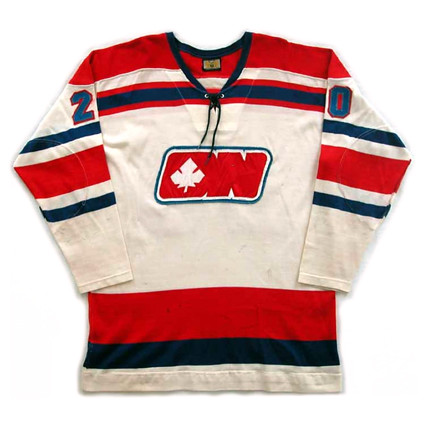
The team logo is also very bold and well executed, although we always felt it looked more like a corporate logo, for a railroad in particular, rather than a pro hockey team.

Still, a very nice jersey and one that lived an all too short life.

Ottawa Nationals jersey

Here is a history of the formation of the WHA and some of the first players to join the upstart league.


Tuesday, July 6, 2010

1972-73 Ottawa Nationals Brian Gibbons Jersey

July by the Numbers checks in at #6 today with a short-lived team from the World Hockey Association.

One of the founding members of the WHA, the Ottawa Nationals got off to a late start after adding a second owner in a better financial position than the original, but failed to come to obtain an agreement to play in Toronto's Maple Leaf Gardens. Management subsequently found their home in Ottawa where they played in the 10,000 seat Ottawa Civic Centre but averaged just 3,000 fans per game.

Due to their late start, the team was unable to secure any star players as several of the other clubs were able to do in order to attract the attention of the fans and media heading in to the WHA's debut season.

The team was led in scoring by former Maple Leaf, Bruin and Golden Seal Wayne Carleton, who led the team with 42 goals and 49 assists for 91 points in 75 games. No other player was able to reach 30 goals or 70 points. The Nationals goaltending duties was split between former Penguin Les Binkley and the quirky Gilles Gratton, who played in 51 of the team's games, going 25-22-3.

The Nationals finished in fourth place in the East Division with a slightly less than .500 record at 35-39-4, but qualified for the playoffs, where they would face the New England Whalers.

Unfortunately for the Nationals, the city of Ottawa demanded a $100,000 payment prior to the playoffs for the right to play in the arena through the end of the following season, which the club decided against paying. This led the team to once more look toward Toronto, where they struck a deal to play their playoff games at Maple Leaf Gardens, kicking off the seemingly endless WHA franchise relocation that would plague the league until the dreaded franchise demise became the norm beginning in 1976 when another Ottawa club, the Civics, became the first to fold completely.

Having lost their first two games 6-3 and 4-3 in Boston, the Nationals returned "home" to face the New England Whalers. They won Game 3 4-2, but lost Game 4 by a decisive 7-3 score while averaging 5,000 fans a game. The Whalers closed out the series with a 5-4 win back in Boston to end the Nationals season, and as it turned out, the Nationals themselves, as the team was sold following the season to John Bassett, who kept the team in Toronto beginning with the 1973-74 season and renamed them the Toros.

Today's featured jersey is a 1972-73 Ottawa Nationals Brian Gibbons jersey. This is a very attractive jersey for it's day and the addition of the extra blue stripe trimmed in white just under the shoulder yoke makes it very unique. We especially like the white name on the red nameplate placed directly on top of that stripe.

The team logo is also very bold and well executed, although we always felt it looked more like a corporate logo, for a railroad in particular, rather than a pro hockey team.

Still, a very nice jersey and one that lived an all too short life.

Ottawa Nationals jersey

Here is a history of the formation of the WHA and some of the first players to join the upstart league.


hit counter for blogger