History of Jersey 83-93 Banner sm photo History of Jersey 83-93 Banner sm.jpg
Showing posts with label Pitre Didier. Show all posts

Tuesday, March 7, 2017

1974-75 Montreal Canadiens Guy Lafleur Jersey

The Montreal Canadiens were founded in 1909 as members of the brand new National Hockey Association in order to provide the French fans of Montreal a team to rival the Anglophone Montreal Wanderers.

The first player to ever score a goal for the Canadiens was future Hall of Famer Newsy Lalonde, who would lead the club with 16 goals despite only appearing in 6 games before being traded to the Renfrew Creamery Kings (also known as the Millionaires). Lalonde would add another 22 goals for Renfrew in just five games to lead the NHA in scoring with 38 goals, as assists were not awarded back then. Lalonde would return to Montreal for the 1910-11 season and again led the club with 19 goals in 16 games.

Newsy Lalonde photo Newsy Lalonde 1909-10.png
The first goal scorer in Canadiens history, Newsy Lalonde,
picture here in the first ever Canadiens sweater

With Lalonde lured out west by the Vancouver Millionaires for the 1911-12 season, Didier Pitre became the first Canadiens player to reach the 20 point mark when he finished as the runner up in the NHA scoring race with 27 goals in an 18 game schedule.

In 1914-15, Pitre became the first Canadiens player to reach the 30 point mark when he totaled 34 points from 30 goals and 4 assists, which were now credited as of 1913-14. Pitre barely missed out being the first 40 point scorer in 1915-16 when his 24 goals and 15 assists, but his 39 points made him the first Canadien to lead the league in scoring.

Didier Pitre photo Didier Pitre.jpg
Pitre was the first Canadiens player with both 20 and 30 points

For the 1917-18 season, the NHA was disbanded and a new league rose to take it's place, the National Hockey League, of which the Canadiens were charter members. The brand new NHL was led in scoring by Joe Malone, who was on loan from the dormant Quebec Bulldogs. Malone was teamed with Lalonde and Pitre and the trio put on a scoring display unlike any ever seen before, as Malone became the first Canadiens player to top 40 points when he blitzed the league for 44 goals and 4 assists for 48 points in just 20 games. Malone's 44 goals in 1917-18 would stand as the league record for 46 years until 1943-44!

Joe Malone photo Joe Malone Montreal.jpg
Joe Malone's 44 goals stood as the NHL record for 46 years

Such was the dominance of Malone's season, it would take until the 1927-28 season for Howie Morenz to become the first for Montreal to reach the 50 point barrier when his 33 goals and 16 assists game him 51 points to not only lead the club, but the entire NHL.

Howie Morenz photo Howie Morenz Canadiens.jpg
Howie Morenz was the first to 50 points

While Toe Blake came oh-so-close to hitting 60 points in 1942-43 with 59, the honors went to teammate Elmer Lach the following season when he vaulted past the 60 point barrier on his way to 72! While it took 16 years for Lach to hit both 60 points and 70 for the first time in team history, it took him just 12 months to become the first member of the Canadiens with 80 when he scored 26 goals and 54 points for exactly 80 in 1944-45, leading a 1-2-3 Canadiens sweep of the NHL scoring race, as Lach's 80 led Maurice Richard's 73 and Blake with 67.

Elmer Lach photo Elmer Lach.jpg
Lach rewrote the Montreal record book in the 1940's,
as he was the first to 60, 70 and 80 points in two seasons

While Jean Beliveau came close with 88 points in 1955-59, it would be left winger Dickie Moore to first reach the 90 point plateau with 41 goals and 55 assists for 96 points, with Beliveau close behind at 91 to finish 1-2 in the league.

Dickie Moore photo Dickie Moore Canadiens.jpg
Dickie Moore pushed the mark to 90 points

While both Frank Mahovlich (96 in 1972) and Jacques Lemaire (95 in 1973) would take runs to become the first to reach the century mark, it would be Guy Lafleur who would take the honors as the first Canadien in the then 58 year history of the club to ever reach 100 points in a single season when he scored twice and added two assists on this date in 1975 in an 8-4 Montreal win over the Washington Capitals in Montreal.

Lafleur would go on to surpass 110 points later that season as he finished with 53 goals and 66 assists for a total of 119 points.

Just one season later, Lafleur eclipsed the 120 point mark with 125 from 56 goals and 69 points to win the NHL scoring race, a feat he repeated the very next season of 1976-77 as he amassed 136 points from 56 goals and 80 assists to set a team record which still stands to this day.

Guy Lafleur photo Guy Lafleur Canadiens.jpg
Guy Lafleur was the first to 100, as well as 110, 120 and
130 points in the span of just three seasons during the 1970's

To put Lafleur's 136 point season into perspective, Max Pacioretty led Montreal in scoring in the 2013-14 season with 60 points, less than half of Lafleur's record setting total.

Today's featured jersey is a 1974-75 Montreal Canadiens Guy Lafleur jersey as worn during the season Lafleur became the first player in franchise history to score 100 points in a single season.

While the first red Canadiens sweater with a blue band across the chest can be traced back to the 1912-13 season, it underwent a period of evolution, which included a "CA" crest before adopting to the "CH" logo in 1916, until arriving at the today's featured jersey for the 1966-67 season when the sleeve numbers were relocated inside the arm stripes. The 1974-75 season would be the final one for this variation with the lace up collar, which arrived back in 1941, as it would be replaced by a modern v-neck for 1975-76.

Montreal Canadiens 1974-75 jersey photo Montreal Canadiens 1974-75 jersey copy.jpg
photo courtesy of Classic Auctions

Today's video section is a career retrospective of Lafleur in his native French.

Thursday, September 1, 2016

1909-10 Montreal Canadiens Didier Pitre Jersey

After playing for the Montreal Nationals in 1903 and 1904 as an amateur, Didier Pitre turned professional with the Michigan Soo Indians (also known as the American Soo Indians in deference to the club in the same league based in  Sault Ste. Marie, Ontario) of the International Professional Hockey League, the first professional league in North America for the 1904-05 season, scoring 11 goals in 13 games. The following season of 1905-06 Pitre destroyed all that came before him, leading the league with 41 goals in 22 games. His final season with the Soo Indians saw him average over a goal per game with 25 in 23 games as well as being credited with 11 assists for 36 points in 1906-07.

Following the demise of the three season old IPHL, and with professional teams now having been formed back east in Canada, Pitre, born on this date in 1883, returned to familiar territory in Quebec when he signed with the Montreal Shamrocks of the Eastern Canada Hockey Association for the 1907-08 season. He would find the going tougher, being limited to 3 goals in 10 games.

For the 1908-09 season, he saw action in 5 games with the Edmonton Eskimos, 3 in the regular season and 2 during their unsuccessful Stanley Cup challenge against the Ottawa Senators. He was then signed by the Renfrew Creamery Kings of the Federal Hockey League, scoring 5 goals in 5 games. His season wasn't quite over yet, as he added an exhibition game with his first club, the Montreal Nationals, to his schedule and impressed with four goals.

He next joined the first year Montreal Canadiens of the National Hockey Association, scoring 11 goals in 12 games. Les Canadiens found the going rough, finishing in last place with a 2-10 record. Pitre continued to play for the Canadiens for three more seasons, increasing his goal total to 19 in 16 games in 1910-11, tied for the team lead with teammate Newsy Lalonde and sixth in the NHA. For the 1911-12 season, Pitre was runner up in the NHA scoring race with 27 goals in 18 games. His final season with the Canadiens saw him again finish sixth in league scoring with 24 goals in 17 games, just one back of Lalonde for the team lead.

Pitre Canadiens 1910-11 photo Pitre Canadiens 1910-11.jpg
Pitre in 1910-11 with the second year Canadiens

For the 1913-14 season, Pitre was lured west by Frank Patrick to be a part of his Vancouver Millionaires club in the Pacific Coast Hockey Association. Pitre's 14 goals and 16 points put him in the top ten in the PCHA scoring.

After one season our wast, Pitre returned to the Montreal Canadiens and immediately set a career high in goal scoring with 30 goals in 20 games, again finishing second in league scoring with 34 points.

On top of his game, Pitre immediately followed that with a career best 39 points in 24 games from 24 goals and 15 assists to win the NHA scoring championship for the 1915-16 season as the former doormats won the O'Brien Cup as NHA champions with a 16-7-1 record.

The Canadiens then hosted the Portland Rosebuds of the PCHA for the rights to the Stanley Cup. Montreal would win the first Stanley Cup in franchise history 3 games to 2, with Pitre scoring a hat trick in Montreal's 6-3 win in Game 3 on his way to leading the playoffs in goal scoring. Pitre played not only center, but also spent time at the rover position for the Canadiens.

Pitre Canadiens 1915-16 photo Pitre Canadiens 1915-16.png
Pitre during the 1915-16 season when he won the NHA
scoring title and the only Stanley Cup of his career

Pitre was second on Montreal in scoring behind Lalonde for 1916-17, but still scored more than a goal per game with 21 goals in 20 games plus 6 additional assists. His 27 points were sixth in the NHA. Montreal won the first half of the season with a 7-3 record, but the outbreak of World War I reeked havoc with the league and the 228th Battalion club no longer had time for hockey and the other Toronto franchise was suspended by the league in a dispute with their difficult owner Eddie Livingstone, who the other owners wanted to be rid of.

Montreal won the two-game, total-goals playoff series with Ottawa 7-6 to advance to the Stanley Cup playoffs against the Seattle Metropolitans, who won the cup three games to one.

In a further effort to rid themselves of Livingstone, the other four NHA team owners disbanded the NHA and reformed a week later as the new National Hockey League. Pitre was again the second leading scorer on the club behind Lalonde, this time with 17 goals and 23 points in 20 games.

For the 1918-19 season, Pitre finished third on the Canadiens in scoring behind the league leader Lalonde and Odie Cleghorn but was fifth in the NHL with 14 goals and 19 points in 17 games. Montreal won the NHL playoffs 4 games to 1 over the Senators to advance to the ill-fated Stanley Cup Finals, which was played in Seattle. The series was tied at 2-2-1 when the Spanish Flu Epidemic forced the cancellation of the series, costing Pitre's Montreal teammate "Bad" Joe Hall his life four days later.

Pitre, known for his size, speed and his hard shot, retained his place in the league's top ten in scoring in 1919-20 with 14 goals and 26 points but fell just shy in 1920-21 with 25 points, one point behind the 26 points needed to keep his streak alive.

The Canadiens were so deep at forward by this stage that during his final two seasons in the NHL, Pitre was moved to defense at age 38, in part thanks to his experience playing rover and taking the place on the blueline formerly occupied by Hall. This change led to him scoring only 2 goals and 6 points in 1921-22 and 1 goal and 3 points in 1922-23.

Pitre Canadiens 1922-23 photo Pitre Canadiens 1922-23.jpg
Pitre at the end of his career with Montreal in 1922-23

Pitre's final NHA, PCHA and NHL totals were 234 goals and 61 assists for 295 points in 270 games played and he was inducted into the Hockey Hall of Fame in 1963.

Today's featured jersey is a 1909-10 Montreal Canadiens Didier Pitre jersey. This blue jersey with a white horizontal chest stripe and large "C" on the chest was worn by Les Canadiens during their first ever season while members of the NHA.

This jersey style lasted only a single season, as was the norm for the Canadiens during their formative years. In their first 16 seasons, Montreal would use 11 different jersey styles, including five in their first four seasons, in stark contrast to their tradition of keeping their same iconic style with only minor detail alterations since 1925.

Montreal Canadiens Didier Pitre 1909-10 jersey

Bonus Jersey: The Canadiens revived their original 1909-10 jerseys as part of their centennial celebrations during the 2008-09 and 2009-10 seasons. This was one of six different styles worn as part of the centennial jersey program.

This particular style was worn on November 21, 2009 in a 3-2 shootout loss to the Detroit Red Wings. Mike Cammalleri scored both Canadiens goals during the game.

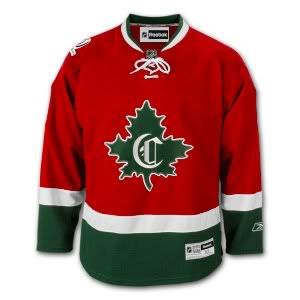
This jersey was scheduled to be worn one additional time on February 13, 2010, but the centennial jersey program was discontinued by the Canadiens new ownership with two games left on the schedule, with the other being on January 23, 2010 when their red and green 1910-11 jerseys were to have been worn, making these two styles the only ones to have been worn just once.

Montreal Canadiens 09-10 09-10TBTC jersey photo MontrealCanadiens09-1009-10TBTCF.jpg
Montreal Canadiens 09-10 09-10TBTC jersey photo MontrealCanadiens09-1009-10TBTCB.jpg
 photo MontrealCanadiens09-1009-10TBTCP.jpg

Our video selection today takes a look back at the formation of Les Canadiens in 1909.


Tuesday, September 1, 2015

1909-10 Montreal Canadiens Didier Pitre Jersey

With the formation of the Montreal Canadiens of the National Hockey Association on December 4, 1909, player-coach Jack Laviolette was put in charge of assembling a roster of French-Canadian players.

The first man he signed was former teammate Didier Pitre, with whom he had played on the American Soo Indians of the original International (Professional) Hockey League in Michigan from 1904 to 1907.

Renowned as a great skater and possessing the hardest shot in hockey, Pitre was an important acquisition for Laviolette and the upstart Les Canadiens as they sought to establish themselves as the team for the French speaking population of Montreal while in the same league with the Montreal Shamrocks and the Montreal Wanderers.

Laviolette paired himself and Pitre with Newsy Lalonde to form a line known as "The Flying Frenchmen" for 7 of the next 9 seasons. While the Canadiens finished last in their first season with a 2-10 record, Pitre managed to average just under a goal per game, with 11 in 12 contests. Pitre exceeded a goal per game average for the next three seasons with Montreal, who changed their name to the "Montreal Canadiens" for their third season, as he first put up 19 goals in 16 games to tie Lalonde for the team lead in scoring as the Canadiens finished second with an 8-8 record. Pitre then an impressive 27 goals in 18 contests, good for second place in the NHA, followed by 24 markers in the 17 games of the 1912-13 campaign to finish one behind Lalonde on the Canadiens and sixth overall.

Following the 1912-13 season, Pitre moved to the west for the 1913-14 season with the Vancouver Millionaires of the Pacific Coast Hockey League, where he scored 14 goals and 2 assists in 16 games in his only season with the Millionaires to tie for seventh in scoring.

Pitre returned to the Canadiens for the 1914-15 season in time to post the finest offensive season of his career when he scored 30 goals, plus 4 assists, in 20 games after moving from defense up to forward.

After scoring 24 goals in 24 games during the 1915-16 NHA season, fourth in the NHA, Pitre led the league champion Canadiens by contributing 4 more goals in 5 playoff games against the Portland Rosebuds as Montreal won the first Stanley Cup in franchise history. Pitre's share for winning the only Stanley Cup of his career amounted to $238.

Montreal again finished atop the NHA the following season to return to the Stanley Cup playoffs for the second consecutive year after Pitre recorded his fifth consecutive 20 goal season in the NHA. His 21 goals in 20 games placed him sixth in the final season of the NHA.

For the 1917-18 season, the Canadiens became charter members of the brand new National Hockey League and Pitre would continue to play with Montreal for six more seasons, averaging 15 goals a season for the first four years while in the NHL.

The Canadiens would return to the Stanley Cup Finals one more time during Pitre's career in 1919, but the series was cancelled after five games had been played with Pitre leading all playoff scorers at the time due to the flu epidemic which would claim the life of Pitre's teammate Joe Hall.

For the final two seasons of Pitre's career, he would move back to play defense in the spot vacated by the passing of Hall.

Pitre would eventually play 20 seasons of hockey, 13 of those with the Canadiens with whom he would score 220 goals and 59 assists for 279 points in 255 games and was elected to the Hockey Hall of Fame in 1962.

Today's featured jersey is a 1909-10 Montreal Canadiens Didier Pitre jersey. This blue jersey with a white horizontal chest stripe and large "C" on the chest was worn by Les Canadiens during their first ever season while members of the NHA.

This jersey style lasted only a single season, as was the norm for the Canadiens during their formative years. In their first 16 seasons, Montreal would use 11 different jersey styles, including five in their first four seasons, in stark contrast to their tradition of keeping their same iconic style with only minor detail alterations since 1925.

Montreal Canadiens Didier Pitre 1909-10 jersey

Bonus Jersey: The Canadiens revived their original 1909-10 jerseys as part of their centennial celebrations during the 2008-09 and 2009-10 seasons. This was one of six different styles worn as part of the centennial jersey program.

This particular style was worn on November 21, 2009 in a 3-2 shootout loss to the Detroit Red Wings. Mike Cammalleri scored both Canadiens goals during the game.

This jersey was scheduled to be worn one additional time on February 13, 2010, but the centennial jersey program was discontinued by the Canadiens new ownership with two games left on the schedule, with the other being on January 23, 2010 when their red and green 1910-11 jerseys were to have been worn, making these two styles the only ones to have been worn just once.

Montreal Canadiens 09-10 09-10TBTC jersey photo MontrealCanadiens09-1009-10TBTCF.jpg
Montreal Canadiens 09-10 09-10TBTC jersey photo MontrealCanadiens09-1009-10TBTCB.jpg
 photo MontrealCanadiens09-1009-10TBTCP.jpg

Our video selection today takes a look back at the formation of Les Canadiens in 1909.


Saturday, March 7, 2015

1974-75 Montreal Canadiens Guy Lafleur Jersey

The Montreal Canadiens were founded in 1909 as members of the brand new National Hockey Association in order to provide the French fans of Montreal a team to rival the Anglophone Montreal Wanderers.

The first player to ever score a goal for the Canadiens was future Hall of Famer Newsy Lalonde, who would lead the club with 16 goals despite only appearing in 6 games before being traded to the Renfrew Creamery Kings (also known as the Millionaires). Lalonde would add another 22 goals for Renfrew in just five games to lead the NHA in scoring with 38 goals, as assists were not awarded back then. Lalonde would return to Montreal for the 1910-11 season and again led the club with 19 goals in 16 games.

Newsy Lalonde photo Newsy Lalonde 1909-10.png
The first goal scorer in Canadiens history, Newsy Lalonde,
picture here in the first ever Canadiens sweater

With Lalonde lured out west by the Vancouver Millionaires for the 1911-12 season, Didier Pitre became the first Canadiens player to reach the 20 point mark when he finished as the runner up in the NHA scoring race with 27 goals in an 18 game schedule.

In 1914-15, Pitre became the first Canadiens player to reach the 30 point mark when he totaled 34 points from 30 goals and 4 assists, which were now credited as of 1913-14. Pitre barely missed out being the first 40 point scorer in 1915-16 when his 24 goals and 15 assists, but his 39 points made him the first Canadien to lead the league in scoring.

Didier Pitre photo Didier Pitre.jpg
Pitre was the first Canadiens player with both 20 and 30 points

For the 1917-18 season, the NHA was disbanded and a new league rose to take it's place, the National Hockey League, of which the Canadiens were charter members. The brand new NHL was led in scoring by Joe Malone, who was on loan from the dormant Quebec Bulldogs. Malone was teamed with Lalonde and Pitre and the trio put on a scoring display unlike any ever seen before, as Malone became the first Canadiens player to top 40 points when he blitzed the league for 44 goals and 4 assists for 48 points in just 20 games. Malone's 44 goals in 1917-18 would stand as the league record for 46 years until 1943-44!

Joe Malone photo Joe Malone Montreal.jpg
Joe Malone's 44 goals stood as the NHL record for 46 years

Such was the dominance of Malone's season, it would take until the 1927-28 season for Howie Morenz to become the first for Montreal to reach the 50 point barrier when his 33 goals and 16 assists game him 51 points to not only lead the club, but the entire NHL.

Howie Morenz photo Howie Morenz Canadiens.jpg
Howie Morenz was the first to 50 points

While Toe Blake came oh-so-close to hitting 60 points in 1942-43 with 59, the honors went to teammate Elmer Lach the following season when he vaulted past the 60 point barrier on his way to 72! While it took 16 years for Lach to hit both 60 points and 70 for the first time in team history, it took him just 12 months to become the first member of the Canadiens with 80 when he scored 26 goals and 54 points for exactly 80 in 1944-45, leading a 1-2-3 Canadiens sweep of the NHL scoring race, as Lach's 80 led Maurice Richard's 73 and Blake with 67.

Elmer Lach photo Elmer Lach.jpg
Lach rewrote the Montreal record book in the 1940's,
as he was the first to 60, 70 and 80 points in two seasons

While Jean Beliveau came close with 88 points in 1955-59, it would be left winger Dickie Moore to first reach the 90 point plateau with 41 goals and 55 assists for 96 points, with Beliveau close behind at 91 to finish 1-2 in the league.

Dickie Moore photo Dickie Moore Canadiens.jpg
Dickie Moore pushed the mark to 90 points

While both Frank Mahovlich (96 in 1972) and Jacques Lemaire (95 in 1973) would take runs to become the first to reach the century mark, it would be Guy Lafleur who would take the honors as the first Canadien in the then 58 year history of the club to ever reach 100 points in a single season when he scored twice and added two assists on this date in 1975 in an 8-4 Montreal win over the Washington Capitals in Montreal.

Lafleur would go on to surpass 110 points later that season as he finished with 53 goals and 66 assists for a total of 119 points.

Just one season later, Lafleur eclipsed the 120 point mark with 125 from 56 goals and 69 points to win the NHL scoring race, a feat he repeated the very next season of 1976-77 as he amassed 136 points from 56 goals and 80 assists to set a team record which still stands to this day.

Guy Lafleur photo Guy Lafleur Canadiens.jpg
Guy Lafleur was the first to 100, as well as 110, 120 and
130 points in the span of just three seasons during the 1970's

To put Lafleur's 136 point season into perspective, Max Pacioretty led Montreal in scoring in the 2013-14 season with 60 points, less than half of Lafleur's record setting total.

Today's featured jersey is a 1974-75 Montreal Canadiens Guy Lafleur jersey as worn during the season Lafleur became the first player in franchise history to score 100 points in a single season.

While the first red Canadiens sweater with a blue band across the chest can be traced back to the 1912-13 season, it underwent a period of evolution, which included a "CA" crest before adopting to the "CH" logo in 1916, until arriving at the today's featured jersey for the 1966-67 season when the sleeve numbers were relocated inside the arm stripes. The 1974-75 season would be the final one for this variation with the lace up collar, which arrived back in 1941, as it would be replaced by a modern v-neck for 1975-76.

Montreal Canadiens 1974-75 jersey photo Montreal Canadiens 1974-75 jersey copy.jpg
photo courtesy of Classic Auctions

Today's video section is a career retrospective of Lafleur in his native French.

Monday, September 1, 2014

1909-10 Montreal Canadiens Didier Pitre Jersey

With the formation of the Montreal Canadiens of the National Hockey Association on December 4, 1909, player-coach Jack Laviolette was put in charge of assembling a roster of French-Canadian players.

The first man he signed was former teammate Didier Pitre, with whom he had played on the American Soo Indians of the original International (Professional) Hockey League in Michigan from 1904 to 1907.

Renowned as a great skater and possessing the hardest shot in hockey, Pitre was an important acquisition for Laviolette and the upstart Les Canadiens as they sought to establish themselves as the team for the French speaking population of Montreal while in the same league with the Montreal Shamrocks and the Montreal Wanderers.

Laviolette paired himself and Pitre with Newsy Lalonde to form a line known as "The Flying Frenchmen" for 7 of the next 9 seasons. While the Canadiens finished last in their first season with a 2-10 record, Pitre managed to average just under a goal per game, with 11 in 12 contests. Pitre exceeded a goal per game average for the next three seasons with Montreal, who changed their name to the "Montreal Canadiens" for their third season, as he first put up 19 goals in 16 games to tie Lalonde for the team lead in scoring as the Canadiens finished second with an 8-8 record. Pitre then an impressive 27 goals in 18 contests, good for second place in the NHA, followed by 24 markers in the 17 games of the 1912-13 campaign to finish one behind Lalonde on the Canadiens and sixth overall.

Following the 1912-13 season, Pitre moved to the west for the 1913-14 season with the Vancouver Millionaires of the Pacific Coast Hockey League, where he scored 14 goals and 2 assists in 16 games in his only season with the Millionaires to tie for seventh in scoring.

Pitre returned to the Canadiens for the 1914-15 season in time to post the finest offensive season of his career when he scored 30 goals, plus 4 assists, in 20 games after moving from defense up to forward.

After scoring 24 goals in 24 games during the 1915-16 NHA season, fourth in the NHA, Pitre led the league champion Canadiens by contributing 4 more goals in 5 playoff games against the Portland Rosebuds as Montreal won the first Stanley Cup in franchise history. Pitre's share for winning the only Stanley Cup of his career amounted to $238.

Montreal again finished atop the NHA the following season to return to the Stanley Cup playoffs for the second consecutive year after Pitre recorded his fifth consecutive 20 goal season in the NHA. His 21 goals in 20 games placed him sixth in the final season of the NHA.

For the 1917-18 season, the Canadiens became charter members of the brand new National Hockey League and Pitre would continue to play with Montreal for six more seasons, averaging 15 goals a season for the first four years while in the NHL.

The Canadiens would return to the Stanley Cup Finals one more time during Pitre's career in 1919, but the series was cancelled after five games had been played with Pitre leading all playoff scorers at the time due to the flu epidemic which would claim the life of Pitre's teammate Joe Hall.

For the final two seasons of Pitre's career, he would move back to play defense in the spot vacated by the passing of Hall.

Pitre would eventually play 20 seasons of hockey, 13 of those with the Canadiens with whom he would score 220 goals and 59 assists for 279 points in 255 games and was elected to the Hockey Hall of Fame in 1962.

Today's featured jersey is a 1909-10 Montreal Canadiens Didier Pitre jersey. This blue jersey with a white horizontal chest stripe and large "C" on the chest was worn by Les Canadiens during their first ever season while members of the NHA.

This jersey style lasted only a single season, as was the norm for the Canadiens during their formative years. In their first 16 seasons, Montreal would use 11 different jersey styles, including five in their first four seasons, in stark contrast to their tradition of keeping their same iconic style with only minor detail alterations since 1925.

Montreal Canadiens Didier Pitre 1909-10 jersey

Bonus Jersey: The Canadiens revived their original 1909-10 jerseys as part of their centennial celebrations during the 2008-09 and 2009-10 seasons. This was one of six different styles worn as part of the centennial jersey program.

This particular style was worn on November 21, 2009 in a 3-2 shootout loss to the Detroit Red Wings. Mike Cammalleri scored both Canadiens goals during the game.

This jersey was scheduled to be worn one additional time on February 13, 2010, but the centennial jersey program was discontinued by the Canadiens new ownership with two games left on the schedule, with the other being on January 23, 2010 when their red and green 1910-11 jerseys were to have been worn, making these two styles the only ones to have been worn just once.

Montreal Canadiens 09-10 09-10TBTC jersey photo MontrealCanadiens09-1009-10TBTCF.jpg
Montreal Canadiens 09-10 09-10TBTC jersey photo MontrealCanadiens09-1009-10TBTCB.jpg
 photo MontrealCanadiens09-1009-10TBTCP.jpg

Our video selection today takes a look back at the formation of Les Canadiens in 1909.


Wednesday, September 1, 2010

1909-10 Montreal Canadiens Didier Pitre Jersey

With the formation of the Montreal Canadiens of the National Hockey Association on December 4, 1909, player-coach Jack Laviolette was put in charge of assembling a roster of French-Canadian players.

The first man he signed was former teammate Didier Pitre, with whom he had played on the American Soo Indians of the original International (Professional) Hockey League in Michigan from 1904 to 1907.

Renowned as a great skater and possessing the hardest shot in hockey, Pitre was an important acquisition for Laviolette and the upstart Les Canadiens as they sought to establish themselves as the team for the French speaking population of Montreal while in the same league with the Montreal Shamrocks and the Montreal Wanderers.

Laviolette paired himself and Pitre with Newsy Lalonde to form a line known as "The Flying Frenchmen" for 7 of the next 9 seasons. While the Canadiens finished last in their first season with a 2-10 record, Pitre managed to average just under a goal per game, with 11 in 12 contests. Pitre exceeded a goal per game average for the next three seasons with Montreal, who changed their name to the "Montreal Canadiens" for their third season, as he first put up 19 goals in 16 games to tie Lalonde for the team lead in scoring as the Canadiens finished second with an 8-8 record. Pitre then an impressive 27 goals in 18 contests, good for second place in the NHA, followed by 24 markers in the 17 games of the 1912-13 campaign to finish one behind Lalonde on the Canadiens and sixth overall.

Following the 1912-13 season, Pitre moved to the west for the 1913-14 season with the Vancouver Millionaires of the Pacific Coast Hockey League, where he scored 14 goals and 2 assists in 16 games in his only season with the Millionaires to tie for seventh in scoring.

Pitre returned to the Canadiens for the 1914-15 season in time to post the finest offensive season of his career when he scored 30 goals, plus 4 assists, in 20 games after moving from defense up to forward.

After scoring 24 goals in 24 games during the 1915-16 NHA season, fourth in the NHA, Pitre led the league champion Canadiens by contributing 4 more goals in 5 playoff games against the Portland Rosebuds as Montreal won the first Stanley Cup in franchise history. Pitre's share for winning the only Stanley Cup of his career amounted to $238.

Montreal again finished atop the NHA the following season to return to the Stanley Cup playoffs for the second consecutive year after Pitre recorded his fifth consecutive 20 goal season in the NHA. His 21 goals in 20 games placed him sixth in the final season of the NHA.

For the 1917-18 season, the Canadiens became charter members of the brand new National Hockey League and Pitre would continue to play with Montreal for six more seasons, averaging 15 goals a season for the first four years while in the NHL.

The Canadiens would return to the Stanley Cup Finals one more time during Pitre's career in 1919, but the series was cancelled after five games had been played with Pitre leading all playoff scorers at the time due to the flu epidemic which would claim the life of Pitre's teammate Joe Hall.

For the final two seasons of Pitre's career, he would move back to play defense in the spot vacated by the passing of Hall.

Pitre would eventually play 20 seasons of hockey, 13 of those with the Canadiens with whom he would score 220 goals and 59 assists for 279 points in 255 games and was elected to the Hockey Hall of Fame in 1962.

Today's featured jersey is a 1909-10 Montreal Canadiens Didier Pitre jersey. This blue jersey with a white horizontal chest stripe and large "C" on the chest was worn by Les Canadiens during their first ever season while members of the NHA.

This jersey style lasted only a single season, as was the norm for the Canadiens during their formative years. In their first 16 seasons, Montreal would use 11 different jersey styles, including five in their first four seasons, in stark contrast to their tradition of keeping their same iconic style with only minor detail alterations since 1925.

Montreal Canadiens Didier Pitre 1909-10 jersey

Bonus Jersey: The Canadiens revived their original 1909-10 jerseys as part of their centennial celebrations during the 2008-09 and 2009-10 seasons. This was one of six different styles worn as part of the centennial jersey program.

This particular style was worn on November 21, 2009 in a 3-2 shootout loss to the Detroit Red Wings. Mike Cammalleri scored both Canadiens goals during the game.

This jersey was scheduled to be worn one additional time on February 13, 2010, but the centennial jersey program was discontinued by the Canadiens new ownership with two games left on the schedule, with the other being on January 23, 2010 when their red and green 1910-11 jerseys were to have been worn, making these two styles the only ones to have been worn just once.

Montreal Canadiens 09-10 09-10TBTC jersey photo MontrealCanadiens09-1009-10TBTCF.jpg
Montreal Canadiens 09-10 09-10TBTC jersey photo MontrealCanadiens09-1009-10TBTCB.jpg
 photo MontrealCanadiens09-1009-10TBTCP.jpg

Our video selection today takes a look back at the formation of Les Canadiens in 1909.


hit counter for blogger