History of Jersey 83-93 Banner sm photo History of Jersey 83-93 Banner sm.jpg
Showing posts with label Clancy King. Show all posts

Saturday, December 17, 2016

1921-22 Ottawa Senators Frank "King" Clancy Jersey

After playing junior hockey in his native Ottawa, Frank "King" Clancy garnered the attention of the local professional club, the Ottawa Senators, who just happened to be the current World Champions.

After a tryout with the Senators, he was signed to a three year contract for $800 a year. When his current, amateur club, the St. Brigid's Athletic Club heard Clancy was planning to leave their team, they attempted to get him to reconsider, talking about the merits of amateurism and how money can often taint a sport and take the joy out of it for the athlete. When they could see that their star player was unconvinced, St. Brigid's make a counteroffer...

Seven dollars and fifty cents - for the entire season!

They explained that was all the money they had left in their treasury and Clancy could have it all if he'd stay!

Needless to say, Clancy became a member of the Senators for the 1921-22 season and played the first game of his NHL career on this date in 1921.
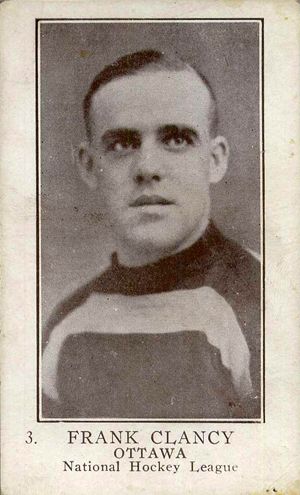
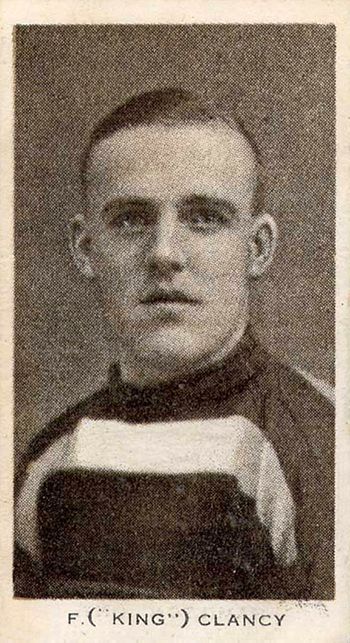
Clancy Rookie Card, Clancy Rookie Card

Clancy relates the story of his first NHL game in the 1968 book "Clancy: The King's Story as Told to Brian MacFarlane";
My first game as pro! I can remember it like it was last night. We were scheduled to play in Hamilton, and they had players on their roster like Goldie Prodgers and Ken Randall and the two Mummery boys [Harry and Walter]. They were all big men, powerful men. The night before I left home for that encounter, my poor dad came down to the station in Ottawa and gave me the kind of advice that any father would give a boy going off to play his first professional game. He took me aside, told me not to worry, to do my best and a lot of other things. Then he shook my hand and wished me luck as I got on the train. 
Now we're on the train and on our way, and I thought everything was just great. Every once in a while some passenger would come down the aisle and I could see he'd recognize some of the players. Now and again one the boys would be asked for his autograph. Nobody recognized me, of course, but I was tickled pink to be among the famous Ottawa Senators. 
We stayed at the Royal Connaught Hotel in Hamilton and that was great too. The next morning going into breakfast, I learned something else. At home my breakfast usually meant a plate of porridge, a piece of toast and maybe a glass of milk. But these guys! They polished off everything! Double orders of bacon and eggs, flapjacks, sausages, toast, rolls, and gallons of milk. I'd never seen fellows eat like that in all my life! It was a revelation to see a bunch of hungry hockey players tie on the feedbag. 
That night we headed out to the Barton Street Arena, the same arena that's used for hockey in Hamilton today. And if I thought I was going to get in a lot of ice time in my first game as a pro, I soon had another thing coming. 
Frankie Boucher and I sat on the bench right though the sixty minutes of game time. We got a chance to warm up before the game and we took a whirl around the ice between periods, but during the actual play we didn't get a smell of the ice. Boucher didn't get the call; I didn't get the call. We're sitting there like a couple of dummies. Now we come to the end of regulation time and the game is tied 2-2. This mean we have to play overtime. The coach, Petey Green, taps me on the shoulder and says, "You go out there in place of [EddieGerard on the defence." Then he turns to Boucher and says, "You go out there in place of [Frank] Nighbor at centre ice." Now this was sudden-death overtime and no time to be making mistakes, and here's the coach throwing two bushers out there in place of two of the greatest players in the game. 
We just begin the overtime, when I get the luckiest break in the world. I remember getting the puck. It came back to me off the draw, and it looked like a big watermelon rolling my way. I slapped at it with my stick and stumbled on ahead with it before I let fly a pass across to Punch Broadbent. I kept going up the ice because I didn't have sense enough to stay back on defense where I belonged. Then, whoops-a-daisy, I get the puck right back again, but I was off at a poor angle and on the wrong side of the net when I took this pass. There wasn't much I could to but wing a shot at the net. I let go a backhander and, lo and behold, I look up and see the goal judge waving his handkerchief and wave it in the air. To me, this handkerchief looked at big as a bed sheet. 
I had scored on my first shot as a professional in the National Hockey League, and it was a winning goal in sudden-death overtime. Naturally I was robbed by my teammates and it then dawned on me that I should keep the puck as a souvenir. When I went after it, the Hamilton goalkeeper, a fellow by the name of [HowieLockhart, just glared at me. I never did know why, until a couple of years later when I met him outside the rink one day and asked him why he would do such a thing. He said it was because the puck went though a hole in the netting at the side of the goal! It hadn't gone in the front at all and so it shouldn't have counted! 
But my first goal did count and we beat Hamilton 3-2 on that shot of mine. To this day I'm not sure whether to be proud of it or embarrassed by it. But scoring that goal on my first shot in the big leagues did one thing for me. It gave me a little confidence. My teammates hadn't see how the puck went in and they couldn't care less. In the shower after the game, Gerard, whose place I'd taken, came over to me and said, "Frankie, that was a terrific shot!:" I thought it was too - until this fellow Lockhart told me what he thought about it some time later.
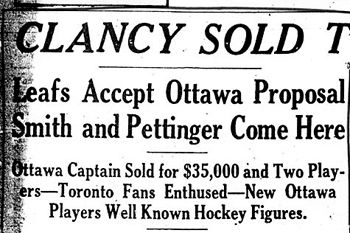
The "goal" would be one of just four Clancy would score as an NHL rookie in 24 games that season. Clancy would play nine seasons with the Senators, winning Stanley Cups in 1923 and 1927 and being named their captain in 1928, before moving on to the Toronto Maple Leafs in 1930 in exchange for $35,000 and two players as the struggling Senators began to sell of their most valuable assets in an effort to stay in business.

Clancy Sold, Clancy Sold

Clancy would play for the Maple Leafs for seven seasons, winning another Stanley Cup in 1932, where his charismatic personality, combined with his small size and extra large toughness, would make him a beloved icon in Toronto.
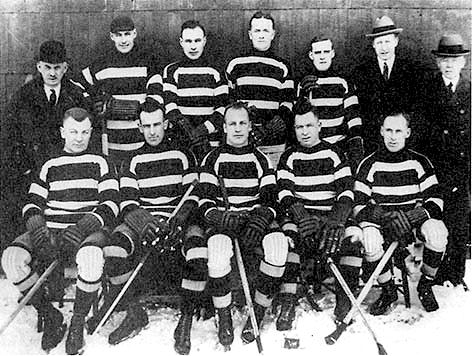
1923-24 Ottawa Senators team, 1923-24 Ottawa Senators team
The 5' 7" Clancy (back row, far right)  is dwarfed by his much larger
Senators teammates in this 1923-24 team photo

Clancy was said, according to McFarlane, to have started a thousand fights and never won any of them. At the time of his retirement in 1937, Clancy was the highest scoring defenseman in NHL history with 136 goals in 592 games, with his best season coming in 1930 with 17.
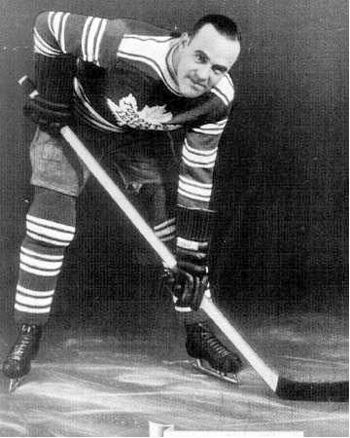
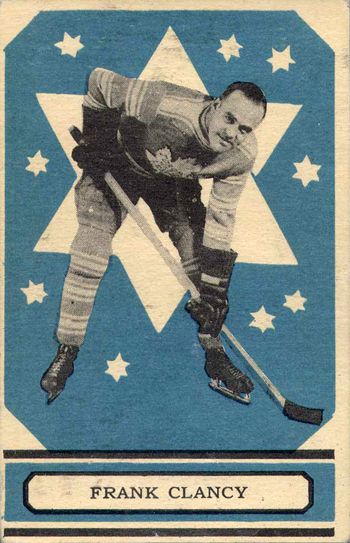
Clancy Maple Leafs, Clancy Maple Leafs

Following his playing days, Clancy became an NHL referee for 11 years before he went into coaching, first in the American Hockey League, which included a Calder Cup championship with Pittsburgh in 1952.
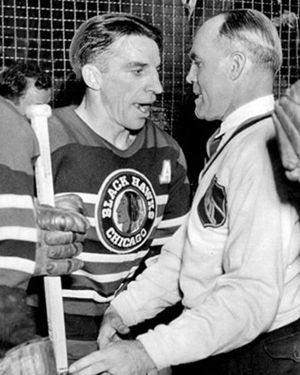
Doug Bentley and King Clancy Referee, Doug Bentley and King Clancy Referee
Doug Bentley politely conversing with referee Clancy

He was promoted to coach of the Maple Leafs in 1953 and, after three seasons, became assistant general manager until 1969 when he was made vice-president of the club, a position he held until he passed away at the age of 83 in 1986, the last surviving member of the 1923 Stanley Cup champions.
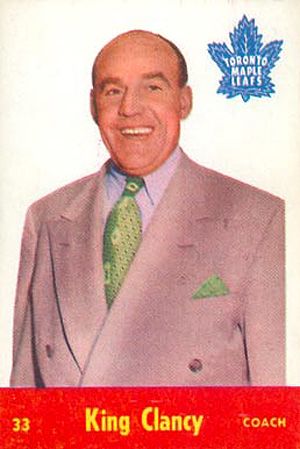
Clancy Coach, Clancy Coach

Clancy was inducted into the Hockey Hall of Fame in 1958 and the Canada Sports Hall of Fame in 1975. In 1998, he was ranked #52 on The Hockey News list of the 100 Greatest Hockey Players.

One further tribute was bestowed on the legendary Clancy when the King Clancy Memorial Trophy was named in his honor and is awarded annually since 1987 to the NHL player who demonstrates leadership qualities on and off the ice and who has made exceptional humanitarian contributions on the community.
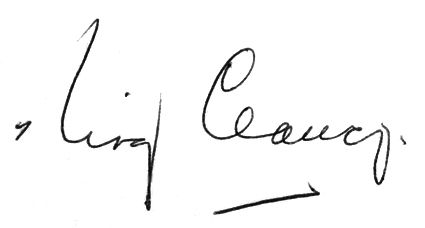
Clancy Autograph, Clancy Autograph

Today's featured jersey is a 1922-23 Ottawa Senators King Clancy jersey. The Senators wore their barber pole jerseys for each of their 14 seasons in the NHL, a style which actually dates back to the turn of the century years prior to the formation of the NHL.

The Senators occasionally wore a special patch commemorating their standing as league champions and in 1929 an "O" crest arrived, but the black, red and white stripes were a constant, both at home and on the road, as the first road jersey did not arrive until the 1927-28 season when the newly renamed Maple Leafs introduced a white jersey to be worn for games against the New York Rangers, who also wore blue sweaters.
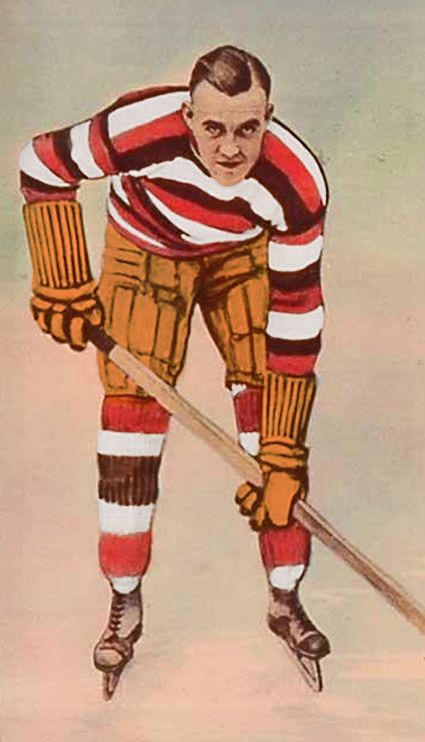
Ottawa Senators 1922-23 jersey, Ottawa Senators 1922-23 jersey

Bonus jersey: Today's bonus jersey is a 1931-32 Toronto Maple Leafs King Clancy jersey. This white jersey was the first road jersey in NHL history, necessitated by the green-clad Toronto St. Patricks being sold and changing their name to the Toronto Maple Leafs during the 1926-27 season.

When the Maple Leafs introduced a new blue jersey for the 1927-28, the New York Rangers were already wearing blue, which, for the first time in league history, necessitated a special jersey to avoid the confusion of both teams wearing blue sweaters. It would not be until six seasons later in 1933-34 that the New York Americans would become the second team to wear two different sweaters during a season.
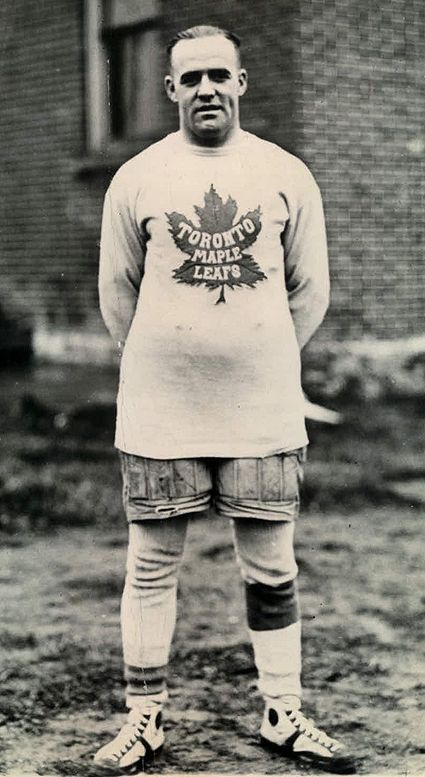
Toronto Maple Leafs 1931-32 jersey, Toronto Maple Leafs 1931-32 jersey

In today's video  section, a look at the versatility of Clancy.


Wednesday, December 17, 2014

1921-22 Ottawa Senators Frank "King" Clancy Jersey

After playing junior hockey in his native Ottawa, Frank "King" Clancy garnered the attention of the local professional club, the Ottawa Senators, who just happened to be the current World Champions.

After a tryout with the Senators, he was signed to a three year contract for $800 a year. When his current, amateur club, the St. Brigid's Athletic Club heard Clancy was planning to leave their team, they attempted to get him to reconsider, talking about the merits of amateurism and how money can often taint a sport and take the joy out of it for the athlete. When they could see that their star player was unconvinced, St. Brigid's make a counteroffer...

Seven dollars and fifty cents - for the entire season!

They explained that was all the money they had left in their treasury and Clancy could have it all if he'd stay!

Needless to say, Clancy became a member of the Senators for the 1921-22 season and played the first game of his NHL career on this date in 1921.

Clancy Rookie Card, Clancy Rookie Card

Clancy relates the story of his first NHL game in the 1968 book "Clancy: The King's Story as Told to Brian MacFarlane";
My first game as pro! I can remember it like it was last night. We were scheduled to play in Hamilton, and they had players on their roster like Goldie Prodgers and Ken Randall and the two Mummery boys [Harry and Walter]. They were all big men, powerful men. The night before I left home for that encounter, my poor dad came down to the station in Ottawa and gave me the kind of advice that any father would give a boy going off to play his first professional game. He took me aside, told me not to worry, to do my best and a lot of other things. Then he shook my hand and wished me luck as I got on the train. 
Now we're on the train and on our way, and I thought everything was just great. Every once in a while some passenger would come down the aisle and I could see he'd recognize some of the players. Now and again one the boys would be asked for his autograph. Nobody recognized me, of course, but I was tickled pink to be among the famous Ottawa Senators. 
We stayed at the Royal Connaught Hotel in Hamilton and that was great too. The next morning going into breakfast, I learned something else. At home my breakfast usually meant a plate of porridge, a piece of toast and maybe a glass of milk. But these guys! They polished off everything! Double orders of bacon and eggs, flapjacks, sausages, toast, rolls, and gallons of milk. I'd never seen fellows eat like that in all my life! It was a revelation to see a bunch of hungry hockey players tie on the feedbag. 
That night we headed out to the Barton Street Arena, the same arena that's used for hockey in Hamilton today. And if I thought I was going to get in a lot of ice time in my first game as a pro, I soon had another thing coming. 
Frankie Boucher and I sat on the bench right though the sixty minutes of game time. We got a chance to warm up before the game and we took a whirl around the ice between periods, but during the actual play we didn't get a smell of the ice. Boucher didn't get the call; I didn't get the call. We're sitting there like a couple of dummies. Now we come to the end of regulation time and the game is tied 2-2. This mean we have to play overtime. The coach, Petey Green, taps me on the shoulder and says, "You go out there in place of [EddieGerard on the defence." Then he turns to Boucher and says, "You go out there in place of [Frank] Nighbor at centre ice." Now this was sudden-death overtime and no time to be making mistakes, and here's the coach throwing two bushers out there in place of two of the greatest players in the game. 
We just begin the overtime, when I get the luckiest break in the world. I remember getting the puck. It came back to me off the draw, and it looked like a big watermelon rolling my way. I slapped at it with my stick and stumbled on ahead with it before I let fly a pass across to Punch Broadbent. I kept going up the ice because I didn't have sense enough to stay back on defense where I belonged. Then, whoops-a-daisy, I get the puck right back again, but I was off at a poor angle and on the wrong side of the net when I took this pass. There wasn't much I could to but wing a shot at the net. I let go a backhander and, lo and behold, I look up and see the goal judge waving his handkerchief and wave it in the air. To me, this handkerchief looked at big as a bed sheet. 
I had scored on my first shot as a professional in the National Hockey League, and it was a winning goal in sudden-death overtime. Naturally I was robbed by my teammates and it then dawned on me that I should keep the puck as a souvenir. When I went after it, the Hamilton goalkeeper, a fellow by the name of [HowieLockhart, just glared at me. I never did know why, until a couple of years later when I met him outside the rink one day and asked him why he would do such a thing. He said it was because the puck went though a hole in the netting at the side of the goal! It hadn't gone in the front at all and so it shouldn't have counted! 
But my first goal did count and we beat Hamilton 3-2 on that shot of mine. To this day I'm not sure whether to be proud of it or embarrassed by it. But scoring that goal on my first shot in the big leagues did one thing for me. It gave me a little confidence. My teammates hadn't see how the puck went in and they couldn't care less. In the shower after the game, Gerard, whose place I'd taken, came over to me and said, "Frankie, that was a terrific shot!:" I thought it was too - until this fellow Lockhart told me what he thought about it some time later.
The "goal" would be one of just four Clancy would score as an NHL rookie in 24 games that season. Clancy would play nine seasons with the Senators, winning Stanley Cups in 1923 and 1927 and being named their captain in 1928, before moving on to the Toronto Maple Leafs in 1930 in exchange for $35,000 and two players as the struggling Senators began to sell of their most valuable assets in an effort to stay in business.

Clancy Sold, Clancy Sold

Clancy would play for the Maple Leafs for seven seasons, winning another Stanley Cup in 1932, where his charismatic personality, combined with his small size and extra large toughness, would make him a beloved icon in Toronto.

1923-24 Ottawa Senators team, 1923-24 Ottawa Senators team
The 5' 7" Clancy (back row, far right)  is dwarfed by his much larger
Senators teammates in this 1923-24 team photo

Clancy was said, according to McFarlane, to have started a thousand fights and never won any of them. At the time of his retirement in 1937, Clancy was the highest scoring defenseman in NHL history with 136 goals in 592 games, with his best season coming in 1930 with 17.

Clancy Maple Leafs, Clancy Maple Leafs

Following his playing days, Clancy became an NHL referee for 11 years before he went into coaching, first in the American Hockey League, which included a Calder Cup championship with Pittsburgh in 1952.

Doug Bentley and King Clancy Referee, Doug Bentley and King Clancy Referee
Doug Bentley politely conversing with referee Clancy

He was promoted to coach of the Maple Leafs in 1953 and, after three seasons, became assistant general manager until 1969 when he was made vice-president of the club, a position he held until he passed away at the age of 83 in 1986, the last surviving member of the 1923 Stanley Cup champions.

Clancy Coach, Clancy Coach

Clancy was inducted into the Hockey Hall of Fame in 1958 and the Canada Sports Hall of Fame in 1975. In 1998, he was ranked #52 on The Hockey News list of the 100 Greatest Hockey Players.

One further tribute was bestowed on the legendary Clancy when the King Clancy Memorial Trophy was named in his honor and is awarded annually since 1987 to the NHL player who demonstrates leadership qualities on and off the ice and who has made exceptional humanitarian contributions on the community.

Clancy Autograph, Clancy Autograph

Today's featured jersey is a 1922-23 Ottawa Senators King Clancy jersey. The Senators wore their barber pole jerseys for each of their 14 seasons in the NHL, a style which actually dates back to the turn of the century years prior to the formation of the NHL.

The Senators occasionally wore a special patch commemorating their standing as league champions and in 1929 an "O" crest arrived, but the black, red and white stripes were a constant, both at home and on the road, as the first road jersey did not arrive until the 1927-28 season when the newly renamed Maple Leafs introduced a white jersey to be worn for games against the New York Rangers, who also wore blue sweaters.

Ottawa Senators 1922-23 jersey, Ottawa Senators 1922-23 jersey

Bonus jersey: Today's bonus jersey is a 1931-32 Toronto Maple Leafs King Clancy jersey. This white jersey was the first road jersey in NHL history, necessitated by the green-clad Toronto St. Patricks being sold and changing their name to the Toronto Maple Leafs during the 1926-27 season.

When the Maple Leafs introduced a new blue jersey for the 1927-28, the New York Rangers were already wearing blue, which, for the first time in league history, necessitated a special jersey to avoid the confusion of both teams wearing blue sweaters. It would not be until six seasons later in 1933-34 that the New York Americans would become the second team to wear two different sweaters during a season.

Toronto Maple Leafs 1931-32 jersey, Toronto Maple Leafs 1931-32 jersey

In today's video  section, a look at the versatility of Clancy.


Monday, December 17, 2012

1921-22 Ottawa Senators Frank "King" Clancy Jersey

After playing junior hockey in his native Ottawa, Frank "King" Clancy garnered the attention of the local professional club, the Ottawa Senators, who just happened to be the current World Champions.

After a tryout with the Senators, he was signed to a three year contract for $800 a year. When his current, amateur club, the St. Brigid's Athletic Club heard Clancy was planning to leave their team, they attempted to get him to reconsider, talking about the merits of amateurism and how money can often taint a sport and take the joy out of it for the athlete. When they could see that their star player was unconvinced, St. Brigid's make a counteroffer...

Seven dollars and fifty cents - for the entire season! They explained that was all the money they had left in their treasury and Clancy could have it all if he'd stay!

Needless to say, Clancy became a member of the Senators for the 1921-22 season and played the first game of his NHL career on this date in 1921.

Clancy Rookie Card, Clancy Rookie Card

Clancy relates the story of his first NHL game in the 1968 book "Clancy: The King's Story as Told to Brian MacFarlane";
My first game as pro! I can remember it like it was last night. We were scheduled to play in Hamilton, and they had players on their roster like Goldie Prodgers and Ken Randall and the two Mummery boys [Harry and Walter]. They were all big men, powerful men. The night before I left home for that encounter, my poor dad came down to the station in Ottawa and gave me the kind of advice that any father would give a boy going off to play his first professional game. He took me aside, told me not to worry, to do my best and a lot of other things. Then he shook my hand and wished me luck as I got on the train. 
Now we're on the train and on our way, and I thought everything was just great. Every once in a while some passenger would come down the aisle and I could see he'd recognize some of the players. Now and again one the boys would be asked for his autograph. Nobody recognized me, of course, but I was tickled pink to be among the famous Ottawa Senators. 
We stayed at the Royal Connaught Hotel in Hamilton and that was great too. The next morning going into breakfast, I learned something else. At home my breakfast usually meant a plate of porridge, a piece of toast and maybe a glass of milk. But these guys! They polished off everything! Double orders of bacon and eggs, flapjacks, sausages, toast, rolls, and gallons of milk. I'd never seen fellows eat like that in all my life! It was a revelation to see a bunch of hungry hockey players tie on the feedbag. 
That night we headed out to the Barton Street Arena, the same arena that's used for hockey in Hamilton today. And if I thought I was going to get in a lot of ice time in my first game as a pro, I soon had another thing coming. 
Frankie Boucher and I sat on the bench right though the sixty minutes of game time. We got a chance to warm up before the game and we took a whirl around the ice between periods, but during the actual play we didn't get a smell of the ice. Boucher didn't get the call; I didn't get the call. We're sitting there like a couple of dummies. Now we come to the end of regulation time and the game is tied 2-2. This mean we have to play overtime. The coach, Petey Green, taps me on the shoulder and says, "You go out there in place of [EddieGerard on the defence." Then he turns to Boucher and says, "You go out there in place of [Frank] Nighbor at centre ice." Now this was sudden-death overtime and no time to be making mistakes, and here's the coach throwing two bushers out there in place of two of the greatest players in the game. 
We just begin the overtime, when I get the luckiest break in the world. I remember getting the puck. It came back to me off the draw, and it looked like a big watermelon rolling my way. I slapped at it with my stick and stumbled on ahead with it before I let fly a pass across to Punch Broadbent. I kept going up the ice because I didn't have sense enough to stay back on defense where I belonged. Then, whoops-a-daisy, I get the puck right back again, but I was off at a poor angle and on the wrong side of the net when I took this pass. There wasn't much I could to but wing a shot at the net. I let go a backhander and, lo and behold, I look up and see the goal judge waving his handkerchief and wave it in the air. To me, this handkerchief looked at big as a bed sheet. 
I had scored on my first shot as a professional in the National Hockey League, and it was a winning goal in sudden-death overtime. Naturally I was robbed by my teammates and it then dawned on me that I should keep the puck as a souvenir. When I went after it, the Hamilton goalkeeper, a fellow by the name of [HowieLockhart, just glared at me. I never did know why, until a couple of years later when I met him outside the rink one day and asked him why he would do such a thing. He said it was because the puck went though a hole in the netting at the side of the goal! It hadn't gone in the front at all and so it shouldn't have counted! 
But my first goal did count and we beat Hamilton 3-2 on that shot of mine. To this day I'm not sure whether to be proud of it or embarrassed by it. But scoring that goal on my first shot in the big leagues did one thing for me. It gave me a little confidence. My teammates hadn't see how the puck went in and they couldn't care less. In the shower after the game, Gerard, whose place I'd taken, came over to me and said, "Frankie, that was a terrific shot!:" I thought it was too - until this fellow Lockhart told me what he thought about it some time later.
The "goal" would be one of just four Clancy would score as an NHL rookie in 24 games that season. Clancy would play nine seasons with the Senators, winning Stanley Cups in 1923 and 1927 and being named their captain in 1928, before moving on to the Toronto Maple Leafs in 1930 in exchange for $35,000 and two players as the struggling Senators began to sell of their most valuable assets in an effort to stay in business.

Clancy Sold, Clancy Sold

Clancy would play for the Maple Leafs for seven seasons, winning another Stanley Cup in 1932, where his charismatic personality, combined with his small size and extra large toughness, would make him a beloved icon in Toronto.

1923-24 Ottawa Senators team, 1923-24 Ottawa Senators team
The 5' 7" Clancy (back row, far right)  is dwarfed by his much larger
Senators teammates in this 1923-24 team photo

Clancy was said, according to McFarlane, to have started a thousand fights and never won any of them. At the time of his retirement in 1937, Clancy was the highest scoring defenseman in NHL history with 136 goals in 592 games, with his best season coming in 1930 with 17.

Clancy Maple Leafs, Clancy Maple Leafs

Following his playing days, Clancy became an NHL referee for 11 years before he went into coaching, first in the American Hockey League, which included a Calder Cup championship with Pittsburgh in 1952.

Doug Bentley and King Clancy Referee, Doug Bentley and King Clancy Referee
Doug Bentley politely conversing with referee Clancy

He was promoted to coach of the Maple Leafs in 1953 and, after three seasons, became assistant general manager until 1969 when he was made vice-president of the club, a position he held until he passed away at the age of 83 in 1986, the last surviving member of the 1923 Stanley Cup champions.

Clancy Coach, Clancy Coach

Clancy was inducted into the Hockey Hall of Fame in 1958 and the Canada Sports Hall of Fame in 1975. In 1998, he was ranked #52 on The Hockey News list of the 100 Greatest Hockey Players.

One further tribute was bestowed on the legendary Clancy when the King Clancy Memorial Trophy was named in his honor and is awarded annually since 1987 to the NHL player who demonstrates leadership qualities on and off the ice and who has made exceptional humanitarian contributions on the community.

Clancy Autograph, Clancy Autograph

Today's featured jersey is a 1922-23 Ottawa Senators King Clancy jersey. The Senators wore their barber pole jerseys for each of their 14 seasons in the NHL, a style which actually dates back to the turn of the century years prior to the formation of the NHL.

The Senators occasionally wore a special patch commemorating their standing as league champions and in 1929 an "O" crest arrived, but the black, red and white stripes were a constant, both at home and on the road, as the first road jersey did not arrive until the 1927-28 season when the newly renamed Maple Leafs introduced a white jersey to be worn for games against the New York Rangers, who also wore blue sweaters.

Ottawa Senators 1922-23 jersey, Ottawa Senators 1922-23 jersey

Bonus jersey: Today's bonus jersey is a 1931-32 Toronto Maple Leafs King Clancy jersey. This white jersey was the first road jersey in NHL history, necessitated by the green-clad Toronto St. Patricks being sold and changing their name to the Toronto Maple Leafs during the 1926-27 season.

When the Maple Leafs introduced a new blue jersey for the 1927-28, the New York Rangers were already wearing blue, which, for the first time in league history, necessitated a special jersey to avoid the confusion of both teams wearing blue sweaters. It would not be until six seasons later in 1933-34 that the New York Americans would become the second team to wear two different sweaters during a season.

Toronto Maple Leafs 1931-32 jersey, Toronto Maple Leafs 1931-32 jersey

In today's video  section, a look at the versatility of Clancy.


Thursday, March 17, 2011

1934 Toronto Maple Leafs St. Patrick's Day King Clancy Jersey

Francis Michael "King" Clancy was born in 1903 and played 16 seasons in the NHL from 1921 to 1937.

Clancy entered the NHL in 1921 playing for his hometown Ottawa Senators. His rugged style would earn him a reputation for heart and effort despite his small stature, as he was five feet seven inches and just 155 pounds. His outgoing personality off the ice combined to make him a fan favorite.


In only his second season, the Senators would win the NHL championship and face off against first the Pacific Coast Hockey Association champions the Vancouver Maroons, who they defeated 3 games to 1 to advance to face the Edmonton Eskimos, champions of the West Coast Hockey League. Game 1 would go to Ottawa 2-1 before the teams would meet again on March 31, 1923. Clancy, normally a defenseman, would set a record by by playing each position on the ice, including two minutes in goal when the regular Senators goaltender Clint Benedict served a penalty! It remains the only time that a player has played in all six positions in a Stanley Cup Final game. The Senators would go on to win the game 1-0 and capture the cup that day.

Four years later the Senators would capture the second cup of Clancy's career when they defeated the Boston Bruins 2 games to none, although there were a pair of ties between the clubs as well.

For the first eight seasons of Clancy's career, he would average 14 points a season with a high of 21, but in 1929-30, Clancy would rack up 17 goals and 23 assists for 40 points in 44 games, by far the most productive offensive season of his career, as he would never even reach 30 in any other season.

Before the following season, Clancy was dealt to the Toronto Maple Leafs for $35,000 and two players. Once in Toronto, Clancy would endear himself to the fans in Toronto with his enthusiasm, effort and out going personality.


He would capture the third and final Stanley Cup of his playing career when the Maple Leafs defeated the New York Rangers 3 games to none, with Game 1 in New York and Game 2 moved to Boston due to the circus being in town! Game 3 was played in Toronto where the Maple Leafs wrapped up the series at home.

Clancy's playing career would last five more seasons before he retired just six games into the start of a sixth. His final NHL totals would be 136 goals and 147 assists for 283 points and 914 penalty minutes.

After his second career as a referee, he began the third phase of his hockey life, moving into coaching in 1949 until 1956, including winning the Calder Cup when with the Pittsburgh Hornets of the American Hockey League. After moving into the front office following his coaching career, Clancy would eventually be named vice-president of the Maple Leafs.

Clancy was inducted into the Hockey Hall of Fame in 1958 and the King Clancy Memorial Trophy was named in his honor in 1987 to award the player who demonstrates leadership qualities on and off the ice and who has made exceptional humanitarian contributions in the community.

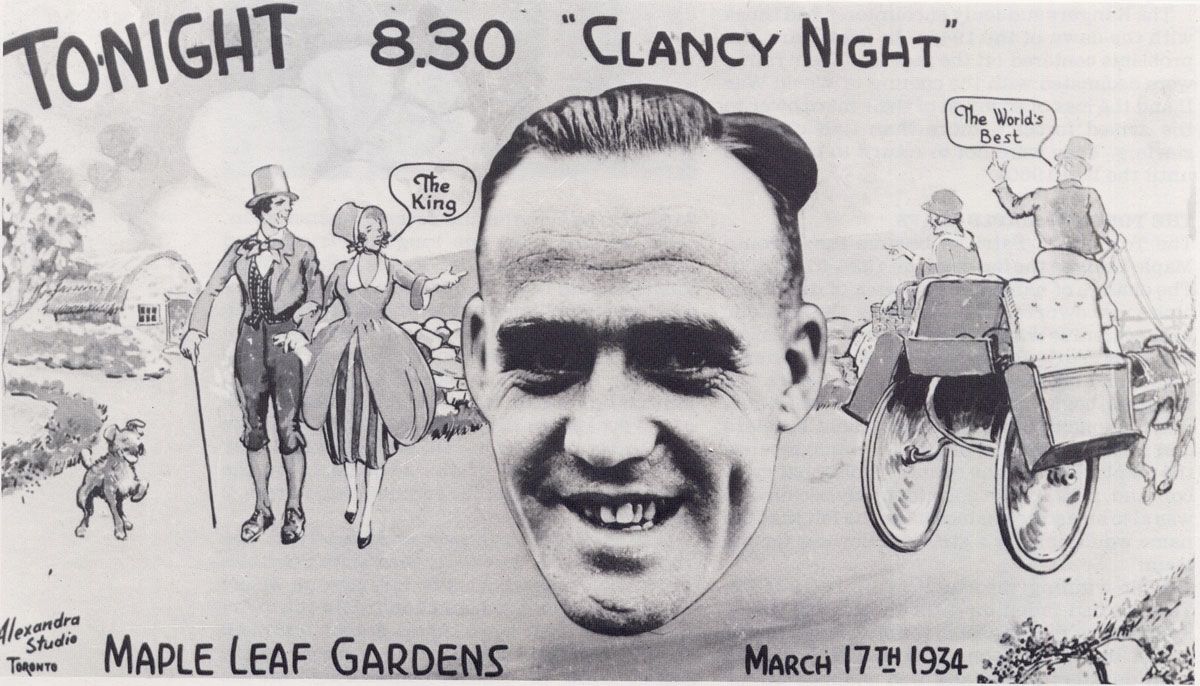
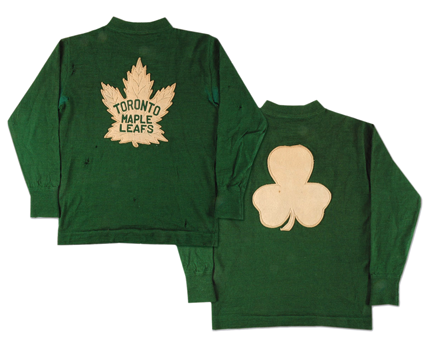
Today's featured jersey is perhaps the most unique one ever on Third String Goalie, a 1934 Toronto Maple Leafs St. Patrick's Day King Clancy jersey. Clancy was given this unique jersey to wear on "Clancy Night" on this day, St. Patrick's Day, in 1934 to celebrate his contributions to the Maple Leafs.


Uniquely, Clancy was the only player to wear this style jersey in the game while the rest of the Maple Leafs wore their traditional blue jerseys!

Clancy himself recalls the game and his unique sweater, "It was March 17, 1934, and it was King Clancy Night in Maple Leaf Gardens and they had me all dressed in green. Stockings, boots, uniform, stick, everything. It was Conn Smythe's idea, and I was a real sickly sight. We were playing the Rangers, and the first time he saw me when I came past the New York bench, Lester Patrick said, "My God, Clancy, what's this?" I think it was the only time I'd ever heard Lester utter a profanity. The effect of my outfit on the Rangers was amazing. They just sort looked at me and gagged, and for the entire first period not one of them came near me.

"I was having a field day on defense, and when the period was over Lester came to me and whispered, "King, what are you doing to me? My boys won't go anywhere near you, and you've got the whole building upset. You look awful. Come on now, King, how about taking that ridiculous uniform of so we can play hockey?"

"I just grinned and nodded, but to tell you the truth I did feel a little embarrassed, so I changed between periods. But really I changed out of respect for Lester. We won the game anyway."

This special green jersey features a shamrock on the back in place of Clancy's usual #7 and was worn during the first period of the game that night before protests by the New York Rangers apparently humorless Lester Patrick forced Clancy back into his more familiar blue and white Maple Leafs jersey for the remainder of the game, which was won by Toronto 3-2 in front of 11,000 adoring Clancy fans.


There is sadly little video online about King Clancy, but here is a look at the 1931-32 Stanley Cup Champion Toronto Maple Leafs that Clancy was a member of. Notice the diminutive size of the cup at the time.


Today we're all Irish.


Wednesday, March 17, 2010

1934 Toronto Maple Leafs St. Patrick's Day King Clancy Jersey

Francis Michael "King" Clancy was born in 1903 and played 16 seasons in the NHL from 1921 to 1937.

Clancy entered the NHL in 1921 playing for his hometown Ottawa Senators. His rugged style would earn him a reputation for heart and effort despite his small stature, as he was five feet seven inches and just 155 pounds. His outgoing personality off the ice combined to make him a fan favorite.


In only his second season, the Senators would win the NHL championship and face off against first the Pacific Coast Hockey Association champions the Vancouver Maroons, who they defeated 3 games to 1 to advance to face the Edmonton Eskimos, champions of the West Coast Hockey League. Game 1 would go to Ottawa 2-1 before the teams would meet again on March 31, 1923. Clancy, normally a defenseman, would set a record by by playing each position on the ice, including two minutes in goal when the regular Senators goaltender Clint Benedict served a penalty! It remains the only time that a player has played in all six positions in a Stanley Cup Final game. The Senators would go on to win the game 1-0 and capture the cup that day.

Four years later the Senators would capture the second cup of Clancy's career when they defeated the Boston Bruins 2 games to none, although there were a pair of ties between the clubs as well.

For the first eight seasons of Clancy's career, he would average 14 points a season with a high of 21, but in 1929-30, Clancy would rack up 17 goals and 23 assists for 40 points in 44 games, by far the most productive offensive season of his career, as he would never even reach 30 in any other season.

Before the following season, Clancy was dealt to the Toronto Maple Leafs for $35,000 and two players. Once in Toronto, Clancy would endear himself to the fans in Toronto with his enthusiasm, effort and out going personality.


He would capture the third and final Stanley Cup of his playing career when the Maple Leafs defeated the New York Rangers 3 games to none, with Game 1 in New York and Game 2 moved to Boston due to the circus being in town! Game 3 was played in Toronto where the Maple Leafs wrapped up the series at home.

Clancy's playing career would last five more seasons before he retired just six games into the start of a sixth. His final NHL totals would be 136 goals and 147 assists for 283 points and 914 penalty minutes.

After his second career as a referee, he began the third phase of his hockey life, moving into coaching in 1949 until 1956, including winning the Calder Cup when with the Pittsburgh Hornets of the American Hockey League. After moving into the front office following his coaching career, Clancy would eventually be named vice-president of the Maple Leafs.

Clancy was inducted into the Hockey Hall of Fame in 1958 and the King Clancy Memorial Trophy was named in his honor in 1987 to award the player who demonstrates leadership qualities on and off the ice and who has made exceptional humanitarian contributions in the community.

Today's featured jersey is perhaps the most unique one ever on Third String Goalie, a 1934 Toronto Maple Leafs St. Patrick's Day King Clancy jersey. Clancy was given this unique jersey to wear on "Clancy Night" on this day, St. Patrick's Day, in 1934 to celebrate his contributions to the Maple Leafs.


Uniquely, Clancy was the only player to wear this style jersey in the game while the rest of the Maple Leafs wore their traditional blue jerseys!

Clancy himself recalls the game and his unique sweater, "It was March 17, 1934, and it was King Clancy Night in Maple Leaf Gardens and they had me all dressed in green. Stockings, boots, uniform, stick, everything. It was Conn Smythe's idea, and I was a real sickly sight. We were playing the Rangers, and the first time he saw me when I came past the New York bench,Lester Patrick said, "My God, Clancy, what's this?" I think it was the only time I'd ever heard Lester utter a profanity. The effect of my outfit on the Rangers was amazing. They just sort looked at me and gagged, and for the entire first period not one of them came near me.

"I was having a field day on defense, and when the period was over Lester came to me and whispered, "King, what are you doing to me? My boys won't go anywhere near you, and you've got the whole building upset. You look awful. Come on now, King, how about taking that ridiculous uniform of so we can play hockey?"

"I just grinned and nodded, but to tell you the truth I did feel a little embarrassed, so I changed between periods. But really I changed out of respect for Lester. We won the game anyway."

This special green jersey features a shamrock on the back in place of Clancy's usual #7 and was worn during the first period of the game that night before protests by the New York Rangers apparently humorless Lester Patrick forced Clancy back into his more familiar blue and white Maple Leafs jersey for the remainder of the game, which was won by Toronto 3-2 in front of 11,000 adoring Clancy fans.


There is sadly little video online about King Clancy, but here is a look at the 1931-32 Stanley Cup Champion Toronto Maple Leafs that Clancy was a member of. Notice the diminutive size of the cup at the time.


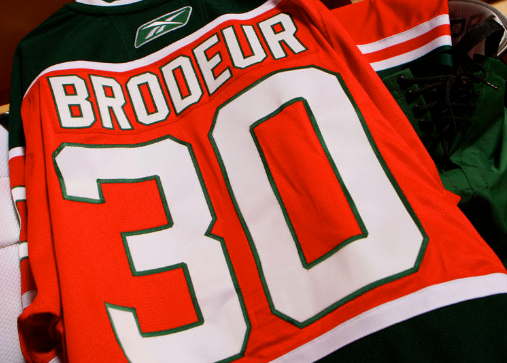
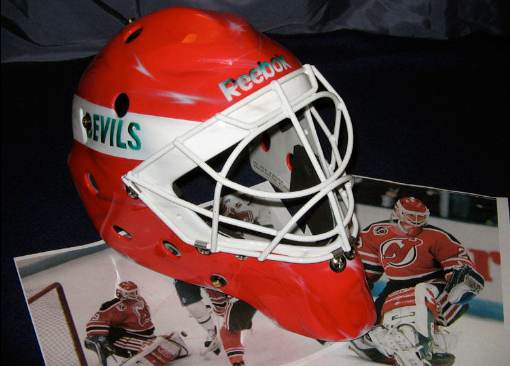
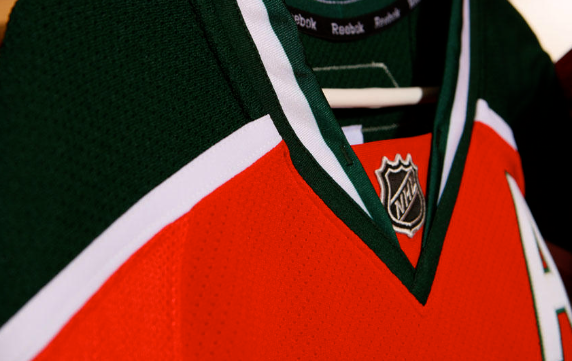
Dasherboard: Speaking of special green jerseys on St. Patrick's Day, the New Jersey Devils will be wearing their original red and green jerseys in a special one time only event tonight against the Pittsburgh Penguins. Martin Brodeur will even be wearing a throwback mask painted like the one he wore when he first broke in to the NHL, while wearing sweater #29.

The red and green jerseys were originally worn from 1982-83 through the 1991-92 season. The jerseys worn on the ice will be Reebok Edge jerseys, while the ones being made available for retail are CCM 550 style jerseys.

In addition to wearing Reebok Edge jerseys, the Devils will be wearing their current name and number fonts which technically have only been worn on their jerseys since the change to the red and black jerseys in 1992-93, instead of the number fonts originally worn on the red and green ones.


hit counter for blogger