Joe Mullen, one of the best kept secrets in hockey history, attended Boston College for four years and, after finishing his college career, immediately played for the United States in the 1979 World Championships where he scored seven goals in eight games.
Boston College Eagles captain Joe Mullen
Rather than playing for the United States at the 1980 Olympics, Mullen turned professional when he signed a contract with the St. Louis Blues due to his father's illness and subsequent financial needs of the family, causing him to miss being a part of the 1980 "Miracle on Ice" United States Olympic hockey team.
St. Louis assigned Mullen to the Salt Lake Golden Eagles of the CHL, where he was named the league's Rookie of the Year. The following season with the Golden Eagles, he would win the league scoring title.
In 1981-82 Mullen would see 45 games in the NHL and score 59 points. After another partial season in 1982-83, Mullen would stick full time with the Blues and rewarded them with his first 40 goal season, scoring 41 goals and 85 points. The next season would see another 40 goals and hit 92 points.
Inexplicably, St. Louis would trade Mullen halfway through the 1985-86 season, along with Terry Johnson and Rik Wilson to the Calgary Flames for Ed Beers, Charles Bourgeois and Gino Cavallini.
Not breaking stride, Mullen would total a career high 44 goals that season split between the two clubs. He would top that with 47 goals the next season as he led the Flames in scoring with 87 points, along with winning the Lady Byng Trophy, and 40 more goals the year after. The Flames would put it all together in 1988-89, as Mullen would score a career high 51 goals, along with 59 assists for a career best 110 points and his second Lady Byng Trophy.
Following a remarkable game in Flames history on March 21, 1989, Mullen celebrates his 50th goal of the season, as does Joe Nieuwendyk, while Lanny McDonald smiles after reaching both 500 goals and 1,000 points, all during the same game
During the final game of the 1988-89 season, Mullen scored a goal and picked up a pair of assists in a 4-2 Flames win over the Edmonton Oilers. The three points Mullen scored that night set a new NHL record for most points in a season by an American born player, breaking the mark of 107 set by JimmyCarson of the Los Angeles King set the previous season.
Mullen and the Flames would finish the season by capturing the Stanley Cup after narrowly defeating the Vancouver Canucks in overtime of Game 7 in round 1 prior to sweeping the Kings in four and eliminating the Chicago Blackhawks in five before defeating the Montreal Canadiens in six games in the last Stanley Cup Final played between two Canadians teams, becoming the only team to ever win the cup against the Canadiens at the Montreal Forum in it's 71 year history.
After another 36 goal season in 1989-90, Mullen would be traded again, this time to the Pittsburgh Penguins prior to the 1990-91 season for a second round draft pick. The timing couldn't have been better for Mullen. Although he would only play in 47 regular season games due to injuries, his 17 points in 22 playoff games would help the Penguins capture their first Stanley Cup.
Mullen again gets to lift Lord Stanley's cup
He would return to form with 42 goals in 1991-92 and Pittsburgh would again capture the Stanley Cup, the third of Mullen's career.
Two more 70 point seasons would follow before he was limited to 45 games in 1994-95 but did score the 1000th point of his career on February 7, in 1995 in Pittsburgh, making him the 42nd player to reach 1000 points but only the first American to ever do so.
He would sign as a free agent with the Boston Bruins for the 1995-96 season and play in 37 games, scoring 8 goals. After the season, Mullen would be named the 1995 winner of the Lester Patrick Trophy.
Mullen would return to Pittsburgh for his final NHL season. With just ten games remaining in the season, Mullen would score the 500th goal of his career, only the 25th player and first American to ever reach that hallowed milestone.
Internationally, despite missing out on the 1980 Olympics, Mullen would suit up for the United States during the 1984, 1987 and 1992 Canada Cup tournaments. After having retired from hockey in 1997, He would return one more time at age 42 to play for the United States in a qualifying tournament for the 1999 World Championships.
Mullen was selected as a member of the Hockey Hall of Fame on this date in 2000.
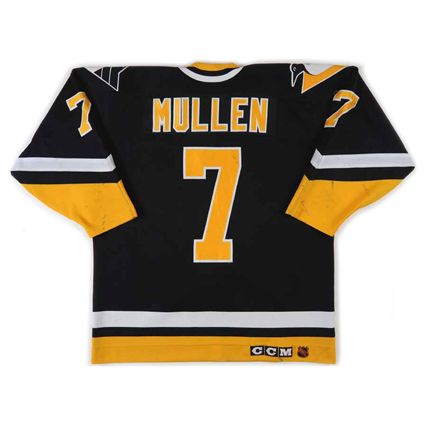
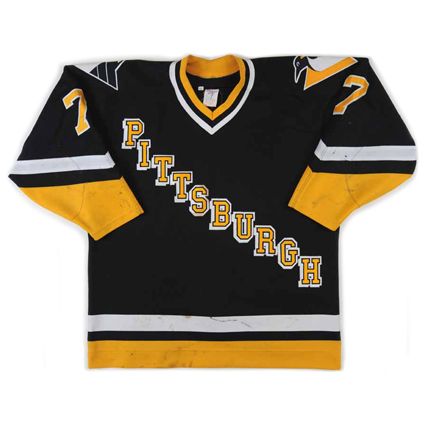
Today's featured jersey is a 1994-95 Pittsburgh Penguins Joe Mullen jersey worn during the season Mullen became the first American player to ever score 1,000 points in the NHL. The Penguins were fresh off winning back-to-back Stanley Cups in 1991 and 1992, but chose to mess with success and introduced a brand new set of jerseys for the 1992-93 season, which included dropping the "skating penguin" logo, which dated back to 1968-69, in favor of the "robo penguin", a modern, highly stylized logo, which served as the main crest of their home white jerseys and the secondary logo on their new road black jerseys. While the white jerseys came off as quite modern, thanks to their new, graphic crest and pointed shoulder yoke, the road jerseys were an attractive melding of the old and new, as the jersey template was originally used by Pittsburgh back in 1974-75 when the team wore blue jerseys, paired with the diagonal "PITTSBURGH" cresting as used during their inaugural season of 1967-68. Those classic elements were then mated with their modern, new logo as the secondary shoulder logo, done in a rather sizable manner, which was all executed in their current black and gold colors. After being introduced in 1992-93, the black road jersey would last through the 1996-97 season until being replaced by the Penguins far less attractive alternate jersey, while the white home jersey continued on through 2001-02.
Bonus jersey: Today's bonus jersey is a 1988-89 Calgary Flames Joe Mullen jersey as he wore in when he became the highest scoring American-born player in NHL history at home against the Edmonton Oilers. Calgary would go on to capture the Stanley Cup at the conclusion of the 1988-89 season, Mullen's first championship.
Calgary would continue to wear this style jersey through the 1993-94 season until it was replaced after 22 seasons of use, which included a change in logo after the franchise's relocation from Atlanta to Calgary.
Here is an interview with Mullen from May of 1991 showing off his eastern accent and talking about is unusual neck collar he wore on the ice, as seen in the photo above of him holding the Stanley Cup.
Next is Mullen from 20 years later looking back at his early days of playing roller hockey in New York City.
Here are videos of Mullen winning the Stanley Cup, first with the Calgary Flames in 1989 followed by the Penguins winning Game 6 to capture the 1991 Stanley Cup, which includes Mullen scoring a pair of the many Penguins goals and assisting on the one by Ron Francis.
Gary Roberts, born on this date in 1966, began his road to the NHL with the Ottawa 67's of the OHL in 1982-83. After his second season, in which he scored 57 points in 48 games and impressed with his toughness, acquiring 144 penalty minutes, Roberts was drafted 12th overall in the 1984 NHL Entry Draft. Additionally, Ottawa won the OHL playoff championship and advanced to the Memorial Cup, which they were able to win following a 7-2 dismantling of the Kitchener Rangers in the final.
Now full of confidence after having been drafted as well as winning the championship the previous year, Roberts elevated his game to the next level in 1984-85 when he scored 44 goals and 106 points while amassing 186 penalty minutes in 59 games, establishing himself as an elite NHL prospect.
Roberts began the 1985-86 season with Ottawa bit was traded to the Guelph Platers for the second half of the season. Roberts was the missing piece for Guelph, as he racked up 31 points in 20 playoff games to lead the Paters to the second Memorial Cup title of his career.
Roberts turned professional the next season with the Moncton Golden Flames of the AHL. He was called up to the Calgary Flames, which included scoring a goal in his game. He bounced up and down between the AHL and NHL in 1986-87, eventually totaling 15 points in 32 games with Calgary.
During his second full season with the Flames in 1988-89, Roberts and the Flames went on a run through the playoffs which cumulated in their winning the only Stanley Cup championship in Flames history. In 22 games, Roberts contributed 12 points.
Roberts game took a big leap forward the following season, as he nearly doubled his previous season's offensive totals with 39 goals and 72 points, while his toughness was not affected, as he finished with over 200 penalty minutes for the third of five consecutive seasons.
In 1991-92 Roberts reached the pinnacle of his offensive production with the only 50 goal season of his career with 53 on his way to totaling a career best 90 points to lead the Flames in scoring, no easy feat on a roster with Al MacInnis, Theo Fleury, Sergei Makarov and Joe Nieuwendyk. Thanks to his 207 penalty minutes, Roberts became the first player in NHL history to ever score 50 goals and have over 200 penalty minutes in one season, essentially creating the concept of the modern "power forward" singlehandedly.
In the 1993-94 season Roberts nearly equalled his career high when he hit 84 points in 73 games. During the season he blocked a slapshot while killing a penalty, which broke his thumb in seven places, but in a testament to his ongoing toughness, he missed just one game and scored two goals in his return.
Injuries did get the better of Roberts when he suffered severe nerve damage in his neck, which limited him to just 8 games of the 1994-95 season. His recovery time continued into the 1995-96 season as he require multiple surgeries to address his condition. Finally, he returned in January of 1996 and scored a goal in his first game back. He would play in the Flames next 35 games, changing from center to wing to avoid additional contact for his fragile neck, and score 22 goals and 42 points before once again injuring his neck and missing the remainder of the season as well as the 1996 playoffs.
With the risk of paralysis from any further injury a very real possiblity, Roberts announced his retirement from the NHL in June of 1996, just two days before receiving the Masterton Trophy for his comeback to hockey after nearly a year away earlier in the season.
Roberts never actually signed his retirement papers however, and continued to work out and rehabilitate his neck while missing the 1996-97 season. He announced himself fit and pain free in January of 1997 and was offered a contract by the Flames for the 1997-98 season. Roberts let the Flames know that while he was interested in returning to the NHL, it would be only if he were traded to an Eastern Conference club.
A deal was struck with the Carolina Hurricanes in August and Roberts was able to successfully pass his physical and return to action for the 1997-98 season. He would play three seasons with the Hurricanes, playing 61, 77 and 69 games. He would not return to his previous offensive totals, as his game, as well as the overall style of play in the NHL had changed from the wide open style of his 90 point season eight seasons earlier, but he was still and effective two-way player who consistently scored between 42 and 53 points during the second phase of his career.
Following his three seasons with the Hurricanes, Roberts signed as a free agent with the Toronto Maple Leafs, where his 53 points in 2000-01 were good for second on the club behind perennial leader Mats Sundin while leading the team in hits with 206.
During the 2001-02 playoffs, Roberts led the Maple Leafs with 19 points in 19 games as Toronto made it to the conference finals.
He missed the first four months of the 2002-03 season following shoulder surgeries during the offseason. After playing for a month, he missed another month with a groin injury before returning for the playoffs.
He bounced back with 72 games in 2003-04, which included the 1,000th game of his career on January 13, 2004. That season he was also reunited with former Flames teammate Nieuwendyk.
After sitting out the 2004-05 season due to the NHL lockout rather than playing in Europe like many other NHLers, Roberts, along with Nieuwendyk, signed with the Florida Panthers for the resumption of play for the 2005-06 campaign. His season was limited to 58 games, during which he scored 40 points or more for the 13th time in his career.
During his second season in Florida, Roberts, now 40, was traded to the Pittsburgh Penguins for the remainder of the 2006-07 season.
He returned to Pittsburgh for 2007-08, but suffered a broken leg in December. Known league-wide for his toughness and conditioning, Roberts was said to be listed as "questionable" for the next Penguins game by some fans in jest after hearing the news, along the lines of other such Gary Roberts Facts as;
Gary Roberts sleeps with a pillow under his hockey stick
Gary Roberts goes grocery shopping at Lowe's
That's not a chin under Gary Roberts playoff beard, it's another fist
Roberts season was not finished however, and he returned in time to join the Penguins run to the Stanley Cup Finals.
Following the season, Roberts was traded to the Tampa Bay Lightning where he played in 30 games before retiring for good in March of 2009 after 21 seasons, 438 goals, 910 points, 2,560 penalty minutes and one Stanley Cup and a well earned reputation for toughness, perseverance, fitness and longevity.
Today's featured jersey is a 1991-92 Calgary Flames Gary Roberts jersey worn during the season in which Roberts had his only 50 goal season while setting a career record with 90 points.
The Flames wore this jersey from their first season in Calgary through the 1993-94 season, which included the first nine of Robert's ten seasons with the Flames before changing to a new, more modern style for his final season in Calgary prior to his first retirement following the season due to a serious neck condition.
Bonus Jersey: Today's bonus jersey is a 1999-00 Carolina Hurricanes Gary Roberts jersey as worn during his return to the NHL following his first retirement after returning to action after needing 11 months to recover from serious nerve damage to his neck.
This is a rare "triple patch" jersey, which features both the NHL 2000 patch, worn by all teams in honor of the new millennium, as well as the Raleigh Arena Inaugural Season patch on the front of the jersey. When the Whalers moved out of Hartford, the franchise's new arena would take two years to construct, forcing the team to play their first two seasons as the Hurricanes in Greensboro, an hour and a half from their eventual home in Raleigh.
Completed for the 1999-00 season, the club would now move into their new, permanent home and celebrated the move with a celebratory patch.
Also appearing on this jersey, but obscured from view on the left arm in between the sleeve number and secondary shoulder logo, is the Steve Chaisson Memorial patch, worn in memory of former Hurricane Chaisson who died in an automobile accident just after the conclusion of the previous season.
The Hurricanes have worn this jersey since relocating from Hartford in 1997, even maintaining the essentially the same jersey during the switch to the Reebok Edge jerseys in 2007-08.
In today's video section, the 41-year-old Roberts teaches 23 -year-old Ben Eager a lesson about respect.
In this highlight, Roberts scores in triple overtime to win a playoff game for the Maple Leaf in 2002.
Finally, Roberts wreaking havoc for Pittsburgh during the 2007-08 season. And don't you forget it.
TimHarrer, born on this date in 1957, played high school hockey at Bloomington Lincoln High School in Minnesota and was named an All-State player as a junior. That attracted the attention of the coach of the University of Minnesota, HerbBrooks, who offered Harrer a scholarship for the 1976-77 season to join the defending national champion Golden Gophers.
"Our practices lated forever. The more you practice and the more you play with better players, the quicker you improve," Harrer recalled. "If you're not competitive, you just get weeded out."
He earned the Gophers Rookie of the Year award after playing in 38 games and scoring 14 goals and 23 points as a freshman. His potential did not go unnoticed and Harrer was drafted by the Atlanta Flames in the 1977 NHL Amateru Draft, as well as being selected by the Calgary Cowboys in the 1977 WHA Amateur Draft.
He returned to Minnesota for a second season, nearly doubling his point total with 22 goals and 43 points in 1977-78, good for second on the team. The following season Harrer took another leap forward with 28 goals and 53 points, a season capped off with a 4-3 win over North Dakota in the NCAA National Championship Final, giving Minnesota the championship in Brooks final game as their head coach.
While Brooks was off to lead the United States Olympic team for the upcoming Winter Olympics in Lake Placid, Harrer was now a senior at Minnesota.
For the 1979-80 season, he absolutely caught fire, setting a team record which still stands today, 32 years later, when he scored 53 goals in 41 games. Additionally, he added 29 assists for 82 points to lead Minnesota in scoring. His 53 goals ranks as the fifth highest in NCAA history and earned him the WCHA's Most Valuable Player Award and All-America First Team recognition, which earned him a place on one of the Gophers' Mariucci Arena murals.
Also during 1979, Harrer was famously brought in by Brooks to compete with the United States Olympic Team during the latter stages of their preparation for the Games, either to replace a struggling Mike Eruzione or perhaps just to light a fire under his team. Wither way, the move had a desirable effect, as it brought the players who had gone through all of Brooks' intense training and practices closer together, and Eruzione stayed at Harrer's expense after his four games with the Olympic team, which included a goal and 4 points.
Brooks kept searching, and when Eruzione hit his drought, he found a willing pair of freshman forwards: Tim Harrer and Aaron Broten from the U. Brooks had recruited both of them, and both were players with speed and skill and explosive scoring ability. Brooks's plan was to tell the press that Eruzione had injured his back, then make his erstwhile captain an assistant coach; that way he could still be in Lake Placid and contribute to the team. When the coach laid out this scenario to Eruzione, the captain was aghast. Making the Olympic team meant everything to him. In the fall, he had fractured his wrist one day in a collision with Eric Strobel, then fainted in the van as trainer Gary Smith drove him to the hospital for X-rays, not so much from the pain of the fracture as from the prospect of it costing him his roster spot. Now he was on the brink again, and for once this was no Brooksian mind game. In a hotel lobby in St. Paul, before a team dinner in late January, Brooks had a private conversation with Gus Hendrickson, his friend and the coach of Minnesota-Duluth.
"I'm going to cut Eruzione. He's just not very good," Brooks said. "I think I'm going to go with Tim Harrer."
"But Eruzione's your leader. You need a leader," Hendrickson said. "Herbie, don't start screwing things up now." It was exactly the sentiment of the team. They'd been through Brooks's boot-camp grind for six months. Eruzione had become a widely admired captain, an emotional linchpin.
"If he cuts Eruzione, we're not going to go," John Harrington told Hendrickson, his former coach.
The players on the team were furious when Harrer and Broten arrived -- even the Gopher guys who knew and liked them. "Great to see you, Tim," [Steve] Janaszak said to Harrer. "When's your flight back?" Not even three weeks before Opening Ceremonies, the team confronted Brooks about his revolving door and had a four-letter suggestion for him: stop. It wasn't fair to bring in guys so late, to send guys packing who had been making sacrifices for months. Of course the imports might stand out during their audition; they hadn't spent months getting beaten up by Central Hockey League thugs looking to make a name for themselves by working over an Olympic kid. Led by Eruzione and O'Callahan, the players told Brooks that they were a family and that the team needed to come from the guys in the room right there. Brooks for once backed off.
“I think Herb just made a decision that it wasn’t right [to keep me]. He just wanted to keep the team together. It wasn’t really fair to all of a sudden bring me in out of the blue and send somebody home that’s been with the team all year,” Harrer said.
Following the completion of his college career, Harrer joined the Birmingham Bulls of the Central Hockey League for 2 regular season games as well as 4 playoff games.
For the 1980-81 season, Harrer split time between Birmingham (28 games) and the Hershey Bears of the AHL (39 games). He next joined the Oklahoma City Stars of the CHL for the 1981-82 season, netting 29 goals and 56 points for third on the club.
His next stop was with the Colorado Flames of the CHL, where he impressed with 33 goals and 62 points, which earned him a call up by the Calgary Flames of the NHL, who had relocated from Atlanta in 1980. His time with Calgary was brief, just three games without a point before being returned to Colorado.
Harrer had his finest season as a professional in 1983-84 when he skated for the Salt Lake Golden Eagles, also of the CHL. There, he scored 42 goals, one off the team lead, and 27 assists for 69 points in 66 games.
His final season as a professional saw Harrer play 7 games for the Nova Scotia Oilers of the AHL, 28 games for the IHL's Toledo Goaldiggers and 4 games for ATSE Graz in Austria, scoring three goals.
In 2001, Harrer was named one of the 50 greatest players in University of Minnesota hockey history.
Today's featured jersey is a 1982-83 Calgary Flames Tim Harrer jersey, worn during his brief stint in the NHL with the Flames. The Flames kept the same sweater style used in Atlanta, only with the "A" crest changed to a "C". These jerseys would remain in use from 1980-81 to 1994-95.
Note how the 1 appears to be a different size than the 2 on the back, suggesting this jersey was recycled from a previous number worn by a different player.
Bonus jersey: Today's Bonus jersey is a 1980 United States Olympic Team Tim Harrer jersey as worn by Harrer during his brief stint with the Olympic Team during their pre-Olympic schedule of games. While Harrer was not named to the final Olympic Team roster, his time with the club was well documented in the feature film "Miracle" as the point when the team bonded together as one.
This jersey is one of the final set of jerseys made of use in the Olympics, as the pre-Olympic jerseys had USA diagonally down the front rather than arched across the chest like today's featured jersey.
Here is the scene from "Miracle" where the players confront Brooks about bringing in Harrer late in the process, which would be at the expense of one of the existing team members who has gone through the rigors of training under Brooks for months, at the risk of upsetting team chemistry.
After being named CHL Rookie of the year following his 63 goal, 131 point season for the Hull Olympiques in 1987-88, Martin Gelinas was drafted 7th overall by the Los Angeles Kings in the 1988 NHL Entry Draft.
He would never play for the Kings though, as he was part of the package of players, draft choices and cash sent to the Edmonton Oilers as part of the Wayne Gretzky trade. Gelinas would begin the 1988-89 season with the Oilers, but after six games was sent back to Hull for more seasoning. He made the Oilers roster the following season in time to be a part of the Oilers last Stanley Cup championship of their 1980's dynasty. He would eventually play four seasons in Edmonton with a high of 40 points from 20 goals and 20 assists.
Not having lived up to the expectations he established in junior hockey, Gelinas was traded to the Quebec Nordiques, who after just 31 games, placed him on waivers from where he was claimed by the Vancouver Canucks for the second half of the 1993-94 season, which included a run all the way to the Stanley Cup Finals.
Gelinas went from waivers to the Stanley Cup Finals in 1993-94
Gelinas would play four more seasons for the Canucks, including setting a career highs of 35 goals and 68 points in 1996-97 which included a four goal game and being voted the club's MVP.
A slow start to the following 1997-98 season (4 goals and 8 points in 24 games) plus the arrival of opinionated Head Coach Mike Keenan saw Gelinas and longtime Canucks goaltender Kirk McLean sent to the Carolina Hurricanes just after the New Year's. With Carolina, Gelinas would play five seasons, including a 23 goal, 52 point season in 2000-01 and another appearance in the Stanley Cup Finals in 2002.
For the 2002-03 season, Gelinas signed as a free agent with the Calgary Flames. His first season was a good one, as he reached the 20 goal mark for the fifth time in his career on his way to 52 points, the fourth 50 point or more season of his career.
The Flames finished 6th in the Western Conference during the 2003-04 season, which included Gelinas playing in his 1,000th NHL game on this date in 2003. The Flames were paired with Gelinas' old club the Canucks in the first round of the playoffs. The series went the full seven games and, after Vancouver scored with five seconds left in regulation to force overtime, Gelinas won the series for Calgary with a goal 1:25 into the extra period.
Calgary's reward was the top seeded Detroit Red Wings. After the teams traded wins in the first four games, Calgary's defense, led by goaltender Miikka Kprusoff, clamped down and did not allow another goal for the remainder of the series. Calgary won Game 5 by a score of 1-0 and Game 6 saw regulation end with both teams scoreless. With the first overtime winding down, Gelians again won the series with a goal with just 47 seconds remaining, making Gelinas the first player in NHL history to end three playoff series with overtime goals.
The Flames were then paired with the second seeded San Jose Sharks in the conference finals. Calgary got off to a great start, winning two in San Jose, only to lose the next two at home. Kiprusoff then blanked the Sharks in San Jose as the series moved back to Calgary for Game 6.
Jarome Iginla got Calgary on the board first and Gelinas registered the second Flames goal at 13:02 of the second before the Sharks solved Kiprusoff at 16:14. When the Sharks failed to score another goal, Gelinas was once more credited with scoring the game winning goal in a series clinching game for the third consecutive series, something only Ken Linseman of the Oliers in 1984 had ever done before and no one has equaled since.
With the NHL season cancelled due to the lockout the following season, Gelinas played in Switzerland for HC Forward Morges of the Swiss second division in 2004-05.
He returned to the NHL for two seasons with the Florida Panthers and a final one with the Nashville Predators to close out his NHL career with 1,273 games played, 309 goals and 351 assists for 660 points. He would return to Switzerland for one final season, playing 27 games for SC Bern in 2008-09 before retiring for good.
Gelinas finished his career with the Predators
Today's featured jersey is a 2003-04 Calgary Flames Martin Gelinas jersey as worn during his clutch playoff performance in the 2004 Stanley Cup Playoffs, where 3 of his 8 goals were series clinching goals.
When the Flames black alternate jersey was promoted to be the Flames road jersey in 2000 when the previous set of jerseys was retired, a home white companion was needed for the black alternate, and the designers simply made a white version of the black jersey's basic striping tempate and adorned it with the Flames traditional flaming C logo on the front while keeping the same name and number font from the alternate jersey. This new white jersey was used by the Flames for six seasons until being replaced by the new league-wide redesign mandated by the change to the new Reebok Edge jerseys in 2007-08.
Bonus jersey: Today's bonus jersey is a 1992-93 Edmonton Oilers Martin Gelinas jersey as worn during his final season in Edmonton when all players wore the Stanley Cup Centennial patch on their jerseys.
By our count, Gelinas wore a number jerseys during his NHL career, 2 with Edmonton, 2 with Quebec, 5 with Vancouver, 2 with Carolina, 3 with Calgary, 3 with Florida and 2 with Nashville for a total of 19, an impressive number, but far short of Mike Sillinger's 40 documented jerseys.
Today's first video highlight is Gelinas' Game 7 winner in overtime against the Sharks.
Our next video is his Game 6 winner in overtime versus Detroit.
Makarov began his career in the Soviet Championship League with Traktor Chelyabinsk in the 1976-77 season, appearing in 11 games and scoring one goal, which gave little clue as to what would follow.
Sergei and Nikolai Makarov with Traktor in 1977
Still, his potential was recognized and he was named to the Soviet Union World Junior squad for the 1977 Soviet World Junior Team where he won a gold medal and finished second in team scoring with 4 goals and 8 points in 7 games.
He then proceeded to impress during his second and final season in Cheylabinsk with 18 goals and 31 points in 36 games to lead Traktor in scoring while finishing in the top ten in league scoring as an 19 year old. His international resume grew with a second gold medal at the World Juniors where the right winger finished third in tournament scoring with 8 goals and 15 points in 7 games. Later that spring, Makarov played in his first World Championships for the Soviet Union, debuting with 3 goals and 5 points in 10 games while earning another gold medal, his third before his 20th birthday.
As was the way in the world of Soviet hockey, Makarov's potential and scoring exploits caught the attention of the powers that be at the Soviet Red Army club, and he soon found himself as a member of the Soviet military, assigned to duty as a hockey player for CSKA Moscow for the 1978-79 season, playing with illustrious teammates such as VladimirPetrov, BorisMikhailov, Kharlamov and future linemate Vladimir Krutov as well as defensemen Fetisov and Alexei Kasatonov.
Makarov fit right into the high powered Red Army lineup, totaling 18 goals and 39 points in his first season in Moscow, which concluded with the first of 11 consecutive Soviet Championship League titles for Makarov in Moscow. No longer eligible for the World Juniors, Makarov would have to settle for a lone gold medal in 1979, as the Soviets won the World Championship at home in Moscow where Makarov had 8 goals and 12 points in 8 games. Additionally, Makarov was a member of the Soviet Union National Team who defeated a team of NHL All-Stars in the 1979 Challenge Cup in Madison Square Garden in New York.
His offensive game took a quantum leap upward in 1979-80, as he led the league in scoring with 68 points in 44 games on his way to being named the Soviet MVP in 1980. He also made his Olympic debut that year, returning home with a silver medal from Lake Placid, New York.
Makarov was again the Soviet scoring champion in 1981 thanks to a 42 goal, 79 point season, which proved to be his career high while competing in the Soviet Union. He was also back to his gold medal winning ways, as the Soviets won the 1981 World Championship in the spring and then claimed the Canada Cup in the fall of that same year with Makarov chipping in 9 points in 7 games.
He completed a hat trick of league scoring titles in 1982 after a 32 goal, 75 point season before leading the Soviets in scoring at the 1982 World Championships, which added another gold medal to his collection. Also, 1981-82 was the season Larionov would finally arrive in Moscow from Khimik Voskresensk, which led to the formation of both the famed KLM line with both Makarov and Krutov as well as the Green Unit, with defensemen Fetisov and Kasatonov to complete the legendary five man group.
Larionov's arrival completed the Green Unit in 1981
He was limited to just 30 games of the 1982-83 season, which put an end to his run of league scoring titles, but he recovered from his injury in time to capture another World Championship following a dominant 9 goal, 18 point performance in 10 games for his fifth gold in five tries.
Makarov won three Soviet League MVP awards
Makarov then went on a run of dominance that would see him lead the league in scoring for six consecutive seasons from 1984 through 1989, highlighted by a 36 goal, 73 point season in 1983-84. During that time period he would win his second and third Soviet MVP awards in 1985 and 1989.
Makarov attacking the NHL's Grant Fuhr during Rendez-vous '87
Internationally, 1984 would see him win his first Olympic gold medal, a disappointing bronze at the 1985 World Championships despite his leading the tournament in scoring, a return to gold in 1986 where he again led all scorers in points, a sliver at the 1987 Worlds, a second Olympic gold in 1988 and a return to gold at the World Championships in 1989.
Makarovwould win a second Olympic gold medal in 1988
Makarov's run of Soviet Championships, league scoring titles the KLM line and the Green Unit came to an abrupt end when he, Fetisov, Larionov Kasatonov and Krutov became the first wave of Soviet players allowed to join the NHL following Larionov's open letter of protest of the way they players were treated. Makarov was able to join the defending Stanley Cup champion Calgary Flames, who had drafted him back in 1983 in hopes that he would some day be allowed to leave the Soviet Union.
Makarov made his NHL debut with the Calgary Flames in 1989
His talent translated well to the North American game, as he set a career highs with 62 assists and 86 points in his rookie season, thanks no doubt to the much longer NHL schedule of games, 80 versus no more than 50 in the Soviet Union. He was controversially named the winner of the Calder Trophy as the NHL Rookie of the Year at the age of 31, which led to the "Makarov Rule" limiting the award to players under the age of 26.
31 year old Makarov with the Calder Trophy
as NHL "Rookie" of the Year
He followed with two more seasons of 70 points or more and after a fourth season in Calgary, Makarov was dealt to the Hartford Whalers in June of 1993 only to be sent to the San Jose Sharks in August prior to the start of the 1993-94 season, where he was reunited with Larionov and led the third year Sharks in scoring with 30 goals and 68 points.
Makarov's second 30 goal NHL season came with the Sharks in 1993-94
With the Flames early playoff exits in 1990 and 1991, Makarov made two final international appearances for the Soviet Union, winning gold in 1990 and a bronze in 1991 at the World Championships. Makarov was limited to 43 games in 1994-95, seemingly brining a close to his playing days at age 37, as he then turned to coaching. He did make a brief comeback attempt in 1996-97, playing four games with the Dallas Stars and then six games with HC Fribourg-Gottéron in Switzerland before retiring for good.
Makarov's final totals show 11 Soviet championships, two Soviet Cups, 11 European Champions Cups, three Soviet MVP awards, nine Soviet scoring titles, the Calder Trophy, a Canada Cup, the 1979 Challenge Cup, two World Junior golds, eight gold, one silver and two bronze medals at the World Championships and a silver and two gold Olympic medals. He is the all-time leading scorer for the Soviet Union with 248 total points, with only Alexsandr Maltsev having more scored more than 200.
His Soviet scoring totals are 322 goals and 710 points with an additonal 134 goals and 384 points while in the NHL. In 2001, Makarov was inducted into the IIHF Hall of Fame and then in 2008 received the ultimate honor of being named to the prestigious IIHF Centennial All-Star Team, which was limited to only the best six players in the last 100 years, one at each position.
The IIHF Centennial All-Star Team, Kharlamov, Tretiak, Fetisov, Borje Salming, Wayne Gretzky and Makarov
Today's featured jersey is a 1981 Soviet Union National Team Sergei Makarov jersey. In September of 1976, the Soviet Union debuted a new set of sweaters decorated with repeating diamond shapes around the waist - a radical departure for the Soviets. This style would serve the them well, including several tours of North America in the Super Series games against NHL clubs, the 1976 Canada Cup, the 1979 Challenge Cup, the 1980 Olympics, the 1981 Canada Cup and another tour of North America in 1983.
While the Soviet Union was used to having it's way at the World Championships and the Olympics, the Canada Cup was the one time where each country could send it's best players regardless of their amateur or professional status, which benefited Canada more than any other country.
The Soviet Union had opened it's tournament with a 1-1 tie against their rivals from Czechoslovakia and received a sound 7-3 thumping at the hands of Canada in the Round Robin portion of the tournament, knowing that both countries had already qualified for the playoffs. The Soviets then downed the Czechs 4-1 in the Semifinals and stunned Canada 8-1 in the finals, scoring the last seven goals of the contest after the game was tied at 1-1 eight minutes into the second period. Makarov would finish the final with two assists, including one on Larionov's opening goal of the game at the five minute mark of the second period.
Bonus jersey: Today's bonus jersey is a 1979-80 Soviet Central Red Army Sergei Makarov jersey as worn by Makarov during the season he would lead the league in scoring for the first of nine times in ten seasons as well as being named the league MVP for the first of three times. This jersey has a few details of note, as it was manufactured by a Canadian company, Sandow SK, and it's nameplate and numbers are sewn on, as opposed to the common 1980's Soviet practice of screen printing with thick ink. Also, the assistant captain's "A" appears to be dye-sublimated onto it's own "mini-nameplate", which was then sewn onto the jersey, and at a somewhat haphazard angle, rather than a letter being sewn directly to the jersey, a method often seen in Europe but rarely in North America. Due to it's Canadian manufacturing, it's probable that this jersey was made for the 1979-80 Red Army tour of North America as a part of the "Super Series" of exhibition games against NHL club teams and then brought back for use during the Soviet league regular season after the addition of a Cyrillic nameplate. Sharp-eyed readers will notice the blue letters on the back showing through the neck hole, which has been covered up by the red nameplate when viewed from the back, which shows this particular jersey has been recycled from another player, a common practice in the latter days of the Soviet Union when resources such as hockey equipment were stretched thin at times.
Extra bonus jersey: Today's extra bonus jersey is a 1987 Soviet Union National Team Sergei Makarov jersey as worn by Makarov during Rendez-vous '87, a two-game series held in Quebec City on February 11 and 13, 1987 which replaced that season's traditional NHL All-Star Game and featured a team of NHL All-Stars against the Soviet National Team.
This jersey is typical of the Soviet style, with a minimum of adornments and simple one color names and numbers, made to look even more spartan when compared to the flashy NHL All-Star jerseys it competed against. This style made its debut at the 1984 Olympics and was worn again later that year for the 1984 Canada Cup. Although the Soviets wore a series of flashier Adidas jerseys from 1985 through the 1987 Canada Cup, this style made a single encore return for Rendez-vous '87 in February against a team of NHL All-Stars.
Super extra bonus jersey: Today's super extra bonus jersey is a 1990-91 Calgary Flames Sergei Makarov jersey. Makarov was among the first wave of star players allowed to leave the Soviet Union to play professionally in the NHL and made an immediate impact, winning the NHL Rookie of the Year award after leading the Flames in scoring in 1989-90.
The Flames moved to Calgary in 1980-81 and retained the same jerseys they wore in Atlanta, only with the flaming A crest updated to a flaming C. This style jersey would remain in use through the 1993-94 season.
On this date in 1989, the Calgary Flames traveled to Le Colisée to take on the Quebec Nordiques.
The 1989-90 Calgary Flames
Rick Wamsely got the start in goal for the Flames while Stephane Fiset was the starter for the home team.
Stephane Fiset got the start in goal for Quebec
The Nordiques opened the scoring at 4:26 with a goal from Darin Kimble, his first of the still early season from Claude Loiselle andGreg Adams. Just over three minutes later, Curtis Leschyshyn made it 2-0 for the Nordiques from MarcFortier and Daniel Dore at 7:31 on a power play. Less than one minute later Wamsley's night was over when he was pulled after Michel Gouletconverted another power play opportunity from Joe Sakicand Mario Marios at 8:29. Mike Vernon then came on in relief of Wamsley, who had given up 3 goals and 6 shots.
Mike Vernon entered the game in relief
Gary Suter stopped the bleeding for Calgary at 9:44 from Joe Mullen and Doug Gilmour at even strength. Peter Stastny restored the Nordiques three goal lead when he beat Vernon at 15:03 from Michel Petit and Finland's Iiro Jarvi, also at even strength to close out a great first period for the host Nordiques, who led 4-1 at the break.
Calgary wasted little time in the second period letting the Nordiques they would not be going away quietly when Joel Otto scored after just 37 seconds from Suter and Mullen. Joe Nieuwendyk then pulled the Flames within a goal when he beat Fiset at 6:13 from Al MacInnis and Soviet Sergei Makarov at even strength.
The Nordiques then capitalized on a five minute major and game misconduct to the Flames Theo Fleury for drawing blood while highsticking. First, Guy Lafleur scored at 14:31 from Jeff Brown and Joe Cirella followed by Stastny restoring the three goal lead for Quebec from Brown and Dore just 28 seconds later. The final five minutes passed with no additional goals, leaving the Nordiques ahead 6-3 after two.
At 7:35 of the third,Cirella put the Nordiques up by 4 before Brown made it a 5 goal lead at 11:27, with both goals being assisted by Stastny and Jarvi.
Now leading 8-3 with seven minutes remaining, things were looking good for Quebec, so there was likely little concern when Gary Roberts scored an even strength goal for the Fames from Makarov and Rick Nattress at 13:27 to cut the lead to 8-4. Eyebrows might have been raised when Roberts scored again 16 seconds later from Makarov and Nieuwendyk but when Jim Peplinski beat Fiset for the Flames third goal in just 27 seconds (from Paul Ranheim and MacInnis) to close the gap to 2, the Nordiques knew they once again had a game on their hands.
Roberts scored twice in 16 seconds
When Cirella was whistled for a penalty for Quebec at 15:07, tensions must have risen among the home 15,391 fans, but throats must have really tightened when Marois was sent off while helping kill Cirella's penalty at 16:55, creating a brief two-man advantage for Calgary. Tables then turned when MacInnis found himself in the box for the Flames just as Cirella's penalty was set to expire, negating the Calgary advantage from Marios' penalty.
As time was winding down, the Flames hopes were dealt a severe blow when Roberts was given a double minor and a game misconduct at 19:41 while the Nordiques' Cirella received a single minor for his part in the fracas - leaving Calgary shorthanded for the final 19 seconds of the game and still trailing by 2.
Right off the ensuing faceoff and with Vernon having been pulled for an extra attacker, Gilmour lit the lamp from Otto and MacInnis at 19:45 - shorthanded - to reduce the once 5 goal advantage to 1 with 15 seconds to play.
Gilmour scored shorthanded for Calgary
Then, from a center ice faceoff, somehow, Gilmour won the draw and got the puck toRanheim who beat Fiset with a wrist shot from the top of the slot - with the Flames still shorthanded - for the fifth time in 2:22 just four seconds after Gilmour's goal to complete the amazing Flames comeback. The two goals four seconds apart not surprisingly set an NHL record for the Fastest Two Shorthanded Goals in league history.
Ranheim's goal tied the game and set an NHL record
The overtime passed without any additional scoring, leaving each team with a point from the unfathomable 8-8 draw, which no one saw coming with the road team down by 5 with under seven minutes to play.
None of the goalies acquitted themselves very well, with Vernon finishing with 17 saves on 22 shots in 56:24 and Fiset, who somehow managed to stay in the game after giving up three in 27 seconds, made 27 saves on 35 shots.
The Flames would go on to win the Smythe division with a 42-23-15 record but were bounced in the first round of the playoffs, while the Nordiques had a dismal season at 12-61-7 for 31 points, making them the doormat of the league, finishing a full 33 points back of the second worst team.
Today's featured jersey is a 1989-90 Calgary Flames Doug Gilmour jersey. That season was the Flames 10th season in Calgary and they marked the occasion by wearing a patch on their upper left arm.
The Flames moved to Calgary from Atlanta back in 1980. They simply retained the same jerseys worn in Atlanta, only with the logo changed from a flaming A to a flaming C. This style would remain unchanged through the 1993-94 season before being replaced with a new style after a long 14 year run.
This style was then revived by the club as a throwback jersey in 2009-10 for their 30th anniversary season a pleasing and well received return tat prompted the team to make it their alternate through the 2012-13 season.
Third String Goalie - The Hockey Jersey of the Day Blog
"Sweater" for all my Canadian friends!
Welcome!
Welcome to our end of the rink.
Bienvenue sur notre bout de la patinoire.
So why "Third String Goalie"?
It's defined as "A fan who sits in the stands wearing a jersey."
If that's not us, we don't know what is...
Our aim is to feature a different jersey each day from a historical perspective. Stay tuned and hopefully you'll see some jerseys of interest or perhaps some that you haven't seen before and learn a bit of hockey history along the way.
In addition to our articles, be sure to scroll down this column and explore the other fun and informative features of this blog.
If you have any suggestions or comments, feel free to contact us at:
Looking to reach our loyal readers with your hockey related product or service? Of our hundreds of readers each day, 60% are located in the United States and 30% come from Canada. Our audience is your audience and you can target them now with our reasonable ad rates.
We've been linked to by SI.com, ESPN.com, Uni-Watch.com, NBCSports.com and the Yahoo! Sports Puck Daddy blog among others.
There is no limitation to what kind of hockey jersey it can be - replica, authentic or game worn jersey from the NHL, a national team, the minors, juniors, college, high school or even your pond hockey jersey.
Feel free to write a paragraph or two about the jersey telling us why you like the jersey, how you got it, what makes it special to you or even a full-blownThird String Goalie-style history lesson - whatever you feel like sharing.
Visting from outside North America? Just select your preferred language and Third String Goalie will be instantly converted to your language of choice!