History of Jersey 83-93 Banner sm photo History of Jersey 83-93 Banner sm.jpg
Showing posts with label Dryden Ken. Show all posts

Thursday, May 18, 2017

1970-71 Montreal Canadiens Ken Dryden Jersey

For the first time in 23 years, the 1969-70 Montreal Canadiens missed out on the playoffs, despite a 38-22-16 record for 92 points. They finished with an identical record to the New York Rangers, but lost out on the final day of the season when the second tiebreaker, after number of wins, total goals scored, went to the Rangers 246-244 when the Rangers outscored Montreal 9-2 on the final day of the season.

So dominant was the East Division, which was comprised of the Original 6 teams, over the West Division's 1967 expansion clubs, that fifth place Montreal's 92 points were 6 more than the West Division winning St. Louis Blues 86 and 28 more than the second place Pittsburgh Penguins!

Changes were made for the 1970-71 season when the Buffalo Sabres and Vancouver Canucks were added to the league and placed in the East Division, while the Chicago Black Hawks were moved to the West.

Montreal started their campaign with 4 wins and 8 of their first 12. By the end of December they were 16-11-8, having lost just once in their last 10. After an indifferent January, where the Canadiens were 6-5-3, Montreal found their game in February, finishing the month 10-1-1.

The Canadiens cooled off a bit the rest of the way, which saw the quiet debut of a rookie goaltender named Ken Dryden on March 14th.

Dryden Montreal, Dryden Montreal
Dryden joined the Canadiens late in the 1970-71 season

Dryden, an unusual case, having been drafted back in 1964, had elected to attend Cornell University in the United States rather than immediately devote himself fulltime to hockey. After having won 76 of 81 starts, including an NCAA national championship in 1967 at Cornell, Dryden had been playing for the Montreal Voyageurs of the AHL that season while working toward his law degree from McGill University by day.

Dryden Cornell, Dryden Cornell
Dryden took the unconventional route of United States college hockey to
the NHL, which included winning an NCAA championship while at Cornell

He won his first game over the Pittsburgh Penguins, allowing just one goal and making 35 saves. Phil Myre would start the next game, allowing 6 goals in a loss to St. Louis. Dryden got the next stars, defeating the rival Toronto Maple Leafs after holding them to just one goal on March 18th.

March 20th saw history made, as Rogie Vachon started the game for Montreal, but was injured during the second period and replaced by Dryden. Once he entered the game, Punch Imlauch of the Buffalo Sabres, with a sense of history, inserted Ken's brother Dave Dryden into the Sabres lineup, the first time two brothers had faced each other in goal during an NHL game. Ken was the eventual winner among the four goalies who saw the ice that night, despite the two brothers having an identical 12 saves on 15 shots.

Ken and Dave Dryden, Ken and Dave Dryden
Ken and Dave Dryden meet at center ice following
a game where they faced each other, as was their custom

Dryden then defeated the Rangers the following day 6-2. Vachon got the win on March 24th followed by Myre winning on the 27th. Dryden's turn came next on the 28th and he outdueled the Chicago Black Hawks Tony Esposito 2-1. March 31st saw the Bruins shell Vachon for 6 goals in a loss prior to Dryden winning 7-2 against the Rangers on April 3rd before it was Myre's turn to get hammered by the Bruins, 7-2 on the final day of the season.

After going 10-6-1 to finish the season, the Canadiens final record of 42-23-13 gave them 97 points in the standings (fourth overall) and returned the Canadiens to their familiar place in the playoffs, but it left Montreal coach Al MacNeil with a decision to make, as the rookie Dryden clearly had the hot hand, going 6-0-0 with a 1.65 goals against average entering the playoffs after just having watched their first round opponent Boston tear apart his two veterans.

Dryden lost Game 1 by a score of 3-1, and gave up 5 in Game 2, only Montreal scored 7 of their own to even the series. Back in Montreal for Game 3, Dryden held the Bruins to just 1 for the win. Boston again came back strong to win Game 4 by a score of 5-2. The Bruins were even strong back in Boston for Game 5, a dominant 7-3 win. Still, MacNeil stuck with Dryden for Game 6 back at home, where 8 goals by the Canadiens were more than enough to stay alive for a Game 7 back in Boston. Dryden responded to the pressure like an established veteran, not a rookie playing in only his 13th game, as he made 46 saves to out duel Gerry Cheevers 4-2 and eliminate the first overall Bruins in a seventh game on the road.

Dryden Montreal, Dryden Montreal
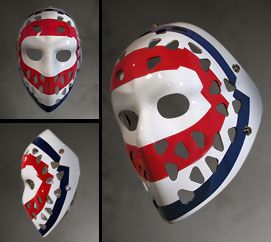
Dryden, still wearing his "pretzel style" mask early in his career

After eliminating the Minnesota North Stars in six games, including two wins on the road, Montreal advanced to the Stanley Cup Finals to take on the West Division winning Chicago Black Hawks, who finished 10 points ahead of the Canadiens in the regular season standings.

Dryden vs Minnesota, Dryden vs Minnesota
Montreal versus Minnesota in the second round of the playoffs

Game 1 of the finals in Chicago went to overtime tied at 1-1 before Chicago won a minute into the second overtime. The Black Hawks won Game 2 at home 5-3 but Dryden held Chicago to 2 goals in Games 3 and 4 as Montreal evened the series 2-2.

Esposito shut out the Canadiens back in Chicago to put Montreal on the brink. A dramatic Game 6 saw the Canadiens trailing 3-2 when Frank Mahovlich tied the game at 5:10 from captain Jean Béliveau and Peter Mahovlich saved the day with a shorthanded game winner from brother Frank at 8:55. Dryden made 27 saves on 30 shots while Esposito only faced 16 shots from Montreal.

Once again, the rookie Dryden was facing a Game 7 on the road against a higher seeded team, only now in a winner-take-all 60 minutes with the Stanley Cup going to the survivor on this date in 1971. Dennis Hull scored a power play with 48 seconds remaining in the first period from his brother Bobby Hull and Cliff Koroll. Chicago's lead was extended to two with Danny O'Shea's goal from Pit Martin at 7:33 of the second.

Jacques Lemaire got Montreal on the board at 14:18 from Jacques Laperrière followed by Henri Richard tying the game at 18:20 from Lemaire, sending the game into it's final 20 minutes even.

At 2:34 of the third period, Richard put Montreal ahead for the first time in the game with an even strength goal from Réjean Houle and Guy Lapointe. Dryden would hold Chicago off the board for the entire second half of the game, making 31 saves in all to lead Montreal to the Stanley Cup championship despite only having six regular season games of experience.

Dryden vs Chicago, Dryden vs Chicago
Rookie Dryden shut down Chicago in the Stanley Cup Finals

The win for Montreal on the road was the only game in the series not won by the home team.

It was quite a turnaround for Montreal, who had failed to even qualify for the playoffs the previous season and even more of a surprise considering their unsettled goaltending situation heading into the playoffs.

Also of note, winning the championship was a fine way for the Canadiens captain Béliveau to go out in style, as he had just played in the final game of his career, leaving the ice as a champion with the Stanley Cup in his arms, the 10th of his career.

Jean Beliveau Stanley Cup 1971, Jean Beliveau Stanley Cup 1971
Béliveau accepts the 1971 Stanley Cup following the final game of his career

The 23-year-old rookie Dryden would be named the winner of the Conn Smythe Trophy as the most valuable player in the playoffs. He played all 20 of Montreal's postseason games, finishing with a 12-8 record and a 3.00 goals against average, with five of those wins coming on the road and two of those being in Game 7's.

Remarkably, Dryden would go on to win the Calder Trophy as Rookie of the Year the following season, despite already having won the Conn Smythe Trophy and a Stanley Cup! Winning a Stanley Cup as the playoff MVP was a feat no other player had ever done before or since.

Today's featured jersey is a 1970-71 Montreal Canadiens Ken Dryden jersey from the season in which the Canadiens would capture their 17th Stanley Cup championship during Dryden's first season with the club and Béliveau's 20th and last.

This style jersey dates back to 1941 and, aside from a version with a blue stripe around the chest for three years in the late 40's, has remained essentially unchanged ever since.


Bonus jersey: Today's bonus jersey is a 1970-71 Montreal Canadiens Jean Beliveau jersey as worn during his final game as he skated off the ice as a Stanley Cup champion. The Canadiens first wore a red jersey with a blue band across the chest adorned with a white "C" back in the 1912-13 National Hockey Association season due to complaints by the Ottawa Senators that Montreal's blue, white and red barberpole jersey was too similar their black, red and white barberpole jersey.

The red jersey with the blue band became their primary jersey for the 1913-14 NHA season, now with a C that contained the letter A, which stood for the team's official name of "Club athletique Canadien".


Four seasons later, a change in ownership saw the team now wearing the now iconic "CH" logo as the team name was changed to "Club de hockey Canadien".


 photo Montreal Canadiens 1970-71 jersey.jpeg
Photo courtesy of Classic Auctions

Today's video section starts with highlights of Game 7 of the Canadiens first round series against Boston. Two pad stack!


Next, the 1971 Stanley Cup Finals, scored with the always funky 1970's background music. Be sure to note the old Chicago Stadium scoreboard with it's clock dials!


Here is fellow goaltender John Davidson narrating a look at the career of Dryden, highlighting the incredible beginning of Dryden's career before summarizing the remainder of his career.


Here is Dryden, telling about his career from his point of view, as part of the Legend of Hockey series.

Wednesday, May 18, 2016

1970-71 Montreal Canadiens Ken Dryden Jersey

For the first time in 23 years, the 1969-70 Montreal Canadiens missed out on the playoffs, despite a 38-22-16 record for 92 points. They finished with an identical record to the New York Rangers, but lost out on the final day of the season when the second tiebreaker, after number of wins, total goals scored, went to the Rangers 246-244 when the Rangers outscored Montreal 9-2 on the final day of the season.

So dominant was the East Division, which was comprised of the Original 6 teams, over the West Division's 1967 expansion clubs, that fifth place Montreal's 92 points were 6 more than the West Division winning St. Louis Blues 86 and 28 more than the second place Pittsburgh Penguins.

Changes were made for the 1970-71 season when the Buffalo Sabres and Vancouver Canucks were added to the league and placed in the East Division, while the Chicago Black Hawks were moved to the West.

Montreal started their campaign with 4 wins and 8 of their first 12. By the end of December they were 16-11-8, having lost just once in their last 10. After an indifferent January, where the Canadiens were 6-5-3, Montreal found their game in February, finishing the month 10-1-1.

The Canadiens cooled off a bit the rest of the way, which saw the quiet debut of a rookie goaltender named Ken Dryden on March 14th.

Dryden Montreal, Dryden Montreal

Dryden, an unusual case, having been drafted back in 1964, had elected to attend Cornell University in the United States rather than immediately devote himself full time to hockey. After having won 76 of 81 starts, including an NCAA national championship in 1967 at Cornell, Dryden had been playing for the Montreal Voyageurs of the AHL that season while working toward his law degree from McGill University by day.

Dryden Cornell, Dryden Cornell

He won his first game over the Pittsburgh Penguins, allowing just one goal and making 35 saves. Phil Myre would start the next game, allowing 6 goals in a loss to St. Louis. Dryden got the next stars, defeating the rival Toronto Maple Leafs after holding them to just one goal on March 18th.

March 20th saw history made, as Rogie Vachon started the game for Montreal, but was inured during the second period and replaced by Dryden. Once he entered the game, Punch Imlauch of the Buffalo Sabres, with a sense of history, inserted Ken's brother Dave Dryden into the Sabres lineup, the first time two brothers had faced each other in goal during an NHL game. Ken was the eventual winner among the four goalies who saw the ice that night, despite the two brothers having an identical 12 saves on 15 shots!

Ken and Dave Dryden, Ken and Dave Dryden
Ken and Dave meet at center ice following a game where
they faced each other, as was their custom

Dryden then defeated the Rangers the following day 6-2. Vachon got the win on March 24th followed by Myre winning on the 27th. Dryden's turn came next on the 28th and he out dueled the Chicago Black Hawks Tony Esposito 2-1. March 31st saw the Bruins shell Vachon for 6 goals in a loss prior to Dryden winning 7-2 against the Rangers on April 3rd before it was Myre's turn to get hammered by the Bruins, 7-2 on the final day of the season.

After going 10-6-1 to finish the season, the Canadiens final record of 42-23-13 gave them 97 points in the standings (fourth overall) and returned the Canadiens to their familiar place in the playoffs, but it left Montreal coach Al MacNeil with a decision to make, as the rookie Dryden clearly had the hot hand, going 6-0-0 with a 1.65 goals against average entering the playoffs after just having watched their first round opponent Boston tear apart his two veterans.

Dryden lost Game 1 by a score of 3-1, and gave up 5 in Game 2, only Montreal scored 7 of their own to even the series. Back in Montreal for Game 3, Dryden held the Bruins to just 1 for the win. Boston again came back strong to win Game 4 by a score of 5-2. The Bruins were even strong back in Boston for Game 5, a dominant 7-3 win. Still, MacNeil stuck with Dryden for Game 6 back at home, where 8 goals by the Canadiens were more than enough to stay alive for a Game 7 back in Boston. Dryden responded to the pressure like an established veteran, not a rookie playing in only his 13th game, as he made 46 saves to out duel Gerry Cheevers 4-2 and eliminate the first overall Bruins in a seventh game on the road.

Dryden Montreal, Dryden Montreal
Dryden, still wearing his "pretzel style" mask early in his career

After eliminating the Minnesota North Stars in six games, including two wins on the road, Montreal advanced to the Stanley Cup Finals to take on the West Division winning Chicago Black Hawks, who finished 10 points ahead of the Canadiens in the regular season standings.

Dryden vs Minnesota, Dryden vs Minnesota
Montreal versus Minnesota in the second round

Game 1 of the finals in Chicago went to overtime tied at 1-1 before Chicago won a minute into the second overtime. The Black Hawks won Game 2 at home 5-3 but Dryden held Chicago to 2 goals in Games 3 and 4 as Montreal evened the series 2-2.

Esposito shut out the Canadiens back in Chicago to put Montreal on the brink. A dramatic Game 6 saw the Canadiens trailing 3-2 when Frank Mahovlich tied the game at 5:10 from captain Jean Béliveau and Peter Mahovlich saved the day with a shorthanded game winner from brother Frank at 8:55. Dryden made 27 saves on 30 shots while Esposito only faced 16 shots from Montreal.

Once again, the rookie Dryden was facing a Game 7 on the road against a higher seeded team, only now in a winner-take-all 60 minutes with the Stanley Cup going to the survivor on this date in 1971. Dennis Hull scored a power play with 48 seconds remaining in the first period from his brother Bobby Hull and Cliff Koroll. Chicago's lead was extended to two with Danny O'Shea's goal from Pit Martin at 7:33 of the second.

Jacques Lemaire got Montreal on the board at 14:18 from Jacques Laperrière followed by Henri Richard tying the game at 18:20 from Lemaire, sending the game into it's final 20 minutes even.

At 2:34 of the third period, Richard put Montreal ahead for the first time in the game with an even strength goal from Réjean Houle and Guy Lapointe. Dryden would hold Chicago off the board for the entire second half of the game, making 31 saves in all to lead Montreal to the Stanley Cup championship despite only having six regular season games of experience.

Dryden vs Chicago, Dryden vs Chicago

The win for Montreal on the road was the only game in the series not won by the home team.

It was quite a turnaround for Montreal, who had failed to even qualify for the playoffs the previous season and even more of a surprise considering their unsettled goaltending situation heading into the playoffs. Also of note, winning the championship was a fine way to go out in style for the Canadiens captain Béliveau, who had just played in the final game of his career, going out as a champion with the Stanley Cup in his arms, the 10th of his career.

Jean Beliveau Stanley Cup 1971, Jean Beliveau Stanley Cup 1971
Béliveau accepts the 1971 Stanley Cup following the final game of his career

The 23-year-old rookie Dryden would be named the winner of the Conn Smythe Trophy as the most valuable player in the playoffs. He played all 20 of Montreal's postseason games, finishing with a 12-8 record and a 3.00 goals against average, with five of those wins coming on the road and two of those being in Game 7's.

Remarkably, Dryden would go on to win the Calder Trophy the following season as Rookie of the Year, despite already having won the Conn Smythe Trophy and a Stanley Cup, something no player had ever done before or since.

Today's featured jersey is a 1970-71 Montreal Canadiens Ken Dryden jersey from the season in which the Canadiens would capture their 17th Stanley Cup championship during Dryden's first season with the club and Béliveau's 20th and last.

This style jersey dates back to 1941 and, aside from a version with a blue stripe around the chest for three years in the late 40's, has remained essentially unchanged ever since.


Today's video section starts with highlights of Game 7 of the Canadiens first round series against Boston. Two pad stack!


Next, the 1971 Stanley Cup Finals, scored with the always funky 1970's background music. Be sure to note the old Chicago Stadium scoreboard with it's clock dials!


Here is fellow goaltender John Davidson narrating a look at the career of Dryden, highlighting the incredible beginning of Dryden's career before summarizing the remainder of his career.


Here is Dryden, telling about his career from his point of view, as part of the Legend of Hockey series.

Thursday, January 28, 2016

1987 NHL All-Star Wayne Gretzky Jersey

All-Star Week continues here at Third String Goalie with a look at the times the NHL All-Stars have faced off against the best of the Soviet Union.

While the NHL All-Star Game has been almost exclusively a competition between players of the NHL, there have been two occasions when the usual format was bypassed in favor of an international competition against the Soviet Union.

The first such occasion occurred in 1979 with an event called the 1979 Challenge Cup. Up to this point, the Soviets had played against North American professionals three times, the first being the ground breaking 1972 Summit Series against a team of Canadians from the NHL. The 1974 Summit Series revisited the concept, only this time against a team of the best players from the WHA. The first Canada Cup tournament took place in 1976, which had not only Team Canada and the Soviet National Team, but also teams from Sweden, Czechoslovakia, the United States and Finland.

The Challenge Cup was held in New York's Madison Square Garden and took the place of that season's traditional All-Star Game and consisted of a three game series held on February 8, 10 and 11, 1979.

Challenge Cup program
1979 Challenge Cup program cover

The NHL All-Star team was made up of NHL players, regardless of the country they were born in. In all, the NHL All-Stars comprised 23 Canadians and three Swedes.

Guy Lafleur opened the scoring in Game 1 just 16 seconds into the game, but by now the North Americans had learned not to dismiss the Soviets, a lesson learned in Game 1 of the 1972 Summit Series. Each team scored a power play goal before the first period ended with the NHLers up by one.

The NHL extended it's lead in the second period with goals from Clark Gillies and Bob Gainey. Vladimir Golikov pulled one back for the Soviet Union 3:02 into the third, but the All-Stars circled the wagons and held off the Soviets the rest of the way to win 4-2 with Ken Dryden getting the win in goal for the NHL.

Challenge Cup pennant
A souvenir pennant from the Challenge Cup

Game 2 had the Soviet Union scoring first at 8:10 only to have the NHL score three consecutive goals, a power play from Mike Bossy and an even-strength goal from Bryan Trottier in the first followed by a Gilbert Perrault tally just 27 seconds into the second.

The Soviets fought back with a goal at 2:05 before Larry Robinson restored the All-Stars lead to two again at 5:06. That lead quickly disappeared when the Soviet Union scored at 17:02 on the power play and again 45 second later to even the game heading into the third.

Golikov got one past Dryden at 1:31 for the game winner, as the rest of the period was scoreless as Vladislav Tretiak held the All-Stars at bay to even the series at one game apiece.


Challenge Cup ticket
A ticket for the 1979 Challenge Cup

Game 3 was simply all the Soviet Union as they put on a dazzling display of complete hockey. There was no score after the first period before the Soviets scored at 5:47 and again at 7:44 on a power play. The third period was all Soviet Union as they solved goalie Gerry Cheevers again and again, scoring four times during a six minute span beginning at 8:44 to win the series 2 games to 1 with Vladimir Myshkin getting the shutout in his surprise debut for the Soviets.

1979 Challenge Cup team
The happy Soviets celebrate their Challenge Cup victory

While many people my not remember the Challenge Cup games, the cup itself is a spectacular trophy perhaps best remembered when the Soviet team returned to Madison Square Garden exactly one year later on February 9, 1980 and paraded the Challenge Cup around the ice prior to their 10-3 demolition of the United States Olympic Hockey Team in a tune-up match for the impending 1980 Olympics.

1979 Challenge Cup parade
The Soviets parading the Challenge Cup

This game occurred just 13 days before the Soviets shocking defeat in the "Miracle on Ice", when essentially the same Soviet team that easily dominated the best of the NHL 6-0 in Game 3 of the Challenge Cup lost to a team of American college players during the Olympics.

Similar to the Canada Cup trophy, the Soviets were allowed to win the trophy, but were not allowed to actually keep the trophy, which now resides in the Hockey Hall of Fame in Toronto.

Challenge Cup display
The Challenge Cup on display at the Hockey Hall of Fame

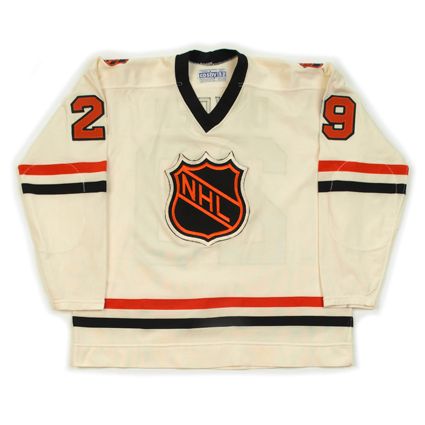
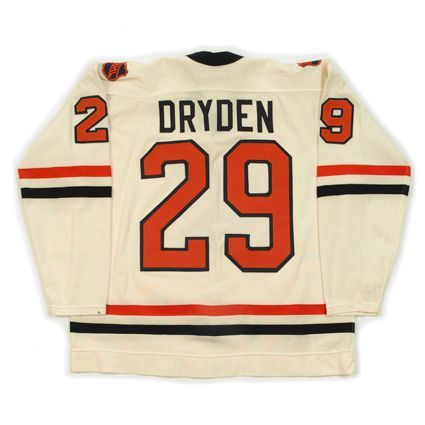
The jerseys worn by the NHL All-Star Team for the 1979 Challenge Cup were without a doubt the simplest, most plain ones ever worn by an NHL All-Star Team and actually managed to make the Soviet jerseys almost look flashy by comparison!

Without so much as a single star on them, the closest thing these jerseys can be compared to are the NHL referee's sweaters worn in the 1940's only with the addition of a pair of stripes and bolder numbers.

NHL All Star 1979 jersey photo NHLAllStar1978-79F.jpg
NHL All Star 1979 jersey photo NHLAllStar1978-79B.jpg

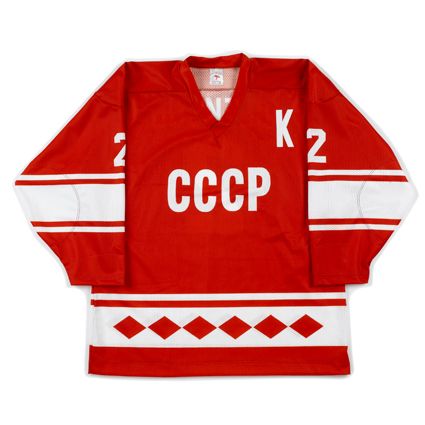
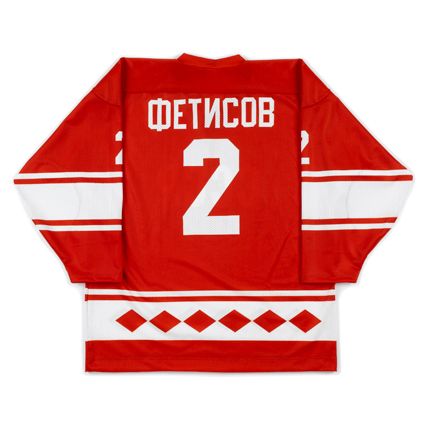
The Soviet Union jerseys were their usual utilitarian selves, simply adorned with CCCP in a simple font with legible numbers and some basic striping as adornment, but with the addition of the repeating diamond pattern around the waist for a touch of flair not seen on the jerseys of the NHL All-Stars.

These Soviet jerseys would be the now familiar style as worn in the 1980 Olympic Games in Lake Placid, New York.

Soiet Union 1976-81 jersey photo RussiaCCCP1976-81F.jpg
 photo RussiaCCCP1976-81B.jpg

The next instance where the normal All-Star Game was put aside for a year came eight years later with Rendez-vous '87, which was similar in format to the 1979 Challenge Cup, where the Soviet National Team faced off against a team of NHL All-Stars, except in a two game format, rather than three as in 1979.

rendez-vous-87 program
Rendez-vous '87 program cover

Why the teams did not compete for the rights to the impressive Challenge Cup once again, we do not quite understand, but the hockey competition was just a part of the annual Quebec Winter Carnival which was a multi-cultural event that year featuring entertainers and food from Canada, Russia and the United States.

The games were held in Quebec City, Quebec at Le Colisee, home of the Quebec Nordiques.

The Soviet lineup was a strong one, and featured over a dozen players who would eventually compete in the NHL within the next six years. The changing face of the NHL was reflected by the increasing international presence on it's roster, now sporting players from not only Canada and Sweden as before, but with the addition of players from the United States and Finland as well.

Game 1 took place on February 11, 1987 and Jari Kurri got the NHL All-Stars off to a 1-0 lead 5:23 in to the game. The Soviets fell behind 2-0 when Glenn Anderson scored with three minutes remaining in the second period but managed to get on the board before the period ended when Alexei Kasatonov got one by Grant Fuhr with 1:18 remaining.

rendez-vous-87action 1
Action from Rendez-vous '87
The third period was an exciting affair, as the Soviets tied the game 2:03 into the period. Canada retook the lead five minutes later with Kevin Dineen's goal only to have the Soviets tie the game once more one minute later thanks to Anatoli Semenov.

The game continued scoreless as time began to wind down before Dave Poulin got the game winning goal for the All-Stars with just a minute and fifteen seconds left when he beat goaltender Evgeny Belosheikin, who had the audacity to wear Tretiak's legendary #20!

After a day of rest, the teams returned to the ice on February 13, 1987 following much the same script, as the NHL again scored 3:32 into the game to lead 1-0 after the first period.

rendez-vous-87action 2
More action from Rendez-vous '87

The Soviet Union got two goals early in period two when Valeri Kamensky and Vladimir Krutov scored a minute and a half apart for their first lead of the competition. Doug Wilson evened the scoring at 2-2 with his goal on the power play at 7:33 only to have Kamensky and Krutov each score their second goals of the game to put the Soviets ahead by two. Kamensky's second goal came with 19 seconds left in the second period, while Krutov's game winner came 9:19 into the third period.

Krutov Rendez-vous '87 Pictures, Images and Photos
Krutov's two goals were key to the Soviet in in Game 2

Andrei Khomutov increased the Soviet lead to 5-2 at 12:59, which proved to be an important goal in not only the game, but in the larger picture of the series as a whole, for when Ray Bourque scored at 19:23 of the third period, it was too little too late as the Soviets not only won the game 5-3, but earned bragging rights for the series by outscoring the NHL All-Stars by a combined 8-7 over the two games thank's to Khomutov's goal.

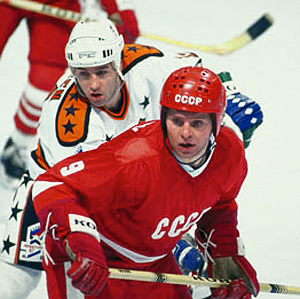
Following the game, team captains Wayne Gretzky and Viacheslav Fetisov traded jerseys in keeping with the tradition of European soccer players, leading to the most unusual sight of national hero and proud Canadian Gretzky wearing a Soviet National Team jersey emblazoned with CCCP across the front as well as a Cyrillic captain's "K".

Gretzky & Fetisov jersey swap
"Comrade" Gretzky in his Soviet National Team jersey

Despite the loss in the series, the two games together allowed the Canadian members of the NHL All-Star Team a chance to compete together in advance of that fall's thrilling 1987 Canada Cup.

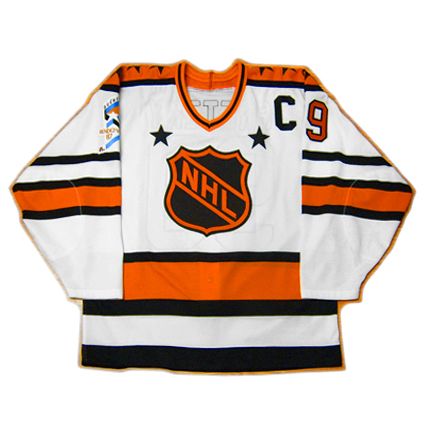
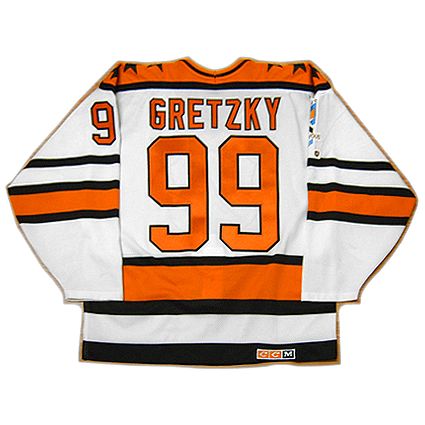
Today's featured jersey is a 1987 NHL All-Star Team Wayne Gretzky jersey as worn in the two game Rendez-vouz '87. This jersey's unusual customization had sleeve numbers only on the left arm, as the Rendez-Vouz '87 patch was placed on the right sleeve in the location usually occupied by the numbers due to the stars on the chest occupying the usual location for such a patch on the upper right chest.

This style of jersey was worn only for the two games of the series in Quebec City and there was no dark "road" version worn, as was the norm with NHL All-Star jerseys since the introduction of the East vs. West format in 1969. We have, however, seen an orange road version of this jersey, but have no idea why they bothered to produce any.

Examples of this style jersey for collectors are rather scarce, as retail jersey sales were still in their infancy in 1987.


1987 NHL All-Star Rendez-vous '87 jersey photo 1987NHLAll-StarRendez-vous87F.jpg
1987 NHL All-Star Rendez-vous '87 jersey photo 1987NHLAll-StarRendez-vous87B.jpg

Bonus Jersey: Today's Bonus jersey is a 1987 Soviet National Team Sergei Priakin jersey as worn during Rendez-vous '87. These jerseys were some of the less successful of the Soviet Union's, as the dark red stripes on the red body of the jersey were too close in color to create any worthwhile contrast.

Gone were the striking diamond pattern on the waist of the 1979 Challenge Cup jerseys, as well as the more pleasing font for the numbers. Things would improve in the years following, as the jerseys worn in international hockey would soon be made by the Finnish brand Tackla, giving the final jerseys of the Soviet era some much needed graphic design.

Priakin would become the answer to a trivia question in 1988 when he became the first Soviet player to be allowed to compete in the NHL, which he did with the Calgary Flames. He would also suffer the common plight of the Soviet players during this early era of playing in North America, as the spelling of their names on the backs of their jerseys often varied from appearance to appearance. As seen here, "PRYAKHIN" would latter play for the Flames wearing "PRIAKIN".

1987 Soviet Union Rendez-vous '87 F

Today's video highlights begin with all the goals scored in the 1979 Challenge Cup.

Game 1, won by the NHL All-Stars.


Game 2, the Soviets come from behind to win the game and turn the tide of the series.


The Soviet Union's dominant performance in Game 3.


Next, Poulin tips in the game winning goal in Game 1 of Rendez-vous '87.


In Game 2 of Rendez-vous '87, Kamensky is a one man highlight reel, scoring two and assisting on Khomutov's goal for good measure.


Thursday, March 20, 2014

1972-73 Montreal Canadiens Ken Dryden Jersey

History was made on this date in 1971 when the Montreal Canadiens Ken Dryden faced his brother Dave Dryden of the Buffalo Sabres in the first ever matchup of brothers in goal during an NHL game, won 5-2 by Montreal.

Dave, six years older than Ken, actually made his NHL debut with a single appearance back in February of 1962 season for the New York Rangers. Since NHL teams did not dress backup goaltenders at the time, Dave was actually sitting in the stands when Rangers starter Gump Worsley needed to be replaced after the first period. It would take him several years to see action in the NHL again, this time with the Chicago Black Hawks, where he would play parts of three seasons until establishing himself as an NHL regular with the expansion Sabres in 1970-71.

Dave would play four seasons with Buffalo before jumping to the World Hockey Association, first with the Chicago Cougars, of whom he was a part owner, before finding a home with the Edmonton Oilers for the final four seasons of the WHA and one back in the NHL.

Ken, always one to march to the beat of his own drummer, was originally drafted in 1964, but chose to instead pursue a college degree while continuing to play hockey at Cornell, where he would win an NCAA championship in 1967. After playing for the Canadian National Team in 1969-70, he would play the vast majority of the 1970-71 season with the Montreal Voyageurs of the American Hockey League while pursing his law degree at McGill University before being called up to finally make his NHL debut with the Montreal Canadiens, seven years after being drafted, in time for the final six games of the season.

Ken Dryden's NHL debut came on March 14, 1971 in a 5-1 win against the Pittsburgh Penguins and it was four days later on this date in 1971 that Ken's Canadiens squared off against Dave's Sabres, becoming the first and only pair of brothers to oppose each other in goal during an NHL game.

Although it wasn't supposed to happen.

The Sabres general manager Punch Imlach, who understood the publicity the brother versus brother would bring and how it would simply be fun to be a part of, planned all along to start Dave in goal for the Sabres, but Canadiens coach Al MacNeil had already picked Rogie Vachon to start against Buffalo rather than the untested rookie Ken.

Imlach, being the visiting team, was required to submit his lineup first and stuck to his guns with Dave, but so did MacNeil, who went with Vachon. With that, Imlach decided to immediately replace Dave in the Sabres goal once the game got underway, and once the first whistle blew, Joe Daley came on for the Sabres.

Fate intervened however, when a few minutes into the second period Vachon was felled by an injury, which pressed Ken into service. "As soon as Ken went in, Punch said "In you go, too," Dave said. "To him, the score would have meant nothing, it was just the fact that he had set out to have both of us play against each other."

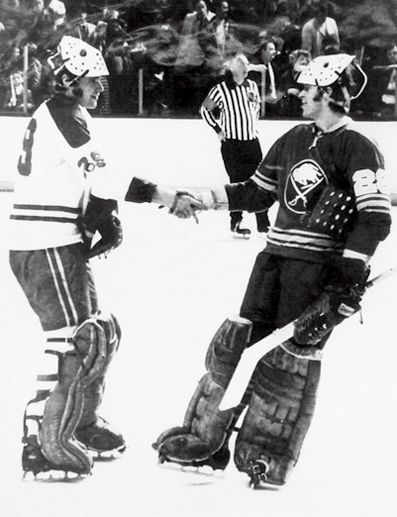
The final score of the game was 5-2 in favor of the Canadiens, who were on their way to a Stanley Cup championship, over the first year expansion Sabres. When the game ended, the two brothers skated to center ice and shook hands, something normally reserved for playoff games.

"We knew, I think, that no brothers had played against each other, but the crowd didn't know it at all," said Dave.

"It's interesting, we have a picture of Ken and I at the end of the game shaking hand and you can see the crowd in the background, and obviously the crowd wasn't watching. There isn't anyone's face looking at us."


"The best part was here was our Dad, who took a chance and came down, and he saw it," said Ken about his father, whom he had told in advance that he was not going to be starting the game.

Following that first game, they ended up playing each other about four or five times over the course of their careers during the two additional seasons their NHL careers overlapped, and they had agreed that they would always shake hands at center ice after the game. We don't believe the photo above is from their first encounter, as Ken would have been wearing his "pretzel" mask on the occasion of his nhl debut, but it is an early enough photo that his mask has yet to acquire his iconic concentric "C" design that many interpreted as a bullseye target.

"I was so distracted knowing he was at the other end," Ken said. "I didn't enjoy those games against Buffalo."

Even though Ken only appeared in six regular season games for Montreal, he won all of them, only giving up nine goals, which lead to him quickly taking over the starting job for the Canadiens in the playoffs. Miraculously, he started all 20 of Montreal's playoff games, leading them to the Stanley Cup and being named the winner of the Conn Smythe Trophy. Oddly, since he did not play enough regular season games, Ken entered the following season with his rookie status still intact and would go on to be named the winner of the Calder Trophy as the NHL's rookie of the year, having already been named the MVP of the playoffs the prior season, a feat no one else in league history has ever accomplished.

Dave Dryden would also be credited with an influential accomplishment of his own, as he was the innovator of the modern goalie mask, which combined the protection of a fiberglass mask with the vision of a cage mask for the first time ever.


Dave is also the answer to a trivia question, having surrendered the first professional goal scored by Wayne Gretzky.

Today's featured jersey is a 1972-73 Montreal Canadiens Ken Dryden jersey from a season in which the Canadiens would capture another Stanley Cup championship.

This style jersey dates back to 1941 and, aside from a version with a blue stripe around the chest for three years in the late 40's, has remained essentially unchanged ever since.


Here is a profile of Dave Dryden's career on the occasion of his being inducted into the Etobicoke Sports Hall of Fame.


Next we have footage of Gretzky's first professional goal, scored against Dave Dryden.


Here's a fun one, home movies originally shot on Super 8 of Dave Dryden playing goal for the Sabres against the Minnesota North Stars in 1974.


In an attempt to give some equal time, we close out today with a look back at the career of Ken Dryden, hosted by former goaltender John Davidson.


hit counter for blogger