History of Jersey 83-93 Banner sm photo History of Jersey 83-93 Banner sm.jpg
Showing posts with label Great Britain. Show all posts

Sunday, April 30, 2017

2017 IIHF Lower Divisions Tournament Update

The IIHF  World Championship season is upon us. To date, titles have been decided at the Division I, II and III levels in action that took place between April 3rd and concluded yesterday in advance of the Top Division 2017 IIHF World Championships that begin on May 5th in Cologne, Germany and Paris, France.

The Division III tournament took place from April 10-16 in Sofia, Bulgaria and saw an eclectic mix of eight countries scheduled to participate that consisted of Bosnia & Herzegovina, hosts Bulgaria, Chinese Taipei (Taiwan), Georgia, Hong Kong, Luxembourg, South Africa and the United Arab Emirates.

 photo D3 Bulgaria.png

However, before the competition could begin, Bosnia & Herzegovina withdrew and all their scheduled games became 5-0 forfeits. Why 5-0 and not 3 or 6 for 1 or 2 goals per period, we don't understand...

The teams were divided into two groups, with Group A consisting of Bulgaria, Taiwan, Hong Kong and Bosnia & Herzegovina, with Bulgaria winning the group with a 3-0 record and a 18-3 goals for and against margin. Hong Kong took the other spot in the playoff round after beating Taiwan 5-2.

In Group B, Luxembourg took the top honors with a 3-0 mark and an even greater goal differential of +21. Georgia was next after defeating both South Africa 6-5 and the overmatched United Arab Emirates 19-0 for the other playoff position.

While the United Arab Emirates were thrashed 17-0 by Luxembourg, 8-0 by South Africa and 19-0 by Georgia to finish the competition without even a single goal while giving up 44 for an average of nearly 15 per game, it will be Bosnia & Herzegovina who are demoted for their failure to participate.

In the playoff games, Luxembourg defeated Hong Kong 8-1 while Bulgaria had a similarly easy time over Georgia 9-3. The final saw Luxembourg dominate with a 10-4 victory for their first ever IIHF gold medals. Goaltender Philippe Lepage was the star with no less than 57 saves in the victory, while three players, Benny Welter, Miroslav Mosr and Thierry Beran each had two goals and an assist in the victory that propels them into Division II Group B for 2018.

 photo Luxembourgh 2017.jpg
Luxembourg was thrilled to win their first ever tournament

The next step up the IIHF ladder system is Division II Group B, which was held in Auckland, New Zealand from April 4-10 with another eclectic grouping of six teams consisting of China, North Korea, Israel, Mexico, New Zealand and Turkey.

 photo D2B NZ.jpg

With just six teams in this tournament, all teams were placed in a single group with a round robin schedule and the final results determined by the standings rather than a knockout playoff format as Division III used this year.

The round robin schedule is always set to have the two top seeded teams meeting in the final game of the competition in anticipation that all the favorites will win and the final game will provide the drama over who will win promotion, but things do not always go to plan, and the key game of the tournament actually took place on the second day when China defeated New Zealand 5-2.

China would go on to complete their schedule undefeated with all wins coming in regulation and finishing with a +17 goal differential. Hosts New Zealand finished second at 4-1 thanks to their unfortunate third period against China, as the teams were tied at 2-2 after two periods before giving up 3 goals in the final 20 minutes.

After Israel in third place at 3-2, things become a lot more complicated, as North Korea, Mexico and Turkey all finished even at 1-4! The North Koreans win came from a 11-3 thrashing of Turkey, while Mexico's win came at the expense of North Korea 5-1. Turkey, on the other hand, beat Mexico 1-0 throwing the deciding factor of relegation down to Division III for next year to the goal differential for games among the three tied teams, which sank the Turkish hopes after their 8 goal loss to the North Koreans.

China will now compete at the Division II Group A level next year where they last played in 2016.

 photo China 2017.jpg
China celebrates their championship

Division II Group A was held in Galati, Romania among Australia, Belgium, Iceland, Romania, Serbia and Spain.

 photo D2A RM.jpg

This was a close-fought affair with the host Romanians winning the promotion to Division I Group B for 2018 after winning 4 regulation games against 1 loss, that coming against Iceland after winning their first two games. Romania finished with 12 points in the standings to the 11 for Australia, thanks to the opening game of the tournament seeing the Aussies defeat Serbia 4-3 in overtime after the Serbs tied the game with 4:34 to play in regulation. The overtime win was worth 2 standings points to the Australians, rather than 3 had they won in regulation, which was the difference between them and the Romanians 12 points and their 11. Of course, the other factor was the 5-1 Romanian victory over the Australians in their head to head meeting.

Serbia earned points in 4 of their 5 games with 2 wins, 2 overtime losses and a defeat for 8 points. Belgium and Israel also won 2 games each, but did not take anyone to overtime for any additional points in the standings. All of this left Spain in last place, as they managed one overtime win over Serbia, but their 2 points left them far back of the other teams who all won at least 2 games in regulation. Spain's relegation will see them play in Division II Group B next year.

 photo Romania 2017.jpg
Romania will move up to Division I for 2018

Moving up to Division I Group B, the six participants were Croatia, Estonia, Great Britain, Japan, Lithuania and the Netherlands with the competition taking place in Belfast, Northern Ireland, which is a part of Great Britain.

 photo DIB GB.png

The final game of the tournament yesterday was a winner take all affair between the undefeated British and the Japanese. Playing in front of a raucous home crowd, Great Britain scored one in the first and three in the second to take a 4-0 win to earn the promotion up to Division I Group A for the first time since 2013.


After the Japanese in second, Baltic states Lithuania and Estonia were third and fourth, while Croatia's 6-2 win over the Netherlands assured their safety as winless Netherlands was relegated to Division II Group A for 2018.

 photo Great Britain 2017.jpg
Joyful Great Britain was able to win at home in dominant fashion

In Division I Group A, two promotion spots were on the line for the six participants, as two teams are relegated from the Top Division each year. Vying for those spots were Austria, Hungary, Kazakhstan, South Korea, Poland and hosts Ukraine.

 photo DIA UKR.png

South Korea began with a 4-2 win over Poland and Austria dropped a 2-3 decision to Kazakhstan. The next day South Korea then defeated the Kazakhs. Day 3 saw Austria keep pace with a 3-1 victory over Hungary. Everyone was back in action on Day 4 and it was the South Koreans turn to defeat Hungary by the same 3-1 score while Austria made a second period goal hold up in a 1-0 win over Ukraine. Meanwhile, Kazakhstan stayed in the hunt with a 1-0 of their own over Poland.

Wednesday's only game saw the Kazakhs defeat Ukraine 4-2 to keep the host team winless.

This set up a meeting between the undefeated South Koreans and Austria, who were in need of a win to equalize the standings due to their opening game loss. The Austrians answered the call with a dominant 5-0 win.

The battle then came down to the final day. Kazakhstan had 8 points (2 wins, 1 OT Win and a loss), while South Korea were both at 9 points, each with 3 wins and a loss.

Kazakhstan was up first and did what they needed to do with a 3-1 regulation win over Hungary to take over the top spot at 11 points. Austria then secured a promotion to the Top Division with an 11-0 pasting of the Poles to leap into first place with now 12 points. Finally, South Korea took to the ice against Ukraine, who already knew they were relegated.

 photo Austria 2017.jpg
Austria roared to the gold with 16 goals in their final two games

After a scoreless first period, South Korea scored first five minutes into the second period but at 13:24 of the second, the Ukrainians tied the game at 1-1. Neither team could find the net in the third period, but the point earned by South Korea for getting to overtime bumped them up to 10 points, needing the win to claim a second point on the day to claim the other promotion place, as they held the head-to-head tiebreaker over Kazakhstan thanks to their earlier 5-2 win on Day 2.

Neither team was able to win in overtime and the game progressed to a shootout. South Korea led 1-0 after one round and again after two rounds. Then Sanghoon Shin scored to win the shootout 2-0 and the game 2-1 for the Koreans to take the additional point for the win to climb to 11 points and earn their first promotion to the Top Division in their history.


With the five lower division tournaments now complete, all eyes will turn toward the Top Division of the World Championship ladder, as the 2017 IIHF World Championships will begin this coming Friday, May 5th, which will be co-hosted by Cologne, Germany and Paris, France.
 photo 2017 IIHF WC logo.jpg

The competition will be divided into two groups, with Group A consisting of Russia, the United States, Sweden, Slovakia, Germany, Latvia, Denmark and Italy and will take place in Cologne. 


Group B, being held in Paris, will see Canada, Finland, the Czech Republic, Switzerland, Belarus, Norway, France and Slovenia all taking part.

After each team plays the other teams once each in a round robin format concluding on May 16th, the last place team in each group will be relegated to Division I Group A and be replaced by Austria and South Korea for 2018. The top four teams in each group will advance to the playoff round, which starts on May 18th with the bronze and gold medals decided on the final day of May 21st in Cologne.

Our featured jersey today is a 2005 Austria National Team Gerhard Unterluggauer jersey as worn during the 2005 World Championships, which were hosted by Austria. This was an unfortunately short lived style, as all national teams received attractive new jerseys for 2005 only to see them replaced with the new Nike Swift styles for the 2006 Olympics.
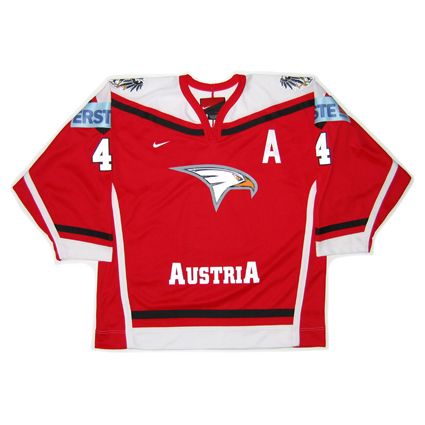
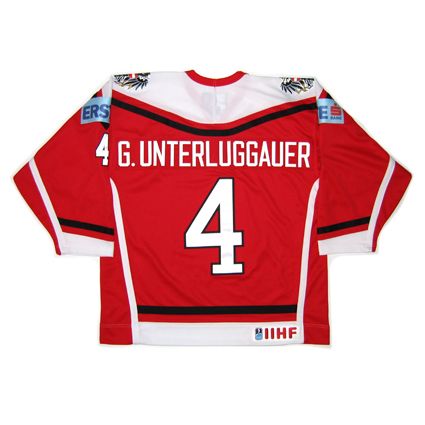
Unterluggauer, a defenseman, began his pro career back in the 1992-93 season, playing his entire career in Austria save for a three year stint in the German DEL in the early 2000's. He has won the Austrian championship twice, in 1993 and 1999.

He has been playing for the Austria National Team since 1993 and his resume includes three Olympic Games (1998, 2002 and 2014) and 18 World Championships.

Austria 2005 jersey photo Austria2005F.jpg
Austria 2005 jersey photo Austria2005B.jpg

Bonus jersey: Today's bonus jersey is a 2008 Great Britain National Team Jason Hewitt jersey as worn during Olympic Pre-Qualifying Group D held in Poland in November of 2008. This is a truly striking jersey with it's large, dynamic lion crest logo with Union Jack mane. The curved, vertical striping only add to the excitement of this vibrantly colored jerseys.

Great Britain 2008 jersey, Great Britain 2008 jersey

Thursday, February 16, 2017

1936 Great Britain National Team Jon Coward Jersey

The 1936 Winter Olympics were held in Garmisch-Partenkirchen in far southern Germany.

 photo 1936-winter-olympicposter.jpg

15 teams took part in a three round format. The First Round saw the teams divided into three groups of four and one group of three teams, with the first two teams advancing to the Second Round.

 photo 1936Olympichockey2.jpg
The picturesque outdoor venue for the 1936 Olympic hockey tournament

Group A saw Canada and Austria advance over Poland and Latvia. Group B was led by host Germany followed by the United States, with Italy and Switzerland eliminated. In Group C, both Czechoslovakia and Hungary moved on with France and Belgium eliminated, while in Group D, Great Britain and Sweden moved on with Japan falling by the wayside.

 photo GBvsSweden1936.jpg
Great Britain vs Sweden in Group D action

In the Second Round Group A had Great Britain winning with a 2-0-1 record followed by Canada at 2-1, keyed by a 2-1 British win over Canada as Edgar Brenchley scored with 1:30 remaining in the third period, which would have an enormous impact on the final standings. Both Germany and Hungary were eliminated from Group A, while Group B saw the United States advance to the Final Round with a 3-0 record, as did Czechoslovakia at 2-1 with both Sweden and Austria knocked out of the competition.

 photo 1936GreatBritainNationalTeam.jpg
The 1936 Great Britain National Team

Thus, in the Final Round, four teams met to determine the three medal placings in yet another round robin format, with the medals determined by their final placings in the group standings, rather than a knockout playoff format as is done today.

Rather than have Great Britain and Canada, as well as the United States and Czechoslovakia, play again, the rules called for their Second Round results to carry over to the Final Round. Thus Great Britain's surprising 2-1 win over Canada and the United States shut out the Czechs 2-0 gave the winners a leg up entering the Final Round and denied the losers the opportunity for a rematch.

Play began on February 14 as Great Britain assured itself a medal with a 5-0 blanking of the Czechs, who were then thrashed by Canada 7-0 the next day, February 15. Later that same day, Great Britain and the United States waged a scoreless battle that stretched to three overtimes before being scored as a 0-0 tie. This left Great Britain with 5 points in the standings, with the United States at 3 and their game against Canada remaining on this date in 1936, needing a win to tie for the top spot and a shot at gold through tiebreakers.

But it was not to be, as Canada defended a first period goal to defeat a tired United States 1-0 following the Americans six period marathon the day before to relegate the US to third place and the bronze medal. Their win gave Canada the silver at 2-1 and four points, leaving the British alone at the top with 5 points and as gold medal champions for the only time in their history, with the difference being Brenchley's goal during their meeting in the Second Round.

 photo CanadavsUSA1936.jpg
The concluding game of the tournament, Canada vs. the United States

While the British had iced teams in both 1924 and 1928 that were largely comprised of Canadians living in the United Kingdom, in 1936 it was determined that the players must be British-born this time out. Still, nine of the 13 players had grown up in Canada and 11 had played hockey in Canada at some point in their lives. The gold medal for Great Britain marked the first time in the five Olympic hockey tournaments that Canada had not won gold, and to date, some 78 years later, the last medal won by Great Britain in Olympic hockey competition.

 photo 1936GreatBritaincelebrates.jpg
A happy Great Britain National Team celebrates

Today's featured jersey is a 1936 Great Britain Jon Coward jersey worn in the Olympics in Germany as the British upset the world of hockey to take their memorable, and only, gold medal in their history. His jersey is on display at the Hockey Hall of Fame in Toronto.

In the early days of international hockey, Great Britain won the European Championship in 1910, won a bronze at the winter Olympics in 1924, took 4th in 1928 and won gold in 1936. Following the resumption of the Olympics following World War II, Great Britain returned for the 1948 games with a 5th place but have since failed to qualify for the Olympics again. This year they won Group J in the Olympic Pre-Qualification Round over South Korea, Japan and Romania, but were eliminated during the Final Qualification Round.

Despite their absence from the Olympics since 1948, the British still compete at the World Championships, currently at the second level of the IIHF ladder system, Division I, Group A. They are ranked 22nd in the world, with their highest placing being 21st in 2011. 1993 was a high point, as they finished first in the B pool, earning their only promotion to the Top Division for 1994, especially impressive when you consider they were in the D pool as recently as 1990, a miraculous rise through the ranks, having won Group D in 1990, Group C1 in 1992 and Group B in 1993! Since that time they competed in the B Pool in 1995 through 2000 and the renamed Division I since then, avoiding relegation for 19 years now.

Coward, like many of his teammates in 1936, was born in Great Britain but learned to play hockey while living in Canada. He returned to England in 1935 and joined the Richmond Hawks of the English National League for two seasons. In addition to being a member of the 1936 Olympic team, he was on the 1937 Great Britain National Team that won a silver medal at the 1937 World Championships. In 1993, he was inducted into the British Ice Hockey Hall of Fame.

 photo GreatBritain1936jersey.jpg

Today's video selection is some remarkable footage from the United States vs. Canada game, the outcome of which gave Great Britain their surprising gold medal.


Here is a great video, which deserves to be seen by more people, Philip Erhardt, the son of gold medal winner and Great Britain team captain Carl Erhardt showing his father's medal and other memorabilia, as well as telling stories of his father's experience in Germany, which was under control of Adolph Hitler and the Nazi party by then. The hockey sticks alone are worth your time, as well as seeing his father's jersey. Simply awesome stuff.

Monday, February 16, 2015

1936 Great Britain National Team Jon Coward Jersey

The 1936 Winter Olympics were held in Garmisch-Partenkirchen in far southern Germany.

 photo 1936-winter-olympicposter.jpg

15 teams took part in a three round format. The First Round saw the teams divided into three groups of four and one group of three teams, with the first two teams advancing to the Second Round.

 photo 1936Olympichockey2.jpg
The picturesque outdoor venue for the 1936 Olympic hockey tournament

Group A saw Canada and Austria advance over Poland and Latvia. Group B was led by host Germany followed by the United States, with Italy and Switzerland eliminated. In Group C, both Czechoslovakia and Hungary moved on with France and Belgium eliminated, while in Group D, Great Britain and Sweden moved on with Japan falling by the wayside.

 photo GBvsSweden1936.jpg
Great Britain vs Sweden in Group D action

In the Second Round Group A had Great Britain winning with a 2-0-1 record followed by Canada at 2-1, keyed by a 2-1 British win over Canada as Edgar Brenchley scored with 1:30 remaining in the third period, which would have an enormous impact on the final standings. Both Germany and Hungary were eliminated from Group A, while Group B saw the United States advance to the Final Round with a 3-0 record, as did Czechoslovakia at 2-1 with both Sweden and Austria knocked out of the competition.

 photo 1936GreatBritainNationalTeam.jpg
The 1936 Great Britain National Team

Thus, in the Final Round, four teams met to determine the three medal placings in yet another round robin format, with the medals determined by their final placings in the group standings, rather than a knockout playoff format as is done today.

Rather than have Great Britain and Canada, as well as the United States and Czechoslovakia, play again, the rules called for their Second Round results to carry over to the Final Round. Thus Great Britain's surprising 2-1 win over Canada and the United States shut out the Czechs 2-0 gave the winners a leg up entering the Final Round and denied the losers the opportunity for a rematch.

Play began on February 14 as Great Britain assured itself a medal with a 5-0 blanking of the Czechs, who were then thrashed by Canada 7-0 the next day, February 15. Later that same day, Great Britain and the United States waged a scoreless battle that stretched to three overtimes before being scored as a 0-0 tie. This left Great Britain with 5 points in the standings, with the United States at 3 and their game against Canada remaining on this date in 1936, needing a win to tie for the top spot and a shot at gold through tiebreakers.

But it was not to be, as Canada defended a first period goal to defeat a tired United States 1-0 following the Americans six period marathon the day before to relegate the US to third place and the bronze medal. Their win gave Canada the silver at 2-1 and four points, leaving the British alone at the top with 5 points and as gold medal champions for the only time in their history, with the difference being Brenchley's goal during their meeting in the Second Round.

 photo CanadavsUSA1936.jpg
The concluding game of the tournament, Canada vs. the United States

While the British had iced teams in both 1924 and 1928 that were largely comprised of Canadians living in the United Kingdom, in 1936 it was determined that the players must be British-born this time out. Still, nine of the 13 players had grown up in Canada and 11 had played hockey in Canada at some point in their lives. The gold medal for Great Britain marked the first time in the five Olympic hockey tournaments that Canada had not won gold, and to date, some 78 years later, the last medal won by Great Britain in Olympic hockey competition.

 photo 1936GreatBritaincelebrates.jpg
A happy Great Britain National Team celebrates

Today's featured jersey is a 1936 Great Britain Jon Coward jersey worn in the Olympics in Germany as the British upset the world of hockey to take their memorable, and only, gold medal in their history. His jersey is on display at the Hockey Hall of Fame in Toronto.

In the early days of international hockey, Great Britain won the European Championship in 1910, won a bronze at the winter Olympics in 1924, took 4th in 1928 and won gold in 1936. Following the resumption of the Olympics following World War II, Great Britain returned for the 1948 games with a 5th place but have since failed to qualify for the Olympics again. This year they won Group J in the Olympic Pre-Qualification Round over South Korea, Japan and Romania, but were eliminated during the Final Qualification Round.

Despite their absence from the Olympics since 1948, the British still compete at the World Championships, currently at the second level of the IIHF ladder system, Division I, Group A. They are ranked 22nd in the world, with their highest placing being 21st in 2011. 1993 was a high point, as they finished first in the B pool, earning their only promotion to the Top Division for 1994, especially impressive when you consider they were in the D pool as recently as 1990, a miraculous rise through the ranks, having won Group D in 1990, Group C1 in 1992 and Group B in 1993! Since that time they competed in the B Pool in 1995 through 2000 and the renamed Division I since then, avoiding relegation for 19 years now.

Coward, like many of his teammates in 1936, was born in Great Britain but learned to play hockey while living in Canada. He returned to England in 1935 and joined the Richmond Hawks of the English National League for two seasons. In addition to being a member of the 1936 Olympic team, he was on the 1937 Great Britain National Team that won a silver medal at the 1937 World Championships. In 1993, he was inducted into the British Ice Hockey Hall of Fame.

 photo GreatBritain1936jersey.jpg

Today's video selection is some remarkable footage from the United States vs. Canada game, the outcome of which gave Great Britain their surprising gold medal.


Here is a great video, which deserves to be seen by more people, Philip Erhardt, the son of gold medal winner and Great Britain team captain Carl Erhardt showing his father's medal and other memorabilia, as well as telling stories of his father's experience in Germany, which was under control of Adolph Hitler and the Nazi party by then. The hockey sticks alone are worth your time, as well as seeing his father's jersey. Simply awesome stuff.

Sunday, February 16, 2014

1936 Great Britain National Team Jon Coward Jersey

The 1936 Winter Olympics were held in Garmisch-Partenkirchen in far southern Germany.

 photo 1936-winter-olympicposter.jpg

15 teams took part in a three round format. The First Round saw the teams divided into three groups of four and one group of three teams, with the first two teams advancing to the Second Round.

 photo 1936Olympichockey2.jpg
The picturesque outdoor venue for the 1936 Olympic hockey tournament

Group A saw Canada and Austria advance over Poland and Latvia. Group B was led by host Germany followed by the United States, with Italy and Switzerland eliminated. In Group C, both Czechoslovakia and Hungary moved on with France and Belgium eliminated, while in Group D, Great Britain and Sweden moved on with Japan falling by the wayside.

 photo GBvsSweden1936.jpg
Great Britain vs Sweden in Group D action

In the Second Round Group A had Great Britain winning with a 2-0-1 record followed by Canada at 2-1, keyed by a 2-1 British win over Canada as Edgar Brenchley scored with 1:30 remaining in the third period, which would have an enormous impact on the final standings. Both Germany and Hungary were eliminated from Group A, while Group B saw the United States advance to the Final Round with a 3-0 record, as did Czechoslovakia at 2-1 with both Sweden and Austria knocked out of the competition.

 photo 1936GreatBritainNationalTeam.jpg
The 1936 Great Britain National Team

Thus, in the Final Round, four teams met to determine the three medal placings in yet another round robin format, with the medals determined by their final placings in the group standings, rather than a knockout playoff format as is done today.

Rather than have Great Britain and Canada, as well as the United States and Czechoslovakia, play again, the rules called for their Second Round results to carry over to the Final Round. Thus Great Britain's surprising 2-1 win over Canada and the United States shut out the Czechs 2-0 gave the winners a leg up entering the Final Round and denied the losers the opportunity for a rematch.

Play began on February 14 as Great Britain assured itself a medal with a 5-0 blanking of the Czechs, who were then thrashed by Canada 7-0 the next day, February 15. Later that same day, Great Britain and the United States waged a scoreless battle that stretched to three overtimes before being scored as a 0-0 tie. This left Great Britain with 5 points in the standings, with the United States at 3 and their game against Canada remaining on this date in 1936, needing a win to tie for the top spot and a shot at gold through tiebreakers.

But it was not to be, as Canada defended a first period goal to defeat a tired United States 1-0 following the Americans six period marathon the day before to relegate the US to third place and the bronze medal. Their win gave Canada the silver at 2-1 and four points, leaving the British alone at the top with 5 points and as gold medal champions for the only time in their history, with the difference being Brenchley's goal during their meeting in the Second Round.

 photo CanadavsUSA1936.jpg
The concluding game of the tournament, Canada vs. the United States

While the British had iced teams in both 1924 and 1928 that were largely comprised of Canadians living in the United Kingdom, in 1936 it was determined that the players must be British-born this time out. Still, nine of the 13 players had grown up in Canada and 11 had played hockey in Canada at some point in their lives. The gold medal for Great Britain marked the first time in the five Olympic hockey tournaments that Canada had not won gold, and to date, some 78 years later, the last medal won by Great Britain in Olympic hockey competition.

 photo 1936GreatBritaincelebrates.jpg
A happy Great Britain National Team celebrates

Today's featured jersey is a 1936 Great Britain Jon Coward jersey worn in the Olympics in Germany as the British upset the world of hockey to take their memorable, and only, gold medal in their history. His jersey is on display at the Hockey Hall of Fame in Toronto.

In the early days of international hockey, Great Britain won the European Championship in 1910, won a bronze at the winter Olympics in 1924, took 4th in 1928 and won gold in 1936. Following the resumption of the Olympics following World War II, Great Britain returned for the 1948 games with a 5th place but have since failed to qualify for the Olympics again. This year they won Group J in the Olympic Pre-Qualification Round over South Korea, Japan and Romania, but were eliminated during the Final Qualification Round.

Despite their absence from the Olympics since 1948, the British still compete at the World Championships, currently at the second level of the IIHF ladder system, Division I, Group A. They are ranked 22nd in the world, with their highest placing being 21st in 2011. 1993 was a high point, as they finished first in the B pool, earning their only promotion to the Top Division for 1994, especially impressive when you consider they were in the D pool as recently as 1990, a miraculous rise through the ranks, having won Group D in 1990, Group C1 in 1992 and Group B in 1993! Since that time they competed in the B Pool in 1995 through 2000 and the renamed Division I since then, avoiding relegation for 19 years now.

Coward, like many of his teammates in 1936, was born in Great Britain but learned to play hockey while living in Canada. He returned to England in 1935 and joined the Richmond Hawks of the English National League for two seasons. In addition to being a member of the 1936 Olympic team, he was on the 1937 Great Britain National Team that won a silver medal at the 1937 World Championships. In 1993, he was inducted into the British Ice Hockey Hall of Fame.

 photo GreatBritain1936jersey.jpg

Today's video selection is some remarkable footage from the United States vs. Canada game, the outcome of which gave Great Britain their surprising gold medal.


Here is a great video, which deserves to be seen by more people, Philip Erhardt, the son of gold medal winner and Great Britain team captain Carl Erhardt showing his father's medal and other memorabilia, as well as telling stories of his father's experience in Germany, which was under control of Adolph Hitler and the Nazi party by then. The hockey sticks alone are worth your time, as well as seeing his father's jersey. Simply awesome stuff.

Monday, November 12, 2012

Olympic Pre-Qualification Update

Over the weekend the 2014 Winter Olympic Pre-Qualification Phase concluded with action in Groups G, H and J sending three winners onto the Final Olympic Qualification, which will take place from February 7th to 10th, 2013.

Kiev hosted Group H, which saw hosts Ukraine (currently ranked 20th in the IIHF World Rankings) and Poland (23rd) on a collision course following dual shutouts of overmatched Estonia and Spain. While Poland struck first with a goal at 3:28 of the first period, Ukraine evened it up at 1-1 with a power play goal with just over a minute remaining.

Just 39 seconds into the second period, Ukraine capitalized on a late penalty call in the first period to take a lead they would not relinquish, adding a late goal in the second with 31 seconds to go and then their third and fourth power play goals of the game for a final 5-1 margin to the delight of the blue and yellow clad home supporters.

Ukraine, Ukraine
Ukraine celebrates their Group H victory

Things were tighter in Group J heading into Sunday, as three teams had a chance to advance, as Japan (22nd) led with 5 points after a 2-0 victory over Romania and an 3-2 overtime win over South Korea (28th). Great Britain (21st) was second at 4 points thanks to a point from their 5-4 shootout loss to South Korea and 3-0 win over Romania. South Korea were still in with a shot thanks to picking up 2 points from their shootout win over Great Britain and the point gained in their overtime loss to hosts Japan, but needing an outright win over Romania on Sunday to keep their hopes alive.

South Korea got the win they needed in the form of a 2-0 triumph over Romania to give them 6 points in the standings and hoping that Great Britain would defeat Japan in overtime, which would leave South Korea, Great Britain and Japan all tied with 6 points with South Korea holding the tie-breaking advantage to win the group.

Unfortunately for the South Koreans, things did not go their way, as the British capitalized on a power play midway through the first period to take a 1-0 lead and struck again just 30 seconds later against one time Los Angeles Kings goaltender Yutaka Fukufuji, silencing the home fans in Japan.

By no means did Great Britain go into a defensive shell, as they held the advantage in shots on goal in both the first (16-7) and third periods (10-6), while the second was even at nine each. Following a scoreless second period, Japan got one past Stephen Murphy in goal for the visitors at 4:01 of the third, setting up a tense final run to the finish, which included a late power play for Japan with just 1:41 remaining, which became a 6-on-4 when Japan pulled their goalie with 60 seconds left. Murphy and Great Britain stood tall to hold on for a 2-1 win, and the three full points gained from winning in regulation leap frogged them over both Japan's 5 and South Korea's 6 to win the group with 7.

Great Britain vs. Japan, Great Britain vs. Japan
Stephen Murphy's 21 saves on 22 shots led Great Britain to the next round

Group G in Budapest saw hosts Hungary cruise to the deciding game with a 5-1 win over Lithuania  and a 13-0 drubbing of Preliminary Qualification Group K winners Croatia. Their opponents were the Netherlands, who downed Croatia 8-2 before easily handling Lithuania 9-2.

The two clubs then engaged in what was not only the most thrilling game of this round of Olympic Qualification, but perhaps the entire 2012-13 season in the world of hockey.

Hungary opened the scoring at 8:17 with a power play goal just 21 seconds after a too many men penalty on the Netherlands. The Dutch rebounded at 11:59 to even the score before adding two more before the period ended at 3-1 in favor of the visitors.

While Hungary scored at 1:19 to pull within one, the Netherlands captialized on the only penalty of the period to restore their two goal lead at the three minute mark. Just over eight minutes later Hungary again closed to within 1 at 3-2 and then had the building rocking when they tied the score at 16:28.

Netherlands vs Hungary, Netherlands vs Hungary
The hard fought game between Hungary and the Netherlands
could have gone either way

The Netherlands retook the lead at 8:50 of the third period only to have Hungary's Janos Vas matched his brother Marton Vas' earlier goal. Hungary finally was able to lead the game for the first time since midway through the first period when they scored at 15:04, sending the home fans into a frenzy.

Hungary was unable to hold on for the remainder of the game though, as the Netherlands fought back to tie the game at 6-6 with just 1:30 left in regulation.

Neither team was able to score during the remainder of the third period or the five minutes of overtime which followed, meaning the winner of not only the game, but the group, would be decided by a three round shootout.

After the first two shooters missed the net, team captain Diederick Hagemijer scored for the Dutch and Csaba Kovacs of Hungary was stopped by goalkeeper Ian Meierdres for Holland. Marcel Kars then advanced the Netherlands to the Final Olympic Qualification in February with the clinching goal to make the final score 7-6 in a terrific night of hockey as the 24th ranked Netherlands upset the 19th ranked Hungarians at home.

Netherlands flag, Netherlands
Everyone loves winning a trophy, and that is a seriously nice one
the Dutch they are clearly enjoying

Remember, the Netherlands, Great Britain and Ukraine will not be advancing to the 2014 Olympics just yet, as they must participate in another phase of the competition, the Final Olympic Qualification, which will take place from February 7th to 10th in 2013.

Things get much tougher for those teams advancing, as they are slotted into Groups D, E and F, where teams ranked 10-18 await.

The Netherlands (24) will be looking to return to the Olympic Hockey Tournament for the first time since 1980, but face long odds as the lowest ranked team remaining when they participate in Group D, which is being hosted by Germany (10) and will also consist of Austria (15) and Italy (16).

Group E sees Latvia (11) hosting France (14) and Kazakhstan (17) plus Great Britain (21) (who have not skated in the Olympics since 1948) while Group F will take place in Denmark (12) with Belarus (13) and Slovenia (18) all awaiting Ukraine (20), whose only Olympic participation was in 2002 in Salt Lake City and the top ranked team to advance from the just completed round of Pre-Qualifcation.

Only when the Final Olympic Qualification is concluded will the winners of those three groups gain an entry into the actual 2014 Winter Olympic hockey tournament in Sochi a year later where hosts Russia (1), Slovakia (6) and the United States (7) in Group A, Finland (2), Canada (5) and Norway (8) in Group B and the Czech Republic (3), Sweden (4) and Switzerland (9) in Group C welcome the final three survivors of the three step qualification process which began in September 2012 in Croatia.

While little publicized and virtually unknown in North America, the Olympic qualification tournament can provide some some of the most dramatic moments, as we have seen today, particularly in Groups D, E and F with an actual berth in the Olympics on the line, as making it to the games in as good as a gold medal for the participants of the lower ranked nations and is a source of tremendous pride for all involved to compete at the highest level on sport's biggest stage against the world's best.

Our first featured jersey today is a 2002 Ukraine National Team Vadim Shakhraychuk jersey as worn during the 2002 World Championships in Sweden. It features the Coat of Arms of Ukraine as the main crest, a trident commonly called the Tryzub, a symbol which dates back over 1,000 years and most historians agree depicts a stylized falcon which in turn represents the Holy Spirit.

Nike Ukraine jerseys are quite difficult to obtain, and even more so from this time period. Once the challenge of even acquiring one has been met, having it customized properly is even more difficult, as jersey material fabric in its singular shade of blue is simply unavailable. Fortunately for us, the experts at Exclusive Pro Sports were able to custom dye fabric to match in order create an accurate nameplate, something we are confident no other customizers are capable of.

Ukraine 2002 jersey, Ukraine 2002 jersey
Ukraine 2002 jersey, Ukraine 2002 jerseyaaUkraine 2002 jersey, Ukraine 2002 jersey

Our second featured jersey is a 2008 Great Britain National Team Jason Hewitt jersey as worn during Olympic Pre-Qualifying Group D held in Poland in November of 2008. This is a truly striking jersey with it's large, dynamic lion crest logo with Union Jack mane. The curved, vertical striping only add to the excitement of this vibrantly colored jerseys. Easily one of our favorites in the Third String Goalie collection.

Great Britain 2008 jersey, Great Britain 2008 jersey

Today's final featured jersey is a 2008 Netherlands National Team Ivy van den Huevel jersey as worn in the 2008 IIHF Division I Group A World Championships in Innsbruck, Austria as well as the IIHF Group C Pre-Olympic Qualification Tournament in Narva, Estonia in November 2008.

The main crest, striping, name, numbers and even the IIHF logo on the back are all dye-sublimated, with the name on a nameplate which was then sewn on, while the sponsorship patch on the back is printed on a patch which was then sewn onto the jersey. The pair of sponsorship patches on the arms are embroidered patches which were then sewn on.

This very attractive jersey in the traditional Dutch color of orange features a striking main logo and some basic, yet effective striping and contrasting blue accent colors for an overall excellent look.

Netherlands 2008 jersey photo Netherlands2008F.jpg
Netherlands 2008 jersey photo Netherlands2008B.jpg

The Great Britain and Netherlands jerseys are from our friends at WorldHockeyJerseys.com, the number one source of game-worn jerseys from national teams of the International Ice Hockey Federation. Nick and Mike have supplied us at Third String Goalie with a number of our jerseys, including those from Estoina, Belgium, Great Britain, Hungary, Iceland, Poland, the Netherlands and Spain. To view their home page on ebay and check for any upcoming auctions, please click here.

Tuesday, July 31, 2012

2004-05 London Racers Adam Dobson Jersey

July by the Numbers concludes with a trip to the United Kingdom for jersey #31.

With the 2012 Summer Olympics in London now in full swing, it seems like an appropriate time to conclude our July tour of the world of hockey with a look at the recent history of club hockey in the United Kingdom, which rose to a national level in 1982 when three regional leagues, one in southern England, one in the north of England and one in Scotland, were replaced by a single entity known as the British Hockey League.

The 12 team Premier Division of the BHL lasted 14 seasons and was run in the promotion/relegation system of European soccer. 22 different teams participated over the course of the league's run. Only two teams were able to remain in the Premier Division for every one of it's seasons, the Durham Wasps and the Nottingham Panthers, with the Wasps winning the championship on five occasions, 1985, 1986, 1989, 1991 and 1992, the most of any club.

Durham Wasps, Durham Wasps
The Durham Wasps

Other BHL champions were the Dundee Rockets in 1983 and 1984, the Murrayfield Racers in 1987 and 1988, the Cardiff Devils from Wales in 1993 and 1994 and the Sheffield Steelers in 1995 and 1996, keeping alive the tradition of teams winning back to back titles, which occurred six times in just 14 seasons!

There was also a Division One below the Premier Division, which on occasion was divided into North and South conferences. 36 teams participated in Division One during it's time, with only the Devils earning the promotion from Division One and rising to the Premier Division championship.
In 1996-97, the Ice Hockey Superleague replaced the Premier Division, with the new British National League acting as the new Division One, although the promotion/relegation system was not used. The IHSL was comprised of just eight teams it's first season but clubs came and went and went and went over the seven seasons of operation. 13 different teams played in the IHSL, including three from Newcastle alone.

ISL logo, ISL logo

At the same time, a third level of hockey came into being, the English Premier Ice Hockey League, the EPIHL.

The Steelers won the IHSL championship in 1997, followed by the Ayr Scottish Eagles in 1998, the Devils in 1999, the London Knights in 2000, the Steelers in 2001 and 2002 with the Belfast Giants winning the final title in 2003.

Sheffiled 01-02, Sheffiled 01-02
The Sheffield Steelers celebrate their championship in 2002

The league dropped to seven clubs in 2001, lost two more early in 2002-03 and two of those five were unlikely to return for 2003-04, which forced the league to fold after the 2002-03 season concluded, as only Belfast, Nottingham and Sheffield remained, with much of the criticism leveled at the high number of foreign players (only four British players participated league-wide in 2002-03) and the salary cap, which was viewed as being set too high to allow teams with smaller arenas to compete.

The lower British National League lasted through 2004-05 and saw 23 teams compete in the league which had 12 teams at it's peak. the Fife Flyers won 3 titles, the Guildford Flames 2 and five other clubs one each.

The next phase of British ice hockey arrived in 2003-04 with the creation of the Elite Ice Hockey League, the replacement for the IHSL.

The three surviving teams from the IHSL formed a new league with a lower salary cap and a better commitment to British players with a rule that allowed only 12 foreign players, which attracted three teams from the British National League as well as two newly formed clubs in London and Manchester.

EIHL logo, EIHL logo

After some political wrangling with the BNL and the governing body, Ice Hockey UK, the league got underway in the fall of 2003, a season won by the Sheffield Steelers over the brand new Manchester Phoenix, who suspended operations following the season (after a vote by their fans!) while a new rink of a favorable size was constructed. The 2004-05 season, which saw the arrival of several NHL players due to the season missed due to the lockout, went the way of the Coventry Blaze.

Coventry Blaze 04-05, Coventry Blaze 04-05
The Coventry Blaze - 2005 champions

For the 2005-06 season, the Edinburgh Capitals and Newcastle Vipers left the lower ranked BHL to join the EIHL, which along with the departure of the Bracknell Bees, led to the demise of the BNL, which elevated the EPIHL to second tier status.

Nine teams now began the EIHL season, only to see the London Racers fold in November following a lot of difficulty in fielding a competitive team and finding an appropriate home rink, which included several safety related incidents with the boards and glass of the tiny area, which seated less than 1,000 fans. Meanwhile, the Vipers had a dream season, capturing the championship in it's first season of play.

With a new arena on the way, which paved the way for a return of the Manchester Phoenix, and the Hull Stingrays being elected to join the league, the total number of clubs was raised for the first time to 10 in 2006-07, which also saw the adaptation of the new, "by the book" standards put into effect by the NHL concerning holding, hooking and interference, which raised the level of play to a higher speed and attracted more fans. Nottingham would take the championship at the conclusion of the season.

Sheffield won the title in 2007-08 and repeated the feat again in 2008-09, their third overall.

Sheffield Steelers 2007-08, Sheffield Steelers 2007-08
The back to back champion Sheffield Steelers

Following the 2008-09 season, Manchester announced it's intentions to drop down to the EPIHL, as did the Basingstoke Bison. The Braehead Clan were and Dundee Stars were then elected to replace the two departing clubs which allowed the league to again remain at 10 teams. The Belfast Giants were the champions in 2009-10, their first title since 2003.

The Nottingham Panthers were crowned the champions in 2010-11 and for the 2011-12 season, Fife in Scotland replaced Newcastle in order to again maintain the current level of clubs at ten despite the seemingly constant changes in franchises, which are uniquely distributed among the four countries of the United Kingdom, with 4 now in Scotland, 1 in Northern Ireland, 4 in England and 1 in Wales. Nottingham repeated their championship following the most recent 2011-12 season. The Panthers third title now ties them with Sheffield for the most in the EIHL's nine seasons.

Panthers 10-11, Panthers 10-11
The Nottingham Panthers celebrating in 2011

The majority of the players in the EIHL come from North America, Canada in particular, which leads to a more physical style of play compared to other European leagues, and player movement is a regular occurrence, as long term contracts are uncommon.

Ice hockey in the UK is still a very niche sport, receiving little coverage by the media, with only the finals being shown live in 2010. The EIHL is considered to be below the leagues in Germany, Finland and Sweden, but on par with Italy, Denmark and Norway and above the Netherlands and France. For comparison, it is considered to be roughly equivalent to the ECHL, the third level of North American professional hockey.

Today's featured jersey is a 2004-05 London Racers Adam Dobson jersey. Jerseys in the English Premier Ice Hockey League are a mixed bag of loud and garish, influenced from the east by those worn in various European leagues, and classic and traditional, with influences coming from the NHL to the west, with today's featured jersey clearly being one of the more subdued ones, looking very much like the Canadian jerseys worn in the 2010 Olympics.

In some ways, we feel guilty in choosing a London Racers jersey to represent all of British ice hockey, as the team was nothing less than a failure, if not an embarrassment, as their first hastily organized season saw the club finish with an absolutely abysmal 3-49-2-2 record while playing in a building constructed back in 1873.

While their second season saw the club move to a new arena, it was very small, even by British standards. The club also hired a former AHL player to coach and benefitted from the NHL lockout, which allowed it to attract a pair of NHLers, which contributed to an acceptable 19-19-9-3 mark, which saw the team improve by 40 points and climb out of the cellar.

Their third season was cut short when first, an opposing player suffered serious facial injuries after hitting an object which was protruding from the arena boards. Then, there were issues a week later when the plexiglass at the arena shattered in an irregular manner, injuring a spectator and causing a game to be abandoned. When another piece of glass broke in practice in the same way, serious safety concerns about the arena were raised. When the team could not find a new home or reach an agreement about improvements at the rink, the club withdrew from the league and folded just 17 games into the season, although the arena management claimed that the concerns about the arena were a smokescreen to cover the club's financial problems.

To be fair, while there have been a number of long-running successful teams in Great Britain, only three of the current ten teams were formed prior to 1988, the Cardiff Devils (1986), Nottingham Panthers (1980) and the Fife Flyers, who date back to 1938, while four of the ten only came into being after 2000. While Fife is the oldest team in the league, they only joined the EIHL for the 2011-12 season.

Meanwhile, other long established teams fell by the wayside in the 1990's, the Ayr Bruins (1936-1991), the Blackpool Seagulls (1951-1993), the Durham Wasps (1947-1996) and the Murrayfield Racers (1952-1996).

Sheffield, Nottingham and Cardiff have all played in the British Hockey League, the Ice Hockey Superleague and the Elite Ice Hockey League over the last 30 years, which does not speak to a great deal of stability in the leagues they play in, while the fact only three teams have competed in all three leagues does not speak to the stability of the majority of British clubs themselves, especially when one considers the top level has been run without the relegation system since 1996-97.

Still, five of the ten teams in the current EIHL have participated for every season and the league has managed to maintain it's membership at 10 clubs for five of the last six years, which hopefully is a sign that the league, which will be concluding it's first decade this coming season, can achieve a level of stability, and perhaps even growth, with speculation of expansion to large population centers of Manchester, Dublin and London, as you would hope that a city of 8.1 million people could support a team in a league where the average rink holds just 4,200.

London Racers 04-05 jersey, London Racers 04-05 jersey

Today's video is the Elite Ice Hockey League playoff finals from the recently completed 2011-12 season, which saw the Nottingham Panthers repeat as champions with a win over the Belfast Giants.

Honestly, there's a few leagues in North America (MLB, NFL & NBA) that could learn a thing or two about attractive championship trophies from the British.


hit counter for blogger