History of Jersey 83-93 Banner sm photo History of Jersey 83-93 Banner sm.jpg
Showing posts with label Kovalchuk Ilya. Show all posts

Monday, April 17, 2017

SKA Saint Petersburg 2017 Gagarin Cup Champions - Ilya Kovalchuk is Alive and Well and Living in Saint Petersburg

SKA Saint Petersburg captured the 2017 Gagarin Cup yesterday with a come from behind 5-3 over Metallurg Magnitogorsk yesterday to take the finals by 4 games to 1.

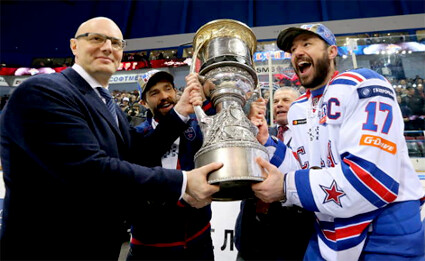
Kovalchuk 2017 Gagarin Cup
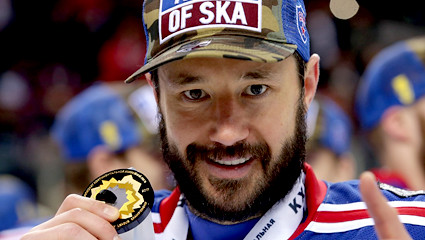
SKA captain Ilya Kovalchuk happily accepting the Gagarin Cup

Metallurg defeated the first year club Kunlun Red Star out of Beijing, China 4-1 and then cruised by both Barys Astana of Kazakhstan and the Russian club Ak Bars Kazan with back-to-back sweeps to advance to the finals as the Eastern Conference representative.

SKA had a similar route, defeating HC Vityaz of the Moscow region in four straight, advancing past Dynamo Moscow 4-1 and then sweeping Lokomotiv Yaroslavl 4-0, who had eliminated top seed CSKA Moscow, making SKA's route to the final just that much easier.
SKA Saint Petersburg logo

Game 1 of the finals went the way of SKA 5-4 after a back and forth affair which saw both teams leading at times. The game was tied at 2-2 after 2 periods and SKA took a 4-3 lead with a power play goal from Patrik Hersley with 5 minutes to play. Evgeny Dadonov extended the SKA lead to two at 16:59 and Tomas Filippi's goal for Metallurg with just 11 seconds remaining was too little too late for the home side Magnitogorsk.


Game 2 in Magnitogorsk was tied at 1-1 following the first period and Vladilsav Kaletnik scored the game winning goal in the second period and Tommi Santala's goal with 1:11 remaining in the game made the final score 3-1 as Vasily Koshechkin stopped 43 of 44 SKA shots in goal for Metallurg.


Game 3 at the Ice Palace in Saint Petersburg was all about the goaltenders. After a scoreless first period where SKA held an 18-3 advantage in shots, each team had a goal in the second period, as Andrei Zubarev opened the scoring at 2:54 for SKA. Agonizingly for the home fans, Denis Kazionov tied the game with just 6 seconds left in the period for Metallurg, who had a 12-6 lead in shots during period two. Neither team scored in the third period, as SKA held the edge in shots 12-5. After a scoreless first overtime, Dadonov won the game for SKA with a goal at 12:45 of the second overtime period. Mikko Koskinen got the win in goal for Saint Petersburg after making 27 saves, while Koshechkin was the hard luck loser for Magnitogorsk after making 58 saves, 24 in the two overtimes, as his offense managed only 8.


Game 4 at the Ice Palace was 1-0 for the visitors and Magnitogorsk held their one goal leading heading into the third period as the teams traded goals in the second for a 2-1 advantage. Just 1:28 into the third it was game on when Zubarev tied the game at 2-2 and Dinar Khafizullin won it for SKA when he beat Koshechkin at the 12:05 mark. Koskinen got the win in goal for SKA as they outshout Metallurg by a wide margin once again, 50-24. The win gave Saint Petersburg a 3-1 lead in games, putting them on the brink of the championship.


Yesterday's Game 5 was back in Magnitogorsk, and what a game it was. Metallurg scored first at 8:49 on a goal by Oskar Osala. Viktor Antipin extended the Magnitogorsk lead to 2-0 at 3:56 of the second period and it appeared as if it were their night.

Then three minutes later, Nikita Gusev started the SKA comeback at 7:00. Alexander Barabanov leveled the game just 2:23 later near the game's halfway mark. Dadonov scored his 9th goal of the playoffs at 14:29 to give SKA their first lead of the night at 3-2, which was the score at the end of the second period.
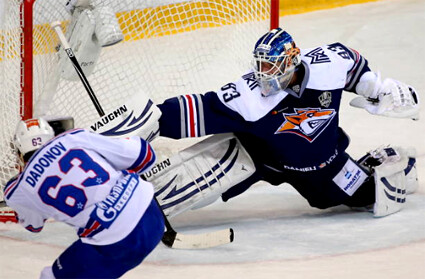
Koshechkin Dadonov
SKA's Dadonov attacking Koshechkin in the Metallurg goal

SKA kept rolling in the third, as Ilya Kovalchuk scored what appeared to be a back breaker at just nine seconds for a 4-2 lead for Saint Petersburg. However, Metallurg was not going to go away easy, especially at home, and Yaroslav Kosov responded to  a mere 46 seconds later to narrow the gap to 4-3 with essentially an entire period remaining to play.

Koskinen stood tall for SKA though, making 19 saves in the period while SKA managed a mere 3 shots, one of which was an empty net goal by Sergei Plotnikov with 1:06 to play to secure the championship for Saint Petersburg 4 games to 1. Despite being on the losing side, goaltender Koshechkin was named the playoff MVP.


When the start of the 2012-13 NHL season was delayed by a lockout, Kovalchuk signed with SKA and was also named team captain. He returned to the New Jersey Devils for the shortened NHL season was the labor issues were resolved, scoring 31 points in 37 games. Then, in July of 2013, he shocked the hockey world when he retired from the NHL, walking away from the $77 million and 12 years he had remaining on his contract.

While he said his reasoning was a desire to return home to Russia with his family, many accused him of following the money, as the far lower tax rate in Russia would have resulted in an even greater total salary in his pocket.

Less than a week after his "retirement", Kovalchuk signed a four year contract with Saint Petersburg. He immediately led the team to a division championship with the third best record in the league and tied Artemi Panarin for the team lead with 40 points having played 6 less games. SKA won a playoff series but were ousted in round two.

Kovalchuk was again second to Panarin in scoring in 2014-15, with 55 points in 54 games. During the playoffs, SKA defeated Torpedo Nizhny Novgorod, Dynamo Moscow, top seed CSKA and Ak Bars to capture the historic first championship for the club that was founded back in 1946, a drought of 69 seasons! Kovalchuk was third in team playoff scoring and fourth overall. He was named the playoff MVP, but refused to accept it and passed it to teammate Dadonov.
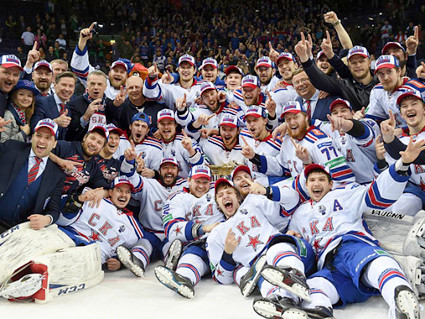
SKA 2015 Gagarin Cup team
The 2015 Gagarin Cup champions SKA Saint Petersburg

For the 2015-16 season, Kovalchuk was once again second in scoring, only this time behind Vadim Shipachev. He had 49 points in 50 games during the regular season. While SKA advanced to the semifinals before being eliminated, Kovalchuk was limited to just four games of SKA's 15 playoff games.

This season, Kovalchuk finally led SKA in scoring. He was the only member of the roster to play in all 60 of the team's games and led the club in goals with 32 and points with 78, which was second overall in the KHL.

Saint Petersburg won the Bobrov Division and finished tied with CSKA for the most overall points during the regular season. As we documented above, SKA marched through the playoffs to win their second Gagarin Cup championship in three seasons by defeating the defending champions Magnitogorsk by playing only two games over the minimum of 16 needed to win.
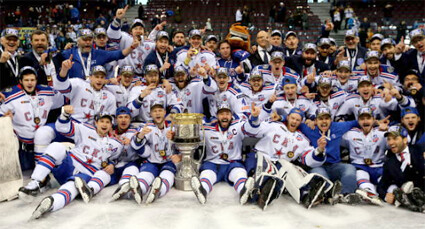
SKA 2017 Gagarin Cup team
The 2016-17 Gagarin Cup champions SKA Saint Petersburg

Since leaving the NHL, Kovalchuk has played in the KHL All-Star Game all four seasons, won two Gagarin Cups and one Playoff MVP award while scoring 89 goals and 222 points in 209 games.
KHL Playoffs 2016/17

Today's featured jersey is a 2016-17 SKA Saint Petersburg Pavel Datsyuk jersey. Datsyuk played in 44 of SKA's 60 games this season, scoring 12 goals and 34 points. He was injured off and on throughout the season and was injured once more during the second round of the playoffs against Dynamo which caused him to miss the Gagarin Cup finals.
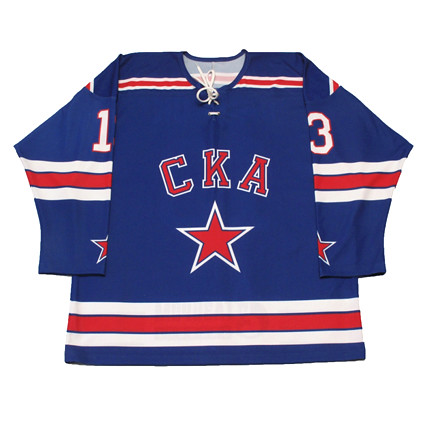
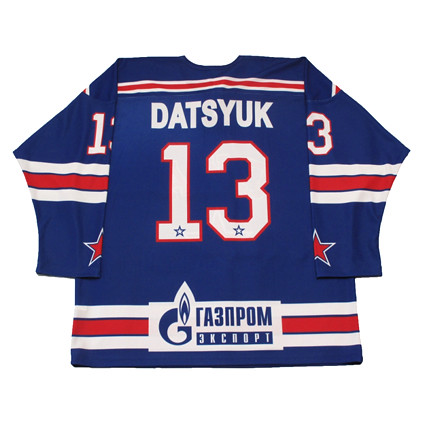
SKA Saint Petersburg 2016-17 F jersey
SKA Saint Petersburg 2016-17 B jersey

Friday, May 6, 2016

The 2016 IIHF World Championships - 1992 Russia National Team Alexei Kovalev Jersey

The 2016 IIHF World Championship begins today in Moscow and Saint Petersburg, Russia.

2016 IIHF World Championship logo photo 2016 IIHF World Championship logo horizontal.jpg

The 16 teams are divided into two groups, with Group A consisting of hosts Russia, Sweden, the Czech Republic, Switzerland, Latvia, Norway, Denmark and Kazakhstan, with all games being played at the 12,100 capacity VTB Ice Palace in Moscow.

Group B sees Canada, Finland, the United States, Slovakia, Belarus, France, Germany, and Hungary playing their games at the 7,300 capacity Yubileyny Sports Palace in Saint Petersburg.

Laika photo Laika.jpg
The tournament mascot, Laika

This will be just the third time the World Championships have been held in Russia since the break up of the Soviet Union, with the previous two times being in 2000 (Saint Petersburg) and 2007 (Moscow). Prior to that, the Soviet Union hosted the World Championships in 1957, 1973, 1979 and 1986, with all four taking place in Moscow.

The format of the tournament calls for each team to play the other seven teams in it's group in the Preliminary Round, which extends from today, May 6th through May 17th. The current format, as opposed to the old one in which there were four groups of four, favors the higher ranked teams, as a single loss is less devastating when playing a seven game schedule in the opening round as opposed to the earlier format's three games.

Once the Preliminary Round has been completed, the last place teams in each group will be relegated to Division I Group A for the 2017 season, unless either France or Germany finish last in Group B, as they are guaranteed a place in next year's World Championships as co-hosts of next year's event.

While Slovenia has secured their place in the 2017 Worlds by winning the recently completed Division I Group A, Italy will be anxiously awaiting the results of the Preliminary round in Russia, as they will be promoted to the 2017 Top Division tournament - unless both France and Germany finish 7th and 8th in Group B, in which case Italy will lose its promotion.

The top 4 teams in each group will advance to the Quarterfinals on May 19th with the winners meeting in the Semifinals on May 21st. The losers of those games will meet the next day on May 22nd for the bronze medal while the winners will face off for the IIHF World Championship later the same day.

World Championship trophy photo WorldChampionshiptrophy.jpg
The World Championship trophy

Today's opening day begins with Sweden taking on Latvia in Group A, while Group B wastes no time as the United States begins their schedule with no less than Canada. Later today host Russia faces the Czech Republic in Group A in Moscow and the other Group B match sees Finland open against Belarus.

Saturday sees a massive six games on the schedule as the rest of the 16 teams begin play before the day concludes with the United States playing Belarus in Saint Petersburg. There are also six games on Sunday, by the end of which all teams will have played twice.

For fans in Canada, TSN will show, for the first time ever, every game of the World Championships. Viewers in the US can watch all of the American games, two Quarterfinals, both Semifinals and the Bronze and Gold Medal games on the NBC Sports Network, but note that some of the games will  only be streamed on NBC Live Extra and not all of them will be on NBCSN. With the time difference between North America and Moscow, games will air live between mid morning and early afternoon eastern time.

 photo RussiaFederationlogo.png

The Russia National Ice Hockey Team is currently ranked 2nd in the IIHF World Rankings and played their first international game in April of 1992 after breakup of the Soviet Union and the subsequent games as the Confederation of Independent States and The Unified Team as late as February of 1992 during the Winter Olympics. Quite literally, the Soviet Union ceased to exist during the 1992 World Junior Tournament while the Soviet team was competing.

The Russians have participated in the Olympics in ice hockey six times since 1994. Their best result was a silver medal in 1998 in Nagano, Japan. Their only other medal was a bronze in 2002 in Salt Lake City.

Pavel and Valeri Bure Silver 1998 photo Pavel and Valeri Bure Silver 1998.jpg
Pavel and Valeri Bure with their silver medals in 1998

Since 1992, Russia has been regular participants at the World Championships. After finishing fifth in 1994, they won their first World Championship gold medal in 1993 in  Germany. After a lackluster First Round, where they opened with a 2-2 tie against Italy and a later both a 5-2 loss to Sweden and a 3-1 loss to Canada, they came alive in the Playoffs with a 5-1 win over Germany and a confidence boosting 7-4 win over Canada, which put them in the gold medal game, where they got their revenge on Sweden 3-1 to become World Champions for the first time as Russia.

Russia 1993 World Champions photo Russia 1993 World Champions.jpg
Ilya Byakin, Andrei Khomutov, Vyacheslav Bykov and
Vyacheslav Butsayev after winning the 1993 World Championship

The Russians entered a down period following their championship in 1993, finishing either fourth or fifth at the World Championships for the next six years, followed by a disastrous tournament in 2000 when they finished a shocking 11th, which included losses to the United States, Switzerland, Latvia and Belarus, made even worse by the fact it was as hosts in Saint Petersburg.

The program showed signs of life when they returned to the medal podium in 2002 with a silver medal, but 2003 and 2004 saw them again finish a distant 7th and 10th.


 Things began to change with a bronze in 2005 and again in 2007 in Moscow before a satisfying undefeated run through the 2008 tournament, which concluded with a 5-4 win over Canada in Canada to claim their first championship in 15 years, something unimaginable during the days of the Soviet Union's Big Red Machine.

 photo OvechkinRussia2008.jpg
Alexander Ovechkin never passes on a chance to play for Russia
and is seen here with the 2008 World Championshp trophy

Their 2008 gold medal was shown to not be a fluke when they repeated as gold medalists again in 2009, a second consecutive unbeaten run that concluded with another one goal victory over Canada.

Since then the Russians have been a force to be reckoned with, earning their fourth consecutive medal in 2010 with a silver, a fourth place in 2011 and a return to gold with a championship again in 2012, this time not only undefeated, but all coming in regulation without giving up a point in the standings.

Russia 2012 photo Russia-2012.jpg
Russia celebrating their perfect run through
the 2012 World Championships

After a sixth place in 2013, they won their fifth gold medal as Russia in 2014  behind another ten consecutive regulation wins without a single game even going to overtime.

Russia 2014 photo Russia-2014 trophy.jpg
Russia accepting their 2014 World Championship Trophy

Last year they won a second straight medal, in the form of a silver, their third since 2002 to go with a pair of bronze and four gold, a total of nine medals in the last 14 years.

Today's featured jersey is a 1992 Russia National Team Alexei Kovalev jersey as worn during the 1992 World Championships during the earliest days of the Russian National Team following the breakup of the Soviet Union in December of 1991.

When competing at the 1992 Olympics in February of 1992, Russia competed as the Unified Team, a joint team from Russia, Ukraine, Kazakhstan, Belarus, Uzbekistan and Armenia, wearing the last of their old Soviet Union jerseys, only with a blank space where the CCCP lettering used to reside on the front.

By the time the World Championships arrived in late April, Russia now had their own separate hockey program and were decked out in their stunning new jerseys which featured a bold design based on the onion domes of St. Basil's Cathedral in Moscow's Red Square.

For some reason, these great jerseys had a unexpectedly short life span, having only been used for the 1992 World Championships and the 1993 World Juniors before being replaced by a new style.

Kovalev was one of the most skilled players in the history of Russian hockey and played 19 seasons in the NHL. He won a Stanley Cup with the New York Rangers, making him one of the first four Russians to ever have their name engraved on the cup.

Internationally, he played twice for the Soviet Union at the European Juniors, as part of the Unified Team at the 1992 World Juniors and Olympics, winning gold both times, and for Russia eight times, three World Championships, earning a bronze in 2005 (when he was named the Best Forward), the World Cup of Hockey twice, and two more Olympics, winning bronze in 2002.

Russia 1992 jersey photo Russia1992F.jpg
Russia 1992 jersey photo Russia1992B.jpg

Bonus jersey: Today's bonus jersey is a 1993 Russia National Team Alexei Yashin jersey like those worn at the World Championships held in Germany where Russia defeated Sweden 3-1 to win the only World Championship gold medal of Yashin's career.

This Tackla jersey filled a narrow gap between the Tackla jerseys of the Soviet Union and the change to Reebok branding for all teams in 1994.

Russia 1993 WC jersey photo Russia 1993 WC F jersey.jpg
Russia 1993 WC jersey photo Russia 1993 WC B jersey.jpg

Bonus jersey: Today's bonus jersey is a 2009 Russia National Team Ilya Kovalchuk jersey as worn when Russia captured the gold medal at the 2009 World Championships as Kovalchuk was named the tournament's MVP after scoring 14 points in nine games.

Kovalchuk, who normally wears #17 in NHL competition in honor of former Soviet great Valeri Kharlamov, regularly wears #71 when playing for the National Team due to #17 being retired by the National Team in the late Kharlamov's honor.

This style was only worn for the 2009 World Championships before it was immediately replaced by a new style for 2010.

Russia 2009 jersey photo Russia 2009 WC F.jpg
Russia 2009 jersey photo Russia 2009 WC B.jpg

In today's video section, Kovalchuk scores the winning goal in overtime of the 2008 World Championships, defeating the host Canadians.


Next are highlights from Russia's 2012 World Championship.

Wednesday, May 27, 2015

Saint Petersburg, Russia - 2012-13 SKA Saint Petersburg Ilya Kovalchuk Jersey

Founded 312 years ago on this date in 1703 by Peter the Great, Saint Petersburg (Sankt Peterburg) is the second largest city in Russia with a population of 5 million. From 1713 to 1728 and again from 1732 to 1918 it was the capital of Russia until the communist Russian Revolution of 1917. It is also the northernmost city in the world with a population of over a million.

Saint Petersburg photo St Petersburg.jpg
Saint Petersburg

The city was founded when Peter the Great desired a better seaport and won the territory from the Swedish Empire, who controlled the area at the time.

Peter the Great photo Peter the Great.jpg
Peter the Great

After the Russian victory, the Peter and Paul Fortress was built, the first brick and stone building of the new city from which the city got its name.

Peter and Paul Fortress photo peter-paul-fortress-arial-shot.jpg
The Peter and Paul Fortress, birthplace of Saint Petersburg

In the 1860's, following the emancipation of peasants in Russia, the city saw large growth, which saw Saint Petersburg surpass Moscow in population as well as becoming one of Europe's largest industrial cities. Additionally, it developed a major naval base, river and sea port.

Following the outbreak of World War I, the government renamed the city Petrograd, meaning "Peter's City" in order to remove the German words "Sankt" and "Burg"

In October of 1917, the Bolsheviks, led by Vladimir Lenin, stormed the grand Winter Palace, the official residence of the Russian monarchy dating back to 1732, which led to the transfer of all power to the Soviets and gave rise to the Communist Party. When the city was threatened with bombardment and invasion by advancing German troops, the Soviets transferred the capital to Moscow to keep it away from the border, as was the case in Petrograd.

 photo St_Petersburg_winter_palace.jpg
The Winter Palace, home of the Czars

On January 26, 1924, five days after the death of Lenin, the city was again renamed, this time to Leningrad.

During World War II, German forces laid siege to the city from September of 1941 until January of 1944, one of the longest, most destructive and lethal sieges of a major city in modern history, with over a million civilian casualties, mainly from starvation.

Siege of Leningrad photo Siege of Leningrad.jpg
Citizens fleeing German bombardment during the
devastating siege of Leningrad during World War II

In 1991, after the fall of communism and the breakup of the Soviet Union, the city reverted back to its original name of Saint Petersburg.

It is considered the cultural center of Russia and is home to The Hermitage, one of the largest art museums in the world and one some 200 museums in the city. Additionally, there are about 8,000 architectural monuments, 50 theaters and many parks in Saint Petersburg.

It's main hockey club is SKA Saint Petersburgh, with SKA standing for Sports Club of the Army, written as CKA in Cyrillic. The team was founded in 1946 with the name Kirov LDO (Leningrad Officers Club). It underwent several name changes until changing to SKA in 1959. Like CSKA Moscow (Central Red Army), SKA belonged to the Soviet Ministry of Defense sports club system with its roster stocked with Leningrad Military District officers.

SKA logo photo SKA logo.png

SKA Leningrad were relegated for the 1947-48 season, but earned an immediate promotion back to the top level in their first try. Their return to the top level did not go well, and the club was once again demoted to the second division, and again won the right to return to the top division for 1950-51. This time they were successful in staying up, and remained in highest level for the next 40 years. The team remained in the top division until 1991, never having won a Soviet Championship League title thanks in large part to the dominance of CSKA Moscow.

Their first taste of success would wait until 1968 when they were a finalist for the USSR Cup, a season long knockout competition which ran concurrently with the league regular season. The club earned their first hardware in 1970, when they won their first Spengler Cup, defeating the Czechoslovakian team Dukla Jihlava.

The team repeated their Spengler Cup success with another victory over Dukla Jihlava in 1971 and then completed arguably the best season in club history with a bronze medal in the Soviet Championship League and a runner up finish in the USSR Cup.

Their next success would arrive with their third Spengler Cup victory in 1977 at the expense of Dukla Jihlava once again.

SKA Leningrad's next good result in the Soviet Championship League came with another bronze medal after the 1987 campaign.

That success would have to suffice for some time, as the political upheaval which arrived with the dissolution of the Soviet Union would affect the club's finances and resources as the changes in Russian society and it's sporting landscape sorted themselves out over the early part of the 1990's. This instability saw the team relegated for only the third time in it's history, as they were relegated following the 1990-91 season.

SKA Leningrad logo photo SKALeningradbadge.jpg
A badge from their days as SKA Leningrad

Another affect the breakup of the Soviet Union had on the team was the name of their home city Leningrad changing back to it's historic, original pre-1914 name of Saint Petersburg in 1991. From then on, the club would now be known as Hockey Club SKA Saint Petersburg.

SKA Saint Petersburg logo, SKA Saint Petersburg logo

The team spent the 1991-92 season in the second division and joined the new International Hockey League for its debut 1992-93 season. In the aftermath of the Soviet Union, the landscape of Russian hockey was rather unstable, and in the IHL ceased after just four seasons, being replaced by the Russian Superleague in 1999.

While several teams were able to rise to the top and win championships with the loss of dominance by CSKA after its systemic advantages were lost following the fall of communism, SKA was not one of those. In the 12 years of the RSL, six different clubs won championships but Saint Petersburg was unable to win even a single playoff round.

The Kontinental Hockey League arrived in 2008-09. The club's fortunes began to look upwards, beginning in 2010, when they won their fourth Spengler Cup.

SKA Spengler Cup 2010 photo SKASaintPetersburgwonin2010.png
SKA Saint Petersburg celebrate their 2010 Spengler Cup

Playoff success arrived in 2011-12 with the team making it to the conference finals before winning the Continental Cup as the team with the best regular season record at the conclusion of the 2012-13 regular season as they posted a 36-2-11-3 record for 115 points, 11 clear of second place. While they did advance to the conference finals again, the club lost in six games to the eventual champions Dynamo Moscow.

Finally in the 2014-15 season, the team finished second overall in the KHL and then defeated Torpedo Novgorod 4-1, Dynamo Moscow 4-1, Continental Cup winners CSKA Moscow in seven games before claiming their first championship in 69 years when they beat Ak Bars Kazan 4 games to 1.

SKA Gagarin Cup photo SKA Gagarin Cup.jpg
After never winning a domestic championship,
SKA Saint Petersburg won the 2015 Gagarin Cup

SKA were captained by former NHL goal scoring leader Ilya Kovalchuk, who was named the MVP of the Gagarin Cup Playoffs.

Kovalchuk Gagarin Cup photo Kovalchuk Gagarin Cup.jpg
SKA captain Kovalchuk hoisting the Gagarin Cup
for the team's first championship in 69 years

Other notable players to have skated for SKA include Maxim Afinogenov, Alexi Kasatonov, Darius Kasparaitis, Evgeni Nabokov, Alexi Ponikarovsky, Vladimir Tarasenko, Alexi Yashin, Valeri Zelepukin and Sergei Zubov.

SKA Vs Hurricanes photo SKAvsHurricanes2.jpg
Evgeni Nabokov in goal for SKA during their 5-3 exhibition game
victory against the Carolina Hurricanes in 2010

Their home games are held in The Ice Palace, which holds 12,300 fans and has hosted the IIHF European Champions Cup from 2005 to 2008. In 2011-12, SKA averaged 10,126 fans, becoming the first Russian club to average over 10,000 fans per game in a season. SKA also placed 6th overall in attendance in all of Europe and first in Russia.

Today's featured jersey is a 2012-13 SKA Saint Petersburg Ilya Kovalchuk jersey as worn by the NHLer early in the season while the NHL lockout was still in effect, foreshadowing his return to Saint Petersburg following his "retirement" from the NHL for the following season.

While in most leagues 68 seasons and no titles to show for it would be a cause for ridicule, not unlike baseball's Chicago Cubs, but the tilted system of Soviet hockey in favor of perennial champions CSKA (Central Red Army), 32 titles in 46 years and 13 in a row from 1978 to 1990, takes some of the heat of SKA as few clubs, other than perhaps Moscow Dynamo, were winning any championships either.

Of note, with the expansion of the KHL beyond the borders of Russia, the league no longer customizes player jerseys with the names on the back in Cyrillic, changing to English in 2011-12.

Russia SKA Saint Petersburgh 2012-13 jersey photo Russia-SKASaintPetersburgh2012-13F.jpg
Russia SKA Saint Petersburgh 2012-13 jersey photo Russia-SKASaintPetersburgh2012-13B.jpg

Today's video section is highlights of SKA Saint Petersburg winning Game 5 of the Gagarin Cup Finals to win their first championship in 69 years.

Friday, February 12, 2010

2009 Russia National Team Ilya Kovalchuk Jersey

The highest seeded team in Group B at the 2010 Vancouver Olympic Men's Ice Hockey Tournament is Russia.

The Russia National Ice Hockey Team is currently ranked 1st in the IIHF World Rankings is one of the favorites to win a medal in Vancouver, having won the last two World Championships.

Based on their status as one of the top nine ranked countries, Russia was automatically entered in the 2010 Olympic tournament, allowing them avoid the qualification process for teams outside the top nine.

Russia has participated in the Olympics in ice hockey four times since 1994 after the breakup of the Soviet Union. In 1994 they finished in 4th place, followed by their best showing in 1998 with a silver medal in Nagano, Japan, the first Olympics with full professional participation. The followed that with a bronze in 2002 and another fourth the last time out in 2006.

Since 1992, Russia have been regular participants in the World Championships, with a number of medals to their credit. They first won a gold medal in 1993, still playing with the core of the last Soviet Union trained club. Following that success, the program fell into a down period when compared to the dominance of the Soviet Union. From 1994 through 2001, the Russians failed to win a medal of any kind, which included a dismal 11th place finish as hosts of the 2000 tournament. Russian fortunes too a turn for the better with a silver in 2002, bronze medals in 2005 and 2007 before regaining the gold in 2008 and backing that up with another gold in 2009.

The Russians have also participated in the World Cup of Hockey twice, reaching the semi-finals in 1996.

Russia enters the 2010 Olympics with 14 NHLers on it's roster, highlighted by Alexander Ovechkin of the Washington Capitals, currently the best player in the world. Other members of the incredibly potent Russian offense include Pavel Datsyuk, Evgeni Malkin, Ilya Kovalchuk and Aleksey Morozov, formerly of the Pittsburgh Penguins, currently playing in the KHL. Russia is so loaded up front that they neglected to name current KHL scoring leaders and former Olympians Maxim Shushinski and Alexei Yashin to their roster.

The Russian defense will be led by the offensively talented Andrei Markov and Sergei Gonchar, while the goal will be patrolled by Evgeni Nabokov, Ilya Bryzgalov and Semyon Varlamov, with Nabokov expected to play in the majority of the games and Bryzgalov a more than capable backup, having led the Russians to the 2009 World Championship.

This is a stellar lineup that sports, in addition to the 14 NHLers, nine players from the Russian KHL, including the familiar names of Sergei Fedorov and Viktor Kozlov.

With the format for this year's Olympics calling for the top four teams after the Preliminary Round to receive byes into the quarterfinals, the key for Russia will be defeating rivals the Czech Republic in the Preliminary Round on February 21 to go undefeated to ensure themselves one of the byes. This could be a tough task in the most difficult of the three groups. From then on, it's a single elimination tournament, with just two wins required to make the finals, and most experts are calling for Russia to be playing for gold on February 28th.

Today's featured jersey is a Nike 2009 Russia National Team Ilya Kovalchuk jersey as worn when Russia captured the gold medal at the 2009 World Championships as Kovalchuk was named the tournament's MVP after scoring 14 points in nine games.

Kovalchuk, who normally wears #17 in NHL competition in honor of former Soviet great Valeri Kharlamov, regularly wears #71 when playing for the National Team due to #17 being retired by the National Team in the late Kharlamov's honor.

A regular on the National Team, Kovalchuk, despite only being 26 years old, already has played in two World Junior U18 Championships, earning a silver and a gold, a World Junior u20 Championship, six World Championships, earning two bronze and two gold, as well as two previous Olympics, with a bronze to his credit in 2002.

Russia 2009 jersey photo Russia 2009 WC F.jpg
Russia 2009 jersey photo Russia 2009 WC B.jpg

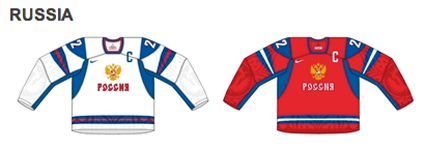
Here is a look at the jerseys that Russia will be wearing in the 2010 Olympics in Vancouver. A jersey with too much going on, it has blue underarm flashes, oddly narrow stripes on both the waist and arms, with the arms then coming to a point toward the inside of the sleeves for some reason. Add in the color blocks for the numbers on the shoulders leave this jersey looking like a patchwork quilt. If that weren't enough, they have also added the subtle printing on the lower arms of the eagle from the crest to give you even more to look at.


Here, Kovalchuk scores the winning goal in overtime of the 2008 World Championships, defeating the host Canadians.


Next up is a compilation of Kovalchuk highlights from both the 2009 and 2008 World Championships.


Here is some classic footage of the Soviet Union winning the 1965 World Championships over Czechoslovakia.


hit counter for blogger