On April 18, 1987, the WashingtonCapitals hosted the New YorkIslanders in Game 7 of their opening round playoff series.
The game would not end until the early hours of the following day.
The series had opened in Washington with a split, with the Capitals taking Game 1 by a score of 4-3 and the Islanders evening the series by taking Game 2 by a 3-1 margin. Back on Long Island the Capitals took two, with a Game 3 shutout 2-0 and a 4-1 win in Game 4 to take a commanding 3-1 edge in games. The Islanders stayed alive with a 4-2 win back in Washington and forced a deciding Game 7 with a 5-4 win at home.
With viewers across North America tuned in on ESPN and the CBC, the puck dropped at 7:40 PM and the Capitals dominated early but it took nearly the entire period for Mike Gartner to eventually put Washington ahead 1-0 with 48 seconds left in the first.
Pat Flatley evened the score at 11:35 of the middle period before Grant Martin restored Washington's one goal lead at 18:45 by beating the Islanders goaltender Kelly Hrudey. The period ended at 2-1 for Washington, which held a 25-10 margin in shots.
There was no scoring in the third period until Bryan Trottier put a backhander between Captials goalie Bob Mason's legs at 14:37 to tie the game at 2-2. For the remainder of regulation both teams sought an advantage without success, and regulation came to a close without a winner.
In the first twenty minute overtime, the teams both recorded 11 shots on goal and the Capitals Greg Smith nearly won it with a slap shot that beat Hrudey but clanged off the right post with seconds remaining.
Washington did their best to end it in the second overtime by outshooting the Islanders 17-9, but could not solve Hrudey. Perhaps the best chance to end the game in the second OT was when Islander Randy Wood's shot that hit the pipe.
The game then advanced to a third overtime, the first in 16 years, and fatigue really began to take hold as Easter Sunday began. The Islanders got the better of the Capitals during the period, holding an 11-10 edge in shots on goal. Mason denied the Islanders better scoring chances and the second sixty minutes closed scoreless.
For the first time since 1951, a game would enter the fourth overtime and people really started to get punchy, ESPN's Bill Clement in particular, having taken off his shirt and converted his tie into a headband before doing some voice impressions prior to the start of the fourth overtime.
The game started to climb the list of the longest games in NHL history, entering the top five of all time after a 1:10 of play in the fourth overtime period. The Islanders moved ahead in shots four to one when Ken Leiter of the Islanders pinched in the keep the puck in the Washington end. He circled behind the goal and passed to Gord Dineen, whose shot was blocked in front of Mason. The puck deflected back to Pat LaFontaine, who fired a slapshot passed a screened Mason to finally end the game after 128:47 of play, winning not only the game, but eliminating the Capitals as the Islanders won the series 4 games to 3, despite the fact that the Capitals had not trailed in the series or the game until LaFontaine's goal.
LaFontaine's goal came at 1:58 AM, 6 hours and 18 minutes after the opening faceoff. Hrudey was credited with 73 saves, an NHL playoff record, while Mason's total was 54 in the game that would become known as the "Easter Epic".
LaFontaine meets Mason in the handshake line following the Easter Epic
Today's featured jersey is a 1986-87 New York Islanders Pat LaFontaine jersey. Throughout his career, LaFontaine's name was spelled with a variety of all capital letters of equal size and other times when the "A" was in a smaller size as shown here.
Later LaFontaine Islanders jerseys would have the more traditional all caps of the same size, so it is essential for you to do your research for the exact specification of lettering style used for the particular year of any LaFontaine Islanders jersey you may want to add to your collection.
The smaller "A" can be found on early Islanders, 1996 USA and black Sabres jerseys.
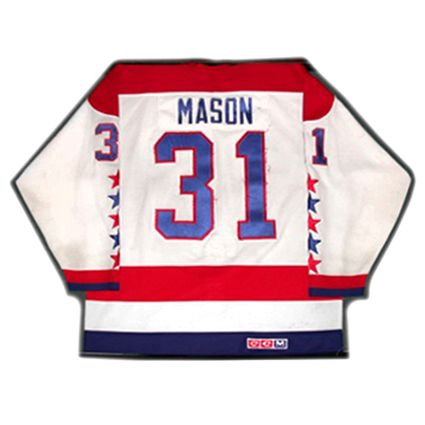
Bonus jersey: Today's bonus jersey is a 1986-87 Washington Capitals Bob Mason jersey . The Capitals wore this style starting with their inaugural season of 1974-75 and continued to use it through the 1995-95 season before a radical overhaul of their branding saw them drop their red, white and blue color set in favor of a lighter shade of blue and black with bronze accents.
The team reverted to their classic red, white and blue colors for the 2007-08 season and reintroduced today's bonus jersey style for the 2011 Winter Classic, which proved so popular they made this their alternate jersey starting with the 2011-12 season through the 2014-15 campaign before switching to the red road version of this jersey.
Today's video section features highlights of the Easter Epic, which faced off on this date in 1987. First, from the CBC, featuring a more subdued Don Cherry than the much more voluminous one he has evolved into.
Next, BillClement loses his mind on national TV prior to the fourth overtime.
Finally, LaFontaine reflects on his memories of the game and the playoffs in general.
Post settings
Labels
Easter Epic, Lafontaine Pat, New York Islanders, Washington Capitals
Published on
4/18/13, 5:00 AM
Central Daylight Time
Permalink
Location
Search Description
Options
Drafted by third overall by the New York Islanders, PatLaFontaine delayed his entry into the NHL by first playing for the United States National Team in preparation for the 1984 Olympics.
At the conclusion of the Olympics, LaFontaine then joined the Islanders for the remainder of the 1983-84 season, scoring 13 goals in 15 games. He would play seven seasons on Long Island, unfortunately arriving at the conclusion of the Islanders dynasty which occurred with the loss in the 1984 Stanley Cup Finals to the Edmonton Oilers. It would be the last time LaFontaine would play in the finals, as his teams would never advance past the second round of the playoffs for the remainder of his career.
He proved to be a prolific goal scorer with the Islanders, scoring 38 goals in this third full season and then posting four consecutive seasons of 40 goals or more, highlighted by his career high of 54 in 1989-90 and his 105 points that year was his best as an Islander.
The highlight of LaFontaine's time with the Islanders was scoring the series winning goal in the fourth overtime of Game 7 between the Islanders and the Washington Capitals during the 1987 playoffs. "It was the most memorable moment in my hockey life. Even today, wherever I go, people come up to me and start telling me where they were during the Easter Epic," LaFontaine said.
LaFontaine would suffer a concussion during the playoffs in 1990, the first of several that would affect his career.
With the situation in New York looking dismal for the foreseeable future, LaFontaine turned down a contract offer from the Islanders and sat out the first three weeks of the season before being traded to the Buffalo Sabres.
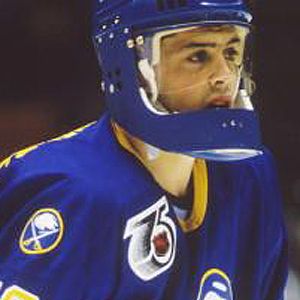
The Sabres were a good fit for LaFontaine and he immediately scored 93 points in 57 games that season, although he was limited by a broken jaw which led to some interesting headgear upon his return.
He followed up his first season in Buffalo with the best offensive season of his career in 1992-93, after being named team captain, with 53 goals and 95 assists, helping set up many of Alexander Mogilny's 76 goals in the process, for a career best 148 points and second place in the NHL scoring race.
LaFontaine and Mogilny were rewarded with spots in the 1993 NHL All-Star Game
The next two seasons were a struggle for LaFontaine, as he only managed to play in 38 total games due to knee surgery for a torn ligament. Still, he was awarded the Masterton Trophy in 1995.
Proving he still could compete, he had his seventh 40 goal season in 1995-96, finishing with 91 points. Early in the next season, he would suffer another concussion, costing him several months of playing time which would limit him to just 13 games. Sabres management and team doctors refused to clear him to play, but LaFontaine demanded a trade, believing he could still play.
The Sabres subsequently traded him to the New York Rangers for the final season of his career. He managed to play in 67 games, which included reaching the 1,000 point milestone on this date in 1998, as well as representing the United States a month later at the Olympics in Nagano, Japan.
LaFontaine at the 1998 Olympics
After suffering another serious concussion in a collision with a teammate in mid March, LaFontaine would miss the remainder of the year and retire at the end of the season, having totaled 468 goals, 545 assists and 1013 points in his abbreviated 15 year career.
In addition to the 1984 and 1998 Olympics which bookended his international career, LaFontaine would also compete for the United States in the 1987 Canada Cup, the 1989 World Championships, the 1991 Canada Cup and the gold medal winning 1996 World Cup of Hockey team, where LaFontaine had four points in five games.
LaFontaine hoists the 1996 World Cup
In 2003 he was inducted into the Hockey Hall of Fame as well as the United States Hockey Hall of Fame. In 2006, the Buffalo Sabres would retire LaFontaine's #16 on March 3rd.
An interesting note of trivia, LaFontaine is one of only three players to play for all three teams from the state of New York, and the only one to have played his entire career in New York state. LaFontaine once joked, "I got to play for three great organizations in my career and never once had to buy new license plates."
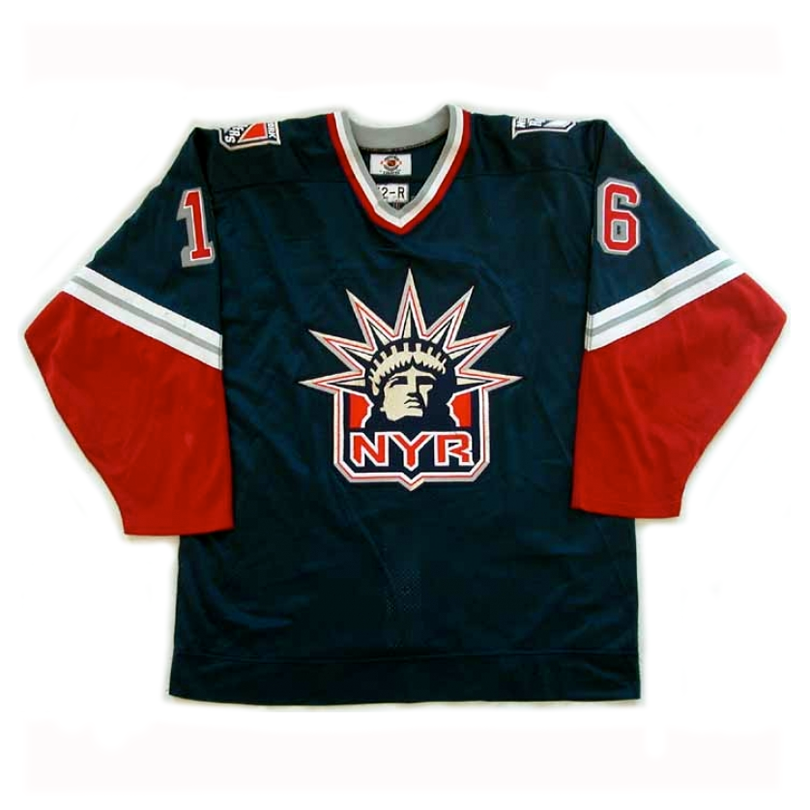
Today's featured jersey is a 1997-98 New York Rangers Pat LaFontaine jersey. This highly attractive jersey was worn during the season LaFontaine scored his 1,000th career point.
The beautiful "Liberty" jersey was first introduced in 1996 and featured a bold new crest featuring the Statue of Liberty and a very classy darker shade of blue than the traditional road jerseys. This style is perhaps the finest third jersey in NHL history and would remain in use through the 2006-07 season until being discontinued when all clubs were limited to just two jerseys with the arrival of the new Reebok Edge jerseys.
During LaFontaine's career, there was inconsistency in the way his name was displayed on the back of his jerseys. The Islanders had it as both "LAFONTAINE" in all capital letters of the same size and also "LAFONTAINE" with the "A" capitalized, but in a smaller size. The Sabres seem to have used all capitals the same size while the Rangers used the small "A" style. His 1987 USA Canada Cup and jerseys used the smaller "A", while we have seen his 1996 USA World Cup jerseys both ways!
If you are going to add a LaFontaine jersey to your collection, we strongly recommend searching for photos and videos of the style of jersey you wish to replicate and supply your findings to your customizers in order to get the most accurate jersey possible.
We begin today's video selections with the Top 10 goals by Pat LaFontaine.
Next, a tribute to LaFontaine on the occasion of his jersey retirement by the Sabres.
JohnLafontaine was a Canadian from Tecumseh, Ontario who worked for Chrysler, who transferred him to St. Louis, Missouri where his son Pat Lafontaine was born in 1965.
It was in St. Louis where Lafontaine first learned to skate. His father was transferred once again, this time to Waterford, Michigan, just 33 miles from Detroit when Pat was seven. He was able to get in plenty of ice time as the Lafontaine's lived on Williams Lake. He also played on his older brother's team, with kids that were a year or two older than he was, which pushed him to improve his game to keep up with the older boys.
With the end goal of American kids being to play college hockey in those days, the thought of turing pro hadn't even occurred to him until he was fifteen, following the success of the 1980 "Miracle on Ice" United States Olympic team's gold medal performance, as well as that of American Bobby Carpenter of Massachusetts, who turned pro with the Washington Capitals in 1981.
Lafontaine was clearly no ordinary talent, as while Carpenter was just turning pro in 1981-82, Lafontaine scored an Earth-shattering 175 goals and 149 assists for a stunning 324 points in a 79 game season with Detroit Compuware of the midget AAA Michigan National Hockey League, an average of over four points per game!
No doubt influenced by his father's Canadian roots, the decision was made that the best place for Lafontaine to continue to progress was Canadian junior hockey rather than an American college. With that, Lafontaine left home at age 17 and moved to the Montreal suburb of Verdun to play for the Verdun Juniors of the Quebec Major Junior Hockey League for the 1982-83 season.
"Our coach, PierreCramer, put me together with Jean-Maurice Cool and we traded for GerardGallant. We gelled together," Lafontaine recalled.
Pat Lafontaine while with Verdun
Lafontaine began the season with a goal and two assists at Chicoutimi. He duplicated that in his second game at home to Saint Jean. His first hat trick came four games later to extend his point scoring streak to six. Eight games later Lafontaine had his second hat trick as well as four assists for a seven point night.
November 1st saw the streak reach 20 games at Laval with a pair of assists. Four games later Hull was victimized by Lafontaine's fourth hat trick and second seven point game.
He reached the 30 game mark November 26th with a goal and three assists against Drummondville. He surpassed 100 points on December 3rd in his 32nd game of the season and Game 35 of the consecutive point streak on December 10th was an impressive showing, as Lafontaine raised his season high with an eight point night courtesy of a two goal, six assist performance.
Game 40 was achieved December 21st with a goal. After a two week break for the World Junior Tournament, Verdun returned to the ice on January 5th and Lafontaine picked up where he left off with back to back hat tricks (numbers 6 and 7 of the season) on the 5th and the 7th. The point scoring streak now reached 43 games, as well as a total of 142 points, on this date in 1983 when Lafontaine had a pair of goals and an assist versus Chicoutimi.
Lafontaine preparing before a game with Verdun
For the first time all season, Lafontaine was held scoreless at Shawinigan on January 12th, but began another scoring streak of 26 games that would carry through to the end of the season.
He set a season high with four goals on the 18th, only to raise that to five on the 28th of January. Lafontaine reached the 200 point barrier on the 23rd and equalled a season high with eight points on February 25th, which included his 11th hat trick. He finished the regular season strongly with a hat trick and three assists for six points on March 11th and then repeated those totals the very next game on March 13th.
He then put an exclamation point on his amazing season when he pumped in five goals as well as three assists for his third eight point night of the season to score 20 points in his final three games, giving Lafontaine points in 69 of the Juniors 70 games that season as well as 15 total hat tricks.
Lafontaine had a 43 game point scoring streak in 1982-83
and scored in 69 of his team's 70 games
In addition to his three eight point games, he had three seven point games, four with six and five games of five points apiece. His final totals were 104 goals and 130 assists for 234 points to lead the league in scoring and earn the Jean Beliveau Trophy with the second highest total in league history at the time. He had 15 more assists than his next closest competitor, Claude Verret, whom he beat by 46 points in the scoring race. Lafontaine also won the goal scoring crown by a full 20 goals over future NHL superstar Mario Lemeiux, who came third in the points race a full 50 points back of Lafontaine.
Lafontaine's remarkable season sees him still third on the single season goal scoring list as well as third on the single season point scoring record more than 25 years later.
Once the playoffs began, Lafontaine kicked off the postseason with four assists as Verdun swept Trois-Rivieres on the strength of Lafontaine's ten points. Shawingan fell in six after shutting out Lafontaine in Game 1 although he came back to score 12 points in the final five games. Verdun then won the President's Cup and qualified for the Memorial Cup by defeating Longueuil four games to one thanks to 13 points from Lafontaine, which earned him the Michel Briere Memorial Trophy as QMJHL playoff MVP after leading the playoffs in scoring with 35 points in 15 games, which added the Guy Lafleur Trophy to his ever growing hardware collection.
Additionally, Lafontaine collected the Mike Bossy Trophy as Best Pro Prospect of the Year, the Michel Bergeron Trophy as Offensive Rookie of the Year and the Frank J. Selke Memorial Trophy as Most Sportsmanlike Player thanks to his total of just 10 penalty minutes for the entire regular season.
Despite being named the Best Pro Prospect in the QMJHL, Lafontaine was drafted third overall that season behind the Minnesota North Stars first overall selection of Brian Lawton and the Hartford Whalers choice of Sylvain Turgeon second before the New York Islanders grabbed Lafontaine.
Lafontaine would only play for Verdun for a single season, one in which he dominated and proved he was ready to move up to play against a higher level of competition, which he did by spending a season with the United States National Team in preparation for the 1984 Olympic Games.
Lafontaine wearing the colors of the United States
Once the Olympics were concluded, Lafontaine then joined the Islanders for the final 15 games of the 1983-84 season, which included scoring a hat trick and two assists in only his second NHL game. He also gained valuable experience in 16 playoff games as the Islanders made it all the way to the Stanley Cup Finals, only to see their dynasty end as the Edmonton Oilers began theirs.
Lafontaine would go on to prove the North Stars and Whalers wrong by having a 15 season NHL career during which he would score 468 goals and over 1,000 points, appear in five NHL All-Star Games, have his #16 retired by the Buffalo Sabres and eventually be inducted into both the Hockey Hall of Fame and the United States Hockey Hall of Fame in 2003.
Today's featured jersey is a 1982-83 Verdun Juniors Pat Lafontaine jersey. The Verdun Juniors franchise can be traced back to 1933 when they began life as the Montreal Junior Canadiens, a name they retained until 1972. Name changes then ensued, going from the Montreal Bleu Blanc Rouge to the Montreal Juniors, the Verdun Juniors, and the Verdun Junior Canadiens, all of which explains why their jerseys copied the Montreal Canadiens template so directly.
Eventually the club relocated 35 miles east to Saint-Hyacinthe where they became knows as the Saint-Hyacinthe Laser in 1989 where the Canadiens look was continued. They remained there until 1996 when they moved once more, this time 421 miles northwest to Rouyn-Noranda where they became known as the Huskies and continue to play there to this day, but finally broke their ties to the Canadiens jersey template.
Bonus jersey: Today's bonus jersey is a 1984 United States National Team Pat Lafontaine jersey as worn at the 1984 Olympics in Sarajevo, Yugoslavia. Before joining the NHL, Lafontaine spent a year with the United States National Team, playing a schedule of 58 games during which he scored 56 goals and 55 assists for 111 points in preparation for the 1984 Olympics. During the Games, Lafontaine scored 5 goals and 8 points in 6 games for the Americans after which he would make his NHL debut for the New York Islanders never having played a game in the minor leagues.
This diagonally lettered jersey was first used by the United States in 1981 and was used through the 1984 Olympics before being replaced by a new design later that year for the 1984 Canada Cup. Note the odd treatment of the filled in center of the "O" in his name and the "6" on the sleeve.
While today's post focused on Lafontaine's junior hockey dominance, video of that era was impossible to find, so we present to you Lafontaine's top ten goals.
Drafted by third overall by the New York Islanders, PatLaFontaine delayed his entry into the NHL by first playing for the United States National Team in preparation for the 1984 Olympics.
At the conclusion of the Olympics, LaFontaine then joined the Islanders for the remainder of the 1983-84 season, scoring 13 goals in 15 games. He would play seven seasons on Long Island, unfortunately arriving at the conclusion of the Islanders dynasty which occurred with the loss in the 1984 Stanley Cup Finals to the Edmonton Oilers. It would be the last time LaFontaine would play in the finals, as his teams would never advance past the second round of the playoffs for the remainder of his career.
He proved to be a prolific goal scorer with the Islanders, scoring 38 goals in this third full season and then posting four consecutive seasons of 40 goals or more, highlighted by his career high of 54 in 1989-90 and his 105 points that year was his best as an Islander.
The highlight of LaFontaine's time with the Islanders was scoring the series winning goal in the fourth overtime of Game 7 between the Islanders and the Washington Capitals during the 1987 playoffs. "It was the most memorable moment in my hockey life. Even today, wherever I go, people come up to me and start telling me where they were during the Easter Epic," LaFontaine said.
LaFontaine would suffer a concussion during the playoffs in 1990, the first of several that would affect his career.
With the situation in New York looking dismal for the foreseeable future, LaFontaine turned down a contract offer from the Islanders and sat out the first three weeks of the season before being traded to the Buffalo Sabres.
The Sabres were a good fit for LaFontaine and he immediately scored 93 points in 57 games that season, although he was limited by a broken jaw which led to some interesting headgear upon his return.
He followed up his first season in Buffalo with the best offensive season of his career in 1992-93, after being named team captain, with 53 goals and 95 assists, helping set up many of Alexander Mogilny's 76 goals in the process, for a career best 148 points and second place in the NHL scoring race.
LaFontaine and Mogilny were rewarded with spots in the 1993 NHL All-Star Game
The next two seasons were a struggle for LaFontaine, as he only managed to play in 38 total games due to knee surgery for a torn ligament. Still, he was awarded the Masterton Trophy in 1995.
Proving he still could compete, he had his seventh 40 goal season in 1995-96, finishing with 91 points. Early in the next season, he would suffer another concussion, costing him several months of playing time which would limit him to just 13 games. Sabres management and team doctors refused to clear him to play, but LaFontaine demanded a trade, believing he could still play.
The Sabres subsequently traded him to the New York Rangers for the final season of his career of 1998-99. He managed to play in 67 games that season, which included reaching the 1,000 career points milestone, as well as representing the United States at the Olympics in Nagano, Japan.
LaFontaine at the 1998 Olympics
After suffering another serious concussion in a collision with a teammate in mid March, LaFontaine would miss the remainder of the year and retire at the end of the season, having totaled 468 goals, 545 assists and 1013 points in his abbreviated 15 year career.
In addition to the 1984 and 1998 Olympics which bookended his international career, LaFontaine would also compete for the United States in the 1987 Canada Cup, the 1989 World Championships, the 1991 Canada Cup and the gold medal winning 1996 World Cup of Hockey team, where LaFontaine had four points in five games.
LaFontaine hoists the 1996 World Cup
Following his career, LaFontaine was inducted into the Hockey Hall of Fame on this date in 2003 as well as the United States Hockey Hall of Fame later that same year. "I am truly thrilled to receive this tremendous honor. Growing up in St. Louis, I always played for the love of the game and never dreamed this could ever lead to my being a member of the Hockey Hall of Fame." he stated when told of his selection to the hall. On March 3. 2006 the Buffalo Sabres would retire LaFontaine's #16.
An interesting note of trivia, LaFontaine is one of only three players to play for all three teams from the state of New York, and the only one to have played his entire career in New York state. LaFontaine once joked, "I got to play for three great organizations in my career and never once had to buy new license plates."
Today's featured jersey is a 1992-93 Buffalo Sabres Pat LaFontaine jersey. LaFontaine would join the Sabres for the 1991-92 season while they were still wearing their original blue and gold jerseys. At the time LaFontaine became a Sabre, the club had changed from a lace up collar as first worn in 1970-71 upon the club's debut, added names on the back in 1977-78, added shoulder logos in 1978-79, and thickened the arm and sleeve stripes in 1983-84.
During the first five of LaFontaine's six years with Buffalo, the jersey would remain the same, but the NHL 75th Anniversary patch in 1991-92, the Stanley Cup Centennial patch in 1992-93, the Sabres 25th Anniversary patch in 1994-95 and the Roger Crozier Memorial #1 patch in 1995-96 were all worn.
Bonus jersey: Today's bonus jersey is a 1996-97 Buffalo Sabres Pat LaFontaine jersey. For LaFontaine's final season in Buffalo, the Sabres moved out of their old arena, The Buffalo Memorial Auditorium, and moved into the new Marine Midland Arena. To kick off the new era in Sabres history, the team completely revamped their entire identity package, which included not only new jerseys and a new buffalo head logo, but a change to the all new color scheme of black, red and sliver. For the only season LaFontaine would wear the "goat head" jerseys, the Seymour H. Knox III memorial patch was worn as a tribute to one of the Sabres original owners.
The black and red jerseys would be worn for nine seasons through the 2005-06 season, but never really were accepted by the Sabres faithful who longed for a return to the blue and gold. In a perfect example of "be careful what you ask for, you just might get it", the blue and gold returned in 2006-07, only now in the form of the universally ridiculed "Buffaslug" logo!
During LaFontaine's career, there was inconsistency in the way his name was displayed on the back of his jerseys. The Islanders had it as both "LAFONTAINE" in all captial letters of the same size and also "LAFONTAINE" with the "A" capitalized, but in a smaller subscript size during his early days with the club. The Sabres used all capitals the same size while the Rangers used the small "A" style. His 1987 USA Canada Cup and jerseys used the smaller "A", while we have seen his 1996 USA World Cup jerseys both ways!
That makes it essential for you to do your research for the exact specification of lettering style for not only the name on the back, but use of the "A" or the "C" used for the particular year of any LaFontaine jersey you may want to add to your collection. We strongly recommend searching for photos and videos of the style of jersey you wish to replicate and supply your findings to your customizers in order to get the most accurate jersey possible.
Extra bonus jersey: Today's extra bonus jersey is a 2003-04 Buffalo Sabres Chris Drury jersey as worn when the Sabres retired LaFontaine's #16.
The red alternate jersey was first used by the Sabres in 2000-01 and lasted through the rest of the black and red era, which ended at the end of the 2005-06 season.
We begin today's video selections with the Top 10 goals by Pat LaFontaine.
Next, a tribute to LaFontaine on the occasion of his jersey retirement by the Sabres.
On this date in 1987, the WashingtonCapitals hosted the New YorkIslanders in Game 7 of their opening round playoff series.
The game would not end until the early hours of the following day.
The series had opened in Washington with a split, with the Capitals taking Game 1 by a score of 4-3 and the Islanders evening the series by taking Game 2 by a 3-1 margin. Back on Long Island the Capitals took two, with a Game 3 shutout 2-0 and a 4-1 win in Game 4 to take a commanding 3-1 edge in games. The Islanders stayed alive with a 4-2 win back in Washington and forced a deciding Game 7 with a 5-4 win at home.
With viewers across North America tuned in on ESPN and the CBC, the puck dropped at 7:40 PM and the Capitals dominated early but it took nearly the entire period for Mike Gartner to eventually put Washington ahead 1-0 with 48 seconds left in the first.
Pat Flatley evened the score at 11:35 of the middle period before Grant Martin restored Washington's one goal lead at 18:45 by beating the Islanders goaltender Kelly Hrudey. The period ended at 2-1 for Washington, which held a 25-10 margin in shots.
There was no scoring in the third period until Bryan Trottier put a backhander between Captials goalie Bob Mason's legs at 14:37 to tie the game at 2-2. For the remainder of regulation both teams sought an advantage without success, and regulation came to a close without a winner.
In the first twenty minute overtime, the teams both recorded 11 shots on goal and the Capitals Greg Smith nearly won it with a slap shot that beat Hrudey but clanged off the right post with seconds remaining.
Washington did their best to end it in the second overtime by outshooting the Islanders 17-9, but could not solve Hrudey. Perhaps the best chance to end the game in the second OT was when Islander Randy Wood's shot that hit the pipe.
The game then advanced to a third overtime, the first in 16 years, and fatigue really began to take hold as Easter Sunday began. The Islanders got the better of the Capitals during the period, holding an 11-10 edge in shots on goal. Mason denied the Islanders better scoring chances and the second sixty minutes closed scoreless.
For the first time since 1951, a game would enter the fourth overtime and people really started to get punchy, ESPN's Bill Clement in particular, having taken off his shirt and converted his tie into a headband before doing some voice impressions prior to the start of the fourth overtime.
The game started to climb the list of the longest games in NHL history, entering the top five of all time after a 1:10 of play in the fourth overtime period. The Islanders moved ahead in shots four to one when Ken Leiter of the Islanders pinched in the keep the puck in the Washington end. He circled behind the goal and passed to Gord Dineen, whose shot was blocked in front of Mason. The puck deflected back to Pat LaFontaine, who fired a slapshot passed a screened Mason to finally end the game after 128:47 of play, winning not only the game, but eliminating the Capitals as the Islanders won the series 4 games to 3, despite the fact that the Capitals had not trailed in the series or the game until LaFontaine's goal.
LaFontaine's goal came at 1:58 AM, 6 hours and 18 minutes after the opening faceoff. Hrudey was credited with 73 saves, an NHL playoff record, while Mason's total was 54 in the game that would become known as the "Easter Epic".
LaFontaine meets Mason in the handshake line following the Easter Epic
Today's featured jersey is a 1986-87 New York Islanders Pat LaFontaine jersey. Throughout his career, LaFontaine's name was spelled with a variety of all capital letters of equal size and other times when the "A" was in a smaller size as shown here.
Later LaFontaine Islanders jerseys would have the more traditional all caps of the same size, so it is essential for you to do your research for the exact specification of lettering style used for the particular year of any LaFontaine Islanders jersey you may want to add to your collection.
The smaller "A" can be found on early Islanders, 1996 USA and black Sabres jerseys.
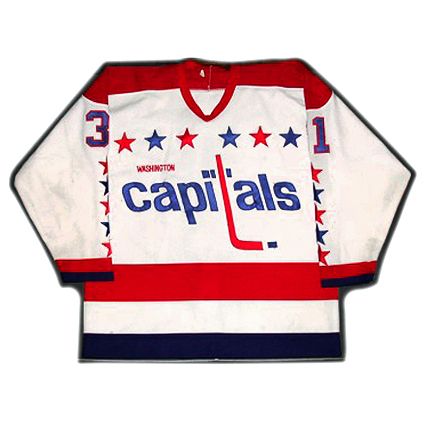
Bonus jersey: Today's bonus jersey is a 1986-87 Washington Capitals Bob Mason jersey . The Capitals wore this style starting with their inaugural season of 1974-75 and continued to use it through the 1995-95 season before a radical overhaul of their branding saw them drop their red, white and blue color set in favor of a lighter shade of blue and black with bronze accents.
The team reverted to their classic red, white and blue colors for the 2007-08 season and reintroduced today's bonus jersey style for the 2011 Winter Classic, which proved so popular they made this their alternate jersey starting with the 2011-12 season through the 2014-15 campaign before switching to the red road version of this jersey.
Today's video section features highlights of the Easter Epic, which faced off on this date in 1987. First, from the CBC, featuring a more subdued Don Cherry than the much more voluminous one he has evolved into.
Next, BillClement loses his mind on national TV prior to the fourth overtime.
Finally, LaFontaine reflects on his memories of the game and the playoffs in general.
Drafted by third overall by the New York Islanders, PatLaFontaine delayed his entry into the NHL by first playing for the United States National Team in preparation for the 1984 Olympics.
At the conclusion of the Olympics, LaFontaine then joined the Islanders for the remainder of the 1983-84 season, scoring 13 goals in 15 games. He would play seven seasons on Long Island, unfortunately arriving at the conclusion of the Islanders dynasty which occurred with the loss in the 1984 Stanley Cup Finals to the Edmonton Oilers. It would be the last time LaFontaine would play in the finals, as his teams would never advance past the second round of the playoffs for the remainder of his career.
He proved to be a prolific goal scorer with the Islanders, scoring 38 goals in this third full season and then posting four consecutive seasons of 40 goals or more, highlighted by his career high of 54 in 1989-90 and his 105 points that year was his best as an Islander.
The highlight of LaFontaine's time with the Islanders was scoring the series winning goal in the fourth overtime of Game 7 between the Islanders and the Washington Capitals during the 1987 playoffs. "It was the most memorable moment in my hockey life. Even today, wherever I go, people come up to me and start telling me where they were during the Easter Epic," LaFontaine said.
LaFontaine would suffer a concussion during the playoffs in 1990, the first of several that would affect his career.
With the situation in New York looking dismal for the foreseeable future, LaFontaine turned down a contract offer from the Islanders and sat out the first three weeks of the season before being traded to the Buffalo Sabres.
The Sabres were a good fit for LaFontaine and he immediately scored 93 points in 57 games that season, although he was limited by a broken jaw which led to some interesting headgear upon his return.
He followed up his first season in Buffalo with the best offensive season of his career in 1992-93, after being named team captain, with 53 goals and 95 assists, helping set up many of Alexander Mogilny's 76 goals in the process, for a career best 148 points and second place in the NHL scoring race.
LaFontaine and Mogilny were rewarded with spots in the 1993 NHL All-Star Game
The next two seasons were a struggle for LaFontaine, as he only managed to play in 38 total games due to knee surgery for a torn ligament. Still, he was awarded the Masterton Trophy in 1995.
Proving he still could compete, he had his seventh 40 goal season in 1995-96, finishing with 91 points. Early in the next season, he would suffer another concussion, costing him several months of playing time which would limit him to just 13 games. Sabres management and team doctors refused to clear him to play, but LaFontaine demanded a trade, believing he could still play.
The Sabres subsequently traded him to the New York Rangers for the final season of his career. He managed to play in 67 games, which included reaching the 1,000 point milestone on this date in 1998, as well as representing the United States a month later at the Olympics in Nagano, Japan.
LaFontaine at the 1998 Olympics
After suffering another serious concussion in a collision with a teammate in mid March, LaFontaine would miss the remainder of the year and retire at the end of the season, having totaled 468 goals, 545 assists and 1013 points in his abbreviated 15 year career.
In addition to the 1984 and 1998 Olympics which bookended his international career, LaFontaine would also compete for the United States in the 1987 Canada Cup, the 1989 World Championships, the 1991 Canada Cup and the gold medal winning 1996 World Cup of Hockey team, where LaFontaine had four points in five games.
LaFontaine hoists the 1996 World Cup
In 2003 he was inducted into the Hockey Hall of Fame as well as the United States Hockey Hall of Fame. In 2006, the Buffalo Sabres would retire LaFontaine's #16 on March 3rd.
An interesting note of trivia, LaFontaine is one of only three players to play for all three teams from the state of New York, and the only one to have played his entire career in New York state. LaFontaine once joked, "I got to play for three great organizations in my career and never once had to buy new license plates."
Today's featured jersey is a 1997-98 New York Rangers Pat LaFontaine jersey. This highly attractive jersey was worn during the season LaFontaine scored his 1,000th career point.
The beautiful "Liberty" jersey was first introduced in 1996 and featured a bold new crest featuring the Statue of Liberty and a very classy darker shade of blue than the traditional road jerseys. This style is perhaps the finest third jersey in NHL history and would remain in use through the 2006-07 season until being discontinued when all clubs were limited to just two jerseys with the arrival of the new Reebok Edge jerseys.
During LaFontaine's career, there was inconsistency in the way his name was displayed on the back of his jerseys. The Islanders had it as both "LAFONTAINE" in all captial letters of the same size and also "LAFONTAINE" with the "A" capitalized, but in a smaller size. The Sabres seem to have used all capitals the same size while the Rangers used the small "A" style. His 1987 USA Canada Cup and jerseys used the smaller "A", while we have seen his 1996 USA World Cup jerseys both ways!
If you are going to add a LaFontaine jersey to your collection, we strongly recommend searching for photos and videos of the style of jersey you wish to replicate and supply your findings to your customizers in order to get the most accurate jersey possible.
We begin today's video selections with the Top 10 goals by Pat LaFontaine.
Next, a tribute to LaFontaine on the occasion of his jersey retirement by the Sabres.
JohnLaFontaine was a Canadian from Tecumseh, Ontario who worked for Chrysler, who transferred him to St. Louis, Missouri where his son Pat LaFontaine was born in 1965.
It was in St. Louis where LaFontaine first learned to skate. His father was transferred once again, this time to Waterford, Michigan, just 33 miles from Detroit when Pat was seven. He was able to get in plenty of ice time as the LaFontaine's lived on Williams Lake. He also played on his older brother's team, with kids that were a year or two older than he was, which pushed him to improve his game to keep up with the older boys.
With the end goal of American kids being to play college hockey in those days, the thought of turing pro hadn't even occurred to Pat until he was fifteen, following the success of the 1980 "Miracle on Ice" United States Olympic team's gold medal performance, as well as that of American Bobby Carpenter of Massachusetts, who turned pro with the Washington Capitals in 1981.
LaFontaine was clearly no ordinary talent, as while Carpenter was just turning pro in 1981-82, LaFontaine scored an Earth-shattering 175 goals and 149 assists for a stunning 324 points in a 79 game season with Detroit Compuware of the midget AAA Michigan National Hockey League. Yes, three hundred and twenty-four points, an average of overfour points per game!
No doubt influenced by his father's Canadian roots, the decision was made that the best place for Pat to continue to progress was Canadian junior hockey rather than an American college. With that, LaFontaine left home at age 17 and moved to the Montreal suburb of Verdun to play for the Verdun Juniors of the Quebec Major Junior Hockey League for the 1982-83 season.
"Our coach, PierreCramer, put me together with Jean-Maurice Cool and we traded for GerardGallant. We gelled together," LaFontaine recalled.
LaFontaine began the season with a goal and two assists at Chicoutimi. He duplicated that in his second game at home to Saint Jean. His first hat trick came four games later to extend his point scoring streak to six. Eight games later LaFontaine had his second hat trick as well as four assists for a seven point night.
November 1st saw the streak reach 20 games at Laval with a pair of assists. Four games later Hull was victimized by LaFontaine's fourth hat trick and second seven point game.
He reached the 30 game mark November 26th with a goal and three assists against Drummondville. He surpassed 100 points on December 3rd in his 32nd game of the season and Game 35 of the consecutive point streak on December 10th was an impressive showing, as LaFontaine raised his season high with an eight point night courtesy of a two goal, six assist performance.
Game 40 was achieved December 21st with a goal. After a two week break for the World Junior Tournament, Verdun returned to the ice on January 5th and LaFontaine picked up where he left off with back to back hat tricks (numbers 6 and 7 of the season) on the 5th and the 7th. The point scoring streak now reached 43 games, as well as a total of 142 points, on this date in 1983 when LaFontaine had a pair of goals and an assist versus Chicoutimi.
For the first time all season, LaFontaine was held scoreless at Shawinigan on January 12th, but began another scoring streak of 26 games that would carry through to the end of the season.
He set a season high with four goals on the 18th, only to raise that to five on the 28th of January. LaFontaine reached the 200 point barrier on the 23rd and equalled a season high with eight points on February 25th, which included his 11 hat trick. LaFontaine finished the regular season strongly with a hat trick and three assists for six points on March 11th and then repeated those totals the very next game on March 13th.
He then put an exclamation point on his amazing season when he pumped in five goals as well as three assists for his third eight point night of the season to score 20 points in his final three games, giving LaFontaine points in 69 of the Juniors 70 games that season as well as 15 hat tricks.
In addition to his three eight point games, he had three seven point games, four with six and five games of five points apiece. His final totals were 104 goals and 130 assists for 234 points to lead the league in scoring and earn the Jean Beliveau Trophy with the second highest total in league history at the time. He had 15 more assists than his next closest competitor, Claude Verret, whom he beat by 46 points in the scoring race. LaFontaine also won the goal scoring crown by a full 20 goals over future NHL superstar Mario Lemeiux, who came third in the points race a full 50 points back of LaFontaine.
LaFontaine's remarkable season sees him still third on the single season goal scoring list as well as third on the single season point scoring record more than 25 years later.
Once the playoffs began, LaFontaine kicked off the postseason with four assists as Verdun swept Trois-Rivieres on the strength of LaFontaine's ten points. Shawingan fell in six after shutting out LaFontaine in Game 1 although he came back to score 12 points in the final five games. Verdun then won the President's Cup and qualified for the Memorial Cup by defeating Longueuil four games to one thanks to 13 points from LaFontaine, which earned him the Michel Briere Memorial Trophy as QMJHL playoff MVP after leading the playoffs in scoring with 35 points in 15 games, which added the Guy Lafleur Trophy to his ever growing hardware collection.
Additionally, LaFontaine collected the Mike Bossy Trophy as Best Pro Prospect of the Year, the Michel Bergeron Trophy as Offensive Rookie of the Year and the Frank J. Selke Memorial Trophy as Most Sportsmanlike Player thanks to his total of just 10 penalty minutes for the entire regular season.
Despite being named the Best Pro Prospect in the QMJHL, LaFontaine was drafted third overall that season behind the Minnesota North Stars first overall selection of Brian Lawton and the Hartford Whalers choice of Sylvain Turgeon second before the New York Islanders grabbed LaFontaine.
LaFontaine would only play for Verdun for a single season, one in which he dominated and proved he was ready to move up to play against a higher level of competition, which he did by spending a season with the United States National Team in preparation for the 1984 Olympic Games.
Once the Olympics were concluded, LaFontaine then joined the Islanders for the final 15 games of the 1983-84 season, which included scoring a hat trick and two assists in only his second game. He also gained valuable experience in 16 playoff games as the Islanders made it all the way to the Stanley Cup Finals, only to see their dynasty end as the Edmonton Oilers began theirs.
He would go on to prove the North Stars and Whalers wrong by having an NHL career which would eventually see LaFontaine inducted into the Hockey Hall of Fame in 2003.
Today's featured jersey is a 1982-83 Verdun Juniors Pat LaFontaine jersey. The Verdun Juniors franchise can be traced back to 1933 when they began life as the Montreal Junior Canadiens, a name they retained until 1972. Name changes then ensued, going from the Montreal Bleu Blanc Rouge to the Montreal Juniors, the Verdun Juniors, and the Verdun Junior Canadiens, all of which explains why their jerseys copied the Montreal Canadiens template so directly.
Eventually the club relocated 35 miles east to Saint-Hyacinthe where they became knows as the Saint-Hyacinthe Laser in 1989 where the Canadiens look was continued. They remained there until 1996 when they moved once more, this time 421 miles northwest to Rouyn-Noranda where they became known as the Huskies and continue to play there to this day but finally broke their ties to the Canadiens jersey template.
While today's post focused on LaFontaine's junior hockey dominance, video of that era was impossible to find, so we present to you Pat LaFontaine's top ten goals.
Third String Goalie - The Hockey Jersey of the Day Blog
"Sweater" for all my Canadian friends!
Welcome!
Welcome to our end of the rink.
Bienvenue sur notre bout de la patinoire.
So why "Third String Goalie"?
It's defined as "A fan who sits in the stands wearing a jersey."
If that's not us, we don't know what is...
Our aim is to feature a different jersey each day from a historical perspective. Stay tuned and hopefully you'll see some jerseys of interest or perhaps some that you haven't seen before and learn a bit of hockey history along the way.
In addition to our articles, be sure to scroll down this column and explore the other fun and informative features of this blog.
If you have any suggestions or comments, feel free to contact us at:
Looking to reach our loyal readers with your hockey related product or service? Of our hundreds of readers each day, 60% are located in the United States and 30% come from Canada. Our audience is your audience and you can target them now with our reasonable ad rates.
We've been linked to by SI.com, ESPN.com, Uni-Watch.com, NBCSports.com and the Yahoo! Sports Puck Daddy blog among others.
There is no limitation to what kind of hockey jersey it can be - replica, authentic or game worn jersey from the NHL, a national team, the minors, juniors, college, high school or even your pond hockey jersey.
Feel free to write a paragraph or two about the jersey telling us why you like the jersey, how you got it, what makes it special to you or even a full-blownThird String Goalie-style history lesson - whatever you feel like sharing.
Visting from outside North America? Just select your preferred language and Third String Goalie will be instantly converted to your language of choice!