On this date in 1996, BrettHull made history, becoming part of the first ever father/son pair to reach 500 goals in the NHL.
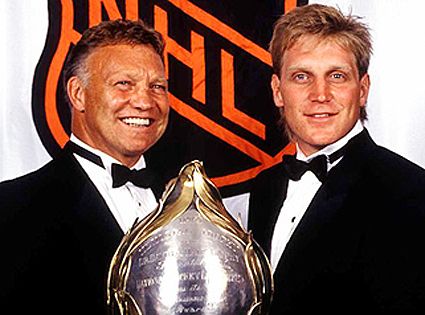
Two-time winner Bobby Hull celebrating Brett Hull's 1991 Hart Trophy as NHL MVP
Bobby Hull began his career with the Chicago Black Hawks in 1957 and would equal the NHL record of 50 goals in 1962 held by Maurice Richard (1945) and Bernie "Boom Boom" Geoffrion (1961). He would break the record in 1966 when he scored 54, the highest total in the Original Six era.
Bobby would top 50 goals three more times, in 1967 with 52 goals, 1969 with 58 (a personal best and the all-time record then) and 1972 with an even 50.
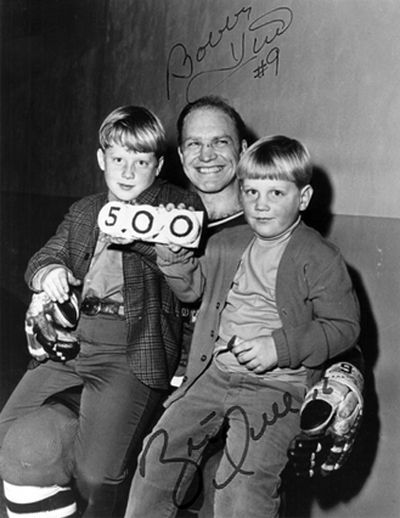
He would reach 500 goals on February 21, 1970 against the New York Rangers and finish his NHL career with 610 goals, currently 15th all-time. However, Hull did spend seven seasons with the Winnipeg Jets of the World Hockey Association, where he scored an additional 303 goals, giving him 913 for his entire career.
Bobby with sons Bobby Jr. and Brett after scoring his 500th NHL goal
Brett Hull would begin his path to 500 goals with the Calgary Flames when he scored his first NHL goal in the 1986-87 season while appearing in only 5 games. During the 1987-88 season Brett would score 26 goals in 52 games for Calgary before being traded to the St. Louis Blues, along with Steve Bozak for Rob Ramageand Rick Wamsley.
It was in St. Louis that Brett would ignite and achieve his first 40 goal season in 1988-89. A monster season in 1989-90 would see him join the elite 70 goal club with 72, joining the likes of Phil Esposito, Wayne Gretzky, Jari Kurri, Mario Lemieux and Bernie Nicholls.
Amazingly, Hull would beat that mark the very next season when he lit the lamp 86 times, the second highest single season mark ever, just six shy of Gretzky's 92.
Brett would continue his assault on the 500 mark with seasons of 70 in 1991-92, becoming only the second and final player to score 50 goals in 50 games more than once, 54 and then 57 over the next three seasons. The lockout shortened season of 1994-95 limited him to 29, but he reached 40 for the final two times of his career with 43 followed by 42 the season he reached 500, becoming just the 24th player at the time in the exclusive club and joining his father as the only father/son duo to achieve the feat together.
Brett Hull while with the St. Louis Blues
Hull would reach 500 in style, scoring a hat trick as part of a four point night against the Los Angeles Kings.
Hull would continue to play seven more seasons in the NHL, winning two Stanley Cups and adding another 241 goals to his tally to finish with 741, currently third all-time behind only Gretzky and Gordie Howe.
He joined his father in having his jersey number retired in 2006, the only father/son combo in any professional sport to be so honored, and then joined him in the Hockey Hall of Fame in 2009.
Combined, the Bobby and Brett scored 1,351 NHL goals with Bobby's brother Dennis Hull adding another 303 for a family total of 1,654.
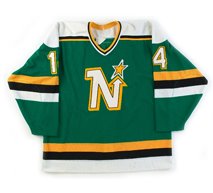
Today's featured jersey is a 1996-97 St. Louis Blues Brett Hull jersey just like the one he wore when he scored goal number 500. This jersey style was worn from 1994-95 until the 1997-98 season before being replaced with the more traditional looking jersey first introduced as the Blues alternate jersey in 1997-98.
Many did not like the inclusion of what they felt was an excessive amount of red in the blues jersey, particularly the road version, along with what they felt was the excessive number of stripes, which were there to replicate the musical staff. The diagonal lines of the jersey were unconventional at the time, but even more so were the numbers, which grew in size from right to left across the back as the lines of the staff fell away.
Bonus Jersey: Today's bonus jersey is a 1969-70 Chicago Black Hawks Bobby Hull jersey as worn when he scored his 500th NHL goal on February 21, 1970 in Chicago against the New York Rangers.
This jersey style was first introduced for the 1955-56 season and underwent several tweaks and evolutions, including varying locations of the secondary logo, the addition of black cuffs on the sleeves, sleeve numbers and a modernization of the crest until arriving at this style with the change from a lace-up collar to a v-neck in 1965-66. Since then, only the addition of red trim around the numbers and the arrival of names on the back are worth noting, as the jersey has remained essentially unchanged since 1965.
In today's video section, Brett scores his 500th goal on this date in 1996.
Here's a look at Bobby in action from his days with Chicago. Note him coming up the steps from the locker room to reach the ice level in the quirky old Chicago Stadium.
The 1996 World Cup of Hockey can trace it's roots to the 1972 Summit Series, which featured the Soviet National Team, whose vastly experienced players were considered amateurs and thus eligible for the Olympics, facing off against Team Canada, whose roster was made up of Canadian NHL professionals who were not allowed to participate in the Olympic Games at the time, clearing the path for Soviet domination of Olympic hockey.
The Soviet Union won 8 of 10 Olympic gold medals from 1956 to 1992
The 1972 Summit Series concept of the best players each nation had to offer, regardless of amateur or professional stats, was expanded in 1976 with the creation of the first Canada Cup tournament, which saw teams from not only Canada and the Soviet Union, but the addition of teams representing Finland, Sweden, Czechoslovakia and the United States.
The United States saw mixed results in the Canada Cup tournaments, finishing 5th out of 6 in 1976. A 4th place in the round-robin portion in 1981 saw them qualify for the semi-finals, where they were easily defeated by the host Canadians by a 4-1 score.
Tony Esposito playing goal for the United States in 1981
A strong round-robin result had the USA finishing 2nd in 1984, including a 7-1 opening game defeat of Sweden, a 4-4 tie with Canada, a narrow 2-1 loss to the Soviet Union and a 6-4 win over West Germany for a 3-1-1 record. The United States would face off against Sweden in the semifinals and suffer a stunning 9-2 drubbing at the hands of the Swedes, who scored on their first four shots on goal, a team the USA had so easily defeated just 11 days earlier.
In the 1987 edition, the United States completed the round-robin portion of the tournament with a 2-3 record to finish 5th and fail to advance to the playoff round.
Things improved in 1991, with the Americans taking second in the round-robin portion with an impressive 4-1 record. They opened the tournament by defeating Sweden 6-3, then lost to Canada 6-3 before running off a series of victories against Czechoslovakia (4-2), the Soviet Union (2-1) and Finland (4-3). The semi-finals saw a confident US take care of Finland again by a 7-3 score and advance to the finals versus Canada, who would defeat the US by scores of 4-1 and 4-2 to win the best-of-three finals.
For 1996, the tournament was renamed the World Cup of Hockey as a result of various behind the scenes business developments involving Canada Cup founder Alan Eagleson's legal troubles as a result of his fraud and embezzlement scandal. Instead of being run for the financial benefit of Hockey Canada as the Canada Cup was, the newly organized World Cup was a joint venture between the NHL and it's players union, the NHL Players Association (NHLPA).
Taking a more global perspective, the competition now included eight teams, partially as a result of the political upheaval during the fall of communism in Eastern Europe which saw Czechoslovakia split into the Czech Republic and Slovakia. There were now also games held in Europe for the first time.
The teams involved in the North American Pool included Canada Cup hold-overs Canada, Russia (no longer the Soviet Union) and the United States plus newcomer Slovakia. The games were held in Vancouver, Montreal, Philadelphia, Ottawa and New York.
The European Pool saw Sweden and Finland joined by the Czech Republic and Germany, which had participated in the Canada Cup once as West Germany in 1984. Stockholm, Sweden, Helsinki, Finland, Prague in the Czech Republic and Garmisch, located in Germany, would all host games in Europe, with the top three teams advancing to the playoffs held in North America.
The North American Pool saw the United States come out on top with a 3-0 record and earn a bye directly into the semifinals, while Sweden won the European Pool for its trip to North America and a place in the semifinals.
In the quarterfinals Germany would fall to Canada 4-1 in Montreal and Russia would overpower Finland 5-0 in their game played in Ottawa.
The semifinals would see Canada take down Sweden 3-2 in two overtimes in a game held not in Canada, but Philadelphia! Canada held a 2-0 lead after two periods, only to see Sweden come back to tie the game in the third. Theo Fleury would score the game winner with just 13 seconds remaining in the second overtime to send Canada into the best-of-three finals.
Meanwhile, the United States would oddly have to travel to Ottawa to defeat Russia 5-2. Just 26 seconds into the game, Pat Lafontaine would put the Americans ahead and Brett Hull then scored on the powerplay to give the US a 2-0 lead just before the end of the opening period. The United States would extend its lead by scoring a pair of goals in the second, after giving up one to the Russians, to take a commanding 4-1 lead into the third. Sergei Zubovwould pull one back for Russia less than two minutes into the third, but the United States would counter that with a goal at 14 minutes to re-establish their three goal margin and advance to the finals versus Canada.
Game One of the finals was held in Philadelphia and was a close fought battle. Eric Lindros would put the Canadians up 1-0 after one period. Defenseman Derian Hatcher would score a pair of goals in the second to give the USA the lead, only to have Claude Lemieux tie the game during the final minutes of the second.
Fleury gave the Canadians the lead half way through the third. The lead held up through the remainder of the period until the USA pulled their goaltender Mike Richter. The resulting man advantage caused the Canadians to ice the puck repeatedly, and with less than 10 seconds remaining in the game, Joel Otto won the faceoff back to US captain Brian Leetch, who fired the puck at Canadian goaltender Curtis Joseph, who made the save only to have Eric Desjardins try to put the puck under his goalie Joseph and see it sneak through his legs and trickle over the goal line with 6.3 seconds showing on the clock.
Canada would dominate the resulting overtime, outshooting the US 6-1 before Steve Yzerman shot one past a screened Richter to give Canada the first game in the best-of-three finals.
Game Two in Montreal would see the United States come out on top with a 5-2 win. The teams would trade goals in the first period, but the United States would add a pair in the second from John LeClair, his second of the game, followed by a goal by Hull. Joe Sakic would cut the margin to one at 14:48 of the third, but the United States would put the game away with a pair of empty net goals in the last 1:08 of the contest, forcing a deciding Game Three, also to be held in Montreal on this date in 1996.
With Richter, playing at the top of his game, holding off the Canadian attack, the United States scored the first goal at 11:18 of the first on the power play as Hull would give the US a 1-0 lead after one. The lead would hold up almost the entire second period as Richter would continue his stellar play in goal for the US, making 21 saves in the second period before Lindros would even the score with just six seconds before the intermission. At this point, the Canadians had decisively outshot the Americans by a margin of 32-14.
Adam Foote would solve Richter at 12:50 of the third to give Canada their first lead in over 5 1/2 periods of hockey.
Hull would even the score when he deflected a high shot from the point by Leetch that would stand after a video review, tying the contest at 16:42.
Energized by the goal, the Americans continued to press and Tony Amonte gave them the lead with 2:35 remaining.
Amonte celebrates after scoring to give the Americans the lead
Derian Hatcher put the game out of reach with an empty net goal at 19:19 and Adam Deadmarsh drilled a long slapshot past Joseph with just 14 seconds left to give the USA a final 5-2 margin in a game that was tied with just 3:18 remaining.
Richter would be named the First Star of the game after making 35 saves on 37 shots.
Tkachuk, Leetch and Weight hoist the World Cup
along with presenter Jean Beliveau
Hull would finish the tournament with 7 goals and 4 assists for 11 points in 7 games to lead the tournament in scoring followed closely by teammate LeClair with 10 points from 6 goals and 4 assists. Doug Weight (7), Leetch (7) and Keith Tkachuk (6) would all finish in the top 10 in scoring for the Americans.
The United States celebrates its greatest accomplishment since 1980
The tournament All-Star team would be made of of Forwards Mats Sundin (Sweden), Hull and LeClair of the USA, defensemen Calle Johansson of Sweden and Chris Chelios (USA) as well as goaltender Richter of the USA, who would also be named the tourament's Most Valuable Player thanks to finishing with a 5-1 record, with his only loss coming in overtime.
Richter accepting his reward as tournament MVP
Today's featured jersey is a 1996 United States National Team Brett Hull jersey as worn when the United States captured the inaugural World Cup of Hockey championship.
The jersey features the smaller 3" size World Cup of Hockey logo patch worn on the left shoulder by the Nike-clad teams in the tournament, which included not only the USA, but Russia, Slovakia, Finland and Germany.
The larger 4" size patch was worn by the teams that wore Bauer jerseys, which were the Czech Republic and Sweden, who also wore the patch on the left shoulder, and Canada, who wore the patch on their right chest.
This style of USA jersey features dye-sublimated "waving flag" stripes on the waist that contain subtle stars in the red areas, as well as in the white sleeve stripes. The 1996 United States jerseys are very sought after and command a lot of attention when they come up for sale.
Unlike the white jerseys available for retail sale, the blue road jerseys were not sold to the public and can only be found as game worn or team issued jerseys, which are complete with fight straps and command premium prices on the rare occasions they become available. Since they were intended for used by the actual players, they are also only found in larger sizes, such as 54, 56, 58 and 60.
Bonus jersey: Today's bonus jersey is a 1996 United States National Team Mike Richter jersey as worn by the World Cup of Hockey tournament MVP.
As was Nike's practice at the time, jerseys sold customized with
player names and numbers featured sewn twill crests and were tagged with
numbered sizes, such as 48 and 52 (but no fight straps), while blank
jerseys were sold as lettered sizes, such as L and XL, and with sublimated crests.
The blank examples are scarce, but do offer the collector the opportunity to have their jersey customized as a Hull, Tkachuk, Lafontaine, Amonte, LeClair or any other personal favorite from the victorious American roster.
The jerseys sold with player names from Nike were #35 Richter, #2 Leetch and #27 Jeremy Roenick. However, Roenick never actually played in the World Cup due to being a free agent
and not being covered by health insurance at the time so those looking for authenticity should hold out for Richter or Leetch jerseys.
None of the retail jerseys were
sold with the World Cup patch. Those would need to be added separately by their
owners for proper authenticity as is the case with today's bonus jersey.
Extra bonus jersey: Today's extra bonus jersey is a 1996 United States National Team Brian Leetch jersey as worn by the World Cup of Hockey tournament MVP.
In addition to the retail jerseys not being
sold with the World Cup patch, the Leetch jerseys did not come with
the captain's "C" either. That would also need to be added separately for proper authenticity as is the case with today's extra bonus
jersey.
First up is LeClair tying Game 1 with less than seven seconds to play.
Here are highlights of the thrilling finale of the 1996 World Cup of Hockey.
On this date in 1996, BrettHull made history, becoming part of the first ever father/son pair to reach 500 goals in the NHL.
Two-time winner Bobby Hull celebrating Brett Hull's 1991 Hart Trophy as NHL MVP
Bobby Hull began his career with the Chicago Black Hawks in 1957 and would equal the NHL record of 50 goals in 1962 held by Maurice Richard (1945) and Bernie "Boom Boom" Geoffrion (1961). He would break the record in 1966 when he scored 54, the highest total in the Original Six era.
Bobby would top 50 goals three more times, in 1967 with 52 goals, 1969 with 58 (a personal best and the all-time record then) and 1972 with an even 50.
He would reach 500 goals on February 21, 1970 against the New York Rangers and finish his NHL career with 610 goals, currently 15th all-time. However, Hull did spend seven seasons with the Winnipeg Jets of the World Hockey Association, where he scored an additional 303 goals, giving him 913 for his entire career.
Bobby with sons Bobby Jr. and Brett after scoring his 500th NHL goal
Brett Hull would begin his path to 500 goals with the Calgary Flames when he scored his first NHL goal in the 1986-87 season while appearing in only 5 games. During the 1987-88 season Brett would score 26 goals in 52 games for Calgary before being traded to the St. Louis Blues, along with Steve Bozak for Rob Ramageand Rick Wamsley.
It was in St. Louis that Brett would ignite and achieve his first 40 goal season in 1988-89. A monster season in 1989-90 would see him join the elite 70 goal club with 72, joining the likes of Phil Esposito, Wayne Gretzky, Jari Kurri, Mario Lemieux and Bernie Nicholls.
Amazingly, Hull would beat that mark the very next season when he lit the lamp 86 times, the second highest single season mark ever, just six shy of Gretzky's 92.
Brett would continue his assault on the 500 mark with seasons of 70 in 1991-92, becoming only the second and final player to score 50 goals in 50 games more than once, 54 and then 57 over the next three seasons. The lockout shortened season of 1994-95 limited him to 29, but he reached 40 for the final two times of his career with 43 followed by 42 the season he reached 500, becoming just the 24th player at the time in the exclusive club and joining his father as the only father/son duo to achieve the feat together.
Brett Hull while with the St. Louis Blues
Hull would reach 500 in style, scoring a hat trick as part of a four point night against the Los Angeles Kings.
Hull would continue to play seven more seasons in the NHL, winning two Stanley Cups and adding another 241 goals to his tally to finish with 741, currently third all-time behind only Gretzky and Gordie Howe.
He joined his father in having his jersey number retired in 2006, the only father/son combo in any professional sport to be so honored, and then joined him in the Hockey Hall of Fame in 2009.
Combined, the Bobby and Brett scored 1,351 NHL goals with Bobby's brother Dennis Hull adding another 303 for a family total of 1,654.
Today's featured jersey is a 1996-97 St. Louis Blues Brett Hull jersey just like the one he wore when he scored goal number 500. This jersey style was worn from 1994-95 until the 1997-98 season before being replaced with the more traditional looking jersey first introduced as the Blues alternate jersey in 1997-98.
Many did not like the inclusion of what they felt was an excessive amount of red in the blues jersey, particularly the road version, along with what they felt was the excessive number of stripes, which were there to replicate the musical staff. The diagonal lines of the jersey were unconventional at the time, but even more so were the numbers, which grew in size from right to left across the back as the lines of the staff fell away.
Bonus Jersey: Today's bonus jersey is a 1969-70 Chicago Black Hawks Bobby Hull jersey as worn when he scored his 500th NHL goal on February 21, 1970 in Chicago against the New York Rangers.
This jersey style was first introduced for the 1955-56 season and underwent several tweaks and evolutions, including varying locations of the secondary logo, the addition of black cuffs on the sleeves, sleeve numbers and a modernization of the crest until arriving at this style with the change from a lace-up collar to a v-neck in 1965-66. Since then, only the addition of red trim around the numbers and the arrival of names on the back are worth noting, as the jersey has remained essentially unchanged since 1965.
In today's video section, Brett scores his 500th goal on this date in 1996.
Here's a look at Bobby in action from his days with Chicago. Note him coming up the steps from the locker room to reach the ice level in the quirky old Chicago Stadium.
Brett Hull joined an exclusive club on this date in 1991 by scoring his 50th goal in 50 games or less.
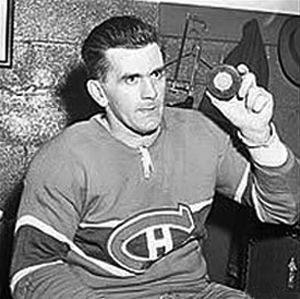
The feat was famously first accomplished back in 1944-45 by Maurice "Rocket" Richard on the final day of the season when the schedule was only 50 games long. Even with the season extended to 60 games in 1946 and 70 games in 1949, it would still take another 16 years for anyone to score 50 again when Bernie Geoffrion scored his 50th but not until his 62nd game.
Maurice Richard celebrates becoming the first to score 50 goals in a season
It would take 35 years before anyone would equal Richard's 50 in 50, when in 1980-81 Mike Bossy famously scored twice in the last five minutes of his 50th game to match Richard, who was in attendance at the game to congratulate Bossy.
Mike Bossy poses with Maurice Richard to celebrate Bossy's 50th goal in 50 games
Wayne Gretzky would shatter the 50 in 50 mark the following season when he simply assaulted the record by scoring four goals in his 38th game to put him at 45 goals and then blasted in five goals in the very next game to hit the 50 goal mark in only 39 games.
Think about that for a moment. At the conclusion of game 37 Gretzky stood at 41 goals and then scored nine goals in just two games! That's a good week for some teams these days.
Gretzky poses with the pucks from his five goals, including the one from milestone 50th goal
Gretzky would again beat the 50 game barrier twice more when he scored 50 in 42 games in 1983-84 and 40 in a leisurely 49 games in 1984-85.
Mario Lemieux was the next one to join the ranks of 50 in 50, when in 1988-89 he managed to score his 50th in the Pittsburgh Penguins 46th game, which was the 44th game that Lemieux had played in that season.
Mario Lemieux
The most recent member of the 50 in 50 club would be Brett Hull, when he scored twice in his 49th game to reach the magical 50 mark on this date in 1991. Hull would again achieve 50 in 50 the following season of 1991-92 when he scored goal #50 against Kelly Hrudey of the Los Angeles Kings in a 3-3 tie.
Brett Hull
To qualify for the 50 goals in 50 games mark, a player must score 50 on or before his team's 50th game, which has resulted in some close calls, due to players missing a few games in the early part of the year. Jari Kurri scored 50 in 50 in 1984-85, but it was the Edmonton Oilers 53rd game of the season. Alexander Mogilny also scored his 50 goal in the Buffalo Sabres 53rd game of 1992-93 in what was only Mogilny's 46th game.
Lemieux's injury problems affected him twice, as he scored his 50th in 1992-93 during the Penguins 72nd game, but only Lemieux's 48th of the season. 1995-96 would see Lemieux score 50 in 50 of his games, but the 59th game for Pittsburgh.
The final unofficial 50 in 50 member is Cam Neely of the Boston Bruins, who in 1993-94 scored his 50th goal in the 44th game of his season, which was the Bruins 66th contest that year.
Additionally, Charlie Simmer (1980-81) and Bernie Nicholls (1988-89), both of the Kings, and Lemieux (1987-88) came close with 50 goals in 51 games and Brett's father Bobby Hull got his 50th in his 52nd game in 1965-66.
To give credit where credit's due, Anders Hedberg and Bobby Hull both scored 50 goals in less than 50 games while playing in the World Hockey Association, whose records are not recognized by the NHL.
Today's featured jersey is a 1990-91 St. Louis Blues Brett Hull jersey from the game during which he scored his 50th goal of the season.
This style Blues jersey, with it's new, darker shade of blue than before, can be traced back to the 1984-85 season, although with a "Blues" wordmark over the top of a smaller blue note crest. The word mark disappeared in 1987 and the crest had it's sharp corners rounded in 1989-90, giving us today's featured jersey.
The names would change from one color to three in 1992-93 for the final two seasons of use before a radical redesign sent this classic style into retirement.
Today's video highlight is Brett Hull scoring his 50th goal in his 49th games.
Brett Hull joined an exclusive club on this date in 1991 by scoring his 50th goal in 50 games or less.
The feat was famously first accomplished back in 1944-45 by Maurice "Rocket" Richard on the final day of the season when the schedule was only 50 games long. Even with the season extended to 60 games in 1946 and 70 games in 1949, it would still take another 16 years for anyone to score 50 again when Bernie Geoffrion scored his 50th but not until his 62nd game.
Maurice Richard celebrates becoming the first to score 50 goals in a season
It would take 35 years before anyone would equal Richard's 50 in 50, when in 1980-81 Mike Bossy famously scored twice in the last five minutes of his 50th game to match Richard, who was in attendance at the game to congratulate Bossy.
Mike Bossy poses with Maurice Richard to celebrate Bossy's 50th goal in 50 games
Wayne Gretzky would shatter the 50 in 50 mark the following season when he simply assaulted the record by scoring four goals in his 38th game to put him at 45 goals and then blasted in five goals in the very next game to hit the 50 goal mark in only 39 games.
Think about that for a moment. At the conclusion of game 37 Gretzky stood at 41 goals and then scored nine goals in just two games! That's a good week for some teams these days.
Gretzky poses with the pucks from his five goals, including the one from milestone 50th goal
Gretzky would again beat the 50 game barrier twice more when he scored 50 in 42 games in 1983-84 and 40 in a leisurely 49 games in 1984-85.
Mario Lemieux was the next one to join the ranks of 50 in 50, when in 1988-89 he managed to score his 50th in the Pittsburgh Penguins 46th game, which was the 44th game that Lemieux had played in that season.
Mario Lemieux
The most recent member of the 50 in 50 club would be Brett Hull, when he scored twice in his 49th game to reach the magical 50 mark on this date in 1991. Hull would again achieve 50 in 50 the following season of 1991-92 when he scored goal #50 against Kelly Hrudey of the Los Angeles Kings in a 3-3 tie.
Brett Hull
To qualify for the 50 goals in 50 games mark, a player must score 50 on or before his team's 50th game, which has resulted in some close calls, due to players missing a few games in the early part of the year. Jari Kurri scored 50 in 50 in 1984-85, but it was the Edmonton Oilers 53rd game of the season. Alexander Mogilny also scored his 50 goal in the Buffalo Sabres 53rd game of 1992-93 in what was only Mogilny's 46th game.
Lemieux's injury problems affected him twice, as he scored his 50th in 1992-93 during the Penguins 72nd game, but only Lemieux's 48th of the season. 1995-96 would see Lemieux score 50 in 50 of his games, but the 59th game for Pittsburgh.
The final unofficial 50 in 50 member is Cam Neely of the Boston Bruins, who in 1993-94 scored his 50th goal in the 44th game of his season, which was the Bruins 66th contest that year.
Additionally, Charlie Simmer (1980-81) and Bernie Nicholls (1988-89), both of the Kings, and Lemieux (1987-88) came close with 50 goals in 51 games and Brett's father Bobby Hull got his 50th in his 52nd game in 1965-66.
To give credit where credit's due, Anders Hedberg and Bobby Hull both scored 50 goals in less than 50 games while playing in the World Hockey Association, whose records are not recognized by the NHL.
Today's featured jersey is a 1990-91 St. Louis Blues Brett Hull jersey from the game during which he scored his 50th goal of the season.
This style Blues jersey, with it's new, darker shade of blue than before, can be traced back to the 1984-85 season, although with a "Blues" wordmark over the top of a smaller blue note crest. The word mark disappeared in 1987 and the crest had it's sharp corners rounded in 1989-90, giving us today's featured jersey.
The names would change from one color to three in 1992-93 for the final two seasons of use before a radical redesign sent this classic style into retirement.
Today's video highlight is Brett Hull scoring his 50th goal in his 49th games.
On this date in 1996, BrettHull made history, becoming part of the first ever father/son pair to reach 500 goals in the NHL.
Two-time winner Bobby Hull celebrating Brett Hull's 1991 Hart Trophy as NHL MVP
Bobby Hull began his career with the Chicago Black Hawks in 1957 and would equal the NHL record of 50 goals in 1962 held by Maurice Richard (1945) and Bernie "Boom Boom" Geoffrion (1961). He would break the record in 1966 when he scored 54, the highest total in the Original Six era.
Bobby would top 50 goals three more times, in 1967 with 52 goals, 1969 with 58 (a personal best and the all-time record then) and 1972 with an even 50.
He would reach 500 goals on February 21, 1970 against the New York Rangers and finish his NHL career with 610 goals, currently 15th all-time. However, Hull did spend seven seasons with the Winnipeg Jets of the World Hockey Association, where he scored an additional 303 goals, giving him 913 for his entire career.
Bobby with sons Bobby Jr. and Brett after scoring his 500th NHL goal
Brett Hull would begin his path to 500 goals with the Calgary Flames when he scored his first NHL goal in the 1986-87 season while appearing in only 5 games. During the 1987-88 season Brett would score 26 goals in 52 games for Calgary before being traded to the St. Louis Blues, along with Steve Bozak for Rob Ramageand Rick Wamsley.
It was in St. Louis that Brett would ignite and achieve his first 40 goal season in 1988-89. A monster season in 1989-90 would see him join the elite 70 goal club with 72, joining the likes of Phil Esposito, Wayne Gretzky, Jari Kurri, Mario Lemieux and Bernie Nicholls.
Amazingly, Hull would beat that mark the very next season when he lit the lamp 86 times, the second highest single season mark ever, just six shy of Gretzky's 92.
Brett would continue his assault on the 500 mark with seasons of 70 in 1991-92, becoming only the second and final player to score 50 goals in 50 games more than once, 54 and then 57 over the next three seasons. The lockout shortened season of 1994-95 limited him to 29, but he reached 40 for the final two times of his career with 43 followed by 42 the season he reached 500, becoming just the 24th player at the time in the exclusive club and joining his father as the only father/son duo to achieve the feat together.
Brett Hull while with the St. Louis Blues
Hull would reach 500 in style, scoring a hat trick as part of a four point night against the Los Angeles Kings.
Hull would continue to play seven more seasons in the NHL, winning two Stanley Cups and adding another 241 goals to his tally to finish with 741, currently third all-time behind only Gretzky and Gordie Howe.
He joined his father in having his jersey number retired in 2006, the only father/son combo in any professional sport to be so honored, and then joined him in the Hockey Hall of Fame in 2009.
Combined, the Bobby and Brett scored 1,351 NHL goals with Bobby's brother Dennis Hull adding another 303 for a family total of 1,654.
Today's featured jersey is a 1996-97 St. Louis Blues Brett Hull jersey just like the one he wore when he scored goal number 500. This jersey style was worn from 1994-95 until the 1997-98 season before being replaced with the more traditional looking jersey first introduced as the Blues alternate jersey in 1997-98.
Many did not like the inclusion of what they felt was an excessive amount of red in the blues jersey, particularly the road version, along with what they felt was the excessive number of stripes, which were there to replicate the musical staff. The diagonal lines of the jersey were unconventional at the time, but even more so were the numbers, which grew in size from right to left across the back as the lines of the staff fell away.
Bonus Jersey: Today's bonus jersey is a 1969-70 Chicago Black Hawks Bobby Hull jersey as worn when he scored his 500th NHL goal on February 21, 1970 in Chicago against the New York Rangers.
This jersey style was first introduced for the 1955-56 season and underwent several tweaks and evolutions, including varying locations of the secondary logo, the addition of black cuffs on the sleeves, sleeve numbers and a modernization of the crest until arriving at this style with the change from a lace-up collar to a v-neck in 1965-66. Since then, only the addition of red trim around the numbers and the arrival of names on the back are worth noting, as the jersey has remained essentially unchanged since 1965.
In today's video section, Brett scores his 500th goal on this date in 1996.
Here's a look at Bobby in action from his days with Chicago. Note him coming up the steps from the locker room to reach the ice level in the quirky old Chicago Stadium.
Third String Goalie - The Hockey Jersey of the Day Blog
"Sweater" for all my Canadian friends!
Welcome!
Welcome to our end of the rink.
Bienvenue sur notre bout de la patinoire.
So why "Third String Goalie"?
It's defined as "A fan who sits in the stands wearing a jersey."
If that's not us, we don't know what is...
Our aim is to feature a different jersey each day from a historical perspective. Stay tuned and hopefully you'll see some jerseys of interest or perhaps some that you haven't seen before and learn a bit of hockey history along the way.
In addition to our articles, be sure to scroll down this column and explore the other fun and informative features of this blog.
If you have any suggestions or comments, feel free to contact us at:
Looking to reach our loyal readers with your hockey related product or service? Of our hundreds of readers each day, 60% are located in the United States and 30% come from Canada. Our audience is your audience and you can target them now with our reasonable ad rates.
We've been linked to by SI.com, ESPN.com, Uni-Watch.com, NBCSports.com and the Yahoo! Sports Puck Daddy blog among others.
There is no limitation to what kind of hockey jersey it can be - replica, authentic or game worn jersey from the NHL, a national team, the minors, juniors, college, high school or even your pond hockey jersey.
Feel free to write a paragraph or two about the jersey telling us why you like the jersey, how you got it, what makes it special to you or even a full-blownThird String Goalie-style history lesson - whatever you feel like sharing.
Visting from outside North America? Just select your preferred language and Third String Goalie will be instantly converted to your language of choice!