History of Jersey 83-93 Banner sm photo History of Jersey 83-93 Banner sm.jpg
Showing posts with label Montreal Wanderers. Show all posts

Tuesday, February 20, 2018

1903-04 Portage Lakes Hod Stuart Jersey

 William Hodgson "Hod" Stuart was born on this date in Ottawa, Ontario in 1879. His first senior level team was the Rat Portage Thistles in 1895-96. He joined the Ottawa Hockey Club (later known as the Silver Seven and then the Senators) of the Canadian Amateur Hockey League for the 1898-99 season for three games. A cover-point (later known as the more familiar term of a defenseman), Stuart played in 3 games, scoring one goal for Ottawa while his brother Bruce Stuart played in one game for the team.

1899 Ottawa Hockey Club team
The 1898-99 Ottawa Hockey Club

Stuart returned to Ottawa HC for the 1899-00 season and was named the team captain. He played in seven of the team's eight games, scoring 5 goals, as he was not afraid to join the offense from his defensive role.

As hockey was still a purely amateur sport in those days, Stuart moved to Quebec when he was able to land a job there though his father's business contacts. The change in location led to him joining the Quebec Bulldogs, also of the CAHL, for the 1900-01 season and his brother Bruce did the same. Again, he played in seven of the club's eight games, scoring twice.

He returned for a second season with the Bulldogs in 1901-02, scoring 5 times in 8 games.

As professionalism started to come into the game, Stuart was signed for the princely sum of $15-$20 per week for the 1902-03 season by the Pittsburgh Bankers of the Western Pennsylvania Hockey League in the United States, in addition to his income from his day job in Pittsburgh. In 13 games, Stuart scored 7 goals and 8 assists with 29 penalty minutes as the Bankers finished first in the four team league with a 10-3-1 record. Stuart was named the best cover-point in the league.

After one season in Pittsburgh, Stuart moved further west with his brother Bruce to join the professional Portage Lakes Hockey Club in Northern Michigan for the 1903-04 season. The club was not part of any league that season and played a schedule of 14 exhibition games, with Stuart scoring 13 goals while Bruce had an astonishing 44!
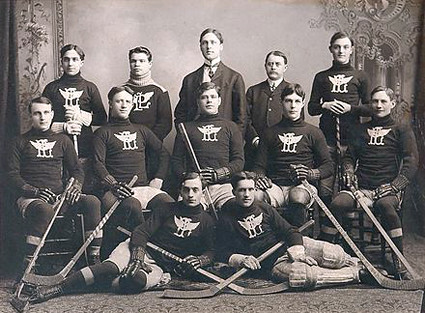
1903-04 Portage Lakes Hockey Club team
The 1903-04 Portage Lakes Hockey Club

For the 1905-06 season, the American Soo Indians and Canadian Sault were banned from competing in the amateur Ontario Hockey Association after having played against the professionals from Portage Lakes. The solution was the formation of a new, professional league, which consisted of five teams, which was dubbed the International Hockey League.

Stuart was given $1,800 to play for the Calumet Miners as well as manage their rink for the season. While Hod changed teams, Bruce remained with Portage Lakes for the next three seasons.

Stuart scored 18 goals in 22 games for the Miners, who won the league championship with a 18-5-1 record, as he was named the best cover-point in the league.
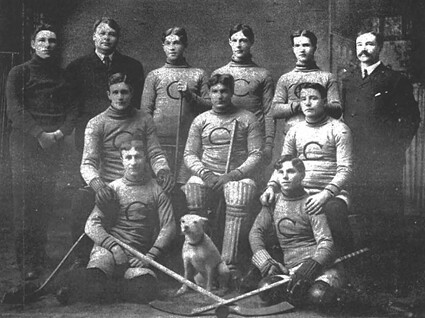
1904-05 Calumet-Laurium_Miners
The 1904-05 Calumet Miners Hockey Club

On December 11, 1905, Stuart was suspended from the league after other teams complained he had won too many championships and was too rough a player. He was reinstated on December 30th and joined the Pittsburgh Professionals for the remainder of their season, scoring 11 times in 20 games. After Pittsburgh completed their schedule, Stuart suited up for one additional game for Calumet.
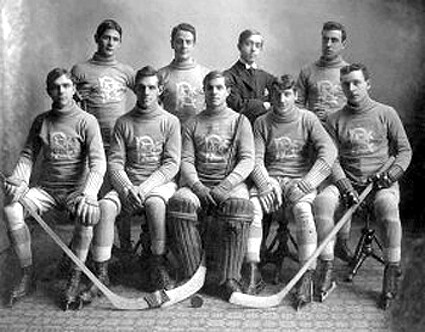
1905-06_Pittsburgh_Bankers
The 1905-06 Pittsburgh Professionals

Stuart began the 1906-07 season with Pittsburgh in the IPHL, but after 4 games with a goal and 3 assists, he grew increasingly frustrated with the violence and refereeing in the league and went so far as to have a letter critical of the league and its officiating. Shortly afterwards, the Pittsburgh players refused to play a game against the Michigan Soo due to the choice of referee. The club's management felt that Stuart was the instigator of the boycott and released him from the club.

Having heard earlier that the Montreal Wanderers of the Eastern Canada Amateur Hockey Association were not only interested in his services, but willing to make hm the highest paid player in hockey, signed with the Wanderers and made his debut on January 2, 1907 in front of 6,069 fans. He would eventually play in 8 of the Wanderers 10 regular season games, scoring 3 times and was one of only four professionals to play for the club that season. With Montreal, he was once again reunited with Bruce, who also played 3 regular season and 3 Stanley Cup games with the Wanderers that season.
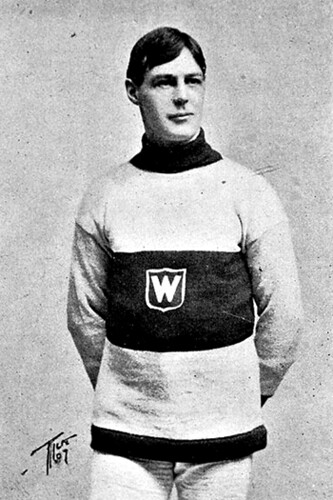
Stuart Montreal Wanderers
Stuart joined the Montreal Wanderers after his release from Pittsburgh

If Stuart was unhappy with the level of violence in the IPHL, he certainly was not pleased with the events of January 12th, when the Ottawa Senators repeatedly battered the Wanderers players with their sticks, with Charles Spittal's attack on Cecil Blanchford later being described at "attempting to split his skull", while the Senators Alf Smith hit Stuart "across the temple, laying him out like a corpse", while Harry Smith broke Ernie Johnson's face, breaking his nose. Reports of the game commended Stuart, stating that he neither flinched or retaliated, even after bearing most of the hits.

At a special league meeting, the Montreal Victorias proposed suspending Spittal and Alf Smith for the rest of the season, which was voted down and eventually led to the league president Fred McRobie resigning. When the Senators returned to Montreal, Spittal, Alf Smith and Harry Smith were all arrested, with Spittal and Alf Smith eventually paying $20 fines.

On January 17th and 21st, the Wanderers faced a challenge for the Stanley Cup they had won the previous March. Kenora, the 1906 Manitoba champions, pulled off an upset, wresting the cup away from the Wanderers by winning 4-2 and 8-6.

Afterwards, the Wanderers focused on their ECAHA schedule, and racked up win after win, eventually finishing the season as league champions after a perfect 10-0 undefeated season with Stuart contributing 3 goals in eight games.

That championship earned them the right to a rematch with Kenora, which took place on March 23rd and 25th in Winnipeg. Montreal dominated the first game 7-2, and even though the Thistles won Game 2 by a score of 6-5, the Wanderers large margin of victory in the first game gave them ta 12-8 win in the two game, total goals series, giving Stuart a Stanley Cup championship.
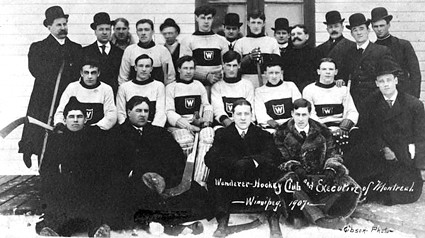
1907 Montreal Wanderers team
The 1906-07 Stanley Cup champion Montreal Wanderers

In celebration of their championship, the Wanderers engraved the names of their entire roster inside the bowl of the Stanley Cup, the first winning team to do so in what is now and annual tradition.
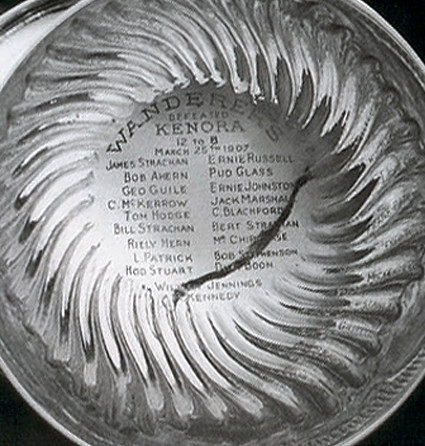
1907 Wanderers engraving
The Wanderers started a tradition when they
engraved their entire roster into the Stanley Cup

Tired of the violence in hockey, Stuart quit playing hockey after the Stanley Cup matches and joined his father in the construction business. As part of his duties, he was sent to Belleville, Ontario to oversee a construction project. On the afternoon of June 23, 1907, he went swimming with some friends and swam to a nearby lighthouse, climbed on a platform and dove onto some obscured rocks in the shallow water and died instantly of a broken neck at the age of 28 just three months after he and the Wanderers won the Stanley Cup in 1907.
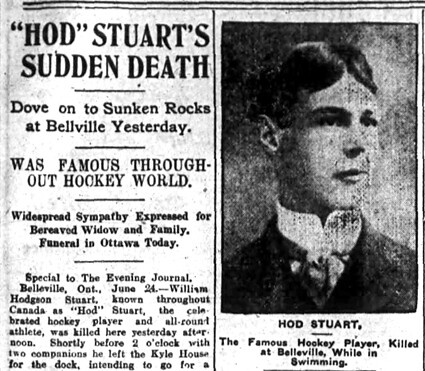
Hod Stuart Obit
A newspaper account of Stuart's accident

On January 2, 1908 (nine years before the creation of the National Hockey League) an all-star benefit game was held as a benefit for the family of  Stuart with the tickets sold out days in advance.
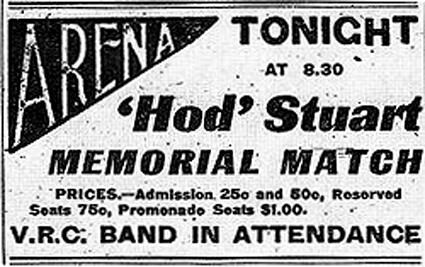
Stuart Memorial Game
An ad for the first All-Star Game,
a fundraiser for the family of Hod Stuart

In that first all-star game ever held in any sport, the Montreal Wanderers faced off against a team of players from the Eastern Canada Amateur Hockey Association with the game hosted at no charge by the Westmount Arena in front of 3,800 fans, raising over $2,100 for his widow and two children.

The Wanderers led 7-1 after the first half of the contest, but the All-Stars, which consisted of players from the Ottawa Senators, Montreal Victorias, Montreal Amateur Athletic Association, Montreal Shamrocks and Quebec Bulldogs, fought back to make it a game, but the Wanderers prevailed by a final score of 10-7.
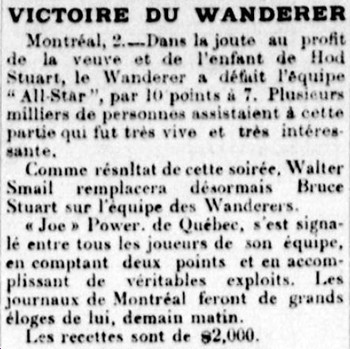
Hod Stuart Memorial Game article
A newspaper account of the Hod Stuart Memorial Game

Stuart was inducted into the Hockey Hall of Fame in 1945, one of the original nine honored members of the inaugural class along with Hobey Baker, Charlie Gardiner, Eddie Gerard, Frank McGee, Howie Morenz, Tommy Phillips, Harvey Pulford and Georges Vezina.
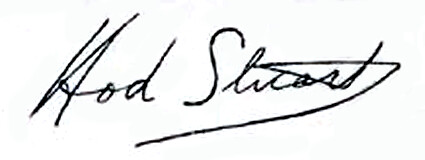
Hod Stuart autograph

Today's featured jersey is a 1903-04 Portage Lakes Hockey Club Hod Stuart jersey. The Portage Lakes Hockey Club was founded back in 1899 and began to pay its players in 1902. They introduced their winged logo for the 1902-03 season with sweaters that had white shoulders and turtleneck collar. For the following season they sweaters became a solid color and remained so through their final season of 1906-07 when the IPHL folded and the Portage Lakes club along with it. We have seen a single mention that the team's sweaters were green, but cannot be certain of this.

Noteworthy players enticed by the lure of being paid to play hockey who suited up for Portage Lakes at times included Hall of Famers "Bad" Joe Hall, Riley Hern, Bruce Stuart, Hod Stuart and Fred "Cyclone" Taylor.
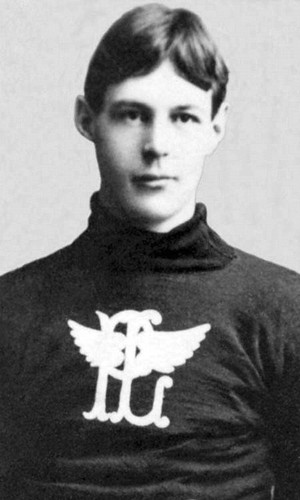
Stuart Portage Lakes

Friday, December 15, 2017

The Halifax Explosion - 1917-18 Montreal Wanderers Harry Hyland Jersey

The morning of December 6, 1917 was like any other day in Halifax, Nova Scotia. Halifax had been founded by the British military as a fortress to protect their interests against the French back in the late 1700s thanks to its large and deep natural harbor as well as its strategic location.

Halifax Before, Halifax Before
Early 20th Century Halifax

With World War I raging in Europe, the factories, foundries and mills in both Halifax and nearby Dartmouth were working at full capacity, keeping the harbor busy with with shipping convoys taking goods and supplies across the Atlantic, destined for the war effort in Europe.

Ferries to and from Dartmouth, located on the opposite side of the harbor, civilian shipping, as well as fishing boats and pleasure craft all competed for space with the military shipping traffic on the harbor adding to the congestion.

Meanwhile, the French vessel the Mont-Blanc was loaded with 228,000 kilos of TNT, 2.1 million kilos of wet and dry picric acid, a toxic substance used in the making of munitions and explosives, 223,000 kilos of Benzol, a highly flammable liquid similar to gasoline, and "guncotton", a highly flammable substance used in firearms, all of which made the Mont-Blanc a floating bomb of the highest order.

The Mont Blanc, The Mont Blanc
The Mont-Blanc

Unable to cross the Atlantic solo due to the risk of a German u-boat attack, the Mont-Blanc sailed out of New York for Halifax in order to join a convoy of other ships congregating in Halifax Harbour in the interests of safety. While the ship arrived in late afternoon on December 5th, it was too late in the day to enter the harbor, as the anti-submarine nets had been closed for the night, forcing the Mont-Blanc to spend the night outside the harbor.

Meanwhile inside the harbor, the Belgian relief ship Imo was forced to delay its scheduled departure that day due to the supply of coal for its boilers arriving too late for it to leave for New York in order to collect emergency supplies for civilians in war ravaged Belgium prior to the harbor gates being closed.

At 7:30 in the morning on December 6th the navy opened the gate in the nets, allowing the Mont-Blanc to head into the harbor, traveling at a speed of four knots, under the limit of five knots. At the same time, the Imo headed toward the Narrows to begin its voyage south. As the Imo increased its speed to seven knots, it encountered the first ship entering the harbor. That incoming ship went against the usual rules of passing on the left. The two ships exchanged horn blasts to signal their intent, which resulted in the Imo passing the other ship on the right, putting the Imo on the wrong side of the harbor in the Dartmouth channel.


Once past the first ship, the Imo continued to steam along on the wrong side of the channel, allowing it to avoid a tug boat towing a pair of barges which had just pulled away from the Halifax shore on the right of the Imo.

The Mont-Blanc and the Imo were now in the same channel as they continued to travel toward each other. The Mont-Blanc blew its whistle first to signify that it had the right of way and would be maintaining course, implying the Imo would have to move to the right to clear the way. The captain of the Imo however, had other thoughts, and blew his whistle twice to signify his intent to hold his course. The Mont-Blanc then moved slightly to its right closer to the Dartmouth shore to give the Imo additional room for clearance, hoping the Imo would respond in kind by moving to its right in order to give the two ships adequate distance between them for safe passage. When the Mont-Blanc again blew its whistle once, the Imo responded with two blasts of his horn, indicating it would not be changing course.

The sailors who knew what the repeated signals meant realized trouble was brewing and gathered to watch the two ships. Finally, as the Mont-Blanc and the Imo were bearing down on each other, the Mont-Blanc turned hard left into the center of the channel to avoid a collision with the Imo, as it could not move any further toward shore for fear of running aground while loaded with such dangerous cargo.

Unfortunately for all concerned, the Imo now finally chose to change course by reversing engines, which swung the ship to its right - and into the path of the Mont-Blanc. If only one of the ships had made its evasive maneuver, nothing more than a close call would have been the result. However, they both were now aimed for the same spot and the resulting collision caused the Imo to penetrate nine feet into the hull of the Mont-Blanc at 8:45 AM. The Imo then pulled away to extricate itself from the Mont-Blanc, causing enough sparks to ignite the lethal combination of picric acid and vapors from the ruptured drums of benzol, producing an uncontrollable fire at the forward end of the damaged Mont-Blanc.

Fearing an immediate explosion, the captain of the Mont-Blanc ordered the crew to abandon the ship, which was spewing a large column of oily, black smoke. As the public gathered on the streets or stood at the windows of their homes to watch the spectacular fire and exploding barrels of benzol rocketing into the air.

The rescuers, as well as those on the shore, had no idea of the danger contained inside the Mont-Blanc, as any outward warnings of the dangerous cargo in the form of red flags were not displayed on the Mont-Blanc for fear of drawing unwanted attention from the Germans while at sea. As boats rushed to their assistance, the crew of the Mont-Blanc attempted to warn them off as they rowed furiously ashore in their lifeboats, but they were unable to be understood, as the crew spoke only French as they reached the Dartmouth side and ran for the woods and to safety.

The hastily abandoned ship was now not only ablaze, but also adrift and moving toward Halifax's Richmond neighborhood and into Pier 6, which then caught fire as well. The boat was then met by the Halifax Fire Department, with its one motorized truck and a dozen horse-drawn wagons, who were all unaware of the ship's highly dangerous contents.

And then it happened.

The Mont-Blanc erupted with a force stronger than any man-made explosion in world history prior to the atomic age. The ship shattered and was blown sky-high, 980 feet into the air. White hot pieces of its hull came falling back to Earth as lethal shrapnel rained down all over Halifax and Dartmouth. A 1,140 pound piece of the ship's anchor landed 2 1/2 miles away while the Mont-Blanc's gun barrel flew over three miles, landing clear across the harbor in Dartmouth.

Halifax Explosion, Halifax Explosion
This photo was taken just seconds after the explosion of the Mont-Blanc

The fireball rose over 6,200 feet over the harbor, symbolizing the hell that had just descended on the area. The smoke from the fire reached 20,000 feet while buildings shook and items fell off of shelves as far as 80 miles away with the shock wave being felt 200 miles away as 400 acres in the immediate vicinity were completely destroyed by the blast.

Halifax damage map, Halifax damage map
Halifax damage map

Homes, apartments, business and the sugar refinery were all destroyed in an instant. Every building within a 10 mile radius, 12,000 in all, were badly damaged, if not destroyed.


Richmond School, Richmond School

Additionally, the water immediately surrounding the ship was evaporated by the intense heat of the explosion, which momentarily exposed the harbor floor! The shockwave from the blast sent water rushing violently outwards, creating a wave that spread toward both shores, rising as high as 60 feet. The wave carried the Imo onto the shore on the Dartmouth side of the harbor as the tidal wave washed up three blocks into the city.

The Imo, The Imo
The Imo, washed ashore on the opposite side of the harbor

Over 1,500 people died instantly, while 9,000 were injured by not only the blast, but falling debris from the shattered ship, collapsing buildings and shards of flying glass, which blinded 38 people with roughly 600 more suffering eye injuries while standing at their windows watching the initial blaze.

Many of those who survived the initial blast now had to hang on for their lives as the water rushed up onto the shore where they had gathered, claiming more victims who were in shock or injured and unable to withstand the surging waters. Miraculously, all but one of the crew of the Mont-Blanc survived the disaster.

Since it was wintertime, fires broke out all over as stoves, lamps and furnaces throughout the area were toppled, igniting blazes fueled by the debris, which claimed even more victims throughout the region, in part due to the majority of the firefighters having died in the initial blast, as well as the lack of standardized equipment from town to town which hampered the efforts when fire hoses could not be coupled together.

Halifax Explosion, Halifax Explosion
The damaged Halifax Exhibition Building

More fatalities occurred the following day when a blizzard dumped 16 inches of snow on the region, which included those still trapped in the rubble of collapsed buildings, those not yet tended to and those susceptible to the cold, as homes no longer had glass in the windows to contain any heat. In the days that followed, people moved into churches, temporary shelters and even railroad boxcars - anywhere warm and dry.

Halifax After, Halifax After
Halifax after the snowfall

The final death toll was 1,950 with 1,630 homes destroyed in the explosion and fires. 6,000 people were rendered homeless and 25,000 lacked adequate housing. Industry was essentially gone, as was the workforce.

Halfiax Herald Headline, Halfiax Herald Headline

In 1994 a study was conducted comparing 130 major, artificial, non-nuclear explosions by a team of scientists and historians and they concluded that "Halifax Harbour remains unchallenged in overall magnitude as long as five criteria are considered together: number of casualties, force of blast, radius of devastation, quantity of explosive material and total value of property destroyed."

Mont Blanc anchor, Mont Blanc anchor
The piece of the Mont-Blanc anchor, which was hurled over 2 miles by the blast

Nine days after the disaster, the first exhibition game in NHL history was contested between the Montreal Canadiens and the Montreal Wanderers played a benefit game for the victims of the explosion at Halifax Harbour.

The first NHL season was only four days away, as the league had only just been formed the previous month when the owners of the Canadiens, Wanderers, Ottawa Senators, Toronto Arenas and Quebec Bulldogs, in an effort to rid themselves of contentious, difficult and abrasive fellow National Hockey Association owner Eddie Livingstone.

Livingstone, who owned both the Toronto Shamrocks and Toronto Blueshirts, had multiple disagreements with the NHA and his fellow owners over many matters, including his ownership of two clubs, which gave him two votes in league matters. He feuded with the Wanderers owner Sam Lichtenhein in particular, and at one point Lichtenhein offered Livingstone $3,000 to simply close up shop and walk away from the NHA, while Livingstone countered with a $5,000 offer if Lichtenhien would do the same!

Today's featured jersey is a 1917-18 Montreal Wanderers Harry Hyland jersey. At their November, 1917 annual meeting, the NHA voted to suspend operations, supposedly "due to the difficulty in running a five team league", only to meet again in a weeks time, only this time without Livingstone, to form a new five team league, the National Hockey League, which was the NHA minus Livingstone but with the Toronto franchise in new hands.

The Wanderers, who had been formed back in 1903, had first taken possession of the Stanley Cup in 1906 by winning the ECAHA playoffs and won seven cup challenges and four league titles over the next five seasons. They then fell on hard times after entering the NHA, losing the only playoff series they contested over the next eight seasons. Their final three NHA seasons saw a string of fourth and fifth place finishes, thanks in part to the loss of players off to serve in World War I, putting the team in a fragile financial position as interest in the club among the anglophones waned.

Once the inaugural NHL season began, the Wanderers, the team of Montreal's minority English speaking population, defeated Toronto in a thrilling 10-9 opening night contest attended by just 700 fans despite the offer of free admission for military personnel and their families. They were then manhandled by the Canadiens 11-2. Ottawa then took two games in a home and home set by scores of 6-3 and 9-2, with the second game begin played on December 29, 1917.

1917-18 Montreal Wanderers team, 1917-18 Montreal Wanderers team
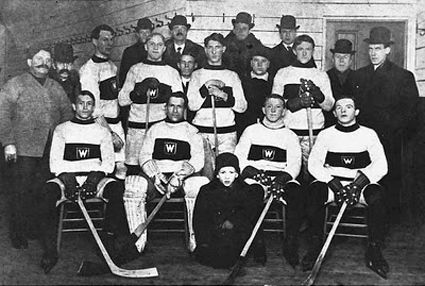
The 1917-18 Montreal Wanderers

Four days later on January 2, 1918, the Wanderers were scheduled to play the Canadiens again, but a fire that began in the Montreal Arena's ice making plant, spread and burned the arena down to the ground. Team owner Lichtenhein had already made a request from the other clubs to loan the Wanderers better players to field a more competitive team in hopes of attracting more fans, but when the plan was rejected by his fellow owners following the fire, and with his club dealing with the loss of their home arena, Lichtenhein disbanded the club on January 4, ending the Wanderers fourteen year history.

Montreal Arena fire, Montreal Arena fire
The aftermath of the Montreal Arena fire

Harry Hyland was leading the Wanderers in scoring in 1917 when the club folded. He had a ten year career in hockey, playing first for the Montreal Shamrocks in 1908. He joined the Wanderers for two seasons, including as a Stanley Cup champion in 1910, before spending the 1911-12 season with the New Westminster Royals.

He returned to the Wanderers in 1912-13 and played six more seasons with the club with whom he averaged over a goal per game, scoring 158 goals in 134 games with a high of 30 in 18 games in 1914. His greatest single game came in 1912-13 when he scored 8 goals against Quebec.

Following the demise of the Wanderers, he joined the Ottawa Senators as a playing coach to finish the season and his career. He was inducted into the Hockey Hall of Fame in 1962.

Today's featured jersey is a 1917-18 Montreal Wanderers Harry Hyland jersey worn by the Wanderers for their brief time in the brand new National Hockey League. The Wanderers debuted white sweaters with the red stripe around the center adorned with a shield containing a white "W" for the 1905 season and it would remain their only sweater throughout the rest of their days.

Had the Wanderers survived, it is hard to imagine they would have ever changed their style in a manner similar to the Canadiens or Detroit Red Wings. So closely was their distinctive sweater associated with the club, that the team was often referred to as "the Redbands".

Montreal Wanderers 17-18 jersey, Montreal Wanderers 17-18 jersey

Today's first video is a reenactment of the Halifax Explosion, which illustrates the incredible devastation of the largest man made detonation on Earth prior to the atomic age.


Today's second video is actual newsreel footage of the devastation and rescue work immediately following the disaster.

Thursday, December 15, 2016

The Halifax Explosion - 1917-18 Montreal Wanderers Harry Hyland Jersey

The morning of December 6, 1917 was like any other day in Halifax, Nova Scotia. Halifax had been founded by the British military as a fortress to protect their interests against the French back in the late 1700s thanks to its large and deep natural harbor as well as its strategic location.

Halifax Before, Halifax Before
Early 20th Century Halifax

With World War I raging in Europe, the factories, foundries and mills in both Halifax and nearby Dartmouth were working at full capacity, keeping the harbor busy with with shipping convoys taking goods and supplies across the Atlantic, destined for the war effort in Europe.

Ferries to and from Dartmouth, located on the opposite side of the harbor, civilian shipping, as well as fishing boats and pleasure craft all competed for space with the military shipping traffic on the harbor adding to the congestion.

Meanwhile, the French vessel the Mont-Blanc was loaded with 228,000 kilos of TNT, 2.1 million kilos of wet and dry picric acid, a toxic substance used in the making of munitions and explosives, 223,000 kilos of Benzol, a highly flammable liquid similar to gasoline, and "guncotton", a highly flammable substance used in firearms, all of which made the Mont-Blanc a floating bomb of the highest order.

The Mont Blanc, The Mont Blanc
The Mont-Blanc

Unable to cross the Atlantic solo due to the risk of a German u-boat attack, the Mont-Blanc sailed out of New York for Halifax in order to join a convoy of other ships congregating in Halifax Harbour in the interests of safety. While the ship arrived in late afternoon on December 5th, it was too late in the day to enter the harbor, as the anti-submarine nets had been closed for the night, forcing the Mont-Blanc to spend the night outside the harbor.

Meanwhile inside the harbor, the Belgian relief ship Imo was forced to delay its scheduled departure that day due to the supply of coal for its boilers arriving too late for it to leave for New York in order to collect emergency supplies for civilians in war ravaged Belgium prior to the harbor gates being closed.

At 7:30 in the morning on December 6th the navy opened the gate in the nets, allowing the Mont-Blanc to head into the harbor, traveling at a speed of four knots, under the limit of five knots. At the same time, the Imo headed toward the Narrows to begin its voyage south. As the Imo increased its speed to seven knots, it encountered the first ship entering the harbor. That incoming ship went against the usual rules of passing on the left. The two ships exchanged horn blasts to signal their intent, which resulted in the Imo passing the other ship on the right, putting the Imo on the wrong side of the harbor in the Dartmouth channel.

Once past the first ship, the Imo continued to steam along on the wrong side of the channel, allowing it to avoid a tug boat towing a pair of barges which had just pulled away from the Halifax shore on the right of the Imo.

The Mont-Blanc and the Imo were now in the same channel as they continued to travel toward each other. The Mont-Blanc blew its whistle first to signify that it had the right of way and would be maintaining course, implying the Imo would have to move to the right to clear the way. The captain of the Imo however, had other thoughts, and blew his whistle twice to signify his intent to hold his course. The Mont-Blanc then moved slightly to its right closer to the Dartmouth shore to give the Imo additional room for clearance, hoping the Imo would respond in kind by moving to its right in order to give the two ships adequate distance between them for safe passage. When the Mont-Blanc again blew its whistle once, the Imo responded with two blasts of his horn, indicating it would not be changing course.

The sailors who knew what the repeated signals meant realized trouble was brewing and gathered to watch the two ships. Finally, as the Mont-Blanc and the Imo were bearing down on each other, the Mont-Blanc turned hard left into the center of the channel to avoid a collision with the Imo, as it could not move any further toward shore for fear of running aground while loaded with such dangerous cargo.

Unfortunately for all concerned, the Imo now finally chose to change course by reversing engines, which swung the ship to its right - and into the path of the Mont-Blanc. If only one of the ships had made its evasive maneuver, nothing more than a close call would have been the result. However, they both were now aimed for the same spot and the resulting collision caused the Imo to penetrate nine feet into the hull of the Mont-Blanc at 8:45 AM. The Imo then pulled away to extricate itself from the Mont-Blanc, causing enough sparks to ignite the lethal combination of picric acid and vapors from the ruptured drums of benzol, producing an uncontrollable fire at the forward end of the damaged Mont-Blanc.

Fearing an immediate explosion, the captain of the Mont-Blanc ordered the crew to abandon the ship, which was spewing a large column of oily, black smoke. As the public gathered on the streets or stood at the windows of their homes to watch the spectacular fire and exploding barrels of benzol rocketing into the air.

The rescuers, as well as those on the shore, had no idea of the danger contained inside the Mont-Blanc, as any outward warnings of the dangerous cargo in the form of red flags were not displayed on the Mont-Blanc for fear of drawing unwanted attention from the Germans while at sea. As boats rushed to their assistance, the crew of the Mont-Blanc attempted to warn them off as they rowed furiously ashore in their lifeboats, but they were unable to be understood, as the crew spoke only French as they reached the Dartmouth side and ran for the woods and to safety.

The hastily abandoned ship was now not only ablaze, but also adrift and moving toward Halifax's Richmond neighborhood and into Pier 6, which then caught fire as well. The boat was then met by the Halifax Fire Department, with its one motorized truck and a dozen horse-drawn wagons, who were all unaware of the ship's highly dangerous contents.

And then it happened.

The Mont-Blanc erupted with a force stronger than any man-made explosion in world history prior to the atomic age. The ship shattered and was blown sky-high, 980 feet into the air. White hot pieces of its hull came falling back to Earth as lethal shrapnel rained down all over Halifax and Dartmouth. A 1,140 pound piece of the ship's anchor landed 2 1/2 miles away while the Mont-Blanc's gun barrel flew over three miles, landing clear across the harbor in Dartmouth.

Halifax Explosion, Halifax Explosion
This photo was taken just seconds after the explosion of the Mont-Blanc

The fireball rose over 6,200 feet over the harbor, symbolizing the hell that had just descended on the area. The smoke from the fire reached 20,000 feet while buildings shook and items fell off of shelves as far as 80 miles away with the shock wave being felt 200 miles away as 400 acres in the immediate vicinity were completely destroyed by the blast.

Halifax damage map, Halifax damage map
Halifax damage map

Homes, apartments, business and the sugar refinery were all destroyed in an instant. Every building within a 10 mile radius, 12,000 in all, were badly damaged, if not destroyed.


Richmond School, Richmond School

Additionally, the water immediately surrounding the ship was evaporated by the intense heat of the explosion, which momentarily exposed the harbor floor! The shockwave from the blast sent water rushing violently outwards, creating a wave that spread toward both shores, rising as high as 60 feet. The wave carried the Imo onto the shore on the Dartmouth side of the harbor as the tidal wave washed up three blocks into the city.

The Imo, The Imo
The Imo, washed ashore on the opposite side of the harbor

Over 1,500 people died instantly, while 9,000 were injured by not only the blast, but falling debris from the shattered ship, collapsing buildings and shards of flying glass, which blinded 38 people with roughly 600 more suffering eye injuries while standing at their windows watching the initial blaze.

Many of those who survived the initial blast now had to hang on for their lives as the water rushed up onto the shore where they had gathered, claiming more victims who were in shock or injured and unable to withstand the surging waters. Miraculously, all but one of the crew of the Mont-Blanc survived the disaster.

Since it was wintertime, fires broke out all over as stoves, lamps and furnaces throughout the area were toppled, igniting blazes fueled by the debris, which claimed even more victims throughout the region, in part due to the majority of the firefighters having died in the initial blast, as well as the lack of standardized equipment from town to town which hampered the efforts when fire hoses could not be coupled together.

Halifax Explosion, Halifax Explosion
The damaged Halifax Exhibition Building

More fatalities occurred the following day when a blizzard dumped 16 inches of snow on the region, which included those still trapped in the rubble of collapsed buildings, those not yet tended to and those susceptible to the cold, as homes no longer had glass in the windows to contain any heat. In the days that followed, people moved into churches, temporary shelters and even railroad boxcars - anywhere warm and dry.

Halifax After, Halifax After
Halifax after the snowfall

The final death toll was 1,950 with 1,630 homes destroyed in the explosion and fires. 6,000 people were rendered homeless and 25,000 lacked adequate housing. Industry was essentially gone, as was the workforce.

Halfiax Herald Headline, Halfiax Herald Headline

In 1994 a study was conducted comparing 130 major, artificial, non-nuclear explosions by a team of scientists and historians and they concluded that "Halifax Harbour remains unchallenged in overall magnitude as long as five criteria are considered together: number of casualties, force of blast, radius of devastation, quantity of explosive material and total value of property destroyed."

Mont Blanc anchor, Mont Blanc anchor
The piece of the Mont-Blanc anchor, which was hurled over 2 miles by the blast

Nine days after the disaster, the first exhibition game in NHL history was contested between the Montreal Canadiens and the Montreal Wanderers played a benefit game for the victims of the explosion at Halifax Harbour.

The first NHL season was only four days away, as the league had only just been formed the previous month when the owners of the Canadiens, Wanderers, Ottawa Senators, Toronto Arenas and Quebec Bulldogs, in an effort to rid themselves of contentious, difficult and abrasive fellow National Hockey Association owner Eddie Livingstone.

Livingstone, who owned both the Toronto Shamrocks and Toronto Blueshirts, had multiple disagreements with the NHA and his fellow owners over many matters, including his ownership of two clubs, which gave him two votes in league matters. He feuded with the Wanderers owner Sam Lichtenhein in particular, and at one point Lichtenhein offered Livingstone $3,000 to simply close up shop and walk away from the NHA, while Livingstone countered with a $5,000 offer if Lichtenhien would do the same!

Today's featured jersey is a 1917-18 Montreal Wanderers Harry Hyland jersey. At their November, 1917 annual meeting, the NHA voted to suspend operations, supposedly "due to the difficulty in running a five team league", only to meet again in a weeks time, only this time without Livingstone, to form a new five team league, the National Hockey League, which was the NHA minus Livingstone but with the Toronto franchise in new hands.

The Wanderers, who had been formed back in 1903, had first taken possession of the Stanley Cup in 1906 by winning the ECAHA playoffs and won seven cup challenges and four league titles over the next five seasons. They then fell on hard times after entering the NHA, losing the only playoff series they contested over the next eight seasons. Their final three NHA seasons saw a string of fourth and fifth place finishes, thanks in part to the loss of players off to serve in World War I, putting the team in a fragile financial position as interest in the club among the anglophones waned.

Once the inaugural NHL season began, the Wanderers, the team of Montreal's minority English speaking population, defeated Toronto in a thrilling 10-9 opening night contest attended by just 700 fans despite the offer of free admission for military personnel and their families. They were then manhandled by the Canadiens 11-2. Ottawa then took two games in a home and home set by scores of 6-3 and 9-2, with the second game begin played on December 29, 1917.

1917-18 Montreal Wanderers team, 1917-18 Montreal Wanderers team
The 1917-18 Montreal Wanderers

Four days later on January 2, 1918, the Wanderers were scheduled to play the Canadiens again, but a fire that began in the Montreal Arena's ice making plant, spread and burned the arena down to the ground. Team owner Lichtenhein had already made a request from the other clubs to loan the Wanderers better players to field a more competitive team in hopes of attracting more fans, but when the plan was rejected by his fellow owners following the fire, and with his club dealing with the loss of their home arena, Lichtenhein disbanded the club on January 4, ending the Wanderers fourteen year history.

Montreal Arena fire, Montreal Arena fire
The aftermath of the Montreal Arena fire

Harry Hyland was leading the Wanderers in scoring in 1917 when the club folded. He had a ten year career in hockey, playing first for the Montreal Shamrocks in 1908. He joined the Wanderers for two seasons, including as a Stanley Cup champion in 1910, before spending the 1911-12 season with the New Westminster Royals.

He returned to the Wanderers in 1912-13 and played six more seasons with the club with whom he averaged over a goal per game, scoring 158 goals in 134 games with a high of 30 in 18 games in 1914. His greatest single game came in 1912-13 when he scored 8 goals against Quebec.

Following the demise of the Wanderers, he joined the Ottawa Senators as a playing coach to finish the season and his career. He was inducted into the Hockey Hall of Fame in 1962.

Today's featured jersey is a 1917-18 Montreal Wanderers Harry Hyland jersey worn by the Wanderers for their brief time in the brand new National Hockey League. The Wanderers debuted white sweaters with the red stripe around the center adorned with a shield containing a white "W" for the 1905 season and it would remain their only sweater throughout the rest of their days.

Had the Wanderers survived, it is hard to imagine they would have ever changed their style in a manner similar to the Canadiens or Detroit Red Wings. So closely was their distinctive sweater associated with the club, that the team was often referred to as "the Redbands".

Montreal Wanderers 17-18 jersey, Montreal Wanderers 17-18 jersey

Today's first video is a reenactment of the Halifax Explosion, which illustrates the incredible devastation of the largest man made detonation on Earth prior to the atomic age.


Today's second video is actual newsreel footage of the devastation and rescue work immediately following the disaster.

Monday, December 5, 2016

1911-12 Montreal Wanderers Riley Hern Jersey

Born on this date in 1880, Riley Hern played both goaltender and forward as a youth but settled on goaltending by the time he progressed to senior hockey with the Stratford Legionnaires of the Ontario Hockey Association from 1898 to 1901.

He turned professional in 1901 with the Pittsburgh Keystones of the Western Pennsylvania Hockey League, which he led in victories with 9 in his first season. After going five-for-five in wins the next season, he suffered a dismal 1-10 slog through the 1902-03 season.

Looking for greener pastures, he found one in Houghton, Michigan with the Portage Lake Hockey Club. Not a member of any established league at the time, Portage Lake played a schedule of exhibition games to great success, as Hern finished the season with an outstanding record of 15-1.

1903-04 Portage Lake Hockey Club
The 1903-04 Portage Lake Hockey Club

With the stellar lineup of talent Portage Lake had assembled, which included future Hall of Famers "Bad" Joe Hall, Bruce Stuart, his brother Hod Stuart and the legendary Cyclone Taylor, thanks in no small part due to the salaries the club was paying in what was still primarily an amateur sport, Portage Lake became members of the International Professional Hockey League for it's inaugural 1904-05 season. After a second place finish in year one, Portage Lake won the league title in 1905-06 as Hern posted a 15-5 record.

He moved east for the 1906-07 season to join the current Stanley Cup holders, the Montreal Wanderers, who were members of the Eastern Canada Amateur Hockey Association at the time. Before the season began the Wanderers faced a Stanley Cup challenge from the New Glasgow Cubs, who they turned back in a two-game, total-goal series with scores of 10-3 and 7-2 to retain the cup by a total of 17-5.

Hern and the Wanderers then lost control of the cup on January 21st when the Kenora Thistles wrested the cup away with 4-2 and 8-6 wins.

After their surprising defeat, the Wanderers marched unchallenged through the ECAHA schedule, finishing with a flawless 10-0 record on the back of 105 goals scored while giving up just 39, which calculates to an average of a 10-4 win every game. As champions, and also on a roll having posted goal totals of 16, 13, 18, 10 and 16 in their last five games, the Wanderers attempted to reclaim the cup by traveling west to challenge Kenora for the rights to the Stanley Cup.

With the first game delayed a day due to bad ice conditions which forced a change in venue from Kenora to Winnipeg, Hern and the Wanderers all but reclaimed the cup during Game 1 with a 7-2 win. Kenora hung tough and won the second game 6-5, but failed to overcome the five goal deficit they faced after Game 1. With the Wanderers taking the series 12 goals to 8, they returned to Montreal with the cup in hand, only to have it stolen and held for ransom!

1907 Montreal Wanderers
The 1907 Montreal Wanderers

A some point during a team photo shoot, the cup was stolen from photographer Jimmy Rice's home and held for ransom! When no one would pay for it's return, the Stanley Cup was left on Rice's doorstep and his wife used it as a geranium planter until the fall when it was put back into service!

At some point during the time between winning the cup, having it stolen, it being used as a planter and the next cup challenge, the Wanderers had the audacity to not only engrave the name of their team into the cup, but the entire roster of the club, beginning a tradition which many feel makes the Stanley Cup the greatest trophy in sports.

1907 Wanderers engraving
The 1907 Wanderers celebratory engraving in the bottom of the bowl of the Stanley Cup

For the 1907-08 season, the Wanderers had to defend the cup against the Ottawa Victorias, whom they easily turned back 9-3 and 13-1. Following the regular season, where the Wanderers again emerged as league champions, they were challenged for the cup twice more, first by the Winnipeg Maple Leafs, who they beat 11-5 and 9-3, and then by the Toronto Professionals in a one game playoff the Wanderers won by a score of 6-4, which gave Hern a 13-2 record for the season.

1908 Montreal Wanderers Pictures, Images and Photos
The 1908 Montreal Wanderers

Once again, prior to the 1908-09 season, the Wanderers face yet another challenge for the Stanley Cup, this one from the Edmonton Hockey Club, a team stocked with ringers for the challenge. It was to no avail however, as the Wanderers won Game 1 handily, building a four goal advantage heading into the final game after a 7-3 win. Edmonton did take Game 2 7-6, but the cup remained firmly in the hands of the Wanderers.

With the 1909 schedule consisting of only 12 games, each contest was critical as the Wanderers and the Ottawa Senators engaged in a neck and neck struggle for the league championship which entitled the winner to the rights to the cup. The Wanderers gained the upper hand with a 7-6 overtime win during the opening game of the season for each club. The two clubs dominated their games against the Quebec Bullogs and Montreal Shamrocks for the remainder of January until their next meeting on January 30th when Ottawa prevailed 5-4. On February 6th, the clubs were involved in their third consecutive one goal game, won by Ottawa 9-8 and they sealed the Wanderers fate with a dominant 8-3 win in their final meeting to end the Wanderers two year hold of the cup, which included four successful defenses.

With that, the ECHA dissolved and the Wanderers formed a new league, the National Hockey Association, while the other three clubs entered the Canadian Hockey Association, which failed after less than two weeks, sending its clubs looking to join the NHA. Hern and the Wanderers tore through the now seven team league with an 11-1 record, outscoring their opposition 91-41, with Hern getting all the starts for Montreal. With Ottawa in the NHA, Montreal assumed control of the Stanley Cup once more by virtue of winning the league title. They faced one challenge for the cup from Berlin of the Ontario Professional Hockey League, whom they dispatched 7-3.

Montreal Wanderers 1909-10 Pictures, Images and Photos
The 1910 Montreal Wanderers

Hern would play one final season of 1910-11 and with the Wanderers finishing fourth with a 7-9 mark, the Wanderers would relinquish the cup as Hern's hockey career came to a close at the age of 30.

Hern would conclude his career with a 106-43 regular season record and a 10-4 won-loss record in Stanley Cup challenge games and was elected to the Hockey Hall of Fame in 1962.

Today's featured jersey is a 1911-12 Montreal Wanderers Riley Hern jersey. The Wanderers adopted the "redband" style jersey and no doubt influenced the Montreal Canadiens who later adopted their iconic red sweaters with a blue band across the chest in 1913. This Wanderers jersey remained unchanged and in use until January 2, 1918 when their home arena burned down, forcing the club, already in debt, to cease operations after 14 1/2 seasons of competition.

Riley Hearn Wanderers

Wednesday, January 13, 2016

1910-11 Montreal Wanderers Art Ross Jersey

Born on this date in 1886, Art Ross moved to Montreal in 1902 at the age of 16 and played high school and junior hockey with hockey pioneers and innovators Frank and Lester Patrick. at Westmount Academy and then with the Montreal Westmount club in the Canadian Amateur Hockey League, the top amateur league in Canada, beginning with the 1902-03 season. He played with Westmount again in the 1903-04 season before joining the Montreal Merchants for the 1904-05 season where he scored 10 goals in 8 games.

He moved west in pursuit of a banking career but still had time for hockey, playing for the Brandon Wheat City club of the Manitoba Hockey League in 1905-06, scoring 6 times in 7 games. Ross was then added to the Kenora Thistles roster for their Stanley Cup challenge against the Montreal Wanderers, for which he was paid $1,000 for the two game series.

Teamed with the likes of future Hall of Famers Bad Joe Hall, Tommy Phillips and Tom Hooper, Kenora became the smallest town to ever win the Stanley Cup, as they defeated the Wanderers 4-2 and 8-6 to win the series 12 goals to 8 in the hostile territory of the Montreal Arena, which would figure in Ross' career later on as we shall see...

1907 Kenora Thistles team photo Kenora Thistles 1907 Stanley Cup.jpg
The 1907 Stanley Cup champion Kenora Thistles

Ross moved back home to Montreal for the 1906-07 season and joined the very same Wanderers club he had helped dethrone as Stanley Cup holders, clearly having impressed the team management with his puck rushing style from his defensive position, a rarity in those days, as the defensemen of the day either fired the puck down the ice or deferred the forwards, passing it up to one at the first opportunity.

Art Ross Wanderers photo Art Ross - Montreal Wanderers 1910.png
Ross, seen here with the Wanderers, would return to Montreal
on several occasions throughout his career

Thanks in part to his 8 goals in 10 games, the Wanderers would finish atop the Eastern Canada Amateur Hockey Association to retain the Stanley Cup they had won back from Kenora in a rematch two months after having lost it to the Thistles, of which Ross was not a part of. This would make Ross only the second player, after Jack Marshall, to win the cup two years in a row with two different clubs. Additionally, the Wanderers rebuffed challenges from the Ottawa Victorias, the Winnipeg Maple Leafs and the Toronto Argonauts that spring.

Wanderers champions photo Montreal Wanderers World Champions 1906-1908.jpg
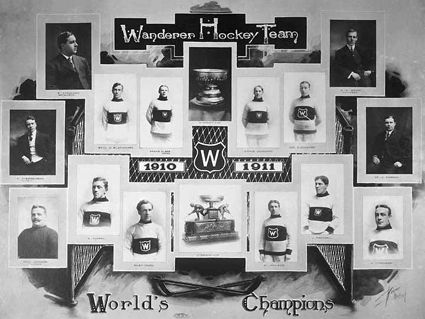
The holders of the Stanley Cup, the Montreal Wanderers

In January of 1908, Ross was a participant in the first all-star game in sports history, which was a benefit game for the family of the late Wanderers defender Hod Stuart, who drowned the previous summer.

For the 1908-09 season, Ross helped the Wanderers fend off another Stanley Cup challenge before the start of the regular season, a 13-10 defeat of the Edmonton Hockey Club. He scored twice in the Wanderers 9 games, but they lost the regular season title to the Ottawa Hockey Club and therefore their rights to the Stanley Cup. Ross was also hired by the Cobalt Silver Kings for a pair of playoff games, which they won to become Timiskaming Professional Hockey League champions.

1909 Cobalt Silver Kings team photo 1909 Cobalt Silver Kings team.png
The 1909 Cobalt Silver Kings

It was back to Montreal for the 1909-10 season, this time with the All-Montreal Hockey Club as a player/manager in the upstart Canadian Hockey Association. Ross had scored 4 goals in 4 games before the league imploded in mid-January of 1910. Ross then caught on with the Haileybury Comets of the rival National Hockey Association, playing in 6 games and scoring 6 goals, which earned him $2,700.

Art Ross Haileybury photo 1910_1911__art_ross.jpg
Art Ross with the Haileybury Comets

Ross was lured back by the Wanderers, who were now members of the same NHA as Haileybury, for the 1910-11 season. He scored 4 times in 11 games and also enhanced his reputation as a tough player by knocking out the Quebec Bulldogs' Eddie Oatman, which started a massive brawl that required police intervention to break up!

Montreal Wanderers 1909-10 photo Montreal Wanderers 1909-10.jpg
The World Champion Montreal Wanderers

The 1911-12 season saw Ross set a career high with 16 goals in 18 games followed by 11 goals in 19 games in 1912-13. After a salary dispute with the Wanderers, the two sides agreed to a new deal and Ross totaled 4 goals and 9 points in 1913-14.

Art Ross Wanderers photo Ross 1912-13 Wanderers card.png
An early Art Ross hockey card

Prior to the 1914-15 season, Ross attempted to persuade other players to leave their clubs and form a new league, which resulted in him being suspended. He responded by declaring himself a free agent. The president of the NHA then upped the suspension to cover all of organized hockey!

When is plan for a new league failed to gain traction, he applied to be reinstated to the NHA, which was granted in December  1914. The Wanderers were less than happy with Ross for the commotion and released him from the team. Ross then found a home with the Ottawa Senators.

Ottawa and the Wanderers finished with identical 14-6 records and a two game, total goal playoff was held to determine who would play the Pacific Coast Hockey Association's Vancouver Millionaires for the Stanley Cup. Ottawa won 4-0 in Game One and held off the Wanderers by despite a 1-0 loss in Game Two.

1914-15 Ottawa Senators team photo 1914-15 Ottawa Senators team.jpg
The 1914-15 Ottawa Senators

After scoring just 3 goals and 1 assist for Ottawa the previous season, Ross equaled a career high with 16 points in 1915-16 with 8 goals and 8 assists.

Somewhat surprisingly, following his acrimonious departure in 1914, Ross returned to Montreal and the Wanderers for the 1916-17 NHA season, in part to keep an eye on his Montreal sporting good store that he owned. He finished with 6 goals and 2 assists for the Wanderers in the final season for the NHA.

A new league was formed as part of some back room dealings, which brought an end to the NHA, but game rise to today's National Hockey League for 1917-18. In addition to his playing duties, Ross was also now the team's coach, but after just three games of the inaugural NHL season, the Wanderers aforementioned Montreal Arena was destroyed by a fire on January 2, 1918, which led to the financially struggling Wanderers folding their homeless franchise, which brought an abrupt end to Ross' playing days.

Montreal Arena fire photo MontrealArenafire1917-18.jpg
The aftermath of the Montreal Arena fire
that brought an end to Ross' playing career

Ross managed to score but one goal in his three NHL games, but ironically, the league scoring championship trophy is named for the man who only scored once in his NHL career!

1917-18 Montreal Wanderers team photo 1917-18MontrealWanderersteam.jpg
The 1917-18 Montreal Wanderers, who played
only three games of the inaugural NHL season

Ross remained active in hockey after his playing days concluded, which saw him coaching McGill University, becoming an NHL referee, coaching the Hamilton Tigers and then being hired by Charles Adams as the vice president, general manager, coach and scout for his NHL expansion franchise, which Ross himself dubbed the Boston Bruins.

In just five seasons, the Bruins, under Ross' leadership, rose from a 6-24 record to Stanley Cup champions. Ross became the first coach to ever pull his goalie late in a losing situation to gain an extra attacker in 1931. Before he retired in 1954 after 30 years with the club, the Bruins would win additional Stanley Cups in 1939 and 1941.

Art Ross Bruins photo Art Ross - Boston Bruins 1931 .png
Art Ross as coach of the Bruins in 1931

Ross was inducted into the Hockey Hall of Fame in 1949, specifically for his playing career, and not his long career as a team executive.

Today's featured jersey is a 1910-11 Montreal Wanderers Art Ross jersey. The Wanderers were formed in 1903 and were active until their arena burned down in 1918. All photographic records indicate the Wanderers wore the same white sweaters with a red band across the chest for their entire professional existence.

The Wanderers franchise finished first in the Federal Amateur Hockey League in 1904 before winning the ECHA championship in 1906 by defeating Ottawa in a two game, total goal playoff to capture the Stanley Cup.

They then won two more ECHA titles in 1907 and 1908 as well as turning away a challenge from the New Glasgow Cubs, winning back the Cup after losing it two months earlier to the Kenora Thistles, and then defending challenges for the cup from the Ottawa Victorias, Winnipeg Maple Leafs, Toronto Hockey Club and Edmonton Eskimos through March of 1909.

Art Ross Wanderers photo Ross Wanderers.png
 

hit counter for blogger