History of Jersey 83-93 Banner sm photo History of Jersey 83-93 Banner sm.jpg
Showing posts with label Detroit Cougars. Show all posts

Monday, March 27, 2017

The Detroit Red Wings Single Season Goal Scoring Record - 1972-73 Detroit Red Wings Mickey Redmond Jersey

When the Western Canada Hockey League folded after the 1925-26 season, a deal was made in which the new Detroit expansion NHL club bought the rights to the players of one of the most successful of the WCHL teams, the 1925 Stanley Cup champion Victoria Cougars.

1925 Victoria Cougars photo 1925VictoriaCougarsteam.jpg
The 1925 Stanley Cup champion Victoria Cougars

The new Detroit club was named the Cougars in honor of the source of its roster, the Victoria Cougars. The new NHL Cougars played a 44 game schedule, finishing last in the American Division of the 10 team league with a 12-28-4 record. John Sheppard would lead the team in scoring with 13 goals and 21 points in 43 games.
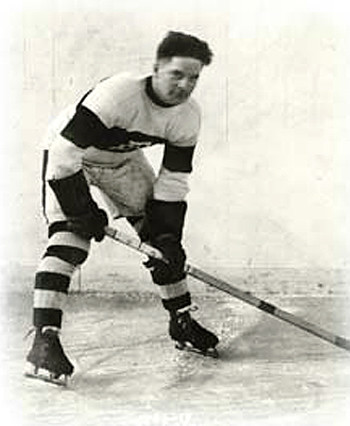
Sheppard Cougars Red Wings
John Sheppard

For the following season of 1927-28, the Detroit Olympia would become the Cougars new home for the next 52 years through December of 1979. That same season, Jack Adams would take over as head coach in Detroit and spend the next 36 years as either the coach or general manager of the club. The Cougars would finish the season with a 19-19-6 record for fourth place in the American Division. George Hay would lead the team with 22 goals and 35 points in 42 games, tied for third in the league.
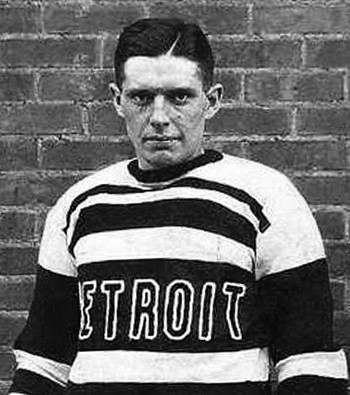
Hay Cougars Red Wings
George Hay

Before the start of the 1930-31 season, the Detroit club would change its name from their original choice of Cougars to Falcons, bringing an end to the first era of of the franchise with hopes of changing its luck. The name Falcons would last but two seasons until a change in ownership led to the adaptation of the Red Wings name. Ebbie Goodfellow would raise the Detroit single season goal scoring mark to 25 during the team's first year as the Falcons.
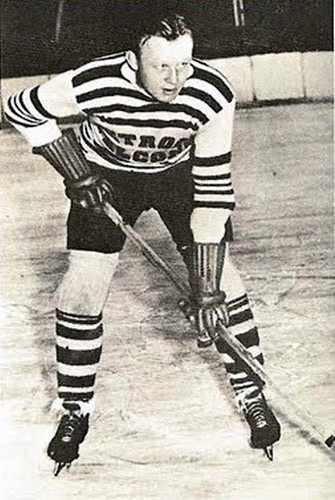
Goodfellow Falcons Red Wings
Ebbie Goodfellow

For the 1932-33 season, the franchise was purchased by James Norris and rechristened the Detroit Red Wings, which included a changed to their famed "winged wheel" logo. The Red Wings would win the Stanley Cup in 1936, 1937 and 1943, and Larry Aurie would lead the NHL in goals in 1936-37 with 23, but Goodfellow's mark of 25 would last until the 1943-44 season when it was destroyed by Carl Liscombe's 36 goals.

Ted Lindsay would lead the NHL with 33 in 1948 and Sid Abel's 28 topped the league in 1949 but, after a Stanley Cup championship in 1950, it would be Gordie Howe in 1950-51 who would set the bar higher when he led the NHL in goals for three consecutive seasons, first with 43 in 1951, then 47 in 1952 and finally 49 in 1952-53.
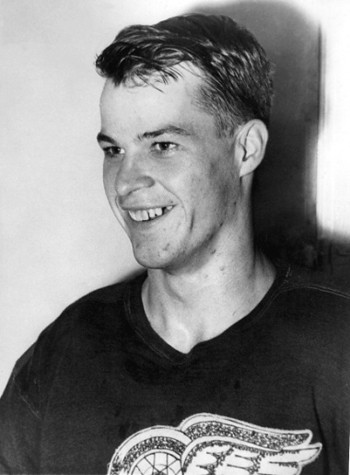
Gordie Howe Young 2
Young Gordie Howe led the NHL in goals for three seasons
while pushing the Red Wings team record from 43 up to 49

Howe would equal his own record in 1952-53 with 49 again, but despite championships in 1952, 1954 and 1955 and Howe leading all players in 1957 (44 goals) and again in 1963 (38) followed by Norm Ullman with 42 goals in 1965, it would take until this date in 1973 for Mickey Redmond to become the first player in Red Wings history to score 50 goals in a season when he scored at 16:47 of the third period from Gary Bergman in an 8-1 Detroit win over the Toronto Maple Leafs. Redmond would then score his 51st of the season just 18 seconds later on his way to a season total and new club record of 52.
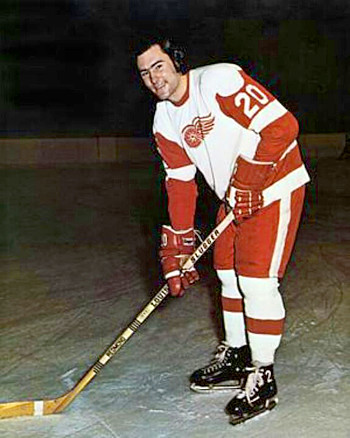
Redmond Red Wings 2
Mickey Redmond, the first Red Wing to score 50 goals

John Ogrodnick moved the Detroit single season record up to 55 during his career year of 1984-85 when he had 105 points, 20 more than his next best season.
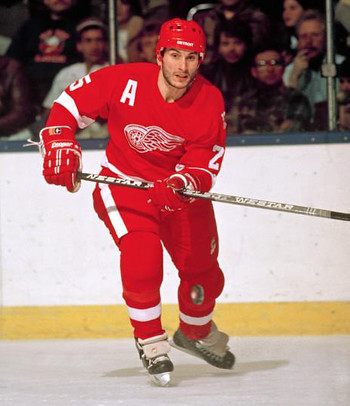
Ogrodnick Red Wings
John Ogrodnick

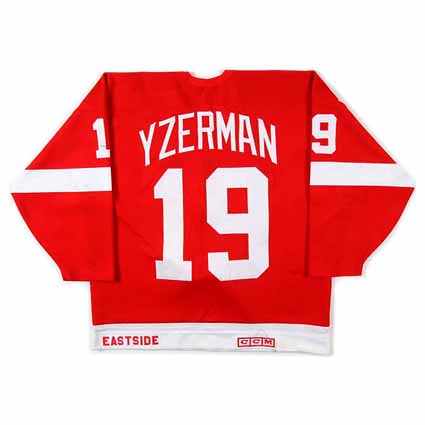
Finally, in 1988-89, Steve Yzerman would establish the current single season team record with a blistering 65 goal season on his way to a 155 point total, which also remains a club record in its own right along with his 90 assists that season.
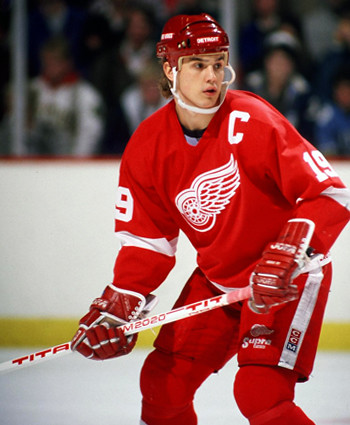
Yzerman Red Wings 2
Detroit single season goal scoring record holder Steve Yzerman

Since then, only three times has anyone surpassed Ogrodnick's 55 goals, starting with Yzerman, who had 62 in 1989-90 the season after setting the record of 65. Yzerman had 58 in 1992-93 and Russian Sergei Fedorov had a 56 goal season in 1993-94, leaving Yzerman the only player to surpass 60 for Detroit, having done it twice.

No Red Wing has led the NHL in goals since Ullman back in 1965 despite the team winning Stanley Cup titles in 1997, 1998, 2002 and 2008.
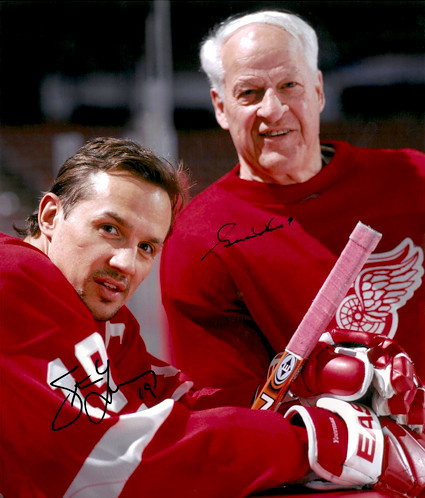
Yzerman and Howe
Red Wings legends Yzerman and Howe, who hold the franchise
single season and career goal and point scoring records

Today's featured jersey is a 1972-73 Detroit Red Wings Mickey Redmond jersey as worn by Redmond the season he became the first player in franchise history to score 50 goals in a season.

The Red Wings first introduced this style jersey in 1932 when they changed their name from the Falcons. There have been minor tweaks to fonts and modernizations, such as sleeve numbers and names on the back, but the Red Wings red jersey has remained essentially unchanged in now over 85 years.
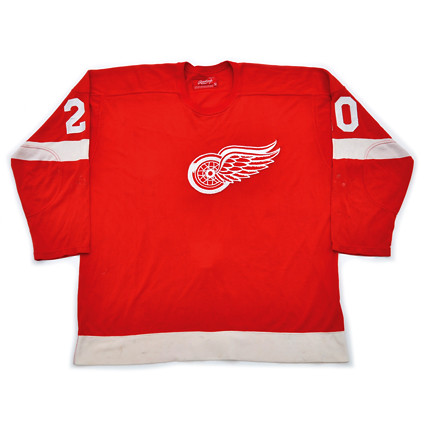
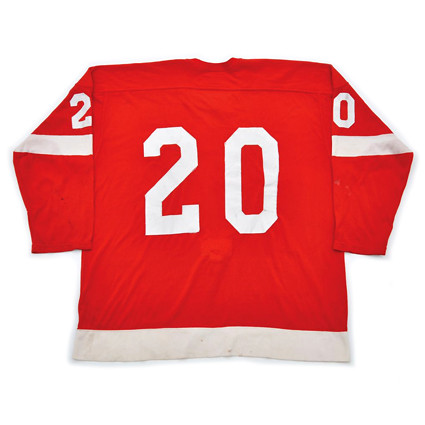
Detroit Red Wings 1972-73 F jersey
Detroit Red Wings 1972-73 B jersey

Bonus jersey: Today's bonus jersey is a 1988-89 Detroit Red Wings Steve Yzerman jersey worn by Yzerman the season he set the Red Wings single season goals, assists and points scoring records.
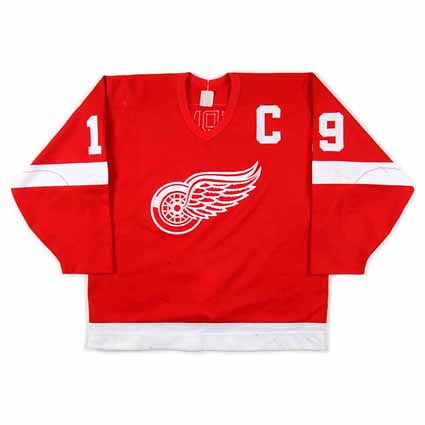
Detroit Red Wings 1988-89 F jersey
Detroit Red Wings 1988-89 B jersey


Friday, November 18, 2016

1926-27 Detroit Cougars Russell Oatman Jersey

It was on this date in 1926 that the Detroit Cougars would play in their first NHL game, losing 2-0 to the Boston Bruins at the Border Cities Arena in Windsor, Ontario where the Cougars would play their home games during their first season since they had no home arena in Detroit at the time.

When the Western Canada Hockey League folded after the 1925-26 season, a deal was made so the new Detroit expansion NHL club bought the rights to the players of one of the most successful of the WCHL teams, the 1925 Stanley Cup champion Victoria Cougars.

1925 Victoria Cougars photo 1925VictoriaCougarsteam.jpg
The 1925 Stanley Cup champion Victoria Cougars

The new Detroit club was named the Cougars in honor of the Victoria club from where it's roster originated. The Cougars played a 44 game schedule, finishing last in the American Division of the 10 team league with a 12-28-4 record. John Sheppard would lead the team in scoring with 21 points in 43 games.

 photo 1926-27DetroitCougarsteam.jpg
1926-27 Detroit Cougars team

For the following season of 1927-28, the Detroit Olympia would become the Cougars new home, where they would play for the next 52 years, until December of 1979. That same season, Jack Adams would take over as coach in Detroit and spend the next 36 years as either the coach or general manager of the club. The Cougars would finish the season with a 19-19-6 record for fourth place in the American Division. George Hay would lead the team with 35 points in 42 games, tied for third in the league.

Detroit Cougars 1927-28 photo DetroitCougars1928.jpg
The Detroit Cougars in 1928

he 1928-29 Cougars would finish with a similar 19-16-9 record but make the Stanley Cup playoffs for the first time, losing out to the Toronto Maple Leafs 7-2 in a two game total goals series. Carson Cooper would lead the Cougars in scoring with 27 points in 43 games to finish third in the league.

The final season for the name Cougars, 1929-30, would see Detroit post a 14-24-5 record and miss out on the playoffs. Cooper would again lead the team in scoring, this time with 36 points in 44 games played.

Before the start of the next season, the Detroit club would change it's name from its original choice of Cougars to Falcons, bringing an end to the first era of of the franchise and hoping to change it's luck. The name Falcons would last but two seasons until a change in ownership led to the adaptation of the Red Wings name.

Today's featured jersey is a 1926-27 Detroit Cougars Russell Oatman jersey worn by the expansion Cougars during their first season in the NHL. The Cougars name lasted just four seasons, but the team wore a new style sweater for every one of those four years, offering no clues as to what was to come, as the Red Wings name was introduced in 1932 and their red jerseys have now remained unchanged for over 80 years!

Detroit Cougars 1926-27 jersey photo DetroitCougars1926-27jersey.jpg

Bonus jersey: Today's bonus jersey is a 2008-09 Detroit Red Wings Nicklas Lidström jersey worn for the Winter Classic on January 1, 2009 at Wrigley Field in Chicago when the Red Wings defeated the Chicago Blackhawks 6-4. This jersey is based on the style that Detroit wore in during the franchise's first season of 1926-27 when they were known by their original name of the Detroit Cougars.

Detroit Red Wings 2008-09 Winter Classic jersey photo DetroitRedWings2008-09WClassicF.jpg
Detroit Red Wings 2008-09 Winter Classic jersey photo DetroitRedWings2008-09WClassicB.jpg

Our video section begins with a preview of the 2009 Winter Classic, during which the Red Wings wore jerseys inspired by the original Cougars jerseys.


Sunday, September 25, 2016

The 1926-27 NHL American Expansion - Chicago, Detroit and New York

In the 1923-24 NHL season, the league consisted of a mere four teams, all of them located in Canada. Those clubs were the Hamilton Tigers, Montreal Canadiens, Ottawa Senators and Toronto St. Patricks. The league grew by two for the 1924-25, adding the Montreal Maroons, and expanding into the United States for the first time with the formation of the Boston Bruins.

Bruins 25-26 photo Bruins25-26.jpg
The 1925-26 Boston Bruins

More changes came the following season of 1925-26 when the Hamilton franchise was dropped and it's players signed by the expansion New York Americans. Additionally, fearing the formation of a competing new league, the NHL awarded a franchise to Pittsburgh, which was christened the Pittsburgh Pirates.

Meanwhile, out west the Pacific Coast Hockey Association, formed back in in 1912-13, had ended its 13 year run after the 1923-24 season, which included both the Vancouver Millionaires in 1915 and the Seattle Metropolitans in 1917 winning the Stanley Cup. For the 1924-25 season, following the demise of the PCHA, the Vancouver Maroons, formerly the Millionaires, and the Victoria Cougars joined the three year old Western Canada Hockey League, raising their league membership to six. League champion Victoria would go on to defeat the NHL's Canadiens for the Stanley Cup that season, making them the final team from outside the NHL to win the cup.

1925 Victoria Cougars photo 1925VictoriaCougarsteam.jpg
The 1925 Stanley Cup champion Victoria Cougars

The league shortened it's name to the Western Hockey League for the 1925-26 season, dropping "Canada" in recognition of the Regina Capitals relocating across the border to Portland, Oregon, where they revived the PCHA's Portland Rosebuds name. The Cougars again won the league playoffs for the right to challenge their NHL counterpart, the Montreal Maroons, but fell three games to one.

1924-25 Portland Rosebuds team photo 1924-25 Portland Rosebuds team.jpg
The 1924-25 Portland Rosebuds

Salaries were now on the rise and the WHL was finding it difficult to keep their best players. With their mounting financial issues too great to overcome, the WHL folded, leaving the NHL as the only top-level professional league in North America.

Pleased with their results in Boston, the NHL purchased the contracts of every WHL player for $258,000 and, on this date in 1926, the NHL granted franchises to the New York Rangers, Detroit Cougars (later the Red Wings) and the Chicago Black Hawks, increasing the number of teams in the league to ten, and, for the first time in league history, the American clubs outnumbered the Canadian franchises. In just three years the four team, all-Canadian NHL had become a ten team league with six of those being in the United States.

The majority of the initial Black Hawks roster came from the Portland Rosebuds while Detroit's roster came mainly from the Victoria Cougars, hence the original name of the eventual Red Wings franchise being "Cougars" in recognition of the source of their roster.

The Black Hawks original owner was Frederic McLaughlin who had been a commander in the 86th Infantry during World War I, a division known as the "Black Hawk Division", which in turn was named after Chief Black Hawk of the Illinois region.

The Black Hawks first ever game was on November 17, 1926 at the Chicago Coliseum where they defeated the Toronto St. Patricks 4-1.

The Black Hawks would lead the league in goals with 115 in 44 games (with no other club reaching 100), but also allow a league high 116 on their way to third place in the American Division with a 19-22-3 record.

The team was led by Babe Dye's 25 goals and in points by Dick Irvin with 36, which was second in the league by a single point. Hugie Lehman was the lone goaltender for Chicago, playing in every game of the season.

Chicago Black Hawks 1924-25 photo ChicagoBlackHawks1924-25.jpg
The inaugural 1926-27 Chicago Black Hawks

Detroit began play on November 18, 1926 with a 2-0 loss to Boston at "home". The Detroit Olympia was not completed in time for the Cougars first season, so the team actually began play at the Border Cities Arena across the Detroit River in Windsor, Ontario! Their first victory came in their third game against the Black Hawks, 1-0 in Chicago.

The Cougars found the going tough in the NHL, winning just 12 games while losing 28 with 4 ties as they finished last in the league with 28 points.

Detroit scored the second fewest goals in the league that season with 76 in 44 games. While the Maroons only scored 71, their stingy defense left them at +3 for the season, while Detroit was a -29, worst in the league.

Johnny Sheppard led the team in both goals, with 13, and points with 21 while no other player had more than 15. Hap Holmes was their main goaltender, playing in 41 of their 44 games.

 photo 1926-27DetroitCougarsteam.jpg
1926-27 Detroit Cougars team

The New York Rangers were owned by Tex Rickard, the owner of Madison Square Garden. After seeing he success of his tenant, the New York Americans, he desired a team of his own and founded the Rangers.

Madison Square Garden 1925 photo MadisonSquareGarden.jpg
Madison Square Garden in 1925

Their roster was not imported wholesale from a WHL club, but pieced together from various sources. Brothers Bill Cook and Bun Cook came from the Saskatoon Sheiks of the WHL and Frank Boucher from Vancouver. Other players were plucked from the amateur and junior ranks by none other than Conn Smythe.

The Rangers first game came at home against the Montreal Maroons, who they defeated 1-0. They won the American Division with a 25-13-6 record, good for 56 points. Their offense was mid-pack while their defense allowed just 72 goals, one back of the league leading Maroons' 71, giving the Rangers a +23 goal differential.

Bill Cook led not only the Rangers, but the entire NHL in points with 37, one ahead of Chicago's Irvin thanks to his league best 33 goals while Lorne Chabot was second in goals against with a 1.46 average in 36 of their 44 games.

1926-27 New York Rangers photo 1926-27NewYorkRangers.jpg
The 1926-27 New York Rangers first training camp

The Black Hawks drew the Bruins in the first round of the playoffs that season, but lost 6-1 followed by a 4-4 tie to lose their two-game, total goals series 10-5. Boston then advanced to face the Rangers. After a scoreless tie in the opening game, the Bruins won on the road 3-1 to eliminate New York.

It wouldn't take the Rangers long to become the first of the Class of 1926 to win the Stanley Cup, as they would defeat the Maroons 3 games to 2 the very next season of 1927-28 in only their second try.

The Rangers would win again in 1933 followed by the Black Hawks first championship in 1934 with Detroit, by then known as the Red Wings, following suit in 1936 for their first title. Good things come to those that wait however, as Detroit would go on to win 11 Stanley Cups, more than Chicago's 6 and New York's 4 combined.

Today's featured jersey is a 1926-27 Detroit Cougars Eric Brolin jersey worn by the expansion Cougars during their first season in the NHL. The Cougars name lasted just four seasons, but the team wore a new style sweater for every one of those four years, offering no clues as to what was to come, as the Red Wings name was introduced in 1932 and their red jerseys have now remained unchanged for over 80 years!

Detroit Cougars 1926-27 jersey photo DetroitCougars1926-27jersey.jpg

Bonus jersey: Today's bonus jersey is a 1926-27 Chicago Black Hawks Dick Irvin jersey worn for the Black Hawks first season of play. The following season they reversed the colors of their sweaters, now black with white stripes for the next seven seasons of play.

irvin photo: Irvin Irvin.jpg

Extra bonus jersey: Today's extra bonus jersey is a 1926-27 New York Rangers Hal Winkler jersey. While researching this entry we believed that the original Rangers sweaters had white lettering, changing to red for the 1927-28 season before adopting red letters with white outlines from 1928-29 on. However... we found several team photos and player photos attributed to the 1926-27 season, including the below photo of goaltender Hal Winkler, which had to be from 1926-27, as he only played eight total games for the Rangers, clearly with red letters with white outlines two seasons before we believed they were first used.

Perhaps the white only jerseys were used in training camp and were replaced with the jersey shown below for the regular season. Either way, we're confident that the below photo of Winkler is from the Rangers inaugural season leaving us with a mystery to solve.

New York Rangers 26-27 jersey

Tuesday, November 18, 2014

1926-27 Detroit Cougars Eric Brolin Jersey

It was on this date in 1926 that the Detroit Cougars would play in their first NHL game, losing 2-0 to the Boston Bruins at the Border Cities Arena in Windsor, Ontario where the Cougars would play their home games during their first season since they had no home arena in Detroit at the time.

When the Western Canada Hockey League folded after the 1925-26 season, a deal was made so the new Detroit expansion NHL club bought the rights to the players of one of the most successful of the WCHL teams, the 1925 Stanley Cup champion Victoria Cougars.


1925 Victoria Cougars photo 1925VictoriaCougarsteam.jpg
The 1925 Stanley Cup champion Victoria Cougars

The new Detroit club was named the Cougars in honor of the Victoria club from where it's roster originated. The Cougars played a 44 game schedule, finishing last in the American Division of the 10 team league with a 12-28-4 record. John Sheppard would lead the team in scoring with 21 points in 43 games.


 photo 1926-27DetroitCougarsteam.jpg
1926-27 Detroit Cougars team

For the following season of 1927-28, the Detroit Olympia would become the Cougars new home, where they would play for the next 52 years, until December of 1979. That same season, Jack Adams would take over as coach in Detroit and spend the next 36 years as either the coach or general manager of the club. The Cougars would finish the season with a 19-19-6 record for fourth place in the American Division. George Hay would lead the team with 35 points in 42 games, tied for third in the league.


Detroit Cougars 1927-28 photo DetroitCougars1928.jpg
The Detroit Cougars in 1928

he 1928-29 Cougars would finish with a similar 19-16-9 record but make the Stanley Cup playoffs for the first time, losing out to the Toronto Maple Leafs 7-2 in a two game total goals series. Carson Cooper would lead the Cougars in scoring with 27 points in 43 games to finish third in the league.

The final season for the name Cougars, 1929-30, would see Detroit post a 14-24-5 record and miss out on the playoffs. Cooper would again lead the team in scoring, this time with 36 points in 44 games played.

Before the start of the next season, the Detroit club would change it's name from its original choice of Cougars to Falcons, brining an end to the first era of of the franchise and hoping to change it's luck. The name Falcons would last but two seasons until a change in ownership led to the adaptation of the Red Wings name.

Today's featured jersey is a 1926-27 Detroit Cougars Eric Brolin jersey worn by the expansion Cougars during their first season in the NHL. The Cougars name lasted just four seasons, but the team wore a new style sweater for every one of those four years, offering no clues as to what was to come, as the Red Wings name was introduced in 1932 and their red jerseys have now remained unchanged for over 80 years!


Detroit Cougars 1926-27 jersey photo DetroitCougars1926-27jersey.jpg

Bonus jersey: Today's bonus jersey is a 2008-09 Detroit Red Wings Nicklas Lidström jersey worn for the Winter Classic on January 1, 2009 at Wrigley Field in Chicago when the Red Wings defeated the Chicago Blackhawks 6-4. This jersey is based on the style that Detroit wore in during the franchise's first season of 1926-27 when they were known by their original name of the Detroit Cougars.

Detroit Red Wings 2008-09 Winter Classic jersey photo DetroitRedWings2008-09WClassicF.jpg
Detroit Red Wings 2008-09 Winter Classic jersey photo DetroitRedWings2008-09WClassicB.jpg

Our video section begins with a preview of the 2009 Winter Classic, during which the Red Wings wore jerseys inspired by the original Cougars jerseys.


Wednesday, November 18, 2009

2008-09 Detroit Red Wings Nicklas Lidström Winter Classic Jersey

It was on this date in 1926 that the Detroit Cougars would play in their first NHL game, losing 2-0 to the Boston Bruins at the Border Cities Arena in Windsor, Ontario where they would play their home games during their first season since they had no arena in Detroit at the time.

When the Western Canada Hockey League folded after the 1925-26 season, a deal was made so that the new Detroit expansion club bought the rights to the players of one of the most successful of the WCHL teams, the 1925 Stanley Cup finalist Victoria Cougars.

The club was named the Cougars in the Victoria club's honor. The Cougars played a 44 game schedule, finishing last in the American Division of the 10 team league with a 12-28-4 record. John Sheppard would lead the team in scoring with 21 points in 43 games.

The following year the Detroit Olympia would become their new home, where they would play for 52 years, until December of 1979. That same season Jack Adams would take over as coach and spend the next 36 years as either the coach or general manager of the club. The Cougars would finish the season with a 19-19-6 record for fourth place in the American Division. George Hay would lead the team with 35 points in 42 games, tied for third in the league.

he 1928-29 Cougars would finish with a similar 19-16-9 record, but make the Stanley Cup playoffs for the first time, losing out to the Toronto Maple Leafs 7-2 in a two game series. Carson Cooper would lead the Cougars in scoring with 27 points in 43 games to finish third in the league.

The final season for the name Cougars would see Detroit finish with a 14-24-5 record and miss out on the playoffs. Carson Cooper would again lead the team in scoring, this time with 36 points in 44 games played. For the next season the Detroit club would rename itself the Falcons.

Today's featured jersey is a 2008-09 Detroit Red Wings Nicklas Lidström jersey worn for the Winter Classic on January 1, 2009 at Wrigley Field in Chicago when the Red Wings defeated the Chicago Blackhawks 6-4. Lidström had one assist in the game. This jersey features the Winter Classic patch, as worn on all players jerseys during the game.

This jersey is based on the style that Detroit wore in during the franchise's first season of 1926-27 when they were known by their original name of the Detroit Cougars.

Detroit Red Wings 2008-09 Winter Classic jersey photo DetroitRedWings2008-09WClassicF.jpg
Detroit Red Wings 2008-09 Winter Classic jersey photo DetroitRedWings2008-09WClassicB.jpg

We know you saw this eleventy-billion times leading up to the game, but now that some time has passed, it's probably safe to view it once again because it is really well done.


Here is the NBC introduction to the game and the Canadian and US national anthems.


Finally, the start of the second period, which features the goal that Nicklas Lidström assisted on.


hit counter for blogger