History of Jersey 83-93 Banner sm photo History of Jersey 83-93 Banner sm.jpg
Showing posts with label Forsberg Peter. Show all posts

Monday, February 27, 2017

1994 Sweden National Team Peter Forsberg Jersey

The 1994 Winter Olympic hockey tournament, held in Lillehammer, Norway will always be remembered for one defining moment, Peter Forsberg's memorable gold medal winning shoot out goal.

1994 Lillehammer Olympics photo 1994_Lillehammer_Winter_Olympics_logo.png

Forsberg had debuted with the Modo Hockey junior team in his hometown of Örnsköldsvik in 1989-90 and made one appearance with the senior club later that same season. The following year he split time between the junior club and the senior club, getting into 23 games and scoring his first goal in the Elitserien. He was also drafted 6th overall by the Philadelphia Flyers during the NHL Entry Draft that year, although he would remain in Sweden for an additional three seasons, in part to play in the 1994 Olympics, at a time when he felt it would be his only Olympic opportunity prior to the NHL suspending it's season to allow it's players to participate in the games, something that wouldn't begin until 1998.


Forsberg Modo photo ForsbergModo.jpg
Forsberg while with Modo

Forsberg moved up to the senior club full time the following year, scoring 28 points in 39 games. As his experience and confidence grew, so did his point totals, and in 1992-93, Forsberg averaged more than a point per game for the first time, with 47 points in 39 games and was named as both the the MVP of the Elitserien as well as the Swedish hockey Player of the Year.

He would win both awards again the next season after 44 points in 39 games.

Internationally, Forsberg first appeared for Sweden in the 1991 European Junior Championships, followed by both the World Junior Championship and World Championship in both 1992 and 1993.


Forsberg Sweden WJC photo PeterForsbergWJC1.jpg
Forsberg at the 1992 World Juniors

Already considered by that point to be the best player in the World not in the NHL, Forsberg would make himself known to hockey fans all across North America with the events on this day in the 1994 Olympic gold medal final.

Sweden was placed in Group B for the Preliminary Round with Canada, France, Italy, Slovakia and the United States and tied in their first game 4-4 with Slovakia, making their first ever Olympic appearance. They easily handled Italy 4-1 and France 7-1 before defeating the United States 6-4 before losing to Canada 3-2 to finish their group in third place behind Slovakia and Canada.

As a result of their third place finish, they drew Germany (second place in Group A) in the first round of the Medal Round playoffs and easily eliminated them 3-0. Next up was the surprisingly down Russians, who were feeling the effects of the breakup of the Soviet Union in 1991 and the resulting turmoil in their hockey program. Having lost to the Finns 5-0 and the Germans 4-2 in Group A, Sweden ended their tournament 4-3 to advance to the Gold Medal Final against Canada, who knocked out the Czech Republic 3-2 and Finland 5-3 for their shot at gold.

The scoring was opened by Sweden at 6:10 of the first period on the power play on a goal by Kenny Jonsson from Hakan Loob and Peter Forsberg. There was no additional scoring until Canada got on the board with a goal by Paul Kariya from Chris Kontos and Greg Johnson at 9:08 of the third.

Canada went up by one when defesman Derek Mayer scored an unassisted goal at 11:43. Canada was able to keep their lead until Brad Werenka was called for a penalty at 17:50 and Sweden made them pay the price when Magnus Svensson scored on a shot from the point with assists from Forsberg and Jonsson at 18:11 on the resulting power play.

The game would finish deadlocked at 2-2 and the following ten minute overtime failed to settle the score, moving the game to a deciding shootout.

Petr Nedved opened the shootout with a goal for Canada, while Loob missed for Sweden. Kariya then converted for Canada and Svensson matched that with a goal of his own to keep Sweden within one.

Dwayne Norris was stopped by Swedish goaltender Tommy Salo and Mats Nasulnd was kept off the scoreboard by Canadian Corey Hirsch. Unlike today's three round shootouts, this one was scheduled to go five rounds.

Greg Parks missed for Canada and Forsberg evened the shootout at 2-2 for Sweden. After Johnson missed for Canada, Roger Hansson failed to win it for Sweden and the shootout moved into sudden death.

With players now allowed to shoot again, Svensson missed for Sweden before Nedved had Salo beaten but put the puck wide during his chance to win gold.

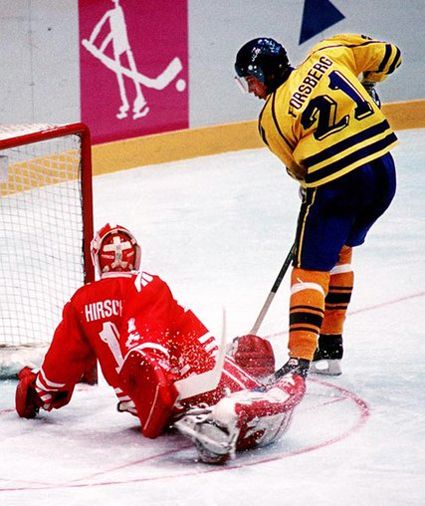
The 13th shooter would see the 20-year-old Forsberg take his second attempt with the weight of the world on his shoulders, and using a move that would be immortalized on a Swedish postage stamp, faked to his forehand (having gone to the right on his first shootout goal) before nearly skating past the net on his left, drawing Hirsch to the side of the crease, as Forsberg fully extended his right arm and gently tucked the puck into the center of the net on his backhand around the outstretched Hirsch.
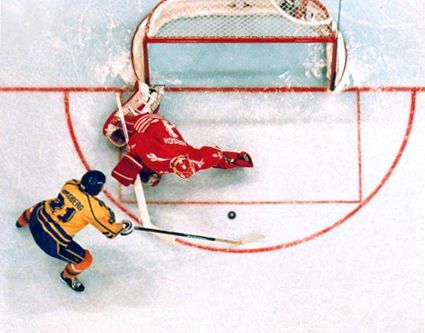

Forsberg's famous Golden Goal

It was a shot Forsberg had recalled seeing when he was 15 while watching Kent Nilsson on a breakaway during the 1989 World Championships against American John Vanbiesbrouck.

"I liked it right away," Forsberg recalled. "The goalie ended up in the stands."

 photo 1994ForsbergGoldenGoal.jpg
Another angle of Forsberg's spectacular shootout goal

When Salo laid himself out in the crease and blocked Kariya's final attempt, Sweden had captured the gold medal.

 photo KariyaSalo1994Olympicshootout.jpg
Salo stops Karyia to seal the gold medal

With the gold medal victory, Loob, Naslund and Tomas Jonsson became the first players to win the World Championship, the Stanley Cup and the Gold Medal, an accomplishment that would become known as the Triple Gold Club. Forsberg would eventually join the exclusive club in 1996, which currently consists of just 22 players in the history of the sport.
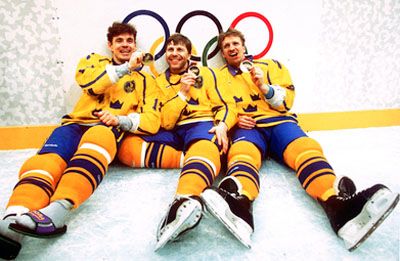

The inaugural class of the Triple Gold Club

Today's featured jersey is a 1994 Sweden Peter Forsberg Jersey. These jerseys are very similar to the Tackla branded jerseys used in 1992, including the same distinctive block numbers with the 3-D geometric "drop shadow" effect for the numbers, with the obvious addition of the overly large Reebok logos on the shoulders and additional piping that runs down the arms. These jerseys are a medium weight mesh and all the graphics dye-sublimated.

For collectors  the 1994 Reebok jerseys are much scarcer than the Tackla jerseys from 1988 to 1993, which can be found as game worn, some replicas with names and blank jerseys, which were apparently made available for purchase by fans, while the Reebok jerseys appear to never have been made for retail sale, as we have only seen game worn examples on the market and in photos, generally with sponsor patches from the World Championships, as evidenced by our inability to find standard collector photos of the front and back of any 1994 Reebok Sweden Olympic jersey to illustrate today's post.

Sweden 1994 jersey photo Sweden1994jersey.jpg


Here is the complete Gold Medal Final shootout, in two parts.


Here is Nilsson's original goal which inspired the young Forsberg in 1989.

Friday, September 18, 2015

2004-05 MODO Hockey Peter Forsberg Jersey

The fourth jersey of "The Lockout Collection" sees us travel up to Sweden for our next stop.

As we have seen, while many NHL players followed the money and found employment in Russia during the NHL lockout, many players chose other countries, with Sweden being the second most popular, especially among native Swedes, naturally.

One such player was Peter Forsberg, who returned to his hometown of Örksköldsvik to play for MODO Hockey, the club for whom he made his professional debut in 1989-90.

Forsberg Modo, Forsberg Modo

Forsberg skated for MODO for six seasons, which included winning both the Golden Puck as Swedish Player of the Year and the Golden Helmet for Swedish Elitserien Most Valuable Player in 1993 and repeated the feat of winning both again 1994 before becoming a member of the NHL's Quebec Nordiques for one season prior to their relocation to Denver, Colorado where they became the Avalanche.

Forsberg Nordiques, Forsberg Nordiques

Injuries began to take their toll on Forsberg, who had his spleen removed during the 2001 NHL playoffs, causing him to miss not only the remainder of the playoffs, but factored into his decision to take the following regular season off before returning for the 2002 playoffs. He was also limited to 39 games in 2003-04 following his MVP season the year prior, so it should not have been a surprise when injuries affected his return to MODO as well.

Coached by his father Kent Forsberg and teamed with twins Daniel and Henrik Sedin as well as Markus Näslund, who all hail from Örksköldsvik, Forsberg scored 39 points, on 13 goals and 26 assists, but he was limited to 33 games of the 50 game Swedish schedule due to a broken bone in his hand and and surgery following a dislocated wrist.

Forsberg Modo 04-05, Forsberg Modo 04-05

MODO was eliminated in the first round of the playoffs by Färjestads BK in six games as Forsberg was only able to appear in just one game of the series.

After a return to the NHL with the Philadelphia Flyers for a season and a half and a 17 game stint with the Nashville Predators, Forsberg had surgery on his foot, which would would keep him out of all but 16 Colorado Avalanche games in 2007-08, which included seven playoff games.

The 2008-09 season would see him attempt to play once more, but only make it into three games with MODO, where he would score a goal and record two assists. He managed 23 games with MODO in 2009-10, scoring 30 points, and four games for Sweden in the 2010 Olympics, all of which gave him enough encouragement to return to the NHL with Colorado, but it was an ill-fated attempt which ended after only two games in 2010-11 bringing and end to his career once and for all.

Forsberg Modo 09-10, Forsberg Modo 09-10

Today's featured jersey is a 2004-05 MODO Hockey Peter Forsberg jersey as worn during his time in Sweden during the NHL lockout. This jersey is typical of many European jerseys in that it features no less than 19 sponsor logos, which sometimes make it hard to recognize which word is actually the player's name, especially lesser known ones, thanks in part to the inconsistency in Europe regarding the players names sometimes being positioned below the back numbers and sometimes in the more traditional location above the numbers.

The jersey is all dye-sublimated except for the name and numbers, which are sewn on twill material, including the drop-shadow for the numbers.

Sweden Modo 2004-05 jersey photo Sweden Modo 2004-05 F.jpg
Sweden Modo 2004-05 jersey photo Sweden Modo 2004-05 B.jpg

Here is a Swedish TV report on Forsberg playing for Modo in the 2004-05 season, where he can be seen wearing the home version of today's featured jersey.


Based on the change in jersey style, we believe this to be the one goal he scored in his attempted return to the ice in 2008-09 for MODO against Skellefteå.


This final highlight is from the 1993-94 playoffs, where Forsberg scores in overtime to give MODO the victory.


Monday, November 17, 2014

The 2014 Hockey Hall of Fame Induction Ceremony

Tonight is the 2014 Hockey Hall of Fame Induction Ceremony for this year's inductees, Rob Blake, Peter Forsberg, Dominik Hasek and Mike Modano, and outstanding class of excellent players. Also going into the hall tonight will be the long overdue inclusion of head coach Pat Burns and referee Bill McCreary.

Here then is our tribute to the Hockey Hall of Fame Class of 2014.

Colorad Avalanche 2001-02 jersey photo ColoradAvalanche2001-02Fjersey.jpg
Colorad Avalanche 2001-02 jersey photo ColoradAvalanche2001-02Bjersey.jpg
2001-02 Colorado Avalanche Rob Blake jersey
≈
2001 Stanley Cup Champion
1998 Norris Trophy
≈
1994 and 1997 World Championship Gold Medal
2002 Olympic Gold Medal
Member of the Triple Gold Club
≈
Six time NHL All-Star

Colorado Avalanche 1996-97 jersey photo ColoradoAvalanche1996-97Fjersey.jpg
Colorado Avalanche 1996-97 jersey photo ColoradoAvalanche1996-97Bjersey.jpg
1996-97 Colorado Avalanche Peter Forsberg Jersey
≈
1996 and 2001 Stanley Cup Champion
1995 Calder Trophy
2003 Art Ross Trophy
2003 Hart Trophy
≈
1992 and 1998 World Championship Gold Medal
1994 and 2006 Olympic Gold Medal
Member of the Triple Gold Club
≈
Seven time NHL All-Star
≈
Holds the IIHF record for Most Points in a World Junior Tournament with 31
Holds the IIHF record for Most Points in a World Junior Game with 10

Czech Republic 1998 H jersey photo CzechRepublic1998HF.jpg
Czech Republic 1998 H jersey photo CzechRepublic1998HB.jpg
1998 Czech Republic National Team Dominik Hasek Jersey
≈
2002 and 2008 Stanley Cup Champion
1994, 2001 and 2008 Jennings Trophy
1997 and 1998 Pearson Award
1994, 1995, 1997, 1998, 1999 and 2001 Vezina Trophy
≈
1998 Olympic Gold Medal
1998 Olympics Best Goaltender
1983 World Championship Silver Medal
1987 and 1989 World Championship Best Goaltender
1982, 1983 and 1985 World Junior Silver Medal
1983 World Junior Best Goaltender
≈
1987, 1989, 1990, 1997 and 1998 Czechoslovak First League MVP
1986, 1987, 1988, 1989 and 1990 Czechoslovak First League Best Goaltender
≈
Holds NHL records for Highest Career Save Percentage and Most Games Played by a European Born Goaltender and Most Saves in a Shutout with 70
≈
Holds Buffalo Sabres records for Most All-Time Games, Most Wins, Most Shutouts and Lowest Career Goals against Average, Most Shutouts in a Single Season, Lowest Single Season Goals Against Average

1998-99 Dallas Stars jersey photo 1998-99DallasStarsFjersey-1.png
1998-99 Dallas Stars jersey photo 1998-99DallasStarsBjersey-1.png
1998-99 Dallas Stars Mike Modano Jersey
≈
1999 Stanley Cup Champion
≈
1996 World Cup of Hockey Champion
2002 Olympic Silver Medal
Seven time NHL All-Star
≈
Holds NHL records for Most Career Goals by a American, Most Career Points
by an American and Most Career Playoff Points by an American
≈
Holds Dallas Stars franchise records for Most Career Regular Games Played, Most Career Playoff Games, Most Career Regular Season Assists, Most Career Playoff Assists, Most Career Regular Season Points and Most Career Playoff
Points

Pat Burns coached 1,019 games with the Montreal Canadiens, Toronto Maple Leafs, Boston Bruins and New Jersey Devils, winning the Jack Adams Award as Coach of the Year with Montreal, Toronto and Boston, each in his first year with those clubs and the only one to ever win it three times. Burns then won the Stanley Cup with New Jersey in 2003.

Bill McCreary was an NHL referee from 1984 through 2011, worked 1,737 regular season games, 297 playoff games, the 1994 NHL All-Star Game, Wayne Gretzky's final game, 15 Stanley Cup Finals, the 2005 Spengler Cup in Switzerland, the 1991 Canada Cup and the 1998, 2002 and 2010 Olympics.

The 2014 Hockey Hall of Fame Induction Ceremony will be broadcast on TSN 2 in Canada and the NHL Network in the United States starting at 7:00 PM Eastern time tonight.

Thursday, February 27, 2014

1994 Sweden National Team Peter Forsberg Jersey

The 1994 Winter Olympic hockey tournament, held in Lillehammer, Norway will always be remembered for one defining moment, Peter Forsberg's memorable gold medal winning shoot out goal.

1994 Lillehammer Olympics photo 1994_Lillehammer_Winter_Olympics_logo.png

Forsberg had debuted with the Modo Hockey junior team in his hometown of Örnsköldsvik in 1989-90 and made one appearance with the senior club later that same season. The following year he split time between the junior club and the senior club, getting into 23 games and scoring his first goal in the Elitserien. He was also drafted 6th overall by the Philadelphia Flyers during the NHL Entry Draft that year, although he would remain in Sweden for an additional three seasons, in part to play in the 1994 Olympics, at a time when he felt it would be his only Olympic opportunity prior to the NHL suspending it's season to allow it's players to participate in the games, something that wouldn't begin until 1998.


Forsberg Modo photo ForsbergModo.jpg
Forsberg while with Modo

Forsberg moved up to the senior club full time the following year, scoring 28 points in 39 games. As his experience and confidence grew, so did his point totals, and in 1992-93, Forsberg averaged more than a point per game for the first time, with 47 points in 39 games and was named as both the the MVP of the Elitserien as well as the Swedish hockey Player of the Year.

He would win both awards again the next season after 44 points in 39 games.

Internationally, Forsberg first appeared for Sweden in the 1991 European Junior Championships, followed by both the World Junior Championship and World Championship in both 1992 and 1993.


Forsberg Sweden WJC photo PeterForsbergWJC1.jpg
Forsberg at the 1992 World Juniors

Already considered by that point to be the best player in the World not in the NHL, Forsberg would make himself known to hockey fans all across North America with the events on this day in the 1994 Olympic gold medal final.

Sweden was placed in Group B for the Preliminary Round with Canada, France, Italy, Slovakia and the United States and tied in their first game 4-4 with Slovakia, making their first ever Olympic appearance. They easily handled Italy 4-1 and France 7-1 before defeating the United States 6-4 before losing to Canada 3-2 to finish their group in third place behind Slovakia and Canada.

As a result of their third place finish, they drew Germany (second place in Group A) in the first round of the Medal Round playoffs and easily eliminated them 3-0. Next up was the surprisingly down Russians, who were feeling the effects of the breakup of the Soviet Union in 1991 and the resulting turmoil in their hockey program. Having lost to the Finns 5-0 and the Germans 4-2 in Group A, Sweden ended their tournament 4-3 to advance to the Gold Medal Final against Canada, who knocked out the Czech Republic 3-2 and Finland 5-3 for their shot at gold.

The scoring was opened by Sweden at 6:10 of the first period on the power play on a goal by Kenny Jonsson from Hakan Loob and Peter Forsberg. There was no additional scoring until Canada got on the board with a goal by Paul Kariya from Chris Kontos and Greg Johnson at 9:08 of the third.

Canada went up by one when defesman Derek Mayer scored an unassisted goal at 11:43. Canada was able to keep their lead until Brad Werenka was called for a penalty at 17:50 and Sweden made them pay the price when Magnus Svensson scored on a shot from the point with assists from Forsberg and Jonsson at 18:11 on the resulting power play.

The game would finish deadlocked at 2-2 and the following ten minute overtime failed to settle the score, moving the game to a deciding shootout.

Petr Nedved opened the shootout with a goal for Canada, while Loob missed for Sweden. Kariya then converted for Canada and Svensson matched that with a goal of his own to keep Sweden within one.

Dwayne Norris was stopped by Swedish goaltender Tommy Salo and Mats Nasulnd was kept off the scoreboard by Canadian Corey Hirsch. Unlike today's three round shootouts, this one was scheduled to go five rounds.

Greg Parks missed for Canada and Forsberg evened the shootout at 2-2 for Sweden. After Johnson missed for Canada, Roger Hansson failed to win it for Sweden and the shootout moved into sudden death.

With players now allowed to shoot again, Svensson missed for Sweden before Nedved had Salo beaten but put the puck wide during his chance to win gold.

The 13th shooter would see the 20-year-old Forsberg take his second attempt with the weight of the world on his shoulders, and using a move that would be immortalized on a Swedish postage stamp, faked to his forehand (having gone to the right on his first shootout goal) before nearly skating past the net on his left, drawing Hirsch to the side of the crease, as Forsberg fully extended his right arm and gently tucked the puck into the center of the net on his backhand around the outstretched Hirsch.


Forsberg's famous Golden Goal

It was a shot Forsberg had recalled seeing when he was 15 while watching Kent Nilsson on a breakaway during the 1989 World Championships against American John Vanbiesbrouck.

"I liked it right away," Forsberg recalled. "The goalie ended up in the stands."

 photo 1994ForsbergGoldenGoal.jpg
Another angle of Forsberg's spectacular shootout goal

When Salo laid himself out in the crease and blocked Kariya's final attempt, Sweden had captured the gold medal.

 photo KariyaSalo1994Olympicshootout.jpg
Salo stops Karyia to seal the gold medal

With the gold medal victory, Loob, Naslund and Tomas Jonsson became the first players to win the World Championship, the Stanley Cup and the Gold Medal, an accomplishment that would become known as the Triple Gold Club. Forsberg would eventually join the exclusive club in 1996, which currently consists of just 22 players in the history of the sport.


The inaugural class of the Triple Gold Club

Today's featured jersey is a 1994 Sweden Peter Forsberg Jersey. These jerseys are very similar to the Tackla branded jerseys used in 1992, including the same distinctive block numbers with the 3-D geometric "drop shadow" effect for the numbers, with the obvious addition of the overly large Reebok logos on the shoulders and additional piping that runs down the arms. These jerseys are a medium weight mesh and all the graphics dye-sublimated.

For collectors  the 1994 Reebok jerseys are much scarcer than the Tackla jerseys from 1988 to 1993, which can be found as game worn, some replicas with names and blank jerseys, which were apparently made available for purchase by fans, while the Reebok jerseys appear to never have been made for retail sale, as we have only seen game worn examples on the market and in photos, generally with sponsor patches from the World Championships, as evidenced by our inability to find standard collector photos of the front and back of any 1994 Reebok Sweden Olympic jersey to illustrate today's post.

Sweden 1994 jersey photo Sweden1994jersey.jpg


Here is the complete Gold Medal Final shootout, in two parts.


Here is Nilsson's original goal which inspired the young Forsberg in 1989.

Sunday, May 19, 2013

The 2013 IIHF Hall of Fame Induction Class

Today is the induction ceremony for the 2013 IIHF Hall of Fame class, and it's a remarkable collection of talent with a long list of accomplishments.

Peter Forsberg's international career began in fine style at the 1991 European Junior Championships where he averaged just under 3 points per game with 5 goals and 12 assists for 17 points in 6 games to lead the tournament in scoring.

1992 saw him earn his first medal with a silver at the 1992 World Juniors (11 points in 7 games) before making his senior level debut later that spring at the World Championships where he contributed 4 goals and 6 points in 8 games to earn his first gold medal.

He repeated the double of playing in both the World Juniors and the World Championships in 1993, earning a silver medal on both occasions. In just 7 games of the World Juniors, Forsberg scored a remarkable 7 goals and 31 points to lead the tournament in scoring by a full 7 points, which included setting a single game record with 10 points in a dominating win over Japan.

Forsberg made his Olympic debut in 1994 in Lillehammer, Norway, where his gold medal winning goal in the shootout over Canada earned him immortality when it was commemorated on a Swedish postage stamp. He totaled 8 points in 8 games for the tournament.

Forsberg Stamp photo ForsbergStamp-1.jpg
The Swedish postage stamp commemorating
Forsberg's goal at the 1994 Olympics

When Forsberg won the Stanley Cup with the Colorado Avalanche in 1996, he became only the sixth member of the Triple Gold Club in recognition of his gold medals at both the World Championships and the Olympics as well as winning a Stanley Cup.

The first bronze medal of his career arrived at the 1996 World Cup of Hockey and his second Olympic opportunity came in 1998 when the stars of the NHL were able to participate for the first time in Nagano, Japan.

1998 saw Forsberg return to the World Championships for the first time in five years where he was again a key part of Sweden claiming the gold medal thanks to his 11 points in 7 games.

Two more silver medals followed in 2003 and 2004 at the World Championships as well as a second appearance at the World Cup of Hockey in the fall of 2004.

Forsberg would win his second Olympic gold medal at the 2006 Games in Torino, Italy where he averaged a point per game with 6 assists in 6 games.

Forsberg gold 2006 photo Forsberggold2006.jpg
Forsberg's second Olympic gold arrived in 2006

His international career would conclude in 2010 with his fourth Olympic participation of his career.

In total, Forsberg would score 35 goals and 81 assists for 116 points in 83 games while winning one bronze, five silver and four gold medals, two at the World Championships and two at the Olympics.

Today's first featured jersey is a 1996 Sweden National Team Peter Forsberg jersey from the 1996 World Cup of Hockey. Sweden would win the European pool with a 3-0 record, defeating Finland, Germany and the Czech Republic, before losing 3-2 to Canada in two overtimes in the semi-finals.

This jersey features the large 4" diameter 1996 World Cup of Hockey patch worn by all the Bauer supplied teams in the tournament, which also included Canada and the Czech Republic. The remaining teams, the United States, Russia, Slovakia, Finland and Germany all wore Nike jerseys which sported the same patch, only in a 3" size.

Sweden 1996 WCOH jersey photo Sweden1996WCOH21RF.jpg
Sweden 1996 WCOH jersey photo Sweden1996WCOH21RB.jpg

Fellow Swede Mats Sundin participated at the 1989 and 1990 European Junior Championships, the 1990 World Juniors before moving up to the senior level in 1991 with a gold medal at the World Championships before then being a member of the 1991 Canada Cup team.

His second gold medal came in the 1992 World Championships and was followed by a bronze at the 1994 Worlds where he set a personal best with 14 points in 8 games. He participated at the 1996 World Cup of Hockey before making his Olympic debut at the 1998 Games in Japan.

His third gold medal came at the 1998 World Championships following another strong performance with 11 points in 10 games.

2001 would see a second bronze medal added to his collection at the 2001 World Championships before a second Olympics in 2002 at Salt Lake City. The first silver of Sundin's career came in 2003 at the World Championships which was followed by his second World Cup of Hockey in 2004.

Sundin's international career came to a conclusion in the finest manner possible when he captained Sweden to a gold medal at the 2006 Olympics in Italy while contributing 3 goals and 8 points in 8 games.

Sundin Forsberg 2006 gold photo ForsbergSundingold2006.jpg
Sundin and Forsberg celebrating their gold medals in 2006

Sundin would score 47 goals and 100 points in 81 games during his international career, winning two bronze, one silver and four gold medals.

Today's second featured jersey is a 2006 Sweden National Team Mat Sundin jersey. 2006 was the year that Nike introduced the brand new Nike Swift jerseys, first seen at the World Junior Tournament on the USA and Canada. Each of the 12 participating countries in the 2006 Olympics wore the new Swift designs, except for Switzerland and the eventual gold medal winners Sweden, who were somehow able to overcome the truck-like weight and aerodynamics of the old style jerseys when compared to the new technologically advanced jerseys the rest of the field was outfitted with.

Two unique additions to the 2006 Swedish Olympic jerseys were an attempt to create a "lace up" collar style, which was simply a few slits cut into the existing yoke collar and threading a white elastic threat through it, which did not actually have to be tied, as it was a single continuous piece.

The second unique feature of the jerseys at the 2006 Olympics was the Swedish Olympic logo added to the right shoulders.

Lundqvist Sweden 2006
The Swedish Olympic logo added to their jerseys at the 2006 games

Given the opportunity, Sweden always opts for their traditional bright yellow jerseys with blue crowns, stripes, names and numbers, but for this contest they captured gold in their road blue sweaters.

Sweden 2006 jersey photo Sweden2006OLYF.jpg
Sweden 2006 jersey photo Sweden2006OLYB.jpg
Sweden 2006 jersey photo Sweden2006OLYP2.jpg

Defenseman Teppo Numminen of Finland's lengthy career began at the 1986 European Junior Championships before he joined the senior team at the 1987 World Championships and later the 1987 Canada Cup. Still eligible, Numminen then played in the 1988 World Junior Championships (scoring 5 goals and 7 points in 7 games on his way to a bronze medal) which was quickly followed by his Olympic debut at the 1988 Games in Calgary where he won a silver medal.

He would return to the international stage in 1991 at the World Championships followed later that year with his second Canada Cup tournament.

The 1996 World Championships began a series of appearances which included the 1996 World Cup of Hockey, the 1997 World Championships and the 1998 Olympics, earning a bronze medal.

Numminen would return to the Olympics in 2002 in Salt Lake City, skate for Finland at the 2004 World Cup of Hockey and close out his lengthy international career in 2006 at the Olympic Games in Italy where he was rewarded with a silver medal.

Today's third featured jersey is a 1996 Finland National Team Teppo Numminen jersey. This attractive "waving flag" style jersey was worn by Numminen at the 1996 World Cup of Hockey, and being a Nike jersey, had the smaller 3" size tournament logo patch on the upper left arm.

Finland 1996 jersey photo Finland1996Fjersey.jpg
Finland 1996 jersey photo Finland1996Bjersey.jpg
photo courtesy of Classic Auctions

While Paul Henderson's international career is not as lengthy as those of his fellow inductees, his performance during the final games of the 1972 Summit Series were quite memorable and concluded with one of hockey's most memorable goals, his late game winner against the Soviet Union in Game 8, an iconic moment in the history of international hockey. He had scored goals in Game 1 and Game 5, but was also knocked unconscious later in that same game. He returned later in Game 5 and scored the game winning goal in Game 6, a 3-2 win for Canada.

Canada won Game 7 4-3, with Henderson again scoring the game winning goal while being tripped at the time. Late in the final Game 8, Henderson came off the bench, but missed a pass and was tripped and fell behind the goal. He returned to his feet in time to receive a pass from Phil Esposito and fire a shot, which was blocked. The rebound came back to him, which he fired into the goal past Vladislav Tretiak with just 34 seconds to play to give him his third consecutive game winning goal and the series win, making him an instant hero in Canada.

 photo Hendersonscores.jpg
"Henderson scores for Canada!"

Henderson left the NHL for the World Hockey Association in 1974, which made him eligible for the follow up 1974 Summit Series, his only other appearance for Team Canada.

Today's fourth featured jersey is a 1972 Team Canada Paul Henderson jersey as worn during the four 1972 Summit Series games in Moscow.

This jersey came up for public sale for the first time ever at auction in June of 2010 on ClassicAuctions.net.

The concern and publicity over the possible threat to "the most significant artifact in the history of the game of hockey" due to it falling into the the wrong hands and being cut to pieces for inclusion on trading cards eventually saw the jersey sell for a record shattering $1,275,707, far outstripping the reported $250,000 paid for a Wayne Gretzky game worn jersey and the $191,000 for a Bobby Orr rookie jersey and easily withstanding a later challenge from Mike Eruzione's 1980 United States "Miracle on Ice" jersey, which reached $657,250.

The winning bidder, Canadian real estate developer Mitchell Goldhar, not only preserved the jersey from possible destruction, but returned it to Canada from where it had been located in the United States, but took the iconic Canadian sweater on a tour of the country in an effort to share it with the citizens of the nation where everyone remembers where they were when Henderson score his dramatic goal. One of the highlights of the jerseys return to Canada was having Henderson don the jersey once again.

Canada 1972 Henderson jersey
photo courtesy of Classic Auctions

Danielle Goyette of Canada played in three Olympics, winning silver in 1998 and gold medals in 2002 and 2006, and nine World Championships, winning gold eight times (1992, 1994, 1997, 1999, 2000, 2001, 2004 and 2007) and silver in 2005.

Goyette Gold 2006 photo goyettegold2006.jpg
Goyette with her second Olympic gold in 2006

She averaged a point and a half per game and led all players in goals at the 1998 Olympics and was the scoring leader at the 1992 World Championships and the 2002 Olympics. Additionally, she was honored by being Canada's flag bearer at the 2006 Olympics in Italy.

Goyette Flag Bearer photo danielle_goyette_flag.jpg
Goyette was Canada's flag bearer in 2006

Today's fifth featured jersey is a 2002 Canada National Team Danielle Goyette jersey. This jersey was worn in the games leading up to the 2002 Olympics during which Goyette won her first Olympic gold medal.

Note the back numbers crossing into the waist stripes, an indication of the shorter length of the women's jerseys.

Canada 2002 womens jersey photo Canada2002womensjersey.jpg
photo courtesy of Classic Auctions

In addition to those players, builder Jan-Ake Edvinsson, broadcaster Gord Miller and the 1954 Soviet Union National Team will also be honored.

1954 Soviet Union team photo 1954SovietUnionteam.jpg
The 1954 Soviet Union National Team

Wednesday, February 27, 2013

1994 Sweden National Team Peter Forsberg Jersey

The 1994 Winter Olympic hockey tournament, held in Lillehammer, Norway will always be remembered for one defining moment, Peter Forsberg's memorable gold medal winning shoot out goal.

Forsberg had debuted with the Modo Hockey junior team in his hometown of Örnsköldsvik in 1989-90 and made one appearance with the senior club later that same season. The following year he split time between the junior club and the senior club, getting into 23 games and scoring his first goal in the Elitserien. He was also drafted 6th overall by the Philadelphia Flyers during the NHL Entry Draft that year, although he would remain in Sweden for an additional three seasons, in part to play in the 1994 Olympics, at a time when he felt it would be his only Olympic opportunity prior to the NHL suspending it's season to allow it's players to participate in the games, something that wouldn't begin until 1998.

Forsberg moved up to the senior club full time the following year, scoring 28 points in 39 games. As his experience and confidence grew, so did his point totals, and in 1992-93, Forsberg averaged more than a point per game for the first time, with 47 points in 39 games and was named as both the the MVP of the Elitserien as well as the Swedish hockey Player of the Year.

He would win both awards again the next season after 44 points in 39 games.

Internationally, Forsberg first appeared for Sweden in the 1991 European Junior Championships, followed by both the World Junior Championship and World Championship in both 1992 and 1993.

Already considered by that point to be the best player in the World not in the NHL, Forsberg would make himself known to hockey fans all across North America with the events of this day in the 1994 Olympic Gold Medal Final.

Sweden was placed in Group B for the Preliminary Round with Canada, France, Italy, Slovakia and the United States and tied in their first game 4-4 with Slovakia, making their first ever Olympic appearance. They easily handled Italy 4-1 and France 7-1 before defeating the United States 6-4 before losing to Canada 3-2 to finish their group in third place behind Slovakia and Canada.

As a result of their third place finish, they drew Germany (second place in Group A) in the first round of the Medal Round playoffs and easily eliminated them 3-0. Next up was the surprisingly down Russians, who were feeling the effects of the breakup of the Soviet Union in 1991 and the resulting turmoil in their hockey program. Having lost to the Finns 5-0 and the Germans 4-2 in Group A, Sweden ended their tournament 4-3 to advance to the Gold Medal Final against Canada, who knocked out the Czech Republic 3-2 and Finland 5-3 for their shot at gold.

The scoring was opened by Sweden at 6:10 of the first period on the power play on a goal by Kenny Jonsson from Hakan Loob and Peter Forsberg. There was no additional scoring until Canada got on the board with a goal by Paul Kariya from Chris Kontos and Greg Johnson at 9:08 of the third.

Canada went up by one when defesman Derek Mayer scored an unassisted goal at 11:43. Canada was able to keep their lead until Brad Werenka was called for a penalty at 17:50 and Sweden made them pay the price when Magnus Svensson scored on a shot from the point with assists from Forsberg and Jonsson at 18:11 on the resulting power play.

The game would finish deadlocked at 2-2 and the following ten minute overtime failed to settle the score, moving the game to a deciding shootout.

Petr Nedved opened the shootout with a goal for Canada, while Loob missed for Sweden. Kariya then converted for Canada and Svensson matched that with a goal of his own to keep Sweden within one.

Dwayne Norris was stopped by Swedish goaltender Tommy Salo and Mats Nasulnd was kept off the scoreboard by Canadian Corey Hirsch. Unlike today's three round shootouts, this one was scheduled to go five rounds.

Greg Parks missed for Canada and Forsberg evened the shootout at 2-2 for Sweden. After Johnson missed for Canada, Roger Hansson failed to win it for Sweden and the shootout moved into sudden death.

With players now allowed to shoot again, Svensson missed for Sweden before Nedved had Salo beaten but put the puck wide during his chance to win gold.

The 13th shooter would see the 20-year-old Forsberg take his second attempt with the weight of the world on his shoulders, and using a move that would be immortalized on a Swedish postage stamp, faked to his forehand (having gone to the right on his first shootout goal) before nearly skating past the net on his left, drawing Hirsch to the side of the crease, as Forsberg fully extended his right arm and gently tucked the puck into the center of the net on his backhand around the outstretched Hirsch.


It was a shot Forsberg had recalled seeing when he was 15 while watching Kent Nilsson on a breakaway during the 1989 World Championships against American John Vanbiesbrouck.

"I liked it right away," Forsberg recalled. "The goalie ended up in the stands."

When Salo laid himself out in the crease and blocked Kariya's final attempt, Sweden had captured the gold medal.

With the gold medal victory, Loob, Naslund and Tomas Jonsson became the first players to win the World Championship, the Stanley Cup and the Gold Medal, an accomplishment that would become known as the Triple Gold Club. Forsberg would eventually join the exclusive club in 1996, which currently consists of just 22 players in the history of the sport.


Today's featured jersey is a 1994 Sweden Peter Forsberg Jersey. These jerseys are very similar to the Tackla branded jerseys used in 1992, including the same distinctive block numbers with the 3-D geometric "drop shadow" effect for the numbers, with the obvious addition of the overly large Reebok logos on the shoulders and additional piping that runs down the arms. These jerseys are a medium weight mesh and all the graphics dye-sublimated.


Here is the complete Gold Medal Final shootout, in two parts.


Here is Nilsson's original goal which inspired the young Forsberg in 1989.


hit counter for blogger