History of Jersey 83-93 Banner sm photo History of Jersey 83-93 Banner sm.jpg
Showing posts with label NHA. Show all posts

Tuesday, December 19, 2017

The 100th Anniversary of the NHL

It was on this date one hundred years ago in 1917 that the first games of the National Hockey League were played. The league was formed for one basic reason - for the owners to rid themselves of fellow team owner Eddie Livingstone!

Livingstone was the owner of the Toronto Shamrocks of the National Hockey Association (NHA) and had a contentious relationship with his fellow owners, primarily Sam Lichtenhein of the Montreal Wanderers, with whom he often butted heads with. At one point, Lichtenhein even offered Livingstone $3,000 to abandon his team and walk away, but the cheeky Livingstone countered with a $5,000 offer for Lichtenhein to do the same!

Prior to the 1915-16 season, Livingstone purchased the Toronto Blueshirts, giving him both Toronto NHA franchises - and an unwelcome two votes in league matters. When Frank Patrick and Lester Patrick, owners of the Pacific Coast Hockey League (PCHA) Seattle Metropolitans raided the Blueshirts roster, Livingstone transferred Shamrocks players to the Blueshirts. The league seized the Shamrocks franchise from Livingstone, as had been demanded by the league only a week earlier, not wanting one owner with whom they did not get along with having two votes, when there was now nothing left for Livingstone to sell since the club had no players. It also angered the other owners that they were now a five team league, forcing one club to be idle each week and that road trips to Toronto would be for one game instead of the more economical two, as in the past.

In 1916-17, the 228th Battalion of the Canadian Army formed a team in the six team NHA, taking the place of the Shamrocks. Unfortunately, the 228th received their orders to head overseas to join the fighting in World War I and had to withdraw from the league during the season. This gave the other four owners of the Montreal Canadiens, Montreal Wanderers, Quebec Bulldogs and Ottawa Senators the opening they needed, and they held a meeting without Livingstone and voted to suspend his remaining Blueshirts franchise with the excuse of wanting to keep the league with an even number of teams.

 photo 1917-18 228th Battalion Team.jpg
A rare shot of the 228th Battalion Hockey Team

Livingstone field suit against the league as a result. The Blueshirts home rink, the Arena Gardens were then given three weeks to separate itself from Livingstone by the NHA or the other owners would operate without a club in Toronto and thus the arena would lose its tenant. The feisty Livingstone of course refused to sell his club, and therefore, at their annual meeting in November, the NHA announced it was suspending league operations due to the difficulty of running a five team league and also blaming player shortages due to World War I.

 photo Mutual_Street_Arena_interior.jpg
The Blueshirts home rink, the Arena Gardens

A week later, all of the owners, minus Livingstone naturally, announced they had formed a brand new league, the National Hockey League (NHL), which consisted of the Montreal Canadiens, the Montreal Wanderers, the Ottawa Senators and the Quebec Bulldogs. The new league also claimed to have retained the contracts of the suspended Toronto Blueshirts players!

With the Quebec Bulldogs suspending operations due to financial difficulties before the new NHL could even begin the 1917-18 season, the Arena Gardens were awarded a temporary NHL franchise, managed by Charlie Querrie, making the fledgling NHL a four team league once again. The league also assigned the Blueshirts players on a lease basis to the temporary Toronto franchise. To further complicate matters, many of the players had signed contracts with both Livingstone and the Arena.

The season, and the league, would kick off on this date in 1917 when Toronto lost to the host Montreal Wanderers in front of 700 fans by a score of 10-9. The Wanderers Dave Ritchie scored the first goal in NHL history, while Harry Hyland had four goals to record the league's first hat trick in short order. In the day's other game,  the Ottawa Senators lost to the Montreal Canadiens 7-4 in Ottawa.

The Canadiens would win the first half of the season to earn a spot in the postseason championship playoff, while the Wanderers opening night win would be their only one in the NHL, as they would cease operations following the fire that burned down their home, the Montreal Arena, on January 2nd after just six games of their schedule and the Wanderers at a dismal 1-5 record.
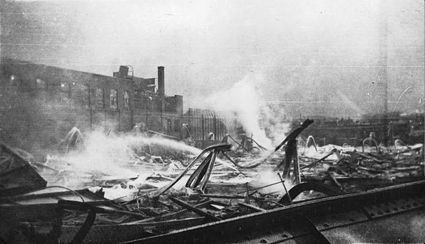
Team owner Lichtenhein had already made a request from the other clubs to loan the Wanderers better players to field a more competitive team in hopes of attracting more fans, but when the plan was rejected by his fellow owners following the fire, and with his club dealing with the loss of their home arena, Lichtenhein disbanded the club on January 4, ending the Wanderers fourteen year history.

Montreal Arena fire, Montreal Arena fire

The aftermath of the Montreal Arena fire

The Toronto club had no official nickname, but the "Blueshirts" were successful on the ice, winning the second half of the season schedule and earned the right to play Montreal for the championship. Toronto was led by Reg Noble, who scored 30 goals and 10 assists in 20 games for 40 points, third overall in the league behind the prolific Joe Malone of the Canadiens who scored a spectacular 44 goals in just 20 games as part of his league leading point total. Corbett Denneny and Harry Cameron also were standouts for Toronto, with 29 and 27 points respectively, for fifth and sixth in league scoring. Toronto's Harry "Hap" Holmes came in second to Georges Vezina of Montreal in the goaltending department with a goals against average of 4.80 in 16 games.

Toronto defeated the Canadiens for the league championship in a two games, total goals series 10-7, capturing the O'Brien Cup. Toronto then faced off against the Vancouver Millionaires of the PCHA and won the Stanley Cup by 3 games to 2, causing Livingstone to again head to court to file suit for the revenue earned by "his" championship squad of players.
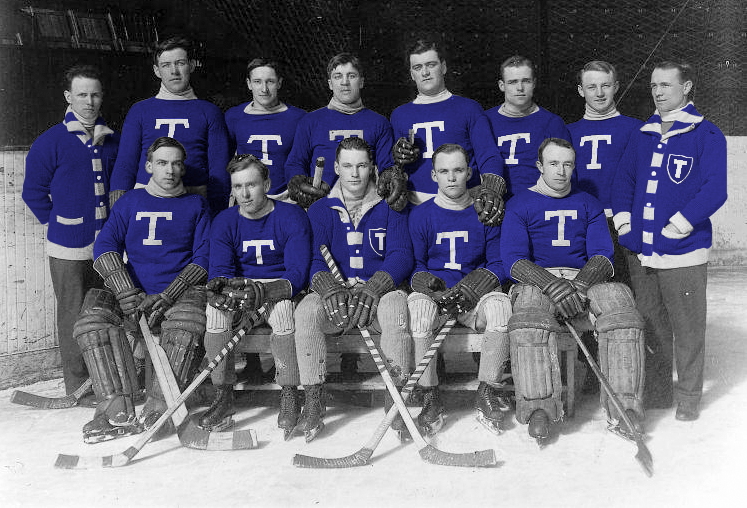

As a result of this lawsuit, the Arena Gardens formed a new company, the Toronto Arena Hockey Club Company, to own and run a hockey team separate from the Arena Gardens business in order to protect the Arena business from Livingstone's lawsuits. The NHL then awarded a "new" franchise to the Hockey Club Company. This club was officially named the Toronto Arenas and, not surprisingly, was stocked with the same players from the 1918 championship club. When his players were once again not returned to him for the 1918-19 season, Livingstone sued the Arena Gardens.

Once again, the players were uncertain who would prevail in the courts and covered their bases by signing contracts with both the Toronto Arena Hockey Club Company and Livingstone.

Livingstone did prevail in the courts sometimes, but not always. Two rulings in his favor of $20,000 and later $100,000 sent the Arena Gardens into bankruptcy. Despite the company's legal wranglings at the time, the arena would continue to operate for 77 years until closing in 1989.

When the Toronto Arenas did take to the ice in the 1918-19 season as Stanley Cup Champions, they did not play like it. Forced to sell most of their star players due to mounting legal bills, the Arenas record for the season was 5 wins and 13 losses, attendance was low and several players left the team. Finally, the team wrote to the league requesting that the season be ended when each of the three clubs had reached 18 games played and then officially withdrew from the league. This left only the Canadiens and Senators to play for the championship of the NHL and the right to meet the Pacific Coast Hockey Association champions for the Stanley Cup, which Montreal won 4 games to 1.

Meanwhile, Livingstone was busy was attempting to overthrow the NHA management, purchased the dormant Quebec Bulldogs franchise, and began an unsuccessful attempt to start a rival league, the Canadian Hockey Association and threatened to file an injunction to stop the NHL from operating. He also made unsuccessful attempts to start new leagues in 1920, 1924 and 1926, none of which ever played a single game.

Finally, the Toronto Arenas franchise was sold to the St. Patricks Hockey Club of Toronto, who ran the successful senior amateur St. Patricks team in the Ontario Hockey League, which included Arenas team manager Querrie in the four-man ownership group, in December of 1919.

The new owners renamed the club the Toronto St. Patricks and the $5,000 sale price was supposed to go to Livingstone to settle the purchase of his NHA club, for which he had once demanded $20,000 for after they had won the 1918 Stanley Cup. However, Livingstone never received the money, which many believe was kept by NHL president Frank Calder.

The Toronto St. Patricks were members of the NHL through the 1926-27 season, when Querrie, having been sued by none other than Livingstone, was forced to sell the St. Patricks. He reached an agreement to sell the club to Conn Smythe, who renamed the club the Toronto Maple Leafs and constructed Maple Leaf Gardens in 1931.

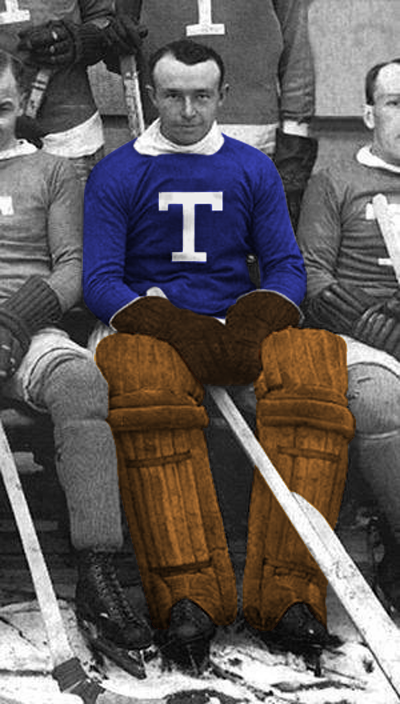
Today's featured jersey is a 1917-18 Toronto Blueshirts Hap Holmes jersey as worn during the inaugural season of the National Hockey League. Their jerseys would change for the second NHL season with the addition of white stripes around the arms and the word "Arenas" across the front, bisected by the large T crest from the previous season.

Holmes would win the Stanley Cup four different times, and with four different teams. He first joined Eddie Livingstone's Toronto Blueshirts of the NHA in 1912, winning the cup with them in 1914. He joined the Seattle Metropolitans of the PCHA in 1915 and won the cup with Seattle in 1917.

In his only season with the Toronto Blueshirts, he would win his third Stanley Cup before returning to Seattle the following season. After the Metropolitans folded four seasons later, Holmes would join the WCHL's Victoria Cougars in 1924 and go on to win his fourth Stanley Cup, the last cup won by a non-NHL team. After one more season in Victoria, the entire WCHL folded and the Victoria Cougars players were sold to the new Detroit NHL franchise, which took the name the Cougars as a tribute to the Victoria club before eventually becoming the Red Wings. Holmes would play his final two seasons in Detroit and conclude his career with 408 games played, 198 wins, 40 of which were shutouts, 192 losses and 14 ties.

Holmes was inducted into the Hockey Hall of Fame in 1972 and the American Hockey League award for the top goaltender each season is named the Hap Holmes Memorial Award.
Friday, November 11, 2016

Canadian Remembrance Day - 1916-17 Toronto 228th Battalion Hockey Team

Today is Remembrance Day in Canada, the date of "remembrance for the men and women who have served, and continue to serve our country during times of war, conflict and peace".

Poppy, Poppy

Official national ceremonies are held at the National War Memorial in Ottawa and presided over by the Governor General of Canada. ceremonies include two minutes of silence, a Royal Canadian Air Force flyover, a 21 gun salute and the singing of "In Flanders Fields", lyrics of which are famously posted in the dressing room of the Montreal Canadiens. Wreaths are the laid at the base of the memorial and, more recently, the public places poppies on the Tomb of the Unknown Soldier.

Remembrance Day Canada, Remembrance Day Canada

In the days of hockey's infancy, the Toronto 228th Battalion was a member of the National Hockey Association during the 1916-17 season. They played in the league as a replacement for the Toronto Shamrocks when the Pacific Coast Hockey League raided the Stanley Cup winning Toronto Blueshirts roster in 1915, leaving owner Eddie Livingstone with only enough players for just one of the two Toronto franchises he owned.

Eddie Livingstone photo Eddie Livingstone.jpg
The controversial Eddie Livingstone

When Livingstone transferred the roster of his Shamrocks to the Blueshirts, the Shamrocks franchise was reclaimed by the NHA, which was not fond in the least of Livingstone, as he was a thorn in their sides, especially in light of Livingstone having two votes on league matters, particularly when you consider that the NHA consisted of just six teams in 1914-15.

After a season of dormancy, the NHA awarded the recalled Shamrocks franchise to the 228th Battalion in order to bring the league back up to a more workable even number of six teams.

All the players of the 228th Battalion Hockey Club were troops of the 228th Battalion of the Canadian Expedition Forces of the Canadian Army, which were also known as the Northern Fusiliers.

228th Battallion Hockey Team, 228th Battallion Hockey Team
The 228th Battalion

In reality, several accomplished players had been brought in to bolster the roster of the hockey club when they "enlisted" in the Army during the time of World War I specifically to play hockey for the 228th, as the competitiveness and success of the team was seen as a morale booster and recruiting tool by the Canadian Army in order to keep enlistment levels up.

The club took to the ice for their first game on December 27th, 1916, a 10-7 win over the mighty Ottawa Senators. They fared even better their second time on the ice, a 10-4 defeat of the Montreal Wanderers. After the New Year, the 228th shut out Livingstone's Blueshirts 4-0 on January 3rd before outlasting the Quebec Bulldogs three days later by a 16-9 margin.

The Fusiliers were brought back down to Earth when they lost to the Montreal Canadiens 6-1 on the 10th before a hard fought 1-1 tie against the Senators. The Wanderers then turned the tables on the 228th when it was their turn to win their second meeting by the same 10-4 score as the first contest.

They got back into winning form on January 20th by defeating their Toronto rivals the Blueshirts once again, this time 8-6. They closed out the first half schedule with a 12-4 thrashing of the Bulldogs before dropping a 9-4 loss at the hand of the Canadiens.

The season's first half was concluded with the 228th Battalion in third place at 6-3-1, but leading the league in goals scored, averaging 7 a game and well clear of the Canadiens 58.

Mutual_Street_Arena_interior, Mutual_Street_Arena_interior
The home rink of the 228th, the Mutual Street Arena

Meanwhile in Europe, World War I had been in full swing since back in August of 1914, and as a Dominion of the British Empire, Canada was obliged to send troops into action.

The 228th then lost on January 31st by a score of 8-0 to the Senators, but were awarded a victory when Ottawa was found to have used an ineligible player.

Things began to unravel for the NHA when the 228th was called into service in early February. After a postponement of their game against the Wanderers on February 3rd and a loss to Toronto on February 7th in their final game, the unit was called to active duty.

February 12th's game scheduled against the Bulldogs was cancelled and the 228th was ordered to depart to join the fighting in Europe, taking away the league's highest scoring and most popular team, as well as exposing several of the players as simply hired guns when they showed up on the rosters of other NHA clubs in short order, having no interest in trench warfare and risking their lives overseas. The matter was not helped when future Hockey Hall of Famer Eddie Oatman publicly claimed the Army owed him $800 in salary as a hockey player after he was "discharged for special circumstances" from the army before the battalion left for Europe, freeing him up to play for the Canadiens.

The NHA unsuccessfully took the Canadian Army to court, seeking a $3,000 payment because of the Northern Fusiliers leaving the league. The other fallout of the departure of the 228th from the NHA would have a permanent effect on professional hockey, as the league would use the fact they were now down to an odd number of teams as a means to rid themselves of Livingstone.

The NHA first suspended the Blueshirts and continued with just four teams for the remainder of the season, including dispersing the Blueshirts players to the other teams and demanded Livingstone sell his franchise!

When Livingstone instead responded with his threatened lawsuit, the owners of the Canadiens, Wanderers, Senators and Bulldogs met secret in November of 1917 and suspended the NHA, only to reconvene a week later to form a brand new league without Livingstone, the National Hockey League.

Today's featured jersey is from the 1916-17 Toronto 228th Battalion Hockey Team.

Members of the 228th included Amos Arbour, a Stanley Cup champion in 1916 with the Canadiens, Roxy Beaudro, 1907 cup champion who scored the series clinching goal for the Kenora Thistles, Art Duncan, who was awarded the Military Cross for shooting down 11 enemy aircraft during the war, George McNamara, a Hockey Hall of Famer who won the Stanley Cup in 1914 with the Blueshirts, his brother Howard McNamara, who captained the 1916 Canadiens to the Stanley Cup, Gordon MeekingGeorge Podgers, who won Stanley Cups with Quebec in 1912 and 1916 with the Canadiens, as well as Oatman, who was also a member of the 1912 cup champion Bulldogs.

228th Battalion Hockey Team photo 228th Battalion Hockey Team in hockey gear.jpg
The 228th Battalion Hockey Team in an exceedingly rare photo of them
in their hockey equipment, as they played less than one full season

Lacking any color shots of the team in their hockey gear, we present this modified image from the sadly defunct Hockey Sweater Museum website of the sweater worn by the 228th Battalion, with our best estimate of its khaki coloring.

228th Battalion Kakhi large photo 228th Battalion Kakhi large.jpg

Today's video section honors Canadian Remembrance Day.


Sunday, November 11, 2012

1916-17 Toronto 228th Battalion Jersey

Today is Remembrance Day in Canada, the date of "remembrance for the men and women who have served, and continue to serve our country during times of war, conflict and peace".

Poppy, Poppy

Official national ceremonies are held at the National War Memorial in Ottawa and presided over by the Governor General of Canada. ceremonies include two minutes of silence, a Royal Canadian Air Force flyover, a 21 gun salute and the singing of "In Flanders Fields", lyrics of which are famously posted in the dressing room of the Montreal Canadiens. Wreaths are the laid at the base of the memorial and, more recently, the public places poppies on the Tomb of the Unknown Soldier.

Remembrance Day Canada, Remembrance Day Canada

In the days of hockey's infancy, the Toronto 228th Battalion was a member of the National Hockey Association during the 1916-17 season. They played in the league as a replacement for the Toronto Shamrocks when the Pacific Coast Hockey League raided the Stanley Cup winning Toronto Blueshirts roster in 1915, leaving owner Eddie Livingstone with only enough players for just one of the two Toronto franchises he owned.

When Livingstone transferred the roster of his Shamrocks to the Blueshirts, the Shamrocks franchise was reclaimed by the league, which was not fond in the least of Livingstone, who was a thorn in their sides, having two votes on league matters, especially considering the league consisted of just six teams in 1914-15. After a season of dormancy, the NHA awarded the franchise to the 228th Battalion in order to bring the league back up to a more workable even number of six teams.

All the players of the 228th Battalion club were troops of the 228th Battalion of the Canadian Expedition Forces of the Canadian Army, which were also known as the Northern Fusiliers. In reality, several accomplished players had been brought in to bolster the roster when they "enlisted" in the Army during the time of World War I specifically to play hockey for the 228th, as the competitiveness and success of the team was seen as a morale booster and recruiting tool by the Canadian Army in order to keep enlistment levels up.

The club took to the ice for their first game on December 27th, 1916, a 10-7 win over the mighty Ottawa Senators. They fared even better their second time on the ice, a 10-4 defeat of the Montreal Wanderers. After the New Year, the 228th shut out Livingstone's Blueshirts 4-0 on January 3rd before outlasting the Quebec Bulldogs three days later by a 16-9 margin.

The Fusiliers were brought back down to Earth when they lost to the Montreal Canadiens 6-1 on the 10th before a hard fought 1-1 tie against the Senators. The Wanderers then turned the tables on the 228th when it was their turn to win their second meeting by the same 10-4 score as the first contest.

They got back into winning form on January 20th by defeating their Toronto rivals the Blueshirts once again, this time 8-6. They closed out the first half schedule with a 12-4 thrashing of the Bulldogs before dropping a 9-4 loss at the hand of the Canadiens.

The season's first half was concluded with the 228th Battalion in third place at 6-3-1, but leading the league in goals scored, averaging 7 a game and well clear of the Canadiens 58.

Mutual_Street_Arena_interior, Mutual_Street_Arena_interior
The home rink of the 228th, the Mutual Street Arena

Meanwhile in Europe, World War I had been in full swing since back in August of 1914, and as a Dominion of the British Empire, Canada was obliged to send troops into action.

The 228th then lost on January 31st by a score of 8-0 to the Senators, but were awarded a victory when Ottawa was found to have used an ineligible player.

Things began to unravel for the NHA when the 228th was called into service in early February. After a postponement of their game against the Wanderers on February 3rd and a loss to Toronto on February 7th in their final game, the unit was called to active duty.

228th Battallion Hockey Team, 228th Battallion Hockey Team
The 228th Battalion

February 12th's game scheduled against the Bulldogs was cancelled and the 228th was ordered to depart to join the fighting in Europe, taking away the league's highest scoring and most popular team, as well as exposing several of the players as simply hired guns when they showed up on the rosters of other NHA clubs in short order, having no interest in trench warfare and risking their lives overseas. The matter was not helped when future Hockey Hall of Famer Eddie Oatman publicly claimed the Army owed him $800 in salary as a hockey player after he was "discharged for special circumstances" from the army before the battalion left for Europe, freeing him up to play for the Canadiens.

The NHA unsuccessfully took the Canadian Army to court, seeking a $3,000 payment because of the Northern Fusiliers leaving the league. The other fallout of the departure of the 228th from the NHA would have a permanent effect on professional hockey, as the league would use the fact they were now down to an odd number of teams as a means to rid themselves of Livingstone. The NHA first suspended the Blueshirts and continued with just four teams for the remainder of the season including dispersing the Blueshirts players to the other teams and demanded Livingstone sell his franchise.

When he instead responded with his threatened lawsuit, the owners of the Canadiens, Wanderers, Senators and Bulldogs met secret from Livingstone in November of 1917 and suspended the NHA, only to reconvene a week later and form a brand new league, the National Hockey League.

Today's featured jersey is from the 1916-17 Toronto 228th Battalion Hockey Team.

Members of the 228th included Amos Arbour, a Stanley Cup champion in 1916 with the Canadiens, Roxy Beaudro, 1907 cup champion who scored the series clinching goal for the Kenora Thistles, Art Duncan, who was awarded the Military Cross for shooting down 11 enemy aircraft during the war, George McNamara, a Hockey Hall of Famer who won the Stanley Cup in 1914 with the Blueshirts, his brother Howard McNamara, who captained the 1916 Canadiens to the Stanley Cup, Gordon MeekingGeorge Podgers, who won Stanley Cups with Quebec in 1912 and 1916 with the Canadiens, as well as Oatman, who was also a member of the 1912 cup champion Bulldogs.

228th Battalion Hockey Team photo 228th Battalion Hockey Team in hockey gear.jpg
The 228th Battalion Hockey Team in an exceedingly rare photo of them
in their hockey equipment, as they played less than one full season

Lacking any color shots of the team in their hockey gear, we present this modified image from the sadly defunct Hockey Sweater Museum website of the sweater worn by the 228th Battalion, with our best estimate of its khaki coloring.

228th Battalion Kakhi large photo 228th Battalion Kakhi large.jpg

Today's video section honors Canadian Remembrance Day.


hit counter for blogger