History of Jersey 83-93 Banner sm photo History of Jersey 83-93 Banner sm.jpg
Showing posts with label WCHA. Show all posts

Saturday, March 28, 2015

1986-87 University of North Dakota Tony Hrkac Jersey

On this date in 1987, the University of North Dakota Fighting Sioux, led by 1987 Hobey Baker winner and national scoring champion Tony Hrkac and future NHL All-Star Ed Belfour, captured the NCAA championship at the Joe Louis Arena in Detroit, Michigan by defeating the Michigan State Spartans by a score of 5-3.

1987 Sioux trophy photo 1987Siouxtrophy.jpg
North Dakota celebrates their 1987 national championship

The NCAA tournament began with eight teams meeting in the quarterfinals, which were still a two-game, total-goals format.

The Minnesota Golden Gophers, second in the WCHA defeated the Boston College Eagles, the champions of Hockey East, 4-1 in the first game. While the Eagles would win the second game 3-2, Minnesota's three goal advantage from Game 1 stood up to take the series 6-4.

The Michigan State Spartans, second in the CCHA regular season and winners of their conference tournament, easily dispatched the Maine Black Bears 11-5 to advance to face Minnesota in the Final Four in Detroit, 90 miles from the Spartans' campus.

In the other half of the bracket, WCHA champions North Dakota took two from the St. Lawrence Saints, third in the ECAC, to win 9-4.

In the final pairing, the Harvard Crimson, champions of the ECAC, destroyed the CCHA champion Bowling Green Falcons in Game 1 by a score of 7-1, taking an insurmountable six goal lead into Game 2, which they easily won 3-0 for a final tally of 10-1.

Michigan State survived their semifinal game in Detroit against Minnesota 5-3, aided in part by a fluke goal when the puck caromed off the seam in the Zamboni doors behind the Minnesota goal, leaving Minnesota goaltender John Blue miles out of his crease waiting for the ring-around while the puck deflected into the slot for an easy shot into the unguarded net for the Spartans.

North Dakota advanced to the final with a stout 5-2 win over Harvard.

In the championship final, North Dakota prevailed by a score of 5-3 over the partisan Michigan State crowd which numbered an NCAA record 17,644 fans in attendance. Ian Kidd opened the scoring for North Dakota in the first period with a backhander before defenseman Murray Baron added another 1:37 later to make it 2-0 for the Fighting Sioux. Just 18 seconds later Bob Joyce scored from Hrkac and Kidd, North Dakota's third goal in the span of just 1:55.

Belfour Sioux photo BelfourSioux-1.jpg
Ed Belfour guards the Fighting Sioux goal

Michigan State got a goal back in the second period, which North Dakota soon countered to restore the three goal cushion before future NHLer Kevin Miller scored for the Spartans to make it 4-2 after two periods.

Each team would add a goal in the third for the final score of 5-3 as the Gino Gasparini coached team earned their fifth national championship and set a record with their 40th win of the season to finish the season at 40-8.

University of North Dakota 1987 National Champions
The 1987 NCAA champion North Dakota Fighting Sioux

Hrkac led the tournament in scoring with 3 goals and a record 9 assists for 12 points and was named to the All-Tourament team along with teammates Belfour, defnseman Kidd and linemate Joyce.

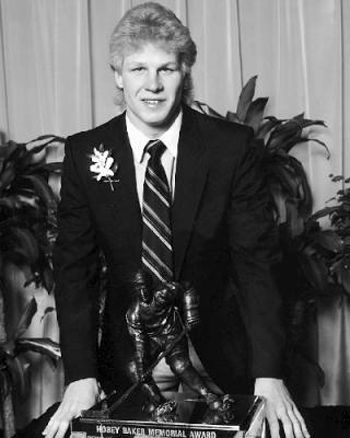
Hrkac also led the nation in scoring that season with 116 points in 48 games, far outdistancing his nearest competitor by 24 points to set an NCAA record, while Joyce and Hrkac finished 1-2 in goals with 52 and 46. Hrkac's outstanding season was recognized with the Hobey Baker Award, given annually to the top player in American college hockey also on this date in 1987.
Hrkac Hobey Baker photo TonyHrkac1987.jpg
Tony Hrkac posing with the Hobey Baker Award

After playing two seasons at North Dakota, Hrkac would immediately enter the NHL with the St. Louis Blues. In addition to the Blues, he would also play with the Quebec Nordiques, San Jose Sharks, Chicago Blackhawks, Dallas Stars, which included winning a Stanley Cup in 1999, a brief stint with the New York Islanders, the Mighty Ducks of Anaheim and the Atlanta Thrashers. Periodically, Hrkac would spend time in both the AHL and the IHL, including a standout season in 1992-93 with the Indianapolis Ice, where he would win the league scoring title with 132 points and be named the league MVP. In 2004, he would help the Milwaukee Admirals capture the Calder Cup in the AHL playoffs.

Joyce saw action in the NHL with the Boston Bruins, Washington Capitals and Winnipeg Jets as well as several years in the IHL before finishing his career with three seasons in Germany.

Freshman defenseman Baron would have the most successful NHL career among the skaters, playing 988 games with the Philadelphia Flyers, St. Louis Blues, Montreal Canadiens, Phoenix Coyotes and Vancouver Canucks, but easily the most recognizable name off the 1986-87 Fighting Sioux roster would be goaltender Belfour.

Ed Belfour Fighting Sioux

After playing a single season with North Dakota, Belfour would break into the NHL in a big way in 1990-91, winning the Calder Trophy, the Jennings Trophy and the Vezina Trophy with the Chicago Blackhawks while posting a record of 43-19-7. The next season he would lead the Blackhawks to the Stanley Cup Finals for the first time in 19 years. He would also repeat capturing both the Jennings and Vezina trophies in 1992-93. During his nine seasons in Chicago, Belfour would establish himself as one of the elite goalies in the NHL.

After a brief stay in San Jose, Belfour would join the Dallas Stars, backstopping the team to the Stanley Cup in 1999, while winning another Jennings Trophy, and a return to the finals in 2000. He would close out his 19 year NHL career with three seasons in Toronto with the Maple Leafs and a season with the Florida Panthers.

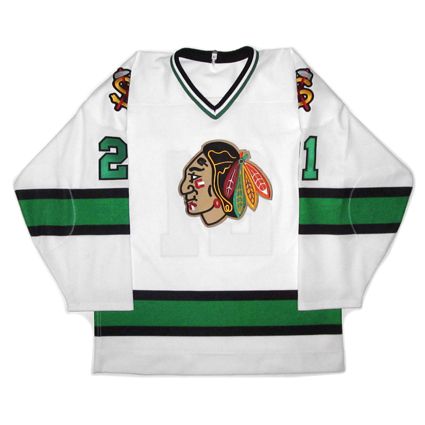
Today's featured jerseys is a 1986-87 University of North Dakota Fighting Sioux Tony Hrkac jersey. This classic Fighting Sioux jersey is clearly derived from the traditional Chicago Blackhawks jersey, only with the Blackhawks red replaced by the green of the Fighting Sioux and with the "C" in the crossed tomahawks secondary logo replaced by an "S".

A much beloved style among Fighting Sioux fans, this style was first used in 1978 and lasted through 1993 when political correctness resulted in a "North Dakota word mark" style for a couple of seasons until stylized "geometric" Indian head was employed. While today's featured style came into being in 1984, the use of the "Blackhawks" crest dates back to 1971.

For the most complete history of North Dakota jerseys online, we highly recommend Sioux-Jersey.com.
North Dakota Sioux 1986-87 jersey, North Dakota Sioux 1986-87 jersey

Bonus jersey: Today's bonus jersey is a 1986-87 University of North Dakota Fighting Sioux Ed Belfour jersey as worn by Belfour in his NCAA national championship season. No names were used on the back of the North Dakota road jerseys at that time and Belfour wore #29 in college rather than the more familiar #30 he would later wear in the NHL.

For more on the issue surrounding the discontinuation of the "Fighting Sioux" name, please read our post here.

North Dakota Sioux 1986-87 R jersey photo NorthDakotaSioux1986-87RF.jpg
North Dakota Sioux 1986-87 R jersey photo NorthDakotaSioux1986-87RB.jpg

Here is a great find, highlights of both the semi-final game against Harvard followed by the title winning game against Michigan State.


Here is a music video tribute to the 1987 North Dakota Fighting Sioux, featuring perhaps the worst performance of the most annoying song ever written, but the rare footage of the team in action is worth the audio punishment. No points will be deducted for watching with the sound off.


Finally, a look back at the career of Hrkac on the occasion of his induction into the Northwestern Ontario Sports Hall of Fame.

Tuesday, August 5, 2014

1958-59 University of Minnesota Golden Gophers Herb Brooks Jersey

Herb Brooks, born on this date in 1937, played for the University of Minnesota Golden Gophers from 1955-56 to 1958-59, appearing in 75 games as both a wing and defenseman, totaling 18 goals and 27 assists for 45 points.

Herb Brooks photo BrooksGopherplayer.jpg

Following his college career, he was famously the last player cut from the gold medal winning 1960 USA Olympic team. After watching the USA win the gold medal on TV, Brooks' father turned and said "Obviously they cut the right guy."

Herb Brooks photo BrooksUSA1960.jpg

Herb Brooks would go on to become a member of both the 1964 and 1968 USA Olympic teams in Innsbruck, Austria and Grenoble, France. In addition, he would play in five World Championships for the USA in 1965, 1967,1968, 1970 and 1971.

Herb Brooks photo 1968OlympicTeam.jpg
Herb Brooks as captain of the 1968 US Olympic team

Following his playing career, Brooks would coach the University of Minnesota for seven seasons, beginning in 1972, leading the Gophers to WCHA championships in 1974 and 1975 and capturing the national championship three times, in 1974, 1976 and 1979. His final collegiate coaching record was 175-101-20.

Herb Brooks photo BrooksGophercoach.jpg
Brooks between the benches for the Gophers at their quirky
old Mariucci Arena

After coaching Team USA at the 1979 World Championships, he was named general manager and head coach of the 1980 Olympic hockey team, earning a permanent place in history after guiding the team to the famous "Miracle on Ice", where he led a team of college players to a 4-3 victory over the heavily favored Soviet Union and then securing the gold medal versus Finland with a third period come-from-behind victory two days later.

Herb Brooks photo Brooks1980coach.jpg
Brooks as coach of the 1980 US Olympic team

After coaching in Switzerland for a year, Brooks would return to coach the New York Rangers for four seasons, being named The Sporting News Coach of the Year in 1981-82, before return to the college ranks for a year at St. Cloud State before coaching the Minnesota North Stars for a year. He later coached both the New Jersey Devils in 1992-93 and the Pittsburgh Penguins in 1999-2000. His final NHL record was 219-221-66.

Herb Brooks photo BrooksNorthStarscoach.jpg
Back in Minnesota behind the bench for the North Stars where he would be reunited with Neal Broten (left) who he coached to an NCAA title with the Gophers and a gold medal in 1980

In between coaching the Devils and Penguins, he also coached Team France at the 1998 Olympics. In 2002 in Salt Lake City, Brooks would once again lead Team USA, making it all the way to the finals and winning a silver medal.

Herb Brooks photo Brooks2002coach.jpg
In 2002 Brooks once again led the US to an Olympic medal

He would be awarded the Lester Patrick Trophy for contributions to American hockey in 1980 as part of Team USA and would win the award again as an individual in 2002. He was also inducted into the United States Hockey Hall of Fame in 1990, the International Ice Hockey Federation Hall of Fame in 1999 and the Hockey Hall of Fame in 2006.

A statue of Brooks stands outside the River Centre in St. Paul, which is part of the complex that includes the Xcel Energy Center, home of the Minnesota Wild.

Herb Brooks photo Brooksstatue.jpg

Today's featured jersey is a 1958-59 University of Minnesota Golden Gophers Herb Brooks jersey. This is a very rare jersey, as it was purchased as a group order of custom made jerseys for members of a Golden Gophers online forum and was never available through any online or retail stores. That changed with the creation of VintageMinnesotaHockey.com, who now offers anyone a chance to own this beautiful jersey from "America's Coach".

It's customized with the #5 that Brooks wore his senior season with the Gophers and also sports the Goldy Gopher patch on the left sleeve. It also has the ornate Minnesota Centennial patch on the upper left chest to finish off the look. 

Minnesota Gophers 1959-60 jersey photo MinnesotaGophers1959-60F.jpg
Minnesota Gophers 1959-60 jersey photo MinnesotaGophers1959-60B.jpg

The "Miracle on Ice" was named the Top International Hockey Story of the Century by the International Ice Hockey Federation as part of their centennial celebrations and immortalized in the 2004 film "Miracle".


Saturday, May 10, 2014

Third String Goalie 5th Anniversary

Yesterday marked the fifth anniversary of Third String Goalie. To date we have made 1597 posts, are followed by 83 people here on blogger, by 296 on our Facebook page, and 774 of the most intelligent people on Twitter.

We've written about jerseys from Alaska to Japan and from Iceland to South Africa, including jerseys from the United States, Canada, Iceland, Great Britain, France, the Netherlands, Germany, Norway, Denmark, Sweden, Finland, Switzerland, Italy, Slovenia, the Czech Republic, Croatia, Austria, Slovakia, Hungary, South Africa, Poland, Latvia, Belarus, Ukraine, Russia, Kazakhstan, China and Japan.

In addition to the countries we've written about, we've also had visitors from 193 different countries and territories, which still shocks us to no end, often wondering what someone from someplace like Nepal or Iran was expecting to find when they arrived here?

We've written about the oldest hockey sweater in existencebrand new releases and sweaters never actually used. we've covered jerseys we love and those we do not.

We've also gone astray a time or two with unexpected stories we felt worth sharing and we sincerely hope you've enjoyed the ride.

As a small token of our appreciation for your readership, all readers who email us their mailing address will receive a Third String Goalie refrigerator magnet for free!

*****

Also, we are pleased to announce we are having an Anniversary Sale in the Third String Goalie Online Shop Sale!

Prices have never been lower and we have t-shirts, polos, sweatshirts, hoodies, jackets, clothing for kids, tote bags, home & office, mugs and even buttons all featuring our vintage Third String Goalie logo.

Click the image below for The Third String Goalie Online Shop
Photobucket
Third String Goalie Branded Goods proudly featuring
the Patron Saint of Goaltenders Georges Vezina. 

In honor of our 5th anniversary, we have chosen to feature one of our favorites from our personal collection with the number 5.

Herb Brooks played for the University of Minnesota Golden Gophers from 1955-56 to 1958-59, appearing in 75 games as both a wing and defenseman, totaling 18 goals and 27 assists for 45 points.

Herb Brooks photo BrooksGopherplayer.jpg

Following his college career, he was famously the last player cut from the gold medal winning 1960 USA Olympic team. After watching the USA win the gold medal on TV, Brooks' father turned and said "Obviously they cut the right guy."

Herb Brooks photo BrooksUSA1960.jpg

Herb Brooks would go on to become a member of both the 1964 and 1968 USA Olympic teams in Innsbruck, Austria and Grenoble, France. In addition, he would play in five World Championships for the USA in 1965, 1967,1968, 1970 and 1971.

Herb Brooks photo 1968OlympicTeam.jpg
Herb Brooks as captain of the 1968 US Olympic team

Following his playing career, Brooks would coach the University of Minnesota for seven seasons, beginning in 1972, leading the Gophers to WCHA championships in 1974 and 1975 and capturing the national championship three times, in 1974, 1976 and 1979. His final collegiate coaching record was 175-101-20.

Herb Brooks photo BrooksGophercoach.jpg
Brooks between the benches for the Gophers at their quirky
old Mariucci Arena

After coaching Team USA at the 1979 World Championships, he was named general manager and head coach of the 1980 Olympic hockey team, earning a permanent place in history after guiding the team to the famous "Miracle on Ice", where he led a team of college players to a 4-3 victory over the heavily favored Soviet Union and then securing the gold medal versus Finland with a third period come-from-behind victory two days later.

Herb Brooks photo Brooks1980coach.jpg
Brooks as coach of the 1980 US Olympic team

After coaching in Switzerland for a year, Brooks would return to coach the New York Rangers for four seasons, being named The Sporting News Coach of the Year in 1981-82, before return to the college ranks for a year at St. Cloud State before coaching the Minnesota North Stars for a year. He later coached both the New Jersey Devils in 1992-93 and the Pittsburgh Penguins in 1999-2000. His final NHL record was 219-221-66.

Herb Brooks photo BrooksNorthStarscoach.jpg
Back in Minnesota behind the bench for the North Stars where he would be reunited with Neal Broten (left) who he coached to an NCAA title with the Gophers and a gold medal in 1980

In between coaching the Devils and Penguins, he also coached Team France at the 1998 Olympics. In 2002 in Salt Lake City, Brooks would once again lead Team USA, making it all the way to the finals and winning a silver medal.

Herb Brooks photo Brooks2002coach.jpg
In 2002 Brooks once again led the US to an Olympic medal

He would be awarded the Lester Patrick Trophy for contributions to American hockey in 1980 as part of Team USA and would win the award again as an individual in 2002. He was also inducted into the United States Hockey Hall of Fame in 1990, the International Ice Hockey Federation Hall of Fame in 1999 and the Hockey Hall of Fame in 2006.

A statue of Brooks stands outside the River Centre in St. Paul, which is part of the complex that includes the Xcel Energy Center, home of the Minnesota Wild.

Herb Brooks photo Brooksstatue.jpg

Today's featured jersey is a 1958-59 University of Minnesota Golden Gophers Herb Brooks jersey. It also has the ornate Minnesota Centennial patch on the upper left chest. This is a very rare jersey, as it was purchased as part of a custom group order for members of the Golden Gophers online forum and was never available through any online or retail stores. It's customized with the #5 that Brooks wore his senior season with the Gophers and also sports the Goldy Gopher patch on the left sleeve.

Minnesota Gophers 1959-60 jersey photo MinnesotaGophers1959-60F.jpg
Minnesota Gophers 1959-60 jersey photo MinnesotaGophers1959-60B.jpg

The "Miracle on Ice" was named the Top International Hockey Story of the Century by the International Ice Hockey Federation as part of their centennial celebrations and immortalized in the 2004 film "Miracle".


Thursday, March 27, 2014

1986-87 University of North Dakota Tony Hrkac Jersey

On this date in 1987, the University of North Dakota Fighting Sioux, led by 1987 Hobey Baker winner and national scoring champion Tony Hrkac and future NHL All-Star Ed Belfour, captured the NCAA championship at the Joe Louis Arena in Detroit, Michigan by defeating the Michigan State Spartans by a score of 5-3.

1987 Sioux trophy photo 1987Siouxtrophy.jpg
North Dakota celebrates their 1987 national championship

The NCAA tournament began with eight teams meeting in the quarterfinals, which were still a two-game, total-goals format.

The Minnesota Golden Gophers, second in the WCHA defeated the Boston College Eagles, the champions of Hockey East, 4-1 in the first game. While the Eagles would win the second game 3-2, Minnesota's three goal advantage from Game 1 stood up to take the series 6-4.

The Michigan State Spartans, second in the CCHA regular season and winners of their conference tournament, easily dispatched the Maine Black Bears 11-5 to advance to face Minnesota in the Final Four in Detroit, 90 miles from the Spartans' campus.

In the other half of the bracket, WCHA champions North Dakota took two from the St. Lawrence Saints, third in the ECAC, to win 9-4.

In the final pairing, the Harvard Crimson, champions of the ECAC, destroyed the CCHA champion Bowling Green Falcons in Game 1 by a score of 7-1, taking an insurmountable six goal lead into Game 2, which they easily won 3-0 for a final tally of 10-1.

Michigan State survived their semifinal game in Detroit against Minnesota 5-3, aided in part by a fluke goal when the puck caromed off the seam in the Zamboni doors behind the Minnesota goal, leaving Minnesota goaltender John Blue miles out of his crease waiting for the ring-around while the puck deflected into the slot for an easy shot into the unguarded net for the Spartans.

North Dakota advanced to the final with a stout 5-2 win over Harvard.

In the championship final, North Dakota prevailed by a score of 5-3 over the partisan Michigan State crowd which numbered an NCAA record 17,644 fans in attendance. Ian Kidd opened the scoring for North Dakota in the first period with a backhander before defenseman Murray Baron added another 1:37 later to make it 2-0 for the Fighting Sioux. Just 18 seconds later Bob Joyce scored from Hrkac and Kidd, North Dakota's third goal in the span of just 1:55.

Belfour Sioux photo BelfourSioux-1.jpg
Ed Belfour guards the Fighting Sioux goal

Michigan State got a goal back in the second period, which North Dakota soon countered to restore the three goal cushion before future NHLer Kevin Miller scored for the Spartans to make it 4-2 after two periods.

Each team would add a goal in the third for the final score of 5-3 as the Gino Gasparini coached team earned their fifth national championship and set a record with their 40th win of the season to finish the season at 40-8.

University of North Dakota 1987 National Champions
The 1987 NCAA champion North Dakota Fighting Sioux

Hrkac led the tournament in scoring with 3 goals and a record 9 assists for 12 points and was named to the All-Tourament team along with teammates Belfour, defnseman Kidd and linemate Joyce.

Hrkac also led the nation in scoring that season with 116 points in 48 games, far outdistancing his nearest competitor by 24 points to set an NCAA record, while Joyce and Hrkac finished 1-2 in goals with 52 and 46. Hrkac's outstanding season was recognized with the Hobey Baker Award, given annually to the top player in American college hockey also on this date in 1987.

Hrkac Hobey Baker photo TonyHrkac1987.jpg
Tony Hrkac posing with the Hobey Baker Award

After playing two seasons at North Dakota, Hrkac would immediately enter the NHL with the St. Louis Blues. In addition to the Blues, he would also play with the Quebec Nordiques, San Jose Sharks, Chicago Blackhawks, Dallas Stars, which included winning a Stanley Cup in 1999, a brief stint with the New York Islanders, the Mighty Ducks of Anaheim and the Atlanta Thrashers. Periodically, Hrkac would spend time in both the AHL and the IHL, including a standout season in 1992-93 with the Indianapolis Ice, where he would win the league scoring title with 132 points and be named the league MVP. In 2004, he would help the Milwaukee Admirals capture the Calder Cup in the AHL playoffs.

Joyce saw action in the NHL with the Boston Bruins, Washington Capitals and Winnipeg Jets as well as several years in the IHL before finishing his career with three seasons in Germany.

Freshman defenseman Baron would have the most successful NHL career among the skaters, playing 988 games with the Philadelphia Flyers, St. Louis Blues, Montreal Canadiens, Phoenix Coyotes and Vancouver Canucks, but easily the most recognizable name off the 1986-87 Fighting Sioux roster would be goaltender Belfour.

Ed Belfour Fighting Sioux

After playing a single season with North Dakota, Belfour would break into the NHL in a big way in 1990-91, winning the Calder Trophy, the Jennings Trophy and the Vezina Trophy with the Chicago Blackhawks while posting a record of 43-19-7. The next season he would lead the Blackhawks to the Stanley Cup Finals for the first time in 19 years. He would also repeat capturing both the Jennings and Vezina trophies in 1992-93. During his nine seasons in Chicago, Belfour would establish himself as one of the elite goalies in the NHL.

After a brief stay in San Jose, Belfour would join the Dallas Stars, backstopping the team to the Stanley Cup in 1999, while winning another Jennings Trophy, and a return to the finals in 2000. He would close out his 19 year NHL career with three seasons in Toronto with the Maple Leafs and a season with the Florida Panthers.

Today's featured jerseys is a 1986-87 University of North Dakota Fighting Sioux Tony Hrkac jersey. This classic Fighting Sioux jersey is clearly derived from the traditional Chicago Blackhawks jersey, only with the Blackhawks red replaced by the green of the Fighting Sioux and with the "C" in the crossed tomahawks secondary logo replaced by an "S".

A much beloved style among Fighting Sioux fans, this style was first used in 1978 and lasted through 1993 when political correctness resulted in a "North Dakota word mark" style for a couple of seasons until stylized "geometric" Indian head was employed. While today's featured style came into being in 1984, the use of the "Blackhawks" crest dates back to 1971.

For the most complete history of North Dakota jerseys online, we highly recommend Sioux-Jersey.com.
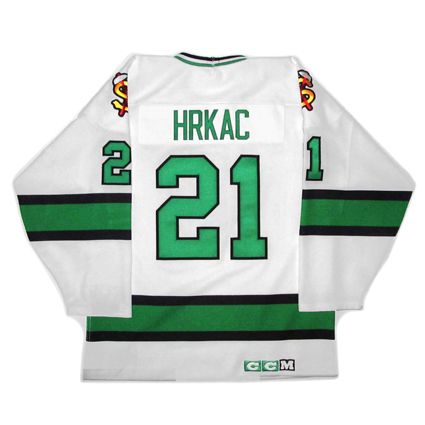
North Dakota Sioux 1986-87 jersey, North Dakota Sioux 1986-87 jersey

Bonus jersey: Today's bonus jersey is a 1986-87 University of North Dakota Fighting Sioux Ed Belfour jersey as worn by Belfour in his NCAA national championship season. No names were used on the back of the North Dakota road jerseys at that time and Belfour wore #29 in college rather than the more familiar #30 he would later wear in the NHL.

For more on the issue surrounding the discontinuation of the "Fighting Sioux" name, please read our post here.

North Dakota Sioux 1986-87 R jersey photo NorthDakotaSioux1986-87RF.jpg
North Dakota Sioux 1986-87 R jersey photo NorthDakotaSioux1986-87RB.jpg

Here is a great find, highlights of both the semi-final game against Harvard followed by the title winning game against Michigan State.


Here is a music video tribute to the 1987 North Dakota Fighting Sioux, featuring perhaps the worst performance of the most annoying song ever written, but the rare footage of the team in action is worth the audio punishment. No points will be deducted for watching with the sound off.


Finally, a look back at the career of Hrkac on the occasion of his induction into the Northwestern Ontario Sports Hall of Fame.

Monday, November 25, 2013

1987-88 University of Minnesota Golden Gophers Robb Stauber Jersey

Born on this date in 1967 in Duluth, Minnesota, goaltender Robb Stauber would become the first goaltender to win the Hobey Baker Award as the outstanding player in US College Hockey in the eighth season of the award.

After being named an All-State Goalkeeper at Duluth Denfeld High School, Stauber would attend the University of Minnesota beginning in 1986. He would appear in 20 games and finish with a 13-5 record while splitting time with future Boston Bruins goalie John Blue. The Gophers would finish third in the nation that season after making it to the NCAA Final Four. Stauber would record his first point that season after being credited with an assist. During the season he would also play for the United States in the World Junior Tournament.

Stauber's second season with the Golden Gophers in 1987-88 would see him set a team record with 44 games played, posting a 34-10 record and lowering his goals against average from 3.53 down to 2.72 and help the team capture the WCHA Championship.


The Gophers would make another trip to the Final Four before losing to St. Lawrence 3-2 on a goal in the final minute of the game. Never one to sit back and watch the play develop, Stauber was always on the lookout to fire a long pass to send one of his potent forwards back up the ice in the other direction, and collected five assists as a result. At the end of the season he would be named the winner of the John Mariucci Award as the Gophers's Most Valuable Player, be named WCHA Goaltender of the Year, earn All-WCHA First Team honors, be named to the All-America first team, earning a coveted spot on one of the Mariucci Arena murals, reserved for Gopher First Team All-Americans, and become the first goaltender to win the Hobey Baker Award.

1988-89 would see the Gophers capture back to back WCHA Championships and Stauber would see action in 34 games, post a 26-8 record and lower his goals against average yet again to 2.43. His assist total would climb to seven, despite playing ten fewer games than the previous season. Stauber and the Gophers would make it all the way to the NCAA Championship game only to lose to Harvard 4-3 in overtime in one of the greatest college hockey games of all time. Stauber would be named the WCHA Goaltender of the Year for the second season in a row and be named one of the ten finalists for the Hobey Baker Award.
His final college career stats shows a 2.77 goals against average and a 73-23 record and he was recently named one of the Top 50 Players in WCHA History. Without question, Stauber was a supremely talented goaltender which gave him the confidence to often leave his crease to challenge shooters or corral the puck before attempting another of his home run passes to his forwards up the ice. In fact, he would even score a goal while playing in the minors later in his career.


Following his collegiate career, Stauber would make another appearance for the United States, this time at the 1989 World Championships in Stockholm, Sweden.

The next season, 1989-90, he would make his NHL debut for the Los Angeles Kings, seeing action in a pair of games as a teammate to Wayne Gretzky. He would spend the next two seasons in the minors and return to the NHL full time in the 1992-93 season, in which the Kings would make it all the way to the Stanley Cup Finals with Stauber seeing action in four games verus the Calgary Flames in the opening round.


 photo StauberKings1.jpg
Stauber guarding the Kings net during the 1992-93 season

After one more season in Los Angeles where Stauber would play in 22 regular season games, including wearing the first decorated goalie pads in NHL history.


Stauber Kings pads photo StauberKingspads1.jpg
Stauber Kings pads photo StauberKingspads93-94.jpg
Stauber during the 1993-94 season (above) wearing
the first decorated goalie pads in NHL history (below)

Stauber was traded to the Buffalo Sabres during the 1994-95 season, seeing six games of action.

He would spend the next three seasons back in the AHL with Rochester, where he once scored a goal, Portland and Hartford.

His final NHL totals are 62 games played with 21 wins, 23 losses and 9 ties, 1 shutout and a 3.80 goals against average along with 4 playoff games and a 3-1 record.

Since retiring as a player, Stauber has opened Stauber's Goalcrease Academy to train goalkeepers, written a book about, what else, goaltending, and has been the goaltenders coach for the University of Minnesota.

Today's featured jersey is a 1987-88 University of Minnesota Robb Stauber jersey as worn during his career at the University of Minnesota, including his Hobey Baker winning season and was lettered by our friends at VintageMinnesotaHockey.com.

This jersey with it's classic hockey styling was first used by Minnesota in 1985-86 and the gold trim was added to the shoulder yoke after just one season. Today's featured jersey can be dated to precisely 1987-88 by the presence of the shoulder trim but the lack of a WCHA patch, which arrived in 1988-89 in gold. The WCHA patch changed to a more contrasting maroon color after one season and this style remained in use through 1992-93, the final season of the old Mariucci Arena. The only other variation of the jersey was in 1990-91 when a USA flag patch was worn (only on the home jerseys) following a wave a patriotism following the outbreak of the first Gulf War in August of 1990.

Minnesota Gophers 1987-88 jersey photo MinnesotaGophers1987-88F.jpg
Minnesota Gophers 1987-88 jersey photo MinnesotaGophers1987-88B.jpg

It's a true disappointment that Stauber's college career took place prior to the age of youtube, since he was simply the most spectacular, dynamic and aggressive goaltender we have ever had the privilege of watching play live. Luckily, we did find these highlights of a vintage Gopher playoff game that contains some classic rare footage showing Stauber playing with reckless abandon early in the video from 1988 in the original Mariucci Arena. Hopefully this will give you some hint of what kind of an amazing video a true compilation of Stauber's best saves and most daring challenges would have looked like.


"SAVE BY STAUBER!!"


Saturday, October 19, 2013

A New Era Dawns in College Hockey

This is Terry Pegula, billionaire, hockey fan, owner of the Buffalo Sabres and, most importantly, a Penn State alumnus.

Terry Pegula, Terry Pegula

When introduced as the Sabres new owner, he cried being in the presence of Gilbert Perreault, so you really do have to appreciate the man's passion for hockey and his undeniable love for his Sabres, and we do not mean "his Sabres" in the sense that he now owns them, but "his Sabres" in the way he has cheered for them as a fan since forever.

As a man of means beyond what most of us can comprehend, he has also generously donated $102 million to Penn State, the largest private gift in school history, to construct a brand new arena and pay for both the men's and women's club hockey teams to be elevated to Division I status - an incredibly  selfless gift that will affect the lives of hundreds future student athletes and arena employees as well as those who were employed in the construction of the new arena.

However…

There is also a man named Jim Delaney, who is president of the Big Ten Conference, and another man named Mark Silverman, who is the president of the Big Ten Network, a channel which is in need of more programming and always looking to add to it's $315 million in revenue it generated in 2012, a 30% increase in ad revenue from 2011 to 2012 and up 60% from 2010's $196 million. With each of the conference schools receiving $24.7 million from the network, and the conference itself seeing a payment of $11 million, Silverman wants to be able to send more of those kinds profits to Delaney.

While there had been discussions regarding the creation of a Big Ten conference for hockey for years, they never amounted to anything, but now with the move to Division I by Penn State, there are now six hockey programs among the Big Ten's current 12 members, a very critical number, as six is the minimum number of teams required for the NCAA to issue an automatic bid into the NCAA tournament for a conference champion and the minimum number of schools needed under Big Ten rules to allow for a conference championship to be recognized.

With that magic number of six schools now reached thanks to the addition of Penn State, and an eager television network looking to add programming, the formation of the Big Ten Hockey Conference was announced in March of 2011, which will begin play this season. The benefits for the six schools is the healthy increase in the amount prestige and publicity they can expect by being now affiliated with the "Big Ten" name, the exposure they will get from having a TV deal with the Big Ten Network and, of course, the money they will receive from the network while having to only divide it six ways by being members of a new, smaller conference.

Big 10 Logo, Big 10 Logo

Those six member schools are Michigan (with 9 national championships), Michigan State (3) and Ohio State, who are all leaving the Central Collegiate Hockey Association (CCHA), Minnesota (5) and Wisconsin (6), who both left the Western Collegiate Hockey Association (WCHA), and the previously mentioned startup program at Penn State, who are going to enjoy the benefits of being able to step right into the highest profile hockey conference in the country.

While the news of five major schools leaving the their two established conferences was in itself a blow to those conferences, they easily could have continued as is, but that was not to be the case.

Oh, no. Not by a long shot.

The stronger schools of the WCHA and CCHA quickly began talks to combine into a new conference of their own, as reported and announced in July of 2011. The new conference was named the National Collegiate Hockey Conference and combines Colorado College (2), Denver (7), Minnesota-Duluth (1), Nebraska-Omaha, North Dakota (7) and later St. Cloud State of the WCHA with Miami of Ohio and then Western Michigan of the CCHA.

 photo NCHClogo.jpg

This news left the remaining schools in both the WCHA and CCHA reeling, and the other schools being left behind began to look at what they could do to protect their own interests, as the CCHA was now looking at five of it's 11 members leaving, while the WCHA was facing being gutted by the loss of eight of it's 12 members!

WCHA Logo, WCHA Logo

The next domino to fall was when Northern Michigan (1) announced it was leaving the CCHA in order to return to it's former conference, the WCHA. The CCHA effectively died when Alaska-Fairbanks, Ferris State and Lake Superior State (3) followed Northern Michigan to the WCHA in August with Bowling Green (1) doing the same on October 4th, followed the very next day by the CCHA's Notre Dame accepting an invitation to join Hockey East in 2013.

The move by Notre Dame in turn led to Connecticut leaving the Atlantic Hockey Association to join Hockey East in 2014 in order to get Hockey East back to an even number of schools. This move will require UConn to make some major changes to it's program, as they currently do not offer scholarships and their home arena seats less than 2,000 fans.

Finally, mercy was shown to the independent program at the University of Alabama-Huntsville when the WCHA agreed to accept the Chargers as it's 10th program, saving the endangered program from extinction and certainly making scheduling easier with an even number of teams, but certainly not easing the now far-flung conference's travel demands any less.

The ramification of all this movement is that the CCHA ceased to exist at the end of the 2012-13 season after 42 years of play, dating back to 1971-72.

CCHA Logo, CCHA Logo

Meanwhile, the WCHA was gutted when it lost the likes of Colorado College, Denver, Minnesota, Minnesota-Duluth, Nebraska-Omaha, North Dakota, St. Cloud and Wisconsin (28 combined national titles in all), and will now be comprised of Alabama-Huntsville, Alaska-Anchorage, Alaska-Fairbanks, Bemidji State, Bowling Green, Ferris State, Lake Superior State, Michigan Tech, Minnesota State-Mankato and Northern Michigan (8 combined national titles), taking the WCHA from the most dominant conference in the history of US college hockey, with 36 national titles to it's credit and a conference which sent all four teams to the Frozen Four in 2005, to a collection of cast-offs abandoned by the Big Ten schools and not invited to join the NCHC all banded together for survival. The new WCHA will be virtually unrecognizable, as it will now have more teams in Michigan's upper peninsula than it will have in the states of Minnesota, Colorado, North Dakota, Nebraska and Wisconsin - combined!

In a situation no one wanted, both Alaska schools will now be in the same conference, undesirable to the other conference members due to the high cost of travel expenses involved when making the trip to Alaska, as well as the large time difference, as Alaska is four time zones from the five WCHA schools located in Michigan and Ohio. How remote is Alaska considered to the other schools? A provision in the league playoffs dictates that both Alaska schools will automatically be paired together in the first round of the league playoffs regardless of their conference standing in order to avoid anyone having to travel there!

About the only thing the "new" WCHA has going for it is that it will retain the MacNaughton Cup as it's championship trophy due to the retention of Michigan Tech in all the shuffling of schools.

MacNaughton Cup, MacNaughton Cup
The MacNaughton Cup

The disappointments of this massive realignment are many, especially to those fans used to shorter road trips to away games due to conferences grouped geographically. For example, the western-most school in the new Big Ten, Minnesota, previously had eight conference rivals within 390 miles and now finds it's second closest opponent 650 miles to the east.

The other major disappointment is to the schools who worked hard to upgrade their programs from Division III to Division I, construct new buildings and sometimes wait years for acceptance into the WCHA, especially a school like Bemidji State, who spent 11 seasons in the catch-all College Hockey America conference before they were finally able to join fellow Minnesota schools Minnesota, Minnesota-Duluth, Minnesota State and St. Cloud State in 2010, only to now see all but Minnesota State bolt for the promise of greener pastures after just three seasons in the WCHA for the Beavers.

Sanford Center, Sanford Center
Bemidji State's new Sanford Center

In addition, all of the smaller schools who benefitted from the larger profile Big Ten schools filling their buildings and providing their largest gates will certainly be affected by few, if any, visits from Michigan, Michigan State, Minnesota and Wisconsin. If you are Minnesota State, an hour or so down the road from Minneapolis, do you want Minnesota to fill your building twice a year, or do you want Bowling Green instead? If you are Ferris State, do you want Michigan filling your building, or Alaska-Anchorage coming to town?

Other rumors have hockey taking a back seat to basketball on the Big Ten Network, with the traditional Friday-Saturday series now becoming Thursday-Friday, Saturday-Monday or even Sunday-Monday series, which will garner no favors among the traditional hockey fans, as the whole Big Ten Hockey Conference is being perceived as a big cash grab by the conference and it's television network with no regard for the implications this will have for any of the other programs outside of the six Big Ten schools, particularly the smaller schools who will be greatly affected by the massive shuffling of conferences in the west.

All this sure seems like a lot of trouble to go to for a fledgling Penn State program, which would have fit in nicely geographically and competitively with the CCHA and fellow Big Ten schools Michigan, Michigan State and Ohio State, or even any of the east coast leagues, Hockey East or especially the Eastern Collegiate Athletic Conference (ECAC), regardless of where Penn State's football or basketball programs happen to play.

The other major disappointment will be the severing of so many grand and traditional rivalries, illustrated by the fact the six schools in Michigan will now be spread among three different conferences (5 of 6 were in the CCHA), and the five Minnesota schools (all previously in the WCHA) will also now be scatted among the same three conferences, the Big Ten, NCHC and WCHA, as geography will be thrown to the wind in the new version of Division I hockey. The Big Ten will run from Minnesota to Pennsylvania, the NCHC will span from Colorado to Ohio and the WCHA will stretch from the wilds of Alaska all the way to Ohio in the Eastern time zone and down to Alabama in the deep south!

Last night saw the first conference games in the new NCHC, as things kicked off with North Dakota (still without a nickname following the dropping of "Fighting Sioux") facing off against the top ranked team in the nation, the Miami University Redhawks, with #6 North Dakota coming out on top by a score of 4-2 in Oxford, Ohio despite being outshot 37-25 by the home team.

Later in the west, the Colorado College Tigers defeated the visiting #20 University of Minnesota Duluth Bulldogs 3-1.

The WCHA starts it's conference play on October 25th with Northern Michigan hosting Michigan Tech and Bemidji State making the trip down to Alabama-Huntsville as the two former College Hockey America schools renew acquaintances.

Big Ten conference play will not begin until Friday, November 29th when Ohio State travels to Michigan and Wisconsin visits Minnesota for a Friday-Saturday series, but as predicted, the Ohio State series against Michigan is a very non-traditional Friday-Monday series.

Today's featured jersey is a 2010-11 Miami University RedHawks Vincent LoVerde jersey. The RedHawks entered this weekend as the #1 ranked team in the USCHO.com poll. The school began it's varsity hockey program in 1978 as an independent school for two seasons before joining the CCHA for the 1980-81 season.

It's first NCAA playoff bid came in 1993 with a return in 1997, but only recently became a force in college hockey. After their third NCAA appearance in 2004, the RedHawks have been in the tournament every season since 2006, their consecutive appearance streak now currently at eight.

Miami won the CCHA regular season championship four times, 1993, 2006, 2009 and 2013, as well as winning the CCHA playoff championship in 2011, the same season Andy Miele became the program's first Hobey Baker Award winner as the top player in college hockey.

Their first #1 national ranking arrived in 2006 and set a team record for wins in 2008 with 33, a club led by future NHLers Ryan Jones and Alec Martinez.

2009 saw them reach their first Frozen Four, where they led the championship final 3-1 heading into the final minute of the game, only to eventually lose 4-3 in overtime, and returned to their second Frozen Four in 2010.

Other notable former Miami alumni include former Montreal Canadien Brian Savage, Randy Robitaille, veteran defenseman Dan Boyle of the San Jose Sharks and the New Jersey Devils Andy Greene.

Miami Univeristy 2010-11 jersey photo MiamiUniveristy2010-11Fjersey.jpg
Miami Univeristy 2010-11 jersey photo MiamiUniveristy2010-11Bjersey.jpg
Photos courtesy of JohnsonsJerseys.net

Today's video selection is a promo video for the new NCHC.


hit counter for blogger