Born on this date in 1966, Dimitri Kvartalnov looked for all the world to be on his way to NHL stardom.
Kvartalnov began his career with five full seasons with Khimik Voskresenek of the Soviet League, which included leading the league in scoring in 1989-90 and playing for the Soviet Union in the World Championships twice, winning gold in 1989 and bronze in 1991.
Dimitri, incorrectly identified as his brother Andrei
Kvartalnov then moved to North America and joined the San Diego Gulls of the International Hockey League, where he destroyed the league, scoring 60 goals and 58 assists for 118 points in 77 games. Kvartalnov picked up a trio of awards that season as the Rookie of the Year, Scoring Champion and Most Valuable Player.
IHL scoring champion Kvartalnov
Following his stellar IHL season, the Boston Bruins selected Kvartalnov with the 16th pick in the 1992 NHL Entry Draft.
Already with ten years of pro experience and entering the prime of his career at age 26, his NHL career got off to a record start in 1992 with 12 goals and ten assists to give him points in his first 14 games, a mark that would stand for fifteen years until surpassed by Evgeni Malkin in 2007.
Playing on "The Bonanza Line" of Adam Oates (Adam) and fellow NHL rookie Joe Juneau (Little Joe) and Kvartalnov (Hoss), the line would score nearly a third of the Bruins goals that season, with 107 of the club's 332 for the year. Oates would finish third in league scoring with 142 points and Juneau topped 100 with 102 while setting a record for left wingers with 70. Kvartalnov would amass 30 goals and 42 assists for 72 points in 73 games in his first season and had the look of a future NHL star - at least on the outside.
The Bonanza Line even had their own hockey card
The first sign of trouble was when the Bruins left him unprotected in the expansion draft, and despite his 30 goal season seemingly indicating enormous potential, he went unclaimed. Once the season began, Kvartalnov found himself in coach Brian Sutter's doghouse. Sutter, who had little use for Kvartalnov's apparent one dimensional style of play, left him out of the lineup on many occasions during his second season. After 39 games, in which he scored just 19 points, half the pace of a year before, and with a -9 rating, Kvartalnov was placed on waivers and eventually demoted to Providence of the AHL. There he was back to a point a game, but his time with the Bruins and North America was over at the conclusion of the season.
His career was far from over however.
Kvartalnov would move to Switzerland and play three seasons with HC Ambri-Piotta, finishing third in league scoring in 1995-96 and leading the team in scoring in 1996-97.
Kvartalnov back in Europe with HC Ambri-Piotta
Klagenfurt AC in Austria was his next stop, where he would play for three seasons which included leading the team in scoring with 72 points in 45 games in 1997-98.
He would split the 1999-00 season between the Manheim Eagles in Germany and Jokerit Helsinki in Finland.
The following season he would return to Russia, joining Ak Bars Kazan where he would play for four seasons and lead them in scoring twice. 2004-05 saw a move to Cherepovets Severstal and then a return to Khimik for six games. He would play the 2005-06 season with Krylja Sovetov (Soviet Wings) in the lower division, helping them regain a place in the top league for 2006-07. Half way through the season Kryla would deal Kvartalnov back to Cherepovets, and he would retire at the conclusion of the season after a 24 year professional career in which he would score a total of 509 goals and 474 assists for 983 points. Kvartalnov has subsequently gone into coaching in the KHL and guided Severstal Cherepovets for three seasons, spent two with Sibir Novosibirsk andis currently the head coach of CSKA Moscow, who have finished first overall in the KHL regular season all three of his seasons with the Red Army club.
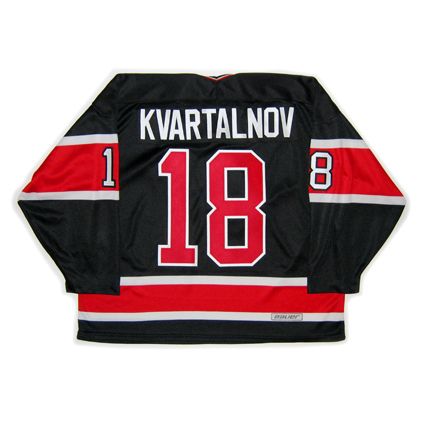
Today's featured jersey is a 1989-90 Khimik Voskresenek Dimitri Kvartalnov jersey as worn by Kvartalnov when he was the leading scorer in the Soviet League. It's typical of the Soviet jerseys of the era in that it is a relatively lightweight mesh and all the elements are either dye sublimated or screened on. Of note are the wild numbers on the back, reminding us of the 1982 movie "TRON". This jersey also has Dimitri's first initial "D" on the back in Cyrillic, as his brother Andrei was also a member of the team. The shape of the Cyrillic "D" likely led to the confusion and his being identified on his O-Pee-Chee hockey card as Andrei.
We obtained this jersey from a member of the Khimik traveling party during a game at Met Center in Bloomington, Minnesota when Khimik was playing a game in the Super Series against the Minnesota North Stars. Having no real idea who the players on the club were at the time, and being given our choice of a few different jerseys, we opted for the one with the longest name simply because it looked the most "Soviet". Only later when we decoded the Cyrillic lettering did we realize we had unknowingly obtained the jersey from the Soviet League's leading scorer from the prior season!
Bonus jersey: Today's bonus jersey is a 1991-92 San Diego Gulls Dimitri Kvartalnov jersey. version of the Gulls played in the IHL from 1990-91 to 1994-95 before moving north to become the Los Angeles Ice Dogs for one season prior to becoming the Long Beach Ice Dogs. The Gulls wore the same striking black and red jerseys for their entire run in San Diego and are easily our favorites of any of the four teams to have used the San Diego Gulls name.
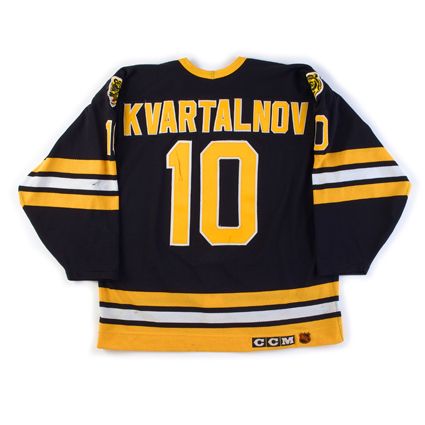
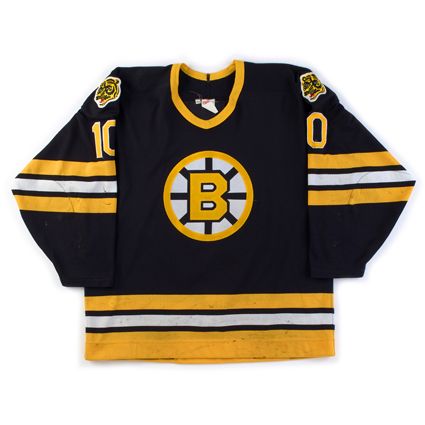
Extra bonus jersey: Today's extra bonus jersey is a 1993-94 Boston Bruins Dimitri Kvartalnov jersey. As well as obtaining Kvartalnov's game worn Khimik jersey, we later acquired his Bruins road jersey from his second season in the NHL. When paired with our Khimik jersey from the Soviet League, we like to call it our "Ultimate Home and Away Jerseys".
In today's video section, you cannot defend passing this good. You just can't.
Next, Kvartalnov picks up a rolling puck and shows his soft hands as he stickhandles his way to a nifty goal against the Hartford Whalers.
Next, Kvartalnov receives a laser pass from the playmaker Oates and, showing the good skills with his skates many European hockey players have from growing up playing soccer, gets the puck up to his stick and scores against the Washington Capitals Olaf Kolzig.
Finally, we present you with the theme song to the TV series Bonanza, from where the Bruins Bonanza Line of Oates, Juneau and Kvartalnov got their name.
Born on this date in 1970, DennyLambert played three seasons with the Sault Ste. Marie Greyhounds of the Ontario Hockey League from 1988-89 to 1990-91, which was his best season with 28 goals and 67 points. Undrafted, Lambert signed with the San Diego Gulls of the International Hockey League for the 1991-92 season. He would play four seasons with the Gulls, including the Gulls finest season when they made it to the Turner Cup Finals in 1993. While with the Gulls, he would average 260 penalty minutes a season, with a high of 314 in 1993-94, third in the league by less than 10 minutes.
Lambert spent four seasons in the IHL with the San Diego Gulls
Lambert had a fine 1994-95 season, scoring 25 goals and 60 points, double his average from the previous three seasons, which caught the attention of the Mighty Ducks of Anaheim, who signed him for the remainder of the season, which made for a long year for Lambert, as combined he played in 88 regular season games that season, which must rank as one of the highest totals ever. Lambert scored his first NHL goal that season on his way to 4 points He split the following season between the Baltimore Bandits of the American Hockey League and the Mighty Ducks, playing 44 games with Baltimore and 33 with Anaheim. For the 1996-97 season, Lambert was signed by the Ottawa Senators as a free agent, playing 80 games his first season and another 72 games in 1997-98, setting a NHL high of 250 penalty minutes that season, as well as scoring a career best 9 goals.
Lambert played for the Senators for two seasons
Now established as a full-time NHLer, Lambert was chosen by the Nashville Predators in the 1998 NHL Expansion Draft, where he would play the entire 1998-99 season.
Lambert battles Kelly Chase while with the Predators
Lambert was then traded to another new expansion club, the first year Atlanta Thrashers for the 1999-00 season, where he would play for two seasons.
From one first year expansion team to another,
Lambert went from Nashville to Atlanta
It was back to Anaheim for the 2001-02 season for his second stint with the Mighty Ducks. There Lambert yet again finished with between 213 and 219 penalty minutes for the fifth time in six seasons, with only his 250 minutes in 1997-98 tampering with his amazing consistency. Lambert wrapped up his career with the Milwaukee Admirals of the AHL in 2002-03 before retiring as a player. After some time as an assistant, Lambert would become head coach of the Soo Greyhounds, his junior club, for three seasons from 2008 to 2011. Today's featured jersey is a 1991-92 San Diego Gulls Denny Lambert jersey. This iteration of the Gulls were members of the IHL for five seasons, a team name that dates back to a previous Western Hockey League franchise which began play in the mid 1960's. After their five seasons in San Diego, the IHL franchise relocated up the coast to become the Long Beach Ice Dogs, and were immediately replaced by a new franchise in the WHL, also known as the Gulls. Their membership would become part of the ECHL and last through 2006. Two seasons later, the San Diego Gulls name would once again resurface, now used by a Junior A team in the Western States Hockey League, now the fourth franchise to use the Gulls name in San Diego! The Gulls stellar 1992-93 season saw them finish with a 62-12-8 record for a league record 132 points, but fell short in the finals. Notable players for the Gulls were RonDugay, GlenHanlon, Charlie Simmer, RayWhitney, SeanBurke, LindyRuff and IHL scoring champion Dimitri Kvartalnov. While the Gulls history was a brief one, they left behind a legacy of attractive jerseys with classic styling and a very sharp logo.
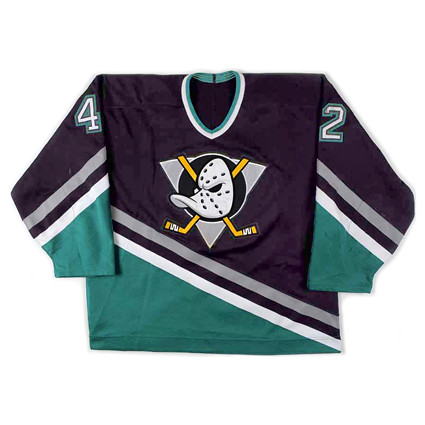
Bonus jersey: Today's bonus jersey is a 1995-96 Mighty Ducks of Anaheim Denny Lambert jersey from the second of Lambert's two original seasons with the Mighty Ducks.
Anaheim entered the league in 1993-94 and immediately shook up the establishment with eggplant and jade colored jerseys that had diagonal striping on not only the arms, but the waist stripe as well at a time when 25 out of 25 other teams had a straight waist stripe and only two other teams, the Florida Panthers and Pittsburgh Penguins were so bold as to have angled sleeve striping.
While the Mighty Ducks alternate jerseys came and went, thankfully in some cases, their original home and road jerseys remained unchanged for 13 years until new ownership rebranded every aspect of the franchise, including the team name, as they adopted the more conventional Anaheim Ducks moniker as well as adopting an all new color scheme.
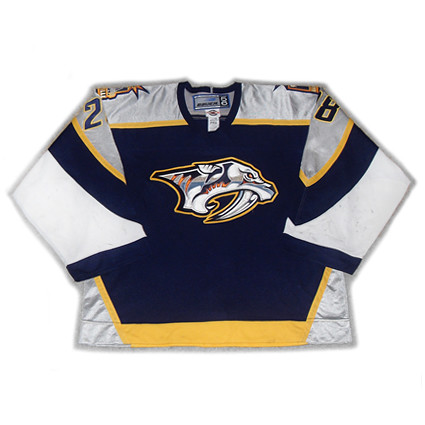
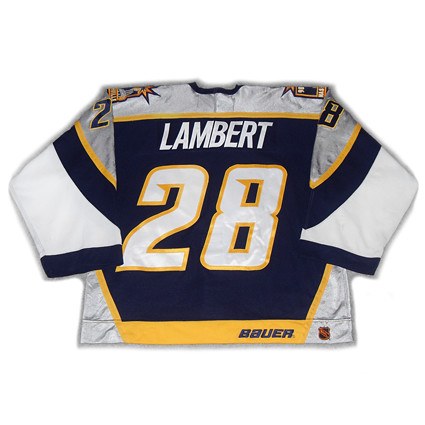
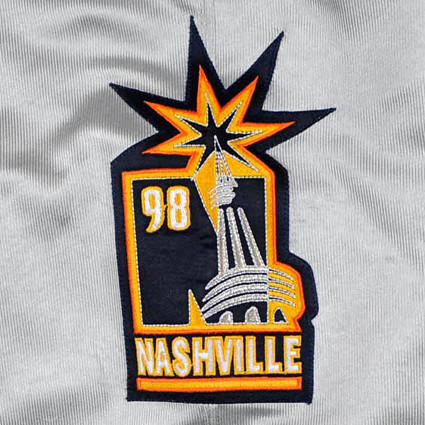
Extra bonus jersey: Today's extra bonus jersey is a 1998-99Nashville Predators Denny Lambert jersey from the Predators first season in the NHL. Two things set the first season Predators jerseys apart from those that would follow. First, the secondary shoulder patch for their first season would have "98" added to the design, as shown below.
Second, the first season Predators jerseys were supplied by Bauer, making them completely unique in the NHL, as six teams were supplied by Nike, nine by CCM and the remaining 11 by Starter. For their second season, Nashville would change to CCM jerseys, leaving the first season Bauer jerseys as an interesting footnotefor collectors.
In today's video section, Lambert does what he does best, as he throws haymakers with PaulKruse of the Salt Lake Golden Eagles during the 1991-92 IHL season.
Next is an interview with Lambert, who recalls his time with the Senators.
July by the Numbers crosses the United States for a stop in sunny San Diego, California for jersey #5.
The name San Diego Gulls dates back to the original Gulls franchise, which played in the Western Hockey League from 1966 to 1974. That franchise met it's demise with the arrival of the San Diego Mariners of the World Hockey Association, but the Mariners lasted just three seasons before folding, one of many teams to fall by the wayside in the unstable WHA.
Professional hockey would return to San Diego in 1990 when the International Hockey League would grant the city an expansion franchise, which would revive the name San Diego Gulls.
The team was reasonably competitive their first season with a 30-45-8 record, but missed out on the playoffs.
Russian import DmitriKvartalnov arrived for the Gulls second season and helped ignite their offense, which scored 67 goals more than the previous season, led by Kvartalnov's league leading 118 points. His 60 goals also led the IHL and were 16 more than his next closest pursuer.
IHL scoring champion Dmitri Kvartalnov
The Gulls roster also boasted future NHLer RayWhitney, former New York Ranger RonDuguay and WayneGretzky's brother KeithGretzky and were led in goal by IHL veteran RickKnickle.
Ray Whitney
The boost in offense resulted in a reversal of their record, finishing the season 45-28-9, a 31 point improvement.
With Kvartalnov off to join the Boston Bruins, the Gulls no longer had the flashy high scorer they enjoyed the previous season, but they roster was also no longer so top heavy in scoring. Their more balanced attack was led by DanielShank's 39 goals and 92 points, which placed him 5th in the league. Former Winnipeg Jet and Buffalo Sabre ScottArniel was second with 35 goals and 83 points, one of six Gulls with over 70 points, compared to three the year before. Knickle again led the way in goal with 33 wins in 41 appearances as the Gulls soared to a league best 62 wins and 132 points, setting not only IHL records, but professional records as well, tying the 132 points by the 1976-77 Montreal Canadiens and holding the victory record outright until it was tied by the 1995-96 Detroit Red Wings.
The club started the season by going 26 games before losing in regulation for the first time and had winning streaks of 8, 9, 11 and 12 games and never lost more than 2 in a row all season under head coach RickDudley. The Gulls were able to load their roster with veteran and experienced players since they were not affiliated with any NHL club eager to have their young prospects developing in the minors. Starting the season with five players who had at least 10 seasons of NHL experience, the club was so dominant that the other IHL owners banded together and passed a rule which required teams to have at least six players with less than three years of professional experience.
As expected, the Gulls swept the Peoria Rivermen and ousted the Kansas City Blades in six to reach the Turner Cup Finals for the only time in their history, but were unceremoniously swept by the Fort Wayne Komets, scoring just 5 goals while giving up a massive 21.
Scott Arneil
The Gulls came back down to earth in 1993-94, winning 42 games while now being coached by former NHLer HaroldSnepsts, their fourth coach in four seasons. Lonnie Loach led the club in scoring with 42 goals and 91 points from 74 games, as he also played three games with the Mighty Ducks of Anaheim that season. The Las Vegas Thunder fell in five games to the Gulls, but they in turn were swept by the Atlanta Knights to put an end to their season.
They slipped to a 37-36-8 record in 1995-96 with HubieMcDonough leading the way with 43 goals and 98 points, 6th in the IHL. AllanBester led the goaltenders with 58 appearances, winning 28, while four other goalies combined to win less than 10. Despite being up 2 games to 1, the Gulls lost the final two games of their best-of-five series, which proved to be the final games for the Gulls.
After finishing third in league attendance in 1992-93 with an average of 7,728, and over 7,100 the following season, the Gulls dropped to 4,660 during their final season as the franchise was then relocated two hours up the coast to Long Beach where they were renamed the Ice Dogs.
Today's featured jersey is a 1990-91 San Diego Gulls Peter Dineen jersey. While the Gulls only lasted five seasons, they left behind a legacy of a striking logo and attractive jerseys of red and black.
Today's video section is some good old IHL hockey from the mid-1990's with fists and mullets as the Gulls and Houston Aeros engage is a battle, which includes current Minnesota Wild head coach MikeYeo, #8 for the Aeros.
Born on this date in 1966, Dimitri Kvartalnov looked for all the world to be on his way to NHL stardom.
Kvartalnov began his career with five full seasons with Khimik Voskresenek of the Soviet League, which included leading the league in scoring in 1989-90 and playing for the Soviet Union in the World Championships twice, winning gold in 1989 and bronze in 1991.
Dimitri, incorrectly identified as his brother Andrei
Kvartalnov then moved to North America and joined the San Diego Gulls of the International Hockey League, where he destroyed the league, scoring 60 goals and 58 assists for 118 points in 77 games. Kvartalnov picked up a trio of awards that season as the Rookie of the Year, Scoring Champion and Most Valuable Player.
IHL scoring champion Kvartalnov
Following his stellar IHL season, the Boston Bruins selected Kvartalnov with the 16th pick in the 1992 NHL Entry Draft.
Already with ten years of pro experience and entering the prime of his career at age 26, his NHL career got off to a record start in 1992 with 12 goals and ten assists to give him points in his first 14 games, a mark that would stand for fifteen years until surpassed by Evgeni Malkin in 2007.
Playing on "The Bonanza Line" of Adam Oates (Adam) and fellow NHL rookie Joe Juneau (Little Joe) and Kvartalnov (Hoss), the line would score nearly a third of the Bruins goals that season, with 107 of the club's 332 for the year. Oates would finish third in league scoring with 142 points and Juneau topped 100 with 102 while setting a record for left wingers with 70. Kvartalnov would amass 30 goals and 42 assists for 72 points in 73 games in his first season and had the look of a future NHL star - at least on the outside.
The Bonanza Line even had their own hockey card
The first sign of trouble was when the Bruins left him unprotected in the expansion draft, and despite his 30 goal season seemingly indicating enormous potential, he went unclaimed. Once the season began, Kvartalnov found himself in coach Brian Sutter's doghouse. Sutter, who had little use for Kvartalnov's apparent one dimensional style of play, left him out of the lineup on many occasions during his second season. After 39 games, in which he scored just 19 points, half the pace of a year before, and with a -9 rating, Kvartalnov was placed on waivers and eventually demoted to Providence of the AHL. There he was back to a point a game, but his time with the Bruins and North America was over at the conclusion of the season.
His career was far from over however.
Kvartalnov would move to Switzerland and play three seasons with HC Ambri-Piotta, finishing third in league scoring in 1995-96 and leading the team in scoring in 1996-97.
Kvartalnov back in Europe with HC Ambri-Piotta
Klagenfurt AC in Austria was his next stop, where he would play for three seasons which included leading the team in scoring with 72 points in 45 games in 1997-98.
He would split the 1999-00 season between the Manheim Eagles in Germany and Jokerit Helsinki in Finland.
The following season he would return to Russia, joining Ak Bars Kazan where he would play for four seasons and lead them in scoring twice. 2004-05 saw a move to Cherepovets Severstal and then a return to Khimik for six games. He would play the 2005-06 season with Krylja Sovetov (Soviet Wings) in the lower division, helping them regain a place in the top league for 2006-07. Half way through the season Kryla would deal Kvartalnov back to Cherepovets, and he would retire at the conclusion of the season after a 24 year professional career in which he would score a total of 509 goals and 474 assists for 983 points. Kvartalnov has subsequently gone into coaching and has led Severstal Cherepovets for three seasons before joining Sibir Novosibirsk.
Today's featured jersey is a 1989-90 Khimik Voskresenek Dimitri Kvartalnov jersey as worn by Kvartalnov when he was the leading scorer in the Soviet League. It's typical of the Soviet jerseys of the era in that it is a relatively lightweight mesh and all the elements are either dye sublimated or screened on. Of note are the wild numbers on the back, reminding us of the 1982 movie "TRON". This jersey also has Dimitri's first initial "D" on the back in Cyrillic, as his brother Andrei was also a member of the team. The shape of the Cyrillic "D" likely led to the confusion and his being identified on his O-Pee-Chee hockey card as Andrei.
We obtained this jersey from a member of the Khimik traveling party during a game at Met Center in Bloomington, Minnesota when Khimik was playing a game in the Super Series against the Minnesota North Stars. Having no real idea who the players on the club were at the time, and being given our choice of a few different jerseys, we opted for the one with the longest name simply because it looked the most "Soviet". Only later when we decoded the Cyrillic lettering did we realize we had unknowingly obtained the jersey from the Soviet League's leading scorer from the prior season!
Bonus jersey: Today's bonus jersey is a 1991-92 San Diego Gulls Dimitri Kvartalnov jersey. version of the Gulls played in the IHL from 1990-91 to 1994-95 before moving north to become the Los Angeles Ice Dogs for one season prior to becoming the Long Beach Ice Dogs. The Gulls wore the same striking black and red jerseys for their entire run in San Diego and are easily our favorites of any of the four teams to have used the San Diego Gulls name.
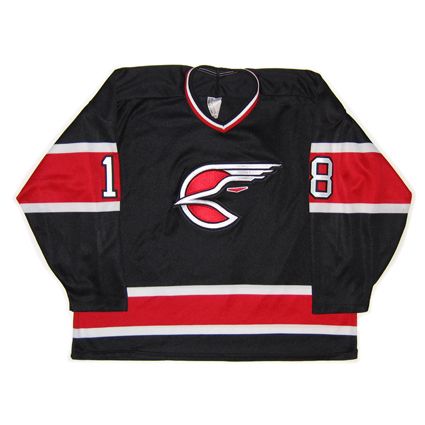
Extra bonus jersey: Today's extra bonus jersey is a 1993-94 Boston Bruins Dimitri Kvartalnov jersey. As well as obtaining Kvartalnov's game worn Khimik jersey, we later acquired his Bruins road jersey from his second season in the NHL. When paired with our Khimik jersey from the Soviet League, we like to call it our "Ultimate Home and Away Jerseys".
In today's video section, you cannot defend passing this good. You just can't.
Next, Kvartalnov picks up a rolling puck and shows his soft hands as he stickhandles his way to a nifty goal against the Hartford Whalers.
Next, Kvartalnov receives a laser pass from the playmaker Oates and, showing the good skills with his skates many European hockey players have from growing up playing soccer, gets the puck up to his stick and scores against the Washington Capitals Olaf Kolzig.
Finally, we present you with the theme song to the TV series Bonanza, from where the Bruins Bonanza Line of Oates, Juneau and Kvartalnov got their name.
Born on this date in 1970, DennyLambert played three seasons with the Sault Ste. Marie Greyhounds of the Ontario Hockey League from 1988-89 to 1990-91, which was his best season with 28 goals and 67 points. Undrafted, Lambert signed with the San Diego Gulls of the International Hockey League for the 1991-92 season. He would play four seasons with the Gulls, including the Gulls finest season when they made it to the Turner Cup Finals in 1993. While with the Gulls, he would average 260 penalty minutes a season, with a high of 314 in 1993-94, third in the league by less than 10 minutes.
Lambert had a fine 1994-95 season, scoring 25 goals and 60 points, double his average from the previous three seasons, which caught the attention of the Mighty Ducks of Anaheim, who signed him for the remainder of the season, which made for a long year for Lambert, as combined he played in 88 regular season games that season, which must rank as one of the highest totals ever. Lambert scored his first NHL goal that season on his way to 4 points He split the following season between the Baltimore Bandits of the American Hockey League and the Mighty Ducks, playing 44 games with Baltimore and 33 with Anaheim. For the 1996-97 season, Lambert was signed by the Ottawa Senators as a free agent, playing 80 games his first season and another 72 games in 1997-98, setting a NHL high of 250 penalty minutes that season, as well as scoring a career best 9 goals.
Now established as a full-time NHLer, Lambert was chosen by the Nashville Predators in the 1998 NHL Expansion Draft, where he would play the entire 1998-99 season.
Lambert battles Kelly Chase while with the Predators
Lambert was then traded to another new expansion club, the first year Atlanta Thrashers for the 1999-00 season, where he would play for two seasons.
It was back to Anaheim for the 2001-02 season for his second stint with the Mighty Ducks. There Lambert yet again finished with between 213 and 219 penalty minutes for the fifth time in six seasons, with only his 250 minutes in 1997-98 tampering with his amazing consistency. Lambert wrapped up his career with the Milwaukee Admirals of the AHL in 2002-03 before retiring as a player. After some time as an assistant, Lambert would become head coach of the Soo Greyhounds, his junior club, for three seasons from 2008 to 2011. Today's featured jersey is a 1991-92 San Diego Gulls Denny Lambert jersey. This iteration of the Gulls were members of the IHL for five seasons, a team name that dates back to a previous Western Hockey League franchise which began play in the mid 1960's. After their five seasons in San Diego, the IHL franchise relocated up the coast to become the Long Beach Ice Dogs, and were immediately replaced by a new franchise in the WHL, also known as the Gulls. Their membership would become part of the ECHL and last through 2006. Two seasons later, the San Diego Gulls name would once again resurface, now used by a Junior A team in the Western States Hockey League, now the fourth franchise to use the Gulls name in San Diego! The Gulls stellar 1992-93 season saw them finish with a 62-12-8 record for a league record 132 points, but fell short in the finals. Notable players for the Gulls were RonDugay, GlenHanlon, Charlie Simmer, RayWhitney, SeanBurke, LindyRuff and IHL scoring champion Dimitri Kvartalnov. While the Gulls history was a brief one, they left behind a legacy of attractive jerseys with classic styling and a very sharp logo.
In today's video section, Lambert does what he does best, as he throws haymakers with PaulKruse of the Salt Lake Golden Eagles during the 1991-92 IHL season.
July by the Numbers crosses the United States for a stop in sunny San Diego, California for jersey #5.
The name San Diego Gulls dates back to the original Gulls franchise, which played in the Western Hockey League from 1966 to 1974. That franchise met it's demise with the arrival of the San Diego Mariners of the World Hockey Association, but the Mariners lasted just three seasons before folding, one of many teams to fall by the wayside in the unstable WHA.
Professional hockey would return to San Diego in 1990 when the International Hockey League would grant the city an expansion franchise, which would revive the name San Diego Gulls.
The team was reasonably competitive their first season with a 30-45-8 record, but missed out on the playoffs.
Russian import DmitriKvartalnov arrived for the Gulls second season and helped ignite their offense, which scored 67 goals more than the previous season, led by Kvartalnov's league leading 118 points. His 60 goals also led the IHL and were 16 more than his next closest pursuer.
IHL scoring champion Dmitri Kvartalnov
The Gulls roster also boasted future NHLer RayWhitney, former New York Ranger RonDuguay and WayneGretzky's brother KeithGretzky and were led in goal by IHL veteran RickKnickle.
Ray Whitney
The boost in offense resulted in a reversal of their record, finishing the season 45-28-9, a 31 point improvement.
With Kvartalnov off to join the Boston Bruins, the Gulls no longer had the flashy high scorer they enjoyed the previous season, but they roster was also no longer so top heavy in scoring. Their more balanced attack was led by DanielShank's 39 goals and 92 points, which placed him 5th in the league. Former Winnipeg Jet and Buffalo Sabre ScottArniel was second with 35 goals and 83 points, one of six Gulls with over 70 points, compared to three the year before. Knickle again led the way in goal with 33 wins in 41 appearances as the Gulls soared to a league best 62 wins and 132 points, setting not only IHL records, but professional records as well, tying the 132 points by the 1976-77 Montreal Canadiens and holding the victory record outright until it was tied by the 1995-96 Detroit Red Wings.
The club started the season by going 26 games before losing in regulation for the first time and had winning streaks of 8, 9, 11 and 12 games and never lost more than 2 in a row all season under head coach RickDudley. The Gulls were able to load their roster with veteran and experienced players since they were not affiliated with any NHL club eager to have their young prospects developing in the minors. Starting the season with five players who had at least 10 seasons of NHL experience, the club was so dominant that the other IHL owners banded together and passed a rule which required teams to have at least six players with less than three years of professional experience.
As expected, the Gulls swept the Peoria Rivermen and ousted the Kansas City Blades in six to reach the Turner Cup Finals for the only time in their history, but were unceremoniously swept by the Fort Wayne Komets, scoring just 5 goals while giving up a massive 21.
Scott Arneil
The Gulls came back down to earth in 1993-94, winning 42 games while now being coached by former NHLer HaroldSnepsts, their fourth coach in four seasons. Lonnie Loach led the club in scoring with 42 goals and 91 points from 74 games, as he also played three games with the Mighty Ducks of Anaheim that season. The Las Vegas Thunder fell in five games to the Gulls, but they in turn were swept by the Atlanta Knights to put an end to their season.
They slipped to a 37-36-8 record in 1995-96 with HubieMcDonough leading the way with 43 goals and 98 points, 6th in the IHL. AllanBester led the goaltenders with 58 appearances, winning 28, while four other goalies combined to win less than 10. Despite being up 2 games to 1, the Gulls lost the final two games of their best-of-five series, which proved to be the final games for the Gulls.
After finishing third in league attendance in 1992-93 with an average of 7,728, and over 7,100 the following season, the Gulls dropped to 4,660 during their final season as the franchise was then relocated two hours up the coast to Long Beach where they were renamed the Ice Dogs.
Today's featured jersey is a 1990-91 San Diego Gulls Peter Dineen jersey. While the Gulls only lasted five seasons, they left behind a legacy of a striking logo and attractive jerseys of red and black.
Today's video section is some good old IHL hockey from the mid-1990's with fists and mullets as the Gulls and Houston Aeros engage is a battle, which includes current Minnesota Wild head coach MikeYeo, #8 for the Aeros.
Third String Goalie - The Hockey Jersey of the Day Blog
"Sweater" for all my Canadian friends!
Welcome!
Welcome to our end of the rink.
Bienvenue sur notre bout de la patinoire.
So why "Third String Goalie"?
It's defined as "A fan who sits in the stands wearing a jersey."
If that's not us, we don't know what is...
Our aim is to feature a different jersey each day from a historical perspective. Stay tuned and hopefully you'll see some jerseys of interest or perhaps some that you haven't seen before and learn a bit of hockey history along the way.
In addition to our articles, be sure to scroll down this column and explore the other fun and informative features of this blog.
If you have any suggestions or comments, feel free to contact us at:
Looking to reach our loyal readers with your hockey related product or service? Of our hundreds of readers each day, 60% are located in the United States and 30% come from Canada. Our audience is your audience and you can target them now with our reasonable ad rates.
We've been linked to by SI.com, ESPN.com, Uni-Watch.com, NBCSports.com and the Yahoo! Sports Puck Daddy blog among others.
There is no limitation to what kind of hockey jersey it can be - replica, authentic or game worn jersey from the NHL, a national team, the minors, juniors, college, high school or even your pond hockey jersey.
Feel free to write a paragraph or two about the jersey telling us why you like the jersey, how you got it, what makes it special to you or even a full-blownThird String Goalie-style history lesson - whatever you feel like sharing.
Visting from outside North America? Just select your preferred language and Third String Goalie will be instantly converted to your language of choice!