History of Jersey 83-93 Banner sm photo History of Jersey 83-93 Banner sm.jpg
Showing posts with label Tkachuk Keith. Show all posts

Tuesday, March 28, 2017

The 1992-93 Winnipeg Jets Rookie Goal Scoring Records - 1992-93 Winnipeg Jets Teemu Selanne Jerseys

The Winnipeg Jets finished the 1991-92 season in fourth place in the Smythe Division with a record of 33-32-15, good for 81 points while scoring 251 goals for and allowing 244, third best in the NHL.

The team was led in scoring by defenseman Phil Housley, who had 23 goals and 63 assists for 86 points, 21 more than their highest scoring forward, Ed Olczyk, who led the team with 32 goals on his way to 65 points.

The Jets were paired with the Vancouver Canucks in the first round of the playoffs. The Jets won the opening game on the road 3-2, but then lost the next one in Vancouver by the same 3-2 score. The Jets then put the Canucks on the brink of elimination by taking Games 3 and 4 back at home, 4-2 and 3-1. Vancouver stayed alive by hammering Winnipeg 8-2 back at home and then forced a Game 7 with another thrashing of the Jets 8-2 in Game 6. Demoralized, the Jets went out with a whimper when the Canucks whitewashed them 5-0 in Game 7 in British Columbia.

One of the first moves the Jets made for the 1992-93 season was to trade their 12th and 36th overall picks in the 1992 NHL Entry Draft to the Chicago Blackhawks for Chicago's 17th and 27th overall selections. With the 17th pick, the Jets took Russian Sergei Bautin, a defenseman from Dynamo Moscow, fresh of three consecutive Soviet championships.
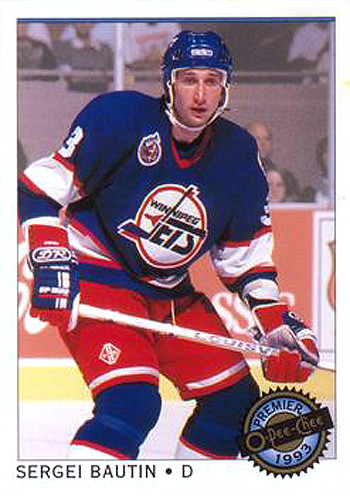
Bautin Jets
The Jets 1992 first round draft pick, Sergei Bautin

With their 27th pick, third in Round Two, the Jets took another Russian fellow defenseman Boris Mironov from the CSKA Red Army club. In the true spirit of a sleeper pick, with the 204th selection in Round Nine, Winnipeg found a gem in goaltender, and yet another Russian, Nikolai Khabibulin, also from CSKA Moscow. Khabibulin would be the latest selection in the 1992 draft to go on to be an NHL All-Star, 87 picks later than the next closest future All-Star. In all, the Jets took seven Russians, an American, a Canadian, a Ukrainian, a Kazakh and a Finn.

An Olympic gold medalist, Bautin would make the Jets roster out of training camp and play in 71 games during the 1992-93 season.

Also joining the Jets for the 1992-93 season was Russian forward Alexei Zhamnov, who was coming off of four seasons as Bautin's teammate at Dynamo Moscow and a fellow gold medalist at the 1992 Albertville Olympics.
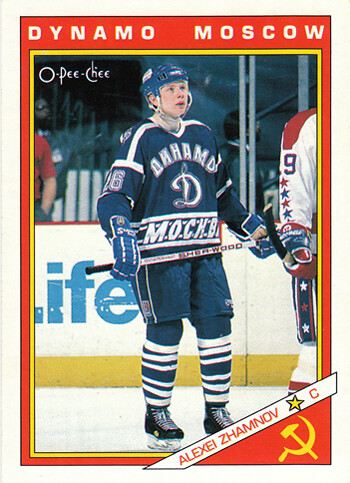
Zhamnov Dynamo
Zhamnov came to the Jets from Dynamo Moscow

The one name who would go on to have easily the most impact on the Jets 1992-93 season was 1988 draft pick, Teemu Selanne of Finland's Jokerit Helsinki. Selanne had caught the eyes of the Jets scouts with a 43 goal, 66 point season in 33 games of Jokerit's Junior A program, which concluded with a championship. Winnipeg's organizational philosophy was to allow their European draft picks to develop in their native countries, and by 1991 were working to bring him to North America.
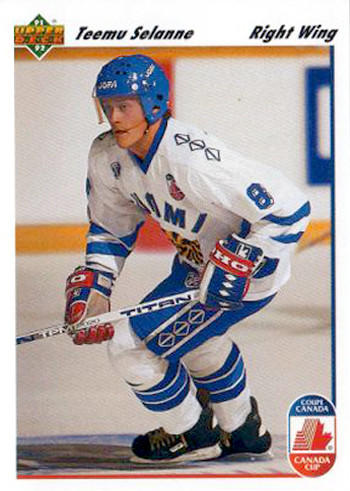
Selanne Finland
Teemu Selanne at the 1991 Canada Cup

As Selanne had not yet signed a contract with the Jets, he was considered a restricted free agent, which led to the Calgary Flames signing him to a three year, $2.7 million offer sheet, $1.5 million more than the Jets had offered the Finn. Worried about paying such a high salary to a rookie, Winnipeg nevertheless exercised their right to match Calgary's offer and Selanne made his NHL debut with a pair of assists on October 6, 1992, scoring his first goal two nights later.

In addition to Selanne, Zhamnov and Bautin, other members of the Jets eligible for the Calder Trophy as NHL Rookie of the Year were 1988 draft pick Evgeny Davydov, another Russian from CSKA Moscow and 1990 selection, American Keith Tkachuk of Boston University. Both Davydov and Tkachuk had played with the Jets the prior season, but were both under the 25 game limit which maintained their rookie status for 1992-93. Tkachuk had seen action in 17 games, while Davydov played in 12.
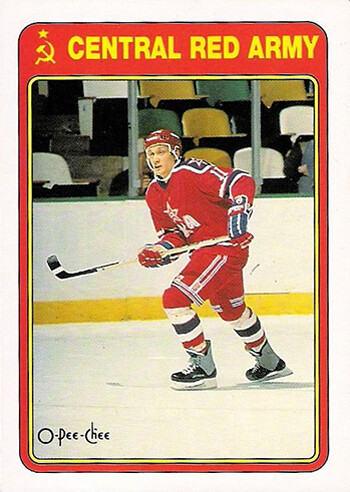
Davydov CSKA
Evgeny Davydov was a member of the powerful Red Army club
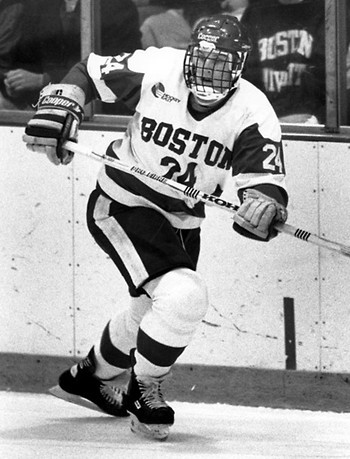
Tkachuk Boston University
American Keith Tkachuk while at Boston University

Selanne, coming off a 39 goal season with Jokerit in 44 games, wasted little time making his presence known in the NHL, scored his first career hat-trick in his fifth game and produced 11 goals in his first 12. Selanne hit the 20 goal mark in December 11th in style during 8-6 loss to the Washington Capitals and added his 21st goal a little over five minutes later and completed his hat trick just 40 seconds into the second period.

Selanne reached the 30 goal plateau on January 2nd when he scored his second goal of the night at the 14:50 mark of the third period against the New Jersey Devils Chris Terreri.

Davydov was the next to reach the 20 goal mark on January 22nd with an assist from Stu Barnes on when he beat Calgary's Mike Vernon at 10:52 of the third period during a 4-4 tie.
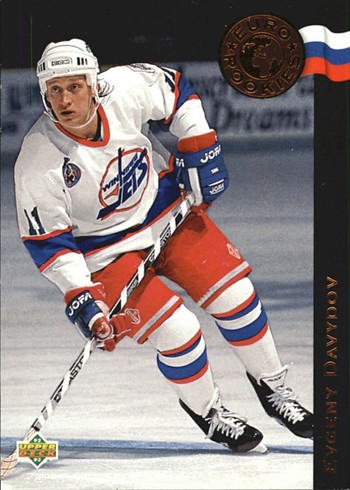
Davydov Jets
Davydov was the second Jets rookie to 20 goals

By the end of January the Finn Selanne was the talk of hockey world as he reached the 40 goal mark on January 30th in a 6-3 win over the Hartford Whalers.

On the final day of February, Selanne put on a spectacular display when he scored goals 48, 49, 50 and 51 in a four goal romp against the Minnesota North Stars and goaltender Darcy Wakuluk in a 7-6 Jets win.

During Winnipeg's next game on March 2nd, it was Tkachuk's turn to make it to the 20 goal level when he beat the Quebec Nordiques Stephane Fiset on a power play 1:26 into the third period with assists from Housely and Barnes.
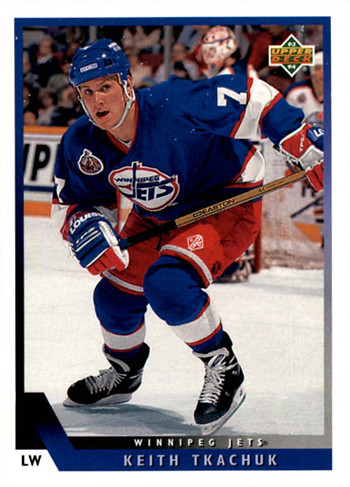
Tkachuk Jets
Tkacuk's 20th goal was overshadowed by Selanne's record breaking hat trick

Tkachuk's accomplishment was completely overshadowed that night by the spectacular Selanne though, as the Finnish Flash recorded a second consecutive hat trick with goals 52, 53 and 54 to surpass Mike Bossy's NHL rookie goal scoring record of 53.


Selanne surpassed 60 goals on March 14th versus the Tampa Bay Lighting with two first period goals against Pat Jablonski to put him at 61. On March 23rd, the Finn netted goals 66 and 67 plus an assist of Zhamnov's 18th goal of the season to give him 110 points, breaking Peter Stastny's NHL rookie points record.
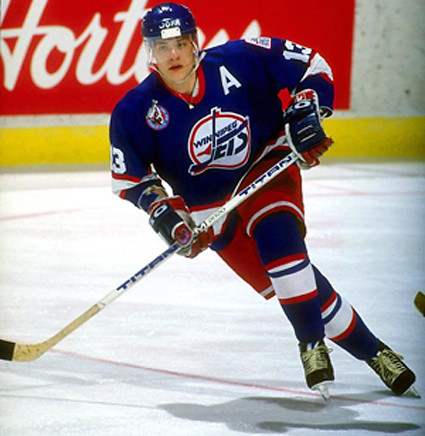
Selanne Jets
Selanne set rookie records for goals and points in 1992-93

During the Jets next game, Zhamnov scored his 19th goal against the St. Louis Blues and then, on this date in 1993, Zhamnov got his 20th goal of the season, beating the Los Angeles Kings Robb Stauber with just five seconds left in regulation from Selanne and Tkachuk to tie the game at 3-3.
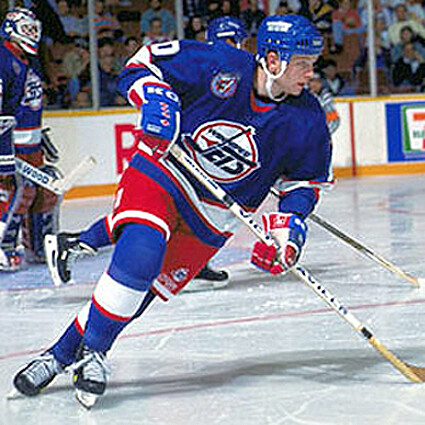
Zhamnov Jets
Zhamnov scored his 20th goal on this date in 1993

Zhamnov's 20th goal, joining Selanne, Davydov and Tkachuk with at least 20 goals each, made the Winnipeg Jets the first team in NHL history with four 20-goal rookie scorers.

Selanne would finish with a league leading 76 goals while leading the Jets in scoring with 132 points, both rookie records which stand to this day, and was awarded a much deserved Calder Trophy as the NHL Rookie of the Year. Zhamnov was third on the team in points behind Housley's 97, scoring 25 goals and 47 assists for 72 points while Tkachuk and Davydov had 28 goals apiece, with Tkachuk finishing with 51 points and Davydov 49.

Of note, veterans Thomas Steen with 22 goals and Darrin Shannon at 20 would join the spectacular rookie quartet with 20 or more goals for Winnipeg that season.

The Jets would score 322 goals that season, 71 more than the previous season thanks in no small part to Selanne's exploits. Unfortunately, their goals against would rise by 76 and the Jets would once again be eliminated in the first round of the playoffs, bowing to the Canucks again, this time in six games.

Zhamnov would play four seasons for the Jets with a high of 30 goals until being traded to Chicago. 1992-93 would be Davydov's last with Winnipeg, as he was dealt to the Florida Panthers prior to the following season.

Tkachuk would play five seasons in Winnipeg with a high of 50 goals in 1995-96 on his way to 98 points and would be named team captain in 1993. He would move with the franchise when they relocated and became the Phoenix Coyotes for the 1996-97 season during which he led the NHL in goals with a career high 52. He was again named team captain in 1996 and remained with the franchise for five seasons in Arizona. He would eventually score 500 goals, 1,000 points and play in over 1,000 games.

Selanne would play three more seasons for Winnipeg, never scoring more than 25 goals before a cost cutting trade sent him to the Mighty Ducks of Anaheim. After a lengthy NHL career, Selanne would finish with 684 goals and 1,457 points in 1,451 games played. He led the NHL in goal scoring again in both 1998 and 1999 and won a Stanley Cup in 2007.
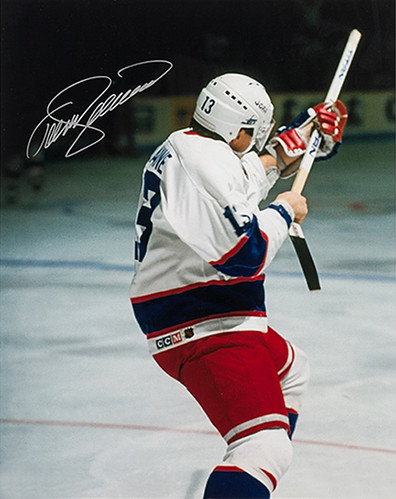
Selanne Jets Rookie Record
Selanne's memorable trap shooting celebration after
breaking Bossy's rookie goal scoring record

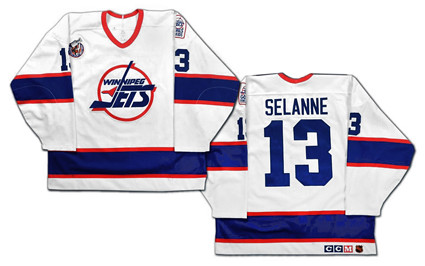
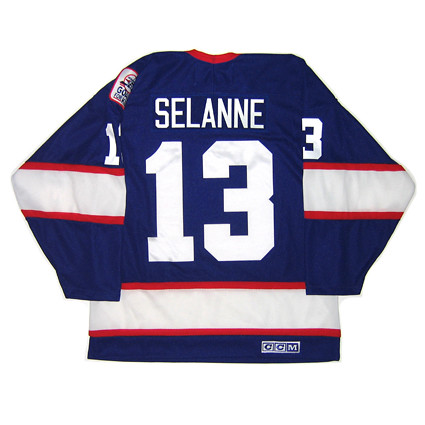
Today's featured jersey is a 1992-93 Winnipeg Jets Teemu Selanne jerseys as worn the the season Selanne shattered the NHL rookie goal scoring and points record. Selanne entered the NHL wearing #13 for his first season, as Randy Carlisle was wearing his preferred #8. After Carlisle's departure after Selanne's rookie season, he subsequently changed to #8 for the remainder of his time in Winnipeg.

The Jets were formed as a founding member of the World Hockey Association in 1972-73 and made the move to the NHL for the 1979-80 season. They introduced today's feature style jersey for the 1990-91 season and wore it until the franchise moved out of Winnipeg after the 1995-96 season.

The Jets were responsible for one of the oddities concerning the Stanley Cup Centennial patch worn by all the players that season, as, for the first half of the schedule, Winnipeg wore a set of jerseys which had the white outline around their patches like the rest of the league, but for the second half of the season the white outlines vanished and they were the only team to not have the outline around their patches, which did not help them stand out from the jerseys like they did previously.

Selanne did not have the A on the first set of jerseys from the first half of the season where the white outlined patches were worn and did wear the assistant captain's "A" with the version of the patch that lacked the white outline for the season's second half, but there are photos showing Selanne with the borderless patch prior to being awarded the "A".
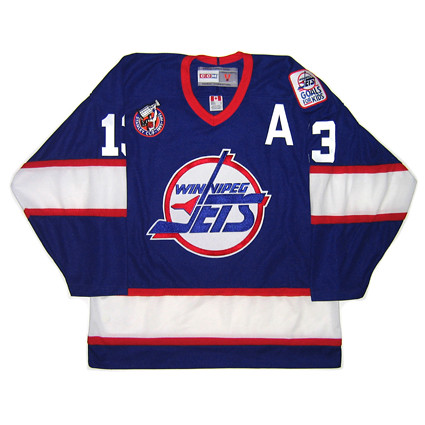
Winnipeg Jets 1992-93 F
Winnipeg Jets 1992-93 B

Winnipeg Jets 1992-93 home jersey
photo courtesy of Classic Auctions

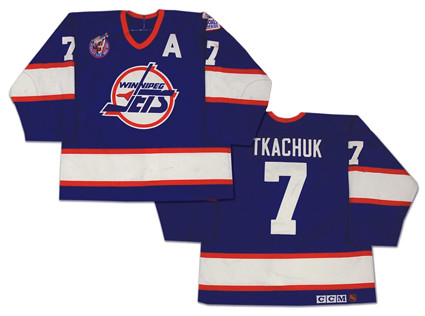
Bonus jersey: Today's bonus jersey is a 1992-93 Winnipeg Jets Keith Tkachuk jersey as worn the the season Tkachuk was one of four Jets rookies to reach the 20 goal mark, making Winnipeg the first team in NHL history with four 20 goal rookies.

Winnipeg Jets 1992-93 road jersey
photo courtesy of Classic Auctions

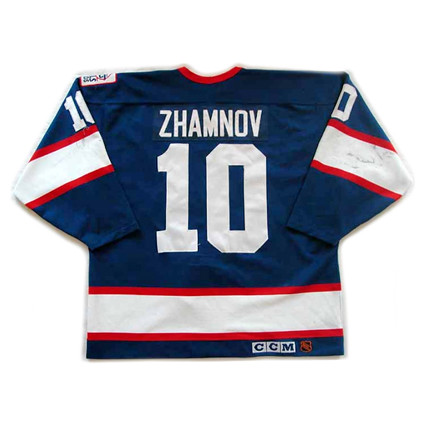
Extra bonus jersey: Today's extra bonus jersey is a 1994-95 Winnipeg Jets Alexei Zhamnov jersey as worn the the season Zhamnov set a career high with 30 goals. 
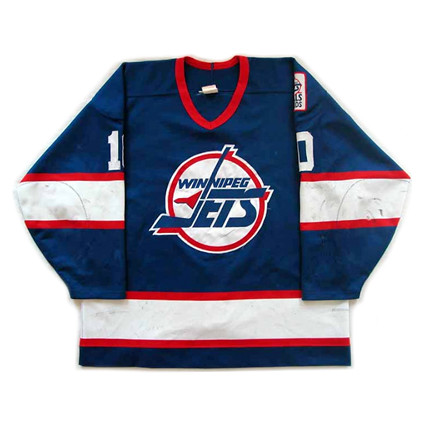
Winnipeg Jets 1993-94 F jersey
Winnipeg Jets 1993-94 B jersey

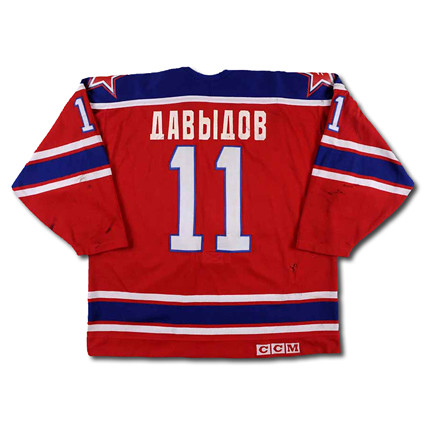
Extra extra bonus jersey: Today's extra extra bonus jersey is a 1990-91 CSKA Moscow Evgeny Davydov jersey as worn during Davydov's final season in the Soviet Union prior to coming to the NHL. Davydov won three Soviet championships with the Red Army club in 1987, 1988 and 1989.

Unlike many of the sometimes paper thin mesh Soviet jerseys of the era with silkscreened or heat sealed graphics, this Red Army jersey is a top of the line, Canadian-made CCM jersey produced to the same standards as one would find in the NHL and very likely produced for use in the 1989, 1990 or 1991 Super Series which then had the English nameplates removed and Cyrillic names screened on as they were converted for use back home in the Soviet League.
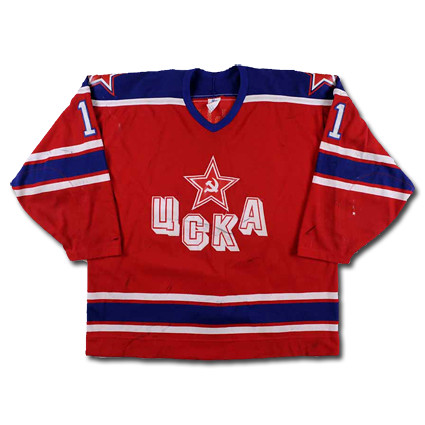
CSKA 1990-91 F jersey
CSKA 1990-91 B jersey

Extra extra extra bonus jersey: Today's extra extra extra bonus jersey is a 1992 Unified Team Evgeny Davydov jersey as worn during the 1992 Winter Olympics in Albertville, France. With the upheaval of the political situation in the Soviet Union in 1991, there was little time to sort out what kind of identity the brand new team made up of six of the 15 former Soviet republics would be represented by.
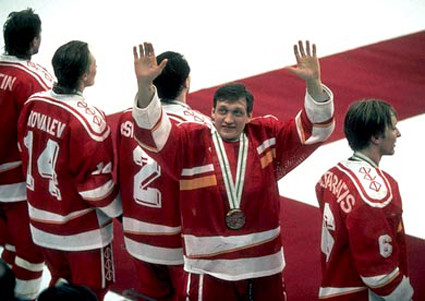
The Unified Team competed under the Olympic flag, and with just five weeks before the games were to commence, the jersey supplier to all the Olympic teams, Tackla of Finland, made up a set of the current Soviet Union jerseys, only without the "CCCP" lettering across the chest. Note they did not even alter the chest stripes, which were still notched on the left hand side for the curvature of the absent "P"!

92-unified-team-davydov
Davydov waving to the crowd during the 1992 gold medal ceremony

This was the one and only appearance for these stop-gap jerseys, as Russia wore a brand new set of jerseys at the 1992 World Championships held just two months later in April as an independent nation, separate from the other five countries of the Unified Team.
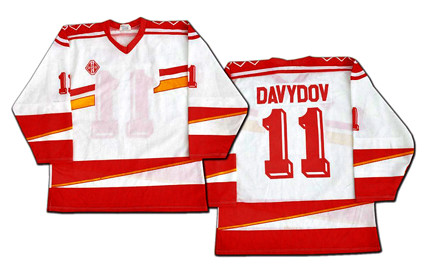
1992 Unified Team Davydov jersey
photo courtesy of Classic Auctions

Today's video section is all about Selanne's magical rookie season in 1992-93.


Thursday, April 28, 2016

1995-96 Winnipeg Jets Keith Tkachuk Jersey

The late, great original Winnipeg Jets were formed in 1972 as one of the founding teams of the World Hockey Association, which brought professional hockey to several Canadian cities, including Winnipeg, Ottawa, Quebec City, Edmonton and later Toronto, Vancouver and Calgary.

The Jets would make the biggest splash in the league by luring away Bobby Hull from the NHL's Chicago Black Hawks for the unheard of sum of $1,000,000, putting the fledgling league on the map.

Photobucket

Their first season of 1972-73 saw them finish first in the Western Division and make it all the way to the Avco Cup Finals where they would fall to the New England Whalers. While they would fail to qualify for the playoffs the next two seasons, they would set themselves up to be one of the most exciting teams in all of hockey for the next four years by signing Swedes Anders Hedberg and Ulf Nilsson.

Photobucket

The duo, paired with Hull, would electrify the franchise as they finished second, fourth and seventh in league scoring in just their first season together as Hull set a new professional record with 77 goals, although the club failed to qualify for the playoffs.

1975-76 was the season it all came together for the Jets. They tied the Houston Aeros for the most points in the league with 106 as Hull, Nilsson and Hedberg finished second, third and seventh in league scoring. Once in the playoffs they cruised through the Edmonton Oilers 4-0, the Calgary Cowboys 4-1 and swept the Aeros in the finals in four straight to capture their first WHA championship.

Winnipeg Jets 75-76

While Hull only played in 34 games in 1976-77, Hedberg led the league in goals with 70 as he and Nilsson came two-three in the scoring race. The Jets returned to the Avco Cup Finals but fell to the Quebec Nordiques in seven games.

Hull returned to full-time duty in 1977-78 and the dynamic trio finished with Nilsson, Hedberg and Hull 2-3-4 in scoring, with teammate Kent Nilsson eighth. The Jets finished atop the league standings and defeated the Birmingham Bulls and New England Whalers to take home the championship for the second time.

Winnipeg Jets 77-78

1978-79 was one of change for the Jets, as Hull would only compete in four games and Hedberg and Nilsson would defect for the bright lights of Broadway when they signed to play for the New York Rangers of the NHL.

Still, the remainder of the Jets would pull through, coming in third in the regular season standings in the final WHA season, but defeat both the Nordiques and then the Oilers to win their second consecutive Avco Cup and their third overall as they went to the league finals for the fifth time in seven seasons.

Winnipeg Jets 78-79

The Jets, along with New England (Hartford), Edmonton and Quebec were admitted into the NHL for the 1979-80 season, but at a steep price. The restrictive rules placed on the renegade clubs joining the NHL saw the Jets required to relinquish leading scorer Kent Nilsson, Terry Ruskowski (4th in scoring) and Rich Preston (6th). In addition, leading scorer among defensmen Barry Long was also gone from the roster. Forced to draft 18th out of 21, the Jets would finish dead last in the NHL for the next two seasons.

Acquiring Dale Hawerchuk in the 1981 draft started the Jets back on the road to respectability. Eventually the Jets would claim fourth overall in the league in 1984-85, but were doomed by finding themselves in the same division with league powerhouses Edmonton and the Calgary Flames. With the current divisional playoff format of the time, the Jets were forced to face the Oilers at the height of their dynasty no less than six times in the eight seasons between 1983 and 1990, losing each and every series while winning a total of only four games as the Oilers went on to win five Stanley Cups and the Flames one during that time period.

While the Jets playoff success in the NHL was derailed by the Oilers dynasty, one enduring memory is the "White Out", which arrived in the 1987 playoffs when the Jets asked fans to wear white to home playoff games in response to the Flames "C of Red". Following their four game sweep of Calgary that season, a tradition was born which the franchise continues to employ to this day.


While they were a competitive club on the ice, it became increasingly difficult for the Jets to compete financially, being the fourth smallest market in the NHL (pop. 675,000 and about the size as Omaha, Nebraska), and hampered by playing in the Winnipeg Arena which opened in 1955 and lacked the modern amenities such as luxury boxes and club seating required to keep pace in the modern sports landscape.

They tried to remain competitive, including trading Hawerchuk to Buffalo in 1990 for Phil Housley, Scott Arniel, Jeff Parker and a draft pick which would become Keith Tkachuk.

1992-93 saw the arrival of Russian Alexi Zhamnov, the bruising Tie Domi and the dynamic Finn Teemu Selanne, who would electrify the city with 76 goals as a rookie.

Teemu Selanne

Still, playoff success eluded the Jets and they slipped in the standings, completely missing out on the playoffs in 1994 and 1995.

With the weaker Canadian dollar of the day hurting the franchise financially, eventually the push for a new arena began, which was eventually unsuccessful, making the owners of the club willing to sell the team they viewed as inviable. When it proved impossible to find a local buyer, the owners announced their intention in May of 1995 to sell the club to buyers from outside of Winnipeg, who would inevitably move the team.

The fans of Winnipeg rallied in a way never seen before or since. The "Save the Jets" rally at The Forks on May 16, 1995 drew over 35,000 people in an effort to raise funds to purchase the franchise. While an astonishing outpouring generated a reported $13 million, it fell far short of the over $110 million required and it was announced on October 18, 1995 that the team had been sold to Americans Richard Burke and Steven Gluckstern, who had originally hoped to move the club to the Twin Cities of Minneapolis and St. Paul, Minnesota, and with the Jets eventually landing in the most unlikely of places, in the desert of Phoenix, Arizona.

Still, the Jets would play one final season in Winnipeg before any relocation was to happen. Morale among the fans only deteriorated further when Selanne, who won over the hearts of Winnipeggers with his scoring exploits and personality is sent to the Mighty Ducks of Anaheim in February of 1996 in a salary dump. For a city about to lose it's franchise, having it's most beloved player since Bobby Hull miss the going away party was a real kick in the stomach.

A rise in the standings in 1995-96 saw the lame duck Jets qualify for the playoffs on the final day of the season to put the moving vans on hold for as long as the team could last in the postseason. Paired against the Red Wings in the playoffs, Detroit took the first to games at home while the Jets responded by winning Game 3 at home. Detroit then won at Winnipeg to put the Jets on the brink, but they staved off elimination with a 3-1 win in Detroit to return home to Winnipeg, but the end came for the Jets with a 4-1 loss in their final game on this date in 1996.

Today's featured jersey is a 1995-96 Winnipeg Jets Keith Tkachuk jersey as worn in the final game in Jets history, a loss at home which eliminated the Jets from the playoffs for a final time. This jersey features the Cherished Memories worn during the final ten games in Jets history plus their playoff series versus Detroit. There was also a blue version worn on the road jerseys.

Tkachuk wore the captain's "C" for that game, as regular team captain that season Kris King was out of action with an injury.

Winnipeg Jets 1995-96 jersey photo WinnipegJets95-96F.jpg
Winnipeg Jets 1995-96 jersey photo WinnipegJets95-96B.jpg
Winnipeg Jets 1995-96 jersey photo WinnipegJets95-96P1.jpgaaWinnipeg Jets 1995-96 jersey photo WinnipegJets95-96P2.jpg

Apologies in advance for more video today than you can shake a hockey stick at, but we felt it was all relevant and worth including.

Most importantly, one of our favorite hockey videos ever. At an hour long, it's a lot to ask of our readers accustomed to our usual brief videos, but ladies and gentlemen, we present to you the genius that is "Death by Popcorn - The Tragedy of the Winnipeg Jets".

Not recommended for those of you at work due to it's length and a couple of unfortunate rough spots in the language from the Oilers jersey wearing "man on the street" 10 and 34 minutes into the video, but it's essential viewing if only for Hawerchuk's speech on the occasion of his induction into the Hockey Hall of Fame.


Next, the announcement in May, 1995 following the end of the 1994-95 season that the efforts to save the Jets have failed and the franchise will be relocated.


Now, "The Funeral", a 90 minute farewell gathering at the Winnipeg Arena to say goodbye at the conclusion of the 1994-95 season to the team and retire Thomas Steen's #25 on May 6, 1995 (in ten parts), which inspired the "Save the Jets" fundraising campaign and gathering of 35,000 fans ten days later in Winnipeg.


Here is a news report, first on the plight of the Quebec Nordiques, and then a look at public efforts to save the Jets by raising enough money to purchase the team to prevent the current ownership from moving the team, which would ultimately fail. The Nordiques would in fact move to Denver for the start of the 1995-96 season, but the Jets will remain in Winnipeg for one final lame duck season.


Now, an interview with Selanne from the "Save the Jets" rally ten days after "The Funeral", followed by the player introductions at the rally followed by John Paddock and then Randy Gilhen addressing the gathering.


Next, Tkachuk scores his 50th goal of the season in the final regular season game in Jets history on April 12, 1996 to earn the Jets a playoff berth, followed by a report on "Puck-gate", as none other than Wayne Gretzky makes off with the puck from the final game!


In this video, the Jets get help from a higher power in the effort to stay in Winnipeg.


Highly recommended viewing, the half hour documentary on the Winnipeg Jets and their financial issues from TSN - "Winnipeg Jets - For the Love of the Game", which includes an interview with NHL commissioner Gary Bettman.


If we haven't put enough demands on your time today, here is our final effort to cost you your job if you are viewing all this at work, here is the conclusion of the final game in Winnipeg Jets history, their 4-1 loss at home to close out their playoff series against Detroit on this day in 1996.

Monday, March 28, 2016

2003-04 St. Louis Blues Keith Tkachuk Jersey

After a year at Boston University, where the Terriers lost a thrilling 8-7 national championship final in three overtimes, as well as beginning his international career by playing for the United States in the 1991 World Junior Tournament, Keith Tkachuk, who was born on this date in 1972, spent the majority of the 1991-92 season playing for the US National Team.

Tkachuk Boston U, Tkachuk Boston U

He played a number of games with the national team through December before playing in his second World Junior tournament. Following the World Juniors, Tkachuk then resumed his duties with the US National Team in preparation for the 1992 Olympics in Albertville, France.

After the conclusion of the Olympics, Tkachuk began his NHL career with the Winnipeg Jets, who had drafted him with the 19th pick of the first round of the 1990 NHL Amateur Draft. He got his feet wet with 17 regular season games and seven playoff games prior to embarking on a full NHL season in 1992-93 and joined a Winnipeg team on the rise, which featured an international flavor with Tkachuk joining players from Finland, Russia, Sweden, the United States and Canada. While Tkachuk's 51 points were overshadowed by Teemu Selanne's record shattering 76 goal season, the rugged forward made his presence known in other ways however, as he totaled over 200 penalty minutes, second most on the club.

Tkachuk led the Jets in points the following season with his first 40 goal season (41) and 81 points in 84 games and was named the team captain, a post he would hold for two seasons. Two years later he would raise his game to the next level when he reached the 50 goal mark and again led the Jets in points, this time with 98 in what would be the Jets final season in Winnipeg.

Tkachuk Jets

When the Jets relocated to Phoenix, and renamed the Coyotes, Tkachuk made the move with the club and was once again named team captain, the first in Coyotes history. He led the club in scoring once more with 86 points as well as playing in his first NHL All-Star Game. He raised his personal best goal total to 52, which led the NHL and made him the first ever American-born player to do so. He was also only the fourth player in league history to record 50 goals and 200 penalty minutes, making him the definition of the modern power forward.

Tkachuk Coyotes

He repeated as team scoring leader again in 1997-98 and had his fourth season with 40 or more goals with an even 40.

At the trade deadline three seasons later, Tkachuk was dealt to the St. Louis Blues for three players and a first round draft pick following a couple of injury plagued seasons. His impact was immediate as the Blues made it to the conference finals where Tkachuk was second in playoff scoring by a single point with seven goals and ten points in ten games.

Three 30 plus goal seasons followed with Tkachuk leading the Blues in scoring in 2003-04 with 71 points. The Blues traded Tkachuk to the Atlanta Thrashers at the 2007 trade deadline for a player and first, second and third round draft picks only to see Atlanta eliminated in four straight in the first round of the playoffs.

Tkachuk immediately returned to St. Louis as a free agent in time for the 2007-08 season, which included him scoring his 500th career goal on the final day of the season into an empty net. Back for another season with the Blues, Tkachuk scored his 1,000th career point in 2007-08 as part of a 4-2 Blues win over Atlanta, just the sixth American to reach the 1,000 point plateau.

Tkachuk would play one final season with the Blues in 2009-10, finishing his career with 1,021 games played, 538 goals and 527 assists for 1,065 points and 2,219 penalty minutes.

After his initial international experience prior to joining the Jets in 1992, Tkachuk was once more was a member of Team USA at the 1996 World Cup of Hockey, where he earned a gold medal. He returned to the Olympics in 1998 and again in 2002, where he earned a silver medal on home soil. He concluded his international career with one final appearance in the Olympics in 2006 in Torino, Italy. He also made a noteworthy return to the World Cup in 2004, which included a memorable four goal performance against Russia in the quarterfinals.

Tkachuk USA

Today's featured jersey is a 2003-04 St. Louis Blues Keith Tkachuk jersey from the season Tkachuk led the Blues in scoring. The white version of this jersey was introduced as an alternate for the 1997-98 season, and was essentially a modern take on the Blues jerseys worn from 1973 to 1984. Blues fans raved about the new sweaters and they were quickly promoted to replace the controversial multi-diagonally striped previous set which featured a large amount of red, especially on the road jerseys.

With the white alternate now promoted to the new home jersey, a blue version was created as the road jersey, which remained in use for nine years until being retired due to the change to the new Reebok Edge jerseys. We predict if not forced to retire this jersey to make way for the Edge jerseys, the Blues would have continued to use this very clean and striking jersey to this day.

St Louis Blues 2003-04 jersey

Bonus Jersey: Today's bonus jersey is a 1999-00 Phoenix Coyotes Keith Tkachuk jersey, one of the most unusual primary jerseys in NHL history. It's southwest inspired geometric striping, unusual color palette, it was a very polarizing jersey, as fans either embraced it's unique look or hated how busy the sweater was and called the logo creepy.

A subtle detail of the Coyotes jerseys was the "Goals for Kids" charity patch worn on the left shoulder of the jersey, which from any sort of distance looked identical to the "Phoenix Coyotes" secondary logo on the right shoulder, unlike the separate Goals for Kids patch worn lower on the sleeve of the Winnipeg Jets jerseys prior to the franchise relocating to Phoenix.

Phoenix Coyotes 1999-00 jersey photo Phoenix Coyotes 99-00 F.jpg
Phoenix Coyotes 1999-00 jersey photo Phoenix Coyotes 99-00 B.jpg
Phoenix Coyotes 1999-00 jersey photo Phoenix Coyotes 99-00 P1.jpg

Extra Bonus Jersey: Today's extra bonus jersey is a 1992 United States National Team Keith Tkachuk jersey as worn in the 1992 World Junior Tournament held in Germany where Tkachuk scored seven points in seven games as the United States came home with the bronze medal.

USA 1990-92 jersey photo USA 1990-92 F.jpg
USA 1990-92 jersey photo USA 1990-92 B.jpg

Our first video today is Tkachuk scoring his 50th goal of the season into an empty net during the final Winnipeg Jets regular season game in 1996.


Next up is Tkachuk's 500th NHL goal on the last day of the 2007-08 season, also into an empty net.


Here are highlights from Tkachuk's four goal game in the quarterfinals of the 2004 World Cup of Hockey against Russia with his fourth one into an...

empty net.


Finally, a look back at the career of Keith Tkachuk, perhaps the greatest empty net scorer in hockey history!

Monday, April 28, 2014

1995-96 Winnipeg Jets Keith Tkachuk Jersey

The late, great original Winnipeg Jets were formed in 1972 as one of the founding teams of the World Hockey Association, which brought professional hockey to several Canadian cities, including Winnipeg, Ottawa, Quebec City, Edmonton and later Toronto, Vancouver and Calgary.

The Jets would make the biggest splash in the league by luring away Bobby Hull from the NHL's Chicago Black Hawks for the unheard of sum of $1,000,000, putting the fledgling league on the map.

Photobucket

Their first season of 1972-73 saw them finish first in the Western Division and make it all the way to the Avco Cup Finals where they would fall to the New England Whalers. While they would fail to qualify for the playoffs the next two seasons, they would set themselves up to be one of the most exciting teams in all of hockey for the next four years by signing Swedes Anders Hedberg and Ulf Nilsson.

Photobucket

The duo, paired with Hull, would electrify the franchise as they finished second, fourth and seventh in league scoring in just their first season together as Hull set a new professional record with 77 goals, although the club failed to qualify for the playoffs.

1975-76 was the season it all came together for the Jets. They tied the Houston Aeros for the most points in the league with 106 as Hull, Nilsson and Hedberg finished second, third and seventh in league scoring. Once in the playoffs they cruised through the Edmonton Oilers 4-0, the Calgary Cowboys 4-1 and swept the Aeros in the finals in four straight to capture their first WHA championship.

Winnipeg Jets 75-76

While Hull only played in 34 games in 1976-77, Hedberg led the league in goals with 70 as he and Nilsson came two-three in the scoring race. The Jets returned to the Avco Cup Finals but fell to the Quebec Nordiques in seven games.

Hull returned to full-time duty in 1977-78 and the dynamic trio finished with Nilsson, Hedberg and Hull 2-3-4 in scoring, with teammate Kent Nilsson eighth. The Jets finished atop the league standings and defeated the Birmingham Bulls and New England Whalers to take home the championship for the second time.

Winnipeg Jets 77-78

1978-79 was one of change for the Jets, as Hull would only compete in four games and Hedberg and Nilsson would defect for the bright lights of Broadway when they signed to play for the New York Rangers of the NHL.

Still, the remainder of the Jets would pull through, coming in third in the regular season standings in the final WHA season, but defeat both the Nordiques and then the Oilers to win their second consecutive Avco Cup and their third overall as they went to the league finals for the fifth time in seven seasons.

Winnipeg Jets 78-79

The Jets, along with New England (Hartford), Edmonton and Quebec were admitted into the NHL for the 1979-80 season, but at a steep price. The restrictive rules placed on the renegade clubs joining the NHL saw the Jets required to relinquish leading scorer Kent Nilsson, Terry Ruskowski (4th in scoring) and Rich Preston (6th). In addition, leading scorer among defensmen Barry Long was also gone from the roster. Forced to draft 18th out of 21, the Jets would finish dead last in the NHL for the next two seasons.

Acquiring Dale Hawerchuk in the 1981 draft started the Jets back on the road to respectability. Eventually the Jets would claim fourth overall in the league in 1984-85, but were doomed by finding themselves in the same division with league powerhouses Edmonton and the Calgary Flames. With the current divisional playoff format of the time, the Jets were forced to face the Oilers at the height of their dynasty no less than six times in the eight seasons between 1983 and 1990, losing each and every series while winning a total of only four games as the Oilers went on to win five Stanley Cups and the Flames one during that time period.

While the Jets playoff success in the NHL was derailed by the Oilers dynasty, one enduring memory is the "White Out", which arrived in the 1987 playoffs when the Jets asked fans to wear white to home playoff games in response to the Flames "C of Red". Following their four game sweep of Calgary that season, a tradition was born which the franchise continues to employ to this day.


While they were a competitive club on the ice, it became increasingly difficult for the Jets to compete financially, being the fourth smallest market in the NHL (pop. 675,000 and about the size as Omaha, Nebraska), and hampered by playing in the Winnipeg Arena which opened in 1955 and lacked the modern amenities such as luxury boxes and club seating required to keep pace in the modern sports landscape.

They tried to remain competitive, including trading Hawerchuk to Buffalo in 1990 for Phil Housley, Scott Arniel, Jeff Parker and a draft pick which would become Keith Tkachuk.

1992-93 saw the arrival of Russian Alexi Zhamnov, the bruising Tie Domi and the dynamic Finn Teemu Selanne, who would electrify the city with 76 goals as a rookie.

Teemu Selanne

Still, playoff success eluded the Jets and they slipped in the standings, completely missing out on the playoffs in 1994 and 1995.

With the weaker Canadian dollar of the day hurting the franchise financially, eventually the push for a new arena began, which was eventually unsuccessful, making the owners of the club willing to sell the team they viewed as inviable. When it proved impossible to find a local buyer, the owners announced their intention in May of 1995 to sell the club to buyers from outside of Winnipeg, who would inevitably move the team.

The fans of Winnipeg rallied in a way never seen before or since. The "Save the Jets" rally at The Forks on May 16, 1995 drew over 35,000 people in an effort to raise funds to purchase the franchise. While an astonishing outpouring generated a reported $13 million, it fell far short of the over $110 million required and it was announced on October 18, 1995 that the team had been sold to Americans Richard Burke and Steven Gluckstern, who had originally hoped to move the club to the Twin Cities of Minneapolis and St. Paul, Minnesota, and with the Jets eventually landing in the most unlikely of places, in the desert of Phoenix, Arizona.

Still, the Jets would play one final season in Winnipeg before any relocation was to happen. Morale among the fans only deteriorated further when Selanne, who won over the hearts of Winnipeggers with his scoring exploits and personality is sent to the Mighty Ducks of Anaheim in February of 1996 in a salary dump. For a city about to lose it's franchise, having it's most beloved player since Bobby Hull miss the going away party was a real kick in the stomach.

A rise in the standings in 1995-96 saw the lame duck Jets qualify for the playoffs on the final day of the season to put the moving vans on hold for as long as the team could last in the postseason. Paired against the Red Wings in the playoffs, Detroit took the first to games at home while the Jets responded by winning Game 3 at home. Detroit then won at Winnipeg to put the Jets on the brink, but they staved off elimination with a 3-1 win in Detroit to return home to Winnipeg, but the end came for the Jets with a 4-1 loss in their final game on this date in 1996.

Today's featured jersey is a 1995-96 Winnipeg Jets Keith Tkachuk jersey as worn in the final game in Jets history, a loss at home which eliminated the Jets from the playoffs for a final time. This jersey features the Cherished Memories worn during the final ten games in Jets history plus their playoff series versus Detroit. There was also a blue version worn on the road jerseys.

Tkachuk wore the captain's "C" for that game, as regular team captain that season Kris King was out of action with an injury.

Winnipeg Jets 1995-96 jersey photo WinnipegJets95-96F.jpg
Winnipeg Jets 1995-96 jersey photo WinnipegJets95-96B.jpg
Winnipeg Jets 1995-96 jersey photo WinnipegJets95-96P1.jpgaaWinnipeg Jets 1995-96 jersey photo WinnipegJets95-96P2.jpg

Apologies in advance for more video today than you can shake a hockey stick at, but we felt it was all relevant and worth including.

Most importantly, one of our favorite hockey videos ever. At an hour long, it's a lot to ask of our readers accustomed to our usual brief videos, but ladies and gentlemen, we present to you the genius that is "Death by Popcorn - The Tragedy of the Winnipeg Jets".

Not recommended for those of you at work due to it's length and a couple of unfortunate rough spots in the language from the Oilers jersey wearing "man on the street" 10 and 34 minutes into the video, but it's essential viewing if only for Hawerchuk's speech on the occasion of his induction into the Hockey Hall of Fame.


Next, the announcement in May, 1995 following the end of the 1994-95 season that the efforts to save the Jets have failed and the franchise will be relocated.


Now, "The Funeral", a 90 minute farewell gathering at the Winnipeg Arena to say goodbye at the conclusion of the 1994-95 season to the team and retire Thomas Steen's #25 on May 6, 1995 (in ten parts), which inspired the "Save the Jets" fundraising campaign and gathering of 35,000 fans ten days later in Winnipeg.


Here is a news report, first on the plight of the Quebec Nordiques, and then a look at public efforts to save the Jets by raising enough money to purchase the team to prevent the current ownership from moving the team, which would ultimately fail. The Nordiques would in fact move to Denver for the start of the 1995-96 season, but the Jets will remain in Winnipeg for one final lame duck season.


Now, an interview with Selanne from the "Save the Jets" rally ten days after "The Funeral", followed by the player introductions at the rally followed by John Paddock and then Randy Gilhen addressing the gathering.


Next, Tkachuk scores his 50th goal of the season in the final regular season game in Jets history on April 12, 1996 to earn the Jets a playoff berth, followed by a report on "Puck-gate", as none other than Wayne Gretzky makes off with the puck from the final game!


In this video, the Jets get help from a higher power in the effort to stay in Winnipeg.


Highly recommended viewing, the half hour documentary on the Winnipeg Jets and their financial issues from TSN - "Winnipeg Jets - For the Love of the Game", which includes an interview with NHL commissioner Gary Bettman.


If we haven't put enough demands on your time today, here is our final effort to cost you your job if you are viewing all this at work, here is the conclusion of the final game in Winnipeg Jets history, their 4-1 loss at home to close out their playoff series against Detroit on this day in 1996.


hit counter for blogger