History of Jersey 83-93 Banner sm photo History of Jersey 83-93 Banner sm.jpg
Showing posts with label Vezina Georges. Show all posts

Thursday, April 30, 2015

1910-11 Montreal Canadiens Georges Vezina Jersey

In 1909, goaltender Georges Vezina joined his local team, the Chicoutimi Hockey Club.

Vezina Saguenéens
Vezina in 1909 as a member of the Saguenéens

The club, known as the Saguenéens, played an exhibition game against a brand new club playing in their first ever season, the Montreal Canadiens in February of 1910. Vezina shutout the Canadiens by a score of 2-0 that evening. So impressive was Vezina's performance that his opponent that evening, Joseph Cattarinich, recommended Vezina to his team owner George Kennedy, who reached an agreement with Vezina to play for the Canadiens beginning with the 1910-11 season.

Vezina made his Montreal debut on New Year's Eve in 1910 and went on to play all 16 of the Canadiens games in the National Hockey Association (NHA), finishing with a record of 8-8 while allowing the fewest goals in the league and his cool demeanor earned him the nickname the "Chicoutimi Cucumber". The following year he again led the league with the fewest goals allowed, but Montreal gave him little offensive support and their 8-10 record left them in last place.

Vezina Montreal 12-13
Vezina in the Canadiens barberpole jerseys of 1912-13

He recorded his first professional shutout, as well as the first in Canadiens history, with a 6-0 win over the Ottawa Senators on January 18, 1913. After finishing with a 9-11 mark that season, the Canadiens improved in 1913-14 when Vezina posted his first winning season with a 13-7 mark, good for a tie for first place with the Toronto Blueshirts, who defeated Montreal in a two game playoff series for the championship.

After a last place finish in 1914-15, Montreal rebounded strongly in 1915-16 to earn their first O'Brien Cup as NHA champions with a 16-7-1 record. As champions of the NHA, Montreal earned the right to host the Portland Rosebuds of the PCHA in a best-of-five playoff for the rights to the Stanley Cup.

Portland shut out Montreal 2-0 in Game 1, but the Canadiens came back to win the second game 2-1. Game three also went to Montreal 6-3 prior to Portland evening the series with a 6-4 win in Game 4 to set up a winner take all Game 5. Vezina and the Canadiens then captured the first Stanley Cup in franchise history with a 2-1 win over the Rosebuds in front of their fans at the Montreal Arena.

Vezina Montreal 1915-16
Vezina from the Stanley Cup winning season of 1915-16. Note the "CA" logo on the chest, worn prior to the now familiar "CH" logo, which would arrive the following season.

Montreal defeated Ottawa in a two-game, total-goals playoff 7-6 to remain NHA champions in 1916-17 to earn their second O'Brien Cup but fell in the Stanley Cup Finals to the Seattle Metropolitans.

For the 1917-18 season, Montreal began play in the new National Hockey League (NHL), Vezina recorded the first shutout in NHL history on February 18, 1918 and early in the next season, on December 28, 1918, he became the first goaltender to ever earn a point in the NHL when he was credited with an assist in a 6-3 win over the Toronto Arenas. While Montreal finished second during the regular season, they defeated Ottawa in the playoffs for their first NHL championship. They then travelled to Seattle to face the Metropolitans in the Stanley Cup Final, but play was suspended with the series tied at 2-2-1 when players began to become sick due to the Spanish Influenza epidemic, which would claim the life of Canadian Joe Hall.

1919 Stanely Cup engraving
The engraving noting "series not completed" for the 1919 Stanley Cup Finals

After four more seasons with Montreal, each with a winning record, Vezina established an NHL record with the first goals against average under 2.00 when he finished the season at 1.97. Montreal then defeated the favored Senators to become champions of the NHL and went on to capture their second Stanley Cup in 1924 when they first defeated the Vancouver Maroons 2 games to none and then the Calgary Tigers two games to none. In their four Stanley Cup contests, Vezina allowed just four goals, with a shutout in the final game to clinch the cup.

Vezina Montreal 1923-24
Vezina from the Stanley Cup winning 1923-24 season

The following season Vezina set career best marks with 17 wins as well as lowering his goals against average to 1.81.


 photo MontrealCanadiens1924-25jersey.png
Vezina in the Canadiens 1924-25 jerseys which
commemorates their status as world champions

When Vezina arrived for training camp in 1925-26, he appeared sick, and by the time the regular season began on November 28, he had lost 35 pounds in six weeks and was running a fever of 102º. Still, he started the game against the Pittsburgh Pirates and held them scoreless through one period. During the intermission he began vomiting blood prior to insisting he begin the second period, but he collapsed on the ice and was taken out of the game. "In the arena, all was silent as the limp form of the greatest of goalies was carried slowly from the ice," reported one journalist.

The following day he was diagnosed with tuberculosis and never played again. He returned home to Chicoutimi and died on March 27, 1926 just 39 years old.

During his 15 year career, which began on this date in 1910, Vezina played every one of Montreal's 328 regular season and 39 playoff games and had the lowest goals against average seven times and the second lowest on another five occasions.

With Vezina in goal, Montreal would win two NHA championships, three NHL championships and two Stanley Cups from those five appearances. His final combined NHA and NHL totals show 175 wins, 15 by shutout, a goals against average of 3.49 and another 15 playoff victories.

In 1926 the owners of the Canadiens donated a trophy in his name, the Vezina Trophy, which is awarded annually to the most valuable goaltender each season in the NHL.

He was elected to the Hockey Hall of Fame as a charter member of it's inaugural 12 man class on this date in 1945.

Today's featured jersey is a 1910-11 Montreal Canadiens Georges Vezina jersey. While the Canadiens are known for their iconic Bleu, Blanc et Rouge jerseys with the blue band across their red jerseys, the earliest version of of today's well known look did not arrive until the Canadiens fourth season of 1912-13 when their white, blue and red barberpole jerseys caused the Ottawa Senators to complain that Montreal's barberpole sweaters were too similar to their white, black and red version. The Canadiens response was a red sweater with a blue stripe across the chest, worn only against Ottawa.

Prior to that, the Canadiens wore a blue sweater with white striping for their inaugural season of 1909-10. For their second season of 1910-11, a gorgeous red jersey with white and green trim arrived, adorned with a green maple leaf and an Old English "C". Despite it's attractiveness, this sweater would be worn for just one season.

Vezina Montreal 1910-11

Today's video selection is a brief look at the career of Georges Vezina.


Tuesday, December 31, 2013

1910-11 Montreal Canadiens Georges Vezina Jersey

In 1909, goaltender Georges Vezina joined his local team, the Chicoutimi Hockey Club.

Vezina Saguenéens
Vezina in 1909 as a member of the Saguenéens

The club, known as the Saguenéens, played an exhibition game against a brand new club playing in their first ever season, the Montreal Canadiens in February of 1910. Vezina shutout the Canadiens by a score of 2-0 that evening. So impressive was Vezina's performance that his opponent that evening, Joseph Cattarinich, recommended Vezina to his team owner George Kennedy, who reached an agreement with Vezina to play for the Canadiens beginning with the 1910-11 season.

Vezina made his Montreal debut on this date, New Year's Eve. in 1910 and went on to play all 16 of the Canadiens games in the National Hockey Association (NHA), finishing with a record of 8-8 while allowing the fewest goals in the league and his cool demeanor earned him the nickname the "Chicoutimi Cucumber". The following year he again led the league with the fewest goals allowed, but Montreal gave him little offensive support and their 8-10 record left them in last place.

Vezina Montreal 12-13
Vezina in the Canadiens barberpole jerseys of 1912-13

He recorded his first professional shutout, as well as the first in Canadiens history, with a 6-0 win over the Ottawa Senators on January 18, 1913. After finishing with a 9-11 mark that season, the Canadiens improved in 1913-14 when Vezina posted his first winning season with a 13-7 mark, good for a tie for first place with the Toronto Blueshirts, who defeated Montreal in a two game playoff series for the championship.

After a last place finish in 1914-15, Montreal rebounded strongly in 1915-16 to earn their first O'Brien Cup as NHA champions with a 16-7-1 record. As champions of the NHA, Montreal earned the right to host the Portland Rosebuds of the PCHA in a best-of-five playoff for the rights to the Stanley Cup.

Portland shut out Montreal 2-0 in Game 1, but the Canadiens came back to win the second game 2-1. Game three also went to Montreal 6-3 prior to Portland evening the series with a 6-4 win in Game 4 to set up a winner take all Game 5. Vezina and the Canadiens then captured the first Stanley Cup in franchise history with a 2-1 win over the Rosebuds in front of their fans at the Montreal Arena.

Vezina Montreal 1915-16
Vezina from the Stanley Cup winning season of 1915-16. Note the "CA" logo on the chest, worn prior to the now familiar "CH" logo, which would arrive the following season.

Montreal defeated Ottawa in a two-game, total-goals playoff 7-6 to remain NHA champions in 1916-17 to earn their second O'Brien Cup but fell in the Stanley Cup Finals to the Seattle Metropolitans.

For the 1917-18 season, Montreal began play in the new National Hockey League (NHL), Vezina recorded the first shutout in NHL history on February 18, 1918 and early in the next season, on December 28, 1918, he became the first goaltender to ever earn a point in the NHL when he was credited with an assist in a 6-3 win over the Toronto Arenas. While Montreal finished second during the regular season, they defeated Ottawa in the playoffs for their first NHL championship. They then travelled to Seattle to face the Metropolitans in the Stanley Cup Final, but play was suspended with the series tied at 2-2-1 when players began to become sick due to the Spanish Influenza epidemic, which would claim the life of Canadian Joe Hall.

1919 Stanely Cup engraving
The engraving noting "series not completed" for the 1919 Stanley Cup Finals

After four more seasons with Montreal, each with a winning record, Vezina established an NHL record with the first goals against average under 2.00 when he finished the season at 1.97. Montreal then defeated the favored Senators to become champions of the NHL and went on to capture their second Stanley Cup in 1924 when they first defeated the Vancouver Maroons 2 games to none and then the Calgary Tigers two games to none. In their four Stanley Cup contests, Vezina allowed just four goals, with a shutout in the final game to clinch the cup.

Vezina Montreal 1923-24
Vezina from the Stanley Cup winning 1923-24 season

The following season Vezina set career best marks with 17 wins as well as lowering his goals against average to 1.81.

 photo MontrealCanadiens1924-25jersey.png
Vezina in the Canadiens 1924-25 jerseys which
commemorates their status as world champions

When Vezina arrived for training camp in 1925-26, he appeared sick, and by the time the regular season began on November 28, he had lost 35 pounds in six weeks and was running a fever of 102º. Still, he started the game against the Pittsburgh Pirates and held them scoreless through one period. During the intermission he began vomiting blood prior to insisting he begin the second period, but he collapsed on the ice and was taken out of the game. "In the arena, all was silent as the limp form of the greatest of goalies was carried slowly from the ice," reported one journalist.

The following day he was diagnosed with tuberculosis and never played again. He returned home to Chicoutimi and died on March 27, 1926 just 39 years old.

During his 15 year career, which began on this date in 1910, Vezina played every one of Montreal's 328 regular season and 39 playoff games and had the lowest goals against average seven times and the second lowest on another five occasions.

With Vezina in goal, Montreal would win two NHA championships, three NHL championships and two Stanley Cups from those five appearances. His final combined NHA and NHL totals show 175 wins, 15 by shutout, a goals against average of 3.49 and another 15 playoff victories.

In 1926 the owners of the Canadiens donated a trophy in his name, the Vezina Trophy, which is awarded annually to the most valuable goaltender each season in the NHL.

He was inducted into the Hockey Hall of Fame as a charter member of it's inaugural 12 man class in 1945.

Today's featured jersey is a 1910-11 Montreal Canadiens Georges Vezina jersey. While the Canadiens are known for their iconic Bleu, Blanc et Rouge jerseys with the blue band across their red jerseys, the earliest version of of today's well known look did not arrive until the Canadiens fourth season of 1912-13 when their white, blue and red barberpole jerseys caused the Ottawa Senators to complain that Montreal's barberpole sweaters were too similar to their white, black and red version. The Canadiens response was a red sweater with a blue stripe across the chest, worn only against Ottawa.

Prior to that, the Canadiens wore a blue sweater with white striping for their inaugural season of 1909-10. For their second season of 1910-11, a gorgeous red jersey with white and green trim arrived, adorned with a green maple leaf and an Old English "C". Despite it's attractiveness, this sweater would be worn for just one season.

Vezina Montreal 1910-11

Today's video selection is a brief look at the career of Georges Vezina.


Friday, December 28, 2012

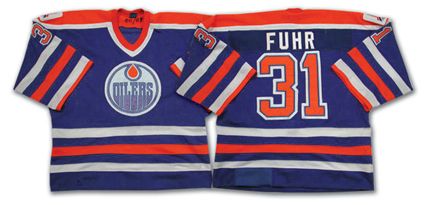
1988-89 Edmonton Oilers Grant Fuhr Jersey

On this date in 1918, Georges Vezina of the Montreal Canadiens became the first goalie in NHL history to be awarded an assist when Newsy Lalonde gathered up the puck after a save by Vezina, skated the length of the ice and scored a goal during a 6-3 Canadiens win over the Toronto Arenas.

Georges Vezina
Georges Vezina

It would take 61 years before a goaltender would be credited with scoring a goal, and he never actually shot the puck. That occurred on November 28, 1979 when Rob Ramage of the hapless Colorado Rockies gathered up the puck after a save by the New York Islanders Billy Smith during a delayed penalty call and passed the puck back out of the corner, which unfortunately for the Rockies sailed by his intended teammates and had enough force to continue all the way down the length of the ice and into the Rockies unmanned goal.


It would take eight more years for an NHL goalie to genuinely shoot the puck into the opposing net when Ron Hextall of the Philadelphia Flyers score against the Boston Bruins on December 8, 1987. Hextall later scored again during the playoffs against the Washington Capitals on April 11, 1989.

Martin Brodeur of the New Jersey Devils is the only other goalie to date to have scored twice with a playoff goal in 1997 and a regular season goal in 2000.

Jeff Reese holds the record for most points by a goaltender in a game with three, which he scored on February 10, 1983 while playing for the Calgary Flames.

It should come as little surprise to find out that an Edmonton Oiler holds the record for most points by a goaltender in a season, as well as the career record for most points by a goalie. Those honors belong to Grant Fuhr of the high powered Oilers. His record of 14 points in 1983-84 set the standard which still remains the one to beat more than 25 years later.

Fuhr Oilers, Fuhr Oilers
Grant Fuhr

While Fuhr certainly earned a number of assists by simply going behind the net and teeing up a dump-in for Paul Coffey to carry up the ice and set up a Wayne Gretzky goal, Fuhr also earned a number of assists by firing the puck up the ice to an open teammate to initiate a rush.

Fuhr's total of 60 points (which includes regular season and playoffs combined) leads all goalies in career scoring, followed by Patrick Roy's 56, who just barely tops the 55 scored by Tom Barrasso and Brodeur's 54 points, two of which were goals. Mike Vernon's 41 leads both Hextall and John Vanbiesbrouck at 38, with two of Hextall's points coming from his goals.

The rest of the top ten consist of Ed Belfour at 35, Curtis Joseph's 33 and the tenth spot is occupied by both Sean Burke and Dan Bouchard, who are tied at 30. Honorable mention goes to Kirk McLean (29), Andy Moog (28), Bill Ranford (26) and the duo of Mike Palmateer and Tony Esposito with 25 each. Of the 16 goalies listed, only Broduer remains active and it must be noted that Barrasso's 48 assists are the most by a player counting only the regular season, two more than Fuhr's 46.

Today's featured jersey is a 1988-89 Edmonton Oilers Grant Fuhr jersey. Fuhr remains the all-time point scoring leader among NHL goalies with 60, four more than the next closest pursuer, and holder of the most points in a season by a goaltender for over 25 years.

Fuhr played 19 NHL seasons and won 403 games with the Oilers, Buffalo Sabres, Toronto Maple Leafs, Los Angeles Kings, St. Louis Blues and Calgary Flames as well as being the Oilers starting goaltender for Stanley Cup championships with the Oilers in 1984, 1985, 1987 and 1988. He also won the Canada Cup in both 1984 and 1987. He also won the Vezina Trophy in 1988 and was inducted into the Hockey Hall of Fame in 2003. Just to be clear, the Vezina Trophy is awarded for puck stopping ability, not goalie scoring exploits!

Oilers 88-89 jersey Pictures, Images and Photos
photo courtesy of Classic Auctions

Here is footage of Broduer's first goal, which came in the 1997 playoffs.


Our final video today is a tribute to Grant Fuhr and a collection of some of his flashiest saves.


Dasherboard: The World Junior Championships had a light schedule yesterday. In Group A, Switzerland thrashed Latvia 7-2 to keep pace with Finland and Sweden, while the United States rebounded from their last tune-up game by hammering Germany 8-0 to get their tournament off to a strong start, now even with Canada at 3 points and one ahead of Russia at 2 in Group B.

Today's schedule is a full four games, with Finland taking on the Czech Republic in the day's first game, followed by Canada looking to defeat Slovakia, who gave Russia all they could handle in their first game.

The second game in Group A at the Sports Palace following Finland and the Czech Republic will be Sweden facing off against Switzerland, who are surely in for a much tougher game than provided by Latvia.

The day concludes with a  prime matchup, as host Russia takes on the United States, with neither team hoping to have to share the three points at stake. Surely the loser of this game will lose out on getting the bye into the semifinals, so there is plenty to play for in one of the best match ups of the Preliminary Round.

Friday, January 21, 2011

1924-25 Montreal Canadiens Georges Vezina Jersey

Born on this date in 1887, goaltender Georges Vezina joined his local team, the Chicoutimi Hockey Club.

Vezina Saguenéens
Vezina in 1909 as a member of the Saguenéens

The club, known as the Saguenéens, played an exhibition game against a brand new club playing in their first ever season, the Montreal Canadiens in February of 1910. Vezina shutout the Canadiens by a score of 2-0 that evening. So impressive was Vezina's performance that his opponent that evening, Joseph Cattarinich, recommended Vezina to his team owner George Kennedy, who reached an agreement with Vezina to play for the Canadiens beginning with the 1910-11 season.

Vezina Montreal 1910-11
Vezina during his first season with Montreal

Vezina made his Montreal debut on New Year's Eve in 1910 and went on to play all 16 of the Canadiens games in the National Hockey Association (NHA), finishing with a record of 8-8 while allowing the fewest goals in the league and his cool demeanor earned him the nickname the "Chicoutimi Cucumber". The following year he again led the league with the fewest goals allowed, but Montreal gave him little offensive support and their 8-10 record left them in last place.

Vezina Montreal 12-13
Vezina in the Canadiens barberpole jerseys of 1912-13

He recorded his first professional shutout, as well as the first in Canadiens history, with a 6-0 win over the Ottawa Senators on January 18, 1913. After finishing with a 9-11 mark that season, the Canadiens improved in 1913-14 when Vezina posted his first winning season with a 13-7 mark, good for a tie for first place with the Toronto Blueshirts, who defeated Montreal in a two game playoff series for the championship.

After a last place finish in 1914-15, Montreal rebounded strongly in 1915-16 to earn their first O'Brien Cup as NHA champions with a 16-7-1 record. As champions of the NHA, Montreal earned the right to host the Portland Rosebuds of the PCHA in a best-of-five playoff for the rights to the Stanley Cup.

Portland shut out Montreal 2-0 in Game 1, but the Canadiens came back to win the second game 2-1. Game three also went to Montreal 6-3 prior to Portland evening the series with a 6-4 win in Game 4 to set up a winner take all Game 5. Vezina and the Canadiens then captured the first Stanley Cup in franchise history with a 2-1 win over the Rosebuds in front of their fans at the Montreal Arena.

Vezina Montreal 1915-16
Vezina from the Stanley Cup winning season of 1915-16. Note the "CA" logo on the chest, worn prior to the now familiar "CH" logo, which would arrive the following season.

Montreal defeated Ottawa in a two-game, total-goals playoff 7-6 to remain NHA champions in 1916-17 to earn their second O'Brien Cup but fell in the Stanley Cup Finals to the Seattle Metropolitans.

For the 1917-18 season, Montreal began play in the new National Hockey League (NHL), Vezina recorded the first shutout in NHL history on February 18, 1918 and early in the next season, on December 28, 1918, he became the first goaltender to ever earn a point in the NHL when he was credited with an assist in a 6-3 win over the Toronto Arenas. While Montreal finished second during the regular season, they defeated Ottawa in the playoffs for their first NHL championship. They then travelled to Seattle to face the Metropolitans in the Stanley Cup Final, but play was suspended with the series tied at 2-2-1 when players began to become sick due to the Spanish Influenza epidemic, which would claim the life of Canadian Joe Hall.

1919 Stanely Cup engraving
The engraving noting "series not completed" for the 1919 Stanley Cup Finals

After four more seasons with Montreal, each with a winning record, Vezina established an NHL record with the first goals against average under 2.00 when he finished the season at 1.97. Montreal then defeated the favored Senators to become champions of the NHL and went on to capture their second Stanley Cup in 1924 when they first defeated the Vancouver Maroons 2 games to none and then the Calgary Tigers two games to none. In their four Stanley Cup contests, Vezina allowed just four goals, with a shutout in the final game to clinch the cup.

Vezina Montreal 1923-24
Vezina from the Stanley Cup winning 1923-24 season

The following season Vezina set career best marks with 17 wins as well as lowering his goals against average to 1.81.

When Vezina arrived for training camp in 1925-26, he appeared sick, and by the time the regular season began on November 28, he had lost 35 pounds in six weeks and was running a fever of 102º. Still, he started the game against the Pittsburgh Pirates and held them scoreless through one period. During the intermission he began vomiting blood prior to insisting he begin the second period, but he collapsed on the ice and was taken out of the game. "In the arena, all was silent as the limp form of the greatest of goalies was carried slowly from the ice," reported one journalist.

The following day he was diagnosed with tuberculosis and never played again. He returned home to Chicoutimi and died on March 27, 1926 just 39 years old.

During his 15 year career Vezina played every one of Montreal's 328 regular season and 39 playoff games and had the lowest goals against average seven times and the second lowest on another five occasions. With Vezina in goal, Montreal would win two NHA championships, three NHL championships and two Stanley Cups from those five appearances. His final combined NHA and NHL totals show 175 wins, 15 by shutout, a goals against average of 3.49 and another 15 playoff victories.

In 1926 the owners of the Canadiens donated a trophy in his name, the Vezina Trophy, which is awarded annually to the most valuable goaltender each season in the NHL.

He was inducted into the Hockey Hall of Fame as a charter member of it's inaugural 12 man class in 1945.

Today's featured jersey is a 1924-25 Montreal Canadiens Georges Vezina jersey. After winning the Stanley Cup in 1924 by defeating the Vancouver Maroons of the PCHL and the Calgary Tigers of the WPHL, Montreal flaunted their title with a special set of sweaters for the 1924-25 season, featuring a globe pictured on the front which contained the word "Champions" inside of it to commemorate their status as World Champions.

Montreal Canadiens 1924-25  jersey

Today's video selection is a brief look at the career of Georges Vezina.


Tuesday, December 28, 2010

1988-89 Edmonton Oilers Grant Fuhr Jersey

On this date in 1918, Georges Vezina of the Montreal Canadiens became the first goalie in NHL history to be awarded an assist when Newsy Lalonde gathered up the puck after a save by Vezina, skated the length of the ice and scored a goal during a 6-3 Canadiens win over the Toronto Arenas.

Georges Vezina
Georges Vezina

It would take 61 years before a goaltender would be credited with scoring a goal, and he never actually shot the puck. That occurred on November 28, 1979 when Rob Ramage of the hapless Colorado Rockies gathered up the puck after a save by the New York Islanders Billy Smith during a delayed penalty call and passed the puck back out of the corner, which unfortunately for the Rockies sailed by his intended teammates and had enough force to continue all the way down the length of the ice and into the Rockies unmanned goal.


It would take eight more years for an NHL goalie to genuinely shoot the puck into the opposing net when Ron Hextall of the Philadelphia Flyers score against the Boston Bruins on December 8, 1987. Hextall later scored again during the playoffs against the Washington Capitals on April 11, 1989.

Martin Brodeur of the New Jersey Devils is the only other goalie to date to have scored twice with a playoff goal in 1997 and a regular season goal in 2000.

Jeff Reese holds the record for most points by a goaltender in a game with three, which he scored on February 10, 1983 while playing for the Calgary Flames.

It should come as little surprise to find out that an Edmonton Oiler holds the record for most points by a goaltender in a season, as well as the career record for most points by a goalie. Those honors belong to Grant Fuhr of the high powered Oilers. His record of 14 points in 1983-84 set the standard which still remains the one to beat more than 25 years later.

While Fuhr certainly earned a number of assists by simply going behind the net and teeing up a dump-in for Paul Coffey to carry up the ice and set up a Wayne Gretzky goal, Fuhr also earned a number of assists by firing the puck up the ice to an open teammate to initiate a rush.

Fuhr career total of 60 points (which includes regular season and playoffs combined) leads all goalies in career scoring, followed by Patrick Roy's 56, who just barely tops the 55 scored by Tom Barasso. Brodeur ranks fourth all time with 44 points, two of which were goals. Mike Vernon's 41 leads both Hextall and John Vanbiesbrouck at 38, with two of Hextall's points coming from his goals.

The rest of the top ten consist of Ed Belfour at 35, Curtis Joseph's 33 and the tenth spot is occupied by both Sean Burke and Dan Bouchard, who are tied at 30. Honorable mention goes to Kirk McLean (29), Andy Moog (28), Bill Ranford (26) and the duo of Mike Palmateer and Tony Esposito with 25 each. Of the 16 goalies listed, only Broduer remains active.

Today's featured jersey is a 1988-89 Edmonton Oilers Grant Fuhr jersey. Fuhr remains the all-time point scoring leader among NHL goalies with 60, four more than the next closest pursuer, and holder of the most points in a season by a goaltender for over 25 years.

Fuhr played 19 NHL seasons and won 403 games with the Oilers, Buffalo Sabres, Toronto Maple Leafs, Los Angeles Kings, St. Louis Blues and Calgary Flames as well as being the Oilers starting goaltender for Stanley Cup championships with the Oilers in 1984, 1985, 1987 and 1988. He also won the Canada Cup in both 1984 and 1987. He also won the Vezina Trophy in 1988 and was inducted into the Hockey Hall of Fame in 2003. Just to be clear, the Vezina Trophy is awarded for puck stopping ability, not goalie scoring exploits!

Oilers 88-89 jersey Pictures, Images and Photos

Here is footage of Broduer's first goal, which came in the 1997 playoffs.


Our final video today is a tribute to Grant Fuhr and a collection of some of his flashiest saves.


Dasherboard: The World Junior Championships had a light schedule yesterday. Slovakia won in 2-1 overtime in their game against the plucky Germans to pull even with the United States with two points in the Group A standings, one point behind Switzerland.

In Group B, the Czech Republic did what was require by shutting out Norway, but the 2-0 score does little to inspire anyone into believing the Czechs will be strong enough to advance to the Playoff Round in light of Sweden's 7-1 drubbing of Norway the day before.

Today's schedule is a full four games, with Switzerland and Finland battling it out in Group A. With three points for a win in international hockey, a win for Switzerland would all but guarantee them a place in the Playoff Round. The day's second game has the Czech Republic hoping to stifle Canada's scoring attack and come away with at least a point or two in the standings. A win for Canada, even if it comes in overtime, will put them in an excellent position to advance with Norway still on their schedule and a likely three points from that game.

Sweden will be facing Russia at Dwyer Arena in the best matchup the smaller rink will see all tournament. A regulation win for Sweden will certainly put the Russians in a bad spot while a win for the Russians keeps them right in the mix in the "Group of Death".

The final game of the day has the United States looking to improve upon their performance in their opening game which went to overtime. A regulation win could very well see them at the top of the group by the end of the day and in a good position to earn one of the coveted byes directly into the semifinals.
 

hit counter for blogger