History of Jersey 83-93 Banner sm photo History of Jersey 83-93 Banner sm.jpg
Showing posts with label SKA Leningrad. Show all posts

Wednesday, May 27, 2015

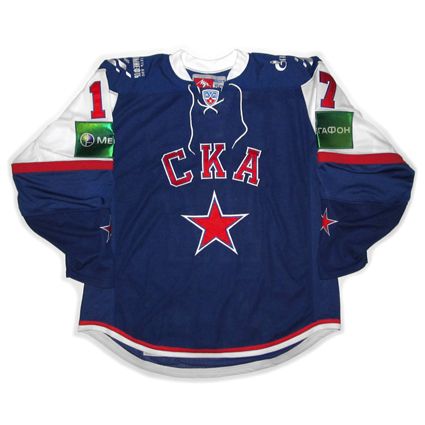
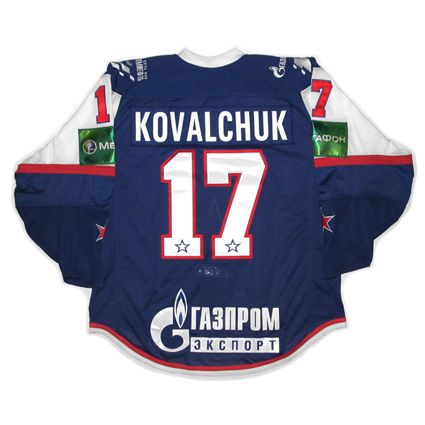
Saint Petersburg, Russia - 2012-13 SKA Saint Petersburg Ilya Kovalchuk Jersey

Founded 312 years ago on this date in 1703 by Peter the Great, Saint Petersburg (Sankt Peterburg) is the second largest city in Russia with a population of 5 million. From 1713 to 1728 and again from 1732 to 1918 it was the capital of Russia until the communist Russian Revolution of 1917. It is also the northernmost city in the world with a population of over a million.

Saint Petersburg photo St Petersburg.jpg
Saint Petersburg

The city was founded when Peter the Great desired a better seaport and won the territory from the Swedish Empire, who controlled the area at the time.
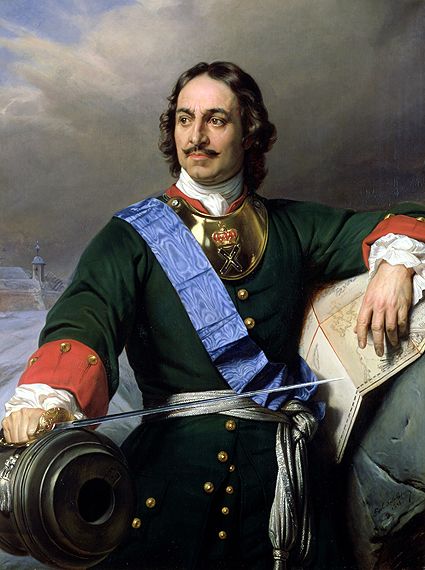
Peter the Great photo Peter the Great.jpg
Peter the Great

After the Russian victory, the Peter and Paul Fortress was built, the first brick and stone building of the new city from which the city got its name.

Peter and Paul Fortress photo peter-paul-fortress-arial-shot.jpg
The Peter and Paul Fortress, birthplace of Saint Petersburg

In the 1860's, following the emancipation of peasants in Russia, the city saw large growth, which saw Saint Petersburg surpass Moscow in population as well as becoming one of Europe's largest industrial cities. Additionally, it developed a major naval base, river and sea port.

Following the outbreak of World War I, the government renamed the city Petrograd, meaning "Peter's City" in order to remove the German words "Sankt" and "Burg"

In October of 1917, the Bolsheviks, led by Vladimir Lenin, stormed the grand Winter Palace, the official residence of the Russian monarchy dating back to 1732, which led to the transfer of all power to the Soviets and gave rise to the Communist Party. When the city was threatened with bombardment and invasion by advancing German troops, the Soviets transferred the capital to Moscow to keep it away from the border, as was the case in Petrograd.

 photo St_Petersburg_winter_palace.jpg
The Winter Palace, home of the Czars

On January 26, 1924, five days after the death of Lenin, the city was again renamed, this time to Leningrad.

During World War II, German forces laid siege to the city from September of 1941 until January of 1944, one of the longest, most destructive and lethal sieges of a major city in modern history, with over a million civilian casualties, mainly from starvation.

Siege of Leningrad photo Siege of Leningrad.jpg
Citizens fleeing German bombardment during the
devastating siege of Leningrad during World War II

In 1991, after the fall of communism and the breakup of the Soviet Union, the city reverted back to its original name of Saint Petersburg.

It is considered the cultural center of Russia and is home to The Hermitage, one of the largest art museums in the world and one some 200 museums in the city. Additionally, there are about 8,000 architectural monuments, 50 theaters and many parks in Saint Petersburg.

It's main hockey club is SKA Saint Petersburgh, with SKA standing for Sports Club of the Army, written as CKA in Cyrillic. The team was founded in 1946 with the name Kirov LDO (Leningrad Officers Club). It underwent several name changes until changing to SKA in 1959. Like CSKA Moscow (Central Red Army), SKA belonged to the Soviet Ministry of Defense sports club system with its roster stocked with Leningrad Military District officers.
SKA logo photo SKA logo.png

SKA Leningrad were relegated for the 1947-48 season, but earned an immediate promotion back to the top level in their first try. Their return to the top level did not go well, and the club was once again demoted to the second division, and again won the right to return to the top division for 1950-51. This time they were successful in staying up, and remained in highest level for the next 40 years. The team remained in the top division until 1991, never having won a Soviet Championship League title thanks in large part to the dominance of CSKA Moscow.

Their first taste of success would wait until 1968 when they were a finalist for the USSR Cup, a season long knockout competition which ran concurrently with the league regular season. The club earned their first hardware in 1970, when they won their first Spengler Cup, defeating the Czechoslovakian team Dukla Jihlava.

The team repeated their Spengler Cup success with another victory over Dukla Jihlava in 1971 and then completed arguably the best season in club history with a bronze medal in the Soviet Championship League and a runner up finish in the USSR Cup.

Their next success would arrive with their third Spengler Cup victory in 1977 at the expense of Dukla Jihlava once again.

SKA Leningrad's next good result in the Soviet Championship League came with another bronze medal after the 1987 campaign.

That success would have to suffice for some time, as the political upheaval which arrived with the dissolution of the Soviet Union would affect the club's finances and resources as the changes in Russian society and it's sporting landscape sorted themselves out over the early part of the 1990's. This instability saw the team relegated for only the third time in it's history, as they were relegated following the 1990-91 season.

SKA Leningrad logo photo SKALeningradbadge.jpg
A badge from their days as SKA Leningrad

Another affect the breakup of the Soviet Union had on the team was the name of their home city Leningrad changing back to it's historic, original pre-1914 name of Saint Petersburg in 1991. From then on, the club would now be known as Hockey Club SKA Saint Petersburg.

SKA Saint Petersburg logo, SKA Saint Petersburg logo

The team spent the 1991-92 season in the second division and joined the new International Hockey League for its debut 1992-93 season. In the aftermath of the Soviet Union, the landscape of Russian hockey was rather unstable, and in the IHL ceased after just four seasons, being replaced by the Russian Superleague in 1999.

While several teams were able to rise to the top and win championships with the loss of dominance by CSKA after its systemic advantages were lost following the fall of communism, SKA was not one of those. In the 12 years of the RSL, six different clubs won championships but Saint Petersburg was unable to win even a single playoff round.

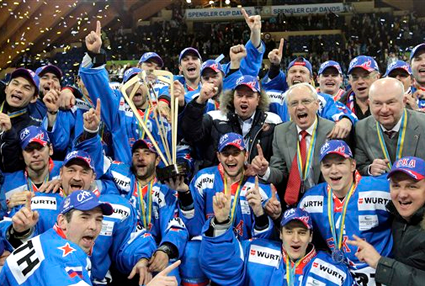
The Kontinental Hockey League arrived in 2008-09. The club's fortunes began to look upwards, beginning in 2010, when they won their fourth Spengler Cup.
SKA Spengler Cup 2010 photo SKASaintPetersburgwonin2010.png
SKA Saint Petersburg celebrate their 2010 Spengler Cup

Playoff success arrived in 2011-12 with the team making it to the conference finals before winning the Continental Cup as the team with the best regular season record at the conclusion of the 2012-13 regular season as they posted a 36-2-11-3 record for 115 points, 11 clear of second place. While they did advance to the conference finals again, the club lost in six games to the eventual champions Dynamo Moscow.

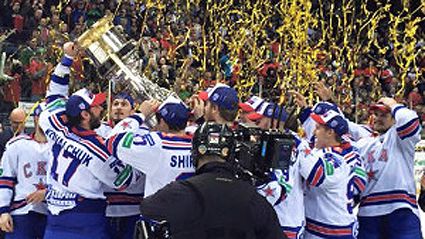
Finally in the 2014-15 season, the team finished second overall in the KHL and then defeated Torpedo Novgorod 4-1, Dynamo Moscow 4-1, Continental Cup winners CSKA Moscow in seven games before claiming their first championship in 69 years when they beat Ak Bars Kazan 4 games to 1.
SKA Gagarin Cup photo SKA Gagarin Cup.jpg
After never winning a domestic championship,
SKA Saint Petersburg won the 2015 Gagarin Cup

SKA were captained by former NHL goal scoring leader Ilya Kovalchuk, who was named the MVP of the Gagarin Cup Playoffs.
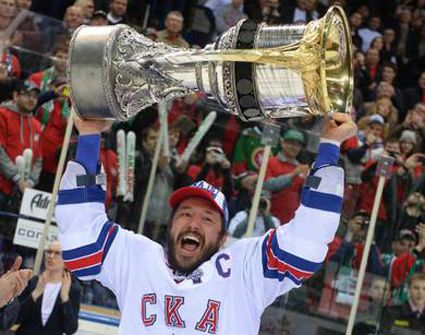
Kovalchuk Gagarin Cup photo Kovalchuk Gagarin Cup.jpg
SKA captain Kovalchuk hoisting the Gagarin Cup
for the team's first championship in 69 years

Other notable players to have skated for SKA include Maxim Afinogenov, Alexi Kasatonov, Darius Kasparaitis, Evgeni Nabokov, Alexi Ponikarovsky, Vladimir Tarasenko, Alexi Yashin, Valeri Zelepukin and Sergei Zubov.
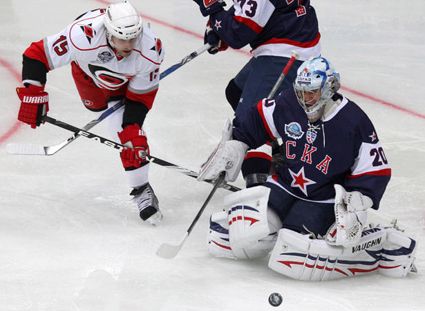
SKA Vs Hurricanes photo SKAvsHurricanes2.jpg
Evgeni Nabokov in goal for SKA during their 5-3 exhibition game
victory against the Carolina Hurricanes in 2010

Their home games are held in The Ice Palace, which holds 12,300 fans and has hosted the IIHF European Champions Cup from 2005 to 2008. In 2011-12, SKA averaged 10,126 fans, becoming the first Russian club to average over 10,000 fans per game in a season. SKA also placed 6th overall in attendance in all of Europe and first in Russia.

Today's featured jersey is a 2012-13 SKA Saint Petersburg Ilya Kovalchuk jersey as worn by the NHLer early in the season while the NHL lockout was still in effect, foreshadowing his return to Saint Petersburg following his "retirement" from the NHL for the following season.

While in most leagues 68 seasons and no titles to show for it would be a cause for ridicule, not unlike baseball's Chicago Cubs, but the tilted system of Soviet hockey in favor of perennial champions CSKA (Central Red Army), 32 titles in 46 years and 13 in a row from 1978 to 1990, takes some of the heat of SKA as few clubs, other than perhaps Moscow Dynamo, were winning any championships either.

Of note, with the expansion of the KHL beyond the borders of Russia, the league no longer customizes player jerseys with the names on the back in Cyrillic, changing to English in 2011-12.

Russia SKA Saint Petersburgh 2012-13 jersey photo Russia-SKASaintPetersburgh2012-13F.jpg
Russia SKA Saint Petersburgh 2012-13 jersey photo Russia-SKASaintPetersburgh2012-13B.jpg

Today's video section is highlights of SKA Saint Petersburg winning Game 5 of the Gagarin Cup Finals to win their first championship in 69 years.

Sunday, July 13, 2014

1995-96 SKA Saint. Petersburg Viktor Belyakov Jersey

July by the Numbers stays in the Soviet Union for jersey #13.

Having been founded in 1946, Sports Club of the Army Leningrad has competed at the highest level of Soviet and Russian hockey in every season of it's existence, save for three.

SKA Leningrad were relegated for the 1947-48 season, but earned an immediate promotion back to the top level in their first try. Their return to the top level did not go well, and the club was once again demoted to the second division, and again won the right to return to the top division for 1950-51. This time they were successful in staying up, and remained in highest level for the next 40 years.

SKA Leningrad logo, SKA Leningrad logo
An old badge for HC SKA Leningrad

Their first taste of success came in 1968 when they were a finalist for the USSR Cup, a season long knockout competition which ran concurrently with the league regular season. The club earned their first hardware in 1970, when they won their first Spengler Cup, defeating the Czechoslovakian team Dukla Jihlava.

The team repeated their Spengler Cup success with another victory over Dukla Jihlava in 1971 and then completed arguably the best season in club history with a bronze medal in the Soviet Championship League and a runner up finish in the USSR Cup.

Their next success would arrive with their third Spengler Cup victory in 1977 at the expense of Dukla Jihlava once again.

SKA Leningrad's next success in the Soviet Championship League came with another bronze medal after the 1987 campaign.

That success would have to suffice for some time, as the political upheaval which arrived with the dissolution of the Soviet Union would affect the club's finances and resources as the changes in Russian society and it's sporting landscape sorted themselves out over the early part of the 1990's. This instability saw the team relegated for only the third time in it's history, as they were relegated following the 1990-91 season.

Another affect the breakup of the Soviet Union had on the team was the name of their home city Leningrad changing back to it's historic, original pre-1914 name of Saint Petersburg in 1991. From then on, the club would now be known as Hockey Club SKA Saint Petersburg.

SKA Saint Petersburg logo, SKA Saint Petersburg logo

They team would rebound from their relegation in short order, returning to the top level after just one season. The league they returned to in 1991-92 was the renamed and reorganized International Hockey League, which would be renamed Russian Super League in 1999 when membership was once again open to teams from outside of Russia, such as those from Belarus and Latvia.

SKA Saint Petersburg would compete in all seasons of the RSL from 1996-97 through 2007-08 and then join the newly created Kontinental Hockey League for it's inaugural 2008-09 season and win the Bobrov Division in 2009-10 with Maxim Shushinski finishing second in scoring by a single point with 65 points, followed by teammate Alexi Yashin with 64.

The following October, SKA defeated the Carolina Hurricanes of the NHL in an exhibition game in Saint Petersburg by a score of 5-3.

SKA Vs Hurricanes, SKA Vs Hurricanes
Tuomo Ruutu of Carolina tries to score on SKA goaltender
Evgeni Nabokov during their 2010 exhibition game

Their noteworthy season continued in December with the club defeating Team Canada to capture it's fourth Spengler Cup on New Year's Eve, five weeks before the club hosted the KHL All-Star Game at the Ice Palace, their home rink built for the 2000 World Championships.

SKA Saint Petersburg Spengler Cup 2010, SKA Saint Petersburg Spengler Cup 2010
Maxim Shushinsky accepting the 2010 Spengler Cup

The Ice Palace holds 12,300 fans and has hosted the IIHF European Champions Cup from 2005 to 2008. In 2011-12, SKA averaged 10,126 fans, becoming the first Russian club to average over 10,000 fans per game in a season. SKA also placed 6th overall in all of Europe behind teams from Switzerland, Belarus, two from Germany and Sweden.

The 2012-13 season saw Saint Petersburg finish the KHL regular season as the club with the most regular season points, which earned them the Continental Cup, a rare piece of hardware for the team, as it was their first trophy to show for 66 seasons of competition in first the Soviet Union and later the various Russian hockey leagues.

SKA Saint Petersburg logo, SKA Saint Petersburg logo

Today's featured jersey is a 1995-96 SKA Saint Petersburg Viktor Belyakov jersey. Despite having been broken up in late 1991, this jersey still carries influences from the Soviet Union with it's spartan design and prominent red stars.

The thin numbers with a clear drop shadow is classic early 1990's European style, but what really screams "European" about the jersey is the fold over dress shirt collar, more commonly found in Scandinavian countries. A sign of the changing economics of the times is evidenced by the sponsorship found along the waist, both front and back, which would only grow to be more prominent as time passed.

Fortunately for you our readers, the internet has yet to be able to transmit odors, because there is nothing in this world that smells quite like an old Russian game worn jersey, a remarkable stench that packs a pretty mean punch!

Belyakov was a center who played for SKA beginning in 1988-89 when the city was still known as Leningrad and remained with the club for 10 seasons through the change to Saint Petersburg, and the Soviet League evolving into the International Hockey League, the Russian Hockey League and the Russian Super League. He finished his career with two additional seasons with Sibir Novobirsk, helping them earn promotion from the Russian second division to the Super League for his final season of 2002-03.

SKA Saint Petersburg 95-96 jersey, SKA Saint Petersburg 95-96 jersey

Today's video segment is an lengthy interview, in English, with SKA's Alexi Yashin (and his wife) at the 2010 Spengler Cup that we feel is worth your time.


This next video is a report on SKA Saint Petersburg from just prior to the 2010-11 season.


Friday, July 13, 2012

1995-96 SKA Saint. Petersburg Viktor Belyakov Jersey

July by the Numbers stays in the Soviet Union for jersey #13.

Having been founded in 1946, Sports Club of the Army Leningrad has competed at the highest level of Soviet and Russian hockey in every season of it's existence, save for three.

SKA Leningrad were relegated for the 1947-48 season, but earned an immediate promotion back to the top level in their first try. Their return to the top level did not go well, and the club was once again demoted to the second division, and again won the right to return to the top division for 1950-51. This time they were successful in staying up, and remained in highest level for the next 40 years.

SKA Leningrad logo, SKA Leningrad logo
An old badge for HC SKA Leningrad

Their first taste of success came in 1968 when they were a finalist for the USSR Cup, a season long knockout competition which ran concurrently with the league regular season. The club earned their first hardware in 1970, when they won their first Spengler Cup, defeating the Czechoslovakian team Dukla Jihlava.

The team repeated their Spengler Cup success with another victory over Dukla Jihlava in 1971 and then completed arguably the best season in club history with a bronze medal in the Soviet Championship League and a runner up finish in the USSR Cup.

Their next success would arrive with their third Spengler Cup victory in 1977 at the expense of Dukla Jihlava once again.

SKA Leningrad's next success in the Soviet Championship League came with another bronze medal after the 1987 campaign.

That success would have to suffice for some time, as the political upheaval which arrived with the dissolution of the Soviet Union would affect the club's finances and resources as the changes in Russian society and it's sporting landscape sorted themselves out over the early part of the 1990's. This instability saw the team relegated for only the third time in it's history, as they were relegated following the 1990-91 season.

Another affect the breakup of the Soviet Union had on the team was the name of their home city Leningrad changing back to it's historic, original pre-1914 name of Saint Petersburg in 1991. From then on, the club would now be known as Hockey Club SKA Saint Petersburg.

SKA Saint Petersburg logo, SKA Saint Petersburg logo

They team would rebound from their relegation in short order, returning to the top level after just one season. The league they returned to in 1991-92 was the renamed and reorganized International Hockey League, which would be renamed Russian Super League in 1999 when membership was once again open to teams from outside of Russia, such as those from Belarus and Latvia.

SKA Saint Petersburg would compete in all seasons of the RSL from 1996-97 through 2007-08 and then join the newly created Kontinental Hockey League for it's inaugural 2008-09 season and win the Bobrov Division in 2009-10 with Maxim Shushinski finishing second in scoring by a single point with 65 points, followed by teammate Alexi Yashin with 64.

The following October, SKA defeated the Carolina Hurricanes of the NHL in an exhibition game in Saint Petersburg by a score of 5-3.

SKA Vs Hurricanes, SKA Vs Hurricanes
Tuomo Ruutu of Carolina tries to score on SKA goaltender
Evgeni Nabokov during their 2010 exhibition game

Their noteworthy season continued in December with the club defeating Team Canada to capture it's fourth Spengler Cup on New Year's Eve, five weeks before the club hosted the KHL All-Star Game at the Ice Palace, their home rink built for the 2000 World Championships.

SKA Saint Petersburg Spengler Cup 2010, SKA Saint Petersburg Spengler Cup 2010
Maxim Shushinsky accepting the 2010 Spengler Cup

The Ice Palace holds 12,300 fans and has hosted the IIHF European Champions Cup from 2005 to 2008. In 2011-12, SKA averaged 10,126 fans, becoming the first Russian club to average over 10,000 fans per game in a season. SKA also placed 6th overall in all of Europe behind teams from Switzerland, Belarus, two from Germany and Sweden.

SKA Saint Petersburg logo, SKA Saint Petersburg logo

Today's featured jersey is a 1995-96 SKA Saint Petersburg Viktor Belyakov jersey. Despite having been broken up in late 1991, this jersey still carries influences from the Soviet Union with it's spartan design and prominent red stars.

The thin numbers with a clear drop shadow is classic early 1990's European style, but what really screams "European" about the jersey is the fold over dress shirt collar, more commonly found in Scandinavian countries. A sign of the changing economics of the times is evidenced by the sponsorship found along the waist, both front and back, which would only grow to be more prominent as time passed.

Fortunately for you our readers, the internet has yet to be able to transmit odors, because there is nothing in this world that smells quite like an old Russian game worn jersey, a remarkable stench that packs a pretty mean punch!

Belyakov was a center who played for SKA beginning in 1988-89 when the city was still known as Leningrad and remained with the club for 10 seasons through the change to Saint Petersburg, and the Soviet League evolving into the International Hockey League, the Russian Hockey League and the Russian Super League. He finished his career with two additional seasons with Sibir Novobirsk, helping them earn promotion from the Russian second division to the Super League for his final season of 2002-03.

SKA Saint Petersburg 95-96 jersey, SKA Saint Petersburg 95-96 jersey

Today's video segment is an lengthy interview, in English, with SKA's Alexi Yashin (and his wife) at the 2010 Spengler Cup that we feel is worth your time.


This next video is a report on SKA Saint Petersburg from just prior to the 2010-11 season.


hit counter for blogger