History of Jersey 83-93 Banner sm photo History of Jersey 83-93 Banner sm.jpg
Showing posts with label Buffalo Sabres. Show all posts

Saturday, May 20, 2017

The Fog Game - 1974-75 Buffalo Sabres Rene Robert Jersey

In 1973-74, the Buffalo Sabres had finished mid-pack and missed out on the Stanley Cup playoffs. They rebounded strongly in 1974-75, winning the newly created Adams Division and finishing tied with the defending Stanley Cup Champions, the Philadelphia Flyers and also the Montreal Canadiens with 113 points.

The Sabres, led by The French Connection line, which consisted of Rene Robert (with a team leading 100 points), Gilbert Perreault (96 points) and Rick Martin (95 points), defeated the Chicago Black Hawks 4 games to 1 in the quarterfinals before ousting the Canadiens 4-2 to reach their first Stanley Cup Finals in only their fifth season of play.

Game 1 of the finals, the first without an Original Six team since 1926, was played in Philadelphia's Spectrum and went to the Flyers 4-1. Philadelphia also took Game 2 by a close 2-1 margin.

The series then moved to the Buffalo Memorial Auditorium for Game 3 on this date in 1975, which would prove to be one of the strangest games in NHL history.

"The Aud" was originally constructed in 1940, the building was renovated with the arrival of the Sabres and Buffalo Braves of the NBA in 1970.

Buffalo Memorial Auditorium The Aud photo memorialauditoriumpostcard.png
The Buffalo Memorial Auditorium

Early in Game 3, a bat was spotted flying near ice level during the game. Finally at one point, with the teams line up for a face off in the Flyers zone, with the bat buzzing the players heads, Jim Lorentz raised his stick and swatted the bat out of midair and Rick MacLeish of the Flyers picked up the dead creature and deposited it over the boards at the Flyers bench.

Lorentz swats the bat photo Lorentzswatsbat.png
Jim Lorentz deftly swats the bat

As time passed, the sell out crowd of over 16,000 fans began to have an effect, as the non-air conditioned arena began to get warmer and steamier. Temperatures at ice level eventually got so warm that a layer of fog began to appear on the ice.

1975 Buffalo Fog Game
The fog became more dense as the game progressed

Eventually, the fog became thicker and thicker, causing the officials to halt play several times because the players could not see halfway down the ice. Several attempts were made to deal with the fog, including having the players skate in circles to try to stir up the air and clear the fog, as well as having the arena staff quickly raise and lower bed sheets to move larger amounts of air with some effect.

Play was resumed, but then stopped again and again and the visibility remained poor. Eventually both coaches, Fred Shero of the Flyers and Floyd Smith of the Sabres instructed their players to shoot as often as possible since the opposing goaltender was going to have problems seeing the puck.

Down by two goals, the Sabres fought back with a pair of goals by Danny Gare and Martin just 17 seconds apart to even the score at 2-2 before the struggling Sabres goaltender Gerry Desjardins let in a shot by MacLeish from 40 feet to put the Flyers back in the lead at the end of the first period.

During the intermission, Desjardins asked to be relieved in the Sabres goal. "After the second goal against me, I thought it was a grand time to get the hell out of there. I knew if I had stayed in, everything would have gone down the drain," Desjardins said following the game. "After all, we were only down by one goal. It was close at the end of the first period, Why waste it?"

During the second period, Reggie Leach scored on his own rebound after a wild scramble in front of new Sabres goalie Roger Crozier to give the Flyers a 4-2 lead, but Don Luce was able to put one past Bernie Parent to send the game into the third with Philadelphia up 4-3.

During the third period, defenseman Bill Hajt of Buffalo put in a rebound of a shot by Martin to even the score and eventually send the game into overtime.

The fog continued to disrupt play in overtime, causing seven stoppages. Finally, with about a minute to play, Perreault skated into the Flyers zone and passed the puck to Robert in the far corner. Robert, along the goal line, shot the puck from the sharp angle, which eluded Parent and went between his legs for the winning goal for the Sabres after nearly 80 minutes of play, sending the crowd into a frenzy.

Sabres Flyers fog game winner photo WinningGoalFog.png
The Sabres celebrate the game winning goal

"I didn't see Perreault's pass," said Parent. "I saw Robert's shot too late for me to come out and stop it. I'm surprised he overtime took so long. It was hard to see the puck from the red line. If three men came down and made a good pass from the red line, you couldn't see the puck. A good shot from the red line could have won it. But it was the same thing for Crozier."

"There had been a lot of pressure on our line," Robert said. "People saw we scored so many goals during the season, what has happened to us now, that we're letting down, the we don't check. Philadelphia double shifts our line, you know, and they are a real good team, too. Getting a big goal like that makes you feel good. It has been tough for us."

Today's featured jersey is a 1974-75 Buffalo Sabres Rene Robert jersey as worn when Robert scored the winning goal in overtime of the "Fog Game" in the 1975 Stanley Cup Finals.

The original Sabres jerseys, worn from 1970-71 to 1976-77 featured a lace-up collar and no names on the back, unless it was for a national TV game, in which case names were added and then removed afterwards, as the club owners felt that not having names on the backs of the jerseys would lead to increased program sales.

1974-75 Buffalo Sabres Rene Robert jersey
photo courtesy of Classic Auctions

Our video section today begins with a quick look at the bat attack and the fog bank which later descended over the ice.


Here is a longer look at the game, including the winning goal, with quotes from broadcaster Rick Jeanneret, Lorentz and winning goal scorer Robert.


This look at the history of "The Aud" includes footage of Robert's overtime goal in the fog.

Wednesday, May 3, 2017

2006-07 Atlanta Thrashers Slava Kozlov Jersey

Vyacheslav Kozlov started his hockey career with two games for his hometown Khimik Voskresensk in the 1987-88 season at just 15 years old. That spring he also participated in his first IIHF European Under-18 Junior Championships for the Soviet Union, earning a bronze medal.

In 1988-89, he played in 14 games, but contributed one lone assist. He returned to the European U18 Juniors in 1989, this time coming home with a gold medal after scoring 5 goals and 12 points in 6 games.

Now 17, Kozlov moved up to Khimik full time, playing in 45 games with 14 goals and 26 points for the 1989-90 season. Over the New Year holiday, Kozlov made is World Junior Championships (U20) debut, winning a silver medal with the Soviets and scoring 4 goals and 11 points in 7 games. Later that spring, he played in his third European U18 Juniors, and while the Soviets were limited to a silver medal, Kozlov was the tournament's leading scorer with 19 points in 6 games.

 photo Kozlov Soviet Union 1.jpg

Kozlov was then drafted by the Detroit Red Wings 45th overall early in the 3rd Round of the 1990 NHL Entry Draft.

He returned to Khimik for a fourth season of play in 1990-91, scoring 11 goals and 24 points in another 45 games. He also had a busy international season, playing at the 1991 World Juniors, earning a silver, scoring 12 points in 7 games. He then played in his first senior level IIHF World Championships, and scored 3 goals and 7 points in 10 games as an 18 year old, winning a silver medal. Later that fall, Kozlov had the honor of being a part of the Soviet roster at the 1991 Canada Cup tournament. He had a goal and 3 points competing against the world's best as a teenager.

 photo Kozlov 1991 Canada Cup.jpg

He began the 1991-92 season with CSKA Moscow, scoring 11 points in 11 games before making his NHL debut on March 12, 1992 with the Red Wings. He would play in 7 games with a pair of assists, both recorded on his debut.

 photo Kozlov Red Wings 1.jpg

Having played just 18 games the previous season, and needing time to adapt to both the size of the rinks and style of hockey in North America, as well as the change in lifestyle, Kozlov played 45 games in the American Hockey League with the Adirondack Red Wings in the 1992-93 season, excelling with 23 goals and 59 points. He also was called up by Detroit for 17 games, scoring his first 4 NHL goals.

While he did play 3 games with Adirondack during the 1993-94 season, Kozlov became a full time NHLer with 77 games for Detroit with a head turning 34 goals and 73 points, good for fifth on the high powered Red Wings. With Detroit an early playoff exit, Kozlov made it over to Italy in time to play one game with Russia at the 1994 World Championships.

With the start of the 1994-95 NHL season delayed until January by labor issues, Kozlov joined his old club CSKA Moscow for 10 games before returning to Detroit once the NHL season got underway. He had 33 points in 46 games and then had 9 goals and 16 points in 18 playoff games as the Red Wings made it to the Stanley Cup Finals.

When the Red Wings acquired Igor Larionov early in the 1995-96 season, Red Wings head coach Scotty Bowman formed what would become known as The Russian Five. While NHL teams had forward lines of three players and dedicated defensive pairs, the North American game did not employ five man units, such as was common in the days of the Soviet Union.

Detroit's Russian Five would consist of center Larionov, Left Winger Kozlov, right wing Sergei Fedorov and defensemen Vladimir Konstantinov and Slava Fetisov, with Larionov and Fetisov having been members of the original, famous Soviet Russian Five, the Green Unit.

Playing a creative, puck possession style and being sound defensively, the Russian Five experiment worked well, with Fedorov leading Detroit in scoring with 107 points, with Kozlov fourth with 73 points, just ahead of Larionov's 71 in fifth place. Fetisov was ninth in team scoring with Konstantinov 11th with 14 goals and 34 points. Detroit made it to the Semifinals of the playoffs, gaining more valuable playoff experience.

Before the 1996-97 season, Kozlov again suited up for Russia, this time at the 1996 World Cup of Hockey, scoring 3 points in 5 games.

While Kozlov's offensive numbers regressed for the 1996-97 season to 23 goals and 45 points, the Red Wings put together a great playoff run, defeating the St. Louis Blues in 6, the Mighty Ducks of Anaheim in 4, outlasting rivals the Colorado Avalanche in 6 and sweeping the Philadelphia Flyers in 4 straight to win the Stanley Cup. Kozlov was third in playoff scoring with 7 goals and 13 points in 20 games.

 photo LarionovRedWingsRussian5.jpg
The Russian Five of Kozlov and Larionov in front, with Konstantinov, Fedorov and Fetisov in back, posing with the Conn Smythe Trophy, the Stanley Cup and the Clarence Campbell Bowl

Sadly, the Russian Five lost member Konstantinov, when he and Fetisov were in a limousine celebrating just days after their Stanley Cup victory, which crashed into a tree, ending Konstantinov's career due to the injuries he suffered in the crash.

Kozlov then scored 25 goals and 52 points in 1997-98, followed by another 14 points in 22 playoff games as the Red Wings repeated as Stanley Cup champions.

Kozlov would play three more seasons with the Red Wings, with the best being the 1998-99 season when he had 29 goal and 29 assists for 58 points.

The Red Wings traded Kozlov to the Buffalo Sabres for the 2001-02 season as part of a package in exchange for future Hall of Fame goaltender Dominik Hasek. Kozlov would play one injury shortened season with the Sabres, scoring just 9 goals and 22 points in only 38 games.

Kozlov was then dealt to the Atlanta Thrashers for the 2002-03 season, where he was relied on as one of the team's offensive leaders. His point totals immediately took a leap upward with his new responsibilities, and he introduced himself to the fans in Atlanta with a 21 goal, 70 point season, his best in seven seasons and second on the team behind only Dany Heatley.

 photo Kozlov Thrashers 2.jpg

After a 20 goal, 53 point season in 2003-04, the 2004-05 NHL season was eventually cancelled due to a lockout of the players by the owners. Kozlov returned to Russia for the season, playing 38 games with his original club Khimik before switching over to the free spending Ak Bars Kazan for 8 games to finish the season.

He returned to Atlanta for the 2005-06 season with a fine 25 goal, 71 point season. He then had the best offensive season of his career in 2006-07 with 28 goals and 52 assists for a career high 80 points, good for second best on the team.

 photo Kozlov Thrashers 1.jpg

Kozlov rebounded from a 41 point season in 2007-08 with a 26 goal, 76 point season in 2008-09, the second highest of his career, once again second on the team. He would play one final, limited season with Atlanta, scoring 26 points in 55 games.

 photo Kozlov Thrashers 3.jpg

For the 2010-11 season, Kozlov would continue his career in the primarily Russian KHL, signing with CSKA Moscow. He would play in 40 games with 25 points before a late season move to Ufa Salavat Yulayev. While he would play just 4 regular season games with Ufa, he would play in 21 playoff games for the club, as they would go on to win the Gagarin Cup as KHL champions.

Despite the championship with Ufa, Kozlov would sign with Dynamo Moscow for the 2011-12 season, scoring 21 points in 44 games. While Kozlov was limited to just 6 playoff games, Dynamo would defeat Dinamo Minsk in 4, Torpedo Nizhny Novgorod in 6, sweep SKA Saint Petersburg and then outlast Avangard Omsk in the full seven games for Kozlov's second consecutive Gagarin Cup.

 photo Kozlov Dynamo 2.jpg

For the 2012-13 season, he would see limited action, playing in just 13 games with Spartak Moscow. He would play a second season with Spartak in 2013-14, scoring 26 points in 54 games. His final season of play would come with Atlant Moscow Oblast, playing in 46 games with 13 points before retiring after a 28 year career.

 photo Kozlov Spartak 1.jpg

Kozlov's final NHL totals were 1,182 games played, with 356 goals and 497 assists for 853 points ad two Stanley Cup championships. His KHL final totals were a more modest 201 games played with 37 goals and 61 points, yet two Gagarin Cups to his credit.

 photo Kozlov Stanley Cup.jpg

Today's featured jersey is a 2006-07 Atlanta Thrashers Slava Kozlov jersey as worn during his career best season of 80 points.

The Thrashers debuted in 1999-00 wearing a unique set of jerseys. NHL rules did not allow a new franchise to have a third jersey until their fifth season of play, so the Thrashers chose not to produce a standard road jersey with their primary logo and instead made an alternate jersey to be worn on for road games that featured their secondary shoulder logo.

This style was worn from the club's debut in 1999-00 to 2006-07 before all the NHL jerseys were replaced by the new Reebok Edge jerseys in 2007-08.

 photo Atlanta Thrashers 2006-07 F jersey.jpeg
 photo Atlanta Thrashers 2006-07 B jersey.jpeg

Today's second featured jersey is a 2005-06 Atlanta Thrashers Slava Kozlov jersey as worn during the final season for their original road "alternate" jersey used since they debuted in 1999-00.

 photo Atlanta Thrashers 2005-06 F jersey.jpeg
 photo Atlanta Thrashers 2005-06 B jersey.jpg

Bonus jersey: Today's bonus featured jersey is a 1999-00 Detroit Red Wings Slava Kozlov jersey as worn during his successful run with the Red Wings, which included winning back-to-back Stanley Cups in 1997 and 1998.

This style has been worn virtually unchanged since the club changed their name from the Falcons to the Red Wings in 1932-33 with only the addition of sleeve numbers and names on the back worth noting.

 photo Detroit Red WIngs 1999-00 F jersey.jpg
 photo Detroit Red WIngs 1999-00 B jersey.jpg

Extra extra bonus jersey: Today's extra extra bonus featured jersey is a 1996 Russia National Team Slava Kozlov jersey as worn during the 1996 World Cup of Hockey.

Due to a last minute change, the Russians rejected their already available for public sale jersey for the 1998 Olympics and reverted to this style for the Games in Nagano, Japan, where they earned a silver medal.

 photo Russia 1996 F jersey.jpeg
 photo Russia 1996 B jersey.jpeg
photos courtesy of Classic Auctions

Extra extra extra bonus jersey: Today's extra extra extra bonus featured jersey is a 2001-02 Buffalo Sabres Slava Kozlov jersey as worn during the first home game for the New York Rangers following the 9/11 terrorist attacks on the World Trade Center in Manhattan.

Both teams wore special, one-off jerseys that were crested "New York" on the front rather than the Sabres usual buffalo head logo, while the Rangers jerseys also read "New York" rather than "Rangers". All the jerseys were then auctioned off after the game to raise money for the Twin Towers Fund.

 photo Buffalo Sabres 2001-02 New York F jersey.jpeg
 photo Buffalo Sabres 2001-02 New York B jersey.jpeg


Saturday, February 18, 2017

1989-90 Buffalo Sabres Alexander Mogilny Jersey

Born on this date in 1969, Alexander Mogliny, just 20 years old, made a choice that would affect the rest of his life.

While in Stockholm, Sweden, having just completed winning a gold medal at the 1989 World Championships, Mogilny made the life changing decision to become the first Soviet player to defect, leaving behind his family but escaping the totalitarian rule of the communist system, and iron-fisted Soviet old school coach Viktor Tikhonov in particular, whom Mogilny felt would make his life not only at the rink, but outside of hockey, miserable for years to come due to his independent nature.

Mogilny Soviet Union, Mogilny Soviet Union
Mogilny while playing for the Soviet Union National Team

The story begins at the 1988 NHL Entry Draft when the Sabres, with one of their two picks in the fifth round, selected one of the most exciting young players in the world, Alexander Mogilny with the 89th overall pick. While many Soviet players had been chosen in the NHL draft before, it was generally in much later rounds when taking a flyer on a player unlikely to ever appear in an NHL game was worth the roll of the dice with an essentially meaningless pick.

Gerry Meehan, the Sabres general manager explains, "I would never have used the draft pick if I didn’t think he would be coming,” Meehan said. “The attitude then was, ‘There’s no way this guy is going to come out. He’s too big a young star.’ It was my view that it was inevitable that, sooner or later, the Russians were going to have to let their players come and play on a world stage other than the Olympics and the World Championship.”

Gerry Meehan
Gerry Meehan

At the beginning of 1989, former Sabre Don Luce, the club's Director of Amateur Evaluation, traveled to Anchorage, Alaska to to 1989 World Junior Tournament. There, Pavel Bure and linemates Mogilny and Sergei Fedorov, were finishing third (Bure) and tied for fourth (Mogliny and Fedorov) in tournament scoring while leading the Soviets to a 6-1 record and the gold medal. Luce met briefly with Mogilny in Anchorage and gave him a business card, cementing Mogilny's decision to defect at the first opportunity.
 

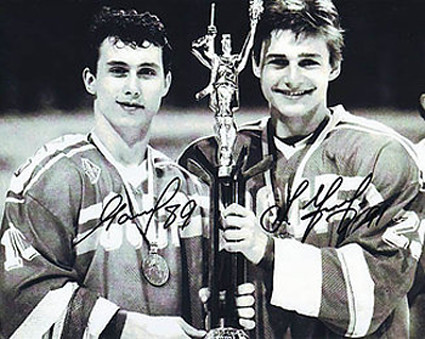
Mogilny Fedorov CCCP
Alexander Mogilny and Sergei Fedorov

That opportunity arrived four months later when the Soviets were given two days in Stockholm after winning the 1989 World Championship. Luce, at home in North America, received a phone call on this date in 1989 from a man who claimed to be Mogilny's agent, Sergei Fomitchev. Unsure if he was really in contact with Mogilny, he asked Fomitchev to have Mogilny repeat what he had said to him in Anchorage. Told then that he had not played very well, Mogilny had stated "I show you next game", prior to scoring a hat trick against Canada to clinch the gold medal.

After Mogilny repeated the phrase, Luce and Meehan were on a plane to Sweden three hours later, arriving midday on May 3rd. While waiting for Fomitchev to return from shopping, the got an urgent call saying Mogilny's defection had to happen right away because it would be his best opportunity to get away.

They met at a mall and drove off. The next two days were spent moving from hotel to hotel to avoid being found while Meehan worked with the U. S. Embassy to arrange the necessary paperwork.

At one point Mogilny, from the far eastern part of Russia where few players have originated from, attempted to call home and midway through the conversation the call was disconnected, giving rise to Mogilny's fears that the call had been traced and the authorities knew where they were.

The day they left they abandoned their rental car and took a taxi to the airport, and once inside the security gates, their fears of the Soviet officials was over. With that, Mogliny had become the first Soviet athlete to defect in 45 years.


 Meehan remembers, “He asked me in his broken English, ‘Am I free now?’ " And I said, ‘Yeah, you’re free.’ And he went over and had a beer. He couldn’t believe it. He said ‘free’, he didn’t say ‘safe’. He said ‘free’. I found that to be kind of poignant.”

Fedorov defected less than a year later at the 1990 Goodwill Games in Seattle and shortly afterwards, the Iron Curtain fell allowing Bure to join the NHL without having to defect.

During his rookie season in the NHL, wearing he number 89 presented to him by the Sabres owner Seymour H. Knox III in recognition of his place in the draft where Buffalo selected him and the year of his defection, Mogilny would play 65 games, scoring 15 goals and 43 points as he became acclimated to living in North America and learning a new language and culture. "It was a huge adjustment to come to the NHL. The language barrier was the toughest part. Lack of communication affected me both on and off the ice. It also took some time to get used to the airline travel. I had to deal with a fear of flying," Mogilny recalled.


Mogilny broke into the NHL with Buffalo

He would double his goal total the following season to reach 30 for the first time.


The arrival of Pat Lafontaine in Buffalo would give Mogilny a world class teammate to work with and his point totals took another jump upwards, finishing 1991-92 with 39 goals and 84 points and became the first Russian on an NHL All-Star Team. Given a year to work together and now fully integrated into life in the United States and the NHL, Mogilny had one of the greatest seasons in league history in 1992-93. He would score 127 points from 51 assists and a remarkable 76 goals in 77 games. His 76 goals remain tied for fifth all-time in a single season with Teemu Selanne and Phil Esposito.

With Lafontaine limited to just 38 games over the next two seasons, Mogilny was named team captain in his absence, the first European to ever captain an NHL club, but his production suffered as a result of the missing Lafontaine.

Mogilny Captain, Mogilny Captain 
Mogilny as captain of the Sabres

He was then traded to the Vancouver Canucks and reunited with Bure for the 1995-96 season, in which he would score 55 goals and 107 points, the second highest of his career in both categories.

Mogilny Bure Canucks, Mogilny Bure Canucks 
The Russian duo of Mogilny and Bure reunited in Vancouver

After five seasons of diminishing point totals in Vancouver, from 107 to 73, then 45 twice, he was dealt to the New Jersey Devils late in the 1999-00 season, having previously enjoyed the most minimal playoff success to that point in his career, having only escaped the first round once in ten seasons.

Prior to leaving the Soviet Union, Mogilny had already, just ten days after his 19th birthday, won a gold medal at the 1988 Olympics and then added he World Championship gold just days before his defection. Now with the Devils, Mogilny would see his first extended playoff run, which would eventually lead to a Stanley Cup championship. When he won the Stanley Cup with the New Jersey Devils, he became just the ninth player in history to join the Triple Gold Club.

Mogilny Stanley Cup
Mogliny joined the Triple Gold Club in 2000

The move to New Jersey was a positive one for Mogilny, as he would regain his scoring touch and exceed 40 goals for only the third time in his career, with 43 goals during an 83 point season and another run to the Stanley Cup Finals in 2000-01.

He would sign with the Toronto Maple Leafs for the 2001-02 season, where he would play for three seasons, including winning the
Lady Byng Trophy in 2003 and scoring his 1,000th point in 2003-04, before returning to the Devils for the final season of his career in 2005-06 before retiring with 473 goals and 1032 points in 990 games.

Mogilny Devils, Mogilny Devils
Mogilny had a 40 goal season while finishing his career with the Devils

Following his defection, Mogilny would never play for the Soviet Union again and he would eventually suit up for Russia just once in the 1996 World Cup of Hockey, cutting short what was destined to be a fine, if not outstanding, international career.

Mogliny Russia
Mogilny's lone international appearance for Russia
came during the 1996 World Cup of Hockey

When asked following his career about the reasons for his defection, Mogilny responded, “Why did I do it? I did it for freedom. If the bird can fly and the fish can swim, you have to be able to move around the world and be free and not watched constantly. If a human being doesn’t have freedom, that’s not life. It’s like living in a cage. To me, you might as well be dead.”

Today's jersey is a 1989-90 Buffalo Sabres Alexander Mogilny jersey. This jersey sports Mogilny's distinctive #89, which is based on the year of his defection from the Soviet Union and also features the Sabres 20th Anniversary patch worn in Mogilny's rookie season following his defection earlier that year.

The Sabres wore this style from their inaugural season of 1970-71 through the 1995-96 season when a complete makeover of their identity package saw them adopt new colors and a new logo for a decade until a return to their traditional blue and gold colors, which eventually included a return to a modernized version of this classic jersey in 2010-11 after having used this style as an alternate jersey in 2006-07 and again in 2008-09 to 2009-10.

Buffalo Sabres 89-90 jersey photo BuffaloSabres89-90F.jpg
Buffalo Sabres 89-90 jersey photo BuffaloSabres89-90B.jpg
 photo BuffaloSabres89-90P.jpg

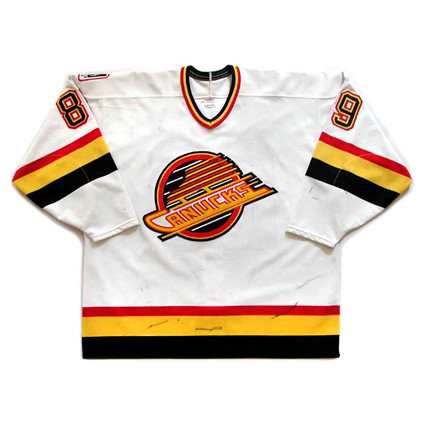
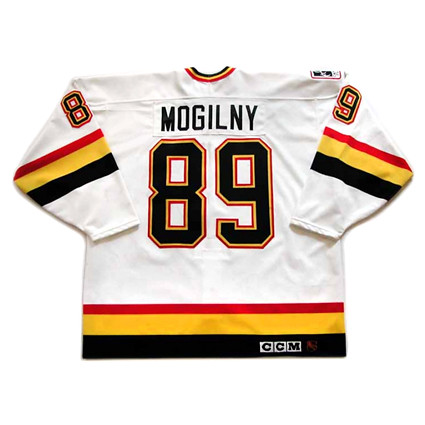
Bonus jersey: Today's bonus jersey is a 1995-96 Vancouver Canucks Alexander Mogilny jersey during his first season in Vancouver when he scored 55 goals and 107 points, the second highest of his career.

Vancouver introduced this white home jersey in 1989-90 after a decade of wearing gold jerseys at home. This style was worn through the 1996-97 season when the club got a complete makeover, with new colors and a new logo.


Vancouver Canucks 1995-96 F jersey
Vancouver Canucks 1995-96 B jersey

Extra bonus jersey: Today's extra bonus jersey is a 2003-04 Toronto Maple Leafs Alexander Mogilny jersey from the season during which he scored his 1,000th NHL point.


The evolution of this Maple Leafs jersey began back in the 1992-93 season when Toronto adopted a brand new style jersey with a more traditional look based on a sweater first worn back in 1934-35, only now paired with their modern Maple Leafs crest. The jersey first evolved with the adoption of a modern name and number font in 1997-98. While the name remained unchanged, the curvy numbers were replaced in 2000-01 with a return to a more classic block font for the numbers, although now trimmed in blue and outlined in silver, the first time a third color had been used on a Maple Leafs jersey since World War II, when the lettering on the crest was red for a few seasons.


The retro style maple leaf secondary logo was replaced by a new "TML" monogram at the same time the number font was changed in 2000-01.


Toronto Maple Leafs 2003-04 jersey, Toronto Maple Leafs 2003-04 jersey

Extra extra bonus jersey: Today's extra extra bonus jersey is a 1988-89 CSKA Moscow Alexander Mogilny jersey from Red Army's 13th consecutive Soviet Championship League title under Tikhonov just weeks prior to Mogilny defecting to the west.

Mogilny's departure in early May after that year's World Championships in Sweden, effectively marked the end of an era for Tikhnov and the supremacy of CSKA, as prior to the following season Slava Fetisov, Igor Larionov and Vladimir Krutov left the Soviet Union with permission of the authorities to play in the NHL, bringing to a close Red Army's unparalleled streak of championship dominance.


CSKA Red Army 88-89 jersey, CSKA Red Army 88-89 jersey

In today's video section, an interview with Mogliny from the 1989 World Junior Championships in January, a few months prior to his defection in April after the World Championships. He sticks to the party line quite well, giving little hint as to what was to follow, or at least that's what the interpreter tells us...


Here is a look at the some of the career highlights of Mogilny.


Here, Mogilny scores his 70th goal of the 1992-93 season, only the seventh player to reach 70 in NHL history.


Speaking of the remarkable 1992-93 season, here is a brief feature story on the partnership between Mogilny and Lafontaine.


Finally, an excellent documentary about Mogliny's defection narrated by Meehan that runs 23 minutes and is well worth your time.


Saturday, December 3, 2016

1980 United States Olympic Team Mike Ramsey Jersey

After graduating from Minneapolis Roosevelt High School, where he was considered the top defenseman in Minnesota, Mike Ramsey, born on this date in 1960, joined the University of Minnesota Golden Gophers for the 1978-79 season.

Ramsey Roosevelt, Ramsey Roosevelt
Mike Ramsey of the Roosevelt Teddies

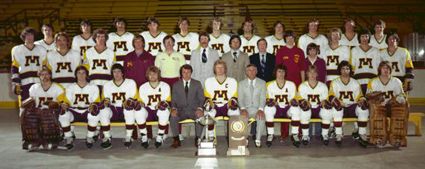
Ramsey scored 24 points in 34 games as a college rookie as Minnesota would go on to win the NCAA national championship under the guidance of head coach Herb Brooks.

The 1979 NCAA national champion Minnesota Golden Gophers

During that season Ramsey also participated in the 1979 World Junior Championships for the United States. Later that spring, Ramsey was chosen 11th overall by the Buffalo Sabres in the 1979 NHL Entry Draft, the first Minnesotan ever taken in the first round.

Rather than return to Minnesota for a second season, Ramsey became the youngest member of the United States Olympic Hockey Team under his college coach Brooks. The Americans shocked the world by upsetting the Soviet Union in the "Miracle on Ice" and then completed their quest by winning the gold medal with a win over Finland.

Ramsey USA, Ramsey USA
Ramsey demonstrating his tough defensive style

Following the Olympics, Ramsey immediately turned professional and joined the Sabres for the final 13 games of the season followed by an equal number of playoff games, a total of 89 games played that season including the Olympic Team's training schedule, a huge number of games for someone two years removed from high school hockey.

Ramsey, buoyed by his high pressure Olympic experience against players much older than himself, adapted to the faster and stronger players in the NHL, playing over 150 games in the NHL over the course of the next two seasons. With Buffalo quickly eliminated from the playoffs, Ramsey was free to once again wear the red, white and blue of the United States at the 1982 World Championships.

The 1982-83 NHL season was one of Ramsey's finest offensive seasons, as he scored 8 goals and 38 points while posting a +20 rating. The following season Ramsey's offensive total dipped to 31 points, but he set a career high with 9 goals, as well as having a +27 rating.

Ramsey Sabres, Ramsey Sabres
The respected Ramsey was named captain of the Sabres

Before the 1984-85 NHL season could begin, Ramsey competed in the 1984 Canada Cup tournament, scoring a goal and an assist in six games as the United States finished second in the round robin portion of the tournament before losing in the semifinals.

Another strong 30 point season followed as Ramsey set a career high with a +31 rating. Two more seasons with Buffalo saw Ramsey extend his streak of 72 or more games played to seven, and set a career high in 1986-87 with 30 points. Ramsey was also named an NHL All-Star in 1987 when the usual All-Star Game format was put on hold as the NHLers faced off against the Soviet Union in the two-game series known as Rendez-Vous '87.

The 1987 Canada Cup came next for Ramsey prior to the 1987-88 NHL season, the first of six more solid defensive seasons with the Sabres which included being named captain of the Sabres in 1991-92. Then, after 14 seasons in Buffalo, Ramsey was traded to the two-time defending Stanley Cup champion Pittsburgh Penguins where he was reunited with his old Sabres coach Scotty Bowman.

Ramsey Penguins, Ramsey Penguins
Ramsey again played for Bowman while with the Penguins

There was no third Stanley Cup for Pittsburgh, and after playing the following season of 1993-94 with the Penguins, Ramsey signed as a free agent with the Detroit Red Wings. His time there was spoiled by injuries which limited him to just 33 games in 1994-95 and 47 the next.

Ramsey Red Wings, Ramsey Red Wings

He retired over the summer, but returned for a pair of games in February of 1996, but felt he wasn't up to standards and retired for good after 18 seasons, 1,070 games, 79 goals and 266 assists for 345 point and but one season with a negative plus/minus rating all while never playing a single game in the minors.

Ramsey played in four NHL All-Star Games and was inducted into the US Hockey Hall of Fame in 2001.

Today's featured jersey is a 1980 United States Olympic Team Mike Ramsey jersey. This blue road jersey was worn during the Americans final game against Finland which clinched the gold medal.

USA 1980 #5 jersey photo USA19805RF.jpg
USA 1980 #5 jersey photo USA19805RB.jpg

Bonus Jersey: Today's bonus jersey is a 1986-87 Buffalo Sabres Mike Ramsey jersey. This classic Sabres jersey style would remain in use through the 1995-96 season until replaced by an all new look for Buffalo when the team's colors changed to red, black and white. It was brought back as an alternate jersey in 2006-07 and was the basis for a new, modernized alternate in 2008-09 before being promoted to the team's primary jersey in 2010-11, much to the delight of the fans.

 photo Buffalo Sabres 1986-87 F jersey.jpg
 photo Buffalo Sabres 1986-87 B jersey.jpg

Extra bonus Jersey: Today's extra bonus jersey is a 1987 United States National Team Mike Ramsey jersey as worn in the 1987 Canada Cup tournament. The United States first wore this style in 1984 and wore it for a long run through to 1995 until Nike took over making jerseys for IIHF international competition.

  photo USA 1987 CC F jersey.jpg
 photo USA 1987 CC B jersey.jpg

Extra extra bonus Jersey: Today's extra extra bonus jersey is a 1994-95 Detroit Red Wings Mike Ramsey jersey as worn during the 1995 Stanley Cup Finals against the victorious New Jersey Devils.

The Red Wings name was adopted in1932 after the team was originally called the Cougars and Falcons. The Red Wings first wore just a red jersey for all games for two seasons until introducing a white jersey for the 1924-35 season. That jersey had white sleeves with a broad red stripe and remained in use all the way until the 1960-61 season until they sleeve colors were reversed to today's red sleeves with a white stripe.

Only minor additions have taken place since then, such as the addition of sleeve numbers and names on the back, which remain one of the few professional sports teams to still employ the stylish and classy vertically arched names.

 photo Detroit Red Wings 1994-95 F jersey.jpg
 photo Detroit Red Wings 1994-95 B jersey.jpg

In today's video section, a great clip, as Ramsey levels a Montreal Canadiens player with a clean, hard hit and is then jumped by Mario Tremblay. Not only does Ramsey land a dozen heavy rights, but the two of them would go on to be assistant coaches together with the Minnesota Wild!


Here, Ramsey risks his life and career by actually checking Wayne Gretzky - during the NHL All-Star Game! Yes, he didn't put Gretzky in the fourth row of seats like he could have, but still, it's the last hit we recall in an all-star game!


Finally, here is Ramsey being interviewed a in 2009 between periods of a Minnesota High School girls hockey game in which his daughter Rachel was playing.


hit counter for blogger