History of Jersey 83-93 Banner sm photo History of Jersey 83-93 Banner sm.jpg
Showing posts with label Howe Mark. Show all posts

Monday, March 6, 2017

1985-86 Philadelphia Flyers Mark Howe Jersey

Mark Howe first gained recognition as a surprising addition as member of the 1972 United States Olympic Team that won a remarkable silver medal in Sapporo, Japan. At just 16 years old, and still only a high school junior who had just recently gotten his driver's license and playing on a team with Vietnam War veterans, he remains the youngest member of a US Olympic Hockey Team ever.

1972 USA Olympic team
1972 United States Olympic Team - Mark Howe, back row first on left

"We picked Mark up, and he played some exhibition games with us. We needed a left winger. He was on our list for skill and attitude. The maturity level of this kid was overwhelming. He was a big part of the team. He was tougher than hell. Vlclav Nedomansky of Czechoslovakia nailed him in a preseason game, and he didn't know where he was, but it didn't bother him at all. I used him as a forward, and he became a Hall of Fame defenseman."
Howe recalls,
"The whole thing was just a great, great learning experience. The way I looked at it for my career, it was a huge stepping-stone. I learned more in the six weeks I was gone than I learned in the years and years of going to school. I mean, just about life in general - and just seeing the talent of the players from overseas, watching the Soviets play was a whole new level. Coach Williamson pushed me hard. I was a scorer. But when I went to that team, I wasn't. I was the guy who provided energy. I had to fit into a role, and so for me, it was a completely different experience - a tremendous learning experience."
During the medal ceremony as Howe stood with a silver medal around his neck, it finally struck him that this was a moment to savor.
"I remember looking up at the flag, and that's when I realized what an honor it was the play and represent your country. No matter what I did, I always gave the best I could. Seeing the flag of your country being raised - even though there was one a little higher than ours - was my fondest moment."
He then added to his resume by winning a Memorial Cup in 1973 as a member of the Toronto Marlboros of the Ontario Hockey League and was named the tournament's Most Valuable Player in the process.

At a time when the NHL had an minimum age limit of 20 for it's players, the 18 year old Howe turned professional during the NHL/WHA rivalry in a headline-grabbing signing to play for the Houston Aeros of the WHA along side his brother Marty Howe and his legendary father Gordie, who was lured out of retirement for the opportunity to play with his sons.

Mark,Gordie and Marty Howe
Marty, Gordie and Mark Howe

Mark scored his first goal 27 years to the day after his father scored for the first time for the Detroit Red Wings. His trophy cabinet continued to grow, as Mark was awarded the Lou Kaplan Award as WHA Rookie of the Year and the Aeros won the Avco World Trophy in 1974. In 1975 the Aeros repeated as champions of the WHA and Howe was the leading playoff scorer with 22 points in 13 games. He was also named to Team Canada for the 1974 Summit Series against the Soviet Union.
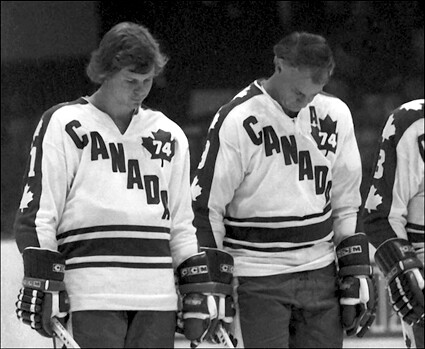
Mark and Gordie Howe 1974 Summit Series
Mark and Gordie Howe suited up for Canada at the 1974 Summit Series

Howe, who began his career as a wing, had moved back to defense by 1976-77 and the trio of Howes signed with the New England Whalers for the 1977-78 season. They continued to play together through the 1979-80 season when the Whalers became members of the NHL. While he regularly scored in the mid-70's points-wise in Houston, his offensive game came alive in New England, first with 91 points in 1977-78 which was followed by 107 points in the final WHA season of 1978-79 before scoring 80 in his first NHL season.
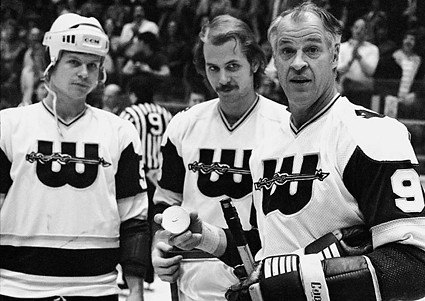
Mark, Marty and Gordie Howe Whalers
The Howe trio moved to Hartford for 1977-78

After Gordie retired following the 1979-80 season, Mark no longer had to play in his father's shadow and was named to his first NHL All-Star Game in 1981 and was later played for the United States in the 1981 Canada Cup.

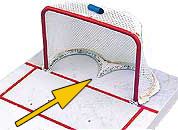
After one more season in Hartford, Howe was traded to the Philadelphia Flyers at the 1983 draft following concerns after a grisly injury in which he was impaled in the thigh by the pointed center of a goal. His recovery required a liquid diet for a period of time that resulted in him losing 24 pounds. His injury resulted in a redesign for goal frames and the way they were held in place on the ice.
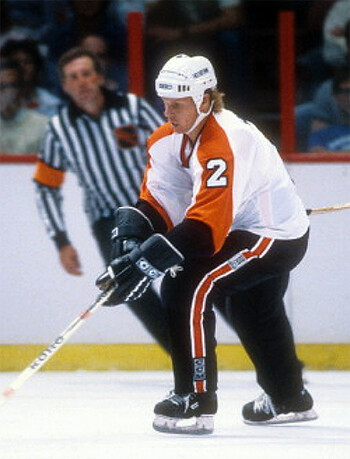
Mark Howe Flyers Cooperalls 1981-82
Howe was present in Philadelphia during
the brief "Cooperalls" era

He rebounded from his injury and excelled as a member of some great defensive teams of the era. Howe played in his second All-Star Game and was a finalist for the Norris Trophy in 1983 and played in the Stanley Cup Finals in 1985.

He had perhaps the best season of his career in 1985-86, setting NHL career highs with 24 goals, 58 assists and 82 points, made his third All-Star Game, was the NHL plus/minus leader at +85 and came in second in voting for the Norris Trophy.

Perhaps the highlight of his season came on this date in 1986 when the Flyers hosted the Toronto Maple Leafs. The first period had ended with the Flyers trailing 2-1, but Howe tied the game with his 22nd goal of the season with assists from twin brothers Rich Sutter and Ron Sutter at 2:47 of the second on a power play.


Five minutes later, Howe struck again, this time from Pelle Eklund and Ilkka Sinisalo even strength at 9:35 for a 3-2 Philadelphia lead. Toronto tied the game a little over five minutes later, but with just four seconds remaining in the second, Tim Kerr scored his 45th goal from Brad McCrimmon and Howe to restore the Flyers one goal advantage going into the third period.

It only took the Maple Leafs a minute and a half to tie the game at 4-4, but then the same combo that was responsible for the second Flyers goal struck again, this time Ron Sutter scoring from Rich Sutter and Howe for a 5-4 lead for Philadelphia.

The game remained close until, with just 1:08 to play, Lindsay Carson beat Toronto's Don Edwards from Howe to give the Flyers a two goal cushion. With Edwards now pulled, Sinisalo scored his 29th goal of the year into an empty net, with assists going to Howe and Murray Craven. It was Howe's fourth consecutive assist and followed his back-to-back goals, giving him six points on the night and on six consecutive Flyers goals.

In addition, his six points set new Philadelphia team records for goals, assists and points in a season by a Flyers defenseman.

Mark Howe Flyers
Howe rewarded the Flyers faith with a ten year run for the club

In 1986-87 Howe helped lead the Flyers to the 1987 Stanley Cup Finals while contributing 12 points in 26 games from the blueline and was a Norris finalist for the third time.

After playing 75 games in 1987-88 and his fourth All-Star Game, back and knee injuries would limit him to no more than 60 games for the remaining seven seasons of his career. 
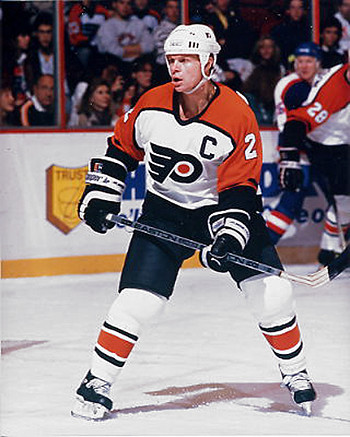
 Mark Howe Flyers captain
The respected Howe served as the Flyers captain at times

After four more seasons with the Flyers, Howe signed as a free agent with the Detroit Red Wings, the club his father gained most of his fame with.

While healthy, Howe provided veteran leadership to the Red Wings defensive corps, which included a young Nicklas Lidstrom. The Red Wings began a transformation in 1993-94 with the arrival of Scotty Bowman as coach and made the Stanley Cup Finals in 1995, their first finals appearance since 1966.
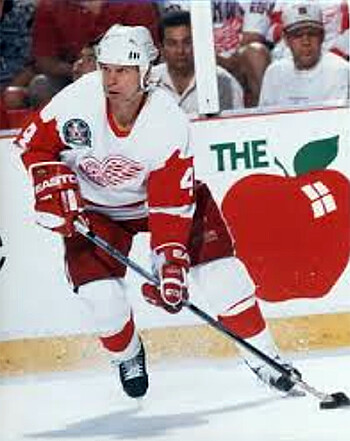
Mark Howe Red Wings
Howe finished his long career with Detroit

After one more season, in which he was limited to just 18 games, Howe retired with 929 NHL games and 426 in the WHA for a combined 405 goals and 841 assists for 1246 points. He won an Olympic silver medal in 1972, was WHA Rookie of the Year in 1974 and won the WHA Avco World Cup in 1974 and 1975. He was the 1986 NHL Plus/Minus Award winner and a four time NHL All-Star.

He was elected to the United States Hockey Hall of Fame in 2003 and was inducted into the Hockey Hall of Fame in 2011. Also on this date in 2012, the Flyers retired Howe's #2, making him only the fifth Flyer to ever be so honored.
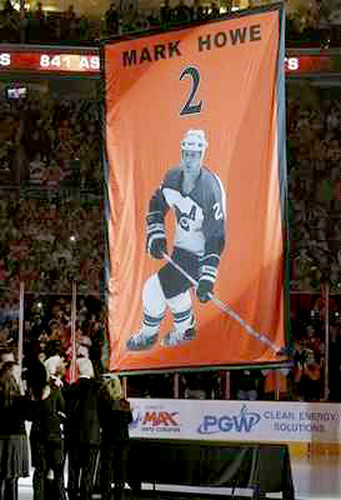
Mark Howe jersey retirement 
Howe had his number 2 retired on this date in 2012

Today's featured jersey is a 1985-86 Philadelphia Flyers Mark Howe jersey, the season he set Flyers single season records for goals, points and assists by a defenseman and both his goals and points records still stand today.

The Flyers jerseys remained relatively unchanged from their introduction in 1967 with only gradual detail changes such as the addition of black outlines separating the sleeve and body colors in 1982 and tweaks to the names and numbering style.

Philadelphia wore the #31 on the left shoulder above their sleeve numbers in memory of goaltender Pelle Lindbergh, who was killed in a car accident.
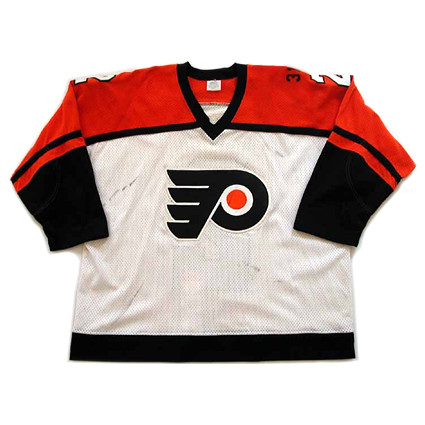
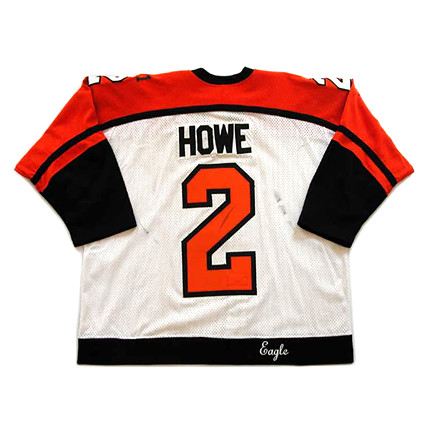
Philadelphia Flyers 1985-86 F jersey
Philadelphia Flyers 1985-86 B jersey

Bonus jersey: Today's bonus jersey is a 1980-81 New England Whalers Mark Howe jersey. From the beginning part of Mark's career when he played with both his father Gordie and his brother Marty, Howe wore his first name on his jerseys from his pro debut with the Houston Aeros in 1973 through his final season with the Whalers of 1981-82.

The Whalers wore this style of jersey beginning with their entry into the NHL in 1979-80. One of the terms of their acceptance into the NHL was to change their name from the New England Whalers, used  for seven years while members of the WHA, to the Hartford Whalers at the insistence of the Boston Bruins, who apparently thought of themselves as New England's team. The name change necessitated a new logo, the ever-popular whale tail logo with the hidden H in the negative space.

This jersey remained in use through the 1984-85 season, including one year being paired with the "Cooperalls" long pants, one of only two teams to use the short lived trousers. The jersey saw the unfortunate removal of the Pucky the Whale shoulder logos in 1985-86 but continued to be worn through the 1991-92 season, although with the angled sleeve stripes straightened in 1989-90, until a new set of jerseys debuted in 1992-93 with blue replacing green as the primary team color.
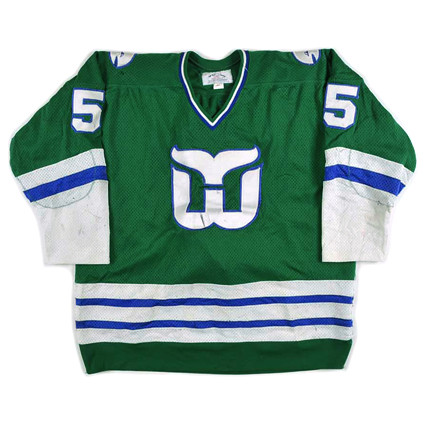
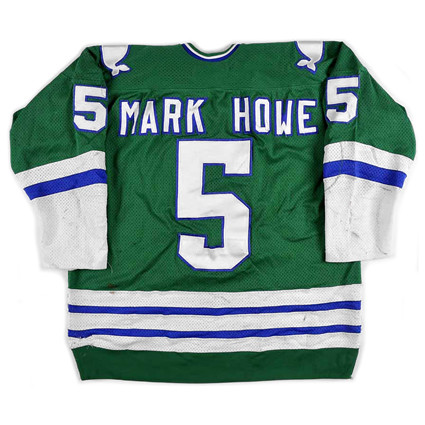
Hartford Whalers 198-81 F jersey
Hartford Whalers 198-81 B jersey


Extra bonus jersey: Today's extra bonus jersey is a 1979 WHA All-Star Mark Howe jersey. With the WHA down to just six teams during its dying days, a single team of WHA All-Stars was selected and faced off in a three game series against Dynamo Moscow of the Soviet Union. With father Gordie on the team, who famously played on a line with Wayne Gretzky, Mark's jersey has his first initial "M" in front of his last name

The three game series, played entirely in Edmonton, saw the WHA All-Stars win all three games, the first two by identical 4-2 scores and the final one  4-3.
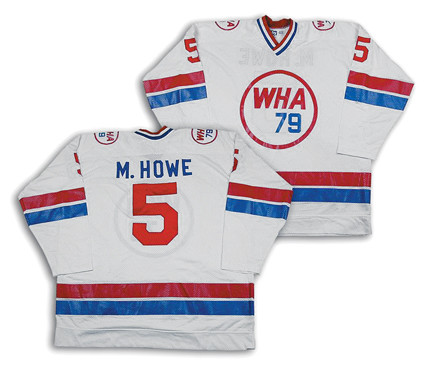
WHA All-Star 1979 jersey 
photo courtesy of Classic Auctions

Today's video segment begins with a little fatherly advice from Gordie to Mark about making the move to the WHA.


Next, a look at Howe's career, as presented during his induction into the Hockey Hall of Fame in 2001.


Finally, here is Howe's memorable speech during his Hockey Hall of Fame induction.

Thursday, May 28, 2015

1980-81 New England Whalers Mark Howe Jersey

Born on this date in 1955, Mark Howe first gained recognition as a surprising addition as member of the 1972 United States Olympic Team that won a remarkable silver medal in Sapporo, Japan. At just 16 years old, and still only a high school junior who had just recently gotten his driver's license and playing on a team with Vietnam War veterans, he remains the youngest member of a US Olympic Hockey Team ever.

1972 USA Olympic team
1972 United States Olympic Team - Mark Howe, back row first on left

"We picked Mark up, and he played some exhibition games with us. We needed a left winger. He was on our list for skill and attitude. The maturity level of this kid was overwhelming. He was a big part of the team. He was tougher than hell. Vlclav Nedomansky of Czechoslovakia nailed him in a preseason game, and he didn't know where he was, but it didn't bother him at all. I used him as a forward, and he became a Hall of Fame defenseman."
Howe recalls,
"The whole thing was just a great, great learning experience. The way I looked at it for my career, it was a huge stepping-stone. I learned more in the six weeks I was gone than I learned in the years and years of going to school. I mean, just about life in general - and just seeing the talent of the players from overseas, watching the Soviets play was a whole new level. Coach Williamson pushed me hard. I was a scorer. But when I went to that team, I wasn't. I was the guy who provided energy. I had to fit into a role, and so for me, it was a completely different experience - a tremendous learning experience."
During the medal ceremony as Howe stood with a silver medal around his neck, it finally struck him that this was a moment to savor.
"I remember looking up at the flag, and that's when I realized what an honor it was the play and represent your country. No matter what I did, I always gave the best I could. Seeing the flag of your country being raised - even though there was one a little higher than ours - was my fondest moment."
He then added to his resume by winning a Memorial Cup in 1973 as a member of the Toronto Marlboros of the Ontario Hockey League and was named the tournament's Most Valuable Player in the process.

At a time when the NHL had an minimum age limit of 20 for it's players, the 18 year old Howe turned professional during the NHL/WHA rivalry in a headline-grabbing signing to play for the Houston Aeros of the WHA along side his brother Marty Howe and his legendary father Gordie, who was lured out of retirement for the opportunity to play with his sons.

Mark,Gordie and Marty Howe

Mark scored his first goal 27 years to the day after his father scored for the first time for the Detroit Red Wings. His trophy cabinet continued to grow, as Mark was awarded the Lou Kaplan Award as WHA Rookie of the Year and the Aeros won the Avco World Trophy in 1974. In 1975 the Aeros repeated as champions of the WHA and Howe was the leading playoff scorer with 22 points in 13 games. He was also named to Team Canada for the 1974 Summit Series against the Soviet Union.

Howe, who began his career as a wing, had moved back to defense by 1976-77 and the trio of Howes signed with the New England Whalers for the 1977-78 season. They continued to play together through the 1979-80 season when the Whalers became members of the NHL. While he regularly scored in the mid-70's points-wise in Houston, his offensive game came alive in New England, first with 91 points in 1977-78 which was followed by 107 points in the final WHA season of 1978-79 before scoring 80 in his first NHL season.

Howe Family Whalers

After Gordie retired following the 1979-80 season, Mark no longer had to play in his father's shadow and was named to his first NHL All-Star Game in 1981 and was later played for the United States in the 1981 Canada Cup. After one more season in Hartford, Howe was traded to the Philadelphia Flyers at the 1983 draft following concerns after a grisly injury in which he was impaled in the thigh by the pointed center of a goal. His recovery required a liquid diet for a period of time that resulted in him losing 24 pounds. His injury resulted in a redesign for goal frames and the way they were held in place on the ice.

He rebounded from his injury and excelled as a member of some great defensive teams of the era. Howe played in his second All-Star Game and was a finalist for the Norris Trophy in 1983 and played in the Stanley Cup Finals in 1985.

He had perhaps the best season of his career in 1985-86, setting NHL career highs with 24 goals, 58 assists and 82 points, made his third All-Star Game, was the NHL plus/minus leader at +85 and came in second in voting for the Norris Trophy.

Mark Howe Flyers

In 1986-87 Howe helped lead the Flyers to the 1987 Stanley Cup Finals while contributing 12 points in 26 games from the blueline and was a Norris finalist for the third time.

After playing 75 games in 1987-88 and his fourth All-Star Game, back and knee injuries would limit him to no more than 60 games for the remaining seven seasons of his career. After four more seasons with the Flyers, Howe signed as a free agent with the Detroit Red Wings, the club his father gained most of his fame with.

While healthy, Howe provided veteran leadership to the Red Wings defensive corps, which included a young Nicklas Lidstrom. The Red Wings began a transformation in 1993-94 with the arrival of Scotty Bowman as coach and made the Stanley Cup Finals in 1995, their first finals appearance since 1966.

After one more season, in which he was limited to just 18 games, Howe retired with 929 NHL games and 426 in the WHA for a combined 405 goals and 841 assists for 1246 points.

Howe was elected to the United States Hockey Hall of Fame in 2003, inducted into the Hockey Hall of Fame in 2011 and had his jersey number retired by the Flyers in 2012.

Today's featured jersey is a 1980-81 New England Whalers Mark Howe jersey. From the beginning part of Mark's career when he played with both his father Gordie and his brother Marty, Howe wore his first name on his jerseys from his pro debut with the Houston Aeros in 1973 through his final season with the Whalers of 1981-82.

The Whalers wore this style of jersey beginning with their entry into the NHL in 1979-80. One of the terms of their acceptance into the NHL was to change their name from the New England Whalers, used  for seven years while members of the WHA, to the Hartford Whalers at the insistence of the Boston Bruins, who apparently thought of themselves as New England's team. The name change necessitated a new logo, the ever-popular whale tail logo with the hidden H in the negative space.

This jersey remained in use through the 1984-85 season, including one year being paired with the "Cooperalls" long pants, one of only two teams to use the short lived trousers. The jersey saw the unfortunate removal of the Pucky the Whale shoulder logos in 1985-86 but continued to be worn through the 1991-92 season, although with the angled sleeve stripes straightened in 1989-90, until a new set of jerseys debuted in 1992-93 with blue replacing green as the primary team color.

Hartford Whalers 1980-81 jersey photo Hartford Whalers 1980-81 F jersey.jpg
Hartford Whalers 1980-81 jersey photo Hartford Whalers 1980-81 B jersey.jpg

Bonus jersey: Today's bonus jersey is a 1984-85 Philadelphia Flyers Mark Howe jersey. Howe was finally able to venture out on his own and ditch the first name on his back in 1982-83 when he joined Philadelphia. 1984-85 was Howe's third season with Philadelphia and he scored 18 goals and 57 points and made it to the Stanley Cup Finals the season he wore this jersey.

The Flyers jerseys remained relatively unchanged from their introduction in 1967 with only gradual detail changes such as the addition of black outlines separating the sleeve and body colors in 1982 and tweaks to the names and numbering style.

Philadelphia Flyers 1984-85 jersey photo Philadelphia Flyers 1984-85 F jersey.jpg
Philadelphia Flyers 1984-85 jersey photo Philadelphia Flyers 1984-85 B jersey.jpg

Today's video segment begins with a little fatherly advice from Gordie to Mark about making the move to the WHA.


Next, a look at Howe's career, as presented during his induction into the Hockey Hall of Fame in 2001.


Finally, here is Howe's memorable speech during his Hockey Hall of Fame induction.

Tuesday, March 6, 2012

1984-85 Philadelphia Flyers Mark Howe Jersey

Mark Howe first gained recognition as a surprising addition as member of the 1972 United States Olympic Team that won a remarkable silver medal in Sapporo, Japan. At just 16 years old, and still only a high school junior who had just recently gotten his driver's license and playing on a team with Vietnam War veterans, he remains the youngest member of a US Olympic Hockey Team ever.

1972 USA Olympic team
1972 United States Olympic Team - Mark Howe, back row first on left

"We picked Mark up, and he played some exhibition games with us. We needed a left winger. He was on our list for skill and attitude. The maturity level of this kid was overwhelming. He was a big part of the team. He was tougher than hell. Vlclav Nedomansky of Czechoslovakia nailed him in a preseason game, and he didn't know where he was, but it didn't bother him at all. I used him as a forward, and he became a Hall of Fame defenseman."
Howe recalls,
"The whole thing was just a great, great learning experience. The way I looked at it for my career, it was a huge stepping-stone. I learned more in the six weeks I was gone than I learned in the years and years of going to school. I mean, just about life in general - and just seeing the talent of the players from overseas, watching the Soviets play was a whole new level. Coach Williamson pushed me hard. I was a scorer. But when I went to that team, I wasn't. I was the guy who provided energy. I had to fit into a role, and so for me, it was a completely different experience - a tremendous learning experience."
During the medal ceremony as Howe stood with a silver medal around his neck, it finally struck him that this was a moment to savor.
"I remember looking up at the flag, and that's when I realized what an honor it was the play and represent your country. No matter what I did, I always gave the best I could. Seeing the flag of your country being raised - even though there was one a little higher than ours - was my fondest moment."
He then added to his resume by winning a Memorial Cup in 1973 as a member of the Toronto Marlboros of the Ontario Hockey League and was named the tourament's Most Valuable Player in the process.

At a time when the NHL had an minimum age limit of 20 for it's players, the 18 year old Howe turned professional during the NHL/WHA rivalry in a headline-grabbing signing to play for the Houston Aeros of the WHA along side his brother Marty and his legendary father Gordie, who was lured out of retirement for the opportunity to play with his sons.

Mark,Gordie and Marty Howe

Mark scored his first goal 27 years to the day after his father scored for the first time for the Detroit Red Wings. His trophy cabinet continued to grow, as Mark was awarded the Lou Kaplan Award as WHA Rookie of the Year and the Aeros won the Avco World Trophy in 1974. In 1975 the Aeros repeated as champions of the WHA and Howe was the leading playoff scorer with 22 points in 13 games. He was also named to Team Canada for the 1974 Summit Series against the Soviet Union.

Howe, who began his career as a wing, had moved back to defense by 1976-77 and the trio of Howes signed with the New England Whalers for the 1977-78 season. They continued to play together through the 1979-80 season when the Whalers became members of the NHL. While he regularly scored in the mid-70's points-wise in Houston, his offensive game came alive in New England, first with 91 points in 1977-78 which was followed by 107 points in the final WHA season of 1978-79 before scoring 80 in his first NHL season.

Howe Family Whalers

After Gordie retired following the 1979-80 season, Mark no longer had to play in his father's shadow and was named to his first NHL All-Star Game in 1981 and was later played for the United States in the 1981 Canada Cup. After one more season in Hartford, Howe was traded to the Philadelphia Flyers at the 1983 draft following concerns after a grisly injury in which he was impaled in the thigh by the pointed center of a goal. His recovery required a liquid diet for a period of time that resulted in him losing 24 pounds. His injury resulted in a redesign for goal frames and the way they were held in place on the ice.

He rebounded from his injury and excelled as a member of some great defensive teams of the era. Howe played in his second All-Star Game and was a finalist for the Norris Trophy in 1983 and played in the Stanley Cup Finals in 1985.

He had perhaps the best season of his career in 1985-86, setting NHL career highs with 24 goals, 58 assists and 82 points, made his third All-Star Game, was the NHL plus/minus leader at +85 and came in second in voting for the Norris Trophy.

Mark Howe Flyers

In 1986-87 Howe helped lead the Flyers to the 1987 Stanley Cup Finals while contributing 12 points in 26 games from the blueline and was a Norris finalist for the third time.

After playing 75 games in 1987-88 and his fourth All-Star Game, back and knee injuries would limit him to no more than 60 games for the remaining seven seasons of his career. After four more seasons with the Flyers, Howe signed as a free agent with the Detroit Red Wings, the club his father gained most of his fame with.

While healthy, Howe provided veteran leadership to the Red Wings defensive corps, which included a young Nicklas Lidstrom. The Red Wings began a transformation in 1993-94 with the arrival of Scotty Bowman as coach and made the Stanley Cup Finals in 1995, their first finals appearance since 1966.

After one more season, in which he was limited to just 18 games, Howe retired with 929 NHL games and 426 in the WHA for a combined 405 goals and 841 assists for 1246 points and was elected to the United States Hockey Hall of Fame in 2003.

The Flyers will retire Howe's #2 tonight prior to their game against the Red Wings, making Howe only the fifth Flyer to ever have his number retired.

Today's featured jersey is a 1984-85 Philadelphia Flyers Mark Howe jersey. 1984-85 was Howe's third season with Philadelphia and he scored 18 goals and 57 points and made it to the Stanley Cup Finals the season he wore this jersey.

The Flyers jerseys remained relatively unchanged from their introduction in 1967 with only gradual detail changes such as the addition of black outlines separating the sleeve and body colors in 1982 and tweaks to the names and numbering style.

Philadelphia Flyers jersey,Hockey jersey

Today's video segment is a look at Mark Howe, followed by an interview with him while he was with the Whalers in the WHA.


Next, a look at Howe's career, as presented during his induction into the Hockey Hall of Fame in 2001.


Finally, here is Howe's memorable speech during his Hockey Hall of Fame induction.


Monday, November 14, 2011

The 2011 Hockey Hall of Fame Induction Ceremony

Tonight is the 2011 Hockey Hall of Fame Induction Ceremony for this year's inductees, Ed Belfour, Doug Gilmour, Mark Howe and Joe Nieuwendyk, and outstanding class of excellent players.

Here then is our tribute to the Hockey Hall of Fame Class of 2011.

Chicago Blackhawks 90-91 F
Chicago Blackhawks 90-91 B
1990-91 Chicago Blackhawks Ed Belfour Jersey
1999 Stanley Cup Champion
1991 Calder Trophy
1991 & 1993 Vezina Trophy
1991, 1993, 1995 & 1999 William Jennings Trophy
1991 Canada Cup Gold Medal
2002 Olympic Gold Medal
Six time NHL All-Star
Holds Chicago Blackhawks team records for Most Penalty Minutes (240),
Games Played in a Single Season (74), Most Wins in a Single Season (43)
Holds Dallas Stars team records for Most Shutouts in a Single Season (9),
Most Career Playoff Games Played (73), Most Career Playoff Wins (44), Most
Career Playoff Shutouts (8) and Single Season Playoff Wins (16)
Holds Toronto Maple Leafs team record for Most Wins in a Single Season (37)

Calgary Flames 88-89 jersey
1988-89 Calgary Flames Doug Gilmour Jersey
1989 Stanley Cup Champion
1993 Selke Trophy
1987 Canada Cup Gold Medal
Two time NHL All-Star
Holds the NHL record for Fastest Two Shorthanded Goals at 4 seconds
Holds Toronto Maple Leafs team records for Most Points in One
Season (127), Most Assists in One Season (95) and Most Assists in One Game (6)

Philadelphia Flyers 84-85 jersey
1984-85 Philadelphia Flyers Mark Howe Jersey
1974 & 1975 WHA Avco Cup
1974 WHA Rookie of the Year
1986 NHL Plus/Minus Award
1972 Olympic Silver Medal
Four time NHL All-Star

Dallas Stars 98-99 F
Dallas Stars 98-99 B
1998-99 Dallas Stars Joe Nieuwendyk Jersey
1989, 1999 & 2003 Stanley Cup Champion
1988 Calder Trophy
1995 King Clancy Trophy
1999 Conn Smythe Trophy
2003 Masterton Trophy
Four time NHL All-Star
2002 Olympic Gold Medal

The 2011 Hockey Hall of Fame Induction Ceremony will be broadcast live on TSN 2 in Canada and the NHL Network in the United States starting at 7:30 PM Eastern time tonight.


hit counter for blogger