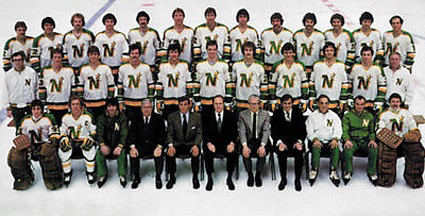
AlShaver was the voice of Minnesota North Stars hockey. Always was. Always will be.
He was a graduate of the Lorne Green Academy of Radio and Television Art in Toronto in 1948 and worked the morning show and baseball play-by-play at CJOY in Guelph, Ontario. He then worked in Calgary and Medicine Hat, Alberta before taking a job in Edmonton in 1952, where he did play-by-play for the Edmonton Eskimos of the Canadian Football League. He also broadcast five Grey Cup championship games nationally on the CBC.
During the 1960's he worked in both Montreal and Toronto, which included doing junior hockey games and hosting a bowling show, until 1967 when the National Hockey League made it's dramatic expansion from six teams to twelve.
Shaver was hired as the voice of the North Stars for their inaugural season and was with the team first on WCCO until 1978.
He moved with the team to KSTP until the franchise relocated to Dallas in 1993 for a total of all 26 seasons of the North Stars, calling 2,062 out of 2,071 games.
"It was a 26-year love affair that began on an October night in St. Louis, 1967, and ended abruptly on an April evening in 1993 when my love left me and moved to Dallas," Shaver wrote in 2007 .
In addition to working for the North Stars, KSTP also had Shaver work on the Minnesota State High School Hockey Tournament, which gave him the opportunity to meet legendary Broadcaster HowardCosell, who commented "What are you doing here?" as Cosell was of the opinion that Shaver should be in New York working for a national network.
Howard Cosell with Al Shaver
He was such a part of the fabric of the North Stars that he was featured on both the team's media guide and made more than one appearance on the cover of the team's program.
Not quite ready to close out his broadcasting career, he then worked for the University of Minnesota Golden Gophers until he retired on his own terms in 1996.
Shaver was a ten-time Minnesota Sportscaster of the Year and was inducted into the Museum of Broadcasting Hall of Fame in 2003. He was also given the 1993 Foster Hewitt Memorial Award by the Hockey Hall of Fame for outstanding contributions to radio and TV broadcasting and the game of hockey.
In addition to those honors, the press box at the Xcel Energy Center, home of the Minnesota Wild, is named for him.
On a personal note, as a youngster, we would listen to Shaver call North Stars games against the Chicago Black Hawks at night with our transistor radio tuned to WCCO. We recall Shaver always saying "a shot from the blue line hits traffic in front", leading us to mistakenly believe "Traffic" was the name of a Chicago defenseman and the greatest shot blocker in hockey history!
Upon getting the opportunity to share that story with Shaver, he related that when goaltender Cesare Maniago would make a great save, he'd call out "Oh! Maniago makes a great save!" causing some to believe that the Canadian born "O'Maniago" was actually of Irish decent!
For a real treat, to hear Al at his best, including a call of "a shot hitting Traffic" and an "O'Maniago" as well as him excitedly calling a fight all in the same sequence, click below to listen.
On the occasion of the final North Stars home game in 1993, we felt bad that Shaver was being overlooked on what would be his last time calling a North Stars game in Minnesota amidst all the vitriol for the North Stars owner who was moving the club. In an effort to pay tribute to the man who had called the North Stars games since day one, we made a simple sign in his honor. With the game against Chicago (who it turns out never employed a defenseman named "Traffic" we had learned by then) beginning to wind down, and us not having had a chance to display our sign, the North Stars obliged by finally scoring their first goal of the game with less than 6 minutes remaining.
The in-arena presentation was for the video of the goal to be replayed on the Met Center scoreboard along with Shaver's call of the goal. Perfect! The fans in the arena had just heard Shaver's voice for the first time all night and the time was right to display the sign. Unlike modern arenas where the corridor is outside of the seating bowl, the Met Center had a walkway inside the seating bowl which separated the lower bowl from the upper level sections, giving us the opportunity to not just hold up our sign, but to walk an entire lap inside the arena with our sign held high for all fans to see.
So off we went on our tribute lap to Shaver, not knowing what to expect. Fans who saw the sign began to stand and applaud, hold their glasses up high as well as reach down from the upper seats to "high five" the sign. Roughly a quarter of the way around the arena, we realized that a camera had been trained on us and the sign was now filling the video replay screen for all to see, especially the fans lower down who may not have had a chance to see the sign until then. It didn't end there either, as one of Shaver's sons asked for the sign once we were done with it, a request we were only too happy to oblige.
Not only was there a video camera trained on the sign during the "lap of honor", but a still camera as well, resulting in a sizable photo which appeared in the Minneapolis StarTribune two days later!
Shaver currently lives in the Vancouver area enjoying his retirement while his son WallyShaver has done the broadcasting for the North Stars, Minnesota Moose and Golden Gophers for years now and his grandson JasonShaver currently does play-by-play for the Chicago Wolves of the AHL, carrying on the family legacy.
Here is some footage of Al Shaver calling games for the North Stars. "What a ham this turkey is!"
Hailing from the Iron Range in northern Minnesota, MarkPavelich, born on this date in 1958, attended the University of Minnesota Duluth beginning in 1977-78. His progress was pronounced, as he scored 12 goals and 19 points his first season, 14 goals and 44 points his second (third on the club) and leapt up to 31 goals and 79 points to lead the team in 1978-79.
Pavelich while with Minnesota Duluth
His creative "rink rat" style of play caught the eye of head coach HerbBrooks who who named Pavelich to the 1980 United States Olympic Team, where he teamed with UMD Bulldogs teammate JohnHarrington and fellow northern Minnesota native BuzzSchneider in a line that became known as the "Coneheads".
"It was kind of unique, obviously, growing up playing hockey in Eveleth," Pavelich recalled. "I was fortunate enough to have the rink just a couple of blocks say, It was just nonstop hockey. I was always down at the rink."
During the 53 games leading up to the Olympics, Pavelich scored 45 points and during the seven games of the Olympic tournament, he averaged a point per game, with one goal and six assists, including his assist on the opening United States goal scored by Schneider and the critical first assist, earned by sending the puck into the slot despite facing and moving the opposite direction while falling backwards, where it was gathered by MikeEruzione, who then scored the game winning goal in the "Miracle on Ice" upset over the Soviet Union, later named the top story in the IIHF's first 100 years.
Undrafted by any NHL club, certainly in part due to his 5' 8" size, Pavelich took his game to HC Lugano in Switzerland, where he racked up 73 points in 60 games before once again putting on the red, white and blue of the United States at the 1981 World Championships.
Meanwhile, back in the United States the pairing of his Olympic coach Brooks and his assistant CraigPatrick, was reunited when Patrick hired Brooks to be the head coach of the New York Rangers. They brought Pavelich back to the United States and reunited him with not only Brooks, but also former US teammate DaveSilk and later RobMcClanahan.
Pavelich took to the NHL right off the bat, finishing third in team scoring with 33 goals and tying for second in points with RonDugay at 76. The following season Pavelich rose to second in team scoring with a nearly identical 75 points while raising his goal total to a team leading 37, which included a record setting game against the Hartford Whalers in 1983.
In that game, Pavelich opened the scoring with a power play goal just 1:17 into the contest. VaclavNedomansky banked another power play goal for the Rangers less than a minute later at 2:15. After the teams traded goals two minutes apart later in the period, the Rangers began to pull away with goals by Swede Kent-Erik Andersson at 18:36 and Pavelich's second goal, again on the power play with just ten seconds remaining in the period to give New York a commanding 5-1 lead after the first period.
BarryBeck stunned the Whalers just nine seconds into the second period before Pavelich completed his second career hat trick at the 9:06 mark. MikeRogers made it 8-1 Rangers two minutes later. Pavelich's former 1980 teammate MarkJohnson stemmed the tide with a goal for the Whalers at 12:52 before EdJohnstone's goal for the Rangers and MichelGalarneau's for Hartford made it 9-3 for home team after two.
But there was still more yet to come, and in surprising, record setting fashion, for at 8:40 of the third period Pavelich scored his fourth goal of the night, from TomLaidlaw and McClanahan, followed by his fifth goal of the game from Laidlaw just 11 seconds later, making Pavelich the first American-born player in the 66 year history of the NHL to score five goals in a game. His feat also equaled the Rangers team record set by DonMurdoch in 1976-77.
"As a pro, this is my most memorable game," he said afterwards.
Pavelich shows his five goal pucks to the media
following his record setting performance
In 9 playoff games that season, "Pav" set a career best with 4 goals and 9 points in 9 games.
While his goal total dropped from 37 to 29 the following season, he set a career high with 82 points thanks to his 53 assists in 1983-84.
1984-85 was a season of change, as Brooks was fired as the Rangers coach after 45 games and Pavelich himself was limited to just 48 games himself, although he still maintained a nearly a point per game average with 45.
With Brooks gone, Pavelich's days in New York were numbered, as he was uncomfortable and unaccustomed to playing the traditional NHL "dump and chase" style of new Rangers coach TedSator and retired at the end of the season after playing 59 games, scoring 20 goals and 40 points.
He was happy to return home to the simple life of hunting and fishing, only to be called on by Brooks once more, who had now taken over as the head coach of the Minnesota North Stars. It was a short-lived reunion however, as Pavelich would only play a dozen games for the North Stars in 1986-87, although they were productive ones, with 4 goals and 10 points. The record shows that later that season he suited up for the Dundee Rockets in the British Hockey League for a single game, being credited with a pair of assists.
While now done with the NHL, he was not quite finished with hockey just yet, finding a home with HC Bolzano in Italy beginning with the 1987-88 season, where he teamed with former North Stars teammate, Swede KentNilsson. There, Pavelich scored nearly a goal per game, with 31 goals in 36 games on his way to 73 points, more than two points per game. That was not all, as Bolzano went on to win the league championship that season, which included Pavelich's 9 goals and 20 points in just 8 playoff games.
He returned to Bolzano for another season in 1988-89, adding 23 goals and 57 points in 44 games before he retired once again.
But not for good.
With the league expanding in 1991, Pavelich was lured out of Minnesota one final time by the expansion San Jose Sharks, where he recorded an assist on the Sharks first ever goal on October 4, 1991. His return was very brief however, as he would only play two games before retiring, this time for good.
His final NHL totals were 355 games played, 137 goals and 192 assists for 329 points , with another 7 goals and 24 points in 23 playoff games.
Pavelich remains to this day a unique individual, who shuns the spot light of fame accorded to the 1980 Olympic Team, rarely leaving the comfort of home in the woods of Minnesota for reunions, interviews or personal appearances, unlike the always available Eruzione, who is often kidded that he has made a career out of one goal and has never met a microphone he didn't like. "The past is the past," Pavelich has been quoted as saying.
It would take 22 years before Pavelich joined his 19 teammates for a reunion, this coming at the the 2002 NHL All-Star Weekend. "It was just that time," Pavelich said when asked why he had chosen that weekend to rejoin his teammates.
His wife Kara said of his reputation, "I know Mark is often said to be reclusive, but that's overdone. He has a very large circle of friends." when Mark was inducted into the Duluth Entertainment and Convention Center Athletic Hall of Fame (the former home of the UMD Bulldogs) in 2006.
Today's featured jersey is a 1982-83 New York Rangers Mark Pavelich jersey from the season during which he became the first American-born player in NHL history to score five goals in one game.
The Rangers had worn a variation of their traditional blue sweaters with "Rangers" diagonally since their inception in 1926 almost without exception until a change to a new modern style in 1976-77, which lasted only one more season until they went back to their traditional look in 1978-79, only with one major difference, as "New York" had now replaced "Rangers" across the front of their classic blue jerseys for the first time ever.
This style would last for Pavelich's entire stay in New York, lasting through the 1986-87 season until a return to "Rangers", which remains through today.
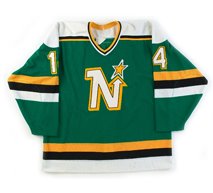
Bonus jersey: Today's bonus jersey is a 1986-87 Minnesota North Stars Mark Pavelich jersey as
worn during his brief stay with his home state North Stars, where he was
reunited with coach Brooks for the third time in his career.
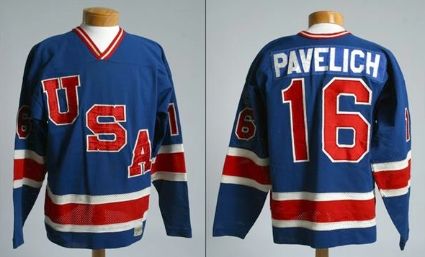
Extra bonus jersey: Today's extra bonus jersey is a 1980 United States Mark Pavelich jersey. This style, with "USA" diagonally across the front was worn during the 1980 Olympic Team's pre-Olympic schedule of games played against an assortment of minor league, college and other national teams in preparation for their participation in the Olympics. During the Games, they wore a new set of jerseys with the "USA" cresting now arched across the front.
This jersey was auctioned off by Lelands.com in December of 2004 and sold for $4,969.87.
Extra extra bonus jersey: Today's extra extra bonus jersey is a 1980 United States Olympic Team Mark Pavelich jersey. After 32 years with only MarkWells' blue and white Miracle on Ice jerseys becoming available to collectors of game worn jerseys, 2012 saw KenMorrow
auction off his Miracle jersey for $104,328 and 2013 had Eruzione
parting with both is blue ($286,800) and white jersey, which sold for
$657,250, considerably less than it's $1,000,000 pre-sale estimate.
Pavelich's white jersey, worn when he assisted on Eruzione's game winning goal against the Soviet Union, was also put up for auction at the same time as Eruzione's jerseys. The final
highest bid for the Pavelich jersey was $116,203, and with
the 19.5% buyer's premium added on, the final selling price rose
to $138,863. That exceeds the final price of KenMorrow's Miracle on Ice jersey, which sold for $104,328, by $34,534.
Our story today begins back in 1967 when the NHL expanded from six teams to 12 with the addition of the St. Louis Blues, Pittsburgh Penguins, Philadelphia Flyers, Los Angeles Kings and the focus of today's story, the California Seals and the Minnesota North Stars.
While the North Stars thrived in the hockey hotbed of Minnesota, the situation in California got off to a rocky start. San Francisco was not considered a particularly lucrative market for hockey, but the terms of the new television agreement the league had signed with CBS called for two of the six new expansion clubs to be located in California.
The Seals were supposed to have been located in San Francisco, but the planned arena was never built. Instead, the team was based across the bay in Oakland. The club was originally called the "California Seals" to appeal to fans in the larger San Francisco and address complaints from the other NHL team, who thought Oakland was not a major league city, as it's only other professional sports team at the time was the Oakland Raiders of the second rate American Football League. Then, on November 6, 1967, after having played just a dozen games, owner Barry Van Gerbig announced the team's name was being changed to the "Oakland Seals"!
Team captain Bobby Baun wearing their first "C" logo jersey
from the club's original name of "California Seals"
Poor attendance led to threats by Van Gerbig to move the club and the poor record in the ice led to only seven of the original 20 players returning for the second season. While the team finished with records below .500, they qualified for the playoffs in 1968-69 and 1969-70, but lost in the first round both times.
The 1968-69 Oakland Seals now wearing "O" logo sweaters
Prior to the 1969-70 season, Van Gerbig sold the club to a group called Trans National Communications, but when the group filed for bankruptcy, ownership reverted to Van Gerbig, who put the club up for sale once again.
The Oakland Seals were then purchased by Charlie O. Finley, owner of the Oakland Athletics baseball club, who had moved to the bay area in 1968. Never one to sit still, Finley renamed the team the "California Golden Seals" and changed the team's colors from green and blue to green and gold to match those worn by his baseball club, as well as having the team wear flashy white skates!
Owner Finley changed the Seals colors to green and gold
with flashy (and infamous) white skates
Unfortunately the the Golden Seals finished last in the NHL during their first season under Finley's ownership with just 45 points from 78 games. Even worse, the Seals first overall pick in the 1971 NHL Entry Draft had already been traded to the Montreal Canadiens for Ernie Hicke and Montreal's first round pick in 1970, used by he Golden Seals to take Chris Oddleifson, and the always needed cash. The Canadiens then used the draft choice obtained from the Golden Seals to select none other than future Hall of Famer Guy Lafleur.
The team improved by 15 points the following season, but suffered from the emergence of the World Hockey Association, as the frugal Finley refused to match the WHA's contract offers to his players resulting in five of the team's top ten scorers leaving for the rival league and the Golden Seals once again sank to the bottom of the standings with 48 points in 1972-73 and followed that up with just 36 points in 1973-74.
Matters were made worse, if that's even possible, by a divisional restructuring which somehow found the Golden Seals placed in the newly created Adams Division with the Boston Bruins, Buffalo Sabres and Toronto Maple Leafs, in an apparent effort by the league to kill off the franchise, as each of the other clubs were a minimum of 2,300 miles to the east!
Having grown tired of owning the hockey team, especially in direct comparison to his three-time world champion Athletics baseball team, Finley tried unsuccessfully to sell the Golden Seals and the franchise was eventually eventually taken over by the NHL.
Goaltender Gilles Meloche wearing the new post-Finley
team colors of Pacific Blue and California Gold
Melvin Swig then purchased the team in 1975 with plans to have the team play in a new arena in San Francisco. Those plans never came to pass following the election of a new mayor who was opposed to the plan, so after nine money-losing seasons, low attendance and few victories, minority owners George and Gordon Gund convinced Swig to relocate the team to their hometown of Cleveland, Ohio, making the club the first NHL team to relocate since 1934 and bringing to and end the Golden Seals ordeal in California, where the team had more names than playoff appearances!
Once relocated for the 1976-77 season, the franchise was renamed the Cleveland Barons and took up residence in the Richfield Coliseum, giving them the largest seating capacity in the NHL at the time of 18,544, but they would never come close to filling it in the two years they played in Cleveland. Their 1976 home opener drew only 8,900 fans and they attracted 10,000 at only seven out of their 40 home games.
The 1976-77 Cleveland Barons team
After the first season in Cleveland, majority owner Swig sold his interest in the team to the Gund brothers, who tried to put a more competitive team on the ice the second year. The Barons were able to defeat the defending champions the Montreal Canadiens in November and the Toronto Maple Leafs, New York Islanders and Buffalo Sabres in consecutive games in January. They also set an attendance record of 13,110 vs. Philadelphia that year, but a agonizing 15 game losing streak eliminated them from playoff contention and an eventual point total lower than the year before.
Goaltender and Golden Seals holdover Gilles Meloche anchored the NHL's Cleveland Barons
After the season the Gunds tried to buy the Coliseum, but failed. Meanwhile, the North Stars had fallen on hard times in Minnesota, thanks to a combination of poor play which caused them to miss the playoffs four of the previous five seasons and competition from the cross-town Minnesota Fighting Saints of the WHA, who played just 11 miles up the road in St. Paul and at times drew sellout crowds of over 17,000 during the North Stars down period.
With serious concerns that both clubs were on the verge of folding, on this date in 1978, the league granted approval for the Barons to merge with the Minnesota North Stars under the Gunds ownership. The team would play in Minnesota and retain the North Stars name, but take the Barons place in the Adams Division. The Barons remain the last franchise in the four major North American sports leagues to cease operations.
Things had to happen fast, as the 1978 NHL Amateur Draft was just two days away and a special dispersal draft for the excess players from the combined rosters needed to be held first. The new North Stars were allowed to protect 10 players and two goaltenders from the combined rosters of Cleveland and Minnesota prior to the dispersal draft, in which any team wanting to claim an unprotected player could do so for $30,000.
Working quickly for the freshly merged club, Minnesota's brand new General Manager Lou Nanne (who had only stopped playing at the end of the just completed season!) and Cleveland's GM Harry Howell (who became the combined team's head coach) evaluated their recently combined roster and protected Per-Olav Brasar, Brad Maxwell, Bryan Maxwell, Glen Sharpley, Tim Young and goaltender Pete LoPresti from the North Stars roster and Mike Fidler, Rick Hampton, Al MacAdam, Dennis Maruk, Greg Smith and goaltender Gilles Meloche from the Barons.
Tim Young
Only the five worst teams were allowed to make selections from the unprotected players in the Dispersal Draft, held on June 15, 1978, just two days after the merger of Cleveland and Minnesota was agreed to! The Washington Captials chose to pass, and were instead allowed to make an additional pick at the end of the first round of the 1978 Amateur Draft.
After the St. Louis Blues chose Mike Crombeen from the Barons roster, the North Stars were allowed to protect an additional player, which was Ron Zanussi. The Vancouver Canucks then chose Randy Holt, also formerly of the Barons. After the Pittsburgh Penguins passed on their chance to select a player, Bob Stewart was then added to the protected list by Minnesota. The Dispersal Draft then concluded when the Colorado Rockies declined their chance to select a player.
The newly merged roster was then immediately supplemented later the same day by the North Stars having the first overall pick in the 1978 NHL Amateur Draft thanks to Minnesota having finished dead last in the league at the end of the 1977-78 season. They chose eventual NHL Rookie of the Year and future team captain Bobby Smith in the first round and his Ottawa 67's linemate Steve Payne in the second round, both of whom would go on to be 40 goal scorers for the North Stars. They then hit on future Miracle on Ice team member Steve Christoff later in the second round, who would score 26 goals twice for the North Stars and excel as a penalty killer, and another future team captain, defenseman Curt Giles in the fourth round.
In addition to those protected in the dispersal draft and chosen in the Amateur Draft, the team was also able to retain several players who were not chosen in the Dispersal Draft despite not being protected. Among those were Tom Younghans, Fred Barrett and Bill Butters off the North Stars roster and the return to Minnesota of J. P. Parise from Cleveland as well as goaltender Gary Edwards, who supplanted LoPresti as Meloche's backup, playing in 25 games in 1978-79.
Looking back on the previous week, Nanne probably could not believe his luck, having taken over as General Manager the worst team in the NHL, he now suddenly found himself with the additions of Fidler, MacAdam, Maruk, Greg Smith, Parise, and goaltenders Meloche and Edwards plus draft picks Bobby Smith and Payne for the upcoming season - and all without having to have traded a single asset!
Bobby Smith arrived in Minnesota the year they merged with the Cleveland Barons
The critics said if you combined the rosters of two terrible teams, you were going to be left with a terrible team, but the combined talents of of the two teams plus the addition of their draft class of 1978 proved them wrong. While they did miss out on the playoffs in 1979, the 1979-80 roster reached the playoff Semifinals.
A common thread from the Seals to the Barons and
eventually the North Stars, Gilles Meloche
Then the 1980-81 team, who by now had Christoff and Giles plus 1979 draft picks Craig Hartsburg andhomegrown Neal Broten plus electrifying undrafted free agent Dino Ciccarelli (who was passed over after having suffered a broken leg in juniors), veteran Paul Shmyr, tough guy Jack Carlson and rookie goaltender Don Beaupre, made it to the Stanley Cup Finals in the space of three short seasons after having finished dead last in the NHL.
The new look North Stars reached the Stanley Cup Finals in 1981
It would take 22 years before the NHL would return to Ohio, but not to Cleveland, as the new team would be in the form of the Columbus Blue Jackets in 2000-01.
Today's first featured jersey is a 1974-75 California Golden Seals Gilles Meloche jersey. Meloche arrived in Oakland for the 1971-72 season after a trade from the Chicago Black Hawks, who had drafted Meloche in 1970.
After the departure of owner Finley, the Golden Seals colors were changed from his signature green and gold to the even less intimidating shades of "Pacific Blue" (teal) and "California Gold" (yellow), quite probably the worst colors ever for an NHL team, which were about as intimidating as Easter eggs. The change also gave the team more total color schemes than playoff appearances as well.
Aside from the unusual color scheme of the last incarnation of Golden Seals jerseys, another odd characteristic of this set was the decidedly "football jersey" style vertical stripes where the arms meet the body of the jersey, which are something that had never appeared on an NHL jersey before or since.
Today's second featured jersey is a 1976-77Cleveland Barons Gilles Meloche jersey. Made by ProJoy at a time when replicas were less than accurate. While this jersey has it's issues, like the sleeve stripes being straight instead of angled, the crest is very well made, with each piece being a separate piece of fabric sewn together. The Gothic "B" in the state of Ohio in the center of the main logo is five separate layers of fabric and both the curved "Cleveland" and "Barons" names are each intricate single pieces of twill sewn onto the "C"!
What sets the 1976-77 jerseys apart from the 1977-78 jerseys is the wonderful State of Ohio patches on the sleeves for the numbers. The other difference between the two year was that the 1976-77 jerseys did not have the names on the back of the road jerseys.
But then, as is part of the fun of jersey collecting, a mystery presented itself in the form of this picture...
A name on the back of a Barons road jersey with the State of Ohio sleeve patches? That didn't add up, so we posted the photo on a collector forum and questioned wether it was perhaps from a pre-season game before the 77-78 season.
The key to the mystery was that the Barons are shown playing the St. Louis Blues, who they played twice that season - once on February 28th, a Monday, and again on April 2nd, a Saturday and a national TV hockey day.
Due to the fact their game was going to be shown on national TV, the Barons were required at the request of the network to add names to the back of the jerseys, which were then removed after the game because the team owners thought that having names on the back of the player's jerseys would hurt their program sales.
Armed with that unique story, we had our jersey customized as it was worn on April 2nd, 1977 against the Blues, complete with the State of Ohio patches and the name on the back for national TV purposes. We love being able to say that a jersey was worn on one specific date, generally through the addition of a unique patch, a trend that will no doubt apparent to regular readers of this blog.
Today's third featured jersey is a 1983-84 Minnesota North Stars Gilles Meloche jersey. An interesting fact about Meloche is that he played for the California Golden Seals from 1971-72 to 1975-76, the Cleveland Barons in both 1976-77 and 1977-78 and then the Minnesota North Stars from 1978-79 to the 1984-85 season, 14 seasons in all with three different teams without once ever having being traded or signing a free agent contract as the Seals relocated to Cleveland and the Barons then merged with the North Stars.
Joining Meloche on the journey from California to Cleveland to Minnesota was MacAdam and technically Greg Smith (1 game as a rookie with the Seals before their move to Cleveland) and Maruk, who was traded to Washington after just two games with the North Stars (only to return to Minnesota five years later).
We doubt if any other players ever had so much discontinuity in such a continuous career as Meloche (14 seasons with three teams but no trades or free agent signings) and MacAdam (10 seasons of the same)!
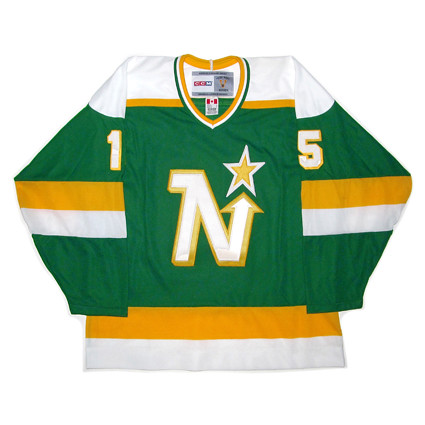
The North Stars ushered in their new era of Gund's ownership with a new style of jersey, dropping the dual waist and arm stripes of the same color by changing to dual two color stripes of the same width. While the white home jerseys got the addition of black trim back in 1981-82, the green road jerseys did not have the addition of the striking black accent color until 1988-89.
Today's video is a brief, and frankly depressing look at the history of pro hockey in Cleveland through the departure of the Barons.
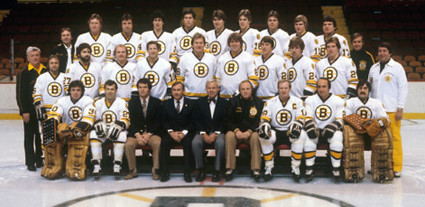
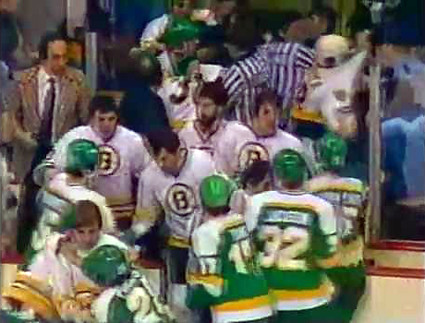
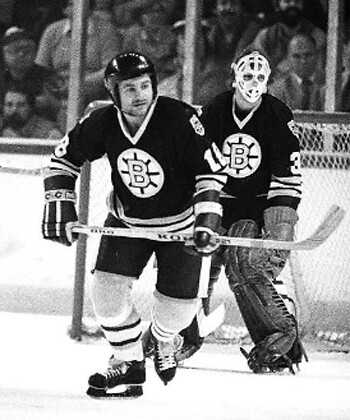
The Minnesota North Stars were founded in 1967. Fourteen years later, they still had never won a game in the Boston Garden and were 0-27-7 at The Garden going into their game on February 26, 1981. The North Stars were routinely intimidated by the Big, Bad Bruins, who featured a lineup with noted tough guys Terry O'Reilly (223 penalty minutes that season), Mike Milbury (222), Stan Jonathan (192), Keith Crowder (172), Brad McCrimmon (148) and Brad Park (111).
The 1980-81 Boston Bruins
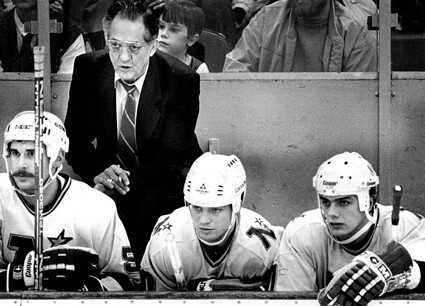
By this point in the season, the North Stars knew that they were going to be facing the Bruins in the playoffs and Head Coach Glen Sonmor decided that the "Curse of the Bruins" was going to come to an end that night. Sonmor wanted to instill a new attitude of toughness into his team and to no longer back down from any challenge, especially that of intimidation by the Bruins.
The North Stars fiery Head Coach Glen Sonmor
Sonmor's instructions to his squad was simple and direct. "Not the second time, or the third time or even the fourth time, but on the first time that any Bruin tried to intimidate one of them. that they were to drop the gloves. I told them that we were going to wear that night and that we were going to keep going to war until the game was over. Period." The North Stars took the message to heart, and right off the opening faceoff, the Bruins Steve Kasper cracked the North Stars star player, Bobby Smith, right under the chin with his stick. Smith immediately dropped the gloves and fought Kasper. Afterwards, there was one fight after another. In the first period alone, there were 340 penalty minutes called and 12 players ejected from the game!
Here are the penalties from the boxscore from just the first period alone:
Penalties - BOS - Crowder 0:07 ; BOS - Crowder ( (maj)) 0:07 ; BOS - Crowder (Misconduct (10 min)) 0:07 ; BOS - Kasper 0:07 ; BOS - Kasper ( (maj)) 0:07 ; MINS - Payne 0:07 ; MINS - Payne 0:07 ; MINS - Payne ( (maj)) 0:07 ; MINS - Payne (Misconduct (10 min)) 0:07 ; MINS - Payne (Misconduct (10 min)) 0:07 ; MINS - Smith B 0:07 ; MINS - Smith B ( (maj)) 0:07 ; BOS - Milbury 2:53 ; MINS - Christoff 2:53 ; BOS - O'Reilly 3:35 ; BOS - O'Reilly ( (maj)) 3:35 ; MINS - Carlson ( (maj)) 3:35 ; BOS - Mccrimmon 4:28 ; MINS - Hartsburg 5:42 ; MINS - Smith G 6:02 ; BOS - Bench 8:06 ; BOS - Gillis ( (maj)) 8:06 ; BOS - Gillis (Misconduct (10 min)) 8:06 ; BOS - Milbury ( (maj)) 8:06 ; MINS - Bench 8:06 ; MINS - Hartsburg ( (maj)) 8:06 ; MINS - Hartsburg (Misconduct (10 min)) 8:06 ; MINS - Younghans ( (maj)) 8:06 ; BOS - Bourque 8:58 ; BOS - Bourque ( (maj)) 8:58 ; BOS - Crowder 8:58 ; BOS - Crowder 8:58 ; BOS - Crowder 8:58 ; BOS - Crowder (Game Misconduct) 8:58 ; BOS - Mccrimmon ( (maj)) 8:58 ; BOS - Mccrimmon ( (maj)) 8:58 ; BOS - Mccrimmon (Misconduct (10 min)) 8:58 ; BOS - Mccrimmon (Game Misconduct) 8:58 ; BOS - Mcnab 8:58 ; BOS - Mcnab (Game Misconduct) 8:58 ; BOS - Milbury 8:58 ; BOS - Milbury (Game Misconduct) 8:58 ; BOS - O'Reilly 8:58 ; BOS - O'Reilly (Game Misconduct) 8:58 ; BOS - Vachon 8:58 ; MINS - Bench 8:58 ; MINS - Carlson 8:58 ; MINS - Carlson (Game Misconduct) 8:58 ; MINS - Hartsburg (Game Misconduct) 8:58 ; MINS - Macadam 8:58 ; MINS - Macadam ( (maj)) 8:58 ; MINS - Macadam (Misconduct (10 min)) 8:58 ; MINS - Macadam (Game Misconduct) 8:58 ; MINS - Meloche 8:58 ; MINS - Payne (Game Misconduct) 8:58 ; MINS - Roberts ( (maj)) 8:58 ; MINS - Roberts (Game Misconduct) 8:58 ; MINS - Smith G ( (maj)) 8:58 ; MINS - Smith G (Game Misconduct) 8:58 ; MINS - Younghans 8:58 ; MINS - Younghans (Game Misconduct) 8:58 ; MINS - Maxwell B 12:44 ; MINS - Zanussi 14:02 ; BOS - Kasper 17:36
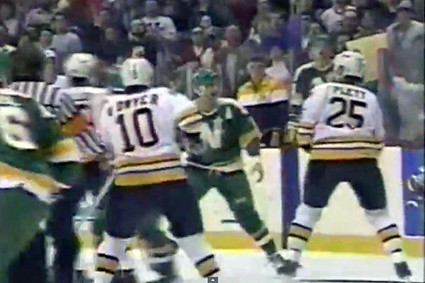
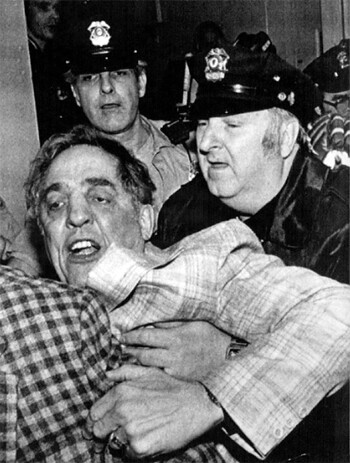
At one point, players were being sent off to the dressing rooms using the aisle that ran between the benches and a spark of anger set off a melee off the ice that involved the police trying to separate the combatants!
The fighting spilled off the ice and between the benches
By the end of the game, 42 penalties had been called for a NHL record 406 penalty minutes with six more major penalties in the second period plus four more in the third. After the game, Bruins Head Coach Gerry Cheevers got into a shouting match with Sonmor, who was so fired up he tried to get at Cheevers. With his players holding him back, Sonmor even tried to take a few swings at his Bruins counterpart.
Sonmor being restrained
The Bruins had won the game 5-1, but the North Stars management could not have cared less. The message had been sent - the North Stars were not going to be intimidated any more. After the game, reporters came to Sonmor with disparaging quotes from Cheevers, to which the feisty Sonmor replied, "OK, I have a message that you can take back to Gerry. Tell him to meet me between the dressing rooms the next time we play each other and we'll settle this like men. We'll see who's got character then." Adding "Oh, by the way, tell him to bring a basket to carry his f---ing head home in!" The league president called Sonmor into his office afterwards and asked him if he had incited the North Stars that night. He replied with honesty, "We needed to make a stand." and I wasn't going to apologize for that. Sonmor was fined but the North Stars General Manager Lou Nanne gladly paid the fine for his head coach, knowing what Sonmor was up to and was behind him 100%. Sure enough, the North Stars were paired up in the opening round of the 1981 Stanley Cup Playoffs. Just before Sonmor was to leave for the airport for Boston, he opened a letter from a local woman who said that she was a psychic. She had a vision of Sonmor standing behind the bench in the Boston Garden wearing an eye patch and beating the "Curse of the Garden". Sonmor thought her name, Amy Puckett, sounded enough like a hockey "puck" and considered it a good omen. Sonmor, you see, had his budding hockey career cut short by an eye injury which left him with a glass eye in place of the one he lost to a slapshot. Sure enough, Sonmor figured he could use all the good Karma he could get at that point and retrieved his eye patch for the trip to Boston. "I put that patch on right before we hit the ice and I remember screaming out just like a general leading his troops into battle: "Boys, the curse ends tonight!" Game 1 on April 8th saw Minnesota lead 2-1 after the first period on goals by Steve Payne and Brad Maxwell, but the Bruins scored twice in the second to take a 3-2 lead into the third. It only took 37 seconds forPayne to tie the game, but Peter McNab gave Boston their lead back at 7:14. The unlikely brawler Jack Carlson scored at 11:55 to tie the game, which later went to overtime. The curse then ended 3:34 into the overtime when Payne completed a hat trick to win not only the game, but end a 14 year, 35 game winless streak.
Steve Payne's hat trick ended the North Stars curse in Boston
The Bruins needed to win Game 2 at home before heading to Minnesota, but the North Stars were flying high after their win the night before. While Boston scored first 56 seconds into the game on a power play, Bobby Smith responded just 19 seconds later and the North Stars were off and running. They got goals from Payne and Al MacAdam to take a 3-1 lead before the first period was half over. Boston fought back to tie the game with goals with 31 seconds remaining in the first and 41 seconds into the second, but the North Stars replied with 3 goals from Brad Maxwell, Payne and MacAdam for a 6-3 lead after two. The Bruins tried to fight back with a goal at 29 seconds of the third but the North Stars responded with two goals in less than three minutes for a commanding 8-4 lead. Two Boston goals within a minute were not enough and Tim Young's goal at 14:25 made the final score 9-6, something unthinkable as recently as February 25th, six weeks earlier. Back in 1981, the opening round of the Stanley Cup Playoffs were a best-of-five, meaning the Bruins were not on the brink of elimination with no margin for error as the series moved back to Minnesota for Game 3 at the Met Center in Bloomington. Energized by their rabid home fans, the North Stars got out to a 2-0 lead within the game's first five minutes, as Brad Palmer beat Rogie Vachon with assists from Steve Christoff and Neal Broten and 3:36 followed by MacAdam scoring from Young and Payne at 4:57. Dino Ciccarelli scored on a power play with an assist to Bobby Smith at 12:00 exactly with Terry O'Reilly in the penalty box. Payne set the North Stars faithful into a full throated roar when he made the score 4-0 at 18:33 with an assist to MacAdam. Mike O'Connell got the Bruins on the board late in the period with a shorthanded goal against Gilles Meloche at 19:47 with O'Reilly serving his second minor of the period. The majority of the second period passed without any scoring until Greg Smith scored an unassisted, shorthanded goal at 18:05 with Curt Giles in the penalty box for the North Stars to make the score 5-1 for Minnesota with twenty minutes to play. There was a fracas at the 5:18 mark which led toCrowderand McCrimmon getting minor penalties and Jonathan being whistled for a double minor plus a major and a game misconduct. Minnesota, meanwhile, saw a minor to Carlson and a double minor to Ciccarelli, giving the North Stars an extended power play in light of Jonathan's major. Bobby Lalonde with just 4 goals in 62 games during the regular season, then tried single handedly to save the Bruins season, scoring a shorthanded goal at 11:10 from O'Connell. Christoff was penalized for Minnesota at 11:51 followed by Middleton receiving a penalty for the Bruins at 13:59. Lalonde then struck again at 15:42 for his second shorthanded goal at 15:42 to cut the North Stars advantage to 5-3.
Bobby Lalonde had a pair of shorthanded goals
Lalonde's second shorthanded goal, along with those by Minnesota's Greg Smith in the second period and O'Connell's first period goal while Boston was a man down, set an NHL record for the Most Shorthanded Goals in a Playoff Game at 4. With the desperate Bruins having pulled Vachon in search of two goals to keep their season alive, Payne scored his seventh goal of the series from Young into an empty net at 18:34 to make the final score 6-3 to close out the game and the series, something few would have bet on in mid-February.
The 1980-81 Minnesota North Stars
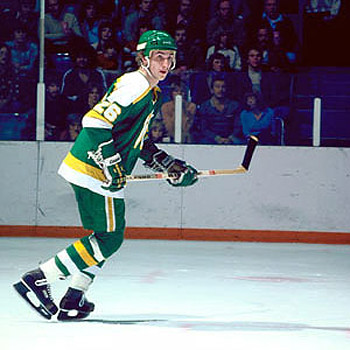
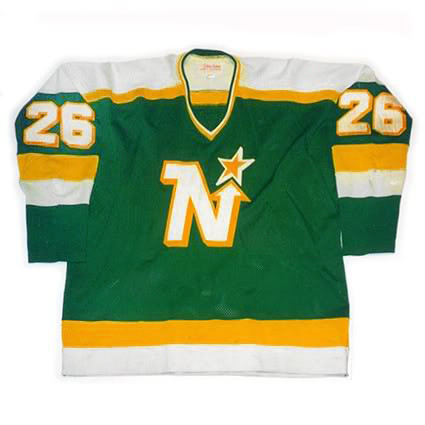
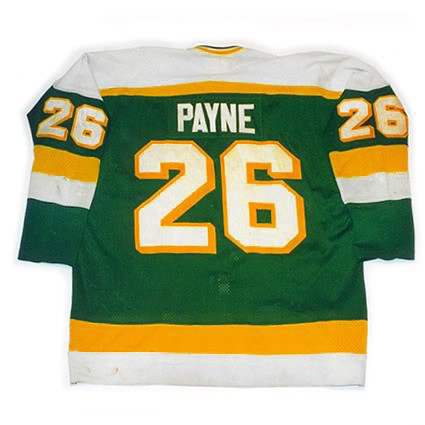
Buoyed by their success against Boston, the North Stars then defeated the Buffalo Sabres in five games, including three on the road, and then eliminated the Calgary Flames in six to advance to the Stanley Cup Finals, where they encountered the defending champion New York Islanders dynasty in the making, who won their second of four consecutive Stanley Cups in five games. Today's featured jersey is a 1980-81 Minnesota North Stars Steve Payne jersey from the North Stars infamous brawl with the Bruins and the player who scored the goal that ended the North Stars curse in Boston when the teams met later in the playoffs. During the North Stars run to the Finals, Payne led the club in points with 29 with 17 goals and 12 assists in 19 games. Payne had an eventful night in Boston, as he was involved in a secondary brawl at the seven second mark with Crowder, which earned him a double minor unsportsmanlike conduct, a fighting major and a rare double misconduct. All of this should have kept Payne out of the action until well into the second period, yet he still managed to find himself involved in the fracas which erupted at the 8:58 mark of the first period in the runway next to the Bruins bench which earned him a game misconduct before the first period had even reached the halfway mark. Payne finished the evening with 7 seconds of ice time and a total of 39 penalty minutes!
The North Stars would adopt this jersey style in 1978-79 when they merged with the Cleveland Barons. While the white home jerseys gain generous amounts of black striping in 1981-82, the black was unexplainably not added to the green jerseys until 1988-89.
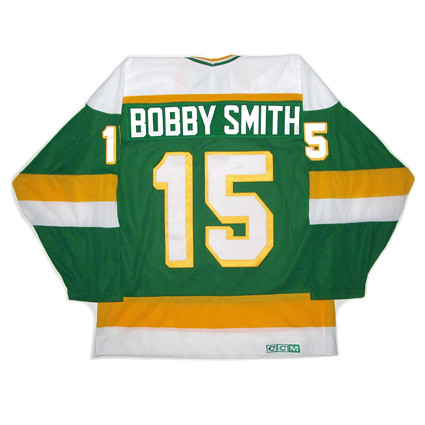
Today's featured jersey is a 1980-81 Minnesota North Stars Bobby Smith jersey worn during the era when defenseman Greg Smith was also a member of the North Stars. But rather than go with the usual first initials "B. SMITH" and "G. SMITH" to identify the pair, the North Stars, for some unexplained reason, chose to put his full name "BOBBY SMITH" on Bobby's jersey, despite the full name treatment usually reserved for brothers whose names began with the same letter, such as Rich and Ron Sutter, Dave and Don Maloney, Jim and Joe Watson or Mark and Marty Howe. We assume Greg Smith received the same full name treatment,.
After the departure of Greg Smith following the 1980-81 season, Bobby Smith had just the standard surname only on his jersey, but after his return to the North Stars following his time in Montreal, the arrival of former Philadelphia Flyer DerrickSmith in 1991-92 saw Bobby's jerseys identified as "B SMITH" this time around. Bobby Smith led the North Stars in scoring in 1980-81 with 29 goals and 64 assists for 93 points and was second to Payne in playoff scoring with 8 goals and 25 points in 19 games.
While we were unable to find footage of the North Stars and Bruins playoff series, particularly Game 3 that set the record for the most shorthanded goals in a playoff game, here are highlights of the record setting February 26th game when the North Stars made their stand against the Big, Bad Bruins.
After beginning his career in the Ilves Tampere junior system, including making his international debut at the European Junior Championships for Finland in 1982, RaimoHelminen made his debut their senior team in the Finnish SM-liiga for the 1982-83 season with 31 games while he split his time with the junior team that season.
For 1983-84, Helminen, born on this date in 1964, won a silver medal at the World Junior tournament in 1984 and just one month later he made his Olympic debut in Sarajevo, Yugoslavia where the 19 year old appeared in six games, scoring 2 points.
Helminen with Ilves in 1983-84
Helminen finished third in league scoring for Ilves with 21 goals and a career best 57 points in 36 games in 1984-85 as the club won their first league championship in their history. He then made his debut at the 1985 World Championships where he continued his offensive output with 4 goals and 9 points in 10 games.
Helminen had been drafted by the New York Rangers in 1984 and moved to the NHL for the 1985-86 season, appearing in 66 games, scoring 10 goals and 40 points as a rookie. He was back with the Rangers for the 1986-87 season, but things did not go nearly as well, as he only produced 6 points in 21 games and spent time with New Haven in the AHL before a late season trade saw him sent to the Minnesota North Stars for the final 6 games of the season.
New York Ranger Raimo Helminen
Before the next season began, Helminen was back on the international stage, playing for Finland in the 1987 Canada Cup tournament. He was back in Tampere with Ilves, racking up 43 points in 31 games, including 20 goals. He also appeared in his second Olympics, scoring 10 points in 7 games as Finland won their first ever medal with a silver in Calgary.
Helminen while playing for Finland in the late 1980's Note the green gloves from Ilves
He gave the NHL another try in 1988-89, this time with the New York Islanders, but his play was hampered by back problems. He would total 24 NHL games that season and another 16 with the Springfield Indians of the AHL, where he averaged a point per game.
For 1989-90, he moved to Malmö IF in the Swedish second division, where he starred with 26 goals and 56 points in 29 games to help Malmö earn a promotion to the Swedish Elitserien for the following season.
Helminen would play the next six seasons for Malmö, which included becoming the first foreign born player to win the Swedish scoring title in 1993, with 42 points in 40 games, and winning a league championship in 1992 and again in 1994, a season during which he scored 20 goals and 54 points in 38 games.
Helminen during his time in Sweden with Malmö
During this time period Helminen played in his third and fourth Olympics in 1992 and again 1994, earning a bronze medal as well as playing in the World Championships in 1992 (silver) and 1994 (silver). He was also a member of the first Finnish World Championship winning team in 1995 when the Finns defeated the Swedes in Sweden, triggering joyous celebrations back home in Finland. Helminen contributed 8 points in 8 games on his way to the gold medal.
Helminen skates away from a sprawling American goaltender Garth Snow during the 1994 Olympics
1996 was also a busy year for him internationally, as he participated in both the World Championships in the spring and then the inaugural World Cup of Hockey that fall prior to returning to Tampere to play for Ilves from 1996-97 onward.
Helminen back with Ilves
He was named Player of the Year in 1998 and named team captain in 1999, a position he would hold through the remainder of his long career. He continued to score at a high pace, reaching 50 points twice and topped 40 five times over the next eight seasons, an impressive feat considering the shorter Finnish season, having never played more than 56 games in any season. During his final season of play in 2007-08, he was the oldest player in the league at 44 years of age.
Helminen during his retirement ceremony
His international career also continued to rack up successes as the Finns were now a nation to be reckoned with. Helminen would play in the 1997 World Championships, the 1998 Olympics (bronze), the 1998 World Championships (silver), the 1999 (silver), 2000 (bronze), 2001 (silver) and 2002 Olympics in Salt Lake City. The 2002 Olympics were Helminen's record sixth Olympic Games.
Helminen battles Mats Sundin of Sweden during the 1998 World Championships
That fall he would play in his 11th and final World Championships to conclude his full international career with one World Championship gold, seven silver (one World Junior, five World Championship and one Olympic) and three bronze medals, two Olympic and one at the World Championship.
He would continue to play for Ilves until the 2007-08 season before announcing his retirement after 751 games, 161 goal and 420 assists for 581 points in Finland as well as 226 games and 199 points in Sweden's Elitserien and another 117 games and 59 points in the NHL.
Helminen holds the record for the most international games at 331, scoring 52 goals and 207 points, with his 155 assists and 207 points being Finnish career records internationally.
Helminen was recognized when he set the record for most international appearances
His number 41 was retired by Ilves and Helminen was inducted into the IIHF Hall of Fame in 2012.
Ilves honored Helminen by retiring his #41
Today's featured jersey is a 1996 Finland National Team Raimo Helminen jersey from the inaugural World Cup of Hockey. This attractive "waving flag" style of jersey marked Nike's entry into being the jersey supplier for the IIHF, which continues to this day. This style was worn through the 1997 World Championships until new styles were debuted for the 1998 Olympics.
Bonus jersey: Today's bonus jersey is a 1987-88 Minnesota North Stars Dave Ganger jersey which was previously worn by Helminen during his six games with the North Stars at the end of the 1986-87 season. During that time period a jersey with so much life remaining it in would generally be reused after simply swapping one player's nameplate for another, giving some jerseys an interesting but sometimes difficult to prove history.
Occasionally, jerseys would also undergo number changes as well, further clouding it's past and requiring nearly forensic examination for evidence of changes in customization to suggest previous wearers.
Here is a look at the career if Helminen followed by an interview with him in Finnish.
Third String Goalie - The Hockey Jersey of the Day Blog
"Sweater" for all my Canadian friends!
Welcome!
Welcome to our end of the rink.
Bienvenue sur notre bout de la patinoire.
So why "Third String Goalie"?
It's defined as "A fan who sits in the stands wearing a jersey."
If that's not us, we don't know what is...
Our aim is to feature a different jersey each day from a historical perspective. Stay tuned and hopefully you'll see some jerseys of interest or perhaps some that you haven't seen before and learn a bit of hockey history along the way.
In addition to our articles, be sure to scroll down this column and explore the other fun and informative features of this blog.
If you have any suggestions or comments, feel free to contact us at:
Looking to reach our loyal readers with your hockey related product or service? Of our hundreds of readers each day, 60% are located in the United States and 30% come from Canada. Our audience is your audience and you can target them now with our reasonable ad rates.
We've been linked to by SI.com, ESPN.com, Uni-Watch.com, NBCSports.com and the Yahoo! Sports Puck Daddy blog among others.
There is no limitation to what kind of hockey jersey it can be - replica, authentic or game worn jersey from the NHL, a national team, the minors, juniors, college, high school or even your pond hockey jersey.
Feel free to write a paragraph or two about the jersey telling us why you like the jersey, how you got it, what makes it special to you or even a full-blownThird String Goalie-style history lesson - whatever you feel like sharing.
Visting from outside North America? Just select your preferred language and Third String Goalie will be instantly converted to your language of choice!