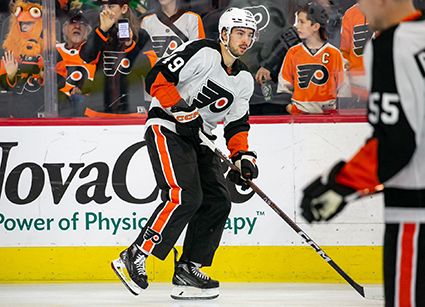
With all the attention the Philadelphia Flyers received yesterday for wearing long pants during warmups on Reverse Retro Night, we felt it was an appropriate time to revisit the sartorial splendor widely known as Cooperalls.
The Flyers shook up the hockey world by bringing back the Cooperalls during warmups on Reverse Retro night
While many scoff at and scorn the Cooperalls, ranking them with other such sports uniform misfits as the 1976 Chicago White Sox shorts, we here at Third String Goalie embrace not only the concept of the Cooperalls, but their look as well. In our opinion, they made the players look taller and sleeker. If football and baseball players can look good in long pants, why not hockey players?
The Flyers innovated the use of the long pants,seen here on Mark Howe
Even the basic idea of long pants for hockey players just makes so much sense to us. Why players would ever wear short pants for a winter sport played on ice, we will never quite understand...
The Cooperalls were first developed in order to increase player safety and protection, as the pads under the Cooperalls were held tightly to the body, unable to shift out of place like the current pads of the day, which would leave the player exposed to injuries, their tailbone in particular.
The original "Cooperalls" worn by the Flyers in 1981-82 were black with an orange stripe trimmed in white which ran down the length of the leg and were actually not Cooperalls, but a CCM version of the Cooperalls called CCM Pro Guard. Philadelphia completed their first season in the long pants with a 38-31-11 record, which was good for 87 points, placing them sixth in the Wales Conference.
The first year 1981-82 "Cooperalls" with the orange stripe down the leg
Cooperalls were also reportedly worn by the Toronto Maple Leafs during the 1981-82 pre-season, but despite a reported game worn pair of actual Cooperalls, not the CCM Pro Guard version, for sale on ebay, no photographic or video evidence of game action to support this claim is readily available.
A supposed pair of Maple Leafs Cooperalls
For the 1982-83 season, the Flyers long pants returned, only this time in solid black, adorned only with a large Flyers logo way down at the ankle of each leg. Philadelphia rose to a 49-23-8 record, good for a Patrick Division title and second overall in the Wales Conference. Unfortunately for the Flyers faithful, they would be eliminated in the first round of the playoffs both seasons while wearing the CCM Pro Guard pants at the hands of the New York Rangers.
The 1982-83 season pants were black with a team logo on the ankle
The Flyers were joined by the Hartford Whalers in wearing "Cooperalls" for the 1982-83 season, with the Whalers version featuring a full-length pair of blue stripes surrounded by three white stripes, which again were actually the CCM version as evidenced by the vertical CCM logo near the bottom of each leg.
The Whalers were the second team to wear long pants in the NHL
The Whalers did the full length pants look no favors with their on-ice performance, as they tied for last in the league with 45 points following a 19-54-7 record.
Following the 1982-83 season the NHL outlawed the long pants on the grounds of player safety, as the outer fabric of the pants was made out of slick material comparable to a nylon windbreaker which was more slippery than the traditional hockey pants/knit socks combination. Any player who fell while wearing them would find themselves skidding relatively unabated into the boards at a much higher speed than previously.
The long pants were outlawed by the NHL on the grounds of safety
Still, it wasn't just the Flyers and Whalers who wore the "Cooperalls", as Canada's junior leagues and high schools in Minnesota also wore them for a period of time.
Brendan Shanahan of the London Knights in his Cooperalls
Brett Hull of the Penticton Vees sporting his Cooperalls
For those of you who think that 1983 was the last of the "Cooperalls" on NHL ice, think again, for it was on Halloween night in 2002 that JeremyRoenick hilariously took to the ice during warmups for the Flyers upcoming game against the Phoenix Coyotes wearing a blond wig, blacked-out front teeth, striped "Cooperalls" and a #16 BobbyClarke sweater!
Roenick on Halloween Night in 2002 paying tribute to Bobby Clarke
Perhaps it's now time to revisit the idea of the long pants. We're actually surprised that Reebok didn't taken this one on when they debuted the Reebok Edge jerseys in 2007-08. After all, they were bold enough to reinvent the hockey jersey, so why not change the pants while you are at it? Doing so certainly would have no doubt taken away some of the negative attention the jerseys received at the time.
Additionally, in the last 35 years there certainly have been many innovations and advances in fabric technology to the point that the basic excuse for banning Cooperalls in the first place, the slick fabric, could now easily be addressed by any number of equipment manufacturers.
After all, think of all the other men's sports at the Winter Olympics - alpine and cross-country skiing, bobsled and luge, curling, figure skating, speed skating, ski jumping and snowboarding - and just how many of those winter sports feature competitors wearing short pants? Right. Not one.
Even if the old guard would refuse to allow the return of the late, great Cooperalls full time, there was an opportunity staring them in the face that was seemingly just too good to pass up when the Flyers will play outdoors in the 2017 NHL Stadium Series in February of 2017.
With the Flyers having had so few changes in style of their sweaters over the last 50 years, the one thing that has changed has been their pants, and the time is right for a return to the Cooperalls/CCM PRo Guard long pants of yore. It is, after all, an outdoor game, and wouldn't a nice warm pair of long pants (perhaps lined with some modern high tech Therma Base/Polartec/Thermal Dri-FIT/Play Warm fabric) be just the thing to keep the players warm against winter's chill rather than shorts and socks? Roenick thought so...
Today's featured pants are the 1981-82 Philadelphia Flyers Bill Barber "Cooperalls". Not actually Cooperalls, but CCM Pro Guard pants, they were worn for only a single season. These pants, with their elegant long stripe down the leg, which served to accentuate that the pants were indeed full length, were a shock to the established look when they first appeared.
The stripe on the Flyers pants disappeared for the second season, with just a Flyers logo waaaaay down by the ankle of the otherwise all-black pants. Meanwhile, four hours to the north, the Hartford Whalers also adopted the long pants for one season and went all out to call attention to the full length of their pants with no less than five alternating white and green stripes.
While Philadelphia and Hartford actually both wore the CCM Pro Guard pants, the name "Cooperalls" has become the popular nomenclature for the full length hockey pants in the same way that all brands of tissues are commonly referred to as "Kleenex" while copiers are often referred to as a "Xerox machine" regardless of brand.
Today's video segment begins with spectacular footage from the first ever NHL Cooperalls vs. Cooperalls matchup on December 11, 1982, a 7-4 win for the Whalers over the Flyers. The teams would meet two more times that season, a home and home pair of games on January 8th and 9th 1983, both won by Philadelphia for a grand total of just three all-long pants games in NHL history.
Next, the Flyers wearing their Cooperalls from the first season of use, noted by the orange stripe down the legs.
Here is a gem, a brief clip of Roenick dressed as Clarke during warmups on Halloween in 2002 with a Clarke jersey, big blonde wig and retro Cooperalls, much to Clarke's amusement.
This next clip from the WHL features Cam Neely of the Portland Winterhawks going toe-to-toe with Shawn Green of the New Westminster Bruins while both were wearing Cooperalls in the 1983-84 season.
In this next clip from the 1984 Minnesota State High School Hockey Tournament, St. Paul Johnson takes on the Hill-Murray Pioneers during the Cooperall era. Note the clear boards of the old St. Paul Civic Center to complete the obscurity double!
Even French-Canadians and Soviets liked Cooperalls!
Jacques Plante ushered in a new era of goaltending back on November 1, 1959 when, after being struck in the face with a shot by the New York Rangers hard shooting Andy Bathgate, he was assisted off the ice, leaving behind a trail of blood.
"He had been struck in the face and it opened up a cut from the corner of his mouth all the way up through his nostril," related Red Fisher of the Montreal Gazette. With no backup goaltenders on the roster in those days, there was a 21 minute delay while Plante was stitched up. When he finally returned to the bench, he told head coach Toe Blake, "I'm ready to go back in but I have to wear my mask." He was allowed to wear the mask, which he had been wearing in practice, and Montreal went on to win the game 3-1.
A bloodied Jacques Plante wearing his mask after being badly cut in 1959
Before the next game Blake did not want Plante to wear the mask, to which Plante replied, "If I don't wear the mask, I'm not playing." Having been a four time All-Star, four time Vezina Trophy winner and five time Stanley Cup champion at that point in his career - the mask stayed. Others quickly followed Plante's lead and goalies who did not wear a mask soon became the exception to the rule, with the last in the NHL being Andy Brown in 1974.
Andy Brown of the Penguins with his unprotected face down among the sticks
While Gerry Cheevers was the first to wear a decorated mask on November 8, 1967 in a game vs. the Rangers when he wore a mask with the first of his trademark stitches drawn on it with a marker, it is Doug Favell who is credited with having the first painted mask in the NHL, which debuted on this date, Halloween, in 1971. Favell tells the story of how the first painted mask came to be, taken from the Marek vs. Wyshynski podcast from October 31, 2014:
"It just came from bantering in the morning because it was Halloween. We were all kidding around in the room and somebody said "If you're going to the party tonight, you have to dress up" and somebody was kidding me, and someone said. "Favey, why don't you show up tonight as a goaltender?" I said, "Maybe I'll do that," so the kidding started.
As I was getting ready to leave, I said to Frank Lewis, who was our trainer. "Frank, with tonight being Halloween, why don't we put orange on the mask? Can you paint orange on the mask? We'll paint it orange like The Great Pumpkin," because back then Charlie Brown and The Great Pumpkin were a big thing. "Why don't we paint it like a pumpkin tonight for Halloween?"
"Yea, I can do that," Lewis replied. So he took it home that afternoon and painted it orange and I came back that night and wore it. And the funny thing is, we're all so superstitious that if we hadn't won that night, we beat L. A. 4-1, I'd have probably just painted it white again. If we'd have lost, I'd have said "That's it. It's not good," but we won and got going, got on a little streak, and I said, "This is a pretty good thing." It was that simple.
Some players said it was a distraction because it was fairly bright. An ophthalmologist said, "Your eye will attract." I thought it was an advantage because your eye would naturally go to the brightest thing, so in that flash, they would look at my mask instead of looking at the net, so I thought it was an a distraction and I felt I needed whatever I could get to distract the shooters, so I went with it and next year we painted the starburst on it, which was a design and was even more of a distraction to the shooters.
While doing our research for this story we did uncover some contradictions and discrepancies in various versions of Favell's stories recounting the origins of his first painted mask. At times Favell has stated his mask debuted in 1970, and other times 1971. Favell's pumpkin mask would not have debuted against the Kings, as he recalled above, as Philadelphia played host the Montreal Canadiens in a game won 5-3 by Philadelphia on Halloween night in 1971. The Flyers did defeat the Kings 3-1 just before Halloween on October 29, 1970, so perhaps this is where some of the confusion comes from…
Additionally, the "little streak" story does not hold up well, as the Flyers lost their next three games and went 2-7-3 over November 1971. The club actually did not have a winning month until five months later in March. If the mask had debuted in 1970, the story is much the same, with Philadelphia going 4-6-1 in November of that year.
Favell's story on the end of the solid orange pumpkin mask, thanks to a late Buffalo Sabres goal on the final game of the season, took place on April 2, 1972 when Gerry Meehan won the game for the Sabres with just four seconds remaining, has been consistently told by Favell, and dates the orange mask to the 1971-72 season. reaffirming its debut as being on Halloween in 1971.
Favell debuted with the Flyers during the first year of league expansion of 1967-68. During his early days with Philadelphia, he wore a Terry Sawchuk style mask before changing to his Ernie Higgins produced mask for the 1971-72 season, the style which he would have famously painted orange on Halloween in 1971 after having the new, white mask for less than two months, which leaves photos of Favell in his plain white mask as a rarity.
Favell's mask in its original plain white color
Following its humorous orange paint job on October 31, 1971, the Favell's mask would remain solid orange for the remainder of the season through the fateful last second goal against Buffalo to close out the 1971-72 season.
Taking the concept of painting his mask as a distraction to shooters farther for the next season, Favell would wear his new "starburst" design beginning in 1971-72 through the 1972-73 season, his last with the Flyers.
Favell in his striking new design, which ushered in the era of bold graphics
A trade in the summer of 1973 sent Favell to the Toronto Maple Leafs, but before leaving for Toronto, Philadelphia trainer Lewis painted Favell's mask with a blue maple leaf on the forehead and surprised him with it when he came to collect his equipment from the Flyers according to Favell.
Favell's mask with its fourth and final paint scheme, or so we thought...
Favell continued to wear the same mask, now sporting its fourth different paint scheme, counting its original plain white, until 1974 when he got a new, more protective mask by renowned mask maker Greg Harrison which featured a larger, more centered maple leaf design which covered his eyes, nose and mouth.
Favell's new Harrison mask, with its larger maple leaf paint scheme
Favell's original Higgins mask, the one first painted solid orange and now sporting a blue maple leaf, was then lent to the Hockey Hall of Fame in Toronto due to its place in hockey history as the first painted mask. This is where the story takes a turn for the bizarre… In 2011, game worn hockey equipment dealer Frank Servello noticed the mask the hall had on display was not Favell's original mask, but a replica painted in the same manner. Favell was easily able to confirm the Maple Leaf mask on display was not his original due to details about the mask on display which did not match the one he had used, repaired and modified. It turns out, at some point, and no one knows when, Favell's original mask, painted with the maple leaf, was stolen from the hall, repainted twice, and then later anonymously returned to The Hall, looking very different from when it left.
Favell's original, but now repainted Higgins mask was then put on display by the hall with its red droplet shape on the forehead, red nose and red under the chin, which is generally referred to as the "clown mask", as a vintage mask, but in no way identified as being Favell's, as no one at the hall apparently knew.
It was then that a member of the Vintage Goalie Mask Discussion Page recognized the similarities between the clown mask and Favell's missing original in August of 2011 and posted his impression of the clown mask likely being Favell's missing mask.
Notified by Servello that his original mask, now repainted, was likely in the possession of The Hall of Fame, Favell met with the hall to first identify his original mask based on his modifications and repairs, and reclaim its possession 37 years after first loaning it to the hall for display.
The mask then underwent a restoration process, which revealed first flames over the right eye of the mask as well as a predominantly black paint scheme, which unfortunately adhered to the blue paint of the maple leaf design, rendering that design unsalvageable.
But once the black paint was removed, and the maple leaf design with it, the third version of the mask, the starburst pattern from 1972-73 was revealed, proving it was indeed Favell's original Higgins mask and the first painted mask in NHL history, complete with some of its previous orange paint from Halloween night in 1971 exposed to further document its place in NHL history.
Here are photos from GameUsedMasks.com showing the restoration of Favell's mask, the first painted mask in NHL history, taking it from its twice vandalized state down to its sunburst paint scheme of 1972-74.
And here is the final restoration down to the sunburst mask (with some of the earlier brighter orange paint revealed on the forehead, showing the mask's history), the first mask with a painted design. This is where they chose to stop the painstaking process of removing the layers of paint which were added to the mask while it was out of the possession of the Hall of Fame.
Here is an interview with Favell from 2011 discussing his original, now repainted mask now that it was back in his possession after being on loan to the Hall of Fame.
Here is another feature on Favell and his mask from Hockey Night in Canada.
During the 1978-79 NHL season, the Philadelphia Flyers finished second in the Patrick Division with a 40-25-15 record for 95 points. In third place was the New York Rangers, who also had 40 wins but 29 losses and 11 ties, which left them four points back of the Flyers with 91 points.
In the first round of the playoffs, Philadelphia was paired with the Vancouver Canucks in a best-of-three series. Vancouver immediately put the Flyers on the brink of elimination with a 3-2 win in Philadelphia. The Flyers forced a third game with a 6-4 win in Vancouver and then eliminated the Canucks with a dominant 7-2 victory back at home.
The 1978-70 Philadelphia Flyers
Meanwhile, the Rangers were also matched up with a cross-continent opponent in the Los Angeles Kings. Game 1 in Madison Square Garden was a laugher, 7-2 in favor of the blueshirts. Two days later the teams reconvened in California, where New York got a much tougher battle as the Kings fought to keep their season going, but fell to the visitors 2-1 in overtime.
The 1978-79 New York Rangers
Round 2 then saw the Patrick Division rivals squaring off in a series which began on April 16, 1979 in Philadelphia. After Bill Barber scored with 4:59 to play, the game went to overtime tied at 2-2 and Ken Linseman won it for the Flyers just 44 seconds into overtime.
Game 2 was tied at 1-1 after 8 minutes, but from then on it was all Rangers as they reeled off six consecutive goals to win going away 7-1 with Ron Greschner leading the way with a pair of goals against Robbie Moore.
Game 3 in New York was more of the same, as the Flyers led 1-0 after the first period, but the Rangers roared to life with 2 goals in the first three minutes of the second period on their way to a 5-1 win.
An on form John Davidson was too much for the Flyers as he shut out Philadelphia in Game 4 after making 28 saves. Davidson had now allowed the Flyers just two goals over the last three games. Meanwhile, the Rangers offense continued to roll with 5 more goals, including 2 from Don Murdoch and 2 from Ed Johnstone.
John Davidson
After being held to one goal in New York, the Flyers were relieved to be back at home in The Spectrum for Game 5 on this date in 1979. Davidson was back in goal for the Rangers, while Wayne Stephenson got the call over Moore for Philadelphia.
With Mel Bridgman in the penalty box for the Flyers, Greschner scored his 4th of the playoffs from Phil Esposito and Mike McEwen for a power play goal at 9:55 of the first period.
Ron Greschner
At 12:44, Mario Marois was sent off for the Rangers, but veteran Walt Tkaczuk scored a shorthanded goal from Dave Farrish at 13:26 for a 2-0 lead for New York after one.
Walt Tkaczuk
Offering no hint as to what was to come, there was no scoring in the second period despite two power plays for New York, including a two man advantage for 57 seconds. Of note, Paul Holmgren and Rangers goaltender Davidson were called for matching minors for the second time in the game at 18:58!
The fans had barely settled into their seats when Tkaczuk scored an unassisted goal at 2:03 for a 3-0 Rangers lead. Steve Vickers then made it 4-0 at 4:13 from Tkaczuk to really put the Flyers season in jeopardy.
Steve Vickers
Ernie Hickey was then called for a penalty against New York at 7:01 only to have the flashy Ron Dugay score from Swede Anders Hedberg and Vadnais at 8:19 for a demoralizing shorthanded goal to extend the Rangers lead to 5-0.
Ron Dugay
Not going down without a fight, Reggie Leach beat Davidson for the first Flyers goal in 179 minutes, dating back to the second minute of Game 3. Leach's goal came on a power play from Blake Dunlop and Holmgren at 10:37.
Less than two minutes later, Bob Dailey added a second goal for Philadelphia from Dennis Ververgaert and Linseman at 12:21.
Three minutes passed before Behn Wilson scored the third consecutive goal for the Flyers from Linseman and Ververgaert at 15:27 to reduce the Rangers lead to 5-3 with four and a half minutes still to play.
Flyers head coach Fred Shero pulled Stephenson for an extra attacker, but Vadnais scored an empty net goal from Dugay and Farrish at 16:50.
Carol Vadnais
In full desperation mode, Shero again pulled his goalie for an extra attacker but Johnstone scored his fourth goal of the playoffs (after only 5 in the regular season) in an empty net at 17:24 from Don Maloney and Esposito.
Ed Johnstone
Finally, with 34 seconds left to play, Hedberg made the final score 8-3 when he scored the record setting ninth goal of the period from Vickers and Tkaczuk. It was the sixth goal of the third for New York, who had the first three and then the final three after the Flyers attempt at a comeback in the middle portion of the period.
Anders Hedberg
The final shots on goal were 23 for New York and 28 for the home Flyers as the Rangers closed out the series 4 games to 1 in record setting fashion.
The fifth seeded Rangers would advance to face the #1 New York Islanders, who they would defeat in six games to advance to the Stanley Cup Finals against the Montreal Canadiens. New York would win Game 1 4-1, but lose the next four in a row as Montreal would win their fourth consecutive Stanley Cup and tenth of the last 15 seasons.
Today's featured jersey is a 1978-79 New York Rangers Walt Tkaczuk jersey as worn during the record setting third period of the Rangers playoff game against the Flyers when both teams combined for nine goals in one period.
1978-79 was the first season the Rangers changed back to their classic style jersey after two seasons in a modernized jersey which featured the Rangers shield logo rather than their traditional jerseys which dated back to the team's formation in 1926, only now with "New York" on the front rather than "Rangers" as they had worn for both home and road games, even after introducing a white jersey in 1951. This put the Rangers more in line with the general practice of wearing their name on their home jerseys and their location on their road jerseys. The "New York" cresting would last nine seasons until they reverted to "Rangers" on both the home and roads once again.
Tkaczuk had two goals during the game, including the first goal of the record setting third period. He also assisted on the second goal and the ninth one as well.
Bonus jersey: Today's bonus jersey is a 1978-79 New York Rangers Anders Hedberg jersey as worn during the record setting third period of the Rangers playoff game against the Flyers when both teams combined for nine goals in one period.
Hedberg scored the final goal of the record setting third period and also had an assist on the third one as well.
Extra bonus jersey: Today's extra bonus jersey is a 1978-79 Philadelphia Flyers Reggie Leach jersey as worn during the record setting third period of the Flyers playoff game against the Rangers when both teams combined for nine goals in one period.
Leach scored the first goal of the Flyers attempt at a comeback, which was the fourth goal of the record setting third period.
MarkHowe first gained recognition as a surprising addition as member of the 1972 United States Olympic Team that won a remarkable silver medal in Sapporo, Japan. At just 16 years old, and still only a high school junior who had just recently gotten his driver's license and playing on a team with Vietnam War veterans, he remains the youngest member of a US Olympic Hockey Team ever.
1972 United States Olympic Team - Mark Howe, back row first on left
"We picked Mark up, and he played some exhibition games with us. We needed a left winger. He was on our list for skill and attitude. The maturity level of this kid was overwhelming. He was a big part of the team. He was tougher than hell. Vlclav Nedomansky of Czechoslovakia nailed him in a preseason game, and he didn't know where he was, but it didn't bother him at all. I used him as a forward, and he became a Hall of Fame defenseman."
Howe recalls,
"The whole thing was just a great, great learning experience. The way I looked at it for my career, it was a huge stepping-stone. I learned more in the six weeks I was gone than I learned in the years and years of going to school. I mean, just about life in general - and just seeing the talent of the players from overseas, watching the Soviets play was a whole new level. Coach Williamson pushed me hard. I was a scorer. But when I went to that team, I wasn't. I was the guy who provided energy. I had to fit into a role, and so for me, it was a completely different experience - a tremendous learning experience."
During the medal ceremony as Howe stood with a silver medal around his neck, it finally struck him that this was a moment to savor.
"I remember looking up at the flag, and that's when I realized what an honor it was the play and represent your country. No matter what I did, I always gave the best I could. Seeing the flag of your country being raised - even though there was one a little higher than ours - was my fondest moment."
He then added to his resume by winning a Memorial Cup in 1973 as a member of the Toronto Marlboros of the Ontario Hockey League and was named the tournament's Most Valuable Player in the process.
At a time when the NHL had an minimum age limit of 20 for it's players, the 18 year old Howe turned professional during the NHL/WHA rivalry in a headline-grabbing signing to play for the Houston Aeros of the WHA along side his brother Marty Howeand his legendary father Gordie, who was lured out of retirement for the opportunity to play with his sons.
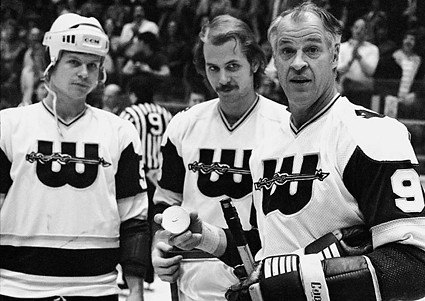
Marty, Gordie and Mark Howe
Mark scored his first goal 27 years to the day after his father scored for the first time for the Detroit Red Wings. His trophy cabinet continued to grow, as Mark was awarded theLou Kaplan Award as WHA Rookie of the Year and the Aeros won the Avco World Trophy in 1974. In 1975 the Aeros repeated as champions of the WHA and Howe was the leading playoff scorer with 22 points in 13 games. He was also named to Team Canada for the 1974 Summit Series against the Soviet Union.
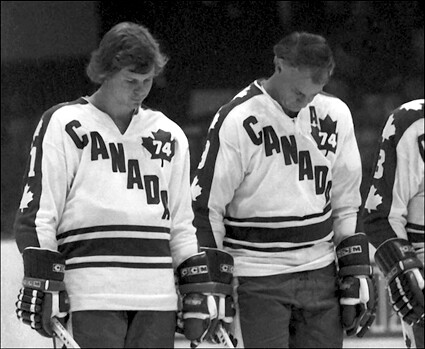
Mark and Gordie Howe suited up for Canada at the 1974 Summit Series
Howe, who began his career as a wing, had moved back to defense by 1976-77 and the trio of Howes signed with the New England Whalers for the 1977-78 season. They continued to play together through the 1979-80 season when the Whalers became members of the NHL. While he regularly scored in the mid-70's points-wise in Houston, his offensive game came alive in New England, first with 91 points in 1977-78 which was followed by 107 points in the final WHA season of 1978-79 before scoring 80 in his first NHL season.
The Howe trio moved to Hartford for 1977-78
After Gordie retired following the 1979-80 season, Mark no longer had to play in his father's shadow and was named to his first NHL All-Star Game in 1981 and was later played for the United States in the 1981 Canada Cup.
After one more season in Hartford, Howe was traded to the Philadelphia Flyers at the 1983 draft following concerns after a grisly injury in which he was impaled in the thigh by the pointed center of a goal. His recovery required a liquid diet for a period of time that resulted in him losing 24 pounds. His injury resulted in a redesign for goal frames and the way they were held in place on the ice.
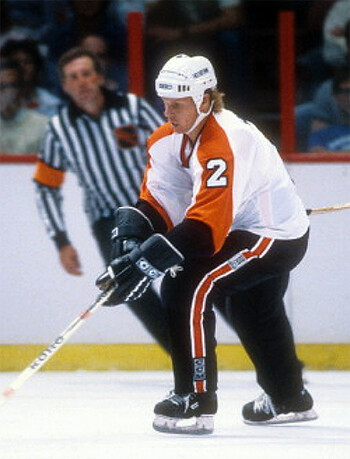
Howe was present in Philadelphia duringthe brief "Cooperalls" era
He rebounded from his injury and excelled as a member of some great defensive teams of the era. Howe played in his second All-Star Game and was a finalist for the Norris Trophy in 1983 and played in the Stanley Cup Finals in 1985.
He had perhaps the best season of his career in 1985-86, setting NHL career highs with 24 goals, 58 assists and 82 points, made his third All-Star Game, was the NHL plus/minus leader at +85 and came in second in voting for the Norris Trophy. Perhaps the highlight of his season came on this date in 1986 when the Flyers hosted the Toronto Maple Leafs. The first period had ended with the Flyers trailing 2-1, but Howe tied the game with his 22nd goal of the season with assists from twin brothers Rich Sutter and Ron Sutter at 2:47 of the second on a power play.
Five minutes later, Howe struck again, this time from Pelle Eklund and Ilkka Sinisalo even strength at 9:35 for a 3-2 Philadelphia lead. Toronto tied the game a little over five minutes later, but with just four seconds remaining in the second, Tim Kerr scored his 45th goal from Brad McCrimmon and Howe to restore the Flyers one goal advantage going into the third period.
It only took the Maple Leafs a minute and a half to tie the game at 4-4, but then the same combo that was responsible for the second Flyers goal struck again, this time Ron Sutter scoring from Rich Sutter and Howe for a 5-4 lead for Philadelphia.
The game remained close until, with just 1:08 to play, Lindsay Carson beat Toronto's Don Edwards from Howe to give the Flyers a two goal cushion. With Edwards now pulled, Sinisalo scored his 29th goal of the year into an empty net, with assists going to Howe and Murray Craven. It was Howe's fourth consecutive assist and followed his back-to-back goals, giving him six points on the night and on six consecutive Flyers goals.
In addition, his six points set new Philadelphia team records for goals, assists and points in a season by a Flyers defenseman.
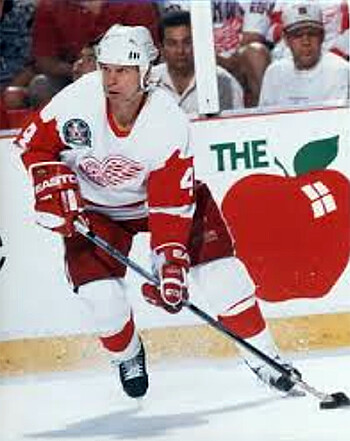
Howe rewarded the Flyers faith with a ten year run for the club
In 1986-87 Howe helped lead the Flyers to the 1987 Stanley Cup Finals while contributing 12 points in 26 games from the blueline and was a Norris finalist for the third time.
After playing 75 games in 1987-88 and his fourth All-Star Game, back and knee injuries would limit him to no more than 60 games for the remaining seven seasons of his career.
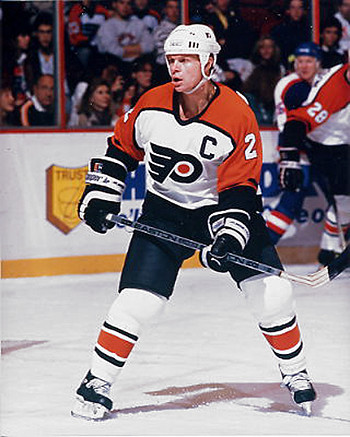
The respected Howe served as the Flyers captain at times
After four more seasons with the Flyers, Howe signed as a free agent with the Detroit Red Wings, the club his father gained most of his fame with.
While healthy, Howe provided veteran leadership to the Red Wings defensive corps, which included a young Nicklas Lidstrom. The Red Wings began a transformation in 1993-94 with the arrival of Scotty Bowman as coach and made the Stanley Cup Finals in 1995, their first finals appearance since 1966.
Howe finished his long career with Detroit
After one more season, in which he was limited to just 18 games, Howe retired with 929 NHL games and 426 in the WHA for a combined 405 goals and 841 assists for 1246 points. He won an Olympic silver medal in 1972, was WHA Rookie of the Year in 1974 and won the WHA Avco World Cup in 1974 and 1975. He was the 1986 NHL Plus/Minus Award winner and a four time NHL All-Star.
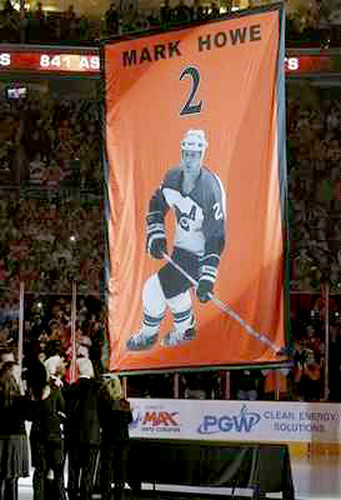
He was elected to the United States Hockey Hall of Fame in 2003 and was inducted into the Hockey Hall of Fame in 2011. Also on this date in 2012, the Flyers retired Howe's #2, making him only the fifth Flyer to ever be so honored.
Howe had his number 2 retired on this date in 2012
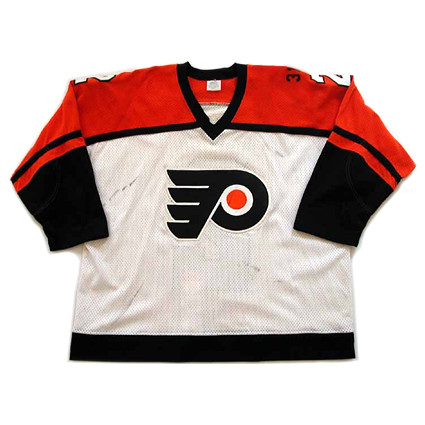
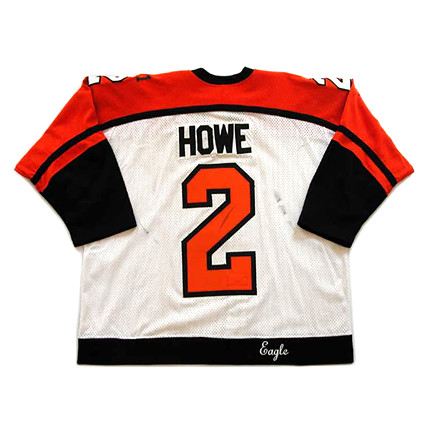
Today's featured jersey is a 1985-86 Philadelphia Flyers Mark Howe jersey, the season he set Flyers single season records for goals, points and assists by a defenseman and both his goals and points records still stand today.
The Flyers jerseys remained relatively unchanged from their introduction in 1967 with only gradual detail changes such as the addition of black outlines separating the sleeve and body colors in 1982 and tweaks to the names and numbering style.
Philadelphia wore the #31 on the left shoulder above their sleeve numbers in memory of goaltender Pelle Lindbergh, who was killed in a car accident.
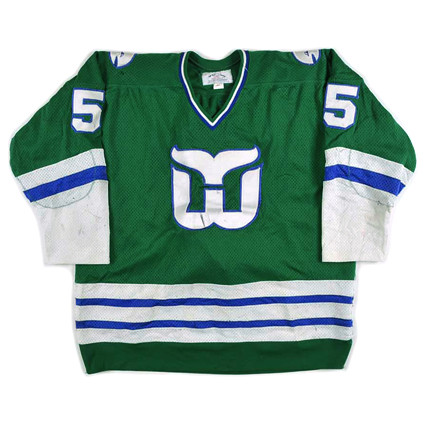
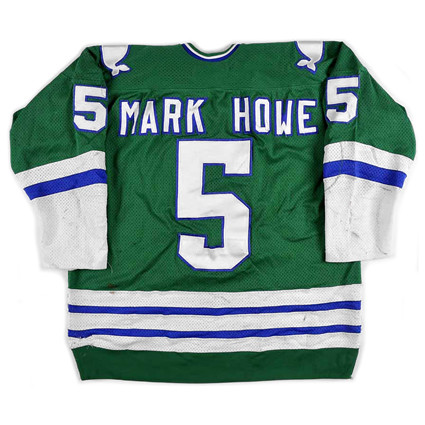
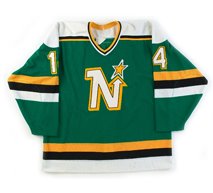
Bonus jersey: Today's bonus jersey is a 1980-81 New England Whalers Mark Howe jersey.
From the beginning part of Mark's career when he played with both his
father Gordie and his brother Marty, Howe wore his first name on his
jerseys from his pro debut with the Houston Aeros in 1973 through his
final season with the Whalers of 1981-82. The
Whalers wore this style of jersey beginning with their entry into the
NHL in 1979-80. One of the terms of their acceptance into the NHL was to
change their name from the New England Whalers, used for seven years
while members of the WHA, to the Hartford Whalers at
the insistence of the Boston Bruins, who apparently thought of
themselves as New England's team. The name change necessitated a new
logo, the ever-popular whale tail logo with the hidden H in the negative
space. This jersey remained in use through the 1984-85 season, including one year being paired with the "Cooperalls"
long pants, one of only two teams to use the short lived trousers. The
jersey saw the unfortunate removal of the Pucky the Whale shoulder logos
in 1985-86 but continued to be worn through the 1991-92 season,
although with the angled sleeve stripes straightened in 1989-90, until a
new set of jerseys debuted in 1992-93 with blue replacing green as the
primary team color.
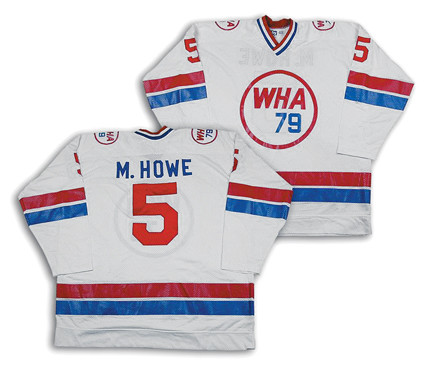
Extra bonus jersey: Today's extra bonus jersey is a 1979WHA All-Star Mark Howe jersey. With the WHA down to just six teams during its dying days, a singleteam of WHA All-Stars was selected and faced off in a three game series against Dynamo Moscow of the Soviet Union. With father Gordie on the team, who famously played on a line with Wayne Gretzky, Mark's jersey has his first initial "M" in front of his last name
The three game series, played entirely in Edmonton, saw the WHA All-Stars win all three games, the first two by identical 4-2 scores and the final one 4-3.
Third String Goalie - The Hockey Jersey of the Day Blog
"Sweater" for all my Canadian friends!
Welcome!
Welcome to our end of the rink.
Bienvenue sur notre bout de la patinoire.
So why "Third String Goalie"?
It's defined as "A fan who sits in the stands wearing a jersey."
If that's not us, we don't know what is...
Our aim is to feature a different jersey each day from a historical perspective. Stay tuned and hopefully you'll see some jerseys of interest or perhaps some that you haven't seen before and learn a bit of hockey history along the way.
In addition to our articles, be sure to scroll down this column and explore the other fun and informative features of this blog.
If you have any suggestions or comments, feel free to contact us at:
Looking to reach our loyal readers with your hockey related product or service? Of our hundreds of readers each day, 60% are located in the United States and 30% come from Canada. Our audience is your audience and you can target them now with our reasonable ad rates.
We've been linked to by SI.com, ESPN.com, Uni-Watch.com, NBCSports.com and the Yahoo! Sports Puck Daddy blog among others.
There is no limitation to what kind of hockey jersey it can be - replica, authentic or game worn jersey from the NHL, a national team, the minors, juniors, college, high school or even your pond hockey jersey.
Feel free to write a paragraph or two about the jersey telling us why you like the jersey, how you got it, what makes it special to you or even a full-blownThird String Goalie-style history lesson - whatever you feel like sharing.
Visting from outside North America? Just select your preferred language and Third String Goalie will be instantly converted to your language of choice!