History of Jersey 83-93 Banner sm photo History of Jersey 83-93 Banner sm.jpg
Showing posts with label Colorado Rockies. Show all posts

Saturday, May 27, 2017

The Rocky History of the Colorado Rockies - 1980-81 Colorado Rockies Lanny McDonald Jersey

The NHL had planned to expand in 1976-77 and had awarded "conditional" franchises to both Denver and Seattle. However, several franchises were having financial difficulties at the time, the California Golden Seals, Kansas City Scouts and Pittsburgh Penguins in particular.

Due to the number of existing clubs having enough troubles of their own, the proposed expansion was called off and the Seals relocated to Cleveland to become the Barons while the Scouts moved to Denver after selling only 2,000 season tickets for the upcoming season while finding themselves nearly $1 million in debt after playing just two seasons in Kansas City.

While in Denver, the Colorado Rockies continued the Scouts tradition of struggling to make the playoffs. Their first season record in Denver of 20-46-14 was a 13 point improvement over anything achieved in Kansas City, but they still failed to qualify for the playoffs. The club was led in scoring by Wilf Paiement, who set a franchise record that would never be topped with 41 goals on his way to 81 total points.
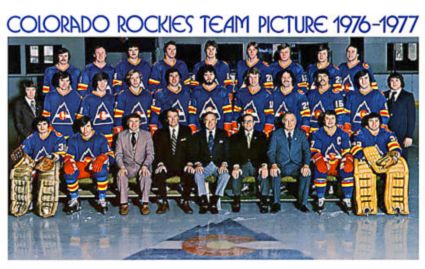
1976-77 Colorado Rockies team photo 1976-77 Colorado Rockies team.jpg
The inaugural 1976-77 Colorado Rockies

Doug Favell arrived from the Toronto Maple Leafs to split time in goal with Scouts holdover Michel Plasse, who led the team in games played with 54 and had 12 of their 20 wins.

In 1977-78, thanks to an increase in their number of ties from 14 to 21, over 25% of the team's games and finishing with more ties than wins, they set a Rockies record with 59 points after going 19-40-21 and actually finished second in the horrid Smythe Division, which also had league doormats Vancouver (57 points), St. Louis (53) and Minnesota (45). Luckily for the Rockies, they resided in the Campbell Conference, as the Penguins failed to make the top six in the Wales Conference despite having 68 points in the standings! Paiement again led the team in scoring with 87 points, establishing the club record. Favell took over as the number one goaltender, playing in 47 games with 13 wins, while Plasse had 3 wins in 25 games and Bill McKenzie added 3 more in 12 games.
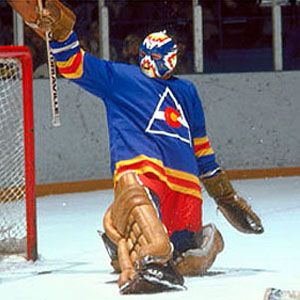
Favell Rockies photo FavellRockies.jpg
Doug Favell in his bold Rockies mask

The one and only Rockies playoff experience was desperately brief, as the format of the opening round of the playoffs was a best-of-three format and Colorado lost 3-2 at Philadelphia in Game 1 and followed that with a 3-1 loss in the only home playoff game in Rockies history as the Flyers swept them out of the playoffs two games to none.

The Rockies actually requested to relocate the team to New Jersey in 1978, but were turned down as their proposed home, the Byrne Arena had yet to be completed and no suitable temporary rink was available at the time. The Rockies point total dropped to 42 after a 15 win season in 1978-79 under two head coaches, Pat Kelly and Bep Guidolin. Paiement once more led the team in scoring, although his total shrank to just 60 points.
Wilf Paiement Rockies photo Wilf Paiement Rockies.jpg
Wilf Paiement led the Rockies in scoring their first three seasons

Several new arrivals in 1979-80 attempted to infuse some hope in the fans, as Rene Robert came from the Buffalo Sabres to lead the team in scoring with 63 points and be named team captain. Additionally, the club traded for veteran Lanny McDonald and Don Cherry took over behind the bench as head coach. At one point the outspoken Cherry even nicknamed his own goalie Hardy Astrom "The Swedish Sieve"!

McDonald Rockies photo McDonaldRockies.jpg
Lanny McDonald

Despite their attempts at improvement, the league did the Rockies no favors by expanding in 1979-80 by allowing four WHA teams to join the NHL, with the Edmonton Oilers and Winnipeg Jets being added to the Smythe Division, putting two more obstacles between the Rockies and the playoffs despite the increase in playoff teams from 12 to 16. Even with having their rosters purged by the terms of the expansion, Edmonton would qualify for the playoffs with 18 more points than Colorado and Winnipeg was able to tie the Rockies in points with 51.

McDonald took over the scoring lead with 81 points in 1980-81 and defenseman Rob Ramage made his presence known with 62 points while goaltender Chico Resch also arrived from the New York Islanders. The team scored a franchise high of 258 goals and improved to 57 points, but well short of the 74 needed to make the playoffs.

Resch Rockies
Chico Resch

Their final season of 1981-82 in Denver was more of the same, with an 18-49-13 record for 49 points and the Rockies gave up 121 more goals than they scored, an average deficit of 1.5 per game. Brent Ashton edged Steve Tambellini 60 to 59 for the club scoring lead and Resch anchored the goaltending, seeing action in 61 games and setting the franchise high with 16 wins.

The Rockies were not helped by having major stability issues during their time in Colorado. In six seasons they had three owners, seven head coaches and seven different team captains.

Finally on this date in 1982, the Colorado Rockies franchise was sold to Dr. John McMullen, who relocated the franchise to New Jersey and renamed the club the New Jersey Devils, ending the Rockies six year run in Denver.

Today's featured jersey is a 1980-81 Colorado Rockies Lanny McDonald jerseyWhen the team moved to Colorado from Kansas City, they retained the team's blue, red and gold colors, which conveniently matched those of the Colorado state flag. A striking new logo, which borrowed heavily from the Colorado state flag, was created, incorporating the imagery of the Rocky Mountains. The Rockies blue road jerseys were particularly attractive when compared to the home whites.

Aside from the addition of the player's names on the back in 1977, the Rockies jerseys remained unchanged during their time in Denver.

Colorado Rockies Jersey
photo courtesy of Classic Auctions

Bonus jersey: Today's bonus jersey is a 1976-77 Colorado Rockies Nelson Pyatt jersey. This lightweight mesh jersey was from the Rockies first set of jerseys, worn early in their first season until their main jersey set arrived.

This jersey stands out due to it's smaller crest made of a white mountain, while the club's main jerseys had a much larger crest which consisted of a blue mountain outlined with a bold white outline as shown in today's extra bonus jersey below.

 photo Colorado Rockies 1976-77 road jersey.jpg
photo courtesy of Classic Auctions

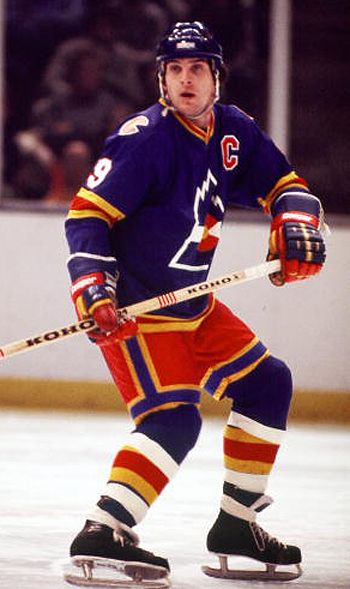
Extra bonus jersey: Today's extra bonus jersey is a 1981-82 Colorado Rockies Joe Micheletti jersey as worn during Micheletti's final NHL season. The Rockies main set of jerseys featured a much more professional logo, with a blue mountain outlined in white with a bolder C. Additonally, the numbers were now two colors instead of the single color of their early first season placeholder jerseys.

When the player names arrived on the back, they were single color letters on both the home and road jerseys.
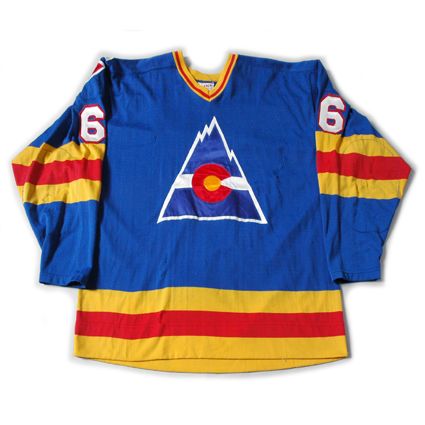
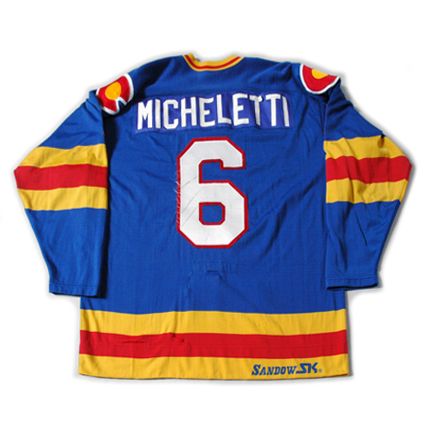
 photo ColoradoRockies1981-82F.jpg
Colorado Rockies 1981-82 jersey photo ColoradoRockies1981-82B-1.jpg

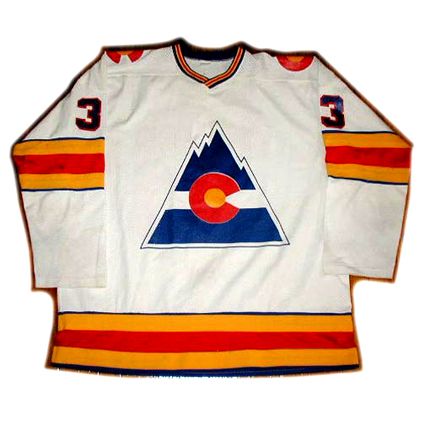
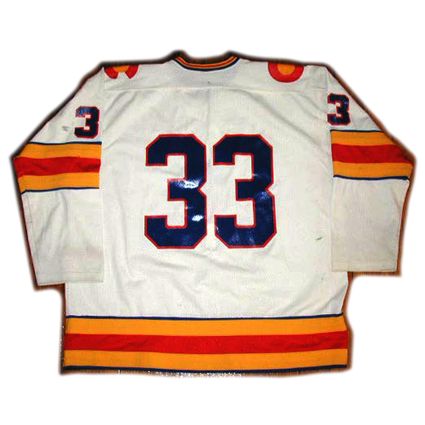
Extra extra bonus jersey: Today's extra extra bonus jersey is a 1977-78 Colorado Rockies Doug Favell jersey as worn during Favell's second season in Colorado when he played in 47 games as the club's main goaltender. Following the season the name was removed from the back of the jersey to prepare the jersey for possible reuse of the jersey.

Notice the shine on the back numbers from the plasticized, heat sealed material used for the numbers rather than the modern sewn on twill material.

Colorado Rockies 77-78 jersey, Colorado Rockies 77-78 jersey

Today's video segment begins the Legends of Hockey profile on Lanny McDonald and discusses his departure from Toronto to Colorado and what he meant to the Maple Leafs before moving to to focus on his time in Calgary.


You knew it had to happen sooner or later, the video for "Rock and Roll, Part 2", first used as an arena anthem by the Colorado Rockies and then adopted by nearly every other professional sports team for over twenty years.


Just in case you were ever curious, here's the nearly forgotten "Rock and Roll, Part 1".

Sunday, May 14, 2017

1981-82 Colorado Rockies Steve Tambellini Jersey

As a rookie in junior hockey during the 1975-76 season, Steve Tambellini loudly announced his presence with 38 goals and 97 points in 72 games with the Lethbridge Broncos, earning WCHL Rookie of the Year honors. He reaffirmed his talent by raising his goal total the following season to 42, despite playing in 17 less games!

In his final season of junior hockey, Tambellini, born on this date in 1958, finished third in the league in scoring with a team leading 155 points from 75 goals and 80 assists in 66 games. During the season, he would make his international debut for Canada with 2 goals and 2 assists on his way to earning a bronze medal at the 1978 World Junior Tournament. Following the season, Tambellini was drafted in the first round by the New York Islanders in the 1978 NHL Entry Draft.

He would spend the following season with the Fort Worth Texans of the CHL, notching 25 goals and 52 points. He also made his NHL debut with a single game with the Islanders.

In 1978-80, Tambellini spent the entire season with the Islanders, but saw the ice in only 45 games in a limited role, but was able to score his first 5 NHL goals as well as 8 assists. While he did not play in any games in the playoffs, the powerful Islanders would go on to win their first Stanley Cup, and Tambellini's name was engraved on the cup based on his regular season contributions.

Tambellini Islanders, Tambellini Islanders

After playing 61 games with the Islanders in 1980-81, Tambellini, deemed expendable due to the incredible depth and scoring ability of the Islanders roster in the early stages of it's Stanley Cup dynasty, was sent westward, along with goaltender Chico Resch, to the Colorado Rockies, where he added 6 goals to his season total to record his first 20 goal season with 25 in all. After scoring 18 points in 13 games with Colorado, Tambellini joined Team Canada for the 1981 World Championships.

Playing a much larger role with the offensively challenged Rockies, Tambellini scored 29 goals and 59 points, good for second place on the club while playing on a line with veteran Lanny McDonald and Paul Gagne.

Tambellini Rockies, Tambellini Rockies

Tambellini was headed back east for the 1982-83 season when the Rockies franchise relocated to New Jersey, where they were renamed the Devils. There, the center registered his third consecutive season of at least 25 goals and his second consecutive season of leading the club in goals.

During the off season, it was once more back west, as Tambellini was involved in a deal which sent him to the Calgary Flames. After his first season of 73 games, he would be limited to just 47 games the second season.

He then moved even further west, signing a free agent contract with the Vancouver Canucks for the 1985-86 season, but was limited to 48 games with a knee injury and later a broken thumb. He bounced back with 72 games in 1986-87.

Tambellini Canucks, Tambellini Canucks

His final NHL season saw him still with the Canucks, but he also took the uncommon for then step of playing for Canada during the 1988 Olympics, which were held in Canada while the NHL regular season was still in progress, scoring a goal and three assists.

Tambellini Canada, Tambellini Canada

Not quite done with playing hockey, Tambellini played 10 games in Switzerland for Zurcher SC in Swiss second division in 1988-89 and a full season with EC Villacher SV in Austria, where he went out in style, scoring 44 goals and 81 points in 38 games to close out his playing career.

In all, he scored 160 NHL goals and 310 points in 553 games.

Today's featured jersey is a 1981-82 Colorado Rockies Steve Tambellini jersey worn during his only full season with the Rockies prior to their move to New Jersey the following season.

The Rockies kept the same jersey style as they had worn while the Kansas City Scouts for their entire run in Colorado, only with a new Colorado themed crest based on the state flag.


Colorado Rockies 1981-82 jersey photo Colorado Rockies 1981-82 F jersey.jpg
Colorado Rockies 1981-82 jersey photo Colorado Rockies 1981-82 B jersey.jpg

Bonus jersey: Today's bonus jersey is a 1982-83 New Jersey Devils Steve Tambellini jersey from the Devils first season after relocating from Colorado when Tambellini led the club in goals. The Devils would wear these red and green jerseys for their first 10 seasons before changing their colors to red and black, finally escaping the endless comparisons to having "Christmas colors".

The only two patches ever worn on this style came in the jerseys final season of 1991-92 when they wore the NHL 75th Anniversary patch on their left chest and a discreet Devils 10th Anniversary patch on the rear hem of their jerseys next to the CCM branding, perhaps the smallest patch ever worn on an NHL jersey.

New Jersey Devils 82-83 jersey, New Jersey Devils 82-83 jersey

Extra bonus jersey: Today's extra bonus jersey is a 1988 Team Canada Steve Tambellini jersey as worn during the 1988 Olympics held in Calgary. While all the teams were contractually obligated to wear Tackla jerseys for the Olympics, Canada chose to wear their Canadian manufactured CCM jerseys for the Games, which resulted in them receiving a $100,000 fine despite covering up the CCM logo on the rear hem with a piece of twill.

Canada 1988 jersey, Canada 1988 jersey
Photo courtesy of Classic Auctions

Monday, October 5, 2015

1976-77 Colorado Rockies Michel Plasse Jersey

On this date in 1976, the Colorado Rockies played their first ever game, which was also the first NHL regular season game to ever by played in Denver, Colorado.

The Rockies began life as the expansion Kansas City Scouts in 1974 and had a very poor 15-54-11 record their first season, having been outscored 184-328 and finishing the season by winning just one of their final 19 games as they went 1-15-3 to close out their inaugural campaign.

1974-75 Kansas City Scouts team photo 1974-75 Kansas City Scouts team.jpg
The 1974-75 Kansas City Scouts

Things were going better for the Scouts in year two, with a 11-21-4 mark near the end of 1975, but the club managed to win only a single game the rest of the season! The last 44 games saw the Scouts set the benchmark for futility with a 1-35-8 record, which included being outscored 105-214, an average of being outscored by 2.5 goals per game.

One of the main issues facing the Scouts was the arrival of the World Hockey Association in 1972, which resulted in a dramatic rise in player salaries as well as a suddenly very thin talent pool, as the number of professional teams went from 14 NHL teams in 1971-72 to 32 between the two leagues combined by 1975-76.

With the Scouts averaging 8,218 fans per game in their 17,000 seat arena (roughly 5,000 below the league average at the time) and an ownership group in debt, a mid-season ticket drive was staged that resulted in only 2,000 sales. Faced with that bleak reality, the owners decided to get out of the hockey business and sold the club to a group headed by Jack Vickers, who moved the team to Denver for the 1976-77 season, renaming his new club the Rockies.

As a side note, Denver as actually scheduled to receive an expansion franchise that season and the Scouts relocation to Denver scuttled that plan, which cost Seattle, Washington it's opportunity to receive the other franchise, which it still has never obtained now 39 years later.

The Rockies opened their first season in Denver with a 4-2 win over the Toronto Maple Leafs on this date in 1976, and eventually finished with a 20-46-14 record, which relegated them to a 5th place finish in the five team Smythe Division.

1976-77 Colorado Rockies team photo 1976-77 Colorado Rockies team.jpg
The inaugural 1976-77 Colorado Rockies

While the Rockies actually won one less game in 1977-78, they improved by five points in the standings by virtue of 21 tie games, which reduced their loss total from the year prior by six games. This resulted in the franchise qualifying for the playoffs for the first time in their four year history to date. Unfortunately, their stay was brief, as the "preliminary round" contested at the time was a quick best-of-three and the Rockies were ousted by the powerful Philadelphia Flyers in two straight.

The team took a step backwards the following season, dropping to 15 wins and just 42 points in the standings, which was the worst in the NHL.

Wilf Paiement Rockies photo Wilf Paiement Rockies.jpg
Wilf Paiement led the Rockies in scoring their first three seasons

Despite rising to 19 wins and 51 points in 1979-80, the Rockies were still last overall in the league yet again.

McDonald Rockies photo McDonaldRockies.jpg
Lanny McDonald arrived in Colorado in 1979-80

It was more of the same in 1980-81, but the Rockies nudged up from 51 points to 57, which did allow them to not only stay ahead of the Jets, but pass the moribund Detroit Red Wings by a point as well.

Once more, it all went wrong for the Rockies during their final season in Denver when they came home trailing the pack, having dropped back to 49 points, five behind Detroit. To make matters worse, the Jets improved by a whopping 48 points that season!

One would expect all the last place finishes to eventually lead to some improvement, but a look at the Scouts and Rockies early draft picks reveals a list of names that include Barry Dean (#2 overall in 1975 - 81 career NHL points), Don Cairns (#20 overall in 1975 - 105 points), Doug Berry (#38 overall in 1977 - 43 points), Randy Pierce (#47 overall in 1977 - 138 points), Mike Gillis (#5 overall in 1978 - 76 points), Merlin Malinowski (#27 overall in 1978 - 165 points), Paul Gagne (#19 overall in 1980 - 212 points), Joe Ward (#22 overall in 1980 - 0 points), Rich Chernomaz (#26 overall in 1981 - 16 points) and Uli Hiemer (#48 overall in 1981 - 73 points).

The Rockies drew fairly well at the gate, but the dismal finishes, seven coaches in six seasons and three different owners while in Colorado made for a very unstable franchise, which was eventually sold to John McMullen, who relocated the franchise to New Jersey for the 1982-83 season and renamed them the "Devils". Of note, the Devils would also play their very first game on this date in 1982, a 3-3 tie against the Pittsburgh Penguins.

In New Jersey, the club would find it's long awaited stability and success, as McMullen would own the club for 18 years, have one general manager for 29 years and win three Stanley Cups.

Today's featured jersey is a 1976-77 Colorado Rockies Michel Plasse jersey worn in the Rockies first-ever game played on this date in 1976. Plasse was a goaltender who had actually spent some time with the franchise while they were in Kansas City, was backing up starting goaltender Doug Favell for the majority of the game, but did see action for a few minutes early in the third period when he relieved Favell who came out of the game while suffering from a cramp.

This jersey survived in such remarkable condition as both goalies would change numbers after a few games, with Plasse taking the #31, leaving this one relatively unused.

 photo Colorado Rockies 1976-77 jersey.jpg

Bonus jersey: Today's bonus jersey is a 1976-77 Colorado Rockies Nelson Pyatt jersey. This lightweight mesh jersey was from the Rockies first set of jerseys, worn early in their first season until their main jersey set arrived.

This jersey stands out due to it's smaller crest made of a white mountain, while the club's main jerseys had a much larger crest which consisted of a blue mountain outlined with a bold white outline as pictured in the player photos above.

 photo Colorado Rockies 1976-77 road jersey.jpg

Here is an interview with Rockies captain Lanny McDonald on the occasion of his return to Toronto.


Our next video is some old time hockey featuring the Colorado Rockies.

Thursday, May 14, 2015

1981-82 Colorado Rockies Steve Tambellini Jersey

As a rookie in junior hockey during the 1975-76 season, Steve Tambellini loudly announced his presence with 38 goals and 97 points in 72 games with the Lethbridge Broncos, earning WCHL Rookie of the Year honors. He reaffirmed his talent by raising his goal total the following season to 42, despite playing in 17 less games!

In his final season of junior hockey, Tambellini, born on this date in 1958, finished third in the league in scoring with a team leading 155 points from 75 goals and 80 assists in 66 games. During the season, he would make his international debut for Canada with 2 goals and 2 assists on his way to earning a bronze medal at the 1978 World Junior Tournament. Following the season, Tambellini was drafted in the first round by the New York Islanders in the 1978 NHL Entry Draft.

He would spend the following season with the Fort Worth Texans of the CHL, notching 25 goals and 52 points. He also made his NHL debut with a single game with the Islanders.

In 1978-80, Tambellini spent the entire season with the Islanders, but saw the ice in only 45 games in a limited role, but was able to score his first 5 NHL goals as well as 8 assists. While he did not play in any games in the playoffs, the powerful Islanders would go on to win their first Stanley Cup, and Tambellini's name was engraved on the cup based on his regular season contributions.

Tambellini Islanders, Tambellini Islanders

After playing 61 games with the Islanders in 1980-81, Tambellini, deemed expendable due to the incredible depth and scoring ability of the Islanders roster in the early stages of it's Stanley Cup dynasty, was sent westward, along with goaltender Chico Resch, to the Colorado Rockies, where he added 6 goals to his season total to record his first 20 goal season with 25 in all. After scoring 18 points in 13 games with Colorado, Tambellini joined Team Canada for the 1981 World Championships.

Playing a much larger role with the offensively challenged Rockies, Tambellini scored 29 goals and 59 points, good for second place on the club while playing on a line with veteran Lanny McDonald and Paul Gagne.

Tambellini Rockies, Tambellini Rockies

Tambellini was headed back east for the 1982-83 season when the Rockies franchise relocated to New Jersey, where they were renamed the Devils. There, the center registered his third consecutive season of at least 25 goals and his second consecutive season of leading the club in goals.

During the off season, it was once more back west, as Tambellini was involved in a deal which sent him to the Calgary Flames. After his first season of 73 games, he would be limited to just 47 games the second season.

He then moved even further west, signing a free agent contract with the Vancouver Canucks for the 1985-86 season, but was limited to 48 games with a knee injury and later a broken thumb. He bounced back with 72 games in 1986-87.

Tambellini Canucks, Tambellini Canucks

His final NHL season saw him still with the Canucks, but he also took the uncommon for then step of playing for Canada during the 1988 Olympics, which were held in Canada while the NHL regular season was still in progress, scoring a goal and three assists.

Tambellini Canada, Tambellini Canada

Not quite done with playing hockey, Tambellini played 10 games in Switzerland for Zurcher SC in Swiss second division in 1988-89 and a full season with EC Villacher SV in Austria, where he went out in style, scoring 44 goals and 81 points in 38 games to close out his playing career.

In all, he scored 160 NHL goals and 310 points in 553 games.

Today's featured jersey is a 1981-82 Colorado Rockies Steve Tambellini jersey worn during his only full season with the Rockies prior to their move to New Jersey the following season.

The Rockies kept the same jersey style as they had worn while the Kansas City Scouts for their entire run in Colorado, only with a new Colorado themed crest based on the state flag.

Colorado Rockies 1981-82 jersey photo Colorado Rockies 1981-82 F jersey.jpg
Colorado Rockies 1981-82 jersey photo Colorado Rockies 1981-82 B jersey.jpg

Bonus jersey: Today's bonus jersey is a 1982-83 New Jersey Devils Steve Tambellini jersey from the Devils first season after relocating from Colorado when Tambellini led the club in goals. The Devils would wear these red and green jerseys for their first 10 seasons before changing their colors to red and black, finally escaping the endless comparisons to having "Christmas colors".

The only two patches ever worn on this style came in the jerseys final season of 1991-92 when they wore the NHL 75th Anniversary patch on their left chest and a discreet Devils 10th Anniversary patch on the rear hem of their jerseys next to the CCM branding, perhaps the smallest patch ever worn on an NHL jersey.

New Jersey Devils 82-83 jersey, New Jersey Devils 82-83 jersey

Extra bonus jersey: Today's extra bonus jersey is a 1988 Team Canada Steve Tambellini jersey as worn during the 1988 Olympics held in Calgary. While all the teams were contractually obligated to wear Tackla jerseys for the Olympics, Canada chose to wear their Canadian manufactured CCM jerseys for the Games, which resulted in them receiving a $100,000 fine despite covering up the CCM logo on the rear hem with a piece of twill.

Canada 1988 jersey, Canada 1988 jersey
Photo courtesy of Classic Auctions

Friday, October 24, 2014

1977-78 Edmonton Oilers Joe Micheletti Jersey

Joe Micheletti, born on this date in 1954, won a Minnesota state high school championship in 1973 while playing for the Hibbing Blue Jackets. Micheletti had a dominating tournament, scoring 7 goals and 11 points in just three games, which included a pair of hat tricks, with one coming in the championship final.

 photo JoeMichelettiHibbing.jpg
Joe Micheletti celebrates a victory for the Hibbing Blue Jackets

Following his high school career, Micheletti moved down to the Twin Cities to join the University of Minnesota Golden Gophers under their legendary Herb Brooks. His freshman season of 1973-74 ended with the Gophers winning the NCAA national championship over the Michigan Tech Huskies.

 photo 1973-74MinnesotaGophersteam.jpg
The NCAA champion 1973-74 Minnesota Golden Gophers

After scoring 20 points in 1974-75, Micheletti's game to a step forward with 31 points in 33 games during the 1975-76 season, which concluded with the Gophers winning a second national championship, again defeating Michigan Tech on a roster than included future "Miracle on Ice" Olympians Bill Baker, Steve Janaszak, Phil Verchota and future NHLer Reed Larson.

1975-76 Minnesota Gophers team photo 1975-76MinnesotaGophersteam.jpg
The 1975-76 Gophers won Minnesota's second title in three years

For his final college season of 1976-77, Micheletti was named the Gophers team captain and continued to increase his offensive production with  9 goals and 39 assists for 48 points in 39 games.

Although he was drafted by the Montreal Canadiens in the 1974 NHL Amateur Draft, Micheletti chose to join the Calgary Cowboys of the WHA for the latter part of the 1976-77 season once his final college season ended. During 14 games with the Cowboys, he scored 3 goals and 6 points.

Following the conclusion of the WHA season, Micheletti was selected to play for the United States at the 1977 World Championships, where he had 5 assists in ten games.

He was then traded just days before the Cowboys franchise folded to the Winnipeg Jets, but prior to the start of the regular season he was again traded, this time to the Edmonton Oilers. He would play two seasons in Edmonton, first scoring a career best 48 points after being limited to 56 games by a knee injury, followed by 47 in 72 games of the 1978-79 season. The Oilers would make it to the Avco Cup Finals with Micheletti contributing 9 assists in 13 games.

Another trade would send Micheletti to the St. Louis Blues of the NHL for the 1979-80 season. He would play two and a half seasons in St. Louis, with his best campaign for the Blues coming in 1980-81 with 4 goals and 27 assists in 63 regular season games and a fine playoff performance with 12 points in 11 playoff games.

Micheletti Blues photo MichelettiBlues.jpg
Micheletti while with the Blues in the NHL

His time in St. Louis would come to a close with a trade that sent him to the Colorado Rockies in a deal which sent former Gophers teammate Baker to the Blues. He would play in 21 games for tColorado, scoring 8 points for the offensively challenged Rockies, the lowest scoring team in the NHL.

 photo MichelettiRockies.jpg
Micheletti during his final season with Colorado

That season would also see Micheletti play 17 games for the Fort Worth Texans of the Central Hockey League, scoring 17 points in 17 games, as well as making his second appearance for the United States at the 1982 World Championships, which would prove to be the end of his playing days.

His final combined WHA and NHL totals were 300 games played with 42 goals (31 in the WHA), 130 assists and 172 points.

After two seasons of work on the Blues radio broadcasts, from 1987-88 to 1990-91 Micheletti was an assistant coach for St. Louis and then returned to broadcasting where he has established himself as a recognizable and knowledgeable figure, often appearing on national NHL telecasts as well as the Olympics on four occasions.

Micheletti broadcaster photo Michelettibroadcaster.jpg
Micheletti has gone on to a successful broadcasting career

Today's featured jersey is a 1977-78 Edmonton Oilers Joe Micheletti jersey as worn during his career best season of 48 points, scored in just 56 games. The Oilers began life during the inaugural WHA season of 1972-73 as the Alberta Oilers using orange as their predominate color, as the white jerseys had an orange shoulder yoke and orange arm and waist striping while the road jerseys were primarilty orange.

It was during their third season that the change was made to make blue the primary color while orange was reduced to the trim color as shown in today's featured jersey. This style jersey would remain in use for the remainder of the Oilers days in the WHA and it most easily identified by the low contrast blue letters against the orange background of the main crest on the home white jerseys and orange letters on a white background of the road jerseys, which also was not as visible as it could have been.

With their entry into the NHL for the 1979-80 season, the Oilers would finally make a change for the better by adopting a much higher contrast main crest with blue letters and an orange oil drop against a white background for both their home and road jerseys.

 photo EdmontonOilers1977-78Fjersey.jpg
Edmonton Oilers 1977-78 jersey photo EdmontonOilers1977-78Bjersey.jpg

Bonus jersey: Today's bonus jersey is a 1981-82 Colorado Rockies Joe Micheletti jersey as worn during Micheletti's final NHL season. The Rockies wore the same jerseys as they did during their brief stay in Kansas City as the Scouts, only with the new mountain crest of the Rockies, whose team colors inherited from the Scouts conveniently matched the Colorado state flag, making it easy to incorporate its main elements into the main crest.

The only change the jerseys underwent was the addition of the players names onto the road blue jerseys for their second and final season of 1981-82.

 photo ColoradoRockies1981-82F.jpg
Colorado Rockies 1981-82 jersey photo ColoradoRockies1981-82B-1.jpg

In today's video section, Micheletti and Sam Rosen react to Sean Avery's unorthodox tactics against Martin Brodeur.


Here is a look at the 1974 Minnesota Gophers national championship team.

Monday, May 27, 2013

1980-81 Colorado Rockies Lanny McDonald Jersey

The NHL had planned to expand in 1976-77 and had awarded "conditional" franchises to both Denver and Seattle. However, several franchises were having financial difficulties at the time, the California Golden Seals, Kansas City Scouts and Pittsburgh Penguins in particular. Due to the number of existing clubs having enough troubles of their own, the proposed expansion was called off and the Seals relocated to Cleveland to become the Barons while the Scouts moved to Denver after selling only 2,000 season tickets while finding themselves nearly $1 million in debt after playing just two seasons in Kansas City.

While in Denver, the Colorado Rockies continued the Scouts tradition of struggling to make the playoffs. Their first season record in Denver of 20-46-14 was a 13 point improvement over anything achieved in Kansas City, but they still failed to qualify for the playoffs. The club was led in scoring by Wilf Paiement, who set a franchise record that would never be topped with 41 goals with 41 and totaled 81 points.

Paiement Rockies
Wilf Paiement

Thanks to an increase of ties from 14 to 21, over 25% of the team's games and more ties than wins, they set a Rockies record with 59 points after going 19-40-21 and actually finished second in the horrid Smythe Division, which also had league doormats Vancouver (57 points), St. Louis (53) and Minnesota (45). Luckily for the Rockies, they resided in the Campbell Conference, as the Penguins failed to make the top six in the Wales Conference despite having 68 points in the standings! Paiement again led the team in scoring with 87 points, establishing the club record.

The one and only Rockies playoff experience was desperately brief, as the format of the opening round of the playoffs were then a best-of-three format and Colorado lost 3-2 at Philadelphia in Game 1 and followed that with a 3-1 loss in the only home playoff game in Rockies history as the Flyers swept them out of the playoffs two games to none.

The Rockies actually requested to relocate the team to New Jersey in 1978, but were turned down as their proposed home, the Byrne Arena had yet to be completed and no suitable temporary rink was available at the time. The Rockies point total dropped to 42 after a 15 win season in 1978-79 under two head coaches, Pat Kelly and Bep Guidolin. Paiement once more led the team in scoring, although his totals shrank to just 60 points.

Several new arrivals in 1979-80 attempted to infuse some hope in the fans, as Rene Robert came from the Buffalo Sabres to lead the team in scoring with 63 points and be named team captain. Additionally, the club traded for veteran Lanny McDonald and Don Cherry took over behind the bench as head coach. At one point the outspoken Cherry nicknamed his own goalie Hardy Astrom "The Swedish Sieve"!

Still, the league did the Rockies no favors by expanding in 1979-80 by allowing four WHA teams to join the NHL, with the Edmonton Oilers and Winnipeg Jets being added to the Smythe Division, putting two more obstacles between the Rockies and the playoffs despite the increase in playoff teams from 12 to 16. Even with having their rosters purged by the terms of the expansion, Edmonton would qualify for the playoffs with 18 more points than Colorado and Winnipeg was able to tie the Rockies in points with 51.

McDonald took over the scoring lead with 81 points in 1980-81 and Rob Ramage on defense made his presence known with 62 points. Goaltender Chico Resch also arrived from the New York Islanders. The team scored a franchise high of 258 goals and improved to 57 points, but well short of the 74 needed to make the playoffs.

Resch Rockies
Chico Resch

Their final season of 1981-82 in Denver was more of the same, with an 18-49-13 record for 49 points and the Rockies gave up 121 more goals than they scored, an average deficit of 1.5 per game. Brent Ashton edged Steve Tambellini 60 to 59 for the club scoring lead and Resch anchored the goaltending seeing action in 61 games and setting the franchise high with 16 wins.

The Rockies were not helped by having major stability issues during their time in Colorado. In six seasons they had three owners, seven head coaches and seven different team captains.

Finally on this date in 1982, the Colorado Rockies franchise was sold to Dr. John McMullen, who relocated the franchise to New Jersey and renaming the club the Devils, ending the Rockies six year run in Denver.

Today's featured jersey is a 1980-81 Colorado Rockies Lanny McDonald jersey. McDonald played seven seasons with the Toronto Maple Leafs before being traded to the Rockies along with Joel Quenneville for Pat Hickey and Paiement. He was later traded to the Calgary Flames where he would play for eight seasons and retire after winning the Stanley Cup. His final regular season goal was his 500th.

When the team moved to Colorado from Kansas City, they retained the team's blue, red and gold jerseys, which conveniently matched those of the Colorado state flag, and developed a striking logo which borrowed heavily from the state flag while incorporating the imagery of the Rocky Mountains. The Rockies blue road jerseys were particularly attractive when compared to the home whites.

Aside from the addition of the player's names on the back in 1977, the Rockies jerseys remained unchanged during their time in Denver.

Colorado Rockies Jersey

Today's video segment begins the Legends of Hockey profile on Lanny McDonald and discusses his departure from Toronto to Colorado and what he meant to the Maple Leafs before moving to to focus on his time in Calgary.


You knew it had to happen sooner or later, the video for "Rock and Roll, Part 2", first used as an arena anthem by the Colorado Rockies and then adopted by nearly every other professional sports team for over twenty years.


Just in case you were ever curious, here's the nearly forgotten "Rock and Roll, Part 1".


Thursday, April 5, 2012

1977-78 Colorado Rockies Doug Favell Jersey

Born on this date in 1945, goaltender Doug Favell played his junior hockey with the Niagara Falls Flyers of the Ontario Hockey Association in 1963-64 and 1964-65, teamed with future NHLer Bernie Parent. The duo led the Flyers to a Memorial Cup championship in 1965.

Favell then began his road to the NHL as part of the Boston Bruins organization, playing one game with the Minneapolis Bruins following the Flyers Memorial Cup title in 1965 in preparation for joining the Oklahoma City Blazers of the Central Hockey League in 1965-66. That same season Favell would also play a pair of games for the San Francisco Seals of the Western Hockey League.

He would spend the entire 1966-67 season back in Oklahoma City, the final season of the Original 6. Prior to the start of the next season, Favell got a break when he was selected in the 1967 Expansion Draft by the Philadelphia Flyers, as the Bruins boasted a deep goaltending situation with Gerry Cheevers, Eddie Johnston and Parent all sharing time in Boston.

With teams now having their goaltenders share the suites, as opposed to having a single goaltender play ever minute of every game in the not so distant past, combined with the six new clubs joining the league that season, as many as 24 men could now find work in the NHL as a goalie, when compared to just 6 maskless goalies at the start of the decade.

Favell's partner in Philadelphia would turn out to be none other than Parent, who was also left unprotected by the Bruins for the expansion draft, and he too was selected by the Flyers. Favell saw action in 37 games, posting a 15-15-6 record as Philadelphia finished first in the Western Division among the other expansion clubs.

Favell Flyers, Favell Flyers
Favell wearing a Terry Sawchuk-style mask

Favell had a tough time the following season, being limited to just 21 games and 3 wins. The 1969-70 season was not any better, with Favell seeing time in use 15 games, winning 4.

The 1970-71 season saw Favell change the look of hockey forever, when the Flyers goaltender took to the ice on Halloween night with his protective goalie mask painted bright orange, the first painted mask in league history following Cheevers mask with stitch marks drawn on with a marker.

Favell Flyers, Favell Flyers
Favell in the NHL's first painted goalie mask, his orange Halloween night mask

That season also saw Parent traded to the Maple Leafs in February of 1971, clearing the way for Favell to take over as the number one goaltender for the Flyers, eventually playing in 44 games that season. He set a career high the following year with 54 appearances, and while that total dropped to 44 in 1972-73, he set a career high with 20 wins that season while posting his third consecutive goals against average under 3.00.

Favell Flyers, Favell Flyers
Favell in his striking new mask, as the era of bold graphics had now arrived

In an odd twist, Favell was traded to the Maple Leafs in exchange for none other than... Parent! The goaltending situation in Toronto was a crowded one, with Favell competing for time with Dunc Wilson (24 games) and former Bruin's goaltender Johnston (26), with Favell getting the most games in 32 and posting a fine 14-7-9 record.

Favell Maple Leafs, Favell Maple Leafs
Favell while with the Maple Leafs

Favell played in 39 games the following year but won just 12 followed by an injury plagued 1975-76, playing in just 3 games for Toronto and 4 for Oklahoma City.

He was then sold to the Colorado Rockies, who had just relocated from Kansas City. There, he split time with incumbent Michel Plasse for the 1976-77 season, playing in 30 games but finding it difficult to rack up any wins for the lowly Rockies.

The following season Favell took over as the Rockies top net minder, playing 47 games, the second highest of his career, accounting for 13 of the Rockies 19 wins and leading Colorado into the playoffs for the only time in Rockies history.

Favell Rockies, Favell Rockies
Favell toiling away for the Rockies, again with a bold new mask design

His fortunes changed for the 1978-79 season, and Favell only was in goal for 7 games, failing to register a win, and spent the majority of the season with the Philadelphia Firebirds of the AHL where he played in 32 games.

With expansion brining in four teams who were previously members of the WHA for 1979-80, an expansion draft was held, and Favell was selected by the Edmonton Oilers, and Favell instead chose to retire than start over with another new, young club.

Today's featured jersey is a 1977-78 Colorado Rockies Doug Favell jersey as worn during Favell's second season in Colorado when he played in 47 games as the club's main goaltender. Following the season the name was removed from the back of the jersey to prepare the jersey for possible reuse of either the jersey itself or perhaps just the nameplate.

Notice the shine on the back numbers from the plasticized, heat sealed material used for the numbers rather than the modern sewn on twill material.

The Scouts were formed in 1974-75 with blue, red and gold jerseys and moved after just two seasons to Colorado, where the state flag conveniently happened to be blue, red and gold, the design of which was incorporated into the Rockies crest.

The club wore the same jerseys for six seasons of poor play and low attendance before relocating once again, this time becoming the New Jersey Devils.

Colorado Rockies 77-78 jersey, Colorado Rockies 77-78 jersey

Here is an interview with Favell all about goalie masks and the rapid evolution of them in their early days and his subsequent changes in paint schemes he wore in the early days of painted masks.


hit counter for blogger