The third of the 2012 inductees into the Hockey Hall of Fame was long time Colorado Avalanche and Quebec Nordiques captain JoeSakic.
Sakic was originally drafted by the Avalanche franchise when they were still the Quebec Nordiques 15th overall in the 1987 NHL Entry Draft.
A little known fact is that Sakic's parents were Croatian immigrants and he grew up speaking Croatian before attending elementary school. He would be named Rookie of the Year in the Western Hockey League of Canadian Juniors in 1987 after scoring 133 points. He also survived a horrific bus crash involving his club, the Swift Current Broncos, in which four of his teammates were killed. The following year Sakic was named WHL Most Valuable Player and Canadian Major Junior Player of the Year after scoring 160 points.
Sakic during his days with Swift Current
He scored an assist on his NHL debut on October 6, 1988 versus the Hartford Whalers and originally wore sweater #88 because Alain Cote was wearing his preferred #19. He finished with 62 points in 70 games.
Sakic wearing #88 as a rookie
With Cote now retired, Sakic claimed his #19 for 1989-90 and scored 102 points. 1990-91 saw Sakic score 109 points, sixth overall in the league, and be named co-captain of the Nordiques (for home games).
Sakic would miss 11 games in 1991-92, which would hurt him in his chances to repeat another 100 point season, and he would conclude the year with 94 points. During this time period. the Nordiques regularly finished in last place, which allowed them to load up on high draft choices and put them in position to acquire a number of talented players, highlighted by their trade of holdout Eric Lindros.
Now named full time team captain of the newly reconfigured Nordiques, Sakic would respond in 1992-93 with 105 points and lead the Nordiques out of the wilderness and into the playoffs for the first time in his career on the heels of a staggering 52 point improvement, double their total of the year prior. Without any previous playoff experience, the Nordiques would be eliminated in the first round by arch-rivals the Montreal Canadiens.
Sakic as captain of the Nordiques
1993-94 was a slight step back for Sakic, as he would fall short of the 100 point barrier with 92, but the Nordiques would take a large step back, dropping 28 points in the standings and miss the playoffs yet again.
The Nordiques final season of in Quebec saw Sakic finish fourth in scoring during the lockout shortened 1994-95 season and the Nordiques would capture the division title, only to be eliminated in six games by the New York Rangers, ending their time in Canada.
Relocated to Denver, the Colorado Avalanche took to the ice in the 1995-96 season hoping to continue the improvement shown during Sakic's seven seasons in Quebec. Little did anyone anticipate the events that would unfold that season.
After having a major falling out with the Montreal Canadiens, superstar goaltender Patrick Roywas traded to the Canadiens former arch-rivals, now located in Colorado, a trade which would have never, ever happened had the club remained in Quebec, and the Avalanche were now on their way to glory.
Sakic topped 50 goals for the first time with 51, adding 69 assists for a career high 120 points for third in the league. The Avalanche would storm the playoffs, defeating first the Vancouver Canucks, followed by the Chicago Blackhawks by identical 4 games to 2 margins. Next up was a hard fought series with the Detroit Red Wings, upsetting the team that finished 27 points ahead of them in the standings 4-2 for the right to face the upstart Florida Panthers, whom they easily dismissed in four straight games for the the franchises first Stanley Cup Championship in their first season out of Quebec. Sakic would lead the playoffs in scoring that season and be named the winner of the Conn Smythe Trophy.
It had been a long journey for Sakic, who, along with Curtis Leschyshyn, were the only two Nordiques players from the 1988-89 season to suffer through the years of last place finishes to eventually raise the Stanley Cup.
Sakic raises the 1996 Stanley Cup after many years of toil with the franchise
Sakic would eventually play 13 seasons in Colorado, scoring 100 points twice more in his career, eventually surpassing the 600 goal, 1,000 assist and 1,600 point marks. The Avalanche were regular fixtures in the playoffs, and contenders for the Stanley Cup for seven straight seasons, reaching the conference finals in six of those seven seasons, including winning the Stanley Cup again in 2001, the same season he won the Hart Trophy as league MVP, the Pearson Award and the Lady Byng Trophy.
Sakic again raised the Stanley Cup in 2001
Today's featured jersey is a 1992 NHL All-Star Joe Sakic jersey from the NHL's 75th Anniversary season. For the game in Philadelphia, the Campbell Conference wore red jerseys in the style of the first NHL All-Star Game, held in 1947. Back then the format was for the defending Stanley Cup champions to play an all-star team made up of players from the other five clubs in league, in a game held prior to the start of the regular season.
The Wales Conference wore white jerseys, which were first used in 1951 when the format of the game was changed to the First Team All-Stars facing off against the Second Team All-Stars.
Sakic wore #16 for the game due to to 16 year veteran Bryan Trottier also being on the Wales Conference roster. With Sakic only being in the league for four seasons at the time, Trottier's seniority gave him the right to wear the #19 and Sakic was obliged to chose a different number, in this case the similar appearing #16.
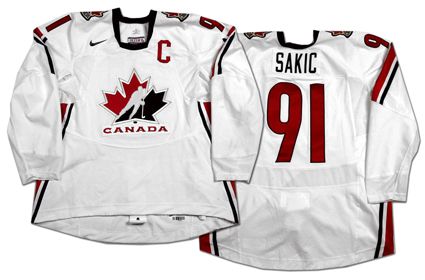
Bonus jersey: Today's bonus jersey is a 2006 Team Canada Joe Sakic jersey. This jersey was worn at the Olympic Games held in Torino, Italy. Yet again, Sakic was obligated to to switch to a number other than his usual #19, this time in deference to Steve Yzerman, whose #19 was retired by the Canadian National Team in 2005. Aside from Sakci changing to #91, the retirement of Yzerman's #19 also affected others on the Canadian Roster who also wore #19 in the NHL; #9 ShaneDoan, #39 BradRichards and #97 JoeThornton.
Our first video today are the Top 10 Joe Sakic Moments from his throughout his career.
Our second video is a tribute video dedicated to his entire career on the occasion of his retirement.
The Hockey Hall of Fame announced it's 2012 inductees, which included Stanley Cup champion JoeSakic.
Sakic was originally drafted by the Colorado Avalanche franchise when they were still the Quebec Nordiques 15th overall in the 1987 NHL Entry Draft.
A little known fact is that Sakic's parents were Croatian immigrants and he grew up speaking Croatian before attending elementary school. He would be named Rookie of the Year in the Western Hockey League of Canadian Juniors in 1987 after scoring 133 points. He also survived a horrific bus crash involving his club, the Swift Current Broncos, in which four of his teammates were killed. The following year Sakic was named WHL Most Valuable Player and Canadian Major Junior Player of the Year after scoring 160 points.
He scored an assist on his NHL debut on October 6, 1988 versus the Hartford Whalers and originally wore sweater #88 because Alain Cote was wearing his preferred #19. He finished with 62 points in 70 games.
Sakic wearing #88 as a rookie
With Cote now retired, Sakic claimed his #19 for 1989-90 and scored 102 points. 1990-91 saw Sakic score 109 points, sixth overall in the league, and be named co-captain of the Nordiques (for home games).
Sakic would miss 11 games in 1991-92, which would hurt him in his chances to repeat another 100 point season, and he would conclude the year with 94 points. During this time period. the Nordiques regularly finished in last place, which allowed them to load up on high draft choices and put them in position to acquire a number of talented players, highlighted by their trade of holdout Eric Lindros.
Now named full time team captain of the newly reconfigured Nordiques, Sakic would respond in 1992-93 with 105 points and lead the Nordiques out of the wilderness and into the playoffs for the first time in his career on the heels of a staggering 52 point improvement, double their total of the year prior. Without any previous playoff experience, the Nordiques would be eliminated in the first round by arch-rivals the Montreal Canadiens.
1993-94 was a slight step back for Sakic, as he would fall short of the 100 point barrier with 92, but the Nordiques would take a large step back, dropping 28 points in the standings and miss the playoffs yet again.
The Nordiques final season of in Quebec saw Sakic finish fourth in scoring during the lockout shortened 1994-95 season and the Nordiques would capture the division title, only to be eliminated in six games by the New York Rangers, ending their time in Canada.
Relocated to Denver, the Colorado Avalanche took to the ice in the 1995-96 season hoping to continue the improvement shown during Sakic's seven seasons in Quebec. Little did anyone anticipate the events that would unfold that season.
After having a major falling out with the Montreal Canadiens, superstar goaltender Patrick Roywas traded to the Canadiens former arch-rivals, now located in Colorado, a trade which would have never, ever happened had the club remained in Quebec, and the Avalanche were now on their way to glory.
Sakic topped 50 goals for the first time with 51, adding 69 assists for a career high 120 points for third in the league. The Avalanche would storm the playoffs, defeating first the Vancouver Canucks, followed by the Chicago Blackhawks by identical 4 games to 2 margins. Next up was a hard fought series with the Detroit Red Wings, upsetting the team that finished 27 points ahead of them in the standings 4-2 for the right to face the upstart Florida Panthers, whom they easily dismissed in four straight games for the the franchises first Stanley Cup Championship in their first season out of Quebec. Sakic would lead the playoffs in scoring that season and be named the winner of the Conn Smythe Trophy.
It had been a long journey for Sakic, who, along with Curtis Leschyshyn, were the only two Nordiques players from the 1988-89 season to suffer through the years of last place finishes to eventually raise the Stanley Cup.
Sakic with the Stanley Cup in 1996
Sakic would eventually play 13 seasons in Colorado, scoring 100 points twice more in his career, eventually surpassing the 600 goal, 1,000 assist and 1,600 point marks. His 16 years as captain of the franchise is the second longest tenure in NHL history and his outstanding career with the Avalanche was recognized when his #19 was retired by the club in 2009.
While Sakic played in Colorado, the Avalanche were regular fixtures in the playoffs, and contenders for the Stanley Cup for seven straight seasons, reaching the conference finals in six of those seven seasons, including winning the Stanley Cup again in 2001, the same season he won the Hart Trophy as league MVP, the Pearson Award and the Lady Byng Trophy.
Sakic with the Lady Byng, Stanley Cup and Hart Trophy in 2001
Internationally, Sakic was a member of the Canadian National Team that won the World Junior Championship in 1988, the 1994 World Championship, the 2002 Olympics and the 2004 World Cup of Hockey. Sakic also won a silver medal at the 1991 World Championships and was captain of Team Canada at the 2006 Olympics in Italy. His Stanley Cup championship, World Championship and Olympic gold medal made him one of the first group of Canadians to become a member of the Triple Gold Club in 2002.
Mario Lemieux with Sakic after receiving their gold medals in 2002
Today's featured jersey is a 1995-96 Colorado Avalanche Joe Sakic jersey and features the 1996 Stanley Cup Finals patch. This jersey stands apart with it's "mountain range" striping on the waist and arms, unlike any other jersey of it's day. Combined with it's unique color palette, custom number font, memorable secondary shoulder logos and the club's success on the ice, this style Colorado Avalanche jersey is a true icon of it's era and only the change to the templated Reebok Edge jerseys killed off what would have likely been one of those jerseys that lived on unchanged for years.
The white names and numbers on this jersey have a textured herringbone pattern pattern to them, which is called "Glacier Twill". In addition to that detail, the silver outline around all the numbers is a metallic silver material, which is often done as a flat grey material on Avalanche jerseys. The lettering for the name is also tall and narrow, as shown by the shape of the "C", which is also often found as a nearly perfect circle shape with rounded, instead of flat sides like shown here.
Our first video today are the Top 10 things about Joe Sakic.
Our second video is a tribute video dedicated to his entire career on the occasion of his retirement.
On this date in 2009, the Colorado Avalanche retired the #19 of long time captain JoeSakic.
Sakic was originally drafted by the Avalanche franchise when they were still the Quebec Nordiques 15th overall in the 1987 NHL Entry Draft.
A little known fact is that Sakic's parents were Croatian immigrants and he grew up speaking Croatian before attending elementary school. He would be named Rookie of the Year in the Western Hockey League of Canadian Juniors in 1987 after scoring 133 points. He also survived a horrific bus crash involving his club, the Swift Current Broncos, in which four of his teammates were killed. The following year Sakic was named WHL Most Valuable Player and Canadian Major Junior Player of the Year after scoring 160 points.
He scored an assist on his NHL debut on October 6, 1988 versus the Hartford Whalers and originally wore sweater #88 because Alain Cote was wearing his preferred #19. He finished with 62 points in 70 games.
With Cote now retired, Sakic claimed his #19 for 1989-90 and scored 102 points. 1990-91 saw Sakic score 109 points, sixth overall in the league, and be named co-captain of the Nordiques (for home games).
Sakic would miss 11 games in 1991-92, which would hurt him in his chances to repeat another 100 point season, and he would conclude the year with 94 points. During this time period. the Nordiques regularly finished in last place, which allowed them to load up on high draft choices and put them in position to acquire a number of talented players, highlighted by their trade of holdout Eric Lindros.
Now named full time team captain of the newly reconfigured Nordiques, Sakic would respond in 1992-93 with 105 points and lead the Nordiques out of the wilderness and into the playoffs for the first time in his career on the heels of a staggering 52 point improvement, double their total of the year prior. Without any previous playoff experience, the Nordiques would be eliminated in the first round by arch-rivals the Montreal Canadiens.
1993-94 was a slight step back for Sakic, as he would fall short of the 100 point barrier with 92, but the Nordiques would take a large step back, dropping 28 points in the standings and miss the playoffs yet again.
The Nordiques final season of in Quebec saw Sakic finish fourth in scoring during the lockout shortened 1994-95 season and the Nordiques would capture the division title, only to be eliminated in six games by the New York Rangers, ending their time in Canada.
Relocated to Denver, the Colorado Avalanche took to the ice in the 1995-96 season hoping to continue the improvement shown during Sakic's seven seasons in Quebec. Little did anyone anticipate the events that would unfold that season.
After having a major falling out with the Montreal Canadiens, superstar goaltender Patrick Roywas traded to the Canadiens former arch-rivals, now located in Colorado, a trade which would have never, ever happened had the club remained in Quebec, and the Avalanche were now on their way to glory.
Sakic topped 50 goals for the first time with 51, adding 69 assists for a career high 120 points for third in the league. The Avalanche would storm the playoffs, defeating first the Vancouver Canucks, followed by the Chicago Blackhawks by identical 4 games to 2 margins. Next up was a hard fought series with the Detroit Red Wings, upsetting the team that finished 27 points ahead of them in the standings 4-2 for the right to face the upstart Florida Panthers, whom they easily dismissed in four straight games for the the franchises first Stanley Cup Championship in their first season out of Quebec. Sakic would lead the playoffs in scoring that season and be named the winner of the Conn Smythe Trophy.
It had been a long journey for Sakic, who, along with Curtis Leschyshyn, were the only two Nordiques players from the 1988-89 season to suffer through the years of last place finishes to eventually raise the Stanley Cup.
Sakic would eventually play 13 seasons in Colorado, scoring 100 points twice more in his career, eventually surpassing the 600 goal, 1,000 assist and 1,600 point marks. The Avalanche were regular fixtures in the playoffs, and contenders for the Stanley Cup for seven straight seasons, reaching the conference finals in six of those seven seasons, including winning the Stanley Cup again in 2001, the same season he won the Hart Trophy as league MVP, the Pearson Award and the Lady Byng Trophy.
Today's featured jersey is a 1995-96 Colorado Avalanche Joe Sakic jersey and features the 1996 Stanley Cup Finals patch. This jersey stands apart with it's "mountain range" striping on the waist and arms, unlike any other jersey of it's day. Combined with it's unique color palette, custom number font, memorable secondary shoulder logos and the club's success on the ice, this style Colorado Avalanche jersey is a true icon of it's era and only the change to the templated Reebok Edge jerseys killed off what would have likely been one of those jerseys that lived on unchanged for years.
The white names and numbers on this jersey have a textured herringbone pattern pattern to them, which is called "Glacier Twill". In addition to that detail, the silver outline around all the numbers is a metallic silver material, which is often done as a flat grey material on Avalanche jerseys. The lettering for the name is also tall and narrow, as shown by the shape of the "C", which is also often found as a nearly perfect circle shape with rounded, instead of flat sides like shown here.
Our first video today are the Top 10 Joe Sakic Moments from his throughout his career.
Our second video is a tribute video dedicated to his entire career on the occasion of his retirement.
Canada, represented by the Trail Smoke Eaters, won the 1961 World Championships in Lausanne, Switzerland. They would not win another World Championship gold medal until this date 33 years later.
From 1962 to 1969 Canada would follow their gold medal with a silver in 1962 and then a trio of 4th places followed by a trio of bronze medals. They would again place 4th prior to withdrawing from international competition in 1970 over the rules regarding the use of professional players until returning in 1977, but still their gold medal drought continued, as this was now the time of the Soviet Union, who, between 1963 and their breakup in 1991, won 20 World Championships in 26 years, while Czechoslovakia captured four, leaving table scraps for everyone else.
From 1977 to 1993, Canada finished in seventh place once in 1992 (the only time since entering the World Championships in 1920 that they finished below fourth place and still their worst placing ever), fourth place six times, won four bronze medals (1978, 1982, 1983 and 1986) and earned three silver medals in 1985, 1989 and 1991 as the gold medal continued to elude the once dominant Canadians. From 1920 1961, Canada had won gold 19 times out of 25 tries.
In February of 1994, Canada came so close to winning gold at the Olympics in Lillehammer, Norway, famously losing in the shootout to Peter Forsberg'sfamous effort.
Canada opened first round group play beating hosts Italy 4-1 and then beat Austria 6-1, narrowly edged Germany 3-2, blew out Great Britain 8-2 and knocked off rivals Russia 3-1 to claim the top spot in Group 1. Their reward was a mediocre Czech Republic, fourth in Group 2, whom they defeated in the quarterfinals 3-2 on a goal by Corson with just 2:34 left in the game.
They then shocked Sweden in the semifinals, thanks to a hat trick by Robitaille and four assists by Thomas, 6-0 to advance to face Finland (6-0-1), for the gold medal.
In a close fought game, the two teams played the first two periods evenly and scoreless. In the third period, Finland held a wide margin in shots and it eventually paid off when Esa Keskinen scored to put the Finns up 1-0. Finally, with less than five minutes to play, Brind'Amour scored on the power play to even the score at 1-1. The remainder of regulation and a ten minute overtime passed by scoreless, sending Canada into an all-to-familiar shootout with gold on the line.
The format called for each team to shoot five times and both Robitallie and Sakic scored for Canada, but Jari Kurri and Mikko Mäkelä countered for Finland, sending the shootout into a sudden death of it's own.
Robitaille was chosen to shoot again and skated in on Finnish goaltender Jarmo Myllys, but momentarily lost control of the puck. Fortunately for Canada, he regained possession and proceeded to brilliantly deke Myllys to score the go-ahead goal for the Canadians. When Ranford stopped Mika Nieminen on Finland's final try, Canada had finally won it's 20th World Championship gold medal after 33 years of waiting.
Today's featured jersey is a Reebok 1994 Team Canada Joe Sakic jersey as worn in the 1994 World Championships in Milan, Italy.
Sakic would play for Canada nine times during his career, winning gold at every level, including the World Juniors in 1988, the World Championships in 1994, the Olympics in 2002 and the World Cup in 2004. He would also add silver medals to his collection at the 1991 World Championships and the 1996 World Cup of Hockey.
This 1994 jersey sports large Reebok logos on the shoulders, but was manufactured by Tackla, using their distinctive dye-sublimation and drop shadowed block font for the numbers.
Today's video section features a great find, rare footage of the 1994 gold medal final of the World Championships between Canada and Finland. The first five rounds of the shootout are edited pretty tight, so don't blink. Following the game highlights are interviews with many of the players.
Dasherboard: The 2010 IIHF World Championships opened yesterday with a world record, and upset and a surprise.
The world record was the 77,803 fans who filled the Veltins Arena in the opening game of the tournament. The upset was #12 ranked Germany, who by all rights should be down in Division I this year, defeating the #5 ranked United States 2-1 just 21 seconds into overtime on a reviewed shot that went in off a skate. It was the first time Germany had defeated the United States at the World Championships since 1993.
The surprise came in the form of the gold jerseys worn unexpectedly by Germany for the occasion. They appear to have had a commemorative patch on the lower left hip, likely indicating these jerseys were a special one time only affair.
On this date in 1999, Joe Sakic of the Colorado Avalanche scored his 1,oooth career point with an assist in a 5-1 win over the St. Louis Blues in Colorado.
Sakic was originally drafted by the Avalanche franchise when they were still the Quebec Nordiques 15th overall in the 1987 NHL Entry Draft.
A little known fact is that Sakic's parents were Croatian immigrants and he grew up speaking Croatian before attending elementary school. He would be named Rookie of the Year in the Western Hockey League of Canadian Juniors in 1987 after scoring 133 points. He also survived a horrific bus crash involving his club, the Swift Current Broncos, in which four of his teammates were killed. The following year Sakic was named WHL Most Valuable Player and Canadian Major Junior Player of the Year after scoring 160 points.
He scored an assist on his NHL debut on October 6, 1988 versus the Hartford Whalers and originally wore sweater #88 because Alain Cote was wearing his preferred #19. He finished with 62 points in 70 games although the Nordiques finished in last place overall in the NHL, which allowed the to select Swede Mats Sundin first overall.
With Cote now retired, Sakic claimed his #19 for 1989-90 and scored 102 points but the Nordiques sank to the depths of the NHL, finishing a distant last in points, 33 points behind the second worst club, with Owen Nolan being the prize that awaited them at the 1990 draft.
1990-91 saw Sakic score 109 points, sixth overall in the league, and be named co-captain of the Nordiques (for home games). Yet another last place finish by the Nordiques, this time by 11 points, put them in position to draft Eric Lindros, despite Lindros' adamant refusal to play for the Nordiques.
Sakic would miss 11 games in 1991-92, which would hurt him in his chances to repeat another 100 point season, and he would conclude the year with 94 points. The Nordiques managed to finish next to last in the standings. Unfortunately, they did not pass any clubs ahead of them from the season before, but "moved up" from last by finishing ahead of the expansion San Jose Sharks in their debut season. While first round draft pick Todd Warrinerwould never skate for Quebec, being involved in a later trade along with Sundin that would bring in Wendel Clark and Sylvain Lefebvre, the off-season trade of the holdout Lindros for a king's ransom would send the Nordiques on the path to competitiveness, as they would receive goaltender Ron Hextall, Steve Duchesne, Kerry Huffman, Mike Ricci, Chris Simon, future star Peter Forsberg, a pair of first round draft picks in 1993 and 1994 along with a cool $15 million.
Now named full time team Captain of the newly reconfigured Nordiques, Sakic would respond in 1992-93 with 105 points and lead the Nordiques out of the wilderness and into the playoffs for the first time in his career on the heels of a staggering 52 point improvement, double their total of the year prior. Without any previous playoff experience, the Nordiques would be eliminated in the first round by arch-rivals the Montreal Canadiens. The process of building the Nordiques took another step forward by picking both goalie Jocelyn Thibault and Adam Deadmarsh in the first round of the draft.
1993-94 was a slight step back for Sakic, as he would fall short of the 100 point barrier with 92, but the Nordiques would take a large step back, dropping 28 points in the standings and miss the playoffs yet again.
The Nordiques final season of in Quebec saw Sakic finish fourth in scoring during the lockout shortened 1994-95 season and the Nordiques would capture the division title, only to be eliminated in six games by the New York Rangers, ending their time in Canada.
Relocated to Denver, the Colorado Avalanche took to the ice in the 1995-96 season hoping to continue the improvement shown during Sakic's seven seasons in Quebec. Little did anyone anticipate the events that would unfold that season.
After having a major falling out with the Montreal Canadiens, superstar goaltender Patrick Roy was traded to the Canadiens former arch-rivals, now located in Colorado, a trade which would have never, ever happened had the club remained in Quebec. In addition to receiving Roy, veteran Mike Keane would arrive in exchange for Thibault, Martin Rucinsky and Andrei Kovalenko, and the Avalanche were on their way.
Sakic topped 50 goals for the first time with 51, adding 69 assists for a career high 120 points for third in the league. The Avalanche would storm the playoffs, defeating first the Vancouver Canucks, followed by the Chicago Blackhawks by identical 4 games to 2 margins. Next up was a hard fought series with the Detroit Red Wings, upsetting the team that finished 27 points ahead of them in the standings 4-2 for the right to face the upstart Florida Panthers, whom they easily dismissed in four straight games for the the franchises first Stanley Cup Championship in their first season out of Quebec. Sakic would lead the playoffs in scoring that season and be named the winner of the Conn Smythe Trophy.
It had been a long journey for Sakic, who, along with Curtis Leschyshyn, were the only two Nordiques players from the 1988-89 season to suffer through the years of last place finishes to eventually raise the Stanley Cup.
Sakic would eventually play 13 seasons in Colorado, scoring 100 points twice more in his career, eventually hitting the 1,000 point mark on this date in 1999. The Avalanche were regular fixtures in the playoffs, and contenders for the Stanley Cup for seven straight seasons, reaching the conference finals in six of those seven seasons, including winning the Stanley Cup again in 2001.
Today's featured jersey is a Starter 1995-96 Colorado Avalanche Joe Sakic jersey and features the 1996 Stanley Cup Finals patch. This jersey stands apart with it's "mountain range" striping on the waist and arms, unlike any other jersey of it's day. Combined with it's unique color palette, custom number font, memorable secondary shoulder logos and the club's success on the ice, this style Colorado Avalanche jersey is a true icon of it's era and only the change to the templated Reebok Edge jerseys killed off what would have likely been one of those jerseys that lived on unchanged for years.
The white names and numbers on this jersey have a textured herringbone pattern pattern to them, which is called "Glacier Twill". In addition to that detail, the silver outline around all the numbers is a metallic silver material, which is often done as a flat grey material on Avalanche jerseys. The lettering for the name is also tall and narrow, as shown by the shape of the "C", which is also often found as a nearly perfect circle shape with rounded, instead of flat sides like shown here.
Our featured video today are the Top 10 Joe Sakic Moments from his throughout his career.
Third String Goalie - The Hockey Jersey of the Day Blog
"Sweater" for all my Canadian friends!
Welcome!
Welcome to our end of the rink.
Bienvenue sur notre bout de la patinoire.
So why "Third String Goalie"?
It's defined as "A fan who sits in the stands wearing a jersey."
If that's not us, we don't know what is...
Our aim is to feature a different jersey each day from a historical perspective. Stay tuned and hopefully you'll see some jerseys of interest or perhaps some that you haven't seen before and learn a bit of hockey history along the way.
In addition to our articles, be sure to scroll down this column and explore the other fun and informative features of this blog.
If you have any suggestions or comments, feel free to contact us at:
Looking to reach our loyal readers with your hockey related product or service? Of our hundreds of readers each day, 60% are located in the United States and 30% come from Canada. Our audience is your audience and you can target them now with our reasonable ad rates.
We've been linked to by SI.com, ESPN.com, Uni-Watch.com, NBCSports.com and the Yahoo! Sports Puck Daddy blog among others.
There is no limitation to what kind of hockey jersey it can be - replica, authentic or game worn jersey from the NHL, a national team, the minors, juniors, college, high school or even your pond hockey jersey.
Feel free to write a paragraph or two about the jersey telling us why you like the jersey, how you got it, what makes it special to you or even a full-blownThird String Goalie-style history lesson - whatever you feel like sharing.
Visting from outside North America? Just select your preferred language and Third String Goalie will be instantly converted to your language of choice!