DaleHawerchuk scored 103 points for the Cornwall Royals of the QMJHL in 1979-80 and followed up his stellar rookie season with another astonishing 45 points in 18 playoff games from 20 goals and 25 assists to lead the Royals in playoff scoring on their way to the 1980 Memorial Cup championship. He was subsequently named as the league's Rookie of the Year and Playoff MVP.
Still too young to be drafted, Hawerhcuk returned for a second season with the Royals, leading not only the team but the entire QMJHL with 81 goals and 102 assists for 183 points in just 72 games, an average of over 2.5 points per game. He tied with future NHL head coach Marc Crawford to lead the Royals in playoff points with 35 as the Royals became back-to-back Memorial Cup champions.
Hawerchuk was then named the Memorial Cup MVP as well as the QMJHL Player of the Year as well as the CHL Player of the Year, making him the prime pick in the upcoming draft.
That same season Hawerchuk made his international debut for Canada, playing in the 1981 World Junior Tournament, making a name for himself with 5 goals and 9 points in 5 games.
Thanks to their distant last place finish during their second season of play in the NHL following the demise of the WHA, the Winnipeg Jets were in prime position to select Hawerchuk with the first overall pick in the 1981 NHL Entry Draft.
Hawerchuk did not disappoint, leading the Jets to an NHL record 48 point single season improvement in the standings thanks to a team leading 45 goals and 103 points, making him the youngest player to ever reach 100 points. Additionally, he played in that season's NHL All-Star Game and won the Calder Trophy as the league's Rookie of the Year.
Following the Jets early exit from the playoffs, he made his World Championships debut, scoring three times on his way to earning a bronze medal.
Another 40 goal season followed in 1982-83 before he reeled off five consecutive seasons of 100 points or more, highlighted by his stellar 1984-85 season of 53 goals and 77 assists for 130 points, all career highs, which saw him finish 3rd in the NHL scoring race. His 50th goal in 1985 made him the first Jets player to ever score 50 goals in a season in a 5-5 tie against the Chicago Black Hawks. This was also the same season when Hawerchuk was named as the Jets team captain.
During that stretch of 100+ point seasons from 1983-84 to 1987-88, Hawerchuk also participated in the 1986 World Championships (6 points in 8 games, earning a second bronze medal), Rendez-vous '87, in which a team of NHL All-Stars took part in a two game series against the Soviet Union, and the prestigious 1987 Canada Cup, during which he scored 4 goals and 6 points in 9 games as Canada emerged victorious.
While his streak of 100 point seasons would end in 1988-89 with "just" 96 points, he would extend his streak of consecutive 40 goal seasons to five. With the Jets missing the playoffs, Hawerchuk would captain Team Canada at the 1989 World Championships in Stockholm, Sweden, totaling 12 points in 10 games as the Canadians brought home a silver medal.
He would play one final season in Winnipeg before being traded to the Buffalo Sabres, along with a first round draft pick (which became BradMay) , in a blockbuster trade for PhilHousely, former Royals teammate ScottArniel, JeffParker and Buffalo's first round pick, which the Jets used to select KeithTkachuk.
Hawerchuk's goal scoring in Buffalo not approach is totals in Winnipeg, but his playmaking skills would come to the fore, as he helped set up snipers such as DaveAndreychuk, Pierre Turgeon, AlexanderMogilny and PatLaFontaine, which allowed him to lead the club in scoring in 1991, 1992 and 1994, with a high of 98 points in 1991-92.
Prior to his second season with Buffalo, Hawerchuk made his final international appearance, skating once again for Team Canada at the 1991 Canada Cup, contributing 5 points in 8 games as the Canadians again won the tournament for the second time in his career.
For the 1995-96 season, Hawerchuk signed as a free agent with the St. Louis Blues, where he played 66 games of the 1995-96 season, which included his 500th NHL goal before a trade to the Philadelphia Flyers for the final 16 games of the season. He would return to the Flyers for the final season of his career in 1996-97, although he was limited to 51 games of the regular season, Hawerchuk closed out his career with the longest playoff run of his career which concluded with his only appearance in the Stanley Cup Finals.
Hawerchuk's final NHL totals were 518 goals and 891 assists for 1,409 points, which still ranks as #18 all-time 15 years after his retirement.
Following his career, it was announced on this date in 2001 that Hawerchuk would be one of that year's inductees into the Hockey Hall of Fame. He also had his #10 retired by the relocated Jets, now known as the Phoenix Coyotes, in 2007 and named to the Buffalo Sabres Hall of Fame in 2011.
Today's featured jersey is a 1983-84 Winnipeg Jets Dale Hawerchuk jersey. This style Jets jersey was first worn in 1979-80 as the Jets marked a new era in franchise history as they gained entry into the NHL. This style would be worn through 1989-90 when the club changed to a new style, and would be the only style worn by Hawerchuk while a member of the Jets.
Bonus jersey: Today's bonus jersey is a 1989 Team Canada Dale Hawerchuk jersey as he captained Canada to a silver medal at the World Championships. This jersey was produced by Tackla and featured the company's diamond shape logo along the shoulders. Tackla supplied jerseys for the World Juniors, the World Championships and the Olympics from 1987 to 1993.
Today's video section begins with one of our favorite videos of all time, Les Dale Hawerchuks performing their utterly brilliant song "Dale Hawerchuk".
Next, an extended look at the playing career of Hawerchuk.
DaleHawerchuk, born on this date in 1963, scored 103 points for the Cornwall Royals of the QMJHL in 1979-80 and followed up his stellar rookie season with another astonishing 45 points in 18 playoff games from 20 goals and 25 assists to lead the Royals in playoff scoring on their way to the 1980 Memorial Cup championship. He was subsequently named as the league's Rookie of the Year and Playoff MVP.
Still too young to be drafted, Hawerhcuk returned for a second season with the Royals, leading not only the team but the entire QMJHL with 81 goals and 102 assists for 183 points in just 72 games, an average of over 2.5 points per game. He tied with future NHL head coach Marc Crawford to lead the Royals in playoff points with 35 as the Royals became back-to-back Memorial Cup champions.
Hawerchuk was then named the Memorial Cup MVP as well as the QMJHL Player of the Year as well as the CHL Player of the Year, making him the prime pick in the upcoming draft.
That same season Hawerchuk made his international debut for Canada, playing in the 1981 World Junior Tournament, making a name for himself with 5 goals and 9 points in 5 games.
Thanks to their distant last place finish during their second season of play in the NHL following the demise of the WHA, the Winnipeg Jets were in prime position to select Hawerchuk with the first overall pick in the 1981 NHL Entry Draft.
Hawerchuk did not disappoint, leading the Jets to an NHL record 48 point single season improvement in the standings thanks to a team leading 45 goals and 103 points, making him the youngest player to ever reach 100 points. Additionally, he played in that season's NHL All-Star Game and won the Calder Trophy as the league's Rookie of the Year.
Following the Jets early exit from the playoffs, he made his World Championships debut, scoring three times on his way to earning a bronze medal.
Another 40 goal season followed in 1982-83 before he reeled off five consecutive seasons of 100 points or more, highlighted by his stellar 1984-85 season of 53 goals and 77 assists for 130 points, all career highs, which saw him finish 3rd in the NHL scoring race. This was also the same season when Hawerchuk was named as the Jets team captain.
During that stretch of 100+ point seasons from 1983-84 to 1987-88, Hawerchuk also participated in the 1986 World Championships (6 points in 8 games, earning a second bronze medal), Rendez-vous '87, in which a team of NHL All-Stars took part in a two game series against the Soviet Union, and the prestigious 1987 Canada Cup, during which he scored 4 goals and 6 points in 9 games as Canada emerged victorious.
While his streak of 100 point seasons would end in 1988-89 with "just" 96 points, he would extend his streak of consecutive 40 goal seasons to five. With the Jets missing the playoffs, Hawerchuk would captain Team Canada at the 1989 World Championships in Stockholm, Sweden, totaling 12 points in 10 games as the Canadians brought home a silver medal.
He would play one final season in Winnipeg before being traded to the Buffalo Sabres, along with a first round draft pick (which became BradMay) , in a blockbuster trade for PhilHousely, former Royals teammate ScottArniel, JeffParker and Buffalo's first round pick, which the Jets used to select KeithTkachuk.
Hawerchuk's goal scoring in Buffalo not approach is totals in Winnipeg, but his playmaking skills would come to the fore, as he helped set up snipers such as DaveAndreychuk, Pierre Turgeon, AlexanderMogilny and PatLaFontaine, which allowed him to lead the club in scoring in 1991, 1992 and 1994, with a high of 98 points in 1991-92.
Prior to his second season with Buffalo, Hawerchuk made his final international appearance, skating once again for Team Canada at the 1991 Canada Cup, contributing 5 points in 8 games as the Canadians again won the tournament for the second time in his career.
For the 1995-96 season, Hawerchuk signed as a free agent with the St. Louis Blues, where he played 66 games of the 1995-96 season, which included his 500th NHL goal before a trade to the Philadelphia Flyers for the final 16 games of the season. He would return to the Flyers for the final season of his career in 1996-97, although he was limited to 51 games of the regular season, Hawerchuk closed out his career with the longest playoff run of his career which concluded with his only appearance in the Stanley Cup Finals.
Hawerchuk's final NHL totals were 518 goals and 891 assists for 1,409 points, which still ranks as #19 all-time 15 years after his retirement.
Following his career, Hawerchuk was inducted into the Hockey Hall of Fame in 2001, had his #10 retired by the relocated Jets, now known as the Arizona Coyotes, in 2007 and named to the Buffalo Sabres Hall of Fame in 2011.
Today's featured jersey is a 1983-84 Winnipeg Jets Dale Hawerchuk jersey. This style Jets jersey was first worn in 1979-80 as the Jets marked a new era in franchise history as they gained entry into the NHL. This style would be worn through 1989-90 when the club changed to a new style, and would be the only style worn by Hawerchuk while a member of the Jets.
Bonus jersey: Today's bonus jersey is a 1989 Team Canada Dale Hawerchuk jersey as he captained Canada to a silver medal at the World Championships. This jersey was produced by Tackla and featured the company's diamond shape logo along the shoulders. Tackla supplied jerseys for the World Juniors, the World Championships and the Olympics from 1987 to 1993.
Extra bonus jersey: Today's extra bonus jersey is a 1990-91 Buffalo Sabres Dale Hawerchuk jersey from his first season with the Sabres. Hawerchuk played five seasons with Buffalo with a high of 98 points in 1991-92 and 35 goals in 1993-94.
The Sabres wore this style from their inaugural season of 1970-71 through the 1995-96 season when a complete makeover of their identity package saw them adopt new colors and a new logo for a decade until a return to their traditional blue and gold colors, which eventually included a return to a modernized version of this classic jersey in 2010-11 after having used this style as an alternate jersey in 2006-07 and again in 2008-09 to 2009-10.
Today's video section begins with one of our favorite videos of all time, Les Dale Hawerchuks performing their utterly brilliant song "Dale Hawerchuk".
Next, an extended look at the playing career of Hawerchuk.
The Winnipeg Jets finished the 1991-92 season in fourth place in the Smythe Division with a record of 33-32-15, good for 81 points while scoring 251 goals for and allowing 244, third best in the NHL.
The team was led in scoring by defenseman Phil Housley, who had 23 goals and 63 assists for 86 points, 21 more than their highest scoring forward, Ed Olczyk, who led the team with 32 goals on his way to 65 points.
The Jets were paired with the Vancouver Canucks in the first round of the playoffs. The Jets won the opening game on the road 3-2, but then lost the next one in Vancouver by the same 3-2 score. The Jets then put the Canucks on the brink of elimination by taking Games 3 and 4 back at home, 4-2 and 3-1. Vancouver stayed alive by hammering Winnipeg 8-2 back at home and then forced a Game 7 with another thrashing of the Jets 8-2 in Game 6. Demoralized, the Jets went out with a whimper when the Canucks whitewashed them 5-0 in Game 7 in British Columbia.
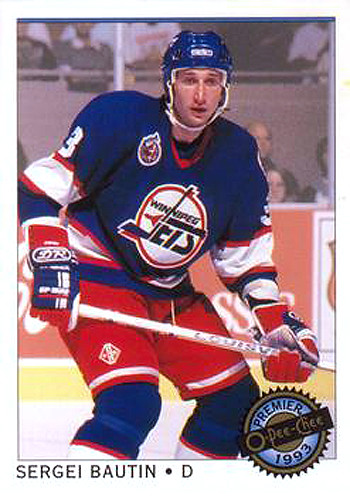
One of the first moves the Jets made for the 1992-93 season was to trade their 12th and 36th overall picks in the 1992 NHL Entry Draft to the Chicago Blackhawks for Chicago's 17th and 27th overall selections. With the 17th pick, the Jets took Russian Sergei Bautin, a defenseman from Dynamo Moscow, fresh of three consecutive Soviet championships.
The Jets 1992 first round draft pick, Sergei Bautin
With their 27th pick, third in Round Two, the Jets took another Russian fellow defenseman Boris Mironov from the CSKA Red Army club. In the true spirit of a sleeper pick, with the 204th selection in Round Nine, Winnipeg found a gem in goaltender, and yet another Russian, Nikolai Khabibulin, also from CSKA Moscow. Khabibulin would be the latest selection in the 1992 draft to go on to be an NHL All-Star, 87 picks later than the next closest future All-Star. In all, the Jets took seven Russians, an American, a Canadian, a Ukrainian, a Kazakh and a Finn.
An Olympic gold medalist, Bautin would make the Jets roster out of training camp and play in 71 games during the 1992-93 season.
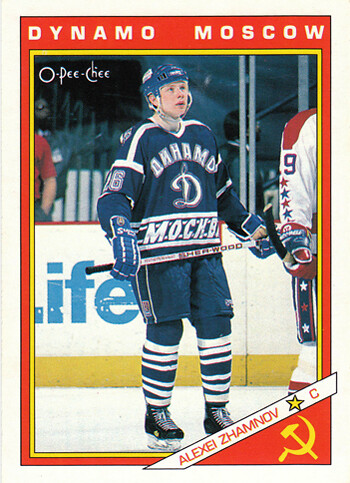
Also joining the Jets for the 1992-93 season was Russian forward Alexei Zhamnov, who was coming off of four seasons as Bautin's teammate at Dynamo Moscow and a fellow gold medalist at the 1992 Albertville Olympics.
Zhamnov came to the Jets from Dynamo Moscow
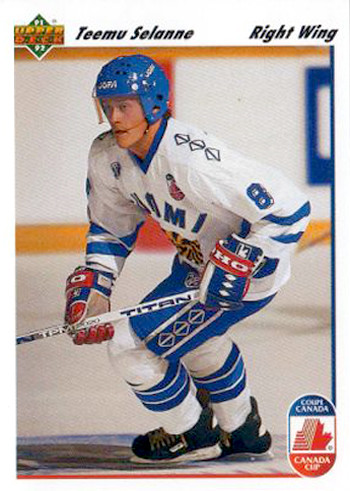
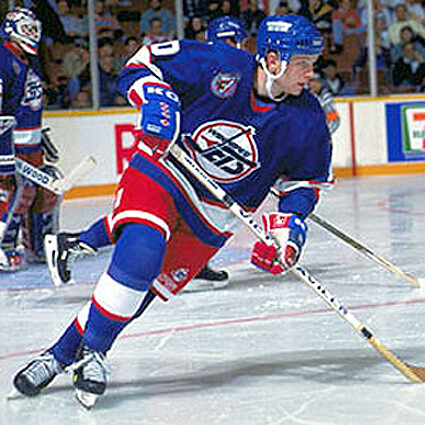
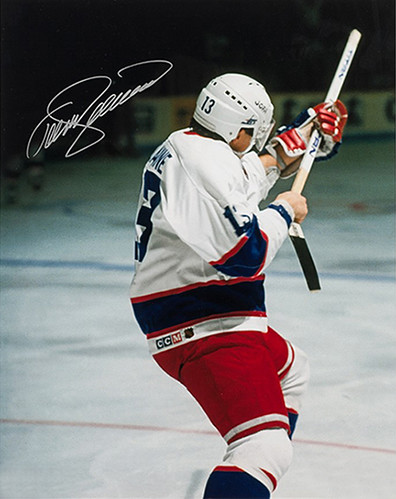
The one name who would go on to have easily the most impact on the Jets 1992-93 season was 1988 draft pick, Teemu Selanne of Finland's Jokerit Helsinki. Selanne had caught the eyes of the Jets scouts with a 43 goal, 66 point season in 33 games of Jokerit's Junior A program, which concluded with a championship. Winnipeg's organizational philosophy was to allow their European draft picks to develop in their native countries, and by 1991 were working to bring him to North America.
Teemu Selanne at the 1991 Canada Cup
As Selanne had not yet signed a contract with the Jets, he was considered a restricted free agent, which led to the Calgary Flames signing him to a three year, $2.7 million offer sheet, $1.5 million more than the Jets had offered the Finn. Worried about paying such a high salary to a rookie, Winnipeg nevertheless exercised their right to match Calgary's offer and Selanne made his NHL debut with a pair of assists on October 6, 1992, scoring his first goal two nights later.
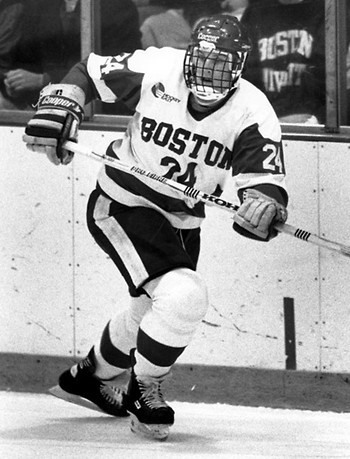
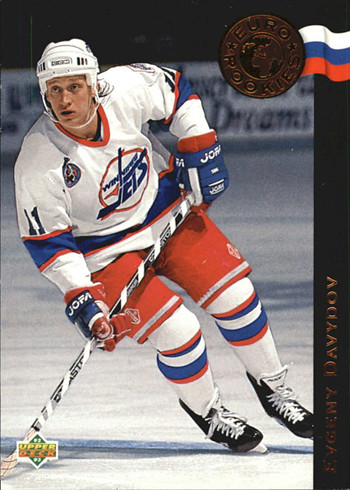
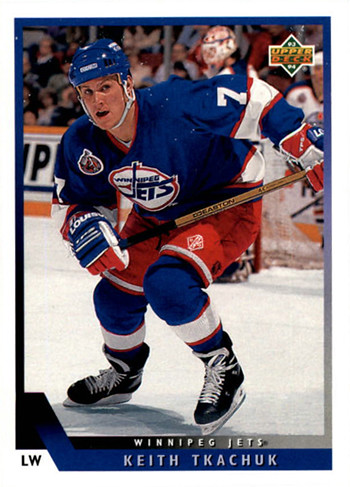
In addition to Selanne, Zhamnov and Bautin, other members of the Jets eligible for the Calder Trophy as NHL Rookie of the Year were 1988 draft pick Evgeny Davydov, another Russian from CSKA Moscow and 1990 selection, American Keith Tkachuk of Boston University. Both Davydov and Tkachuk had played with the Jets the prior season, but were both under the 25 game limit which maintained their rookie status for 1992-93. Tkachuk had seen action in 17 games, while Davydov played in 12.
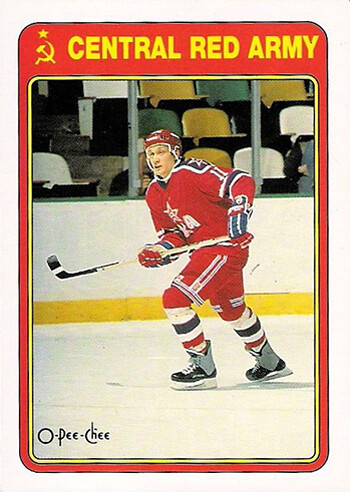
Evgeny Davydov was a member of the powerful Red Army club
American Keith Tkachuk while at Boston University
Selanne, coming off a 39 goal season with Jokerit in 44 games, wasted little time making his presence known in the NHL, scored his first career hat-trick in his fifth game and produced 11 goals in his first 12. Selanne hit the 20 goal mark in December 11th in style during 8-6 loss to the Washington Capitals and added his 21st goal a little over five minutes later and completed his hat trick just 40 seconds into the second period.
Selanne reached the 30 goal plateau on January 2nd when he scored his second goal of the night at the 14:50 mark of the third period against the New Jersey Devils Chris Terreri.
Davydov was the next to reach the 20 goal mark on January 22nd with an assist from Stu Barnes on when he beat Calgary's Mike Vernon at 10:52 of the third period during a 4-4 tie.
Davydov was the second Jets rookie to 20 goals
By the end of January the Finn Selanne was the talk of hockey world as he reached the 40 goal mark on January 30th in a 6-3 win over the Hartford Whalers.
On the final day of February, Selanne put on a spectacular display when he scored goals 48, 49, 50 and 51 in a four goal romp against the Minnesota North Stars and goaltender Darcy Wakuluk in a 7-6 Jets win.
During Winnipeg's next game on March 2nd, it was Tkachuk's turn to make it to the 20 goal level when he beat the Quebec Nordiques Stephane Fiset on a power play 1:26 into the third period with assists from Housely and Barnes.
Tkacuk's 20th goal was overshadowed by Selanne's record breaking hat trick
Tkachuk's accomplishment was completely overshadowed that night by the spectacular Selanne though, as the Finnish Flash recorded a second consecutive hat trick with goals 52, 53 and 54 to surpass Mike Bossy's NHL rookie goal scoring record of 53.
Selanne surpassed 60 goals on March 14th versus the Tampa Bay Lighting with two first period goals against Pat Jablonski to put him at 61. On March 23rd, the Finn netted goals 66 and 67 plus an assist of Zhamnov's 18th goal of the season to give him 110 points, breaking Peter Stastny's NHL rookie points record.
Selanne set rookie records for goals and points in 1992-93
During the Jets next game, Zhamnov scored his 19th goal against the St. Louis Blues and then, on this date in 1993, Zhamnov got his 20th goal of the season, beating the Los Angeles Kings Robb Stauber with just five seconds left in regulation from Selanne and Tkachuk to tie the game at 3-3.
Zhamnov scored his 20th goal on this date in 1993
Zhamnov's 20th goal, joining Selanne, Davydov and Tkachuk with at least 20 goals each, made the Winnipeg Jets the first team in NHL history with four 20-goal rookie scorers.
Selanne would finish with a league leading 76 goals while leading the Jets in scoring with 132 points, both rookie records which stand to this day, and was awarded a much deserved Calder Trophy as the NHL Rookie of the Year. Zhamnov was third on the team in points behind Housley's 97, scoring 25 goals and 47 assists for 72 points while Tkachuk and Davydov had 28 goals apiece, with Tkachuk finishing with 51 points and Davydov 49.
Of note, veterans Thomas Steen with 22 goals and Darrin Shannon at 20 would join the spectacular rookie quartet with 20 or more goals for Winnipeg that season.
The Jets would score 322 goals that season, 71 more than the previous season thanks in no small part to Selanne's exploits. Unfortunately, their goals against would rise by 76 and the Jets would once again be eliminated in the first round of the playoffs, bowing to the Canucks again, this time in six games.
Zhamnov would play four seasons for the Jets with a high of 30 goals until being traded to Chicago. 1992-93 would be Davydov's last with Winnipeg, as he was dealt to the Florida Panthers prior to the following season.
Tkachuk would play five seasons in Winnipeg with a high of 50 goals in 1995-96 on his way to 98 points and would be named team captain in 1993. He would move with the franchise when they relocated and became the Phoenix Coyotes for the 1996-97 season during which he led the NHL in goals with a career high 52. He was again named team captain in 1996 and remained with the franchise for five seasons in Arizona. He would eventually score 500 goals, 1,000 points and play in over 1,000 games.
Selanne would play three more seasons for Winnipeg, never scoring more than 25 goals before a cost cutting trade sent him to the Mighty Ducks of Anaheim. After a lengthy NHL career, Selanne would finish with 684 goals and 1,457 points in 1,451 games played. He led the NHL in goal scoring again in both 1998 and 1999 and won a Stanley Cup in 2007.
Selanne's memorable trap shooting celebration after
breaking Bossy's rookie goal scoring record
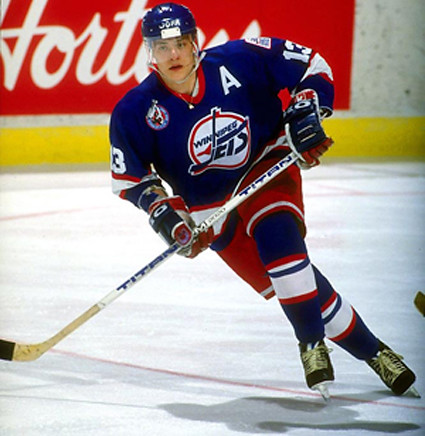
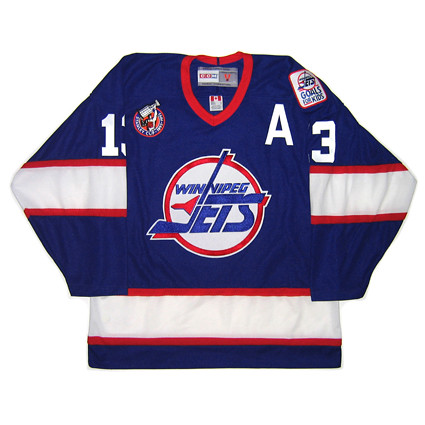
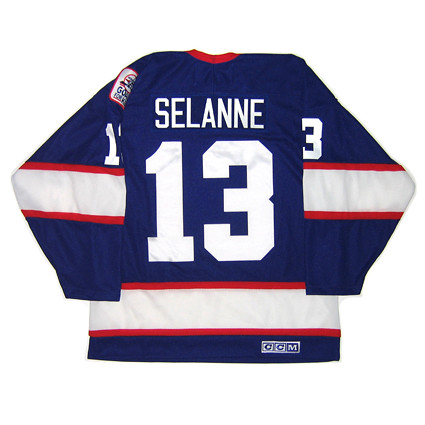
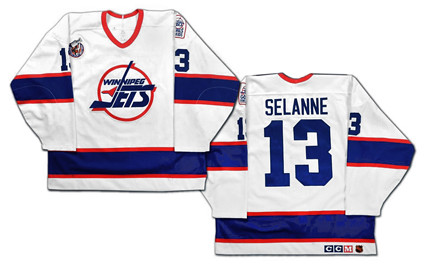
Today's featured jersey is a 1992-93 Winnipeg Jets Teemu Selanne jerseys as worn the the season Selanne shattered the NHL rookie goal scoring and points record. Selanne entered the NHL wearing #13 for his first season, as Randy Carlisle was wearing his preferred #8. After Carlisle's departure after Selanne's rookie season, he subsequently changed to #8 for the remainder of his time in Winnipeg.
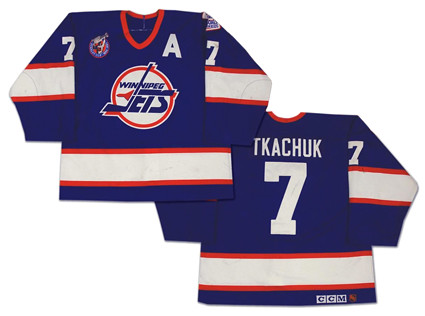
The Jets were formed as a founding member of the World Hockey Association in 1972-73 and made the move to the NHL for the 1979-80 season. They introduced today's feature style jersey for the 1990-91 season and wore it until the franchise moved out of Winnipeg after the 1995-96 season.
The Jets were responsible for one of the oddities concerning the Stanley Cup Centennial patch worn by all the players that season, as, for the first half of the schedule, Winnipeg wore a set of jerseys which had the white outline around their patches like the rest of the league, but for the second half of the season the white outlines vanished and they were the only team to not have the outline around their patches, which did not help them stand out from the jerseys like they did previously.
Selanne did not have the A on the first set of jerseys from the first half of the season where the white outlined patches were worn and did wear the assistant captain's "A" with the version of the patch that lacked the white outline for the season's second half, but there are photos showing Selanne with the borderless patch prior to being awarded the "A".
Bonus jersey: Today's bonus jersey is a 1992-93 Winnipeg Jets Keith Tkachuk jersey as worn the the season Tkachuk was one of four Jets rookies to reach the 20 goal mark, making Winnipeg the first team in NHL history with four 20 goal rookies.
Extra bonus jersey: Today's extra bonus jersey is a 1994-95 Winnipeg Jets Alexei Zhamnov jersey as worn the the season Zhamnov set a career high with 30 goals.
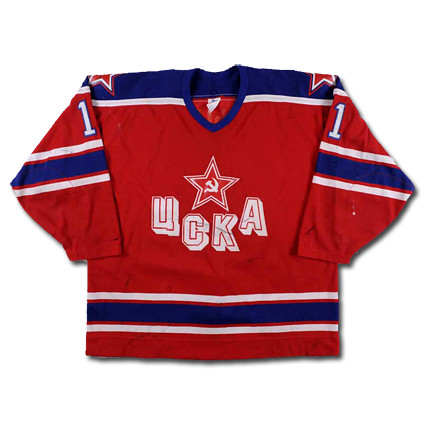
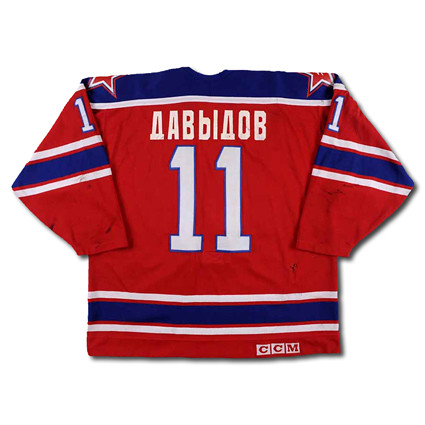
Extra extra bonus jersey: Today's extra extra bonus jersey is a 1990-91 CSKA Moscow Evgeny Davydov jersey as worn during Davydov's final season in the Soviet Union prior to coming to the NHL. Davydov won three Soviet championships with the Red Army club in 1987, 1988 and 1989.
Unlike many of the sometimes paper thin mesh Soviet jerseys of the era with silkscreened or heat sealed graphics, this Red Army jersey is a top of the line, Canadian-made CCM jersey produced to the same standards as one would find in the NHL and very likely produced for use in the 1989, 1990 or 1991 Super Series which then had the English nameplates removed and Cyrillic names screened on as they were converted for use back home in the Soviet League.
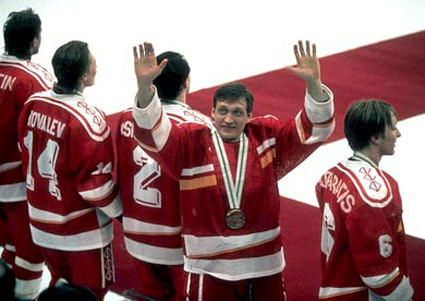
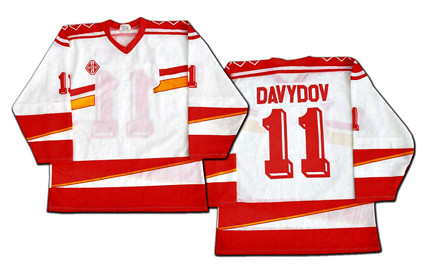
Extra extra extra bonus jersey: Today's extra extra extra bonus jersey is a 1992 Unified Team Evgeny Davydov jersey as worn during the 1992 Winter Olympics in Albertville, France. With the upheaval of the political situation in the Soviet Union in 1991, there was little time to sort out what kind of identity the brand new team made up of six of the 15 former Soviet republics would be represented by.
The Unified Team competed under the Olympic flag, and with just five weeks before the games were to commence, the jersey supplier to all the Olympic teams, Tackla of Finland, made up a set of the current Soviet Union jerseys, only without the "CCCP" lettering across the chest. Note they did not even alter the chest stripes, which were still notched on the left hand side for the curvature of the absent "P"!
Davydov waving to the crowd during the 1992 gold medal ceremony
This was the one and only appearance for these stop-gap jerseys, as Russia wore a brand new set of jerseys at the 1992 World Championships held just two months later in April as an independent nation, separate from the other five countries of the Unified Team.
Alexei Zhamnov began his career with four games for Dynamo Moscow in the Soviet Championship league in the 1988-89 season. He became a full time member of the team in 1989-90 with 17 points in 43 games. Dynamo would go on to win the league championship for the first time since 1954 and break a 13 year stranglehold on the title by CSKA Moscow, better known as Central Red Army, thanks in part to the departures of some key Red Army players who were allowed to leave for North America and the NHL for the first time.
During the season the 19-year-old Zhamnov also competed for the Soviet Union during the 1990 World Junior Championships. He excelled with 6 goals in 7 games as his first international experienced resulted in a silver medal.
His performance raised his profile, and with the new world order that now allowed players to leave the Soviet Union and come to North America, Zhamnov was drafted in the fourth round by the Winnipeg Jets, who had a history of looking to Europe for talent.
Zhamnov, a center, would play two more successful seasons for Dynamo, as he raised his point total to 28 in 1990-91 and then 36 in 1991-92 as Dynamo would win the league championship for the second and third times in a row to close out the Soviet era.
Zhamnov won three consecutive championships with Dynamo Moscow
Internationally, Zhamnov made his debut at the World Championships in 1991, scoring 4 goals and 9 points in 10 games to win a bronze medal in his first senior level tournament. Later that same fall, he would participate in the 1991 Canada Cup tournament.
With the Soviet Union in the process of dissolving in early 1992, Zhamnov made his Olympic debut with what was called the Unified Team, which was players from the former Soviet countries minus the Baltic States of Estonia, Latvia and Lithuania. They rolled through the tournament with a 7-1 record, earning Zhamnov a gold medal.
Zhamnov next competed at the 1992 World Championships, but a level of disarray began to set in during the early days of the independent Russian program and the team failed to medal.
For the 1992-93 season, Zhamnov made the move to North America to join Winnipeg at the age of 22, confirming the pipeline of talent from Russia was now flowing, as the first wave of Soviet players finally allowed to leave were all veterans, such as VladimirKrutov (29), IgorLarionov (29) and VladislavFetisov (31). Not counting those who defected at a young age, such as AlexanderMogliny and SergeiFedorov, the departure of Pavel Bure from the Soviet Union at the age of 20 was a sign that the rich vein of Russian talent was now there to be mined by the NHL, as even just three years earlier Zhamnov would have not been allowed to leave Dynamo, and certainly not with his best days ahead of him.
Unlike some other European transfers, he required no time in the minors to adjust to the rugged style of the NHL game, which was played on smaller rinks than he was used to in Europe. Doing his part to fit in with the high-flying Jets by scoring 25 goals and 72 points in 68 games, which included scoring his first career goal on this date in 1992 in a 4-4 tie against the Los Angeles Kings in Winnipeg.
NHL rookie Zhamnov while with the Jets
He would repeat that feat in 1993-94 with 71 points in 61 games. Once the labor issues of the 1994-95 season were resolved, Zhamnov was on form, registering his only 30 goal season, which included a five goal game on April 1, 1995, on his way to 65 points in just 48 games to lead the team in scoring and finish third overall in the NHL behind only Jaromir Jagr and Eric Lindros.
Changes were in store for Zhamnov prior to the 1996-97 season. First, the Jets franchise was relocated to Arizona, where it became the Phoenix Coyotes. Then in mid August, Zhamnov was traded, along with another player and a first round draft pick to the Chicago Blackhawks for Jeremy Roenick.
Prior to the start of his first season in Chicago, Zhamnov returned to the international stage, playing for Russia at the 1996 World Cup of Hockey.
He had a fine first season with Chicago, putting up his typical 20 goals and 52 points. For the 1997-98 season, he again had a 20 goal season with 21. Additionally, he returned to the Olympics for the first time in six years as the NHL took a break in February to allow its stars to compete in Japan, from where he returned with a silver medal.
His consistency remained for the next two seasons, with 20 goals and 61 points in 1998-99 and 23 goals and 60 points in 1999-00. Following that season he returned to the World Championships for only the second time and first since 1991.
Zhamnov was dealt to Chicago for the 1996-97 season
His eight for eight streak of 20 goal seasons came to an end when Zhamnov was limited to just 13 goals for the 2000-01 season. He rebounded with his best season since 1995 when in 2001-02 he scored 22 goals and 67 points in 77 games, which earned him a spot in his only NHL All-Star Game. During the season he made his third Olympic appearance, earning a bronze medal at the 2002 Games in Salt Lake City.
With the departure of Tony Amonte, Zhamnov was named the Blackhawks team captain for the 2002-03 season. After playing 23 games for the Blackhawks in 2003-04, Zhamnov was dealt to the Philadelphia Flyers where he would play 20 regular season games. After making the playoffs just twice with Winnipeg and only once with Chicago, the run to the Conference Finals with the Flyers was by far his deepest run at the Stanley Cup as he added 14 points in 18 games.
Zhamnov was named the Blackhawks captain in 2002
With the NHL season lost to another labor dispute in 2004-05, Zhamnov stayed active my playing for Vityaz Chekov in the Russian second division.
He returned to the NHL for the 2005-06 season, signing with the Boston Bruins as a free agent. He suffered a shoulder injury in training camp and later an ankle injury in January, which not only limited him to just 24 games with Boston, but the ankle injury prevented him from playing in his fourth Olympics in February, as he was named to the Russian team for the 2006 Games.
Zhamnov's final games were with Boston
He retired from the NHL with 807 games played 249 goals and 719 points. Internationally, he finished with a World Junior silver medal, a World Championship bronze and gold, silver and bronze Olympic medals. He is now the General Manager of Vityaz Chekov in the KHL.
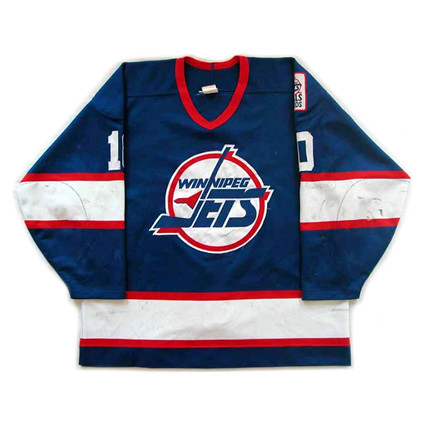
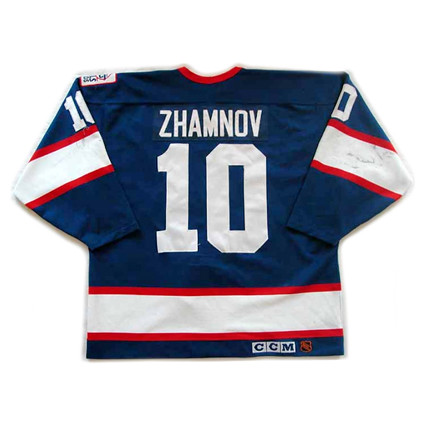
Today's featured jersey is a 1993-94 Winnipeg Jets Alexei Zhamnov jersey from his first NHL club. The Jets adopted this style, rare in the NHL with single color numbers, for the 1990-91 season and wore it through their rest of their time in Winnipeg.
Patches worn on this jersey were the NHL 75th Anniversary patch in 1991-92, the Stanley Cup Centennial patch (in two versions) and for their final ten games as the Jets, a Cherished Memories patch. The Jets were the only team to wear a version of the Stanley Cup Centennial patch without white trim, which they did for the early part of the season. During the second half of the season they got a new set of jerseys which now had the same patch with the white trim as the rest of the NHL.
Bonus jersey: Today's bonus jersey is a 1991 Soviet Union Alexei Zhamnov jersey as worn for the World Championships in Finland when Zhamnov participated in his first World Championships prior to the demise of the Soviet Union.
After wearing their stoic red jerseys with white lettering, suddenly in 1989 Tackla produced this new style for the Soviet Union with it's bright yellow accent color, angled striping (pre-dating the Mighty Ducks of Anaheim's first NHL angled striping by four years) and drop shadowed front cresting, giving the Soviets a dash of flair never seen before.
Extra bonus jersey: Today's extra bonus jersey is a 2000-01 Chicago Blackhawks Alexei Zhamnov jersey. This jersey is adorned with the Blackhawks 75th Anniversary patch on the right chest and Zhamnov's assistant captain's A on the left.
Making this jersey unique is the addition of the 2000 Hockey Hall of Fame Game, a regular season contest held annually since 1999 on the Friday before the annual Hall of Fame induction ceremonies the following Monday between the host Toronto Maple Leafs and a varying opponent every year with both teams wear the special Hall of Fame Game patch for the occasion to kick of the Hall of Fame weekend festivities.
With style and flair, Zhamnov scores his fifth goal of the night against the Kings.
Here, Zhamnov pulls of the same move twice during his rookie season.
Finally, an interview with Zhamnov while he was General Manager of Atlant Mytishchi with English translations.
Third String Goalie - The Hockey Jersey of the Day Blog
"Sweater" for all my Canadian friends!
Welcome!
Welcome to our end of the rink.
Bienvenue sur notre bout de la patinoire.
So why "Third String Goalie"?
It's defined as "A fan who sits in the stands wearing a jersey."
If that's not us, we don't know what is...
Our aim is to feature a different jersey each day from a historical perspective. Stay tuned and hopefully you'll see some jerseys of interest or perhaps some that you haven't seen before and learn a bit of hockey history along the way.
In addition to our articles, be sure to scroll down this column and explore the other fun and informative features of this blog.
If you have any suggestions or comments, feel free to contact us at:
Looking to reach our loyal readers with your hockey related product or service? Of our hundreds of readers each day, 60% are located in the United States and 30% come from Canada. Our audience is your audience and you can target them now with our reasonable ad rates.
We've been linked to by SI.com, ESPN.com, Uni-Watch.com, NBCSports.com and the Yahoo! Sports Puck Daddy blog among others.
There is no limitation to what kind of hockey jersey it can be - replica, authentic or game worn jersey from the NHL, a national team, the minors, juniors, college, high school or even your pond hockey jersey.
Feel free to write a paragraph or two about the jersey telling us why you like the jersey, how you got it, what makes it special to you or even a full-blownThird String Goalie-style history lesson - whatever you feel like sharing.
Visting from outside North America? Just select your preferred language and Third String Goalie will be instantly converted to your language of choice!