History of Jersey 83-93 Banner sm photo History of Jersey 83-93 Banner sm.jpg
Showing posts with label Priakin Sergei. Show all posts

Monday, February 13, 2017

Rendez-vous '87 - 1987 NHL All-Star Wayne Gretzky Jersey

In 1987, the NHL deviated from it's usual All-Star Game format in the form of Rendez-vous '87, a series of two games during which a team of NHL All-Stars faced off against the Soviet National Team in Quebec City, Quebec at Le Colisee, home of the Quebec Nordiques.

rendez-vous-87 program
Rendez-vous '87 program cover

The event was just a part of the annual Quebec Winter Carnival, a multi-cultural event featuring entertainers and food from Canada, Russia and the United States.

The Soviet lineup was a strong one, and featured over a dozen players who would eventually compete in the NHL within the next six years. The changing face of the NHL was reflected by the increasing international presence on its roster, now sporting players from not only Canada and Sweden, as in the 1979 Challenge Cup, but with the addition of players from the United States and Finland as well.

Game 1 took place on February 11, 1987 and Jari Kurri got the NHL All-Stars off to a 1-0 lead 5:23 in to the game. The Soviets fell behind 2-0 when Glenn Anderson scored with three minutes remaining in the second period but managed to get on the board before the period ended when Alexei Kasatonov got one by Grant Fuhr with 1:18 remaining.

rendez-vous-87action 1

The third period was an exciting affair, as the Soviets tied the game 2:03 into the period. Canada retook the lead five minutes later with Kevin Dineen's goal only to have the Soviets tie the game once more one minute later thanks to Anatoli Semenov.

The game continued scoreless as time began to wind down before Dave Poulin got the game winning goal for the All-Stars with just a minute and fifteen seconds left when he beat goaltender Evgeny Belosheikin, who had the audacity to wear Tretiak's legendary #20!

After a day of rest, the teams returned to the ice on February 13, 1987 following much the same script, as the NHL again scored 3:32 into the game to lead 1-0 after the first period.

rendez-vous-87action 2

The Soviet Union got two goals early in period two when Valeri Kamensky and Vladimir Krutov scored a minute and a half apart for their first lead of the competition. Doug Wilson evened the scoring at 2-2 with his goal on the power play at 7:33 only to have Kamensky and Krutov each score their second goals of the game to put the Soviets ahead by two. Kamensky's second goal came with 19 seconds left in the second period, while Krutov's game winner came 9:19 into the third period.

Krutov Rendez-vous '87 Pictures, Images and Photos
Krutov's two goals were key to the Soviet in in Game 2

Andrei Khomutov increased the Soviet lead to 5-2 at 12:59, which proved to be an important goal in not only the game, but in the larger picture of the series as a whole, for when Ray Bourque scored at 19:23 of the third period, it was too little too late as the Soviets not only won the game 5-3, but earned bragging rights for the series by outscoring the NHL All-Stars by a combined 8-7 over the two games thanks to Khomutov's goal.

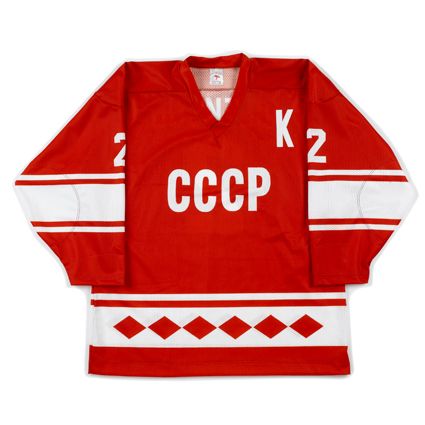
Following the game, team captains Wayne Gretzky and Viacheslav Fetisov traded jerseys in keeping with the tradition of European soccer players, leading to the most unusual sight of Gretzky wearing a Soviet National Team jersey emblazoned with CCCP across the front as well as a Cyrillic captain's "K".

Gretzky & Fetisov jersey swap
"Comrade" Gretzky in his Soviet National Team jersey

Despite the loss in the series, the two games together allowed the Canadian members of the NHL All-Star Team a chance to compete together in advance of that fall's thrilling 1987 Canada Cup.

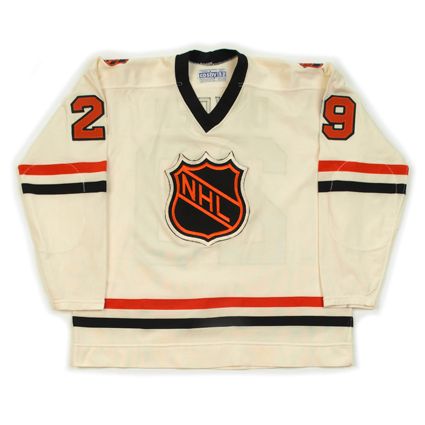
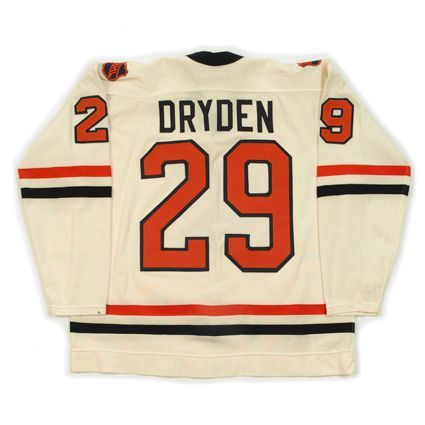
Today's featured jersey is a 1987 NHL All-Star Team Wayne Gretzky jersey as worn in the two game Rendez-vouz '87.

This jersey's unusual customization had sleeve numbers only on the left arm, as the Rendez-Vouz '87 patch was placed on the right sleeve in the location usually occupied by the numbers because of the stars occupying the usual location on the upper right chest for such a patch.

This style of jersey was worn only for the two games of the series in Quebec City and there was no dark "road" version ever produced for the team to wear, as was the norm with NHL All-Star jerseys since the introduction of the East vs. West format in 1969. That said, we have seen an orange version of this jersey, which we assume was a prototype.

Examples of this style jersey for collectors are rather scarce, as retail jersey sales were still in their infancy in 1987.

1987 NHL All-Star Rendez-vous '87 jersey photo 1987NHLAll-StarRendez-vous87F.jpg
1987 NHL All-Star Rendez-vous '87 jersey photo 1987NHLAll-StarRendez-vous87B.jpg

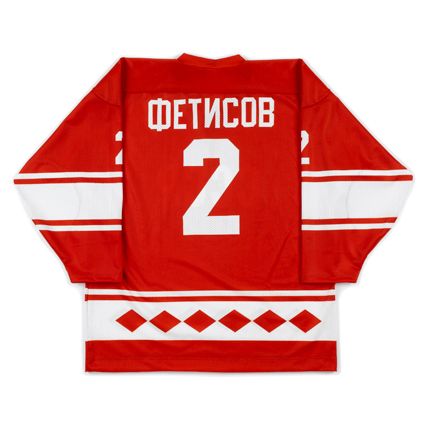
Bonus Jersey: Today's Bonus jersey is a 1987 Soviet National Team Sergei Priakin jersey as worn during Rendez-vous '87. These jerseys were some of the less visually successful of the Soviet Union's, as the dark red stripes against the red body of the jersey was too similar to create any worthwhile contrast.

Gone were the striking diamond pattern on the waist of the 1979 Challenge Cup jerseys, as well as the more pleasing font for the numbers. Things would improve in the years following, as the jerseys worn in international hockey would soon be made by the Finnish brand Tackla, giving the final jerseys of the Soviet era some much needed graphic design.

Sergei Priakin would become the answer to a trivia question in 1988 when he became the first Soviet player to be allowed to compete in the NHL, which he did with the Calgary Flames. He would also suffer the common plight of the Soviet players during this early era of playing in North America, as the spelling of their names on the backs of their jerseys often varied from appearance to appearance. As seen here, "PRYAKHIN" would latter play for the Flames wearing "PRIAKIN".

1987 Soviet Union Rendez-vous '87 F

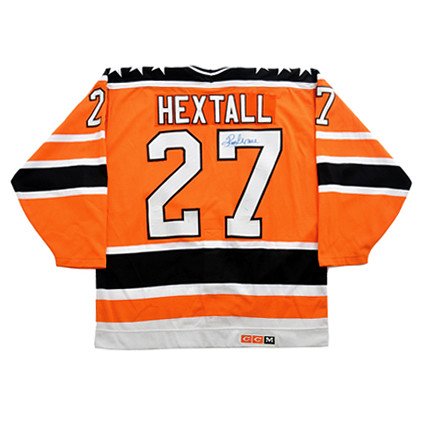
Extra bonus Jersey: Today's extra bonus jersey is a 1987 NHL All-Star Team Wayne Gretzky jersey. This orange jersey was never worn by the NHL All-Stars during the two game Rendez-vous '87 event and we assume this was a prototype made in case the series format called for the need for the All-Stars to wear an away jersey or perhaps in anticipation of this style being worn again for the 1988 NHL All-Star Game, which did not happen, as the league reverted back to the template worn in 1987.

Whatever the reason for its existence, it is a sharp looking style but one that raises more questions than it answers.

Note a few inaccuracies in the customization of this particular jersey, such as the event patch placed on the right chest and the sleeve numbers on the right arm, as well as what appears to be a twill nameplate rather than one made out of the same material as the body of the jersey.

 NHL All-Star 1987 Orange F jersey
NHL All-Star 1987 Orange B jersey
Today's video highlights begin with Poulin tipping in the game winning goal in Game 1 of Rendez-vous '87.


In Game 2 of Rendez-vous '87, Kamensky is a one man highlight reel, scoring two and assisting on Khomutov's goal for good measure.


Thursday, March 31, 2016

1988-89 Calgary Flames Sergei Priakin Jersey

Sergei Pryakhin, or as often spelled in North America "Priakin", was the first member of the Soviet National Team to ever allowed by the Soviet government to play in the NHL.

Pryakhin, a right wing, first played for Krylja Sovetov (Soviet Wings) in the Soviet League in 1981-82 and then seven full seasons afterwards, eventually being named team captain. Additionally, he played twice for the Soviet Union in the World Junior Championship, winning a gold medal in 1983. He later played for the Soviet National Team in 1987 in both the World Championship and later the Canada Cup, winning silver each time. He would earn gold as a member of the national team in the 1990 World Championships.

Following the 1988-89 Soviet League season, the 25-year-old was given permission to join the Calgary Flames, who had drafted him 252nd overall in 1988, and made history when he competed in his first game on this date in 1989.

Photobucket

One reason Pryakhin was the one chosen to be the first allowed to leave was that he was not a star player and considered replaceable on the national team. That fact factored into the Flames decision to select him in the first place, figuring that the chances of him actually being allowed to leave were better if he were not a star. Another factor in the change in philosophy by the Soviets was of course, money. While the Flames spent reportedly upwards of $500,000 on Pryakhin, the largest portion of that money went to the Soviet ice hockey federation.

Another factor in the choice of the above average Pryakhin being allowed to leave was because his professionalism would make him a good ambassador for Soviet hockey. Plus, if he did play well, it would set a precedent in establishing a market for the future release of Soviet superstar players and motivate other Soviet players back home.

Pryakhin was under pressure from all directions right from the start, dealing with the extreme change in culture and language with no one who had experienced the move previously to consult with, going from playing in front of 2,000 fans to 20,000 fans, plus the animosity he faced from the Canadian and American players, who viewed his presence as taking a job away from a North American. Pryakhin tried to smartly avoid such discussions with responses such as, "I don't want to talk politics. I am here to play hockey. I think it is hockey that will benefit from having Soviets in the NHL."

Priakin Flames photo Priakin card.jpg

His timing could not have been better, as the Flames would go on to capture their only Stanley Cup that season. Since Pryakhin had only played in two regular season games and one playoff game, he was not eligible to have his name engraved on the Stanley Cup. However, he did receive a championship ring, the first Soviet trained player to do so.

Pryakhin played in 20 Flames games the following season, scoring a pair of goals and a pair of assists for four points. He was held scoreless in two playoff games.

Priakin Flames photo Priakin auto.jpg

1990-91 saw Pryakhin split time between the Salt Lake Golden Eagles, scoring 17 points in 18 games, and the Flames, where he got into 24 games and totaled seven points.

That would prove to be the end of his time in the NHL and he would return to Europe to continue his career, starting with a return to the Soviet Wings in 1992-93 before moving to Zurich of the Swiss National League A. The following season of 1993-94 was also spent with Zurich as well. The next four seasons Pryakhin played for Espoo in Finland before a final season playing in Japan for the Oji Eagles.

So significant was Pryakhin's permission from the Soviets to play in the NHL, it was ranked as #76 in the Top 100 Stories of the Century by the International Ice Hockey Federation.

Today's featured jersey is a 1988-89 Calgary Flames Sergei Pryakhin jersey. Note the North Americianization of his last name on the back of the jersey.

The Flames kept their same jersey that they wore in the team's first home of Atlanta when they moved to Calgary in 1980, save for the change from the flaming A logo to the flaming C. This style was worn through the 1993-94 season until being replaced by a new, modernized style the following season.

Calgary Flames 1988-89 jersey photo Calgary Flames 1988-89 F jersey.jpg
Calgary Flames 1988-89 jersey photo Calgary Flames 1988-89 B jersey.jpg
 
Bonus Jersey: Today's Bonus jersey is a 1987 Soviet National Team Sergei Priakin jersey as worn during Rendez-vous '87. These jerseys were some of the less successful of the Soviet Union's, as the dark red stripes on the red body of the jersey were too close in color to create any worthwhile contrast.

Gone were the striking diamond pattern on the waist of the 1979 Challenge Cup jerseys, as well as the more pleasing font for the numbers. Things would improve in the years following, as the jerseys worn in international hockey would soon be made by the Finnish brand Tackla, giving the final jerseys of the Soviet era some much needed graphic design.

Pryakhin would become the answer to a trivia question in 1988 when he became the first Soviet player to be allowed to compete in the NHL, which he did with the Calgary Flames. He would also suffer the common plight of the Soviet players during this early era of playing in North America, as the spelling of their names on the backs of their jerseys often varied from appearance to appearance. As seen here, "PRYAKHIN" would latter play for the Flames wearing "PRIAKIN".

1987 Soviet Union Rendez-vous '87 F
photo courtesy of Classic Auctions
 
While Pryakhin's time in the NHL was brief, it opened the door for the first wave of Soviets and eventually led to amazing plays like these occurring in North America, rather than Russia.


Thursday, January 28, 2016

1987 NHL All-Star Wayne Gretzky Jersey

All-Star Week continues here at Third String Goalie with a look at the times the NHL All-Stars have faced off against the best of the Soviet Union.

While the NHL All-Star Game has been almost exclusively a competition between players of the NHL, there have been two occasions when the usual format was bypassed in favor of an international competition against the Soviet Union.

The first such occasion occurred in 1979 with an event called the 1979 Challenge Cup. Up to this point, the Soviets had played against North American professionals three times, the first being the ground breaking 1972 Summit Series against a team of Canadians from the NHL. The 1974 Summit Series revisited the concept, only this time against a team of the best players from the WHA. The first Canada Cup tournament took place in 1976, which had not only Team Canada and the Soviet National Team, but also teams from Sweden, Czechoslovakia, the United States and Finland.

The Challenge Cup was held in New York's Madison Square Garden and took the place of that season's traditional All-Star Game and consisted of a three game series held on February 8, 10 and 11, 1979.

Challenge Cup program
1979 Challenge Cup program cover

The NHL All-Star team was made up of NHL players, regardless of the country they were born in. In all, the NHL All-Stars comprised 23 Canadians and three Swedes.

Guy Lafleur opened the scoring in Game 1 just 16 seconds into the game, but by now the North Americans had learned not to dismiss the Soviets, a lesson learned in Game 1 of the 1972 Summit Series. Each team scored a power play goal before the first period ended with the NHLers up by one.

The NHL extended it's lead in the second period with goals from Clark Gillies and Bob Gainey. Vladimir Golikov pulled one back for the Soviet Union 3:02 into the third, but the All-Stars circled the wagons and held off the Soviets the rest of the way to win 4-2 with Ken Dryden getting the win in goal for the NHL.

Challenge Cup pennant
A souvenir pennant from the Challenge Cup

Game 2 had the Soviet Union scoring first at 8:10 only to have the NHL score three consecutive goals, a power play from Mike Bossy and an even-strength goal from Bryan Trottier in the first followed by a Gilbert Perrault tally just 27 seconds into the second.

The Soviets fought back with a goal at 2:05 before Larry Robinson restored the All-Stars lead to two again at 5:06. That lead quickly disappeared when the Soviet Union scored at 17:02 on the power play and again 45 second later to even the game heading into the third.

Golikov got one past Dryden at 1:31 for the game winner, as the rest of the period was scoreless as Vladislav Tretiak held the All-Stars at bay to even the series at one game apiece.


Challenge Cup ticket
A ticket for the 1979 Challenge Cup

Game 3 was simply all the Soviet Union as they put on a dazzling display of complete hockey. There was no score after the first period before the Soviets scored at 5:47 and again at 7:44 on a power play. The third period was all Soviet Union as they solved goalie Gerry Cheevers again and again, scoring four times during a six minute span beginning at 8:44 to win the series 2 games to 1 with Vladimir Myshkin getting the shutout in his surprise debut for the Soviets.

1979 Challenge Cup team
The happy Soviets celebrate their Challenge Cup victory

While many people my not remember the Challenge Cup games, the cup itself is a spectacular trophy perhaps best remembered when the Soviet team returned to Madison Square Garden exactly one year later on February 9, 1980 and paraded the Challenge Cup around the ice prior to their 10-3 demolition of the United States Olympic Hockey Team in a tune-up match for the impending 1980 Olympics.

1979 Challenge Cup parade
The Soviets parading the Challenge Cup

This game occurred just 13 days before the Soviets shocking defeat in the "Miracle on Ice", when essentially the same Soviet team that easily dominated the best of the NHL 6-0 in Game 3 of the Challenge Cup lost to a team of American college players during the Olympics.

Similar to the Canada Cup trophy, the Soviets were allowed to win the trophy, but were not allowed to actually keep the trophy, which now resides in the Hockey Hall of Fame in Toronto.

Challenge Cup display
The Challenge Cup on display at the Hockey Hall of Fame

The jerseys worn by the NHL All-Star Team for the 1979 Challenge Cup were without a doubt the simplest, most plain ones ever worn by an NHL All-Star Team and actually managed to make the Soviet jerseys almost look flashy by comparison!

Without so much as a single star on them, the closest thing these jerseys can be compared to are the NHL referee's sweaters worn in the 1940's only with the addition of a pair of stripes and bolder numbers.

NHL All Star 1979 jersey photo NHLAllStar1978-79F.jpg
NHL All Star 1979 jersey photo NHLAllStar1978-79B.jpg

The Soviet Union jerseys were their usual utilitarian selves, simply adorned with CCCP in a simple font with legible numbers and some basic striping as adornment, but with the addition of the repeating diamond pattern around the waist for a touch of flair not seen on the jerseys of the NHL All-Stars.

These Soviet jerseys would be the now familiar style as worn in the 1980 Olympic Games in Lake Placid, New York.

Soiet Union 1976-81 jersey photo RussiaCCCP1976-81F.jpg
 photo RussiaCCCP1976-81B.jpg

The next instance where the normal All-Star Game was put aside for a year came eight years later with Rendez-vous '87, which was similar in format to the 1979 Challenge Cup, where the Soviet National Team faced off against a team of NHL All-Stars, except in a two game format, rather than three as in 1979.

rendez-vous-87 program
Rendez-vous '87 program cover

Why the teams did not compete for the rights to the impressive Challenge Cup once again, we do not quite understand, but the hockey competition was just a part of the annual Quebec Winter Carnival which was a multi-cultural event that year featuring entertainers and food from Canada, Russia and the United States.

The games were held in Quebec City, Quebec at Le Colisee, home of the Quebec Nordiques.

The Soviet lineup was a strong one, and featured over a dozen players who would eventually compete in the NHL within the next six years. The changing face of the NHL was reflected by the increasing international presence on it's roster, now sporting players from not only Canada and Sweden as before, but with the addition of players from the United States and Finland as well.

Game 1 took place on February 11, 1987 and Jari Kurri got the NHL All-Stars off to a 1-0 lead 5:23 in to the game. The Soviets fell behind 2-0 when Glenn Anderson scored with three minutes remaining in the second period but managed to get on the board before the period ended when Alexei Kasatonov got one by Grant Fuhr with 1:18 remaining.

rendez-vous-87action 1
Action from Rendez-vous '87
The third period was an exciting affair, as the Soviets tied the game 2:03 into the period. Canada retook the lead five minutes later with Kevin Dineen's goal only to have the Soviets tie the game once more one minute later thanks to Anatoli Semenov.

The game continued scoreless as time began to wind down before Dave Poulin got the game winning goal for the All-Stars with just a minute and fifteen seconds left when he beat goaltender Evgeny Belosheikin, who had the audacity to wear Tretiak's legendary #20!

After a day of rest, the teams returned to the ice on February 13, 1987 following much the same script, as the NHL again scored 3:32 into the game to lead 1-0 after the first period.

rendez-vous-87action 2
More action from Rendez-vous '87

The Soviet Union got two goals early in period two when Valeri Kamensky and Vladimir Krutov scored a minute and a half apart for their first lead of the competition. Doug Wilson evened the scoring at 2-2 with his goal on the power play at 7:33 only to have Kamensky and Krutov each score their second goals of the game to put the Soviets ahead by two. Kamensky's second goal came with 19 seconds left in the second period, while Krutov's game winner came 9:19 into the third period.
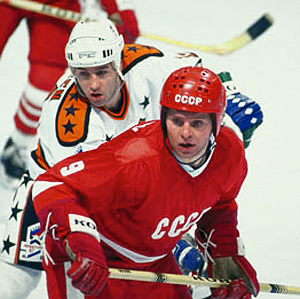
Krutov Rendez-vous '87 Pictures, Images and Photos
Krutov's two goals were key to the Soviet in in Game 2

Andrei Khomutov increased the Soviet lead to 5-2 at 12:59, which proved to be an important goal in not only the game, but in the larger picture of the series as a whole, for when Ray Bourque scored at 19:23 of the third period, it was too little too late as the Soviets not only won the game 5-3, but earned bragging rights for the series by outscoring the NHL All-Stars by a combined 8-7 over the two games thank's to Khomutov's goal.

Following the game, team captains Wayne Gretzky and Viacheslav Fetisov traded jerseys in keeping with the tradition of European soccer players, leading to the most unusual sight of national hero and proud Canadian Gretzky wearing a Soviet National Team jersey emblazoned with CCCP across the front as well as a Cyrillic captain's "K".

Gretzky & Fetisov jersey swap
"Comrade" Gretzky in his Soviet National Team jersey

Despite the loss in the series, the two games together allowed the Canadian members of the NHL All-Star Team a chance to compete together in advance of that fall's thrilling 1987 Canada Cup.

Today's featured jersey is a 1987 NHL All-Star Team Wayne Gretzky jersey as worn in the two game Rendez-vouz '87. This jersey's unusual customization had sleeve numbers only on the left arm, as the Rendez-Vouz '87 patch was placed on the right sleeve in the location usually occupied by the numbers due to the stars on the chest occupying the usual location for such a patch on the upper right chest.

This style of jersey was worn only for the two games of the series in Quebec City and there was no dark "road" version worn, as was the norm with NHL All-Star jerseys since the introduction of the East vs. West format in 1969. We have, however, seen an orange road version of this jersey, but have no idea why they bothered to produce any.

Examples of this style jersey for collectors are rather scarce, as retail jersey sales were still in their infancy in 1987.
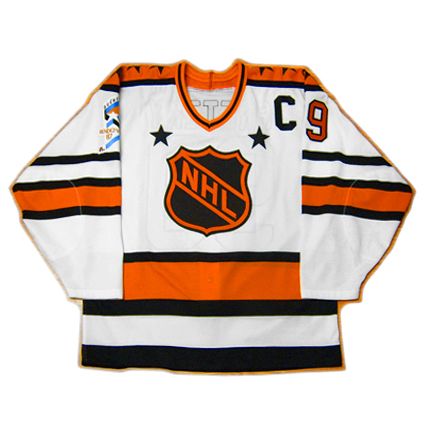
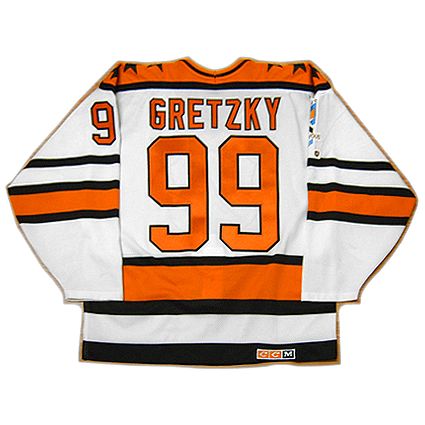
1987 NHL All-Star Rendez-vous '87 jersey photo 1987NHLAll-StarRendez-vous87F.jpg
1987 NHL All-Star Rendez-vous '87 jersey photo 1987NHLAll-StarRendez-vous87B.jpg

Bonus Jersey: Today's Bonus jersey is a 1987 Soviet National Team Sergei Priakin jersey as worn during Rendez-vous '87. These jerseys were some of the less successful of the Soviet Union's, as the dark red stripes on the red body of the jersey were too close in color to create any worthwhile contrast.

Gone were the striking diamond pattern on the waist of the 1979 Challenge Cup jerseys, as well as the more pleasing font for the numbers. Things would improve in the years following, as the jerseys worn in international hockey would soon be made by the Finnish brand Tackla, giving the final jerseys of the Soviet era some much needed graphic design.

Priakin would become the answer to a trivia question in 1988 when he became the first Soviet player to be allowed to compete in the NHL, which he did with the Calgary Flames. He would also suffer the common plight of the Soviet players during this early era of playing in North America, as the spelling of their names on the backs of their jerseys often varied from appearance to appearance. As seen here, "PRYAKHIN" would latter play for the Flames wearing "PRIAKIN".

1987 Soviet Union Rendez-vous '87 F

Today's video highlights begin with all the goals scored in the 1979 Challenge Cup.

Game 1, won by the NHL All-Stars.


Game 2, the Soviets come from behind to win the game and turn the tide of the series.


The Soviet Union's dominant performance in Game 3.


Next, Poulin tips in the game winning goal in Game 1 of Rendez-vous '87.


In Game 2 of Rendez-vous '87, Kamensky is a one man highlight reel, scoring two and assisting on Khomutov's goal for good measure.


Wednesday, February 13, 2013

1987 NHL All-Star Wayne Gretzky Jersey

In 1987, the NHL deviated from it's usual All-Star Game format in the form of Rendez-vous '87, a series of two games during which a team of NHL All-Stars faced off against the Soviet National Team in Quebec City, Quebec at Le Colisee, home of the Quebec Nordiques.

rendez-vous-87 program
Rendez-vous '87 program cover

The event was just a part of the annual Quebec Winter Carnival, a multi-cultural event featuring entertainers and food from Canada, Russia and the United States.

The Soviet lineup was a strong one, and featured over a dozen players who would eventually compete in the NHL within the next six years. The changing face of the NHL was reflected by the increasing international presence on its roster, now sporting players from not only Canada and Sweden, as in the 1979 Challenge Cup, but with the addition of players from the United States and Finland as well.

Game 1 took place on February 11, 1987 and Jari Kurri got the NHL All-Stars off to a 1-0 lead 5:23 in to the game. The Soviets fell behind 2-0 when Glenn Anderson scored with three minutes remaining in the second period but managed to get on the board before the period ended when Alexei Kasatonov got one by Grant Fuhr with 1:18 remaining.

rendez-vous-87action 1

The third period was an exciting affair, as the Soviets tied the game 2:03 into the period. Canada retook the lead five minutes later with Kevin Dineen's goal only to have the Soviets tie the game once more one minute later thanks to Anatoli Semenov.

The game continued scoreless as time began to wind down before Dave Poulin got the game winning goal for the All-Stars with just a minute and fifteen seconds left when he beat goaltender Evgeny Belosheikin, who had the audacity to wear Tretiak's legendary #20!

After a day of rest, the teams returned to the ice on February 13, 1987 following much the same script, as the NHL again scored 3:32 into the game to lead 1-0 after the first period.

rendez-vous-87action 2

The Soviet Union got two goals early in period two when Valeri Kamensky and Vladimir Krutov scored a minute and a half apart for their first lead of the competition. Doug Wilson evened the scoring at 2-2 with his goal on the power play at 7:33 only to have Kamensky and Krutov each score their second goals of the game to put the Soviets ahead by two. Kamensky's second goal came with 19 seconds left in the second period, while Krutov's game winner came 9:19 into the third period.

Krutov Rendez-vous '87 Pictures, Images and Photos
Krutov's two goals were key to the Soviet in in Game 2

Andrei Khomutov increased the Soviet lead to 5-2 at 12:59, which proved to be an important goal in not only the game, but in the larger picture of the series as a whole, for when Ray Bourque scored at 19:23 of the third period, it was too little too late as the Soviets not only won the game 5-3, but earned bragging rights for the series by outscoring the NHL All-Stars by a combined 8-7 over the two games thanks to Khomutov's goal.

Following the game, team captains Wayne Gretzky and Viacheslav Fetisov traded jerseys in keeping with the tradition of European soccer players, leading to the most unusual sight of Gretzky wearing a Soviet National Team jersey emblazoned with CCCP across the front as well as a Cyrillic captain's "K".

Gretzky & Fetisov jersey swap
"Comrade" Gretzky in his Soviet National Team jersey

Despite the loss in the series, the two games together allowed the Canadian members of the NHL All-Star Team a chance to compete together in advance of that fall's thrilling 1987 Canada Cup.

Today's featured jersey is a 1987 NHL All-Star Team Wayne Gretzky jersey as worn in the two game Rendez-vouz '87.

This jersey's unusual customization had sleeve numbers only on the left arm, as the Rendez-Vouz '87 patch was placed on the right sleeve in the location usually occupied by the numbers because of the stars occupying the usual location on the upper right chest for such a patch.

This style of jersey was worn only for the two games of the series in Quebec City and there was no dark "road" version ever produced for the team to wear, as was the norm with NHL All-Star jerseys since the introduction of the East vs. West format in 1969. That said, we have seen an orange version of this jersey, which we assume was a prototype.

Examples of this style jersey for collectors are rather scarce, as retail jersey sales were still in their infancy in 1987.

1987 NHL All-Star Rendez-vous '87 jersey photo 1987NHLAll-StarRendez-vous87F.jpg
1987 NHL All-Star Rendez-vous '87 jersey photo 1987NHLAll-StarRendez-vous87B.jpg

Bonus Jersey: Today's Bonus jersey is a 1987 Soviet National Team Sergei Priakin jersey as worn during Rendez-vous '87. These jerseys were some of the less visually successful of the Soviet Union's, as the dark red stripes against the red body of the jersey was too similar to create any worthwhile contrast.

Gone were the striking diamond pattern on the waist of the 1979 Challenge Cup jerseys, as well as the more pleasing font for the numbers. Things would improve in the years following, as the jerseys worn in international hockey would soon be made by the Finnish brand Tackla, giving the final jerseys of the Soviet era some much needed graphic design.

Sergei Priakin would become the answer to a trivia question in 1988 when he became the first Soviet player to be allowed to compete in the NHL, which he did with the Calgary Flames. He would also suffer the common plight of the Soviet players during this early era of playing in North America, as the spelling of their names on the backs of their jerseys often varied from appearance to appearance. As seen here, "PRYAKHIN" would latter play for the Flames wearing "PRIAKIN".

1987 Soviet Union Rendez-vous '87 F

Extra bonus Jersey: Today's extra bonus jersey is a 1987 NHL All-Star Team Wayne Gretzky jersey. This orange jersey was never worn by the NHL All-Stars during the two game Rendez-vous '87 event and we assume this was a prototype made in case the series format called for the need for the All-Stars to wear an away jersey or perhaps in anticipation of this style being worn again for the 1988 NHL All-Star Game, which did not happen, as the league reverted back to the template worn in 1987.

Whatever the reason for its existence, it is a sharp looking style but one that raises more questions than it answers.

Note a few inaccuracies in the customization of this particular jersey, such as the event patch placed on the right chest and the sleeve numbers on the right arm, as well as what appears to be a twill nameplate rather than one made out of the same material as the body of the jersey.
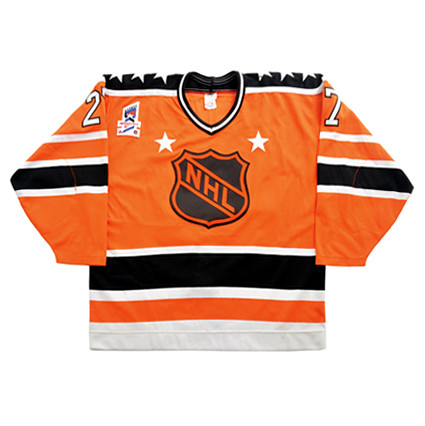
 NHL All-Star 1987 Orange F jersey
NHL All-Star 1987 Orange B jersey
Today's video highlights begin with Poulin tipping in the game winning goal in Game 1 of Rendez-vous '87.


In Game 2 of Rendez-vous '87, Kamensky is a one man highlight reel, scoring two and assisting on Khomutov's goal for good measure.


Wednesday, March 31, 2010

1988-89 Calgary Flames Sergei Priakin Jersey

Sergei Pryakhin, or often spelled in North America "Priakin", was the first member of the Soviet National Team to ever allowed by the Soviet government to play in the NHL.

Pryakhin, a right wing, first played for Krylja Sovetov (Soviet Wings) in the Soviet League in 1981-82 and then seven full seasons afterwards, eventually being named team captain. Additionally, he played twice for the Soviet Union in the World Junior Championship, winning a gold medal in 1983. He later played for the Soviet National Team in 1987 in both the World Championship and later the Canada Cup, winning silver each time. He would earn gold as a member of the national team in the 1990 World Championships.

Following the 1988-89 Soviet League season, the 25-year-old was given permission to join the Calgary Flames, who had drafted him 252nd overall in 1988, and made history when he competed in his first game on this date in 1989.

Photobucket

One reason Pryakhin was the one chosen to be the first allowed to leave was that he was not a star player and considered replaceable on the national team. That fact factored into the Flames decision to select him in the first place, figuring that the chances of him actually being allowed to leave were better if he were not a star. Another factor in the change in philosophy by the Soviets was of course, money. While the Flames spent reportedly upwards of $500,000 on Pryakhin, the largest portion of that money went to the Soviet ice hockey federation.

Another factor in the choice of the above average Pryakhin being allowed to leave was because his professionalism would make him a good ambassador for Soviet hockey, plus, if he did play well, it would set a precedent in establishing a market for the future release of Soviet superstar players and motivate other Soviet players back home.

He was under pressure right from the start, dealing with the extreme change in culture and language, going from playing in front of 2,000 fans to 20,000 fans, plus the animosity he faced from North American players, who viewed his presence as taking a job away from a North American. Pryakhin tried to smartly avoid such discussions with responses such as, "I don't want to talk politics. I am here to play hockey. I think it is hockey that will benefit from having Soviets in the NHL."

His timing could not have been better, as the Flames would go on to capture their only Stanley Cup later that season. While Pryakhin only played in two regular season games and one playoff game, he was not eligible to have his name engraved on the Stanley Cup, he did receive a championship ring, the first Soviet trained player to do so.

Pryakhin played in 20 Flames games the following season, scoring a pair of goals and a pair of assists for four points. He was held scoreless in two playoff games.

1990-91 saw Pryakhin split time between the Salt Lake Golden Eagles, scoring 17 points in 18 games, and the Flames, where he got into 24 games and totaled seven points.

That would prove to be the end of his NHL career and he would return to Europe to continue his career, starting with a return to the Soviet Wings in 1992-93 before moving to Zurich of the Swiss National League A. The following season was also spent with Zurich as well. The next four seasons Pryakhin played for Espoo in Finland before a final season playing in Japan for the Oji Eagles.

So significant was Pryakhin's permission from the Soviets to play in the NHL, it was ranked as #76 in the Top 100 Stories of the Century by the International Ice Hockey Federation.

Today's featured jersey is a 1988-89 Calgary Flames Sergei Pryakhin jersey. Note the North Americianization of his last name on the back of the jersey.

Calgary Flames jersey

While Pryakhin's time in the NHL was brief, it opened the door for the first wave of Soviets and eventually led to amazing plays like these occurring in North America, rather than Russia.


hit counter for blogger