On this date in 1967, the Toronto Maple Leafs defeated the Montreal Canadiens 3-1 to win the Stanley Cup in six games, bringing an end to The Original 6 Era.
The NHL began in 1917 with four member clubs, the Montreal Canadiens, Montreal Wanderers, Toronto Hockey Club and Ottawa Senators. The Wanderers would only last six games before a fire burned down the Montreal Arena, an event which would cause the financially struggling club to call it quits.
The 1918 Montreal Arena fire
The Toronto franchise would be renamed the Arenas for 1918-19 and the St. Patricks in 1919-20, a season which would see the league expand to four clubs once again with the revival of the Quebec Bulldogs. That revival would last but one season before the club was relocated and became the Hamilton Tigers for the 1920-21 season.
The Stanley Cup champion 1921-22 Toronto St. Patricks
The NHL would expand for the 1924-25 season to six clubs with the addition of the Montreal Maroons and the first club based in the United States, the Boston Bruins. If one were prone to split hairs, these six teams, the Bruins, Tigers, Canadiens, Maroons, Senators and St. Pats could be considered the true "Original 6".
The Hamilton franchise was dropped for 1925-26 and it's players transferred to a new club, the New York Americans. Additionally, a new franchise was granted to Pittsburgh, which was named the Pirates, bringing the league up to seven teams.
The following season was again one of change and expansion. A change in ownership in Toronto saw the St. Pats renamed the Maple Leafs mid-season and the Chicago Black Hawks arrived on the scene, along with the Detroit Cougars following the demise of the Western Hockey League. Those two clubs were stocked with the players from the Portland Rosebuds and Victoria Cougars. The New York Rangers, who would share Madison Square Garden with the Americans, were granted an expansion franchise as well. This brought the league now up to a full ten teams.
The newly renamed 1927-28 Toronto Maple Leafs
In 1930-31, the Pirates relocated to Philadelphia and became the Quakers, who would last just one season before folding, leaving the NHL with 9 teams. This scenario would be repeated in 1934-35 when the once powerful Ottawa Senators would relocate and become the St. Louis Eagles, who would also fold after a single season, bringing the number of clubs down to 8.
Also in 1930-31 the Cougars would change their name to the Falcons for two seasons before adopting the name Red Wings in 1933-34.
At the end of the 1937-38 season, the Montreal Maroons would drop by the wayside, lowering the number of clubs down to 7, the lowest number since 1926. Those seven clubs would carry on through the 1941-42 season, when the New York Americans, despite still playing in Manhattan, changed their name to the Brooklyn Americans in an attempt to win more fans. When that failed to work, the Americans ceased operations, a move which officially began the "Original 6" era in 1942-43.
Those six clubs, the Bruins, Black Hawks, Red Wings, Canadiens, Rangers and Maple Leafs would continue on unchanged through the 1966-67 season, 25 seasons in all.
During the Original 6 era, Detroit won the Stanley Cup five times, Montreal ten times, including five in a row from 1956 to 1960, Toronto nine times and Chicago once while the Rangers failed to win the cup despite the one in six odds.
The 1945 Toronto Maple Leafs with the "stovepipe" Stanley Cup
In 1966-67, the Black Hawks finished first with 94 points, easily distancing themselves from Montreal at 77, Toronto with 75 and the final playoff qualifier New York at 72. As was the practice back then, Chicago did not draw the fourth place Rangers, but the third placed Maple Leafs, who upset the Black Hawks 4 games to 2 with all four of their wins by two goals. Montreal advanced to the finals by sweeping the Rangers in four straight.
Montreal looked to have the upper hand after winning Game 1 at home easily by a score of 6-2, but Toronto immediately responded with a 3-0 shutout behind Johnny Bower in goal. A thrilling Game 3 in Toronto saw the Maple Leafs win 3-2 in overtime. Before Toronto could exploit their home advantage Montreal took their turn winning one on the road, again by a dominating 6-2 score.
Back in Montreal, Toronto disappointed the home fans by putting Montreal on the brink with an easy 4-1 with Terry Sawchuk in goal, who took over for Game 4 when Bower was knocked out of the series with an injury.
When Game 6 in Toronto went the way of the Maple Leafs 3-1, the Maple Leafs hoisted the Stanley Cup and the Original 6 era came to an end as the league would expand by no less than six teams for the 1967-68 season, with clubs in Los Angeles, Oakland, St. Louis, Minnesota, Philadelphia and a return to Pittsburgh.
The 1966-67 Stanley Cup Champion Toronto Maple Leafs
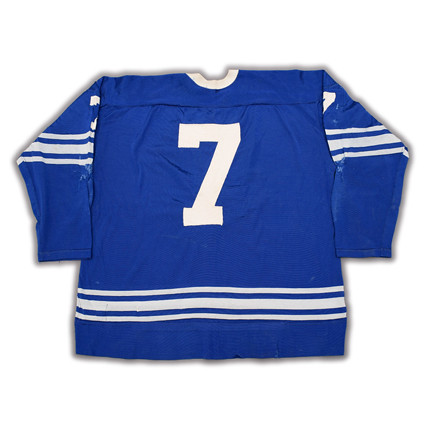
Today's featured jersey is a 1966-67 Toronto Maple Leafs Dave Keon jersey. Keon led the Maple Leafs in scoring that season and was also named the winner of the Conn Smythe Trophy following their Stanley Cup victory.
This jersey style was introduced during the 1966-67 season in time for the Maple Leafs run to the Stanley Cup bearing a maple leaf which closely resembled that of the new Canadian flag introduced in 1965. This jersey would have a relatively brief lifespan, lasting through just the 1969-70 season but was revived by the Maple Leafs in 2011-12 as their new alternate jersey.
Keon played 15 seasons for the Maple Leafs, winning four Stanley Cups. He was inducted into the Hockey Hall of Fame in 1986 and in 2016 was named as the greatest Toronto Maple Leaf in team history.
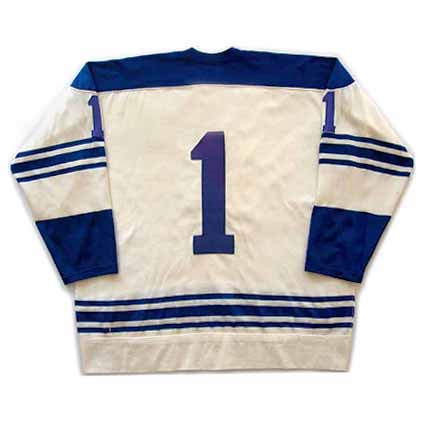
Bonus jersey: Today's bonus jersey is a 1966-67 Toronto Maple Leafs Johnny Bower jersey. This white jersey was worn for the Maple Leafs home games at Maple Leaf Gardens. Bower played 12 seasons for the Maple Leafs, winning four Stanley Cups. He was inducted into the Hockey Hall of Fame in 1976.
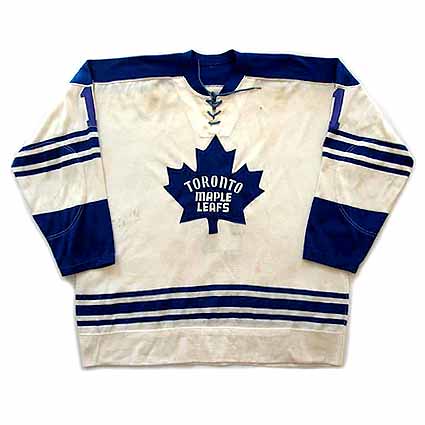
Extra bonus jersey: Today's extra bonus jersey is a 1966-67 Toronto Maple Leafs Tim Horton jersey. Horton played 20 seasons for the Maple Leafs, winning four Stanley Cups. He was inducted into the Hockey Hall of Fame in 1977.
On this date in 1974, DaveKeon of the Toronto Maple Leafs played in his 1,000th career game, and celebrated the occasion in style by scoring a hat trick, the fifth of his career.
Dave Keon played in his 1,000th NHL game on this date in 1974
Keon joined the Maple Leafs for the 1960-61 season and won the Calder Trophy following a 20 goal, 45 point campaign. He would go to have five more consecutive 20-goals seasons.
Keon won the Calder Trophy as Rookie of the Year
During Keon's second season in the NHL, in which the Maple Leafs would capture the Stanley Cup, Keon would add the Lady Byng Memorial Trophy to his already growing trophy case after a season in which he drew but a single minor penalty in 64 games played.
He was one of the fastest skaters in the NHL and one of the best defensive forwards as well, often being matched up against the opposition's top centers.
More Stanley Cups would follow in 1963, as well as a second Lady Byng Trophy, and again in 1964, a season in which Keon would lead the Maple Leafs in scoring for the first time.
After Keon led the Maple Leafs in scoring again in 1966-67, the Maple Leafs would win the 1967 Stanley Cup and Keon was named the Conn Smythe Trophy winner, the only Maple Leaf to ever win the trophy named for the former owner of the club.
Keon poses with the Conn Smythe Trophy
Keon was named captain of the Maple Leafs in 1969-70 and led the team in scoring yet again before setting a then NHL record in 1970-71 with eight shorthanded goals.
Keon has the captain's "C" sewn on to his jersey by Maple Leafs trainer Joe Sgro, while still wearing his jersey!
After coming to an agreement to join the Ottawa Nationals of the fledgling WHA in 1972, the deal fell apart and Keon signed a three year contract to remain in Toronto and led the team in goal scoring in 1972-73, which included his 297th goal as a Maple Leaf, passing George Armstrongand Frank Mahavolich as the franchise's all-time leading goal scorer.
Having fallen out of favor with Maple Leaf's owner Harold Ballard by the end of his contract, Keon jumped to the rival WHA and signed with the Minnesota Fighting Saints for the 1975-76 season. When the Fighting Saints folded in February of 1976, Keon was unable to return to the NHL because the Maple Leafs still held his NHL rights and owner Ballard wanted too steep a price from any NHL club who wanted to sign him, effectively locking Keon out of the NHL.
Keon now with the Fighting Saints of the WHA
Withstaying in the WHA as his only option, Keon signed with the Indianapolis Racers for the remainder of the season. He was traded to the new incarnation of the Minnesota Fighting Saints for the 1976-77 season, only to see that version of the franchise again fold in January of 1977 before the completion of the season.
Indianapolis Racer Dave Keon
Keonfound some stability when he joined the WHA's New England Whalers after the Fighting Saints folded, and would play with the Whalers for the remainder of his career, three seasons in the WHA and three more finally back in the NHL following the demise of the WHA in 1979 when the Whalers were one of four WHA clubs to be allowed to join the NHL.
It was during the 1979-80 season that Keon, then 40 years old, was occasionally on a line with both Gordie Howe (age 50) and Bobby Hull (age 41). When both Howe and Hull retired, Keon was the oldest player in the NHL for his final two seasons before retiring after the 1981-82 season at age 42.
Keon now back in the NHL and it's oldest active player as well
Keon's final totals were 396 goals and 590 assists for 986 NHL points and another 102 goals and 189 assists for 291 points in the WHA, the Calder Trophy, two Lady Byng Trophies, a Conn Smythe Trophy, eight NHL All-Star Game appearances and four Stanley Cups as well as being inducted into the Hockey Hall of Fame in 1986.
Earlier this year Keon was given the tremendous honor of being named The Greatest Maple Leaf in the team's 100 year history.
Today's featured jersey is a 1960-61 Toronto Maple Leafs Dave Keon jersey as worn during his rookie season in the NHL. This style of Maple Leafs jersey dates back to 1934-35, with a few crest variations along the way. This exact crest was introduced in 1938 and had red lettering for three seasons, from 1945-46 through 1947-48. The lace up collar was introduced for the 1958-59 season to arrive at the style Keon wore as a rookie.
Numbers were added to the sleeves in 1962-63 and a white outline was added to the crest the following season and the jersey remained in use through the 1966-67 season until a redesign for the 1967-68 season.
Bonus jersey: Today's bonus jersey is a 1966-67 Toronto Maple Leafs Dave Keon jersey as worn during the fourth Stanley Cup season of Keon's career. This style would be worn for three seasons through 1969-70.
There is a great story about Maple Leafs owner Ballard that recalls when the league made it mandatory in 1978 to put players names on the backs of their home and away jerseys, the notoriously cantankerous Ballard refused to do so. Claiming sales of programs would be reduced - and probably in part because Ballard never liked being told what to do by the league, and then NHL President John Ziegler in particular. When finally forced to comply by the league to put names on the jerseys after being fined, Ballard fought back on February 26, 1978 by putting the names on the back of their blue road jerseys for a game in Chicago in the same blue color as the jersey, making them impossible to read!
Extra bonus jerseys: Today's bonus jerseys are1975-76Minnesota Fighting Saints Dave Keon jerseys as worn during the Fighting Saints final season of their original incarnation. The Fighting Saints were one of the original WHA franchises formed for the 1972-73 season. They originally wore jerseys with the "S" logo but introduced a new set with the Little Saint logo later during their debut season. The jerseys would remain unchanged until the franchise folded in February of 1976.
Extra extra bonus jersey: Today's extra extra bonus jerseys is a1976-77New England Whalers Dave Keon jersey as wornwhile the Whalers were still members of the WHA.
After their inaugural season, the Whalers simplified their logo to just the W bisected with a harpoon and their jerseys would then remain unchanged through the remainder of their time in the WHA, which came to an end after the 1978-79 season.
Extra extra extra bonus jersey: Today's extra extra extra bonus jerseys is a1980-81Hartford Whalers Dave Keon jersey as wornafter the Whalers joined the NHL for the 1979-80 season. The Whalers were required to change their name from New England to Hartford due to a demand by the Boston Bruins as a part of their admission into the NHL.
Along with the new name came a new logo, which featured a bold whale tail and the letter H in the negative space above a bold W. This style underwent a few variations, such as the angled sleeve stripes being straightened, going back to aangled and then straight once again. Additionally, the popular Pucky the Whale shoulder patches would be inexcusably dropped for the 1983-84 season. Of note, this style was also worn with the long Cooperall pants for the 1982-83 season. This jersey would be worn for 13 seasons through the 1991-92 season before the team updated their look, which included promoting blue to their new main color.
Today's first video is Dave Keon's "Legends of Hockey" biography.
This video is from the 1970-71 season, the Maple Leafs first with their new jerseys and new, modern logo, which is still in use today. Keon scores early in the video on a really nice deke against the Detroit Red Wings. After Keon's goal, the Maple Leafs start picking off fans in the stands with flying pucks, as they nail two in a row!
Here are the final minutes of the Maple Leafs last Stanley Cup championship, won while wearing today's featured jersey.
This piece of sheer brilliance was too good to pass up, the Maple Leafs Top Ten Highest Scorers Named Dave!
Finally, a tour of the Dave Keon Arena in Rouyn Noranda, Quebec.
October 31st, Halloween, is sometimes referred to as "All Hallows Eve", making November 1st "All Hallows", with "hallows" being defined as "to consecrate or set apart as being holy". Thus, All Hallows celebrates all those who have been set apart as being holy by being named to sainthood, which leads to another name for All Hallows - "All Saints' Day".
A search of HockeyDB.com reveals twenty teams named "Saints" at various levels of hockey as far back as 1925 with the original incarnation of the St. Paul Saints of the Central Hockey League. The Saints then moved to the American Hockey Association for four seasons, back to the CHL for four, which included winning the league championship in 1935, and once more back to the AHA for seven seasons until World War II brought a temporary halt to the league. When play resumed in 1945, the Saints were now part of the United States Hockey League until 1955 and took home the championship in 1949.
The 1948-49 USHL champion St. Paul Saints
In 1959 the St. Paul Saints name would be revived with a new franchise in the International Hockey League, which would continue play through 1963 until their name was changed to the St. Paul Rangers to reflect their affiliation with the NHL's New York Rangers. This edition of the Saints was quite successful, appearing in the Turner Cup Finals three consecutive seasons, winning championships in both 1960 and 1961 and having their reign ended in 1962.
The 1960 IHL Champion St. Paul Saints
Next on the scene was the St. Catharines Saints in 1940 in the Ontario Hockey Association in Canada. That club lasted only two seasons, but the name was revived in 1982 when a new club joined the American Hockey League in 1982. That club stayed for four seasons prior to a relocation to Newmarket, Ontario where they were now known as the Newmarket Saints until 1991. After another relocation resulted in a name change, followed by yet another in 2005 which currently has them known as the Toronto Marlies.
A little known club in Minnesota called the Hibbing Saints played for one season in the Northern Hockey League. The fourth Saints franchise was the Sherbrooke Saints of the Quebec Senior Hockey League from 1949 to 1954.
The St. Boniface Saints had a long run in the Manitoba Junior Hockey League from 1967 to 2001 before new owners renamed them the Winnipeg Saints where they continue to play in Canadian Tier II Junior "A" hockey.
The 1992-93 St. Boniface Saints
Also formed in 1967, the Windsor St. Clair Saints played in the Ontario Colleges Athletic Association and dominated with championships in 1968, 1969, 1970, 1973, 1975, 1976, 1977 and 1979. They also won the Canadian Colleges Athletic Association National Championship in 1976.
After an extended break from competition, the St. Clair Saints returned in 2001 and won the OCAA championship in 2002 and 2003. Following the demise of the OCAA, the Saints eventually joined Major League Hockey, playing against Senior AAA level teams from 2006 to 2008 before ceasing operations.
The St. Claire Saints pay a hospital visit in 2008
The Laval Saints of the Quebec Major Junior Hockey League lasted but one season in 1969-70.
The next club to arrive on the scene with the Saints name did so with a twist. As founding members of the World Hockey Association in 1972 based in St. Paul, Minnesota, the new club elected to call themselves the Minnesota Fighting Saints. They created one of the best logos hockey has ever seen, which has been copied again and again since then. The Fighting Saints also played a firey, uptempo brand of hockey with plenty of fisticuffs and occasional mayhem thrown in to live up to the team name.
Competing with the NHL's Minnesota North Stars, who were in a down period on the ice at the time, the always competitive Fighting Saints captured the hearts of the Minnesota hockey fans and played to several record setting capacity crowds of over 17,000 at their brand new St. Paul Civic Center on the current site of the Minnesota Wild's Xcel Energy Center.
The 1973-74 Minnesota Fighting Saints
The Fighting Saints lasted four seasons in the unstable WHA and never missed the playoffs or had a losing record. After the original blue-clad WHA Fighting Saints folded during the 1975-76 season, the Cleveland Crusaders relocated to St. Paul for 1976-77 and adopted the Fighting Saints name and logo, but changed their primary color to red to differentiate themselves from the original club. This version of the Fighting Saints lasted only 42 games before also calling it quits.
Surprisingly, there haven't been more teams from St. Louis named the Saints, but there was one such club, the St. Louis Saints, which competed in the Continental Hockey League for two years starting in 1974.
The tenth Saints club, a junior hockey team from Ecorse, Michigan named the Paddock Pool Saints was active from 1975 to 1984 in the Great Lakes Junior Hockey League. The St. Albert Saints (1977-2004) were members of the Alberta Junior Hockey League, not to be confused with the Saskatchewan Junior Hockey League's Prince Albert Saints, who played in 1980-81.
Despite their short life, the Minnesota Fighting Saints popularity influenced several subsequent teams at various levels, including the Dubuque Fighting Saints (1980-2001) of the United States Hockey League, the Danville Fighting Saints (1986-1989) of the All American Hockey League and the St. Paul Fighting Saints (1992-93) of the American Hockey Association. A new version of the Dubuque Fighting Saints began play in the USHL in 2010-11 and immediately won the USHL championship in 2011 and again in 2013.
Going overseas, the Glasgow Saints of Scotland competed in the British Hockey League during the 1990-91 season, but failed to survive beyond that.
The San Angelo Saints who were members of the Central Hockey League from 2002-2005 and the Spruce Grove Saints of
the Alberta Junior Hockey League are the relocated St. Albert Saints a
franchise which can be traced back to 1963 with several different names.
Spruce Grove is currently riding a wave of success, having made the
league finals the last four seasons in a row, winning back-to-back
championships in 2014 and 2015.
The 2009-10 Spruce Grove Saints
The New York Saints of the Metropolitan Junior Hockey League arrived in 2006, but lasted just a single season. Finally, the St. Clair Shores Fighting Saints began play this season in the Federal Hockey League, a minor pro league in the Midwest and Northeast.
Today's featured jersey is a 1972-73 Minnesota Fighting Saints Ted Hampson jersey. Hampson had a long career in hockey which began with the Flin Flon Bombers in junior hockey in 1954-55 and included winning the Memorial Cup in 1957. He criss-crossed North America, playing for Providence in the AHL and Vancouver in the WHL and then back to Rochester, New York of the AHL before making his NHL debut with the Toronto Maple Leafs in 1959-60. He then played three seasons with the New York Rangers from 1960-61 to 1962-63 before a move to the Detroit Red Wings organization.
His first three seasons were spent mainly with the Pittsburgh Hornets of the AHL before playing in Detroit in 1966-67 and half of 1967-68 before a trade sent him to the Oakland Seals, where he would be named the second ever recipient of the Bill Masterton Trophy at the conclusion of the season for perseverance, sportsmanship and dedication to hockey.
Hampson would play three more seasons with Oakland, including setting an NHL career best with 26 goals and 75 points and appearing in the NHL All-Star Game in during the 1968-69 season before being dealt late in the 1970-71 season to the Minnesota North Stars. After playing the 1971-72 season with the North Stars, Hampson would move across the river to St. Paul to join the brand new Fighting Saints of the WHA for the league's debut season of 1972-73, where Hampson would be named the team's captain due to his veteran leadership and win the WHA's first "Most Gentlemanly Player" Award.
After three and a half seasons the Fighting Saints would fold due to financial difficulties. Hampson them finished out the 1975-76 season with the Quebec Nordiques. After sitting out two seasons, he would return to the ice in 1978-79 with the Oklahoma City Stars of the CHL for 23 games and make token appearances of 3 and 6 games in 1979-80 and 1980-81 before his playing days were completed for good.
If the Fighting Saints jersey appears familiar at first glance, is probably is, as the Fighting Saints minor league affiliate the Johnstown Jets was the inspiration for the Charlestown Chiefs of the famed move "Slap Shot", and the movie Chiefs wore jerseys of the same color and striping template as Johnstown, who mimicked the jerseys of their parent club, the Fighting Saints.
This jersey was actually not the original Fighting Saints jersey, as they began play with jerseys featuring a large "S" logo before a second set of jersey featuring the "Little Saint" logo was put into use.
Bonus Jersey: Today's bonus jersey is a 1975-76 Minnesota Fighting Saints Dave Keon jersey. After
Keon came to an agreement to join the Ottawa Nationals of the fledgling
WHA in 1972, the deal fell apart and he signed a three year contract to
remain in Toronto and led the team in goal scoring in 1972-73, which
included his 297th goal as a Maple Leaf, passing George Armstrong and Frank Mahavolich as the franchise's all-time leading goal scorer.
Having fallen out of favor with Maple Leaf's owner Harold Ballard by
the end of his contract, Keon jumped to the rival WHA and signed with
the Minnesota Fighting Saints. When the Fighting Saints folded, Keon was
unable to return to the NHL because the Maple Leafs still held his NHL
rights and owner Ballard wanted too steep a level of compensation from
any NHL club signing him, effectively locking Keon out of the NHL.
With
only the WHA as an option, Keon signed with the Indianapolis Racers for
the remainder of the season. He was traded to the new incarnation of
the Minnesota Fighting Saints for the following season, only to see that
version of the franchise again fold during before the completion of the
season. He once more found some stability when he joined the WHA's New
England Whalers, where he would play for the remainder of his career,
three seasons in the WHA and three more finally back in the NHL
following the merger in 1979.
It was during the 1979-80 season that Keon, then 40 years old, was occasionally on a line with both Gordie Howe (age 50) and Bobby Hull (age
41). When both Howe and Hull retired, Keon was the oldest player in the
NHL for his final two seasons before retiring after the 1981-82 season
at age 42.
Keon's
final totals were 396 goals and 590 assists for 986 NHL points and
another 102 goals and 189 assists for 291 points in the WHA, the Calder
Trophy, two Lady Byng Trophies, a Conn Smythe Trophy, eight NHL All-Star
Game appearances and four Stanley Cups as well as being inducted into
the Hockey Hall of Fame in 1986.
Extra bonus jersey: Today's extra bonus jersey is a 1984-85 St. Catharines Saints Gary Leeman jersey. Leeman was a ten year member of the Toronto Maple Leafs of the NHL, but did play 7 and then 25 games over two seasons with St. Catharines of the AHL early in his career. Leeman would later go on to win a Stanley Cup with the Montreal Canadiens in 1993 and score 466 points in 667 NHL games.
This jersey clearly reflects the then current style of the Saints parent club, the Toronto Maple Leafs. While copying the parent club's jersey style was the norm back then, many minor league clubs have learned the value of having their own separate identity when it comes to their own income through sales of unique merchandise and jerseys.
Today's video segment is a peek into the crazy world of the Minnesota Fighting Saints of the WHA, when one of the players beat up his own coach!
This second video is a highlight film of the Fighting Saints first season of 1972-73. Notice the gold alternate jerseys with the original "S" logo, none of which are known to have survived, as the logos were removed and they were handed down to a local high school who shared the same colors.
Once the Little Saint logo appeared on their jerseys, they Fighting Saints limited themselves to just home white and road blue jerseys.
Another thing to be aware of are the unique clear boards used in the St. Paul Civic Center, which allowed fans a view of the puck at all times, particularly those fans in the first several rows of seats, which were set back from the boards by a fair distance due to the round layout of the Civic Center.
If you are interested in some rare St. Paul Saints for Minnesota Fighting Saints jerseys, our friends at VintageMinnesotaHockey.com have a series of excellent reproductions of not only the WHA's Minnesota Fighting Saints, more accurate than anything found anywhere else online, but also a series of St. Paul Saints jerseys from the minor league club from the 1930's to the 1960's. Just do a search for "Saints" to view your options.
On this date in 1974, DaveKeon of the Toronto Maple Leafs played in his 1,000th career game, and celebrated the occasion in style by scoring a hat trick, the fifth of his career.
Keon joined the Maple Leafs for the 1960-61 season and won the Calder Trophy following a 20 goal, 45 point campaign. He would go to have five more consecutive 20-goals seasons.
During Keon's second season in the NHL, in which the Maple Leafs would capture the Stanley Cup, Keon would add the Lady Byng Memorial Trophy to his already growing trophy case after a season in which he drew but a single minor penalty in 64 games played.
He was one of the fastest skaters in the NHL and one of the best defensive forwards as well, often being matched up against the opposition's top centers.
More Stanley Cups would follow in 1963, as well as a second Lady Byng Trophy, and again in 1964, a season in which Keon would lead the Maple Leafs in scoring for the first time.
After leading the Maple Leafs in scoring again in 1966-67, the Maple Leafs would win the Stanley Cup as Keon was named the Conn Smythe Trophy winner, the only Maple Leaf to ever win the trophy named for the former owner of the club.
Keon poses with the Conn Smythe Trophy
Keon was named captain of the Maple Leafs in 1969-70 and led the team in scoring yet again before setting a then NHL record in 1970-71 with eight shorthanded goals.
Keon has the captain's "C" sewn on to his jersey by Maple Leafs trainer Joe Sgro, while still wearing his jersey!
After coming to an agreement to join the Ottawa Nationals of the fledgling WHA in 1972, the deal fell apart and Keon signed a three year contract to remain in Toronto and led the team in goal scoring in 1972-73, which included his 297th goal as a Maple Leaf, passing George Armstrong and Frank Mahavolich as the franchise's all-time leading goal scorer.
Having fallen out of favor with Maple Leaf's owner Harold Ballard by the end of his contract, Keon jumped to the rival WHA and signed with the Minnesota Fighting Saints. When the Fighting Saints folded, Keon was unable to return to the NHL because the Maple Leafs still held his NHL rights and owner Ballard wanted too steep a level of compensation from any NHL club signing him, effectively locking Keon out of the NHL.
Keon now with the Fighting Saints of the WHA
With only the WHA as an option, Keon signed with the Indianapolis Racers for the remainder of the season. He was traded to the new incarnation of the Minnesota Fighting Saints for the following season, only to see that version of the franchise again fold during before the completion of the season.
Indianapolis Racer Dave Keon
He once more found some stability when he joined the WHA's New England Whalers, where he would play for the remainder of his career, three seasons in the WHA and three more finally back in the NHL following the merger in 1979.
It was during the 1979-80 season that Keon, then 40 years old, was occasionally on a line with both Gordie Howe (age 50) and Bobby Hull (age 41). When both Howe and Hull retired, Keon was the oldest player in the NHL for his final two seasons before retiring after the 1981-82 season at age 42.
Keon now back in the NHL and it's oldest active player as well
Keon's final totals were 396 goals and 590 assists for 986 NHL points and another 102 goals and 189 assists for 291 points in the WHA, the Calder Trophy, two Lady Byng Trophies, a Conn Smythe Trophy, eight NHL All-Star Game appearances and four Stanley Cups as well as being inducted into the Hockey Hall of Fame in 1986.
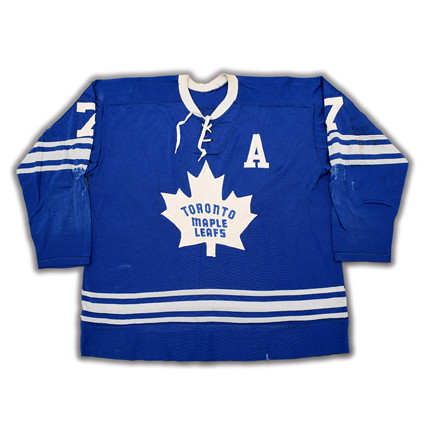
Today's featured jersey is a 1966-67 Toronto Maple Leafs Dave Keon jersey as worn during the fourth Stanley Cup season of Keon's career. The jersey features the tie-neck collar and assistant captain's A Keon would wear before being named the 12th Captain in Maple Leafs history. No names were worn on the back of Maple Leafs jerseys during that era.
There is a great story about Maple Leafs owner Harold Ballard that recalls when the league made it mandatory in 1978 to put players names on the backs of their home and away jerseys, the notoriously cantankerous Ballard refused to do so, claiming sales of programs would be reduced and probably in part because he never liked being told by the league, and then NHL President John Ziegler in particular, what to do. When finally forced to comply by the league after being fined, Ballard fought back on February 26, 1978 by putting the names on the back of their blue road jerseys for a game in Chicago in the same blue color as the jersey, making them impossible to read!
Today's first video is Dave Keon's "Legends of Hockey" biography.
This video is from the 1970-71 season, the Maple Leafs first with their new jerseys and new, modern logo, which is still in use today. Keon scores early in the video on a really nice deke against the Detroit Red Wings. After Keon's goal, the Maple Leafs start picking off fans in the stands with flying pucks, as they nail two in a row!
Here are the final minutes of the Maple Leafs last Stanley Cup championship, won while wearing today's featured jersey.
This piece of sheer brilliance was too good to pass up, the Maple Leafs Top Ten Highest Scorers Named Dave!
Finally, a tour of the Dave Keon Arena in Rouyn Noranda, Quebec.
Third String Goalie - The Hockey Jersey of the Day Blog
"Sweater" for all my Canadian friends!
Welcome!
Welcome to our end of the rink.
Bienvenue sur notre bout de la patinoire.
So why "Third String Goalie"?
It's defined as "A fan who sits in the stands wearing a jersey."
If that's not us, we don't know what is...
Our aim is to feature a different jersey each day from a historical perspective. Stay tuned and hopefully you'll see some jerseys of interest or perhaps some that you haven't seen before and learn a bit of hockey history along the way.
In addition to our articles, be sure to scroll down this column and explore the other fun and informative features of this blog.
If you have any suggestions or comments, feel free to contact us at:
Looking to reach our loyal readers with your hockey related product or service? Of our hundreds of readers each day, 60% are located in the United States and 30% come from Canada. Our audience is your audience and you can target them now with our reasonable ad rates.
We've been linked to by SI.com, ESPN.com, Uni-Watch.com, NBCSports.com and the Yahoo! Sports Puck Daddy blog among others.
There is no limitation to what kind of hockey jersey it can be - replica, authentic or game worn jersey from the NHL, a national team, the minors, juniors, college, high school or even your pond hockey jersey.
Feel free to write a paragraph or two about the jersey telling us why you like the jersey, how you got it, what makes it special to you or even a full-blownThird String Goalie-style history lesson - whatever you feel like sharing.
Visting from outside North America? Just select your preferred language and Third String Goalie will be instantly converted to your language of choice!