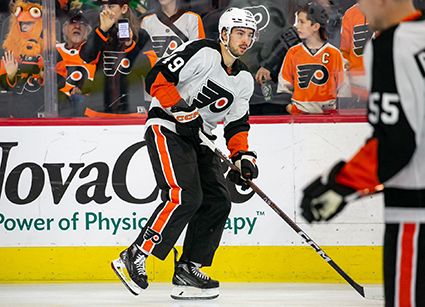
With all the attention the Philadelphia Flyers received yesterday for wearing long pants during warmups on Reverse Retro Night, we felt it was an appropriate time to revisit the sartorial splendor widely known as Cooperalls.
The Flyers shook up the hockey world by bringing back the Cooperalls during warmups on Reverse Retro night
While many scoff at and scorn the Cooperalls, ranking them with other such sports uniform misfits as the 1976 Chicago White Sox shorts, we here at Third String Goalie embrace not only the concept of the Cooperalls, but their look as well. In our opinion, they made the players look taller and sleeker. If football and baseball players can look good in long pants, why not hockey players?
The Flyers innovated the use of the long pants,seen here on Mark Howe
Even the basic idea of long pants for hockey players just makes so much sense to us. Why players would ever wear short pants for a winter sport played on ice, we will never quite understand...
The Cooperalls were first developed in order to increase player safety and protection, as the pads under the Cooperalls were held tightly to the body, unable to shift out of place like the current pads of the day, which would leave the player exposed to injuries, their tailbone in particular.
The original "Cooperalls" worn by the Flyers in 1981-82 were black with an orange stripe trimmed in white which ran down the length of the leg and were actually not Cooperalls, but a CCM version of the Cooperalls called CCM Pro Guard. Philadelphia completed their first season in the long pants with a 38-31-11 record, which was good for 87 points, placing them sixth in the Wales Conference.
The first year 1981-82 "Cooperalls" with the orange stripe down the leg
Cooperalls were also reportedly worn by the Toronto Maple Leafs during the 1981-82 pre-season, but despite a reported game worn pair of actual Cooperalls, not the CCM Pro Guard version, for sale on ebay, no photographic or video evidence of game action to support this claim is readily available.
A supposed pair of Maple Leafs Cooperalls
For the 1982-83 season, the Flyers long pants returned, only this time in solid black, adorned only with a large Flyers logo way down at the ankle of each leg. Philadelphia rose to a 49-23-8 record, good for a Patrick Division title and second overall in the Wales Conference. Unfortunately for the Flyers faithful, they would be eliminated in the first round of the playoffs both seasons while wearing the CCM Pro Guard pants at the hands of the New York Rangers.
The 1982-83 season pants were black with a team logo on the ankle
The Flyers were joined by the Hartford Whalers in wearing "Cooperalls" for the 1982-83 season, with the Whalers version featuring a full-length pair of blue stripes surrounded by three white stripes, which again were actually the CCM version as evidenced by the vertical CCM logo near the bottom of each leg.
The Whalers were the second team to wear long pants in the NHL
The Whalers did the full length pants look no favors with their on-ice performance, as they tied for last in the league with 45 points following a 19-54-7 record.
Following the 1982-83 season the NHL outlawed the long pants on the grounds of player safety, as the outer fabric of the pants was made out of slick material comparable to a nylon windbreaker which was more slippery than the traditional hockey pants/knit socks combination. Any player who fell while wearing them would find themselves skidding relatively unabated into the boards at a much higher speed than previously.
The long pants were outlawed by the NHL on the grounds of safety
Still, it wasn't just the Flyers and Whalers who wore the "Cooperalls", as Canada's junior leagues and high schools in Minnesota also wore them for a period of time.
Brendan Shanahan of the London Knights in his Cooperalls
Brett Hull of the Penticton Vees sporting his Cooperalls
For those of you who think that 1983 was the last of the "Cooperalls" on NHL ice, think again, for it was on Halloween night in 2002 that JeremyRoenick hilariously took to the ice during warmups for the Flyers upcoming game against the Phoenix Coyotes wearing a blond wig, blacked-out front teeth, striped "Cooperalls" and a #16 BobbyClarke sweater!
Roenick on Halloween Night in 2002 paying tribute to Bobby Clarke
Perhaps it's now time to revisit the idea of the long pants. We're actually surprised that Reebok didn't taken this one on when they debuted the Reebok Edge jerseys in 2007-08. After all, they were bold enough to reinvent the hockey jersey, so why not change the pants while you are at it? Doing so certainly would have no doubt taken away some of the negative attention the jerseys received at the time.
Additionally, in the last 35 years there certainly have been many innovations and advances in fabric technology to the point that the basic excuse for banning Cooperalls in the first place, the slick fabric, could now easily be addressed by any number of equipment manufacturers.
After all, think of all the other men's sports at the Winter Olympics - alpine and cross-country skiing, bobsled and luge, curling, figure skating, speed skating, ski jumping and snowboarding - and just how many of those winter sports feature competitors wearing short pants? Right. Not one.
Even if the old guard would refuse to allow the return of the late, great Cooperalls full time, there was an opportunity staring them in the face that was seemingly just too good to pass up when the Flyers will play outdoors in the 2017 NHL Stadium Series in February of 2017.
With the Flyers having had so few changes in style of their sweaters over the last 50 years, the one thing that has changed has been their pants, and the time is right for a return to the Cooperalls/CCM PRo Guard long pants of yore. It is, after all, an outdoor game, and wouldn't a nice warm pair of long pants (perhaps lined with some modern high tech Therma Base/Polartec/Thermal Dri-FIT/Play Warm fabric) be just the thing to keep the players warm against winter's chill rather than shorts and socks? Roenick thought so...
Today's featured pants are the 1981-82 Philadelphia Flyers Bill Barber "Cooperalls". Not actually Cooperalls, but CCM Pro Guard pants, they were worn for only a single season. These pants, with their elegant long stripe down the leg, which served to accentuate that the pants were indeed full length, were a shock to the established look when they first appeared.
The stripe on the Flyers pants disappeared for the second season, with just a Flyers logo waaaaay down by the ankle of the otherwise all-black pants. Meanwhile, four hours to the north, the Hartford Whalers also adopted the long pants for one season and went all out to call attention to the full length of their pants with no less than five alternating white and green stripes.
While Philadelphia and Hartford actually both wore the CCM Pro Guard pants, the name "Cooperalls" has become the popular nomenclature for the full length hockey pants in the same way that all brands of tissues are commonly referred to as "Kleenex" while copiers are often referred to as a "Xerox machine" regardless of brand.
Today's video segment begins with spectacular footage from the first ever NHL Cooperalls vs. Cooperalls matchup on December 11, 1982, a 7-4 win for the Whalers over the Flyers. The teams would meet two more times that season, a home and home pair of games on January 8th and 9th 1983, both won by Philadelphia for a grand total of just three all-long pants games in NHL history.
Next, the Flyers wearing their Cooperalls from the first season of use, noted by the orange stripe down the legs.
Here is a gem, a brief clip of Roenick dressed as Clarke during warmups on Halloween in 2002 with a Clarke jersey, big blonde wig and retro Cooperalls, much to Clarke's amusement.
This next clip from the WHL features Cam Neely of the Portland Winterhawks going toe-to-toe with Shawn Green of the New Westminster Bruins while both were wearing Cooperalls in the 1983-84 season.
In this next clip from the 1984 Minnesota State High School Hockey Tournament, St. Paul Johnson takes on the Hill-Murray Pioneers during the Cooperall era. Note the clear boards of the old St. Paul Civic Center to complete the obscurity double!
Even French-Canadians and Soviets liked Cooperalls!
From the time the WHA's New England Whalers entered the NHL, only now known as the Hartford Whalers at the insistence of the Boston Bruins, they had only qualified for the postseason one time, that coming in their first season of NHL play in 1979-80.
Their reward for making the playoffs was a matchup against the powerful Montreal Canadiens, who finished 34 points ahead of the Whalers in the standings, who then delivered a sound thrashing to the NHL newcomers in Games 1 and 2 in Montreal by scores of 6-1 and 8-4 before eliminating Hartford on their home ice 4-3 at 29 seconds of overtime.
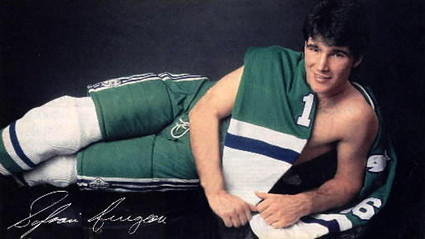
The Whalers point totals dropped from 73 in 1979-80 down to 60 for two seasons before dropping further to 45. That tied Hartford for the fewest points and earned them the second overall pick in the 1983 NHL Draft, where the Whalers selected Sylvain Turgeon ahead of future Hall of Famers Pat Lafontaine, Steve Yzerman and Cam Neely and 1984 Calder Cup and Vezina Trophy winner goaltender Tom Barrasso.
Sylvain Turgeon
The Whalers did rise in points from 66 and then to 69 in 1984-85, but continued their streak of missing the playoffs, which now extended to five consecutive seasons.
In 1985-86, the Whalers were showing signs of continued competitiveness thanks to additions of additions to the roster such as Ray Ferraro and Kevin Dineen to compliment Turgeon and now veteran Ron Francis, who all finished in the top four in team scoring at season's end, with Turgeon leading the way with 45 goals and 70 points, followed by Ferraro and Francis at 77 each and the hard-nosed Dineen's 68.
Ron Francis
The goaltending was anchored by Mike Liut while the defense boasted Ulf Samuelsson, Joel Quenneville, rookie Dana Murzyn and midseason additions Dave Babych, his brother and winger Wayne Babych and veteran center Doug Jarvis.
Mike Liut
The Whalers played respectable hockey through the last three months of 1985, avoiding any long losing streaks, but unable to string together an extended winning streak either. As the calendar changed to 1986 the Whalers won five consecutive games, kicked off by an 11-6 defeat of the Quebec Nordiques, only to give it all back and more with seven losses in a row during a ten game winless streak.
They finished strong however, going 8-1-2 over their final 11 games to finish the season with their first winning record as a member of the NHL at 40-36-4 for 84 points, 4 better than the Buffalo Sabres and good for fourth place in the Adams Division and their first spot in the playoffs since 1980.
The 1985-86 Hartford Whalers
The format of the day called for the first four teams in each division to qualify for the postseason, with the first two rounds of the playoffs coming within their own division. By virtue of their fourth place finish, the Whalers drew the division winners, the Quebec Nordiques, whose 43-31-6 mark earned them 92 points, ahead of Montreal's 87 and the Bruins' 86 in a tight race.
The Nordiques were not the doormats they would become in the early 1990's, having made it to the semifinals the year before and had now posted three consecutive 90 point seasons thanks to a roster which featured the high scoring Peter Stastny (122 points, good for 6th in the league), Michel Goulet, Anton Stastny and the tough Dale Hunter.
The opening round was a Best of Five format and opened in Quebec City on April 9th. Anton Stastny of the Nordiques drew first blood with a power play goal at 2:44, but the Whalers evened the score within the final minute of the first period. The teams traded goals in the third period before Turgeon won it for Hartford 2:36 into overtime, sending 14,500 Nordiques fans home disappointed.
Game 2 was the next night and Hartford scored first at 3:53 and added a second goal at 8:51 of the first. Their lead was extended to three at 8:22 of the second before the Nordiques, who were badly outshot in the first two periods 26-14, showed some signs of life with a goal at 1:39 of the third, only to have the Whalers squash any hope of a comeback with a fourth goal at 16:32 to take a 2-0 lead in games heading back home to Hartford.
That third game at the Hartford Civic Center took place on this date in 1986 and was a wild affair on several levels, as 21 penalties and six goals occurred in just the first period alone!
Dineen got his first goal of the series at 2:29 on a power play and Dave Tippett's shorthanded goal at 5:22 made it 2-0 for the Whalers. Quebec responded at 8:40 on a power play before the teams traded goals in the 16th minute just 46 seconds apart, first by Francis of the Whalers at 15:06 which was followed by a shorthanded goal for Quebec at 15:52. Ferraro extended the Hartford lead to 4-2 with another power play goal, this one coming late at 19:20.
Kevin Dineen
The second period was more of the same, with nine more penalties and four more goals, the first by Samuelsson at 2:07 followed by a string of power play goals, the first by Hunter of the Nordiques at 11:06. Ferraro and John Anderson of Hartford then extended the Whalers lead with goals at 13:08 and 13:34, both with the man advantage to make the score 7-3 in favor of the home team after two periods of play.
That lead was added to when Anderson got his second at exactly 7:00. Although Quebec scored at 13:08, it was too little too late, a point driven home by Dineen with his second of the game at 18:23 to make the final score 9-4 in favor of Hartford and giving them a three game upset sweep of the Nordiques, which would turn out to be not only the first playoff series victory in the history of the Whalers, but their only series win in their history, as they were defeated in the next round by Montreal in Game 7 at 5:55 of overtime.
The following season the Whalers would win the Adams Division title with a franchise best 93 point season, only to have the Nordiques return the favor and upset the Whalers 4 games to 2.
Over the course of the next five seasons the Whalers would qualify for the playoffs each time, thanks in part to the now dreadful Nordiques, whose futility assured that the Whalers would qualify for the playoffs each season, only to see Hartford eliminated immediately in the first round every time.
The Nordiques finally improved thanks to their annual first overall draft picks and it was now the Whalers on the outside looking in, as they failed to qualify for the playoffs in 1993, the final year of the Adams Division.
The realignment of the NHL, which placed Hartford in the new Northeast Division with not only old rivals Montreal, Boston, Buffalo and Quebec, but the addition of the 1991 and 1992 Stanley Cup champion Pittsburgh Penguins did the Whalers postseason chances no favors, and they failed to make the playoffs for their final four seasons in Hartford before relocating to North Carolina, leaving their victory over the Nordiques on this date in 1986 as their one and only playoff series victory.
The Hartford Whalers banners
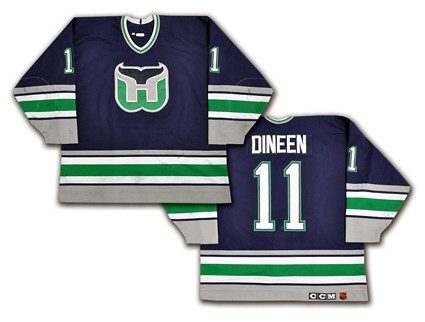
Today's featured jersey is a 1985-86 Hartford Whalers Kevin Dineen jersey. Upon entering the NHL, the Whalers debuted their new "Whale Tail" logo, which obviously featured a "W" for Whalers, but also contained an "H" hidden in the negative space of the logo to represent their change in name to Hartford.
This new style would be worn from 1979-80 until 1991-92, with only minor changes to the sleeve striping angles, the removal of the Pucky the Whale shoulder patches in 1985-86 and the removal of the green waist stripe. The team would then switch from green to blue jerseys in 1992-93, a jersey set which would never see action in the playoffs.
Bonus jersey: Today's bonus jersey is a 1996-97 Hartford Whalers Kevin Dineen jersey. After playing in green jerseys for 20 years, dating back to their inaugural 1972-73 season in the WHA, the Whalers drastically altered their look for the 1992-93 season. Navy blue became their primary jersey color with silver now added to the look, which appeared on the jerseys in an even greater amount than their former trademark green.
This classy new look was worn by the Whalers for their final five seasons in Hartford, but the team never qualified for the postseason during this time period which limited their navy jerseys to exclusive regular season use.
Today's video section kicks off with the Whalers goal song, Brass Bonanza, also known as the "Whalers Victory March" which was adopted by the Whalers as their theme song during their days in the WHA, and remained so through their years in the NHL.
Gordie Howe was once quoted as saying that he loved to hear it as a visiting player for the Houston Aeros, but hearing it every night with the Whalers "began to drive me nuts."
Finally, the last goal in Whalers history, scored by then team captain Dineen.
Blaine Stoughton, born on this date in 1953, began his road to the professional hockey ranks with four seasons with the Flin Flon Bombers of the WCHL, with the first being the 1969-70 season. His point totals his first two seasons were 39 and then 50, before a giant leap upward for the 1971-72 season when he scored more goals than he had points the previous season with 60 goals and 126 points to lead the WCHL in scoring. He also added an additional 121 penalty minutes to go along with his offensive output. The following season he came close to matching his previous year with 58 goals and 118 points.
Having been born at the right time, Stoughton was turning pro during the NHL vs WHA war for players, which led to an enormous increase in salaries for the players. Stoughton was thus drafted 14th overall by the Quebec Nordiques of the WHA and 7th overall by the NHL's Pittsburgh Penguins.
PIttsburgh won out for the rights to sign Stoughton and he was assigned to their minor league club in the AHL, the Hershey Bears, with whom he scored 40 points in 47 games before a call-up to the Penguins for 34 games.
Just prior to the start of the 1974-75 season, Stoughton was traded to the Toronto Maple Leafs in a deal which sent RickKehoe to Pittsburgh. In 78 games with Toronto, he scored 23 goals and 37 points. Despite the 20 goal season, he split time in 1975-76 between Toronto (43 games, 17 points) and the Oklahoma City Blazers of the Central Hockey League (30 games, 36 points).
For the 1976-77 season, Stoughton jumped to the WHA's Cincinnati Stingers, who had obtained his rights from the Nordiques in the WHA expansion draft. The move to the free wheeling WHA was a revelation for Stoughton, who teamed with RickDudley and RichLeduc to form the high powered "LSD Line".
Stoughton and Leduc each had 52 goals to finish fourth in the league, with Leduc's 107 points 7th overall and Stoughton's 102 good for 9th, while Dudley reached 88. Despite their success, the line would not stay together long, as 30 games into the 1977-78 season, Stoughton and GillesMarotte were traded to the Indianapolis Racers after Stoughton did not fit into new head coach JacquesDemers system.
The change to Indianapolis was brief, as Stoughton finished out the season with the Racers, scoring just 13 goals in 47 games, and after playing the first 25 games of the 1978-79 season, the Racers , who were on the verge of folding, was sold to the New England Whalers where he finished out what would prove to be the final days of the WHA as well.
For the 1979-80 season, the Whalers were part of a complex deal which saw four surviving WHA clubs enter the NHL and Stoughton's rights revert back to Toronto, only to be claimed by the newly renamed Hartford Whalers in the subsequent Expansion Draft.
Stoughton thrived during his first season back in the NHL, finishing eighth in scoring with 100 points while leading the league with 56 goals, becoming only the second player after Bobby Hull to score 50 goals in both the WHA and the NHL. The Whalers even made the NHL playoffs that season, only to have Stoughton break his leg during their opening game against the Montreal Canadiens. It would also be the last playoff game of his career, as the Whalers would not qualify for the playoffs for another six seasons.
He returned to play 71 games of the 1980-81 season after ending a contract holdout, scoring 43 goals and 73 points. He again reached the 50 goals mark in 1981-82 with 52, which placed him 6th in the league and allowed him to lead the team in scoring for the only time with 91 points. He also made his only NHL All-Star Game appearance that season.
After his fourth consecutive 40 goal season, scoring 45 in 1982-83, Stoughton played his final 54 games with the Whalers in 1983-84 prior to being traded to the New York Rangers as the Whalers then all-time franchise goals leader in late February of 1984.
Stoughton during the 1982-83 season wearing
the controversial long hockey pants
His 5 goals for the Rangers in 14 games would be the last of his NHL career, as he spent the 1984-85 season with the New Haven Nighthawks of the American Hockey League when he did not make the Rangers roster in training camp and no other teams claimed him.
After two seasons away from pro hockey, Stoughton would play one final stint as a pro, with 15 games of the 1987-88 season with HC Asiago of the Italian Serie A.
Stoughton would play 526 NHL games, scoring 258 goals and 449 points, as well as an additional 89 goals and 179 points in the WHA for a total of 628 points.
Today's featured jersey is a 1978-79 New England Whalers Blaine Stoughton jersey as worn during the Whalers final season in the WHA prior to the league's demise and it's entry into the NHL for 1979-80 season.
After their first two seasons wearing green and white and a circular crest on their road jerseys, the Whalers added gold trim to their color scheme and simplified the crest on their jerseys to just the "W" bisected with a harpoon for the remainder of their time in the WHA, with only a subtle change to the waist striping for their last two WHA seasons, going from a wide white stripe with gold trim to a "Northwestern" pattern, meaning the gold trim was moved outward from the white waist stripe, allowing the green jersey color to separate the white from the gold.
Bonus jersey: Today's bonus jersey is a 1979-80 Hartford Whalers Blaine Stoughton jersey. When the club was forced to change it's name from "New England" to "Hartford" at the request of the Boston Bruins, the Whalers adopted a new whale tail logo, altered their color scheme from green and gold to green and blue and unveiled an entirely new set of modernized jerseys that they would wear for the next 13 seasons with only minor detail changes, although the "Pucky the Whale" patches were discontinued in 1985-86.
Extra bonus jersey: Today's extra bonus jersey is a 1976-77 Cincinnati Stingers Blaine Stoughton jersey. The Stingers wore essentially the same jerseys for their all-to-brief four year run. With the Stingers name lending itself to a multi-stripe theme, it's a wonder the Stingers jerseys were as reserved as they were.
The Stingers logo is a wonderful piece of graphic design and looks as modern today as it did when it was first conceived, and has always been a favorite of ours.
Today's video section begins with Stoughton discussing his time with the Whalers.
Next, a feature on the cocky and confident Stoughton showing him and his mustache in the Whalers training camp.
On this date in 1974, DaveKeon of the Toronto Maple Leafs played in his 1,000th career game, and celebrated the occasion in style by scoring a hat trick, the fifth of his career.
Dave Keon played in his 1,000th NHL game on this date in 1974
Keon joined the Maple Leafs for the 1960-61 season and won the Calder Trophy following a 20 goal, 45 point campaign. He would go to have five more consecutive 20-goals seasons.
Keon won the Calder Trophy as Rookie of the Year
During Keon's second season in the NHL, in which the Maple Leafs would capture the Stanley Cup, Keon would add the Lady Byng Memorial Trophy to his already growing trophy case after a season in which he drew but a single minor penalty in 64 games played.
He was one of the fastest skaters in the NHL and one of the best defensive forwards as well, often being matched up against the opposition's top centers.
More Stanley Cups would follow in 1963, as well as a second Lady Byng Trophy, and again in 1964, a season in which Keon would lead the Maple Leafs in scoring for the first time.
After Keon led the Maple Leafs in scoring again in 1966-67, the Maple Leafs would win the 1967 Stanley Cup and Keon was named the Conn Smythe Trophy winner, the only Maple Leaf to ever win the trophy named for the former owner of the club.
Keon poses with the Conn Smythe Trophy
Keon was named captain of the Maple Leafs in 1969-70 and led the team in scoring yet again before setting a then NHL record in 1970-71 with eight shorthanded goals.
Keon has the captain's "C" sewn on to his jersey by Maple Leafs trainer Joe Sgro, while still wearing his jersey!
After coming to an agreement to join the Ottawa Nationals of the fledgling WHA in 1972, the deal fell apart and Keon signed a three year contract to remain in Toronto and led the team in goal scoring in 1972-73, which included his 297th goal as a Maple Leaf, passing George Armstrongand Frank Mahavolich as the franchise's all-time leading goal scorer.
Having fallen out of favor with Maple Leaf's owner Harold Ballard by the end of his contract, Keon jumped to the rival WHA and signed with the Minnesota Fighting Saints for the 1975-76 season. When the Fighting Saints folded in February of 1976, Keon was unable to return to the NHL because the Maple Leafs still held his NHL rights and owner Ballard wanted too steep a price from any NHL club who wanted to sign him, effectively locking Keon out of the NHL.
Keon now with the Fighting Saints of the WHA
Withstaying in the WHA as his only option, Keon signed with the Indianapolis Racers for the remainder of the season. He was traded to the new incarnation of the Minnesota Fighting Saints for the 1976-77 season, only to see that version of the franchise again fold in January of 1977 before the completion of the season.
Indianapolis Racer Dave Keon
Keonfound some stability when he joined the WHA's New England Whalers after the Fighting Saints folded, and would play with the Whalers for the remainder of his career, three seasons in the WHA and three more finally back in the NHL following the demise of the WHA in 1979 when the Whalers were one of four WHA clubs to be allowed to join the NHL.
It was during the 1979-80 season that Keon, then 40 years old, was occasionally on a line with both Gordie Howe (age 50) and Bobby Hull (age 41). When both Howe and Hull retired, Keon was the oldest player in the NHL for his final two seasons before retiring after the 1981-82 season at age 42.
Keon now back in the NHL and it's oldest active player as well
Keon's final totals were 396 goals and 590 assists for 986 NHL points and another 102 goals and 189 assists for 291 points in the WHA, the Calder Trophy, two Lady Byng Trophies, a Conn Smythe Trophy, eight NHL All-Star Game appearances and four Stanley Cups as well as being inducted into the Hockey Hall of Fame in 1986.
Earlier this year Keon was given the tremendous honor of being named The Greatest Maple Leaf in the team's 100 year history.
Today's featured jersey is a 1960-61 Toronto Maple Leafs Dave Keon jersey as worn during his rookie season in the NHL. This style of Maple Leafs jersey dates back to 1934-35, with a few crest variations along the way. This exact crest was introduced in 1938 and had red lettering for three seasons, from 1945-46 through 1947-48. The lace up collar was introduced for the 1958-59 season to arrive at the style Keon wore as a rookie.
Numbers were added to the sleeves in 1962-63 and a white outline was added to the crest the following season and the jersey remained in use through the 1966-67 season until a redesign for the 1967-68 season.
Bonus jersey: Today's bonus jersey is a 1966-67 Toronto Maple Leafs Dave Keon jersey as worn during the fourth Stanley Cup season of Keon's career. This style would be worn for three seasons through 1969-70.
There is a great story about Maple Leafs owner Ballard that recalls when the league made it mandatory in 1978 to put players names on the backs of their home and away jerseys, the notoriously cantankerous Ballard refused to do so. Claiming sales of programs would be reduced - and probably in part because Ballard never liked being told what to do by the league, and then NHL President John Ziegler in particular. When finally forced to comply by the league to put names on the jerseys after being fined, Ballard fought back on February 26, 1978 by putting the names on the back of their blue road jerseys for a game in Chicago in the same blue color as the jersey, making them impossible to read!
Extra bonus jerseys: Today's bonus jerseys are1975-76Minnesota Fighting Saints Dave Keon jerseys as worn during the Fighting Saints final season of their original incarnation. The Fighting Saints were one of the original WHA franchises formed for the 1972-73 season. They originally wore jerseys with the "S" logo but introduced a new set with the Little Saint logo later during their debut season. The jerseys would remain unchanged until the franchise folded in February of 1976.
Extra extra bonus jersey: Today's extra extra bonus jerseys is a1976-77New England Whalers Dave Keon jersey as wornwhile the Whalers were still members of the WHA.
After their inaugural season, the Whalers simplified their logo to just the W bisected with a harpoon and their jerseys would then remain unchanged through the remainder of their time in the WHA, which came to an end after the 1978-79 season.
Extra extra extra bonus jersey: Today's extra extra extra bonus jerseys is a1980-81Hartford Whalers Dave Keon jersey as wornafter the Whalers joined the NHL for the 1979-80 season. The Whalers were required to change their name from New England to Hartford due to a demand by the Boston Bruins as a part of their admission into the NHL.
Along with the new name came a new logo, which featured a bold whale tail and the letter H in the negative space above a bold W. This style underwent a few variations, such as the angled sleeve stripes being straightened, going back to aangled and then straight once again. Additionally, the popular Pucky the Whale shoulder patches would be inexcusably dropped for the 1983-84 season. Of note, this style was also worn with the long Cooperall pants for the 1982-83 season. This jersey would be worn for 13 seasons through the 1991-92 season before the team updated their look, which included promoting blue to their new main color.
Today's first video is Dave Keon's "Legends of Hockey" biography.
This video is from the 1970-71 season, the Maple Leafs first with their new jerseys and new, modern logo, which is still in use today. Keon scores early in the video on a really nice deke against the Detroit Red Wings. After Keon's goal, the Maple Leafs start picking off fans in the stands with flying pucks, as they nail two in a row!
Here are the final minutes of the Maple Leafs last Stanley Cup championship, won while wearing today's featured jersey.
This piece of sheer brilliance was too good to pass up, the Maple Leafs Top Ten Highest Scorers Named Dave!
Finally, a tour of the Dave Keon Arena in Rouyn Noranda, Quebec.
Today marks the 35th anniversary of the sartorial splendor widely known as Cooperalls, for on this date in 1981, they made their NHL debut when the Philadelphia Flyers took to the ice in their full-length pants versus the Detroit Red Wings.
While many scoff at and scorn the Cooperalls, ranking them with other such sports uniform misfits as the 1976 Chicago White Sox shorts, we here at Third String Goalie embrace not only the concept of the Cooperalls, but their look as well. In our opinion, they made the players look taller and sleeker. If football and baseball players can look good in long pants, why not hockey players?
The Flyers innovated the use of the long pants,seen here on Mark Howe
Even the basic idea of long pants for hockey players just makes so much sense to us. Why players would ever wear short pants for a winter sport played on ice, we will never quite understand...
The Cooperalls were first developed in order to increase player safety and protection, as the pads under the Cooperalls were held tightly to the body, unable to shift out of place like the current pads of the day, which would leave the player exposed to injuries, their tailbone in particular.
The original "Cooperalls" worn by the Flyers in 1981-82 were black with an orange stripe trimmed in white which ran down the length of the leg and were actually not Cooperalls, but a CCM version of the Cooperalls called CCM Pro Guard. Philadelphia completed their first season in the long pants with a 38-31-11 record, which was good for 87 points, placing them sixth in the Wales Conference.
The first year 1981-82 "Cooperalls" with the orange stripe down the leg
Cooperalls were also reportedly worn by the Toronto Maple Leafs during the 1981-82 pre-season, but despite a reported game worn pair of actual Cooperalls, not the CCM Pro Guard version, for sale on ebay, no photographic or video evidence of game action to support this claim is readily available.
A supposed pair of Maple Leafs Cooperalls
For the 1982-83 season, the Flyers long pants returned, only this time in solid black, adorned only with a large Flyers logo way down at the ankle of each leg. Philadelphia rose to a 49-23-8 record, good for a Patrick Division title and second overall in the Wales Conference. Unfortunately for the Flyers faithful, they would be eliminated in the first round of the playoffs both seasons while wearing the CCM Pro Guard pants at the hands of the New York Rangers.
The 1982-83 season pants were black with a team logo on the ankle
The Flyers were joined by the Hartford Whalers in wearing "Cooperalls" for the 1982-83 season, with the Whalers version featuring a full-length pair of blue stripes surrounded by three white stripes, which again were actually the CCM version as evidenced by the vertical CCM logo near the bottom of each leg.
The Whalers were the second team to wear long pants in the NHL
The Whalers did the full length pants look no favors with their on-ice performance, as they tied for last in the league with 45 points following a 19-54-7 record.
Following the 1982-83 season the NHL outlawed the long pants on the grounds of player safety, as the outer fabric of the pants was made out of slick material comparable to a nylon windbreaker which was more slippery than the traditional hockey pants/knit socks combination. Any player who fell while wearing them would find themselves skidding relatively unabated into the boards at a much higher speed than previously.
The long pants were outlawed by the NHL on the grounds of safety
Still, it wasn't just the Flyers and Whalers who wore the "Cooperalls", as Canada's junior leagues and high schools in Minnesota also wore them for a period of time.
Brendan Shanahan of the London Knights in his Cooperalls
Brett Hull of the Penticton Vees sporting his Cooperalls
For those of you who think that 1983 was the last of the "Cooperalls" on NHL ice, think again, for it was on Halloween night in 2002 that JeremyRoenick hilariously took to the ice during warmups for the Flyers upcoming game against the Phoenix Coyotes wearing a blond wig, blacked-out front teeth, striped "Cooperalls" and a #16 BobbyClarke sweater!
Roenick on Halloween Night in 2002 paying tribute to Bobby Clarke
Perhaps it's now time to revisit the idea of the long pants. We're actually surprised that Reebok didn't taken this one on when they debuted the Reebok Edge jerseys in 2007-08. After all, they were bold enough to reinvent the hockey jersey, so why not change the pants while you are at it? Doing so certainly would have no doubt taken away some of the negative attention the jerseys received at the time.
Additionally, in the last 35 years there certainly have been many innovations and advances in fabric technology to the point that the basic excuse for banning Cooperalls in the first place, the slick fabric, could now easily be addressed by any number of equipment manufacturers.
After all, think of all the other men's sports at the Winter Olympics - alpine and cross-country skiing, bobsled and luge, curling, figure skating, speed skating, ski jumping and snowboarding - and just how many of those winter sports feature competitors wearing short pants? Right. Not one.
Even if the old guard would refuse to allow the return of the late, great Cooperalls full time, there was an opportunity staring them in the face that was seemingly just too good to pass up when the Flyers will play outdoors in the 2017 NHL Stadium Series in February of 2017.
With the Flyers having had so few changes in style of their sweaters over the last 50 years, the one thing that has changed has been their pants, and the time is right for a return to the Cooperalls/CCM PRo Guard long pants of yore. It is, after all, an outdoor game, and wouldn't a nice warm pair of long pants (perhaps lined with some modern high tech Therma Base/Polartec/Thermal Dri-FIT/Play Warm fabric) be just the thing to keep the players warm against winter's chill rather than shorts and socks? Roenick thought so...
Perhaps we could be so bold as to suggest denim Cooperalls for that "old time pond hockey look" for this season's Stadium Series? Now we're talking!
Daniel Briere, Simon Gagne and Braydon Coburn modeling the Flyers 2010 Winter Classic jerseys, complete with long pants, an idea whose time has returned!
Today's featured pants are the 1981-82 Philadelphia Flyers Bill Barber "Cooperalls". Not actually Cooperalls, but CCM Pro Guard pants, they were worn for only a single season. These pants, with their elegant long stripe down the leg, which served to accentuate that the pants were indeed full length, were a shock to the established look when they first appeared.
The stripe on the Flyers pants disappeared for the second season, with just a Flyers logo waaaaay down by the ankle of the otherwise all-black pants. Meanwhile, four hours to the north, the Hartford Whalers also adopted the long pants for one season and went all out to call attention to the full length of their pants with no less than five alternating white and green stripes.
While Philadelphia and Hartford actually both wore the CCM Pro Guard pants, the name "Cooperalls" has become the popular nomenclature for the full length hockey pants in the same way that all brands of tissues are commonly referred to as "Kleenex" while copiers are often referred to as a "Xerox machine" regardless of brand.
Today's video segment begins with spectacular footage from the first ever NHL Cooperalls vs. Cooperalls matchup on December 11, 1982, a 7-4 win for the Whalers over the Flyers. The teams would meet two more times that season, a home and home pair of games on January 8th and 9th 1983, both won by Philadelphia for a grand total of just three all-long pants games in NHL history.
Next, the Flyers wearing their Cooperalls from the first season of use, noted by the orange stripe down the legs.
Here is a gem, a brief clip of Roenick dressed as Clarke during warmups on Halloween in 2002 with a Clarke jersey, big blonde wig and retro Cooperalls, much to Clarke's amusement.
This next clip from the WHL features Cam Neely of the Portland Winterhawks going toe-to-toe with Shawn Green of the New Westminster Bruins while both were wearing Cooperalls in the 1983-84 season.
In this next clip from the 1984 Minnesota State High School Hockey Tournament, St. Paul Johnson takes on the Hill-Murray Pioneers during the Cooperall era. Note the clear boards of the old St. Paul Civic Center to complete the obscurity double!
Even French-Canadians and Soviets liked Cooperalls!
Third String Goalie - The Hockey Jersey of the Day Blog
"Sweater" for all my Canadian friends!
Welcome!

Welcome to our end of the rink.
Bienvenue sur notre bout de la patinoire.
So why "Third String Goalie"?
It's defined as "A fan who sits in the stands wearing a jersey."
If that's not us, we don't know what is...
Our aim is to feature a different jersey each day from a historical perspective. Stay tuned and hopefully you'll see some jerseys of interest or perhaps some that you haven't seen before and learn a bit of hockey history along the way.
In addition to our articles, be sure to scroll down this column and explore the other fun and informative features of this blog.
If you have any suggestions or comments, feel free to contact us at:
Looking to reach our loyal readers with your hockey related product or service? Of our hundreds of readers each day, 60% are located in the United States and 30% come from Canada. Our audience is your audience and you can target them now with our reasonable ad rates.
We've been linked to by SI.com, ESPN.com, Uni-Watch.com, NBCSports.com and the Yahoo! Sports Puck Daddy blog among others.
There is no limitation to what kind of hockey jersey it can be - replica, authentic or game worn jersey from the NHL, a national team, the minors, juniors, college, high school or even your pond hockey jersey.
Feel free to write a paragraph or two about the jersey telling us why you like the jersey, how you got it, what makes it special to you or even a full-blownThird String Goalie-style history lesson - whatever you feel like sharing.
Visting from outside North America? Just select your preferred language and Third String Goalie will be instantly converted to your language of choice!