History of Jersey 83-93 Banner sm photo History of Jersey 83-93 Banner sm.jpg
Showing posts with label Mighty Ducks of Anaheim. Show all posts

Monday, January 9, 2017

1991-92 San Diego Gulls Denny Lambert Jersey

Born on this date in 1970, Denny Lambert played three seasons with the Sault Ste. Marie Greyhounds of the Ontario Hockey League from 1988-89 to 1990-91, which was his best season with 28 goals and 67 points.

Undrafted, Lambert signed with the San Diego Gulls of the International Hockey League for the 1991-92 season. He would play four seasons with the Gulls, including the Gulls finest season when they made it to the Turner Cup Finals in 1993. While with the Gulls, he would average 260 penalty minutes a season, with a high of 314 in 1993-94, third in the league by less than 10 minutes.

Lambert Gulls, Lambert Gulls
Lambert spent four seasons in the IHL with the San Diego Gulls

Lambert had a fine 1994-95 season, scoring 25 goals and 60 points, double his average from the previous three seasons, which caught the attention of the Mighty Ducks of Anaheim, who signed him for the remainder of the season, which made for a long year for Lambert, as combined he played in 88 regular season games that season, which must rank as one of the highest totals ever. Lambert scored his first NHL goal that season on his way to 4 points

He split the following season between the Baltimore Bandits of the American Hockey League and the Mighty Ducks, playing 44 games with Baltimore and 33 with Anaheim.

For the 1996-97 season, Lambert was signed by the Ottawa Senators as a free agent, playing 80 games his first season and another 72 games in 1997-98, setting a NHL high of 250 penalty minutes that season, as well as scoring a career best 9 goals.

Lambert Senators, Lambert Senators
Lambert played for the Senators for two seasons

Now established as a full-time NHLer, Lambert was chosen by the Nashville Predators in the 1998 NHL Expansion Draft, where he would play the entire 1998-99 season.

Kelly Chase vs Denny Lambert, Kelly Chase vs Denny Lambert
Lambert battles Kelly Chase while with the Predators

Lambert was then traded to another new expansion club, the first year Atlanta Thrashers for the 1999-00 season, where he would play for two seasons.

Lambert Thrashers, Lambert Thrashers
From one first year expansion team to another,
Lambert went from Nashville to Atlanta

It was back to Anaheim for the 2001-02 season for his second stint with the Mighty Ducks. There Lambert yet again finished with between 213 and 219 penalty minutes for the fifth time in six seasons, with only his 250 minutes in 1997-98 tampering with his amazing consistency.

Lambert wrapped up his career with the Milwaukee Admirals of the AHL in 2002-03 before retiring as a player. After some time as an assistant, Lambert would become head coach of the Soo Greyhounds, his junior club, for three seasons from 2008 to 2011.

Today's featured jersey is a 1991-92 San Diego Gulls Denny Lambert jersey. This iteration of the Gulls were members of the IHL for five seasons, a team name that dates back to a previous Western Hockey League franchise which began play in the mid 1960's.

After their five seasons in San Diego, the IHL franchise relocated up the coast to become the Long Beach Ice Dogs, and were immediately replaced by a new franchise in the WHL, also known as the Gulls. Their membership would become part of the ECHL and last through 2006. Two seasons later, the San Diego Gulls name would once again resurface, now used by a Junior A team in the Western States Hockey League, now the fourth franchise to use the Gulls name in San Diego!

The Gulls stellar 1992-93 season saw them finish with a 62-12-8 record for a league record 132 points, but fell short in the finals. Notable players for the Gulls were Ron Dugay, Glen Hanlon, Charlie Simmer, Ray Whitney, Sean Burke, Lindy Ruff and IHL scoring champion Dimitri Kvartalnov.

While the Gulls history was a brief one, they left behind a legacy of attractive jerseys with classic styling and a very sharp logo.

San Diego Gulls 91-92 jersey, San Diego Gulls 91-92 jersey

Bonus jersey: Today's bonus jersey is a 1995-96 Mighty Ducks of Anaheim Denny Lambert jersey from the second of Lambert's two original seasons with the Mighty Ducks.

Anaheim entered the league in 1993-94 and immediately shook up the establishment with eggplant and jade colored jerseys that had diagonal striping on not only the arms, but the waist stripe as well at a time when 25 out of 25 other teams had a straight waist stripe and only two other teams, the Florida Panthers and Pittsburgh Penguins were so bold as to have angled sleeve striping.

While the Mighty Ducks alternate jerseys came and went, thankfully in some cases, their original home and road jerseys remained unchanged for 13 years until new ownership rebranded every aspect of the franchise, including the team name, as they adopted the more conventional Anaheim Ducks moniker as well as adopting an all new color scheme.
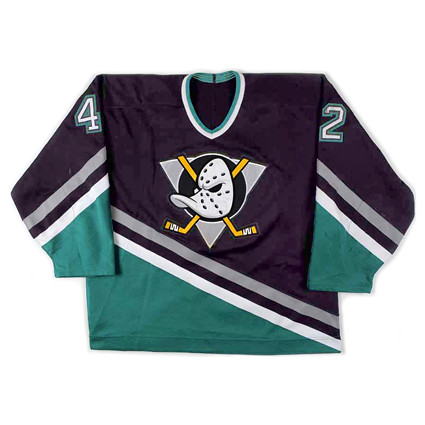
Mighty Ducks of Anaheim 1995-96 F jersey
Mighty Ducks of Anaheim 1995-96 B jersey

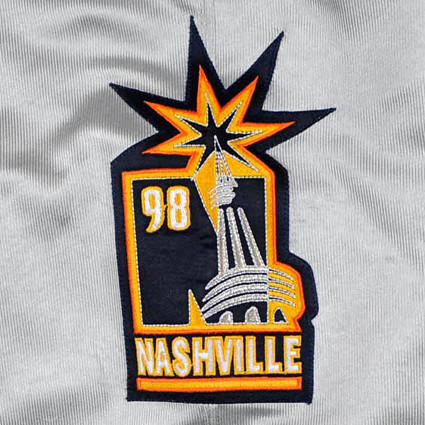
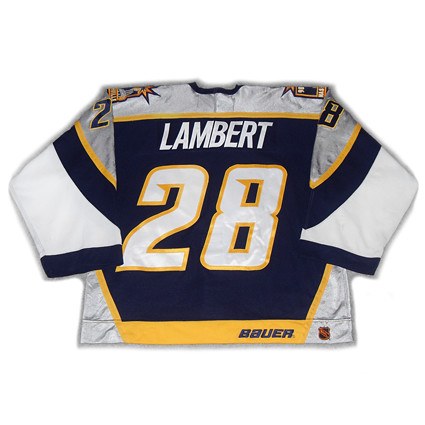
Extra bonus jersey: Today's extra bonus jersey is a 1998-99 Nashville Predators Denny Lambert jersey from the Predators first season in the NHL.

Two things set the first season Predators jerseys apart from those that would follow. First, the secondary shoulder patch for their first season would have "98" added to the design, as shown below.

Second, the first season Predators jerseys were supplied by Bauer, making them completely unique in the NHL, as six teams were supplied by Nike, nine by CCM and the remaining 11 by Starter. For their second season, Nashville would change to CCM jerseys, leaving the first season Bauer jerseys as an interesting footnote for collectors.
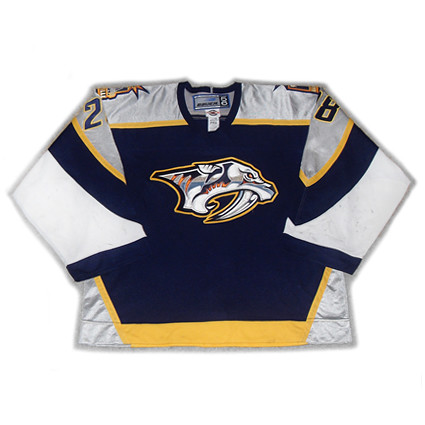
Nashville Predators 1998-99 F jersey
Nashville Predators 1998-99 B jersey
Nashville Predators 1998-99 P jersey

In today's video section, Lambert does what he does best, as he throws haymakers with Paul Kruse of the Salt Lake Golden Eagles during the 1991-92 IHL season.


Next is an interview with Lambert, who recalls his time with the Senators.


Monday, November 2, 2015

2004 Belarus National Team Ruslan Salei Jersey

After beginning his career with his hometown Russian Superleague club Dynamo Minsk of Belarus in 1992-93, defenseman Ruslan Salei, born on this date in 1974, played two more seasons with the club, then renamed Tivali Minsk, until taking the opportunity of the recently changed political landscape to come to North America and try to gain the attention of NHL scouts.

He signed with the Las Vegas Thunder of the International Hockey League for the 1995-96 season. While never an offensive force, he did surpass any offensive output he managed in Russia, thanks in part to the longer North American professional season, when he scored 7 goals and 30 points, five times more than the high of 6 he managed the year before in 51 games. In addition, he also showed his rugged side by accumulating 123 penalty minutes. All of this led to his being drafted 9th overall in the 1996 NHL Entry Draft by the Mighty Ducks of Anaheim.

His next season was divided between the Thunder (8 games), the Baltimore Bandits of the American Hockey League (12 games) and making his NHL debut with Anaheim (30 games), which included Salei scoring his first NHL point with an assist.

Salei Ducks

For 1997-98, Salei spent the vast majority of his season with the Mighty Ducks, which included his scoring 5 goals and 15 points in 66 games. He also skated for the Cincinnati Mighty Ducks of the AHL in six games that same season.

He would spend the entire 1998-99 season with Anaheim, playing in 74 games as well as seeing his first playoff action in three games during the postseason. While certainly not a flashy offensive defenseman, he became a fan favorite for his grit, nastiness and determination.

After four more seasons, the Mighty Ducks would go on their first extended playoff run, making it all the way to the Stanley Cup Finals, thanks to their solid defensive corps, consisting of Niclas Havelid, Keith Carney, Sandis Ozolinsh, Salei, Vitali Vishnevsky and Kurt Sauer playing in front of Conn Smythe Winner Jean-Sebastien Giguere. The Mighty Ducks gave up just 6 goals in 4 games while sweeping Detroit in Round 1, eliminated Dallas in six, miraculously gave up just a single goal to Minnesota as they were swept in four and took the New Jersey Devils to seven games in the finals as Giguere finished the postseason with five shutouts.

The highlight of not only the playoffs, but perhaps his entire career, was Salei winning Game 3 of the finals for the Mighty Ducks with his overtime goal in Game 3 against Martin Brodeur.

After the 2003-04 season with Anaheim, Salei would travel to Russia to play with Ak Bars Kazan of the Russian Superleague during the NHL lockout of 2004-05. He returned to Anaheim for one final season when the NHL resumed play in 2005-06, which included his setting a new NHL high with 19 points.

Salei left the Mighty Ducks after nine seasons to sign a free agent contract with the Florida Panthers. The change in scenery led to a change in Salei's game, as he immediately surpassed his previous offensive totals by a large margin, setting career highs with 6 goals and 26 assists for 32 points, the only time in his NHL career he would exceed 23 points.

Salei Panthers

After a second season in Florida, he was dealt at the trading deadline (for former teammate Ozolinsh) to the Colorado Avalanche for the final 17 games of the season.He would play another season for Colorado, surpassing 20 points for only the third time, the other being his second season in Florida.

Salei Avalanche

He suffered a serious back injury early in 2009-10, which limited him to just 14 games for the season. The 2010-11 season saw him reunited with his former Mighty Ducks coach Mike Babcock, this time with the Detroit Red Wings. Showing his back issues were behind him, he competed in 75 regular season games as well as 11 playoff contests.

Salei Red Wings

His final NHL totals after 14 seasons of play were 917 games played with 45 goals and 159 assist for 204 points and 1,065 penalty minutes.

Internationally, Salei was a stalwart on the Belarus blue line. The Belarusians first competed internationally at the 1994 World Championships at the Group C level, where they came second to fellow newcomers Slovakia. The won Group C in 1995 with a 4-0 record (while outscoring their opponents 19-8) and were promoted to Group B.

Salei Belarus

Salei returned to the national team in 1996 and 1997 to help them qualify for the 1998 Olympics in Japan, the first to feature NHL stars, which included a record 21-0 win over Lithuania. Once in Japan, Salei and Belarus won their preliminary round group to advance to the first round, only to be grouped with powerhouses Canada, Sweden and the United States. He also scored his first Olympic goal during

Later that same spring, Belarus, now having been promoted to the top level Group A, advanced to the second round, having finished second to the Czech Republic in Group 1 thanks to wins over Germany and Japan.

He made his next international appearance at the 2000 World Championships, which was highlighted with wins over Ukraine, a shocking 1-0 shutout of Russia and a 5-3 win over Switzerland. Salei and Belarus did not fare as well in 2001, as they finished 14th, usually enough to avoid relegation, but with Japan being protected as the Far Eastern qualifier despite finishing dead last, Belarus were relegated to Division I.

Salei made his second Olympic appearance in 2002 and scored 2 goals in 6 games as Belarus became the Cinderella story of the games. First, they needed to win Group B of the Preliminary Round to advance to the First Round, where they lost three straight games to the United States, Finland and Russia. Still, all eight remaining teams advanced to the Quarterfinals where Belarus shocked the world with their stunning 4-3 defeat of Sweden thanks to Vladimir Kopat's shot from center ice which careened off of Swedish goaltender Tommy Salo's head and into the net with less than 2 and a half minutes remaining.

In 2004, Salei helped Belarus steamroll the opposition in Division I Group A with 3 goals and 7 points for his highest scoring international tournament ever, as they went 5-0 while outscoring their competition 34-9 to return to the Top Level, where they remain to this day.

After two games in an unsuccessful Olympic qualification attempt in 2005, Salei returned to the World Championships in 2008 and again in 2009 where he scored 2 goals and 5 points while serving as team captain.

Salei Belarus

Salei participated in the third Olympics of his long international career in 2010 in Vancouver. Three months later, Salei made his final international appearance as he took part in his 9th World Championships in Germany, where he scored a goal, the 13th of his career for Belarus. In all, he would play in 69 games and score 31 points in 14 tournaments.

For the 2011-12 season, Salei signed with Lokomotiv Yaroslavl of the Kontinental Hockey League.

Salei Lokomotiv

As the team were leaving to play their first game of the season, scheduled back in Salei's hometown of Minsk, Belarus, their plane crashed on takeoff, killing Salei and all but one of his 25 teammates, who then died five days later. Additionally, 11 team staff members and 7 of the 8 of the plane's crew also perished. The crash resulted in Lokomotiv bypassing their participation in the KHL season and a moving tribute to Lokomotiv on the ice in Minsk the following day.

Salei Lokomotiv

This season, tributes to Salei include former Detroit teammate Pavel Datsyuk wearing Salei's #24 during the preseason, the Red Wings honoring Salei on their patch which also includes Brad McCrimmon and Stefan Liv and the Ducks wearing Salei's #24 all season long.

At his funeral, Salei's coffin was draped with his Mighty Ducks jersey.

Salei Funeral

Today's featured jersey is a 2004 Belarus National Team Ruslan Salei jersey as worn in Salei's participation at the World Championships B Pool tournament when Salei had his highest offensive output in an international tournament with a career high 3 goals and 4 assists for 7 points.

Belarus' National Team first began play in 1994 in the C Pool. It took them two tries to elevate themselves to the B Pool and two more to rise to Group A in 1997. After being relegated in 2001, the earned immediate promotion back to the Top Level in 2002. They were again relegated in 2003 thanks to Japan being exempt from relegation. Once gain they earned an immediate promotion back to the top in 2004 and have remained there ever since, which included an all-time high finish of 6th in 2006, thanks to wins over Slovakia, Kazakhstan, Ukraine and Switzerland on their way to finishing with a 4-3 record.

The original version of today's featured jersey was crested with "Belarus" in English, which was later changed to Cyrillic in 2002.

Belarus 2004  jersey

Bonus Jersey: Today's bonus jersey is a 2002-03 Mighty Ducks of Anaheim Ruslan Salei jersey in which he scored the game winning goal in overtime of Game 3 of the Stanley Cup Finals, as evidenced by the 2003 Finals patch on the upper right chest.

Mighty Ducks of Anaheim 02-03 jersey

Today's video highlights begin with Salei winning Game 3 of the 2003 finals for Anaheim with his goal in overtime, just one of 5 playoff goals he would ever score with the Mighty Ducks.


Here are a pair of tributes to Salei, which include footage from his various NHL teams as well as playing for Belarus.


Tuesday, October 20, 2015

1991-92 Dynamo Moscow Mikhail Shtalenkov Jersey

Goaltender Mikhail Shtalenkov, born on this date in 1965, with Dynamo Moscow backing up veteran Vladimir Myshkin in 1986-87 and saw action in 17 games with a goals against average of 2.41 on this way to being named the Soviet Rookie of the Year. He played 25 games in 1987-88, but Myshkin reclaimed his number one status, limiting Shtalenkov to 10 games over the next two seasons.

Shtalenkov Dynamo photo Shtalenkov Dynamo.jpg
Shtalenkov began his career with Dynamo Moscow

With the departure of Myshkin, Shtalenkov took over as the number one goaltender for the 1990-91 season and guided the club to their second consecutive Soviet League championship. This would earn him his first international opportunity, as he would join the Soviet National Team for the 1991 Canada Cup tournament where he would start all five of the Soviet's games.

Shtalenkov Soviet Union photo Shtalenkov Soviet Union.jpg
Shtalenkov began his international career in the
1991 Canada Cup with the Soviet Union

1991-92 would be a memorable season for Shtalenkov, as he would play 25 games for Dynamo and win another league championship, 8 games for the Unified Team at the 1992 Olympics, where he would play 8 games with a 1.64 goals against and a 92% save percentage to backstop the team to a gold medal just a matter of weeks following he breakup of the Soviet Union and finally 6 games for Russia at the 1992 World Championships.

With two consecutive league titles and a gold medal on his resume, Shtalenkov brought his game to North America and signed with the Milwaukee Admirals, then of the IHL. He led the team in games played with 47 while finishing the season with a 26-14-5 record with a 3.03 GAA to earn the Garry F. Longman Memorial Trophy as the IHL's top rookie.

Shtalenkov Admirals photo Shtalenkov Admirals.jpg
Shtalenkov was the IHL Rookie of the Year in 1993

This attracted the attention of the NHL, and Shtalenkov was drafted by the Mighty Ducks of Anahiem in the 1993 NHL Entry Draft. He would play 28 games for the San Diego Gulls of the IHL, going 15-11-2, and then make his NHL debut for the Mighty Ducks, seeing action in 10 games with a 3-4-1 record. He would also then play 6 games for Russia at the 1994 World Championships.

Shtalenkov Gulls photo Shtalenkov Gulls.jpg
Shtalenkov while with the San Diego Gulls of the IHL

He was back with Anaheim for the 1994-95 season, seeing action in 18 games before playing in 30 games of the 1995-96 season. He would once again play for Russia at the 1996 World Championships in the spring and later be named to their roster for the 1996 World Cup of Hockey later in the fall.

Shtalenkov Mighty Ducks photo Shtalenkov Mighty Ducks 3.jpg
Shtalenkov made his NHL debut with Anaheim

In 1996-97 Shtalenkov played 24 regular season games for Anaheim and then made his playoff debut with 4 games in goal for the Mighty Ducks.

Shtalenkov Mighty Ducks photo Shtalenkov Mighty Ducks.jpg

He would play a career high 40 games in 1997-98 while splitting time with Guy Herbert. Shtalenkov would also return to the Olympics in 1998, the first Games for which the NHL would take a break to allow it's top players a chance to compete. He would play in 5 of Russia's games, winning 4, and come back with a silver medal.

Shtalenkov Russia photo Shtalenkov Russia.jpg
Shtalenkov backstopped Russia to a silver medal in 1998

The NHL would expand for the 1998-99 season, and Shtalenkov would be claimed by the Nashville Predators, who would in turn trade him to the Edmonton Oilers. After 34 games with Edmonton during the 1998-99 season, he would be dealt to the Phoenix Coyotes in March of 1999.

Shtalenkov Coyotes photo Shtalenkov Coyotes.jpg
Shtalenkov while with the Coyotes

Shtalenkov would play just 15 games for Phoenix in 1999-00 before being traded yet again, this time to the Florida Panthers, with whom he would play the final 15 games of his NHL career.

Shtalenkov Panthers photo Shtalenkov Panthers.jpg
The final games of Shtalenkov's career were with the Panthers

For the 2000-01 season, Shtalenkov would return to Dynamo Moscow, where he would play in 25 games, with six shutouts and a 1.95 GAA. Later in the spring, he would play in his fourth and final World Championships for Russia.

Shtalenkov would play one final season for Dynamo in 2001-02, playing in 28 games with a 2.02 goals against average.

His final NHL totals were 190 games played, with a 62-82-19 record with 8 shutouts and a 2.88 goals against average.

Since 2009, Shtalenkov has been a goaltending coach for various teams in the KHL.

Today's featured jersey is a 1991-92 Dynamo Moscow Mikhail Shtalenkov jersey as worn the year Shtalenkov took over as the team's number one goaltender and led Dynamo to the league championship.

Moscow Dynamo 1990-91 jersey photo Moscow Dynamo 1990-91 F.jpg
Moscow Dynamo 1990-91 B photo Moscow Dynamo 1990-91 B.jpg

Bonus jersey: Today's bonus jersey is a 1997-98 Mighty Ducks of Anaheim Mikhail Shtalenkov jersey as worn by Shtalenkov during the season he set an NHL career high with 40 games played.

The Mighty Ducks would break new ground in 1993 when they debuted their new jerseys with the first diagonal waist striping in league history in addition to their never before seen colors of jade and eggplant.

This jersey would serve the club well, lasting through thirteen seasons until a change in ownership led to a modified team name and all new colors to mark the team's new era, bringing to an end the groundbreaking color scheme of the Disney owned Mighty Ducks.

 photo Mighty Ducks 1997-98 F jersey.jpg
Mighty Ducks 1997-98 jersey photo Mighty Ducks 1997-98 B jersey_1.jpg

Extra bonus jersey: Today's extra bonus jersey is a 1998-99 Phoenix Coyotes Mikhail Shtalenkov jersey. This wild alternate jersey as worn by Shtalenkov during the season he was claimed by Nashville, traded to Edmonton and then sent to Phoenix.

The Coyotes home and road jerseys of the day were thought to be strange enough by traditional hockey fans, but this eerie alternate jersey took things to a whole new level, causing some to refer to it as "Peyote Ugly", after the plant known in the southwest for it's hallucinogenic properties.

This jersey was worn by Phoenix for five seasons until a complete overhaul of the team's identity led to not only an all new logo, but all new team colors and jerseys as well.

Phoenix Coyotes 1998-99 jersey photo Phoenix Coyotes 1998-99 F jersey.jpg
Phoenix Coyotes 1998-99 jersey photo Phoenix Coyotes 1998-99 B jersey.jpg

Today's video section is the Top Five Saves of the Week - and Shtalenkov makes the number one save of them all.

Monday, February 9, 2015

Red Army Movie Green Unit Week - 1996-97 HC CSKA Moscow Alexei Kasatonov Jersey

The move "Red Army" documents the most successful dynasty in sports history, the Soviet Central Red Army Hockey Club, winners of 32 Soviet League Championships in the 42 years between 1948 and 1989, including 13 consecutive from 1977 to 1989, 12 Russian Cups and 20 European Champions Cups. Additionally, the majority of the roster traditionally made up the Soviet Union National Team, which won 22 World Championships and 7 Olympic Gold Medals.

Red Army poster photo RedArmyMovieposter.jpg

During the 1980's, the driving force on the ice was the five man group known as The Green Unit which consisted of forwards Sergei Makarov, Igor Larionov and Vladimir Krutov and defensemen Alexei Kasatonov and Viacheslav Fetisov.

Green Unit photo GreenUnit.jpg
Kasatonov, Makarov, Larionov, Krutov and Fetisov

The Soviet five man units were in contrast to the North American practice of having three man forward lines and separate two man defensive pairs which were not linked to any particular of a team's forward lines' rotation on the ice.

The Green Unit was coached by the legendary Viktor Tihonov, whose all-powerful, dictatorial style brought the team great successes, but at the cost of the freedom of his players, who were required to not only train, but live in the team's training base for 11 months out of the year.

The Green Unit is the predecessor to the later, but better known "Russian Five" of the 1997 Stanley Cup champion Detroit Red Wings, which consisted of forwards Larionov, Sergei Fedorov and Slava Kozlov with Fetisov and Vladimir Konstantinov on defense

The focus of the film is seven-time World Champion, two-time Olympic gold medalist, two-time Stanley Cup champion and Canada Cup winner and Soviet National Team captain Fetisov, who resisted the control of Tikhonov and sought to change the system from within all while refusing to take the quick way out by defecting as others had done. One of the most interesting aspects of the film is the creative, free flowing style of the Soviet team while living under a repressive political system in contrast to the North American teams had all the personal freedoms one could hope for but played a rigid style of hockey with a heavy dose brutality.

Red Army opened in theaters in New York and Los Angeles on January 23rd, in San Francisco and Washington D. C. on January 30th, Chicago on February 6th and will open in San Diego, Dallas, Houston, Minneapolis, Philadelphia, Baltimore, Boston, Miami, Ft. Lauderdale, Boca Raton, West Palm, Phoenix and in the New York and Los Angeles areas this Friday, February 13th.

The movie will also open in Denver, Atlanta, St. Louis, Buffalo (2/20), Seattle, Portland, Detroit, Kansas City (2/27), Tampa, Cleveland, Cincinnati, Pittsburgh (3/6), Columbus (3/13) and Indianapolis (3/27) among many, many other smaller markets between February 20th and March 27th.

In honor of the wider US release of Red Army beginning this Friday and continuing nationwide over the course of the next month, this week we are featuring each member of the Soviet Central Red Army Hockey Club's famed "Green Unit", beginning with defenseman Kasatonov, who was born in 1959 in what was then known as Leningrad in the Soviet Union.

Kasatononv played seven seasons in the NHL following a 15 year career in the Soviet Elite League, which began with SKA Leningrad in 1976-77. He would play for SKA for two seasons after which he moved to CSKA Moscow, known more commonly as the Red Army Hockey Club, who were able to collect all the best players in the Soviet Union through their power to make the players they desired members of the Soviet Army and assign them to the army sports club's hockey team as part of their military duty.

This loophole also allowed the Soviet veterans to continue to play together in the Olympics as amateurs, as they were not technically paid to play hockey, but were paid as soldiers in the military, much to the annoyance and frustration of the Canadians, whose players to paid directly as professional athletes, and therefore not eligible to compete in the Olympics after the conclusion of their junior careers.

Kasatonov played for CSKA Moscow from the 1978-79 season through 1989-90, winning 11 consecutive Soviet League Championships from 1979 to 1989 and 12 consecutive European Cups. While a member of Red Army, he scored a high of 18 goals in 1984-85 and a best 27 assists and 39 points in 1981-82 in a league where the season was between 40 and 50 games long.

Alexi Kasatonov
Kasatonov with CSKA Moscow

As a member of CSKA Moscow, he was also a long-time member of the Soviet National Team, which naturally was primarily comprised of players from the most dominant club in the land.

Kasatonov CCCP photo KasatonovCCCP.jpg
Kasatonov in the mid 1980's on the Soviet National Team

While playing for his country, Kasatonov won gold medals at the World Championships in 1981, 1982, 1983, 1986 and 1989 and a silver medal in the 1980 and gold medals in both the 1984 and 1988 Olympics as a member of the famed "Green Unit".

Soviet Green Unit
The "Green Unit"

Following the conclusion of the 1989-90 Soviet season, Kasatonov was allowed to join the New Jersey Devils of the NHL, where he would be reunited with former Red Army teammate Fetisov for the second half of the NHL sechedule. Kasatonov's first NHL season comprised 39 games in which he scored 6 goals and 21 points while acclimating to life in North America, which was often a difficult proposition for Soviet players in those days.

Kasatonov Devils photo KasatonovDevils.jpg
Kasatonov now in the NHL with New Jersey

The NHL game agreed with Kasatonov though, and he scored 41 and 40 points the next two seasons while playing 78 and 76 games, with 14 additional playoff games added on, for a total of 168 over two seasons, when compared to the perhaps 120 he was accustomed to. He was limited to 64 games and saw his point total drop precipitously to just 17 in 1992-93, which saw the 34 year old left unprotected in the 1993 NHL Expansion Draft and subsequently claimed by the Mighty Ducks of Anaheim.

Kasatonov played 55 games for the Mighty Ducks and appear in the 1994 NHL All-Star Game prior to being traded to the St. Louis Blues in late March of 1994 wher he would play just 8 games with the Blues.

He returned to CSKA Moscow for nine games during the work stoppage of 1994, and once the NHL season began, he began play with the Boston Bruins, with whom he had signed as a free agent. The following season Kasatonov played 19 games with Boston and 16 games with Providence of the AHL.

He returned to Russia for one last season with Tikhonov's new club, the similarly named HC CSKA Moscow in 1996-97 before his retirement as a professional.

HIs final NHL totals were 38 goals and 122 assists for 160 points in 383 games, and combined, he scored 200 goals and 627 points in 1128 games.

Kasatonov was named a "Honored Master of Sport" in Russia and was inducted into the IIHF Hall of Fame in 2009.

Alexi Kasatonov
Kasatonov's induction to the IIHF Hall of Fame in 2009

Today's featured jersey is a 1996-97 HC CSKA Moscow Alexei Kasatonov jersey. This jersey is from Kasatonov's final season when he returned to Russia following the conclusion of his NHL career. Note the name on the back in Cyrillic lettering.

After the collapse of the Soviet Union in 1991, the government funding of the once all-conquering CSKA Moscow disappeared and the Pittsburgh Penguins of the NHL entered into a business partnership with the club, which was often referred to as "the Russian Penguins" during this time period as a penguin was integrated into the club's identity.

After two seasons of attempting to run the once mighty Soviet club with their NHL marketing savvy, the Russians figured they had learned all they needed to know, and felt they could run the show themselves without having to give Pittsburgh a 50% cut of the profits. The North Americans were only too happy to head home, having had enough close calls with the meddlesome Russian Mafia, who not only kicked the team's sponsors out of their "Super Boxes", but were responsible for the assassinations of as many as three of the team's staff!

In 1995-96, all the multinational sponsors pulled out, CSKA were eliminated from the playoffs in the first round and the team had the water and electricity turned off before being locked out of their own arena. In the upheaval afterwards, long-time CKSA head coach Tikhonov was ousted and responded by forming his own, incredibly similarly named team, HC CKSA Moscow!

While the original CSKA Moscow "Red Army" club returned to their previous star logo, the upstart new HC CSKA Moscow adopted the "Russian Penguin" identity as their own, creating much confusion among jersey collectors, as the Penguin logo was used for eight consecutive seasons, but by two separate, but nearly identically named clubs.

The CSKA Moscow "Russian Penguins" jerseys were red with black and white trim. The HC CSKA Moscow "Russian Penguins" jerseys were also red with black and white trim with LG sponsorship and the letters XK (Cyrillic for HC to differentiate themselves from CSKA Moscow) added to the upper chest of the penguin logo before a change to red jerseys with blue and white trim as shown in today's featured jersey.

After six seasons of two separate "Red Army" clubs, they were merged for the 2002-03 season, bringing to an end the use of the Russian Penguins logo.

Russian Penguins 96-97 jersey

Bonus Jersey: Today's bonus jersey is a 1993-94 Mighty Ducks of Anaheim Alexei Kasatonov jersey as worn during the Mighty Ducks inaugural season in which Kasatonov played 55 games before being traded to the St. Louis Blues.

Mighty Ducks 93-94 jersey

In today's video segment, a look at Kasatonov's career and his life after retiring from hockey, which includes coaching hockey in America.


Here, Kasatonov discusses the "Miracle on Ice" 25 years later.


Finally, while playing for the Soviet National Team, Kasatonov scores against Grant Fuhr and the NHL All-Stars during Rendez-Vous '87.


Finally, the trailer for the movie "Red Army", opening in theaters across the United States soon.


Monday, January 12, 2015

Teemu Selanne Anaheim Ducks Jersey Retrospective

Last night at the Honda Center Teemu Selanne became the first player in the history of the Anaheim Ducks franchise to have his number retired when his number 8 was raised to the rafters.

Selanne jersey retirement photo Selannejerseyretirement.jpg

Selanne played 21 NHL seasons, with 15 of those being in Ahaheim. He began his career with the Winnipeg Jets in 1992-93 in spectacular style, setting the NHL record for Most Goals by a Rookie with 76. He remains one of only eight men to score 70 in a season and it remains the fifth highest by a player in a single season and the only 70 goal season by a rookie.

Selanne was dealt by a financially distressed Jets team to the Mighty Ducks of Anaheim midway through the 1995-96 season and formed a memorable duo with linemate Paul Kariya for years.

He would play six seasons with the Mighty Ducks and would wear five different jersey styles for the club.

The first two jerseys were the Mighty Ducks original home and away jerseys, which broke new ground as the first jerseys in league history to feature a bold diagonal waist stripe when they debuted for the 1993-94 season. The infuence was immediate, as both the St. Louis Blues and Calgary Flames would follow suit the following season. They also added new, radical colors to the NHL palette, those being eggplant and jade.

 photo 1998-99TeemuSelanneAnaheimMightyDucksGameWornJersey-MauricequotRocketquotRichardTrophyF.jpg
 photo 1998-99TeemuSelanneAnaheimMightyDucksGameWornJersey-MauricequotRocketquotRichardTrophyB.jpg
The Mighty Ducks 1993-2003 home jersey,
this particular one manufactured by Nike

Anaheim Mighty Ducks 2000-01 jersey photo AnaheimMightyDucks2000-01Fjersey.jpg
Anaheim Mighty Ducks 2000-01 jersey photo AnaheimMightyDucks2000-01Bjersey.jpg
The Mighty Ducks 1993-2003 eggplant colored road jersey

In addition to the Mighty Ducks standard home and away jerseys, Selanne had the misfortune to arrive in Anaheim the season they club debuted their first alternate jersey, the absurd "Wild Wing" jersey which featured their team mascot as a super hero breaking through the ice, made possible by the first use of dye-sublimation technology, which now allowed designs to be printed onto the jerseys, rather than being limited to just sewing pieces of fabric together to create limited striping patterns.

The jerseys were so poorly received by the players that they were only worn six times and the players even went so far to request that they not be pictured wearing them in the following season's media guide!

Anaheim Mighty Ducks 1995-96 Wild Wing Alt #8 jersey photo AnaheimMightyDucks95-96Alt8F.jpg
Anaheim Mighty Ducks 1995-96 Wild Wing Alt #8 jersey photo AnaheimMightyDucks95-96Alt8B.jpg
The Mighty Ducks short lived "Wild Wing" alternate of 1995-96

After the failure of the Wild Wing alternate in 1996, the Mighty Ducks would try again in 1997-98 when they would introduce not one, but two new alternate jerseys. The pair would share the same template. The first was a somewhat unnecessary white alternate, but the "fourth" jersey was jade with eggplant running down the arms, which complimented the home white and road eggplant jerseys well enough.

Mighty Ducks of Anaheim 1997-98 third jersey photo AnaheimMightyDucksGOJ97-98F.jpg
Mighty Ducks of Anaheim 1997-98 third jersey photo AnaheimMightyDucksGOJ97-98B.jpg
The white third jersey arrived first, having been worn during the
season opening Game ONe Japan event in Tokyo

Mighty Ducks of Anaheim 1997-98 fourth jersey photo AnaheimMightyDucks97-984thF.jpg
Mighty Ducks of Anaheim 1997-98 fourth jersey photo AnaheimMightyDucks97-984thB.jpg
The jade alternate was the first fourth jersey in league
history and was used for just two seasons

During Selanne's first six years with the Mighty Ducks he would put together back-to-back 50 goal seasons with 51 in 1996-97 and 52 in 1997-98. Thanks to his 58 assists in 1996-97, Selanne would also have the highest scoring season with Anaheim with 109 points. After his 52 goal season in 1998, he followed that with a 47 goal, 107 point season in 1998-99 which earned him the inaugural Rocket Richard Trophy as the leading goal scorer in the NHL. He would lead the Mighty Ducks in scoring in 1997, 1998 and 1999.

Selanne would also appear in seven NHL All-Star Games during his first tour of duty with the Mighty Ducks. This would lead to a unique jersey variation, as Selanne would participate in the 1997 All-Star Super Skills Competition with the flag of Finland on his jersey for the one and only time to denote his nationality as part of the first World vs. North America All-Star Game format to promote the participation of NHL players in the upcoming 1998 Olympics in Nagano, Japan.

 photo AnaheimMightyDucks97-98F.jpg
Selanne wore the Finland flag on his jersey during the 1997 Super Skills
Competition at the 1997 NHL All-Star Game for the one and only time

Other than the Game ONe 1997 patch worn on the eggplant jerseys on October 3, 1997 and the new white third jersey on October 4, 1997, the only other patch worn by Selanne during the first phase of his Anaheim career was the eggplant version of the NHL 2000 patch during the 1999-00 NHL season on the Mighty Ducks home white, road eggplant and white alternate jerseys, as the jade alternate was discontinued after the 1998-99 season.

During the 2000-01 season, Selanne was the Mighty Ducks leading scorer, but with the team in last place, they chose to trade Selanne to the San Jose Sharks. After two and a half seasons in San Jose, he signed a one year contract, along with former Anaheim linemate Kariya, with the Colorado Avalanche. With the NHL season cancelled in 2004-05, Selanne chose to rest and allow his body to heal rather than play in Europe like many other NHLers chose to.

Again a free agent, Selanne chose to return to the Mighty Ducks of Anaheim for the 2005-06 season. Unlike other older veteran players who did not play during 2004-05 and were never the same again, the year off rejuvenated Selanne, who rebounded from a dismal 15 goal season in Colorado to post a 40 goal season in 2005-06. His strong performance upon his return to the NHL was recognized by Selanne being named the 2006 recipient of the Masterton Trophy for dedication and perseverance to hockey.

His 40 goal season was followed by a 48 goal, 94 point 2006-07 season, easily the best of his second stint in Anaheim, which was capped off by a triumphant Stanley Cup championship, which caused many to speculate if the now 36 year old would retire on top.

That was not to be, and not by a long shot, as Selanne would play an additional seven seasons with the Ducks. Age and injuries began to take their toll, as he was limited to 26 games in 2007-08, 65 and 54 games the two following seasons. However, Selanne still had a surprise for his loyal fans, as he rebounded in 2010-11 with a 73 game, 80 point season and backed that up with a full 82 games and 66 points in 2011-12. He would play two more seasons before retiring after the 2013-14 season at the age of 43.

When Selanne returned to the club in 2005-06, they were in their final season of wearing their original white and eggplant jerseys, only with the dark jerseys now being worn at home and the whties on the road. During Selanne's absence, the club introduced a black alternate jersey in 2003-04, which Selanne wore during his first season back with the Mighty Ducks. However, Selanne found on his return to Anaheim that his traditional #8 was now in use by Latvian defenseman Sandis Ozolinsh. Selanne chose to revert to the #13 that he wore during his rookie season in Winnipeg.

Mighty Ducks of Anaheim 2005-06 alt jersey photo AnaheimDucks2005-06F.jpg
Mighty Ducks of Anaheim 2005-06 alt jersey photo AnaheimDucks2005-06B.jpg
The Mighty Ducks final alternate jersey, worn by Selanne for one season
on his return to Anaheim, notable for the #13

A change in ownership for the club saw a change in name from the original and unconventional Mighty Ducks of Anaheim to the Anaheim Ducks for 2006-07. Along with the name change came an entirely new identity package, which meant new logos, colors and, of course, jerseys. The new name and jerseys were christened with the first Stanley Cup in franchise history - fine way to break in the team's new look. Additionally, with Ozolinsh having been traded away the previous season, Selanne was now free to return to his preferred #8 for 2006-07.

Anaheim Ducks 2006-07 Jersey photo 2006-07TeemuSelanneAnaheimDucksGameWornJersey-StanleyCupSeasonF.jpg
 photo 2006-07TeemuSelanneAnaheimDucksGameWornJersey-StanleyCupSeasonB.jpg
The Ducks introduced an entirely new look for 2006-07 and
promptly won the Stanley Cup

Anaheim Ducks 2007-08 jersey photo 2007-08TeemuSelanneAnaheimDucksGameWornJersey-StanleyCupSeasonBRoad.jpg
Anaheim Ducks 2007-08 jersey photo 2007-08TeemuSelanneAnaheimDucksGameWornJersey-StanleyCupSeasonBHome.jpg
The rounded shirt tail look arrived in 2007-08 with the
new Reebok Edge jerseys

After sticking to just a black home jersey and a white road for the first four seasons of the new era as the Anaheim Ducks, the team introduced their a new alternate jersey for the first time since 2005-06. The jersey was an attractive looking upgrade over their home and road jerseys, as the promotion of the capital "D", in the form of a duck's footprint was a bold statement of identity rather than the too short wordmark of the home and road jerseys. Additionally, the more liberal incorporation of orange made for a much more vibrant jersey than the primary black home jersey.

Anaheim Ducks 2011-12 jersey photo AnaheimDucks2011-12SelanneFinlandPremiereFjersey.jpg
Anaheim Ducks 2011-12 jersey photo AnaheimDucks2011-12SelanneFinlandPremiereBjersey.jpg
The fifth alternate jersey in Ducks history arrived in 2010

This particular jersey was worn at the start of the 2011-12 season as part of the NHL Premiere series of games, where selected teams opened their regular season in Europe, as evidenced by the NHL Premiere Finland patch on the right chest. The Ducks were no doubt sent to Finland due to Selanne's popularity in his homeland.

One final jersey variation would await Selanne during the final season of his career, as the Ducks were chosen to play outdoors at Dodger Stadium against the Los Angeles Kings as part of the Stadium Series of games, meant to capitalize on the popularity of the New Year's Day Winter Classic games. As with the Winter Classic, teams would wear special one-off jerseys for the event, with the Ducks choosing a bold orange look, which no doubt was visible from the upper reaches of the baseball stadium.

 photo AnaheimDucks2013-14SelanneStadiumSeriesFjersey.png
Anaheim Ducks 2013-14 Stadium Series jersey photo AnaheimDucks2013-14SelanneStadiumSeriesBjersey.png
The Anaheim Ducks orange Stadium Series jersey was
worn just once on January 25, 2014 outdoors at Dodger Stadium

Of note, during Selanne's final season with the Ducks, they would wear their original eggplant jerseys for an October 13th turn back the clock game to commemorate their 20th NHL season.

During his second time with the club, Selanne would again lead the team in scoring in 2006, 2007 and one final time in 2012, no easy feat at the age of 41 and when competing with young All-Stars such as Ryan Getzlaf and Corey Perry.

In all, Selanne would play 15 seasons in Anaheim, six during his first run with the club as the Mighty Ducks. He would return to the Mighty Ducks for the 2005-06 season and then play eight more after the club name was changed to the Anaheim Ducks, which included winning a Stanley Cup in 2007.

Selanne would wear nine different styles of jerseys, two sets of home and road jerseys and five alternates plus the addition of the one-off Stadium Series jersey for a grand total of ten during his career with the Mighty Ducks and later just Ducks.

Patches worn by Selanne during his second tour of duty in Anaheim included the one game only Teammates for Kids patch on January 5, 2007 on the black home jersey, the 2007 Stanley Cup Finals patch, the NHL Premiere 2011 patch on the white road jersey on October 7, 2011 and on the black alternate on October 7, 2011, the "24" memorial patch for former Mighty Ducks player Ruslan Salei, who died in the Lokomotiv Yaroslavl Air Disaster, the Ducks 20th Anniversary patch during his final NHL season of 2013-14 and the Stadium Series patch on the Ducks special one-off orange jerseys on January 25, 2014.

Here is the tribute video to Selanne from last evening's special night in Anaheim.


Next are highlights of the retirement ceremony from last evening.


hit counter for blogger