History of Jersey 83-93 Banner sm photo History of Jersey 83-93 Banner sm.jpg
Showing posts with label Chicago Blackhawks. Show all posts

Monday, March 4, 2019

1944-45 Detroit Red Wings Ted Lindsay Jersey

After growing up the son of a goaltender who once played for the storied, turn of the century Renfrew Millionaires, Ted Lindsay played junior hockey for the St. Michael's Majors before joining the Oshawa Generals in time to win the 1944 Memorial Cup.

Oshawa Generals Memorial Cup
Ted Lindsay and the 1944 Memorial Cup champion Oshawa Generals

Lindsay joined the Detroit Red Wings for 1944-45 and had a couple of average seasons to begin his career, 23 points and then just 17 in 1945-46, but then the following year Lindsay was put on a line with veteran Sid Abel and a rookie named Gordie Howe and his career shifted into high gear.

Lindsay Howe Abel Production Line
Lindsay, How and Abel, the Production Line

The line was dubbed "The Production Line" based on their offensive output, which saw Lindsay's point totals jump from 17 to 42 and then continue to rise to 52 to lead the Red Wings in scoring and the entire league in goals with 33.
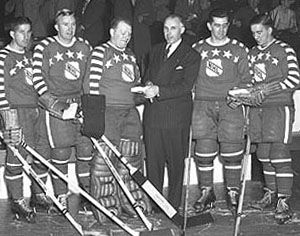
Lindsay 1948 All-Star
Lindsay being named a first team All-Star in 1948

His point total rose to 54 in 1948-49 before a quantum leap to 78 points in 1949-50 to win the Art Ross Trophy for leading the entire NHL in scoring as Howe and Abel came in second and third, giving the line a 1-2-3 standing in the scoring race. "Terrible Ted" also was third in the league with 141 penalty minutes, just three back of the league leader.

Lindsay Red Wings A
Note the unusual treatment of the assistant captain's "A" contained in the diamond shape

In the playoffs, the Red Wings outlasted the Toronto Maple Leafs in seven games and then duplicated the feat against the New York Rangers to win the first Stanley Cup of Lindsay's career. In both series Detroit won Game 7 in overtime.

Lindsay Stanley Cup
Lindsay celebrates with the Stanley Cup

The Red Wings would again capture the Stanley Cup two seasons later in 1951-52 after Lindsay had the second 30 goal season of his career. In 1952-53, he would again top 30 goals with 32 and 70 points for the second time with 71. After the departure of Abel, Lindsay was named captain of the Red Wings, a position he would hold until 1956. It was during this time period that Lindsay began the tradition of the captain of the winning team lifting the Stanley Cup and skating it around the ice in celebration, a scene now repeated every year.

Lindsay 1954 Stanley Cup
Captain Lindsay with the 1954 Stanley Cup

The 19954-55 Red Wings would finished first overall in the league for the seventh consecutive season and go on to take the fourth Stanley Cup of Lindsay's career. While he was limited to just 49 games of the regular season in 1954-55, snapping his 20 goals/40 points streak at 8 seasons, he was healthy in time for the playoffs where his stellar 19 points in 11 games contributed greatly to Detroit winning the second of back-to-back championships.

The time he missed also interrupted his consecutive streak of 100 penalty minutes or more streak, the only one of ten seasons he was under the century mark. So rough was Lindsay's style of play that penalties had to be created for elbowing and kneeing! He also acquired more than 400 stitches during his career before losing track.

in 1956-57, Lindsay had the greatest offensive season of his career with 85 points, this coming from 30 goals and a league leading 55 assists, which earned him a Sports Illustrated cover.

Lindsay and Howe SI cover 1957
Lindsay and Howe on the Cover of SI in the spring of 1957

He was also busy that season off the ice, organizing the NHL Players' Association. Already not on good terms with Detroit general manager Jack Adams, Lindsay's union organizing efforts saw him stripped of his captaincy and later earned him a trip out of town, as he was banished to the lowly Chicago Black Hawks, who had missed the playoffs 12 times in the previous 14 seasons, in a six team league no less! Lindsay was the NHL's third leading all-time goal scorer at the time of the trade.

While the Black Hawks would miss the playoffs in 1957-58, Lindsay would have by far his best of three seasons in Chicago in 1958-59 with 22 goals and 58 points as well as a career high of 184 penalty minutes as the Black Hawks returned to the playoffs for the first time in six seasons. He would retire after one more season with Chicago with 999 games played.

Lindsay Black Hawks
Lindsay while with the Black Hawks

After four seasons away from the ice, Adams replacement and old line mate Abel coaxed Lindsay out of retirement for the 1964-65 season. He returned to the ice on in 1964 for his 1,000th NHL game, becoming only the fourth player in league history at the time to have reached 1,000 games after linemate Howe, Bill Gadsby and Red Kelly. Lindsay added a final 14 goals and 28 points to his career totals as the Red Wings finished with the best regular season record in the league for the first time since his departure.

His final career totals are 379 goals and 472 assists for 851 points in 1,068 games played along with 1,808 penalty minutes. He also competed in 133 playoff games (in an era when the maximum number of games was just 14) scoring 47 goals and 49 assists for 96 points. At the time of his retirement, Lindsay was the highest scoring left winger in league history.

He played in 11 NHL All-Star Games and won four Stanley Cups and was inducted into the Hockey Hall of Fame in 1966, but declined to attend the ceremony since it was for men only, and he wanted his wife and family to attend, a rule which was changed for the following year.

In 1991, the Detroit Red Wings held a pregame ceremony where they retired Lindsay's #7 sweater as well as the #10 of Alex Delvecchio.

Red_Wings_retired_numbers
Lindsay's #7 hangs in the rafters of Joe Louis Arena with the other Red Wings honored greats

In 2010 the NHL Players Association renamed the award the players vote on for their annual MVP from the Lester Pearson Award to the Ted Lindsay Award in honor of his pioneering work in forming the player's association.

Today's featured jersey is a 1944-45 Detroit Red Wings Ted Lindsay jersey. While the Red Wings jerseys have remained essential unchanged since the dawn of time, this particular one stands out for the patches worn on the sleeves during Lindsay's rookie season in the NHL.

The patch on Lindsay's left sleeve is a "V" for victory, with three dots on the left of the patch and a dash on the right (Morse code for "v") was first worn during the 1941-42 season. It remained for four seasons through 1944-45.

On Lindsay's right sleeve is a patch promoting the purchase of war bonds. First worn in 1942-43, this patch was used for three seasons through 1944-45.

Detroit War Bonds patch

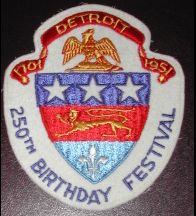
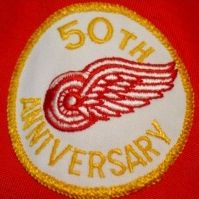
After wearing a patch during 1951 to promote the 250th anniversary of the City of Detroit, the Red Wings would not wear another patch until 1975 for the franchise's 50th Anniversary.

Detroit Red Wings 44-45 jersey

Bonus Jersey: Today's bonus jersey is a 1958-59 Chicago Black Hawks Ted Lindsay jersey. While very similar to today's Blackhawks jerseys, note the location of the crossed tomahawks inside the sleeve stripes rather than the now traditional placement on the shoulders.

This beautiful old sweater shows just why the Black Hawks jerseys frequently finish at the top of lists of best jerseys and was worn by Lindsay during the 1959 playoffs.

Chicago Black Hawks 58-59 jersey

Today's video section begins with Ted Lindsay's biography from the Legends of Hockey series.


In this next clip, a look back at Ted Lindsay's career first broadcast in 1978 when Lindsay was the general manager of the Red Wings.

Tuesday, August 7, 2018

1960-61 Chicago Black Hawks Stan Mikita Jersey

Stan Mikita's story is unlike probably any other player in the long history of the NHL. Born Stanislaus Gouth in Sokolce, Czechoslovakia on May 20, 1940, Mikita's family, fearing the political changes in the late 1940's as the Soviet Union's influence over Eastern Europe grew, sent the eight-year-old Stan, who was unfamiliar with hockey, to live with relatives in Canada just as the Iron Curtain closed and he took the family name Mikita of his aunt.

The Iron Curtain photo IronCurtainmap.png
A map showing Czechoslovakia behind the Iron Curtain

"Hockey was the biggest help in making the adjustment to a new life," Mikita recalled. "I was sitting on the front porch, and eventually I got enough nerve to go down onto the sidewalk to watch. One day they were short a guy, so they motioned for me to come and join them."

"I had no idea how to play hockey, so the first time a guy went around me, I chopped his legs out from under him. I didn't understand a word of English, but one of the older fellows told me, in sign language, "No, we don't play hockey like that." He showed me how to hold the stick and stickhandle. That was my introduction to hockey and where I learned the English language. Needless to say, my vocabulary was limited and included quite a few cusswords."

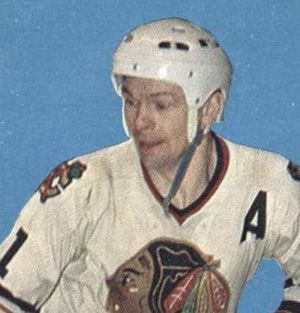
He made his NHL debut with the Black Hawks in 1958-59 season, becoming the first ever Czechoslovakian-born player in NHL history and scoring his first point and the first of many penalty minutes. He would become a regular the following season, appearing in 67 games, scoring his first NHL goal and racking up 119 penalty minutes, as he employed a rough and feisty style in part due to his smaller size.

"I hadn't completely eliminated the language factor, and kids made fun of me. That made me determined to be better than those kids as a hockey player, but I was also in a lot of scraps. When I got to the NHL in 1959, I was still fighting. My first left-winger was Ted Lindsay, who, at 5 foot 8 inches and 152 pounds, was about my size. I asked Teddy, "You've played 16 years in the league. How did you ever survive?" He answered, "Hit 'em first." I followed that advice and made sure everyone knew that I was tough enough for the NHL," said Mikita.

Stan Mikita rookie card photo MikitaRookiecard.jpg
A Stan Mikita rookie card from 1960

Mikita would improve his game in 1960-61, more than doubling his goal total to 19 and nearly doubling his assist total to 34 for a 27 point increase in points to 53 in 66 games along with another 100 penalty minutes. Following the regular season, he led all goal scorers with six and helped the Black Hawks win the Stanley Cup for the first time since 1938.

1960-61 Chicago Blackhawks team photo 1960-61ChicagoBlackhawksteam.jpg
The 1960-61 Stanley Cup champion Chicago Black Hawks

Another leap in production in 1961-62 saw him in the 20's for goals scored with 25 and 52 assists for 77 points, tied for third overall in the league with Gordie Howe, seven behind Chicago teammate Bobby Hull. While the Black Hawks would not repeat as champions, Mikita had 21 points in 12 playoff games as the Black Hawks again made it to the finals.

After another 76 point season, Mikita would capture his first Art Ross Trophy in 1963-64, leading the league in scoring with a career high 89 points on 39 goals and 50 assists, along with 146 penalty minutes, third overall and just 5 behind the league leader.

Mikita would again lead the league in scoring in 1964-65 with 87 points and 154 penalty minutes plus 10 more points in 14 playoff games as they again reached the finals.

Then an amazing thing happened. Mikita returned home from a road trip and his wife told him that their daughter was watching the last road game on TV and asked "Mommy, why does Daddy spend so much time sitting down?" It was at that point that Mikita thought about how to explain to a three-year-old how her father took a penalty he shouldn't have and was being punished for it. He also figured out where his penalty minutes were coming from and made a conscious decision to eliminate "lazy" penalties such as holding, hooking and tripping, as well as his misconduct penalties and began to play a different style of hockey and keep quiet with the referees.

The results were dramatic.

1965-66 saw a drop in penalty minutes to 58, yet he still managed 78 points, second overall.

Mikita's reinvention of his style continued in 1966-67 as he scored 35 goals and 62 assists tying the single season league record of 97 points to capture his third Art Ross Trophy, yet even more surprising was his mere 12 penalty minutes, 142 less than just two seasons prior, which earned him the Lady Byng Award. Had you suggested such a thing was even possible the first six seasons of his career, you would have been laughed at. Mikita is fond of saying, "I realized that you need an awfully long stick to score from the penalty box." The scoring title, along with reinventing his style in play, resulted in Mikita winning the Hart Trophy as well, the first player to ever win all three trophies in a single season.

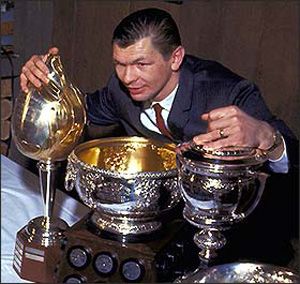
Mikita poses with his record setting trio of trophies in 1967

He would repeat the triple trophy feat in 1967-68 with a career high 40 goals, 47 assists for 87 points and just 14 penalty minutes and be named the winner of the Lady Byng, Hart and Art Ross trophies his fourth scoring title in five years.

Although his point total increased the following season to 97, tying his career best, he would finish fourth in the scoring race. The next six seasons Mikita's consistent production saw him average 78 points per season, with none lower than 65. During that time period the Black Hawks would make it to the finals in 1970-71 (18 points in 18 games) and 1972-73 (20 points in 15 games).

It was just prior to the 1972-73 season that Mikita would have a homecoming while part of Team Canada. After completing the grueling Summit Series against the Soviet Union, Team Canada travelled to Prague to play the Czechoslovakian National Team. Mikita was named team captain for the contest, which was the first time he was able to play in front of his parents and siblings.
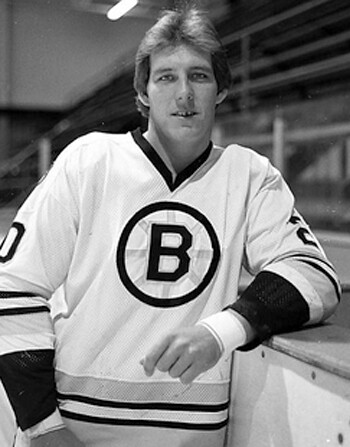
"The welcome I received from the crowd was the proudest moment in my life," said Mikita.

 photo MikitaTeamCanada.jpg
Mikita as a member of Team Canada in 1972

During the 1973-74 season, Mikita played in his 1,000th career game in a 5-3 win over the Minnesota North Stars on December 9, 1973. In doing so, Mikita became only the third player to appear in 1,000 games with Chicago. Additionally, on the same date in 1978, Mikita became only the second player in NHL history to register 900 career assists in a 4-2 win over the St. Louis Blues.
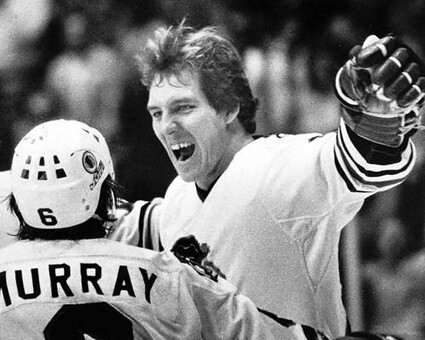
His production would drop from the 80's to the high 50's, partly due to back problems which would eventually cause him to retire  in 1980 as the second highest career scoring leader in NHL history, behind only Howe, with 1,467 points from 541 goals and 926 assists in 1,394 games, the 7th most in league history at the time.
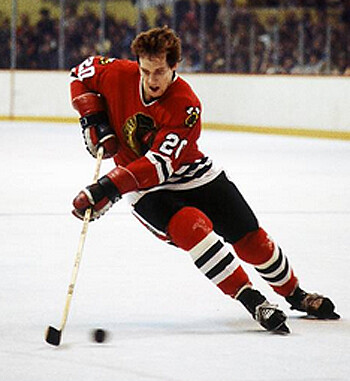
His games, assists and points were all Black Hawks records and he would finish his career with 4 Art Ross Trophies, 2 Hart Trophies and 2 Lady Byng Trophies. In addition to his trophy collection, Mikita would appear in nine NHL All-Star Games - 1964, 1967-1969 and 1971 through 1975.

Howe, Mikita & Hull-1967 ASG photo HoweMikitaampHull-1967ASG.jpg
Mikita played on a line with Howe and Hull in the 1967 All-Star Game

He was inducted into the Hockey Hall of Fame in 1983 and the Slovak Hall of Fame in 2002.

In addition to all his scoring exploits, Mikita was also an innovator of hockey equipment, both intentional in unintentional. Following a concussion in 1972-73, Mikita began wearing a helmet designed especially for him with it's distinctive round crown and even put it into production for others to purchase.


Mikita wearing the Northland Dome helmet

Having even more of an impact on how the game is played, Mikita is credited with the innovation of the curved stick blade in the early 1960's.

"My invention of the curved stick came by accident. One day, I cracked my stick in practice, forming an angle in the blade. I was tired and angry at the thought of climbing the 21 stairs to the dressing room to get another stick. I fired a puck in frustration, and the way it left my stick and the sound it made against the boards caught my attention. Before the stick finally broke, I had taken a half a dozen shots, and each time, it was the same."

"After that, I intentionally bent my stick. I broke a lot before I figured out how to make the wood pliable with heat and soaking. I experimented in practice for a month or two before I used a curved blade in a game."

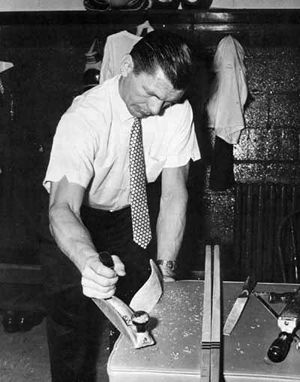
Handyman Mikita ushering in the curved stick era

The curve gave the puck a fluttering path like a baseball knuckleball, moving unexpectedly. Once put into use by Mikita and teammate Bobby Hull, and combined with Hull's notoriously hard slapshot, the curved stick blade quickly became adapted league wide and by 1963 rules were put in place to limit the amount of the curvature to lessen the effect.

Apparently not everyone agrees with this rule...


Today's featured jersey is a 1960-61 Chicago Black Hawks Stan Mikita jersey from the early days of his career. This sweater has the trappings of a 1950's style with the lace-up collar, one color numbers and no name on the back. This was the first variation where the secondary logo of the C with the crossed tomahawks were above the sleeve numbers rather than overlapping the arm stripes and below the sleeve numbers.

This indian head logo sweater, so revered today and often topping Best Jersey Lists, came into being in the 1955-56 season, replacing the previous style which had a small indian head of a different design contained in a circle logo. The 1955-56 version had no sleeve numbers and a slightly different main crest design before the logo changed to today's more familiar version and sleeve numbers were added in 1957-58. Note today's jersey has two sleeve stripes and long black cuffs, which were changed to three stripes to match the waist striping for the 1963-64 season.

Chicago Black Hawks 1959-60 jersey photo 
ChicagoBlackHawks1959-60Fjersey.jpg.png
Chicago Black Hawks 1959-60 jersey photo 
ChicagoBlackHawks1959-60Bjersey.jpg

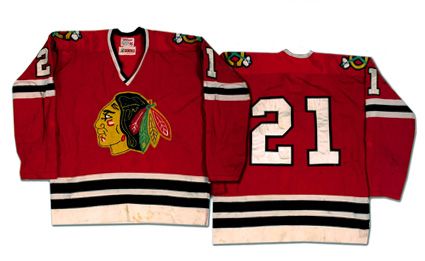
Bonus jersey: Today's bonus jersey is a 1973-74 Chicago Black Hawks Stan Mikita jersey from the season in which he played his 1,000th game. This was the first season that the Black Hawks numbers were two colors, previously being one color white numbers. The Black Hawks would not being using names on the back of their jerseys until 1977.


We hope you have some time on your hands today, as we mine a rich vein of video about Stan Mikita and his lengthy career.

First up, highlights of the 1961 Stanley Cup Finals Game 6 where Mikita assisted on the game winning goal, the first Stanley Cup won by the Black Hawks in 38 years and the only one of Mikita's career.


Here is an interview with Mikita who discusses the creation of the helmet he wore and the incident that led to the development of the curved stick and gives you a glimpse of his self-depreciating sense of humor.


Next is a nice career retrospective on Mikita.


In one of the nicer stories in hockey of the last few seasons, here is Mikita talking about rejoining the Chicago Blackhawks family as an ambassador for the team followed by the long overdue Bobby Hull and Stan Mikita Night.


For further viewing, this two part profile of Mikita from 1995 is also recommended. Part One. Part Two.

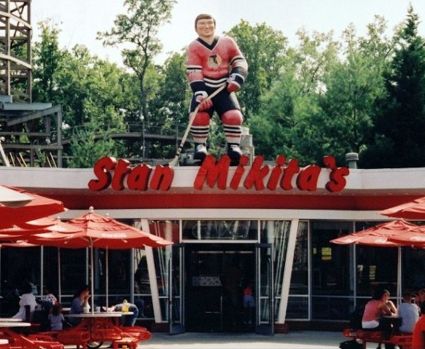
Finally, for fan's of the movie Wayne's World, no one should be without their own Stan Mikita's Donuts t-shirt.

Monday, May 1, 2017

1951-52 Chicago Black Hawks Sid Finney Jersey

Born on this date in 1929 in Bainbridge, Northern Ireland, Sid Finney began playing organized hockey in 1947-48 with the Calgary Buffaloes of the Southern Alberta Junior Hockey League, where, in 15 games, he had 6 goals and 14 points as an 18 year old.

The club moved to the Western Canada Junior Hockey League for the 1948-49 season, and Finney led the team in goals with 27 and tied for the lead in points with 43.

He remained in Calgary for the 1949-50 season, but had aged out of junior hockey, which necessitated a move to the Calgary Stampeders of the Western Canada Senior Hockey League. He was limited to only 17 games that season, scoring 12 points.

"Slippery Sid" caught the eye of the hockey world with his 1950-51 season for the Stampeders, as he led the league in both goals (44) and points with 81 in 57 games played.

 photo 1950-51 Calgary Stampeders team.jpg
The 1950-51 Calgary Stampeders

That effort caught the eyes of the NHL scouts and Finney was signed by the Chicago Black Hawks for the 1951-52 season. He would play 35 games for Chicago, scoring 6 goals and 11 points, and play another 23 games for the St. Louis Flyers down in the American Hockey League with 8 goals and 13 points. A clean player, his penalty minute total for the season was 2.

While Finney did have an assist on Chicago's opening goal  and had the tying and winning goals in the third period in a 7-6 win over the New York Rangers to close out the season on March 23, 1952, his effort was overshadowed when Bill Mosienko set the NHL record for the fastest hat trick in league history at just 21 seconds!

1951-52 Chicago Blackhawks photo 1951-52 Chicago Blackhawks.jpg
The 1951-52 Chicago Black Hawks

The 1952-53 season saw Finny get into another 18 games for the Black Hawks, contributing 4 goals and 6 points. He would, however, spend the majority of his season back with the Stampeders where he averaged over a point per game with 25 goals and 44 points in 39 games. He was with Chicago for the playoffs, seeing action in 7 games.

Despite playing 20 games less than his Calgary teammates in 1953-54, Finny led the Stampeders in goals with 29 and was third on the team with points. For the third consecutive season, he also saw time on the ice in six games for Chicago. He was with the Stampeders for the playoffs, and helped the club win the Lester Patrick Cup as WHL champions with Finney scoring 15 goals and 20 points in 18 games.

 photo 1953-54 Calgary Stampeders team.jpg
1953-54 WHL champion Calgary Stampeders

Finney played exclusively for the Stampeders for the next eight seasons, starting with the 1954-55 season, when he set a new personal best with 35 goals and 77 points. He raised those numbers in 1955-56 with 43 goals and 79 points.

 photo Stampeders 1955-56 progam.jpg

He had a second consecutive 40 goal season in 1956-57 with 41 on his way to matching his 79 points from the year before.

Finney then had a career season in 1957-58 when he established career bests with 45 goals, 43 assists and 88 points to lead the Stampeders in scoring - all this despite missing 12 games! The club then made it to the league finals in the playoffs , as Finney tied for the team lead in postseason scoring.

 photo Finney Stampeders.jpg
Finney had the best season of his career in 1957-58

While his point totals returned to Earth for 1958-59, his 29 goals and 59 points were still at a point per game average over his 60 games played. His 1959-60 season was a virtual repeat, as he played in 59 games with 28 goals and 60 points.

 photo Stampeders 1959-60 progam.jpg
Finney was on the cover of the Stampeders program in 1959-60

For the 1960-61, the consistent Finney lit the lamp 26 times with 68 total points. His final season with the Stampeders saw him second on the team in goals with 35 as he finished with 67 points.

Just before the start of the 1962-83 season, Finney was traded to the rival Edmonton Flyers after 12 seasons with the Stampeders. His output was unaffected by the move to the Flyers, as he scored 23 goals and 65 points, his 11th season with 20 goals or more.

For the 1963-64 season, Finney was on the move again, as Edmonton traded him to the Portland Buckaroos. He would play in 39 games with 9 goals and 19 points.

 photo 1963-64 Portland Buckaroos team.jpg
The 1963-64 Portland Buckaroos

He would also travel east to play 13 games with the Cincinnati Wings of the Central Professional Hockey League, a tough situation as the team had relocated halfway through the season after a deadly explosion at their home rink in Indianapolis and played to small crowds in their new home while seldom winning a game.

After sitting out the 1964-65 season, the 36 year old Finney joined the Drumheller Miners of the Alberta Senior Hockey League, playing in 24 games with 34 points. The Miners would then go on to defeat the Sherbrooke Beavers to win the Allan Cup as senior champions of Canada in a six game series.

 photo 1965-66 Drumheller Miners team.png
The 1965-66 Allan Cup champion Drumheller Miners

Finney retired for four seasons but came back to lace up the skates one more time, playing the 1968-69 season with the Calgary Stampeders of the ASHL, scoring 7 goals and 19 points before hanging up his skates for good.

As a player in the Western Hockey League, Finney played in 694 games with 368 goals and 399 assists for 767 points, 13th all-time in the WHL.

Today's featured jersey is a 1951-52 Chicago Black Hawks Sid Finney jersey as worn by Finney during his first NHL season with Chicago, including the final day of the season when he had two goals and an assist, which was overshadowed by teammate Mosiekno's NHL record 21 second hat trick.

Chicago first wore this barberpole style for the 1937-38 season and continued to wear it through the 1954-55 season. For the first three seasons, it was their only uniform, as they did not wear a second, white jersey until 1940-41.

 photo Chicago Blackhawks 1951-52 F jersey 1.jpeg
 photo Chicago Blackhawks 1951-52 B jersey 2.jpeg

Thursday, April 20, 2017

1984-85 Chicago Blackhawks Steve Larmer Jersey

Beginning his junior career with his hometown Peterborough Petes in 1977-78, Steve Larmer then became a member of the Niagara Falls Flyers for the 1978-79 season. He more than doubled his 41 points from the previous season with 84. That total jumped to 114 in 1979-80 after which Larmer was drafted in the 6th round by the Chicago Black Hawks. He returned for one final season with Niagara Falls during which he scored 55 goals and 133 points.

At the conclusion of the Flyers season, Larmer made his NHL debut with the Black Hawks for four games at the end of the season, scoring his first NHL point with an assist. Chicago assigned him to the New Brunswick Hawks of the AHL where he averaged more than a point per game with 82 in 74 games, good for second on the club. New Brunswick would not only win their division, but defeat Adirondack, Nova Scotia and Binghamton on their way to the Calder Cup championship. Additionally, Chicago called him up for three NHL games during the season.

Larmer Blackhawks 91
Larmer broke into the NHL with Chicago in 1980-81

For the 1982-83 season, Larmer made the Black Hawks roster out of training camp and immediately established himself as an NHL regular, playing in all 80 of Chicago's games on a line with Denis Savard and Al Secord, which led to him scoring an impressive 43 goals and 90 points on his way to being named the recipient of that season's Calder Trophy.

The following season Larmer again played in all 80 games for Chicago, a feat he duplicated again and again and again over the course of five seasons as his consecutive games streak reached 400, all the while producing an amazingly consistent offensive output, as his point totals were always between 75 and 90 points each of those seasons.

His games played streak continued to march on unabated as well as his offensive production. Now named one of Chicago's assistant captains, he narrowly missed equaling his career best of 90 points with 89 in 1987-88, and after scoring 87 the next season reached 90 once more in 1989-90 thanks in part to a career best 59 assists as his consecutive games streak now reached 640. During the playoffs, his eight consecutive postseason in a row, Larmer tied for the team lead in scoring with 22 in 20 games as the Blackhawks reached the conference finals. (Of note, Chicago formally changed their name from "Black Hawks" to "Blackhawks" with the start of the 1986-87 season.)

Showing no signs of slowing down, Larmer set a career high with 101 points in 1990-91 to lead Chicago in scoring for the third consecutive season as he registered second highest goal total of his career with 44, just two back of the 46 he tallied in 1984-85, as well as 57 assists.

Following Chicago's early exit from the playoffs, Larmer skated for Team Canada at the 1991 World Championships, scoring 8 points in 19 games. Later that same year, he competed for Canada again at the 1991 Canada Cup tournament in August prior to the start of the NHL season where he led all players in goals scored with 6, including the game winner in the decisive final game, and finished second in points with 11 in eight games.

Larmer Canada
Larmer at the 1991 Canada Cup

Over the course of the next two years, Larmer extended his games played streak by playing in all 80 of Chicago's games in 1991-92 despite losing 16 pounds due to an ulcer, and then 84 in 1992-93 thanks to a newly expanded schedule which included the short-lived experiment of teams playing a pair of regular season neutral site games. It was the highest scoring regular season in NHL history at the time, but the Blackhawks were one of only two teams to allow less than three goals per game, thanks in part to Larmer's noteworthy defensive contributions.

Larmer Blackhawks 92
The Blackhawks wore throwback jerseys
for the NHL's 75th Anniversary season

After 13 seasons with Chicago, including playing in every game for 11 consecutive seasons, 884 games in a row, Larmer sat out training camp in 1993, demanding a trade from Chicago, citing a need for a "change of scenery", and threatened to retire if a trade was not worked out.

Eventually, after missing the first month of the season and ending his streak 30 games behind second place Gary Unger and 80 behind record holder Doug Jarvis, Larmer was traded to the New York Rangers in early Novemer. At the time of his departure from Chicago, Larmer ranked #3 all time in goals, #5 in assists and #4 in points.

Playing in his first game the day after the trade, Larmer scored his first goal as a Ranger. In early January, Larmer missed the first games of his career due to injury, sitting out three games with a broken hand. In all, he competed in 68 games for the Rangers and contributed 60 points. During the playoffs, his 12th of 13 consecutive years in the playoffs, he was a solid contributor to the Rangers eventual Stanley Cup championship, the first of his career and the Rangers first in 54 years.

Rangers 1993-1994
The 1994 Stanley Cup champion New York Rangers

In the lockout shortened 1994-95 season, milestones arrived in the form of his 1,000th NHL point on March 8 and his 1,000th NHL game on this date in 1995. He would finish the season with 1,006 games played, 441 goals and 571 assists for 1,012 points prior to retiring due to chronic back pain.

Larmer Rangers
Larmer finished his career with the Rangers

Today's featured jersey is a 1984-85 Chicago Black Hawks Steve Larmer jersey as worn when Larmer set a career high of 46 goals that season.

The Blackhawks wore a white jersey for their first season of 1926-27 but then reversed the jerseys colors to black with white stripes for 1927-28. They did not wear another white jersey until the 1940-41 season and their now familiar style featured today did not arrive until the 1955-56 season. Since then there have been changes, such as the original one color black numbers becoming two color numbers in 1973 and the lace-up collar changing to a v-neck in 1965.

Sleeve numbers arrived in 1957-58, and the secondary logo changed size and location a number of times until 1959-60 when it found its permanent location. Names on the back were mandated in 1977-78 and the jersey has remained unchanged ever since, including surviving the introduction of the new Reebok Edge jerseys for 2007-08.

Chicago Blackhawks 1984-85 F jersey

Chicago Blackhawks 1984-85 B jersey

Bonus jersey: Today's bonus jersey is a 1991 Team Canada Steve Larmer jersey as worn during the 1991 Canada Cup, one of only two appearances for Larmer for Team Canada during his career, both of which came during a four month span in 1991, which resulted in a silver followed by a gold medal.

The half maple leaf design of the jersey mimics the shape of the Canada Cup trophy, which clearly was not a "cup" in the traditional sense like the NHL's Stanley Cup.

Canada 1991 jersey
photo courtesy of Classic Auctions

Extra bonus Jersey: Today's extra bonus jersey is a 1981-82 New Brunswick Hawks Steve Larmer jersey from the only minor league season of Larmer's entire career during which his club captured the league championship.

The jersey follows the design of the Toronto Maple Leafs jerseys of the time period, down to the Maple Leaf logos on the shoulder, as the Hawks shared their affiliation with both the Maple Leafs, who inspired their look, and the Black Hawks, who provided the inspiration for their name in a unique combined identity.

The franchise existed from 1978 to 1987, which included two name changes.

New Brunswick Hawks 81-82 jersey
photo courtesy of Classic Auctions

Today's videos begin with the conclusion of the 1991 Canada Cup. Larmer scored the game winning goal and was MVP of the game.


Another highlight of Larmer's career was Larmer's Stanley Cup championship in 1994 with the Rangers.

Monday, March 20, 2017

1982-83 Chicago Blackhawks Al Secord Jersey

Al Secord started his career in fine style, winning the Memorial Cup with the Hamilton Fincups of the Ontario Major Junior Hockey League in 1976 after a regular season during which he scored 9 goals and 22 points. For the curious, Fincup was a combination of the last names of their owners, Joe Finochio and brothers Ron and Mario Cupido!

1975-76 Hamilton Fincups team
The 1976 Memorial Cup champion Hamilton Fincups

Oddly, the championship winning team found themselves homeless for the 1976-77 season, as the ice making plant at their dilapidated Barton Street Arena failed, which necessitated a move to St. Catharines 30 miles down the road after a lease could not be worked out for a second arena located in Hamilton, Mountain Arena, despite their championship form. Life in St. Catharines suited Secord well, as he scored more than a point per game with 66 in 57 games from 32 goals and 34 assists, each being more than his combined total from the previous season. On the flip side, Secord also finished second in the league in penalty minutes with 343, nearly 3 times more than he had in his previous season despite playing in six less games.

During the 1976-77 season, Secord was also a member of the Canadian team at the 1977 World Junior Championships where he earned a silver medal.

After one final season with the Fincups in 1977-78, after a move back to Hamilton's Mountain Arena, Secord was drafted by the Boston Bruins 16th overall in the first round of the 1978 NHL Amateur Draft.

In 1978-79, Secord played 4 games with the Rochester Americans of the AHL, scoring 4 goals and 6 points, but played the vast majority of his season with the Bruins, scoring 16 goals and 23 points in 71 games, which included 125 penalty minutes.

Secord Bruins 1
Secord was a first round pick by the Bruins

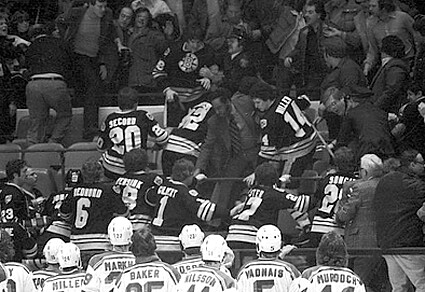
His second season with the Bruins in 1979-80 saw him play in 77 games, increasing his offensive output to 23 goals and 39 points with a jump in penalty minutes to 170, a season which saw him among the Bruins who invaded the stands to brawl with some rowdy New York Rangers fans at Madison Square Garden during a memorable incident.

Secord Bruins stands
The Bruins enter the stands in Madison Square Garden

His 1980-81 season got off to a rocky start, with no goals and just 3 assists in 18 games. He also played in 8 games for the Springfield Indians of the AHL before a trade to the Chicago Black Hawks for defenseman Mike O'Connell. after seeing increasingly diminished ice time on the 4th line with the Bruins when he was not a healthy scratch.

While with Chicago, Secord regained his form from his second season with the Bruins, scoring 13 goals and 22 points in half a season of 41 games. He also visited the penalty box on a regular basis, being sent off for 145 minutes.

Secord Blackhawks 3
New arrival Secord wore #14 with Chicago in 1980-81

During the 1981-82 season, Secord made the Bruins question their decision to trade him when he erupted for 44 goals and 31 assists for 75 points while amassing over 300 penalty minutes, making him the first and only player to ever reach 40 goals and 300 penalty minutes in a single season. Of note, only one other player, Dave "Tiger" Williams, ever managed even 30 goals and 300 penalty minutes with 35 goals and 343 PIM in 1980-81.

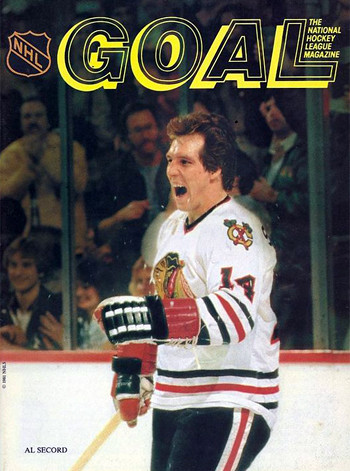
Secord Blackhawks 2
Secord celebrates yet another goal

Secord continued his upward trajectory in 1982-83 as his offensive game continued to impress, as on this date in 1983 Secord became only the second Black Hawks player to ever score 50 goals in a season, joining the legendary Bobby Hull when he scored twice, plus two assists, in a 7-3 victory over the Toronto Maple Leafs.

Secord Blackhawks 4
Secord became the second Black Hawk to reach 50 goals

He would eventually total 54 goals and 86 points playing with "Party Line" linemates Denis Savard and Steve Larmer, who combined for 132 goals and 297 points. Secord also had 180 penalty minutes for good measure as he made life tough for anyone who thought they were going to rough up the diminutive playmaker Savard. Secord's 54 goals put him in lofty company, as they were good for sixth in the NHL that season.

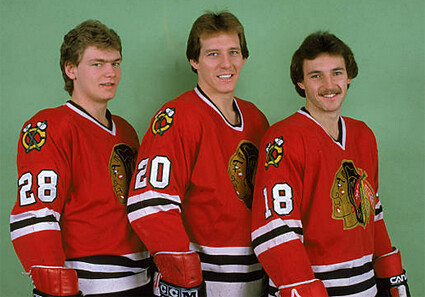
Larmer, Secord, Savard Blackhawks
The line of Larmer, Secord and Savard

Despite his offensive success, the season felt odd for Secord "Steve Larmer came to our line. Me and Denis Savard were very fortunate to have Steve Larmer. We were a solid line. I didn't have that much penalty minutes, because our coach asked me not to fight so often. Actually, even though I scored well, I felt like I didn't play the way I was supposed to play. I was also told not to hit guys so often. I needed to play physical, and I didn't. It's big part of my game, to be on the other guys skin. When I hit a guy and the crowd starts chanting, it brings energy to me and to my teammates. And I was missing that element. It felt strange."

During this time period, Secord had many memorable fights, particularly with Willi Plett and Basil McRae of the rival North Stars, many of which were instigated by his nemesis Dino Ciccarelli, who in turn was often wound up by Savard!

Secord Blackhawks 5
Secord had many fights with the NHL's toughest

Injuries derailed his next two seasons, as he played just 14 in 1983-84 due to torn abdominal muscles and 51 in 1984-85 because of issues with his thigh muscles which was related to the fact that one of his legs was actually longer than the other. He returned to full health in time for the playoffs, scoring 7 goals and 16 points in 15 postseason games.

1985-86 saw Secord play a full 80 games, hitting exactly 40 goals on his way to 76 points as well as 201 penalty minutes, the third 40 goal season of his career.

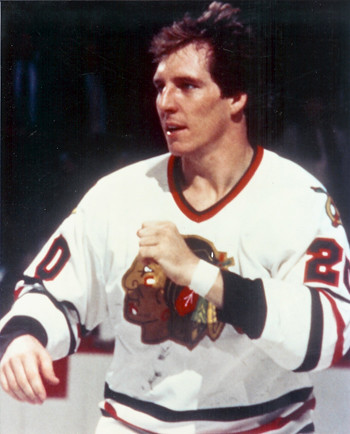
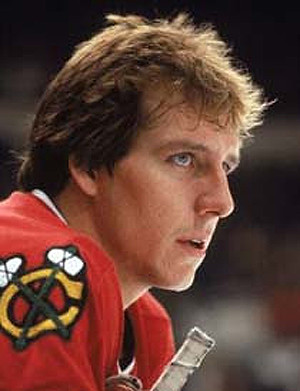
Secord Blackhawks
Secord had three 40 goal seasons with Chicago

He would play one more season with Chicago, having now changed their name from the Black Hawks to Blackhawks. Secord would score 29 goals and 29 assists for 58 points and 196 penalty minutes in 1986-87, which included tying the NHL record for the fastest 4 goals in a game, when he had four consecutive goals in an 8:24 span early in the second period on January 7, 1987 in a 6-4 win over Toronto before making his second international appearance for Canada, playing in the 1987 World Championships later that spring.

Before the start of the 1987-88 season, Secord was traded to the Maple Leafs along with Ed Olczyk for Rick Vaive, Steve Thomas and Bob McGill. His role with Toronto was clearly less focused on offense, as his penalty minutes rose to 221, the second highest of his career, while his goal total sank to 15 in 77 games, the same he had in his injury limited season of 51 games back in 1984-85.

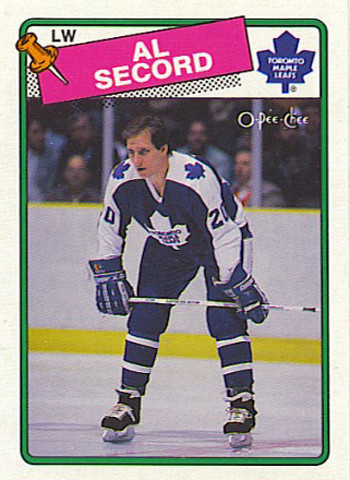
Secord Maple Leafs
Seecord was traded to Toronto in 1987

In 1988-89 he played 40 games with the Maple Leafs, scoring just 5 goals and 15 points plus 71 penalty minutes, before a trade in February of 1989 to the Philadelphia Flyers for their final 20 games of the year, during which he only scored a lone goal with no assists while adding another 38 penalty minutes. In 14 playoff games with the Flyers, Secord had 4 assists and 31 penalty minutes.

Secord Flyers
Secord had a brief stint with the Flyers

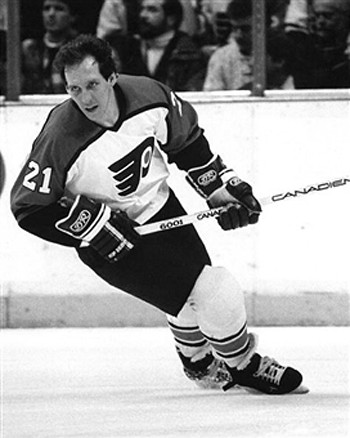
For the 1989-90 season, Secord had a homecoming when he signed as a free agent with the Blackhawks. He would play in 43 games that season, scoring a fine 14 goals and 7 assists with 131 penalty minutes, which would put him over the 2,000 mark for his career.

He retired after the season with 766 games, 273 goals and 222 assists for 495 points and 2,093 penalty minutes with an additional 21 goals and 55 points in 102 playoff games.

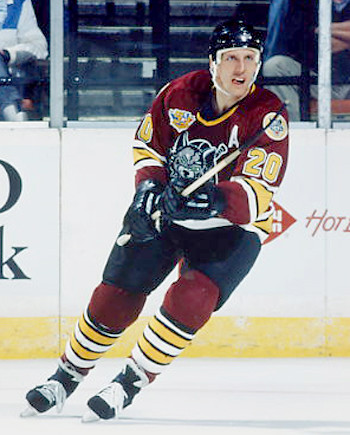
But that was not the end of Secord's hockey career, as, after four seasons away from the rink, he played two seasons with the brand new Chicago Wolves of the International Hockey League in their first season of 1994-95, scoring 13 goals and 33 points in 59 games followed by 8 goals and 16 points in 47 games of the 1995-96 season before hanging up his skates for good.

Secord Wolves
Secord came out of retirement for two seasons with the Wolves

After developing an affinity for flying as a teenager, Secord took flying lessons during the off-seasons and became a commercial airline pilot following his hockey career.

Secord pilot
Secord is now a commercial pilot

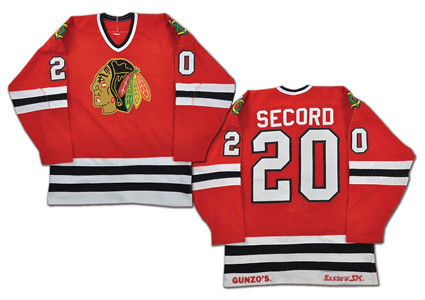
Today's featured jersey is a 1982-83 Chicago Black Hawks Al Secord jersey as worn during the season Secord became only the second player in Black Hawks history to score 50 goals in a season.

The Black Hawks adopted this style in 1955-56 and, with a few modernizations along the way, such as two color numbers and names on the back, this style remains virtually unchanged through today and is often listed as the best jersey in the NHL.

This particular example is from the early day's of rear hem tagging, with the jerseys customizer Gunzo's on the back left and Sandow SK on the rear right.

Chicago Blackhawks 1982-83 jersey
photo courtesy of Classic Auctions

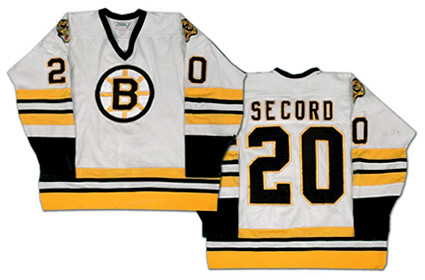
Bonus jersey: Today's bonus jersey is a 1979-80 Boston Bruins Al Secord jersey. Secord broke into the NHL with Boston and played there for three seasons.

The Bruins removed the colored shoulders from their jerseys in 1974-75 and added the secondary logos to the shoulders halfway through the 1976-77 season. Names arrived on the back in 1977-78 and this style would remain in use all the way through 1994-95 until they moved into the new Fleet Center and debuted new jerseys at the time.

Boston Bruins 1979-80 jersey
photo courtesy of Classic Auctions

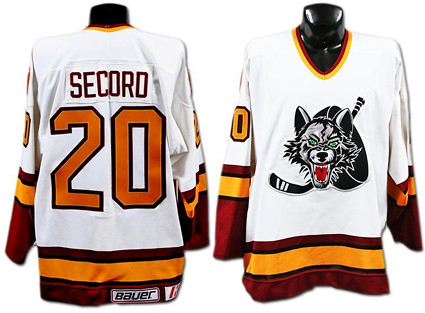
Extra bonus jersey: Today's extra bonus jersey is a 1995-96 Chicago Wolves Al Secord jersey as worn during Secord's final season play as a professional.

The Wolves were formed in 1994 and won he IHL's Turner Cup twice, in 1998 and 2000, and then joined the American Hockey League when the IHL folded in 2001. After joining the AHL, the Wolves then won the Calder Cup in 2002 and 2008.

Chicago Wolves 1995-96 jersey

Today's video section is a look at Secord's post hockey career as a pilot.


Did we mention that Secord and Ciccarelli were not the best of friends?


Here is a collection of Secord fights against some of the toughest names in the business and then strikes a nice balance with highlights of his goal scoring as well before ending with some Wolves footage as a bonus.


hit counter for blogger