The story of DougHarvey begins in 1945-46 when he began to play for the Royal Montreal Hockey Club of the Quebec Senior Hockey League. During his second season with the club, he helped the Montreal Royals capture the prestigious Allan Cup as senior champions of Canada.
He joined the Buffalo Bisons of the American Hockey League for the 1947-48 season, and after 24 games the defenseman then made his NHL debut with his hometown Montreal Canadiens for the remaining 35 games of the season.
A Doug Harvey 1951-52 Parkhurst rookie card
Harvey, playing in an era where defenseman did not rush up the ice with the puck, never put up the same kind of offensive numbers seen in today's game in the post-Bobby Orr era. He was however, a key factor in the Canadiens offensive attack of the day, as he utilized his speed and passing ability to help make Montreal into a championship squad and earn him the recognition as the NHL's first offensive defenseman, paving the way for the likes of Orr.
Another way Harvey changed the game was by controlling the tempo of the action, either by making a rush up the ice or a quick pass to speed up the Montreal transition to offense, or by holding onto the puck and slowing the tempo of the game to slow down an opponent and give his teammates a chance to catch their breath. Harvey, Eddie Shore and Orr are widely regarded as the three men who had the greatest impact on the position of defense over the history of the NHL.
Harvey changed the way defensemen played the game
During Harvey's fourth NHL season of 1950-51, he would make his first of ten consecutive trips to the Stanley Cup finals. The 1951-52 season would see Harvey gain recognition as one of the game's best, as he would make his first of 11 straight NHL All-Star Game appearances.
The 1952-53 season saw Harvey's name engraved on the Stanley Cup for the first time following a 4 games to 1 defeat of the Boston Bruins.
A new trophy was introduced to the NHL for the 1953-54 season, the Norris Trophy, which would be awarded to the league's top defensive player. Harvey would become the second recipient of the award in 1955 and make it virtually his own, as he would win it for seven of the next eight seasons, including 1955, 1956, 1957 and 1958 thanks to his stellar defensive skills in addition to his offensive contributions, which made him a complete player unlike any other defenseman in the previous history of the league.
Harvey won seven Norris Trophies in eight years
1955-56 would also see the beginning of not only another streak, but a dynasty, as the Canadiens would capture their first of a record five consecutive Stanley Cups from 1956 to 1960, giving Harvey a career total of six. During this streak of consecutive All-Star Game appearances, Norris Trophies and championships, Harvey would set a personal best in 1956-57 when he would set a personal high with the only 50 point season of his career from 6 goals and 44 assists. Recall, this was an era when the NHL schedule was shorter, at just 70 games.
With Harvey quarterbacking the deadly Canadiens powerplay, they would often score twice on a single penalty, as players were required to serve their entire two minutes as per the rules of the day, which were finally amended in 1956 to allow the penalized player to return to the ice once a goal was scored in response to the Canadians domination.
After teammate TomJohnson won the Norris Trophy in 1959, Harvey reclaimed the award in 1960 and 1961.
After the retirement of Maurice Richard, Harvey would be named to the prestigious position as captain of the Canadiens for the 1960-61 season.
Harvey became the Canadiens captain in 1960
It would be on this date during the 1962-63 season that Harvey would become only the second defenseman in NHL history to score 500 career points, just three months after Bill Gadsby became the first.
Harvey's time with Montreal would soon come to an end however, as he was an outspoken critic of the team's ability to own players for life, which kept them not only tied to their clubs, but keep their salaries low. Also questioning how players pensions were being handled and funded, he and Detroit's Ted Lindsay went so far as to attempt to organize the players association, which infuriated the Canadiens ownership to the point that they traded their perennial Norris Trophy winning All-Star to the lowly New York Rangers, who had not even qualified for the playoffs in a six team league for 8 of the last 11 seasons.
Harvey responded with winning his third consecutive Norris Trophy during his first season with the Rangers. After one more season in New York, he split the 1963-64 season between the Rangers (14 games), St. Paul Rangers (2 games) and the Quebec Aces of the AHL (52 games).
He spent all of 1964-65 with Quebec and moved to the Baltimore Clippers, also of the AHL for the 1965-66 season. 1966-67 was divided between the Clippers and the Pittsburgh Hornets, as well as making a brief return to the NHL when he appeared in two games with the Detroit Red Wings.
With the NHL doubling in size for the 1967-68 season by adding an additional six clubs, there were plenty of opportunities created, one of which was for Harvey, as the St. Louis Blues came calling for the playoffs after Harvey had been a player/coach during the regular season with the Kansas City Blues of the Central League. Harvey would see action in 8 of the Blues 12 playoff games, as they were the West Division's representatives in the Stanley Cup Finals.
Harvey would return to the Blues for the 1968-69 regular season at the age of 44, playing in the final 70 games of his long and illustrious NHL career.
Harvey finished his career with the St. Louis Blues
His final NHL totals were 1,113 games, 88 goals and 452 assists for 540 points. In addition, he would appear in 137 playoff games, scoring 8 goals and 64 assists for 72 points on his way to six Stanley Cups and seven Norris Trophies, which still remains second all time after Orr's eight.
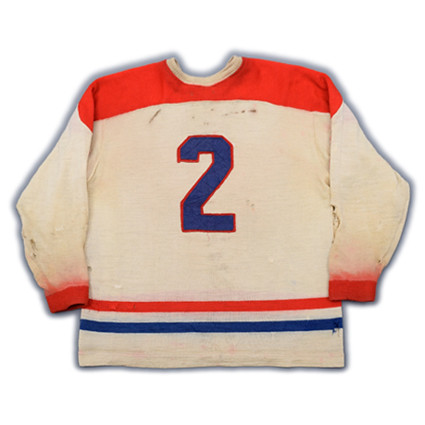
He was elected to the Hockey Hall of Fame in 1973 and became the first defenseman to ever have his number retired by the Montreal Canadiens when his #2 was lifted to the rafters in 1985.
Harvey's #2 was retired by the Canadiens in 1985
In 1998, The Hockey News ranked Harvey as the #6 player on their list of the 100 Greatest Hockey Players. In 2000, he was honored by the Government of Canada by having his picture on a postage stamp.
Today's featured jersey is a 1955-56 Montreal Canadiens Doug Harvey jersey. Harvey was an NHL All-Star, Norris Trophy winner and Stanley champion that season.
The Canadiens would first adopt a red sweater with a blue band as far back as 1912-13 in order to differentiate their barberpole style jersey from that of the Ottawa Senators, five years before the formation of the NHL.
They would adopt the "CH" logo in 1916 and the jersey would remain essentially unchanged ever since.
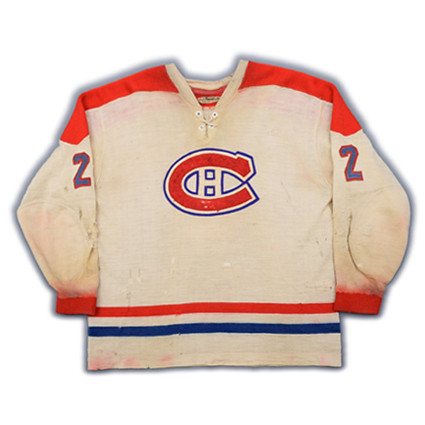
Today's featured jersey is a 1959-60 Montreal Canadiens Doug Harvey jersey. Harvey was an NHL All-Star, Norris Trophy winner and Stanley champion that season.
The Canadiens only wore a red sweater from 1917-18 through 1934-35 until
finally introducing a white one for the first time for the 1935-36
season. Seven seasons later the white sweater was given red shoulders
for the first time and, aside from three seasons in the 1940s when they
wore a jersey with a blue band around the chest like their red jersey,
the white jersey has remained unchanged ever since.
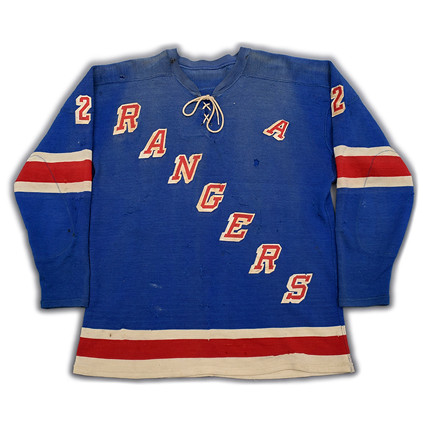
Today's featured jersey is a 1961-62 New York Rangers Doug Harvey jersey. Harvey was an NHL All-Star, Norris Trophy winner and Stanley champion that season, his sixth and final Stanley Cup.
The Rangers began play right from the start in 1926-27 with "RANGERS" diagonally across the chest of their blue sweaters. The current font for the crest came in 1941-42 and the drop shadow just one year later. After a single, unexplainable season with the name arched over the player's number on the front in 1946-47, the blue jerseys have remained virtually unchanged ever since, save for a two year span with a new, modern jersey with the Rangers shield crest on the front in 1976-77 and 1977-78. When the classic style returned for 1978-79, the blue jerseys had "NEW YORK" on the front for nine seasons until the club reverted back to "RANGERS" for 1987-88 and beyond.
Our video selection today is an excellent biography of Harvey with great video footage of him in action.
Next, a TV commercial where Doug and his son DougJr. battle it out for the household table hockey championship. Man, what we would give to be able to buy one of those today for $5!
Finally, a recap of the 1960 Stanley Cup Finals, Harvey's sixth and final championship.
The story of DougHarvey begins in 1945-46 when he began to play for the Royal Montreal Hockey Club of the Quebec Senior Hockey League. During his second season with the club, he helped the Montreal Royals capture the prestigious Allan Cup as senior champions of Canada.
He joined the Buffalo Bisons of the American Hockey League for the 1947-48 season, and after 24 games the defenseman then made his NHL debut with his hometown Montreal Canadiens for the remaining 35 games of the season.
Harvey, playing in an era where defenseman did not rush up the ice with the puck, never put up the same kind of offensive numbers seen in today's game in the post-Bobby Orr era. He was however, a key factor in the Canadiens offensive attack of the day, as he utilized his speed and passing ability to help make Montreal into a championship squad and earn him the recognition as the NHL's first offensive defenseman, paving the way for the likes of Orr.
Another way Harvey changed the game was by controlling the tempo of the action, either by making a rush up the ice or a quick pass to speed up the Montreal transition to offense, or by holding onto the puck and slowing the tempo of the game to slow down an opponent and give his teammates a chance to catch their breath. Harvey, Eddie Shore and Orr are widely regarded as the three men who had the greatest impact on the position of defense over the history of the NHL.
During Harvey's fourth NHL season of 1950-51, he would make his first of ten consecutive trips to the Stanley Cup finals. The 1951-52 season would see Harvey gain recognition as one of the game's best, as he would make his first of 11 straight NHL All-Star Game appearances.
The 1952-53 season saw Harvey's name engraved on the Stanley Cup for the first time following a 4 games to 1 defeat of the Boston Bruins.
A new trophy was introduced to the NHL for the 1953-54 season, the Norris Trophy, which would be awarded to the league's top defensive player. Harvey would become the second recipient of the award in 1955 and make it virtually his own, as he would win it for seven of the next eight seasons, including 1955, 1956, 1957 and 1958 thanks to his stellar defensive skills in addition to his offensive contributions, which made him a complete player unlike any other defenseman in the previous history of the league.
1955-56 would also see the beginning of not only another streak, but a dynasty, as the Canadiens would capture their first of a record five consecutive Stanley Cups from 1956 to 1960, giving Harvey a career total of six. During this streak of consecutive All-Star Game appearances, Norris Trophies and championships, Harvey would set a personal best in 1956-57 when he would set a personal high with the only 50 point season of his career from 6 goals and 44 assists. Recall, this was an era when the NHL schedule was shorter, at just 70 games.
With Harvey quarterbacking the deadly Canadiens powerplay, they would often score twice on a single penalty, as players were required to serve their entire two minutes as per the rules of the day. That rule was finally amended in 1956 to allow the penalized player to return to the ice once a goal was scored in response to the Canadians domination.
After teammate Tom Johnson won the Norris Trophy in 1959, Harvey reclaimed the award in 1960 and 1961.
After the retirement of Maurice Richard, Harvey would be named to the prestigious position as captain of the Canadiens for the 1960-61 season.
His time with Montreal would soon come to an end however, as he was an outspoken critic of the team's ability to own players for life, which kept them not only tied to their clubs, but keep their salaries low. Also questioning how players pensions were being handled and funded, he and Detroit's Ted Lindsay went so far as to attempt to organize the players association, which infuriated the Canadiens ownership to the point that they traded their perennial Norris Trophy winning All-Star to the lowly New York Rangers, who had not even qualified for the playoffs in a six team league for 8 of the last 11 seasons.
Harvey responded with winning his third consecutive Norris Trophy during his first season with the Rangers. After one more season in New York, he split the 1963-64 season between the Rangers (14 games), St. Paul Rangers (2 games) and the Quebec Aces of the AHL (52 games).
He spent all of 1964-65 with Quebec and moved to the Baltimore Clippers, also of the AHL for the 1965-66 season. 1966-67 was divided between the Clippers and the Pittsburgh Hornets, as well as making a brief return to the NHL when he appeared in two games with the Detroit Red Wings.
With the NHL doubling in size for the 1967-68 season by adding an additional six clubs, there were plenty of opportunities created, one of which was for Harvey, as the St. Louis Blues came calling for the playoffs after Harvey had been a player/coach during the regular season with the Kansas City Blues of the Central League. Harvey would see action in 8 of the Blues 12 playoff games, as they were the West Division's representatives in the Stanley Cup Finals.
Harvey would return to the Blues for the 1968-69 regular season at the age of 44, playing in the final 70 games of his long and illustrious NHL career.
His final NHL totals were 1,113 games, 88 goals and 452 assists for 540 points. In addition, he would appear in 137 playoff games, scoring 8 goals and 64 assists for 72 points on his way to six Stanley Cups and seven Norris Trophies, which still remains second all time after Orr's eight.
He was elected to the Hockey Hall of Fame in 1973 and became the first defenseman to ever have his number retired by the Montreal Canadiens on this date in 1985 when his #2 was lifted to the rafters.
In 1998, The Hockey News ranked Harvey as the #6 player on their list of the 100 Greatest Hockey Players. In 2000, he was honored by the Government of Canada by having his picture on a postage stamp.
Today's featured jersey is a 1955-56 Montreal Canadiens Doug Harvey jersey. Harvey was an NHL All-Star, Norris Trophy winner and Stanley champion that season.
The Canadiens would first adopt a red sweater with a blue band as far back as 1912-13 in order to differentiate their barberpole style jersey from that of the Ottawa Senators, five years before the formation of the NHL.
They would adopt the "CH" logo in 1916 and the jersey would remain essentially unchanged ever since.
Bonus jersey: Today's bonus jersey is a 1961-62 New York Rangers Doug Harvey jersey as worn later in his career after being traded away from Montreal for his union organizing activites. Harvey would win yet another Norris Trophy during his first year with the Rangers.
The Rangers debuted in 1926 wearing blue jerseys with RANGERS diagonally across the front and, aside from having arched lettering in 1946-47 and wearing jerseys with their shield logo in 1976-77 and 1977-78, they have worn basically the same jerseys ever since, especially since arriving at their current font for the cresting in 1941.
Our video selection today is an excellent biography of Harvey with great video footage of him in action.
Next, a TV commercial where Doug and his son DougJr. battle it out for the household table hockey championship. Man, what we would give to be able to buy one of those today for $5!
Finally, a recap of the 1960 Stanley Cup Finals, Harvey's sixth and final championship.
Going into the 1960-61 season, the Montreal Canadiens had won five consecutive Stanley Cups and were looking for a record sixth, only to have their streak ended at the hands of the Chicago Black Hawks in a 4 games to 2 Semifinal loss. Chicago would go on to defeat the Detroit Red Wings 4-2 to claim their first championship since 1938.
The 1961-62 NHL season saw Montreal finish atop the regular season standings with a 42-14-14 record for 98 points, well clear of the Toronto Maple Leafs in second with 85 points from a 37-22-11 mark. Third in the final standings were the defending Stanley Cup champion Chicago Black Hawks another ten points back at 75 after winning 31 and losing 26 along with 13 ties. The fourth and final playoff team was the New York Rangers at 26-32-12 with 64 points. The Detroit Red Wings at 60 points missed out on the postseason while the Boston Bruins with 38 points brought up the rear.
Unlike today's expected pairings with the top team taking on the lowest ranked team, in 1962 the #1 Canadiens were paired with the #3 Chicago Black Hawks, while the #2 Maple Leafs took in the #4 New York Rangers.
Chicago and Montreal began their series on March 27, 1962 in Montreal at The Forum. The Canadiens won Game 1 by a score of 2-1. On March 29th they again prevailed in a close contest by a score of 4-3 to take a 2-0 lead as the series moved to Chicago for Games 3 and 4.
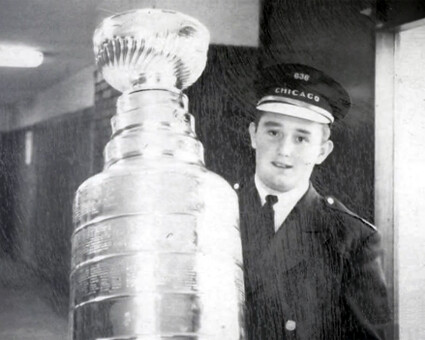
Game 3, played on this date in 1962, saw the Stanley Cup on display at the Chicago Stadium in recognition of the Black Hawks championship from the previous season, their first in 23 years.
The 1960-61 Stanley Cup champion Chicago Black Hawks
In attendance for the game was 25-year-old Ken Kilander from Montreal who had made the trip to Chicago. He often followed the Canadiens to road games, even traveling on the same train as the club, which made him a familiar face with the team and the journalists who covered the team. Kilander financed his travels by playing the piano at the team hotel or a nearby bar while usually wearing his Canadiens jacket.
Notorious Montreal Canadiens fan Ken Kilander
Before the game that night, Kilander was in the lobby of the LaSalle Hotel chatting with some of the reporters who were covering the finals when one of them speculated that Chicago would come back to win the series despite Montreal's two game series lead. Kilander responded by telling him, "The Cup belongs in Montreal, nowhere else."
Knowing that the Cup would be on display that night at the arena, Kilander asked, "What would you fellows do if I went and got the Cup and brought it here to give to the Canadiens?"
Fully aware that it was April Fools' Day, the reporters laughed and one promised, "I'll take your picture and put your name in the paper." Another chimed in with, "What an uproar tht would cause here in Chicago."
Kilander later arrived at the stadium and stopped by to admire the cup on display in a glass case, where he took a moment to notice the tiny lock which was charged with securing the cup...
Once the game was underway, Kilander first got to see Bronco Horvath open the scoring for the Black Hawks at 9:05 of the first period from Eric Nesterenko and Reg Fleming at even strength. Later in the first period Stan Mikita scored another goal for Chicago from Dollard St. Laurent at 18:06.
A Stan Mikita rookie card from 1960
The second period was just about to end when Chicago's Bill Hay converted a power play opportunity with assists from Ab McDonald and Bobby Hull to extend the Black Hawks lead to 3-0 with twenty minutes remaining.
Any hopes of a Montreal comeback were dealt a serious blow when Ken Warram put Chicago up by 4 with assists from Mikita and McDonald just 2:15 into the third period.
Chicago's Glenn Hall turns back an attack from Jean Beliveau during their 1962 Semifinal playoff series
Having seen quite enough at this point, Kilander left his seat and made his way down to the lobby where the Cup was on display. Accounts differ as to whether he smashed the glass of the case, simply opened the case. The caption of a United Press International photo states that Kilander was able to pick the lock of the display case. The truth lies somewhere in the middle, as, finding himself nearly alone with the trophy, he pushed on the glass door, putting pressure on the insufficient lock, which easily popped open.
"I couldn't resist reaching in and taking the Cup in my arms," he said. "Who knew when I'd ever see it again. The Cup meant everything to me."
There is no confusion about what happened next, as Kilander liberated the Stanley Cup from it's display case and he made a dash to the nearest exit out of Chicago Stadium.
An alert 16-year-old usher Roy Perrell stopped him and asked him what he was doing. "I'm taking the cup back to Montreal where it belongs," a determined Kilander responded! Perrell yelled as Kilander continued toward the doors. Police officer Sgt. Jerry Kortapassi had little trouble identifying the culprit in possession of the four foot tall, 25 pound silver trophy. When Kilander repeated his intent to take the Cup back to Montreal, Kortapassi responded with "Only if you're Rocket Richard and I'm the Tooth Fairy," which put an end to Kilander's getaway attempt.
Alert usher Roy Perell, who alerted police that the Stanley Cup was being stolen by Ken Kilander, posing with the cup after its return to safety
The official police report further detailed that Kilander explained to Perrell and Kortapassi that he was taking the Cup in an attempt to win a $400 bet and he would give them $250 to allow him to leave with it.
Needless to say, Kilander found himself no longer in possession of his beloved Stanley Cup, but also standing in a Chicago Municipal Courtroom the next day face to face with Judge Hyam Feldman. The Black Hawks chose not to press charges of the cup, which at the time was valued at $8,000.
The Stanley Cup back safely in it's display case at Chicago Stadium
from a 1962 United Press International wire photo
Also fortunate for Kilander was the decision to not charge him with bribery as well. He told the court his intentions were not to steal the cup, but
take it to his Chicago hotel room, where he would be photographed and
interviewed by the journalists from Montreal.
In the end, Judge Feldman fined him $10 and court costs for disorderly conduct as well as making him promise he would not try to steal the Cup again.
"He said to me, "You can go back to the Stadium tomorrow night and cheer all you want for your Canadiens, but the Cup stays here unless the Black Hawks lose, which I doubt very much they will," related Kilander about his conversation with Judge Feldman.
A newspaper account if Kilander's day in court
Despite Kilander's failure to deliver the Cup to the LaSalle Hotel, the Montreal journalists came through on their end of the deal, as the story of his attempted theft of hockey's greatest prize was splashed across North American sports pages the following day.
Chicago did hold on to win Game 3 on April Fools' Day, evened the series at two games apiece with a 5-3 victory in Game 4 on April 3rd. They then took Game 5 back in Montreal 4-3 before eliminating the favored Canadiens by shutting them out 2-0 in Game 6 to win four straight after having lost the first two, perhaps inspired by Kilander's attempt to liberate the Stanley Cup from their possession!
Looking back on the episode later in life, Kilander recalled, "I know what I did wasn't right, but I wanted the Canadiens to win so badly. I collected enough clipping from that incident to fill a scrapbook."
In the end, neither Kilander, Montreal or Chicago ended up with the coveted trophy, as the other Semifinal playoff series saw Toronto defeat the Rangers 4-2 and then the Maple Leafs went on to defeat Chicago 4 games to 2 to win the nearly stolen Stanley Cup.
Today's featured jersey is a 1961-62 Chicago Black Hawks Stan Mikita jersey. This style of Black Hawks jersey, so revered today and often topping "Best Jersey" lists, came into being for the 1955-56 season, replacing Chicago's previous barberpole style.
The 1955-56 version had no sleeve numbers and a slightly
different main crest design before the logo changed to today's more
familiar version and sleeve numbers were added in 1957-58. Note today's
jersey has two sleeve stripes and long black cuffs, which were changed
to three stripes to match the waist striping for the 1963-64 season.
Bonus jersey: Today's bonus jersey is a 1961-62 Montreal Canadiens Doug Harvey jersey. The
Canadiens would first adopt a red sweater with a blue band as far back
as 1912-13 in order to differentiate their barberpole style jersey from
that of the Ottawa Senators, five years before the formation of the NHL.
The club would adopt the "CH" logo in 1916 and the jersey would remain essentially unchanged ever since.
The story of DougHarvey begins in 1945-46 when he began to play for the Royal Montreal Hockey Club of the Quebec Senior Hockey League. During his second season with the club, he helped the Montreal Royals capture the prestigious Allan Cup as senior champions of Canada.
He joined the Buffalo Bisons of the American Hockey League for the 1947-48 season, and after 24 games the defenseman then made his NHL debut with his hometown Montreal Canadiens for the remaining 35 games of the season.
Harvey, playing in an era where defenseman did not rush up the ice with the puck, never put up the same kind of offensive numbers seen in today's game in the post-BobbyOrr era. He was however, a key factor in the Canadiens offensive attack of the day, as he utilized his speed and passing ability to help make Montreal into a championship squad and earn him the recognition as the NHL's first offensive defenseman, paving the way for the likes of Orr.
Another way Harvey changed the game was by controlling the tempo of the action, either by making a rush up the ice or a quick pass to speed up the Montreal transition to offense, or by holding onto the puck and slowing the tempo of the game to slow down an opponent and give his teammates a chance to catch their breath. Harvey, Eddie Shore and Orr are widely regarded as the three men who had the greatest impact on the position of defense over the history of the NHL.
During Harvey's fourth NHL season of 1950-51, he would make his first of ten consecutive trips to the Stanley Cup finals. The 1951-52 season would see Harvey gain recognition as one of the game's best, as he would make his first of 11 straight NHL All-Star Game appearances.
The 1952-53 season saw Harvey's name engraved on the Stanley Cup for the first time following a 4 games to 1 defeat of the Boston Bruins.
A new trophy was introduced to the NHL for the 1953-54 season, the Norris Trophy, which would be awarded to the league's top defensive player. Harvey would become the second recipient of the award in 1955 and make it virtually his own, as he would win it for seven of the next eight seasons, including 1955, 1956, 1957 and 1958 thanks to his stellar defensive skills in addition to his offensive contributions, which made him a complete player unlike any other defenseman in the previous history of the league.
1955-56 would also see the beginning of not only another streak, but a dynasty, as the Canadiens would capture their first of a record five consecutive Stanley Cups from 1956 to 1960, giving Harvey a career total of six. During this streak of consecutive All-Star Game appearances, Norris Trophies and championships, Harvey would set a personal best in 1956-57 when he would set a personal high with the only 50 point season of his career from 6 goals and 44 assists. Recall, this was an era when the NHL schedule was shorter, at just 70 games.
With Harvey quarterbacking the deadly Canadiens powerplay, they would often score twice on a single penalty, as players were required to serve their entire two minutes as per the rules of the day, which were finally amended in 1956 to allow the penalized player to return to the ice once a goal was scored in response to the Canadians domination.
After teammate Tom Johnson won the Norris Trophy in 1959, Harvey reclaimed the award in 1960 and 1961.
After the retirement of Maurice Richard, Harvey would be named to the prestigious position as captain of the Canadiens for the 1960-61 season.
His time with Montreal would soon come to an end however, as he was an outspoken critic of the team's ability to own players for life, which kept them not only tied to their clubs, but keep their salaries low. Also questioning how players pensions were being handled and funded, he and Detroit's TedLindsay went so far as to attempt to organize the players association, which infuriated the Canadiens ownership to the point that they traded their perennial Norris Trophy winning All-Star to the lowly New York Rangers, who had not even qualified for the playoffs in a six team league for 8 of the last 11 seasons.
Harvey responded with winning his third consecutive Norris Trophy during his first season with the Rangers in 1961-62, a season he was also the Rangers head coach! After one more season in New York, he split the 1963-64 season between the Rangers (14 games), St. Paul Rangers (2 games) and the Quebec Aces of the AHL (52 games).
He spent all of 1964-65 with Quebec and moved to the Baltimore Clippers, also of the AHL for the 1965-66 season. 1966-67 was divided between the Clippers and the Pittsburgh Hornets, as well as making a brief return to the NHL when he appeared in two games with the Detroit Red Wings.
With the NHL doubling in size for the 1967-68 season by adding an additional six clubs, there were plenty of opportunities created, one of which was for Harvey, as the St. Louis Blues came calling for the playoffs after Harvey had been a player/coach during the regular season with the Kansas City Blues of the Central League. Harvey would see action in 8 of the Blues 12 playoff games, as they were the West Division's representatives in the Stanley Cup Finals.
Harvey would return to the Blues for the 1968-69 regular season at the age of 44, playing in the final 70 games of his long and illustrious NHL career.
His final NHL totals were 1,113 games, 88 goals and 452 assists for 540 points. In addition, he would appear in 137 playoff games, scoring 8 goals and 64 assists for 72 points on his way to six Stanley Cups and seven Norris Trophies, which still remains second all time after Orr's eight.
He was elected to the Hockey Hall of Fame in 1973 and became the first defenseman to ever have his number retired by the Montreal Canadiens on this date in 1985 when his #2 was lifted to the rafters.
In 1998, The Hockey News ranked Harvey as the #6 player on their list of the 100 Greatest Hockey Players. In 2000, he was honored by the Government of Canada by having his picture on a postage stamp.
Today's featured jersey is a 1955-56 Montreal Canadiens Doug Harvey jersey. Harvey was an NHL All-Star, Norris Trophy winner and Stanley champion that season.
The Canadiens would first adopt a red sweater with a blue band as far back as 1912-13 in order to differentiate their barberpole style jersey from that of the Ottawa Senators, five years before the formation of the NHL.
They would adopt the "CH" logo in 1916 and the jersey would remain essentially unchanged ever since.
Bonus jersey: Today's bonus jersey is a 1959-60 Montreal Canadiens Doug Harvey jersey as worn during the season in which Harvey would win his fifth of seven Norris Trophies, play in his tenth NHL All-Star Game and win the sixth Stanley Cup of his Hall of Fame career.
Montreal would introduce their first white jersey for the 1935-36 season to be used for games against the Detroit Red Wings. It would not be until the 1941-42 season that the red shoulder yoke and sleeve cuffs would arrive to complete the look. They would use a new style with a blue band around the arms and chest to match their iconic red sweaters from 1944-45 to 1946-47 but revert back to the classic white jersey with red shoulders and cuffs in 1947-48, a look essentially unchanged over 65 years later.
Our video selection today is an excellent biography of Harvey with great video footage of him in action.
Next, a TV commercial where Doug and his son DougJr. battle it out for the household table hockey championship. Man, what we would give to be able to buy one of those today for $5!
Finally, a recap of the 1960 Stanely Cup Finals, Harvey's sixth and final championship.
The story of DougHarvey begins in 1945-46 when he began to play for the Royal Montreal Hockey Club of the Quebec Senior Hockey League. During his second season with the club, he helped the Montreal Royals capture the prestigious Allan Cup as senior champions of Canada.
He joined the Buffalo Bisons of the American Hockey League for the 1947-48 season, and after 24 games the defenseman then made his NHL debut with his hometown Montreal Canadiens for the remaining 35 games of the season.
A Doug Harvey 1951-52 Parkhurst rookie card
Harvey, playing in an era where defenseman did not rush up the ice with the puck, never put up the same kind of offensive numbers seen in today's game in the post-Bobby Orr era. He was however, a key factor in the Canadiens offensive attack of the day, as he utilized his speed and passing ability to help make Montreal into a championship squad and earn him the recognition as the NHL's first offensive defenseman, paving the way for the likes of Orr.
Another way Harvey changed the game was by controlling the tempo of the action, either by making a rush up the ice or a quick pass to speed up the Montreal transition to offense, or by holding onto the puck and slowing the tempo of the game to slow down an opponent and give his teammates a chance to catch their breath. Harvey, Eddie Shore and Orr are widely regarded as the three men who had the greatest impact on the position of defense over the history of the NHL.
Harvey changed the way defensemen played the game
During Harvey's fourth NHL season of 1950-51, he would make his first of ten consecutive trips to the Stanley Cup finals. The 1951-52 season would see Harvey gain recognition as one of the game's best, as he would make his first of 11 straight NHL All-Star Game appearances.
The 1952-53 season saw Harvey's name engraved on the Stanley Cup for the first time following a 4 games to 1 defeat of the Boston Bruins.
A new trophy was introduced to the NHL for the 1953-54 season, the Norris Trophy, which would be awarded to the league's top defensive player. Harvey would become the second recipient of the award in 1955 and make it virtually his own, as he would win it for seven of the next eight seasons, including 1955, 1956, 1957 and 1958 thanks to his stellar defensive skills in addition to his offensive contributions, which made him a complete player unlike any other defenseman in the previous history of the league.
Harvey won seven Norris Trophies in eight years
1955-56 would also see the beginning of not only another streak, but a dynasty, as the Canadiens would capture their first of a record five consecutive Stanley Cups from 1956 to 1960, giving Harvey a career total of six. During this streak of consecutive All-Star Game appearances, Norris Trophies and championships, Harvey would set a personal best in 1956-57 when he would set a personal high with the only 50 point season of his career from 6 goals and 44 assists. Recall, this was an era when the NHL schedule was shorter, at just 70 games.
With Harvey quarterbacking the deadly Canadiens powerplay, they would often score twice on a single penalty, as players were required to serve their entire two minutes as per the rules of the day, which were finally amended in 1956 to allow the penalized player to return to the ice once a goal was scored in response to the Canadians domination.
After teammate TomJohnson won the Norris Trophy in 1959, Harvey reclaimed the award in 1960 and 1961.
After the retirement of Maurice Richard, Harvey would be named to the prestigious position as captain of the Canadiens for the 1960-61 season.
Harvey became the Canadiens captain in 1960
It would be on this date during the 1962-63 season that Harvey would become only the second defenseman in NHL history to score 500 career points, just three months after Bill Gadsby became the first.
Harvey's time with Montreal would soon come to an end however, as he was an outspoken critic of the team's ability to own players for life, which kept them not only tied to their clubs, but keep their salaries low. Also questioning how players pensions were being handled and funded, he and Detroit's Ted Lindsay went so far as to attempt to organize the players association, which infuriated the Canadiens ownership to the point that they traded their perennial Norris Trophy winning All-Star to the lowly New York Rangers, who had not even qualified for the playoffs in a six team league for 8 of the last 11 seasons.
Harvey responded with winning his third consecutive Norris Trophy during his first season with the Rangers. After one more season in New York, he split the 1963-64 season between the Rangers (14 games), St. Paul Rangers (2 games) and the Quebec Aces of the AHL (52 games).
He spent all of 1964-65 with Quebec and moved to the Baltimore Clippers, also of the AHL for the 1965-66 season. 1966-67 was divided between the Clippers and the Pittsburgh Hornets, as well as making a brief return to the NHL when he appeared in two games with the Detroit Red Wings.
With the NHL doubling in size for the 1967-68 season by adding an additional six clubs, there were plenty of opportunities created, one of which was for Harvey, as the St. Louis Blues came calling for the playoffs after Harvey had been a player/coach during the regular season with the Kansas City Blues of the Central League. Harvey would see action in 8 of the Blues 12 playoff games, as they were the West Division's representatives in the Stanley Cup Finals.
Harvey would return to the Blues for the 1968-69 regular season at the age of 44, playing in the final 70 games of his long and illustrious NHL career.
Harvey finished his career with the St. Louis Blues
His final NHL totals were 1,113 games, 88 goals and 452 assists for 540 points. In addition, he would appear in 137 playoff games, scoring 8 goals and 64 assists for 72 points on his way to six Stanley Cups and seven Norris Trophies, which still remains second all time after Orr's eight.
He was elected to the Hockey Hall of Fame in 1973 and became the first defenseman to ever have his number retired by the Montreal Canadiens when his #2 was lifted to the rafters in 1985.
Harvey's #2 was retired by the Canadiens in 1985
In 1998, The Hockey News ranked Harvey as the #6 player on their list of the 100 Greatest Hockey Players. In 2000, he was honored by the Government of Canada by having his picture on a postage stamp.
Today's featured jersey is a 1955-56 Montreal Canadiens Doug Harvey jersey. Harvey was an NHL All-Star, Norris Trophy winner and Stanley champion that season.
The Canadiens would first adopt a red sweater with a blue band as far back as 1912-13 in order to differentiate their barberpole style jersey from that of the Ottawa Senators, five years before the formation of the NHL.
They would adopt the "CH" logo in 1916 and the jersey would remain essentially unchanged ever since.
Our video selection today is an excellent biography of Harvey with great video footage of him in action.
Next, a TV commercial where Doug and his son DougJr. battle it out for the household table hockey championship. Man, what we would give to be able to buy one of those today for $5!
Finally, a recap of the 1960 Stanley Cup Finals, Harvey's sixth and final championship.
The story of DougHarvey begins in 1945-46 when he began to play for the Royal Montreal Hockey Club of the Quebec Senior Hockey League. During his second season with the club, he helped the Montreal Royals capture the prestigious Allan Cup as senior champions of Canada.
He joined the Buffalo Bisons of the American Hockey League for the 1947-48 season, and after 24 games the defenseman then made his NHL debut with his hometown Montreal Canadiens for the remaining 35 games of the season.
Harvey, playing in an era where defenseman did not rush up the ice with the puck, never put up the same kind of offensive numbers seen in today's game in the post-BobbyOrr era. He was however, a key factor in the Canadiens offensive attack of the day, as he utilized his speed and passing ability to help make Montreal into a championship squad and earn him the recognition as the NHL's first offensive defenseman, paving the way for the likes of Orr.
Another way Harvey changed the game was by controlling the tempo of the action, either by making a rush up the ice or a quick pass to speed up the Montreal transition to offense, or by holding onto the puck and slowing the tempo of the game to slow down an opponent and give his teammates a chance to catch their breath. Harvey, Eddie Shore and Orr are widely regarded as the three men who had the greatest impact on the position of defense over the history of the NHL.
During Harvey's fourth NHL season of 1950-51, he would make his first of ten consecutive trips to the Stanley Cup finals. The 1951-52 season would see Harvey gain recognition as one of the game's best, as he would make his first of 11 straight NHL All-Star Game appearances.
The 1952-53 season saw Harvey's name engraved on the Stanley Cup for the first time following a 4 games to 1 defeat of the Boston Bruins.
A new trophy was introduced to the NHL for the 1953-54 season, the Norris Trophy, which would be awarded to the league's top defensive player. Harvey would become the second recipient of the award in 1955 and make it virtually his own, as he would win it for seven of the next eight seasons, including 1955, 1956, 1957 and 1958 thanks to his stellar defensive skills in addition to his offensive contributions, which made him a complete player unlike any other defenseman in the previous history of the league.
1955-56 would also see the beginning of not only another streak, but a dynasty, as the Canadiens would capture their first of a record five consecutive Stanley Cups from 1956 to 1960, giving Harvey a career total of six. During this streak of consecutive All-Star Game appearances, Norris Trophies and championships, Harvey would set a personal best in 1956-57 when he would set a personal high with the only 50 point season of his career from 6 goals and 44 assists. Recall, this was an era when the NHL schedule was shorter, at just 70 games.
With Harvey quarterbacking the deadly Canadiens powerplay, they would often score twice on a single penalty, as players were required to serve their entire two minutes as per the rules of the day, which were finally amended in 1956 to allow the penalized player to return to the ice once a goal was scored in response to the Canadians domination.
After teammate Tom Johnson won the Norris Trophy in 1959, Harvey reclaimed the award in 1960 and 1961.
After the retirement of Maurice Richard, Harvey would be named to the prestigious position as captain of the Canadiens for the 1960-61 season.
It would be on this date during the 1962-63 season that Harvey would become only the second defenseman in NHL history to score 500 career points, just three months after BillGadsby became the first.
Harvey's time with Montreal would soon come to an end however, as he was an outspoken critic of the team's ability to own players for life, which kept them not only tied to their clubs, but keep their salaries low. Also questioning how players pensions were being handled and funded, he and Detroit's TedLindsay went so far as to attempt to organize the players association, which infuriated the Canadiens ownership to the point that they traded their perennial Norris Trophy winning All-Star to the lowly New York Rangers, who had not even qualified for the playoffs in a six team league for 8 of the last 11 seasons.
Harvey responded with winning his third consecutive Norris Trophy during his first season with the Rangers. After one more season in New York, he split the 1963-64 season between the Rangers (14 games), St. Paul Rangers (2 games) and the Quebec Aces of the AHL (52 games).
He spent all of 1964-65 with Quebec and moved to the Baltimore Clippers, also of the AHL for the 1965-66 season. 1966-67 was divided between the Clippers and the Pittsburgh Hornets, as well as making a brief return to the NHL when he appeared in two games with the Detroit Red Wings.
With the NHL doubling in size for the 1967-68 season by adding an additional six clubs, there were plenty of opportunities created, one of which was for Harvey, as the St. Louis Blues came calling for the playoffs after Harvey had been a player/coach during the regular season with the Kansas City Blues of the Central League. Harvey would see action in 8 of the Blues 12 playoff games, as they were the West Division's representatives in the Stanley Cup Finals.
Harvey would return to the Blues for the 1968-69 regular season at the age of 44, playing in the final 70 games of his long and illustrious NHL career.
His final NHL totals were 1,113 games, 88 goals and 452 assists for 540 points. In addition, he would appear in 137 playoff games, scoring 8 goals and 64 assists for 72 points on his way to six Stanley Cups and seven Norris Trophies, which still remains second all time after Orr's eight.
He was elected to the Hockey Hall of Fame in 1973 and became the first defenseman to ever have his number retired by the Montreal Canadiens when his #2 was lifted to the rafters in 1985.
In 1998, The Hockey News ranked Harvey as the #6 player on their list of the 100 Greatest Hockey Players. In 2000, he was honored by the Government of Canada by having his picture on a postage stamp.
Today's featured jersey is a 1955-56 Montreal Canadiens Doug Harvey jersey. Harvey was an NHL All-Star, Norris Trophy winner and Stanley champion that season.
The Canadiens would first adopt a red sweater with a blue band as far back as 1912-13 in order to differentiate their barberpole style jersey from that of the Ottawa Senators, five years before the formation of the NHL.
They would adopt the "CH" logo in 1916 and the jersey would remain essentially unchanged ever since.
Our video selection today is an excellent biography of Harvey with great video footage of him in action.
Next, a TV commercial where Doug and his son DougJr. battle it out for the household table hockey championship. Man, what we would give to be able to buy one of those today for $5!
Finally, a recap of the 1960 Stanely Cup Finals, Harvey's sixth and final championship.
Third String Goalie - The Hockey Jersey of the Day Blog
"Sweater" for all my Canadian friends!
Welcome!
Welcome to our end of the rink.
Bienvenue sur notre bout de la patinoire.
So why "Third String Goalie"?
It's defined as "A fan who sits in the stands wearing a jersey."
If that's not us, we don't know what is...
Our aim is to feature a different jersey each day from a historical perspective. Stay tuned and hopefully you'll see some jerseys of interest or perhaps some that you haven't seen before and learn a bit of hockey history along the way.
In addition to our articles, be sure to scroll down this column and explore the other fun and informative features of this blog.
If you have any suggestions or comments, feel free to contact us at:
Looking to reach our loyal readers with your hockey related product or service? Of our hundreds of readers each day, 60% are located in the United States and 30% come from Canada. Our audience is your audience and you can target them now with our reasonable ad rates.
We've been linked to by SI.com, ESPN.com, Uni-Watch.com, NBCSports.com and the Yahoo! Sports Puck Daddy blog among others.
There is no limitation to what kind of hockey jersey it can be - replica, authentic or game worn jersey from the NHL, a national team, the minors, juniors, college, high school or even your pond hockey jersey.
Feel free to write a paragraph or two about the jersey telling us why you like the jersey, how you got it, what makes it special to you or even a full-blownThird String Goalie-style history lesson - whatever you feel like sharing.
Visting from outside North America? Just select your preferred language and Third String Goalie will be instantly converted to your language of choice!