History of Jersey 83-93 Banner sm photo History of Jersey 83-93 Banner sm.jpg

Saturday, July 11, 2009

2003-04 Ottawa Senators Alternate Daniel Alfredsson Jersey

July by the Numbers reaches #11 today in the form of the familiar number of Daniel Alfredsson.

Born in Sweden in 1972, Alfredsson is currently the captain of the Ottawa Senators. The high scoring Alfredsson holds the Senators franchise records for goals (355), assists (566) and, naturally, points with 921 as well as games played, currently at 932.

He would win the Calder Memorial Trophy in 1995-96, as well as represent the Senators in the NHL All-Star Game in his first three seasons.

His best season to date was in the 2005-06 season when he tallied 43 goals and 60 assists for 103 points, topping the 100 mark for the only time in his career after being paired up with linemates Dany Heatley and Jason Spezza.

On October 5th of that season, Alfredsson became the first player to score a goal in the newly instituted shootout, beating Ed Belfour of Ontario rivals the Toronto Maple Leaf, and as a result, his stick now resides in the Hockey Hall of Fame.

During the lockout season of 2004-05, he would return to his home country of Sweden and help Frölunda win the Swedish Championship.

In 2006-07 the Senators would reach the Stanley Cup Finals, making Alfredsson the first European-born-and-raised captain to do so.

The jersey I am featuring today is a Koho 2003-04 Ottawa Senators Alternate Daniel Alfredsson jersey. This alternate jersey was first introduced in the 2000-01 season and was worn through the 2006-07 campaign.

My example has the rare white version of the Roger Neilson memorial patch, only worn on the black alternate jerseys. It was the only patch worn on this jersey style throughout it's history and depicts one of the colorful neckties that Neilson was known for wearing behind the bench. The home red and road white jerseys had the regular black version of the "Roger" patch.

Ottawa Senators Alt 03-04 F
Ottawa Senators Alt 03-04 B
Ottawa Senators Alt 03-04 P

Alfredsson has also played for Sweden 12 times, including seven World Championships, the World Cup of Hockey twice, and three Olympic Games, including winning the gold medal at the 2006 Winter Olympics in Torino, Italy.


Friday, July 10, 2009

1989-90 Dynamo Moscow Igor Dorofeyev Jersey

July by the Numbers treks on to jersey #10 with a trip back in time to the Soviet Union.

Dynamo Moscow Hockey Club was founded in 1946, it's name "Dynamo" meaning "power from motion" in Greek.

Sponsored by the feared Soviet secret police, the KGB in it's early days, it's the second most successful club team in Russian hockey history, having won the championship at the top level nine times, most recently in 2005, the Spengler Cup twice in 1975 & 1976 and the European Champions Cup in 2006.

The club is part of the Dynamo Moscow Sports Club, which in turn is a part of the Dynamo Sports Society, which also fields teams named Dynamo Moscow in soccer, men's and women's basketball, volleyball, team handball and bandy.

Recognizable names to have played for Dynamo include, Maxim Afinogenov, Darius Kasparitis, Igor Korolev, Viktor Kozlov, Andrei Nikolishin, Alexi Ponikarovsky, Mikhail Shtalenkov, Alexi Yashin, Alexi Zhamnov and Alexi Kovalev and Alexander Ovechkin.

They currently play in the Kontinental Hockey League (KHL) and finished second in the Chernysehev Division in 2008-09, making it as far as the semi-finals before losing out 4 games to 2 to eventual champions Ak Bars Kazan.

The jersey I am featuring today is a 1989-90 Dynamo Moscow Igor Dorofeyev jersey.

It's a lighter weight mesh jersey with vitually all the design elements being silk screened onto the jersey, which is typical of Soviet jerseys from this era. This jersey also features the Dorofeyev, spelled "Dorofeev" on the back in Cyrillic.

It also has the iconic "D" logo on the chest and shoulders, as well as "Moscow" across the waist stripes, which pre-dates the first use of a city name in the NHL by the Los Angeles Kings by a good ten years.

It's one of the last styles of Dynamo jersey before the advent of commercial sponsorship on the club's jerseys.

Russia Moscow Dynamo B 89-90 F
Russia Moscow Dynamo B 89-90 B

Dorofeyev, a right wing, would have a 14 year career which included time in not only Russia, but Switzerland, Italy and Japan.

He was also a part of five of Dynamo Moscow's championships in 1990, 1991, 1992, 1993 and 1995, breaking the 13 year long winning streak of the Red Army Hockey Club.


Thursday, July 9, 2009

2005 Team USA Mike Modano Jersey

July by the Numbers continues with jersey #9 from Team USA.

2005 was the high point in international jersey design, as nearly all the top teams in the IIHF received all new jerseys or excellent updates. Team USA was no exception, as the Nike template style that had been in use since after the 1998 Olympics was finally retired.

The new jersey was based on the St. Louis Blues very well received third jersey, introduced in the 1997-98 season, which immediately became the Blues primary the following year. The USA added a tie-neck collar to complete the look.

Mike Modano was available to play for Team USA in the 2005 World Championships due to the 2004-05 NHL lockout, as his club team the Dallas Stars were usually deep into a playoff run every spring, making Modano unavailable for the World Championships every other year since the Stars moved to Dallas.

Modano was named team captain and finished with three goals and four points in seven games for the United States as the USA finished second in their group to Canada and then lost in the quarter-finals to eventual champions the Czech Republic by a 3-2 score.

This 2005 Team USA Mike Modano jersey features the newly redesigned International Ice Hockey Federation logo patch on the lower back of the jersey, as worn on all the jerseys in the 2005 World Championships, as well as a pair of my custom made Innsbruck/Tirol sponsor patches on the shoulders to give it the "European" look of the sponsorship worn on jerseys at the World Championships.

USA 2005 F
USA 2005 B
USA 2005WC W P1 USA 2005 P

Modano has appeared in a USA jersey on 11 occasions in a variety of tournaments, twice in the World Juniors, once in the 1991 Canada Cup, three times in the World Championships, two World Cups, and three Olympics, earning a gold medal at the 1996 World Cup of Hockey.

Here is some rare, wiggly-jiggly footage of Modano in his 2005 Team USA road jersey.


Wednesday, July 8, 2009

1991-92 Philadelphia Flyers Mark Recchi Jersey

The 8th stop of July by the Numbers finds us in Philadelphia with a #8 Mark Recchi jersey.

Recchi was drafted by the Pittsburgh Penguins in 1988 and would play in Pittsburgh from 1988-89 to the 1991-92 season, including winning the Stanley Cup in 1991. He was then traded to the Flyers, along with Brian Benning and a first round draft pick, for Rick Tocchet, Kjell Samuelsson, Ken Wregget and a third round draft pick.

Recchi would play in Philadelphia for two additional seasons, including scoring a career high 53 goals and 123 points, the Flyers single season record, in 1992-93, before being traded once more early in the 1994-95 season to Montreal in a deal that sent John LeClair and Eric Desjardins to Philadelphia. Recchi would play five seasons in Montreal before finding himself back in the orange and black of the Flyers once more.

Once back in Philadelphia, Recchi would lead the Flyers in scoring with 91 points and be voted as the team's MVP. This time his stay in Philadelphia would last for six seasons before signing a free agent contract back where he started in Pittsburgh before being moved to the Carolina Hurricanes at that season's trading deadline, where he would win his second Stanley Cup. His 15 years between Stanley Cups is the second longest in league history.

The following year he would once more sign with the Penguins as a free agent. The next season, after being put on waivers by Pittsburgh, he would be claimed by the Atlanta Thrashers. The 2008-09 season would see him sign with the Tampa Bay Lightning, only to finish out the season with the Boston Bruins.

Clearly, if Recchi were a collector, he'd have quite a number of different sweaters by this point!

Other possible additions to his collection could include the Canadian World Junior Team in 1988, three appearances for Canada at the World Championships in 1990, 1993 and 1997 and the Olympics in 1998.

Today's featured jersey is a CCM 1991-92 Philadelphia Flyers Mark Recchi home jersey from his first season in Philadelphia. The Flyers chose to put the NHL 75th Anniversary patch up on the right shoulder, unlike all the other teams who wore in on the right chest, save the New York Rangers who wore it on the left chest.

The Flyers hosted the NHL All-Star Game that season and thus wore the 1992 All-Star Game patch on the left shoulder before later changing to the Philadelphia Flyers 25th Anniversary patch in the latter half of the season.

Philadelphia Flyers #8 91-92 F
Philadelphia Flyers #8 91-92 B
Philadelphia Flyers #8 91-92 P1 Philadelphia Flyers #8 91-92 P2

Recchi would score his 500th career goal in January of 2007 while as a member of the Pittsburgh Penguins.


Tuesday, July 7, 2009

1992-93 Minnesota North Stars Neal Broten Jersey

July by the Numbers reaches the 7th giving me the chance to showcase the first of my #7 Neal Broten jerseys.

Broten's career got off to a flying start as he, already the winner of an NCAA Championship and an Olympic Gold Medal before he even started playing for the Minnesota North Stars late in the 1981 season, immediately found himself in the Stanley Cup Finals facing the mighty New York Islanders in only his 19th professional game. He signed with the North Stars at the conclusion of the Minnesota Gophers 1980-81 season in time to play just the final three regular season games before being thrown headfirst into the NHL playoffs, where the North Stars made their run to the finals.

In his first full regular season with the North Stars, Broten would score 38 goals and 98 points while finishing as runner up for the Calder Memorial Trophy. The following year he would play in his first NHL All-Star Game and would then go on to lead the North Stars in scoring in three if his first five seasons, including the 1985-86 season, when he would total a career high 105 points while becoming the first American-born player to reach 100 points in a season and once more play in the NHL All-Star Game.

In 1991, the North Stars would once again go on a run through the playoffs, with Neal scoring 22 points in 23 games, only to fall short against Mario Lemieux and the Pittsburgh Penguins.

Broten would eventually move with the franchise to Dallas for the 1993-94 season. During the following season he would be traded to the New Jersey Devils and finish the season by scoring the game winning goal in the cup clinching Game 4 to win the Stanley Cup for the first time in his career, giving him the trifecta of the capturing the NCAA Championship, an Olympic Gold Medal and the Stanley Cup.

He would eventually return to the Stars to close out his career, finishing with 289 goals, 634 assists and 923 points. He would also retire with several team records for the Stars franchise, including the most assists (593), most games played (992), most points (867), most seasons (16), most assists in a single season (76) and most points by a rookie (98) as well as retiring as second all-time in points by an American (923) and with the most games played by an American (1099).

His #7 would be retired by the Stars in 1998 and he would later be inducted into the United States Hockey Hall of Fame.

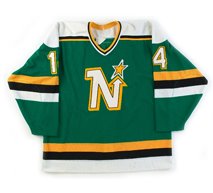
Today's featured jersey is a 1992-93 Minnesota North Stars Neal Broten jersey as worn in the North Stars final season in Minnesota. To celebrate the 100th Anniversary of the Stanley Cup, all jerseys that season carried the Stanley Cup Centennial patch.

Having dropped the familiar green and gold color scheme under new ownership, this style jersey was worn in Minnesota for two seasons and then retained after the move to Dallas. The Dallas Stars version can be differentiated by the addition of stylized state of Texas patches on the shoulders.

Minnesota North Stars B 1992-93 jersey photo Minnesota North Stars B 92-93 F.jpg
Minnesota North Stars B 1992-93 jersey photo Minnesota North Stars B 92-93 B.jpg
Minnesota North Stars B 1992-93 P photo Minnesota North Stars B 1992-93 P.jpg

Aside from the well known 1980 Olympics and being a part of The Miracle on Ice, Broten would later go on to be a member of Team USA in the 1981 and 1984 Canada Cup as well as the 1990 World Championships.


Monday, July 6, 2009

1989-90 Team Canada Ken Lovsin Jersey

Today July by the Numbers moves on to jersey #6.

Ken Lovsin was a member of the Canadian National Team in both 1988-89 and 1989-90, which was coached by Dave King. At the time, the Canadian National Team played a full season together and competed in various international competitions, such as the annual Spengler Cup, held every year in Switzerland, and against various club teams.

The team would attract top NHL prospects, veteran professionals and occasionally current NHL players who were holding out in contract disputes. The program would continue in this format until 1998 when professionals were allowed to compete in the Olympics.

Other members of the Canadian National Team in 1989-90 included Kris Draper and goaltender Ed Belfour, both prior to moving onto the NHL.

Lovisn would participate in but a single NHL game, when he suited up for the Washington Capitals once in the 1990-91 season. He would play two full seasons for Baltimore in the AHL, and a year in Sweden before rejoining the Canadian National Team for the 1993-94 season, which included earning a sliver medal for Canada at the Olympics in Lillehammer, Norway.

Today's featured jersey is a 1989-90 Team Canada Ken Lovsin jersey with the addition of the captain's "C".

One unusual feature of the customizing of this jersey is that the three color sleeve numbers are created by sewing the top red layer onto a white layer and then sewing that layer onto the jersey with blue thread.

The back number is even more unusual, in that it is simply a one layer white number sewn onto the jersey with tightly zig-zagged blue thread and an inner path of red sewn on in the same tight zig-zag fashion. In fact, the distance between the inner red trim and the blue outline varies quite a bit and they even touch each other on occasion. It's actually pretty crude when examined too closely.

I quite like the "speed stripes" treatment on the arms as the white fades out to red approaching the cuffs of the arms. Many of these style jerseys have sponsor patches from Air Canada, Esso and Labatt across the bottom of the jersey on the back.

1989-90 Team Canada jersey

Speaking of examining the back number closely, I should point out that each photo I post on this blog of one of my jerseys is a clickable link to my Webshots account, which has additional functionality beyond just seeing the photo here in my blog. If you would like to see any of my jerseys or patches in much greater detail, and the back number on this Canada jersey is a perfect example, you can send me a "friend request" through webshots.

Here's how
  1. Click here to be taken to the main page of my Webshots galleries.
  2. To the right of the fourth row down is a yellow box with several links to click. Select "make friends". I will then receive an email with your request.
  3. Once I approve you as a friend, you will then be able to view my photos in their original, gigantic 10 x 10 inch, 300 dpi size! You can also then download them to your own computer if you wish.
If you click on one of my photos, just look for the series of links at the top of the photo that reads "Spyboy1 > albums > Northwest Division (or whatever)", and click on "albums" to get to my main page and then follow step 2 above to send a friend request.

Sunday, July 5, 2009

1999-00 University of Minnesota Golden Gophers Ryan Trebil Jersey

The 5th day of July by the Numbers sees a return to the University of Minnesota Golden Gophers for our jersey #5 which belonged to Ryan Trebil.

Ryan's hockey career consisted of four years at Minnesota on defense, where he totaled 79 games, 3 goals and 6 assists while compiling 168 penalty minutes.

This is a game worn Nike 1999-00 University of Minnesota Ryan Trebil road jersey. 1999-00 was the first season that Nike was the manufacturer of the Gophers jerseys and would continue to do so until the 2001-02 championship season. This was never my favorite style Gophers jersey due to the fact the design was a Nike corporate template shared by many other teams at the time, from Team USA and the Czech Republic to Ohio State and Michigan. However...

winning a national championship in a particular jersey does wonders for ones opinion on such matters!

Game worn Gopher jerseys are quite difficult to obtain and are always in demand. I purchased this one directly from the University at an Athletic Department sale roughly seven years ago, the last time I am aware that they made any hockey jerseys available to the public.

One reason the game worn jerseys are so sought after is that Gophers authentic jerseys with fight straps are not made available to the public. The only jerseys sold at retail outlets are replica jerseys that lack the fight straps.

1999-00 Game Worn Minnesota Gophers jersey

Saturday, July 4, 2009

2002-03 New Jersey Devils Scott Stevens Jersey

July by the Numbers celebrates the 4th of July with jersey #4 from Scott Stevens of the New Jersey Devils.

Stevens, drafted 5th overall by the Washington Capitals in 1982, never played a game in the minor leagues and scored on his first ever shot in his first game. After eight seasons with the Capitals, he signed as a restricted free agent with the St. Louis Blues, costing them five first-round draft picks!

St. Louis named Stevens captain and made the Campbell Conference All-Star team in 1991. However, after the 1990-91 season St. Louis would again sign another restricted free agent, Brendan Shanahan of the New Jersey Devils. The Devils were now entitled to compensation and the case eventually went to arbitration, with Stevens being awarded to New Jersey.

In his second season with the Devils, Stevens would again be named team captain and would remain the Devils captain until his retirement 12 seasons later. He would lead the Devils in scoring in 1993-94 with 78 points and was also a league high +53 for the year.

In 1995, the Devils made it to the Stanley Cup Finals, where they swept the Detroit Red Wings in four straight to claim the first of three Stanley Cups. The Devils second Stanley Cup victory in 2000 would see Stevens be named the winner of the Conn Smythe Trophy.

After topping 1,500 games in the 2001-02 season, Stevens and the Devils would once again rise to the top and take their third Stanley Cup by defeating the Mighty Ducks of Anaheim in the 2003 Stanley Cup Finals.

Stevens would end his career with 1,635 games played, 196 goals and 712 assists for 908 points, finishing his career at a +393 with 13 NHL All-Star Game appearances. His #4 would be retired by the Devils on February 3, 2006.

Internationally, Stevens would appear in the World Championships for Canada four times, the 1991 Canada Cup where he would help Canada win the tournament, the 1996 World Cup and the 1998 Olympics.

The featured jersey today is a CCM 2002-03 New Jersey Devils Scott Stevens jersey with the 2003 Stanley Cup Finals patch as worn when the Devils defeated the Mighty Ducks in seven games.

New Jersey Devils 2002-03 jersey photo New Jersey Devils 2002-03 F.jpg
New Jersey Devils 2002-03 jersey photo New Jersey Devils 2002-03 B.jpg
New Jersey Devils 2002-03 jersey photo New Jersey Devils 2002-03 P.jpg

While I have made mention of Stevens Stanley Cup victories and point totals above, Stevens is probably best remembered for his hard hitting reputation, having made numerous memorable thundering checks throughout his 22 NHL seasons.


Friday, July 3, 2009

1980's University of Minnesota Duluth Jersey

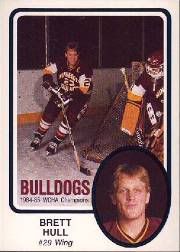
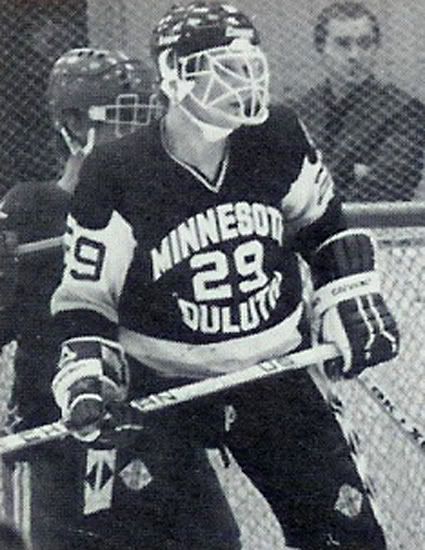
July by the Numbers continues with a #3 game worn University of Minnesota Duluth Bulldogs road jersey from the 1980's. This jersey style was used during the heights of the program when future NHL star Brett Hull skated for the Bulldogs and they were WCHA regular season and conference tournament champions and reached the NCAA Frozen Four in both 1984 and 1985, losing in the championship final in an agonizing four overtimes in 1984 and again three overtimes in the semi-finals the following year.

Both Tom Kurvers and Bill Watson wore this style jersey when they were winners of the Hobey Baker Award in 1984 and 1985

Later versions of this jersey had the word "Duluth" straight across the bottom, rather than the radially arch style you see on mine. In some of the earliest years this style was worn it did not have the skating bulldog shoulder patches.

I suspect my particular jersey may have been used for more than one season, and possibly by more than one player, due to the amount of wear on the jersey and the fact that the Bulldogs did not use names on the back at that time.

At the time of purchase, I was told the "UMD Bulldogs Russia 1984" patch was worn on the jersey when the Bulldogs visited Moscow and Leningrad (now St. Petersburg) in 1984 and I had it reattached. Recently, subsequent research has indicated the likelihood that the patch was worn on the left shoulder with the style of jersey that did not yet have the bulldog shoulder patches, as (barely) shown in this photo.

1980's Game Worn University of Minnesota Duluth jersey

If anyone reading this has any further information about this style Duluth jersey, especially the precise years this style with the bulldog shoulder patches and arched "Duluth" lettering was worn, especially numerical rosters, please don't hesitate to contact me at the email address in my "wantlist" section to the right or by leaving a comment below.

Thursday, July 2, 2009

2001-02 New York Rangers Alternate Brian Leetch Jersey

July by the Numbers continues on July 2nd with jersey #2.

Brian Leetch, picked 9th overall by the New York Rangers, won the Calder Trophy as a rookie in 1988 after first playing in the Olympic Games in Calgary. He played for Team USA in the 1991 Canada Cup, quickly followed by his best personal NHL season in 1991-92 when he totaled 102 points, including a Rangers record 80 assists and captured the Norris Trophy.

1993-94 would see Leetch hoist the Stanley Cup as well as the Conn Smythe Trophy, the first and only American-born player to do so. 1996-97 would go onto see him win his second Norris Trophy.

After captaining the United States to victory in the 1996 World Cup of Hockey, Leetch would be named captain of the Rangers in 1997 and play in his second Olympics in 1998 in Nagano, Japan, followed by his third, earning a silver medal in Salt Lake City in 2002.

Leetch would play in the 2004 World Cup of Hockey and then score his 1000th career point in the 2005-06 season while playing for the Boston Bruins. He would finish his NHL career with 247 goals, 781 assists and 1028 points.

He was one of 12 players voted to the All-Time USA Hockey Team in 1997 and then have his number 2 retried by the Rangers on January 24, 2008 and was been inducted into the United States Hockey Hall of Fame in October of the same year. Just ten days ago it was announced that Leetch will be inducted in the Hockey Hall of Fame in November of this year.

The featured jersey today is the very attractive Starter 2001-02 New York Rangers Alternate Brian Leetch jersey with the 9/11 Memorial Ribbon patch.

This jersey is perhaps the most successful third jersey in the history of the NHL in my book. The darker shade of blue gives it a richer, more elegant look compared to the blue of the Rangers road jerseys of the time. The updating of the Rangers shield crest for the shoulders is a more modern and exciting version than the original, but the real triumph is the Liberty Head main logo crest, also created especially for this jersey. It's bold, unyielding stare announces the presence of the Rangers as force than cannot be ignored, nor easily overcome.

I'm torn about the lack of any waist stripes, but have to give the Rangers credit for breaking out of the mold of every jersey having waist stripes, as was the norm in 1996-97 when this alternate style first appeared. There were two previous alternates without waist stripes, but both of those had bold striping across the center of the jersey, in the case of the Penguins 95-96 Alt with it's wild, color-changing aysemetrical central stripe, and the Canucks alt from the same season with it's top red half and bottom black half, but the Rangers stands alone as the first solid color body free of any stripes, creating a look that certainly made the players appear larger and more intimidating.

New York Rangers A 01-02 F
New York Rangers A 01-02 B

Unfortunately, Starter wasn't the best at customizing their own jerseys, as the red sections of the numbers are much too thin compared to the authentic jerseys.


Wednesday, July 1, 2009

1991-92 Kansas City Blades Arturs Irbe Jersey

With the lack of significant historical events in hockey history in July, especially those that relate directly to jerseys in the Third String Goalie collection, we have decided to take a little different approach to the heart of summer.

Every day in July we am going to feature a jersey whose number on the back matches the current date.

Simple, eh?

It's a chance for us to showcase some jerseys that frankly aren't related to a Stanley Cup victory, milestone goal or even a national holiday. We're going to call it "July by the Numbers".

So, for July 1st, we begin at the beginning and kick things off with a jersey that carries the #1, and you just knew it was going to be a goaltender, didn't you?

Arturs Irbe, a Latvian, was drafted by the Minnesota North Stars in the 10th round of the 1989 NHL Entry Draft, perhaps based on his performance against the North Stars during a North American tour by his Latvian club team, Dynamo Riga.

Remember these 1990-91 O-Pee-Chee Dynamo Riga cards?

Photobucket

Check out those tell-tale green, gold and white seats in the background from the North Stars former home, Met Center. Irbe's performance in that exhibition game in Bloomington, MN might very well have led to his being drafted by the North Stars.

As part of a complicated deal, the North Stars owners, the Gund brothers, were awarded an expansion franchise that would become the San Jose Sharks and begin play in the 1991-92 season. As part of the agreement, the Sharks were awarded some North Stars players and draft picks, one of which was Irbe.

Having come over to the United States for the 1991-92 season, Irbe found himself playing in the International Hockey League for the Sharks minor league team, the Kansas City Blades. In 32 games for the Blades, he had 24 wins, 7 losses and a tie and a goals against average of 2.46.

After spending some time at the NHL level playing for the Sharks (13 games with a 2-6-2 record), Irbe would return to Kansas City in time for the IHL playoffs where he would post a 12-3 record and lead Kansas City to the Turner Cup championship, including a sweep of Muskegon in the finals. He would also earn a share the James Norris Memorial Trophy with Wade Flaherty as the team whose goaltenders allowed the fewest goals in the regular season.

Today's featured jersey is a Bauer 1991-92 Kansas City Blades Arturs Irbe home jersey. It features the correct font used by the Blades for their player names in their championship season, photographic evidence which proved very difficult to find.

Kansas City Blades 1991-92 jersey photo Kansas City Blades 1991-92 F.jpgKansas City Blades 1991-92 jersey photo Kansas City Blades 1991-92 B.jpg

Tuesday, June 30, 2009

1991-92 New Jersey Devils Martin Brodeur Jersey

It was on this date in 1982 that the New Jersey franchise was officially named "Devils" in fan balloting. The unimaginative "Blades", retro "Americans" and the incredibly horrid "Meadowlanders" were runners-up in the contest.

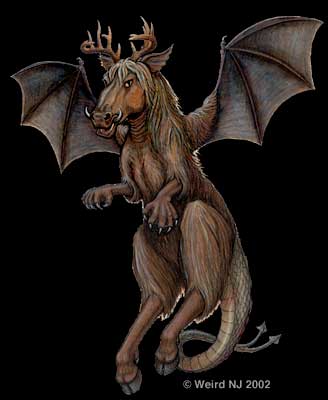
The Jersey Devil - an ominous crytptozoological (and just how many blogs will be using that word today?) creature with a horse-like head, hooves, bat-like wings, a forked tail and oversized claws - was said to terrorize locals in the New Jersey town of Pine Barrens in the 18th century. Legend varies to wether the child, the 13th one born into the Leeds family in 1735, was considered cursed and turned into the Jersey Devil or was born that way after the mother predicted after her 12th child that if she had another, it would be the Devil.

Still, on occasion there are complaints about the name Devils from those who think it refers to the Satanic Devil, rather than the mythical Jersey Devil.

The club was originally founded as the Kansas City Scouts in 1974. A little known fact is that the Scouts were originally going to be called "Mohawks", but the Chicago Blackhawks objected to the name. The Scouts then moved to Denver, Colorado and became the Rockies in 1976 and then relocated to New Jersey in 1982, this time adopting brand new colors and yet another new name. The team made the playoffs once in it's first 13 seasons,

The low point came in 1983-84 season when, at 2-17-0, the travelled to face the powerhouse Edmonton Oliers and were blown out by a score of 13-4. Wayne Gretzky, upset that former teammate Ron Low played for such an inferior team was quoted as saying "Well, it's time they got their act together, folks. They're ruining the whole league. They had better stop running a Mickey Mouse organization and put somebody on ice." The Devils fans reacted and when the Oilers visited two months later, the building was full of signs and fans wearing mouse ears.

Four seasons later the Devils made the playoffs, beginning a run of qualifying for the postseason in 19 of the last 21 years, including each of the last 12 in a row, having won the Stanley Cup in 1995, 2000 and 2003.

Today's featured jersey is a CCM 1991-92 New Jersey Devils Martin Brodeur jersey as worn when Brodeur made his NHL debut, wearing the unfamiliar #29, after an emergency call up, not from the minors but from Canadian Junior Hockey(!), when both Chris Terreri and Craig Billington were injured. He appeared in four regular season games, winning in his debut 4-2 vs. Boston, and one playoff game.

This jersey is in the original Devils colors of red and green, naturally earning the comparison to Christmas, which were worn through the 1991-92 season, thus making these five games the only time Brodeur would sport this style Devils jersey, as he would spend the next season in the minors playing for the Utica Devils and by the time he returned to New Jersey for the 1993-94 season, the Devils had introduced their now customary red and black jersey set.

This jersey has a pair of patches to point out, the first being the obvious NHL 75th Anniversary logo on the upper right chest and then a small, conservative Devils 10th Anniversary patch tucked away on the back side down by the CCM logo on the hem, certainly one of the more subtle patch placements in NHL history. This is another of my custom made patches we printed ourselves, as they had not yet been reproduced at the time we had this jersey customized.

New Jersey Devils 91-92 F
New Jersey Devils 91-92 B
New Jersey Devils 91-92 P1 New Jersey Devils 91-92 P2

Today's video section begins with a look at The Jersey Devil followed by the 1996-97 home opener which features highlights from earlier seasons, including today's featured jersey worn by Martin Brodeur during his first NHL action.


Monday, June 29, 2009

1998-99 University of Minnesota Golden Gophers Alternate John Pohl Jersey

I'm surprised it took this long, but regular readers of Third String Goalie will quickly learn that I am located in the hockey hotbed that is Minnesota, and as such, with the passing of time you will undoubtedly be subjected to a disproportionately large number of University of Minnesota Golden Gophers jerseys. I can promise you that they will possess quite a wide ranging variety of styles and eras, but if you do happen to be a die-hard University of North Dakota or University of Wisconsin fan, I won't apologize, but I will ask for your patience.

Minnesota's 1998 "Mr. Hockey", John Pohl was born on this date in 1979 and until recently held the Minnesota State High School career scoring record, with 378 points. In the world of career 1000 point scorers in the NHL, 378 points doesn't exactly sound like a big deal, but when you factor in a high school career is only four years long and just a mere 28 games season, suddenly averaging 95 points per year makes you sit up and take notice. Pohl's best season was his junior year when he racked up 111 points in 28 games for an average of 3.96 points per game. For comparison, fully admitting it really is apples and oranges, Wayne Gretzky averaged 1.92 points per game during his NHL career.

Pohl went onto play four years at the University of Minnesota, cumulating in a national championship for the Golden Gophers in 2001-02, a season when he was one of the team leaders and an assistant captain. He had his best collegiate season with 27 goals and 52 assists for 79 points and was named a First Team All-American in 2001-02, earning himself a spot on one of the murals at the Gopher's home rink, Mariucci Arena.

Pohl was drafted in 1998 by the St. Louis Blues, but only made one appearance for St. Louis in the NHL before being traded to the Toronto Maple Leafs. He would play 114 games over three seasons for Toronto, scoring 17 goals and 21 assists for 38 points. For the 2008-09 season, Pohl would continue his professional career first in Swizterland for HC Lugano, and most recently Frölunda HC of the Swedish Elite League.

The jersey I am featuring today is a Gemini 1998-99 University of Minnesota Alternate John Pohl jersey. This controversial jersey was worn for a limited number of games, as the players complained that the jersey was too hot to play comfortably in.

At the time this jersey was worn, the head coach of the Gophers, Doug Woog in his final season, had a policy of only recruiting players from the state of Minnesota. Each players jersey was decorated with a diamond shaped patch on the back of the jersey with a silhouette of Minnesota and the players home town embroidered in it. My jersey is from a batch not used by the team with a generic "Gophers" in place of "Red Wing" that would have been worn on Pohl's game worn example.

Minnesota Gophers 98-99 Alt F
Minnesota Gophers 98-99 Alt B
Minnesota Gophers 98-99 Alt P

The unconventional, decidedly "Star Trek" font chosen for the numbers and vertically arched name with continuous black outline was a dramatic departure for the Gophers, as well as the woven pinstripe effect dazzle cloth material. Gemini has an "interesting" aesthetic approach to jerseys at times, favoring the dazzle cloth in particular like no others. Not surprisingly, this jersey was only used for one season.


hit counter for blogger