History of Jersey 83-93 Banner sm photo History of Jersey 83-93 Banner sm.jpg

Wednesday, September 14, 2011

Hockey Jersey Training Camp - Day 3 - How to Spot a Fake

Hockey Jersey Training Camp continues with our third drill, and we are pleased to bring you a guide of what to look for in a fake jersey, reprinted here with kind permission of Tyler at NHLDigest.com.

Tyler begins:

As embarrassing as it is, over the past while several friends (and myself), have been duped into buying knock-off RBK Edge NHL jerseys.

Sometimes these jerseys can be easy to spot, but there are several companies that are making very good quality knock-off jerseys (typically manufactured in China or Korea).

After being bamboozled myself, I thought I’d go to some professionals for some tips and then write about it so you don’t make the same mistake that I did.

5 Things To Look For First:

  1. Does the web site look professional?When it comes to online shopping, your first impressions are important. If the site doesn’t look professionally designed, has poorly written content, or has a checkout process that is less than simple…be cautious.
  2. Does the site offer multiple methods to contact the company?A reputable website will always provide a full physical address on its contact page, as well as Telephone (toll-free is even better), and often live chat. In addition, they also may offer product reviews and site performance ratings to provide feedback from past satisfied customers. If all the site provides is a simple contact form or an email address, then it is likely that they don’t want you to find them too easily – for a reason!
  3. What types of shipping methods are used? If they don’t use one of the major North American courier companies such as UPS, FedEx, Purolator or US or Canada Post, then it is likely that your package is coming from very far away – if it comes at all.
  4. Where is the company based? If you do find a physical address (or other evidence) that the company is based offshore (especially Asia), then it is pretty much a sure bet that the jersey you are getting is a knock-off. All Reebok Authentic jerseys are manufactured in Canada, so there is no reason that a company in China would be selling Canadian-made authentic jerseys!
  5. Is the price too good to be true?If the listed price is significantly below the typical retail price, that should be an obvious warning flag. An Authentic Edge Jersey with real pro customization like will usually go for $350-$400USD, so if you see a seller advertising the same product for anywhere from $75 to $200USD, you can be sure you aren’t getting the real McCoy!
  6. Inspecting The Jersey for Authenticity

    The following are some key things about the jersey’s construction to look for. As mentioned, it’s been some time since the introduction of the RBK Edge jersey, and many fakes are now very close to being identical to the authentic so be very thorough in your investigation!

    1. The very first thing to note is the coloring of the jersey. Many knock-offs are good with the main colors of Black and White. However, you may be able to notice marked differences in Blues and Reds upon comparison to authentic jerseys.
    2. Check the logos and numbers for the correct detail. Again, the knock-offs are getting better at the detailing, but some NHL team logos have detail that can be hard to duplicate. Pay particular attention to the sizing and spacing of the letters and numbers on the jerseys. The letter and spacing are likely to be larger or smaller than the authentic version.
    3. Patches and stitching are also very important to compare. Compare the location of the stitching around the armpits and back of the neck to make sure the construction is authentic. In addition, the NHL and RBK trademarks on authentic jerseys are actually patches and not embroidery. This is one good comparison to make when shopping for a jersey on E-bay.
  7. I have used the fake Flames jersey that I bought on eBay, and compare it to my real authentic Flames jersey. Below are a few things that you can look for to determine whether the jersey you have on hand is in fact a real one. Now, in this experiment I am only using the "fake authentic" jersey that I bought on eBay to compare to a real one, and I am not certain whether this applies to replica ones (cause I don't collect replica jerseys). There are obviously quite a number of different manufacturers out there that manufacture fake jerseys. One jersey cannot speak for all of them, and with the popularity of Internet and communication, these manufacturers have "updated" the way their fake edge are designed and structured.
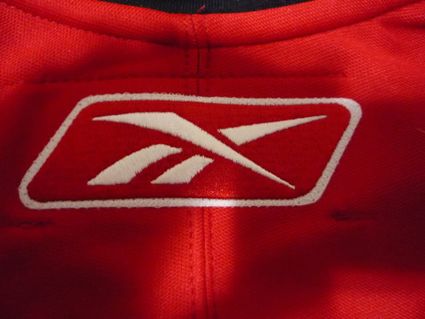
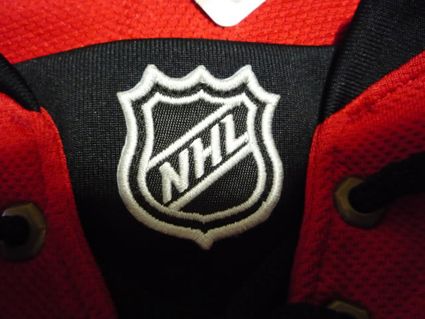
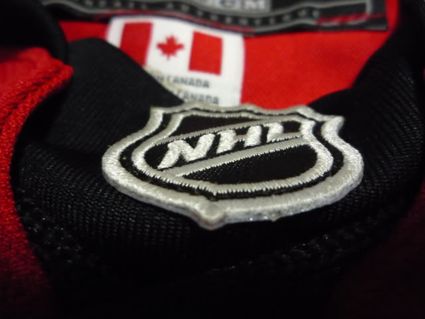
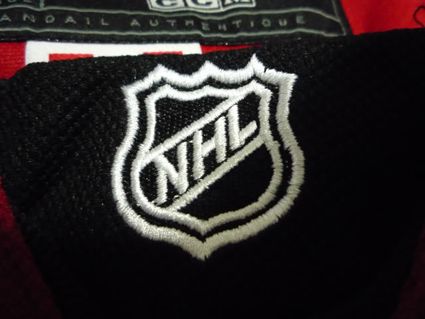
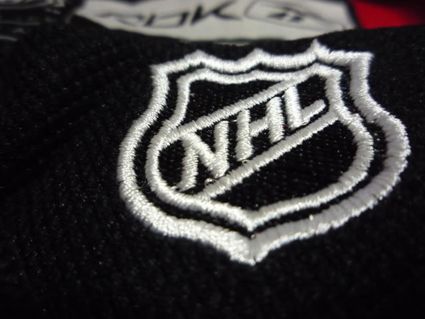
1) The Reebok logo and the NHL shield patch NHL Shield trademark

real:
NHL 1 real
NHL 2 real

fake:
NHL 1 fake
NHL 2 fake

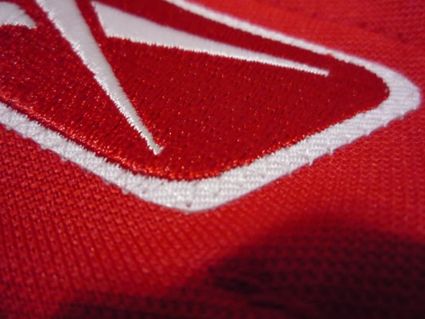
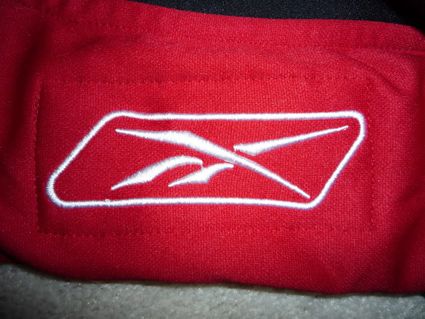
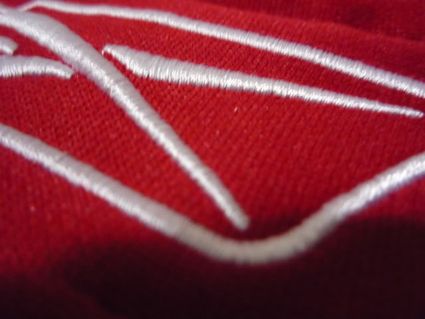
Reebok trademark

Real:
Reebok Logo 1 real
Reebok Logo 2 real

Fake:
Reebok Logo 1 fake
Reebok Logo 2 fake

For all authentic, real Edge jerseys, the Reebok and the NHL shield trademarks are patches, which means they both need to be sewn onto a jersey. On my fake jersey, both trademarks are directly embroidered onto the jersey.
Also pay attention to how the Center Ice tag is sewn on to both jerseys. On the real jersey, it was only sewn on the entire top across, and only the corner of the bottom, whereas on the fake one the Center Ice tag was completely sewn on (the Reebok logo was surrounded by stitching completely). If the logos on your jersey are directly embroidered, then I’m sorry, your jersey is a fake.

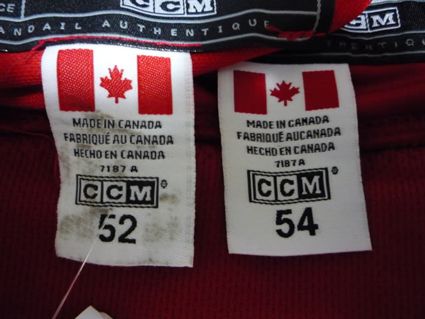
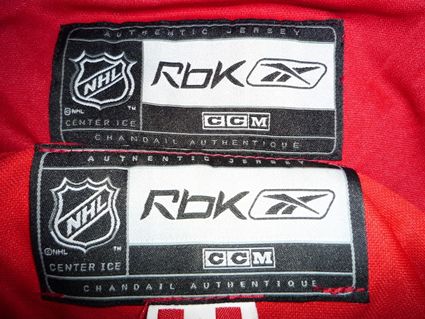
2) Neck tags (sz 52 is the real Edge, sz 54 is the fake one)

Size tag comparison
Reebok tag comparison

Surprisingly, both the size tag and the Reebok Center Ice tag are similar. But there are still a couple of things that could be found
a) The red stripe of the Canada flag are more wide compare to the real one, and the red maple leaf on the fake doesn't really look like a maple leaf. The gaps between letters on the real one is a bit wider compare to the fake
c) The Reebok Center Ice tags are almost identical, and the only difference you can tell is the "I" of the word "CENTER ICE" below the NHL logo (note that the bottom neck tag is from the real jersey)

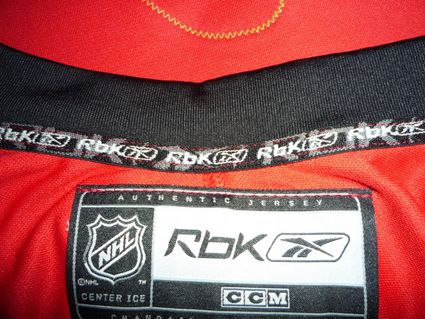
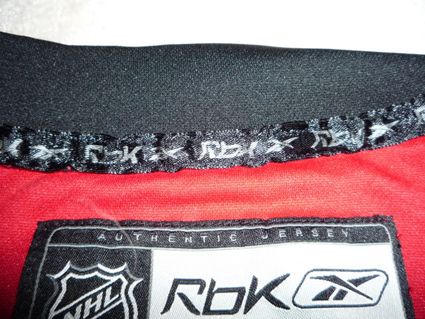
3) Reebok stripe

Real:

Reebok stripe real

Fake:

Reebok stripe fake

For real authentic jersey the Reebok stripe located above the Center Ice tag has the bigger Gray "RBK" wording behind, where there was none on my fake one. Now, as of Aug 22, 2009, I have spotted a few fakes on eBay that starting to have the bigger Gray "RBK" wording behind, so using this guideline to judge your jersey may not work anymore.

4) Twill and customization

Real:

Twill real

Fake:

Twill fake

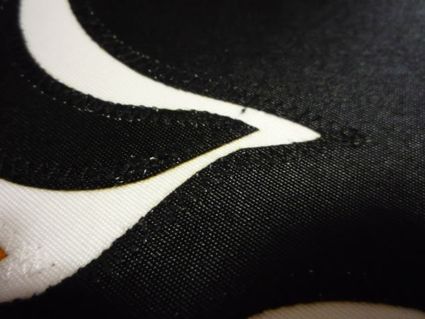
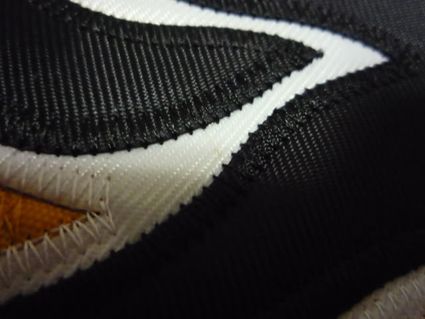
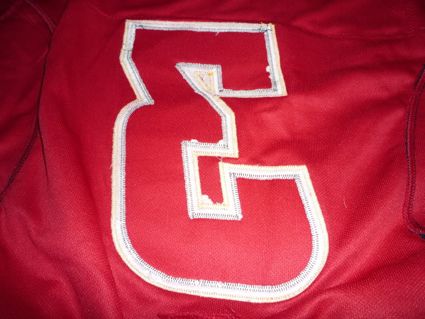
The tackle twill on the real jersey is completely different than that of a fake. The twill that the real one uses, and the ones that we most collectors uses to customize our jerseys, are came from Stahls'. The surfaces are virtually flat and smooth, and very light (aside from the glacier and dazzle twill). But on the fake one the twill are not flat and smooth at all, and are very hard and heavy for some reason.

Further, for some unknown reason there are backing papers behind the logo and the numbers. I do recall a couple of my early 90’s jerseys are customized this way. But this style of customization are seldom used. (TSG note: If you turn a legitimate jersey inside out, you will see only the zig-zag stitching, but fakes use a paper backing inside the jersey to prevent the fabric from tearing or otherwise getting holes in it while it is being sewn, similar to what is used on a sweatshirt with an embroidered design on it)

Paper backing on fake twill

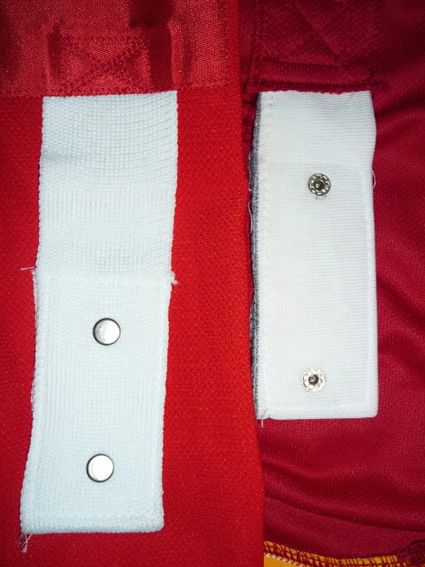
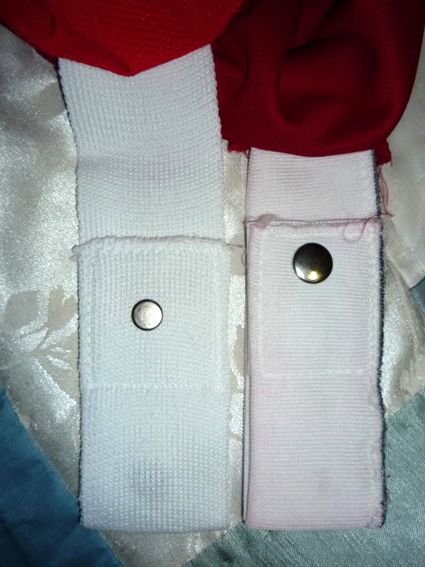
5) Fight strap (the one on the left is real)

Fight Strap comparison 1
Fight Strap comparison 2
Fight Strap comparison 3

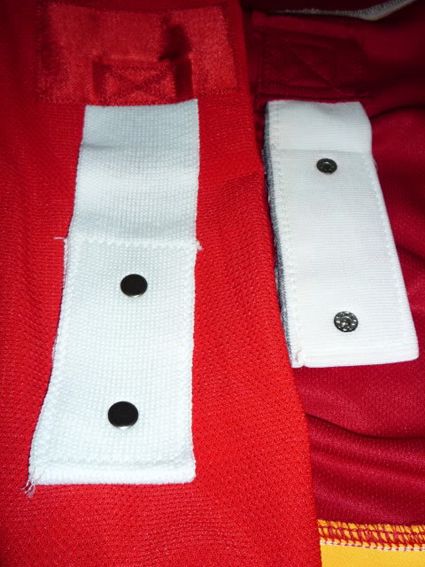
Last but not least is the fight strap. Now, many fans, “rookie” collectors always have a mindset that a jersey with fight strap is authentic, or at least make it an authentic jersey, or even make it as a jersey that players worn on the ice. Well, an experience collector can tell you right away that “A JERSEY HAVING A FIGHT STRAP DOES NOT MAKE IT AUTHENTIC, AND DOES NOT MAKE IT TO BE THE SAME JERSEY THAT PLAYERS WORN ON THE ICE”! You could add a fight strap to a replica jersey easily, but that doesn’t mean the fight strap all of a sudden makes it an authentic jersey, or someone like to phrase it as “same jersey that players worn on the ice.”
Few notes on the fight strap:
a) All CCM, Reebok, or even Nike, you can only stretch the fight strap horizontally, not vertically. This is obviously to prevent the jersey from being pulled over one’s head during a fight. The fight strap on my fake jersey is very poorly constructed.The piece that attached the fight strap onto the jersey is tackle twill, and 99% of the time is the same colour as the jersey. It is sewn on with zig-zag stitching, with a cross stitching inside a small rectangle stitching, and a large rectangle sewn on around the twill using zig-zag stitching as well.

I just hope this information could help all fans and collectors. If you have additional information, please share it with all of us. Thanks in advance.

Happy collecting folks!!

*********************

Thanks again to Tyler for letting us reprint his excellent look at the detail differences between real and fake Reebok Edge jerseys. While there have been fake jerseys made of pre-Reebok jerseys, the proliferation of them, particularly on ebay and craigslist, really exploded with the arrival of Reebok as the sole NHL jersey supplier.

Points we'd like to further emphasize that apply to non-Reebok fakes are the use of shiny, wavy twill for the numbers when compared to the perfectly flat, less glossy twill used on legitimate jerseys. Quite often the fonts used for the numbers are too fat and the outlines too thin, if the font is even correct at all.

As for the online shops that spring up and disappear overnight only to spring up again with a new, similar name, it's pretty simple. If they do not provide a street address in the US or Canada, stay away from it. Read their "About us" or "Contact" pages and look for bad grammar and misspellings. Those are a dead giveaway that you are not dealing with a professional organization that uses English as their primary language of communication.

Tuesday, September 13, 2011

Hockey Jersey Training Camp - Day 2 - Where to Buy Your Jerseys

Day 2 of Hockey Jersey Training Camp brings us to our next "drill", where to buy your jerseys.

In the pre-internet past, buying jerseys was limited to the souvenir stand of your local team and a few select options at a limited number of sporting goods stores.

With the arrival of the internet into our homes, the options for the jersey collector have expanded exponentially since the mid 1990's, beginning with any number of online retailers and of course, ebay, the world's biggest garage sale, where collectors across North America could buy and sell their jerseys without regional boundaries and limited selections as in the past.

Other options beyond ebay that began to appear were online stores, such as IceJerseys.com, RiverCitySports.com, United States College Hockey Online's internet store (USCHO.com) and Shop.NHL.com, who focus almost exclusively on hockey, as well hockey equipment dealers like HockeyGiant.com, HockeyMonkey.com and TotalHockey.com, who all have a jersey selection as part of their hockey gear websites as well as other broader appeal sporting goods retailers such as FogDog.com and FansEdge.com.

No mention of online jersey sellers would be complete without a mention of the wonderfully unique WorldHockeyJerseys.com, who deal with mainly national team jerseys of quite nearly 50 different countries and have been responsible for some real gems in our collection, such as national team jerseys from Estonia, Iceland, the Netherlands and Poland since their founding in late 2006. It was absolutely unheard of to be able to purchase a Mongolian National Team jersey on demand until WHJ came on the scene!

If you are looking for some really obscure or unique items, go no farther than VintageMinnesotaHockey.com. The selection offered by VMH is like no other, beginning with a 1915-16 St. Paul Athletic Club jersey and moving through the history of Minnesota hockey through classic high school, junior, college, minor league, WHA and NHL Minnesota classics, all produced with painstaking detail and quality. Where else are you going to be able to purchase Neal Broten's high school jersey? And if you are a fan of the University of Minnesota, or the players they have recently sent to the NHL, VMH is the place for you to get your Gophers jerseys, from 1936 to 2008.

Another "garage sale" approach online can be your local Craigslist.org listings, where the occasional gem can be found.

Unfortunately the main source we have relied on for over a decade, ebay, has taken an enormous turn for the worse, as fees associated with selling on ebay have risen again and again and again, which are naturally passed on to the buyer whenever possible. Rising postage costs have also made ebay less attractive to a certain degree, but the main problem with buying on ebay these days is the incredible proliferation of fake jerseys from China flooding the market and making the legitimate jerseys quite difficult and time consuming to locate and identify among all the static.

fake hockey jersey
A poor quality knockoff jersey with "Gonchar" misspelled!

Sadly, ebay has little reason or incentive to attempt to curtail all the illegal activity crowding out the legitimate jerseys as they profit from each and every one of the thousands of the knockoffs listed on their site through the listing fees they charge, whether an item sells or not.

Should any of these jerseys actually sell to those unknowingly thinking they are getting a great deal or don't care that the jersey is a fake when compared to the price of a real jersey, ebay makes even more money on both the final value fee and the subsequent paypal payment, further reducing their incentive to clean up their listings, as turning a blind eye to the fake jerseys only helps their bottom line.

Still, despite it's problems, ebay is still the place to look for the majority of what you want as long as you are able to identify the real jerseys from the counterfeits, especially if you are interested in any of the older style jerseys prior to the arrival of Reebok becoming the supplier to the NHL in 2007-08, as the above listed online shops only carry the current seasons jerseys almost without exception.

If one thinks ebay has gotten bad, it hardly compares to the cesspool of junk peddled on craigslist. Even finding a legit jersey for sale with adequate photos is like finding a needle in a haystack, but it can be done with some persistence and luck.

Another alternative to paying retail prices at the various online stores or dealing with the hassles of ebay is to buy directly from other collectors. A limited number of online forums, such as that hosted by IceJerseys, Jersey Central.org or the game worn forums at both GameWorn.net and GameWornJerseys.com all have marketplace sections where collectors can buy from and sell to other members of their online community.

After you have been a member of these discussion forums for a period of time, you will learn which members are trustworthy and have established reputations as honest people to deal with. We personally have started to buy an increasing percentage of our jerseys directly from others this way.

Some of those forums have rules which require you to be a member for a period of time and also participate as an active member of the forum with a minimum number of posts before you can sell your jerseys there. Please be respectful and follow not only their established guidelines, but the spirit of those guidelines. Creating a two dozen brief posts all in one day which add nothing to the conversation and annoyingly dredge up old threads to simply meet the number of posts required will not fool anyone will harm your reputation as a trustworthy seller and won't earn you selling privileges anyway.

If you have any other favorite sources to obtain your jerseys, we'd love to hear about it in the comments section below.

We also invite you to visit the selected advertisers mentioned above in our ThirdStringGoalie marketplace sections in our right hand column of this page.

Monday, September 12, 2011

Hockey Jersey Training Camp - Day 1 - What to Collect

Welcome to Hockey Jersey Training Camp! We are going to cover a number of topics over the course of this training camp in an effort to aid the collector of jerseys, both veteran and rookie.

Our first "drill" will focus on what to collect.

Many fans just buy a jersey or two from their hometown team and call it a day until the player whose name is on the back of their jersey leaves the team, especially under less than friendly circumstances. They are then faced with the choice of wearing a newly outdated jersey, buying a new jersey or simply going to the games with a team sweatshirt.

The avid jersey collector does have to worry about such things, as they have any number of jerseys to fall back on in the event a star player leaves their team.

Many collectors simply buy what catches their eye, regardless of what team it's from, to some degree, as some passionate fans cannot overcome their hatred of their favorite team's rival to ever own one from "the enemy". Other collectors develop a theme to their collections, and that's what we are going to focus on today.

The most common theme is to buy jerseys from your favorite team, be it an NHL club, their local minor league affiliate, junior or college team. For example, some collectors will only purchase Avalanche jerseys. Others Avalanche fans will branch out to include such things as jerseys of Avalanche players from appearances in All-Star games and various international tournaments, such as a Joe Sakic 2000 All-Star jersey or a Peter Forsberg Sweden National Team jersey, in both an effort to wear something a little different from the masses and demonstrating the increased depth of their hockey knowledge, like this amazing Colorado Avalanche collection. One way to add interest to the single team approach is to add jerseys with additional anniversary, all-star or memorial patches a club may have worn.

Other fans will focus their collection not on a single team, but a single player, with Wayne Gretzky or Mario Lemeiux being prime examples, as both players not only wore a number of NHL jerseys, with Gretzky having played for four different teams, while Lemeiux wore no less than eight different Penguins styles, 11 different All-Star jerseys and skated for Canada in five international tournaments.

Other star players often lend themselves to this approach, such as Sakic, Teemu Selanne or Jaromir Jagr to name a few, with the multiple options for NHL, All-Star and International jerseys they have worn during their careers. Sydney Crosby and Alexander Ovechkin also lend themselves to this approach for those of you just getting started in collecting given the opportunity you will have to buy their jerseys when they are current, rather than trying to find discontinued styles that are long out of production from older players, although you better get started, as Ovechkin has already played for Moscow Dynamo, who changed jerseys every one of his four seasons there, the Washington Capitals, who have already changed jersey styles during his five seasons with the club, in four NHL All-Star games and the Russian National Team ten of the last 11 years!

Some fans in smaller locales have been known to collect the NHL jerseys of former players on their local minor league team who have gone on to play at the highest level. This can lead to some unusual and off-beat player choices, as obvious star players are passed over for journeymen types with short careers due to their local connections to the collector.

Other player oriented themes are Hall of Fame players, black players, rookie jerseys and goalie collections.

Getting away from the focus on individual players, some try to collect at least one jersey from each NHL club, defunct clubs, All-Star Game jerseys, each year's Stanley Cup champion or even each year's Conn Smythe winner. One other theme is to collect jerseys from a particular season, our favorite of which is the 1991-92 NHL season, which saw the Original 6 teams all wearing Turn Back the Clock jerseys and all players wearing the attractive NHL 75th Anniversary logo that season.

Adding the unique jerseys worn each year in the now annual Winter Classic is also a good way to add some unique jerseys to one's collection without a huge financial outlay each season, although it appears that there will now be a pair of outdoor games every other season going forward to generate more specialty jerseys for you to pursue.

There is also a subset of collectors who focus on the rare, unusual and unloved jersey styles, such as the short-lived alternate jerseys like the Mighty Ducks "Wild Wing" or Los Angeles Kings "Burger King" jerseys. The New York Islanders Fisherman era sweaters and the Tampa Bay Lightning "Stormy Weather" alternates are also quite popular with fans of what we like to call the "Curious, Weird and Ugly" jerseys. Of those, the Kings alternate is the perfect storm of collectability, being scarce due to it's short life, desirable due to it's unattractiveness and the added competition to own one from those who focus on Gretzky jerseys.

Still other themes consist of either the jerseys of your home country, such as the various Team Canada or Team USA jerseys, and one ambitious collector has taken the opposite approach by attempting to collect jerseys from as many different national teams as possible, which can be quite a challenge given the over 50 full member countries in the International Ice Hockey Federation, which include lesser-known hockey playing nations as Australia, North Korea, Mexico, New Zealand and South Africa!

There's also jerseys from your favorite minor, junior or college teams that can be the basis of a collection.

Once you decide if your collecting is going to have a loose or rigid theme, then there is the aspect of buying only authentic jerseys, the kind with fightstraps which are the same as those worn by players on the ice, or if replica jerseys fit your taste and budget, as throughout the 1990's replica jerseys were made to a very high standard by CCM, Nike, ProPlayer and Starter.

And so far we have not even mentioned the aspect of focusing on game worn jerseys, which is a whole culture in and of itself, as collectors try to track down the actual jerseys worn by the players on the ice during the games. As with anything, there are options in game worn collecting to fit most every budget, as lesser known players or even pre-season jerseys can sometimes be had for prices occasionally below a retail authentic.

Pick one concept or multiple themes if you wish, but be careful to not pick them all, or you just might find yourself writing a daily blog about your collection!

Have an unusual theme for your collection not mentioned here? Please post it in the comments below, as we'd like to hear what interesting ideas others have come up with.

Our video section today features some collectors who have chosen to share their collections on youtube.


Sunday, September 11, 2011

2000-01 FDNY Hockey Team Ray Downey Jersey

Ray Downey was the Fire Department of New York's Chief of Special Operations and a passionate New York Rangers fan and founding member of the FDNY Hockey Team.

Chief Ray Downey

He served with the United States Marine Corps and then became a member of the Fire Department of New York (FDNY) on April 7, 1962, beginning a 39-year career. In August of 2001, Chief Downey was put in charge of Special Operations Command, a team of specialists who aid regular firefighters with unique or highly critical situations, which include Hazardous Materials, Marine Units, Rescue Companies (experienced units with specialized tools and equipment) and Squads, often regarded as mini Rescue Companies who also have specialized tools and equipment. Downey was also promoted to Deputy Chief at the time.

His career was built on numerous successful rescues which made him the most decorated man in the history of the FDNY. He received five medals for valor and 16 unit citations as well as the 1995 Administration Medal.

Additionally, Chief Downey was a task force leader for the New York City Urban Search and Rescue Team as well as the National Disasters Team, who responded to both the Oklahoma City and Atlanta Olympics bombings. He was also a team leader in response to Hurricanes Hugo, Andres, Fran, Marilyn and Opal, Chief of Rescue Operations at the World Trade Center bombing in 1993, all of which contributed to his being called "a charismatic national legend in rescue circles" and he was credited with creating the modern search-and-rescue system adopted by FEMA and fire departments worldwide while pioneering a national network of eight search and rescue teams under FEMA.

He also made frequent trips to Washington D.C. while serving on a congressional panel on domestic terrorism and it's prevention.

All of this led to Downey commanding rescue operations at the World Trade Center on September 11, 2001 following the terrorist attacks earlier that morning when hijacked jetliners were crashed into each of the twin towers.

His unit was called in immediately after the first impact at #2 World Trade Center and he was leading the rescue operations which helped save thousands of lives when the second of the towers collapsed, costing him his life.

He left behind his wife Rosalie and five children, two of whom, Joe and Chuck, are now firemen.

It would take eight months after 9/11 for his remains to be identified through DNA testing before Chief Downey was then laid to rest on May 20, 2002.

When once asked asked why he searched so long for remains of those presumed dead, he cited the families of those left behind. "The only way you can relieve some of their sorrow," he said, "is to successfully recover the bodies of the people they loved."

Of the 343 firefighters lost on 9/11, Special Operations Command lost a total of 95 men with 1,600 years of experience that day.

Ray Downey's life and career are commemorated with The Ray Downey Courage and Valor Award, which is presented each year to an extraordinarily courageous American firefighter.

Following the terrorist attacks in September, 2001 the New York Rangers and Buffalo Sabres faced off in the Rangers first home game of the season on October 7th. Both the Rangers and Sabres wore special jerseys with "New York" diagonally across the front. Following the game won by the Rangers 5-4 in overtime, both sets of jerseys were auctioned off to raise money for the Twin Towers Fund.

 photo NewYorkRangers2001-029-11smjersey.jpga photo BuffaloSabres01-029-11smjersey.jpg

Prior to the game the NYPD and FDNY hockey teams lined up on the ice and the Rangers skated between them during their introductions. FDNY team member Larry McGee had brought Ray Downey's firefighters helmet with him with a picture of Downey tucked into the brim of the helmet. He noticed that of all the players, only Rangers captain Mark Messier had not worn his hockey helmet during the pre-game ceremonies.

As the Rangers were lined up at the blueline, McGee sensed the moment was right and skated over to Messier with the helmet and told him it would be an honor if he would wear it. Messier responded, "Sure, whatever you need" and donned the helmet of the still missing Downey as the Madison Square Garden crowd roared it's approval.

Messier Firehelmet 10/7/01
Mark Messier wearing Chief Downey's helmet prior to the Rangers first home game following the 9/11 terrorist attacks. Note the special "New York" jersey worn only for that game.

"For me, personally, it was very emotional for a lot of reasons," said Messier, "Obviously, with all the people being honored - the firefighters, the police, the rescue workers, the volunteers, the entire city - and all our fans. All on a day when we started fighting back as a country."

At the end of that same season, Messier presented his #11 jersey to the family of Ray Downey during the Rangers annual Blueshirts off our Backs night on April 10, 2002.

Messier Blueshirts off our Backs 2002

The FDNY Hockey Team was first formed back in 1968 and played it's first game against the New York Police Department in 1974 and the FDNY Hockey Team now competes in charity events and tournaments from Alaska to Sweden as well as hosting the FDNY "King of the Ice" Firehouse Tournament, where for over 15 years nearly 100 different firehouses compete for the championship in the largest tournament of it's kind.

The main event on the FDNY Hockey Team calendar is always their annual faceoff against the New York Police Department (NYPD) game as the FDNY Bravest take on the NYPD Finest in "The Battle of the Badges". To date, 42 games have been played with the FDNY holding a 23-17-2 lead in the series.

Today's featured jersey is a 2000-01 Fire Department of New York Hockey Team Ray Downey jersey. This jersey takes the classic simplicity of a jersey very similar to the New Jersey Devils and combines it with the timeless look of the drop shadowed New York Rangers cresting and numbers to create as perfect a hockey jersey as you will ever see.

Of note, none of the players wore their individual names on the back of their jerseys, and instead they all had their team nickname "Bravest" on the back in place of their names, similar to Team Canada in the 1972 Summit Series when they all had "Canada" on the back.

FDNY 2000-01 jersey photo FDNY2000-01F.jpg
 photo FDNY2000-01B.jpg
FDNY 2000-01 P1 small photo FDNY2000-01P1sm.jpga photo FDNY2000-01P2small.jpg

Chief Downey's jersey #9 was retired by the FDNY Hockey Team during a pre-game tribute at the March 2, 2002 FDNY vs. NYPD hockey game.

Downey jersey retirement
Rosalie Downey receives Chief Downey's retired
jersey before the FDNY vs. NYPD game in 2002

While this style jersey has been retired, you can get the current FDNY Hockey Team jersey, based on the 2000-2007 Calgary Flames jerseys, through the above link or at the official store for FDNY gear - The Fire Zone at Rockefeller Center at 34 W 51st St. in New York, New York.

Please take a moment to visit the Deputy Chief Raymond Downey Scholarship Charity Fund, at ChiefRaymondDowney.com, which holds the annual Forever Running Memorial 5K Run/Walk each Father's Day to benefit the organizations he supported, and consider making a donation to the fund. Information on how to contribute can be found by clicking the banner below.

Downey banner,Downey banner

The Rescue Company, written by Chief Ray Downey, a how-to manual on rescue operations for firefighters in both paperback and hardcover, as well as his instructional video on collapse rescues are available below.


The Last Men Out, written by Ray Downey's nephew Tom Downey, is about Rescue 2, the firehouse Ray Downey commanded for fourteen years. Rescue 2 doesn't leave a fire until everybody's safe - they're the last men out.


WTC lights

Thursday, September 8, 2011

2006-07 Minnesota Wild Pavol Demitra Jersey

The crash on takeoff of the jet carrying the Russian club Lokomotiv Yaroslavl to what was supposed to be their season opening game killed 43 of the 45 people on board, taking the lives of all but one of the players and all of the other team personnel on the flight. The only other survivor of the crash was a member of the plane's crew.

"At first we didn't want to believe it. But right now there is no hope. The team is gone," a Lokomotiv team official told the Russian news outlet Sovietsky Sport.

The catastrophe claimed the lives of players and coaches from Belarus, Canada, the Czech Republic, Germany, Latvia, Russia, Slovakia, Sweden and Ukraine, shaking the hockey community worldwide.

Lokomotiv Yaroslavl team picture

Among those familiar to fans of the NHL were assistant coach and 12 year NHL veteran and multiple Soviet and Russian league champion Russian Igor Korolev, eight year NHL veteran and World Championship gold medal winner Czech Karel Rachunek, Stanley Cup and World Championship gold medal winner Czech Josef Vasicek, 11 year NHL veteran, owner of the NHL's longest playing streak for a defenseman and Latvian National Team mainstay Karlis Skrastins, 12 year NHL veteran, World Championship gold medal winner and one of the first four Russians to have his name engraved on the Stanley Cup, assistant coach Alexander Karpovtsev, 14 year NHL veteran, with 917 games played, and Belarus National Team leader Ruslan Salei, 18 year NHL veteran of 1,222 games and Stanley Cup winner and team head coach Canadian Brad McCrimmon.

Russian Alexander Vasyunov had played two seasons with the Lowell Devils of the AHL and 18 games with the New Jersey Devils last season and German Robert Dietrich spent two seasons in North America in the Nashville Predators system with the AHL's Milwaukee Admirals,

Czech Jan Marek led the KHL in goal scoring in 2008-09 and was a World Championship gold medal winner in 2010. Sweden was hit hard by the loss of goaltender Stefan Liv, a three time Swedish Elitserien champion with HV71, and World Championship gold medal and Olympic gold medal champion, both coming in Sweden's historic double of 2006. The Polish born Liv also played in North America with the Grand Rapids Griffins of the AHL in 2006-07.

One of the highest profile names to perish in the crash was Slovak star Pavol Demitra. Demitra began his professional career with two seasons in the Czechoslovak league before moving to North America following his being drafted 227th overall by the Ottawa Senators. He would split three seasons between the NHL's senators and their top minor league affiliate, the Prince Edward Island Senators from 1993-94 to 1995-96.

Demitra played for the Las Vegas Thunder and Grand Rapids Griffins of the IHL as well as eight games with the St. Louis Blues following a trade. he found his greatest success with St. Louis, with three seasons of 35 goals or more, including a high of 37 in 1998-99, the year of his first NHL All-Star Game appearance. Two more All-Star appearances would follow in 2000 and 2002 before Demitra would set a career high in points with 93 in 2002-03, placing 6th overall in the league scoring race. In all, Demitra would lead St. Louis in scoring four times, in 1999, 2000, 2002 and 2003.

Demitra Blues

He would also be recognized with with the Lady Byng Trophy in 2000 after recording 28 goals and 75 points with just eight penalty minutes.

He returned to Slovakia during the NHL lockout of 2004-05 to once again play for Dukla Trencin. Once the NHL resumed play, the free agent Demitra signed to play for the Los Angeles Kings for one season prior to being traded to the Minnesota Wild to be teamed with fellow Slovak and close friend Marian Gaborik. for the 2006-07 and 2007-08 seasons.

Demitra and Gaborik

Demitra tied for the team lead in scoring during his first season in Minnesota despite Gaborik missing nearly half the season due to injury. While with the Wild, Demitra served as team captain during October of 2007.

Demitra captain

His final two NHL seasons were spent with the Vancouver Canucks, although the second was limited to 28 games following a lengthy recovery from off-season shoulder surgery.

His NHL career concluded with 847 games played, 304 goals and 464 points for 768 points. Additionally, in 94 career playoff games, Demitra scored 23 goals and 59 points.

For the 2010-11 season, Demitra signed with Lokomotiv of the KHL in Russia, where hisrenowned playmaking abilities made the veteran the club's leading scorer and placed him in a tied for third in league scoring.

Internationally, Demitra played in the 1992 European Junior Championships and the 1993 World Junior Championships, winning a bronze medal, for Czechoslovakia. Following the division of Czechoslovakia, Demitra skated for Slovakia in both the 1996 World Championships and 1996 World Cup, the 2002 Olympics and 2003 World Championships where he earned a bronze medal.

He then went on to participate in both the 2004 World Championships and 2004 World Cup, the 2005 World Championships, 2006 Winter Olympics and 2007 World Championships.

Demitra then led all players at the 2010 Olympics in scoring with ten points in seven games on his way to being named a tournament all-star. He also scored a sublime shootout goal to give Slovakia a win over Russia in the preliminary round.

His final international appearance was as the 2011 World Championships, where he had the honor of captaining the Slovak team on home ice.

Demitra captain

Demitra and Rachunek
Here, Demitra and future Lokomotiv teammate Rachunek embrace following their preliminary round game at the 2011 World Championships.

Demitra leaves behind his wife Maria and his two children, Lucas and Zara.

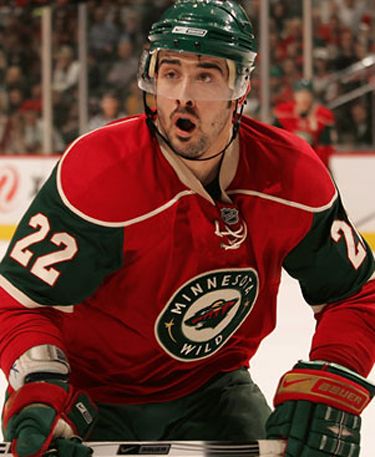
Today's featured jersey is a 2006-07 Minnesota Wild Pavol Demitra jersey as worn on January 6, 2007 with the Garth Brooks Teammates for Kids Foundation patch. Each player on every team would wear the Teammates for Kids patch on their jerseys for a game that January, after which the jerseys were then auctioned off for charity to raise money for the foundation.

To date, the foundation has distributed over $75 million through it's various programs in conjunction with professional athletes.

 photo MinnesotaWildG06-07F.jpg
Minnesota Wild G 06-07 jersey photo MinnesotaWildG06-07B.jpg
Minnesota Wild G 06-07 jersey patch photo MinnesotaWildG06-07P.jpg

Today's first video is an enlightening look into the thoughtful Demitra's journey from a youngster in Czechoslovakia, where the ultimate goal was the World Championships to the Olympics, to seeing the world change and participating in the NHL becoming a new possibility and the adjustments needed after coming to North America.


Demitra had the perfect timing to score a hat trick on Hat Night in Los Angeles. The results were swift and predictable!


Here is Demitra's game winning goal in the shootout against Russia in the 2010 Olympics, where he displayed his puck control by deftly lofting the puck over the Russian goaltender counter to the direction of his body following his patented "swing wide" approach to the net.


In Minsk, Lokomotiv's scheduled opponents for their first game, Dynamo Minsk, held a hockey funeral for those killed in the crash, a moving and emotional ceremony.


To see the full 35 minute version of the service, click here.

***********

On a personal note, we had the pleasure of seeing Demitra play in person for the two seasons he was with the Wild and the opportunity to meet him in person following a few practices. Our favorite memory of him began when we were at a pre-game warmup one night. A kid came down the steps of the arena toward the glass wearing a goaltenders catching glove while the players were warming up. As soon as the kind stopped and held up his glove, Demitra looked up after finishing a stick handling warmup drill and lofted the puck over the glass to the kid, who caught the puck in the glove and ran off.

I commented, "It was like he knew it was coming," to which the regulars replied, "He did, Pavol always looks for a kid to give a puck to."

Armed with that knowledge, the next time we attended a game with our youngster, we did all we could to put ourselves in position to get Demitra's attention. Wearing our vibrant yellow Dukla Trencin jersey, Demitra's previous Slovak club of which he was then a part-owner, to stand out against the dark green seats of the Xcel Energy Center, and with our youngster not only dressed in a Wild jersey, but holding a Dukla Trencin sign with Demitra and Gaborik's numbers 38 and 10 to further stand out, we positioned ourselves alone six rows up to make any attempt to loft a puck to us easier than if we were right behind the glass in the first couple of rows, not to mention away from the larger number of fans at the glass.

Demitra Sign

As Demitra finished his stickhandling drill, he looked up to scan the crowd for a kid, we gave him a quick "over here!" wave, as if we needed to wearing the bright yellow of Dukla, and he softly floated the puck over the glass right to us, which landed more gently in our hands than one could ever imagine.

We repeated this later in the season, and those two seemingly ordinary warmup pucks now hold an even more special place in our modest collection of memorabilia now that Demitra and his many Lokomotiv teammates have now left us.

Sunday, September 4, 2011

Reader Submission - Cincinnati Stingers Jersey Conversion

Today's reader submitted jersey is one of vision, creativity and skill, a Do It Yourself project which turned an inexpensive thrift store find into a great looking retro jersey anyone would be proud to own.

Here is reader Will Scheibler's story:
The jersey I am submitting is a homemade jersey conversion. It started off a Central Saloon Bruins screen printed jersey acquired at a thrift store, and was made into a Cincinnati Stingers jersey with a sewn crest and number.
The first pic shows the conversion part way through. I have removed the black shoulders and serged and sewed in some yellow shoulders and white jersey material obtained from another jersey. The black tackle twill name bar to cover 'Central Saloon' hasn't been sewn in yet.

DIY Stingers

The next pic shows the jersey inside out and you can see when the screen printed 'B' logo was and where the Stingers crest has been sewn over it.

DIY Stingers

Here is the front of the Stingers jersey. I made the crest entirely of tackle twill material with each layer zig-zag stitched on.
DIY Stingers

The back of the jersey has tackle twill #18 sewn over the original screen printed #18.

DIY Stingers

Here's a close up of some of the stitching on the Stingers crest.

DIY Stingers

The Cincinatti Stingers played in the WHA from 1975-1979. According to The Internet Hockey Database, players that wore #18 included Jacques Locas, Murray Myers, Gary Veneruzzo, and Peter Marsh. The online site of the Cincinnati Stingers Historical Society is unfortunately currently down.
I have no idea what league or group the Central Saloon Bruins played in.
Thanks go to Will for sharing his DIY project with us. The results turned out great, better than even the most commonly found retail version of this jersey available to collectors, which leaves out the white border on the black crest, which suffers terribly from having the black crest disappearing into the black of the jersey, reaffirming the old adage "If you want it done right, do it yourself."


hit counter for blogger