History of Jersey 83-93 Banner sm photo History of Jersey 83-93 Banner sm.jpg

Thursday, July 12, 2012

1986 Soviet Union Sergei Starikov Jersey

July by the Numbers takes us back to the days of the Soviet Union for jersey #12.

The Soviet Union joined the world of international hockey back in 1951 and made their world championship debut in 1954, winning gold their first time out, only wearing blue sweaters, not the red ones for which they would become famous for.
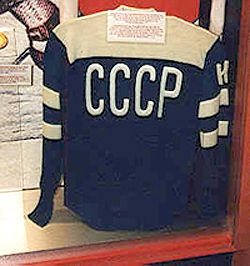
Soviet Union 1954 jersey Pictures, Images and Photos
A 1954 Soviet Union National Team sweater

For the majority of their existence, the Soviets would wear red sweaters of a minimalist style with basic sleeve and waist striping adorned with a simple CCCP across the front. No fancy fonts, no italics, no additional colors. All very utilitarian and simple in nature, just enough to identify the team on the ice and nothing more.

As late as the Olympics in February of 1976 they were still wearing the same simple jersey style as they had used as far back as the 1964 Olympics.
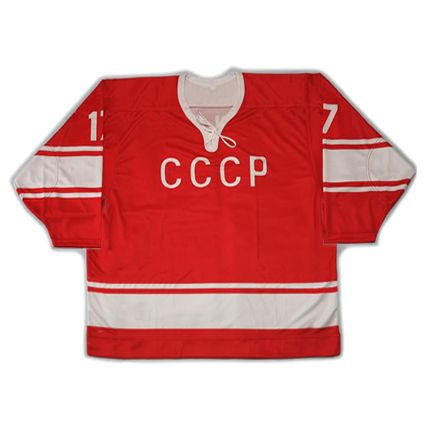
Soviet Union 1972 jersey Pictures, Images and Photos

In September of 1976, they debuted a new set of sweaters, still with the same basic striping pattern, only now decorated with repeating diamond shapes around the waist - a radical departure for the Soviets. This style would serve the Soviets well, including several tours of North America in the Super Series games against NHL clubs, the 1976 Canada Cup, the 1979 Challenge Cup, the 1980 Olympics, the 1981 Canada Cup and another tour of North America in 1983.

 photo RussiaCCCP1976-81F-1.jpg
The Soviet Union's signature diamond stripe
jerseys of the late 70's and early 80's

They would revert to a very basic style with a pair of simple stripes in white and a nearly invisible dark red on their red sweaters for the 1984 Olympics and later the 1984 Canada Cup. The white home jerseys were more successful, with their pair of extremely similar in tone red stripes against white.

Soviet Union 1983 white jersey, Soviet Union 1983 white jersey
The more successful home white version of the 1984 Soviet Olympic jersey
photo courtesy of Classic Auctions

All that changed with the rise of sports marketing in 1985 when Adidas became the supplier to all the teams at the IIHF World Championships. While the jerseys employed the same basic sleeve and waist stripes of the 1976 Olympic jerseys, the iconic three stripe pattern signifying the Adidas brand now ran down the full length of the arms, while sponsorship patches from the Belgian film manufacturer AGFA signaled a new era of commercialism in international hockey.

Fetisov 1985 Soviet Union, Fetisov 1985 Soviet Union
Slava Fetisov wearing an Adidas jersey at the 1985 World Championships

The next and boldest step arrived in 1986 at the World Championships in Katowice, Poland in the form of today's featured jersey, a 1986 Soviet Union Sergei Starikov jersey, as the Soviets arrived with a striking new design unlike anything in the history of their national team, dating back now 35 years.

Attention getting enough was the prominent white stripe running down each arm, which served as a background to highlight the Adidas stripes to an even greater degree than the previous style, but what really made this a stunning departure from any prior Soviet jersey were the bold, asymmetrical white triangles which simply screamed "LOOK AT ME!" in a way no Soviet jersey had ever dared before.

The "double triangle" look was completed with CCCP in a bold, modern font, while similar to the previous style, now tightly spaced in a way that made it appear much more aggressive. A true high point in the history of international jerseys, and brought to you by a no more unexpected and shocking source than the normally staid Soviet Union!

Soviet Union 1986 jersey, Soviet Union 1986 jersey
photo courtesy of Classic Auctions

This exact jersey style had an all too brief lifespan, being worn only for the notorious 1987 World Junior Championships in December of 1986, stretching into January of 1987, when on January 4th, the Soviets and Canadians engaged in the bench clearing brawl in the final game of the tournament, now named the "Punch-up in Piestany".

Without warning, the Soviet Union, then returned one more time to the white and (nearly invisible) dark red striped style previously worn in the 1984 Olympics for Rendez-vous '87, the two game series between the Soviet Union and the NHL All-Stars, which replaced the customary NHL All-Star Game that year.

Vladimir Krutov 1987 Soviet National Team jersey, Vladimir Krutov 1987 Soviet National Team jersey
1987's surprise reprise of the 1984 Soviet Union Olympic jersey
photo courtesy of Classic Auctions

Two months later in April of 1987, a new version of the "double triangle" jersey had appeared for the 1987 World Championships which sadly had the white sleeve stripes now removed in the style of the first Adidas jerseys introduced at the 1985 Worlds, but with the asymmetrical, bold triangles still in place but with the magic of the 1986 World Championship style now gone.

After seeing the downright flashy debut of the "double triangle" style with it's white sleeve stripes, this return to a more spartan look for the stoic Big Red Machine was a let down, as it lacked the flash of previous version. This style would be used once again in September of 1987 during the 1987 Canada Cup.

1987 CCCP Canada Cup jersey, 1987 CCCP Canada Cup jersey
The Soviet Union's 1987 Canada Cup jersey
reels in the flash of the previous style
photo courtesy of Classic Auctions

This would be the last hurrah for this family of jerseys, as the Finnish company Tackla would take over from Adidas from the 1988 World Juniors on, bringing in a whole new family of jerseys for the Soviet program as they remained their supplier through the rest of the history of the Soviet Union and beyond, into the earliest days of the Russian National Team in 1992.

Our video section today illustrates the "double triangle" style, first with footage from the 1985 World Championships, the first with Adidas stripes down the sleeves, but still the basic 1976 Olympic striping pattern.


Ironically, the low point in Soviet hockey history came while wearing the high point in their jersey design, the Punch-up in Piestany at the 1987 World Junior Tournament.


Finally, rare footage from the 1987 World Championships, where the Soviet jerseys took a step back from the bold jerseys of 1986, as the arms no longer had the full length white stripes.


The final appearance of the "double triangle" style at the memorable 1987 Canada Cup.


Wednesday, July 11, 2012

1999-00 Frankfurt Lions John Chabot Jersey

July by the Numbers returns to Germany for jersey #11.

Founded in 1959 as part of the Eintracht Frankfurt sports club, the Frankfurt Lions, the hockey club became it's own separate entity in 1991 and was renamed Frankfurter ESC Die Löwen (The Lions). When the DEL came into being in 1994, the club name was simplified to the Frankfurt Lions.

Frankfurt Lions logo, Frankfurt Lions logo

For their first DEL season, the Lions finished mid-pack in 10th out of 18, improving to 8th in 1995-96. A format change for the league in 1996-97 saw them finish 10th in Phase I of the season and defend their place in the DEL by defeating Ratinger Löwen in three straight games in the relegation playdowns.

A change in ownership over the summer saw new logos and colors adopted and once play began, they improved in 1997-98 to a 4th place in Phase I, before placing second in Phase II of the regular season. In the playoffs, they downed the Hannover Scorpions 3 games to 1, but were swept by defending and eventual champions Adler Manheim.

The following season they finished 4th in the regular season and won their first round playoff series in the full five games before again being knocked out in the Semifinals. 1999-00 saw a 7th place finish and a first round playoff exit before a 10th place finish in 2000-01 followed by 11th place the following season.

The 2002-03 season was a forgettable one for the Lions. They placed 13th out of 14 clubs, which forced them into the relegation playoff against the dreadful Schwenninger ERC Wild Wings, who trailed even the Lions by 25 points in the standings. Shockingly, the Wild Wings defeated the Lions 4 games to 2 to mark the Lions for demotion. The Lions were spared when the Wild Wings entered bankruptcy and had their DEL license cancelled, allowing the Lions to remain in the league after all.

Given their new lease on life, the Kions roared up the standings, raising their win total from 14 to 26 and a 5th place finish, retiring them to the playoffs thanks to league MVP and leading scorer Patrick Lebeau's 69 points. There, they knocked off the favored Cologne Sharks in six games before doing the same to the Hamburg Freezers 3 games to 2, as oddly, the first round is a best of seven, while the semifinals and finals are only a best of five. They then made the most of their second chance after being destined for relegation 12 months earlier when they defeated the Berlin Polar Bears 3 games to 1 to capture the 2004 DEL championship.

2003-04 Frankfurt Lions, 2003-04 Frankfurt Lions
The Frankfurt Lions celebrate their 2004 DEL championship

With the 2004-05 NHL season cancelled, the Lions were able to add NHL regulars Stéphane Robidas of the Chicago Blackhawks and Doug Weight from the St. Louis Blues to their roster in mid-season. which aided the Lions in finishing first overall for the first time during the regular season with a team record 103 points from a 35-17 record. While they won their first round series, they were upset in the semifinals, costing them a chance to defend their championship.

Doug Weight Lions, Doug Weight Lions
Doug Weight while with the Lions

The club dropped to a 9th place n 2006 and came 8th in 2007, winning a preliminary round playoff series before dropping out in the first round. Success returned in 2007-08 with a 4th place finish and a quarterfinal playoff round win before dropping hard fought five game series to the Sharks, with four of the five games decided by a goal, two of which went into overtime.

Turmoil for the club began in August of 2008 when team co-founder and principal owner Gerd Schröder died at the age of 49 after having been in a coma following a stroke earlier in the year.

2008-09 had the Lions finishing 9th and then felled in the preliminary round of the playoffs. 2009-10 again saw the Lions among the league's elite teams, finishing second overall with 98 points, led by DEL scoring champion Canadian Jeff Ulmer's 37 goals and 74 points in 56 games, only to be eliminated in the quarterfinals 3 games to 1.

Jeff Ulmer Lions, Jeff Ulmer Lions
Jeff Ulmer

Sadly, their success on the ice was not reflected in the club's finances, and they were forced to cease operations following the 2010 playoffs, bringing to an end 51 years of hockey.

In the history of the club, Lebeau was their all time leading scorer with 307 points, 111 goals and 196 assists, tops in all three categories.

Patrick Lebeau Lions, Patrick Lebeau Lions
All-time leading scorer Patrick Lebeau
hoisting the 2004 championship trophy

Today's featured jersey is a 1999-00 Frankfurt Lions John Chabot jersey. While a sponsored jersey, this style still manages to maintain the Lions identity, with their Lion head logo still prominent on the front of the jersey despite being overshadowed somewhat by the Arcor logo above it.

On the back, in typical European style, the player name is below the numbers, with the PlayStation name being given top billing across the shoulders.

The jersey is very busy visually thanks more to the ten black, silver and red stripes across the front, and would be better off without the pair of black stripes behind the lion's head.

One very unique feature of the jersey is the skyline of Frankfurt appearing in the sleeve stripes, a simple and effective way to make the jersey a memorable one.

John Chabot was an NHL veteran, having played with Montreal, Pittsburgh and Detroit from 1983 to 1991 before moving to Germany where he played for nine seasons, three of which were with the Lions, where his veteran experience led to him being named team captain.

Franfurt Lions 99-00 jersey, Franfurt Lions 99-00 jersey

Today's video section is Lebeau scoring for the Lions scoring against the Polar Bears in the 2004 DEL finals.


Tuesday, July 10, 2012

1975-76 Cleveland Crusaders Kyle Moffat Jersey

July by the Numbers returns to the United States for a stop in Cleveland for jersey #10.

After purchasing the Cleveland Barons franchise in the AHL, owner Nick Mileti , who also owned the NBA's Cleveland Cavaliers, attempted to buy a franchise in the NHL. When that plan did not pan out, he instead bought a franchise in the newly created World Hockey Association. Unlike the franchises on Boston (New England), New York, Philadelphia, Chicago, Los Angeles and Minnesota, the Crusaders did not have to compete directly with an NHL club in their own back yard.

Cleveland Crusaders logo, Cleveland Crusaders logo

In addition to being the only show in town, the Crusaders made a splash by signing defenseman Paul Shmyr away from the California Golden Seals but really grabbed the headlines when the lured goaltender Gerry Cheevers away from the defending Stanley Cup champion Boston Bruins in arguably the most noteworthy signing by the WHA after Bobby Hull and Gordie Howe.

Cheevers Crusaders, Cheevers Crusaders
Gerry Cheevers

The club found a home at the aging Cleveland Arena, which was built back in 1937 and seated less than 10,000 fans. Backed by the strength of Cheevers goaltending, the Crusaders had a fine first season, finishing second in the Eastern Division with a 43-32-3 record while allowing the fewest goals against and averaging 5,287 fans per game. In the playoffs, they swept the Philadelphia Blazers in their final games in Philadelphia, but were dispatched easily by the New England Whalers 4 games to 1.

Cleveland Crusaders team photo
The inaugural Cleveland Crusaders of 1972-73

Still playing in the Cleveland Arena in 1973-74, the Crusaders slipped a bit in the standings, winning 37 games to a third place finish in their division, but attendance was up nearly 20% to 6,212. For the playoffs, the Crusaders faced the Toronto Toros, who had relocated at the end of the previous season from Ottawa, and the Toros ended Cleveland's season in five games.

Shmyr Crusaders, Shmyr Crusaders
Paul Shmyr battles for the Crusaders

For the Crusaders third season, the club debuted a new home, the Richfield Coliseum, 25 miles south of downtown. Their new arena had room for 18,500 fans and was one of the first with new luxury boxes. While it was rather far from Cleveland, it was hoped that fans from Akron to the south would also be willing to make the drive north to the new arena.

Despite dropping to a 35-40-3 record, the Crusaders finished second in the Eastern Division and were the final qualifier for the playoffs. As the lowest seed, they drew the #1 overall team, the Houston Aeros who had little trouble closing out the Crusaders 4 games to 1.

Although attendance rose with the move to Richfield, up to 6,931, it was certainly less than hoped for, as issues arose with the Coliseum. It's single concourse, which served both levels, quickly became crowded and many fans were often late arriving to games due to the two-lane rural highway which led to the arena, especially on days when the snow came in off Lake Erie, backing up traffic several miles. Additionally, the luxury boxes were at the highest level of the arena, making them actually the worst seats in the house.

Richfield Coliseum, Richfield Coliseum
The Richfield Coliseum

For the 1975-76 season, Mileti sold the club to Jay Moore, but it was more of the same for the Crusaders on the ice, as they posted a nearly identical 35-40-5 record while finishing a narrow second to the Indianapolis Racers for the Eastern Division title as attendance sank to 6,356. The signs of real financial problems began to show themselves, which led to Cheevers leaving the club in mid season to return to the Bruins. The club then faced off against the Whalers in Preliminary Round of the playoffs, getting dumped in three straight games, bringing and end to the Crusaders after four seasons.

Moore then sold the club back to it's original owner Mileti, but for the 1976-77 season, it was announced that the NHL's California Golden Seals were moving to Cleveland to become the Barons, and would be setting up shop at the Coliseum. Knowing the city could not support two professional clubs, Mileti's proposed sale, which would have moved the team to Florida, fell through and the franchise eventually was relocated to St. Paul, where it became the second incarnation of the Minnesota Fighting Saints.

Today's featured jersey is a 1975-76 Cleveland Crusaders Kyle Moffat jersey. The Crusaders jerseys can be divided into two periods, with their first two seasons sporting three stripes in the "Northwestern" pattern and the last two seasons with a single bold stripe on the arms and waist as seen on today's featured jersey.

Cleveland Crusaders 75-76 jersey, Cleveland Crusaders 75-76 jersey

photo courtesy of Classic Auctions


Today's video section begins with footage of the Crusaders in action, where the narrator insults your intelligence by explaining what a "faceoff" is. Note the three stripe pattern on the Crusaders jerseys.

Pay no attention to the fact that there's chicken wire fencing at the end of the rink!


Want to watch Cheevers eat lasagna with his family and sign some mortgage papers? Sure you do. Here's an in-depth 21 minute profile of Cheevers which finally gets around to hockey after somewhat excruciating, unedited 13 minutes...


Monday, July 9, 2012

1996-97 Krefeld Penguins Jason Meyer jersey

July by the Numbers continues and it's back across the Atlantic for jersey #9.

Founded in 1936 as Krefelder Eislauf-Verein 1936 e.V. (KEV for short), the club, after returning after a suspension of play during World War II, won their first championship on March 12, 1952.

After struggling near the bottom of the Bundesliga for a decade and a half, thanks in part to competing with a local rival club, things really began to look up for KEV with some key acquisitions and the demise of the other Krefeld based club, KTSV Prussia in 1971.

KEV 76-77, KEV 76-77

Just as the club was knocking on the door of a title, in a shocking turn of events, ownership had overextended itself in previous seasons and the club's actual financial condition had not been accurately reported, all of which resulted in bankruptcy for KEV, which caused the German sporting authorities to revoke the team's franchise.

A new club, EHC Krefeld was formed in 1978-79, which started at the bottom of the German hockey ladder, playing in a regional league with junior players and older players, some of whom were lured back out of retirement. This club proved far stronger than their opposition, even posting a memorable 48-0 win!

EHC 78-79, EHC 78-79
The inaugural ECH Krefeld club

With the club now promoted up a level, many of the older players once again retired, their mission accomplished. New, younger players were brought in for the 1979-80 season, which resulted in a fine second place finish. Fate intervened however, as first place finisher Hamburg SV declined the opportunity to move up for financial reasons, moving EHC up the ladder once again.

When the 1980-81 season began, the club was now renamed Krefelder Eislauf-Verein 1981 e.V., reviving the name of the original club founded back in 1936. Their rise to the top division was slowed however, as the quality of competition was much stronger in the second division than it was in the third and fourth levels of the past two seasons.

The club endured for 11 seasons in the second division, and again flirted with financial problems and relegation on occasion, but persevered until the 1990-91 season, which began poorly with KEV at the bottom of the table. Bold moves were made to bring in Czech national team goaltender Karel Lang, as well as the high scoring Francois Sills and Peter Jedrus. With the revamping of the lineup complete, the wins soon followed and by the time the playoffs began, KEV had climbed to second place and their victory in the playoffs propelled the club, and once more the city of Krefeld, into the top level of the Bundesliga.

While their play on the ice was enough to keep KEV in the 1. Bundesliga, they once more faced bankruptcy in 1995, only this time a last minute reorganization allowed the club to retain it's license for the 1995-96 season, now reorganized as KEV Pinguine Eishockey GmbH, or Krefeld Pinguine (Krefeld Penguins). This was also the period of time when the Bundesliga gave way to the new DEL hockey league, ushering in a new era for German professional hockey, particularly with the ruling that made players all across Europe free agents when their current contracts expired, allowing a much greater freedom of movement for players previously unable to play in Germany.

After becoming the Krefeld Penguins and a member of the DEL, they regularly made the playoffs, reaching the postseason in five consecutive seasons. They missed the playoffs in 2001, but returned again in 2002.

While the club only managed a sixth place finish in 2002-03, the upset the DEG Metro Stars in five games before knocking out the #1 seeded Berlin Polar Bears 3-1 to reach their first ever finals despite the Polar Bears finishing 31 points higher in the regular season standings. There, they met the Cologne Sharks, the #1 overall seed. Krefeld won Games 1 & 2, but lost the next two, including Game 4 in overtime, which forced a deciding Game 5, which the Penguins won by a score of 3-1 to take the series and the championship 3 games to 2 to capture the first title in club history, second if you count the Penguins as a continuation of the first KEV club, founded back in 1936.

Krefeld Pengins 2003 champions, Krefeld Pengins 2003 champions
The Krefeld Penguins - 2003 DEL champions

During the regular season, Penguins Christoph Brandner (formerly of the Minnesota Wild) led the league with 28 goals, while teammate Brad Purdie was tops in assists with 41. Other notable names on the championship squad were future NHLer Christian Ehrhoff, Canadians and former NHLers Gary Shuchuk and Sandy Moger and the late Robert Müller in goal.

Today's featured jersey is a 1996-97 Krefeld Penguins Jason Meyer jersey. Worn shortly after the club changed their name to include the Penguins nickname, this attempt at a whimsical jersey crosses into the absurd, with with it's tumbling, celebrating penguins surrounding the main sponsor logo on the chest, which itself is an overly large, color-clashing obnoxious billboard.

Adding to the visual confusion is the main team logo of a penguin in a triangle, which is not only on the upper right chest, which would have been fine if they would have stopped there, but it is repeated in a smaller size around the cuffs, as if the five tumbling ones on the front of the jersey weren't enough already! Worse, the triangle shape is then repeated around the waist as well as another one on the cuffs for good measure. Here's an idea. If you want to repeat the team logo around the arms, how about not putting triple arm stripes of varying widths just above them to distract from them?

While we're at it, we also dislike the lousy way the team name is applied to the bottom of both the front and back, particularly the handwritten, juvenile "Pinguine" diagonally across the name of the city.

If the main sponsorship slapped on the front of the jersey like a bumper sticker wasn't bad enough, the back has a pair of bold red logos and the shoulders are adorned with winking green frogs, only adding to the mess that this jersey is!

Don't even ask us why the penguin on the right front, which is repeated larger on the back, has the name "Kevin" on it. We don't even want to know because it's certain to be stupid if we ever found out.

Later Penguins jerseys would have a certain style and flair, but this particular one is a collection of bad ideas lumped together all on one awful jersey - one with frogs and tumbling penguins, one of which is named Kevin.

Krefeld Penguins 96-97 jersey, Krefeld Penguins 96-97 jersey

Today's video section is a look at the history of the franchise in pictures and video, which captures the widely varying jerseys worn by the club in it's history, some good, some simply horrid.


Sunday, July 8, 2012

1968-69 Houston Apollos Bob Ellett Jersey

July by the Numbers travels south for jersey #8.

Born during the hysteria of the Apollo space program, which began in 1963 to send men to the moon for the first time, the Houston Apollos were members of the Central Hockey League from 1965-66 to 1968-69.

Houston Apollos pennant, Houston Apollos pennant

They played their games at the Sam Houston Coliseum and were, oddly enough, a farm team of the far away and very, very French Montreal Canadiens. This led to some of the Canadiens prospects from Quebec finding themselves in a very foreign culture, while the fans in Houston were treated to seeing some of the finest prospects in the game, who would go on to rule the NHL from 1968 to 1979, winning 8 Stanley Cups in 12 seasons.

Andre Boudrias led the inaugural club in scoring with 73 points in 70 games as the team finished fifth out of the six teams, missing the playoffs by four points.

1965-66 Houston Apollos team, 1965-66 Houston Apollos team
The 1965-66 Houston Apollos

Prior to the NHL expansion of 1967-68, minor league franchises enjoyed a certain level of stability during what was still the Original 6 era and it's limited job opportunities for players. This resulted in their top scorers from the season prior, Boudrais and Bill Inglis, returning, along with holdovers Bob Charlebois and Garry Peters, who made up four of their top five scorers in 1966-67.

The Apollos roster also boasted future stars Jacques Lemaire, Serge Savard, Carol Vadnais, Pat Quinn and Rogie Vachon in goal all learning their craft in the deep south. The influx of talent raised the Apollos to a 32-28-10 record, which earned them a third place finish and a spot in the CHL playoffs for the first time.

Savard Apollos, Savard Apollos
Serge Savard

The 1967-68 expansion doubled the size of the NHL, which resulted in a shakeup with the Apollos roster, which was led in scoring by Jude Drouin, who had 22 goals and 60 points, while Chris Bordeleau led the team in goals with 23. Ernie Wakely led the goaltending with 57 games while several future NHLers dotted the roster, including Garry Monahan, Bryan Watson, Ernie Hicke, Vadnais, Danny Grant, Micky Redmond and Claude Larose all going on to play 500 games or more in the NHL.

Hicke led the 1968-69 Apollos to the playoffs with a team leading 72 points, while newcomer Alain Caron had the most goals with 38. The big news was in goal, as the tandem of Phil Myre (53 games) and Tony Esposito (19) shared the crease. The other notable arrival on the club that season was defenseman Guy Lapointe, who would play for the Canadiens for the next 13 seasons.

Guy Lapointe, Guy Lapointe
Apollos graduate Guy Lapointe

While men touched down on the moon in July of 1969, the Apollos also took flight following the 1968-69 season, landing in Montreal where they became known as the Montreal Voyageurs, ending their four seasons in Houston, a move deemed necessary by the Canadiens due to travel costs, low attendance, poor dates in the arena and a lack of practice time operating the club in Houston.

Today's featured jersey is a 1968-69 Houston Apollos Bob Ellett jersey, a beautiful sweater clearly based on the home jersey of the parent Canadiens, as seen in the red shoulders and cuffs, blue numbers outlined in red and the lace-up collar, all traits shared with Montreal's sweaters.

While the Canadiens had a red stripe over a blue stripe around the waist, the Apollos had the color order reversed and the stripes much farther apart.

What really makes this jersey stand out is the fantastic crest of the two-color rocket with contrasting fins which contains the name "Apollos" in beautifully chain-stitched lettering. Simply gorgeous!

Houston Apollos 68-69 jersey, Houston Apollos 68-69 jersey

Saturday, July 7, 2012

1975-76 Calgary Cowboys Ron Chipperfield Jersey

July by the Numbers remains in the World Hockey Associaton for jersey #7.

The WHA franchise originally slated to be the Miami Screaming Eagles was foiled by a lack of finances and a suitable arena which silenced that plan and the team participated in the inaugural WHA season as the Philadelphia Blazers. After just one season, the team packed it's bags and moved all the way to the west coast, becoming the Vancouver Blazers.

After two seasons of being unable to compete with the NHL's Vancouver Canucks, the franchise was moved yet again, this time to Calgary, where they became the Calgary Cowboys.

Calgary Cowboys logo, Calgary Cowboys logo

The WHA had originally hoped to place a team in Calgary back in 1972 as a rival to the Edmonton Oilers, but that plan never came to be. When Blazers team owner Jim Pattison chose to relocate his last place team to Calgary, the WHA was already having difficulties with instability, evidenced by two franchises folding in the middle of the Cowboys first season in Calgary, which hurt their image as a major league product.

The team was housed in the 6,500 seat Stampede Corral with the hopes that strong attendance would encourage the the Calgary Exhibition and Stampede board to expand the seating to a size which would allow the club to be profitable, something not possible with the Corral's current small size.

Calgary Stampede Corral 1988, Calgary Stampede Corral 1988
The Stampede Corral

Led by Danny Lawson and Ron Chipperfield, the team surprised many with a 41-35-4 record. Lawson led the club in scoring with 44 goals and 96 points while Chipperfield followed with 42 goals and 83 points, the only two to surpass 60 points.

Lawson Cowboys, Lawson Cowboys

Butch Deadmarsh added 26 goals while George Morrision, Rick Sentes and Don Tannahill all added 25 goals to the cause while the goaltending was handled by Don McLeod, who played in 63 of the Cowboys 80 games.

McLeod Cowboys, McLeod Cowboys

Despite the small arena, they team still did not play to capacity, averaging a dismal 4,948 fans, next to last in the league by 1,200 fans and one of only two teams under 5,000, the other being the troubled Denver Spurs/Ottawa Civics franchise which did not even survive the season.

The Cowboys entered the playoffs as underdogs to the Quebec Nordiques, who finished 18 points ahead of them in the standings, but Calgary won the first two games on the road in Quebec on their way to a 4-1 series win, which included a legendary brawl that cleared both benches and lasted 20 minutes before the teams were escorted to their locker rooms by the Quebec police! Eventually, Calgary's Rick Jodzio, who started the melee by cross checking the Nordiques Marc Tardif in the head, pleaded guilty in a Quebec court to a charge of assault and the Cowboy's coach Joe Crozier was suspended for the rest of the series over the incident.

Having moved on to the next round, the Cowboys were eliminated in five games by the eventual champion Winnipeg Jets.

For the Cowboys second season, Lynn Powis stepped up with a 30 goal, 30 assist season to lead the club with 60 points. Warren Miller (55), Chipperfiled (54) and Peter Driscoll (52) all chipped in over 50 points. McLeod once again held down the duties in goal, playing in 66 games.

Chipperfield Cowboys, Chipperfield Cowboys

Unfortunately, the team slipped in the standings, winning 31 while losing 43 and tying 7 which resulted in them earning 69 points, missing out on the postseason by 3 points to the Oilers.

1976-77 Calgary Cowboys, 1976-77 Calgary Cowboys
The 1976-77 Calgary Cowboys

Attendance sagged to 4,313, by far the lowest in the league. Think about that for a moment. A professional hockey team in Alberta, Canada not only finished last in the 12 team league, but they were 1,700 below a team in San Diego, California and 4,100 per game down to a club in Birmingham, Alabama and their attendance was doubled by a team in Houston, Texas.

Clearly it was a situation that could not continue, and there were rumors of the team relocating to Ottawa, which had already failed fours years earlier, causing the league to veto the plan. In a familiar refrain, Pattison hoped to keep the team going long enough to be part of a deal to join the NHL, but the NHL made it clear they had no interest in having a team play in the Stampede Corral. With just 2,000 season tickets sold for 1977-78 and no hope for a new arena and not enough time to find a new city to play in, Pattison chose to fold the franchise in August of 1977, bringing to an end the Cowboys after just two seasons.

Today's featured jersey is a 1975-76 Calgary Cowboys Ron Chipperfield jersey as worn during the Cowboys first season in Calgary after the franchise, originally destined for Miami, had played one season in Philadelphia and two in Vancouver.

The team's cartoon logo of a smiling cowboy with a stick and skates was overly simplified to just his hat for the main logo on the team's jerseys, which were a simple, attractive red and white design with multiple stripes, with the red likely chosen to contrast with their hoped rival, the Oilers blue. Had the club survived, the very 1970's smiley face logo would have become dated very quickly and would have been in need of a replacement in short order.

Calgary Cowboys 75-76 jersey, Calgary Cowboys 75-76 jersey

Today's bonus jersey is a 1976-77 Calgary Cowboys Ron Chipperfield jersey as worn on the road during the Cowboys second and final season in Calgary.

Calgary Cowboys 76-77 jersey, Calgary Cowboys 76-77 jersey

photos courtesy of Classic Auctions


Today's video is brief footage of the infamous playoff brawl between the Cowboys and Nordiques, started when Jodzio crosschecked Quebec's Tardif with commentary by Tardif and others in French that we only wish we could understand.


Friday, July 6, 2012

1972-73 Ottawa Nationals Brian GIbbons Jersey

July by the Numbers once again crosses the continent for jersey #6.

When plans began to take place for the inaugural season of the World Hockey Association in 1972-73, the league naturally wanted to have a club located in Toronto, but they ran into a road block of the most stubborn kind in the form of Harold Ballard, the cantankerous owner of the Toronto Maple Leafs and, more importantly, their arena, Maple Leaf Gardens.

When no deal was able to be reached with Ballard, the franchise earmarked for Toronto was instead placed in the capital of Ottawa after an attempt to locate the club in Hamilton. The Nationals failed to lure any top-flight NHL talent to Ottawa, such as Brad Park, Dave Keon or Eddie Shack, all of whom were on their draft list, due to their late start in finding a home, but Wayne Carlton was signed away from the California Golden Seals, one of several players the Seals lost to the upstart WHA, and led the club with 42 goals and 91 points.

Carleton Nationals, Carleton Nationals
The Nationals leading scorer Wayne Carlton

The goaltending duties where handled by rookie Gilles Gratton, who was backed up by former Pittsburgh Penguin veteran Les Binkley. Gavin Kirk and Bob Charlebois each scored more than 60 points while Brian Gibbons led all defensemen in scoring with 42 points while Rick Cunningham led the team with 121 penalty minutes.

Gratton Nationals, Gratton Nationals
Gilles Gratton guards the Nationals goal

After losing their first three games, the Nationals won their next four. They spent their first three months hovering around the .500 mark, closing out December with a 16-18-3 record, which included a pair of four game winning streaks.

January was unkind to the Nationals, who dropped 11 out of 14 to fall to 19-29-3. After going 6-7-1 in February, the Nationals caught fire and roared through March with a spectacular run, winning 11 of 12 to force themselves back into the playoffs, with their 74 points edging the Quebec Nordiques at 71.

Despite Ottawa not having had top level professional hockey since the once-dominant Ottawa Senators left the capital in 1934, attendance proved to be an issue, as the team drew an average of just 3,226 fans per game in the 9,000 seat Ottawa Civic Centre while competing with the established and quite popular Ottawa 67's junior club of the Ontario Hockey Association.

The Nationals were paired with the first place New England Whalers in the opening round of the post season, however...

...the City of Ottawa demanded a payment of $100,000 to secure dates for the following season prior to the playoffs, which prompted the club's ownership to consider their options which resulted in them choosing to move all their "home" playoff games to Toronto!

Now known as the Ontario Nationals during the playoffs, they lost their first two games 6-3 and 4-3 in Boston. The Nationals returned "home" to face the New England Whalers and won Game 3 by a score of 4-2, but lost Game 4 by a decisive 7-3 score while averaging 5,000 fans a game. The Whalers closed out the series with a 5-4 win back in Boston to end the Nationals season, and as it turned out, the Nationals themselves, as the team was sold following the season to John Bassett, who made Toronto their permanent home and renamed the team the Toronto Toros in June of 1973.

Today's featured jersey is a 1972-73 Ottawa Nationals Brian Gibbons jersey as worn during the Nationals only season in Ottawa. This is a very attractive jersey for it's day and the addition of the extra blue stripe trimmed in white just under the shoulder yoke makes it very unique. We especially like the white name on the red nameplate placed directly on top of that stripe.

The team logo is also very bold and well executed, although we always felt it looked more like a corporate logo, for a railroad in particular, rather than a pro hockey team.

Still, a very nice jersey and one that lived an all too short life.

Ottawa Nationals jersey

Here is a history of the formation of the WHA and some of the first players to join the upstart league.


Thursday, July 5, 2012

1990-91 San Diego Gulls Peter Dineen Jersey

July by the Numbers crosses the United States for a stop in sunny San Diego, California for jersey #5.

The name San Diego Gulls dates back to the original Gulls franchise, which played in the Western Hockey League from 1966 to 1974. That franchise met it's demise with the arrival of the San Diego Mariners of the World Hockey Association, but the Mariners lasted just three seasons before folding, one of many teams to fall by the wayside in the unstable WHA.

Professional hockey would return to San Diego in 1990 when the International Hockey League would grant the city an expansion franchise, which would revive the name San Diego Gulls.

The team was reasonably competitive their first season with a 30-45-8 record, but missed out on the playoffs.

Russian import Dmitri Kvartalnov arrived for the Gulls second season and helped ignite their offense, which scored 67 goals more than the previous season, led by Kvartalnov's league leading 118 points. His 60 goals also led the IHL and were 16 more than his next closest pursuer.

Kvartalnov Gulls, Kvartalnov Gulls
IHL scoring champion Dmitri Kvartalnov

The Gulls roster also boasted future NHLer Ray Whitney, former New York Ranger Ron Duguay and Wayne Gretzky's brother Keith Gretzky and were led in goal by IHL veteran Rick Knickle.

Whitney Gulls, Whitney Gulls
Ray Whitney

The boost in offense resulted in a reversal of their record, finishing the season 45-28-9, a 31 point improvement.

With Kvartalnov off to join the Boston Bruins, the Gulls no longer had the flashy high scorer they enjoyed the previous season, but they roster was also no longer so top heavy in scoring. Their more balanced attack was led by Daniel Shank's 39 goals and 92 points, which placed him 5th in the league. Former Winnipeg Jet and Buffalo Sabre Scott Arniel was second with 35 goals and 83 points, one of six Gulls with over 70 points, compared to three the year before. Knickle again led the way in goal with 33 wins in 41 appearances as the Gulls soared to a league best 62 wins and 132 points, setting not only IHL records, but professional records as well, tying the 132 points by the 1976-77 Montreal Canadiens and holding the victory record outright until it was tied by the 1995-96 Detroit Red Wings.

The club started the season by going 26 games before losing in regulation for the first time and had winning streaks of 8, 9, 11 and 12 games and never lost more than 2 in a row all season under head coach Rick Dudley. The Gulls were able to load their roster with veteran and experienced players since they were not affiliated with any NHL club eager to have their young prospects developing in the minors. Starting the season with five players who had at least 10 seasons of NHL experience, the club was so dominant that the other IHL owners banded together and passed a rule which required teams to have at least six players with less than three years of professional experience.

As expected, the Gulls swept the Peoria Rivermen and ousted the Kansas City Blades in six to reach the Turner Cup Finals for the only time in their history, but were unceremoniously swept by the Fort Wayne Komets, scoring just 5 goals while giving up a massive 21.

Arneil Gulls, Arneil Gulls
Scott Arneil

The Gulls came back down to earth in 1993-94, winning 42 games while now being coached by former NHLer Harold Snepsts, their fourth coach in four seasons. Lonnie Loach led the club in scoring with 42 goals and 91 points from 74 games, as he also played three games with the Mighty Ducks of Anaheim that season. The Las Vegas Thunder fell in five games to the Gulls, but they in turn were swept by the Atlanta Knights to put an end to their season.

They slipped to a 37-36-8 record in 1995-96 with Hubie McDonough leading the way with 43 goals and 98 points, 6th in the IHL. Allan Bester led the goaltenders with 58 appearances, winning 28, while four other goalies combined to win less than 10. Despite being up 2 games to 1, the Gulls lost the final two games of their best-of-five series, which proved to be the final games for the Gulls.

After finishing third in league attendance in 1992-93 with an average of 7,728, and over 7,100 the following season, the Gulls dropped to 4,660 during their final season as the franchise was then relocated two hours up the coast to Long Beach where they were renamed the Ice Dogs.

Today's featured jersey is a 1990-91 San Diego Gulls Peter Dineen jersey. While the Gulls only lasted five seasons, they left behind a legacy of a striking logo and attractive jerseys of red and black.

San Diego Gulls 90-91 jersey, San Diego Gulls 90-91 jersey

Today's video section is some good old IHL hockey from the mid-1990's with fists and mullets as the Gulls and Houston Aeros engage is a battle, which includes current Minnesota Wild head coach Mike Yeo, #8 for the Aeros.


Wednesday, July 4, 2012

2001-02 Providence Bruins Chris Kelleher Jersey

July by the Numbers finds it's way to Rhode Island today for jersey #4, a fitting style for Independence Day in the United States.

After the Providence Reds left town after 51 years of play, the city would have to wait 15 years for the arrival of it's next club, the Providence Bruins, who were previously known as the Maine Mariners from 1987 to 1992.

The Bruins won their division in 1992-93, their first season in Providence, with a 46-32-2 record and were led in scoring by future Boston Bruin Tim Sweeney, whose 41 goals and 96 points placed him 8th in the AHL scoring race.

It would take until 1998-99 for Providence to win another division championship, which they did in style with a league best 56-16-4 mark, this after winning just 19 games the previous season! The Bruins were led in scoring by Randy Robitaille's 102 points, only two shy of the league leader. John Grahame (37-9-1) and Jim Carey (17-8-3) split the goaltending duties and the Bruins cruised through the playoffs with a 15-4 record to win the Calder Cup as AHL champions.

P-Bruins 1999 Calder Cup, P-Bruins 1999 Calder Cup
The fans rejoice the P-Bruins Calder Cup championship

While Providence has had four deep playoff runs to the third round since then, they have yet to repeat as league champions. By far their second best season was in 2007-08 when the Bruins again finished with the best regular season record, earning 117 points with a 55-18-3-4 mark and were led in goal by future Boston Bruins goaltender Tukka Rask with 27 wins.

Rask P-Bruins, Rask P-Bruins
Tukka Rask

Throughout the history of the franchise, Sweeney's 41 goals and Robitaille's 74 assists and 102 points still stand as team records. In goal, Tim Thomas holds the marks for both Goals Against Average of 1.84 and Save Percentage at .941 set in 2003-04.

Andy Hilbert's three strong seasons, which included leading the team in scoring twice, place him first overall in career scoring with the Bruins in goals (101), assists (109) and points (210) while Grahame holds the career mark for wins by a goaltender with 67.

Notable players over the history of the club include goaltenders Grahame, Rask and Thomas and skaters Patrice Bergeron, David Krejci, Glen Murray, Josef Stumpel and the late Sergei Zholtok, who ranks second in Providence career scoring with83 goals and 186 points.

Today's featured jersey is a 2001-02 Providence Bruins Chris Kelleher jersey. This jersey is a great example of the special one-off promotional styles often worn by minor league clubs on special occasions and holidays, which are made possible thanks to the dye-sublimation process, which allows for all manner of patterns to be employed not previously feasible with jerseys made entirely of sewn fabric panels.

Also note the Providence Bruins tradition of duplicating their parent club's "spoked B" logo, only replaced with a "spoked P".

Providence Bruins 01-02 jersey, Providence Bruins 01-02 jersey
photo courtesy of Classic Auctions

Today's video segment is highlights of the Providence Bruins winning the Calder Cup in 1999.


Tuesday, July 3, 2012

1951-52 Quebec Aces Joe Crozier Jersey

Juillet par les Numéros de maillot n ° 3 vient de la province de Québec, Canada sous la forme de Les As de Québec.

Quebec Aces logo, Quebec Aces logo

The Québec Aces were founded as an amateur club back in 1928 as a member of the Quebec City Railway-Paper League, where they played until 1936. They joined the Quebec Amateur Hockey Association for the 1936-37 season, playing in the league for five seasons with a best finish of second in 1937-38.

Their next destination was the Quebec Senior Hockey League, beginning in 1941-42. They won the Allan Cup as champions of Canadian senior hockey in 1944.

Quebec Aces 1943-44 team, Quebec Aces 1943-44 team
The 1944 Allan Cup champion Québec Aces

Easily the most recognizable and famous of the Aces was future Montreal Canadiens captain Jean Béliveau, who played for the club for two seasons. He had refused to join the Canadiens, preferring to remain with Québec, in part due to the fact he was making double the average NHL salary at the time. Led by Béliveau, the Aces won the league title in 1952.

Beliveau Aces, Beliveau Aces
The most famous of all the Aces, Jean Béliveau

A series of behind the scenes dealings saw the league turn professional in 1953-54, which resulted in a name change to the Quebec Hockey League. The Aces continued to play in the QHL until it's demise in 1959, which prompted Québec to join the American Hockey League. while in the QSHL/QHL, the Aces had won regular season championships in 1944, 1945, 1952 and 1957, and playoff championships in 1942, 1954 and finally 1957, going on to defeat the champions of the Western Hockey League, the Brandon Regals, for the Edinburgh Trophy.

Quebec Aces 1948-49 team, Quebec Aces 1948-49 team
The Aces in 1948-49, surrounding their gorgeous center ice logo

The Aces found the going tough in their early days in the AHL, failing to make the playoffs during their first four seasons before reeling off three consecutive division championships in 1964, 1965 and 1966. They made the Calder Cup Finals in 1964, but lost to the Cleveland Barons.

Quebec Aces 1963-64 team, Quebec Aces 1963-64 team
The Calder Cup finalist 1963-64 Aces

The club became the minor league affiliate of the expansion Philadelphia Flyers in 1967-68, which saw them immediately return to the Calder Cup Finals in 1968 and 1969, unfortunately coming up short both times.

Quebec Aces logo, Quebec Aces logo
The Aces new winged logo, reflecting their affiliation with Philadelphia

The team would play two more seasons prior to the Flyers moving the franchise to Richmond, Virginia where they were renamed the Richmond Robins, brining an end to the Aces after 44 seasons.

Today's featured jersey is a 1951-52 Québec Aces Joe Crozier jersey worn during the period of time that Béliveau played for the club, guiding them to the 1952 league championship.

This classic wool sweater features a beautifully excited chenille crest with the #3 on the back in felt.

Crozier was a defenseman who played 8 seasons with the Aces as part of his 12 year career, which included reaching the NHL with the Toronto Maple Leafs for 5 games in 1959-60. He would then go into coaching, winning three Calder Cups with the Rochester Americans of the AHL in 1965, 1966 and 1968. He would eventually coach the Buffalo Sabres and Maple Leafs in the NHL as well as the Vancouver Blazers and Calgary Cowboys of the WHA in addition to the minor league and junior clubs he would command from 1961 to 1984.

Quebec Aces 51-52 jersey, Quebec Aces 51-52 jersey

Today's video segment is a look at the career of Jean Béliveau from the Legends of Hockey series.


hit counter for blogger