For seven seasons - day in, day out - GlennHall tended goal every single game, every single minute from the start of the 1955-56 season for the Detroit Red Wings and then for the Chicago Black Hawks starting with the 1957-58 season up through this date in 1962.
502 complete games in goal, 551 if you count the 49 playoff games, without ever once being pulled or given a rest - all without a wearing a mask!
In that first season of the streak, Hall was the Calder Trophy winner as Rookie of the Year while a member of the Detroit Red Wings. Surprisingly, Hall was sent, along with the union organizing Ted Lindsay, to the Chicago Black Hawks in a trade following the season.
In 1961, Hall led the Black Hawks to the Stanley Cup Championship, their first in 22 seasons. Hall was also a first or second team All-Star six times in the seven year run, no easy feat in a then six-team league against competition from Terry Sawchuk(who took over in goal in Detroit following Hall's departure), Johnny Bower, Jacques Plante, Roger Crozier and Gump Worsley.
Perhaps the closest he came to ending the streak was a puck to the face from the Toronto Maple Leaf's Jim Pappin that knocked out the only tooth he ever lost playing hockey and earned him 30 of the 250 stitches he would accumulate during his career.
Despite the end of his consecutive games streak due to a bad back, it would not deter Hall, who would go on to win the Vezina Trophy that season for the first of three times in his career and play in over 400 more games before retiring.
Hall is also known for throwing up before games, which he "credits" to being excited to play, not nerves for fear, and pioneering the butterfly style of goaltending, where a goaltender drops to his knees and spreads his legs out in a "V" shape, rather than doing the splits or laying sideways and stacking the pads on top of each other, the common styles used at the time. Keeping himself vertical also helped keep his face farther off the ice and away from the puck.
Playing with Stan Mikita and Bobby Hull was great for games, but very hard on Hall during practices. Mikita and Hull were the original developers of the curved stick and known for their blazing slap shots. Back in those days practices were not filled with the drills of today's modern practice, plus there were no rules at the time limiting the curvature on stick blades, and the players would blast shot after shot at the goaltenders, which would dip as much as two feet on their way to the net.
Hull in particular had no qualms about firing pucks at people, including trying to fire the puck at the glass in front of the goal judge at Chicago Stadium during pregame warmups to startle him into spilling his traditional coke. The problem for Hall was his location in the net in between Hull and the goal judge, requiring the puck to rip past Hall's head just over his shoulder on it's way to the glass!
Hall was set to retire at age 35, but was taken by the St. Louis Blues in the 1967 Expansion Draft, despite having just won the Vezina trophy! A 35% raise from $35,000 to $47,500 convinced Hall to extend his career. He led the Blues to the Stanley Cup Finals three years in a row and also finally began to wear a mask.
He would capture the Conn Smythe Trophy in the 1968 playoffs, despite being on the losing end of a 4 games to none sweep at the hands of the Montreal Canadiens. Each game was a one-goal victory for Montreal, with Games 1 and 3 going to overtime. Hall would also share the Vezina trophy with Jacques Plante in 1968-69.
He retired with 84 shutouts and a lifetime goals against average of 2.51. He was elected to the Hockey Hall of Fame in 1975.
Today's featured jersey is a 1957-68 Chicago Black Hawks Glenn Hall jersey from his first season in Chicago. The crossed tomahawks and C logo was still worn over the sleeve stripes at the time before relocating up to the shoulder area for the 1960 season. The jersey also has the classic tie-neck collar used through the 1964-65 season. No names were worn on the back of the jerseys in those days, just Hall's traditional goaltender's #1.
First up in todays video section is the excellent Legends of Hockey profile on Hall.
This brief video focuses on Hall's consecutive games streak.
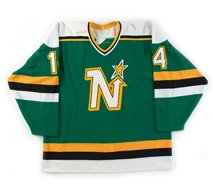
AlShaver was the voice of Minnesota North Stars hockey. Always was. Always will be.
He was a graduate of the Lorne Green Academy of Radio and Television Art in Toronto in 1948 and worked the morning show and baseball play-by-play at CJOY in Guelph, Ontario. He then worked in Calgary and Medicine Hat, Alberta before taking a job in Edmonton in 1952, where he did play-by-play for the Edmonton Eskimos of the Canadian Football League. He also broadcast five Grey Cup championship games nationally on the CBC.
During the 1960's he worked in both Montreal and Toronto, which included doing junior hockey games and hosting a bowling show, until 1967 when the National Hockey League made it's dramatic expansion from six teams to twelve.
Shaver was hired as the voice of the North Stars for their inaugural season and was with the team first on WCCO until 1978.
He moved with the team to KSTP until the franchise relocated to Dallas in 1993 for a total of all 26 seasons of the North Stars, calling 2,062 out of 2,071 games.
"It was a 26-year love affair that began on an October night in St. Louis, 1967, and ended abruptly on an April evening in 1993 when my love left me and moved to Dallas," Shaver wrote in 2007 .
In addition to working for the North Stars, KSTP also had Shaver work on the Minnesota State High School Hockey Tournament, which gave him the opportunity to meet legendary Broadcaster HowardCosell, who commented "What are you doing here?" as Cosell was of the opinion that Shaver should be in New York working for a national network.
Howard Cosell with Al Shaver
He was such a part of the fabric of the North Stars that he was featured on both the team's media guide and made more than one appearance on the cover of the team's program.
Not quite ready to close out his broadcasting career, he then worked for the University of Minnesota Golden Gophers until he retired on his own terms in 1996.
Shaver was a ten-time Minnesota Sportscaster of the Year and was inducted into the Museum of Broadcasting Hall of Fame in 2003. He was also given the 1993 Foster Hewitt Memorial Award by the Hockey Hall of Fame for outstanding contributions to radio and TV broadcasting and the game of hockey.
In addition to those honors, the press box at the Xcel Energy Center, home of the Minnesota Wild, is named for him.
On a personal note, as a youngster, we would listen to Shaver call North Stars games against the Chicago Black Hawks at night with our transistor radio tuned to WCCO. We recall Shaver always saying "a shot from the blue line hits traffic in front", leading us to mistakenly believe "Traffic" was the name of a Chicago defenseman and the greatest shot blocker in hockey history!
Upon getting the opportunity to share that story with Shaver, he related that when goaltender Cesare Maniago would make a great save, he'd call out "Oh! Maniago makes a great save!" causing some to believe that the Canadian born "O'Maniago" was actually of Irish decent!
For a real treat, to hear Al at his best, including a call of "a shot hitting Traffic" and an "O'Maniago" as well as him excitedly calling a fight all in the same sequence, click below to listen.
On the occasion of the final North Stars home game in 1993, we felt bad that Shaver was being overlooked on what would be his last time calling a North Stars game in Minnesota amidst all the vitriol for the North Stars owner who was moving the club. In an effort to pay tribute to the man who had called the North Stars games since day one, we made a simple sign in his honor. With the game against Chicago (who it turns out never employed a defenseman named "Traffic" we had learned by then) beginning to wind down, and us not having had a chance to display our sign, the North Stars obliged by finally scoring their first goal of the game with less than 6 minutes remaining.
The in-arena presentation was for the video of the goal to be replayed on the Met Center scoreboard along with Shaver's call of the goal. Perfect! The fans in the arena had just heard Shaver's voice for the first time all night and the time was right to display the sign. Unlike modern arenas where the corridor is outside of the seating bowl, the Met Center had a walkway inside the seating bowl which separated the lower bowl from the upper level sections, giving us the opportunity to not just hold up our sign, but to walk an entire lap inside the arena with our sign held high for all fans to see.
So off we went on our tribute lap to Shaver, not knowing what to expect. Fans who saw the sign began to stand and applaud, hold their glasses up high as well as reach down from the upper seats to "high five" the sign. Roughly a quarter of the way around the arena, we realized that a camera had been trained on us and the sign was now filling the video replay screen for all to see, especially the fans lower down who may not have had a chance to see the sign until then. It didn't end there either, as one of Shaver's sons asked for the sign once we were done with it, a request we were only too happy to oblige.
Not only was there a video camera trained on the sign during the "lap of honor", but a still camera as well, resulting in a sizable photo which appeared in the Minneapolis StarTribune two days later!
Shaver currently lives in the Vancouver area enjoying his retirement while his son WallyShaver has done the broadcasting for the North Stars, Minnesota Moose and Golden Gophers for years now and his grandson JasonShaver currently does play-by-play for the Chicago Wolves of the AHL, carrying on the family legacy.
Here is some footage of Al Shaver calling games for the North Stars. "What a ham this turkey is!"
On this date in 1955, the Montreal Canadiens and Boston Bruins squared off at The Forum in Montreal.
The Bruins jumped out to an early lead with an even strength goal by LeoBoivin at 1:35 of the first period. Before the period would end, DougMohns would add to the Bruins advantage with a power play goal at the 18:12 mark. Before the period would end, CalGardner of Boston would be whistled for a penalty with just ten seconds remaining that would put Montreal on the power play to start the second period.
With Montreal already with a man advantage, HalLaycoe would be called for a penalty at the 16 second mark that would change the way the game would be played forever more. The Canadiens relished any opportunity to play with a man advantage, for the previous season they led the league in goals with 228 in 70 games, the only team to average more than 3 per game and 24 more than their closest pursuer thanks to their notoriously potent power play.
Montreal controlled the puck following the face-off and Doug Harvey fed Bert Olmstead who got the puck to center JeanBeliveau who redirected it past Bruins goaltender Terry Sawchuk at the 42 second mark to cut the Bruins lead to 2-1.
After the ensuing face-off, with Montreal still on the power play, MauriceRichard worked to get the puck to Olmstead, who again fed Beliveau who again beat Sawchuk on a similar play just 26 seconds later to even the score at 2-2.
Now, in this day and age, the first Montreal goal would have freed Gardner from the penalty box while the second tally would have set Laycoe free, ending the Montreal man advantage, but this was not the case back in 1955, as any penalized player was required to serve the full length of his penalty, regardless of how many goals were scored while his full time was being served.
So, with both Gardner and Laycoe still serving their full sentence with no parole in the offing, Montreal remained on a two-man advantage with 42 second remaining. After controlling the puck once again, Harvey again found Olmstead who knew exactly what to do with it - get the puck to Beliveau. "Le Gros Bill" found the twine to complete his hat trick at 1:26, his third goal with the two man advantage in the span of just 44 seconds!
Gardner was finally able to escape the penalty box 24 seconds later after having to helplessly watch the carnage created by his departure, and Laycoe's freedom finally arrived 26 seconds later, but not until he was forced to watch a 2-0 Boston lead turned into a 3-2 lead for the Canadiens while he was away.
While there were no further power play goals during the contest, Beliveau would score his fourth goal of the night at 15:53 of the third period at even strength, assisted by Olmstead once again and Bernie Geoffrion for a final score in favor of Montreal 4-2 thanks to the talents of Beliveau and the remarkable Canadiens power play.
Beliveau displays the four pucks from his stellar evening and is joined by Olmstead, who assisted on all four goals
Beliveau would go on to go on to win the Art Ross Trophy as scoring champion and the Hart Trophy as league MVP at the conclusion of the season, thanks in part to the opportunity to score multiple goals on a single power play.
Such was the dominance of the Montreal power play, having scored more than once with the man advantage eight times that season, that a new rule was put into effect in time for the start of the 1956-57 season to minimize the distinct offensive advantage enjoyed by the Canadiens, as any penalized player serving a two-minute minor would be freed immediately following any goal scored against his team in an effort to keep games more competitive. Predictably, the vote was 5-1 in favor of the new rule change.
While Montreal was able to capture the Stanley Cup in 1956 with the ability to score seemingly at will with the man advantage, how did the new rule affect the competitive balance for the time period immediately after the new rule was put into effect? Very little, in fact, as the Canadiens would reel off four more consecutive titles from 1957 to 1960 for a dynasty like no other, as no team before or since would ever win five consecutive Stanley Cups.
Today's featured jersey is a 1955-56 Montreal Canadiens Jean Beliveau jersey. Believau was a ten time Stanley Cup champion with Montreal in his 20 years with the club. In addition to the Conn Smythe, Beliveau also won the Art Ross Trophy as scoring champion in 1956 and the Hart Trophy as MVP in 1956 and 1964. Had the Conn Smythe Trophy been in existence prior to the 1965 finals, odds are that Beliveau would have won at least one other one, particularly in 1956 when he led the Canadiens in playoff scoring with 12 goals and 19 points in just ten games.
This exact variation of the Canadiens jersey arrived in 1947 when the red shoulders no longer encroached into the blue arm stripes and would be worn until 1956 when further detail changes were introduced.
Today's video selection is the wonderful Legends of Hockey profile of Jean Beliveau.
Born on this date in 1975, EricFichaud played his junior hockey with the Chicoutimi Sagueneens of the Quebec Major Junior Hockey League beginning in the 1992-93 season. After posting a record of 18-15-1, he took the undisputed number one role in 1993-94, and in 63 starts, went 37-21-3. He backstopped the Sags to the QMJHL championship after winning 16 of 26 playoff games to earn the club a spot in the Memorial Cup.
Following the season Fichaud was drafted 16th overall by the Toronto Maple Leafs before returning to Chicoutimi for one final season during which he recorded his third consecutive winning season with a 21-19-4 mark.
The Maple Leafs traded Fichaud to the New York Islanders at the 1995 draft and he spilt the 1995-96 season between the Worcester Ice Cats of the AHL and the Islanders, who were in a decidedly down period at the time. Fichaud's rookie season ended with a 7-12-2 record, but a respectable 3.31 goals against average.
His second season on Long Island saw his games played increase from 24 to 34 as he complied a 9-14-4 record while lowering his goals against average to 3.10. Following the season he was selected to join Team Canada for the 1997 World Championships, but did not see any action.
Fichaud saw limited playing time in 1997-98 thanks to a shoulder injury, playing 17 games with the Islanders, finishing with a 3-8-3 mark but lowering his GAA once more, down to 2.97, and a single game with the Utah Grizzlies of the IHL.
During the off season, he was dealt to the Edmonton Oilers in June, only to have the Oilers deal him to the Nashville Predators in early October. He once again saw little ice time, playing 8 games with Milwaukee (5-2-1) and a forgettable 9 games with the Predators, going 0-6-0 while competing for playing time with MikeDunham and TomasVokoun.
His next stop was with the Carolina Hurricanes, where once more ice time was at a premium. 9 games with Carolina ended with his release and he was claimed by the Montreal Canadiens who assigned him to the Quebec Citadelles of the AHL, where he performed well with a 4-1-1 mark.
He finally got his first regular ice time in four seasons in 2000-01 with the Citadelles, seeing action in 42 games and finishing with a 19-19-2 record.
For the 2001-02 season, Fichaud started the year with the Manitoba Moose, but was granted his release by the Moose after just 5 games in three months. He signed with the Krefeld Penguins of the German DEL and played in 9 regular season games as well as 3 playoff contests.
Back in North America for the 2002-03 season, Fichaud played with the Hamilton Bulldogs, the top affiliate of the Oilers. He had a good season with a strong Bulldogs club, splitting time with MathieuGaron and TyConklin on his way to 27 appearances and a 14-7-3 mark with 4 shutouts, his highest total since juniors. He also played in 8 playoff games with a 5-3 record as Hamilton made it to the Calder Cup Finals.
He was back for a second season with the Bulldogs, only now part of the Canadiens organization, and in 31 games went 16-11-3.
Beginning with the 2004-05 season, Fichaud started a three year run with Quebec RadioX (named after a radio station owned by the team's owners) of he lower level Ligue Nord-Americaine de Hockey after it elevated itself from being an amateur league. The 2004-05 season was the missed NHL season due to the lockout, and with hundreds of pros looking for work in Europe and many younger NHLers keeping busy in the AHL, work was hard to come by for many, who saw the LNAH as an alternative. It paid off, as RadioX won the league championship in 2005 thanks in part to Fichaud's 8-0 record during the playoffs.
After two more seasons with Quebec, Fichaud played one final season in 2007-08 with the St. Georges CRS Express.
Today's featured jersey is a 1999-00 Quebec Citadelles Eric Fichaud jersey as worn during his first season with the Canadiens AHL affiliate.
This attractive jersey features the unusual choice of a goat head for the team's logo, which was the mascot of the Royal 22nd Regiment, which was stationed in the Citadel of Quebec. The team played in Quebec for just three seasons before relocating to Hamilton where they were renamed the Bulldogs.
A well travelled franchise, it began in 1969 in Montreal as the Voyageurs before moving to Nova Scotia, then Sherbrooke, Quebec and then Frederiction before relocating for the fourth time to Quebec.
Bonus Jersey: Today's bonus jersey is a 1997-98 New York Islanders Eric Fichaud jersey. The Islanders new ownership, in an effort to attract new, younger fans to the downtrodden Islanders scrapped their traditional sweaters, which only happened to have been worn not only since the club's inception in 1972, but also for the length of their Stanley Cup dynasty, and introduced their new jerseys for the 1995-96 season.
As the team wallowed in the depths of the NHL standings and traded away fan favorite Pierre Turgeon for the disgruntled Kirk Muller, the fan base immediately made the new jerseys, and specifically their new fisherman logo, the focus of their growing unhappiness. The fate of the jersey was not made any better when the rival New York Rangers fans began to mock the new jerseys with chants of "We want fishsticks! We want fish sticks!" in reference to the new logo's resemblance to the Gorton's Fisherman logo.
The Islanders adopted a hybrid jersey for 1996-97 with the original Islanders logo placed on the "wave" style jersey as an alternate style. For 1997-98, the fisherman was gone and the hybrid jersey was used full time. In 1998-99, a modern version of the Islanders jersey debuted as the wave style was scrapped permanently.
Today's video selection is a slideshow of images from Fichaud's career, which documents many of the jerseys he wore during his career.
StanSmyl first played junior hockey with the Bellingham Blazers of the British Columbia Junior Hockey League in 1974-75. He led the club to the Fred Page Cup with 33 points in 25 playoff games. He then joined the New Westminster Bruins of the Western Canada Hockey League for three playoff games later that same season before joining the team full time in 1974-75.
Smyl would be a force with the Bruins as the winger would score 32 goals and 74 points while compiling 169 penalty minutes in 72 games. The Bruins would go on to win the WCHL playoff title and advance to the Memorial Cup Final.
He would raise his goal total to 35 and his penalty minute total to 200 in 1976-77. Again, the Bruins would win the WCHL playoffs and return to the Memorial Cup, where they would emerge victorious following a 6-5 win over the Ottawa 67's.
His third season with the Bruins would raise his stock with the NHL scouts, as he set a new personal best with 76 points despite being limited to just 53 games. Once again the Bruins won the WCHL playoffs and returned to defend their championship, their fourth straight Memorial Cup appearance and Smyl's third. Smyl put on a clinic during the playoffs, scoring 14 goals and 35 points in 20 playoff games (including 14 in the 5 games of the Memorial Cup) as the Bruins successfully defended their championship with a 7-4 win over the Peterborough Petes as Smyl was named the Memorial Cup MVP.
Earlier that same season, Smyl made his debut for Canada at the 1978 World Junior Tournament, earning a bronze medal.
Following the season, Smyl would be taken 40th overall by the Vancouver Canucks in the 1978 NHL Amateur Draft and then appeared in 62 games for the Canucks, scoring 38 points as a rookie.
In 1979-80, Smyl left no doubt he belonged in the NHL, as he averaged a point per game with 78 points in 77 games to lead the Canucks in scoring as well as leaving no doubts about his toughness with 204 penalty minutes. He also set a Canucks record with a 12 game point scoring streak and recorded his first NHL hat trick on March 7th.
He played in all 80 games in 1980-81 while scoring 63 points. For the 1981-82 season, he again played in all 80 games while equalling his high of 78 points, which included a new personal best of 34 goals. Late in the season he was named team captain, a position he would hold for the next eight years. The Canucks would qualify for the playoffs despite a losing record and go on to sweep the Calgary Flames in 3, oust the Los Angeles Kings in 5 and defeat the Chicago Black Hawks in 5 to make it to the Stanley Cup Finals only to face the powerful New York Islanders in the third season of their four year dynasty.
As captain, Smyl thrived, setting career highs in 1982-83 in goals (38), assists (50) and points (88) to not only lead the club in scoring for the second time, but also set a franchise record for most points in a season while also bettering his own team record with a 13 game point scoring streak in the process.
During the 1984-85 season, Smyl would become the Canucks all-time leading goal scorer as he would pass DonLever with his 187th goal. With Vancouver missing the playoffs for the first time since Smyl's arrival, he was available to participate in the World Championships for Canada for the only time in his career, scoring a goal in ten games, which would be the game winner in a 3-1 victory over the Soviet Union on the way to a silver medal.
Despite suffering a late season season knee injury in 1985-86, Smyl was still able to keep his streak of seven seasons of 60 points or more alive on his way to earning his third Cyclone Taylor Award as Cancuks MVP, with the other two coming in 1980 and 1983.
Smyl would set a Canucks record for games played, passing HaroldSnepsts on November 5, 1986 when he appeared in his 648th game. Five weeks later, he became the Canucks career point leader in style, recording a hat trick to give him 551 points to pass ThomasGradin. While he failed to reach 60 points, he did record 20 goals for the eighth consecutive campaign.
Smyl would play four more seasons for Vancouver to close out his career as the Canucks leader in goals (262), assists (411), points (673) and games (896). While his offensive numbers would decrease dramatically near the end of his career, he was still a valuable player thanks to his defensive skills and relentless checking as well as his leadership.
He would later become the first Canucks player to have his jersey number retired on this date in 1991 when his #12 was raised to the rafters.
Today's featured jersey is a 1987-88 Vancouver Canucks Stan Smyl jersey. Smyl's rookie season was the first for the Canucks new black, orange and yellow "flying V" jerseys, which lasted until 1985, when today's featured style was introduced. These jerseys took on a somewhat more traditional approach, with the team logo as the main crest and a return to classic arm and waist striping.
Still, the Canucks bold colors still remained, standing out against a sea of reds and blues in the NHL, and they were one of only two teams, with the Kings being the other, to have yellow/gold home jersey rather than the traditional white.
These jerseys would remain in use for four seasons through the 1988-89 season when the home jersey returned to being white and the bold shoulder V striping was removed in a jersey makeover for the final three seasons of Smyl's career.
Today's video section begins with a look at Smyl's career as one of the greatest Canucks ever.
Next, a commercial for Stan Smyl night.
Finally, a look back at the New Westminster Bruins of 1977, which includes and interview with Smyl.
After beginning his career with his hometown Russian Superleague club Dynamo Minsk of Belarus in 1992-93, defenseman RuslanSalei, born on this date in 1974, played two more seasons with the club, then renamed Tivali Minsk, until taking the opportunity of the recently changed political landscape to come to North America and try to gain the attention of NHL scouts.
He signed with the Las Vegas Thunder of the International Hockey League for the 1995-96 season. While never an offensive force, he did surpass any offensive output he managed in Russia, thanks in part to the longer North American professional season, when he scored 7 goals and 30 points, five times more than the high of 6 he managed the year before in 51 games. In addition, he also showed his rugged side by accumulating 123 penalty minutes. All of this led to his being drafted 9th overall in the 1996 NHL Entry Draft by the Mighty Ducks of Anaheim.
His next season was divided between the Thunder (8 games), the Baltimore Bandits of the American Hockey League (12 games) and making his NHL debut with Anaheim (30 games), which included Salei scoring his first NHL point with an assist.
For 1997-98, Salei spent the vast majority of his season with the Mighty Ducks, which included his scoring 5 goals and 15 points in 66 games. He also skated for the Cincinnati Mighty Ducks of the AHL in six games that same season.
He would spend the entire 1998-99 season with Anaheim, playing in 74 games as well as seeing his first playoff action in three games during the postseason. While certainly not a flashy offensive defenseman, he became a fan favorite for his grit, nastiness and determination.
After four more seasons, the Mighty Ducks would go on their first extended playoff run, making it all the way to the Stanley Cup Finals, thanks to their solid defensive corps, consisting of Niclas Havelid, Keith Carney, Sandis Ozolinsh, Salei, Vitali Vishnevsky and KurtSauer playing in front of Conn Smythe Winner Jean-Sebastien Giguere. The Mighty Ducks gave up just 6 goals in 4 games while sweeping Detroit in Round 1, eliminated Dallas in six, miraculously gave up just a single goal to Minnesota as they were swept in four and took the New Jersey Devils to seven games in the finals as Giguere finished the postseason with five shutouts.
The highlight of not only the playoffs, but perhaps his entire career, was Salei winning Game 3 of the finals for the Mighty Ducks with his overtime goal in Game 3 against MartinBrodeur.
After the 2003-04 season with Anaheim, Salei would travel to Russia to play with Ak Bars Kazan of the Russian Superleague during the NHL lockout of 2004-05. He returned to Anaheim for one final season when the NHL resumed play in 2005-06, which included his setting a new NHL high with 19 points.
Salei left the Mighty Ducks after nine seasons to sign a free agent contract with the Florida Panthers. The change in scenery led to a change in Salei's game, as he immediately surpassed his previous offensive totals by a large margin, setting career highs with 6 goals and 26 assists for 32 points, the only time in his NHL career he would exceed 23 points.
After a second season in Florida, he was dealt at the trading deadline (for former teammate Ozolinsh) to the Colorado Avalanche for the final 17 games of the season.He would play another season for Colorado, surpassing 20 points for only the third time, the other being his second season in Florida.
He suffered a serious back injury early in 2009-10, which limited him to just 14 games for the season. The 2010-11 season saw him reunited with his former Mighty Ducks coach Mike Babcock, this time with the Detroit Red Wings. Showing his back issues were behind him, he competed in 75 regular season games as well as 11 playoff contests.
His final NHL totals after 14 seasons of play were 917 games played with 45 goals and 159 assist for 204 points and 1,065 penalty minutes.
Internationally, Salei was a stalwart on the Belarus blue line. The Belarusians first competed internationally at the 1994 World Championships at the Group C level, where they came second to fellow newcomers Slovakia. The won Group C in 1995 with a 4-0 record (while outscoring their opponents 19-8) and were promoted to Group B.
Salei returned to the national team in 1996 and 1997 to help them qualify for the 1998 Olympics in Japan, the first to feature NHL stars, which included a record 21-0 win over Lithuania. Once in Japan, Salei and Belarus won their preliminary round group to advance to the first round, only to be grouped with powerhouses Canada, Sweden and the United States. He also scored his first Olympic goal during
Later that same spring, Belarus, now having been promoted to the top level Group A, advanced to the second round, having finished second to the Czech Republic in Group 1 thanks to wins over Germany and Japan.
He made his next international appearance at the 2000 World Championships, which was highlighted with wins over Ukraine, a shocking 1-0 shutout of Russia and a 5-3 win over Switzerland. Salei and Belarus did not fare as well in 2001, as they finished 14th, usually enough to avoid relegation, but with Japan being protected as the Far Eastern qualifier despite finishing dead last, Belarus were relegated to Division I.
Salei made his second Olympic appearance in 2002 and scored 2 goals in 6 games as Belarus became the Cinderella story of the games. First, they needed to win Group B of the Preliminary Round to advance to the First Round, where they lost three straight games to the United States, Finland and Russia. Still, all eight remaining teams advanced to the Quarterfinals where Belarus shocked the world with their stunning 4-3 defeat of Sweden thanks to Vladimir Kopat's shot from center ice which careened off of Swedish goaltender TommySalo's head and into the net with less than 2 and a half minutes remaining.
In 2004, Salei helped Belarus steamroll the opposition in Division I Group A with 3 goals and 7 points for his highest scoring international tournament ever, as they went 5-0 while outscoring their competition 34-9 to return to the Top Level, where they remain to this day.
After two games in an unsuccessful Olympic qualification attempt in 2005, Salei returned to the World Championships in 2008 and again in 2009 where he scored 2 goals and 5 points while serving as team captain.
Salei participated in the third Olympics of his long international career in 2010 in Vancouver. Three months later, Salei made his final international appearance as he took part in his 9th World Championships in Germany, where he scored a goal, the 13th of his career for Belarus. In all, he would play in 69 games and score 31 points in 14 tournaments.
For the 2011-12 season, Salei signed with Lokomotiv Yaroslavl of the Kontinental Hockey League.
As the team were leaving to play their first game of the season, scheduled back in Salei's hometown of Minsk, Belarus, their plane crashed on takeoff, killing Salei and all but one of his 25 teammates, who then died five days later. Additionally, 11 team staff members and 7 of the 8 of the plane's crew also perished. The crash resulted in Lokomotiv bypassing their participation in the KHL season and a moving tribute to Lokomotiv on the ice in Minsk the following day.
At his funeral, Salei's coffin was draped with his Mighty Ducks jersey.
Today's featured jersey is a 2004 Belarus National Team Ruslan Salei jersey as worn in Salei's participation at the World Championships B Pool tournament when Salei had his highest offensive output in an international tournament with a career high 3 goals and 4 assists for 7 points.
Belarus' National Team first began play in 1994 in the C Pool. It took them two tries to elevate themselves to the B Pool and two more to rise to Group A in 1997. After being relegated in 2001, the earned immediate promotion back to the Top Level in 2002. They were again relegated in 2003 thanks to Japan being exempt from relegation. Once gain they earned an immediate promotion back to the top in 2004 and have remained there ever since, which included an all-time high finish of 6th in 2006, thanks to wins over Slovakia, Kazakhstan, Ukraine and Switzerland on their way to finishing with a 4-3 record.
The original version of today's featured jersey was crested with "Belarus" in English, which was later changed to Cyrillic in 2002.
Bonus Jersey: Today's bonus jersey is a 2002-03 Mighty Ducks of Anaheim Ruslan Salei jersey in which he scored the game winning goal in overtime of Game 3 of the Stanley Cup Finals, as evidenced by the 2003 Finals patch on the upper right chest.
Today's video highlights begin with Salei winning Game 3 of the 2003 finals for Anaheim with his goal in overtime, just one of 5 playoff goals he would ever score with the Mighty Ducks.
Here are a pair of tributes to Salei, which include footage from his various NHL teams as well as playing for Belarus.
On this date in 1987 the New York Islanders DenisPotvin played in his 1000th NHL game.
Potvin was drafted by the Islanders first overall in the 1973 NHL Entry Draft and immediately the Montreal Canadiens offered a package of established players in exchange for Potvin. Thinking long-term, Islanders general manager Bill Torrey turned down the offer, keeping the man who would eventually become their longest serving captain in franchise history.
Following his final season in juniors for the Ottawa 67's when he had 123 points and 232 penalty minutes in just 61 games on defense, Islander fans were expecting much from the rookie, who suffered the pressure from comparisons to Bobby Orr.
Potvin's first campaign saw him play 77 games and score 54 points and added an element of toughness with 175 penalty minutes and earn the Calder Memorial Trophy.
In addition to his standout defense, his offensive numbers would continue to climb, with 76 points in his second season followed by a jump to 98 in 1975-76, beginning a run of seven straight seasons of averaging over a point per game, a season that would see him earn the first of three Norris Trophies.
Three seasons later, in 1978-79, he would have the finest offensive season of his career with 31 goals, 70 assists and 101 points, all career highs, and he would win his third Norris Trophy, having also been named the winner in 1978 as well. He was the first defenseman to score 30 goals and 100 points since Orr in 1975.
Still, the best was yet to come for the Islanders and Potvin, who was named team captain in time for the 1979-80 season. Deep playoff runs in the previous five seasons gave the club experience that they put to good use, capturing the Stanley Cup first in 1980 and then earning the "dynasty" tag by repeating the feat three more seasons in a row, all with Potvin as the captain.
All told, Potvin competed in an astounding 34 playoff rounds in ten consecutive seasons while the Islanders were at their peak, the rough equivalent of two additional seasons worth of games, only played at the highest levels of pressure and emotion.
When he retired after the 1987-88 season, he did so as the NHL leader in goals and points by a defenseman. His final career totals stand at 1060 games played with 310 goals and 742 assists for 1052 points. He also retired with as the career playoff leader in goals (56), assists (108) and points (164) for a defenseman.
His #5 was retired by the Islanders in 1992, the first Islander to ever have his number retired. Prior to that he was elected to the Hockey Hall of Fame in 1991, but perhaps his most enduring legacy might be the "Potvin sucks!" chants that continue to this day in Madison Square Garden, home of the rival New York Rangers.
Today's featured jersey is a 1987-88 New York Islanders Denis Potvin jersey as worn the season he played in his 1000th game on this date.
This jersey style is truly "the jersey that wouldn't die", as the Islanders have tried again and again to redesign their jerseys, first with disastrous results in 1996, before returning with an updated version in 1998. Even after the league wide change to Reebok jerseys in 2007, the Islanders again reintroduced this style as an alternate in 2008, this time with a tie-neck collar as originally worn in 1972, and then promoted that alternate to once more be the team's primary jersey beginning with the 2010-11 season.
First today is a profile of Potvin from the fantastic "Legends of Hockey" series. Love him or hate him, this is well worth watching.
Here is the dramatic finish to the Islanders first Stanley Cup Championship in 1980.
Third String Goalie - The Hockey Jersey of the Day Blog
"Sweater" for all my Canadian friends!
Welcome!
Welcome to our end of the rink.
Bienvenue sur notre bout de la patinoire.
So why "Third String Goalie"?
It's defined as "A fan who sits in the stands wearing a jersey."
If that's not us, we don't know what is...
Our aim is to feature a different jersey each day from a historical perspective. Stay tuned and hopefully you'll see some jerseys of interest or perhaps some that you haven't seen before and learn a bit of hockey history along the way.
In addition to our articles, be sure to scroll down this column and explore the other fun and informative features of this blog.
If you have any suggestions or comments, feel free to contact us at:
Looking to reach our loyal readers with your hockey related product or service? Of our hundreds of readers each day, 60% are located in the United States and 30% come from Canada. Our audience is your audience and you can target them now with our reasonable ad rates.
We've been linked to by SI.com, ESPN.com, Uni-Watch.com, NBCSports.com and the Yahoo! Sports Puck Daddy blog among others.
There is no limitation to what kind of hockey jersey it can be - replica, authentic or game worn jersey from the NHL, a national team, the minors, juniors, college, high school or even your pond hockey jersey.
Feel free to write a paragraph or two about the jersey telling us why you like the jersey, how you got it, what makes it special to you or even a full-blownThird String Goalie-style history lesson - whatever you feel like sharing.
Visting from outside North America? Just select your preferred language and Third String Goalie will be instantly converted to your language of choice!