History of Jersey 83-93 Banner sm photo History of Jersey 83-93 Banner sm.jpg

Wednesday, October 5, 2011

1932-33 Detroit Red Wings John Roach Jersey

When the Western Hockey League ceased operations following the 1926 Stanley Cup finals, the new Detroit franchise in the then nine-year-old National Hockey League purchased the players of the Victoria Cougars.

In recognition of the source of their players, the expansion franchise was christened the Detroit Cougars. They actually played their first season across the river in Windsor, Ontario before moving into the newly completed Detroit Olympia, which would remain their home for over 50 years.

After four seasons as the Cougars, the club was renamed the Detroit Falcons for the 1930-31 season, but after just one more season as the Falcons, the team was sold to James Norris, who renamed his new purchase the Detroit Red Wings, which resulted a new set of sweaters with a new logo, which debuted on this date in 1932.

The new logo for the club, a winged wheel, originated from Norris' days as a player himself with the Montreal Hockey Club, which was affiliated with the Montreal Amateur Athletic Association and commonly referred to as "Montreal AAA", whose logo was was a winged wheel and were the first ever club to hold the newly donated Stanley Cup.

Montreal AAA 1893
The 1893 Montreal AAA, the first Stanley Cup champions

The Red Wings newly designed sweaters were red with a white band at the bottom and a simple white stripe around each arm and was adorned with a new version of the winged wheel, only in a modernized version with a spoked automobile wheel and tire with the wings now going to the right rather than vertically. The numbers on the back were two colors at first, red outlined in white. As was the norm in that era, each team in the league had but one sweater, save the Toronto Maple Leafs who employed a white alternate which was worn against the New York Rangers.

1932-33 Detroit Red Wings
The newly renamed 1932-33 Detroit Red Wings

The Red Wings would not introduce their white sweaters (which were a simple color reversal of the red ones, only with the waist stripe moved up from the very bottom a few inches) until the 1934-35 season and would only wear it against the red-clad Montreal Canadiens.

The red sweaters would be worn for the first pair of Stanley Cups in franchise history in 1936 and 1937 and remain unchanged until the 1937-38 campaign, when the red numbers on the back would switch to a single color white numbers for greater visibility. During this era Detroit would win five more championships in 1943 and in 1950, 1952, 1954 and 1955 following the arrival of the legendary Gordie Howe.

There would be no further changes to either sweater until the 1961-62 season, a span of 23 years, when the white jerseys would now sport red sleeves for the first time and both the home and road jerseys would see their first use of sleeve numbers.

11 years on, the white jerseys saw their first use of names on the back in 1973 and the red jerseys received theirs in 1977.

The names on the back became vertically arched for the first time in 1982, the same season the font for the numbers changed to a fancy retro font for one season before reverting to a block font again in 1983, which also saw the white stripe on the red jerseys move up a few inches from the bottom to mimic the placement on the white jerseys.

The following season saw the colors on the crest reverse and in 1986 the white stripe on the red jerseys would be moved back to the bottom of the torso, the final change to date for a jersey which would survive the change to the Reebok Edge style in 2007. Prior to the change to the Reebok jerseys, Detroit added Stanley Cups in 1997, 1998 and 2002 led by captain Steve Yzerman as well as their most recent one in 2008, their first season in the Edge jerseys.

2008 Detroit Red Wings
The 2008 Stanley Cup champion Detroit Red Wings

Aside from the detail changes documented here, the basic red jersey has remained virtually unchanged from their introduction in 1932, and the only noteworthy change to the white jerseys, which were introduced in 1934, was the change to red sleeves in 1961.

Today's featured jersey is a 1932-33 Detroit Red Wings John Roach jersey as worn on the debut of one of the NHL's most legendary sweaters following the change of the club's name from Falcons to Red Wings following the sale to James Norris in 1932.

The diminutive Roach (just 5' 5" and 130 lbs.!) played 14 seasons in the NHL, first with the Toronto St. Patricks, with whom he won a Stanley Cup during his rookie season, for seven seasons through the change in name to the Maple Leafs in 1926, followed by four with the New York Rangers and finally three with the Red Wings to close out his career. Of note, Roach was also the St. Patricks team captain for the 1924-25 season

Detroit Red Wings 32-33 jersey

Today's featured video is a brief look at the history of the Red Wings. Hold on tight, it moves pretty fast!


The Third String Goalie Hockey League Draft


The first season of the Third String Goalie Hockey League now has it's full allotment of 12 member clubs and is set to hold it's draft tonight at 8 PM central time.

The order of the draft will be selected at random by yahoo 30 minutes prior to the start of the draft. For those team managers who cannot be present for the draft, you can always pre-rank your players and the computer will handle the rest, choosing your highest ranked player on your turn.

Once the draft is completed, you can then begin to manage your roster and lineups for the start of the NHL season on Thursday.

Good luck everyone and thanks for signing up!

Tuesday, October 4, 2011

1997-98 Mighty Ducks of Anaheim Teemu Selanne Jersey

With the kickoff of the NHL season in Europe now an annual event, this year with games in Helsinki, Finland, Stockholm, Sweden and the NHL's first trip to Berlin, Germany, it seems appropriate to feature a jersey worn during the first ever regular season games played outside of North America.

While there is a history of teams playing exhibition or pre-season games, primarily in Europe with one previous instance of games in Japan, for the games to actually count in the regular season standings was something entirely new.

Dubbed NHL Game ONe '97, the NHL season opened on October 3rd and 4th, 1997 with a pair of games held in Tokyo, Japan between the Vancouver Canucks and the Mighty Ducks of Anaheim.

The sold out games were held in the Yoyogi Arena and were part of nearly a week's worth of events which led up to the games, designed to raise the Japanese public's awareness of hockey and increase their interest in the upcoming Winter Olympics, to be held just four months later in Nagano, Japan, which would feature the first wholesale participation of NHL players who were normally unavailable to compete in the Olympics which are held during the middle of the NHL season.

The first game took place on October 3rd, and was won by the Vancouver Canucks and their new captain Mark Messier by a score of 3-2. On a jersey related note, this was the first regular season game for the Canucks new jerseys which featured the Orca logo and their new color scheme featuring blue, which replaced their familiar black and yellow colors.

Scott Walker had the distinction of scoring the first regular season goal outside of North America to open the scoring in the first period, beating the Mighty Ducks goaltender Guy Herbert.

Anaheim evened the score on a goal by Scott Young before Vancouver tied the game on scores from Mark Messier and Pavel Bure. Shawn Antoski got the game winner at 17:22 of the second and the teams played a scoreless third. Kirk McLean got the win and made 32 saves in front of a crowed of 10,500.

Anaheim, designated the home team for the second contest, took the opportunity to debut today's featured jersey, their new white alternates.

Teemu Selanne opened the scoring at 7:42 of the first, only to be equalled by Bure at 15:37.

Tomas Sandstrom would put the Mighty Ducks back in front at 5:19 on the power play but Trevor Linden would respond with a power play goal of his own at 18:01 to tie the score at 2-2 heading into the third.

J. J. Daigneault of the Mighty Ducks would get the game winning goal at 13:38 of the third from Sandstrom and Selanne, which was Selanne's second assist of the game to give him points on all three Anaheim goals. Mikhail Shtalenkov got the win for the Mighty Ducks with 25 saves, including holding off a late Vancouver 6-on-4 advantage, as the Canucks were given a power play and then pulled their goaltender McLean for an extra skater.

The NHL would again return to Japan to open the season with a pair of games in 1998 between the Calgary Flames (who also debuted their new black alternates) and San Jose Sharks and 2000 when the Nashville Predators took on the Pittsburgh Penguins. The league would not venture overseas to open the season again until 2007 for a pair of games in London. Dubbed "NHL Premiere 2007", which were the first regular season games ever held in Europe and featured the renamed Anaheim Ducks and Los Angeles Kings.

2008-09 began with two games in Prague in the Czech Republic, where the New York Rangers swept two from the Tampa Bay Lightning, and another pair in Stockholm which were split by the Ottawa Senators and the Penguins.

The NHL returned to Europe in 2009-10 to again play four games, two in Helsinki split by the Chicago Blackhawks and Florida Panthers and again for a pair in Stockholm where the St. Louis Blues swept the Detroit Red Wings.

The NHL Premiere concept was expanded in 2010-11 to three cities for the first time. The Carolina Hurricanes took a pair from the Minnesota Wild in Helsinki, The Columbus Blue Jackets split their two games in Stockholm while future Stanley Cup champion Boston Bruins spilt their series with the Phoenix Coyotes in Prague.

While three cities will once again host games to start the 2011-12 season, the format has been altered. October 7th sees the Ducks playing the Buffalo Sabres in Helsinki as the Kings and Rangers face off in Stockholm. The next day, the Kings and Sabres both travel to Berlin while the Ducks will face the awaiting Rangers in Stockholm's second game. With the addition of the Sabres this season, 19 teams will have now taken part in games outside of North America.

Today's featured jersey is a Starter 1997-98 Mighty Ducks of Anahiem alternate Teemu Selanne jersey as worn on October 4, 1997. This jersey features the NHL Game ONe '97 patch, worn by both the Mighty Ducks and Canucks for their two-game series in Tokyo, Japan to open the 1997-98 NHL season.

This was the debut for the Mighty Ducks new white home alternate, which would also be joined by a jade green version of this jersey used as a road alternate, giving them four jerseys to pick from throughout the 1997-98 season.

Anaheim Mighty Ducks GOJ 97-98 jersey photo AnaheimMightyDucksGOJ97-98F.jpg
Anaheim Mighty Ducks GOJ 97-98 jersey photo AnaheimMightyDucksGOJ97-98B.jpg
Anaheim Mighty Ducks GOJ 97-98 jersey photo AnaheimMightyDucksGOJ97-98P.jpg

No chance to ever find any video of the games in Japan I'm afraid, so let's go off the board with these two commercials featuring Teemu from his native Finland for a change of pace.


Teemu says: "This is my thing. This is what I'm good at."


Monday, October 3, 2011

The Third String Goalie Hockey League

Reminder: There's still time to sign up for the Third String Goalie Hockey League on Yahoo to play fantasy hockey with us and other readers of TSG!

The live draft is scheduled for Wednesday, October 5th at 8 PM Central time, but you do not need to be present to participate, as your players can be chosen automatically for you based on the pre-rankings which you can edit ahead of time based on your personal preferences.

There are several ways to join the TSGHL, including our posted invitations on the ubiquitoustwitter and facebook.

If this sounds fun to you we hope you will consider joining us!


1997-98 Mighty Ducks of Anaheim Espen Knutsen Jersey

On this date in 1997, the Mighty Ducks of Anaheim and Vancouver Canucks played the first ever regular season game outside North America when they faced off at the Yoyogi Arena in Tokyo, Japan.

It was also the NHL debut for Espen Knutsen, only the third, and the highest scoring ever, player born and trained in Norway.

He began his rise to the NHL back in 1988-89 while playing junior hockey in his native Norway. It was during that season that he made his international debut for Norway with appearances in both the European Junior Championships (scoring 8 goals and 12 points in only 5 games) and the World Junior Championships.

The following season of 1989-90 Knutsen moved up to the Oslo based Vålerenga IF senior team of the Norwegian Eliteserien. His debut season was a spectacular one, scoring 53 points in 40 games from 25 goals and 28 assists. During that season another pair of international appearances were added to his growing resume, scoring 17 points in 6 games at the European Juniors and 9 points in 7 games at the World Junior Championships.

1990-91 saw Knutsen top himself with 54 regular season points, coming in just 31 games, during which he scored 30 goals. He also made his third appearance at the World Juniors that season. During the postseason, he added 7 more points in 5 games as Vålerenga captured the championship.

The 1991-92 season was Knutsen equal his 54 points from the previous campaign, only this time in one less game at 30. He followed that with an outstanding playoff, with 7 goals and 15 points in 8 games as Vålerenga captured back-to-back titles.

Injuries limited him to just 13 games in 1992-93, but he rebounded in 1993-94 with a vengeance, setting a career highs with 32 goals and 58 points, this coming in 38 contests. His international career continued to reach new levels as he was chosen to represent Norway at the 1994 Olympics on home soil in Lillehammer. Later that spring, he made his debut at the World Championships and was eventually named 1994 Norwegian Player of the Year.

Seeking a higher level of competition, Knutsen moved to Djurgardens IF in Sweden's Elitserien for the next three seasons, increasing his point totals from 20 to 33 and then 49. He would also compete for Norway at the World Championships in each of those three years as well.

Knutsen Djurgardens

Despite having been drafted by the Hartford Whalers as far back as 1990, he had remained in Europe the entire time, but with his rights now being held by the Mighty Ducks, he made the jump to North America, where he made his NHL debut at the season opener in Japan. He played 19 games with the Mighty Ducks, scoring 3 goals, but spent the majority of his season with the Cincinnati Mighty Ducks of the American Hockey League after the physical play of the NHL took it's toll on the 168 pound European.

Knutsen Mighty Ducks

He returned to Djurgardens for the next two seasons, including 1999-00 when he led the club in scoring, finished second in the league scoring race and was the highest paid player in the country.

He was recruited by the expansion Columbus Blue Jackets of the NHL and returned to North America for a second go. This time things went much better for Knutsen, as he scored 53 points in 66 games, finishing just 3 back of team leader Geoff Sanderson.

Knutsen Blue Jackets

While his point totals dropped to 42 in 2001-02, he became the first Norwegian to appear in the NHL All-Star Game when he was added to the World Team as an injury replacement.

Knutsen All Star

After the 2002-03 season, during which he was limited to just 31 games by injuries, he scored 9 points for Norway at the World Championships Division I level in what would be his final international appearance.

Knutsen Blue Jackets

Injuries again derailed his 2003-04 season, which was one of turmoil for Knutsen. Early in the season, after just 14 games with Columbus, he was assigned to their top minor league affiliate, the Syracuse Crunch. After just two games he left North America and returned to Vålerenga in Norway for one game followed by six games back with Djurgardens in Stockholm.

His final NHL totals were 207 games played, 30 goals and 81 assists for 111 points.

He wrapped up his career in 2004-05 with 15 games in Djurgardens before calling it a career as a player before beginning anew in the world of coaching, where he is now the head coach for his original club, Vålerenga.

Today's featured jersey is a 1997-98 Mighty Ducks of Anaheim Espen Knutsen jersey as worn on the occasion of his NHL debut for the Mighty Ducks season opening game held in Japan, commemorated by the Game ONe '97 patch worn on the upper right chest of this jersey.

This jersey style certainly raised eyebrows on it's debut in 1993, as only fellow Californians the San Jose Sharks with their teal jerseys debuted two years earlier had ever dared wear such unconventional colors as jade and eggplant in a league filled with blues, reds and blacks with only the occasional appearances of such outlandish colors as green, orange and yellow.

Also quite unusual at the time was the decision to actually use something so bold as a diagonal stripe across the body, but what really had people up in arms was owners Disney naming the team after their recent film "The Mighty Ducks" and choosing by far the most cartoonish, juvenile logo in league history.

All together, the complete package had purists up in arms, many of which never embraced the look even after 11 seasons of use.

Anaheim Mighty Ducks 97-98 jersey

Bonus Jersey: Today's bonus jersey is a 2000-01 Columbus Blue Jackets Espen Knutsen jersey as worn during Knutsen's return to North America for the Blue Jackets inaugural season, which is also commemorated by a patch on the upper right chest.

The Blue Jackets original jerseys were a generally classy style, aside from the head of their cartoon mascot "Stinger" as a secondary shoulder patch, which remained on the shoulders until the Blue Jackets debuted a new alternate jersey in 2003 which saw a brand new logo design for the main crest. In a move to make their brand consistent across all three of their jerseys, the new alternate jersey logo was then used on one shoulder of the home and road jerseys, with a new secondary logo of a Civil War solider's cap on the opposite side, completing the retirement of "Stinger" and upgrading the jerseys look considerably.

Columbus Blue Jackets 00-01 jersey

Today's video segment is Knutsen royally embarrassing himself by participating in the making of a music video, which is coming back to haunt him years later.

Sunday, October 2, 2011

Old-Timey Hockey Tales

Hockey fan and illustrator Robert Ullman, is back with his newest edition of Old-Timey Hockey Tales!

Old-Timey Hockey Tales

Ullman, who is a Penguins fan and frequent participant in the comments on this website, creates eye-catching illustrations of pin-up girls wearing nothing but hockey sweaters, stripey socks and sexy smiles describes his work as "Archie Comics gone bad".

Photobucket

Photobucket

He has begun a tradition of creating battling babes in sweaters to represent his choices in the annual NHL playoffs each spring, which he posts on his blog, Atom-Bomb Bikini.

Photobucket

Ullman playoff pinups

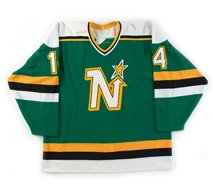
And these are not just generic hockey-style jerseys either. As a true fan and artist with an eye for detail, the jerseys are highly accurate in striping and even the addition of patches. A perfect example is this Minnesota North Stars jersey with the drop shadow on the numbers properly going down and to the right, unlike most of the retail versions of this jersey which we have dubbed, The Most Frequently Screwed Up Jersey of All Time™.

Ullman North Stars

Ullman has also published a number of collections of his work, two of which contain his NHL pin-ups. The first is the all-color hardcover book "Atom-Bomb Bikini: The Lurid Art of Robert Ullman", a 64 page collection of his art featuring girls from a variety of themes, "sporty, super or birthday suited" as he puts it, which includes many of his hockey girls. It its available for just $16.

Ullman Atom-bomb bikini

Atom-bomb bikini sample

Another of his publications of interest to our readers would be Teeny Bikini #5, a 20 page collection of hockey sweater wearing pinup girls (all different illustrations than those in Atom-Bomb Bikini) in black and white with a color cover, which can be yours for a mere $2.

Ullman Teeny Bikini #5

His newest release, the wonderfully titled Old-Timey Hockey Tales, comes in at 32 pages and tells the stories of the Rocket Richard riots, Michel Briere, Jack Adams vs. Red Kelly, Lester Patrick, Gordie Howe, Bill Barliko and Terry Sawchuk among others from hockey's golden age.

Old-Timey Hockey Tales

Old-Timey Hockey Tales

Along the lines of Old-Timey Hockey Tales, you can also purchase a print of Liberez le Rocket!, Ullman's illustrated story about the Rocket Richard Riots. A signed 8" x 12" signed print is available for $10.

LiberezLeRocket sm

Robert also does commission work! You simply provide him with some photos of your significant other and he will create one of his popular pin-up pieces of her wearing your sweater of choice created specifically for you. It doesn't even need to be a hockey theme or even a real person depicted, as he has also created baseball and football themed pieces and can certainly draw you a pretty girl at will.

For $300 you will receive both the original hand drawn 11" x 14" art as well as a color print of the image with all the logos and uniform details. After a quick sketch to ensure you are happy with the pose, he'll begin creating your one of a kind original - a fantastic gift for the holidays!

Ullman Whalers

Photobucket

Saturday, October 1, 2011

Announcing the Third String Goalie Hockey League

We are pleased to announce the Third String Goalie Hockey League!

Up to 11 readers of this site can join our head-to-head fantasy hockey league on Yahoo! Sports for a fun season of competition. The live draft is scheduled for Wednesday, October 5th at 8 PM Central time, but you do not need to be present to participate, as your players can be chosen automatically for you based on the pre-rankings which you can edit ahead of time based on your personal preferences.

All we ask in this fun league is that you remain an active and participating member throughout the season if you choose to participate.

There are several ways to join the TSGHL, including our posted invitations on the ubiquitous twitter and facebook.

For those concerned, the league rosters consist of 3 Centers, Left Wings and Right Wings, 4 Defensemen, 2 Goaltenders, 4 bench spots and 4 Injured Reserve spots.

Scoring categories consist of Goals, Assists, Plus/Minus, Penalty Minutes and Powerplay Points while the goaltending categories are Wins, Goals Against Average, Save Percentage and Shutouts.

If this sounds fun to you we hope you will consider joining us!


Friday, September 30, 2011

1977 Sweden National Team Per-Olov Brasar Jersey

Born on this date in Falun, Sweden Per-Olov Brasar began his professional career with Leksands IF in Sweden's Elitserien in 1969-70 and proved to be a clutch performer in the playoffs, scoring 14 points in 14 games in both 1971 and again in 1973 when Leksands won the league championship.

Brasar Leksands

1974 saw Brasar make his national team debut which saw his first appearance in the World Championships with 9 points in 9 games on his way to a bronze medal. He would make further appearances for Sweden at the Worlds in 1975 (bronze), 1976 (bronze), 1977 (with 11 points in 10 games on his way to a silver medal) and a final one in 1978 as well as being named to Sweden's lineup for the inaugural Canada Cup in 1976.

Brasar Sweden

1974-75 saw Leksands win a second championship following Brasar's best European season with 42 points in just 30 games.

After two more seasons, which included another 40 point campaign in 1976-77, Brasar made the move to North America, signing as a free agent with the Minnesota North Stars of the NHL, where the longer season allowed Brasar to set a new career best with 57 points while registering a 20 goal season while playing with fellow Swedes Roland Eriksson and Kent-Erik Andersson.

Brasar North Stars
Eriksson, Brasar and Andersson teamed up with the North Stars

After a second full season in Minnesota, he was dealt to the Vancouver Canucks 22 games into the 1979-80 season. After having just scored 16 goals in two seasons, the change did Brasar good as he set career highs in all offensive categories with 22 goals, 41 assists and 63 points.

Brasar Canucks

One final NHL season followed in 1981-82, which included a trip to the Stanley Cup finals, before Brasar returned to Leksands in 1982-83. He then played his final season with Mora IK in the second division before retiring as a player.

His final NHL totals were 64 goals and 206 points in 348 games.

Today's featured jersey is a 1977 Sweden National Team Per-Olov Brasar jersey as worn when Brasar won a silver medal with Sweden at the World Championships in Austria.

In the late 1970's Sweden abandoned their traditional "tre kronor" (three crowns" cresting for their jerseys in favor of the slogan "tre kronor" above a polar bear logo, which just happened to be the exact same polar bear used by the Polar Caravans brand of RV campers in an early example of corporate sponsorship on a hockey sweater.

The polar bear was gone by late 1981 and the three crowns returned permanently in time for the 1984 Canada Cup.

1977 Sweden jersey

Bonus jersey: Today's bonus jersey is a 1977-78 Minnesota North Stars Per-Olov Brasar jersey as worn during his rookie season in the NHL when he scored 20 goals to place third on the team behind Eriksson and Tim Young.

1977-78 was the final season for this style North Stars jersey which was first adopted in 1975-76.

Minnesota North Stars 77-78

Wednesday, September 28, 2011

1972 Team Canada Paul Henderson Jersey

"Here's a shot. Henderson makes a wild stab for it and falls. Here's another shot. Right in front. They score! Henderson scores for Canada!"


The most famous goal in Canadian hockey history occurred on this date in 1972, as Paul Henderson scored with 34 seconds remaining in Game 8 of the 1972 Summit Series between Canada and the Soviet Union.

The Summit Series was a groundbreaking event in not only hockey history, but international politics as well. The series would be the first time that the Canadians were able to take on the Soviets with a full squad of professional players head to head with the best that the Soviets had to offer. Most in Canada fully expected an easy time of it for Team Canada, with some even predicting an eight-game sweep.

That was not to be, however, as all of Canada was stunned when the Soviets came back from an early 2-0 deficit in Game 1 to win 7-3 in Montreal.

Canada would win Game 2 in Toronto by a score of 2-1 with the Soviets coming from behind by two goals in Winnipeg to earn a tie in Game 3.

Game 4 would see the Soviets up 4-1 after two periods, with the final score being 5-3, earning Team Canada a shower of boos from the Canadian crowed, earning a tounge-lashing from a frustrated Phil Esposito as the series was about to head off to Moscow for the final four games.


Things did not start off any better for the Canadians in Moscow, however, as Team Canada led 4-1, only to have the Soviets come back to win the game 5-4, putting them ahead three games to one, along with a tie.

Game 6 went better for Team Canada, despite having 31 penalty minutes called against them versus only four assessed to the Soviets, Canada would win 3-2 in a game that would feature a pivotal moment in the series, as Bobby Clarke would fracture the Soviet's best forward Valeri Kharlamov's ankle with a deliberate slash.

Canada would even the series at three games each by winning Game 7 by a score of 4-3, with Paul Henderson scoring the winning goal with a shade over two minutes left in the game, setting up a decisive Game 8.


While the series was supposed to be "a friendly" series of exhibition games with no overall winner, the tie result in game three left an odd amount of games to divide between the two sides and the Soviets proclaimed that even if Game 8 ended in a tie, they would be the winners on the basis of scoring one more goal in the series.

In an effort to ensure the best possible chance for a Soviet victory, they orchestrated a change in officials the night before the decisive game, choosing to replace the previously selected Swede and Czech referees with the West German pair that were responsible for the great discrepancy in penalty minutes in Game 6. Canada threatened to leave Moscow without even playing Game 8 if that were the case and a compromise was reached where the the Soviets hand picked their favorite West German Josef Kompalla, while the Canadians got to choose the Czech ref Bata.

Sure enough, just three minutes into the game Canada was two men short and gave up a power play goal. At 4:10, J. P. Parise was given yet another minor and his reaction earned him a ten-minute misconduct. Now enraged, Parise's threatening outburst got him thrown out of the game as a game misconduct was added on.

Phil Esposito would even the game once the hockey resumed to tie the game at 6:45 and then the teams would trade goals by Vladimir Lutchenko and Brad Park to finish out the first period tied at 2-2.

The Soviets would use a little home ice advantage to score in the first minute of the second, as the puck was fired over the goal, only to take a large rebound off the mesh netting that topped the boards rather than the plexiglass of North American arenas. Vladimir Shadrin would put the puck behind Ken Dryden after it landed back into the area in front of the Canadian goal.

Bill White would score for Canada halfway through the period, only to have the Soviets score just over a minute later to regain the lead and then again once more on the power play at 16:44 to take a 5-3 lead into the third period.

Phil Esposito would ignite the Canadians with a goal at 2:27 of the third to pull Canada back within one. Esposito again charged the net and Yvan Cournoyer was able to put the rebound past Vladislav Tretiak at 12:56, only to have the Soviet goal judge not turn on the goal light, but the goal did count to tie the game. Again, a tie would allow the Soviets to claim a series victory.

With the game no winding down in the last minute of play, Cournoyer intercepted a Soviet clearing attempt and passed to Henderson, but the pass was behind him and he was tripped on the play, which sent him crashing into the end boards to the side of the goal. At that point Phil Esposito, who was following the play, put the puck softly in front of the goal where Henderson, now back on his skates and coming from behind the net was able to jump on the loose puck and swat it towards Tretiak, which he blocked with his leg, allowing Henderson a second shot at glory, which he put over the sprawled Soviet goaltender to give Canada the series victory with only 34 seconds remaining in the contest.

Photobucket

The success of the 1972 Summit Series led to an attempt at a repeat in 1974 with a team made up of players from the WHA and eventually evolved into the Canada Cup tournament, which again led to the current World Cup of Hockey. It also influenced many aspects of how the game was approached and played in North America, with off-season training now becoming important, as well as various strategy differences in puck possession and player positioning.

Today's featured jersey is a CCM 1972 Team Canada Paul Henderson jersey as worn during the four games in Moscow.

This jersey came up for public sale for the first time ever at auction in June of 2010 on ClassicAuctions.net, a leading online auction website based in Quebec, Canada. Fears immediately were voiced from many corners of the hockey world that this historic jersey would fall into the wrong hands - such as those of a trading card company like Be A Player or Upper Deck, who have made a business out of cutting up historical sports artifacts into hundreds of small pieces in order to create collectible trading cards.

Notable previous losses of significant items include the only set of goalie pads worn by Georges Vezina and a 1925 New York Yankees Babe Ruth jersey among the dozens of items that have been desecrated for the sake of short term profits by card companies.

The concern and publicity over the possible threat to "the most significant artifact in the history of the game of hockey" eventually saw the jersey sell for a record shattering $1,275,707, far outstripping the reported $250,000 paid for a Wayne Gretzky game worn jersey and the $191,000 for a Bobby Orr rookie jersey.

The winning bidder, Canadian real estate developer Mitchell Goldhar, not only preserved the jersey from possible destruction, but returned it to Canada from where it had been located in the United States, but took the iconic Canadian sweater on a tour of the country in an effort to share it with the citizens of the nation where everyone remembers where they were when Henderson score his dramatic goal. One of the highlights of the jerseys return to Canada was having Henderson don the jersey once again.

Canada 1972 Henderson jersey


There is much more than can be written and examined about this series, it's significance and it's impact, and in fact many have done just so, as there are a number of books available on the subject as well as DVD sets of the games.

In addition to the usual video highlights, here is a link to the CBC archives of radio and TV footage relating to the series, which give some insights into how the event was viewed at the time especially the shock of the loss in Game 1.

Finally, here is Henderson himself, telling the story from his unique point of view of the series and his famous goal.


Tuesday, September 27, 2011

1985-86 Toronto Maple Leafs Miroslav Frycer Jersey

Born on this date in 1959 in Opava, Czechoslovakia, Miroslav Frycer began his playing days with TJ Vikovice's junior team in the 1976-77 season. He graduated to Vikovice's senior club in 1977 and was with them for four seasons, during which he gained confidence and experience which was evidenced by an annual rise in his scoring totals. He began with 22 points in 34 games, followed by seasons of 34 and then 46 points, which came from 31 goals and 15 assists in a 44 game season.

His final season in Czechoslovakia saw Frycer tally 33 goals and 57 points in just 34 contests.

During his time with Vikovice, he also made annual appearances for his national team, beginning with the 1977 European Junior Championships. 1978 saw him play in his first World Juniors, while 1979 saw him once more compete in the World Juniors, followed a few months later by his debut at the World Championships with a single game.

He represented Czechoslovakia at the 1980 Olympics and closed out his international career at the following year's World Championships.

Following the memorable defections of Peter and Anton Stastny in 1980 to join the Quebec Nordiques, their brother Marian followed as year later, as did the 22-year-old Frycer in a separate defection to join the three Stastnys in Quebec, which obviously precluded him from playing for Czechoslovakia internationally going forward.

Frycer Nordiques

He played one season in Quebec, scoring 20 goals and 37 points in 49 games well as scoring 9 goals in 11 games with the Nordiques minor league affiliate the Fredericton Express. His NHL debut was a memorable one, being named the games first star following a hat trick performance in a 6-4 win over the Toronto Maple Leafs.

With the three Stastny brothers playing on a line, Frycer found himself the odd man out, having to skate with linemates he could not communicate with. Not exactly thrilled with his -12 defensive rating, the Nordiques dealt Frycer at the trade deadline to the Maple Leafs in the spring of 1982.

Frycer Maple Leafs
Frycer with Toronto during the 1983-84 season with the seldom seen Toronto 150th Anniversary patch

Given more playing time and adjusting to life in North America helped Frycer's game, as he scored 25 goals in 1982-83, 25 again in 1984-85, a season during which he was the only Toronto player to appear in the NHL All-Star Game. He then set career highs with 32 goals, 43 assists and 75 points in 1985-86 to lead the Maple Leafs in scoring. Also during that season Frycer set another career best when he scored four times in a high scoring 11-9 win against the Edmonton Oilers.

Frycer Maple Leafs

Injuries which affected his skating abilities began to take their toll on Frycer afterwards, and he was limited to 29 games in 1986-87 and 38 in 1987-88. This also was a time of friction between Frycer and the coaching staff in Toronto, which led to his being dealt to the Detroit Red Wings for the 1988-89 season. He was to play 23 games with Detroit before another trade later that season to the Edmonton Oilers for the final 14 games of his NHL career.

He moved back to Europe to continue his career, first with EHC Freiburg in Germany for the 1989-90 and 1990-91 seasons followed by a year in Italy with SG Brunico.

His final NHL totals were 415 games played, 147 goals and 183 assists for 330 goals.

Today's featured jersey is a 1985-86 Toronto Maple Leafs Miroslav Frycer jersey from the highest scoring season of his career when he scored 75 points.

This style Maple Leafs jersey was first worn back in 1970-71 with a lace-up collar, which then changed to a v-neck for a season, back to a lace-up collar for two and then back to a v-neck yet again. This style jersey underwent it's final change when in 1978 the Maple Leafs consented to putting names on the back, but not before protesting the league requirement for names by skating with invisible blue names on their blue jerseys for a pair of games in 1978!

By the time Frycer arrived on the scene, the lettering had long since been changed to a league-approved white on blue, and would remain unchanged through the 1991-92 season.

Toronto Maple Leafs 85-86

Monday, September 26, 2011

1942-43 Chicago Black Hawks Fido Purpur Jersey

The first player born and raised in North Dakota to play in the NHL, Cliff "Fido" Purpur, was born on this date in 1912.

He first turned professional in 1932-33 with the Minneapolis Millers of the Central Hockey League. In two seasons for the Millers, Purpur played in 81 games and scored 28 goals and 41 points, which caught the attention of the St. Louis Eagles of the NHL. The Eagles signed Purpur to play at the age of 20 for the 1934-35 season, the Eagles one and only in the league prior to folding.

Purpur Eagles

After playing 25 games with St. Louis, including scoring his first NHL goal, Purpur rejoined the Millers for the remainder of the season.

It was in Minneapolis that he acquired his unusual nickname when a sportswriter wrote Purpur was "busier than a springer in a field of pheasants." leading to his unusual canine nickname.

It was back to St. Louis for the 1935-36 campaign, only this time with the St. Louis Flyers of the American Hockey Association in time for the Flyers to win the league championship. His first two seasons with the Flyers started out slowly, scoring 20 goals in 79 games, but he found his offensive game beginning in 1937-38 with 23 goals prior to setting career highs in goals (35), assists (43) and points (78) in 1938-39 to lead the club in scoring on their way to their second consecutive title. His speed and determined play, combined with his smaller size ( 5' 6" and 155 lbs.) and accessibility made him a fan favorite in St. Louis.

He would back up his 35 goals with another 32 in 1939-40 on his way to a 70 point season and conclude his run with the Flyers by helping them to their fourth championship in his six seasons with the club.

His successes in the minors earned him a second opportunity in the NHL, this time with the Chicago Black Hawks. His stay only lasted eight games, as he also developed a medical condition which gave him a persistent fever. The remainder of the 1941-42 season was spent on the other side of Missouri with the Kansas City Americans.

Purpur returned to the Black Hawks full time in 1942-43, setting a career NHL best in all offensive categories with 13 goals, 16 assists and 29 points and played on a line with brothers Max and Doug Bentley. After another full season with Chicago, he split time in 1944-45 between the Black Hawks (21 games) and the Indianapolis Capitols (26 games). He then played briefly with the Detroit Red Wings for seven games of that season's playoffs.

Purpur Black Hawks

It was back to St. Louis for 1945-46 to rejoin the Flyers, where he had his highest scoring season in four years with 18 goals.

His final season of 1946-47 was spent back in the Twin Cities of Minnesota, only this time across the river in St. Paul with the Saints of the United States Hockey League where he scored the final 15 goals of his career.

Purpur's final NHL totals stand at 144 games played with 25 goals and 35 assists for 60 points.

Following his playing days, Purpur played senior hockey in Grand Forks with his brothers Ray and Ken, coached at both the high school level in Grand Forks and the University of North Dakota from 1949 to 1956.

Purpur Brothers
Ray, Ken and Fido Purpur while with the Grand Forks Amerks

He was inducted into the United States Hockey Hall of Fame in 1974 and was given the highest citizen honor of North Dakota, the Theodore Roosevelt Rough Rider Award in 1981.

Fido Purpur

Today's featured jersey is a 1942-43 Chicago Black Hawks jersey from Purpur's finest NHL season when he set career highs in all offensive categories.

The Black Hawks barbepole style was originally adopted in 1937 and went through a few minor revisions in striping and logo before arriving at this design in 1941 which remained unchanged until 1947 before there were some additional tweaks to the logo. The Black Hawks would continue to wear this basic barberpole style jersey until 1955 before changing to the original version of their jerseys which remain in use today.

This jersey was revived as the Blackhawks Turn Back the Clock jersey for the NHL's 75th Anniversary season when the Original 6 teams all wore throwback jerseys from their past at times during the 1991-92 season.

Chicago Black Hawks 42-43 jersey

Sunday, September 25, 2011

Reader Submission - 1996-97 Colorado Avalanche Patrick Roy Jersey

Our next reader submitted jersey is a Colorado Avalanche Patrick Roy jersey from reader Mick Semantel. Here's what Mick has to say about his jersey:
This jersey is a size 48 Starter mesh. A VERY comfortable jersey. I love the material. I found this on the Denver Craigslist for $40. I had lived out there for many years, and still have friends and family out there. I had a friend pick it up for me. I got hooked up by Burnaby Joe (a well known Colorado Avalanche jersey collector). He hooked me up with nameplate material and dropped it off at Denver Athletic (the company who letters the on ice jerseys for the Avalanche).
Colorado Avalanche Patrick Roy

Thanks to Mick for taking the time to send in the photographs and story of his great looking jersey. We sure miss seeing the "mountainous" stripes at the bottom of the jersey, which were lost in the transition to the Reebok Edge jerseys.

This particular jersey dates to the 1996-97 season based on the logos on the rear hem. The Avalanche wore Starter jerseys for their first two seasons in Colorado before changing to CCM, and this jersey, with the S-star logo and separate black and orange NHL shield differ from the Stanley Cup winning 1995-96 jerseys which had the S-star logo above the word "Starter" in a box next to the NHL shield in a white box outlined in blue, with both boxes then outlined in white.

1995-96 Starter logo
1995-96 Starter logo style

It's obviously nice if you can have your jersey lettered by the same people who do the on ice jersey for that team. We've seen plenty of Avalanche jerseys which had issues with the white being smooth, non-glaicer twill, the outlines around the numbers being a flat silver/grey instead of the sparkly metallic twill and using the wrong font for the names on the back, noted for having round letter O's and C's, rather than the proper tall, oval shaped ones with straight sides.

Avalanche wrong font
A Colorado Avalanche jersey with the wrong font for the name on the back


hit counter for blogger