History of Jersey 83-93 Banner sm photo History of Jersey 83-93 Banner sm.jpg

Sunday, April 16, 2017

The Brief, Riotous History of the Birmingham Bulls

After the Ottawa Nationals ownership made the highly unusual move of relocating their franchise to Toronto for the 1973 WHA playoffs after the regular season was completed, the club was sold to new ownership for the 1973-74 season, who made Toronto their permanent home and renamed the club the Toronto Toros.

After one season at the Varsity Arena, with an absurdly small capacity of 4,800, the Toros were able to strike a deal for the 1974-75 season to play at Maple Leaf Gardens, but unfortunately for the Toros, the Maple Leafs owner Harold Ballard was now out of prison and back in control of the Gardens, and Ballard, as cantankerous a man who ever lived, hated the rival WHA for signing away many of his players. Hated it. And that hatred was taken out on the Toros at every opportunity.

For example, the lease called for the Toros to pay $15,000 per game to play at the Gardens, but when the first game came, the arena was quite dark and Ballard then demanded and additional $3,500 for the use of the lights! He also denied the team access to the Maple Leaf's locker room, forcing the Toros to build their own at a cost of $55,000. Ballard even took the cushions off of the players bench, saying the Toros could buy their own!

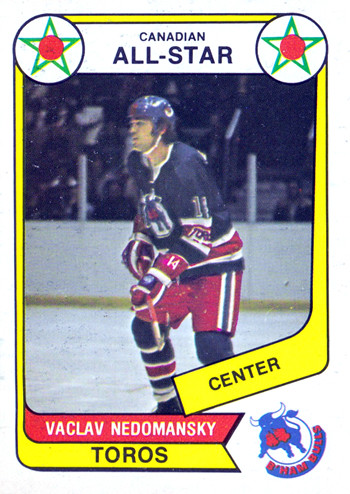
The Toros still gave it their best effort despite the off-ice headaches, and signed Canadian hero Paul Henderson away from the Maple Leafs, obviously earning no favors from his previous employer Ballard, as well as former Maple Leaf and Canadian star Frank Mahovlich and Czechoslovakian defector Vaclav Nedomansky. Attendance rose to 10,000 fans a game but the Toros were dumped in the opening round of the playoffs by the San Diego Mariners in six games.
Nedomansky Bulls 2
Vaclav Nedomansky

For the 1975-76 season, the Toros signed underage junior Mark Napier as a tactic to obtain the best young players before the NHL could, as the established league had rules in place that did not allow players under the age of 20. Nedomansky set Toros records with 56 goals and 98 points in 1975-76, while Napier shown with 43 goals and 93 points, followed by Mahovlich's 34 goals and 89 points. The positive news ended there however, as the team dropped like a rock in the standings, finishing a dismal 24-52-5, last in the Canadian Division and one of the two out of 12 teams who finished the season to not qualify for the playoffs.

The poor performance on the ice resulted in a 20% attendance drop, which combined with the difficulties in dealing with their landlord Ballard, caused ownership to make the bizarre choice to relocate the team once more, only this time to the deep south of the United States to Birmingham, Alabama of all places, a city with zero previous hockey history or connections.

For the 1976-77 season, the club was renamed the Birmingham Bulls, which allowed it to keep the same logo. In Birmingham, aside for being known for its policy of signing yet more underage junior players, the club also became known for their players frequent use of their fists...
logobulls

Seemingly more inclined to fight than score in order to attract fans to the unknown spectacle of ice hockey, the Bulls led the WHA in penalty minutes twice, most often earned in increments of 5 and 10 minutes at a time!
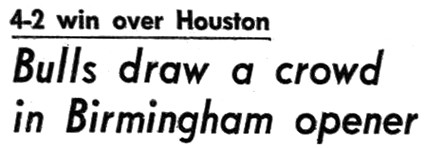
33245367813_bc54751f30_o

During their first season in Birmingham, the Bulls were led in scoring by the 19 year old Napier, who was a one man show for the club, scoring 60 goals and 96 points, far outdistancing Nedomansky's 36 goals and 69 points. Napier's 60 goals were third most in the league that year. Lou Nistico had 166 penalty minutes in 79 games to lead the team while contributing 20 goals and 56 points. Gilles "Bad News" Bilodeau was second with 133 minutes but in only 34 games, a pace that would have led the league had he played a full season.

 photo Napier Bulls.jpg
Mark Napier

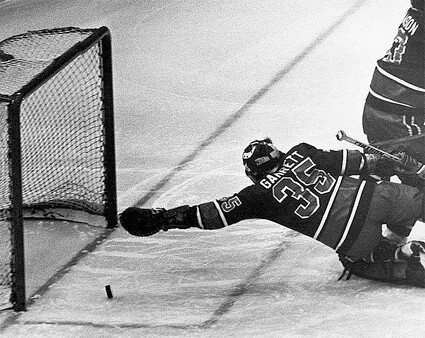
Their goaltending was mainly handled by John Garrett, who the Toros rescued from the roster of the Minnesota Fighting Saints, who had folded during the 1975-76 season. Garrett won 24 of the Bulls 31 wins with a 3.53 goals against average.
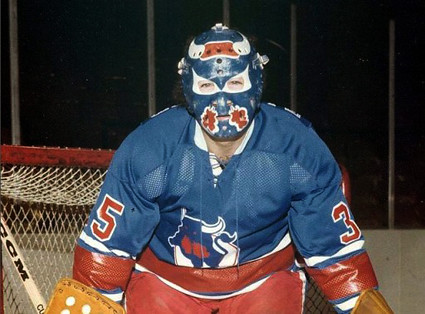
Garrett Bulls 2
Garrett sported a terrific mask that resembled the team's snorting bull logo

The Bulls finished last in the Eastern Conference with a 31-46-4 record for 66 points, ten out of the final playoff spot.
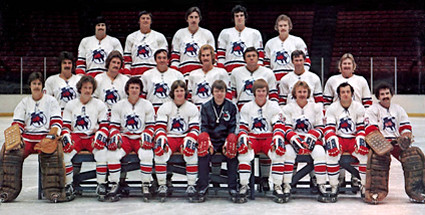
1976-77 Birmingham Bulls team
The 1976-77 Birmingham Bulls

For the 1977-78 season, the club signed Ken Linseman as an underage player, but also made heads turn when, under the guidance of new head coach Glen Sonmor, they rounded up a (literally) Slap Shot movie worthy riotous line up of Steve "Mental Case" Durbano (284 penalty minutes), Frank "Never" Beaton (279), "Bad News" Bilodeau (258) and Dave "Killer" Hanson, one of the Hanson Brothers from Slap Shot, with 241 minutes as the quartet finished 1-2-3-4 in league penalty minutes!

"We had a fellow by the name of Frank "Never Been Beaten" Beaton and he would throw ten punches before you knew you were in a fight with him," Mahovlich recalled. "So it was pretty fast and you didn't know what was happening. Gilles Bilodeau, he was a huge man from northern Quebec. A real lumberjack. A nice person though. A nice, gentle person, but he was down there for one thing. The coach would send him over the boards for one thing, and boy, he did his thing. I don't know if he ever won a fight, but he certainly got into a lot."
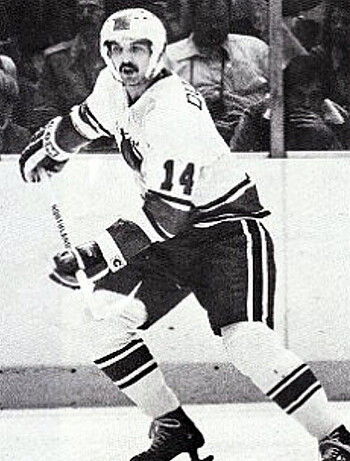
Durbano Bulls
Steve Durbano led the WHA in penalty minutes in 1978

With the top four penalty minute leaders, the Bulls, not unexpectedly, led the WHA with 2,177 total penalty minutes, 476 more than the next closest team and more than twice the Winnipeg Jets 988. The 1,189 minute difference between the two clubs was the equivalent of an entire five man lineup spending four full games in the penalty box!

The aging Mahovlich was put on a line with tough guys Beaton and Hanson. Naturally, his point production plummeted like a rock - from 89 points in 1975-76 in Toronto to 38 points with the Bulls in 1977-78. When asked by a reporter what was wrong, Mahovlich brilliantly replied, "I don't know, but I seem to play better with Gordie Howe and Alex Delvecchio."
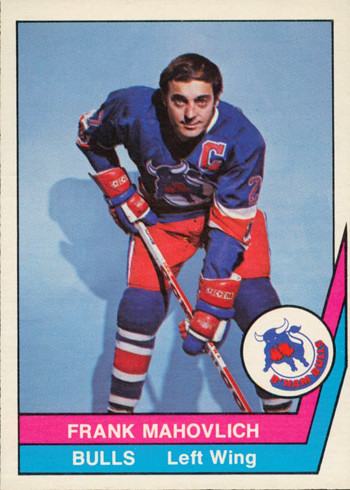
Mahovlich Bulls
Frank Mahovlich went from starring Montreal, Detroit and Toronto to somehow playing in Birmingham, Alabama in the crazy world of the WHA

In one of many infamous incidents, Hanson once inadvertently ripped the toupee off of WHA superstar Bobby Hull during yet another Bulls melee! Mahovlich recalls. "He jumped up behind Hull and pulled Hull's wig off. And in those days, the wigs were sewn in. They were stitched into your head. And Bobby started to bleed from the top down and the blood was coming all over. It happened so quick. I don't know what he was doing, he just did it."

That wasn't the end of the story either. "Then, after the game, I recall Linseman, Durbano and I were walking out from the rink and we were going back to the hotel and Durbano kicks this fellow that was voicing his opinion at him and a fight breaks out right outside our dressing room. This fellow is a tough guy, but you don't know that when a fellow is in a shirt and tie. You don't know whether he is tough or not. So the fellow puts Durbano down and our coach Sonmor runs into the room and yells: "Durbano is getting the living hell beat out of him." Six guys come out of the dressing room with no clothes on, they were still in the shower, and we got a hundred spectators there. We have six guys pulling this fellow off. It was really out of Slap Shot. It was better than Slap Shot. This was the WHA."
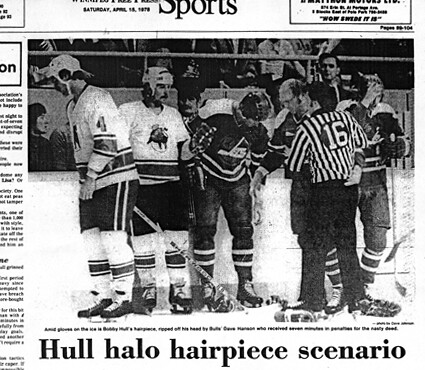
Bulls Hull hairpiece
Hull's hairpiece made headlines thanks to the wild Bulls

Once again, a 19 year old led the club in scoring, this time Linseman, who had 38 goals and 76 points while adding 126 penalty minutes of his own behind the top four. Peter Marrin was next with 28 goals and a team leading 43 assists for 71 points while both Henderson (37) and Napier (33) had over 30 goals along with Linseman.
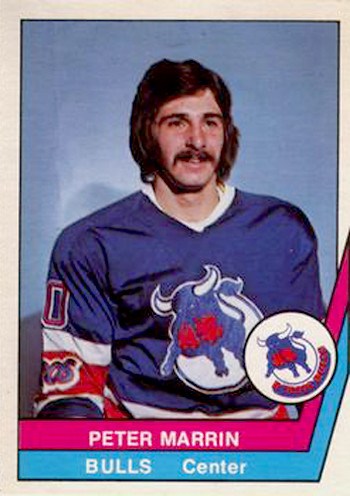
Marrin Bulls
Peter Marrin

The club improved slightly to 36-41-3 for 75 points to finish sixth in the WHA out of eight teams. They were paired against the Winnipeg Jets in the opening round of the playoffs and lost two in Winnipeg 9-3 and 8-3. They returned home and won Game 3 by a score of 3-2 with center John Stewart getting the game winner on a second period power play from Dave Gorman and penalty minute king Durbano(!) for the only playoff win in franchise history, as they would lose the next two 5-1 and 5-2 on their way to being outscored 29-12 in five games.
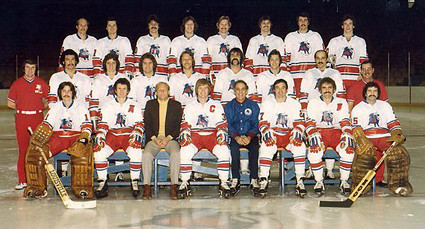
1977-78 Birmingham Bulls team
The 1977-78 Birmingham Bulls

While the club had dabbled in the underage player market previously, they went all in for 1978-79 in the last, desperate days of the WHA. Owner John Bassett was expecting a WHA merger with the NHL following the 1977-78 season and a nice payment to compensate for folding his team, as Birmingham was never going to a part of any NHL expansion.

The Bulls had lost 2,000 season ticket holders after having averaged 8,300 fans and Bassett had sold off Linseman, Napier and Garrett in anticipation of winding up operations, but when the expected merger fell through, he needed a half a dozen players quickly and cheaply, and Bassett had a plan.

Teenager Rick Vaive was signed as a free agent out of Canadian junior hockey who had scored 76 goals for Sherbrooke. He led Birmingham in both scoring, with 59 points, and penalty minutes with a league leading 248.
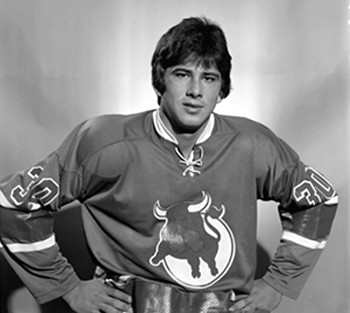
Vaive Bulls
The underage Vaive made a splash when he led the Bulls in scoring and the WHA in penalty minutes as a rookie

Vaive was one of eight underage players on the Bulls roster that season, which earned the club the nickname of the "Baby Bulls". The other seven to join Vaive were Craig Hartsburg, Rob Ramage and Gaston Gingras on defense, goaltender Pat Riggin and forwards Louis Slegher, Keith Crowder and Michel Goulet. Goulet was the team leader in goals with 28 followed by Vaive and Slegher with 26 with Henderson next with 24 at nearly twice the age of the other three at 35 years old.
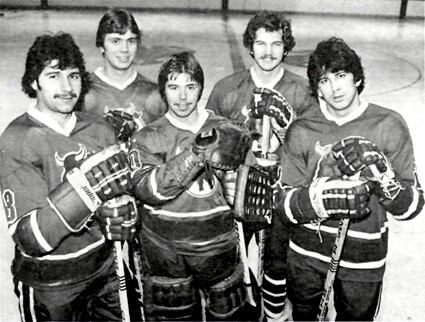
Baby Bulls Gingras, Hartsburg, Riggin, Ramage, Vaive
The Baby Bulls, Gingras, Hartsburg, Riggin, Ramage and Vaive

Following Vaive in penalty minutes was returnee Hanson at 212 followed by another Baby Bull, Ramage, with 165. The 19 year old Riggin split the goaltending duties with Ernie Wakely, who at age 37 was the oldest player on the club.
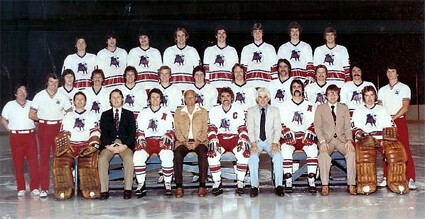
1978-79 Birmingham Bulls team
The 1978-79 Birmingham Bulls

The Bulls record slipped to 32-42-6 for 70 points, last among the 6 teams that made it through the entire season and the only one to not qualify for the playoffs. The Bulls final game came on this date in 1979, a heartbreaking 5-4 overtime loss to the Jets, as a win would have tied the Bulls with the Cincinnati Stingers for the final playoff spot.
Garrett Bulls 3

Bassett did get $2.85 million when the agreement was eventually made to admit four of the desirable WHA survivors into the NHL, the Edmonton Oilers, Quebec Nordiques, Hartford Whalers and the Jets, which meant the end of the Stingers and the Bulls. Sort of.

Birmingham actually remained in business and joined the Central Hockey League for a season and two-thirds before disbanding before the 1980-81 season was complete.

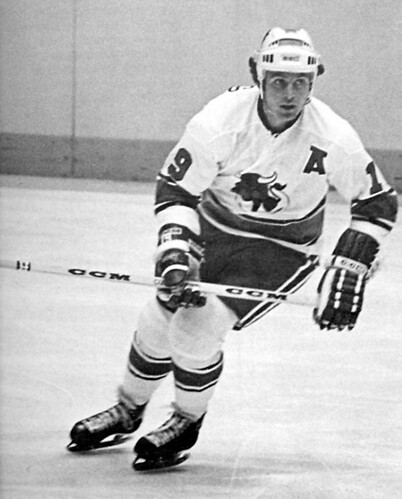
Henderson, who played all three seasons in Birmingham, was the team's all time leader in games played with 237, and in points with 165. Napier had 93 goals in two seasons, besting Henderson's 84, while Hanson was the penalty minute champ with 453 in two seasons ahead of Bilodeau's 391.
Henderson Bulls 4
The Bulls all-time leading scorer Paul Henderson

With the WHA now history, the 1979 NHL Entry Draft was held, only with the previous age limit of 20 now reduced to 18. This meant the previously underage players from the Bulls and Stingers were now up for grabs for the first time in an NHL draft.

Defenseman Ramage was the first overall selection, going to the Colorado Rockies. Vaive was chosen with the fifth pick by the Vancouver Canucks with Hartsburg taken with the next selection by the Minnesota North Stars. Goulet lasted until the 20th pick when he went to the Nordiques. Gingras was chosen by the Montreal Canadiens 6th in Round 2, 27th overall and Riggin became the first goaltender selected as the 33rd pick by the Atlanta Flames as the Baby Bulls were eagerly claimed by the NHL.

Many of the Bulls players would go on to have productive NHL careers, with Goulet, Rod Langway and Mahovlich all eventually being inducted into the Hockey Hall of Fame.

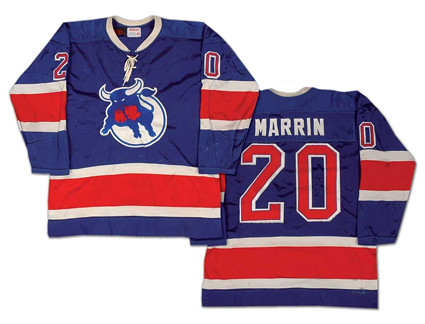
Today's first featured jersey is a 1976-77 Birmingham Bulls Peter Marrin jersey as worn during the Bulls first season in Birmingham. The Bulls wore this jersey style dating back to their days as the Toronto Toros starting in 1973-74.

When the team moved to Birmingham for the 1976-77 season, the only change to their jerseys was the removal of the "Toros" wordmark from the sleeve stripes. Note the block font for the name and the three color numbers created by sewing the red onto the white layer with blue thread.
Birmingham Bulls 1976-77 road jersey
photo courtesy of Classic Auctions

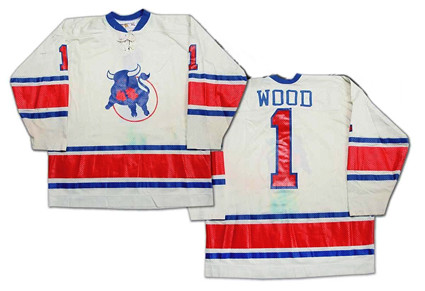
Today's second featured jersey is a 1977-78 Birmingham Bulls Wayne Wood jersey as worn during the Bulls second season in Birmingham. For their second season in Birmingham, the lettering on the back became narrower with serifs added while the numbers were simplified from three colors to just two, now screen printed rather than sewn on.

Birmingham Bulls 1977-78 jersey
photo courtesy of Classic Auctions

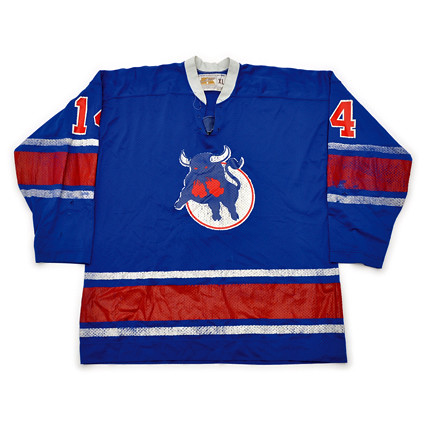
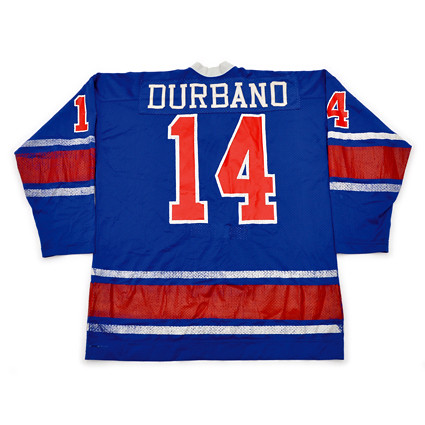
Today's third featured jersey is a 1977-78 Birmingham Bulls Steve Durbano jersey as worn during the Bulls second season in Birmingham. For their second season in Birmingham, the names on the back became narrower with serifs added while the numbers were simplified from three colors to just two, the same as the white jerseys.

Additionally, blue trim was added to the red stripes around the arms and waist, changing them from two colors to now three. Note the wear to the screen printed striping, particularly on the arms, perhaps as a result of being grabbed aggressively during one of Durbano's many fights. Compare the wear on the striping to Marrin's jersey above, where each stripe was a separate sewn piece of fabric, which held up much better to abuse.
Birmingham Bulls 1977-78 14 F jersey
Birmingham Bulls 1977-78 14 B jersey


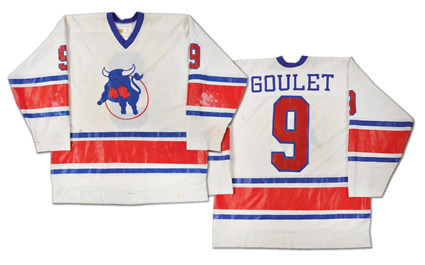
Today's fourth featured jersey is a 1978-79 Birmingham Bulls Michel Goulet jersey as worn during the Bulls third season in Birmingham. For their final season, the jerseys changed from a lace-up collar to a v-neck collar.
Birmingham Bulls 1978-79 9 home jersey
photo courtesy of Classic Auctions

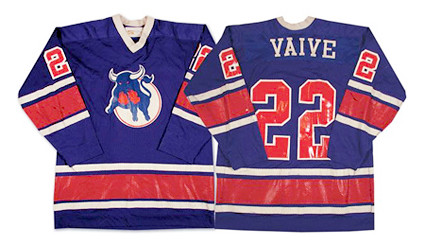
Today's fifth featured jersey is a 1978-79 Birmingham Bulls Rick Vaive jersey as worn during the Bulls third season in Birmingham. For their final season, the blue jerseys were also changed from a lace-up collar to a v-neck collar.

Birmingham Bulls 1978-79 road jersey
photo courtesy of Classic Auctions

In today's video section, what else, a Birmingham Bulls bench clearing brawl against Winnipeg. The audio is a few seconds ahead of the video and there are a number of obstructions from people standing in front of the camera, but it captures the mayhem of the Bulls traveling circus.

Friday, April 14, 2017

A Brief History of the Brief Ottawa Nationals - 1972-73 Ottawa Nationals Tom Martin Jersey

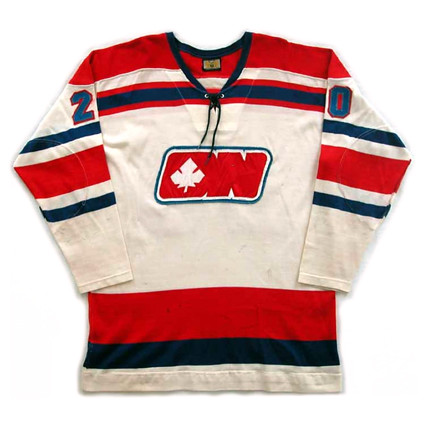
When plans began to take place for the inaugural season of the World Hockey Association in 1972-73, the league naturally wanted to have a club located in Canada's largest city Toronto, but they ran into a road block of the most stubborn kind in the form of Harold Ballard, the cantankerous owner of the Toronto Maple Leafs of the rival NHL and, more importantly, their arena, Maple Leaf Gardens.

When no deal was able to be reached with Ballard, the franchise earmarked for Toronto was instead placed in the capital of Ottawa after an attempt to locate the club in Hamilton. The Nationals failed to lure any top-flight NHL talent to Ottawa, such as Brad Park, Dave Keon or Eddie Shack, all of whom were on their draft list, due to their late start in finding a home.
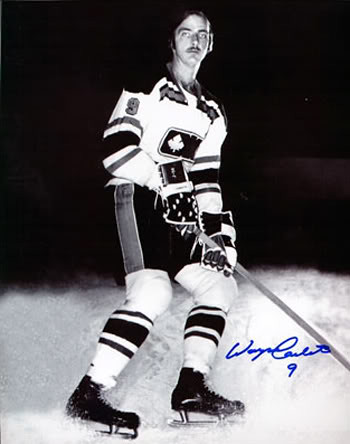
Wayne Carlton was signed away from the California Golden Seals, one of several players the Seals lost to the upstart WHA, and Carlton went on to lead the club with 42 goals, 29 assists and 91 points.

CarletonNationals
The Nationals leading scorer Wayne Carlton

The goaltending duties were handled by rookie Gilles Gratton, who was backed up by former Pittsburgh Penguin veteran Les Binkley. Gavin Kirk and Bob Charlebois each scored more than 60 points while Brian Gibbons led all defensemen in scoring with 42 points while Rick Cunningham led the team with 121 penalty minutes.

GrattonNationals
Gilles Gratton guards the Nationals goal

After losing their first three games, the Nationals won their next four. They spent their first three months hovering around the .500 mark, closing out December with a 16-18-3 record, which included a pair of four game winning streaks.

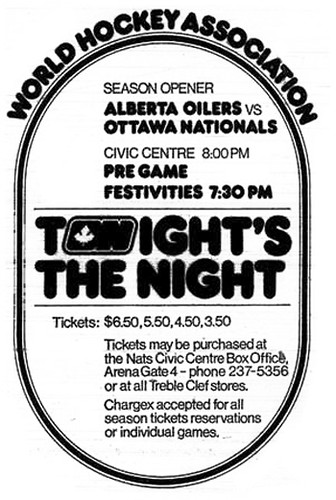
Nationals opening night
An advertisement for the Nationals first game on October 11, 1972

January was unkind to the Nationals, who dropped 11 out of 14 to fall to 19-29-3. After going 6-7-1 in February, the Nationals caught fire and roared through March with a spectacular run, winning 11 of 12 to force themselves back into the playoffs, with their 74 points edging out the Quebec Nordiques at 71.

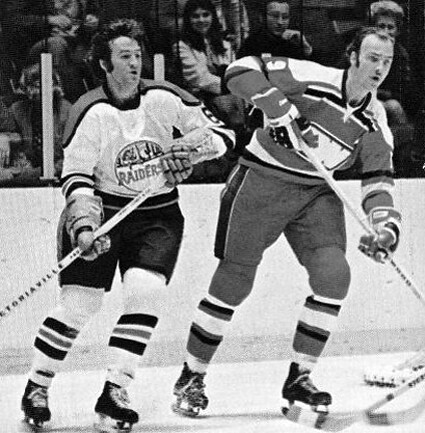
raidersnationals
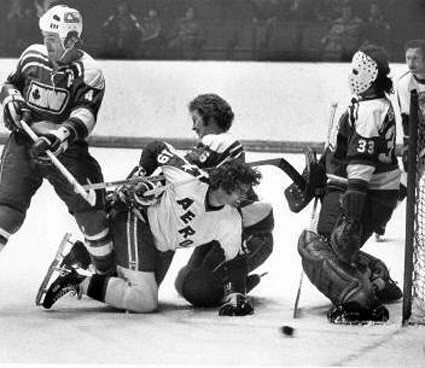
Ottawa's Wayne Carleton battles Ron Ward of the New York Raiders

Despite Ottawa not having had top level professional hockey since the once-dominant Ottawa Senators left the capital way back in 1934, attendance proved to be an issue, as the team drew an average of just 3,226 fans per game in the 9,000 seat Ottawa Civic Centre.

A big part of the problem with the public in Ottawa was the knowledge that Ottawa was not the intended home for the team. Or even ownership's second choice. After plans to play in both Toronto and then Hamilton fell through, only then did they turn to Ottawa. They only sold 400 season tickets and reduced ticket prices twice in an effort to win over the fans while competing with the established and quite popular Ottawa 67's junior club of the Ontario Hockey Association, which had no problem selling out the Civic Centre.

The Nationals were paired with the first place New England Whalers in the opening round of the postseason, however...

...the City of Ottawa demanded a payment of $100,000 to secure dates for the following season prior to the playoffs, which prompted the club's ownership to consider their options. The option they chose resulted in the Nationals moving all their "home" playoff games to their original intended home Toronto!

Nationals head coach Billy Harris dismissed the relocation for the playoffs when asked if it would affect the team, "Everyone seems to think this will bother our players, that they're thinking of moving instead of concentrating on hockey. Heck, earlier in the year they went through five weeks when they didn't know if they should buy groceries or not. We were supposed to be on our way to Milwaukee, so a little thing like this isn't going to affect us."

Now known as the Ontario Nationals during the playoffs, they lost their first two games 6-3 and 4-3 in Boston. The Nationals returned "home" to face the New England Whalers and won Game 3 by a score of 4-2, but lost Game 4 by a decisive 7-3 score while averaging 5,000 fans a game. The Whalers closed out the series with a 5-4 win back in Boston on this date in 1973 to end the Nationals season, and, as it turned out, the Nationals themselves, as the team was sold following the season to John Bassett, who made Toronto their permanent home and renamed the team the Toronto Toros in June of 1973.

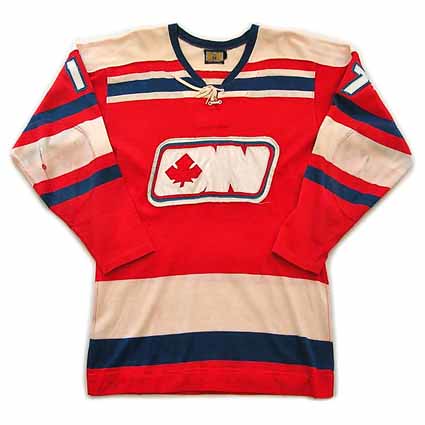
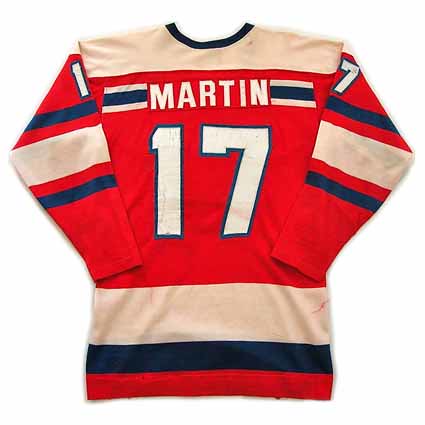
Today's first featured jersey is a 1972-73 Ottawa Nationals Tom Martin jersey as worn for road games during the Nationals only season in Ottawa. This is a very attractive jersey for it's day and the addition of the extra blue stripe trimmed in white just under the shoulder yoke makes it very unique. We especially like the white name on the red nameplate placed directly on top of that stripe.

The team logo is also very bold and well executed, although we always felt it looked more like a corporate logo, for a railroad in particular, rather than a pro hockey team.

Still, a very nice jersey and one that lived an all too short life.

Ottawa Nationals 1972-73 R F jersey
Ottawa Nationals 1972-73 R B jersey

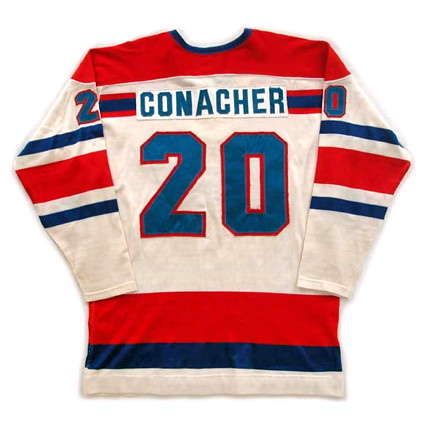
Today's second featured jersey is a 1972-73 Ottawa Nationals Brian Conacher jersey as worn at home during the Nationals only season in Ottawa. 

Ottawa Nationals 1972-73 H F jersey
Ottawa Nationals 1972-73 H B jersey

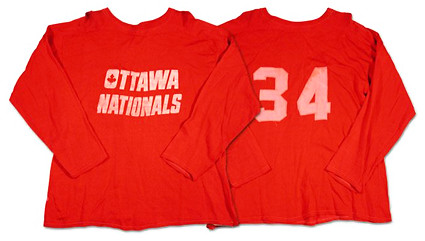
Bonus jersey: Today's bonus featured jersey is a 1972-73 Ottawa Nationals practice jersey as worn during the Nationals only season in Ottawa. 

Ottawa Nationals 1972-73 P jersey

Here is a look at Dennis Murphy and the formation of the WHA and some of the first players to join the upstart league.


Thursday, April 13, 2017

1998 Poland National Team Mariusz Czerkawski Jersey

Born on this date in Poland in 1972, Mariusz Czerkawski began playing for GKS Tychy's junior team in 1988-89. During his second season with Tychy, Czerkawski showed his promise with 35 goals and 46 points in 30 games. He would play one more season for GKS with 25 goals and 40 points in 24 games.

During his time playing club hockey in Poland, he also participated in several international tournaments for his national team, first playing in the 1989 European U18 Junior Tournament B Pool as a 16 year old, scoring 5 goals and 11 points in 5 games and helping Poland earn a promotion to the Top Division.

He got to enjoy the fruits of his labor in 1990, again playing for Poland's U18 team at the World Championships. There, he scored 9 goals and 12 points in 6 games, an average of 2 points per game. Of note, he finished fourth in scoring behind future NHLers such as Slava Kozlov and Espen Knutsen and ahead of  Sergei Zholtok, Mikael RenbergAlexei Kovalev, Jere Lehtinen and Martin Straka. His obvious talents were rewarded with a roster spot on the Polish World Junior U20 team despite being just 17 years old.

Czerkawski again pulled double duty for Poland in 1991, only this time playing in first the U20 World Juniors B Pool, where he dominated with 12 goals and 15 points in 7 games to lead the tournament in scoring on his way to being named the tournament MVP. He was again rewarded for his efforts when he was a part of the Poland National Team at the 1991 World Championship B Pool at the senior level as an 18 year old. Playing with players much older than he was did not phase Czerkawski, as he scored 6 goals and 8 points in 7 games, helping Poland earn a promotion to the newly expanded Top Division for 1992, as four promotion spots were up for grabs that year.

Czerkawski Poland 1
Czerkawski in the red and white of Poland

His success on the international scene led to Czerkawski being drafted during the 1991 NHL Entry Draft by the Boston Bruins in the fifth round, #106 overall.

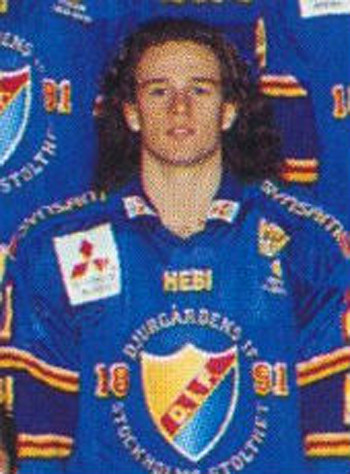
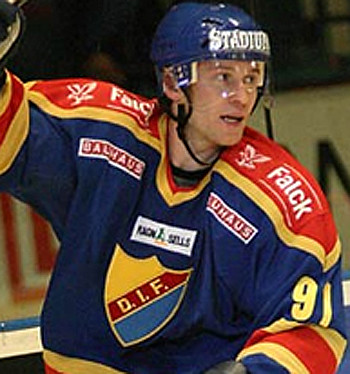
Needing tougher competition to continue his development if he were to make it to the NHL, Czerkawski moved to Sweden for the 1991-92 season, joining Djurgardens IF in the Eliteserien. He found the going somewhat more difficult but acquitted himself with 8 goals and 13 points in 39 games. That season he also made his Olympic debut, playing at the 1992 Games in Albertville, France. Later that spring, he also returned to the World Championships, only now in the Top Division for the first time.

Czerkawski Djurgardens 1
Czerkawski moved to Sweden to continue is development

For the 1992-93 season, Czerkawski played with Hammarby IF in the second level of Swedish hockey, where he had a fine season with 39 goals and 69 points in only 32 games. He also asserted himself with 74 penalty minutes.

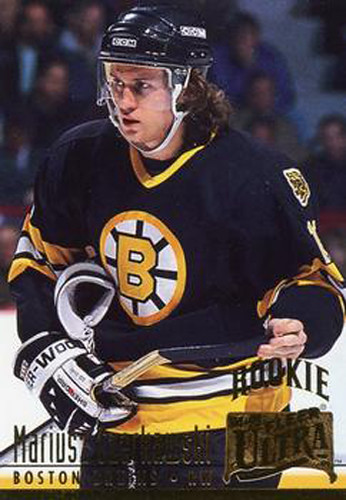
He was back with Djurgardens for the 1993-94 season, scoring at nearly a point per game clip this time around, as he scored 13 times on his way to 34 points in 39 games played. Once Djurgardens was eliminated from the playoffs, Czerkawski made his NHL debut with the Bruins, playing in 4 regular season games, scoring twice before playing an additional 13 playoff games, adding 3 goals and 6 points to the Bruins effort. On his debut, Czerkawski became the first Polish born and trained player in NHL history.

The start of the 1994-95 season was delayed by labor issues, and Czerkawski signed on with Espoo Blues of the Finnish SM-Liiga. He played in 7 games for the Blues with 9 goals and 12 points before returning to North America for the resumption of play in the NHL. In 47 games with Boston, he scored 12 goals and 26 points.

Czerkawski Bruins 1
Czerkawski played 80 games for the Bruins
divided over the course of two seasons

Czerkawski returned to the Bruins for the 1995-96 season, and after 11 points in 33 games, he was involved in a trade that sent himself, Sean Brown and a first round draft pick to the Edmonton Oilers for goaltender Bill Ranford. During the second half of the season with Edmonton, Czerkawski had 12 goals and 29 points.

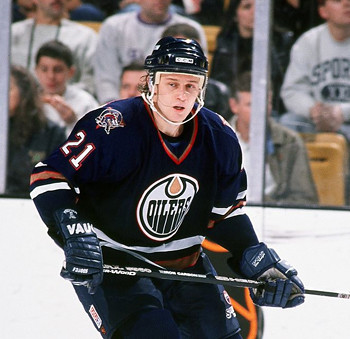
He played the entire 1996-97 season with the Oilers, seeing action in 76 games, scoring 26 goals and 47 points before an additional 12 playoff games.

Czerkawski Edmonton 1
Czerkawski played a season and a half with the Oilers

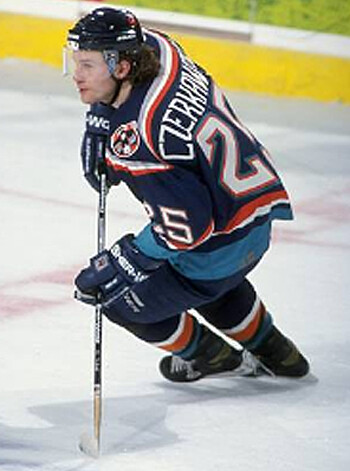
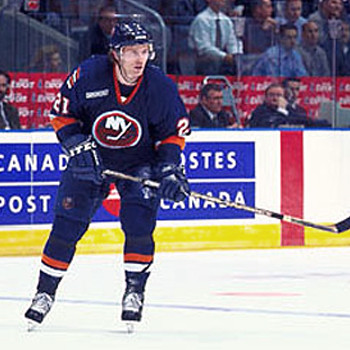
Just before the 1997-98 season, Czerkawski was traded to the New York Islanders for Dan LaCouture. At first, the move affected his offensive output, as he scored roughly half the number of points he had the year before with the Oilers. Czerkawski also returned to the international scene for the first time in six years when he played in the World Championships B Pool Qualifying Round in early November for the Poles.

Czerkawski Islanders 4
Czerkawski was with the Islanders during their final
season with the controversial Fisherman jerseys

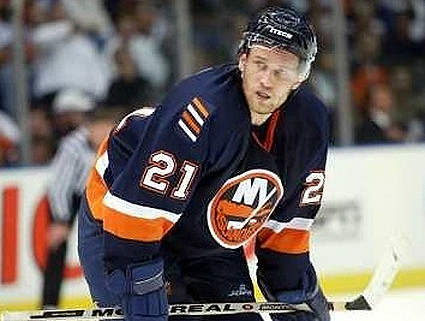
Over the next two seasons Czerkawski's offensive game not only returned, but thrived. In 1998-99 he scored 20 goals for the second time in his NHL career with 21 on his way to 38 points followed by setting career highs in 1999-00 with 35 goals, 35 assists and 70 points to far and away lead the Islanders in scoring, 28 points more than Brad Isbister in second! His fine season was rewarded by being named to the 2000 NHL All-Star Game.

Czerkawski Islanders 21
Czerkawski had a career year in 1999-00
and played in the NHL All-Star Game

Coming off his success in the NHL, Czerkawski scored 4 goals and 11 points in Poland's effort at the 2000 World Championships B Pool.

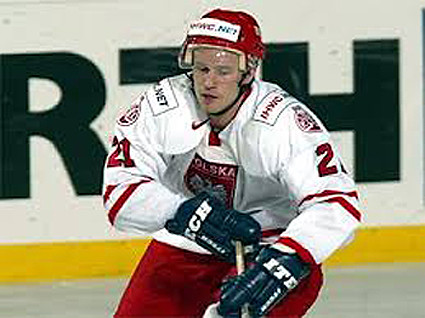
Czerkawski Poland 2
Czerkawski played for Poland 11 times during his career 

Czerkawski played every one of the Islanders games over the course of the next two seasons, again reaching 30 goals in 2000-01 while serving as an assistant team captain for New York. After scoring 62 points that season, he numbers slipped to 22 goals and 51 points in 2001-02. In 2001, the IIHF World Championship ladder system was renovated, and when Czerkawski returned to play for Poland in 2002, they were now placed in the expanded Top Division, Czerkawski's second time participating at the top level since first doing so in 1992.

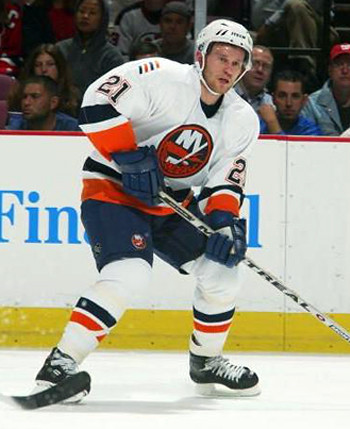
Czerkawski Islanders 1

Czerkawski was traded to the Montreal Canadiens following the season for Arron Asham and a draft pick. The fit was not a good one for Czerkawski, and he only played half a season for the Canadiens with just 5 goals and 14 points in 43 games. He also played 20 games for the Hamilton Bulldogs down in the American Hockey League with 20 points in 20 games as well as 6 postseason games with the Bulldogs.

He then returned to the Islanders when he signed as a free agent for the 2003-04 season, where he returned to form with 25 goal sand 49 points playing in 81 games that season.

Czerkawski Islanders 3
Czerkawski was back with the Islanders for the 2003-04 season

With the 2004-05 NHL season cancelled by the lockout, Czerkawski returned to Djurgardens IF in Sweden where he scored 15 times on his way to 24 points in 46 games. He also took part in the Olympic qualification rounds for Poland, leading the way with 6 goals and 10 points in 6 games. While Poland won the pre-qualification Group E tournament at home in November of 2004 over the Netherlands, Lithuania and Croatia, they were overmatched in the final qualification tournament against Latvia, Belarus and Slovenia.

Czerkawski Djurgardens 2
Czerkawski rejoined Djurgardens IF for 2004-05

The NHL returned to the ice in 2005-06, and by now Czerkawski was a member of the Toronto Maple Leafs, having signed as a free agent. It was not a good fit and, after being a healthy scratch for most of the season, he would only play in just 19 games in Toronto, scoring just 4 goals and a lone assist before being claimed off waivers near the trade deadline by his original NHL club, the Bruins. He played in 16 games to finish out the Bruins schedule with an identical 4 goals and one assist. Czerkawski made his final international appearance for Poland that spring, playing in the 2006 World Championships Division 1 Group B tournament, leading the Poles with 3 goals and 7 points in 5 games.

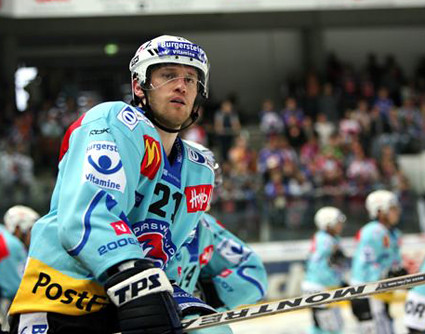
For the 2006-07 season, Czerkawski returned to Europe and signed with Rapperswil-Jona Lakers in the Swiss National League A. He excelled with 21 goals and 41 points in 43 games for second on the team in overall scoring. For the 2007-08 season, he exceeded a point per game with 22 goals and 53 points in 49 games, again second on the club by a single point to effectively bring an end to his career, but Czerkawski did appear in a single game for GKS Tychy where it all began in Poland during the 2008-09 season.

Czerkawski Jona 1
Czerkawski returned to Europe with Rapperswil-Jona

His final NHL totals were 745 games played with 215 goals and 220 assists for 435 points as well as an additional 15 points in 42 playoff games in 12 NHL seasons. He remains far and away the most successful NHLer ever from Poland with 390 more than Krzysztof Oliwa's 45.

Internationally, Czerkawski played for Poland on 11 occasions, scoring 44 goals and 73 points in 61 games combined between the junior and senior levels.

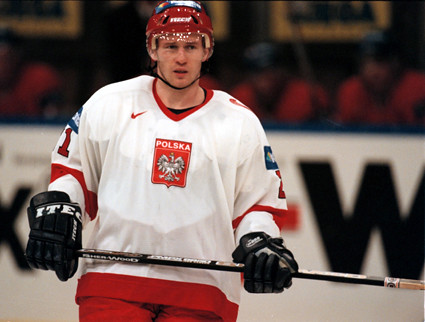
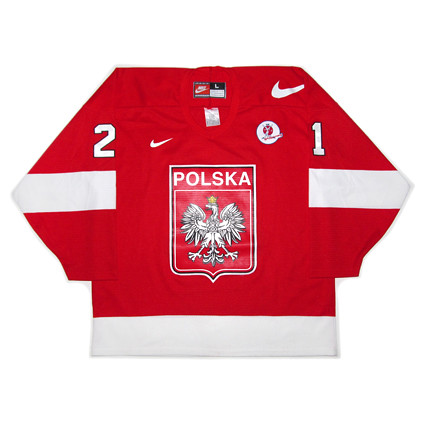
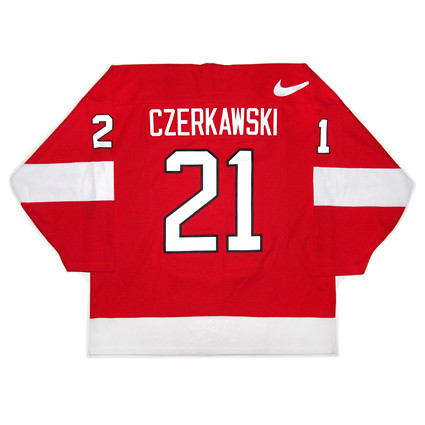
Today's featured jersey is a 1998 Poland National Team Mariusz Czerkawski jersey as worn at the 1998 World Championship Group B in Slovenia.

Poland played its first international game back in 1926 with a best World Championship finish of 4th in 1931. They have appeared in 65 World Championships and have played in Division 1 every year since 2003. In their effort to return to the Top Division, they won promotion from Division 1 Group B in 2014 and have finished 3rd in Division 1 Group A in 2015 and 2016.

To date, they have participated in 13 Olympics and were in six consecutive Games during the 1970s and 1980s, but not have qualified for the Olympics since their last appearance in 1992.

Poland 1998 F jersey
Poland 1998 B jersey

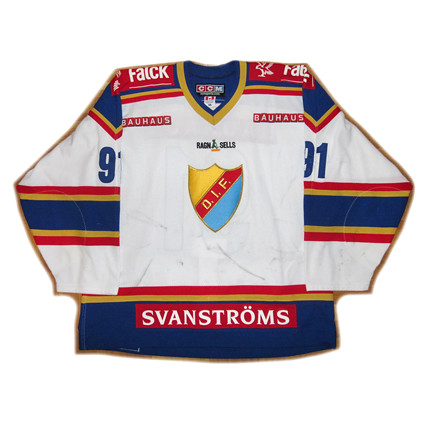
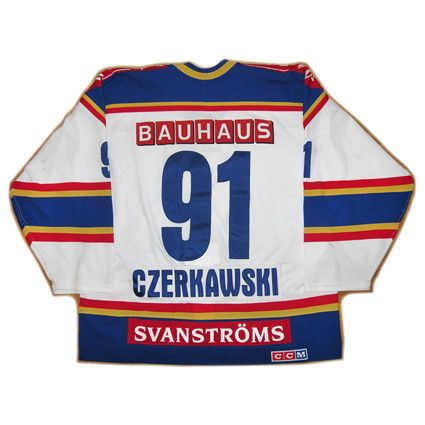
Bonus jersey: Today's bonus jersey is a 1998 Djurgardens IF Mariusz Czerkawski jersey. Djurgardens IF was founded in 1922 in Stockholm, Sweden and are 16-time Swedish champions and twice have won the European Cup.

Djurgardens 2004-05 IF F jersey
Djurgardens IF 2004-05 B jersey

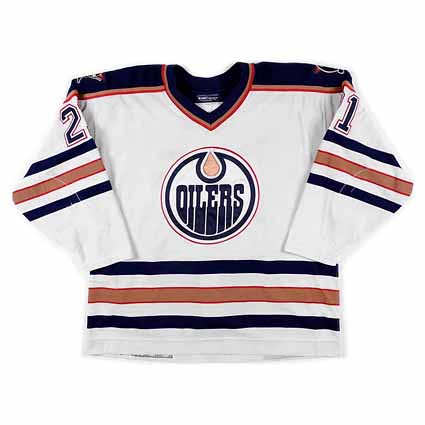
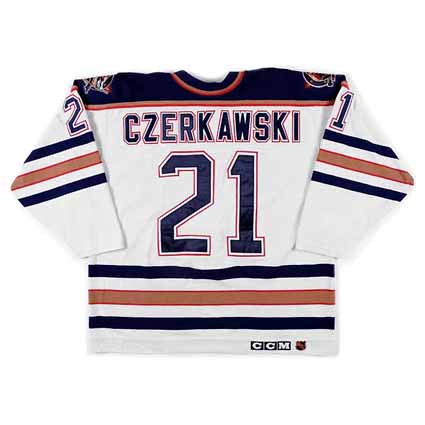
Extra bonus jersey: Today's extra bonus jersey is a 1996-97 Edmonton Oilers Mariusz Czerkawski jersey. Czerkawski joined the Oilers in 1995-96 for their final season in their blue and orange classic jerseys worn during the era when they won five Stanley Cups. For Czerkawski's second season in Edmonton, the club debuted this new, more mature look, with the blue now several shades darker and the bright orange replaced by bronze with the addition of subtle red trim.

This style lasted from 1996-97 through 2006-07. The jersey style was replaced by a new Reebok Edge jersey in 2007-08 but the midnight blue and bronze color scheme remained until 2011-12 when the transformation back to their original look was completed in 2012-13 when the midnight blue jersey, which had been reduced to third jersey status for 2011-12, was retired.

Edmonton Oilers 1996-97 F jersey
Edmonton Oilers 1996-97 B jersey

Today's video section is a package of Czerkawski highlights while he was with the Islanders set to some raucous music. We're calling this one volume optional.

Wednesday, April 12, 2017

The Hartford Whalers Only Playoff Series Victory - 1985-86 Hartford Whalers Kevin Dineen Jersey

From the time the WHA's New England Whalers entered the NHL, only now known as the Hartford Whalers at the insistence of the Boston Bruins, they had only qualified for the postseason one time, that coming in their first season of NHL play in 1979-80.

Their reward for making the playoffs was a matchup against the powerful Montreal Canadiens, who finished 34 points ahead of the Whalers in the standings, who then delivered a sound thrashing to the NHL newcomers in Games 1 and 2 in Montreal by scores of 6-1 and 8-4 before eliminating Hartford on their home ice 4-3 at 29 seconds of overtime.

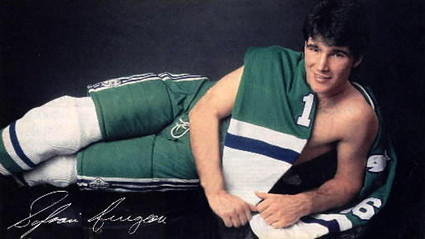
The Whalers point totals dropped from 73 in 1979-80 down to 60 for two seasons before dropping further to 45. That tied Hartford for the fewest points and earned them the second overall pick in the 1983 NHL Draft, where the Whalers selected Sylvain Turgeon ahead of future Hall of Famers Pat Lafontaine, Steve Yzerman and Cam Neely and 1984 Calder Cup and Vezina Trophy winner goaltender Tom Barrasso.

Turgeon Sylvain Whalers
Sylvain Turgeon

The Whalers did rise in points from 66 and then to 69 in 1984-85, but continued their streak of missing the playoffs, which now extended to five consecutive seasons.

In 1985-86, the Whalers were showing signs of continued competitiveness thanks to additions of additions to the roster such as Ray Ferraro and Kevin Dineen to compliment Turgeon and now veteran Ron Francis, who all finished in the top four in team scoring at season's end, with Turgeon leading the way with 45 goals and 70 points, followed by Ferraro and Francis at 77 each and the hard-nosed Dineen's 68.

Francis Whalers, Francis Whalers
Ron Francis

The goaltending was anchored by Mike Liut while the defense boasted Ulf Samuelsson, Joel Quenneville, rookie Dana Murzyn and midseason additions Dave Babych, his brother and winger Wayne Babych and veteran center Doug Jarvis.

Liut Whalers, Liut Whalers
Mike Liut

The Whalers played respectable hockey through the last three months of 1985, avoiding any long losing streaks, but unable to string together an extended winning streak either. As the calendar changed to 1986 the Whalers won five consecutive games, kicked off by an 11-6 defeat of the Quebec Nordiques, only to give it all back and more with seven losses in a row during a ten game winless streak.

They finished strong however, going 8-1-2 over their final 11 games to finish the season with their first winning record as a member of the NHL at 40-36-4 for 84 points, 4 better than the Buffalo Sabres and good for fourth place in the Adams Division and their first spot in the playoffs since 1980.

1985-86 Hartford Whalers team, 1985-86 Hartford Whalers team
The 1985-86 Hartford Whalers

The format of the day called for the first four teams in each division to qualify for the postseason, with the first two rounds of the playoffs coming within their own division. By virtue of their fourth place finish, the Whalers drew the division winners, the Quebec Nordiques, whose 43-31-6 mark earned them 92 points, ahead of Montreal's 87 and the Bruins' 86 in a tight race.

The Nordiques were not the doormats they would become in the early 1990's, having made it to the semifinals the year before and had now posted three consecutive 90 point seasons thanks to a roster which featured the high scoring Peter Stastny (122 points, good for 6th in the league), Michel Goulet, Anton Stastny and the tough Dale Hunter.

The opening round was a Best of Five format and opened in Quebec City on April 9th. Anton Stastny of the Nordiques drew first blood with a power play goal at 2:44, but the Whalers evened the score within the final minute of the first period. The teams traded goals in the third period before Turgeon won it for Hartford 2:36 into overtime, sending 14,500 Nordiques fans home disappointed.

Game 2 was the next night and Hartford scored first at 3:53 and added a second goal at 8:51 of the first. Their lead was extended to three at 8:22 of the second before the Nordiques, who were badly outshot in the first two periods 26-14, showed some signs of life with a goal at 1:39 of the third, only to have the Whalers squash any hope of a comeback with a fourth goal at 16:32 to take a 2-0 lead in games heading back home to Hartford.

That third game at the Hartford Civic Center took place on this date in 1986 and was a wild affair on several levels, as 21 penalties and six goals occurred in just the first period alone!

Dineen got his first goal of the series at 2:29 on a power play and Dave Tippett's shorthanded goal at 5:22 made it 2-0 for the Whalers. Quebec responded at 8:40 on a power play before the teams traded goals in the 16th minute just 46 seconds apart, first by Francis of the Whalers at 15:06 which was followed by a shorthanded goal for Quebec at 15:52. Ferraro extended the Hartford lead to 4-2 with another power play goal, this one coming late at 19:20.

Dineen Whalers, Dineen Whalers
Kevin Dineen

The second period was more of the same, with nine more penalties and four more goals, the first by Samuelsson at 2:07 followed by a string of power play goals, the first by Hunter of the Nordiques at 11:06. Ferraro and John Anderson of Hartford then extended the Whalers lead with goals at 13:08 and 13:34, both with the man advantage to make the score 7-3 in favor of the home team after two periods of play.

That lead was added to when Anderson got his second at exactly 7:00. Although Quebec scored at 13:08, it was too little too late, a point driven home by Dineen with his second of the game at 18:23 to make the final score 9-4 in favor of Hartford and giving them a three game upset sweep of the Nordiques, which would turn out to be not only the first playoff series victory in the history of the Whalers, but their only series win in their history, as they were defeated in the next round by Montreal in Game 7 at 5:55 of overtime.

The following season the Whalers would win the Adams Division title with a franchise best 93 point season, only to have the Nordiques return the favor and upset the Whalers 4 games to 2.

Over the course of the next five seasons the Whalers would qualify for the playoffs each time, thanks in part to the now dreadful Nordiques, whose futility assured that the Whalers would qualify for the playoffs each season, only to see Hartford eliminated immediately in the first round every time.

The Nordiques finally improved thanks to their annual first overall draft picks and it was now the Whalers on the outside looking in, as they failed to qualify for the playoffs in 1993, the final year of the Adams Division.

The realignment of the NHL, which placed Hartford in the new Northeast Division with not only old rivals Montreal, Boston, Buffalo and Quebec, but the addition of the 1991 and 1992 Stanley Cup champion Pittsburgh Penguins did the Whalers postseason chances no favors, and they failed to make the playoffs for their final four seasons in Hartford before relocating to North Carolina, leaving their victory over the Nordiques on this date in 1986 as their one and only playoff series victory.

Whalers Banners, Whalers Banners
The Hartford Whalers banners

Today's featured jersey is a 1985-86 Hartford Whalers Kevin Dineen jersey. Upon entering the NHL, the Whalers debuted their new "Whale Tail" logo, which obviously featured a "W" for Whalers, but also contained an "H" hidden in the negative space of the logo to represent their change in name to Hartford.

This new style would be worn from 1979-80 until 1991-92, with only minor changes to the sleeve striping angles, the removal of the Pucky the Whale shoulder patches in 1985-86 and the removal of the green waist stripe. The team would then switch from green to blue jerseys in 1992-93, a jersey set which would never see action in the playoffs.

Hartford Whalers 85-86 jersey, Hartford Whalers 85-86 jersey
Photo courtesy of Classic Auctions

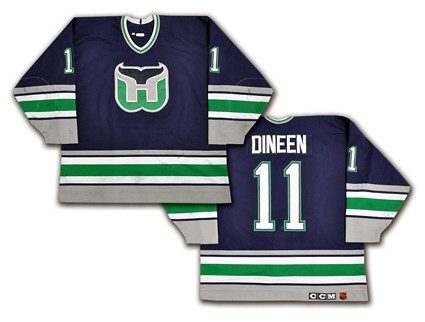
Bonus jersey: Today's bonus jersey is a 1996-97 Hartford Whalers Kevin Dineen jersey. After playing in green jerseys for 20 years, dating back to their inaugural 1972-73 season in the WHA, the Whalers drastically altered their look for the 1992-93 season. Navy blue became their primary jersey color with silver now added to the look, which appeared on the jerseys in an even greater amount than their former trademark green.

This classy new look was worn by the Whalers for their final five seasons in Hartford, but the team never qualified for the postseason during this time period which limited their navy jerseys to exclusive regular season use.

Hartford Whalers 1996-97 jersey
Photo courtesy of Classic Auctions

Today's video section kicks off with the Whalers goal song, Brass Bonanza, also known as the "Whalers Victory March" which was adopted by the Whalers as their theme song during their days in the WHA, and remained so through their years in the NHL.

Gordie Howe was once quoted as saying that he loved to hear it as a visiting player for the Houston Aeros, but hearing it every night with the Whalers "began to drive me nuts."


Finally, the last goal in Whalers history, scored by then team captain Dineen.


hit counter for blogger