History of Jersey 83-93 Banner sm photo History of Jersey 83-93 Banner sm.jpg

Tuesday, March 14, 2017

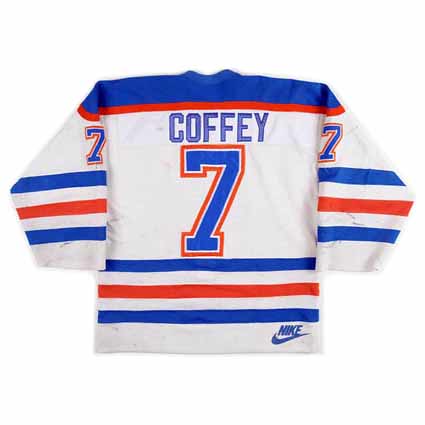
1985-86 Edmonton Oilers Paul Coffey Jersey

On this date in 1986, the Edmonton Oilers hosted the Detroit Red Wings at the Northlands Coliseum. Edmonton carried a league best 49-15-6 record into the game, while Detroit limped toward the finish of the season at a lowly 15-48-6.

Greg Stefan got the start in goal for Detroit, while Andy Moog was the starter for Edmonton.

Before the fans could even settle into their seats, the Red Wings Petr Klima stunned the Oilers with his 26th goal of the season just 34 seconds into the game.

Mark Messier tied the game at 1-1 just over two minutes later when he scored his 29th goal from Glenn Anderson at 2:37.

The game then settled down for a while until Anderson scored his 49th goal from Messier and defenseman Paul Coffey on a power play at 10:45 to give the Oilers the lead at 2-1 before Jari Kurri scored his 58th goal of the season at 13:42 from Wayne Gretzky and Coffey at even strength.
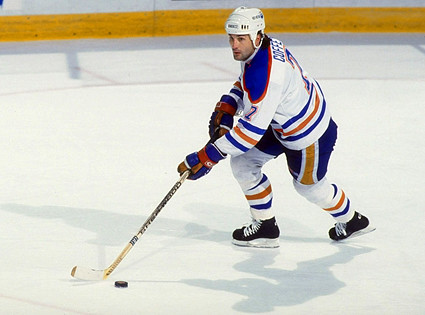
Coffey Oilers 2
Paul Coffey

Detroit attempted to stay close when the rugged Joey Kocur got his 9th goal of the season on a power play from Klima and John Ogrodnick at 15:17 to give the Red Wings hope at 3-2.

Coffey then extended the Oilers lead to two goals again with his 42nd goal from Mark Napier and Lee Fogolin less than a minute later at 16:15. Anderson then reached the 50 goal mark for the second time in his career from Messier and Finn Risto Jalo at 17:50 to make it a demoralizing 5-2 for Edmonton after just the first period.
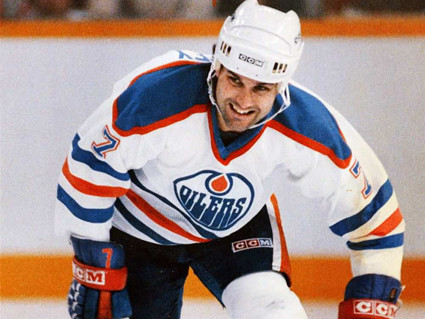
Coffey Oilers 1
Coffey had a goal and two assists in the first period

In the second period, Finland's Esa Tikkanen kept the Oilers rolling with his 4th from Coffey and Kevin McClelland followed by fellow Finn Raimo Summanen's 18th goal from Gretzky and Coffey again at 14:31 which brought a merciful end to Stefan's night in goal for Detroit.

Finally, Coffey struck again at 19:20 with his 43rd goal of the season from Gretzky and Kurri at even strength to give the Oilers a commanding 8-2 lead at the end of the second period of play from 28 shots to Detroit's 21.
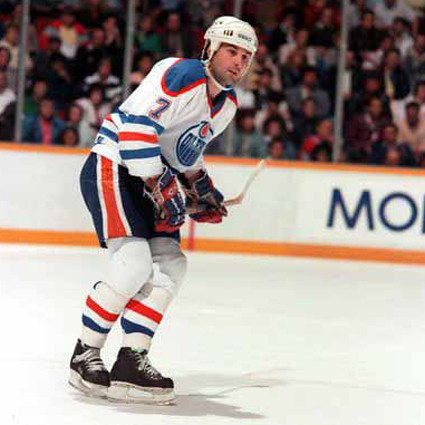
Coffey Oilers 3
Coffey had 2 goals and 4 assists after two periods

The third period was scoreless until Anderson completed a hat trick with 51st goal from Coffey and Messier at 12:44, the Oilers sixth consecutive goal. Warren Young then interrupted the Oilers scoring barrage with is 22nd goal for Detroit at 16:46 from Steve Richmond and goaltender Eddie Mio, who had replaced Red Wings starter Stefan.

The Oilers McCelland restored the Oilers 7 goal lead just 40 second later from Marty McSorley and Charlie Huddy at 17:26 as Edmonton had now reached double digits on the night.

As was often the case in those days of the NHL, the Red Wings frustrations overflowed and a melee broke out at 18:07 when Kocur and McSorely fought for the second time in the period while Harold Snepsts and McCelland joined them with fighting majors and game misconducts of their own.

With all the sticks and gloves picked up, play resumed and Gretzky then scored his only goal of the game, his 49th of the year, from Anderson at 19:03.

Finally, with just 15 seconds to play, Kurri scored his second goal of the game and 59th of the season from Coffey and Gretzky to make the score 12-3. Coffey's assist was his 6th of the game, and when combined with his 2 first period goals, gave him 8 points for the game, tying Tom Bladon's 1977 record for Most Points in a Game by a Defenseman. His 6 assists in a game also tied the record by a defenseman that he shares with four others.

Coffey became just the ninth player in NHL history with 8 points or more in a game, an exclusive club that still only numbers 13 to date.
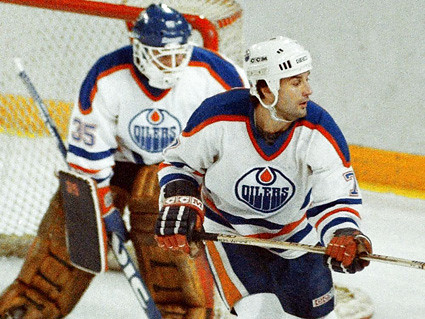
Coffey Oilers 4
Andy Moog and Coffey

Having joined Edmonton in 1980-81, scoring a mere 9 goals and 32 points, Coffey played seven seasons with the Oilers, highlighted by his 1985-86 season, during which he scored and NHL record 48 goals and 90 assists for 138 points, including his record tying 8 point game on this date in 1986.

His 138 points were one short of Bobby Orr's 139 in 1970-71. Between the two of them, Coffey and Orr, hold every one of the top ten highest scoring seasons by a defenseman in NHL history, five for Orr and five for Coffey, and Coffey holds second place in career scoring among defensemen with 1,531, behind only Ray Bourque's 1,579.

During his seven seasons with the Oilers, Coffey won two Norris Trophies and three Stanley Cups.
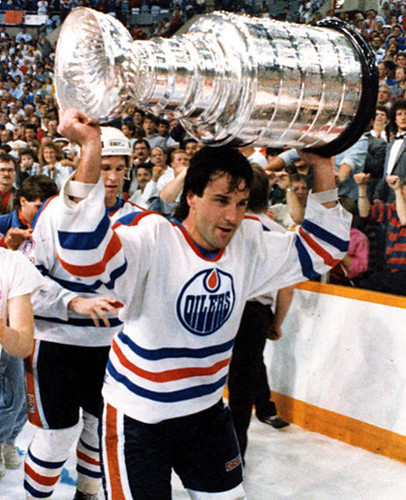
Coffey Oilers 5
Coffey won three Stanley Cups with the Oilers

Today's featured jersey is a 1985-86 Edmonton Oilers Paul Coffey jersey as worn during his record setting game during which he scored 8 total points.

The Oilers reworked their jerseys from their final season in the World Hockey Association where they originated when they joined the NHL in 1979-80. Gone was the low contrast blue lettering against an orange background on their logo in favor of a cleaner, more professional looking and higher contrast blue against a white background, a long overdue change. The same can be said for their road blue jerseys, as the orange lettering on a white background was dropped in favor or the same blue on white coloring of the logo used on the home white jerseys.
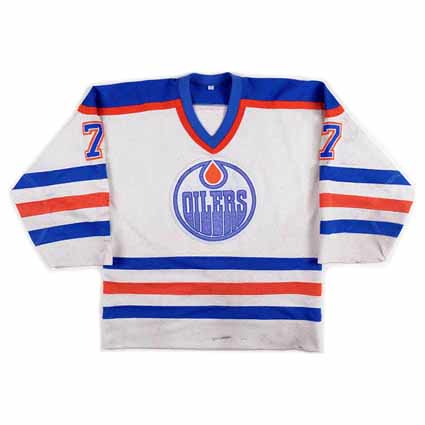
Edmonton Oilers 1985-86 F jersey
Edmonton Oilers 1985-86 B jersey

In today's video section, Coffey ties and then breaks Orr's single season goal scoring record by a defenseman, also during the 1985-86 season.


Monday, March 13, 2017

1978-79 New England Whalers Blaine Stoughton Jersey

Blaine Stoughton, born on this date in 1953, began his road to the professional hockey ranks with four seasons with the Flin Flon Bombers of the WCHL, with the first being the 1969-70 season. His point totals his first two seasons were 39 and then 50, before a giant leap upward for the 1971-72 season when he scored more goals than he had points the previous season with 60 goals and 126 points to lead the WCHL in scoring. He also added an additional 121 penalty minutes to go along with his offensive output. The following season he came close to matching his previous year with 58 goals and 118 points.

Having been born at the right time, Stoughton was turning pro during the NHL vs WHA war for players, which led to an enormous increase in salaries for the players. Stoughton was thus drafted 14th overall by the Quebec Nordiques of the WHA and 7th overall by the NHL's Pittsburgh Penguins.

PIttsburgh won out for the rights to sign Stoughton and he was assigned to their minor league club in the AHL, the Hershey Bears, with whom he scored 40 points in 47 games before a call-up to the Penguins for 34 games.

Just prior to the start of the 1974-75 season, Stoughton was traded to the Toronto Maple Leafs in a deal which sent Rick Kehoe to Pittsburgh. In 78 games with Toronto, he scored 23 goals and 37 points. Despite the 20 goal season, he split time in 1975-76 between Toronto (43 games, 17 points) and the Oklahoma City Blazers of the Central Hockey League (30 games, 36 points).

Stoughton Maple Leafs photo StoughtonMapleLeafs.jpg

For the 1976-77 season, Stoughton jumped to the WHA's Cincinnati Stingers, who had obtained his rights from the Nordiques in the WHA expansion draft. The move to the free wheeling WHA was a revelation for Stoughton, who teamed with Rick Dudley and Rich Leduc to form the high powered "LSD Line".

Stoughton Stingers photo StoughtonStingers.jpg

Stoughton and Leduc each had 52 goals to finish fourth in the league, with Leduc's 107 points 7th overall and Stoughton's 102 good for 9th, while Dudley reached 88. Despite their success, the line would not stay together long, as 30 games into the 1977-78 season, Stoughton and Gilles Marotte were traded to the Indianapolis Racers after Stoughton did not fit into new head coach Jacques Demers system.

The change to Indianapolis was brief, as Stoughton finished out the season with the Racers, scoring just 13 goals in 47 games, and after playing the first 25 games of the 1978-79 season, the Racers , who were on the verge of folding, was sold to the New England Whalers where he finished out what would prove to be the final days of the WHA as well.

For the 1979-80 season, the Whalers were part of a complex deal which saw four surviving WHA clubs enter the NHL and Stoughton's rights revert back to Toronto, only to be claimed by the newly renamed Hartford Whalers in the subsequent Expansion Draft.

 photo StoughtonWhalers.jpg

Stoughton thrived during his first season back in the NHL, finishing eighth in scoring with 100 points while leading the league with 56 goals, becoming only the second player after Bobby Hull to score 50 goals in both the WHA and the NHL. The Whalers even made the NHL playoffs that season, only to have Stoughton break his leg during their opening game against the Montreal Canadiens. It would also be the last playoff game of his career, as the Whalers would not qualify for the playoffs for another six seasons.

He returned to play 71 games of the 1980-81 season after ending a contract holdout, scoring 43 goals and 73 points. He again reached the 50 goals mark in 1981-82 with 52, which placed him 6th in the league and allowed him to lead the team in scoring for the only time with 91 points. He also made his only NHL All-Star Game appearance that season.

After his fourth consecutive 40 goal season, scoring 45 in 1982-83, Stoughton played his final 54 games with the Whalers in 1983-84 prior to being traded to the New York Rangers as the Whalers then all-time franchise goals leader in late February of 1984.

Stoughton Whalers photo StoughtonWhalerslongpants.jpg
Stoughton during the 1982-83 season wearing
the controversial long hockey pants

His 5 goals for the Rangers in 14 games would be the last of his NHL career, as he spent the 1984-85 season with the New Haven Nighthawks of the American Hockey League when he did not make the Rangers roster in training camp and no other teams claimed him.

After two seasons away from pro hockey, Stoughton would play one final stint as a pro, with 15 games of the 1987-88 season with HC Asiago of the Italian Serie A.

Stoughton would play 526 NHL games, scoring 258 goals and 449 points, as well as an additional 89 goals and 179 points in the WHA for a total of 628 points.

Today's featured jersey is a 1978-79 New England Whalers Blaine Stoughton jersey as worn during the Whalers final season in the WHA prior to the league's demise and it's entry into the NHL for 1979-80 season.

After their first two seasons wearing green and white and a circular crest on their road jerseys, the Whalers added gold trim to their color scheme and simplified the crest on their jerseys to just the "W" bisected with a harpoon for the remainder of their time in the WHA, with only a subtle change to the waist striping for their last two WHA seasons, going from a wide white stripe with gold trim to a "Northwestern" pattern, meaning the gold trim was moved outward from the white waist stripe, allowing the green jersey color to separate the white from the gold.

 photo NewEnglandWhalers1978-79jersey.jpg
photo courtesy of Classic Auctions

Bonus jersey: Today's bonus jersey is a 1979-80 Hartford Whalers Blaine Stoughton jersey. When the club was forced to change it's name from "New England" to "Hartford" at the request of the Boston Bruins, the Whalers adopted a new whale tail logo, altered their color scheme from green and gold to green and blue and unveiled an entirely new set of modernized jerseys that they would wear for the next 13 seasons with only minor detail changes, although the "Pucky the Whale" patches were discontinued in 1985-86.

 photo HartfordWhalers1979-80Fjersey.jpg
Hartford Whalers 1979-80 jersey photo HartfordWhalers1979-80Bjersey.jpg

Extra bonus jersey: Today's extra bonus jersey is a 1976-77 Cincinnati Stingers Blaine Stoughton jersey. The Stingers wore essentially the same jerseys for their all-to-brief four year run. With the Stingers name lending itself to a multi-stripe theme, it's a wonder the Stingers jerseys were as reserved as they were.

The Stingers logo is a wonderful piece of graphic design and looks as modern today as it did when it was first conceived, and has always been a favorite of ours.

Cincinnati Stingers 1976-77 jersey photo CincinnatiStingers1976-77Fjersey.jpg
Cincinnati Stingers 1976-77 jersey photo CincinnatiStingers1976-77Bjersey.jpg

Today's video section begins with Stoughton discussing his time with the Whalers.


Next, a feature on the cocky and confident Stoughton showing him and his mustache in the Whalers training camp.

Sunday, March 12, 2017

The Scandal of Geneva - West Germany Forfeits at the 1961 World Championships

Today is a story of controversy in 1961 when East Germany and West Germany were to meet during the 1961 World Championships in Switzerland by Martin Merk from IIHF.com.

*****

The fall of the Berlin Wall and the reunification of Germany in 1990 belong among  the most important and far-reaching moments in international history. Prior to that, East and West Germany had a fierce rivalry, a rivalry that sometimes manifested itself in ice hockey. It even led to a cancelled IIHF World Championship game in Geneva 50 years ago.

It was a flag, just a flag that created an uproar – and what later became known as “The scandal of Geneva” in Germany.

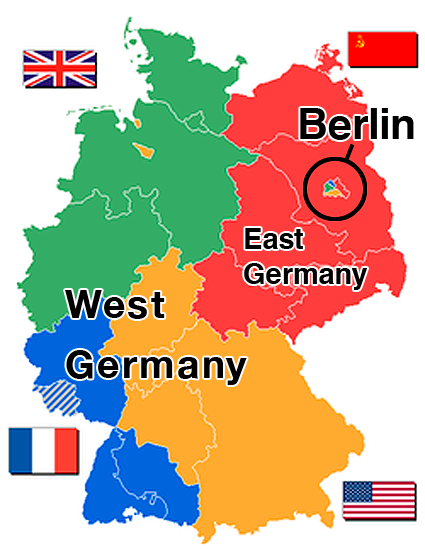
After World War II the west part of Germany (as well as a part of Berlin) was occupied by the Western Allies and became the Federal Republic of Germany (usually known as “West Germany”) in 1948. The Soviet-occupied east reacted with the founding of a socialist state, the German Democratic Republic (“East Germany”, or “DDR” in German).

West Germany, the green, blue and gold areas controlled by Great Britain, France and the United States, and East Germany, the red area, which was controlled by the Soviet Union

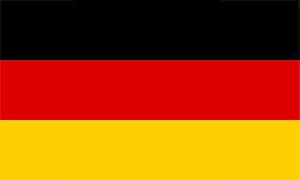
Both countries used the same flag as we know it today, the black, red and gold tricolour.

West Germany Flag
The German tricolor, originally used by both West and East Germany

In 1959, however, the GDR decided to change its flag by adding its coat of arms featuring a hammer and a compass surrounded by a garland of corn symbolizing the workers’ and farmers’ state.

 East Germany Flag photo EastGermanyFlag.png
The flag of the German Democratic Republic,
otherwise known as East Germany

The change of the flag became a touchy issue in the West. It was seen as an insult to the German people and as a clear attempt to permanently divide Germany. Consequently, West Germany banned the flag. It even became chargeable to display it within their territories.

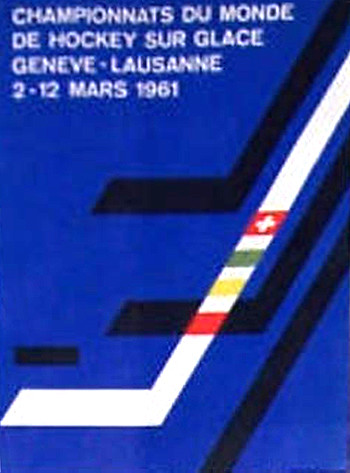
The flag war eventually affected the national teams of East and West Germany. The first time they were supposed to meet each other in an official ice hockey game after the East’s flag makeover was at the 1961 IIHF World Championship in Geneva and Lausanne, Switzerland.

1961 World Championships logo

It was an eight-team round-robin tournament in those days and the two German teams were set to face each other on the last day. Both teams were already out of the medal ranks with East Germany having a 1W-0T-5L record while West Germany stood at 0W-2T-4L.

More than 2,000 fans gathered in the Les Vernets rink to witness the fierce rivalry between the two Germanys, between West and East, capitalists and communists.

Former East German national team player Achim Ziesche recalls the event that unfolded while his team was preparing for the game.

“We were getting ready in the locker room, but we noticed that something was not okay,” he told Deutschlandfunk. “People were running around and they looked sort of helpless. We players didn’t understand what happened, but later we realized that we hadn’t seen anybody from the West German side.”

Some minutes later, the public announcer declared that West Germany refused to play and the game would count as a forfeit and a 5-0 victory for East Germany.

“We were surprised. They were the favourites and we assumed they wouldn’t do that,” Ziesche said. “Not as a team, not as a country and not towards the IIHF and the sporting world.”

The organizers put together a “Swiss selection” so that at least an exhibition game could be staged with East Germany.

The reason for West Germany’s refusal was an order from the government. The President of West Germany’s ice hockey association, Willi Daume, was demanding a guarantee that the East German flag wouldn’t be raised after that game. Otherwise his team would not be allowed to play.

Already in those days the post-game protocol saw the flag of the winning team to be raised, accompanied by the national anthem of the winners. Although the West German team was usually considered as the stronger of the two, Daume didn’t want to take any chances.

A loss to the GDR would be embarrassing, but then he would also lose face in front of his entire nation by hearing the East German anthem while also the outlawed flag were to be raised. So the hockey president drove to Geneva to negotiate with IIHF President, Bunny Ahearne, to change the ceremony protocol regardless of who wins: no anthem, no flags.

Ahearne said no. The ceremony was not be adjusted according to the wishes of some nations.

Daume told the team in the dressing room that they wouldn’t be allowed to play. His players left through the back entrance.

“Our officials were used as a political pawn,” West German national team player Ernst Trautwein recalls. “Thanks God it was the only time I can remember that politicians from our side intervened like this.”

The mix of sports and politics continued each time the teams would meet. East Germany was ahead in 1961 and most time of the ‘60s in ice hockey. This situation changed in the ‘70s when hockey became more professional in West Germany while the East German authorities decided to cut their top league to only two professional teams, Dynamo Berlin and Dynamo Weisswasser. These teams formed the world’s smallest hockey league from 1970 to 1990, and the situation didn’t help the national team.

Only once in the ‘60s did the West Germans display superiority over their brethren. At the 1963 IIHF World Championship in Stockholm, Sweden, the first time both teams were in the A-Pool after the Geneva scandal, the teams finally battled on and not off the ice.

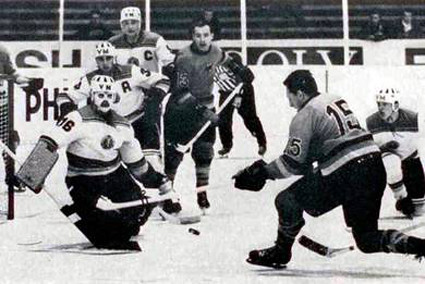
West Germany v East Germany 1963
After the controversy in 1961, the two sides met in 1963, the only time the West Germans would defeat the East Germans at the World Championships during the 1960s

East Germany finished one place ahead of the West, but the West won the head-to-head German clash, 4-3. During the post-game ceremony, the East German players ostentatiously turned their backs towards the West German flag.

East Germany West Germany 1968 photo EastGermanyWestGermany1968.jpg
East Germany in their only Olympic meeting against West Germany in 1968

It took some decades of political division and rivalry until East Germany had its revolution and Germany became unified again in 1991.

*****

Today's first featured jersey is a 1989 East Germany Torsten Hanusch jersey as worn during the 1989 World Championships B Pool. This jersey was worn in the 1989 World Championships B Pool, Hanusch's only appearance for the East German National Team.

While the East Germans competed in the World Championships on a regular basis from 1956 to 1990, they discontinued their Olympic hockey program after 1968, choosing to take the approach of funding single athletes who could win multiple medals, such as a track and field athlete, swimmers and speed skaters, rather than funding an entire team who could only hope to win a single medal, such as water polo or in ice hockey, which frankly was a long shot when up against the likes of the Soviet Union, Czechoslovakia, Sweden and Canada.

This jersey has an extremely minimalist style, with only simple striping on the arms and waist and is devoid of any traditional main cresting, with only the Tackla branding on the upper right chest and the DDR initials and East German coat of arms on the left chest in the style of a soccer jersey, leaving the rest of the body devoid of any traditional main logo.

Also unusual is the East Germans choice of a primarily blue jersey, as the colors of the East German flag were black, gold and red. Additionally, many of the communist ruled nations favored primarily red sweaters, the Soviet Union and Czechoslovakia in particular.

East Germany 1989 jersey photo EastGermany19898F.jpg
East Germany 1989 jersey photo EastGermany19898B.jpg

Today's second featured jersey is a 1989 West German National Team Udo Keissling jersey from the World Championships held in Stockholm, Sweden. West Germany would finish the Round Robin portion with a 0-5-2 record, but avoid relegation by finishing with a 1-2-0 record and save themselves from the drop with a 2-0 defeat of Poland.

One of the best players in German hockey history, Udo Kiessling set a new record in 1992 with his 5th consecutive Olympic tournament appearance. Kiessling's record shows he played a single game in the NHL, in 1982 on a tryout after his German club team was an early exit from the playoffs, but returned home to play in the World Championships, never to return to the NHL again. But just because a player is not in the NHL, doesn't mean he doesn't exist, as Kiessling would go onto have a 24 year career, ending in 1996 at the age of 40.

He made his first appearance in the Olympics at Innsbruck in 1976, winning a Bronze Medal. In addition to his five Olympics, Kiessling also participated in 15 World Championships and the 1984 Canada Cup, as well as winning six national titles in Germany, where he was named the top player three times.

This beautiful jersey features the vibrant colors of the dye-sublimation process and the arresting graphics of the era with the colors of the tri-color German flag streaking across the chest, as well as the distinctive Tackla diamond logos on the shoulders and drop shadow block font for the numbers. Easily one of our favorite jerseys.

West Germany 1989 jersey photo Germany1989WCF.jpg
West Germany 1989 jersey photo Germany1989WCB.jpg

Today's video section is a look at the fall of the Berlin Wall.


Saturday, March 11, 2017

1996 Finland National Team Raimo Helminen Jersey

After beginning his career in the Ilves Tampere junior system, including making his international debut at the European Junior Championships for Finland in 1982, Raimo Helminen made his debut their senior team in the Finnish SM-liiga for the 1982-83 season with 31 games while he split his time with the junior team that season.

For 1983-84, Helminen, born on this date in 1964, won a silver medal at the World Junior tournament in 1984 and just one month later he made his Olympic debut in Sarajevo, Yugoslavia where the 19 year old appeared in six games, scoring 2 points.

Helminen Ilves photo HelminenIlves83-84.jpg
Helminen with Ilves in 1983-84

Helminen finished third in league scoring for Ilves with 21 goals and a career best 57 points in 36 games in 1984-85 as the club won their first league championship in their history. He then made his debut at the 1985 World Championships where he continued his offensive output with 4 goals and 9 points in 10 games.

Helminen had been drafted by the New York Rangers in 1984 and moved to the NHL for the 1985-86 season, appearing in 66 games, scoring 10 goals and 40 points as a rookie. He was back with the Rangers for the 1986-87 season, but things did not go nearly as well, as he only produced 6 points in 21 games and spent time with New Haven in the AHL before a late season trade saw him sent to the Minnesota North Stars for the final 6 games of the season.

Helminen Rangers photo HelminenRangers.jpg
New York Ranger Raimo Helminen

Before the next season began, Helminen was back on the international stage, playing for Finland in the 1987 Canada Cup tournament. He was back in Tampere with Ilves, racking up 43 points in 31 games, including 20 goals. He also appeared in his second Olympics, scoring 10 points in 7 games as Finland won their first ever medal with a silver in Calgary.

Helminen Finland photo HelminenFinland1988.jpg
Helminen while playing for Finland in the late 1980's
Note the green gloves from Ilves

He gave the NHL another try in 1988-89, this time with the New York Islanders, but his play was hampered by back problems. He would total 24 NHL games that season and another 16 with the Springfield Indians of the AHL, where he averaged a point per game.

For 1989-90, he moved to Malmö IF in the Swedish second division, where he starred with 26 goals and 56 points in 29 games to help Malmö earn a promotion to the Swedish Elitserien for the following season.

Helminen would play the next six seasons for Malmö, which included becoming the first foreign born player to win the Swedish scoring title in 1993, with 42 points in 40 games, and winning a league championship in 1992 and again in 1994, a season during which he scored 20 goals and 54 points in 38 games.

Helminen Malmo photo HelminenMalmo.jpg
Helminen during his time in Sweden with Malmö

During this time period Helminen played in his third and fourth Olympics in 1992 and again 1994, earning a bronze medal as well as playing in the World Championships in 1992 (silver) and 1994 (silver). He was also a member of the first Finnish World Championship winning team in 1995 when the Finns defeated the Swedes in Sweden, triggering joyous celebrations back home in Finland. Helminen contributed 8 points in 8 games on his way to the gold medal.

 photo Helminen1994Olympics.jpg
Helminen skates away from a sprawling American goaltender
Garth Snow during the 1994 Olympics

1996 was also a busy year for him internationally, as he participated in both the World Championships in the spring and then the inaugural World Cup of Hockey that fall prior to returning to Tampere to play for Ilves from 1996-97 onward.

Helminen Ilves photo HelminenIlvescaptain2.jpg
Helminen back with Ilves

He was named Player of the Year in 1998 and named team captain in 1999, a position he would hold through the remainder of his long career. He continued to score at a high pace, reaching 50 points twice and topped 40 five times over the next eight seasons, an impressive feat considering the shorter Finnish season, having never played more than 56 games in any season. During his final season of play in 2007-08, he was the oldest player in the league at 44 years of age.

 photo Helminenretirement.jpg
Helminen during his retirement ceremony

His international career also continued to rack up successes as the Finns were now a nation to be reckoned with. Helminen would play in the 1997 World Championships, the 1998 Olympics (bronze), the 1998 World Championships (silver), the 1999 (silver), 2000 (bronze), 2001 (silver) and 2002 Olympics in Salt Lake City. The 2002 Olympics were Helminen's record sixth Olympic Games.

 photo HelminenFinland1998.jpg
Helminen battles Mats Sundin of Sweden
during the 1998 World Championships

That fall he would play in his 11th and final World Championships to conclude his full international career with one World Championship gold, seven silver (one World Junior, five World Championship and one Olympic) and three bronze medals, two Olympic and one at the World Championship. 

He would continue to play for Ilves until the 2007-08 season before announcing his retirement after 751 games, 161 goal and 420 assists for 581 points in Finland as well as 226 games and 199 points in Sweden's Elitserien and another 117 games and 59 points in the NHL.

Helminen holds the record for the most international games at 331, scoring 52 goals and 207 points, with his 155 assists and 207 points being Finnish career records internationally.

Helminen Finland photo HelminenFinlandmostgames.jpg
Helminen was recognized when he set the
record for most international appearances

His number 41 was retired by Ilves and Helminen was inducted into the IIHF Hall of Fame in 2012.

Helminen Ilves #41 photo Helminen41.jpg
Ilves honored Helminen by retiring his #41

Today's featured jersey is a 1996 Finland National Team Raimo Helminen jersey from the inaugural World Cup of Hockey. This attractive "waving flag" style of jersey marked Nike's entry into being the jersey supplier for the IIHF, which continues to this day. This style was worn through the 1997 World Championships until new styles were debuted for the 1998 Olympics.

Finland 1996 jersey photo Finland1996Fjerseycopy.jpg
Finland 1996 jersey photo Finland1996Bjerseycopy.jpg
photo courtesy of Classic Auctions

Bonus jersey: Today's bonus jersey is a 1987-88 Minnesota North Stars Dave Ganger jersey which was previously worn by Helminen during his six games with the North Stars at the end of the 1986-87 season. During that time period a jersey with so much life remaining it in would generally be reused after simply swapping one player's nameplate for another, giving some jerseys an interesting but sometimes difficult to prove history.

Occasionally, jerseys would also undergo number changes as well, further clouding it's past and requiring nearly forensic examination for evidence of changes in customization to suggest previous wearers.

Minnesota North Stars 1987-88 jersey photo MinnesotaNorthStars1987-88Fjersey.jpg
Minnesota North Stars 1987-88 jersey photo MinnesotaNorthStars1987-88Bjersey.jpg

Here is a look at the career if Helminen followed by an interview with him in Finnish.


Friday, March 10, 2017

1977-78 Cleveland Barons Dennis O'Brien Jersey

Dennis O'Brien played his junior hockey with the St. Catharines Black Hawks in the Ontario Hockey League in 1968-69. The defenseman was then selected by the Minnesota North Stars in the 1969 NHL Amateur Draft in the second round, 14th overall.

He spent the entire 1969-70 season honing his craft with the Iowa Stars of the Central Hockey League, the only season that edition of the Stars would exist. While with Iowa, he was credited with 20 points from 2 goals and 18 assists in 72 games while amassing a league leading 331 penalty minutes, 73 more than the notorious Andre "Moose" Dupont.

During the following season of 1970-71, O'Brien split time between the minor league Cleveland Barons of the American Hockey League and made his NHL debut with the North Stars of the NHL. He played exactly 27 games with each team and scored his first NHL goal on his way to a total of three for the season. When the North Stars qualified for the playoffs, O'Brien got his first taste of postseason play with nine games for the North Stars.

O'Brien North Stars
O'Brien during his early days with the North Stars

Now established as a genuine NHLer, O'Brien would play six full seasons on the Minnesota blueline. His stay at home, hard hitting defensive style would not earn him many points, but it would make him a steady, reliable member of the North Stars defensive corps. In five of his six seasons in Minnesota, O'Brien would play at least 70 games five times with a high of six goals and 24 points in 1976-77.

O'Brien North Stars
O'Brien during the 1976-77 season,
wearing the next generation of North Stars jersey

O'Brien would begin his eighth season with the North Stars in 1977-78 but after 13 games he was claimed on waivers by the Colorado Rockies on December 2, 1977. He would see action in 16 games for the Rockies before being traded to the Cleveland Barons on January 12, 1978. He would log 23 games in Cleveland prior to again being placed on waivers. Then on this date in 1978, O'Brien became the first player in NHL history to be with four different NHL teams in one season when he was claimed by the Boston Bruins!

O'Brien Barons photo Dennis Obrien Barons.jpg
O"Brien during his brief time in Cleveland

Once with Boston his situation was again settled, as there was still enough time to play in the Bruins final 16 games of the regular season and contribute to the Bruins playoff effort, as Boston made it all the way to the 1978 Stanley Cup Finals.

After all the movement from team to team to team to team the previous season, O'Brien must have been relieved to play the entire 1978-79 season with the Bruins, save for a pair of games with the Rochester Americans in the AHL.


 photo OBrien Bruins_1.jpg
O'Brien found a measure of stability in Boston

O'Brien briefly laced up his skates for one final season in 1979-80 with three games with the Bruins and six games with the Binghamton Dusters in the AHL before retiring.

His final stats were 592 games played, scoring 13 goals and 91 assists for 122 points and 1,017 penalty minutes, with his highest being 187 in 1975-76.

Today's featured jersey is a 1977-78 Cleveland Barons Dennis O'Brien jersey as worn during his record setting season during which he became the first player to play for four different NHL teams in a single season. To date, only one other player has equalled that amount, Dave McLlwain in 1992, who coincidentally joined his fourth team on the same date of March 10th.

The Barons only existed for two seasons, yet there are detail differences between the jerseys used both years. This particular jersey does not have the state of Ohio shaped sleeve patches, which contained the arm numbers during the Barons first season. Additionally, the sleeve numbers were relocated to the red shoulder areas for their second and final season. Also, the sans-serif font for the player names was changed to a serifed font as seen on today's featured jersey.

Cleveland Barons 77-78 jersey
photo courtesy of Classic Auctions

Bonus jersey: Today's bonus jersey is a 1970-71 Minnesota North Stars Dennis O'Brien jersey as worn during his rookie season in the NHL. The North Stars wore this particular style from the start of their second season of 1968-69 through 1971-72 and always without names on the back.

Minnesota North Stars 1978-79 jersey
photo courtesy of Classic Auctions

Today's video clip is a pretty intense fight between the Cleveland Barons and the Boston Bruins, two of the clubs O'Brien played for in 1977-78.

Thursday, March 9, 2017

The 2017 Minnesota State High School Boy's Hockey Tournament

The 2017 Minnesota State Boys' Hockey Tournament continues today with the start of the Class AA tournament following yesterday's Class A Quarterfinals. Class AA consists of the top 64 schools by enrollment in the state and Class A is for the remaining schools. In terms of enrollment, Class AA is roughly for schools with 1,200 students or more, with the largest of the Twin Cities suburban schools reaching enrollments of 3,000.

Often compared to the Indiana State Boys' Basketball Tournament or the Texas and Florida State Football Tournaments as the most important nationally for their sport, the Minnesota State Boys' Hockey Tournament is a four day festival of excitement, color and sound as the parents, relatives, fans, cheerleaders (on skates!) and bands from 16 schools all travel to the state capital of St. Paul to cheer on their teams as they compete on the ice at the home of the Minnesota Wild, the Xcel Energy Center, in front of sellout crowds of up to 19,500 fans!


Such is the stature of the tournament, that in 2014 KSTC-TV brought in no less a talent than nationally known broadcaster Gary Thorne to handle the television play-by-play duties along side Minnesota hockey legend, Lou Nanne's expert commentary, with last year being Nanne's 53rd year working the state high school tournament.

The tournament began back in 1945 in St. Paul. After a stop at the home of the Minnesota North Stars, the Met Center, for eight years in the 1970's, the tournament returned to St. Paul at the new St. Paul Civic Center, known for it's clear boards, which you can see below in one of today's videos. For nearly 50 years the tournament was played as an eight team, single class tournament, which lent itself to classic David versus Goliath matchups, as the smaller schools from the northern part of the state traveled down to the big city to take on some of the largest schools attendance-wise in the state.

Somewhat controversially, the tournament split into two classes in 1994 based on enrollment. While schools in the smaller enrollment Class A have the option to move up and play in Class AA, the tournament lost something special in the process. Still, it is the largest state sports tournament in the United States in terms of attendance and viewership, as all the championship bracket games are broadcast on local television and 135,618 fans attending in 2015.

Despite the Xcel Energy Center having hosted NHL playoff conference finals, the 2004 NHL All-Star Game and the NCAA Frozen Four twice, with the nearby University of Minnesota winning the title in 2002 and the in-state University of Minnesota Duluth taking home the national championship in St. Paul in 2011, on March 4, 2016 22,244 fans attended the semifinals of the state tournament, setting a new record for the largest crowed to ever attend a hockey game in Minnesota, breaking the record of 21,609, which was also a session of the State High School Tournament in 2015.

Many NHL veterans have participated in the tournament, including Neal Broten, Phil Housley, Reed Larson, John Mayasich, Mike Antonovich, Henry Boucha, Mark Parrish and current NHLers T. J. Oshie of the Washington Capitals, the New York Islanders Brock Nelson and Blake Wheeler, captain of the Winnipeg Jets. Of the 19 Minnesota players taken in the first round of the NHL Entry Draft between 2000 and 2009, 13 of them played in the state tournament.

Housley Packers, Housley Packers
Phil Housley of the South St. Paul Packers

Many rivalries, dynasties, villains and favorites have emerged over the years, with small schools from up north such as Eveleth, Greenway of Coleraine, International Falls and Warroad always being sentimental favorites. Roseau, in particular, has been one of the only small schools (with an enrollment of just 341 compared to 27 Twin Cities schools between 2000-3100 students, and well below the 1,300 cut-off point for Class AA status) to move up to AA and succeed with championships in 1999 and 2007.

Other schools have had their runs, with Eveleth in the late 40's/early 50's, International Falls in the 1960's, Bloomington Jefferson dominating in the early 1990's, but none more so than Edina, with 12 championships, the first coming in 1969, four in the 1970's, three in the 1980's, one in 1997 and most recently in 2010 and back-to-back in 2013 and 2014. All those titles, as well as seemingly annual tournament appearances, put the Hornets at the top of the list of "teams you love to hate", as teams from the tony Minneapolis suburb Edina are considered to be "the rich kids", even sporting green and gold jerseys in the color of money, earning the Hornets the derisive nickname the "Cake Eaters", which they annoyingly wholly embrace!

Edina Champions photo EdinaChampions.jpg
Edina celebrating one of their 12 state titles

Aside from Edina, schools on the outs with the general public are the private schools, such as The Academy of Holy Angels (champions in 2002 and 2005), Hill-Murray (1983, 1991, 2008) and most recently St. Thomas Academy (who played in the smaller Class A, winning championships in 2006, 2008, 2011, 2012 and 2013 until moving up to Class AA in 2014).

Those private schools are considered to have the advantage of being able to recruit the best players to attend their schools rather than take what comes their way in the case of the traditional public schools who draw students from their local geographic region. This "class war" is an age old argument between the public and private schools and is only magnified with the arrival of a smaller school from the north, such as when tiny Roseau makes an appearance in St. Paul, and is one of the driving forces behind the ongoing popularity of the tournament, as every great drama must have its villain.

Since its inception, Class A has been a battle between the smaller private schools, with Benilde-St. Margaret's, St. Thomas Academy, Totino-Grace and Breck winning 12 championships and the smaller schools from the northern part of the state now given a chance to compete for a state title, with classic schools like Eveleth and International Falls able to win their first titles since the early 1970's and first time winners like Hermantown, Red Wing and four time Class A champion Warroad flying the flag for the public schools who have captured 13 titles since the two class system was introduced.

The 2012 Class AA tournament was won by Benilde-St. Margaret's, whose players all wore large patches in support of paralyzed teammate Jack Jablonski. Tied at 2-2 with less than a minute remaining in the semifinals, the Red Knights scored the game winning goal with less than 24 seconds remaining. They then stormed to the championship when Grant Besse set twitter ablaze with his five goal performance, three of which were shorthanded(!), as the Red Knights steamrolled Hill-Murray 5-1 to win an emotional championship with all thoughts on Jablonski, who was in attendance to enjoy the storybook victory that will be talked about for years to come.

Benilde, Benilde
Benilde-St. Margaret's players wearing
#13 patches in support of Jack Jablonski

This year's tournament began Wednesday with the quarterfinals in Class A with Monticello-Annandale-Maple Lake (MAML) from 25 miles northwest of the Twin Cities metro area vs #2 Delano from 20 miles west of the metro area, with the MAML pulling off the upset 3-2 win. #3 Mahtomedi from northeast area of the Twin Cities faced Northfield from 20 miles south of the Twin Cities, with the Raiders prevailing 3-1 to advance to face Monticello-Annandale-Maple Lake. Defending champions and #1 ranked Hermantown from just northwest of Duluth, took on Luverne from the far southwest corner of the state, with Hermantown surviving with a 3-2 overtime win. Finally in the nightcap, the only private school in Class A, #5 St. Cloud Cathedral from an hour northwest of the Twin Cities faced #4 ranked East Grand Forks from the northwest corner of the state on the border with North Dakota, with Cathedral Crusaders winning 6-3 to advance to face favored 27-1-1 Hermantown.

Class AA begins today and sees a vastly different looking field than tournament regulars would expect to see. During section playoffs, upsets abounded with many of the top ranked teams falling and falling early, as #1 Benilde-St. Margaret's, #3 Minnetonka, #4 Holy Family Catholic, #5 Blaine, defending champions #7 Lakeville North, seemingly annual participant #11 Edina, #12 Elk River, #13 Duluth East, #14 St. Thomas Academy, #15 Centennial, also virtually annual participant #16 Hill-Murray all failing to make it to St. Paul this year. And of those who did make it to the State Tournament, not one of the field of eight is a private school for only the fourth time since 2000.

In today's first game, #2 St. Thomas Academy (23-4-1), a private school from the Twin Cities takes on Lakeville South (18-9-1) from the southern edge of the metro area. The survivor of that game will face the winner of #3 Moorhead (22-3-3), another school from the northwest part of the state across the Red River from Fargo, North Dakota, and Hill-Murray (19-5-4), a private school from St. Paul and virtually annual state tournament participant.

The upper half of the Class AA bracket that plays in the evening session begins with a rematch of last year's championship game, defending state champions Wayzata (10-17-1) from the west metro area facing the #1 rated Eden Prarie (21-4-2) squad, led by arguably the best player in the state and future University of Minnesota Golden Gopher Casey Mittelstadt, whose decision to return for his senior season of high school hockey and shoot for a state title for his school with his friends rather than leave school to play junior hockey was written up in no less than the New York Times! Despite Wayzata being the only team in the tournament with a losing record, they are battle tested, having played in the toughest conference in the state and had a hellish non-conference schedule to prepare them for today's game. The final game of the day sees the only classic Iron Range school #5 Grand Rapids (20-7-1) from northern Minnesota 3 hours drive from St. Paul facing #4 Maple Grove (22-6) from the northwest Twin Cities suburbs, with the winner facing the team that advances out of the Wayzata vs. Eden Prairie clash.

Eden Prairie has to like the way things have gone so far, as #2 Edina, #3 Stillwater, #4 Holy Family, #5 Centennial, #7 Elk River and #8 Lakeville North, as ranked by the Let's Play Hockey newspaper, all fell in the section playoffs and they then drew the only team with a losing record in the tournament and their #1 ranking allows them to avoid the #2 and #3 tournament seeds until a possible meeting in the championship final.

It's a huge deal to make it "to state" in Minnesota. This past week thousands of fans attended the eight section finals just for right to go to the state tournament, which for the kids involved means staying in a hotel in the big city, playing in an NHL arena with your buddies that you grew up with in front of all your family and friends while having your games televised live throughout the state. Many players have gone on to win national championships in college and even in the NHL, and over and over again when asked for their greatest hockey memory, the answer frequently comes back "playing in the state tournament in high school." Not necessarily winning it, just playing in it.

Once, a hockey writer quoted former three time national champion University of Minnesota and 1980 "Miracle on Ice" USA Olympic coach Herb Brooks as saying that winning a state championship with St. Paul Johnson in 1955 was one of the best moments in his career. Brooks called the writer to inform him that he had been misquoted. He said it was the best moment.

Herb Brooks Johnson 1955, Herb Brooks Johnson 1955
Herb Brooks, back row far right, celebrating with his St. Paul Johnson
teammates after winning the state championship in 1955

Moose, Tigers, Zephyrs, Raiders, Hawks, Cardinals, Crusaders, Green Wave, Cadets, Cougars, Spuds, Pioneers, Trojans, Eagles, Thunderhawks and Crimson.

16 teams, 4 days, 135,000 fans, some seriously bad hair, 16 bands, 2 champions. There's nothing else quite like it!

And just how important has the hockey hair become to the tournament? Last year sports broadcasting powerhouse ESPN sent former Los Angeles Kings head coach and their lead hockey analyst Barry Melrose to do a feature story, not on the hockey games, but the hockey hair, popularized by the All Hockey Hair Team videos posted annually on You Tube since 2011. Ladies and gentlemen, we give you Minneflowta.


Today's featured jersey is a 2005 Warroad Warriors Zach Larson jersey. This jersey was worn by players at Warroad High School from 2001 to half way through the 2008-09 season. Warroad won the Class A championship in 2003 and 2005 wearing jerseys from this set.

Larson defied superstition and wore this jersey during their undefeated (29-0-2) championship season of 2005 and was a teammate to current Washington Capitals and 2014 United States Olympic standout Oshie, who is the all-time leading scorer in Warroad history with 104 goals and 137 assists for 241 points in just 93 games. Oshie led the entire state of Minnesota in 2004-05 with 37 goals and 100 points.

Warroad Warrior T. J. Oshie

Other notable hockey players to come from Warroad include United States Olympian Gigi Marvin, current New York Islander Brock Nelson, Dave Christian, a member of the Miracle on Ice 1980 gold medal winning USA Olympic team, who would go on to play 15 NHL seasons with Winnipeg, Washington, Boston, St. Louis and Chicago, Dave's father Bill Christian and uncle, the late Roger Christian, who won gold medals in the 1960 Olympics, and Boucha, a 1972 silver Olympic medalist who would play for Detroit, Minnesota, Kansas City and Colorado of the NHL. During it's history, no United States Olympic hockey team has ever won a gold medal without having a player on the team from tiny Warroad!

This is a classic looking jersey in the style and colors of the old Boston Bruins jerseys of the mid 70's to the mid 90's and is one of the few remaining schools to use a Native American nickname and imagery, while others such as Grand Rapids, Minneapolis Southwest and Burnsville all discontinued their use. The use of the Warriors name by Warroad High School is approved by the local Ojibwe band of Chippewa Indians who designed the logo used on the Warriors jerseys.

Due to the multiple years of service the jerseys often see, names on the back are seldom, if ever, worn on high school jerseys.

Warroad Warriors 2001-2008 jersey photo WarroadWarriors2001-2008F.jpg
Warroad Warriors 2001-2008 jersey photo WarroadWarriors2001-2008B.jpg

Bonus jersey: Today's bonus jersey is an Anoka Tornadoes jersey. While many schools create brand new logos for their teams, such as Warroad's locally designed logo, many other appropriate logos from various professional and college teams, either directly or slightly modified. Anoka has been using the logo from the NHL's defunct Atlanta Flames for years, resisting the urge to change the flames in the center of the logo to a tornado, saving that for frequent use as their secondary shoulder logo.

2003 state champions Anoka have been home to one NHLer, Steve Alley, who played 105 games for the Birmingham Bulls of the WHA in 1977-78 and 1978-79 and 15 games for the Hartford Whalers divided between 1979-80 and 1980-81.

Anoka High School jersey photo Anoka High School F jersey.jpg
Anoka High School jersey photo Anoka High School B jersey.jpg

Let's see if we can possibly capture the event, spirit and emotion of the tournament with today's video selections, beginning with a look at last year's excitement.


Here's some classic footage from 1984 with St. Paul Johnson defeating Hill-Murray showing the unique clear boards from the St. Paul Civic Center and everyone wearing Cooperalls!


Check out the explosion of joy as Hill-Murray captures the state title in 2008 over Edina.


hit counter for blogger