History of Jersey 83-93 Banner sm photo History of Jersey 83-93 Banner sm.jpg

Tuesday, November 29, 2016

1916-17 Seattle Metropolitans Jack Walker Jersey

Born on this date in 1888, John Phillip "Jack" Walker first played for the Port Arthur Bearcats of the New Ontario Hockey League (NOHL) in the 1907-08 season, scoring 3 goals in 6 games. His offensive output continued to rise, as he scored 8 goals in 12 games of the 1908-09 season following by a jump to 20 goals in 12 games during the 1909-10 season.

The 1910-11 season saw Walker set a career high with 30 goals in a 14 game schedule. Port Arthur then challenged the Ottawa Senators of the National Hockey Association (NHA) for the Stanley Cup in a one game playoff on March 16, 1911. While Walker did manage to score a goal, Ottawa defended their rights to the cup with a 14-4 win.

Walker returned to Port Arthur for the 1911-12 season and scored his final 17 goals for the Bearcats in 13 games played.

For the 1912-13 season, Walker joined the Moncton Victorias of the Maritime Professional Hockey League where he had a fine season, totaling 21 goals in just 15 games. As a preview of what was to follow, Walker also played one game for the Toronto Blueshirts of the NHA.

Walker would move full time to the Blueshirts for the 1913-14 season and finish second on the team and fifth in the league in scoring with 20 goals in 20 games. Toronto would finish the season in first place with a 13-7 record. The Montreal Canadiens would also post a 13-7 record and the two teams would play a two-game, total goals series to determine not only who would be the league champion, but also take possession of the Stanley Cup, which was previously held by the Quebec Bulldogs of the NHA. While Montreal won the first game 2-0, Toronto stormed back with a 6-0 win in Game 2 to take the series and the rights to the Stanley Cup.

1914 Stanley Cup champion Toronto Blueshirts

Three days later, the Blueshirts were back on the ice defending the cup against the Victoria Aristocrats of the Pacific Coast Hockey Association (PCHA) in a best-of-five series held in Toronto. The Blueshirts took Game 1 by a score of 5-2 played under five man NHA rules with Walker contributing a goal for Toronto. Game 2 was a closer affair, played with the PCHA's six man rules that added the Rover to the mix. The game went to overtime tied at 5-5 before Toronto prevailed after 18 minutes of extra time for a two game lead. Toronto then secured the cup with a 2-1 win to sweep the series in three straight. Walker and the other Blueshirts each received a $297 bonus as their share of the gate receipts.

Walker was back with the Blueshirts for the 1914-15 season, during which he scored 12 goals and was credited with 7 assists for 19 total points in 19 games. The Blueshirts finished mid-pack and were obliged to relinquish their hold on the Stanley Cup.

After playing their first four seasons as a three team league, the PCHA added a fourth team for the 1915-16 season, the Seattle Metropolitans. Needing to stock their roster with players for their inaugural season, the Metropolitans targeted the Blueshirts, and convinced Eddie Carpenter, Hap Holmes, Frank Foyston, Cully Wilson and Walker to all move out west to Seattle.

Walker finished second in team scoring and ninth in the league with 13 goals and 19 points in 18 games during his first PCHA season.

The Metropolitans would finish first in the league with a 16-8 record as Walker was third on the team in scoring, contributing 11 goals and 26 points in 24 games. As the league champions, Seattle faced off against the Montreal Canadiens of the NHA for the Stanley Cup in a best-of-five series held in Seattle.

While the Canadiens stormed to a 8-4 win in Game 1, the next three games were all Metropolitans as goaltender Holmes only allowed Montreal a single goal in each of the next three games, while Seattle scored 6, 4 and then a resounding 9 to win the series 3 games to 1 for the second Stanley Cup of Walker's career.

Seattle Metropolitans
The 1917 Stanley Cup champion Seattle Metropolitans

The outbreak of World War I interrupted Walker's hockey career and he only played a single game of the 1917-18 season. He was back full time with the Metropolitans for the 1918-19 season, and scored 9 goals and 15 points in 20 games. Seattle came in second to the Vancouver Millionaires during the regular season, but defeated them in the playoffs 7-5 during a two-game, total goal series. The Metropolitans advanced to once again face off against the Canadiens.

After Seattle dominated Game 1 7-0 under PCHA rules, during which Walker played at the Rover position, Montreal evened the series with a 4-2 win in Game 2. Seattle again dominated under PCHA rules 7-2. Game 4 ended in a 0-0 tie after Holmes of Seattle and Georges Vezina were both perfect after 60 minutes of regulation and 20 minutes of overtime. The fifth game went to Montreal 4-3, but the remainder of the series was cancelled when five Montreal players were hospitalized due to contracting influenza, with the Canadiens "Bad" Joe Hall passing away four days later. Montreal manage George Kennedy informed those in charge that the Canadiens were forfeiting the cup to Seattle, but Pete Muldoon, the manager of the Metropolitans refused to accept in under such circumstances. The engraving on the cup for 1919 reads "Series Not Completed".

1919 Stanely Cup engraving
The 1919 Stanley Cup engraving

Assuming a more defensive role for the Metropolitans, Walker's offensive numbers reflected the change in his focus, and he was limited to 4 goals and 12 points in 22 games of the 1919-20 season. Seattle won the PCHA regular season and playoff, again coming from a 3-0 deficit after Game 1 to win 6-0 in the second game to return to the Stanley Cup Final after a 6-3 win. Seattle traveled east to play the Senators, with the first three game in Ottawa. The Senators won the first two, 3-2 and 3-0, before the Metropolitans took Game 3 by a score of 3-1. The series was then moved to Toronto in search of better ice conditions. Seattle then tied the series at 2 games each with a 5-2 win to force a Game 5, which went to Ottawa 6-1.

 photo Seattle Metropolitans 1919-20.png
The 1920 PCHA champion Seattle Metropolitans

Over the course of the next four seasons, Seattle would participate in the PCHA playoffs three times, losing to Vancouver each time. Walker only managed 6 goals and 10 points in 1920-21 followed by 8 goals and 12 points in 1921-22, but then he had an offensive resurgence, scoring 13 goals and 23 points in 1922-23 followed by 18 goals and 23 points in 1923-24, which proved to be the final season for both the Metropolitans and the PCHA.

 photo Jack Walker Seattle Metropolitains.jpg
Walker played with the Metropolitans for every one of their nine seasons

While Seattle folded, both the Victoria Cougars and the Vancouver Millionaires, now known as the Maroons, both joined the Western Canada Hockey League (WCHL) and Walker signed on with Victoria for the fourth season of WCHL play and contributed 7 goals and 7 assists in 28 games. While the Cougars finished third in the regular season, they defeated the Saskatoon Crescents 6 goals to 4 in the Semifinals and then defeated the Calgary Tigers 3 goals to 1 to earn the right to face the Canadiens for the Stanley Cup in a best-of-five series.

 photo 0bd31f43-5b65-4acb-a0f9-92fa721dc323.png
Walker joined the Victoria Cougars in 1924

Game 1 in Victoria went to the home team 5-2 and they put Montreal on the ropes with a 3-1 win in Vancouver in Game 2. Montreal stayed alive with a 4-2 win in Game 3, again in Victoria before the Cougars became the last team from outside the NHL to win the Stanley Cup, the third of Walker's career, with a decisive 6-1 win in Game 4 to take the series 3 games to 1. During the four games of the Finals, Walker scored 4 goals and 6 points. Adding in the 4 goals he scored during the Cougars 4 WCHL playoff games, Walker had more goals during the 8 postseason games he played, 8, than he did during his WCHL 28 regular season games, 7.

Victoria Cougars
1925 Stanley Cup champion Victoria Cougars

Not only was it Walker's third Stanley Cup, but it was done with his third different team that originated from three different leagues! To this day, Walker remains one of just 11 players to have ever won the Stanley Cup as a member of three different clubs.

The following season of 1925-26 was a virtual repeat, as Walker scored 9 goals and 17 points as Victoria again finished third but won the WCHL playoffs to return to the Stanley Cup Finals against Montreal, only this time it was the Montreal Maroons, not the Canadiens. Montreal had the upper hand however, taking the cup with a 3 games to 1 victory.

 photo 1925-26 Victoria Cougars team.png
The 1925-26 Victoria Cougars

The WCHL, under financial duress, folded at the end of the season. Meanwhile, in the east, the NHL was in the process of expanding further into the United States. For the 1926-27 season, the Chicago Black Hawks, New York Rangers and Detroit Red Wings were added to the league to join the New York Americans, Pittsburgh Pirates and Boston Bruins. Detroit's roster was stocked with the roster of the Victoria Cougars, which explains the Detroit franchise using the Cougars name in recognition of the source of their roster. All of this maneuvering led to Walker moving east to become a member of the Detroit club in now his sixth different league.

 photo 1926-27 Detroit Cougars team.png
The inaugural 1926-27 Detroit Cougars

In 37 games, Walker scored 3 goals and 7 points while focusing on his renowned defensive abilities. He remained with the Cougars, who would later change their name to the Falcons and then settle on the Red Wings, for a second season, playing in 43 games scoring 2 goals and 6 points.

Walker obtained his release from Detroit in order to move back west for the 1928-29 season to join the new Seattle Eskimos franchise that would play in a new league, the Pacific Coast Hockey League, which was coached by the same Muldoon, his old coach with the Metropolitans. In 34 games he scored 5 goals and 13 points. He played two more seasons with the Eskimos, 1929-30 and 1930-31 and led the league in assists despite now being in his 40's.

 photo Walker Eskimos.jpg
Walker on his return to Seattle with the Eskimos

The Eskimos folded after the 1930-31 season, bringing an end to Walker's playing career. He did continue in hockey as a linseman and referee over the next ten years.

While he only played in two NHL seasons, Walker enjoyed a long and successful career in the formative days of professional hockey, which included winning the Stanley Cup on three different occasions, noteworthy since they came with three different teams in three different leagues. In all, Walker played in 364 games in the top level NHA, PCHA, WCHL and NHL, scoring 135 goals and 104 assists for 239 points.

A year before his passing, Walker was inducted into the Hockey Hall of Fame in 1960.

Today's featured jersey is a 1916-17 Seattle Metropolitans Jack Walker jersey. The Metropolitans were the first team based in the United States to win the Stanley Cup. They were founded in 1915 and won five PCHA titles and one Stanley Cup before folding in 1924.

Their distinctive green, white and red barberpole jersey style is a classic from the early days of professional hockey.

 photo Walker Metropolitans.jpg

Bonus jersey: Today's bonus jersey is a 1924-25 Victoria Cougars Jack Walker jersey. The Cougars began life in 1911 original members of the Patrick's PCHL. Two seasons later they adopted the name Aristocrats until 1916. With the outbreak of World War I, their arena was taken over by the Canadian military, which forced a move to Spokane, Washington as the Canaries for a year, after which the club folded.

The franchise was revived in 1918 as the Aristocrats and once again changed their name, this time to the Cougars in 1922 for their final four seasons, during which they became the final team not a member of the NHL to win the Stanley Cup.

Victoria Cougars 24-25 jersey

Today's video section is a look at the history of hockey in Seattle.


Monday, November 28, 2016

The First Goaltender to Score a Goal - 1980-81 New York Islanders Billy Smith Jersey

NHL history was made on this date in 1979, when Rob Ramage of the hapless Colorado Rockies, while on a delayed penalty call, would send the puck back to the point anticipating a Rockies teammate would be stationed there, only to find the point vacated and the puck making the long journey down the length of the ice and right into the Rockies goal and the record books.

Ramage Rockies, Ramage Rockies
Rob Ramage

Since Islanders goaltender Billy Smith was the last Islander to touch the puck, he was the official scorer of the goal, the first one credited to a goaltender in NHL history.

Billy Smith Islanders, Billy Smith Islanders
Billy Smith

Ron Hextall became the first goaltender to legitimately aim for the net and score a goal in the NHL eight years later on December 8, 1987 when he scored against the Boston Bruins, who had pulled goaltender Rejean Lemelin for a sixth attacker who was apparently not in any way a sixth defender.

Ron Hextall Goal, Ron Hextall Goal
Ron Hextall shoots for the far goal

Hextall scored a second goal during the playoffs on April 11, 1989 versus the Washington Capitals, entering the record books as the first goalie to score during the playoffs.

Chris Osgood of the Detroit Red Wings added his name to the list of goaltenders who have scored on March 6, 1996 with a shot the length of the ice in Hartford versus the Whalers.

Osgood Red Wings, Osgood Red Wings
Chris Osgood

April 17, 1997 would see the first of Martin Brodeur's three goals, as he would fire one in against the Montreal Canadiens. Brodeur would be credited with his second goal, despite being about 125 feet from the puck when a mishandled puck by the Philadelphia Flyers found it's way into an unguarded Flyers net on February 15th of 2000. Brodeur's third credited goal would arrive on March 21, 2013 when the Carolina Hurricanes would errantly put the puck into their own net as their goalie Dan Ellis was skating to the bench for an extra attacker. Ellis attempted to intercept the puck, but when he was unable, not only was Brodeur credited with the goal, but it counted against Ellis since he was still technically on the ice at the time, regardless of how far from his crease he was!

Brodeur Devils, Brodeur Devils
Martin Brodeur

Jose Theodore, then of the Montreal Canadiens would score with style on January 2, 2001 with a backhand shot, as he launched the puck the length of the ice on Long Island against New York in the process of shutting out the Islanders, the only goalie to shoot the puck into the goal and record a shutout in the same game.

Jose Theodore Canadiens, Jose Theodore Canadiens
Jose Theodore

Evgeni Nabokov joined the scoring ranks on March 10, 2002 when he fired one in against the Canucks in Vancouver for the sixth goalie to score with a direct shot on goal.

Nabokov Sharks, Nabokov Sharks
The Sharks Evgeni Nabokov

Mike Smith of the Phoenix Coyotes became the seventh and most recent goalie to purposely shoot the puck into the opposing goal when he scored with one tenth of a second remaining against the Detroit Red Wings on October 19, 2013, the first goal by a direct shot in over 11 years.


Mike Smith Coyotes goal photo Mike Smith Coyotes Goal.jpg
Mike Smith celebrates his goal in 2013

Damian Rhodes of the Ottawa Senators (1999), Mika Noronen of the Buffalo Sabres (2004), Chris Mason of the Nashville Predators (2006) and Cam Ward (2011) would all also receive credit for goals of the Billy Smith variety, as the opponents would all misfire in some manner and send pucks down the ice and into their own nets.

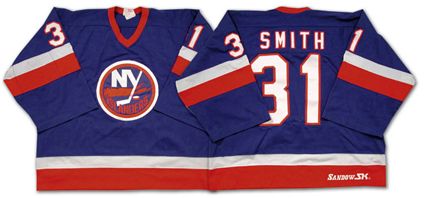
Today's featured jersey is a 1980-81 New York Islanders Billy Smith jersey, the same style he was wearing when he "opened the floodgates" of goalies scoring in the NHL.

In addition to going into the history books as the first goalie to score a goal, Billy Smith did manage to accumulate four Stanley Cups during the early 1980's while backstopping the Islanders dynasty.

This particular style of jersey with the white and orange sleeve stripes was first introduced for the 1978-79 and used through the 1983-84 season before the Islanders changed the specification of the names on the back from two-color to single color white names. The appearance of the "Sandow SK" branding on the rear hem was one of the earliest instances of manufacturer logos appearing on NHL jerseys, which began only the season before and was the first season ever on an Islanders jersey.


photo courtesy of Classic Auctions

Bonus Jersey: Today's bonus jersey is a 1979-80 Colorado Rockies Rob Ramage jersey. Ramage's errant pass led to Billy Smith being credited with the first goal ever scored by a goaltender.

The Rockies wore the same jerseys for their six years in Colorado before moving to New Jersey, with the only notable change being adding names to the backs of their blue road jerseys for their second season of 1977-78.

Colorado Rockies 80-81 jersey, Colorado Rockies 80-81 jersey
photo courtesy of Classic Auctions

Here is the play on which Billy Smith was credited with the first goal ever scored by an NHL goalie.


Here is a wonderful compilation of all the goals scored by goalkeepers in the NHL (up to the time the video was created), several of which are direct shots by the goalies themselves, and not "own goals" on the part of the other team. Be warned, the volume varies quite a bit from clip to clip!


The last video today is a look at the career of Billy Smith from the "Greatest Hockey Legends" series.

Sunday, November 27, 2016

1965-66 Detroit Red Wings Gordie Howe Jersey

Gordie Howe made his NHL debut in 1946, wearing #17 and changed to his iconic #9 at the start of the following season for the purpose of a more preferable sleeping berth on the train while the team was traveling, as the accommodations were more spacious in the lower berths and were allocated based on each players sweater number.

One of the most dominant players in NHL history, Howe would finish in the top five in league scoring for twenty straight seasons.

Teamed with linemates Sid Abel and Ted Lindsay, "The Production Line" would dominate the NHL and lead Detroit to first place in the regular season standings for each of the four seasons they played together from 1948-49 to 1951-52, a span that would include a pair Stanley Cup Championships in 1950 and 1952. So dominant was the line that they finished first, second and third in league scoring in 1949-50, led by Lindsay's 78 points in 69 games.

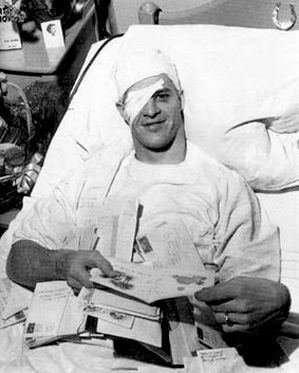
Howe would not be around to lift the Stanley Cup in 1950, having suffered a fractured skull earlier in the playoffs, which required emergency surgery to relieve the pressure.

Howe recovering from his fractured skull in 1950
 
Howe would return to form the following season of 1950-51, scoring 86 points to win the scoring title by 20 points over his nearest competition, the first of seven times he would win the Art Ross Trophy.

Howe would continue throughout the 1950's to accumulate championships and awards, winning the Stanley Cup in 1950, 1952, 1954 and 1955, the Art Ross Trophy as scoring champion from 1951-1954 and 1957, and the Hart Memorial Trophy as the league MVP in 1952, 1953, 1957, 1958 and 1960.

Howe won 4 Stanley Cups in the 1950's

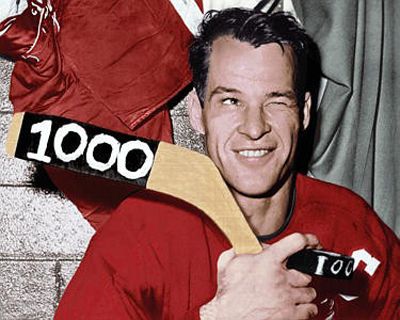
On this date in 1960 that Howe registered an assist in a 2-0 win over the Toronto Maple Leafs to score his 1,000th NHL point, making him the first player in the 44 year history of the league to reach that milestone and he did it in his 938th game. It would be another eight years before Jean Beliveau would become the second and another 20 years before Howe would score his final point, keeping in mind Howe already had 14 years in the league behind him at this point.

Howe celebrates becoming the first player to reach 1,000 points

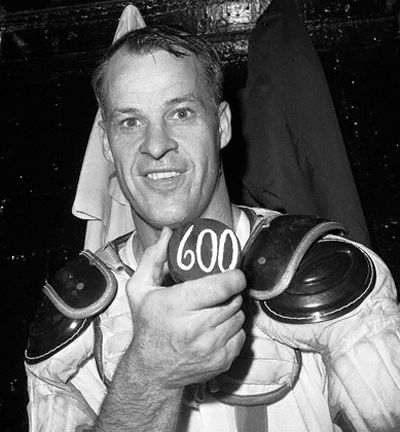
1963 would see Howe capture both the Art Ross and Hart Trophies once more and on this date in 1965, Howe would score his 600th NHL goal in a game versus the Montreal Canadiens, becoming the first player in NHL history to record 600 goals. It would be until 1972 until Bobby Hull would become the second to achieve 600 goals.

Howe celebrates becoming the first player to reach 600 goals

In 1968-69, aided by the recent NHL expansion to 12 teams, which created a longer schedule of games against some admittedly weaker opponents, Howe achieved his one and only 100 point NHL season with 44 goals and 58 assists for 103 points, which included Howe becoming the first player in NHL history to score 1,700 career points when he was credited with a pair of assists in a 5-1 Detroit win over the Los Angeles Kings on this date in 1969. His 1,700 points were achieved in 1,567 games.

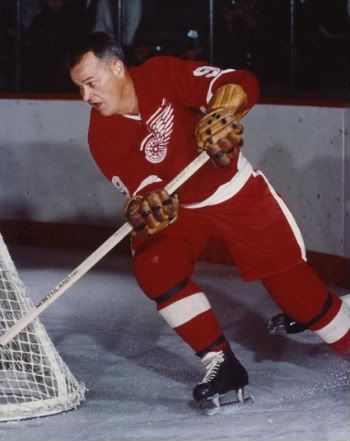
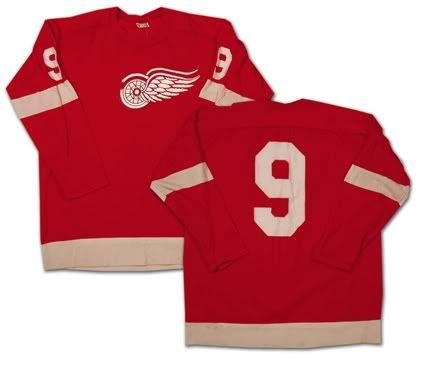
Today's featured jersey is a 1965-66 Detroit Red Wings Gordie Howe jersey from the season Howe scored his 600th NHL goal. When the NHL expanded from six teams to 12, Howe enjoyed an offensive renaissance given the chance to play against the weaker expansion clubs. After four seasons of scoring less than 30 goals, 1967-68 saw him leap up to 39 goals followed by 44 more in 1968-69, tied for his third best season of his professional career, which began in 1946 and lasted all the way to 1980.

While Detroit's red sweater dates back to 1932, the Red Wings did not wear a white sweater until 1934 to wear in games against the Montreal Canadiens. The white sweaters were originally simply a reverse of the red sweaters - all white including white sleeves with red bands around the arms and waist - and did not get its contrasting red sleeves until 1961, making the Red Wings white jerseys, now unchanged for over 50 years old, the "new" one.

 photo DetroitRedWings1968-69jersey.jpg
photo courtesy of Classic Auctions

Bonus jersey: Today's bonus jersey is a 1970-71 Detroit Red Wings Gordie Howe jersey. 1970-71 would be Howe's final season with the Red Wings. This classic style has been used by the Red Wings essentially unchanged since 1932 when the Detroit franchise first adopted the name "Red Wings" after previously being known as the Falcons and the Cougars.

Only detail changes have occurred over the years as this sweater has endured to become a timeless classic.


photo courtesy of Classic Auctions

Today's video is the "Legends of Hockey" profile of Howe.


Here is an unusual find, Howe on the TV game show, "What's My Line?" being questioned by Hogan's Heroes' Colonel Klink Werner Klemperer and Soupy Sales. Howe's legendary toughness is apparent, as he is unfazed at being interrogated by a Nazi prison camp commandant.


Gordie tells Keith Olberman how hockey used to be and to respect your elders.


Saturday, November 26, 2016

1925-26 New York Americans Billy Burch Jersey

On this date in 1925 the New York Americans were accepted into the NHL and would play as tenants of the brand new (and third) Madison Square Garden in New York City.

The club was founded by Thomas Duggan, who had actually been granted three franchises back in 1923, but was required to wait until the completion of construction of Madison Square Garden before the team could take to the ice. The club benefited from the demise of the Tigers in Hamilton, when Duggan's financial backer, mobster "Big Bill" Dwyer, who made his fortune as a prohibition bootlegger, bought the rights to the Tigers players to stock the Americans roster.

Their first game, on October 9, 1925, was against fellow expansion brothers the Pirates in Pittsburgh in a contest won by the Americans 2-1 in overtime. Future Hockey Hall of Famer and team captain Billy Burch scored the first goal in team history at 6:12 of the second period, assisted by veteran Ken Randall. Pittsburgh evened the score at 9:45 on a goal by the great Lionel Conacher, who would play a role in Americans team history later on. The third period went by with no scoring, sending the game into an extra period where defenseman Charlie Langlois won the game for New York with an unassisted, short-handed goal at 3:10 to get the franchise off to a fine start.

After four road games to start the season, the Americans would finally play their first game in their new home, which was not originally designed with the ability to create a sheet of ice.

Madison Square Garden 1925, Madison Square Garden 1925
Madison Square Garden in 1925

Duggan arranged for Madison Square Garden owner Tex Rickard to come to Montreal with Dwyer, who would arrange to properly lubricate Tex with some of his underground liquor production before the Canadiens game he was about to witness. The sight of the sold out arena, combined with the dazzling display put on by Canadiens star Howie Morenz suitably impressed Rickard, who agreed to modify the plans for Madison Square Garden to include ice making capabilities on the condition that Morenz be present for opening game. Thus the first opponent hosted by the Americans was none other than Morenz and the Canadiens, who defeated the home team by a score of 3-1 in front of 17,422 curious New Yorkers who saw Morenz seal the victory for Montreal with their third goal at 4:15 of the third period.

1925 Americans program, 1925 Americans program
A program from the Americans first season

Despite stocking their roster with the players from the first place Tigers club, the team finished fifth out of seven with a 12-20-4 record, led by Burch in scoring with 22 goals, quite nearly one-third of the team's total of 68, and 25 points.

1925-26 New York Americans team, 1925-26 New York Americans team
The 1925-26 New York Americans

Still, despite the placing in the standings, the Americans season overall was deemed such a success at the gate that Rickard obtained his own NHL franchise for the 1926-27 season, which would be nicknamed Tex's Rangers. With the addition of not only a second team in Madison Square Garden, but also Chicago and Detroit joining the league, the NHL was split into two divisions, with the Americans being placed in... the Canadian Division! The extra travel over the border took it's toll on the club and they once more finished out of the playoffs with a 17-25-2 record. Burch again led he club in scoring with 19 goals and 27 points, ten more than Conacher, who was obtained from the cash strapped Pirates.

The Americans sank to last in the Canadian Division in 1927-28 with just 11 wins in the face of 27 losses and 6 ties. To make matters worse, the New York Rangers, owned by their landlord Rickard, won the Stanley Cup in only their second year of existence! From the beginning of the two clubs competing for the same fan base. The Rangers, who were coached by the elegant and respected Lester Patrick, became the team of choice for the upper class of Manhattan while the Americans, perhaps tainted by being associated the jailed bootlegger Dwyer, who was arrested 11 days before the Americans first game and spent the entire first season locked up, were the "working class" team, who somehow failed to capture the imagination of the fanbase in the same manner as the stylish and immediately successful Rangers.

Goaltender Roy Worters was obtained from Pittsburgh to solidify the Americans defense, and the club responded with their first winning record, finishing 19-13-12 for second place in their division and their first playoff berth - against their rival Rangers, who won the two-game, total-goals series 1-0 on a dramatic goal at 29:50 of overtime of the second game. Burch led the club in scoring for the third time in four seasons and Worters was named the Hart Trophy winner as league MVP.

1928-29 New York Americans team, 1928-29 New York Americans team
The 1928-29 New York Americans

The team plunged to fifth place in the 1929-30 season under new head coach Conacher and missed the postseason for what would be the first of six consecutive seasons. Norman Himes, who led the team in scoring in 1928, set a new club records with 28 goals and 50 points, breaking Burch's mark of 36.

Himes again led the club in scoring in 1931-32, although he came back down to Earth with just 24 points. While the Americans finished "fourth" in the Canadian Division, it was due to attrition, as the Ottawa Senators had not competed that season due to financial difficulties, which meant the Americans actually came in last and missed out on the playoffs for the third season in a row. Additionally, the Pirates had by now moved to Philadelphia for a single, dismal 4 win season and closed up shop for good, unable to survive the Great Depression.

The 1932-33 Americans were led in scoring by Himes for the fourth consecutive season as Worters continued to hold down the duties in goal while their won/loss record continued to slip, now down to 15-22-11, a mark essentially duplicated in 1933-34 at 15-23-10. Eddie Burke led the club offensively with 20 goals and 30 points in 46 games. The Americans introduced a second, white sweater for the 1933-34 season, making them only the second team to have two styles following Toronto in 1927. The struggling team attempted a merger at this point with the equally poor Ottawa Senators, which was turned down by the NHL Board of Governors.

 photo Alex Woods Americans.jpg
Goaltender Alex Woods wearing the Americans new white sweater
with the shield crest, worn for just two seasons, 1933-34 and 1934-35

The club had a difficult time in 1934-35 with just 12 wins and their sixth straight, and ninth out of ten seasons of their existence, with no playoffs. Meanwhile, the Rangers not only had yet to have a losing season, made the playoffs in every single one of their now nine seasons and had also delivered a second Stanley Cup by then, which had arrived in 1933.

Another issue for the "Amerks" was Dwyer's inability to recognize the benefits of stability. The club literally had a different head coach every season for their first six seasons, as Tommy Gorman, Newsy Lalonde, Shorty Green, Gorman again, Lionel Conacher and Eddie Gerard all took turns behind the bench until Gerard managed to hold onto the job for two seasons in a row, but only two seasons, as Bullet Joe Simpson then took the helm for three seasons, 1932-33 to 1934-35. Meanwhile, Patrick remained behind the bench for the Rangers' first 13 seasons, and won while doing it, winning 281 games while the Americans would only manged to win 255 during their entire 17 years.

 photo 1935-36 MSG program cover.jpg
A 1935-36 Madison Square Garden program cover, which contained
information on both MSG tenants, the Americans and the Rangers

The world turned upside down in 1935-36, as not only did Sweeney Schriner lead both the Americans and the NHL in scoring, but the Americans finally returned to the postseason guided by new head coach and general manager Red Dutton, while the Rangers missed out on the playoffs for the first time in their history! Oddly enough, the Rangers kept their streak of winning records intact at 19-17-12, while the Americans streak of losing records continued for the fifth straight season but it was enough for the Americans to finish third in the Canadian Division to advance to the postseason. They made the most of the opportunity, and defeated the Chicago Black Hawks 3-0 before staying close enough in a 5-4 loss in Game 2 to win their first ever playoff series 7-5 in total goals. Round 2 went to Toronto, who won the best-of-three 2 games to 1.

Sweeney Schriner, Sweeney Schriner
NHL scoring champion Sweeney Schriner

On the business side of the operation, owner Dwyer, now finding it difficult to pay the bills with the end of prohibition, saw the club taken over by the league. Dwyer was given a second chance, but could not pay off his debts and the league took full control for the 1937-38 season.

After 1936-37, which saw the Americans out of the playoffs once again following a 15-29-4 mark in Worters ninth and final season in goal for the Americans, the club posted only the third winning season in their history when they won 19, lost 18 and tied 11 thanks to Dutton acquiring veterans Ching Johnson and Hap Day.

Ching Johnson 37-38 Americans, Ching Johnson 37-38 Americans
Ching Johnson

Schriener again led the team in scoring with 21 goals and 8 points and the Americans finally got the best of the Rangers, knocking them out of the playoffs in a hard fought Round 1, winning 2-1 in overtime of Game 1, losing 4-3 in Game 2 before winning Game 3 by a score of 3-2 "on the road" at Madison Square Garden in an epic four overtimes in what was then the fourth longest game in league history and arguably the highlight of the Americans franchise history. Despite winning Game 1 of Round 2 versus Chicago, the Black Hawks rebounded with two straight wins to eliminate the Americans.

The Americans qualified for the postseason with a losing record once more at 17-21-10 thanks to the demise of the Montreal Maroons leaving the NHL as one seven team division, with the top six qualifying for the playoffs. Schriner led the team in scoring for the fourth consecutive season with 44 points but a quick exit from the playoffs followed, as they failed to score a goal in either game against the Maple Leafs.

Financial troubles led to Schriner departing for Toronto in exchange for four players. Also of note, the club acquired the great defenseman Eddie Shore late in the season from Boston. The now 37 year old Shore played the final ten games of his career, as well as three playoffs games, as the Americans scrapped their way to a sixth place finish, with their 15-29-4 record surpassing the Canadiens, who won only 10 times. The Americans drew the Detroit Red Wings, who defeated them 2 games to 1 to end Shore's career. Meanwhile, the Rangers captured their third Stanley Cup, while the Americans had yet to win three playoff series.

Eddie Shore Americans, Eddie Shore Americans
Eddie Shore during his brief time with the Americans

The Americans hit bottom in 1940-41 after being forced to sell of their best players in an attempt to stay solvent, coming in a distant last with a dismal 8-29-11 record, the only team to score less than 100 goals and the only to allow more than 147, with 186 against.

Desperate to improve their financial situation, the club changed it's name for the 1941-42 season to the Brooklyn Americans in hopes of connecting with the fans across the East River in Brooklyn despite retaining Madison Square Garden in Manhattan as their home arena due to the lack of a suitable arena in Brooklyn. The team improved record-wise to 16-29-3, but despite scoring 34 more goals while allowing 11 less and improving 8 points in the standings, the Americans finished last in the NHL and missed out on the playoffs once again.

With the arrival of World War II, the Americans were hit harder than most due to their already weak financial position. With many players off to serve in the war, combined with travel restrictions and Dutton's inability to actually relocate the team to Brooklyn, the team suspended operations with the intent of regrouping and coming back after the war. Despite an effort to build a new arena in Brooklyn as a home for the team in 1945, the NHL finally cancelled the franchise formally in 1946. The departure of the Americans from the NHL after the 1941-42 season formally began the "Original 6" era, as no new franchises would begin play until 1967 and metropolitan New York would not have a second team again until 1972 with the arrival of the New York Islanders.

In all, the Americans played 17 seasons, qualifying for the playoffs just five times despite only three winning records in their history.

Today's featured jersey is a 1925-26 New York Americans Billy Burch jersey as worn during the Americans inaugural season. When the Americans took to the ice, it was in their new, star-spangled sweaters, unlike any seen before in the NHL, and we dare say ever since, thanks to it's more than three dozen stars.

The Americans first wore their star spangled sweaters for all games during their first eight seasons, either home or road, before adding a white alternate jersey in 1933. They would wear both jerseys through the 1937-38 season, which was the last for the original stars and stripes jersey. For their final four seasons, only the white jerseys were worn for all games.

New York Americans 25-26 jersey, New York Americans 25-26 jersey
Photo courtesy of Classic Auctions

Extra bonus jersey: Today's extra bonus jersey is a 1935-36 New York Americans Lorne Carr jersey. After wearing sweaters emblazoned with "New York" for their first five seasons, the Americans reversed the wording on the sweaters, making "Americans" the main crest beginning with the 1930-31 season. This style then remained in use for the remainder of their classic stars and stripes jerseys through 1937-38.

New York Americans 1935-36 jersey photo New York Americans 1935-36 jersey.jpeg
Photo courtesy of Classic Auctions

Extra extra bonus jersey: Today's extra extra bonus jersey is a 1935-36 New York Americans Harry Oliver jersey from the middle era of the Americans run in the NHL. Through 1932-33 New York had worn only variations of their original sweaters, but with the concept of separate home and road jerseys made necessary due to the expanding league seeing now multiple teams wearing red or blue sweaters, the Americans introduced a white change sweater for the first time in 1933. That first white sweater, with it's shield crest, lasted two seasons until being replaced by today's bonus jersey for the 1935-36 season.

Oddly, the original look with it's multiple stripes was dropped for 1938-39, leaving this white style as their only sweater for two seasons until an evolution in their look brought a new design for 1940-41, ending today's bonus jerseys' run after six seasons, with the floundering club having just two years left to play prior to folding.

 photo NewYorkAmericans1935-36jersey.jpg
Photo courtesy of Classic Auctions

Extra extra extra bonus jersey: Today's extra extra extra bonus jersey is a 1941-42 Brooklyn Americans Tom Anderson jersey as worn during the Americans final season.

Anderson was named the winner of the Hart Trophy as league MVP after setting a league scoring record for defensemen with 41 points in 48 games. He played eight NHL seasons, with his MVP season being his last, as military duty brought his NHL career to a premature end. He remains just one of three Hart Trophy winners not inducted into the Hockey Hall of Fame.

The Americans adopted their first white jersey, complete with red stripes down the arms and red cuffs, back in 1933. There would be frequent changes in the cresting and waist stripe colors and thickness until the desperate name change to "Brooklyn" in 1941, despite the team never actually playing in Brooklyn.

This game worn example no longer has it's original number 7 on the back, but it's outline is still clearly visible thanks in part to the bleeding of the dye of the red digit's blue outline.

Brooklyn Americans 1941-42 jersey photo Brooklyn Americans 1941-42 F jersey.jpg
Brooklyn Americans 1941-42 jersey photo Brooklyn Americans 1941-42 B jersey.jpg
Photo courtesy of Lelands.com

Today's video is a look at the history of the New York Americans.

Friday, November 25, 2016

Black Friday - 1927-28 Chicago Black Hawks Jersey

In honor of the official kickoff to the Christmas shopping season and the madness known as "Black Friday", today we take a look at the first black jersey worn in the National Hockey League.

The Chicago Black Hawks entered the NHL in time for the 1926-27 season wearing a white jersey adorned with multiple black stripes in the art deco style of the times.

Babe Dye Chicago Black Hawks

The majority of the team's players came from the Portland Rosebuds of the defunct Western Hockey League. The club was named after their owner Frederic McLaughlin's army unit, of which he had been a commander, the 333rd Machine Gun Battalion of the 86th Infantry, nicknamed the "Black Hawk Division". It was McLaughlin's wife Irene who designed the team's Indian head logo.

Despite leading the league in goals scored with 115, they also allowed the most goals with 116 and finished under .500 with a 19-22-3 record. They would qualify for the playoffs, but fell to the Boston Bruins 6-1 and tied them 4-4 in Game 2 to lose the total goals series 10-5.

For their second season, the club would debut brand new sweaters, which were a complete color reversal of their inaugural sweaters, now black with a multitude of white stripes. This sweater was the first black sweater in NHL history.

1927-28 Chicago Black Hawks team

While the sweaters colors were reversed from year one, the crest was not and remained white on black. In all honesty, it too probably could have had it's colors reversed as well for greater contrast and legibility.

Today's featured jersey, a 1927-28 Chicago Black Hawks Teddy Graham jersey, shows the higher placement of the crest for the 1927-28 season, which overlapped the lower two chest stripes.

Chicago Black Hawks 27-28 jersey

For 1928-29 and subsequent seasons, the crest was lowered below the striping and the collar would change from black to white as shown below in this photo or Art Somers from the 1929-30 season.

art somers 1930 blackhawks

The Black Hawks would wear these sweaters for seven seasons and win their first Stanley Cup wearing them in 1934.

Chicago Blackhawks 1934 Cup Champions

1933-34 Chicago Black Hawks team

They would begin the next 1934-35 season wearing them, but midway through the schedule they would debut a new, short-lived set of black sweaters with a wide white chest stripe with red trim which would only be worn for the remainder of that season only.

As most teams only had a single style of sweater through the 1930's worn for all games regardless of home or road, no other team would introduce another black jersey until the 1948-49 season when light and dark "home" and "road" jerseys had by then become the accepted practice, which allowed the Boston Bruins to introduce their first black sweater, knowing Chicago would now be able to wear their white sweaters to differentiate themselves from the Bruins.

Thursday, November 24, 2016

1902-03 Rat Portage Thistles Tom Hooper Jersey

Born on this date in 1883 in Rat Portage, Ontario, Tom Hooper, known as a formidable checker and clever stickhandler, joined the Rat Portage Thistles of the Manitoba Senior Hockey League at the age of 18. The Thistles won the league championship in 1903, and emboldened by their local success, travelled east to challenge the Ottawa Silver Seven for their grip on the Stanley Cup in March of 1903.

Thistles 1902-03
1902-03 Rat Portage Thistles

Their series was a two-game, total-goal contest in which the Silver Seven took a dominant 6-2 win in Game 1, leaving Rat Portage a task they could not overcome. Game 2 also went the way of the Silver Seven 4-2, allowing them to retain their hold on the trophy.

Two seasons later following a 7-1 regular season record in which he scored a career high 9 goals, Hooper and the Thistles, now older and wiser than the teenagers of 1903, once more challenged mighty Ottawa for the rights to the Stanley Cup. This time around, the contest was a best-of-three format and the Thistles broke out on top with a 9-3 win in Game 1, which certainly must have had the Thistles faithful pining for a return to the two-game, total-goals format. The Senators welcomed back center Frank McGee for Game 2, and Ottawa responded with a 4-2 win to even the series. The decisive Game 3 once again went the way of Ottawa in a nail biting 5-4 win for the home Senators, sending the Thistles back to Rat Portage empty handed. Hooper finished the series with a pair of goals this time out.

Thistles 1904-05
The MAHA league champions and Stanley Cup
challenging 1904-05 Rat Portage Thistles

In 1905 the town renamed itself Kenora while the hockey club continued to be known as the Thistles. The Thistles won the MAHA title in 1906, but circumstances out east did not allow time for an immediate challenge, so one was scheduled during the following 1906-07 season.

Thistles 1905-06
The 1905-06 Kenora Thistles pose with their
impressive Manitoba league championship trophy

In January of 1907, the time arrived for the Thistles challenge for the Stanley Cup and they traveled east once more, this time to face the Montreal Wanderers, who had wrestled away control of the cup from Ottawa during their league playoffs.

The Thistles, with future hall of famers Joe Hall, Tommy Phillips, Art Ross, Billy McGimsie, Roxy Beaudro and Hooper, defeated Montreal 4-2 in Game 1 on January 17 and won the coveted Stanley Cup on four days later with an 8-6 triumph to win the two-game, total goal series 12-8, with Hooper contributing 3 goals in the second game , making Kenora, population 4000, the smallest town to have ever won a major sports championship in North America.

Thistles 1907 Stanley Cup holders
The 1907 Stanley Cup holders the Kenora Thistles

Following the Thistles' Manitoba Professional Hockey League season, they defeated Brandon Wheat City 8-6 and 4-1 to win the league's playoff championship, which also allowed them to retain possession of the Stanley Cup. Five days later, on March 23, the Thistles took to the ice to defend their cup against the Wanderers, this time in Winnipeg but without Hooper who had fractured his collarbone. Montreal took Game 1 by a score of 7-2, and although Kenora won the second game 6-5, it was not enough to overcome Montreal's 5 goal margin from the first game, and the cup was again headed back east, ending tiny Kenora's reign as champions of all of Canada after just two months.

Gutted by player defections to professional clubs, the Thistles folded after just one game of the 1907-08 season and Hooper moved east to play one game with the Pembroke Lumber Kings prior to joining the Wanderers for two regular season games, as well as their defense of the Stanley Cup they had claimed back from Kenora a year earlier. The Wanderers easily fended off the challenge from the Ottawa Victorias 9-3 and 13-1 with Hooper having moved back to a defensive role with the Wanderers.

1908 Montreal Wanderers
1908 Stanley Cup holders the Montreal Wanderers

Hooper then joined the Montreal Amateur Athletic Association club for the remaining seven games of the season in which he scored 9 goals and subsequently retired as a player, having played for seven seasons in 65 games and scoring 48 goals as well as winning the Stanley Cup twice. He was later elected to the Hockey Hall of Fame in 1962.

Today's featured jersey is a 1902-03 Rat Portage Thistles Tom Hooper jersey. The Thistles name was selected from a local name the team contest, with the winner, a local Scottish carpenter named Bill Dunsmore, who not only submitting the name "Thistles", but a drawing for the logo that would adorn the team's sweaters as well.

Thistles 1903-04

Most often the Thistles logo would appear centered on the teams sweaters, but as seen in the above team photo from the 1903-04 season, there was some inconsistency in 1902-03 and 1903-04 where some sweaters had what would become the standard centered logo, some had the logo over the left breast and some had no logo whatsoever.

Rat Portage Kenora Thistles 1902-03

Today's video segment is a look at the Kenora Thistles. While the original Thistle club disbanded in 1908, subsequent clubs in Kenora have adopted the Thistle name, which was the case for the club that interview subject Louis McKay played on in 1934.


hit counter for blogger