History of Jersey 83-93 Banner sm photo History of Jersey 83-93 Banner sm.jpg

Monday, November 21, 2016

1971-72 New York Rangers Jean Ratelle Jersey

On this date in 1971, the California Golden Seals traveled to Madison Square Garden to take on the New York Rangers in front of 17,250 fans.

Rookie goaltender Gilles Meloche got the start for the Golden Seals, while veteran Gilles Villemure got the call for New York.

Villemure Rangers photo VillemureRangers.jpg
Rangers starting goaltender Villemure

The Golden Seals came into the game with a 6-11-3 record and had lost five of their previous six games. Meanwhile the host Rangers were 13-2-4 and had just lost their previous game 4-1 the day before in Minnesota, snapping a a 6 game winning streak and a 14 game unbeaten streak.

Jean Ratelle opened the scoring for the Rangers 4:11 into the contest with assists from Rod Gilbert and defenseman Dale Rolfe with his 11th goal of the season. Vic Hadfield's 14th goal of the season at 14:59 from Brad Park and Gilbert made it 2-0 for the Rangers after the first period.

 photo Ratelle Rangers.jpg
Jean Ratelle

The Rangers extended their lead to 3-0 at 4:06 when left winger Ted Irvine scored his third goal of the season from Rod Seiling and new arrival Gene Carr, who had just recently arrived from the St. Louis Blues. Ratelle then scored his second goal of the night at 13:42 from Hadfield and Jim Neilson to extend the Rangers advantage to 4-0 before the Golden Seals showed some signs of life when right winger Norm Ferguson got California on the board when he beat Villemure at 17:53 from future Ranger Carol Vadnais and Gary Jarrett to make the score 4-1 for New York at the end of the second.

Ratelle completed his hat trick just 41 seconds into the third period, again from Gilbert and Rolfe. A little over a minute later Irvine had his second goal of the night when he beat Meloche at 1:56 from Bruce MacGregor and Carr.

Less than two minutes later, Ratelle had his fourth goal of the game and 14th of the season from Hadfield and Gilbert as all three members of the GAG line combined for the seventh Rangers goal at 3:40. Team captain Hadfield, center Ratelle and right wing Gilbert were known as the GAG line, which was an acronym for Goal-A-Game, and no doubt combining for five goals on the night certainly helped maintain their average for the season!
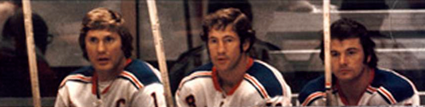
GAG Line Rangers Pictures, Images and Photos
The GAG Line, Hadfield, Ratelle and Gilbert

Carr, already with two assists, scored at 6:44 from Seiling and Neilson for the fourth Rangers goal of the period as the rout was well and truly on as New York now led 8-1.

The next to join the fun for the Rangers was rookie Pierre Jarry, who scored the first goal of his career at 11:03 from Walt Tkaczuk and Neilson. They stayed out on the ice for the subsequent faceoff, which was won by Tkaczuk, who got the puck to Jarry. He crossed the Golden Seals blueline and fired a shot past Meloche for the second goal of his career - just a mere five seconds after his first one! With the Rangers now leading 10-1, California head coach Vic Stasiuk mercifully, and finally, pulled Meloche, who had given up 10 goals on 40 shots against.

 photo Meloche Seals.jpg
Gilles Meloche was finally pulled after giving up ten Rangers goals

Lyle Carter was the unfortunate backup goaltender who had to come in and face the red hot New York onslaught with just under 9 minutes remaining. At 12:27, just 1:19 after coming into the game, Carter gave up the 11th Rangers goal when Carr scored his second of the period from MacGregor and Park with Vadnais in the penalty box for the Golden Seals - remarkably the first power play goal of the game out of the dozen combined goals scored up to that point.

The final nail in the Golden Seals coffin arrived with just 36 seconds left in the game when Bill Fairbairn scored the eighth Rangers goal of the period from Seiling and Tkaczuk at 19:24 for a final score of 12-1 for New York.

 photo Tkaczuk Rangers.png
Walt Tkaczuk had three assists in the third period,
two of them on Jarry's goals five seconds apart

Villemure got the easy win for the Rangers after making 15 saves on 16 shots, while Carter made 10 saves on 12 shots. Combined with the 40 Meloche endured, New York peppered the Golden Seals net with a total of 52 shots for the game.

Villemure Rangers photo 1972-73NewYorkRangersjersey.png
Gilles Villemure

Ratelle was the star of the night with his four goals, while Carr had 2 goals and 2 assists for 4 points of his own. Hadfield (1 goal and 2 assists), Gilbert (3A), Seiling (3A), Neilson (3A) and Tkaczuk (3A) all had three points on the night, while five others had 2 points among the 13 Rangers who registered a point on the night, with special mention going to the rookie Jarry's first two career goals scored just five seconds apart.

As bad as the night was for California, they would rebound with a 6-1 win in their next game against the Detroit Red Wings and avoid any extended losing streaks, save for dropping their final six games of the season, finishing with a 21-39-18 record, good for 6th place in the 7 team West Division with 60 points, just 7 back of third place St. Louis.

Meanwhile, the Rangers went 48-17-13 for 109 points, second best in the league behind only the Boston Bruins 119.

The playoff format of the day saw the teams cross-over from East and West Divisions in the Semifinals, which was done in order to create a more competitive Stanley Cup Final, as the previous format had led to three straight blowouts from 1968 to 1970.

In 1972, the Rangers defeated the Montreal Canadiens 4 games to 2 and then swept the Chicago Black Hawks in 4 straight to advance to the Finals against the Bruins, who defeated the Rangers in six games.

Ratelle (109 points), Hadfield (106) and Gilbert (97), would finish 3-4-5 in league scoring that season, while Villemure's 2.09 goals against average was second in the NHL that season.

Today's featured jersey is a 1971-72 New York Rangers Jean Ratelle jersey. The Rangers debuted in 1926 wearing jerseys not too dissimilar to the one worn by Ratelle in 1971-72. The original white lettering changed to red for their second season of play. The font still used for the cresting arrived in 1941 and the drop shadow on both the crest and the numbers came a year later. In 1951 the laces were added to the collar and they arrived at today's featured style when the sleeve numbers arrived in 1963.

This style would be used through 1975-76 before a new, modern jersey was worn for two seasons with the Rangers shield as the main crest In 1978-79, this style returned, only with Rangers replaced by "New York" on the front until reverting back to "Rangers" in 1987.

 photo New York Rangers 1971-72 F jersey.jpg
 photo New York Rangers 1971-72 B jersey.jpg

Extra bonus jersey: Today's extra extra bonus jersey is a 1971-72 California Golden Seals Gilles Meloche jersey as worn during the Golden Seals game in Madison Square Garden on this date in 1971 when the rookie Meloche was shelled for ten goals by Ratelle and the Rangers.

The Seals debuted with jerseys that were green and blue with white trim from 1967-68 to 1969-70. For the 1970-71 season, new owner Charlie O. Finley changed the team colors to green and gold to match his Oakland Athletics of Major League Baseball, including having his team wear white skates at first to match the white shoes worn by the A's.


This style would remain in use for four seasons under Finley's ownership until the colors were once again changed from kelly green to teal and yellow for the team's final two seasons in Oakland.


 photo California Golden Seals 1971-72 jersey.jpg
photo courtesy of Classic Auctions

Extra extra bonus jersey: Today's extra extra bonus jersey is a 1980 NHL All-Star Game Jean Ratelle jersey as worn in the game played in Detroit. It was the fifth and final All-Star Game of Ratelle's career. Ratelle had an assist in the game on a goal by Craig Hartsburg in a 6-3 winning effort by the Wales Conference.
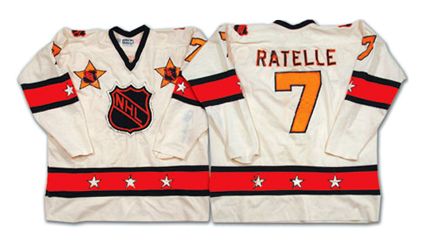
photo courtesy of Classic Auctions

First in today's video segment, linemates Hadfield and Gilbert discuss the GAG line they were on with Ratelle.


Next, some classic footage and a look at the history of the Golden Seals.

Sunday, November 20, 2016

1960-61 Toronto Maple Leafs Dave Keon Jersey

On this date in 1974, Dave Keon of the Toronto Maple Leafs played in his 1,000th career game, and celebrated the occasion in style by scoring a hat trick, the fifth of his career.

 photo KeonMapleLeafs.jpg
Dave Keon played in his 1,000th NHL game on this date in 1974

Keon joined the Maple Leafs for the 1960-61 season and won the Calder Trophy following a 20 goal, 45 point campaign. He would go to have five more consecutive 20-goals seasons.

Keon Maple Leafs photo Keonearly.jpg
Keon won the Calder Trophy as Rookie of the Year

During Keon's second season in the NHL, in which the Maple Leafs would capture the Stanley Cup, Keon would add the Lady Byng Memorial Trophy to his already growing trophy case after a season in which he drew but a single minor penalty in 64 games played.

He was one of the fastest skaters in the NHL and one of the best defensive forwards as well, often being matched up against the opposition's top centers.

More Stanley Cups would follow in 1963, as well as a second Lady Byng Trophy, and again in 1964, a season in which Keon would lead the Maple Leafs in scoring for the first time.

After Keon led the Maple Leafs in scoring again in 1966-67, the Maple Leafs would win the 1967 Stanley Cup and Keon was named the Conn Smythe Trophy winner, the only Maple Leaf to ever win the trophy named for the former owner of the club.

Keon Smythe photo KeonConnSmythe.jpg
Keon poses with the Conn Smythe Trophy

Keon was named captain of the Maple Leafs in 1969-70 and led the team in scoring yet again before setting a then NHL record in 1970-71 with eight shorthanded goals.

Keon Captain photo KeonCaptainMapleLeafs.jpg
Keon has the captain's "C" sewn on to his jersey by
Maple Leafs trainer Joe Sgro, while still wearing his jersey!

After coming to an agreement to join the Ottawa Nationals of the fledgling WHA in 1972, the deal fell apart and Keon signed a three year contract to remain in Toronto and led the team in goal scoring in 1972-73, which included his 297th goal as a Maple Leaf, passing George Armstrong and Frank Mahavolich as the franchise's all-time leading goal scorer.

Having fallen out of favor with Maple Leaf's owner Harold Ballard by the end of his contract, Keon jumped to the rival WHA and signed with the Minnesota Fighting Saints for the 1975-76 season. When the Fighting Saints folded in February of 1976, Keon was unable to return to the NHL because the Maple Leafs still held his NHL rights and owner Ballard wanted too steep a price from any NHL club who wanted to sign him, effectively locking Keon out of the NHL.

Keon Saints photo KeonFightingSaints.jpg
Keon now with the Fighting Saints of the WHA

With staying in the WHA as his only option, Keon signed with the Indianapolis Racers for the remainder of the season. He was traded to the new incarnation of the Minnesota Fighting Saints for the 1976-77 season, only to see that version of the franchise again fold in January of 1977 before the completion of the season.

Keon Racers photo KeonRacers.jpg
Indianapolis Racer Dave Keon

Keon found some stability when he joined the WHA's New England Whalers after the Fighting Saints folded, and would play with the Whalers for the remainder of his career, three seasons in the WHA and three more finally back in the NHL following the demise of the WHA in 1979 when the Whalers were one of four WHA clubs to be allowed to join the NHL.

It was during the 1979-80 season that Keon, then 40 years old, was occasionally on a line with both Gordie Howe (age 50) and Bobby Hull (age 41). When both Howe and Hull retired, Keon was the oldest player in the NHL for his final two seasons before retiring after the 1981-82 season at age 42.

 photo KeonWhalers.jpg
Keon now back in the NHL and it's oldest active player as well

Keon's final totals were 396 goals and 590 assists for 986 NHL points and another 102 goals and 189 assists for 291 points in the WHA, the Calder Trophy, two Lady Byng Trophies, a Conn Smythe Trophy, eight NHL All-Star Game appearances and four Stanley Cups as well as being inducted into the Hockey Hall of Fame in 1986.

Earlier this year Keon was given the tremendous honor of being named The Greatest Maple Leaf in the team's 100 year history.

Today's featured jersey is a 1960-61 Toronto Maple Leafs Dave Keon jersey as worn during his rookie season in the NHL. This style of Maple Leafs jersey dates back to 1934-35, with a few crest variations along the way. This exact crest was introduced in 1938 and had red lettering for three seasons, from 1945-46 through 1947-48. The lace up collar was introduced for the 1958-59 season to arrive at the style Keon wore as a rookie.

Numbers were added to the sleeves in 1962-63 and a white outline was added to the crest the following season and the jersey remained in use through the 1966-67 season until a redesign for the 1967-68 season.

 photo Toronto Maple Leafs 1960-61 F jersey.jpeg
 photo Toronto Maple Leafs 1960-61 B jersey.jpeg
photos courtesy of Classic Auctions

Bonus jersey: Today's bonus jersey is a 1966-67 Toronto Maple Leafs Dave Keon jersey as worn during the fourth Stanley Cup season of Keon's career. This style would be worn for three seasons through 1969-70.

There is a great story about Maple Leafs owner Ballard that recalls when the league made it mandatory in 1978 to put players names on the backs of their home and away jerseys, the notoriously cantankerous Ballard refused to do so. Claiming sales of programs would be reduced - and probably in part because Ballard never liked being told what to do by the league, and then NHL President John Ziegler in particular. When finally forced to comply by the league to put names on the jerseys after being fined, Ballard fought back on February 26, 1978 by putting the names on the back of their blue road jerseys for a game in Chicago in the same blue color as the jersey, making them impossible to read!

 photo Toronto Maple Leafs 1966-67 jersey.jpeg
photo courtesy of Classic Auctions

Extra bonus jerseys: Today's bonus jerseys are 1975-76 Minnesota Fighting Saints Dave Keon jerseys as worn during the Fighting Saints final season of their original incarnation. The Fighting Saints were one of the original WHA franchises formed for the 1972-73 season. They originally wore jerseys with the "S" logo but introduced a new set with the Little Saint logo later during their debut season. The jerseys would remain unchanged until the franchise folded in February of 1976.

Minnesota Fighting Saints 75-76 jersey, Minnesota Fighting Saints 75-76 jersey
 photo Minnesota Fighting Saints 1975-76 road jersey.jpg
photos courtesy of Classic Auctions
 
Extra extra bonus jersey: Today's extra extra bonus jerseys is a 1976-77 New England Whalers Dave Keon jersey as worn while the Whalers were still members of the WHA.

After their inaugural season, the Whalers simplified their logo to just the W bisected with a harpoon and their jerseys would then remain unchanged through the remainder of their time in the WHA, which came  to an end after the 1978-79 season.

 photo Hartford Whalers 1976-77 jersey.jpg
photo courtesy of Classic Auctions

Extra extra extra bonus jersey: Today's extra extra extra bonus jerseys is a 1980-81 Hartford Whalers Dave Keon jersey as worn after the Whalers joined the NHL for the 1979-80 season. The Whalers were required to change their name from New England to Hartford due to a demand by the Boston Bruins as a part of their admission into the NHL.

Along with the new name came a new logo, which featured a bold whale tail and the letter H in the negative space above a bold W. This style underwent a few variations, such as the angled sleeve stripes being straightened, going back to aangled and then straight once again. Additionally, the popular Pucky the Whale shoulder patches would be inexcusably dropped for the 1983-84 season. Of note, this style was also worn with the long Cooperall pants for the 1982-83 season. This jersey would be worn for 13 seasons through the 1991-92 season before the team updated their look, which included promoting blue to their new main color.

 photo Hartford Whalers 1980-81 F jersey.jpg
 photo Hartford Whalers 1980-81 B jersey.jpg

Today's first video is Dave Keon's "Legends of Hockey" biography.


This video is from the 1970-71 season, the Maple Leafs first with their new jerseys and new, modern logo, which is still in use today. Keon scores early in the video on a really nice deke against the Detroit Red Wings. After Keon's goal, the Maple Leafs start picking off fans in the stands with flying pucks, as they nail two in a row!


Here are the final minutes of the Maple Leafs last Stanley Cup championship, won while wearing today's featured jersey.


This piece of sheer brilliance was too good to pass up, the Maple Leafs Top Ten Highest Scorers Named Dave!


Finally, a tour of the Dave Keon Arena in Rouyn Noranda, Quebec.

Saturday, November 19, 2016

1972-73 Chicago Black Hawks Dennis Hull Jersey

Playing his career in the shadow of his older brother and teammate Bobby Hull, Dennis Hull was born on this date in 1944.

Dennis Bobby Hull
Dennis and Bobby Hull

Hull played junior hockey with the St. Catharines Teepees of the Ontario Hockey League beginning in the 1960-61 season and gave no indication of what was to follow with two seasons of 10 and 18 points. The team became sponsored by the Chicago Black Hawks in 1962 and thus became the St. Catharines Black Hawks. In 1962-63 Hull raised his point total to 48 before impressing the following season with 48 goals and 97 points, doubling his total from the previous season.

He made the Chicago roster in 1964-65 and saw action in 55 games, scoring 10 goals as a rookie. The club determined he needed some additional seasoning in 1965-66, and Hull was sent to the minors for 40 games with the St. Louis Braves. He also played 25 games with Chicago that season, but his lone goal raised cause for concern.

Those fears were calmed in 1966-67 when he played in all 70 games, scoring 25 goals and 42 points. Two seasons later Hull registered his first 30 goal season. The only problem for Dennis was that Bobby was in his 12th season for the Black Hawks, had ten seasons of 30 goals or more and scored an NHL record 58 goals that same season. Such was life for Dennis Hull in the NHL.

Dennis Bobby Hull
Dennis in the road red and Bobby Hull in the
home white Black Hawks jerseys
Dennis had a very good 1970-71 season, setting a career high in goals with 40 and nearly catching Bobby, who had 44 while now having been paired with Pit Martin and Jim Pappin on the "MPH Line", which came from the trio's last initials. The team also excelled, making a playoff run that would take them to the first Stanley Cup Finals in Dennis' career.

Dennis Hull Blackhawks
Dennis spent 13 seasons with the Black Hawks
For their final season as teammates, Dennis had his third 30 goal season and set a new personal best with 69 points. For 1972-73, the hockey world was turned on it's ear with the arrival of the World Hockey Association, who made Bobby their marquee attraction by signing him away from the Black Hawks by virtue of a million dollar contract.

This defection resulted in Bobby being blacklisted from the Team Canada roster for the 1972 Summit Series against the Soviet Union, despite his undoubted offensive capabilities. Dennis though, was still a member of the NHL and became part of Team Canada, at the urging of his brother following Dennis' thoughts of boycotting the series in support of Bobby. Dennis was paired with New York Ranger teammates Jean Ratelle and Rod Gilbert, and scored two goals and four points in the four games he played in.

Dennis Hull Canada 1972
Dennis in a 1972 Team Canada jersey
With the 50 goal scorer Bobby now out of the lineup, everyone feared what the impact would be on the Black Hawks, but the MPH Line stepped up to fill the void, and all three players hitting at least 90 points and raising their previous season total by a minimum of 21 which saw Dennis Hull score 39 goals and set a career high with 90 points. That season, Chicago would again return to the Stanley Cup Finals for the second time in Hull's career.

72-73 Chicago Blackhawks team
The 1972-73 Chicago Blackhawks

In 1973-74, Hull would play in 74 games, his eighth consecutive season of 70 games or more, a streak broken the following season when he played in "just" 69 games. He followed that with playing 80 and then 75 in his final two seasons with the Black Hawks. In all, he would play 824 games out of a possible 848 games once he established himself as a regular with the club 11 seasons earlier, a rate of 97% for the model of reliability and consistency he, and the MPH Line, provided the Black Hawks.

Hull was acquired by the Detroit Red Wings for the 1977-78 season, his final one before retiring as a player.

His final NHL totals are 959 games played with 3030 goals and 351 assists for 654 points and he would appear in six NHL All-Star Games, including the 1974 version with linemates Martin and Pappin.

Known for his outgoing personality and sense of humor, he wrote a book entitled (in reference to his nephew and Bobby's offensively gifted son Brett Hull) "The Third Best Hull - I would have been fourth best but they wouldn't let my sister Maxine play."

Dennis Brett Bobby Hull
Bobby, Brett and Dennis Hull

Today's featured jersey is a 1972-73 Chicago Black Hawks Dennis Hull jersey as worn during Hull's career year when he played for Team Canada in the 1972 Summit Series and then went on to the best season of his NHL career with 90 points.

The Black Hawks adopted this jersey style in 1955 and it has become an icon in the world of hockey, remaining essentially unchanged for over 55 years.

Chicago Blackhawks 72-73 jersey, Chicago Blackhawks 72-73 jersey
photo courtesy of Classic Auctions

Hull has gone on to a career as a public and motivational speaker, and here he is telling some of his humorous stories.


Here are highlights of Game 6 of the 1972 Summit Series, in which Hulls scores a goal for Team Canada.


Finally, a pair of intertwined interviews from WGN TV in Chicago, hosted by long time Cubs announcer Jack Brickhouse. Bobby clearly got the better background for his interview...

Friday, November 18, 2016

1926-27 Detroit Cougars Russell Oatman Jersey

It was on this date in 1926 that the Detroit Cougars would play in their first NHL game, losing 2-0 to the Boston Bruins at the Border Cities Arena in Windsor, Ontario where the Cougars would play their home games during their first season since they had no home arena in Detroit at the time.

When the Western Canada Hockey League folded after the 1925-26 season, a deal was made so the new Detroit expansion NHL club bought the rights to the players of one of the most successful of the WCHL teams, the 1925 Stanley Cup champion Victoria Cougars.

1925 Victoria Cougars photo 1925VictoriaCougarsteam.jpg
The 1925 Stanley Cup champion Victoria Cougars

The new Detroit club was named the Cougars in honor of the Victoria club from where it's roster originated. The Cougars played a 44 game schedule, finishing last in the American Division of the 10 team league with a 12-28-4 record. John Sheppard would lead the team in scoring with 21 points in 43 games.

 photo 1926-27DetroitCougarsteam.jpg
1926-27 Detroit Cougars team

For the following season of 1927-28, the Detroit Olympia would become the Cougars new home, where they would play for the next 52 years, until December of 1979. That same season, Jack Adams would take over as coach in Detroit and spend the next 36 years as either the coach or general manager of the club. The Cougars would finish the season with a 19-19-6 record for fourth place in the American Division. George Hay would lead the team with 35 points in 42 games, tied for third in the league.

Detroit Cougars 1927-28 photo DetroitCougars1928.jpg
The Detroit Cougars in 1928

he 1928-29 Cougars would finish with a similar 19-16-9 record but make the Stanley Cup playoffs for the first time, losing out to the Toronto Maple Leafs 7-2 in a two game total goals series. Carson Cooper would lead the Cougars in scoring with 27 points in 43 games to finish third in the league.

The final season for the name Cougars, 1929-30, would see Detroit post a 14-24-5 record and miss out on the playoffs. Cooper would again lead the team in scoring, this time with 36 points in 44 games played.

Before the start of the next season, the Detroit club would change it's name from its original choice of Cougars to Falcons, bringing an end to the first era of of the franchise and hoping to change it's luck. The name Falcons would last but two seasons until a change in ownership led to the adaptation of the Red Wings name.

Today's featured jersey is a 1926-27 Detroit Cougars Russell Oatman jersey worn by the expansion Cougars during their first season in the NHL. The Cougars name lasted just four seasons, but the team wore a new style sweater for every one of those four years, offering no clues as to what was to come, as the Red Wings name was introduced in 1932 and their red jerseys have now remained unchanged for over 80 years!

Detroit Cougars 1926-27 jersey photo DetroitCougars1926-27jersey.jpg

Bonus jersey: Today's bonus jersey is a 2008-09 Detroit Red Wings Nicklas Lidström jersey worn for the Winter Classic on January 1, 2009 at Wrigley Field in Chicago when the Red Wings defeated the Chicago Blackhawks 6-4. This jersey is based on the style that Detroit wore in during the franchise's first season of 1926-27 when they were known by their original name of the Detroit Cougars.

Detroit Red Wings 2008-09 Winter Classic jersey photo DetroitRedWings2008-09WClassicF.jpg
Detroit Red Wings 2008-09 Winter Classic jersey photo DetroitRedWings2008-09WClassicB.jpg

Our video section begins with a preview of the 2009 Winter Classic, during which the Red Wings wore jerseys inspired by the original Cougars jerseys.


Thursday, November 17, 2016

1982 NHL All-Star Dennis Maruk Jersey

Born on this date in 1955, Dennis Maruk caught the attention of NHL scouts while playing junior hockey for the London Knights of the Ontario Hockey Association. As a rookie, Maruk scored 46 goals and 113 points in 1972-73 to break Marcel Dionne's league rookie scoring record , led the club in scoring the next season with 47 goals and 112 points before finishing third overall with 66 goals and 145 points in 65 games, an average of a goal every game and 2.23 points every time he took the ice.

Maruk cartoon
Informative Dennis Maruk hockey card trivia

Following that season Maruk was selected 21st in the second round by the California Golden Seals of the NHL as well as being taken 65th overall by the Cleveland Crusaders of the WHA, his relatively low draft positions being due to his smaller size, as Maruk was 5' 8" and 165 pounds. He chose to sign with California and immediately stepped into the Golden Seals lineup, playing all 80 games of the 1975-76 season. He would score 30 goals finish second in team scoring, just one back of Al MacAdam with 62 points.

Maruk Seals
Maruk with the Golden Seals during the black skates era

That would prove to be the troubled Golden Seals final season in Oakland, and the club relocated to Cleveland, Ohio where they were renamed the Barons for the 1976-77 season. He led the Barons in scoring with 78 points their first season in Cleveland and again in 1977-78 with 36 goals and 71 points, 20 more than his next closest teammate which earned him his first NHL All-Star appearance.

Maruk Barons
Maruk with the Barons in 1976-77 when they had
the State of Ohio patches on the arms

For the 1978-79 season, the lowly Barons were merged with the even worse Minnesota North Stars, resulting in Maruk's third club in four seasons despite never having been traded or waived!

Maruk North Stars
Often overlooked, Maruk had one of the finest mustaches in NHL history

Despite his obvious offensive talents, Minnesota would deal Maruk to the Washington Capitals after just two games in the green and gold, a decision Maruk would make Minnesota regret.

Maruk immediately led the Capitals in scoring with a 31 goal 90 point season. Torn knee ligaments ruined his 1979-80 season, limiting him to just 27 games after not playing less than 76 in any previous season.

He returned healthy and with a vengeance, playing all 80 games for the next three consecutive seasons while scoring 50 goals for the first time in 1980-81, good for eight in the league.

Maruk Capitals
Maruk had 50 and 60 goal seasons with Washington

The 1981-82 season was a career year for Maruk, as he again led the Capitals in scoring with 60 goals (third in the league) and 76 assists for 136 points, which was fourth overall. His efforts were recognized with his second NHL All-Star Game appearance. Despite his career statistical highs, the Capitals and Maruk missed the playoffs yet again. Maruk's 76 assists and 136 points remain the Captials team records to this day.

Maruk All-Star
Maruk played in the NHL All-Star Game in 1978 and 1982

While his personal scoring declined to 31 goals and 81 points, the Capitals qualified for the postseason for the first time in their history. It would also be the first time Maruk would participate in a playoff game in his now eight year career.

Maruk was not to be a part of the Capitals future however, as perhaps wishing they had been the benefactors of his 50 and 60 goal seasons, the North Stars reacquired Maruk for the 1983-84 season. A combination of getting older and the North Star style of play limited Maruk's offensive output, and Maruk would never again approach his electrifying point totals from his days in Washington.

His first four seasons in Minnesota were a model of consistency, as he would play in 71, 71 and 70 games, scoring 60, 60 and 58 points. One tradeoff for the lower scoring totals was that Minnesota qualified for the playoffs all three seasons, including a run to the semifinals in 1984.

Maruk North Stars
Maruk returned to Minnesota in 1983 for his final six seasons

Injuries began to take their toll on the normally healthy Maruk, and a separated shoulder and torn knee ligaments cut his 1986-87 season to 67 games and 46 points. The following season was more of the same, as he missed the start of the schedule with a lacerated tendon and sara his season end early with a shattered knee cap. He would see the ice for just 22 games that season.

The surgery required on his knee would affect his 1988-89 season, and he would eventually play just 5 games in the minors and 6 with the North Stars before retiring from the NHL for good.

Maruk's final career totals are 888 games played, 356 goals and 522 assists for 878 points.

Outside of his NHL career, Maruk also participated in the World Championships for Canada on four occasions, in 1978 winning a bronze medal, 1979, 1981 and 1983 when he brought home a second bronze.

Today's featured jersey is a 1982 NHL All-Star Game Dennis Maruk jersey. This gaudy one year only style is the most absurd of all the 1980's All-Star jerseys with it's excessive number of stars, proving quite visually that less is sometimes more.

Apparently the design team did not get the word that the disco era had ended. In addition to having far too many stars, the NHL logos on the arms would have been better served by being on the shoulders to leave room for sleeve numbers.

Fortunately sanity would prevail and the next ten years would see some of the best jerseys in the history of the All-Star Game.

NHL All-Star 81-82 jersey

Bonus jersey: Today's bonus jersey is a 1981-82 Washington Capitals Dennis Maruk jersey, proving by comparison that less stars can be more effective.

This jersey was worn during Maruk's 60 goal season and can be distinguished by the Maska logo on the back, which was closer to the side of the jersey in previous years. Additionally, the word Washington on the front is much smaller than it was in 1979-80.

Washington Capitals 80-81 jersey

Extra bonus jersey: Today's extra bonus jersey is a 1984-85 Minnesota North Stars Dennis Maruk jersey, proving by comparison that perhaps a minimalist approach to stars can be even more effective!

This style of North Stars jersey was first worn in 1978-79, and while the white jerseys had bold black trim added to them in 1981-82, the green jerseys remained unchanged for an additional seven seasons before, they too, had the black trim added in 1988-89 for just two seasons until the team's entire look was reworked under new ownership.

In comparison to the constellation of starts on the 1982 NHL All-Star jerseys or even the 16 stars on a Capitals jersey, which essentially act as stripes, the North Stars showed great restraint had simply one star, an italicized and drop shadowed star atop the N crest, which conveyed action and speed on what still remains today as a highly popular jersey.

Minnesota North Stars 1984-85 jersey photo Minnesota North Stars 1984-85 F jersey.jpg
Minnesota North Stars 1984-85 jersey photo Minnesota North Stars 1984-85 B jersey.jpg

Today's video segment begins with a tribute to Maruk on the occasion of his entering the Etobicoke Sports Hall of Fame in 2004.


Speaking of gaudy jerseys, here is some rare footage of Maruk while wearing Canada's loudest design ever at the 1978 World Championships against the Soviet Union.


Looking great, but sans mustache, Maruk is interviewed at the 2009 Canadian Pond Hockey Championships.


hit counter for blogger