Monday, November 23, 2015
1929-30 Boston Bruins Eddie Shore Jersey
An NHL record was set on this day in 1929 following an incident when the rugged Buck Boucher of the Montreal Maroons got into a fight with defenseman and legendary tough customer Eddie Shore of the Boston Bruins.
Eddie Shore
At the conclusion of the fight, Shore picked up his stick and proceeded to butt end rookie Dave Trottier of the Maroons, which set off round two for Shore. Trottier, however suffered a collapsed lung, most likely as a result of an injury from the butt ending.
Shore, already public enemy #1 in hockey during his day, was now a wanted man as far as the Maroons were concerned, and they wanted revenge. The first to attempt to extract a pound of flesh was the undersized Hooley Smith, who Shore outweighed by forty pounds! Smith could hold his own however, as his 83 penalty minutes in the 44 game season were third on the club.
Red Dutton, who led the Maroons in penalty minutes that season, sought out Shore to accomplish what Smith couldn't, and the two went at it for Shore's fourth round of the night.
Despite the damage inflicted on Shore up to this point, he had one more bout on his fight card still to go, this one with renowned fighter Babe Siebert, whose 94 penalty minutes came just behind Dutton's 98 that year. Shore, still full of vinegar nailed Siebert with a hard hit as Siebert was flying down the ice. As Siebert rose, Shore clobbered him. This enraged Siebert, who stared at Shore with his stick raised. Siebert and Shore went at it so violently, that the game had to be delayed while the resulting blood was cleaned off of the ice.
Trottier and Siebert from the Maroons both ended up in the hospital as did Shore, thanks to a litany of injuries, - a broken nose, four missing teeth, two black eyes to go with the cuts he had above each one, a gash on his cheek and a concussion! Still, Shore had done what he set out to accomplish, as the defenseman contributed a pair of assists as the Bruins won 4-3.
Barring any further rules changes, Shore's record five fighting majors will live on unchallenged forever, as NHL rules now dictate that any player receiving three fighting majors in one game be given a game misconduct, ending his night and keeping Shore's record intact.
By the end of the season, Shore would total 105 penalty minutes for third overall the league, one place ahead of Dutton's 98. Siebert and Smith would both land places in the top ten as well, making the Maroons game against Boston a true heavyweight card that would go down in the record books seemingly forever.
Shore from the 1933 Sport Kings trading card set,
one of only three hockey players in the 48 card set
Shore would eventually have a 14 year NHL career during which he would receive 978 stitches, break his nose foureen times and his jaw five times as well as a hip, collar bone and his back. He would also win the Hart Trophy as the NHL MVP four times, the most of any defenseman, and win a pair of Stanley Cups. He would be inducted into the Hockey Hall of Fame in 1947. Of the five men Shore fought that night in 1929, Boucher (1960), Dutton (1958), Siebert (1964) and Smith (1972) would all be inducted into the Hall of Fame as well.
Today's featured jersey is a 1929-30 Boston Bruins Eddie Shore jersey. The Bruins were still using their original colors of brown and yellow, which came from the club's original owner Charles Adams' grocery store chain, First National Stores. The Bruins wore a different style in each of their first two seasons before adopting this style in 1926. They would continue to wear this sweater for six seasons, including a Stanley Cup championship in 1929.
Today's video is a fifteen minute film on the career of Shore, a rich topic worthy of much more than we can provide here.
Labels:
Boston Bruins,
Shore Eddie
Sunday, November 22, 2015
The Fastest Five Goals by One Team - 1972-73 Pittsburgh Penguins Ken Schinkel Jersey
On this date in 1972, the Pittsburgh Penguins hosted the St. Louis Blues at The Igloo in Pittsburgh. Jim Rutherford got the start in goal for the home team, while Wayne Stephenson got the call for the Blues.
Syl Apps got the Penguins on the board first with his ninth goal of the season at 3:59 at even strength. Bryan Watson scored his first and only goal of the season at 11:40 to give Pittsburgh a 2-0 lead before Phil Roberto countered for St. Louis at 13:50. Less than a minute later Al McDonough banged in his 10th of the young season from Apps at 14:31 to give the Penguins a 3-1 lead after the first period.
The Blues rallied in the second period, with Roberto getting his second of the game at 1:58 followed by Danny O'Shea evening the score at 3-3 with a shorthanded goal at 7:36 while teammate Barclay Plager was in the box.
Striking quickly, Fran Huck stunned the home crowd as he netted his first goal if the season at 1:22 of the third period to give the Blues their first lead of the game at 4-3 after having trailed 3-1 at the end of the first period.
Losing the lead woke the Penguins up and McDonough tied the game once again with his second goal of the game at 1:56 from Apps again just 34 seconds after the Blues had gone ahead for the first time. Greg Polis then put Pittsburgh back on top 4-3 with his fifth goal at 9:05.
Bryan Hextall then extended the Penguins lead to two with his ninth goal from Jack Lynch and Polis for the game's only power play goal at 12:00 with Danny O'Shea off for a minor penalty. Just 18 seconds later, Jean Pronovost struck for his fifth of the season to stretch the Pittsburgh lead to 6-3 from Polis.
Just 1:22 later at 13:40, McDonough completed his hat trick when he beat Stephenson with the lone assist going to Apps for the third time. Before the fans could even sit back down from celebrating McDonough's hat trick, Ken Schinkel lit the lamp just nine seconds later for his tenth goal of the season from Dave Burrows to push the Penguins advantage to 9-4.
The Penguins then set the NHL record for the Fastest Five Goals by One Team when Ron Schock beat a shell-shocked Stephenson with his sixth goal from Schinkel at the 14:07 mark, just 18 seconds after Shinkel's goal. It was the third Pittsburgh goal in 27 seconds and their fifth in just 2:07, a record which still stands today.
Mercifully, that closed out the scoring as Pittsburgh won by a final score of 10-4, having scored 7 straight goals in the third period to negate the Blues comeback in the most emphatic way. Stephenson remained in to finish the game despite the record setting Pittsburgh onslaught, having given up 10 goals on 34 shots.
McDonough was the star of the night as he finished with 4 points from his hat trick and an assist, while Apps matched his 4 points from a goal and assists on all three of McDonough's goals while Polis (1 goal, 2 assists) had a 3 point game.
Two seasons later the Boston Bruins took a run at the Penguins record when Bobby Schmautz, Ken Hodge, Phil Esposito, Don Marcotte and Johnny Bucyk scored five goals in 2:55 on December 19, 1974. On January 26, 1982, the New York Islanders came the closest to breaking the Penguins now 43 year old record when Duane Sutter, John Tonelli, Bryan Trottier back-to-back and Sutter again, ironically against Pittsburgh, tallied 5 goals in 2:37.
The Penguins 3 goals in 27 seconds was not a record, as Bill Mosienko of the Chicago Black Hawks recorded the Fastest Hat Trick ever in 21 seconds in 1952. The record for Fastest Three Goals by One Team was lowered to 20 seconds by the 1971-72 Bruins trio of Bucyk, Ed Westfall and Ted Green.
Apps would go on to lead the team in scoring for the 1972-73 season with 29 goals and 56 assists for 85 points. McDonough led the team with 35 goals and was next w ith 76 points, closely followed by Lowell MacDonald with 34 goals and 75 points. Rutherford was the Penguins number one goaltender, playing in 49 games and finishing with a 2.91 goals against, 3 shutouts and a 20-22-5 record.
Today's featured jersey is a 1972-73 Pittsburgh Penguins Ken Schinkel jersey. The Penguins early jersey history was one of frequent change, as they began life in 1967-68 with diagonally lettered "Pittsburgh" jerseys in the same style of the New York Rangers, For 1968-69 they completely changed jerseys, abandoning their multiple striped jerseys from their inaugural season and going with a single wide stripe trimmed in navy blue with a circular crest which contained their skating penguin logo.
In 1971-72, the skating penguin became the crest all by itself in a full size, as it's surrounding circle was dropped. This jersey remained the same for two seasons until the lighter shade of blue was darkened considerably for the 1973-74 season. This new version lasted just one season until a complete modernization of their look for 1974-75.
Schinkel's NHL career began in 1959-60 with the New York Rangers. He was with New York for parts of six seasons, as well as the majority of four seasons with the Baltimore Clippers of the American Hockey League.
When the NHL doubled in size in 1967, it created another 120 openings for players and Schinkel joined the Penguins for their inaugural season. He played six seasons for Pittsburgh with a high of 52 points in 1969. He retired midway through the 1972-73 season at the age of 40 as the team leader in games and points to become the Penguins head coach for four seasons.
Jim Rutheford
Syl Apps got the Penguins on the board first with his ninth goal of the season at 3:59 at even strength. Bryan Watson scored his first and only goal of the season at 11:40 to give Pittsburgh a 2-0 lead before Phil Roberto countered for St. Louis at 13:50. Less than a minute later Al McDonough banged in his 10th of the young season from Apps at 14:31 to give the Penguins a 3-1 lead after the first period.
The Blues rallied in the second period, with Roberto getting his second of the game at 1:58 followed by Danny O'Shea evening the score at 3-3 with a shorthanded goal at 7:36 while teammate Barclay Plager was in the box.
Striking quickly, Fran Huck stunned the home crowd as he netted his first goal if the season at 1:22 of the third period to give the Blues their first lead of the game at 4-3 after having trailed 3-1 at the end of the first period.
Losing the lead woke the Penguins up and McDonough tied the game once again with his second goal of the game at 1:56 from Apps again just 34 seconds after the Blues had gone ahead for the first time. Greg Polis then put Pittsburgh back on top 4-3 with his fifth goal at 9:05.
Bryan Hextall then extended the Penguins lead to two with his ninth goal from Jack Lynch and Polis for the game's only power play goal at 12:00 with Danny O'Shea off for a minor penalty. Just 18 seconds later, Jean Pronovost struck for his fifth of the season to stretch the Pittsburgh lead to 6-3 from Polis.
Just 1:22 later at 13:40, McDonough completed his hat trick when he beat Stephenson with the lone assist going to Apps for the third time. Before the fans could even sit back down from celebrating McDonough's hat trick, Ken Schinkel lit the lamp just nine seconds later for his tenth goal of the season from Dave Burrows to push the Penguins advantage to 9-4.
The Penguins then set the NHL record for the Fastest Five Goals by One Team when Ron Schock beat a shell-shocked Stephenson with his sixth goal from Schinkel at the 14:07 mark, just 18 seconds after Shinkel's goal. It was the third Pittsburgh goal in 27 seconds and their fifth in just 2:07, a record which still stands today.
Mercifully, that closed out the scoring as Pittsburgh won by a final score of 10-4, having scored 7 straight goals in the third period to negate the Blues comeback in the most emphatic way. Stephenson remained in to finish the game despite the record setting Pittsburgh onslaught, having given up 10 goals on 34 shots.
McDonough was the star of the night as he finished with 4 points from his hat trick and an assist, while Apps matched his 4 points from a goal and assists on all three of McDonough's goals while Polis (1 goal, 2 assists) had a 3 point game.
Two seasons later the Boston Bruins took a run at the Penguins record when Bobby Schmautz, Ken Hodge, Phil Esposito, Don Marcotte and Johnny Bucyk scored five goals in 2:55 on December 19, 1974. On January 26, 1982, the New York Islanders came the closest to breaking the Penguins now 43 year old record when Duane Sutter, John Tonelli, Bryan Trottier back-to-back and Sutter again, ironically against Pittsburgh, tallied 5 goals in 2:37.
The Penguins 3 goals in 27 seconds was not a record, as Bill Mosienko of the Chicago Black Hawks recorded the Fastest Hat Trick ever in 21 seconds in 1952. The record for Fastest Three Goals by One Team was lowered to 20 seconds by the 1971-72 Bruins trio of Bucyk, Ed Westfall and Ted Green.
Apps would go on to lead the team in scoring for the 1972-73 season with 29 goals and 56 assists for 85 points. McDonough led the team with 35 goals and was next w ith 76 points, closely followed by Lowell MacDonald with 34 goals and 75 points. Rutherford was the Penguins number one goaltender, playing in 49 games and finishing with a 2.91 goals against, 3 shutouts and a 20-22-5 record.
Today's featured jersey is a 1972-73 Pittsburgh Penguins Ken Schinkel jersey. The Penguins early jersey history was one of frequent change, as they began life in 1967-68 with diagonally lettered "Pittsburgh" jerseys in the same style of the New York Rangers, For 1968-69 they completely changed jerseys, abandoning their multiple striped jerseys from their inaugural season and going with a single wide stripe trimmed in navy blue with a circular crest which contained their skating penguin logo.
In 1971-72, the skating penguin became the crest all by itself in a full size, as it's surrounding circle was dropped. This jersey remained the same for two seasons until the lighter shade of blue was darkened considerably for the 1973-74 season. This new version lasted just one season until a complete modernization of their look for 1974-75.
Schinkel's NHL career began in 1959-60 with the New York Rangers. He was with New York for parts of six seasons, as well as the majority of four seasons with the Baltimore Clippers of the American Hockey League.
When the NHL doubled in size in 1967, it created another 120 openings for players and Schinkel joined the Penguins for their inaugural season. He played six seasons for Pittsburgh with a high of 52 points in 1969. He retired midway through the 1972-73 season at the age of 40 as the team leader in games and points to become the Penguins head coach for four seasons.
Labels:
Pittsburgh Penguins,
Schinkel Ken
Saturday, November 21, 2015
Antoine Roussel Changes His Jersey Number
Born in Roubaix, France on this date in 1989, left wing Antoine Roussel moved to Quebec at the age of 16. Having previously played hockey back in France, Roussel joined the Chicoutimi Saguenéens of the Quebec Major Junior Hockey League for the 2006-07 season.
He debuted with 7 goals and 20 points in 56 games and built on that with 13 goals and 37 points in 70 games the following season. He was limited to just 58 games in 2008-09 but nearly managed to equal his point total from the previous season with 35. That same season he also impressed with 6 goals and 8 points in 5 games at the 2009 Division 1 World Junior Championships, having previously competed for France at the 2006 World Junior U18 Division 1 tournament.
His final season with the Saguenéens saw his game take a leap forward with 24 goals and 47 points as well as 9 points in 7 playoff games.
Still, Roussel went undrafted by the NHL and signed a free agent contract with the AHL's Providence Bruins for the 2010-11 season. He would play in 42 games for Providence and an additional 5 for the Reading Royals of the ECHL.
The following season he was invited to the Vancouver Canucks prospect camp, where he impressed and earned a contract with their top minor league affiliate the Chicago Wolves of the AHL. His rugged style of play led to his amassing of 177 penalty minutes as well as 9 points in 61 games with the Wolves.
Following the season he returned to the international stage when he made his World Championship debut for France, scoring 2 goals and an assist in 7 games.
Heading into the 2012-13 season, Roussel signed with the Dallas Stars organization. He spilt time that season between the AHL's Texas Stars, playing in 43 games with 19 points and 107 penalty minutes, and made his NHL debut with Dallas, where he played in 39 games, scoring 7 goals and 14 points with 85 penalty minutes while wearing the #60.
After the Stars elimination from the Stanley Cup playoffs, Roussel suited up for France for the second time at the 2013 World Championships.
Heading into the 2013-14 season, a fan tweeted Roussel with the following:
Roussel replied in March that he was going to keep his "strange" number, assuring him that he was safe to order one of the Stars new jerseys with the #60 when they were released in June.
However…
New management with Dallas decided they wanted to see lower numbers on most of their players, which included Roussel's unconventional #60. With Loui Eriksson having been traded during the offseason, the date of Roussel's birth #21 was available.
After the news came to light in August that Roussel was going to swap his #60 for #21, a seemingly perturbed Sean O'Connor called him out on twitter.
Roussel then made headlines when he followed in the footsteps of the Toronto Maple Leafs Pavel Kubina and offered to pay for any fan who bought a #60 jersey to swap to a new #21 jersey.
When asked about his offer, Roussel stated, "I saw a couple of people last year that bought my jersey with 60. I told hem I'm going to keep the number, so I kind of felt bad for them because they trusted me and I felt like I let them down. I felt like it's fair to do that."
"With the economy these days, it's tough to have some money, when they invest in a jersey like that, it's an investment for some people," Roussel said in sympathy. "I don't want to put those people in a bad spot. I felt that was a good thing to do."
For the 2013-14 campaign, the swap to #21 did not do his game any harm, as Roussel maintained his scoring pace from the previous season, scoring 14 goals and 15 assists for 29 points in 81 games as well as an increase in his penalty minutes to a career high to date to 2009.
Roussel then made his third consecutive World Championship appearance for France where he cut loose with 6 goals and 11 points in 8 games for the French while earning himself a tournament all-star selection.
Today's featured jersey is a 2013-14 Dallas Stars Antoine Roussel jersey worn the first season he changed from #60 to #21, raising the ire of some fans who purchased his original #60 version.
The Stars greatly diminished their emphasis on the color green when their new Reebok Edge jerseys debuted in 2007-08, especially when their home dark jerseys changed from a predominately green jersey to now black. Additionally, they found themselves with some of the most unsatisfying, boring jerseys of the Reebok era. The addition of a white third jersey in 2008-09 did little to improve matters, as it was so similar to their road white jersey only a die hard Dallas fan would notice the change from the "Stars" logo to the arched "Dallas" wordmark which matched the black jersey's cresting.
That all changed in 2013-14 when the club performed a complete makeover of their look, which included a new main crest and a vibrant green home jersey. This reclaimed their ownership of the color, as the only other team to wear a green jersey was the Minnesota Wild, that being a third jersey which is several shades darker than the new look in Dallas. Worth mentioning is the single color numbers, making Dallas one of only five teams to use single color numbers on all their jerseys.
Of note, while Dallas had 12 players with numbers #36 or higher in 2012-13, they still had ten players wear high numbers in 2013-14, including Vernon Fidler (#38), Valeri Nichuskin (#43), Sergei Gonchar (#55), Erik Cole (#72) and the team's leading scorer Tyler Seguin (#91). The five others all played less than ten games that season.
Aside from Roussel, Stars players who did change numbers from 2012-13 to 2013-14 were Jamie Oleksiak from #43 to #5, Ryan Garbutt from #40 to #16 and Jordie Benn from #58 to #24.
He debuted with 7 goals and 20 points in 56 games and built on that with 13 goals and 37 points in 70 games the following season. He was limited to just 58 games in 2008-09 but nearly managed to equal his point total from the previous season with 35. That same season he also impressed with 6 goals and 8 points in 5 games at the 2009 Division 1 World Junior Championships, having previously competed for France at the 2006 World Junior U18 Division 1 tournament.
His final season with the Saguenéens saw his game take a leap forward with 24 goals and 47 points as well as 9 points in 7 playoff games.
Roussel went undrafted after playing for Chicoutimi
Still, Roussel went undrafted by the NHL and signed a free agent contract with the AHL's Providence Bruins for the 2010-11 season. He would play in 42 games for Providence and an additional 5 for the Reading Royals of the ECHL.
Roussel played for Providence following his junior career
The following season he was invited to the Vancouver Canucks prospect camp, where he impressed and earned a contract with their top minor league affiliate the Chicago Wolves of the AHL. His rugged style of play led to his amassing of 177 penalty minutes as well as 9 points in 61 games with the Wolves.
Roussel spent the 2011-12 season with the Chicago Wolves
Following the season he returned to the international stage when he made his World Championship debut for France, scoring 2 goals and an assist in 7 games.
Heading into the 2012-13 season, Roussel signed with the Dallas Stars organization. He spilt time that season between the AHL's Texas Stars, playing in 43 games with 19 points and 107 penalty minutes, and made his NHL debut with Dallas, where he played in 39 games, scoring 7 goals and 14 points with 85 penalty minutes while wearing the #60.
Roussel made his NHL debut while wearing #60
After the Stars elimination from the Stanley Cup playoffs, Roussel suited up for France for the second time at the 2013 World Championships.
Roussel wearing his #60 for France in 2013
Heading into the 2013-14 season, a fan tweeted Roussel with the following:
Roussel replied in March that he was going to keep his "strange" number, assuring him that he was safe to order one of the Stars new jerseys with the #60 when they were released in June.
New management with Dallas decided they wanted to see lower numbers on most of their players, which included Roussel's unconventional #60. With Loui Eriksson having been traded during the offseason, the date of Roussel's birth #21 was available.
After the news came to light in August that Roussel was going to swap his #60 for #21, a seemingly perturbed Sean O'Connor called him out on twitter.
"With the economy these days, it's tough to have some money, when they invest in a jersey like that, it's an investment for some people," Roussel said in sympathy. "I don't want to put those people in a bad spot. I felt that was a good thing to do."
For the 2013-14 campaign, the swap to #21 did not do his game any harm, as Roussel maintained his scoring pace from the previous season, scoring 14 goals and 15 assists for 29 points in 81 games as well as an increase in his penalty minutes to a career high to date to 2009.
Roussel wearing not only his new number 21, but also
the Stars new jersey for the 2013-14 season
Roussel then made his third consecutive World Championship appearance for France where he cut loose with 6 goals and 11 points in 8 games for the French while earning himself a tournament all-star selection.
Roussel also changed his France National Team number to 21
After signing a four year contract over the summer, he again played a full season for Dallas in 2014-15, scoring 13 goals and 25 points and a team leading 148 penalty minutes, more than twice Jamie Benn's 64.
Roussel, one of only two NHL players born in France,
wearing a French flag on the back of his helmet
following the terrorist attacks in Paris in November 2015
wearing a French flag on the back of his helmet
following the terrorist attacks in Paris in November 2015
Today's featured jersey is a 2013-14 Dallas Stars Antoine Roussel jersey worn the first season he changed from #60 to #21, raising the ire of some fans who purchased his original #60 version.
The Stars greatly diminished their emphasis on the color green when their new Reebok Edge jerseys debuted in 2007-08, especially when their home dark jerseys changed from a predominately green jersey to now black. Additionally, they found themselves with some of the most unsatisfying, boring jerseys of the Reebok era. The addition of a white third jersey in 2008-09 did little to improve matters, as it was so similar to their road white jersey only a die hard Dallas fan would notice the change from the "Stars" logo to the arched "Dallas" wordmark which matched the black jersey's cresting.
That all changed in 2013-14 when the club performed a complete makeover of their look, which included a new main crest and a vibrant green home jersey. This reclaimed their ownership of the color, as the only other team to wear a green jersey was the Minnesota Wild, that being a third jersey which is several shades darker than the new look in Dallas. Worth mentioning is the single color numbers, making Dallas one of only five teams to use single color numbers on all their jerseys.
Of note, while Dallas had 12 players with numbers #36 or higher in 2012-13, they still had ten players wear high numbers in 2013-14, including Vernon Fidler (#38), Valeri Nichuskin (#43), Sergei Gonchar (#55), Erik Cole (#72) and the team's leading scorer Tyler Seguin (#91). The five others all played less than ten games that season.
Aside from Roussel, Stars players who did change numbers from 2012-13 to 2013-14 were Jamie Oleksiak from #43 to #5, Ryan Garbutt from #40 to #16 and Jordie Benn from #58 to #24.
Labels:
Dallas Stars,
Roussel Antoine
Friday, November 20, 2015
2006-07 Columbus Blue Jackets Dan Fritsche Jersey
Dan Fritsche was born in the Cleveland suburb of Parma, Ohio in 1985 and played junior hockey with the Cleveland Jr. Barons of the NAHL in 2000-01. From there he moved to the Sarnia Sting of the Ontario Hockey League in Canadian Junior hockey.
Fritsche played 61 games with Sarnia in 2002-03, scoring 32 goals and 71 points in 61 games which led to the Ohioan being drafted 46th overall in the second round of the 2003 NHL Entry Draft by the Columbus Blue Jackets.
Fritsche with the Sarnia Sting
He generated quite a number of game worn jerseys in 2003-04 by first earning a roster spot in training camp with the Blue Jackets. He played in 19 games, which included scoring his first NHL goal on this date in 2003, making him the first Ohio native to score a goal for the Columbus Blue Jackets.
At Christmas time, Fritsche joined Team USA at the World Junior Championships in Helsinki, Finland where he score four points in six games as the United States captured the gold medal over Canada 4-3 in the final.
At the conclusion of the World Juniors, Fritsche was returned to Sarnia by the Blue Jackets, where he woudl score 29 points in 27 games. Once Sarnia's season concluded, Fritsche joined the Blue Jackets top minor league club, the Syracuse Crunch of the AHL for the final four regular season games plus four additional playoff games.
With the 2004-05 lockout taking away the NHL season, Fritsche returned to Sarnia once more, but was traded to the London Knights. He scored 35 points in 28 regular season games for the high powered Knights, who finished the regular season with a dominant 59-7-2 record. London blitzed the OHL in the playoffs and Fritsche contributed 22 points in 17 playoff games, fourth on the club, as they captured the 2005 Memorial Cup.
Drew Larman, Robbie Schremp, and Dan Fritsche celebrate the London Knights Memorial Cup championship in 2005
With the NHL back in business for 2005-06, Fritsche split time with Syracuse (19 games) and Columbus, where he played in 59 games and scored six goals and 13 points. He would stick with the Blue Jackets for the next two seasons, with his best being 2006-07 when he scored 12 goals and 27 points while seeing action in 59 games.
Following the 2007-08 season, Fritsche was included in a trade along with Nikolai Zherdev to the New York Rangers. He found little ice time waiting for him in New York and got into only 16 games with the Rangers by late January prior to being traded to the Minnesota Wild, where he played in 34 games and scored nine points.
He became a free agent at the conclusion of the season and signed with the Blue Jackets organization, once more returning to Syracuse where he played 67 games with the Crunch, scoring 42 points, good for second on the team.
Fritsche during his return to Syracuse in 2009-10
At the start of the 2010-11 season, Fritsche followed the footsteps of his uncle John Fritsche, and played in Switzerland for Geneve Servette in the Swiss National League A.
Fritsche wearing the colors of Geneve Servette
Through the end of last season, Fritsche remains the highest scoring Ohio native in Blue Jackets history, with 63 points in 206 games, 22nd overall in the nine seasons of the club. Other Ohioans to have skated for the Blue Jackets are Brett Harkins (from North Ridgeville, 14 points in 25 games in 2001-02), Mike Rupp (Cleveland, 6 pts in 39 games in 2005-06), Brian Holzinger (Parma, 1 point in 13 games in 2003-04) and Ben Simon (Shaker Heights, no points in 13 games in 2005-06).
Today's featured jersey is a 2006-07 Columbus Blue Jackets Dan Fritsche jersey. The Blue Jackets original jerseys featured cartoonish secondary logo of the head of their team mascot "Stinger". Their jerseys were originally made by CCM/Koho and were adorned with the Blue Jackets Inaugural Season patch.
For 2003-04, an alternate jersey was introduced with a new main logo and Stinger was replaced on the shoulders of the home and road jerseys with the new alternate jersey logo on the left shoulder and a Civil War cap on the right.
Coming out of the lockout, the jerseys remained the same, but were now branded as Reebok for two seasons before the league-wide wholesale change to the Edge jerseys beginning in 2007.
Today's video segment is Fritsche scoring on a breakaway during a delayed penalty call while with the Minnesota Wild.
Labels:
Columbus Blue Jackets,
Fritsche Dan
Thursday, November 19, 2015
1972-73 Chicago Black Hawks Dennis Hull Jersey
Playing his career in the shadow of his older brother and teammate Bobby Hull, Dennis Hull was born on this date in 1944.
Dennis and Bobby Hull
Hull played junior hockey with the St. Catharines Teepees of the Ontario Hockey League beginning in the 1960-61 season and gave no indication of what was to follow with two seasons of 10 and 18 points. The team became sponsored by the Chicago Black Hawks in 1962 and thus became the St. Catharines Black Hawks. In 1962-63 Hull raised his point total to 48 before impressing the following season with 48 goals and 97 points, doubling his total from the previous season.
He made the Chicago roster in 1964-65 and saw action in 55 games, scoring 10 goals as a rookie. The club determined he needed some additional seasoning in 1965-66, and Hull was sent to the minors for 40 games with the St. Louis Braves. He also played 25 games with Chicago that season, but his lone goal raised cause for concern.
Those fears were calmed in 1966-67 when he played in all 70 games, scoring 25 goals and 42 points. Two seasons later Hull registered his first 30 goal season. The only problem for Dennis was that Bobby was in his 12th season for the Black Hawks, had ten seasons of 30 goals or more and scored an NHL record 58 goals that same season. Such was life for Dennis Hull in the NHL.
Dennis had a very good 1970-71 season, setting a career high in goals with 40 and nearly catching Bobby, who had 44 while now having been paired with Pit Martin and Jim Pappin on the "MPH Line", which came from the trio's last initials. The team also excelled, making a playoff run that would take them to the first Stanley Cup Finals in Dennis' career.
For their final season as teammates, Dennis had his third 30 goal season and set a new personal best with 69 points. For 1972-73, the hockey world was turned on it's ear with the arrival of the World Hockey Association, who made Bobby their marquee attraction by signing him away from the Black Hawks by virtue of a million dollar contract.
This defection resulted in Bobby being blacklisted from the Team Canada roster for the 1972 Summit Series against the Soviet Union, despite his undoubted offensive capabilities. Dennis though, was still a member of the NHL and became part of Team Canada, at the urging of his brother following Dennis' thoughts of boycotting the series in support of Bobby. Dennis was paired with New York Ranger teammates Jean Ratelle and Rod Gilbert, and scored two goals and four points in the four games he played in.
With the 50 goal scorer Bobby now out of the lineup, everyone feared what the impact would be on the Black Hawks, but the MPH Line stepped up to fill the void, and all three players hitting at least 90 points and raising their previous season total by a minimum of 21 which saw Dennis Hull score 39 goals and set a career high with 90 points. That season, Chicago would again return to the Stanley Cup Finals for the second time in Hull's career.
The 1972-73 Chicago Blackhawks
In 1973-74, Hull would play in 74 games, his eighth consecutive season of 70 games or more, a streak broken the following season when he played in "just" 69 games. He followed that with playing 80 and then 75 in his final two seasons with the Black Hawks. In all, he would play 824 games out of a possible 848 games once he established himself as a regular with the club 11 seasons earlier, a rate of 97% for the model of reliability and consistency he, and the MPH Line, provided the Black Hawks.
Hull was acquired by the Detroit Red Wings for the 1977-78 season, his final one before retiring as a player.
His final NHL totals are 959 games played with 3030 goals and 351 assists for 654 points and he would appear in six NHL All-Star Games, including the 1974 version with linemates Martin and Pappin.
Known for his outgoing personality and sense of humor, he wrote a book entitled (in reference to his nephew and Bobby's offensively gifted son Brett Hull) "The Third Best Hull - I would have been fourth best but they wouldn't let my sister Maxine play."
Bobby, Brett and Dennis Hull
Today's featured jersey is a 1972-73 Chicago Black Hawks Dennis Hull jersey as worn during Hull's career year when he played for Team Canada in the 1972 Summit Series and then went on to the best season of his NHL career with 90 points.
The Black Hawks adopted this jersey style in 1955 and it has become an icon in the world of hockey, remaining essentially unchanged for over 55 years.
Today's video section begins with highlights of the MPH Line in action.
Hull has gone on to a career as a public and motivational speaker, and here he is telling some of his humorous stories.
Here are highlights of Game 6 of the 1972 Summit Series, in which Hulls scores a goal for Team Canada.
Finally, a pair of intertwined interviews from WGN TV in Chicago, hosted by long time Cubs announcer Jack Brickhouse. Bobby clearly got the better background for his interview...
Labels:
Chicago Blackhawks,
Hull Dennis
Wednesday, November 18, 2015
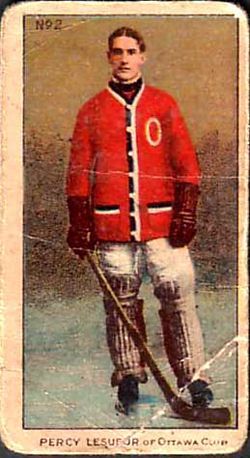
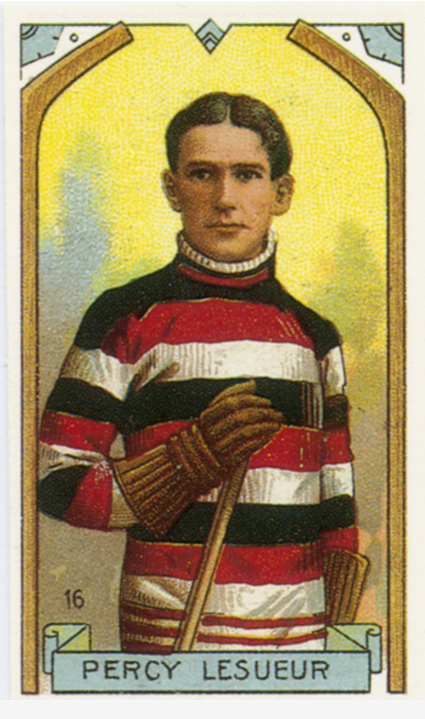
1910-11 Ottawa Senators Percy LeSueur Jersey
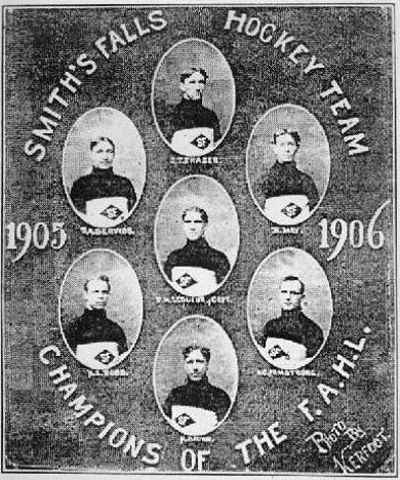
Born on this date in 1881, Percy LeSueur, played amateur hockey in his hometown of Quebec City before the right winger relocating to Smith Falls, Ontario to play for the Smiths Falls Seniors, where he switched to playing in goal, beginning with the 1903-04 season.
He went 3-3 in his fist season and for the 1905-06 season Smith Falls joined the Federal Amateur Hockey League and dominated the competition on their way to a perfect 7-0 record, which earned Smiths Falls the right to challenge the Ottawa Silver Seven for the Stanley Cup. While Ottawa would win the best-of-three series 2 games to none, LeSueur so impressed the Senators with his play, that a week later, with Ottawa having been blown out in the first game of their two-game, total-goals series against the Montreal Wanderers by a score of 9-1, the Silver Seven turned to LeSueur as a replacement for Billy Hauge.
LeSueur accepted the offer and his debut with the Silver Seven was one of the most memorable games in hockey history and perhaps the greatest game ever up to that point, as Ottawa gave up and early goal to increase their deficit to 9 goals before they came roaring back with nine consecutive goals to even the series at 10-10. However, Lester Patrick scored two late goals for the Wanderers to not only spoil the Ottawa comeback but also end their three year stranglehold on the Stanley Cup.
Despite the loss, LeSueur became a full time member of the Silver Seven beginning with the 1906-07 season and would remain so through a series of evolving leagues the club were members of, beginning with the Eastern Canada Amateur Hockey Association. He was second in the league in goals against that season.
During the next ECAHA season, LeSueur was the lone Ottawa representative in the first hockey All-Star game, which was a benefit for the late Hod Stuart. During the regular season, LeSueur was again second in goals against average while repeating his 7-3 won-loss record.
The league shortened it's name to the ECHA for the 1908-09 season during which Ottawa finished in first place with a 10-2 mark as LeSueur once more finished runner-up in the goals against statistic. As league champions, Ottawa was granted possession of the Stanley Cup, having supplanted the previous champion Montreal Wanderers.
As was frequently the case in the formative years of professional hockey, the Silver Seven joined a new league for the 1909-10 season, the Canadian Hockey Association. Before the regular season began, Ottawa defended a challenge for their cup from a team from Galt, Ontario. who they defeated 15 goals to 4 over the two game series. Once the regular season began, the new league was an instant failure, which caused Ottawa to withdraw from the league after playing just two games. They then joined the rival National Hockey Association and went 9-3 to place second behind the rival Wanderers. While Ottawa had defended the cup once more during the NHA season against the Edmonton Hockey Club in late January, possession of the cup passed to Montreal by virtue of their having won the regular season title over Ottawa. With the regular season record from two leagues combined, as well as the Stanley Cup challenge games, LeSueur finished the season with a 15-3 record.
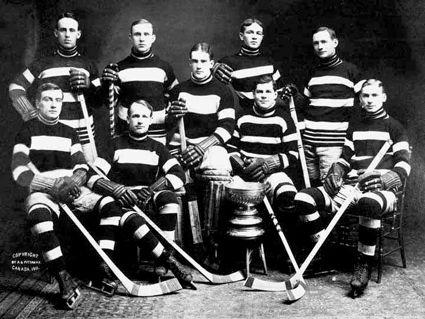
LeSueur was named team captain for the 1910-11 season and Ottawa then stormed the league, powering to a 13-3 record with 122 goals in 16 games, while no other team finished with a record above .500 or 91 goals. LeSueur returned to his customary position with the second best goals against average in the league and, as league champions, Ottawa regained possession of the Stanley Cup, which led to a pair of challenges in March of 1911, which they successfully turned away with a 7-4 win over Galt and a 13-4 thrashing of the Port Arthur Bearcats. They were to be the last Stanley Cup games for LeSueur with Ottawa and he finished with a perfect 7-0 mark in challenge games for the club.
1910-11 Ottawa Senators - holders of the Stanley Cup
LeSueur is in the center of the photo holding
his goalie stick and wearing the leg pads
LeSueur would play three more seasons for the club, by now known as the Ottawa Senators. Additionally, the now veteran LeSueur also coached the team in 1913-14 in addition to maintaining his captain's duties.
With Ottawa having now found a new, younger goaltender to take over their duties in the form of future Hall of Famer Clint Benedict, LeSueur was traded to the Toronto Shamrocks for the 1914-15 season during which he went 8-11. For his final season in hockey, he and the other Shamrocks players were transferred to the Toronto Blueshirts, also owned by Eddie Livingstone. The Blueshirts performed very much the same as the Shamrocks, with LeSueur posting a 9-13 record.
After retiring as a player, LeSueur remained very active in hockey, at times being a referee, manager, arena manager, journalist, broadcaster and coach in both the minor leagues as well as the NHL. Additionally, he is credited with creating the first gauntlet style goalies glove, which evolved from his experimenting with gloves used in baseball. He also designed and patented the first goal net used by the NHL.
LeSueur was inducted into the Hockey Hall of Fame in 1961.
Today's featured jersey is a 1910-11 Ottawa Senators Percy LeSueur jersey with the Senators trademark black, red and white horizontal "barberpole" stripes. This style of jersey was first adopted in 1904, and except for one season with vertical stripes in 1910-11, remained in use through the original Senators final season in Ottawa of 1933-34, with the addition of the letter "O" crest from 1929-30 on.
Labels:
LeSueur Percy,
Ottawa Senators
Tuesday, November 17, 2015
1982 NHL All-Star Dennis Maruk Jersey
Born on this date in 1955, Dennis Maruk caught the attention of NHL scouts while playing junior hockey for the London Knights of the Ontario Hockey Association. As a rookie, Maruk scored 46 goals and 113 points in 1972-73 to break Marcel Dionne's league rookie scoring record , led the club in scoring the next season with 47 goals and 112 points before finishing third overall with 66 goals and 145 points in 65 games, an average of a goal every game and 2.23 points every time he took the ice.
Following that season Maruk was selected 21st in the second round by the California Golden Seals of the NHL as well as being taken 65th overall by the Cleveland Crusaders of the WHA, his relatively low draft positions being due to his smaller size, as Maruk was 5' 8" and 165 pounds. He chose to sign with California and immediately stepped into the Golden Seals lineup, playing all 80 games of the 1975-76 season. He would score 30 goals finish second in team scoring, just one back of Al MacAdam with 62 points.
That would prove to be the troubled Golden Seals final season in Oakland, and the club relocated to Cleveland, Ohio where they were renamed the Barons for the 1976-77 season. He led the Barons in scoring with 78 points their first season in Cleveland and again in 1977-78 with 36 goals and 71 points, 20 more than his next closest teammate which earned him his first NHL All-Star appearance.
For the 1978-79 season, the lowly Barons were merged with the even worse Minnesota North Stars, resulting in Maruk's third club in four seasons despite never having been traded or waived!
Often overlooked, Maruk had one of the finest mustaches in NHL history
Despite his obvious offensive talents, Minnesota would deal Maruk to the Washington Capitals after just two games in the green and gold, a decision Maruk would make Minnesota regret.
Maruk immediately led the Capitals in scoring with a 31 goal 90 point season. Torn knee ligaments ruined his 1979-80 season, limiting him to just 27 games after not playing less than 76 in any previous season.
He returned healthy and with a vengeance, playing all 80 games for the next three consecutive seasons while scoring 50 goals for the first time in 1980-81, good for eight in the league.
The 1981-82 season was a career year for Maruk, as he again led the Capitals in scoring with 60 goals (third in the league) and 76 assists for 136 points, which was fourth overall. His efforts were recognized with his second NHL All-Star Game appearance. Despite his career statistical highs, the Capitals and Maruk missed the playoffs yet again. Maruk's 76 assists and 136 points remain the Captials team records to this day.
While his personal scoring declined to 31 goals and 81 points, the Capitals qualified for the postseason for the first time in their history. It would also be the first time Maruk would participate in a playoff game in his now eight year career.
Maruk was not to be a part of the Capitals future however, as perhaps wishing they had been the benefactors of his 50 and 60 goal seasons, the North Stars reacquired Maruk for the 1983-84 season. A combination of getting older and the North Star style of play limited Maruk's offensive output, and Maruk would never again approach his electrifying point totals from his days in Washington.
His first four seasons in Minnesota were a model of consistency, as he would play in 71, 71 and 70 games, scoring 60, 60 and 58 points. One tradeoff for the lower scoring totals was that Minnesota qualified for the playoffs all three seasons, including a run to the semifinals in 1984.
Injuries began to take their toll on the normally healthy Maruk, and a separated shoulder and torn knee ligaments cut his 1986-87 season to 67 games and 46 points. The following season was more of the same, as he missed the start of the schedule with a lacerated tendon and sara his season end early with a shattered knee cap. He would see the ice for just 22 games that season.
The surgery required on his knee would affect his 1988-89 season, and he would eventually play just 5 games in the minors and 6 with the North Stars before retiring from the NHL for good.
Maruk's final career totals are 888 games played, 356 goals and 522 assists for 878 points.
Outside of his NHL career, Maruk also participated in the World Championships for Canada on four occasions, in 1978 winning a bronze medal, 1979, 1981 and 1983 when he brought home a second bronze.
Today's featured jersey is a 1982 NHL All-Star Game Dennis Maruk jersey. This gaudy one year only style is the most absurd of all the 1980's All-Star jerseys with it's excessive number of stars, proving quite visually that less is sometimes more.
Apparently the design team did not get the word that the disco era had ended. In addition to having far too many stars, the NHL logos on the arms would have been better served by being on the shoulders to leave room for sleeve numbers.
Fortunately sanity would prevail and the next ten years would see some of the best jerseys in the history of the All-Star Game.
Bonus jersey: Today's bonus jersey is a 1981-82 Washington Capitals Dennis Maruk jersey, proving by comparison that less stars can be more effective.
This jersey was worn during Maruk's 60 goal season and can be distinguished by the Maska logo on the back, which was closer to the side of the jersey in previous years. Additionally, the word Washington on the front is much smaller than it was in 1979-80.
Today's video segment begins with a tribute to Maruk on the occasion of his entering the Etobicoke Sports Hall of Fame in 2004.
Speaking of gaudy jerseys, here is some rare footage of Maruk while wearing Canada's loudest design ever at the 1978 World Championships against the Soviet Union.
Looking great, but sans mustache, Maruk is interviewed at the 2009 Canadian Pond Hockey Championships.
Labels:
Maruk Dennis,
NHL All-Star Game,
Washington Capitals
Subscribe to:
Posts (Atom)