History of Jersey 83-93 Banner sm photo History of Jersey 83-93 Banner sm.jpg

Friday, June 14, 2013

1983-84 Winnipeg Jets Dale Hawerchuk Jersey

Dale Hawerchuk scored 103 points for the Cornwall Royals of the QMJHL in 1979-80 and followed up his stellar rookie season with another astonishing 45 points in 18 playoff games from 20 goals and 25 assists to lead the Royals in playoff scoring on their way to the 1980 Memorial Cup championship. He was subsequently named as the league's Rookie of the Year and Playoff MVP.

Still too young to be drafted, Hawerhcuk returned for a second season with the Royals, leading not only the team but the entire QMJHL with 81 goals and 102 assists for 183 points in just 72 games, an average of over 2.5 points per game. He tied with future NHL head coach Marc Crawford to lead the Royals in playoff points with 35 as the Royals became back-to-back Memorial Cup champions.

1990-91 Cornwall Royals team, 1990-91 Cornwall Royals team

Hawerchuk was then named the Memorial Cup MVP as well as the QMJHL Player of the Year as well as the CHL Player of the Year, making him the prime pick in the upcoming draft.

That same season Hawerchuk made his international debut for Canada, playing in the 1981 World Junior Tournament, making a name for himself with 5 goals and 9 points in 5 games.

Thanks to their distant last place finish during their second season of play in the NHL following the demise of the WHA, the Winnipeg Jets were in prime position to select Hawerchuk with the first overall pick in the 1981 NHL Entry Draft.

Hawerchuk did not disappoint, leading the Jets to an NHL record 48 point single season improvement in the standings thanks to a team leading 45 goals and 103 points, making him the youngest player to ever reach 100 points. Additionally, he played in that season's NHL All-Star Game and won the Calder Trophy as the league's Rookie of the Year.

Following the Jets early exit from the playoffs, he made his World Championships debut, scoring three times on his way to earning a bronze medal.

Another 40 goal season followed in 1982-83 before he reeled off five consecutive seasons of 100 points or more, highlighted by his stellar 1984-85 season of 53 goals and 77 assists for 130 points, all career highs, which saw him finish 3rd in the NHL scoring race. His 50th goal on this date in 1985 made him the first Jets player to ever score 50 goals in a season in a 5-5 tie against the Chicago Black Hawks. This was also the same season when Hawerchuk was named as the Jets team captain.

Hawerchuk Jets, Hawerchuk Jets

During that stretch of 100+ point seasons from 1983-84 to 1987-88, Hawerchuk also participated in the 1986 World Championships (6 points in 8 games, earning a second bronze medal), Rendez-vous '87, in which a team of NHL All-Stars took part in a two game series against the Soviet Union, and the prestigious 1987 Canada Cup, during which he scored 4 goals and 6 points in 9 games as Canada emerged victorious.

While his streak of 100 point seasons would end in 1988-89 with "just" 96 points, he would extend his streak of consecutive 40 goal seasons to five. With the Jets missing the playoffs, Hawerchuk would captain Team Canada at the 1989 World Championships in Stockholm, Sweden, totaling 12 points in 10 games as the Canadians brought home a silver medal.

He would play one final season in Winnipeg before being traded to the Buffalo Sabres, along with a first round draft pick (which became Brad May) , in a blockbuster trade for Phil Housely, former Royals teammate Scott Arniel, Jeff Parker and Buffalo's first round pick, which the Jets used to select Keith Tkachuk.

Hawerchuk's goal scoring in Buffalo not approach is totals in Winnipeg, but his playmaking skills would come to the fore, as he helped set up snipers such as Dave Andreychuk, Pierre Turgeon, Alexander Mogilny and Pat LaFontaine, which allowed him to lead the club in scoring in 1991, 1992 and 1994, with a high of 98 points in 1991-92.

Hawerchuk Sabres, Hawerchuk Sabres

Prior to his second season with Buffalo, Hawerchuk made his final international appearance, skating once again for Team Canada at the 1991 Canada Cup, contributing 5 points in 8 games as the Canadians again won the tournament for the second time in his career.

Hawerchuk Canada, Hawerchuk Canada

For the 1995-96 season, Hawerchuk signed as a free agent with the St. Louis Blues, where he played 66 games of the 1995-96 season, which included his 500th NHL goal before a trade to the Philadelphia Flyers for the final 16 games of the season. He would return to the Flyers for the final season of his career in 1996-97, although he was limited to 51 games of the regular season, Hawerchuk closed out his career with the longest playoff run of his career which concluded with his only appearance in the Stanley Cup Finals.

Hawerchuk Flyers, Hawerchuk Flyers

Hawerchuk's final NHL totals were 518 goals and 891 assists for 1,409 points, which still ranks as #18 all-time 15 years after his retirement.

Following his career, it was announced on this date in 2001 that Hawerchuk would be one of that year's inductees into the Hockey Hall of Fame. He also had his #10 retired by the relocated Jets, now known as the Phoenix Coyotes, in 2007 and named to the Buffalo Sabres Hall of Fame in 2011.

Today's featured jersey is a 1983-84 Winnipeg Jets Dale Hawerchuk jersey. This style Jets jersey was first worn in 1979-80 as the Jets marked a new era in franchise history as they gained entry into the NHL. This style would be worn through 1989-90 when the club changed to a new style, and would be the only style worn by Hawerchuk while a member of the Jets.

Winnipeg Jets 83-84 jersey, Winnipeg Jets 83-84 jersey

Bonus jersey: Today's bonus jersey is a 1989 Team Canada Dale Hawerchuk jersey as he captained Canada to a silver medal at the World Championships. This jersey was produced by Tackla and featured the company's diamond shape logo along the shoulders. Tackla supplied jerseys for the World Juniors, the World Championships and the Olympics from 1987 to 1993.

Canada 1989 jersey, Canada 1989 jersey

Today's video section begins with one of our favorite videos of all time, Les Dale Hawerchuks performing their utterly brilliant song "Dale Hawerchuk".


Next, an extended look at the playing career of Hawerchuk.


Thursday, June 13, 2013

1999-00 Grand Rapids Griffins Vyacheslav Butsayev Jersey

Vyacheslav Butsayev, born on this date in 1970, began his career with Torpedo Tolyatti in the second division of hockey in the Soviet Union in 1986 at the age of 16. A center, Butsayev played well and caught the attention of the mighty Central Red Army Club (CSKA) in Moscow.

His first season in the Soviet capital came in 1989-90, which included making his international debut for the Soviet Union at the World Junior Championships, where he came home with a silver medal. Butsayev's timing was both fortunate and unfortunate, as the Soviet Union was in it's last days and the dominance of CSKA was at and end.


 photo ButsayevCSKA.jpg
Butsayev early in his career with Red Army

While Butsayev arrived during the very season CSKA had their 13 year long run of championships come to an end, the Soviet Union would dissolve after his second season with the club, which resulted in many players now making their way to North America for the riches offered by the NHL clubs eager to add the experienced and highly skilled players trained in the Soviet system.

1990-91 would see Butsayev play for both Red Army and then make his World Championship debut where he earned a bronze medal after scoring 4 goals in 10 games. His third season with CSKA was highlighted by making his only Olympics a successful one, as the team dubbed the Unified Team would win the gold medal. Later that spring he could compete in his second World Championships under the banner of the Commonwealth of Independent States.

Butsayev would play five games of the 1992-93 season with CSKA before leaving for the Philadelphia Flyers organization. Once in North America, he would play 24 games with the Hersey Bears of the American Hockey League and 52 with the Flyers, where he scored 2 goals and 16 points.


Butsayev Flyers photo ButsayevFlyers.jpg
Butsayev with the Flyers during his rookie season in the NHL

Following the season he would play for the Russian National Team at the 1993 World Championships which brought home the first gold medal for Russia and the second of Butsayev's career to go with his Olympic gold.


Butsayev Russia photo ButsayevRussia.jpg
Butsayev as a member of the Russia National Team in 1993

He would begin the 1993-94 season with the Flyers, including scoring a hat trick on December 3rd against the Vancouver Canucks, but a trade in February saw him head west to the San Jose Sharks. WIth the start of the following NHL season delayed by labor issues, Butsayev headed home to Russia and played 9 games with Lada Togliatti. He returned to North America later that season, but was limited to 13 games with the Kansas City Blades of the International Hockey League and just 6 games with the Sharks.


Butsayev Sharks photo ButsayevSharks.jpg
Butsayev during his tenure with the San Jose Sharks

For 1995-96, Butsayev signed on as a free agent with the Mighty Ducks of Anaheim, but spent the vast majority of the season with the short-lived Baltimore Bandits of the AHL. It was there that he set a new personal best with 23 goals and 65 points in 62 games. In 7 games with the Mighty Ducks, he would tally 1 goal.

Adding some new stamps to his passport, Butsayev played in Sweden's Elitserien during the 1996-97 season, splitting time between Södertälje SK (16 games) and Färjestads BK (24 games). Freed from the long regular season schedule of the NHL, Butsayev would return to the World Championships with Russia for the first time in four years.

He would return to North America in 1997-98, playing the entire season with the Fort Wayne Komets of the IHL, where he had a fine season to get back on the radar of the NHL clubs, leading the team in scoring with 36 goals and 87 points in 76 games.

He was signed by the Florida Panthers, but could not crack their lineup however, and spent another season in Fort Wayne, scoring 72 points in 71 games to again lead the Komets in scoring. He did appear in one game with the Panthers, who then traded him to the Ottawa Senators in March of 1999, where he played in 2 games.

1999-98 was more of the same for Butsayev. He was claimed by the Tampa Bay Lightning in the Waiver Draft in September of 1999 and played in just 2 games for Tampa Bay before being reclaimed by the Senators off of waivers at the end of October. He would play in 3 games for the Senators, but eventually spent the bulk of his season back in the IHL with the Grand Rapids Griffins, scoring 63 points in 68 games and then adding another 16 points in 17 playoff games as the Griffins would make it to the Tuner Cup Finals.

Butsayev played the entire 2000-01 season with Grand Rapids, posting the second 30 goal season of his career with 33 on his way to 68 points in 75 games.

For the 2001-02 season, Butsayev would return to Russia where he joined Yaroslavl Lokomotiv for the first of three seasons, which included back to back championship titles in 2002 and again in 2003, which included leading the league in playoff scoring that season. 2002 would also see Butsayev take home a silver medal at the World Championships. Following his final season with Lokomotiv of 2003-04, he would make his sixth and final World Championship appearance.


Butsayev Lokomotiv photo Butsayev2002Lokomotiv.jpg
Butsayev celebrating his first championship with Lokomotiv in 2002

He would split the 2004-05 season between Severstal Cherpovets (31 games) and his former club, CSKA Moscow (24 games). His career would wind down by playing the 2005-06 season with HC MVD and 2006-07 with HC Dmitrov of the Russian second division, the 19th team of his career.

Since the conclusion of his playing days, Butsayev has gone into coaching and now is now the head coach of CSKA Moscow in the KHL.

Today's featured jersey is a 1999-00 Grand Rapids Griffins Vyacheslav Butsayev jersey as worn during the season the Griffins made it to the Turner Cup Finals. The Griffins were formed in 1996 as members of the IHL and became affiliated with the Senators in 1999-00 and joined the AHL in 2001-02 following the demise of the IHL. Since the 2002-03 season, the Griffins have been affiliated with fellow Michigan residents, the Detroit Red Wings, located just three hours east.


Grand Rapids Griffins 99-00 jersey photo GrandRapidsGriffins99-00Fjersey.jpg
Grand Rapids Griffins 99-00 jersey photo GrandRapidsGriffins99-00Bjersey.jpg

Our video section today begins with the final game of the 1992 Olympics, where Butsayev and the Unified Team won the gold medal. Note the stripes across the chest of the Unified Team sweaters, but no cresting, as things were changing so rapidly with the demise of the Soviet Union, that the team wore old CCCP crested jerseys with the letters removed, but the striping still intact, including the notch where it hugged the shape of the "P"! Bonus points go to anyone who can spot #22 Butsayev.


More hockey greatness, as Butsayev and CSKA Moscow take on their rivals Dynamo Moscow from November of 1990.


Wednesday, June 12, 2013

1978-79 Quebec Nordiques Marc Tardif Jersey

After playing two seasons with the Montreal Junior Canadiens, Marc Tardif was selected by the Montreal Canadiens with the second overall pick in the 1969 NHL Amateur Draft under some unusual circumstances.

Montreal had invoked their right to select two French Canadians under a provision created by the NHL back in 1936 in an effort to ensure good attendance in Montreal. This system remained in place until 1943. This rule was then brought back again in 1963, the year of the first NHL Draft, as long as the player had not already been signed by another team during the preceding years when teams would simply sign whatever young talent that appealed to them.

None of the players Montreal selected between 1963 and 1967 ever played in the NHL, but in 1968 goaltender Michel Plasse ended that streak. In 1969, it was determined this would be the final year of the special Canadiens provision, as well as teams sponsoring junior clubs, as going forward all players 20 and older would be eligible for a universal draft.

With one last chance to uncover some overlooked talent, the Canadiens struck gold when they chose Rejean Houle and Tardif. Houle would eventually play for the Canadiens from 1969 to 1973 and again from 1976 to 1983.

Tardif, born on this date in 1949, would play the majority of the 1969-70 season with the Montreal Voyageurs of the American Hockey League, amassing 27 goals and 58 points in 45 games. He would also make his NHL debut, seeing action with the Canadiens in 18 games, scoring 3 goals in the process.

Tardif would never play another game in the minors, as he established himself as a regular in the Montreal lineup beginning with the 1970-71 season. Playing time was at a premium in a lineup filled with future Hall of Famers and All-Stars such as Jean Beliveau, Yvan Cournoyer, Peter Mahovlich, Jacques Lemaire, Henri Richard and Frank Mahovlich, but Tardif held his own with 49 points in 76 games in a season which concluded with a Stanley Cup championship.

Tardif Canadiens photo TardifCanadiens.jpg
Tardif broke into the NHL with the Montreal Canadiens

Tardif raised his point total to 53 in 1971-72 and nearly matched it with 50 points in 1972-73, a season which saw Tardif once again have his name engraved on the Stanley Cup.

Change was afoot in the world of hockey however, as that same season saw the debut of the rival World Hockey Association, who made a splash by signing no less a talent than Bobby Hull.

Aggressively looking to stock their rosters, the WHA came calling and Tardif elected to join the upstarts when he signed with the Los Angeles Sharks, immediately leading them in scoring in 1973-74 with 40 goals and 30 points. Tardif was also chosen for Team Canada in the 1974 Summit Series against the Soviet Union, registering 2 assists in 5 games.

Tardif Sharks photo TardifSharks.jpg
A rare shot of Tardif in a Sharks jersey

The Sharks finished 8th out of 12 in attendance that season, but last in the standings. For 1974-75, they were sold to new owners and the franchise was relocated to Detroit, becoming known as the Michigan Stags. The whole affair was a dismal failure, and the team folded in mid-January, as they were unable to compete with the NHL's Detroit Red Wings. Fortunately for Tardif, he was gone by then, having been traded to the Quebec Nordiques in December.

Despite his late arrival, Tardif finished fourth in Nordiques team scoring with 72 points in 53 games. His 38 goals, when combined with his earlier 12 for the Stags, gave him an even 50 for the season, good for sixth in the league. Life with the Nordiques was a far cry from the Stags, as the Nordiques made it all the way to the Avco Cup Finals that season.

Tardif Nordiques photo TardifWHANordiques.jpg
Tardif was an All-Star with the Nordiques

Now fully settled in Quebec, Tardif tore through the WHA with a stunning 71 goals (only the second professional to ever score 70 goals in a season) and 77 assists, leading the league in both categories to win the WHA scoring title with 148 points, 25 clear of Hull.

Tardif's playoffs were ended by a violent on-ice attack by Rick Jodzio of the Calgary Cowboys, which left Tardif with serious head injuries and Jodzio charged in court with bodily harm with intent to injure, as there were fears that Tardif had suffered brain damage in the assault.

Tardif was named team captain for the 1976-77 season but being limited to 62 games that year saw his point total sag to 109, but still good enough for second on the Nordiques. In the postseason, Tardif was able to play in 12 of the team's 17 games as the Nordiques would eventually capture the WHA championship, the third championship of his career.

1976-77 Nordiques team photo 1976-77QuebecNordiquesteam.jpg
The WHA champion 1976-77 Quebec Nordiques

Back to full health in 1977-78, Tardif again led the WHA in scoring with a career best 154 points from 65 goals and 89 assists, again both league leading totals. The 1978-79 season saw another 40 goal season with 41 goals and 96 points in what would be the final season of the WHA.

Tardif Nordiques photo TardifWHAMediaGuide.jpg
The face of the WHA, league MVP Tardif
on the cover of the league media guide

Under some highly restrictive terms, the Nordiques became one of four surviving WHA teams granted entry as expansion franchises in the NHL. The high flying Nordiques were gutted by the terms of the expansion deal, but Tardif was one of the few players Quebec was allowed to protect.

With the Nordiques struggling to find their way in the NHL, Tardif's point totals would plummet from the stellar levels he achieved in the WHA, but were still quite respectable. Over the final four seasons of his career, Tardif would score a high of 39 goals and 70 points in 1981-82.

Tardif Nordiques photo TardifNHLNordiques.jpg
Tardif wearing an NHL era blue Nordiques jersey, now with a red crest

His final combined career totals were 963 games played with 510 goals and 557 assists for 1,067 points with his 316 WHA goals the most in league history and 666 points second overall. He was also named the WHA's Most Valuable Player in 1976 and 1978, the two seasons he would win the scoring championship. Tardif also played in the WHA All-Star Game as well as the NHL's All-Star Game in 1982. His #8 was retired by the Nordiques in 1983.

Today's featured jersey is a 1978-79 Quebec Nordiques Marc Tardif jersey as worn during the Nordiques final season of the WHA as Tardif scored 41 goals to finish as the league's all-time leading goal scorer.

The jerseys used by the Nordiques in the WHA were a far cry from today's high tech "systems", as they were  a lightweight mesh with screen printed cresting, names and numbers about at the level of today's beer leagues. Note the thinning of the number 8 on the back due to wear and repeated washings.

Keen eyed readers will notice the white logo with red trim rather than the more familiar red crest used from 1980-81 while as a member of the NHL.

Quebec Nordiques 78-79 jersey photo QuebecNordiques78-79Fjersey.png
Quebec Nordiques 78-79 jersey photo QuebecNordiques78-79Bjersey.png

Bonus jersey: Today's bonus jersey is a 1977 WHA Eastern Conference All-Star Marc Tardif jersey as worn during the East's 4-2 win over the West in Hartford. This would be the only time this exact style was worn, as the 1974 and 1975 versions had a blue background to the main crest and the format of the game was different in 1976, 1978 and 1979, which dictated different jersey styles.

1977 WHA Eastern Conference All-Star jersey photo WHA1977All-Starjersey.jpg
photo courtesy of Classic Auctions

For our French speaking readers, a video about the Jodzio incident which left Tardif injured and Jodzio in court. Note the presence of the police on the ice at one point!


Next up, a sports report about the Nordiques winning the 1977 Avco Cup, which includes footage of the final game and their championship parade, which all begins at the 1:44 mark after the baseball news of the day.


Finally, the end of Game 7 of the 1977 Avco Cup Finals and the post game celebrations, with Tardif accepting the Avco Cup, footage worth watching just to see how many fans ran onto the ice after the championship was won!

Tuesday, June 11, 2013

2001-02 Detroit Red Wings Dominik Hašek Jersey

The Detroit Red Wings entered the 2002 Stanley Cup Playoffs as the number one seed in the Western Conference due to their league leading 116 points in the regular season standings, 15 points better than the next best team, the Boston Bruins and their 101 points, the only other club to reach 100.

The Red Wings first opponent was the Vancouver Canucks, who came into the playoffs as the #8 seed with 94 points, 22 back of Detroit. The Canucks would win the first two games in Detroit 4-3 and 5-2 to get the attention of the hockey world, but the Red Wings turned the tables back in Vancouver with a 3-1 win followed by a 4-2 triumph to even the series at 2 games apiece. Back at home Red Wings goaltender Dominik Hašek shut out the Canucks with a 25 save performance to put the Canucks on the brink and eliminated Vancouver back on their home ice with a 6-4 win, their fourth straight after losing the first two.

 photo HasekRedWings2002Finals.jpg

With both the second seeded Colorado Avalanche and third seeded San Jose Sharks winning their series, the Red Wings next opponent would be the winner of the #4 St. Louis Blues vs. the #5 Chicago Blackhawks. St. Louis prevailed 4 games to 1 to earn the right to travel to the Motor City.

Hašek greeted the Blues with a 2-0 blanking in Game 1 on 23 saves as St. Louis actually outshot Detroit by a 23-20 margin. Game 2 went the way of the Red Wings 3-2 before the series moved to St. Louis.

The Blues won 6-1 on home ice but Detroit took Game 4 by a 4-3 margin and closed out the St. Louis back in Detroit with their second shutout of the series, this one 4-0 as the Red Wings limited the Blues to just 16 shots on Hašek.

Hasek Red Wings 2002 photo Hasekhelmet.jpg

Their rivals, the Avalanche were once again the roadblock between the Red Wings and the Stanley Cup Finals as they met for the Western Conference title. While Detroit took the first game 5-3 at the Joe Louis Arena, Colorado fought back with a 4-3 overtime win in Game 2. Detroit responded with a 2-1 overtime win in Denver but the Avalanche evened the series at 2-2 with a 3-2 win in Game 4.

In Game 5, once again the Avalanche would take an overtime win in Detroit, this time 2-1 to put the Red Wings season on the line. Hašek rose to the occasion back in Denver with a 2-0 shutout in Game 6, out dueling Patrick Roy with a 24 save shutout.

Hasek Red Wings 2002 photo HasekvsColorado1.jpg
Shutout #4 came in Denver against the Avalanche

The decisive Game 7 was back in Detroit and was a shocker. The first Red Wings goal came just 1:57 into the game and by the 13 minute mark it was 4-0 for Detroit and just seven minutes into the second period Roy had been chased to the bench as the Red Wings were now up 6-0. After the Red Wings made it 7-0 at the 16:09 mark, the only question that remained was would Hašek get his record setting 5th shutout in one playoff year. He would indeed, as the Detroit defense only allowed the Avalanche 19 shots for the game and Hašek completed his second consecutive blanking of Colorado to claim the record in style.

Hasek Red Wings 2002 photo HasekvsColorado2.jpg
Hašek's shutout #5 came in his very next game

The Red Wings now moved on to the Stanley Cup Finals against the Carolina Hurricanes. Of note, the matchup between Hašek of Czechoslovakia and Carolina's Arturs Irbe from Latvia was the first matchup of two European goaltenders in NHL history.

Game 1 went to the Hurricanes 3-2 in Detroit, but the Red Wings responded with a 3-1 win in Game 2 and then took Game 3 in Raleigh 3-2. Game 4 saw Detroit limit Carolina to 6, 7 and then 4 shots on goal and Hašek turned them all away for a 17 save blanking on this date in 2002, pushing his record now out to 6 shutouts in the same playoff season.

Now up three games to one, Hašek and the Red Wings would clinch the Stanley Cup back on home ice in Detroit with a 3-1 win in Game 5 and make Hašek the first European starting goaltender to lead his team to a Stanley Cup championship.

Hasek Red Wings 2002 photo HasekCup2002.jpg

Today's featured jersey is a 2001-02 Detroit Red Wings Dominik Hašek jersey as worn in Carolina when he extended his playoff shutout record from five to six. While it was Hašek's first season with the Red Wings, their iconic jerseys had been around since the franchise changed their name from the Falcons to the Red Wings in 1932, remaining essentially unchanged since, with only such details as changes to the number font a couple of times and the addition of names in the 1970's worth noting.

This jersey features the 2002 Stanley Cup Finals patch, a tradition which began back in 1989 which sees the two finalists wearing a commemorative patch to mark their achievement.

Detroit Red Wings 01-02 jersey photo DetroitRedWings01-02Fjersey.jpg
Detroit Red Wings 01-02 jersey photo DetroitRedWings01-02Bjersey.jpg

And you thought the Red Wings and Avalanche rivalry was over with by 2002…


Here are the Top 10 Dominik Hašek NHL moments. Among hundreds.

Monday, June 10, 2013

1995-96 Colorado Avalanche Joe Sakic Jersey

With the financial troubles of the Quebec Nordiques mounting, they found it difficult to compete with rising player salaries, made even more difficult by a weakening Canadian dollar. Playing in by far the smallest market in the NHL, plus the language barrier facing potential free agents, unlike bi-lingual Montreal, Quebec City was virtually all French, the team owner asked for a bailout from the Quebec government, but was turned down. The team was subsequently sold to a group of investors from Denver, Colorado, where the team was moved and renamed the Colorado Avalanche.

The fans in Colorado were immediately handed a team stocked with captain Joe Sakic, Valeri Kamensky, Adam Deadmarsh, Mike Ricci, Adam Foote and Peter Forsberg. The team later added Claude Lemieux just days before the start of the season and Sandis Ozolinsh later in October.

If that weren't enough, former Montreal Canadiens captain Mike Keane and no less than Patrick Roy arrived in early December after Roy had a public falling out with the Canadiens organization, a trade that never would have happened had the franchise remained in Quebec as the Nordiques, the Canadiens bitter province rivals.

With Roy now anchoring the team in goal, they finished with a 47-25-10 record, easily winning the Pacific Division by 25 points. They defeated the Vancouver Canucks, Chicago Blackhawks and President's Trophy winning Detroit Red Wings, all by identical 4 games to 2 margins. The series against the Red Wings would kick off one of the greatest NHL rivalries, as the teams would meet in the playoff five times in seven years, with three of those being for the right to go to the finals, plus several memorable regular season brawls - which included the goaltenders! The rivalry has even been chronicled in book "Blood Feud", which can be purchased here.


The Florida Panthers would be the opponent for the Avalanche in the Stanley Cup finals, which would open in Denver. Colorado conceded the first goal in Game 1 but three goals in a five minute span of the second period would turn the game in favor of the Avalanche.

Game 2 was tied at 1-1 after eight minutes, but from then on it was all Colorado as they powered to a decisive 8-1 win as the series moved to Florida.

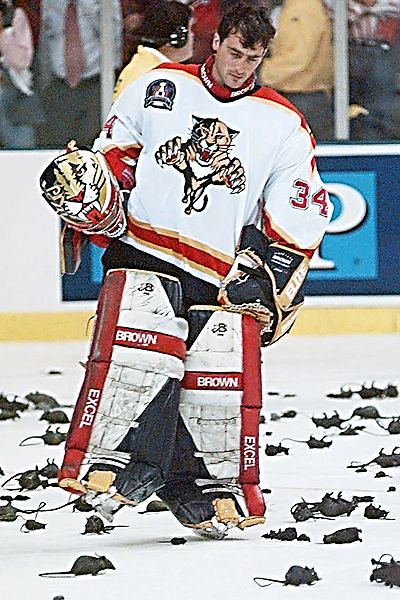
One of the lasting memories of that year's playoffs were the Panthers fan's celebratory rats, which would rain down on the ice by the thousands for each Florida goal, causing opposing goalies to seek shelter inside their net until the hailstorm subsided.

 photo penguinsgoalierats-1.jpg

The celebration stemmed from captain Scott Mellanby deftly killing a rat with a one-timer in the dressing room prior to the team's opening game of the season. When he followed it up by going out and scoring two goals that night, goaltender John Vanbiesbrouck dubbed the feat "a rat trick".


Game 3 in Florida saw Lemieux return from a suspension to score the first goal of the game but Ray Sheppard equalized for Florida at 9:14 and the rats rained down. The Panthers then took the lead on Rob Niedermayer's goal at 11:19 and again thousands of rats pelted ice and Roy, who was unable to escape to the safety of the bench. Following the conclusion of the first period Roy made a resolute declaration - "No more rats".

The quick-strike Avalanche needed just 1:38 into the second period to tie the game on Keane's goal before Sakic got the game winner just 1:22 later as Roy held Florida scoreless the rest of the way for a commanding 3-0 series lead.

The final game, played on this date in 1996, would be legendary. With their lives on the line, Vanbiesbrouck would match Roy save for save as the game progressed through a scoreless first period and then a second. The third period also could not produce a winner and regulation ended deadlocked at 0-0.

Colorado put on the pressure in the first overtime, outshooting Florida 11-7 but Vanbiesbrouck did not bend. The Panthers turned the tables in the second overtime 18-12 but failed to solve Roy to send the game to it's third extra period. Finally, Uwe Krupp won the cup with the cup winning goal at 4:31 for a 1-0 victory for the Avalanche. True enough, Roy kept his promise of no more rats, holding Florida scoreless for over seven periods of play following his declaration following the first period of Game 3. His streak included 18 saves for the remainder of Game 3 and 63 saves in Game 4 for a total of 81 shots and no goals.

Sakic 1996 Stanley Cup photo Sakic1996Cup.jpg
Joe Sakic hoists the 1996 Stanley Cup

With the Stanley Cup win, Russians Alexi Gusarov and Kamensky and Swede Forsberg became members of the exclusive Triple Gold Club for players who have won Olympic Gold, World Championship Gold and the Stanley Cup.

Today's featured jersey is a 1995-96 Joe Sakic Colorado Avalanche jersey with the 1996 Stanley Cup finals patch as worn by Joe when he was awarded the Conn Smythe Trophy. following his 18 goals and 34 points in the playoffs.

When the Avalanche landed in Colorado, the adopted an entirely new identity, from the singular team name, unique to the NHL colors and ground breaking jerseys, which featured the unusual striping pattern reminiscent of a mountain range.

The Stanley Cup finals patch was the first of many that the Avalanche would wear with this style jersey, that would remain unchanged through the 2006-07 season.

Colorado Avalanche 95-96 jersey photo ColoradoAvalanche95-96F.jpg
Colorado Avalanche 95-96 jersey photo ColoradoAvalanche95-96B.jpg
Colorado Avalanche 95-96 jersey photo ColoradoAvalanche95-96P.jpg

The Stanley Cup was the first major championship for a team located in Denver, no doubt leaving the fans left behind in Quebec City to look on in yearning. The Cup was the second for a team that originated in the World Hockey Association, with the first being the Edmonton Oilers.

Sunday, June 9, 2013

2013 Table Hockey World Championships Update

The 2013 Table Hockey World Championships were narrowed down from 121 Group Stage entrants to a final group of 24 players who qualified for the head to head playoffs. With some receiving byes, those 24 were narrowed down to 16 and then the last 8 who met in the Quarterfinals.

2013 ITHF WC logo photo 2013WorldTableHockeyLogo.png

One one of the four Quarterfinal matches progressed to a seventh game as Ahti Lampi defeated fellow Finn Jan Pelkonen. while the other three matches all saw Russians eliminated.

Lampi lost to Edgars Caics in the first Semifinal in a dramatic 2-1 Game 7 and Atis Silis prevailed, also in the full seven games, over Maxim Borisov to set up an all Lativan final.

Caics and Silis shake hands photo CaicsandSilisshakehands.jpg
Caics and Silis shaking hands before the finals

To get to the finals, Caics went 25-3-1 to win the preliminary Group B, edging Silis who opened the tournament at 22-2-5 with Caics winnign their head to head meeting 4-3.

They were both placed in the Final Group II, which Borisov won at 23-4-4 for 50 points with Caics and Silis just behind at 49 points with Caics holding the edge at 22-4-5 and Silis at 21-3-7, but both easily advanced to the Round of 24 and drew byes based on their high placings.

In the Round of 16, Silis swept Latvian Valts Smagars in 4 while Caics needed 6 games to eliminate Russian Alexey Titov to make it to the Semifinals.

Silis took Game 1 of the finals 4-2 but Caics fought back with a 6-1 win in the second game. Silis took a close Game 3 3-2 and dominated Game 4 with an easy 7-1 win before claiming top honors with a 3-2 overtime win in Game 5 to become the first Lativan world champion in 13 tournaments.

In other results, Russia defeated Latvia to win the Team championship, Maria Miloradova took the Ladies title and Borisov took some measure of consolation by winning the Junior championship to go with his third place in the Open Division.

Friday, June 7, 2013

2013 Table Hockey World Championships

Today marks the start of the International Table Hockey Federation (ITHF) 2013 Table Hockey World Championships in Stavanger, Norway.

2013 ITHF WC logo photo 2013WorldTableHockeyLogo.png

The origin of competitive table hockey dates back to the Swedish Championships in 1982 and the Table Hockey World Championships began in 1989 and were held in Stockholm, Sweden. The next edition would not arrive until 1992 in Brno, Czechoslovakia and was quickly followed by the 1993 championships in Paris, France. The tournament then began an every other year schedule which it has maintained since.

Swedes won the first nine World Championship titles, the first coming in 1989 when Mikael Krantz defeated a field of 42 players from 7 countries. 1992 saw Jacob Lindahl win the first of his two titles in the second World Championships, defeating 32 others. Lindahl won the fourth World Championships on home soil to claim his second crown, outlasting a field of 66 players from 8 countires.

Hans Österman then took the 1997 version in Helsinki, Finland and repeated the feat in 2001 in Prague and again in 2005 in Riga, Latvia to become the only 3-time World Champion when he defeated that year's Junior Champion Roni Nuttunen of Finland to prevail over a field which had grown to a record 132 entrants from 22 nationalities!

Österman's third title extended the run of Swedes to nine, which was finally broken when junior Nuttunen became the first player to win back-to-back championships which came in 2007 (Moscow, Russia) and 2009 (Budapest, Hungary). Oleg Dmitrichenko of Russia took the 2011 tournament in Turku, Finland when he dethroned Nuttunen, who was making his fourth straight appearance in the finals. Dmitrichenko prevailed over a field of 105 players from 17 countries. To date the championships have also been held in Germany, the Czech Republic and Switzerland.

ITHF 2011 photo DmitrichenkodefeatingNuttunen2011.jpg
Oleg Dmitrichenko winning the 2011 World Championships

In addition to the Men's singles championships, the women have also been participating in their own tournament along side the men since 1992 in Czechoslovakia. France (1), Sweden (3), Finland (4) and Russia (3) have all won championships in that order, with Pila Pulliainen's three consecutive from 2001 to 2005 being the most among the women, but Russian Maria Yalbacheva will be looking to equalize that this weekend.

1997 saw the introduction of the World Junior Championship (18 and under) with Nuttunen standing out for his win in 2005 and achieving the double World Championship in 2007, as he also won the Open Division, the first junior age player to ever do so.

ITHF WC 2007 photo Nuttunen2007double.png
Nuttunen won both the Open and Junior titles in 2007

The World Veteran Championships (40 and over) were introduced in 2005 and have been contested four times to date.

There are also team championships for both men and women, with the men's division beginning in 1992 and following a similar path to the singles titles, with Sweden dominating the first seven before Finland took one, followed by Sweden again and now Russia twice. The women's Team Championship started in 2005 with the first three going to Russia and the most recent to Finland.

Stiga table hockey games of Sweden are the standard used by the ITHF, the Stiga Play Off model in particular, which features all left handed international player figures as opposed to the Stiga Stanley Cup model, which has a mix of left and right handed NHL players.

Stiga Play Off Hockey photo stigaplayoff.jpg
Stiga Play Off Hockey

The ITHF was founded in 2005 and currently has 18 member nations, all familiar hockey playing nations in Europe except Canada and the United States from North America. In addition to the World Championships, there are many local, regional and national tournaments which take place each season.
The 2013 World Championships  begin on Friday at 9:00 AM in Stavanger with competition n the Juniors, Veterans and Ladies Team competitions followed by the individual competitions in the same groups, all of which conclude with a medal ceremony at 9 PM.

Saturday sees the Open Division Individual Group Stages in the morning followed by the Open Team tournament followed by their medal ceremony to end the day, while Sunday is all about crowning the Open Division Individual winner, with over 100 competitors narrowed down throughout the day to determine the overall champion.

To follow the championships, please visit Stiga's Table Hockey Facebook page, the World Championships Facebook page or the tournament website.

To get involved or participate in a tournament, contact the Canadian Table Hockey Association or the United States Table Hockey Association.

To see some of the skills possessed by table hockey players, take a look at this impressive demonstration of goal scoring techniques.


Here is a video recap of the 2011 World Championships, which featured a final between Dmitrichenko and Nuttunen of Finland.


Ever wonder what the knob hockey players are saying on the ice? Here's your chance.

Thursday, June 6, 2013

1989-90 Boston Bruins Cam Neely Jersey

Born on this date in 1965, Cameron "Cam" Neely played his junior hockey for the Portland Winter Hawks of the Western Hockey League. He gained recognition for his 56 goal, 120 point season in 1982-83 when he led the Winter Hawks to the Memorial Cup championship with 20 points in 14 playoff games, which earned him a 9th overall selection by the Vancouver Canucks in the 1983 NHL Entry Draft.

Neely Winter Hawks
1983 Memorial Cup champion Cam Neely

He began the next season with Portland, but after 19 games made his NHL debut with the Canucks. He played well enough, scoring 31 points in 56 games, as well as gaining his first NHL playoff experience with four games in which he scored a pair of goals.

Neely Canucks
Cam Neely in the Canucks "Flying V" jersey

The next two seasons with Vancouver saw Neely play over 70 games and score 39 and 34 points, Additionally, he showed his rugged side with 137 and 126 penalty minutes. He was however, playing behind veterans Stan Smyl and Toni Tanti and Canucks coach Tom Watt was not a fan of Neely's defensive game, which combined to make Neely expendable in the eyes of the Canucks, who dealt him, also on this date, to the Boston Bruins along with their first pick in the 1987 draft, for former 100 point scorer Barry Pederson.

The change in scenery saw an immediate rise in Neely's production and he scored more goals in his first season in Boston than he did points in Vancouver the year before, and more than doubled his point total from 34 to 72, as the Bruins coaching staff gave him more playing time which led to more confidence.

The 1987-88 season saw a rise in goals to 42 and the first deep playoff run of Neely's career, as the Bruins made it all the way to the Stanley Cup Finals, a run that saw Neely contribute 17 points in 23 games. After a then career best 75 points in 1988-89 before exploding with 55 goals and 92 points in 1989-90 prior to the Bruins making a return to the Stanley Cup Finals later that season. Neely had an excellent playoff season, with 28 points in 21 games.

Proving his 55 goal season was no fluke, Neely lit the lamp 51 times in 1990-91 and registered a second consecutive 90 point season with 91. A knee injury suffered during the conference finals that year would change the course of Neely's career and limit him to just 22 games over the next two seasons combined.

Neely Bruins throwback
Cam Neely in the 1991-92 Bruins throwback jersey

He rebounded in 1993-94 with 50 goals in his 44th game of the season, a mark only Wayne Gretzky has surpassed. Still suffering from injury problems, Neely was limited to just 49 games that year, leaving many to wonder what his goal total could have reached had he played a full season that year. His ability to return to such a high level of play after essentially missing the previous two seasons earned Neely the Masteron Trophy for 1994.

After two more seasons limited to 42 and 49 games, along with a drop in production to point levels in the 40's, led Neely to call it a career due to a degenerative hip condition.

Neely's #8 was retired by the Bruins in 2004 and he was inducted into the Hockey Hall of Fame in 2005.

Today's featured jersey is a 1989-90 Boston Bruins Cam Neely jersey as worn during Neely's finest season in which he set personal highs with 55 goals and 92 points.

This long-serving Bruins jersey was first used back in 1974 and quickly gained secondary shoulder logos and names on the back by 1977 and then remain essentially unchanged through it's retirement at the end of the 1994-95 season.

Boston Bruins 1989-90 jersey

Our first video is a very well done look at highlights of the career of Cam Neely.


Here is a unique look at Cam Neely's 50 goals in 44 games - all 50! - in the 1993-94 season.


Finally, Cam Neely shares his favorite work out routine and then expresses his feelings in no uncertain terms regarding the debut of ESPNews.


Wednesday, June 5, 2013

Grundlovsdag

Today is Grundlovsdag, or "Constitution Day" in Denmark, which celebrates the anniversary of the signing of the Danish Constitution in 1849, which severely limited the King's power and secured basic civil rights.

Danish flag photo DanishFlag.jpg

This day also honors the Constitution of 1953, which among other things allowed women the right to inherit the throne, which is currently being put to good use by Queen Margrethe II of Denmark, who became the first woman to hold the Danish throne in 1972.

 photo MargretheIIofDenmark.png
Queen Margrethe II of Denmark

Constitution Day in Denmark is rather low key compared to other countries, as some shops are open until noon before then closing for the rest of the day, with celebrations including political speeches and festivals. June 5th also happens to be Father's Day (Fars Dag) in Denmark.

Danish kids photo Danishkids.jpg

Denmark currently ranks 12th in the IIHF Mens' World Rankings and has played at the top level of the World Championships since 2003 after an absence of 54 years. While regularly having a tough time, finishing between 10th and 14th our of 16 teams in 10 out of 11 years) the Danes have successfully avoided relegation every time. The first high point for Denmark came in 2003 with an opening 5-2 win versus the United States followed by a 2-2 tie against eventual champions Canada six days later.

Denmark celebrates photo Denmarkcelebrates.png
Denmark celebrating their 2003 victory over the United States

Their highest finish came in 2010 when the Danes finished 8th after advancing to the Qualification Round thanks to a 4-1 win over Finland and a 2-1 overtime victory over the United States. Then then demolished Slovakia 6-0 to open the Qualification Round, which combined with their earlier win over Finland, was enough to put Denmark into the Playoff Round where they fell to Sweden 4-2.

Current Danes in the NHL include the Canucks Jannik Hansen, Mikkel Bødker of the Coyotes, Franz Nielsen of the Islanders, Montreal's Lars Eller, Philip Larsen of Dallas and the Senators Peter Regin. Other successful Danes currently play in the Swedish Elitserien.

Eller Denmark photo LarsEllerDenmark.jpg
Denmark's Lars Eller

Today's jersey is a 2005 Denmark National Team Jesper Damgaard jersey. Damgaard, a defenseman, was the long-time captain of the Danish National Team and played for Denmark at the World Championships a record 17 times, leading the team in games played with 256 while totaling 114 points from the blueline. This jersey features a pair of my custom printed Oddset sponsor patches.

2005 was the high point in our book for international hockey jerseys, as nearly all teams had complete redesigns or very well executed tweaks to their existing jerseys in time for the World Championships in Austria. It was also the last World Championship with the traditional jersey styling and construction before the introduction of the strange feeling, cookie-cutter templated and rather ugly Nike Swift jerseys of 2006.

Denmark 2005 jersey photo Denmark2005F.jpg
Denmark 2005 jersey photo Denmark2005B.jpg

Today's video section begins with Denmark's top ten goals since earning their promotion in 2003.


Our final highlight today is Lars Eller's first NHL goal, which came in his debut on November 5, 2009.


hit counter for blogger