The Toronto Arenas had won the Stanley Cup in 1918 but quickly ran into financial difficulties and were sold by their owners, The Toronto Arena Company, who owned the Arena Gardens rink where the team played, to new owners for $5,000. The new owners then changed the club's name to the Toronto St. Patricks and their sweaters from blue to a more appropriate green.
Rebounding from a chaotic 5-13 season resulting from the sale or defection of their best players due to the financial problems of the previous ownership, the club was essentially starting over for the 1919-20 season.
While they did not qualify for the playoffs, the St. Patricks did improve their season record to 12-12 and were led in points by Corb Denneny, a holdover from the Toronto Arenas, who totaled 24 goals and 36 points in 24 games, good for fourth in the three year old NHL.
Future Hall of Famer Babe Dye led the club with 33 goals and 38 points in 23 games in 1920-21, and the team would finish first in the second half standings, but lost in the NHL playoff finals to the Ottawa Senators.
Babe Dye
1921-22 again saw the St. Patricks led by Dye's 31 goals and 38 points in 24 games, as Toronto would defeat the Senators 5-4 in a two-game, total goals series to capture the O'Brien Trophy and earn the right to play for the Stanley Cup against the Vancouver Millionaires, champions of the Pacific Coast Hockey League.
The series was a best-of-five and all games were played in Toronto. The Millionaires won Game 1 and Dye scored in overtime to even the series at 1 game apiece. Vancouver shut out Toronto 3-0 in Game 3, only to have the St. Patricks return the favor 6-0 in Game 4. Dye took control of the deciding Game 5, scoring four goals to lead the St. Patricks to a 5-1 victory and the Stanley Cup.
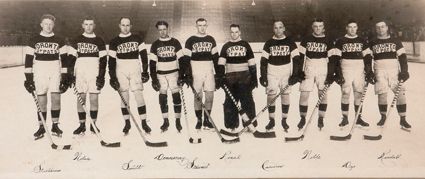
1921-22 Stanley Cup Champion Toronto St. Patricks
The next two seasons Toronto would finish in third place, and miss out on the playoffs both times. Dye again led the team in scoring both seasons, with 37 points in 1922-23 and just 19 in 1923-24, but still enough to lead the club.
Babe Dye in 1922-23 with the Stanley Cup champions patch on his sweater
Dye rebounded with 38 goals and 46 points in 1924-25 to lead the team for the fifth consecutive season to lead Toronto back into the playoffs, only to lose out to the Montreal Canadiens 5 goals to 2 in their two games, total goals series.
Another future Hall of Famer, Jack Adams, would finally unseat Dye as the club's leading scorer, as he managed 21 goals and 26 points to Dye's 23 points in 1925-26, but Toronto would fail to reach the playoffs.
St. Pats Owner Charlie Querrie lost a lawsuit to the notorious Eddie Livingstone, the one time owner of the franchise when they were known as the Toronto Blueshirts and played in the previous National Hockey Association, and decided to put the team up for sale. The club was purchased by Conn Smythe for $160,000. Smythe took control of the team on February 14, 1927 and immediately changed the club's name to the Toronto Maple Leafs, bringing to an end the era of the St. Pats.
On March 2, 2002, the Toronto Maple Leafs wore the green jerseys of the St. Patricks, along with brown pants and helmets, to celebrate the 75th anniversary of the franchise changing their name to the Maple Leafs in a 3-3 tie against the Buffalo Sabres, led by captain Mats Sundin's two goals.
Today's featured jersey is a 2001-02 Toronto St. Patricks Mats Sundin jersey as worn for one game only on March 2, 2002 to mark the 75th Anniversary of the change in the club's name from the St. Patricks to the Maple Leafs on March 2, 2002.
MartyWalsh played in the Canadian Intercollegiate Hockey Union for Queen's University from 1902 through 1906, including a league championship in 1906 which led to a challenge for the Stanley Cup during which he scored four goals in two games versus the Ottawa Silver Seven.
The 1906 Queen's University team, which challenged for the Stanley Cup
with Walsh is seated second from the right in the front row
Walsh turned professional in 1906-07 when he played for the Canadian Soo of the International Hockey League. Unfortunately, his season was limited to seven of 24 games due to a broken leg, but he gave a glimpse of his potential with four goals and five assists for nine points in limited action.
For the 1907-08 season Walsh moved back east to join the mighty Silver Seven, who had defended the Stanley Cup 11 times from March 1903 to March 1906. In his first season with Ottawa, Walsh made his presence known with 27 goals in nine games, including seven in one game against Montreal on March 7, 1908, to lead the league in scoring.
The following season Walsh again led the league in scoring with an astounding 42 goals in just 12 games, an average of 3 1/2 goals a game! The club, now known as the Senators, demolished the competition with a 10-2 mark while scoring 117 goals in their 12 games, quite nearly a ten goal per game average and no game with less than five. As Eastern Canada Hockey Association champions, the Senators became holders of the Stanley Cup.
As was often the case in the formative years of professional hockey, a dispute within the ECHA led to the Senators joining a brand new league for 1909-10, the Canadian Hockey Association. The league was a failure and Ottawa ended up playing just three league games as well as a pair of defenses of the Stanley Cup. Walsh scored nine goals in the two Senators CHA games he played and then six in the first game of the Senators defense of the cup against Galt.
When the CHA disbanded, Ottawa then became a member of the National Hockey Association for their schedule of games that season. Walsh came fourth in league scoring with 23 goals in 11 games as well as adding a pair of goals in a successful defense of the Stanley Cup against Edmonton of the Alberta Amateur Hockey Association. All told, Walsh scored 40 goals in 17 games that season but Ottawa had to relinquish the Stanley Cup to the NHA champion Montreal Wanderers.
Walsh had another stellar season in 1910-11 with 35 goals in 16 NHA contests to lead the league in scoring as the Senators won the league championship to regain possession of the Stanley Cup once more.
1911 Ottawa Senators - holders of the Stanley Cup
On March 13th, Galt once more challenged for the Stanley Cup and Walsh led the defense with three of the seven Ottawa goals to win 7-4.
Three days later, on this date in 1911, Port Arthur had the misfortune to face an on-form Walsh, who scored ten goals in a 13-4 win for the Senators.
In his final season of 1911-12, Walsh scored 9 times in 12 games to close out his carer. Following his playing days, Walsh moved to Edmonton and fell ill, passing away just two years later.
Walsh was inducted into the Hockey Hall of Fame in 1962.
Today's featured jersey is a 1910-11 Ottawa Senators Marty Walsh jersey. The Senators trademark red, black and white horizontal "barberpole" stripes were first adopted in 1903, and except for one season with vertical stripes in 1910-11, remained in use through the original Senators final season in Ottawa of 1933-34, with the addition of the letter "O" crest from 1929-30 on.
On this date in 1989, the New York Rangers retired sweater #1 in honor of goaltender Ed Giacomin.
Giacomin, overcoming serious burns suffered in a kitchen accident as a teenager when a stove exploded, played five seasons for the Providence Reds of the American Hockey League to start his professional career.
He then made his NHL debut with the New York Rangers in 1965-66 and led the NHL in shutouts with nine during his second season, helping the Rangers make the playoffs for only the second time in nine seasons.
Once established as the Rangers starting goaltender, Giacomin would lead the league in games played for the next four seasons, seeing action in between 66 and 70 games while winning 30 games or more each of those four seasons with a high of 37 in 1968-69 and leading the NHL in shutouts again in 1967 with nine and 1968 with eight.
With the acceptance of goalies in the NHL sharing the duty now becoming the norm, Giacomin's games played would shrink to the mid 40's starting in 1970, but he would still lead the league in shutouts in 1971 with eight on his way to winning the Vezina Trophy along with partner Gilles Villemure.
The following season the Rangers would enjoy their greatest playoff success of Giacomin's career, making it to the Stanley Cup Finals.
Giacomin was limited by injuries in 1974-75, limiting him to just 37 games and 13 wins, his first time under 24 wins since becoming the starter in 1966-67. As a result, the Rangers, off to a bad start, began dumping their high priced veterans, which included waiving Giacomin, who was claimed by the Detroit Red Wings.
Giacomin's return to New York was an emotional one, as the Rangers fans chanted "Ed-die! Ed-die!", drowning out even the national anthem, a game that was voted one of the Top 50 moments in Madison Square Garden history, not just Rangers history, but all events at MSG, which include Elvis Presley and other concerts, legendary boxing matches, NBA and college basketball, political conventions and an appearance by the Pope.
He would finish his career by playing two seasons plus an additional nine games in 1977-78 with the Red Wings before retiring in January of 1978 with 609 games and a record of 289-209-96 and 54 shutouts and a goals against average of 2.82.
Giacomin played in the NHL All-Star Game six times, was inducted into the Hockey Hall of Fame in 1987 and his sweater #1, retired on this date in 1989, was only the second number retired by the Rangers in their 64 year history.
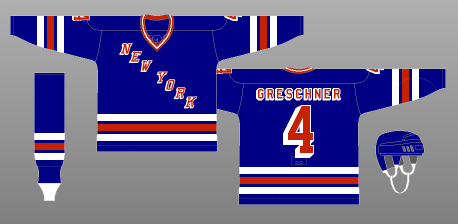
Today's featured jersey is a 1968-69 New York Rangers Ed Giacomin jersey as worn during the season he recorded his highest NHL win total of 37 games.
The Rangers diagonal crest dates back to their first season in the NHL in 1926-27 and changed to the current font in 1941 with the drop shadow first being added the following season. This particular style with the lace-up collar was first used in 1951 with sleeve numbers arriving in 1963.
After a radical change in style in 1976 and a return to a more traditional style which read "New York" on the front in 1978, the Rangers name returned to the blue jerseys in 1987 and this style with the lace up collar was reinstated in 1997 and remains in use today.
Today's video segment begins with the excellent Legends of Hockey profile on Eddie Giacomin which includes footage of his jersey retirement ceremony.
Here's evidence of the combative nature Giacomin possessed referred to by Stan Fischler in the previous video, as he goes after Garry Howatt of the Islanders. It's also an example of the "Ed-die! Ed-die!" chant that used to fill Madsion Square Garden.
One of Montreal's finest athletes of the early 20th century, JackMarshall was born on this date in 1877. He excelled at rugby, soccer, baseball, lacrosse, bowling and hockey. His hockey career began in 1989 when he traveled west to join the Winnipeg Victorias. There, he played three seasons, which concluded with the Victorias defeating the Montreal Shamrocks two games to none at the Montreal Arena by scores of 4-3 and 2-1 in overtime.
The Winnipeg Victorias
Marshall moved back to Montreal for the 1901 season in order to join the Montreal Hockey Club, also known as Montreal AAA due to their association with the Montreal Amateur Athletic Association. In 8 games, Marshall scored 11 goals, good for third in the league. Montreal, as Canadian Amateur Hockey League champions then challenged the same Winnipeg Victorias that Marshall had helped win the Stanley Cup in January of 1901. The best-of-three series was held in Winnipeg and the Victorias began their defense with a victory in Game 1 1-0, but Montreal evened the series two days late with a dominant 5-0 win, with Marshall scoring twice to force a deciding third game. In a close contest, Montreal emerged as 2-1 winners, with Marshall scoring the cup clinching goal to give him the second Stanley Cup of his career.
The 1902 Montreal AAA
During the 1903 CAHL season, Montreal fended off a challenge from the Victorias in an unusual series, as Montreal dominated Game 1 by a score of 8-1 followed by the second game being suspended at 27 minutes of overtime due to a curfew and the result was discarded from the record. Winnipeg fought back to win Game "2" by a score of 4-2, but Montreal retained the cup with a 4-1 triumph in Game 3. In all, Marshall was credited with 7 goals in the four games played.
The 1903 Montreal AAA
Although he remained in Montreal, Marshall wore new colors in 1904, joining the newly created Montreal Wanderers of the Federal Amateur Hockey League. Marshall was an instant success, leading the league with 11 goals even though he only skated in four of the Wanderers six games, aided with a six goal performance against Ottawa on January 20, 1904. In an odd twist, the Wanderers had finished first in the standings, only to have the reigning Stanley Cup holders, the Ottawa Hockey Club, also known as the Silver Seven, join the FAHL after the regular season was concluded! With this unusual turn of events, the Wanderers and Silver Seven were set to play a two game series for the Stanley Cup as well as the FAHL championship. The first game concluded with the teams tied at 5-5, with Marshall having scored for Montreal before the club not only refused to play any overtime, but then requested that the game be declared a no-contest and the series start over as a best-of-three! The trustees of the cup were not amused and demanded the series continue as a two game series and Montreal responded by abandoning their challenge so the cup remained with Ottawa. The 1904-05 season saw Marshall finished tied with Ottawa's Frank McGee for the scoring title with 17 goals in 8 games played. In the 1905-06 season, Marshall played exhibition games with the Toronto Professionals. He joined the Montreal Montagnards of the FAHL for the 1906-07 season, but returned to the Wanderers when the Montagnards folded. Marshall scored an identical 6 goals in three games for each club. Marshall returned to Stanley Cup play, as the Wanderers won the Eastern Canada Amateur Hockey Association regular season, but the Wanderers fell to the Kenora Thistles 12-8 over the course of two games. Marshall spent the next two seasons with the Shamrocks, leading the club in scoring with 19 goals in 9 games in 1907-08 followed by 10 more in a dozen games in 1908-09.
Marshall with the Shamrocks
For 1909-10, Marshall once again returned to the Wanderers, who had joined the new National Hockey Association.
The Wanderers became the Stanley Cup holders by winning the league championship, which entitled them to take possession of the cup from Ottawa, the third different team Marshall had won a cup with. The Wanderers then defended a challenge from the Berlin Dutchmen by a score of 7-3 in the single game played.
The 1911 Montreal Wanderers
After two more seasons with the Wanderers, Marshall joined the brand new Toronto Hockey Club, commonly referred to as the Blueshirts, for the 1912-13 season. The following year Marshall, now a playing manager, skated in a career high 20 games, scoring 3 times but also being credited with his the first assists of his career with 3, as assists were not awarded in the early days of organized hockey.
A Toronto Hockey Club pennant which features Captain Jack Marshall
After Toronto and the Montreal Canadiens finished tied atop the 1913-14 standings with identical 13-7 records, Toronto won the two-games, total-goals series after dropping the first game 2-0 by winning the second 6-0 with Marshall chipping in a goal for the Blueshirts, to earn another Stanley Cup with a record fourth different club. Toronto subsequently fended off a challenge from the Victoria Aristocrats of the PCHL, sweeping three straight in the scheduled best-of-five series.
The 1913-14 Stanley Cup champion Toronto Hockey Club
Marshall would play one final season with the Blueshirts before yet again returning to Montreal, where he rejoined the Wanderers for the fourth time in his career! He would play 15 games in 915-16 and wrap up his career with 8 more games in the 1916-17 NHA season. Marshall was inducted into the Hockey Hall of Fame in 1965 and remains the only player to win the Stanley Cup with four different clubs. Today's featured jersey is a 1902 Montreal AAA Jack Marshall jersey. Also known as the Montreal Hockey Club, the Montreal Amateur Athletic Association (AAA) wore blue sweaters with adorned with a winged wheel, which would later be revived by JamesNorris, founder of the Detroit Red Wings as the Red Wings logo, which remains in use today. The Montreal Hockey Club was founded in 1884 and was the first team to hold the brand new (and substantially shorter) Stanley Cup in 1893. They would also again be holders of the cup in 1894, 1902 and 1903. The club would remain as amateurs until 1906, and after two seasons as a professional club, returned to the amateur ranks and eventually win the Allan Cup in 1930 and change their name to the Montreal Royals in 1932.
The final weekend of the Western Collegiate Hockey Association season took place this past weekend, the final year for the current configuration before Minnesota and Wisconsin leave for the Big Ten Hockey Conference and Denver, Colorado College, North Dakota, Nebraska-Omaha, Minnesota-Duluth and St. Cloud State all leave for the National Collegiate Hockey Conference. The final weekend came down to St. Cloud State, Minnesota and North Dakota all with a shot at the regular season championship, and with it the historic and gorgeous MacNaughton Cup, which is awarded to the league in which Michigan Tech is a member. The cup dates back to 1913 and was originally purchased for $2,000, a hefty sum back in those days and the equivalent of $46,500 today.
The MacNaughtonCup
The cup was originally awarded to the champion of the American Hockey Association until 1932. Through 1950, the cup was given to semi-pro and intermediate teams in Michigan's Copper Country until the family of James MacNaughton arranged to have the cup awarded to the regular season champion of the newly founded Midwest Collegiate Hockey League, which eventually led to the creation of the WCHA in 1959. With Michigan Tech being trustees of the cup, it did follow them to the Central Collegiate Hockey Association in 1981-82, but returned to the WCHA in 1984-85 when they rejoined the league after three seasons away. The St. Cloud State Huskies led going into the weekend with 35 points, with the Minnesota Golden Gophers and the North Dakota (no longer the Fighting Sioux) 2 back with 33 each. St. Cloud clinched at least a tie for a share of the championship with a 4-2 win over the Wisconsin Badgers at Madison, while Minnesota outlasted the feisty Bemidji State Beavers 4-3 and North Dakota kept pace with a 4-3 win on the road against the Minnesota State Mavericks, taking the fight down to the final day with the rights to the cup still undecided.
St. Cloud clinched a share of their first title Friday vs. Wisconsin
Minnesota took care of business over ninth place Bemidji State 5-1, putting pressure on the other two, who were having a much tougher time of things. The Mavericks were even with North Dakota 1-1 as play entered the third period. Meanwhile, Wisconsin lead 2-1 after two against St. Cloud. As time wound down, the Huskies pulled their goaltender in an effort to even their game against Wisconsin, only to have the Badgers score with 1:13 left in the game. While St. Cloud managed a late goal with 33 seconds remaining, it was too little, too late and the Huskies fell to the Badgers and into a tie with Minnesota at 35 points each. North Dakota now needed a win to force a three way tie for the regular season title, but they could not find a way to crack the Minnesota State defense as a fired up Mavericks actually out shot North Dakota 29-13 over the final two periods of the game, which ended regulation tied 1-1. Minnesota State then cost North Dakota a share of the championship with a game winning goal at 3:22 of overtime. Still in possession of the MacNaughton Cup, having won it last season, the coach of Minnesota, Don Lucia, had one of his assistant coaches secretly bring the cup up to Bemidji in the trunk of his car. With the Minnesota players game having finished first, the became aware of the results of the other two games while in their dressing room following their game, whereupon the coaching staff retrieved the hidden trophy from the parking lot and surprised the players when they presented to them in the locker room!
The Gophers with the MacNaughton Cup
The share of the league championship was the first for St. Cloud State, who joined the WCHA back in 1990 after moving up to Division I in 1987. The program was founded back in 1931 and was a Division II and Division III contender, with their final season being under the guidance of the legendary HerbBrooks, head coach of the 1980 United States Olympic "Miracle on Ice" team. During Brooks only season behind the Huskies bench, the team broke or tied no less than 45 school records on their way to a third place finish nationally. Their move to Division I was aided by the construction of a new home arena, the National Hockey Center as the Huskies began life as a Division I independent team. Their first season of 1987-88 was highlighted by a win over the third ranked Lake Superior State Lakers. Their second season saw them not only finish with a winning record, but earned their first invitation to the NCAA playoffs. St. Cloud State then was accepted into the WCHA for the 1990-91 season, finishing fifth overall. The Huskies finished the 2000-01 season with a school best 31-9-1 record, 20-8-0 in the WCHA, and went on to win the WCHA playoff championship, defeating North Dakota in the final game. In addition to winning the playoff championship in 2001, St. Cloud State placed second in 1994, 2006 and 2010.
the 2001 WCHA playoff champion St. Cloud State Huskies
In addition, the Huskies have been selected for the NCAA national championship tournament in 1989, 2000, 2001, 2002, 2003, 2007, 2008 and 2010, but with limited results, as they currently have a 1-9 record with their first win coming in 2010 against Northern Michigan 4-3 in two overtimes. Noteworthy Huskies who have gone onto the NHL include TylerArnason, Stanley Cup winners BretHedican andMatt Cullen, Olympic silver medalist RyanMalone and MarkParrish with Cullen being the highest drafted at #35 in the second round.
Matt Cullen hoists the Stanley Cup
St. Cloud will enter the WCHA playoff this coming weekend as the #1 seed and will host the University of Alaska - Anchorage Seawolves as they look to return to St. Paul, Minnesota in hopes of adding the Broadmoor Trophy as playoff championsin their final season in the WCHA to their first MacNaughton Cup, which will be presented to them in front of their home fans this weekend.
The 2012-13 WCHA champion St Cloud State Huskies
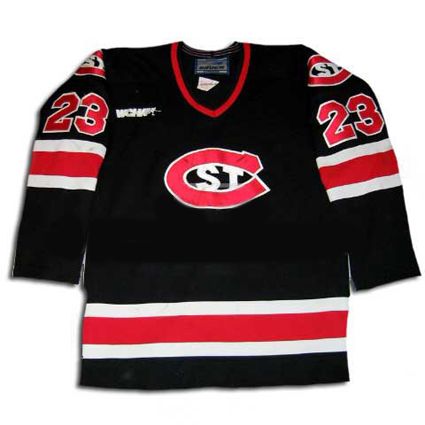
Today's featured jersey is a 1996-97 St. Cloud State Huskies Mark Parrish jersey. At the time, the Huskies home white jersey was a virtual copy of the classic Montreal Canadiens jersey, only this time with a clever take on the Canadiens iconic "CH" logo by swapping out the "H" for an "ST". This gave the Huskies an instantly familiar appearing logo that says "hockey" at first glance, but rewards the viewer on closer inspection. Additionally, while the jersey pattern is the same, the Huskies employ red, black and white as team colors, allowing them to avoid the criticism of simply copying the NHL club's jersey stitch for stitch.
St. Cloud took a different approach to their road jersey, going in an entirely different direction than Montreal's iconic red jersey with it's blue chest stripe, and created a menacing all black jersey, but still in a simple, classic style.
Today's video segment begins with St. Cloud State's first NCAA tournament victory in team history in March of 2010 in double overtime after seven previous appearances, all of which ended in defeat.
With St. Cloud down by a goal, here is a dramatic goal by the Huskies Ben Hanowski when he scored as time expired. Or did he?
Finally, a look at the National Hockey Center, home of the St. Cloud State Huskies.
On this date in 1992, Dave McLlwain played his first game with the Toronto Maple Leafs, tying Dennis O'Brien's NHL record, as it was McLlwain's fourth different team of the season!
McLlwain was drafted by the Pittsburgh Penguins 172nd overall in the 1986 NHL Entry Draft and began his tour of the NHL with the Pittsburgh Penguins in 1987-88 by playing 66 games. He spent most of the following season with the Muskegon Lumberjacks of the IHL, but did get into 24 games with the Penguins.
The Penguins dealt him to the Winnipeg Jets for the 1989-90 season, in which he would have his best NHL season, scoring 25 goals and 26 assists for 51 points. Limited to 60 games in 1990-91, his production declined to 25 points.
The 1991-92 season began with McLlwain playing three games for the Jets, but was traded on October 11th to the Buffalo Sabres. His stay in Buffalo was brief, as having played just five games, McLlwain was on his way to the New York Islanders as part of the blockbuster deal involving Pierre Turgeon that brought Pat Lafontaine to the Sabres on October 25th.
McLlwain played 54 games for the Islanders, scoring 23 points, but then was dealt yet again to the Toronto Maple Leafs on March 10, 1992, where he played the final 11 games of the season and tied the NHL record by suiting up for his forth different NHL club of the season on this date in 1992.
In all, McLlwain played in 73 games that season, scoring 10 goals and 18 assists for 28 points, no doubt affected by the constant upheaval and time spent integrating into each club's schemes and learning his ever-shifting linemates.
He was able to call Toronto home for the entirety of the 1992-93 season, but was claimed by the Ottawa Senators in the waiver draft for the following season. He responded with 17 goals and 26 assists for the second highest total of his NHL career of 43 points.
McLlwain was limited to just 43 games in 1994-95 and spent most of 1995-96 with the Cleveland Lumberjacks of the IHL, scoring 75 points in 60 games, as well as appearing in 18 games with the Penguins, who acquired McLlwain from Ottawa.
McLlwain while with the Lumberjacks
After splitting time between the Lumberjacks, 75 points in 63 games, and the New York Islanders, where he played in four games, McLlwain's NHL career came to a close. His NHL totals were 501 games played, 100 goals and 107 assists for 207 points.
Even though McLlwain's NHL career was at an end, his playing days were far from over, as he spent the 1997-98 season with the Landshut Cannibals of the German DEL and the following two seasons with SC Bern of the Swiss National League A where he averaged more than a point per game, with 103 in 84 games.
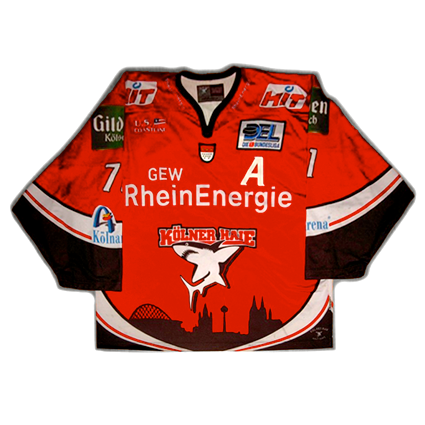
Having played for 21 clubs in 13 seasons, McLlwain finally found stability when he signed with the Cologne Sharks (Kölner Haie) of the DEL, where he played nine seasons, winning a championship in 2002 and leading the team in scoring four times, 2003, 2004, 2006 and 2007 (the latter two leading the entire DEL) and was also named team captain.
McLlwain as captain of the Cologne Sharks
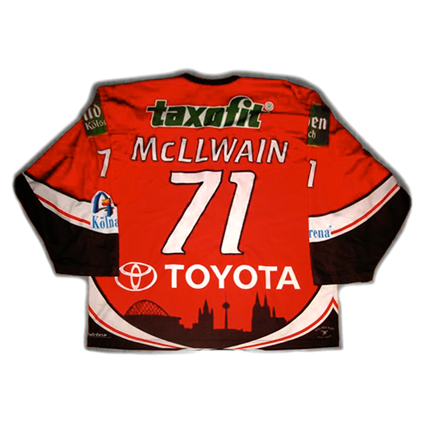
Today's featured jersey is a 2004-05 Kölner Haie (Cologne Sharks) Dave McLlwain jersey. This jersey is very representative of the typical European club team jersey, with all the elements of the basic jersey being dye-sublimated and numerous sponsorship logos, with perhaps a few being sewn on from time to time.
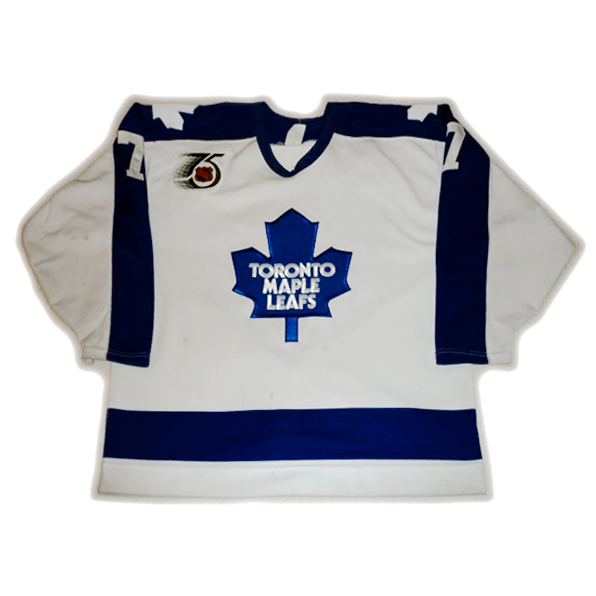
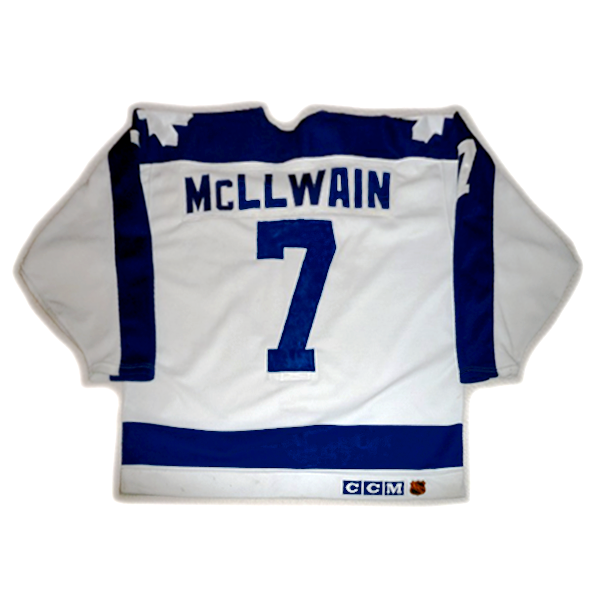
Today's bonus jersey is a 1991-92 Toronto Maple Leafs Dave McLlwain jersey as worn when McLlwain tied the NHL record by playing with the Maple Leafs, his fourth different team in that season.
This jersey features the NHL 75th Anniversary patch as worn on all players jerseys during the 1991-92 season.
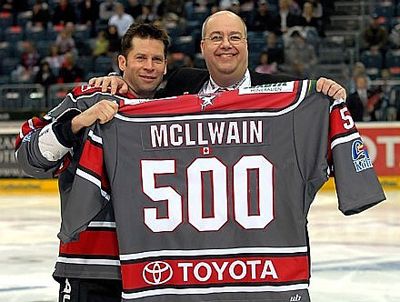
Extra Bonus jersey: Here is the jersey presented to Dave McLlwain in the occasion of this 500th game in the DEL.
Today's video section begins with a goal by McLlwain during his rookie season with the Penguins when he knocks a puck out of mid-air past John Vanbiesbrouck of the New York Rangers.
Next, we feature a tribute to McLlwain that recounts his entire career, from the Kitchner Rangers in junior hockey, to the Pittsburgh Penguins representing the NHL portion of his career and then his time with Cologne in the DEL.
Sorry about the Whitney Houston as the choice of music. Germans. What can you say? These are the same people who like David Hasslehoff.
To read more on McLlwain, here is an extensive interview with "the heart, soul and brain" of the Cologne Sharks from their own website.
At the Let's Play Hockey Expo at the RiverCentre in St. Paul, Minnesota, a very special event is taking place today, as 18 members of the Minnesota Fighting Saints of the World Hockey Association are expected to appear for a reunion and autograph signing at the U. S. Hockey Hall of Fame booth from noon to 2 PM.
This list of players is an exciting one, with several of the players not only being former Fighting Saints, but also legends of Minnesota High School Hockey, University of Minnesota Golden Gopher greats, former United States Olympians and even some having played for the Minnesota North Stars as well.
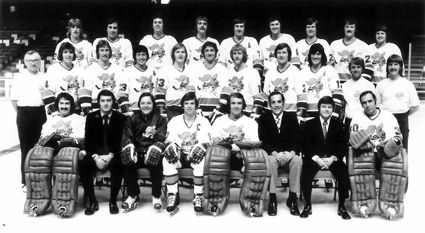
Scheduled to appear are Mike Antonovich, Henry Boucha, tough guys Bill Butters and Jack Carlson, Lefty Curran, Gary Gambucci, goaltender and current TV commentator John Garrett, teamcaptain Ted Hampson, George Konik, Jack McCartan, Mike McMahon, Pat Westrum as well as former owner Wayne Belisle, equipment manager George Konik and head coach and general manager Glen Sonmor who tells some of the best hockey stories you've ever heard. While many of those names may not be very familiar to those outside of the Minneapolis/St. Paul area, one name will stand out, that of Hockey Hall of Famer and former Toronto Maple Leafs and Hartford Whalers player Dave Keon.
Dave Keon
The Fighting Saints were original members of the WHA in 1972-73 and played their games at the newly constructed St. Paul Civic Center, which was located next door to the RiverCentre, which is now the location of the XCel Energy Center, home of the NHL's Minnesota Wild and the ongoing Minnesota State High School Hockey Championships, which concluded today with title games in Class A and Class AA, as we reported yesterday.
The Fighting Saints played through the 1975-76 season before folding halfway through the schedule, wearing blue and yellow jerseys. For the following season the Cleveland Crusaders relocated to St. Paul as the new Fighting Saints and gave it a go for half of the 1976-77 campaign, now wearing red and yellow, before they too folded before the season was completed.
Despite their too brief run, the Fighting Saints left behind a litany of great hockey memories, such as boasting the league's leading scorer Mike Walton, George Morrison's hat trick scored in 43 seconds, their lengthy streak of never being shut out and setting state attendance records of over 17,000 fans, besting the cross-town North Stars of the rival NHL.
Mike Walton
On the other side of the ledger are the crazy stories that surrounded the team, such as the legendary playoff battle with GordieHowe's Houston Aeros which saw the manic Goldy Goldthorpe turned loose on the ice, team tough guy GordGallantpunching out coach HarryNeale after breaking curfew one night, having all three Carlson brothers and DaveHanson (of Slap Shot move fame) on the team at the same time.
The Carlson Brothers
Other stories include Walton leaving the arena in disgust in full uniform, skates and all, and driving to a local bar to drown his sorrows following elimination from the playoffs, Belisle arriving at the airport with a paper bag full of cash to convince the players to get on a plane for a road trip as the team was in the death throws of their first battle with financial difficulties.
Gord Gallant battling with Ted Taylor of the Aeros
In addition to the Fighting Saints reunion, there will be many other noteworthy appearances at the Expo, including four time Stanley Cup champion ClaudeLemieux, 1980 Miracle on Ice team members BillBaker and Mike Ramsey as well as any number of former NHLers with ties to Minnesota, highlighted by Phil Housley and ReedLarson. There will also be players from the University of Minnesota, the North Stars and the Wild, such as Hobey Baker winner Robb Stauber, NHL 40 goal scorer Scott Bjugstad and AndrewBrunette.
The expo runs today from 10 AM until 6 PM and is followed immediately by the Class AA championship game to close out the high school tournament. Admission to the expo is free to all.
In recognition of the Fighting Saints reunion, today's featured jersey is a 1974-75 Minnesota Fighting Saints Gary Gambucci jersey. Gambucci attended the University of Minnesota from 1965-66 until 1987-68 and then played for the United States National Team in the World Championships in 1969, 1970 (scoring 18 points in 7 games to lead the US to promotion out of the B Pool and back up to the A Pool) and 1971, where he scored 7 goals and 10 points in 10 games.
The following season Gambucci spent the majority of his time with the Cleveland Barons of the AHL but he also made his NHL debut with 9 games with the Minnesota North Stars. After spending the entire 1972-73 season with the Barons, scoring just over a point per game with 76 in 75 games, Gambucci played 43 games with the North Stars and 21 with the Portland Buckaroos of the WHL in 1973-74.
He then signed with the Fighting Saints in 1974-75 and was with the team for the next season and a half until they folded midway through the 1975-76 season. Gambucci then concluded his career with his fourth World Championships for the United States in 1976.
Today's video is a look back at the Minnesota Fighting Saints and some of their legendary antics.
Third String Goalie - The Hockey Jersey of the Day Blog
"Sweater" for all my Canadian friends!
Welcome!
Welcome to our end of the rink.
Bienvenue sur notre bout de la patinoire.
So why "Third String Goalie"?
It's defined as "A fan who sits in the stands wearing a jersey."
If that's not us, we don't know what is...
Our aim is to feature a different jersey each day from a historical perspective. Stay tuned and hopefully you'll see some jerseys of interest or perhaps some that you haven't seen before and learn a bit of hockey history along the way.
In addition to our articles, be sure to scroll down this column and explore the other fun and informative features of this blog.
If you have any suggestions or comments, feel free to contact us at:
Looking to reach our loyal readers with your hockey related product or service? Of our hundreds of readers each day, 60% are located in the United States and 30% come from Canada. Our audience is your audience and you can target them now with our reasonable ad rates.
We've been linked to by SI.com, ESPN.com, Uni-Watch.com, NBCSports.com and the Yahoo! Sports Puck Daddy blog among others.
There is no limitation to what kind of hockey jersey it can be - replica, authentic or game worn jersey from the NHL, a national team, the minors, juniors, college, high school or even your pond hockey jersey.
Feel free to write a paragraph or two about the jersey telling us why you like the jersey, how you got it, what makes it special to you or even a full-blownThird String Goalie-style history lesson - whatever you feel like sharing.
Visting from outside North America? Just select your preferred language and Third String Goalie will be instantly converted to your language of choice!