History of Jersey 83-93 Banner sm photo History of Jersey 83-93 Banner sm.jpg

Tuesday, June 12, 2012

2011-12 Los Angeles Kings Willie Mitchell Jersey

In their 45th season of play, the Los Angeles Kings captured their first Stanley Cup championship last night with a dominating 6-1 victory over the New Jersey Devils in front of their delirious home fans.

Kings win Cup, Kings win Cup

The Kings season began with a trip to Europe as part of the NHL Premiere series of opening games. After defeating the Hamburg Freezers 5-4 in an exhibition game, the Kings travelled to Stockholm, Sweden to face the New York Rangers on October 7th, kicking off their season right with a 3-2 win. They returned to Germany, this time in Berlin, where they took on the Buffalo Sabres, dropping a 4-2 decision.

They returned to North America to begin the season proper five days later with a 2-1 shootout loss to the New Jersey Devils, who would feature prominently in their season much later on. They finished October with a 6-3-2 record, which they nearly duplicated in November to reach 12-8-4.

After winning 2-1 on December 1st, the lost their next four in a row to fall to 13-12-4, which cost head coach Andy Murray his job. He was immediately replaced by John Stevens as the search for a permanent replacement began. Under Stevens, the Kings alternated losses and wins over their next four games until Darryl Sutter, who had previously coached Chicago, San Jose and Calgary, as their new, permanent coach.

The effect was swift and dramatic. The Kings scored points in 17 of their next 19 games, going 10-2-6. February though, was not kind to the Kings, who slumped rather badly, dropping eight of their next ten games before making a headline grabbing trade on February 23rd, obtaining former Philadelphia Flyer Jeff Carter from the Columbus Blue Jackets in exchange for defenseman Jack Johnson and a conditional 1st round draft pick.

Carter was unhappy in Columbus and it re-energized him to be reunited with former Flyers teammate Mike Richards. With Carter on board, goaltender Jonathan Quick playing well, the Kings began their playoff push two days later with a 4-0 blanking of the Chicago Blackhawks. A 2-1 loss to Nashville was followed by a three straight wins, but two more losses came next.

Quick won the Kings next six games to elevate Los Angeles from 74 points to 86. After losing two, they would go undefeated over their final six games, winning three and gaining a point in the other three to lock up the final place in the postseason tournament, finishing three wins and five points clear of Calgary in 9th.

Entering the playoffs as the eighth, and final qualifier in the Western Conference, the Kings were paired against the President's Trophy winning Vancouver Canucks, who didn't stand a chance after the Kings won the first two games by matching 4-2 scores in Canada. Los Angeles returned home for a 1-0 shutout by Quick to put the Canucks on the brink. Vancouver stayed alive with a 3-1 win in Game 4, but the Kings moved on with a 2-1 win in overtime of Game 5. Quick only allowed eight goals in the series' five games.

The next challenge for Los Angeles was the #2 seeded St. Louis Blues, however, the Blues were easily dispatched in four straight games with the Kings winning every game by at least two goals as they outscored St. Louis 15-6 to become the first team to defeat both the #1 and #2 seeds in the playoffs.

The Phoenix Coyotes, seed third as Pacific Division winners, were the next hurdle for the Kings, who pushed their winning streak to eight by taking the first three games from Phoenix, which also ran their road record to a perfect 7-0. After the Coyotes stayed alive with a win in Game 5, the Kings closed out the series to advance to the Stanley Cup Finals for the second time in team history with a 4-3 overtime win in Phoenix.

Amazingly, the Kings won their first two games on the road to open their fourth series in a row and extended their road winning streak to 10 games. They looked to be on the brink of a championship after a 4-0 blanking of the Devils in Game 3, but the Devils dug deep and won the next two games 3-1 and 2-1 to send the series back to Los Angeles for a sixth game, the longest series that the Kings had been involved in all postseason.

Not wanting to risk the uncertainty of a seventh game, the Kings took full advantage of an early five minute power play, scoring three times to take control. They added a fourth goal just 1:30 into the second, doing their best to let New Jersey know not to consider any thoughts of a comeback. The Devils would not solve Quick until there was 1:15 left in the second, but with the Kings having never surrendering more than 3 goals in any game of the playoffs, a Devils faced a virtually impossible task entering the third.

In desperation, they pulled goaltender Martin Brodeur with nearly 4 minutes remaining and Trevor Lewis scored to put the game out of reach. Matt Greene followed with a floater from the point just 15 seconds later to produce the final margin of victory and get the celebration underway a few minutes early.

The Kings march through the post season saw them finish with a 16-4 record and a 10-1 mark on the road, winning each series as a lower seed. Quick was named the winner of the Conn Smythe Trophy as the playoff MVP, the third American to win it after Brian Leetch (1994) and Tim Thomas (2011).

Quick Smythe, Quick Smythe

Dustin Brown became just the second American-born captain to win the cup following Derian Hatcher of the Dallas Stars back in 1999. Of note concerning nationalities, forward Anze Kopitar becomes the first Slovenian to win the cup. The Kings trip to Germany and Sweden to open the season is now the fourth year in a row the eventual cup champion has begun their season in Europe as part of the NHL Premiere Series.

Los Angeles Kings Stanley Cup, Los Angeles Kings Stanley Cup

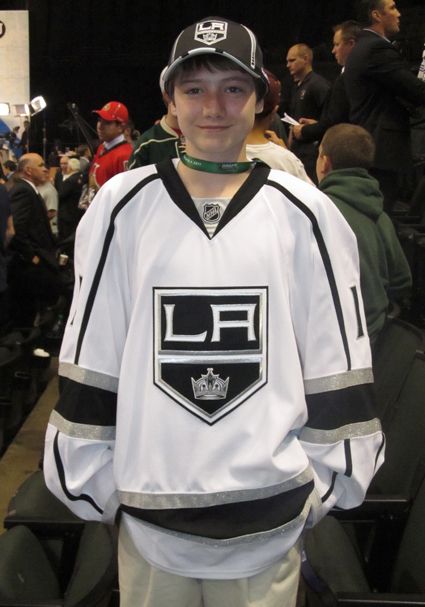
Today's featured jersey is a 2011-12 Los Angeles Kings Willie Mitchell jersey. The Kings made several changes to their jerseys for 2011-12, as they promoted their silver and black alternate jersey with a shield crest to become their new primary home jersey and designating their previous purple and black home jersey adorned with a crown logo as the new alternate. They also created a new white version of their new primary jersey to be worn on the road, a jersey which made it's public debut at the 2011 NHL Draft.

The change to silver and black home and road jerseys was a return to the look the Kings employed from 1988 to 1998, which was ushered in by the arrival of Wayne Gretzky in Los Angeles.

Mitchell, a defenseman, was the second King to hoist the Stanley Cup following team captain Brown. He is a 12 year veteran of the NHL, having started his career with the Devils before moving to the Minnesota Wild, Dallas Stars and Vancouver Canucks and is the oldest player on the Kings. His 24 points this season was a career high, as was his 5 goals.

Los Angeles Kings 11-12 jersey, Los Angeles Kings 11-12 jersey

Here are the highlights of last night's Game 6 as the Kings won the Stanley Cup for the first time in franchise history.


Monday, June 11, 2012

1974-75 Kansas City Scouts Guy Charron Jersey

In 1972, the World Hockey Association came into being, competing directly with the NHL for players and franchise locations. The NHL had already added the Atlanta Flames and New York Islanders in 1972, with the Islanders in particular being a deliberate expansion to occupy a location viewed as desirable by the WHA.

With the WHA having placed teams in direct competition with the NHL in Philadelphia, Boston, Los Angeles, New York, Minnesota and Chicago and taken smaller Canadian markets like Edmonton, Ottawa, Quebec and Winnipeg as their own, the competition for cities in the United States was where the NHL could use expansion as a weapon in their fight against the upstarts.

The remaining cities occupied by the WHA in 1972 were Cleveland and Houston, rounding out their original roster of 12 teams. The weak links in the WHA proved to be Philadelphia, New York and Ottawa, despite their having no direct rival in the NHL. The Philadelphia Blazers moved across the continent to take on the Canucks in Vancouver, while the New York Raiders changed owners and their name to the Golden Blades before fleeing Manhattan to become the New Jersey Knights in what was actually a suburb of Philadelphia 90 miles down the Jersey Turnpike, where they fared even worse than the Blazers, while playing in a substandard home rink.

Meanwhile, Ottawa learned absolutely nothing from the Raiders/Golden Blades about life as tenant of an NHL franchise and made the genius move to have cantankerous NHL hardliner Harold Ballard of all people become their landlord when they moved into Maple Leaf Gardens in Toronto to become the Toros!

That set the scene for the 1974-75 season. The WHA made the questionable move to add teams in Indianapolis and Phoenix as well as having the New Jersey (Philadlephia) franchise set up shop in San Diego, which suffered from the loss of it's potential rivalry with Los Angeles when the Sharks were the next team to try to go head to head with an established NHL cornerstone in Detroit when they became the Michigan Stags, lasting less than a full season.

As a countermove, the NHL expanded to occupy what it viewed as key markets, and on this date in 1974, franchises were awarded to Washington D. C. and Kansas City.

The Kansas City market had been home to a number of teams, dating back to the mid 1920's, including the Kansas City Pla-Mors of the American Hockey Association. They changed their name to the Kansas City Greyhounds in 1933 and the Americans in 1940, lasting until 1942. Other teams played in the United States Hockey League from 1945 to 1951 and the Central Hockey League from 1967 to 1972.

The Scouts were to call the brand new Kemper Arena home and were hoped to create a rivalry with their fellow Missouri residents, the St. Louis Blues. The club was originally going to be called the Mohawks, taking "Mo" from the postal abbreviation for Missouri, and "hawks" from the Kansas nickname of "Jayhawkers" in an effort to appeal to residents on both sides of the border, but the established Chicago Black Hawks protested, saying the name sounded too similar to theirs.

Thus, a name the team contest was held, which resulted in the name "Kansas City Scouts" being chosen in honor of an iconic statue named "The Scout" which overlooks downtown Kansas City from a hill in a nearby park.

Kansas City Scouts logo, Kansas City Scouts logo

The club formed their roster as best they could under the rules the expansion teams were forced to deal with, combined with the intense competition from an additional 14 WHA teams. The Scouts chose goaltender Michel Plasse, a former player with the Kansas City Blues, with their first choice in the 1974 NHL Expansion Draft. Peter McDuffe, another goaltender was chosen second and winger Simon Nolet was taken from the Philadelphia Flyers and would go on to lead the team in scoring.

Simon Nolet Scouts, Simon Nolet Scouts
Simon Nolet

The Scouts would pick second in the Amateur Draft, and chose well, taking eventual NHL All-Star Wilf Paiement. Things did not go quite so well after that, with second round pick Glen Burdon playing a total of 11 NHL games and eventual All-Star and four time Stanley Cup champion Bob Bourne, taken in the third round, being traded for Bart Crashley (2 games with the Scouts) and the rights to Larry Hornung, who played the rest of his career in the WHA, before Bourne ever played a game in Kansas City.

Paiement Scouts, Paiement Scouts
Wilf Paiement

Their first season began with eight games on the road to allow final completion of Kemper Arena. The brutal road trip was a dreadful way to begin life for an expansion club, as they immediately lost 7 and tied 1. After a loss in their home opener on November 2, 1974 to the Chicago Black Hawks, the Scouts finally won their first game over their expansion brothers, the Washington Capitals in Washington.

They would reach New Year's Day with a 5-26-4 record and play respectable hockey through January and February, going 9-13-4, before limping home 1-14-3 to finish next to last with 41 points, 10 back of the lowly California Seals, but 20 ahead of the moribund Capitals.

Nolet led the club in goals with 26 and assists with 32 for 58 points. Guy Charron, obtained from Detroit, was next with 42 points, while Paiement tied Nolet for the lead in goals with 26 of his own on his way to fourth, with his 39 points 2 back of Dave Hudson's 41.

In goal, Plasse lasted 24 games before packing his bags after being traded to Pittsburgh for Denis Herron, who played 22 games while McDuffe led the club in wins with 7 in 36 appearances.

McDuffe Scouts, McDuffe Scouts
Peter McDuffe

Attendance was essentially the same story, as the Scouts finished 17 out of 18 at 7,356, ahead of the Seals 6,172, the only two clubs under 10,000.

The Scouts second draft was nothing short of a failure, failing to land a single player who would play even 170 NHL games as they passed on players like Dennis Maruk, Doug Jarvis and Dave Taylor in what would prove to be an extraordinarily shallow draft that would produce just 6 All-Stars out of 217 picks.

The 1975-76 season began well enough with a 3-2-1 record before the losses began to outnumber the wins. As the calendar reached New Year's, the Scouts were 11-22-4 and on pace for 58 points, but the second half of the season was an unqualified disaster, commencing with a 14 game losing streak.

Two ties, a win and a tie gave a false flicker of hope, as the team went 0-21-6 after their final win on February 6th, their only victory in 1976.

The roster was somewhat of a revolving door, which saw a number of trades, with seven players leaving (along with a first and a pair of second round draft picks) and nine coming in, with one draft pick coming back.

Among those leaving was first year leading scorer and team captain Nolet, who was sent east to Pittsburgh. Charron, now promoted to captain, led the team with 27 goals and 44 assists for 71 points, far ahead of Paiement's 43, the only other player over 40. Also of note, Steve Durbano became a fan favorite as he led the league in penalty minutes with 209. There was turnover in goal as well, as McDuffe was out, which allowed Herron to play 64 games (winning 11), backed up by Bill McKenzie's 22, only one of which he won.

Herron Scouts, Herron Scouts
Denis Herron

During their first two seasons, the Scouts had two head coaches Bep Guidolin and Eddie Bush, three if you count Sid Abel's three game stint to bridge the gap when Guidolin was let go during the Scouts second season.

Guidolin Scouts, Guidolin Scouts

While attendance technically rose to 7,892, it still remained 17th. With the team suffering from a rapid rise in player costs, an ownership group (of thirty-seven individuals!) in debt and losing money and poor play on top of the poor attendance, 5,000 below the league average, the ownership gave it one final chance, but when a season ticket drive to raise more cash sold only 2,000 tickets, the group sold the team to interests who would immediately relocate the franchise to Denver, Colorado for the 1976-77 season, where it was renamed the Colorado Rockies, brining to and end the Scouts stay in Kansas City after an all-to-brief two seasons.

Today's featured jersey is a 1974-75 Kansas City Scouts Guy Charron jersey from the Scouts first season of play. Charron would go on to lead the Scouts in scoring not only in their second season of play, but would lead the franchise in scoring during their time in Kansas City as well.

Charron began his career in 1969-70 with the Montreal Canadiens before five seasons with Detroit before being traded to the Scouts. He would not move with the team to Denver, instead moving over to the Capitals for the final five seasons of his NHL career, which totaled 734 games.

Playing only two seasons in Kansas City did not leave much time for jersey variations, but their second season saw a yellow outline added to the crest to help it separate from the blue background better and the white home jerseys had names added during their second and final season.

Kansas City Scouts 74-75 jersey, Kansas City Scouts 74-75 jersey
photo courtesy of Classic Auctions

Today's video segment is Kansas City commentator Jack Smack lamenting the loss of the Scouts now that the New Jersey Devils, the eventual destination of the Scouts after leaving Denver, are in the Stanley Cup Finals and Kansas City's Sprint Center arena is still without an NHL or NBA tenant.


Saturday, June 9, 2012

2002-03 New Jersey Devils Martin Brodeur Jersey

After winning the Atlantic Division with a 46-20-10-6 record for 108 points, the 2002-03 New Jersey Devils, with the fourth best record, entered the NHL playoffs against the seventh seeded Boston Bruins. New Jersey got their postseason off to a great start, winning 2-1 thanks to a pair of goals by Jamie Langenbrunner. They also won Game 2 after third period goals by Langenbrunner and Joe Nieuwendyk broke a 2-2 tie.

Martin Brodeur shut out the Bruins back in Boston in Game 3 with 29 saves, and after a Game 4 loss, Brodeur repeated the feat with an identical 3-0 shutout, with Langenbrunner scoring his 4th and 5th goals of the series in the third period to seal Boston's fate.

The Devils advanced to face the Tampa Bay Lightning, where were seeded third in the east thanks to their winning the Southeast Division, despite only having the east's fifth best record. The Devils and Brodeur stayed hot, shutting out the Lightning 3-0 to open the series, as Brodeur was require to make only 15 saves as Langenbrunner got the game winner at 7:41 of the third period. Langenbrunner's torrid pace continued, as he scored the game winner in overtime of Game 2, for a 3-2 Devils win.

Tampa Bay won Game 3 back at home before the Devils closed them out with consecutive wins to advance to the Conference Finals where they would take on the President's Trophy winning Ottawa Senators.

Game 1 in Ottawa went into overtime before the Senators prevailed, but New Jersey got an important win on the road in Game 2 to even the series at 1-1 heading back to New Jersey, where Brodeur posted yet another shut out, holding the second leading scoring team in the league off the board with 24 saves.

New Jersey would push Ottawa to the brink with a 5-2 win in Game 4, but the Senators would no be going away quietly, as they came back to win the next two games by scores of 3-1 at home and 2-1 in overtime back in New Jersey to force a Game 7 back in Ottawa.

The Senators broke out on top, but Langenbrunner regained his scoring touch with a pair of goals in the second period to take the lead. Ottawa tied the game early in the third but Jeff Friesen eliminated the Senators with his fifth goal of the playoffs with less than 2:30 remaining to advance to the Stanley Cup Finals.

Devils Senators 2003 playoffs, Devils Senators 2003 playoffs
Freisen scores to eliminate the Senators in Game 7

Meanwhile in the West, the Mighty Ducks of Anaheim swept the Detroit Red Wings in four, eliminated the Dallas Stars in six and locked down the Minnesota Wild by allowing the Wild one goal in their four game sweep thanks to the goaltending of Jean-Sebastien Giguere.

With both Brodeur and Giguere entering the finals with four shutouts, everyone knew goals would likely be at a premium, and sure enough, both Games 1 and 2 were matching 16 save shutouts in favor of Brodeur by identical scores of 3-0, raising Brodeur's postseason shutout total to six while Friesen closed out the scoring both nights to raise his goal total to 8.

Devils Ducks 2003, Devils Ducks 2003
The Devils strong defense shut out Anaheim in Games 1 and 2

The Mighty Ducks fought back at home with a 3-2 win thanks to defenseman Ruslan Salei's overtime winner in Game 3 and Giguere's turn to get the clean sheet with his 26 save shutout, his fifth.

Something strange was in the water for Game 5, as the teams combined for nine goals as Langenbrunner scored two more in the third to extend the Devils 4-3 lead to a 6-3 final score. They were his 10th and 11th of the playoffs. Game 6 was the Mighty Ducks turn to light the lamp, scorching Brodeur for three goals in the first period and chasing him from the net in an eventual 5-2 win to force a winner-take-all Game 7.

Devils Ducks 2003, Devils Ducks 2003

Game 7, played on this date in 2003 in New Jersey, was scoreless after the first period as both defenses limited the amount of chances as the Devils were credited with 7 shots to Anaheim's 5. Rookie Mike Rupp scored his first goal of the playoffs from Scott Niedermayer and Colin White at 2:22. Ten minutes later, Friesen struck for his 9th goal from Rupp and Niedermayer at 12:18 while Brodeur held Anaheim at bay with another 9 saves.

Friesen extended the New Jersey lead to 3-0 with his 10th goal with 3:44 left in the season from Rupp and Devils captain Scott Stevens. It was a memorable night for Rupp, who was credited with the game winning goal and finished at a +3 and scored 3 of his 4 total playoff points while only playing in 4 of the Devils 24 postseason games.

The Mighty Ducks were never able to solve Brodeur, who finished the game with 24 saves and an NHL record 7th playoff shutout in one year. The win was the Devils 12th on home ice, also a record.

Brodeur Stanley Cup 2003, Brodeur Stanley Cup 2003

Langenbrunner led all playoff scorers in goals with 11 and was tied for the points lead at 18 with Niedermayer (2 goals, 16 assists). John Madden was close behind with 16 points and Friesen's 10 goals were one back of Langenbrunner's 11. Add in the fine defensive efforts of Stevens and Niedermayer, along with White and Brian Rafalski, helping Broduer to the shutout record, the candidates for the Conn Smythe Trophy were numerous, so it certainly caught many off guard when Giguere was named the winner over Broduer despite Brodeur setting the shutout record and winning their head to head battle for the cup 12 goals to 18. It was only the fifth time a player on the losing team won the award since it was first handed out in 1965.

Broduer was later recognized with his first Vezina Trophy for his league leading 41 wins and 9 shutouts as well as his 2.02 goals against average and .914 save percentage.

Brodeur 2003 awards, Brodeur 2003 awards
Brodeur with the Jennings Trophy, Stanley Cup and Vezina Trophy

Today's featured jersey is a 2002-03 New Jersey Devils Martin Brodeur jersey as worn during the 2003 Stanley Cup Finals. This jersey is distinguished by the 2003 Stanley Cup Finals patch worn by both the Devils and the Mighty Ducks, a tradition which began back in the 1989 finals and has continued ever since.

New Jersey Devils 02-03 jersey, New Jersey Devils 02-03 jersey
New Jersey Devils 02-03 P jersey, New Jersey Devils 02-03 P jersey

Today's video segment are the highlights of Game 7 of the 2003 Stanley Cup Finals, in which Brodeur shut out the Mighty Ducks to set a new NHL record with 7 shutouts in one playoffs season.


Friday, June 8, 2012

1991-92 Winnipeg Jets Thomas Steen Jersey

Born on this date in 1960 in Sweden, Thomas Steen began his career with Grums IK in 1975-76 and moved over to the Leksands IF junior team in 1976-77, the year he made is debut for the Sweden National Team at the European Junior Championships where he scored 8 points in 6 games as Sweden took home the gold medal.

After a move up to the Elitserien in 1977-78, Steen would play three seasons with Leksands IF. He would also participate for Sweden in the World Junior Tournament in 1978 (silver), 1979 (bronze) and 1980 (bronze). Following the 1978-79 season, Steen was drafted 103rd overall by the Winnipeg Jets.

He moved to Farjestads BK for 1980-81 and more than doubled his previous season high in points when he scored 16 goals and 23 assists for 39 points in 32 games on his way to being named 1981 Elitserien Player of the Year as Farjestads won the Swedish Championship.

Now playing at the senior level, Steen participated in both the World Championships, earning a sliver medal, and also skated in the 1981 Canada Cup.

Having reached the top of Swedish hockey, Steen moved to North America for the 1981-82 season and made his NHL debut with the Winnipeg Jets.

Thomas Steen Jets

His first four seasons saw him adapt quite well to the North American game and his point totals improved each season, from 44 as a rookie, to 59, then 65 and then setting a career high with 30 goals on his way to 84 points in 1984-85. Prior to that season Steen also competed in his second Canada Cup, the 1984 edition in which he led the tournament in goal scoring with 7 goals in 8 games.

After three more steady seasons, which included Steen scoring 11 points in 8 games for Sweden at the 1986 World Championships, helping Sweden to bring home the silver medal, he would set a career high with 88 points from 27 goals and 61 assists in 1988-89 and follow that with his final appearance at the World Championships in 1989.

Health issues began to affect Steen, as he only played in 53 games in 1989-90, his first season under 73 games in his nine years in the NHL, due to a back injury. Those 53 games were very productive however, as Steen totaled 66 points for 1.25 points per game, the highest average of his career. He was also named as one of the team captains for 1989-90 and 1990-91.

The following season was a carbon copy of the previous one, with 67 points in just 58 games played, this time due to a broken ankle. Prior to the start of the 1991-92 season, Steen played for the Sweden National Team for the final time when he played in the 1991 Canada Cup, his third.

Another short season of 38 games in 1991-92 due to both ankle and back issues was followed by a return to health, with 80 games and 72 points in 1992-93 and 76 games and 51 points in 1993-94.

His final NHL season of 1994-95 saw him play in 31 games during the strike-shortened season and finish his 14 year NHL career, spent entirely in Winnipeg, with 950 games played, 264 goals and 553 assists for 817 points. Steen remains the second leading scorer in franchise history, including their over ten years in Phoenix as the Coyotes.

At the conclusion of his career, Winnipeg retired Steen's #25 on May 6, 1995, one of only two numbers ever retired by the Jets and the very first European player to have his number retired by an NHL club.

Steen would come out of retirement in 1996 to play with the Frankfurt Lions of the German DEL in 4 regular season and 3 playoff contests. He would continue playing the following season, joining the Berlin Polar Bears, for whom he would play for three seasons before retiring again in 1999.

Today's featured jersey is a 1991-92 Winnipeg Jets Thomas Steen jersey. This jersey has the "Goals for Kids" patch on the left sleeve and features the NHL 75th Anniversary patch on the right chest as worn by all players in the NHL that season.

After Winnipeg adopted a new set of jerseys for their entry into the NHL in 1979, this was their second and final NHL jersey, which served them well from 1990 to 1996.

Winnipeg Jets 91-92 jersey

Bonus Jersey: Today's bonus jersey is a 1996-97 Eisbaren Berlin "Berlin Polar Bears" Thomas Steen jersey as worn during the final few seasons of Steen's career after he came out of retirement from the NHL. Steen scored 33 points in 49 games.

This jersey has the typical European flair with it's sublimated graphics, multiple, if not excessive, sponsorship logos and even sports a collar, something more common in the Scandinavian leagues. It also has the European-standard player name located below the number on the back, giving the more prominent location above the number to yet another sponsor logo.

Berlin Polar Bears 96-97 jersey

Our video segment begins with Thomas Steen scoring with just seven seconds left in regulation to fuel a late Winnipeg comeback versus the Chicago Blackhawks from 1991-92. Note that the Blackhawks are wearing their Turn Back the Clock jerseys, worn only during the NHL's 75th Anniversary season.


Next is the retirement ceremony in Winnipeg for Thomas Steen's sweater #25.


Thursday, June 7, 2012

1987 Soviet Union Vladimir Krutov Jersey

One of the all-time great Soviet hockey players, Vladimir Krutov, died yesterday at the age of 52.

"Volodya was such a dependable and steadfast man that I would have gone anywhere with him - to war, to espionage, into peril. There are fewer and fewer guys like him in every generation of hockey players," former Soviet goaltender Vladislav Tretiak told the Sport-Express newspaper.

Krutov was a member of the famed KLM line along with Igor Larionov and Sergei Makarov which dominated Soviet and international hockey the 1980's.

KLM Line
The KLM Line

Krutov, a left winger, played for CSKA Moscow (better known in North America as Central Red Army) beginning with one game in 1977-78 and a half season of 24 games the following year,including scoring his first goal, before becoming a full time member of the Red Army squad in 1979. That season, in 40 games, he would average more than a point per game with 30 goals and 12 assists for 42 points.

1981-82 would see Krutov set a personal high with 37 goals and 66 points in 46 games and was Red Army's leading scorer with 53 points in 1982-83. CSKA would win the Soviet League championship in each and every of Krutov's 12 season's with the club. Additionally, he led the league in goals in 1984 (37 goals), 1986 (31) and 1987 (26) and was named to the USSR All-Star Team every year from 1982 to 1988 and was the Soviet Player of the Year in 1987. His final career totals with CSKA were 438 games played with 288 goals and 215 assist for 503 points, which still ranks him 5th in team scoring, 7th in goals and 4th in assists over 20 years later.

In addition to his 12 Soviet League championships, Krutov and CSKA would win the Soviet Cup twice, in 1979 and 1988, and the European Cup in each of his 12 seasons.

While with CSKA, Krutov also toured North America as part of the Super Series, a series of exhibition games between Red Army and other Soviet club teams taking on various NHL teams. He participated in the Super Series three times, in 1982-83, 1985-86 and one last time in 1988-89, playing a total of 17 games, scoring 10 goals and 21 points.

His Soviet League success was duplicated in international play as well, beginning with a silver medal in his international debut at the 1978 European Junior Championships and a pair of gold medals in the World Junior Tournament in 1979 and 1980 while leading the World Juniors in scoring both years with 14 points in 6 games in 1979 and 11 points in 5 games in 1980 while being name Best Forward both times as well.

Krutov's senior international career began with a silver medal at the 1980 Olympic Games (he scored the first goal of the "Miracle on Ice" game and later added an assist to give the Soviets a 3-2 lead) prior to a run of five consecutive gold medals at the 1981 World Championships, the 1981 Canada Cup, the 1982 and 1983 World Championships and the 1984 Olympics.

Soviet Union 1984 Olympics
1984 Olympic Champions

A third place finish in the 1984 Canada Cup and a bronze medal in the 1985 World Championships followed. The Soviet Union would rebound with another gold medal at the 1986 World Championships, where Krutov was named Best Forward.

Soviet Union 1988 Olympics
1986 World Champions

In 1987, Krutov scored two goals in the 5-3 Soviet win in game two of Rendez-vous '87 against the NHL All-Stars before earning a silver medal at the 1987 Worlds, were Krutov led the tournament in goals and points and was named Best Forward for the second consecutive year. Later that year, he participated in the 1987 Canada Cup where he was named to the All-Star Team as the Soviets finished second.

Krutov Canada Cup, Krutov Canada Cup
Krutov playing in the Canada Cup tournament

The 1988 Olympics concluded with another gold medal after finishing the tournament at the leading scorer and Krutov finished his international career in style with his fifth World Championship gold in 1989.

Krutov 1988 Olympics, Krutov 1988 Olympics
Krutov on his way to leading the 1988 Olympics in scoring

Krutov's final medal count shows nine gold medals, three silver and two bronze, which included at least one gold at each of the World Juniors (2), World Championships (5) and the Olympics (2) as well as winning a Canada Cup.

Kutov was one of the first wave of Soviet players allowed to join the NHL, playing for the Vancouver Canucks, who had drafted him in 1986 in hopes that he would some day be allowed to leave the Soviet Union.

He played just one NHL season, 1989-90, scoring 11 goals and 34 points in 61 games while faced with the challenges of being a veteran trying to adjust to the change to a new language and culture while being viewed by some as taking a job away from a Canadian, plus the sudden riches combined with the freedom he was afforded in North America after an entire career in which he was required to train 10 months out of the year. It was unfortunate that Krutov's attempt to play in the NHL was viewed as unsuccessful since it tainted many North American opinions of Krutov based on just a single season late in his otherwise stellar career in the Soviet Union.

Krutov Canucks, Krutov Canucks
"The Tank" unleashes a shot while with Vancouver

He played very little hockey in 1990-91, just one regular season game and three playoff games with the ZSC Lions in Switzerland. After another season with ZSC where he scored 32 points in 28 games, he moved to Östersund IK in the third division of Swedish hockey, helping them earn promotion to the second division on his first try, scoring a dominant 25 goals and 49 points in just 19 games. He would play two more seasons for Östersund and wrapped up his career with Brunflo IK before retiring.

Krutov was named to the Soviet Hockey Hall of Fame in 1981 and the International Ice Hockey Federation Hall of Fame in 2010.

Today's featured jersey is a 1987 Soviet Union National Team Vladimir Krutov jersey as worn by Krutov during Rendez-vous '87, a two-game series held in Quebec City on February 11 and 13, 1987 which replaced that season's NHL All-Star Game which featured a team of NHL All-Stars against the Soviet National Team.

Game 1 went to the NHL All-Stars 4-3 and the Soviets came back to win Game 2 by a core of 5-3 in which Krutov scored a pair of goals, including the game winner at 9:19 of the third period.

Krutov Rendez-vous '87

This jersey is typical of the Soviet style, with a minimum of adornments and simple one color names and numbers, made to look even more spartan when compared to the flashy NHL All-Star jerseys it competed against.

Vladimir Krutov 1987 Soviet National Team jersey
photo courtesy of Classic Auctions

Today's video section begins with Krutov scoring against the Montreal Canadiens on December 31, 1982 in an exhibition game.


Here Krutov scores for the Soviets in Rendez-vous '87 to put the Soviets ahead 2-0 followed by his game winning goal to make it 4-2 on the Soviets way to a 5-3 win.


In some truly rare footage, Krutov scores on a penalty shot for the ZSC Lions, quite possibly the slowest approach in the history of hockey.


Wednesday, June 6, 2012

1980-81 St. Louis Blues Wayne Babych Jersey

Born on this date in 1958, an Edmonton, Alberta native, Wayne Babych played for his hometown Edmonton Mets of the Alberta Junior Hockey League in 1973-74, where the right wing put up a respectable 20 goals and 38 points in 56 games.

Staying close to home, Babych moved up to the Edmonton Oil Kings of the Western Canadian Junior Hockey League for the 1974-75 season, where he scored 19 goals and 36 points. He more than doubled his point total for the following season, thanks to an increase to 32 goals as well as 46 assists for 78 points.

Babych stayed with the franchise when it relocated in 1976-77, becoming the Portland Winter Hawks, with whom he impressed with back to back 50 goal seasons. In 1977, he added 62 assists for 112 points, and topped that with 71 in 1978 for 121 points, leading the team in scoring by 32 points.

Following the season, Babych was selected third overall by the St. Louis Blues in the NHL Amateur Draft. He made the Blues roster straight away, playing 67 games his rookie season, scoring 27 goals and 63 points in 67 games. He backed that up with 61 points in 1979-80 in only 59 games.

Babych Blues, Babych Blues

Seemingly shot out of a cannon, Babych scored more goals than he previous two seasons combined when he finished in sixth in the league with 54 goals, just one back of Wayne Gretzky at 55 to become the first 50 goal scorer in Blues history while playing on a line with Blake Dunlop and Jorgen Pettersson. His 54 goals, 42 assists and 96 points were far and away his career best in all three categories, as were his 93 penalty minutes.

Babych Blues, Babych Blues

He would play three more seasons with St. Louis, never scoring more than 44 points or reaching 20 goals thanks to a torn rotator cuff which suffered in a fight during a preseason game in 1981.

His time in St. Louis had run it's course, and Babych was claimed by the Pittsburgh Penguins in the 1984 waiver draft, where his first season went well, as he did manage 20 goals and 54 points.

Thinking he was going to be back with Pittsburgh the following season, fate had surprises in store for Babych, as he was dealt to the Quebec Nordiques after playing in just two games. Things went well in Quebec, having gotten off to a nice start with 11 points in 15 games, only to be sent back across the border when the Nordiques dealt Babych to the Hartford Whalers for the remainder of the season, where he joined his brother Dave Babych and scored 28 points in 37 games.

Babych Nordiques Penguins, Babych Nordiques Penguins
The hockey card makers had trouble keeping up with
all the movement Babych endured in 1985-86

His final season was an abbreviated one, having suffered a horribly broken leg in the preseason. Told he might never play again, he would spend nearly the entire season recovering in time to play six rehab games with the Binghamton Whalers in the AHL, the only minor league games of his career, before playing in Hartford's final four games of the season. Giving it a try in training camp the following season, pain and fear of further injury were too much, and Babych called it a career.

Babych Whalers, Babych Whalers

His final totals were 519 games, 192 goals and 246 assists for 438 points, and one magical 50 goal season.

Today's featured jersey is a 1980-81 St. Louis Blues Wayne Babych jersey as worn during his career year when he scored a career high 54 goals and 96 points.

St. Louis joined the NHL in 1967 with jerseys that had the colors reversed on their striping. They swapped to today's featured jersey's configuration in 1973-74 and gained names on the back in 1977-78 before the attractive shoulder striping (added to match the white home jersey) was added in 1979-80. This classic Blues style would remain in use until being replaced in 1984-85.

St Louis Blues 80-81 jersey, St Louis Blues 80-81 jersey

In today's video section, Babych looks back on his time in St. Louis with the Blues.


Next is an interview with Babych on the occasion of a rough night, where he suffered a broken cheekbone from an elbow and a broken nose in the subsequent fight!


Tuesday, June 5, 2012

1970-71 Philadelphia Flyers Andre Lacroix Jersey

Born on this date in 1945, Andre Lacroix, the youngest of 14 children, was a multi-skilled center who played for clubs in both the NHL and WHA during his 13 year professional career.

Lacroix, was clearly a man born at exactly the right time and was able to benefit perhaps more than any other player from the dramatic upheaval in professional hockey during the fifteen year span from 1966 to 1980. While other players were able to benefit better financially, Lacroix was rescued first from the minor leagues when the NHL expanded in 1967 and then liberated from his own personal hockey purgatory with the arrival of the WHA to record one of the greatest offensive careers of his generation.

Lacroix set prolific scoring marks in Canadian junior hockey starting in the 1964-65 season with the Peterborough Petes of the OHA by scoring 119 points in 49 games. He showed his goal scoring ability with 45 tallies and highlighted his remarkable playmaking skills with 74 assists. He was also very adept at winning faceoffs and penalty killing as well. He followed that season with a 120 point campaign in the 1965-66 season to lead the league in points.

Following the Petes regular season, Lacroix played a pair of games with the Quebec Aces of the American Hockey League, scoring 4 points. 1966-67 saw Lacroix adapt to the game at the minor league level with a 25 goal, 24 assist season for 49 points.

He elevated his game to the next level in 1967-68 and was sitting at 41 goals and 87 points in 54 games before being recalled by the expansion Philadelphia Flyers, as this was the season that the NHL expanded from it's traditional six clubs to 12, creating approximately 130 new jobs that never existed before, which Lacroix was more than happy to benefit from. In 18 regular season games with Philadelphia, he scored 6 goals and 14 points, including scoring in his NHL debut against the Pittsburgh Penguins on February 21st, and added 5 more points in 7 playoff games.

Photobucket

Building on the confidence of his successful first season in the league, Lacroix led the Flyers in scoring the next two seasons with 56 and 58 points, respectable totals for a member of one of the new expansion clubs who generally scored 50-75 goals less than the established teams.

After one more season in Philadelphia, Lacroix was traded to the Chicago Black Hawks, which did nothing for Lacroix's game. The Black Hawks were loaded with established offensive talent, the likes of Bobby Hull, Pit Martin, Dennis Hull and Stan Mikita, who all had been playing together on the Original Six club for years. This left very little opportunity for Lacroix to fit in and gain valuable ice time or any confidence, limiting him to only 11 points in 51 games.

Fortune smiled on Lacroix once more, as the following season saw the debut of the World Hockey Association, which was eager to establish itself while in competition with it's established rival, the NHL. The new league was eagerly looking for players with a level of offensive ability, and given the opportunity to return to Philadelphia, Lacroix wasted no time in leaving the bad experience in Chicago behind him and signed with the WHA's Philadelphia Blazers for the 1972-73 season.

Life in the freewheeling, better paying WHA agreed with his game and he immediately set a career best with 50 goals and added 74 assists for 124 points to win the inaugrual league scoring championship.

Andre Lacroix Blazers
1972-73 WHA scoring champion Andre Lacroix

While some players were fortunate to find themselves with stable franchises, such as those in Quebec, Winnipeg, Houston, Edmonton and New England (and even they relocated from Boston to Hartford), many more players had to endure the frequent upheavals associated with life in the WHA. Lacroix was forced to live through many of the growing pains, perhaps more than his fair share, and was destined to only play one season in Philadelphia - one way or the other.

The Blazers relocated to Vancouver for the 1973-74 season, but before he could lace up the skates out west, Lacroix was traded to the highly unstable New York Raiders. The franchise was so erratic that they were taken over by the league when the original owners defaulted in year one and sold to a new owner for the second WHA season, who immediately changed the name to the New York Golden Blades. Again, the league ended up taking over the franchise after only 24 games, and moved them out of their money-losing situation as tenants of Madison Square Garden to Cherry Hill, New Jersey for the remainder of the season in a rink so inadequate the visiting teams had to leave the arena in their still wet gear to change into their clothes back at their hotel because of the inadequate situation with the locker rooms there. Worse, the ice surface sloped uphill toward one end!

Rumor has it that the franchise was named the "Knights" because that was the only jersey style a local sporting good store had enough of in stock to be purchased at the last minute following the team's relocation from Manhattan. Ah, life in the WHA.

Andre Lacroix Knights
Lacroix in a seldom seen Knights jersey

Still, throughout all the upheaval and inadequate facilities, Lacroix managed to score 31 goals and lead the league with 80 assists for 111 points, good for second in the league and ahead of the likes of Gordie Howe and Bobby Hull, now in the WHA with Winnipeg.

Clearly the situation in New Jersey was unacceptable and the New York market was now lost to the WHA as the club was sold to a new California-based owner who relocated the team as far from New York as possible to San Diego, California - over 2400 miles away - where they were christened the Mariners.

With the team's situation settled for the time being, Lacroix got back to work and again won the league scoring title, this time with a career high 147 points from 41 goals and a whopping 106 assists, a new professional record at the time and all the more impressive when you consider the Mariners second leading scorer, Wayne Rivers, had 107 total points.

Lacroix Mariners photo LacroixMariners.png

Lacroix again topped 100 points in 1975-76 with 101 and again in 1976-77 with 114 to lead the franchise for the fourth consecutive season. Three seasons of stability was perhaps more than anyone playing in the WHA in the United States was entitled to however, as the Mariners folded after the conclusion of the season.

With his services now available, Lacroix signed with the Houston Aeros as a free agent to replace the scoring of the recently departed Gordie Howe. As was his custom, Lacroix led the Aeros in scoring by a wide margin, with 36 goals and 77 assists for 113 points, 38 more than any other member of the Aeros. But before Lacroix could get truly comfortable, he was on the move once more as the Aeros, one of the strongest and most stable clubs in the WHA up this point, ceased operations when they were left out of any plans to merge with the NHL.

Lacroix signed with the Winnipeg Jets in July of 1978, only to be traded to the New England Whalers in August before even having the chance to report to the Jets training camp! The Whalers were a fairly average team with balanced scoring in 1978-79 and as a result, Lacroix's streak of six consecutive 100 point seasons came to an end with 88 total points that year. Only six other professional players have duplicated Lacroix's 100 points in six consecutive seasons.

In a new twist to the unstable path Lacroix's career had taken, he remained with the Whalers for the 1979-80 season, but the club itself changed leagues, as well as it's name to "Hartford", as the WHA ceased to exist and the Whalers joined the NHL.

Lacroix played in 29 games, scoring 3 goals and 17 points for the Whalers in his final season before retiring.

Lacroix's offensive skills and consistency made him the WHA's all time leader in assists with 547, points with 798 and in games played, totaling 551. Additionally, he ranked fourth in goals scored at 251. All told, Lacroix played in 551 out of a possible 555 games during the seven seasons of the WHA, including not missing a game during the first five seasons of the league.

He was also a member of Team Canada for the 1974 Summit Series against the Soviet Union where he was second on the team with 7 points in 8 games.

Today's featured jersey is a 1974-75 Philadelphia Flyers Andre Lacroix jersey. The Flyers joined the NHL in 1967-68 with identical jerseys, save for the use of simple, one color numbers. The first change to their look came in 1970-71 when the numbers gained a black outline for his final season in Philadelphia.

While the Flyers jersey would continue to evolve over time in small ways, the team would revert back to this look in 2008-09 when they were in need of a new alternate jersey, which then took over as the team's current primary jersey in 2010-11.

Philadelphia Flyers 70-71 jersey, Philadelphia Flyers 70-71 jersey

Today's video section is a look at highlights from Lacroix from WHAHockey.tv. It includes rare footage of the WHA as well as the 1974 Summit Series where the WHA's finest took on the Soviet Union.


hit counter for blogger