History of Jersey 83-93 Banner sm photo History of Jersey 83-93 Banner sm.jpg

Monday, October 4, 2010

1987-88 Buffalo Sabres Mike Donnelly Jersey

On this date in 1996, left winger Mike Donnelly made history when he became the first player to ever play for all three New York teams, the Buffalo Sabres, New York Rangers and New York Islanders when he made his Islanders debut in a 1-0 loss to the Los Angeles Kings.

Donnelly played four seasons at Michigan State University and saw his point totals progress in the usual fashion from 20 points (in 24 games) to 32 (in a full season of 44 games) and then 47 until he made a quantum leap forward with more than double his previous season's total with 97 points, which included a spectacular 59 goals in 44 games to lead the nation in goal scoring and outscore none other than second place finisher and future NHL superstar Brett Hull by 7 goals, not to mention his next closest teammate by 35!

His 59 goal not only established an NCAA single season record, but it was his second goal of the game in the national championship final. It came with 2:51 remaining and gave Michigan State a 6-5 lead over Harvard and the NCAA championship.

Donnelly Michigan State

Despite his prolific goal scoring in his senior season, Donnelly went undrafted and signed with the New York Rangers as a free agent. He spent the 1986-87 season proving himself with the New Haven Nighthawks in the AHL averaging more than a point per game with 61 in 58 games. He would also make his NHL debut with five games with the Rangers, which included his first NHL goal.

He would split time early in the 1987-88 season with the Rangers (17 games) and their IHL affiliate the Colorado Rangers (8 games) before the Rangers would trade him to the Buffalo Sabres, along with New York's 5th round draft choice in 1988 for Paul Cyr and the Sabres 10th round draft pick, also in 1988. This trade would work out great for the Sabres, for not only would they receive Donnelly in the deal, they would use the Rangers former draft choice to select future 76 goal scorer Alexander Mogilny.

The next two seasons were spent primarily with the Sabres farm team, the Rochester Americans of the AHL, although he did play 22 games in 1988-89 and 12 games in 1989-90.

Unable to fully crack the Sabres lineup in three seasons, Donnelly was traded to the Los Angeles Kings. Aside from a brief stint back in New Haven for 18 games, the change of scenery was good for Donnelly's career, as he would play 53 games in 1990-91 and then full seasons of 80, 84 and 81 games with Los Angeles over the next three years, which included an NHL career high of 69 points in 1992-93. He would also chip in another 13 points in 24 playoff games as the Kings would make a run all the way to the Stanley Cup Finals.

After nine games with Los Angeles in 1994-95, Donnelly began his trek back across the country with a trade to the Dallas Stars, where he would play 35 games. The 1995-96 season was divided between the Stars and the Michigan K-Wings.

Completing his trip back to the east coast, Donnelly signed with the New York Islanders, completing the "New York hat trick" with his debut on this date in 1996. He was not destined to play long on Long Island, appearing in just three games for the Islanders. He divided the remainder of the season between the Utah Grizzlies (14 games) and the Detroit Vipers (19 games). His career wound down with 6 games with the Vipers in 1997-98 followed by 5 games with SC Bern of the Swiss National League A.

All told, Donnelly would play in 11 NHL seasons for a total of 465 games, scoring 114 goals, which included highs of 29 in both 1991-92 and 1992-93 with Los Angeles, 121 assists for 235 points.

Today's featured jersey is a 1987-88 Buffalo Sabres Mike Donnelly jersey. This style of Sabres jersey began life in 1983 and remained in use through 1996 until a radical change in both colors and logo for the Sabres.

Buffalo Sabres jersey

In today's video section, Donnelly is awarded a penalty shot against the St. Louis Blues in the 1993-94 season.


Sunday, October 3, 2010

The 9th Annual Minnesota Hockey Collectors Expo

Anyone in the Twin Cities of Minneapolis and St. Paul should stop by Tom Reid's Hockey City Pub near the Xcel Energy Center today for the 9th Annual Minnesota Hockey Collectors Expo.


It's the largest gathering of game worn jerseys in Minnesota each year and you can count on seeing some amazing and varied collections in a great hockey environment.

Photobucket

Photobucket

Photobucket

Weekend Update

From The Onion, America's Finest News Source:

Area Man Claims to be NHL Hall of Famer


BROOKLINE, MA—According to friends and neighbors, local resident Robert Orr has repeatedly mentioned in casual conversation that he has been enshrined in the National Hockey League's Hall of Fame. "Rob's such a joker—he's always saying silly things about how he used to be this famous hockey player and how he scored all these goals and things," said neighbor Maureen Norris, who has known Orr since he was 18 and remembers him as a "hard-working boy" who used to travel out-of-state a lot for business before evidently taking early retirement. "Sometimes it's like he really believes all that baloney, though, so I usually just play along." Those closer to Orr, including his wife and two sons, became concerned about his mental health, however, when he started taking them to the annual NHL Hall of Fame induction ceremonies and pretending to know everyone in attendance.


Saturday, October 2, 2010

1980-81 Minnesota North Stars Gordie Roberts Jersey

Gordie Roberts, born on this date in Detroit, Michigan in 1957, was named after legendary Detroit Red Wings star Gordie Howe.

Drafted 54th overall by the Montreal Canadiens in the 1977 NHL Amateur Draft, Roberts instead signed with the New England Whalers of the rival World Hockey Association as an underage 17-year-old at a time when players entering the NHL were required to be a minimum of 20 years old.

In Roberts third season in New England, the 1977-78 season, the defenseman would become teammates with the very same Gordie Howe whom he was named after! He would also set a career highs with 15 goals, 46 assists and 61 points that season.

Gordie Roberts and Gordie Howe

After one more season in the WHA, the Whalers would become members of the National Hockey League and change their name to the Hartford Whalers. After one full season with the Whalers in the NHL, Roberts would be traded to the Minnesota North Stars after 27 games of the 1980-81 season.

Once in Minnesota he became and integral part of the North Stars defensive corps for eight seasons, as well as a fan favorite for his rugged style of play for a team on the rise following the North Stars merger with the Cleveland Barons in 1978. His highest offensive output in eight seasons in Minnesota was 1983-84 when he reached 53 points for the only time in the NHL.

Gordie Roberts
Roberts as a member of the North Stars

Roberts was eventually traded to the Philadelphia Flyers for a brief period of time in 1988, who dealt him to the St. Louis Blues after only 11 games. He would play two full seasons in St. Louis before another move, this time to the surging Pittsburgh Penguins early in the 1990-91 season. While a member of the Penguins, Roberts would win back to back Stanley Cups in 1991 and 1992.

Now a free agent, he would sign a contract with the Boston Bruins where he would play 124 games over two seasons, which would include his 1,000th NHL game, making him the first American-born player to ever reach that milestone of longevity.

Roberts would continue to play in 1994-95 with the Chicago Wolves of the International Hockey League and spend his final season as a professional back in Minnesota, only this time with the Minnesota Moose, also of the IHL, before retiring.

His final NHL totals were 1,097 games played, 61 goals and 359 assists for 420 points which followed his 311 games in the WHA where he scored 42 goals and 144 assists for a total of 186 points, which combined gave him over 100 goals and 600 points.

Internationally, Roberts made three appearances for the United States, twice at the World Championships in 1982 and 1987, as well as the 1984 Canada Cup.

Roberts was inducted into the United States Hockey Hall of Fame in 1999.

Today's featured jersey is a 1980-81 Minnesota North Stars Gordie Roberts jersey as worn during Roberts first season in Minnesota. It would be the only season in which he would wear this style jersey, as the North Stars would revamp their jerseys for the following season by removing the green shoulders and adding black trim for a more menacing look.

North Stars 80-81 jersey

Our first video today is Roberts all over the ice while playing for the New England Whalers, picking up the puck behind his own net and eventually corralling it behind the Houston Aeros goal, whereupon he centers to Mark Howe for a goal.


In this classic footage from the record setting penalty filled game in Boston, Brad McCrimmon of the Bruins beats up Greg Smith's fist with his face. McCrimmon apparently has not suffered enough abuse, and comes back for more, which Roberts is more than happy to dispense.


Friday, October 1, 2010

1995-96 Colorado Avalanche Joe Sakic Jersey

On this date in 2009, the Colorado Avalanche retired the #19 of long time captain Joe Sakic.

Sakic was originally drafted by the Avalanche franchise when they were still the Quebec Nordiques 15th overall in the 1987 NHL Entry Draft.

A little known fact is that Sakic's parents were Croatian immigrants and he grew up speaking Croatian before attending elementary school. He would be named Rookie of the Year in the Western Hockey League of Canadian Juniors in 1987 after scoring 133 points. He also survived a horrific bus crash involving his club, the Swift Current Broncos, in which four of his teammates were killed. The following year Sakic was named WHL Most Valuable Player and Canadian Major Junior Player of the Year after scoring 160 points.

He scored an assist on his NHL debut on October 6, 1988 versus the Hartford Whalers and originally wore sweater #88 because Alain Cote was wearing his preferred #19. He finished with 62 points in 70 games.

With Cote now retired, Sakic claimed his #19 for 1989-90 and scored 102 points. 1990-91 saw Sakic score 109 points, sixth overall in the league, and be named co-captain of the Nordiques (for home games).

Sakic would miss 11 games in 1991-92, which would hurt him in his chances to repeat another 100 point season, and he would conclude the year with 94 points. During this time period. the Nordiques regularly finished in last place, which allowed them to load up on high draft choices and put them in position to acquire a number of talented players, highlighted by their trade of holdout Eric Lindros.

Now named full time team captain of the newly reconfigured Nordiques, Sakic would respond in 1992-93 with 105 points and lead the Nordiques out of the wilderness and into the playoffs for the first time in his career on the heels of a staggering 52 point improvement, double their total of the year prior. Without any previous playoff experience, the Nordiques would be eliminated in the first round by arch-rivals the Montreal Canadiens.

1993-94 was a slight step back for Sakic, as he would fall short of the 100 point barrier with 92, but the Nordiques would take a large step back, dropping 28 points in the standings and miss the playoffs yet again.

The Nordiques final season of in Quebec saw Sakic finish fourth in scoring during the lockout shortened 1994-95 season and the Nordiques would capture the division title, only to be eliminated in six games by the New York Rangers, ending their time in Canada.

Relocated to Denver, the Colorado Avalanche took to the ice in the 1995-96 season hoping to continue the improvement shown during Sakic's seven seasons in Quebec. Little did anyone anticipate the events that would unfold that season.

After having a major falling out with the Montreal Canadiens, superstar goaltender Patrick Roy was traded to the Canadiens former arch-rivals, now located in Colorado, a trade which would have never, ever happened had the club remained in Quebec, and the Avalanche were now on their way to glory.

Sakic topped 50 goals for the first time with 51, adding 69 assists for a career high 120 points for third in the league. The Avalanche would storm the playoffs, defeating first the Vancouver Canucks, followed by the Chicago Blackhawks by identical 4 games to 2 margins. Next up was a hard fought series with the Detroit Red Wings, upsetting the team that finished 27 points ahead of them in the standings 4-2 for the right to face the upstart Florida Panthers, whom they easily dismissed in four straight games for the the franchises first Stanley Cup Championship in their first season out of Quebec. Sakic would lead the playoffs in scoring that season and be named the winner of the Conn Smythe Trophy.

It had been a long journey for Sakic, who, along with Curtis Leschyshyn, were the only two Nordiques players from the 1988-89 season to suffer through the years of last place finishes to eventually raise the Stanley Cup.

Sakic would eventually play 13 seasons in Colorado, scoring 100 points twice more in his career, eventually surpassing the 600 goal, 1,000 assist and 1,600 point marks. The Avalanche were regular fixtures in the playoffs, and contenders for the Stanley Cup for seven straight seasons, reaching the conference finals in six of those seven seasons, including winning the Stanley Cup again in 2001, the same season he won the Hart Trophy as league MVP, the Pearson Award and the Lady Byng Trophy.

Today's featured jersey is a 1995-96 Colorado Avalanche Joe Sakic jersey and features the 1996 Stanley Cup Finals patch. This jersey stands apart with it's "mountain range" striping on the waist and arms, unlike any other jersey of it's day. Combined with it's unique color palette, custom number font, memorable secondary shoulder logos and the club's success on the ice, this style Colorado Avalanche jersey is a true icon of it's era and only the change to the templated Reebok Edge jerseys killed off what would have likely been one of those jerseys that lived on unchanged for years.

The white names and numbers on this jersey have a textured herringbone pattern pattern to them, which is called "Glacier Twill". In addition to that detail, the silver outline around all the numbers is a metallic silver material, which is often done as a flat grey material on Avalanche jerseys. The lettering for the name is also tall and narrow, as shown by the shape of the "C", which is also often found as a nearly perfect circle shape with rounded, instead of flat sides like shown here.

Colorado Avalanche 95-96 F
Colorado Avalanche 95-96 B

Our first video today are the Top 10 Joe Sakic Moments from his throughout his career.


Our second video is a tribute video dedicated to his entire career on the occasion of his retirement.


Thursday, September 30, 2010

2000-01 Chicago Blackhawks Tony Amonte Jersey

On this date in 2000, Tony Amonte became the 30th man to be named team captain in Chicago Blackhawks history. Amonte joined the NHL following two seasons at Boston University when he skated in a pair of playoff games for the New York Rangers following the conclusion of his college career in 1991.

Amonte played three seasons for the Rangers before being dealt to Chicago in the deal that brought Stephane Matteau to New York. After seven seasons with the Blackhawks, in which he scored over 40 goals three times, Amonte rose to the captaincy, joining an elite group of men to wear the "C" for one of the league's historic Original 6 franchises.

The list of men to wear the "C" for Chicago reads like a trip to the Hockey Hall of Fame in Toronto, beginning with Dick Irvin, the original captain from 1926 to 1929. Irvin would later become the Black Hawks head coach.

Irvin
Dick Irvin

Goaltender Charlie Gardiner (who sadly passed away at age 29) served as captain from 1933 to 1934. Earl Seibert was captain from 1940-42 and proceeded Doug Bentley, who held the job from 1942-1944. Following Bentley was Clint Smith in 1944-45 and John Mariucci in 1945-46.

Bentley
Doug Bentley

Bentley regained the captaincy in 1949-50 prior to giving way to Jack Stewart for 1950 to 1952, followed by Bill Gadsby, who wore the "C" from 1952 to 1954. Defenseman Pierre Pilote was the longest serving team captain in Black Hawks history, serving from 1961 through 1968.

Pilote
Pierre Pilote

All-time franchise scoring leader Stan Mikita was one of three captains in the 1976-77 season and Denis Savard served in the 1988-89 season.

Savard
Denis Savard

Of these men, Irvin was inducted into the Hockey Hall of Fame in 1958, Gardiner in 1945 and Siebert 1963. When he was elected, he became part of the first father/son combination in the Hall of Fame with his father Oliver Siebert.

Doug Bentley was inducted in 1964, Mariucci in 1985, Smith in 1991, Gadsby in 1970 and Stewart joined in 1964. Pilote got the call in 1975 and Savard in 2000.

More recent captains, and certainly some who will receive consideration for the hall, are Dirk Graham (1989-1995), Chris Chelios (1995-1999) and Doug Gilmour (1999-2000) prior to Amonte, who was captain from 2000-2002.

Graham
Dirk Graham

Since the departure of Amonte, the Blackhawks captains have been Russian Alexi Zhamnov (2002-2004), Adrian Aucoin (2005-2007), Martin Lapointe in 2006, and now Stanley Cup winning captain Jonathan Toews, who looks primed to give Pilote a run for his money in the longevity department, having become the third youngest captain in NHL history when he was given the "C" at age 20, and is now the second youngest captain to hoist the Stanley Cup. Toews is currently signed through the 2022-23 season with Chicago.

Toews
Jonathan Toews

Today's featured jersey is a 2000-01 Chicago Blackhawks Tony Amonte jersey. This black alternate jersey was introduced in 1996 and worn through 2006-07 before being retired with the changeover to the new Reebok Edge jerseys. After one season it was revived for a year om 2008-09 before being replaced by the black jersey worn in the Winter Classic held in Chicago's Wrigley Field on January 1st, 2009.

This Amonte jersey features the Blackhawks 75th Anniversary patch to mark their joining the NHL in 1926, one of the more understated team anniversary patches in recent memory befitting an Original 6 franchise.

Chicago Blackhawks 2000-01 jersey photo ChicagoBlackhawks2000-01F.jpg
Chicago Blackhawks 2000-01 jersey photo ChicagoBlackhawks2000-01B.jpg
Chicago Blackhawks 2000-01 jersey photo ChicagoBlackhawks2000-01P.jpg

Our video selection today is a look back at Chicago Blackhawks history, now spanning over 80 years.

Wednesday, September 29, 2010

1969-70 New York Rangers Walt Tkaczuk Jersey

Long time New York Ranger Walt Tkaczuk was born on this date in Emsdetten, Germany. He learned the game of hockey while being raised in Canada after his family emigrated when Walt was two.

He first played with the Kitchener Rangers in 1963 and began to dominate play in 1966-67 with 70 points in 48 games and backed that up with 93 in 52 games in 1967-68, setting himself on the patch to the NHL with a pair of games with New York that same season.
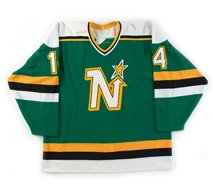
Tkaczuk established himself as a strong two-way player and became a member of "The Bulldog Line" with Bill Fairburn and Dave Balon and later Steve Vickers.

After a rookie campaign in which he scored 36 points, Tkaczuk set a career high in only his second season with 27 goals and 50 assists for 77 points, showing himself to be a good playmaker. He again topped 70 points in 1970-71 with 75 points. While his point total dropped to 66 in 1971-72, he made his first trip to the Stanley Cup Finals and contributed 10 points in 16 playoff games while holding the NHL's leading scorer Phil Esposito without a goal in the finals.

Tkaczuk & Esposito
Tkaczuk and Esposito

Seasons of 66 and 63 points gave him five consecutive over 60 as he became a team leader on the Rangers with a reputation for his faceoff skills and ability to shut down opposing forwards. After a couple of down years offensively, he rebounded with 50 points in 1976-77 and 66 in 1977-78 before another trip to the Stanley Cup Finals in 1979, only to run into the Montreal Canadiens dynasty of the late 1970's.

Walt Tkaczuk
Tkaczuk in the short-lived Rangers jerseys of 1976-1978

Tkaczuk would play two more seasons with the Rangers prior to retiring halfway through the 1980-81 season after a serious eye injury.

His final point totals after 945 games were 227 goals and 451 points for 678 points with another 51 points in 93 playoff games.

Today's featured jersey is a 1969-70 New York Rangers Walt Tkaczuk jersey. While it may be difficult to see without the laces, this jersey, which was first worn in 1963, sported a tie-up collar.

This particular jersey is from the 1969-70 season when Tkaczuk had the best offensive season of his career prior to the Rangers using names on the back of their jerseys in 1978.

Rangers 69-70 jersey

Our video today is a peek at the Rangers/Bruins rivalry from the 1970 playoffs with Tkaczuk involved from the same season as today's featured jersey.


Tuesday, September 28, 2010

1988-89 Edmonton Oilers Grant Fuhr Jersey

Grant Fuhr, born on this date in 1962, led the Victoria Cougars to the WHL championship with a 48-9-1 record followed by a trip to the Memorial Cup Finals in 1981, which garnered the attention of the Edmonton Oilers, who drafted him 8th overall later that spring.

As a rookie, Fuhr immediately led the Oilers in games played with 48, compared to 29 for Ron Low and 8 for Andy Moog. While Fuhr rarely lost, he racked up a notable amount of ties, finishing the season with a 28-5-14 record, which set a new team mark for wins by a goaltender.

After a personally disappointing second season, in which the Oilers advanced to the Stanley Cup Finals against the New York Islanders, he bounced back in 1983-84 with a 30-10-4 record while splitting time with Moog. Fuhr also registered a remarkable 14 offensive points that season, setting a record for goaltenders which still stands to this day. He would play in 16 of the Oilers 19 playoff games, posting an 11-4 record on the way to the Oilers first Stanley Cup championship.

Before the next NHL season could begin, Fuhr began his international career when he was a member of Team Canada during the 1984 Canada Cup. His record in two games was 1-0-1.

The Oilers would again return to the finals in 1984-85 following a 26-8-7 record for Fuhr during the regular season. Fuhr would start all of Edmonton's playoff games, as they romped to their second consecutive championship with a 15-3 record in four rounds of playoffs.

Another fine regular season of 29-8-0 for Fuhr came in 1985-86, but the Oilers playoff run would fall short. The Oilers would regain their title the following season as things returned to normal for Edmonton. Fuhr was 22-13-3 during the regular season while still splitting time with Moog, and 14-5 in the playoffs.

Fuhr's international career continued when he was the goaltender for the NHL All-Stars in the two game Rendez-Vous '87 series against the Soviet Union during the season and was later the goaltender for Team Canada in the 1987 Canada Cup, in which he played in all nine Canadian games. Fuhr played brilliantly on his way to a 6-1-2 record as Canada won the tournament with a memorable 2 games to 1 defeat of the Soviet Union, with all three games being decided by one goal, two of which went into overtime. Fuhr was named the goaltender on the tournament All-Star Team.

Following Moog's departure after the season, Fuhr now assumed an unprecedented amount of work, appearing in 75 games and winning 40. The increased work load did not adversely affect Fuhr either, as he posted his lowest goals against average since his rookie season, which earned him the only Vezina Trophy of his career and second place in the voting for the Hart Trophy for the league's MVP.

Grant Fuhr

The Oilers dynasty was confirmed as they marched through the playoffs virtually unimpeded, as they eliminated the Winnipeg Jets 4-1, swept the rival Calgary Flames 4-0, downed the Detroit Red Wings 4-1 and crushed the Boston Bruins 4-0 in the finals to win their fourth Stanley Cup in five years.

Fuhr remained with the Oilers for three more seasons as the team began to be dismantled, beginning with the famous trade of Wayne Gretzky in the summer of 1988. Still, the Oilers regrouped and captured their fifth championship in 1990, but did so without Fuhr, as he was limited to just 21 games that season and did not make a playoff appearance. The next season was similar, as Fuhr made just 13 regular season appearances, but was the Oilers goaltender of choice in the post season, but the Oilers fell short in the Conference Finals.

During this time period, Fuhr made his only World Championships appearance for Canada in 1989.

Prior to the start of the 1991-92 season, Fuhr was dealt to the Toronto Maple Leafs in a seven player trade. He became a workhorse for Toronto, playing 66 games that season. After playing 29 games of the 1992-93 season, Fuhr was dealt in February of 1993 after a season and a half in Toronto to the Buffalo Sabres. He played as many games in three months in Buffalo as he did in five months in Toronto.

With playing time hard to come by due to the presence of Domink Hasek in Buffalo, Fuhr played 32 games in 1994-95 and just 3 the following season before the Sabres moved Fuhr to the Los Angeles Kings for the remainder of the season after Hasek was able to establish himself as the starter following an injury to Fuhr.

His stay in Los Angeles was brief, as Fuhr would sign with the St. Louis Blues as a free agent for the 1995-96 season. In Fuhr, the Blues found their man and Fuhr was given the reins in goal, seeing action in a personal high 79 games, the same amount he played since being traded to the Sabres 2 1/2 seasons earlier.

He again did the heavy lifting in 1996-97 (73 games) and 1997-98 (58 games). While his workload was reduced to 39 games in 1998-99, in part due to a knee injury he suffered in the 1996 playoffs, Fuhr posted his fourth consecutive winning record while with the Blues. Playoff success eluded St. Louis however, and Fuhr was traded to the Calgary Flames for the 1999-00 season.

It was not a good year for the Flames though, as they were to finish last while Fuhr was used in a backup role to Fred Brathwaite. Fuhr was limited to 23 games, but the second of his five victories that season gave him 400 for his career (only the sixth goaltender in NHL history to reach that mark) in what turned out to be the final season, as he announced his retirement on September 6, 2000.

His final record shows 868 games played with 403 wins, 295 losses and 114 ties. His playoff record was 92-50 in 150 games, which led to his winning the Stanley Cup five times. He also played in six All-Star Games, being named the game's MVP in 1986 in Hartford.

Fuhr was both inducted into the Hockey Hall of Fame and had his #31 retired by the Oilers in 2003.

Grant Fuhr

Today's featured jersey is a 1988-89 Edmonton Oilers Grant Fuhr jersey. This jersey features the Oilers 10th Anniversary patch - of being in the NHL, as the Oilers franchise dates back to 1972 when they were a founding member of the defunct World Hockey Association.

Oilers 88-89 jersey

Here is footage from Fuhr's number retirement ceremony in Edmonton.


Here is Fuhr in St. Louis showing why he is considered one of the best.


Finally, a recent interview with Fuhr on shootouts and goaltending styles.


Monday, September 27, 2010

1991-92 Los Angeles Kings Wayne Gretzky Jersey

On this date in 1991, the very first NHL exhibition to take place outdoors was held when the Los Angeles Kings faced off against the New York Rangers in a parking lot at Caesar's Palace in Las Vegas, Nevada.

Caesars Palace outdoor game

"We were a little bit in awe and I'm sure [the Rangers] were too," said Wayne Gretzky. "We kept looking at each other and couldn't believe we were playing hockey in 80º weather, but it was real nice."

Caesars Palace outdoor game
Gretzky spars with Adam Graves, wearing #11 in honor of Mark Messier

Three huge refrigeration units, three times the normal ice making capacity for a normal game, were brought in at a cost of $135,000. Insulation boards coated with a vapor barrier were laid down first, then covered with sand to form a base for 22 miles of refrigeration tubes, which carried the super-cooled methanol and water solution to freeze the ice. The process began on Tuesday to be read in time for testing on Thursday night.

The heat did cause some issues with the ice, as a tarp had been erected roughly seven feet over the ice to keep the sun's rays from directly shining on the playing surface. That was all well and good, but when the tarp was being removed, it, and some cables, came in contact with the ice. Since the tarp had been heated up by the sun, some huge gouges were melted into the ice, which required some repairs before the players could take to the ice later on.

Aside from the heat, the only other weather related problem was rain on Friday afternoon which turned the rink into a lake, but the refrigeration system and a Zamboni quickly had the ice back into playing shape in short order.

Caesars Palace outdoor game

The main technical problem was that the refrigeration system actually made the ice too cold, causing the ice to crack. This was detected early enough for the technicians to react and raise the temperature of the ice enough to alleviate the problem.

Another issue never before seen on NHL ice were giant grasshoppers that would land on the ice during the game and freeze in place! "They would land on the ice and freeze right there, so by the end of the second period they were everywhere on the ice and it was kind of funny," recalled Kings forward Luc Robitaille.

Kings broadcaster Jim Fox remembers, "If you looked directly down you would see hundreds of bugs. The bugs had fallern and either died or drowned from the water that was being put on the ice. So that was the weirdest part of that game and I think most everyone remembers that."

Gretzky was of course the featured attraction and did not disappoint, scoring a goal in the Kings 5-2 win played in front of 13,000 fans, who paid between $20 to $75, in temperatures in the mid 80's.

Caesars Palace outdoor game

The idea for the came three years earlier from Rich Rose, president of Caesars World Sports. "When I went to [my bosses] with the idea, the only thing they said was, 'Can it be done?'Around here, the don't say, 'No.' They say, 'Yes, find a way to make it happen.' "

Having already staged ice skating in late spring of 1988 in 108º heat, Rose was confident the hockey game would work. "I went to the NHL," he said, "and once they got over the shock and asked me if I really wanted to do this, they gave their approval."

Rose then contacted the Kings owner Bruce McNall about bringing Gretzky and the Kings to Las Vegas, and McNall was all for it.

Caesars Palace outdoor game

Bob May of Ice Systems of America was given the task of creating the rink, having installed 151 permanent and 14 temporary rinks, but never anything quite like the one in Las Vegas. "This was a big challege," he said as he watched the finishing touches being applied to the rink with a smile.

Ironically, another exhibition game scheduled for indoors at the Florida Suncoast Dome between the New York Islanders and Boston Bruins had to be cancelled because the ice inside was too soft.

Today's featured jersey is a 1991-92 Los Angeles Kings Wayne Gretzky jersey as worn in the outdoor exhibition game in Las Vegas. The Kings were actually wearing their 1990-91 jerseys in this game, for after the exhibition schedule was completed, the Kings would debut brand new jerseys with three color names and numbers along with the addition of the Kings 25th Anniversary patch as well as the NHL 75th Anniversary patch for the regular season.

It would be the only season with this exact combination, as the Kings would adopt one color names for the remainder of the life of this jersey style in 1992-93, as well as changing the silver names and numbers to a much more readable black.

Los Angeles Kings 1991 Exhibition jersey

Here's some fisticuffs from the game as Caesar's Palace. Rumor has it there were also some goals scored that night.


The outdoor hockey game was not the only unusual event at Caesar's Palace, as Evel Knievel wadded himself into a little ball trying to jump the fountains in front of the complex. The fountains were later tamed by Evel's son Robbie.


Sunday, September 26, 2010

Weekend Update

From The Onion, America's Finest News Source:

The NHL Signs Broadcast Deal With Food Network

NEW YORK—Flanked by Food Network president Brooke Johnson and cooking-show host Rachael Ray, Commissioner Gary Bettman announced yesterday that the NHL has opted out of its contract with the Versus cable channel (formerly the Outdoor Life Network) and has reached a long-term broadcasting deal with the Food Network starting in the 2010-11 season.

"In all my years as commissioner, I have learned that our diverse group of fans and players all enjoy food of some sort. Italian, French, barbecue, quick-and-easy 30-minute meals—you name it, one or more of them eat it," said Bettman, adding that Iron Chef Frenchhost Hiroyuki Sakai will join play-by-play announcer Mike "Doc" Emrick and analyst Brian Engblom to form a new lead announcing team for all Food Network games. "This partnership has been a long time coming. If the Food Network would have been around in 1991, we would have left ESPN in a heartbeat."

“It’s great to know we will be on television next year,” Bettman added, smiling as the NHL’s new studio team, consisting of Rachael Ray as head hockey anchor and Bill Clement as game analyst, collaborated in an attempt to equate the offsides penalty to “zesting up” a pan-seared T-bone steak. “Thanks, Food Network.”

Food network bettman

Though Bettman maintained that the Food Network was always the league's first choice, sources close to the commissioner confirmed that the NHL also considered broadcasting games on E!, the Golf Channel, and Cartoon Network before eventually deciding to go with the network offering the best combination of financial incentives and airtime.

"We also thought the lead-in programs on Versus, especially those that focused on bull-riding, bass fishing, and violent contact sports, were not entirely compatible with the image of the league," Bettman said. "Now, hockey games will follow Emeril Live, Feasting On Asphalt, and The Hungry Detective, which, as you can plainly see, are a better fit. Also, we are paying the Food Network much less money to broadcast our games."

According to terms of the deal, the Food Network will schedule broadcasts of over 50 full-length hockey games and will carry both the Eastern and Western Conference Semi-Finals, as well as Games 4 through 7 of the Stanley Cup Finals. The only exception, Bettman said, would be made for Rachael Ray, who appears on television roughly three times more than the NHL. In the case of Ray experiencing a scheduling conflict, hockey games will be postponed and rescheduled at Ray's convenience.

"We liked the idea of having hockey because it has two halftimes," said Food Network president Johnson, adding that the first game on the channel will feature the ceremonial dropping of an inaugural homemade Italian meatball at center ice by honorary referee Mario Batali. "Our debut coverage will include a halftime show hosted by Giada De Laurentiis, who will recap the game's events while guiding you through the preparation of Sicilian penne with swordfish and eggplant. Or, if you are in the mood for something more immediate, on-ice reporter Paula Deen will spend timeouts showing you certain tactics to enhance the flavor of your traditional southwestern dip."

Though she stated that she didn't want to give anything away, Johnson said that the network's first hockey-related profile will focus on Sidney Crosby eating veal and creamed spinach prepared by Roker On The Road host Al Roker. Other hockey players now contractually obligated to make appearances on shows include Chris Drury onFood 911, Martin Brodeur on Calorie Commando, and Alexander Ovechkin on Dinner: Impossible.

The new broadcasting deal has some sportswriters saying the move will make hockey even more irrelevant, while others believe this is a clear step up for the league.

"I watch the Food Network far more than I watch hockey, and I think most sports fans feel the same way," saidBoston Globe sports columnist Bob Ryan. "My favorite program is Food Nation With Bobby Flay. So I'll definitely watch that, and then maybe stick around to watch part of a period if the Bruins are playing. Everybody wins here."


Saturday, September 25, 2010

Hockey Jersey Training Camp - Day 9 - The Collecting Community

Day 9 of Hockey Jersey Training Camp moves onto our next "drill" on The Collecting Community.

You've located your jersey and perhaps a patch to put on it, decided whose name and number to add to it, sent it in for customizing and your newly lettered jersey has (finally) arrived in the mail.

Now what? Obviously you can wear it to a game or just around town, making certain to NOT tuck it in, or you can show it off to your friend's friend who says he can get "any jersey you want" for $40 and has zero appreciation for your authentic jersey.

Or, you can show it off to like minds online who can relate to the scarcity of your new sweater, the accuracy of the customization and the attention to detail that your patch brings to your jersey.

Two such places are the forums at JerseyCentral.org, for fans of jerseys of all sports, and IceJerseys.com, who host a hockey jersey only forum for jersey collectors.

Here you can ask questions about the authenticity of potential purchases, learn the finer points of how to spot fakes yourself, where to locate patches, advice on customizers and player choices for your jerseys, buy new jerseys and sell your old ones once you have established yourself as a member of either community and simply show off your new arrival as well as seeing what unique things others have acquired, which will certainly inspire you to try to duplicate one for yourself from time to time.

While the Ice Jerseys forum is strictly hockey related, Jersey Central has separate forums for Throwbacks, NFL, MLB, NBA, Soccer and College as well as hockey. In addition, both forums each have a very active marketplace section and general discussion section.

The depth of knowledge available is quite remarkable as passionate collectors share their insights and knowledge on all things jersey related.

Once you've joined a forum, it's part of the fun to share your collection with others. Photographing your jerseys is an essential part of that and we have a few tips. We recommend a mid-tone background of either a beige carpet, wood flooring or a roll of seamless paper. A mid-tone background will work for both white and dark colored jerseys and look more consistent from shot to shot.

We do not recommend white or black backgrounds or tile surfaces or fabric surfaces, such as a sheet. White backgrounds won't allow white jerseys to separate very well and will fool the camera into thinking the scene is too bright, resulting in underexposed, grey photos, while black will have the opposite results. Black backgrounds will cause light colored jerseys to be overexposed and black jerseys to disappear into the background. The shine on tile surfaces will cause a glare from the flash which may also result in underexposed images. Those with prominent grout will only serve to distract from the jersey, the same of which can be said for a wrinkled sheet.

Once you have chosen your background, lay your jersey down, fold the arms over and get the jersey as flat as possible to reduce as many wrinkles as you can.

We do recommend the use of an on-camera flash. The light hitting the jersey from directly overhead will reduce the appearance of any wrinkles in the jersey, which would be emphasized by any side lighting, such as that coming from a window on one side of the jersey. A flash also has the added benefit of being the same each time, while reliance on sunlight leaves you subject to both sunny and cloudy days, resulting in inconsistent lighting.

To summarize, pick a background, not too light or not too dark, with as little pattern to it as possible and shoot from straight overhead with a flash.

You will need to host your own photos on the internet to be able to post them to any forum. There are many free photo hosting sites from which to choose from, Flickr, Photobucket or Webshots.

As for meeting up with other collectors in person, there are two events that we recommend.

The first is the annual MeiGray Game-Worn Jersey Expo in New Jersey where the largest dealer of NHL game worn jerseys brings together collectors and dealers alike in a festival of jerseys unlike any other.

The other event we recommend is the Minnesota Hockey Collectors Expo at Tom Reid's Hockey City Pub in St. Paul, Minnesota. The 9th annual Expo takes place Sunday, October 3rd from 11 AM to 6 PM. This event is free and features collectors bringing their favorites from their personal collection for some good old show and tell, with an emphasis on jerseys related to the Minnesota Wild, Minnesota North Stars and Minnesota Gophers, as well as many other interesting jerseys from throughout the hockey world. It's great opportunity to see some great game worn jerseys up close, meet some new people and perhaps add a new jersey to your collection.

There are other expos held throughout the country, perhaps one near you. Today there is one scheduled for Pittsburgh from 10am-7pm at the ballroom of the Epiphany Church, located next to the new Consol Energy Center, which happens to be hosting a Pittsburgh Penguins pre-season game vs the Columbus Blue Jackets at 7pm. Admission to the Expo is free.

There is another meeting in March in Northern Virginia, as well as a long-running one in Detroit. Announcements and details can be found on the forums at GameWorn.net.


hit counter for blogger